I did get messages back from the garage about the truck, but nothing about coming in. I’m not sure the problem is the sensor, after finding some oil on the ground in the garage yesterday. It was a while before I went out to move it today, so that I could check the oil levels, and see if there were any new oil stains under it.
There was. Just a couple of drops.
*sigh*
Oil levels were fine. I’m going to have to take a chance, though, and at least make a trip to the nearest Walmart. We’ve used the last of our canned cat food today, and the dry kibble is starting to get low, too.
It was a nice enough day that, after checking on the truck, I stayed out to clear some of the paths that got filled with drifted snow, after two days of high winds. Happily, the plows have gone by, so the roads will be clear. Things are supposed to keep warming up over the next few days, which is going to be quite a relief.
Of course, that makes me think of gardening!
The peppers and eggplant seeds that are set to pre-germinate aren’t showing any radicals yet, nor to I expect them to, this soon. Next on the list was things like tomatoes and herbs, but after watching the above video, I will just be doing the herbs, first. I sorted seeds I’ll be starting by how many weeks before last frost the packages recommend starting them. In theory, I could start the tomatoes in April.
I just really, really want to start more seeds! 😄
I realized it’s been a while since I updated about the onions. All four snail rolls now have seedlings.
They’re tall enough now that I raised the light a bit today. Should they get big enough to need “potting up”, they can be unrolled, more seed starting mix added, then rolled back up again. I made sure to leave enough excess length of the packing foam to accommodate extra width.
Just a little green growth to sooth the gardening soul, as winter drags on!
Normally, today would be my day to go into the city for our first stock up trip for February. With the truck having issues and an appointment to get it checked tomorrow morning, today was a home day, instead.
Which turned out to be a good thing.
I didn’t think I’d pushed myself yesterday, but the pain started hitting last night, and this morning I could barely walk. I managed to feed and water the outside cats, grab a quick breakfast, pain killered up and went back to bed for a couple of hours.
Thankfully, that seemed to help a lot.
Which meant I was up to setting things up in the basement to start more seeds.
That included testing out the heat mats. I’d bought a new one last year, because the old one stopped working, but I tested it again anyhow. For a while, I thought I’d need to buy another heat mat, but the new one did eventually warm up quite nicely. The basement is always between 13-16C/55-61F, though it does feel warmer after we removed the cat barrier in the “window” between the two basements, now that we don’t allow the cats down there anymore. I set up just one of the lights, choosing the one that actually warms up a bit when it’s on.
Then it was time to get the set of seeds to start this early. I decided against starting thyme. I’ll see if the varieties we planted last year survived the winter under their thick mulch and blanket of insulating snow. If they didn’t, I will buy transplants, instead.
I also decided against trying the Sweetie Snack Mix peppers again, and will start more of the other two varieties, instead.
There’s the luffa, of course. I probably could have started those at the same time as the onions. There are sprouts in all four onion seed rolls now.
Then there’s the Caspar eggplant, a new variety I’m trying this year. The Golden Boy celery is the first time I’ll be trying to grow celery. The Sweet Chocolate peppers are a variety the girls suggested. They grew well when we had them before. When it comes to flavour, they really don’t find much difference between any of the varieties we’ve tried. The California Wonder Bell pepper is a new variety for us that I chose specifically because they are described as being thick walled.
I decided to pre-germinate the peppers, eggplant and luffa, as the seeds are larger and will be easier to move and plant, once the radicals appear. I could also use a damp wooden chopstick to pick up the pepper and eggplant seeds.
With the peppers, I was thinking a total of 9 plants. When it came to pre-germinating the seeds, though, I ended up going for 9 seeds each – though the California Wonder got an extra when one of the seeds I grabbed looked like it was damaged. We’ll see how many actually germinate.
I also started just 9 seeds of the eggplant. I’m hoping to get 4-6 transplants out of those.
I was seriously tempted to pre-germinate more than 4 luffa. Even with pre-germinating, they do struggle to survive. We’ll see how many germinate – and how many survive until transplant time. Last year, I started with four, three pregerminated, one didn’t survive being planted, and of the remaining two, only one really grew much at all.
When it came to dampening the paper towels for this, I made sure to use warm water, too.
As for the celery, the seeds are so tiny, I decided not to pre-germinate them. Instead, I repurposed a clamshell from strawberries. The holes on the bottom are fairly large, so I set a paper towel on the bottom to keep the medium from washing out the bottom. Normally, I pre-moisten the starting mix in a large bowl I have for that purpose, but for such a small amount, I filled the container with dry mix, then used the warm water to thoroughly soak it, first, making sure there were no dry spots. Then I pressed it down to get rid of any excess water, and ensure there were not air gaps.
I have a little seed dispenser that I used to scatter the seed lightly over the surface. With seeds that small, the hard part is keeping them from being too densely sown. Also because they are so small, I didn’t top them with more seed starting mix. Instead, I added a layer of vermiculite. That got a thorough spray with warm water.
All of these fit into a seed starting drain tray and are now set on the heat mat, under the light. The light has “legs” that fit on the ends of the aquarium we originally got it for, so it only needed a couple of the fire bricks I’ve been using as supports. The other light we have rested directly on the aquarium frame, so if we need to bring that one out, it’ll need twice as many bricks to get the same height. The handy thing is, as things grow taller, we can just add more bricks to raise the lights by an inch per brick.
For the peppers and eggplant, I’ve got some deep cell trays I can plant them into. The less potting up, the better.
In the beginning of February, I will be starting tomatoes. I will probably pre-germinate, then use the Red Solo cups for those. I’m still torn between starting three, or all four, of the new varieties I got.
Oh, who am I kidding. I’ll be starting all four.
It would also be the time to start herbs, such as tarragon and savory.
Hopefully, this will work out. Aside from the luffa, these varieties have a relatively short days to maturity on them. It’s not just frost free days we need to think about though, but soil temperature. Last year, we had such warm days in May, but the overnight temperatures were so low, we still couldn’t transplant our seedlings until well into June.
Hopefully, this year will be a much better growing year, without the drought, heat waves and smoke!
All righty. Time to get my thoughts organized about how things went this year, and what I want to do next year.
When this post gets published, I’ll actually be at my mother’s place, doing some housekeeping for her and getting her apartment the way she wants it for Christmas. We’re already getting weather warnings for this weekend. Today’s high (Thursday) was -11C/12F. Wind chills at around -22C/-8F. Tomorrow (Friday, when this will be published) and Saturday, our highs are supposed to be -21C/-6F, but we are getting warning of wind chills dropping things to -40C/-40F. !!!!!
Then it’s supposed to start warming up again, up to a high of -5C/23F on Tuesday, before dropping again. There are no longer any predicted highs above freezing around Christmas, but we’re still expecting major swings in temperature.
I’m so glad the winter sown beds got that extra layer or straw.
Speaking of which, here are my final thoughts on how our 2025 garden did.
Winter Sowing
This was the big experiment this year. If it didn’t work, we would have had a very different gardening year, that’s for sure! The other part of the experiment was broadcasting mixes of seeds, some of them years old, which gave me the chance to restock with fresh seed, later on.
Two of the mixes were complete failures, but for very different reasons. The summer squash just never came up. If anything did sprout, they got rolled over by cats. Which is what killed off the “tall and climbing things” bed, and the winter sown flowers. I did see things start to sprout, but they didn’t survive long.
The root vegetables mix in two beds did really well, though one almost got chocked out by the insanely productive Jabousek lettuce seeds that were added. I’m even happier with the greens mix, having finally been able to grow kohlrabi, and those Swiss Chard were an excellent cut and come again crop.
In the end, if it weren’t for the winter sown beds that survived, we would have had a much less productive year! This is a major game changer for me, and I expect to keep doing this from now on. Not only did we get much earlier growth, but it saved me a lot of work in the spring.
The biggest problems
Cats.
I thought it would be the elm seeds, and they were definitely a problem in the expected places, too, but the yard cats were particularly destructive this year.
What I won’t do again, and what I’m doing instead
Definitely not broadcasting mixes. That did give me a good idea of what could be successfully winter sown in our climate zone, though. Particularly with the drought, heat and smoke we got this year. This time, the winter sowing was much more planned out. The beds also got more thoroughly mulched before the hard frosts hit.
With that in mind, we’ve planted carrots, peas, spinach, chard, kohl rabi, cabbage, beets, and Hedou Tiny bok choi. Plus, of course, garlic. There were also lots of little onions found while cleaning up the old kitchen garden that got transplanted. Those might bulb, or go to seed. Either one works for me.
I will also have to make sure to put cat proof protective covers on pretty much everything.
I was also happy with having radish pods instead of radish bulbs. There is a variety grown specifically for their pods that I might pick up at some point but, for now, we quite enjoyed the proliferation of pods to snack on and do quick pickles with. You get a LOT more food from a single radish by eating the pods, too. Definitely for winter sowing, though, as I’ve read they taste a lot stronger when they are direct sown in the spring.
Transplants
This was a really hard year for all our transplants. The heat, drought and smoke likely played a big part in that, but in some beds, it looks like tree roots invading the beds also played a part. We got very little out of our transplants. The ones we started indoors that did best were the Chocolate Cherry and Spoon tomatoes, even as stunted as they were. The worst were probably the melons. The pepper and eggplant plants did rather well, but to so much for blooming and productivity. The purchased herb transplants, on the other hand, did great in their tiny raised bed!
The biggest problems
The transplants were something we could protect from cats rather well. In the end, it was probably a combination of drought conditions and those tree roots. Not a lot that was in our zone of control that we could have done anything about.
What I won’t do again, and what I’m doing instead.
I won’t winter sow onions again. Instead, I will be starting them indoors for transplanting. I had hoped they would at least grow enough to use the greens and deter deer, but most of them simply got choked out.
We will, of course, still be starting seeds indoors to transplant in the spring, but we need to set up a seed starting area and the aquarium greenhouses in the basement. If for no other reason than we need to clear space in the cat free zone, AKA the living room. Now that cats aren’t allowed in the new basement anymore, I can open up the “window” between the basements, near the furnaces. That should help more warm air from the old basement to flow into the new basement and equalize things. There is the “doorway” (a vaguely door shaped hole cut into the wall when the new basement was built) but no real air flow between the two basements.
As for what we can do instead, for better success with our transplants… I honestly don’t know. There isn’t much I can do about heat waves. There are limits to watering during a drought, and not just due to the lower water table. Our well pump still needs to be replaced, if we dare risk the foot valve, so the more the hose is used, the more wear and tear on the pump. In the end, it comes down to the weather, really.
As for the tree roots, we need to cut that row of self-seeded trees down completely, and ensure no suckers start coming up at the stumps. My mother was adamant about not cutting those trees down, even though I see signs that someone tried to at some point. Probably my late brother tried to get rid of them. I recall my mother laughing about how angry he would get because she would stick trees all over the place, making it hard for him to take care of things.
Now my oldest brother owns the property, though, and he is very much in agreement with getting rid of them. He had issues with where and how my parents chose to plant trees, too, and we’re both now dealing with the consequences.
Other than clearing those trees out, the only other thing we can really do is more raised beds. The higher, the better but, for now, even low raised beds help. Once the trees are cut down, I’m even thinking of putting a long, higher raised bed over where they are, to make sure they get good and dead. That would also reclaim the garden space lost to my mother allowing those trees to grow after she transplanted out the raspberries that were there.
As for the purchased herb transplants, those did quite well. I certainly won’t turn my nose up at buying transplants to supplement anything we start indoors.
Yes, I will still be trying luffa again! 😄
Spring Direct Sowing
These where the most affected by this year’s climate conditions of all. It was pretty brutal.
We direct sowed pole beans, bush beans, corn, carrots, peas and more summer squash. I’ll add potatoes to this list as well. I think the potatoes did the best, even though they never reached the blooming stage. The summer squash and two types of beans were the worst.
The biggest problems.
There’s only so much I can blame on the drought. We haven’t had much luck direct sowing summer squash in the past, either. Granted, last year it was slugs that were the big problem, and this year, we had lots of frogs taking care of those for us!
In the end, though, I think most of our issues were the same as with the transplants. Too much heat, drought conditions (even with watering twice a day) and so much smoke. Plus, tree roots.
What I won’t do again, and what I’m doing instead
I will have to find space for them, but summer squash will be started indoors again, for transplanting instead of direct sowing.
Beans and corn; there really isn’t anything I can do differently with those.
The peas did surprisingly well, but we need to ramp up our deer protection.
The carrots need less tree roots competing for space. Those have been winter sown in the trellis bed. If I plant more in the spring, I need to be strategic on where, to avoid those roots.
The chard I direct sowed were a complete fail. I have more varieties to direct sow in the spring, and those will go in earlier. I suspect it was partly too hot when they were planted, and the soil too compacted by watering.
Soil compaction is an issue. We need to add more organic matter to our soil. Preferably something like peat moss (Canadian peat moss is ethically harvested) that will also increase the acidity.
That might be another issue for everything. Our soil is so alkaline, and most things do better in slightly acidic soil. I’ve been amending with Sulphur, but it’s really hard to increase soil acidity. Especially with dark grey zone soil like ours, that leaches everything so quickly.
More high raised beds will allow us to control for that more, but this is the sort of thing that takes years to amend, even the slightest.
Food forest and perennials
Happily, we got quite a boost with our food forest this spring, adding a plum, another variety of eating apple more suited to our climate zone, new cross pollinating varieties of haskap and gooseberry. I remember we had gooseberry here when I was a kid and so loved eating them when they were really really sour! I look forward to eating them again.
The biggest problems
Deer. Drought. The insane number of rocks I find when digging holes to plant in.
What I won’t do again, and what I’ll do instead.
I won’t underestimate how determined deer can be, nor assume they won’t like something! I got spoiled by them ignoring the silver buffalo berry and sea buckthorn, though they did go after that one highbush cranberry, over and over again, last year.
In the spring, I’ll be making more wire mesh cages for the fruit and nut trees. The berry bushes seem to be okay.
I really need to find a place to transplant those grapes to.
Now that I’ve got the new strawberry and asparagus bed, I’m thinking of slowly turning that section over to perennials. Not next year, though. I have other plans for there, first.
Final thoughts
There were a lot of things out of our control this year, and some things I am just not sure what went wrong. Like with the red noodle beans.
With so many changes to our garden this past year, and not being able to reclaim spaces we’d planted in, in previous years, it really isn’t a typical year at all. We did have some surprise successes (peas, crocus) and big disappointments (no melons and almost no squash at all!).
At least I can call it a learning experience.
Here is the last garden tour video I did, where you can see the beds that are already winter sown.
Planning ahead to our 2026 Garden
Obviously, some of that is already in and done, with the winter sowing. We’ve got quite a head start to next year’s garden already.
Doing that meant I got a lot of seeds in advance. I took advantage of some big sales and replenished my stock from MI Gardener.
Here is what I got.
No, we aren’t planting all of that!
But we will be planting both old and new seeds.
My daughters and I went though my seed inventory to make some decisions on what we’ll be planting next year, outside of what I’ve already winter sown.
I just went into the basement, where my seed bins are stored, to get my lists and diagrams. Since I was there anyhow, I went ahead and uncovered the window between the two basements. I’d covered it with a piece of rigid insulation and had poked holes in it to allow for some air flow, but it clearly wasn’t enough. Once that was down, there was a literal wind of warmer air coming in from the old basement! Wow!
So that will make a difference. I’ll have to keep an eye on the thermometer I’ve got over my seed bin. The new basement tends to stay between 10-13C/50-55F, all year. I don’t have a thermometer in the old basement, but it’s often warmer than the main floor!
I didn’t write a list the varieties we intend to plant yet, but have the seed packets set aside. We intend to grow fewer plants of more varieties in some things. The varieties will be listed in future posts, but this is what we’ve decided to grow this year.
To start indoors
Winter squash and gourds. The gourds are my “fun” thing to grow. Summer Squash. Melons. Cucumbers Onions – bulb and bunching Eggplant – hopefully, a variety my daughter is not allergic to! Tomatoes Peppers Celery Herbs Flowers
So… yeah, I’m going to need to make space!
That doesn’t leave much for us to direct sow in the spring!
Spring Direct Sowing
Corn – short season and not to short season Beans – pole and bush. If I have room, beans for drying Potatoes Flowers
Succession sowing
Peas Chard Spinach Carrots
One thing I will have for 2026 is more room to plant in. There is one bed in the old kitchen garden that took forever to re-work, but it is now ready for planting, and included supports to hold hoops or whatever I end up using to hold covers and protect the bed from critters.
The bed that was winter sown with tall and climbing things was a major issue and a complete fail. I did have mesh netting to protect from the seeds, but it couldn’t protect from playful kittens. I’ve been gathering the materials and will rework that bed, yet again. It will be taller, narrower by a few inches, and like the reworked bed in the old kitchen garden, it will have supports I can attached hoops or wire or whatever I need to cover and protect the bed from elm seeds and critters.
The plan so far.
Which, I’m sure, will change a few times before the garden is completely in!
Let’s start with the old kitchen garden, which is mostly winter sown. There is the short side of the L shaped wattle weave bed that is open. I intend to plant herbs there, including fennel, though we want that more as a vegetable than an herb.
The newly finished rectangular bed could have root vegetables planted in it, so I was thinking of more carrots. However, it might be a better place to plant summer squash in.
The open retaining wall blocks are now all filled with transplanted alpine or whatever they are strawberries. Those will be for perennials, since nothing else seems to want to grow in them.
I did the same with the retaining wall blocks by the chain link fence. Hopefully, they will survive the winter. It’s hard to say, being planted in concrete blocks, but all the chimney block planters did get mulched for winter insulation.
Once the longer bed at the other section of chain link fence is redone, I am thinking winter squash and/or gourds would be good to put there. They can be covered until they’re too big for cats to get into, can climb the fence, and are too spikey for deer to eat.
In the East yard, two out of three rectangular beds are winter sown. In the third one, I’m thinking a couple of varieties of tomatoes can go in there.
There is a 4′ square bed in this section, which will get white eggplants transplanted into it.
In the main garden area, one of the beds is sown with Daikon radish on one side, turnips on the other. Down the middle, I plan to direct sow pole beans.
The high raised bed will get bush beans.
In the trellis bed, the winter sown peas didn’t fill the entire row, so we will transplant cucumbers in the last couple of feet.
Of the three remaining 18′ beds in the main garden area, one will have peppers, celery and tomatoes. The other will get squash and/or melons. The third bed will get potatoes.
The area near where the new asparagus and strawberry bed is, is still covered with black plastic, which has mostly killed off the grass and weeds that took over what used to be a squash patch before. I plan to pull that back and use that area to plant two varieties of corn that mature at very different rates, so there should be no issue with cross pollination.
Further out is the area where the Albion Everbearing strawberries were. I plan to sow bread seed poppies in that location, as part of the plan to slowly convert that whole section to perennials, or self seeding annuals that can be treated as perennials.
What you’re not seeing in there is flowers or onions.
The onions will get interplanted all over the place. The bulb onions are saved seed, but the bunching onions are new, so those I’ll try to keep in one spot. Perhaps interplanted with the herbs in the old kitchen garden or something.
The space at the end of the high raised bed will have flowers again – hopefully including those self seeded asters – but I also intend to have both transplanted and direct sown flowers scattered all over, interplanted wherever I find the space.
Somewhere in there, I want to direct sow some of the saved Hopi Black Dye seeds.
If all goes well, I’ll have at least one additional trellis bed done, and we can finish our first trellis tunnel, though maybe not in time for spring planting. If my brother is able to get one of his tractors going and we start dragging dead spruces out of the spruce grove – maybe even cut more of the dead ones down – I will have the logs needed to continue building pairs of trellis beds and, if all works out, pairs of beds that will become polytunnels. Once the second bed for the first trellis tunnel is done, though, framing the existing low raised beds are priority. Those will be only one log high for now, while the trellis beds will be started at two logs high. I’ve got only so many dead spruces to work with, so building the beds up higher will be left after we’ve got all the beds framed out that need it. Over time, I’d like for at least half of the raised beds to be increased to match the high raised bed – 4 logs high. I’m finding that the perfect height for reach, and for my back. I do want to leave some beds lower for things that grow tall, like corn or pole beans. The trellis tunnel beds may eventually be increased to 3 logs high, but we’ll see.
Then there are the perennials and trees.
I’ve placed an order for some Manchurian Walnut, which is one of the few nut trees out there that are hardy enough to grow here – it’s actually hardy to zone 2b, which is what we are in Canadian. I could only afford to get one, rather than any of their bundles. It will be planted in the outer year. In the same order, I was able to get a bundle of five Bleu Basket Willow. Those will be planted beyond the outer yard, where they will eventually be coppiced and used to grow stems for everything from, yes, weaving baskets, to wattle weaving and even willow furniture, if we want. Over time, I plan to get two other varieties of basket willows that are different colours.
We might have to buy replacement Korean Pine, too. We shall see.
We’re also looking at other types of hardy fruit trees to get as the budget allows, such as pears, or varieties of cherry that actually grow and produce in our climate zone.
All in good time.
All done!
Well, there we have it.
In the end, 2025 was a really rough year for gardening. Yes, we were able to harvest and the winter sown beds made a huge difference, but nothing really reached its full potential, including the winter sown beds, as well as the surviving ones did. So many people in our region struggled with their gardens.
I know a lot of people have been going on about “survival gardens” or sharing those idiotic memes about how, if we all grew gardens instead of lawns, no one would starve. Hogwash. Obviously, I’m all for growing as much of your own food as possible, however you can manage is, and to be as self sufficient as possible. I absolutely encourage people to do that, every chance I get. Especially in these unstable times. But the hype and expectations I’m seeing out there are not helping. Years like this show exactly how little control we actually have when it comes to growing our own food. There are bad growing seasons like this, but even if you have an excellent growing season and your garden is doing great, one storm could wipe it all out. Or it could be destroyed by animals, insects or disease.
As the old saying goes, hope for the best, plan for the worst. There will always be things happening we have no control over, other than how we respond to it.
This one is the tallest of the sunflowers, looking close to 7′ tall, taking into account that it’s in a low raised bed. It’s also one of several with seed heads that are working on opening up, late in the season as it is.
I have been checking on the asters. It’s so late in the year, but a few of them are so close to blooming!
Now, as long as I can keep critters like Sir Robin (visible in the second picture) from rolling over them or something, I still have a chance to collect seeds.
Remarkably, I actually had a harvest this morning!
Yes, the yellow bush beans are still producing. This is also the most zucchini I’ve picked at once, all year. I also finally picked our single ripe Sweetie Snack Mix pepper – which had a surprise little green pepper growing out of its top!
I am thinking it’s time to pick the Turkish Orange eggplant. I have confirmed that they do continue to ripen after being picked. In fact, I found out a whole bunch of information on harvesting them.
Today, we hit 26C/79F, which was warmer than forecast. It’s past 6:30pm as I write this, and it’s finally starting to cool down. I’m planning to head out to the garden to water what’s left, before things get too dark. Looking at the 10 day forecast, while we’re expected to cool down soon, it won’t be anything severe, so I should still not need to cover the garden beds. We’ll see as the forecast changes whether we’ll need to cover the winter squash beds, at least for the night.
I’m rather surprised by how the garden – parts of it, at least – is still chugging along.
Today was definitely on the chilly side. Even overnight; apparently, we dropped to 3C/37F last night, which is colder than was forecast. I’m glad we got that plastic over the winter squash!
We’re supposed to drop to 4C/39F tonight, which means we can expect it to get colder. I never removed the plastic cover on the winter squash, though. We got rain last night, which means the squash didn’t get any natural watering, but I do have the soaker hose still set up with them. I rarely used it, as filling their collars with water several times was more efficient. Today, however, I lifted one corner of the cover, hooked up the hose, then covered it again, letting the soaker hose run for an hour.
We did reach our expected high of 12C/54F this afternoon, so the girls and I took advantage of it to get some final harvests done on some things.
I started off in the East garden beds, pulling most of the corn (I left some stalks just to have a bit of protection for the bush beans). There were very few cobs to harvest and, as you can see, they were very small. I did find some yellow bush beans to harvest, though, then later found a few of the Royal Burgundy in the main garden area.
The chocolate cherry had the most to pick green. There were a few Black Beauties and Sub Arctic Plenty to pick. These are now sitting near the window in the cat free zone (aka, the living room) to ripen.
I also picked as many dried super sugar snap pea pods as I could find, as well as the dried radish seed pods. The girls, meanwhile, pulled all the spoon tomatoes, then sat with the plants to pick up the ripest ones. That took long enough that I finished first, then joined them. We made sure to not have any little stems on them before adding them to the bowl. It’s a lot more difficult to get those off if they’re left for later! With the Spoon tomatoes, we did NOT harvest the green ones. They’re so tiny, it really wasn’t worth doing it. So those went into the compost with the vines.
I suspect we’re going to have another year of compost tomatoes next year, and that most of them will be Spoon tomatoes!
Later on, before covering the eggplant and peppers for the night, I harvested a couple of kohl rabi and Turkish Orange eggplant. I have no idea if the eggplant is right, but at this point, it’s unlikely the greener ones will finish ripening, even with protective covers. The plants were already drooping from last night’s cold, in spite of the cover and bottles of hot water to help keep them a bit warmer. I chose the two that looked the most orange, but the rest still have green on them. I don’t think eggplant is something you can pick and will ripen indoors, like tomatoes and peppers can.
The kohl rabi I picked are pretty small, and there are just a few left, but I wanted to snack on them. That bed is almost done.
While the day was chilly, it was quite warm in the portable greenhouse! We have kept the “door” rolled up for quite some time but, yesterday, my daughter unrolled it half way and pulled the zippers down.
The thermometer in there was reading over 30C/86F, late this afternoon!
I’d moved our succulents and coffee plant into there yesterday evening. I’m glad I remembered to, as they likely would not have survived the night, but they would be very happy with the heat they got today! I’m hoping to keep those outdoors as long as possible, as they seem to be doing much better than in our living room.
In the next photo, you can see our first male luffa flower starting to bloom. They fell off when I moved a leaf to get the picture, but there were ants climbing around the stem and base of the flower. Which means, pollinators are still getting into the greenhouse. I still plan to hand pollinate, should the opportunity arise.
My daughter and I were checking on it when we spotted our first female flower buds starting to form. No visible baby luffa yet, they were were too small, but we knew they were female flowers, and those form in singles, while the male flowers form in clusters.
As of now, we no longer have any tomatoes in the garden. There are still bush beans, which will probably be killed off by the cold tonight. I’m debating when to just pick the green peppers and bring them in. I’m really surprised by how well the summer squash is holding out. I don’t expect things like the pumpkins, melons, bush beans, the stalled pole beans or sunflowers to survive tonight’s cold, but you never know. Things like the remaining radish plants that still have greener pods on them, the root vegetables, kohl rabi, chard, and even the tiny onions we’ve got growing in the old kitchen garden, can handle frost. We harvested some herbs at the last minute but I haven’t covered that bed with anything. The basil probably won’t make it, but I think the other herds might. We shall see in the morning.
Meanwhile, I’m now going to find some suitable containers, set up something to watch, then start opening up those dried pods and collect their seeds!
With all the extra stuff that needed to be done yesterday, I did finally get to water the garden yesterday evening. The poor Turkish Orange eggplant were drooping so badly!
This morning, I made sure to give it another watering, before things got too hot – we’re supposed to break past 30C/86F, and the humidex will make it feel even hotter! Before I did, though, I checked on things and got a harvest done.
I’ve been hemming and hawing for a while now about the corn. Being a short season corn, with only 65 days to maturity, they should have been ready to harvest a while ago but – like everything else – they were way behind. In the process of taking a closer look, I found something else.
Our very first female Arikara squash flower buds. There had been only male flowers until now, but now that we’ve got some females about to bloom, there isn’t a male flower to be seen!
*sigh*
Today is the last day of August. We’ve got one more hot day, and then things are going to cool right down, with overnight temperatures low enough that we’ll need to cover some things.
While watering, I also spotted new female flowers on the Mashed Potato and Baked Potato squash. I’ll have to check them again this evening and see if they opened up and can be hand pollinated.
Why I bother, I have no idea. They won’t have enough time to mature, and they are in beds we won’t be able to cover.
Ah, well. You never know. It’s not like weather forecasts don’t constantly change!
I came prepared to do some harvesting, including stainless steel container for the Spoon tomatoes.
I decided to go ahead and harvest some of the corn. Since the stalks had one cob each, I pulled the entire stalk on the ones that looked ready enough. Handily, the beds are right next to the compost pile.
While I was picking beans and corn, I had company.
Sir Robin was absolutely fascinated by the reflections inside the stainless steel bowl and was busy trying to catch whatever he was seeing.
In the next picture, you can see I got a whole bunch of tiny corn cobs. This is not a large cob variety of corn, but they should have been bigger than this. A few little ones had so few developed kernels on them, they weren’t work keeping. So I just ate them. 😄
It was SO nice to finally pick a decent amount of beans! Finally!
The one Sub Arctic Plenty tomato looks like it should have been picked earlier. I think the heat got to it a bit. There was a decent amount of chocolate cherry tomatoes to pick this time.
The carrots are from the bed that was sown in the spring, rather than the ones sown in the fall. With the Atomic Red ones, it’s still somewhat of a thinning by harvesting situation. The Uzbek Golden carrots were planted using home made seed tape, so spacing was not an issue.
I’m always amazed by the Royal Burgundy bush beans. We have only three surviving plants, and one of those got chomped by a deer. Yet even that one had beans to harvest today! The plants are still really prolific, considering how small they are and how delayed their growth has been.
It wasn’t until later, when I was watering the summer squash, that I realized I missed a zucchini! Just one, though I found a couple that I was able to hand pollinate.
I’m quite happy with this harvest. Sure, we’ve had better in previous years. A harvest like this was something I had picked every couple of days throughout the summer but, for how things have gone this year, this is pretty amazing!
Also, it took forever to pick all those little Spoon tomatoes. Aside from the plants being stunted and short this year, it was pretty painful to pick them from the low raised bed. It did help that I could put a foot on the log wall when I needed to, to take some of the pressure off. In theory, I should be squatting to pick them, but I can’t squat with the condition of my knees, so I’m having to bend over, instead.
Thankfully, I got the harvesting and watering done before it got too hot. The watering got interrupted for a while as I spent some time with my brother, going over my mother’s car. It’s going to need a new battery, and that tire was almost flat again. My brother will take care of a few things on it, and we will take care of emptying it out and getting it detailed, and then it’s going to be sold.
As much as it would be good to have a second vehicle again, we just don’t have the budget to insure and fuel two vehicles anymore – and I would really use the space the car it taking up in the garage! That addition was made to be a work/storage space. My mother’s car is just small enough to fit in there, as long as the passenger side it close enough to the wall, so the driver’s side door can be opened wide enough to squeeze out. I would rather store things like the lawn mowers, snow blowers and wood chipper in there, so that the other side they are stored in can be a work shop again. When I was building the cat isolation shelter, I had to keep our vehicle parked outside for months, so that I had the space to build in.
All in good time. There is no hurry, but it would be nice if we could sell it before the winter.
Winter is on my mind a lot these days, even when we’ve got heat like today!
We did finally get the predicted rain this morning, which made thinning the row of Atomic Red carrots much easier!
I’d manage to space the seeds out pretty well when I planted them, so most of the “thinning” I’ve done until now has been to pull up weeds and sprouted Chinese elm. Which is why what I pulled today looked like this.
They were all much bigger than I expected them to be! They look really small from the surface.
At that size, they’re useable, but too small to peel or even scrub. I washed them off with a hose before bringing them inside, the rinsed, trimmed, and rinses some more. As I write this, they’re soaking in water to try and loosen any last bits of soil stuck to them, before we use them.
Or just eat them as snacks.
They’re not at their best at this stage, of course; they’ll be much sweeter once fully mature. I did make sure to taste one, though – it’s a new variety for us – and they’re still quite good.
As we expand our garden beds, we’ll be growing a lot more carrots, as they are a good storage crop, and such a staple in the kitchen. We’re still trying new varieties, too. Now that we know how well they can do with winter sowing, we’ll be planting some this fall for next year.
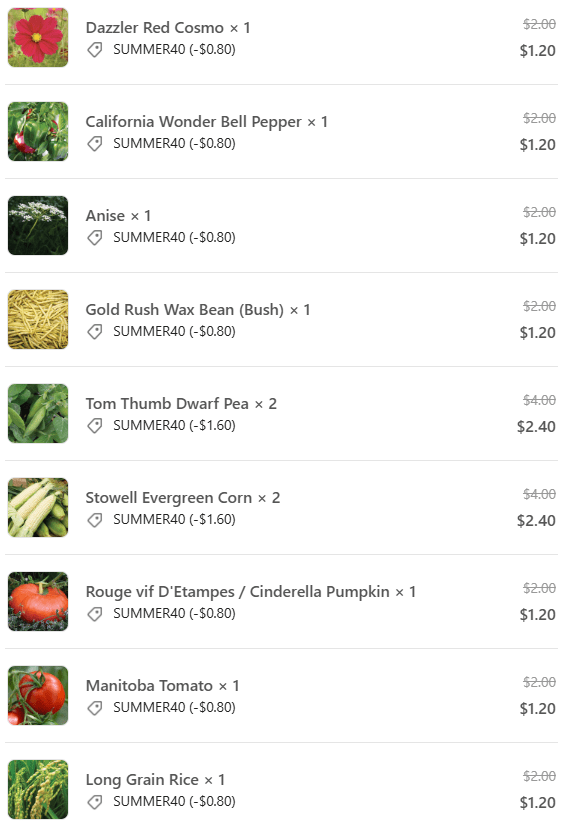
Okay, so I took advantage of MI Gardener having a 40% sale on seeds. Which means I got a lot of things I wouldn’t normally have been able to get and still stayed in budget. Most of these will be for future gardens, as we continue to build more beds and extend further afield.
Here is what I ordered today. Click on the images to see them better. I’ll include links as I list them below, this time in alphabetical order.
Oh, the crazy thing about going back and looking up the links. When I placed the order, I selected “in stock” items only. Going back, I just went through all the seeds, not just categories and not just “in stock”. I found that quite a few things I ordered are now listed as out of stock – but there are things that I see listed as in stock, but weren’t there when I was placing the order from the in stock only list!
Must. Not. Place. Another order!!
Ah, well. Here is what I chose today. All links should open in new tabs.
Anise One for our developing herb garden. I had no idea anise could grow here, but it’s only 75 days to maturity, so we should have no problem.
Bachelor’s Button – blue Bachelor’s Button – pink Years ago, I lived in a city where Bachelor’s Button practically grew wild and always loved them, but I had no idea they were also edible! These are deer resistant, so they will be planted strategically.
Butterneck Squash This one is a Canadian heirloom variety that is apparently almost extinct! So of course we’ll have to grow some to save seed. 90-100 days to maturity.
California Wonder Bell Pepper these are to restock our pepper seed inventory. It’s a thick walled pepper, which caught my attention. Some varieties we’ve tried had surprisingly thin walls. 75 days to maturity.
Canary Yellow Melon I’m as much a sucker for melons as I am for winter squash! 80 days to maturity
Caraway Another one for our future herb garden. 70 days to maturity.
Coffee Seeds (coffea arabica) I always like to have at least one “for fun” thing and one “challenge” thing. This will be a “challenge” thing – and to be grown as a house plant, as this is a zone 11-13 item. 2-4 years to maturity, and yes, this is a real coffee plant that we could potentially harvest beans from to make our own coffee. This one is more for the girls, since they are the coffee drinkers in this household.
Dazzler Red Cosmo I got this because the red is a less common colour for them, and they are great for attracting pollinators. 75-90 days to maturity.
Gold Rush Wax Bean (Bush) I did already get a tri-colour mix of bush beans, but I’ve almost used up the yellow bush bean seeds I had in my current collection, so this is a replenisher. 55 days to maturity.
Golden Boy Celery I’ve never grown celery before. The one time I tried, it was a pink variety and I started them way too late. These ones, however, are 80-90 days to maturity, so I shouldn’t have that problem.
Golden Hubbard Squash Yeah, I’m a sucker for the winter squash! These are a smaller and more prolific variety of Hubbard that grows to “only” 5-15 pounds. 95-110 days to maturity
Hales Best Jumbo Cantaloupe Melon Yup. Another melon! These are described as being more drought tolerant and thrives in hot weather – kinda like we’ve got right now. 85 days to maturity.
Long Grain Rice I looked these up out of curiosity and was shocked. We can actually grow this variety of rice here! Gotta try it! 90-100 days to maturity.
Manitoba Tomato This is an all purpose tomato, and the variety my mother used to grow here, so I know these should work. With only 65 days to maturity, we could direct sow these, instead of starting them indoors.
Meadow wildflower mix One of these days we’ll get a wildflower mix that will take! 90 days to maturity.
Oaxacan green dent corn (x2) There aren’t a lot of seeds per packet, so I got two of these. As a dent corn, we would be growing these to make corn flour. Only 80 days to maturity, too!
Orange flesh honeydew melon Oh, look! Another melon! We have the green flesh honeydew (none of the melons we have this year are going to produce, and I still don’t know what happened), and now orange flesh. 75-110 days to maturity.
Red Long of Tropea onion We’ve grown this variety before, and they did really well. We have our own onion seeds, but none of this variety. 90-110 days to maturity.
Red Wethersfield onion While I think we these are the red onions we have in the mix of our own seeds collected, they were from onions that had died off after transplanting – we thought! – but came up the next year. We’ve never actually successfully grown edible bulbs of these, so I figure it might be worth trying again. 100 days to maturity.
Rouge vif D’Etampes / Cinderella Pumpkin This variety caught my attention partly because it’s listed as being able to last in storage longer. 110 days to maturity.
Russian Tarragon Another one for the future herb garden, and it apparently overwinters well with little protection. Not sure if that applies to our zone 3 winters, but no zone is listed at all for it. 60 days to maturity.
Stowell Evergreen Corn (x2) Another corn, and another addition to our collection of white things! This variety is listed as drought tolerant, which is important for where we are. There aren’t a lot of seeds in the packet for something that needs to be wind pollinated, so I got two. 80-100 days to maturity.
Tom Thumb Dwarf Pea (x2) This variety grows to only 13-18 inches high. No trellis needed. Which would make it much, much easier to protect from deer! Not a lot of seeds per packet, so I got two. 45 days to maturity.
Triticale (x2) Okay, this one is for well into the future! At some point, we do want to grow our own grain to make flour. I’ve already got some heirloom wheat that is particularly noted for making good bread flour though, even with two packets, the amount of seeds I have for those would be grown only to collect more seeds for the first couple of years! The triticale comes in 500 seed count packets, but I still got two. Even so, the first crop would be mostly to get more seed for larger, future plantings. Thinking well ahead on this one! 85 days to maturity.
There we have it! My second order with MI Gardener, in as many days, and third order this summer. 😄
While there are still some things we will get from other sources, these orders will set us up for several years, as we build and expand on our garden beds and growing areas, plus more flower seeds for the pollinators. The additions for the herb garden has brought that goal closer to reality by quite a bit. There are many other herbs I’d love to get, but most of them need a much longer growing season than we’ve got. At least until we get a permanent greenhouse.
I seem to have become addicted to getting seeds like I used to be with getting yarn. Seeds are cheaper, though! Especially with sales like this one. This order totaled US$36, with a savings of US$24. No shipping costs, either. Plus, they have a points program and I now have enough points to get $5 off my next order.
Which is not going to happen for a while. I’ve got lots of seeds now!
Honest!!
At least until their new inventory comes in, after this blow out sale clears space for them.
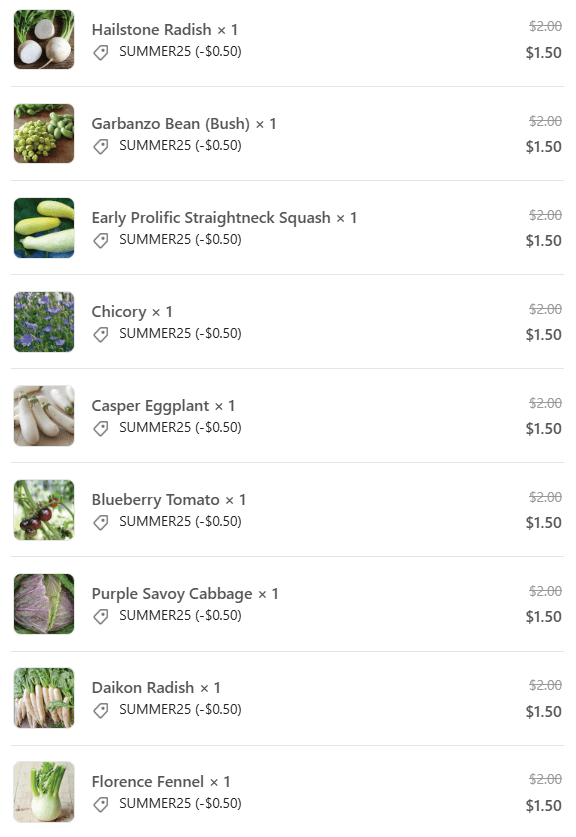
I placed an order with MI Gardener previously, and it arrived a while ago. So why did I order more? Well, MI Gardener prices are some of the best around right now, even when ordering from Canada. I’m on their email list and they announced a 25% off sale that started today. I happened to be up past midnight, so I went ahead and placed an order to take advantage of it. In fact, I might even made another one. I haven’t decided yet.
I took advantage of our winter sowing experiment to clean out my seed inventory of older seeds, so part of my goal was to replace things with fresh seed. With the sale, I’m continuing that, but I am also building my my seed inventory with extra. How much we actually plant will depend on how many beds we have ready this fall for winter sowing as well as for spring sowing and transplanting next year.
So, without further ado, this is what I ordered last night/this morning.
This time, I’m going to link to each item I ordered. All links should open in a new tab. They are list below in the same order as in the images above.
Tigger Melon This was something I had in my wish list. It’s a tiny, personal size, melon. More importantly, it takes 90 days to full maturity, and we average 99 days between first and last frost. In theory, we could direct sow them and get a harvest, though I would start them indoors, just to be safe.
Summer Savory This year, I bought a summer savory transplant. We plan to expand our culinary herb garden, and this will be part of that. Only 65 days to maturity.
Golden Sweet Pea I got another colourful variety last time. We have other peas as well. I just like to have a variety to shake things up. 😊 60 days to maturity.
Black Futsu Squash We have a variety of winter squash seeds, but we’re still experimenting to see what we like. This variety has an edible skin and stores 4-5 months. It needs 110 days to maturity, so definitely one to start indoors.
Orange Currant Tomato This looks very much like an orange version of the Spoon tomatoes we’ve been growing for a few years now – and it the only tomato that has anything we can harvest at the moment. It would be great if these do as well. 65-70 days to maturity.
Yellow Swiss Chard We have Rainbow Chard. We have Fordhook Giant Chard. Why not Yellow Chard, too? As with the other chards, this one is heat tolerant, drought tolerant and can grow in cold weather, so it can be succession sowed as well as winter sown. 28-57 days to maturity.
Sweet Siberian Watermelon One of these days, I’d really like to get watermelon! I only get short season varieties, of course, but so far, none have done well. The one Cream of Saskatchewan melon we got last year about about the size of a baseball, and they’re supposed to be much bigger. This variety is supposed to produce 15-20 pound fruit, yet has only 80 days to maturity. It does come with the warning that it needs lots of room to spread!
Shogoin Turnip a good cool weather variety that needs only 40-60 days to maturity. Plus, it’s really pretty.
Lemon Squash In our first couple of gardening years, we had good summer squash production. Then… nothing seems to be growing! I’m hoping this variety will do better. It’s supposed to be prolific, and only 50-60 days to maturity.
Hailstone Radish with finally being able to grow radishes, and even radish seed pods, through winter sowing, I’m more than happy to experiment with different varieties. This one is only 25 days to maturity!
Garbanzo Bean Okay, this is an odd one. Until fairly recently, I didn’t even know garbanzo beans, aka chickpeas, could grow here. I happen to really like chickpeas. However, they are also drought tolerant, nitrogen fixers. They are 100 days to full maturity, though, so it’s touch and go for this one.
Early Prolific Straightneck Squash So this seems to be another winter squash with an edible skin? The description specifies it is like zucchini, and that the whole thing can be eaten. I’m not sure, but with our luck with any squash these days, I’m willing to try it! Heat tolerant and somewhat drought tolerant. Only 70 days to maturity.
Chicory Okay, I’m not sure how to categorize this one. Perhaps it’s one for the kitchen garden. The leaves can be eaten, and it can be used medicinally, but it’s mostly the roots I’m interested in, as they can be used as a coffee substitute. I remember my parents sometimes buying it at the store, but never tried it. I don’t drink coffee, but my daughters do, and that stuff’s getting really expensive. So… worth a try. Especially with only 80 days to maturity.
Caspar Eggplant I’ve definitely got a “white” theme going on this year! This is described as a rare Japanese variety. Of course, I see “rare” and I’m all for growing it to save seeds. 😄 75 days to maturity.
Blueberry Tomato yes, another tomato to try! A cherry tomato with a lovely appearance. Hopefully, it’ll taste as good as it looks. 75-85 days to maturity.
Purple Savoy Cabbage Growing cabbages is something that’s been our list for when we have more space in the garden. Cold tolerant and good for storage. Only 65-70 days to maturity, too.
Daikon Radish I actually meant to order this last time, but they were sold out. I got the icicle radish instead. My younger daughter really likes Daikon radish. The last time we tried to grow it, something ate them as soon as they sprouted. With winter sowing, we might actually succeed this time! Best of all, only 55 day to maturity. Long for a radish, but well within our growing season.
Florence Fennel This is another one that we tried before, but it did not succeed. We didn’t have the right growing conditions for it. This is one of those vegetables we like, but almost never buy, just as a matter of budget priorities. 70 days to maturity.
And now I’ve gone and removed everything I’ve ordered from my wish list, so I don’t accidentally buy them again! 😄
All of these cost US$27, which is pretty darn good!
Oh, look at me… I’m already going through what they’ve still got in stock to see if there’s something else I want to order.
😂
Anyhow.
We will now have lots of options to choose from when we do our winter sowing in the fall. Last fall, I just scattered mixes of seeds. This time, now that I’ve seen how things worked out, the sowing will be more planned and more attention paid to spacing. Plus, our seed inventory is built up again, so if some things don’t work out, there are other things that can be sown in their stead.
Of course, that means continually adding more garden beds!
In the bottom row, we have Tricolor Mixed bush beans, Rainbow and Fordhook Giant Swiss Chard, an Assorted Mix of beets, White Egg turnip, White Icicle radish and a rainbow blend of carrots.
In the middle is Bi-colour Pear gourds, my “just for fun” item, yellow scallop squash, Gill’s Golden Pippin winter squash, green scallop Bennings squash, Spring Blush peas and White Vienna kohlrabi.
In the top row is Red Beard bunching onions, Borage, American and Giant Noble spinach, Kandy Korn sweet corn, Purple Vienna kohlrabi, and an envelope to collect and store our own seeds in.
From this batch, these are the ones that will be planted this fall, before the ground freezes.
Rainbow and Fordhook Giant Swiss Chard
Assorted Mix beets
White Egg turnip
White Icicle radsih
Rainbow Blend carrots
Spring Blush peas
White and Purple Vienna kohlrabi
American and Giant Noble spinach
I am not sure about the Borage. I’ll have to do some research before deciding if those will be planted in the fall or started indoors in the spring.
Everything else except the corn and bush beans will be started indoors.
Bi-colour Pear gourds
yellow and green patty pan squash
Gill’s Golden Pippin winter squash
Red Beard Bunching onions.
Hopefully, starting the summer squash indoors next year will work. Direct sowing hasn’t been working out for those, for some reason. We didn’t have a slug problem this year, thanks to the many, many frogs, so that wasn’t the issue. We should be able to winter sow summer squash, but when I tried that for this year, none germinated. Most were old seeds, but there were new seeds in there, too. When I planted potatoes in that bed later, I did find a few seeds, but most seemed to have just disappeared. I did have to cover the bed with netting because of the cats, so they might have had something to do with the failure, too.
This, all on its own, is the makings of a decent garden for next year. We have other types of beans, winter and summer squash, melons, peas, corn and our own onion seeds. Of course, we’ll also be getting seed potatoes in the spring, and will probably try the little bell peppers and orange eggplants again. We have herb seeds that I might start indoors, if we have space, or we might cheat and buy transplants again, instead.
So there we have it! The beginnings of next year’s garden, much of which will actually be planted this fall.
Hopefully, we’ll have a better growing year than this one, because something really weird is happening with this year’s garden. It’s been so frustrating. We should be at the peak of growth and harvesting right now, and there’s basically nothing – and not just because of the deer! I’ll be talking about that in my garden tour video, and you’ll be able to see exactly what I mean.
Speaking of which, time to try and record some video. The rain has stopped, but we’re supposed to get thunderstorms later this evening!




 The Re-Farmer