Our 2022 garden: Latte corn, green bush beans, Yakteen gourds – and we’re officially done!

Yes!! It’s done! I can now officially say, we have finished spring planting and transplanting everything! Whether we do a fall planting or not, we’ll decide on later, but right now, everything that will be growing this year is in.

Not that the work is done, but the focus gets to change, and the pressure to get it all in, in time, is gone.

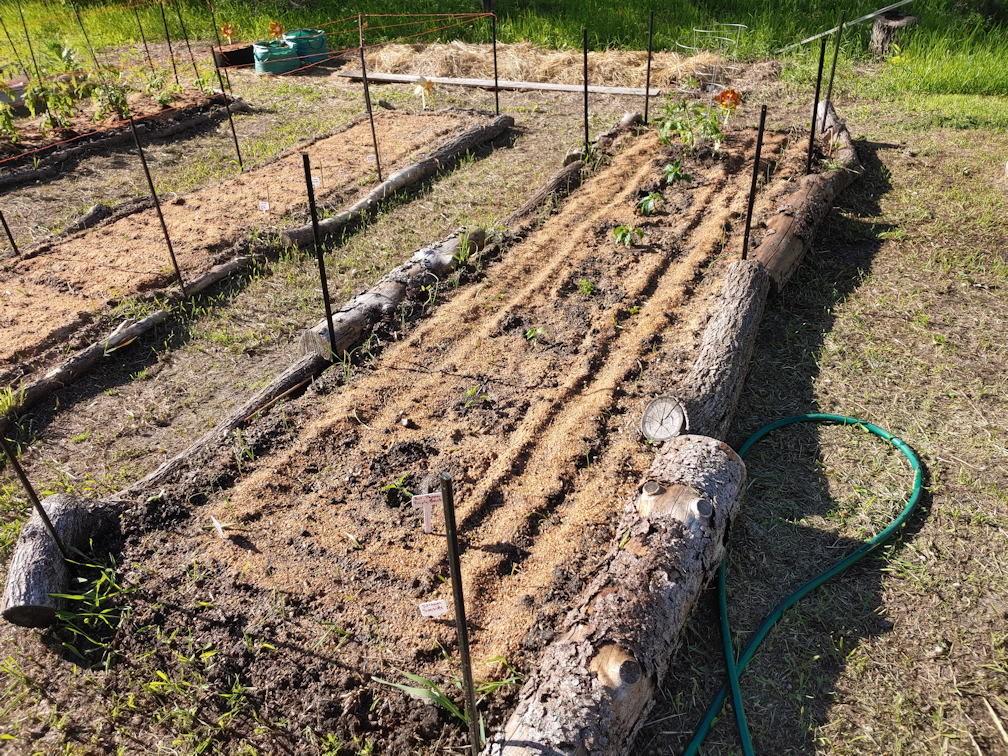
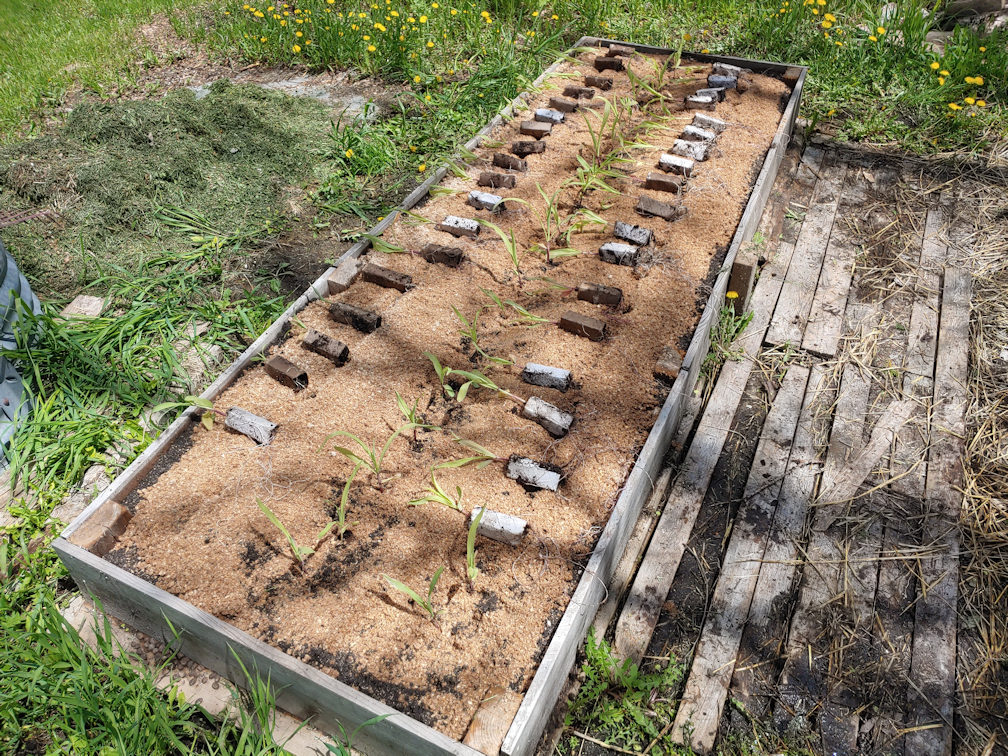
The first thing to get done was finish the bed for the last of the corn and beans.
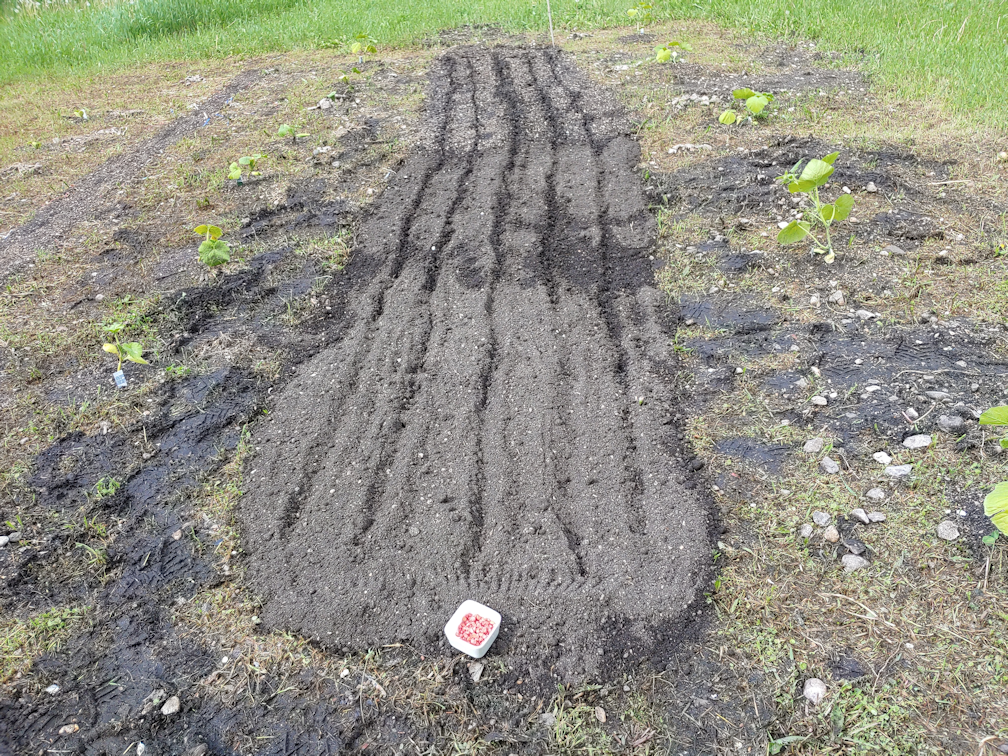
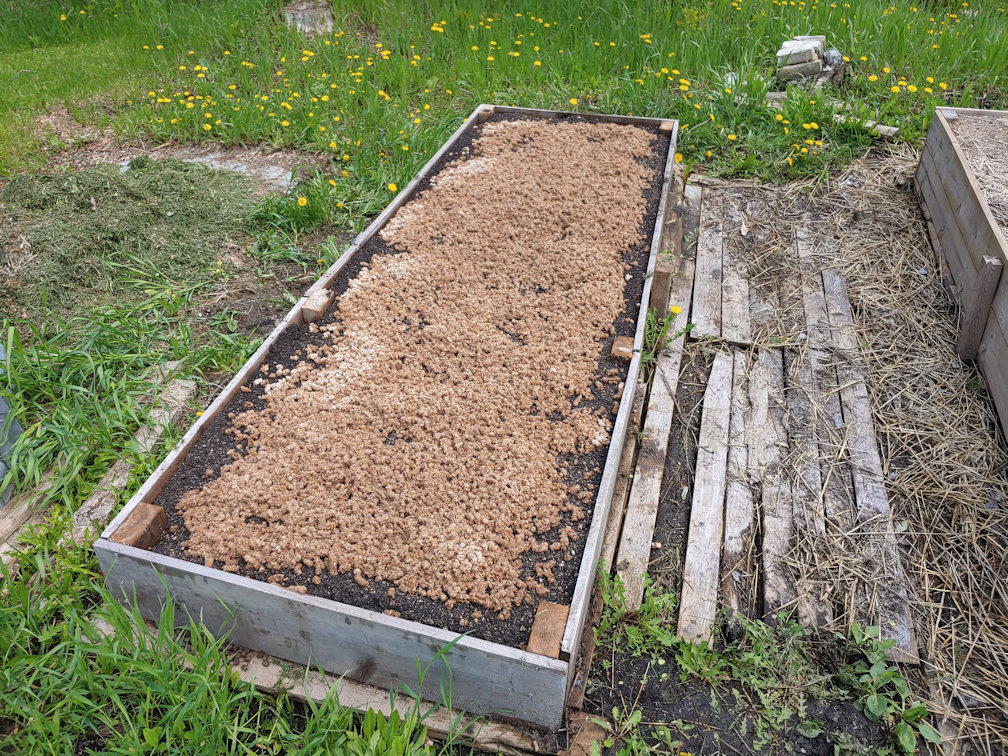
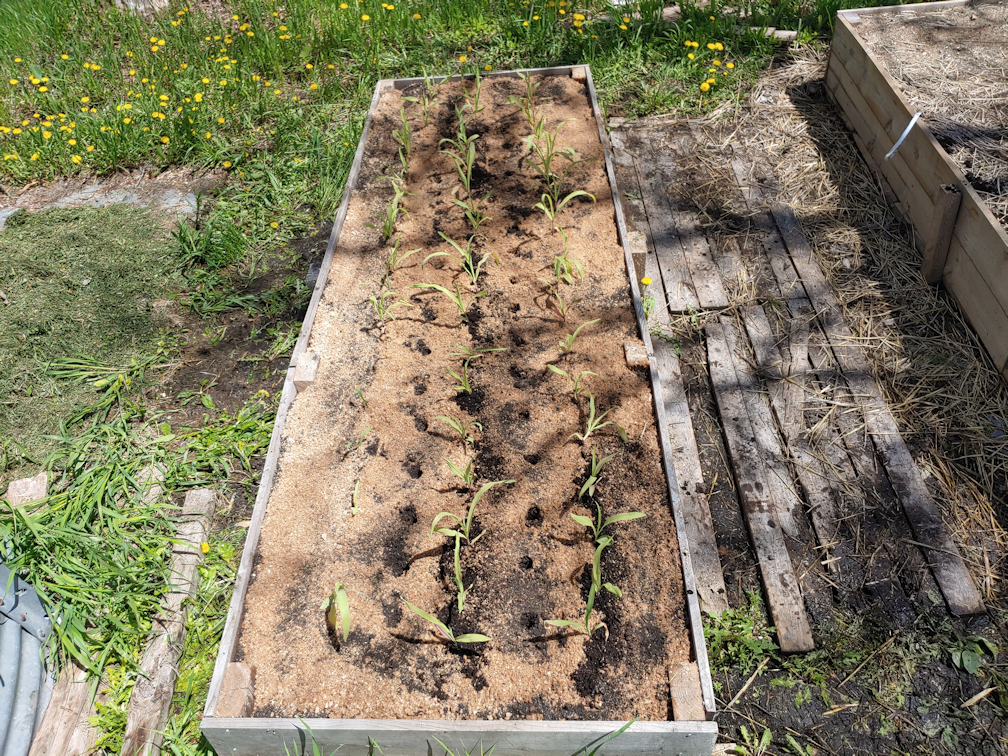
It took another 3 1/2 wheelbarrow loads of soil to top of the rest of the bed. You can really see the difference between what we laid down earlier, and got rained on. I’d taken out the rest of the sod divots, but we still need to gather the rocks.

The bowl in the photo is holding some of the inoculated Latte bi-colour corn seeds. It came as a pack of 200, but that’s less than half the pack, and some went back into the bag. The corn was planted in the three rows in the middle, that are marked off. The plan was to have bush beans on either side, but we only had enough of the Lewis green beans from last year to fill the one side.
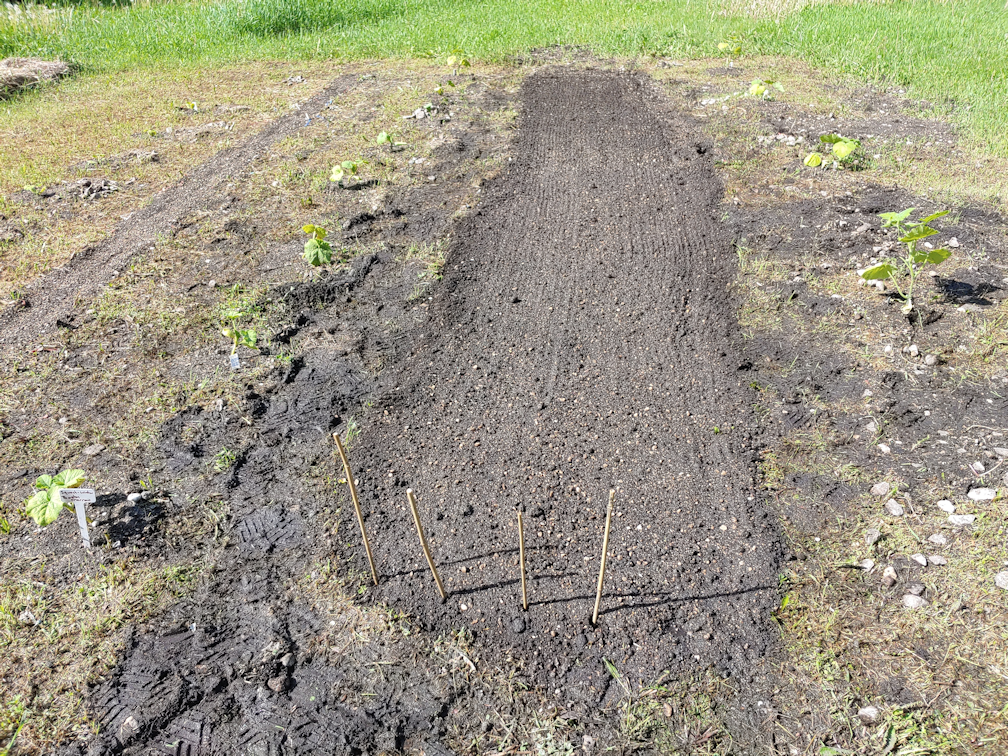
The only other beans we had were pole beans, so we left the last row.

Also, I’ve run out of labels that won’t fade in the sun. It’s a good thing I’m using this blog as a gardening journal! :-D

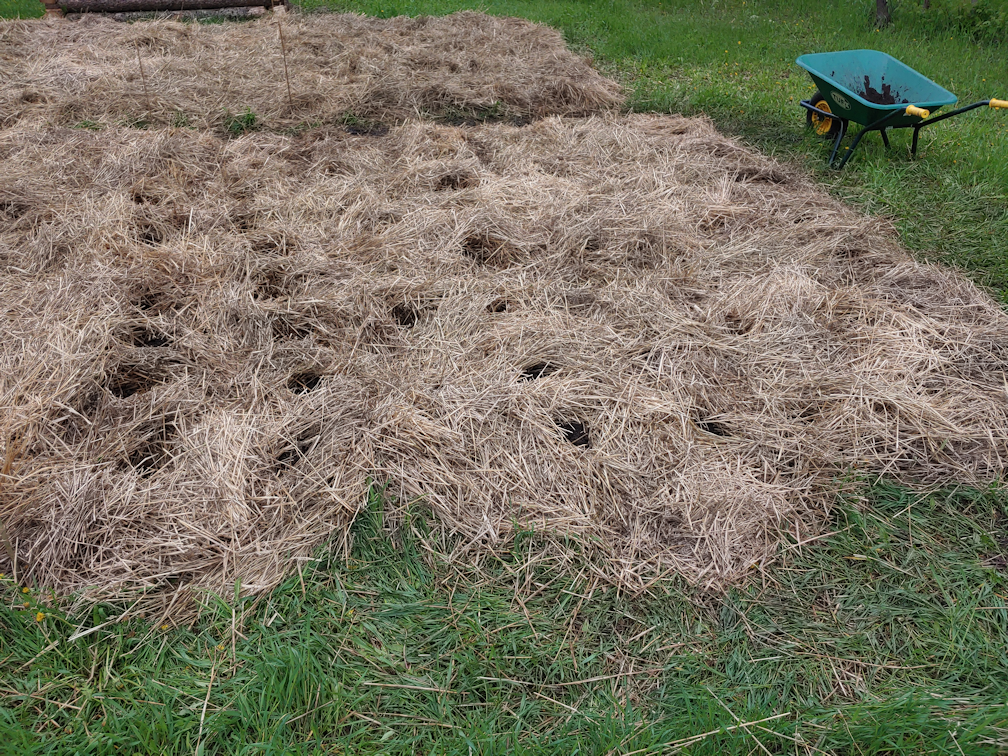
Now, all that’s left here is to mulch the area with straw.

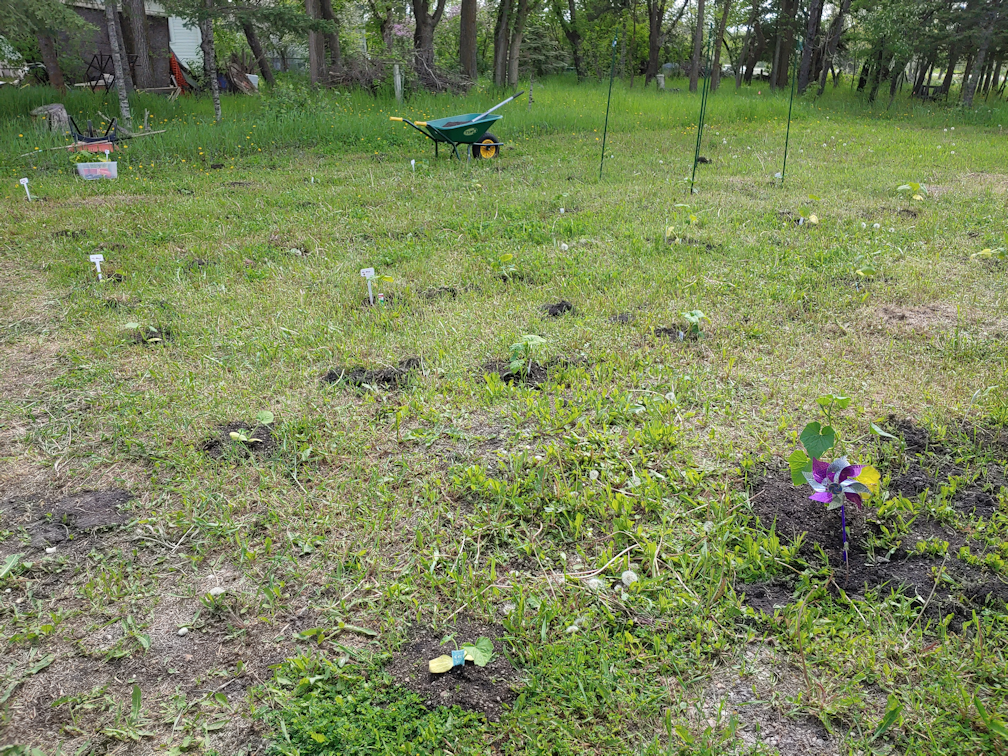
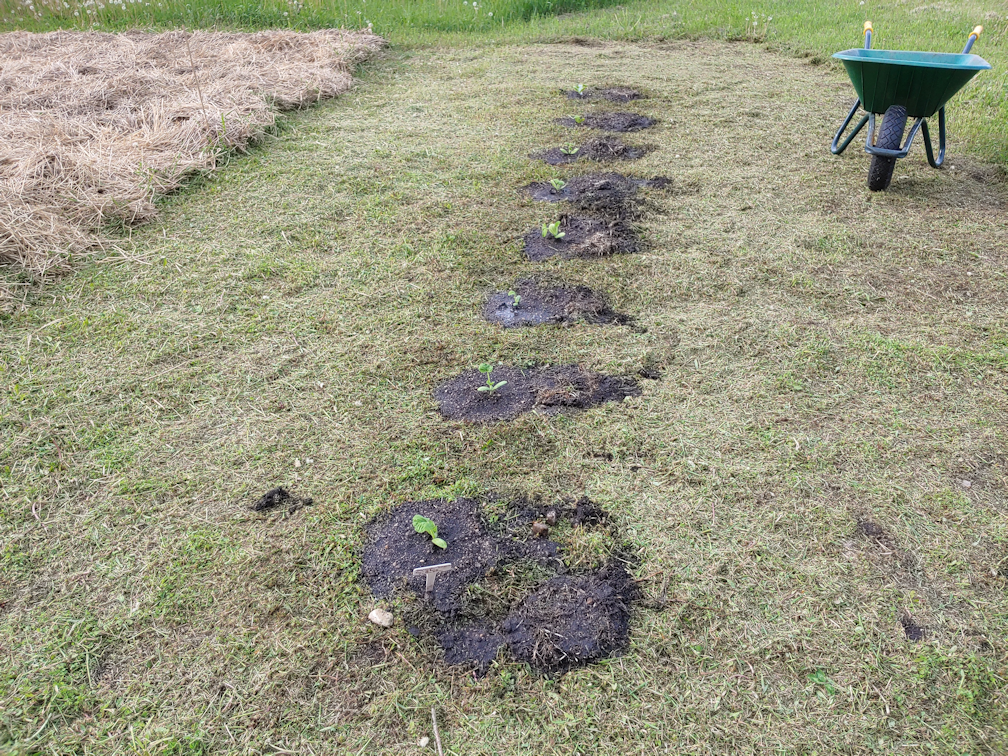
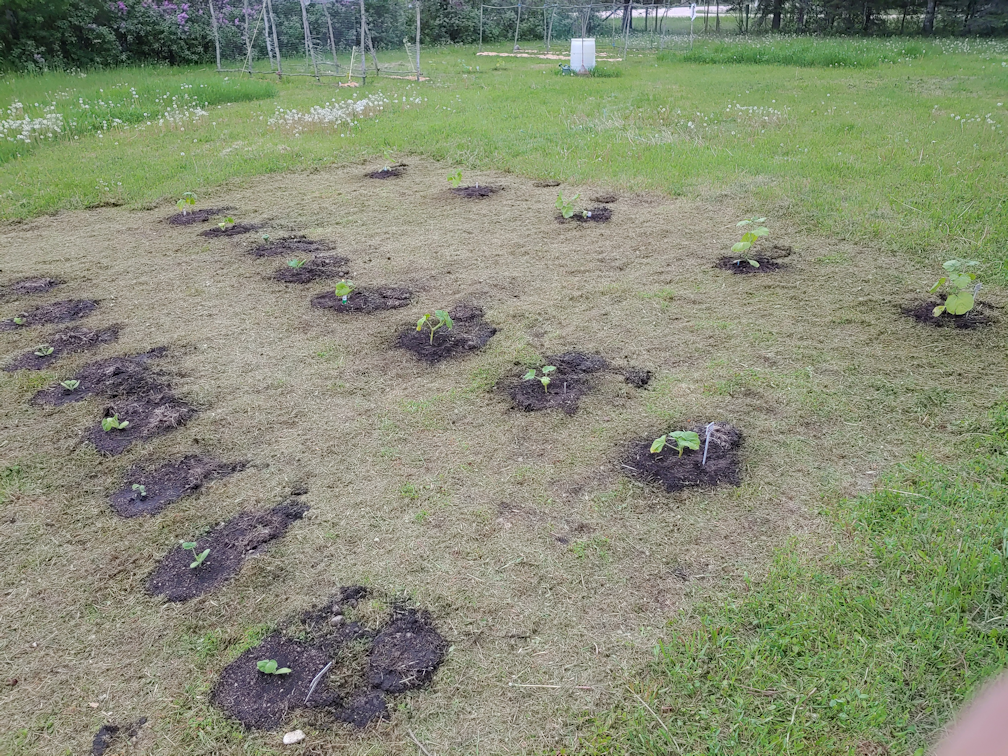
I then decided to go ahead and transplant the Yakteen gourd. The were 4 sprouts in one pot, while the other two pots still had nothing!

The largest plant went into an empty spot in a row of cantaloupe type melons (one of the grocery store melons we saved seeds from), because one of the seedlings withered and died before we could transplant them.
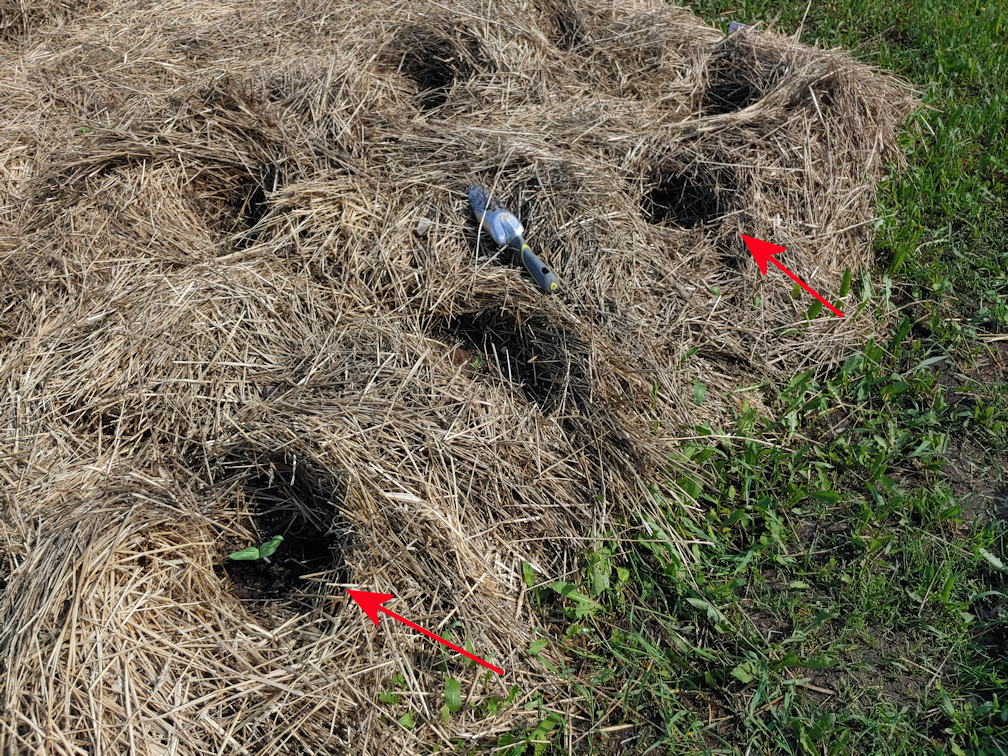
The two smallest seedlings were planted together. Here, they are in a pair of empty spots in one of the rows of Kaho watermelon. The seeds in those spots never germinated, so the space is being used for the gourds.

It feels so good to be all done planting!

Which meant it was time to work on other things…

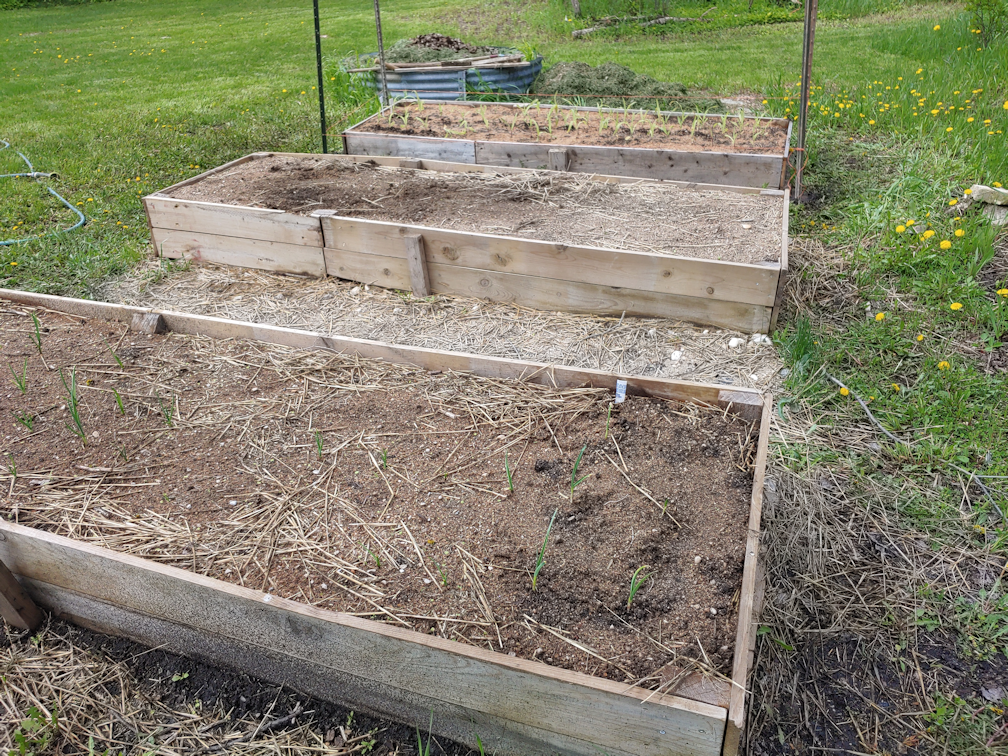
One of the low raised beds did not have supports of netting yet, so I dug out the rest of the bamboo stakes in the garden shed and use the unbroken ones. This bed has all summer squash, and it not something I expect we’ll need to cover for any reason, so we just need supports to put netting around it, if we need to. Last year, the groundhogs were enjoying themselves some squash, but nothing was bothering the plants, so if we need to put netting around them, it wont be until they are quite a bit larger.

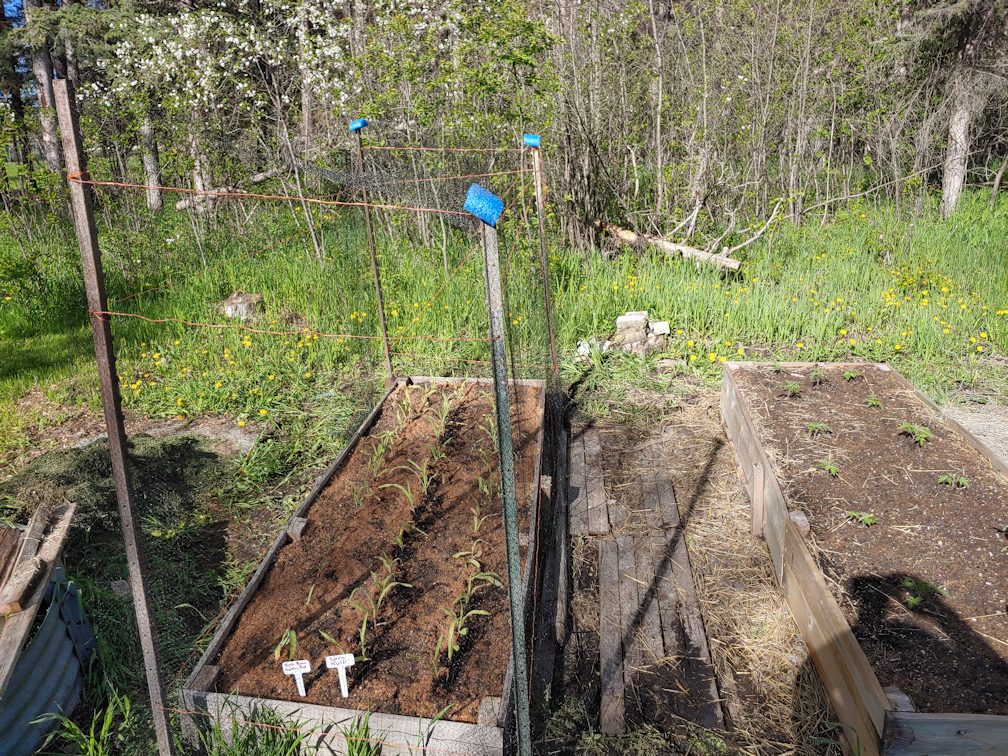
In the low raised beds with the upright supports, it didn’t have the twine strung around yet. Because of the logs, the spacing was really off. I ended up grabbing a couple of sticks, which the arrows are pointing to, to fill in the gaps.

The hoops in the background got a couple of bamboo stakes tied across the tops.

Now, all of these beds have supports on them, whether for netting or shade cloth or whatever we need.

I think we’ll take a bit of a break and let things dry up a bit. I’d still like to take the weed washer into the larger squash bed before we lay the straw mulch down.

Then we need to put the A frame supports at the two trellises beyond the bean tunnel, for the cucumbers, peas and more pole beans, as well as mulch the hulless pumpkins that got planted out there, too.

I’d be excited for the progress, but I’m just too tired. I’ve been pushing my limits a lot, lately, and it’s catching up with me. A bit of a breather, and I should be back up to snuff in no time.

She says, optimistically… ;-)

On top of this, it’s been a busy phone day. My husband had a phone appointment with the doctor to talk about his lab results, and a slight change to one of his medications because of it. Then my husband made another phone appointment… for me! I was outside, weeding, when the call came, so he sent me messages to let me know, but with muddy hands, even if I get the notifications, I can’t check my phone until I’ve washed my hands. It’s a good thing I came in when I did! The appointment was to talk about my own lab results, but first I got a call from home care to talk about my mother. The guy then called my mother and booked an appointment for and assessment next week, which he has asked me to be at. Then he called me back with the appointment time – and a concern. Because of her bed bugs, he’s going to have to be wearing the appropriate PPE, but they wouldn’t consider even doing an assessment if the potential client wasn’t going to do anything about their bed bugs. My mother told him she didn’t have an appointment, because when they asked (who? when?) in her building, who had noticed bed bugs in their units, she didn’t say anything – because she didn’t want to bother anybody!

*sigh*

I explained to him what my brother had done, and that it’s being arranged by schedule. I ended up getting the name of the site manager for her town, which I was able to pass on to my brother.

Then I had my telephone appointment with the clinic, which was basically to tell me nothing has changed. I consistently have one reading that is “on the high side”, but still within normal, so they want to keep an eye on it. All because, back in 2005 or 2006, I took a short term medication with a side effect the doctor wanted to monitor for the duration. Ever since then, everyone’s misunderstood why that was on my file.

One of the other things I did was send an email to the company I ordered the shed from. I asked a couple of questions about the amount charges and what shipping company would be used. Mostly, I’m feeling the waters to see what kind of response I get. Given the time frame for when we’re supposed to receive the boxes, if I don’t get a response soon, I will assume they are not legit and cancel the order and ask for my money back. The problem is that, in looking them up, I’ve found both that they are a scam site, and that they are not the best, but not fake, either.

Ah, well. We’ll find out soon enough.

The Re-Farmer

Our 2022 garden: ground cherry, popcorn and we surrender!

The rain held off this afternoon, so I headed out to where we finally decided to transplant the ground cherries.

After thoroughly dousing myself with mosquito repellant!!

This spot by the compost heap has been covered with that sheet of metal for about 2 years. The metal was placed there as something to put grass clippings on top of, so they’d be easier to collect and use later on.

Isn’t it amazing that, even while under metal, things were still trying to grow under there? !!

The soil was so soft under there, I could easily push the garden fork deeper than the length of the tines, and probably could have gone deeper if I’d wanted to. The ground was also pretty saturated, so it was muddy work to loosen the soil and pull out any roots – including some thoroughly rotted roots from the old tree stump under the compost pile nearby! No watering needed after they were planted, that’s for sure. In fact, I’m a bit concerned it might be too wet for them. We shall see.

The groundcherries got a good mulch with some of the grass clippings I had to move off the sheet of metal in order to move it. Here, they can be left to self seed, and hopefully we’ll get them year after year. We’ll just have to make sure they don’t spread too far and become invasive, which I’ve heard some people have had problems with.

The sheet of metal, meanwhile, is now sitting on top of the tall grass and weeds next to the ground cherries, weighted down with rocks to keep it from blowing away. Hopefully, it will help keep the crab grass and other weeds from invading the ground cherries.

When my daughter came out to help, we went looking through all the garden beds, talking about what needed to be done in each, before she started working on where we decided to plant our corn.

First, she dug a fairly narrow trench for the Tom Thumb popcorn, between the green patty pans and the Boston Marrow. These have a slightly longer growing season – 85-90 days – so we wanted to get them in first.

After she dug the small trench, she moved to the space between the Boston Marrow and the Lady Godiva pumpkins. There’s more space there, and it’s where we will be planting the Latte corn, which needs only 65 days to maturity, and bush beans.

While she worked on that trench, I used the hand cultivator to loosen up the smaller trench, pulled out the bigger rocks, and as many weed roots as I could. Then it got a layer of shredded paper, and finally a about 1 1/2 wheelbarrow loads of garden soil was added. I also removed the divots of sod and dumped them under some trees. They are so full of roots and rocks, it wasn’t worth the time to try and salvage any of the soil.

The Tom Thumb popcorn only grows to about 4 feet. The instructions said to plant them 5 or 6 inches apart, and in rows 36 inches apart, in blocks of at least 4 rows.

Obviously, we didn’t do that.

What we did do was plant two rows, with all the seeds about 6 inches apart. Once the soil was ready, my daughter had finished removing sod in the other area, so I just went down the prepared row, poking pairs of holes into the soil while my daughter went along behind me, dropping the little bitty corn seeds in! :-)

I’m glad we got those planted, because the next job was a killer.

In the second space, I went over it with the hand cultivator to get some of the bigger rocks out, and the more obvious roots. There’s just no way we could get rid of all the roots. While I worked on that, my daughter used one of the old, busted up wheelbarrows to get grass clippings. A full recycling bag of shredded paper went into the bottom, then grass clippings got scattered over the paper.

After dumping the remaining soil in the wheelbarrow in, my daughter went to get more soil with the good wheelbarrow, while I used the old one to remove the divots of sod.

I was reminded of just how badly broken up that old thing was! I’m amazed we got away with using it for as long as we did. In the end, I had to switch to the other old wheelbarrow. It’s smaller and also busted up, but at least it didn’t try to tip over every time I dropped a piece of sod in it, or roll away!

After a while, however, my daughter was waving the white flag. It was pretty hot, and very humid. For all the bug spray we used, we were just sweating it right off. The mosquitoes were after my daughter more than me (I reapplied bug spray, several times!), and after all the back breaking labour of removing sod, she was just done.

After she escaped the clouds of mosquitoes, I managed to move some more of the sod – using the good wheelbarrow! – before switching to getting a couple more loads of soil, and that was it. I surrendered, too! I think we did manage to get half of the area covered with fresh garden soil. The other half will probably need at least 4 – 6 more loads of soil, depending on how full the wheelbarrow is. It’s a fair distance to haul the soil from the pile in the outer yard, and we have to go around through the smaller person gate, rather than the closer vehicle gate, because there’s water there again, so we can’t get away with over filling it.

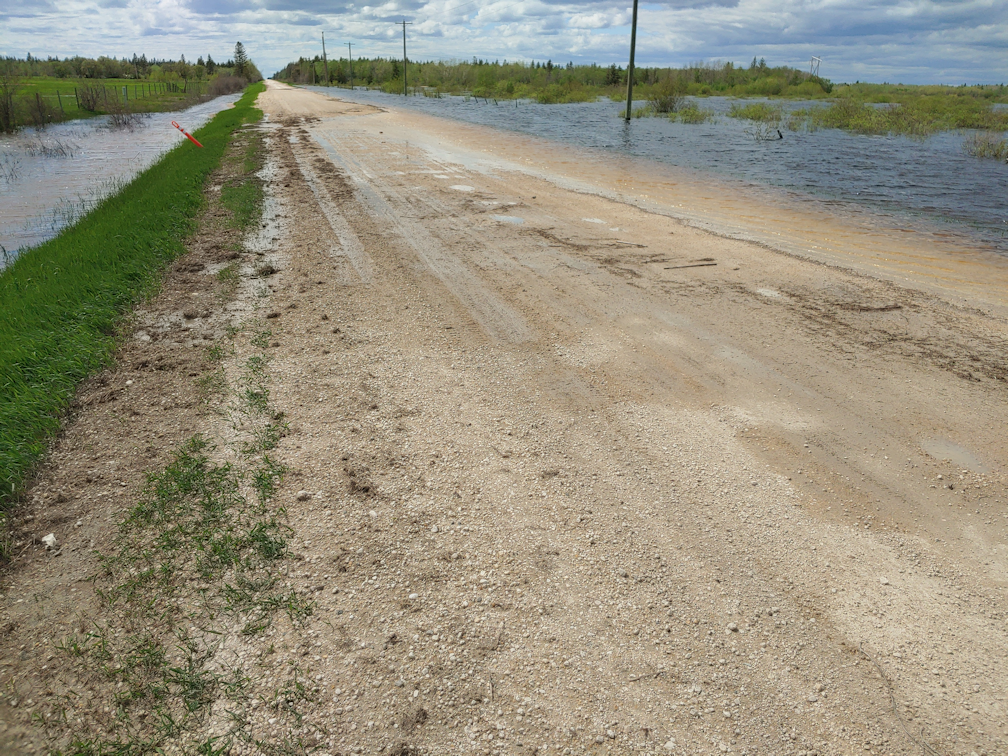
It’s a good thing the Latte corn and the bush beans we will be planting with them don’t need a lot of time to grow, because we probably won’t be able to work on this area tomorrow, and not just because I’m driving my mother to another medical appointment. We’re supposed to start raining again tonight, with thunderstorms over the next two days – complete with overland flow flooding alerts! I’ll be using my mother’s car to drive her. Hopefully, that one patch on the road near our place will stay solid enough by the time I am coming home, that her little car will get through. Anyhow; with the expected weather, we might not be able to finish this area and plant the Latte corn for several days.

By the time we’re done in this area, it will be quite intensely planted. Between that and the straw mulch we intend to add, I’m hoping that should keep the weeds down. Before that gets done, we’ll have to remove the rest of the sod and the piles of rocks scattered about.

It would have been much easier if we could do the carboard and straw like we did for the potato beds, but we just don’t have the carboard for that. We could get more later on, but we really wanted to get these in as quickly as possible. This will be the last direct sown seeds, besides any successive sowing we might do for a fall harvest.

This is also about as close as we’re getting to the “three sisters” method of planting. Hopefully, doing it this way will have the same benefits as the more traditional way. The only real problem I foresee is being able to access the bush beans to harvest them, when everything is all grown in. If we focus on putting the corn in the middle and the beans on the outside, we should be able to reach them okay. It’ll be trying to walk around the Boston Marrow and hulless pumpkins that will be more of a challenge, I think! With the Tom Thumb corn, it will be less of an issue, since they won’t be harvested until the cobs are completely dry on the stalk. Once the mulch is down, there’s not going to be much more needed for them.

If nothing else, this will be a learning experience.

And an experience in humility, as we get driven away by hoards of mosquitoes, trying to eat us alive!

I’m now going to go borrow my husband’s bath chair and shower off the smell of insect repellant now!

The Re-Farmer

Our 2022 garden: filled in the squash bed

The squash bed prepared by my daughter has been filled!

Some things went in some odd configurations. It’s going to take some doing to remember everything, even with the labels.

In my previous post, I’d stopped for a break after getting the Kakai hulless pumpkins, and the Crespo squash, started in the squash bed. As expected, the rest went much faster.

I’m so tired right now, I’m not sure I’m going to remember everything I planted in here at all! :-D

At this corner, the four Endeavor green zucchini got transplanted, running parallel to the low raised bed. This way, they will be easily accessible for harvesting throughout the summer.

There was a bit of space at the end of the row the green zucchini was planted in, so a couple of Teddy winter squash were planted there, and the remaining 6 were planted in a block in the next couple of rows. The Teddy squash has a growing habit similar to zucchini, so I wanted to make sure they were near the path, so we shouldn’t have too much trouble getting by while tending the low raised bed, or the green zucchini.

Next to the Kakai hulless pumpkin, I planted the Baby Pam pumpkins. There was six of them, planted in a 3 x 2 block. These are a smaller pumpkin that are supposed to be excellent for pies.

The poles are with the Apple gourds. I can’t remember if they’re climbers or not, but they are the only gourds in this bed, so I wanted to make them easy to spot.

I know we had some Ozark Nest Egg gourd seedlings, but as I planted them, I got a closer look and it does seem the are all Apple gourds. I don’t remember the Ozark seedlings dying off; if I had noticed, I would have tried planting more! I have no idea what happened to them.

Fit into the remaining spaces are the Georgia Candy Roaster and Winter Sweet.

Of the 7 x 7 grid my daughter dug, I did not plant anything in the south row, as it was too far into the shade. So this squash bed has been planted in a 7 x 6 grid.

The next step will be to mulch this area with straw. There had been thunderstorms forecasted, but now they’re just saying showers – those storm predictions keep going away! Still, we want to make sure the mulch is down as soon as possible.

If I can, though, I’ll see if I can get in with the weed trimmer first. It’ll be more difficult, now that the seedlings are planted, but it will make a big difference later in the season.

There were still seedlings to be transplanted, however. Which means a whole new section needed to be claimed. We were hitting 25C/77F, though, so I went back inside to take a hydration break, though I ended up making a dash to the store to pick up more bug spray. I’d just bought some, and we were already running out. They didn’t have a lot of options – normally we get something that will repel ticks, too, but there was none available. Still, with how fast we’ve been going through them, I got two.

For the rest of the transplants, I decided to start transplanting here.

In this area next to the potatoes, the grass I’d cut was growing back faster that the squash bed I’d just finished planting in, so I couldn’t make do without using the weed trimmer.

I worked in sections, starting out with an area large enough to include walking paths.

I had a couple of bins of transplants already at the garden, so I started on those, first.

These are the G-Star, green patty pan squash. The plants will be more compact compared to the winter squash, and they will be more easily accessed from the path between them and the potato and melon bed. I started by digging the row of holes then, using the jet setting on the hose, drilled into the soil and into the divots to blast as much soil back into the holes as I could, while leaving the roots and rocks behind. Then each hole got a spade full of sifted garden soil, and finally the squash were transplanted.

That process was then repeated for the next row, for the Boston Marrow. There were three pots, but so many of them germinated, I was able to plant eight. Which is probably quite crowded, even though I spaced them out more, as I think these will sprawl quite a bit as they grow.

Once those were in, I went to get more transplants – and found the only squash left were both hulless pumpkins!

Oops. I’d intended to plant them further apart. I would have put the Boston Marrow in between them, if I’d thought ahead. Ah, well.

I chose to plant the Lady Godiva variety here, because there was 5 seedlings, to the other variety’s four.

The last four, the Styrian hulless pumpkins, went next to the bean tunnel. I wasn’t able to use the weed trimmer here, though. I had to add another length of extension cord, but for some reason, it just wouldn’t run. I think there’s an issue with one of the extension cord plugs.

Oh, I almost forgot!

While watering the beds out here earlier, I noticed that we now have peas sprouting! The ones my daughter planted at the finished trellis. There are 2 varieties, and both have broken ground. :-)

So here we have it! That last of the squash, gourds and pumpkins are now transplanted! As with the others, these will also need a straw mulch.

We might end up finishing off the bale, soon!

As of tonight, the only things left to transplant are the ground cherries and the Yakteen gourds. The Yakteen gourds will be filling in some gaps in other places. After talking about it with my daughter, she suggested a place for the ground cherries that I hadn’t thought of. Next to the compost ring, there’s a spot where we’ve got grass clippings sitting on top of a sheet of metal. That metal has been there for about a year now, so it should be just fine to plant into. We’ll just have to find ways to use up the grass clippings that are there! :-)

I am so glad to finally have the transplanting done! Where we’re planting them is far from ideal, but they should be fine, I think.

We still have corn to direct seed. We’ll check the days to maturity and see if we still can, or if the seeds will just have to wait until next year. There are other seeds I’d hoped to plant this year, but they will have to wait until next year. They should have been sown back when everything was flooding. There is no longer enough of a growing season left for them.

While I was working on all this, my younger daughter took care of some other jobs, including doing a burn. We haven’t been able to get the burn barrel going for a while, and it was over full of the cat litter sawdust. That meant she had to stay and tend the fire for several hours.

She had just reached the point where she could put the cover on and finally let it smolder away on its own, when I came by to the pile of garden soil for one last wheel barrow load. Previously, I’d been sifting soil from the remains of the pile near the squash bed, but what’s left of that is so full of roots, it’s not worth the effort anymore. Later in the season, we’ll break up what’s left of it and use it to level off that area which, like so many other spots around the old garden area, is really rough, making it difficult to mow.

While sifting soil into the wheel barrow from the other pile – which went so much faster, as I was able to work from an area that hadn’t been taken over by weeds, yet – my daughter and I both heard a strange sound.

Coming from the branch pile.

A teeny, tiny mewing sound!

There are still kittens in there! Well. At least one. I’ve seen the mamas taking their kittens out of there, so this may be different litter? I have no idea. It’s going to still be a while before we start seeing the moms bringing their babies to the kibble house.

We’ll have to keep our eyes out for them. :-)

So, there we are. The squash transplants are finally done!

Looking at the 14 day forecast, we’re looking at highs hovering around 20C/68F during the day, and the lows hovering around 15C/59F, which fairly regular showers throughout. Which should be just excellent for the garden! It would be so good to finally have a good growing year.

As for me, I am wiped out. A daughter has been kind enough to take care of my laundry for me, I’ve taken my pain killers, and am more than ready to go to bed!

And it’s not even midnight yet. ;-)

The Re-Farmer

Our 2020 garden: the bean tunnel

This year, we decided to use the squash tunnel for vining beans.

But first, it needed some work.

We were able to weed and prep this side of the tunnel in the fall. Can you tell?

What a huge difference in the soil. When we first set up the squash tunnel, using a post hole digger to make holes for the support posts, it was incredibly hard. For the rows to plant in, we layered straw, then fresh garden soil – we’d long run out of carboard, and even shredded paper, if I remember correctly. Then the top was mulched with straw after the squash, gourds and melons were transplanted.

As you can see in the photo, the garden fork can now did deep into the soil, and I could push my hands into it to pull out the weed roots.

And tree roots. A remarkable amount of fine, thin tree roots.

The only things causing problems while using the garden fork was hitting rocks or larger tree roots!

So. Many. Rocks! Deep enough that I didn’t try to dig them out, though. I just pulled out the small rocks nearer the surface.

In the picture, you can see some orange twine. I found 3 places where the screws had snapped, and the cross pieces were basically being held in place by the wire mesh. I just lashed them back to the support poles. We might get one more year out of this tunnel before we build a permanent one, closer to the house, so I’m not too worried about it.

It was very hot work. Though my weather app said it was 19C/66F, with a RealFeel of 21C/70F, this is what the tunnel thermometer read.

Yeah, that’s reading about 33C/91F out there.

I’m sure the heat loving melons, eggplants and peppers were just loving it.

Me? Not so much!

Along with beans, the two Canteen gourds were transplanted. These were growing so fast, they had been potted up three times, and we needed to add support poles because they were trying to climb anything they could reach, including the tomato plants they were sharing a bin with! They were outgrowing their pots again, and really needed something sturdy to climb!

In the row on the left of the photo, I planted Blue Grey Speckled Tepary beans. These are a vining bean for drying, not fresh eating. They are also drought and heat tolerant, so perfect for this spot! The space was just enough for the amount of beans in the package, too. I supposed it’s possible there were more, but the cats tried to eat the package, scattering beans all over the floor. I think we found all of them, but some may have been missed.

On the right in the photo, I planted Red Noodle beans. These beans can grow up to 20 inches long! The packet was supposed to have 25 seeds, but I counted 33, which didn’t fill the row. We still have 2 other varieties of pole beans, but there are too many in the bags to fit in the remaining space, and I didn’t want to plant just a few. One of them has something like 200 seeds in it, so we aren’t going to be planting all of them!

I think, instead, we’ll plant some climbing gourds in the remaining space. We have some Tennessee Dancing gourds that would fit. Or some luffa. I think we have some that survived. We’ll decide after we get the remaining two trellises ready.

I’m glad we got at least two types of vining/pole beans in. It’s quite late in the season to be direct sowing beans here, but they are short season varieties, so it should be fine.

Little by little, it’ll get done!

The Re-Farmer

Our 2022 garden: eggplants, peppers, Wonderberry, and what a long day

It’s shortly before 8pm as I start this, and it’s all I can do not to just go to bed right now!

My day started a bit earlier, as I wanted to get my morning rounds taken care of before making some calls, then heading to the city. My husband and I now have medical appointments for the end of the week. We are both way overdue. Especially my husband.

Once that was done, I headed to the city, stopping to get gas at the town my mother lives in, first. Too early for their fried chicken to be available, so breakfast was a bag of beef jerky. :-D Usually, I just get $20 or $30 in gas, but decided to fill. At 197.9/L $20 wasn’t going to get me much. It cost almost $55 for about a quarter tank.

Then I got to the city and the first gas stations I saw were at 207.9/L

That’s USD$6.24/US gallon.

As I got further into the city, I saw stations that were still at 196.9/L but it likely is just a matter of time before all the stations jump up in price.

It’s insane.

I’m sure glad I filled my tank earlier!

Today was our day to do the rest of our monthly stocking up, and I went to The Wholesale Club again for this trip. Ended up spending just over $400 there, and the only things that could be considered splurges were super long metal tongs, and a super long wooden spoon, for cooking over the firepit. Oh, and more 500ml, wide mouth canning jars for the stash. :-D

There were a couple of things they didn’t have in types and sizes that I wanted, so I went to a nearby Walmart. My splurges there were a heavy duty garden hose, and a fan for my window, to replace the box fan that broke last year. The garden hose was actually a bit cheaper than the medium duty garden hose I was looking at. Normally I’d say, you get what you pay for, but the last time I paid a more premium price for a heavy duty hose, it suddenly burst apart at the tap, the first summer we used it. We’ll see how well this one lasts.

Between the drive and the shopping, the whole thing took about 4-5 hours, but I got pretty much everything on my list – including the highest SPF sunscreen I could find, an more bug spray! After this, we’ll only need to pick up fresh stuff locally, as needed.

I’m glad I remembered to stop at the post office on the way home. Several packages were in, including a birthday gift for my younger daughter. We also finally got the credit from our previous internet provider, which we should have gotten back in February. Since I was there, I also picked up another bag of wood shavings to use as mulch.

Once at home and the girls unloaded the van and put everything away, I headed back outside. We hit more than 20C/68F today, and I wanted to make sure all the transplants – both the ones still in pots, and the ones in the gardens – got a good misting. Happily, there is no sign of transplant shock in anything we transplanted. In fact, one tomato plant that got all droopy right after being planted, has already perked up.

My younger daughter was able to get the Wonderberry transplanted.

We decided to put them around the stone cross. I’ve read that these are good at self seeding, so they can be treated as perennials, and we thought this might be a nice place for them. They are so full of flowers and berries! I would certainly prefer these spreading around the area, instead of those green leafed plants that are taking over everything. They do have pretty flowers but, wow, do they ever invade! Almost every area we’ve managed to clean up among the trees is now covered with these!

Unfortunately, my daughter didn’t get much more done outdoors after this. She was driven inside by the clouds of mosquitoes. I had bug spray on, and it barely kept them at bay. I ended up mowing the main garden area, instead of working on more transplanting or bed prep as I’d intended, because the tall, damp grass is just a haven for mosquitoes. Huge clouds of them would rise up as we walked through! They’re just nasty.

Before I started mowing, my daughter helped me move the row covers we made last year. From the droppings left behind, the deer walked all over them during the winter. They are completely falling apart. When we can, we’ll take them apart and salvage what we can to reuse in other ways in the garden.

I didn’t get all of what needed to be mowed – some areas are still too wet – but the main garden area, and the spaces between beds and trellises we used last year, are now mowed. I also set up the old, patched up rain barrel and filled it with water (which I could now reach without having to steal a length of hose from the front tap, thanks to the new hose I got today) while I mowed, so we can use it to water the silver buffalo berry and sea buckthorn with ambient temperature water. Plus I could reach to use the hose to water the peas.

Once a bare minimum of mowing was done, I went ahead and did some more transplanting.

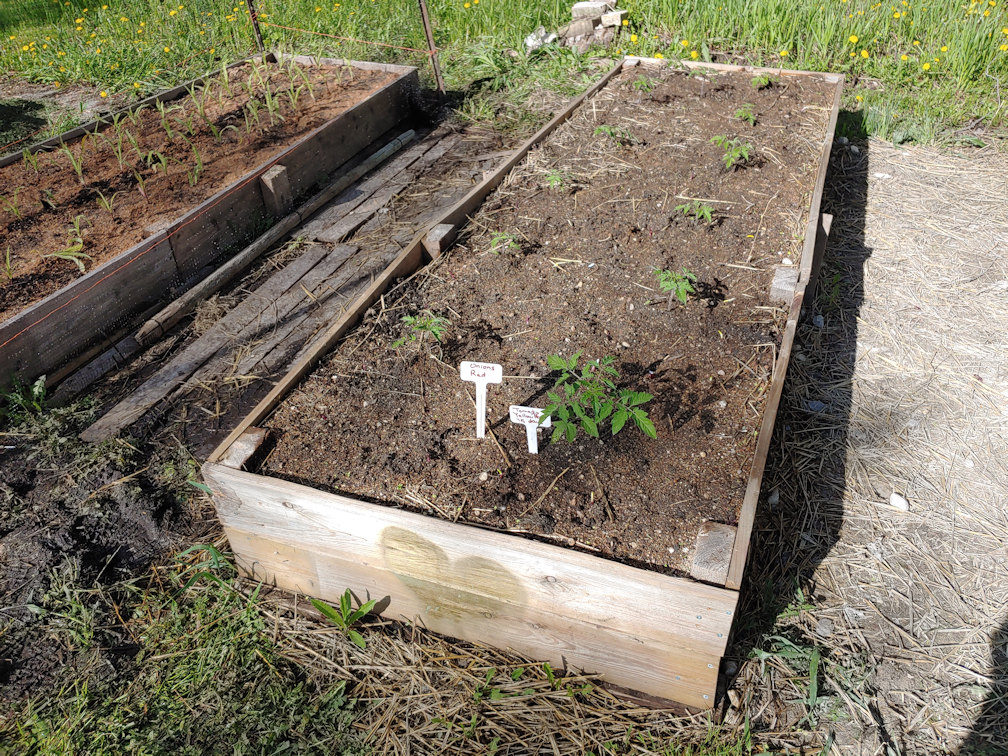
We had 5 surviving Little Finger eggplants, and they just fit into the middle of the half-bed that had space. They are encircled by spinach and onions. Now that the eggplants are in, we can finish setting up the hoops – they just need cross pieces joining them in the middles – so we can cover them with net. I don’t know of the critters would eat eggplant, but I’d rather not give them the opportunity to find out!

There were 7 surviving Purple Beauty bell peppers. Most were from the second seed start. Only two survived the Great Cat Crush. :-D Once they were in, there was still some space in the middle of this bed. Just enough for the last two Cup of Moldova that didn’t fit in the bed that has just tomatoes in it.

This bed is encircled with onions on the outside, while the inside has turnips on one side, spinach on the other. The turnips – all three varieties – germinated a couple days ago, and today I could just see little spinach coming up, too.

With the peppers now planted, we’ll add twine to the supports, and then will be able to put net around the bed.

Tomorrow, we’re going to need to put a priority on transplanting the melons. They are starting to suffer in their too-small toilet tube pots. So they will go into the deep mulch space left over, after the potatoes were planted. I was going to plant the summer squash in there, though to be honest, between the two beds, we might have room for both. Well. Not all the summer squash. We do have a lot of patty pans!

We’re expected to get as warm tomorrow as we did today, so I think an early bed and early rise will be in order again. I want to get more work done in the garden, while it is still cool.

After I pain killer up and slather my dried up hands with lotion! I am in such pain right now. It’s fine if I’m sitting down, except for the joints in my fingers making it hard to type, but every time I get up, I find my joints have completely stiffened up and I can barely walk.

*sigh*

I’m too young to be feeling this old!

:-D

The Re-Farmer

Our 2022 garden: tomatoes, squash onions, and food forest additions

While I spent most of my time with the kulli corn, my daughters took care of other things.

My younger daughter got the sea buckthorn planted. These saplings are quite a bit larger than the silver buffalo berry! This will eventually close the gap of the hedge along the north fence line, where the deer jump through. Hopefully, we have both male and female plants, and will have berries. We do plant to get more, over time, but it will probably be another year or two before we know for sure.

The only trees left to plant now are the Korean Pine.

My other daughter started on the tomatoes.

Along the chain link fence, she planted the dozen Chocolate Cherry tomatoes. That’s a variety I got specifically as a gift for her. :-)

Last year, tomatoes did REALLY well in this location. This year, we’ll see how they do in other locations!

The next tomatoes she and her sister transplanted here were the Cup of Moldova and Sophie’s Choice tomatoes.

The row on the left, and in the centre, are all Cup of Moldova, while the Sophie’s Choice are the row on the right.

There are still two Cup of Moldova waiting to be transplanted, but they ran out of space.

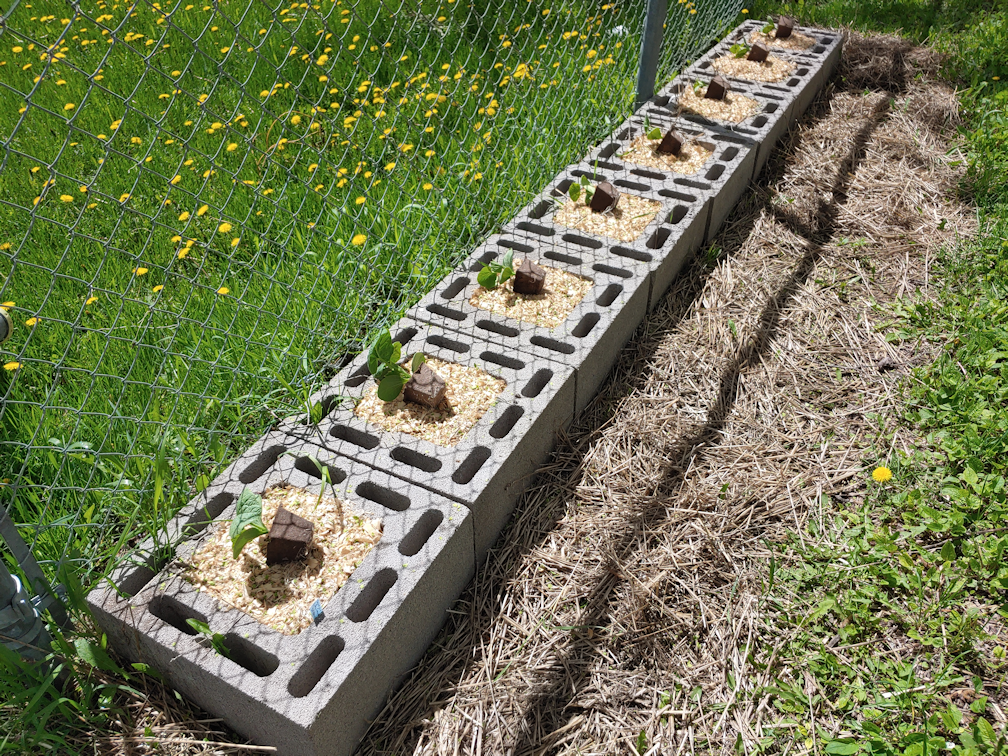
While they worked on that, I transplanted into the blocks we finished adding along the chain link fence this spring.

The Red Kuri/Little Gem squash went into these. I hope they do well here. Last year, we had only 2 plants, but they produced quite a lot of squash. Unfortunately, with the drought, the squash developed so late, we only really got 3 that were mature enough to be edible. The girls and I found them delicious (my husband is finding that he’s not a fan of winter squash), and we look forward to having enough to store for the winter.

While one daughter worked on the bed of tomatoes in the main garden area, adding more support posts and winding bale twine back and forth to help support the tomatoes as they grow, my other daughter and I made use of the newly available bed next to the kulli corn.

There was a total of 13 Yellow Pear tomatoes to transplant. Once they were in, we got the box of red onion sets and planted them all along the outside of the bed in a single row, then fit the rest into the middle, in 2 rows.

The last thing we needed to do before heading inside was putting netting on the kulli corn and the Red Kuri squash. Those were the only two things that were most at risk of betting eaten overnight!

The net is hard to see. I used pipes hammered into the ground to hold the net away from the squash. The blue bits of pool noodle shoved into the tops of the pipes are there to protect the net, as there are some sharper edges on some of the pipes. Last year, we had chicken wire at an angle over cucamelons and gourds, and the vines kept wanting to attach to the chick wire, instead of the chain link. There’s no way the net could hold the weight of squash climbing it, so I wanted to keep it away from the plants as they start growing large enough to reach the fence and start climbing. On the inside, the edge of the net is held in place with ground staples. The excess net went over the fence, and my daughter rolled it up and zip tied it down. We still want to be able to access and tend the plants as needed, which will mostly be done from the inside.

The last thing the girls did was lace up the ends, so keep the critters out. A determined critter could still tear through the net, but hopefully, they won’t want to be bothered.

In the background, you can see some wire “fencing” has been added to the outside of where the Chocolate Cherry tomatoes were planted. It will get netting as well, but the only thing in there that is in danger of critters are the carrots, and they aren’t even germinating yet, so there it no hurry, there.

We have a lot more to transplant, but work needs to be done to prepare for them, first. The supports for A frame trellises need to be added, and beds need to be weeded. The rows we used for the bush beans last year, as well as the straw mulched mounds we grew summer squash in, are completely hidden by the crab grass that has taken them over. The squash tunnel, which will be a pole bean tunnel this year, needs minimal work at least, and the summer squash can be planted in the deep mulch near the potatoes. After we’ve transplanted the squash, gourds, melons and cucumbers, and planted the pole beans, we’ll have a better idea of where we can plant the yellow corn, and the popcorn. We have more bush beans and peas we can interplant with the two types of corn, too.

We also have another variety of baking poppies and dill to plant, but I think we’ll have to skip those for this year. I know where we will plant the Wonderberry, but have still not figured out where to plant the ground cherries. All of these will be treated as perennials, as they will reseed themselves year after year, so they need permanent locations.

We’ll figure it out.

As for tomorrow, I’m finally going to make our second stocking up trip to the city. It’s unlikely I’ll be able to do any work in the garden, but we shall see. It’s hard for me to stay out of the garden, now that the weather has finally turned nice, and we can catch up! :-D

It feels so good to finally get things into the ground!

The Re-Farmer

Our 2022 garden: kulli corn, yellow beans and garlic

Yes! Finally! Major transplanting was started today. :-)

The first thing I needed to finish was topping up the low raised bed they were going into.

Since the snow melted away, we’ve been adding our kitchen compost in the trench, which already had some straw in it, and I even tossed in the soil from various pots we had, from house plants that died, to seed starts from last year that didn’t germinate. The last layer before adding the soil was some fresh grass clippings.

This is the first time this pile of garden soil has been uncovered since last year.

So. Many. Thistles!

And those roots go all the way though the pile.

Which meant I had to bring the makeshift soil sifter into service, so get as many of the roots as possible out. It was long and tedious, but at least it was made a bit easier by scavenging a couple of scrap boards out of a pile to support the steel mesh, rather than the found branches I was using before. Sifting the soil had to be a gentle process, because there were SO many worms.

I kept the worms for the new bed. :-D

After the soil was added, stove pellets were scattered across the top and hydrated so act as a thin mulch. It won’t stop any weeds, but it will help keep the soil surface from compacting. After several soakings, the sawdust was spread evenly with the back of a fan rake.

It took a couple of hours, but I could finally transplant the kulli corn!

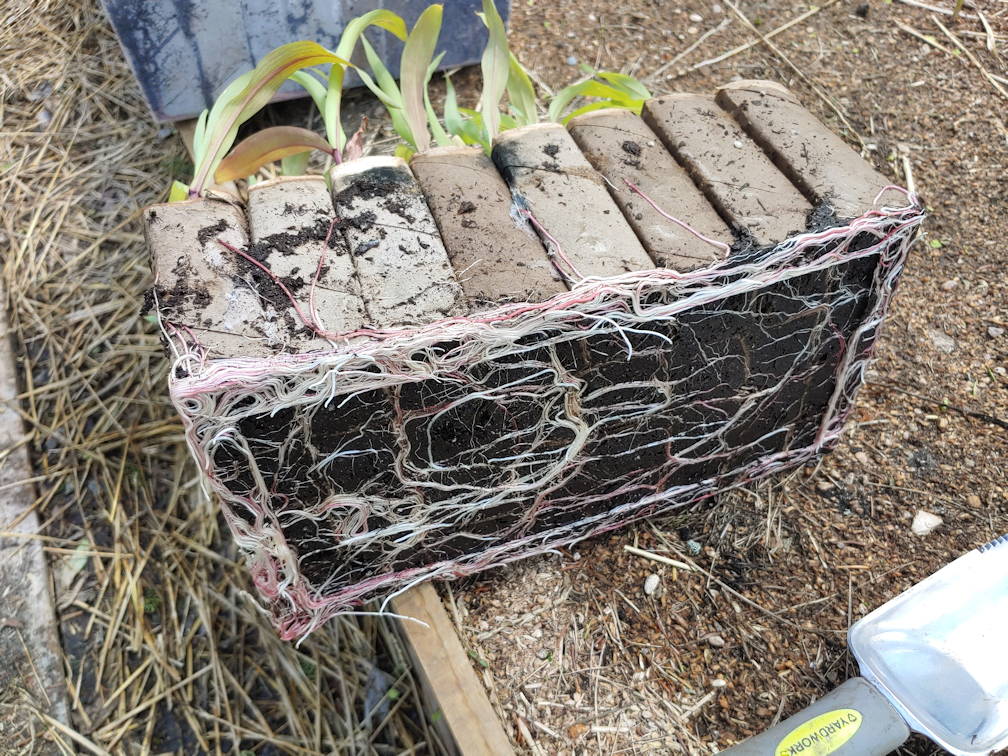
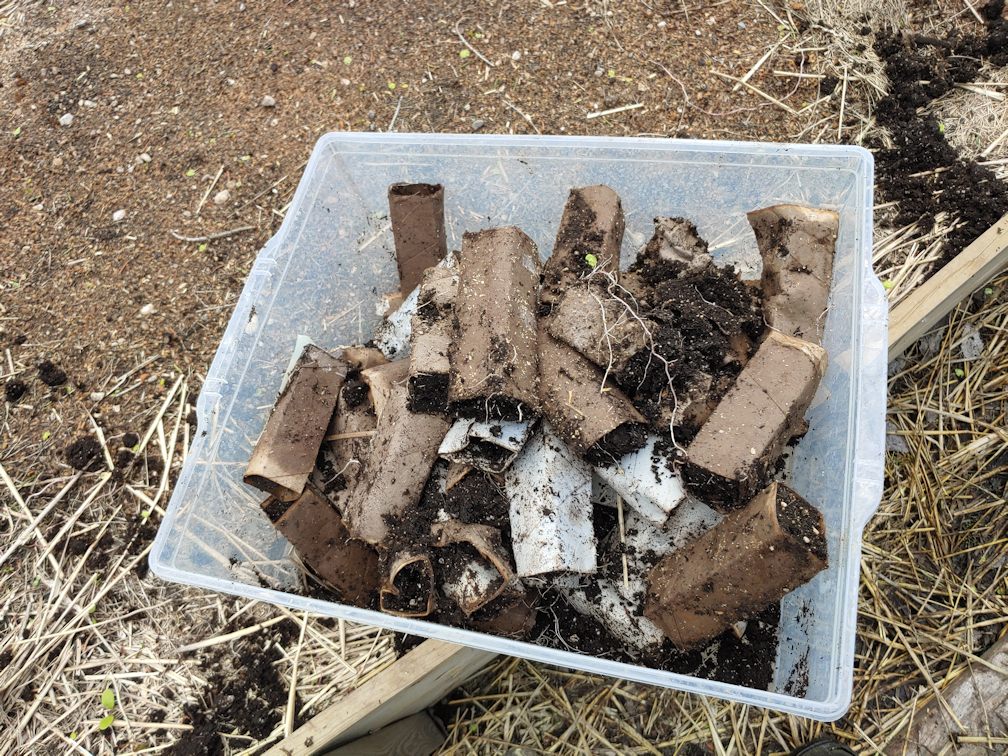
They had a major root system going! It made it difficult to get them out of the bins, then pull apart the tubes. The toilet paper really wanted to come apart!

With the larger bin, it was even more difficult to get them out, and the whole thing ended up falling out and apart. I think only one corn plant actually got broken, though. We’ll see if it makes it.

I counted the seedlings, then marked three rows of 20 evenly spaced spots for the corn. The actual total was 58, including some smaller ones that may or may not make it. We ordered 100 seeds, and there were extras, so we’re looking at roughly 50% germination rate. Which I don’t mind. We would have had trouble finding space for more. They are quite closely planted, as it is. Which should be good for improving pollination.

Of the remaining rolls, I broke apart the cardboard and rifled through it. No sign of the remaining seeds that did not germinate. The carboard went into the compost pile, while the remaining soil was used to top dress any seedlings that looked like they could use it.

I had also grabbed a bag of bush beans from last year, picking the one that looked like it had fewer seeds. That was the yellow “Golden Rod” variety. We still have some green bush beans left, too.

I counted the bean seeds and there was 38 – which was perfect! I could plant two rows of 19 beans, in between the corn.

As they are “old” seeds, I don’t expect 100% germination. This bed is very densely planted, but they should be complimentary.

The corn, however, needed to be protected. The question was, how?

I made a trip to the barn and dug out the T posts I spotted in one corner, a while back. There turned out to be 6 of them, all different lengths. :-/

I had to dig holes to be able to set them, using a garden trowel, since a spade would have been just too big. Within inches, I was hitting water, then rocks and gravel. After placing the posts and trying to push the soil back against them, there was literally water, shooting out from the ground, as I stomped on the soil!

We have no post pounder, so I found a heavy hammer to try and drive them deeper. Especially the longest one, but I think that one ended up hitting a rock. Being the short person that I am, for the taller once, I had to stand on the corners of the bed to reach. Even with a board across the corner to stand on, I was wobbling all over the place! LOL

Once they were in, I strung some twine around to further support the net, once it was added. That was a job that had to wait for when the girls were available.

In the two garlic beds, the nearer one had only 6 remaining garlic coming up – and one of those was barely there. I could find no sign of the few others that had emerged, as well.

I decided to transplant those 6 garlic into the other bed. That one has a lot more garlic trying to grow, but there was still plenty of space at one end to transplant the remaining 6 of the other variety.

The left a bed available for planting into, which we did end up doing.

The main challenge was, how do we cover the bed with netting, yet still be able to access the plants, easily, for weeding and eventual harvesting of yellow beans.

Piece of pool noodles were added to the tops of the posts, so they wouldn’t tear apart the net. When the one on the tallest post fell off, I left it. If it tears, it’ll only go down to the twine, and will actually line up better with the rest.

When I brought the T posts out of the barn, I also grabbed a stack of narrow pipes. I have no idea what they were for, or why they were stored there, but I figured the might make good supports. The short ends of the net are wrapped around those pipes and zip tied into place. For the long sides, we zip tied narrow fence posts we found… somewhere, to weigh down the netting. Any gaps were further secured with ground staples. If we want to tend the bed, we can remove the ground staples and lift the poles to get under the netting.

Hopefully, that will work out.

The corn can potentially grow to 8 ft tall, which is higher than the netting, but if they do get that tall, we’ll deal with it, then.

That was my big job for today, but it wasn’t the only one we got accomplished! I’ll write about that, in my next post. :-)

The Re-Farmer

Our 2022 garden: potatoes, strawberries and sunchokes

We had a lovely, warm and sunny day.

That meant, time to catch up as much as possible in the garden!

My main goal was to get the potatoes in, since the beds for these were all prepped and ready.

The first ones were from the 1kg package; Caribe.

There just happened to be exactly 20 potatoes in the 1kg package, so this bed got 2 rows of 10 potatoes. For each one, I dug into the mulch to the cardboard below – which was very wet, from all the rain we’ve had since this bed was prepped! – cut an X into it and pulled it back, added a potato so that it was in contact with the ground below, then covered it with a couple of scoops of garden soil.

For this bed, I followed up with a watering, to settle in the soil, then covered each spot very lightly with some straw.

Then it was time to do the 5kg potatoes.

The first ones I did were the Bridget. They were planted the same way as the Caribe, though it wasn’t as easy, while having to walk on top of the straw mulch! I also didn’t bother covering them with straw after the soil was added. The hardest part was cutting through the cardboard. Some of those boxed were made of a very heady duty cardboard, and even while soaking wet, it was hard to get through. Which will be excellent for weed suppression, so it’s worth the extra effort.

It’s a lot longer doing it this way, then the first time we grew potatoes the Ruth Stout way. We didn’t have any cardboard, so the potatoes were laid out on the ground, then simply covered with straw. They did okay, but weeds got through the straw mulch as well as the potatoes. This time, we have a thick layer of cardboard, so that should take care of that problem, but it does make it more tedious! It would have been easier if I could kneel down. A lot of head rushes from being bent down so much!

This morning, I checked the tracking for our shrubs and trees, and they were ready for pick up, two days early! By the time I finished planting the Bridget potatoes, it was past 2pm, which is when the post office reopens after lunch break, so I headed out.

Wow.

All that rain we’ve been having, and the road is washed out right at the patch from before – and this is after the water has gone down quite a bit. There’s actually 2 washed out areas. Not as bad as before, though, and I’ll be able to get through with my mother’s car tomorrow, when I had to take her to her doctor’s appointment.

What I forgot, however, was that today was Wednesday.

The store the post office is in, closes at noon on Wednesdays.

Hopefully, the order hasn’t thawed out yet, and they’ll be fine. With tomorrow’s appointment, I am hoping to be able to pick them up after I’m done with my mother’s medical appointment, but it’s hard to say right now.

Not getting to the post office wasn’t a wasted trip, since I did at least confirm the roads are passable.

Once at home, it was back to work.

The next potatoes to do where the All Blue.

This time, I had a daughter able to come out and help. With the Bridget potatoes, with the larger potatoes being cut into smaller pieces, there was a total of 67 to plant, so I had 6 rows of 10 and 1 row of seven.

Having the potatoes chitting in egg trays makes it easy to count them. The flats hold 30, and the carton holds 18, plus extras in the lid. There were 81 in total, so I made 8 rows of 10, with two little ones planted together.

Here are both beds of potatoes done. I have bamboo stakes marking where the potato rows end. These beds are the size of the traps that we lay on the ground to start killing off the grass and weeds. The Bridget potatoes took up half the bed, while the All Blue took up just over half of the second bed. That means we have space to transplant into, in the rest.

While my older daughter and I were working on that, my other daughter worked on the strawberries.

This area is where we had potatoes in grow bags, last year. The soil they grew in was used to create this new bed. I was thinking of planting some of the sweet potato slips here, but we’ll put all of them in grow bags now, so this one can be for the white strawberries.

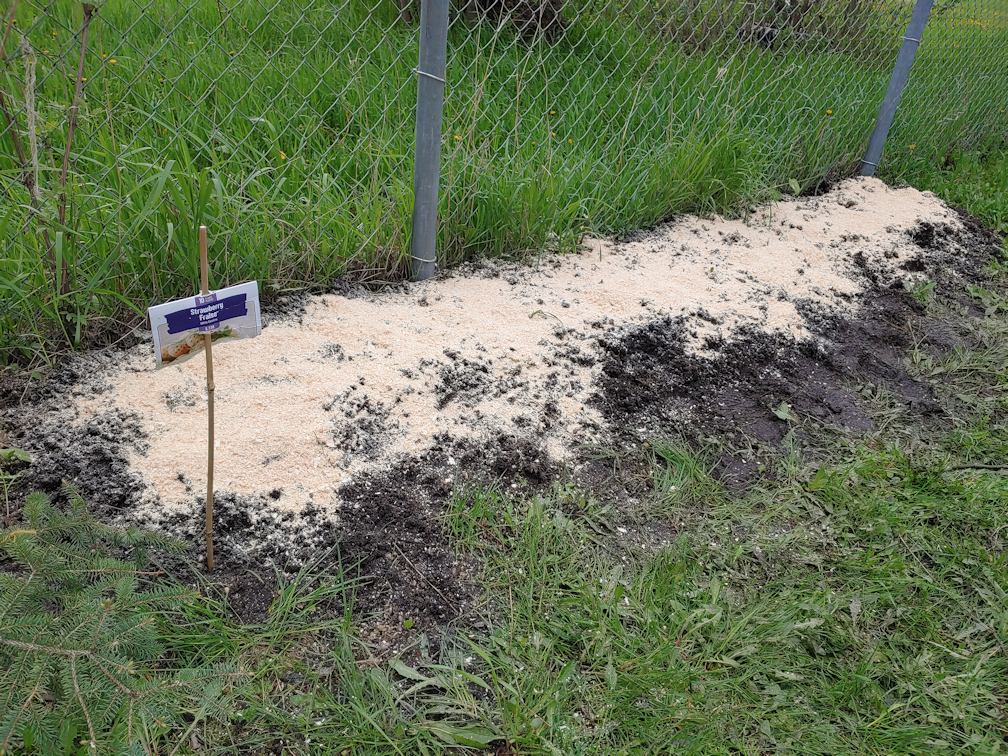
It needed a bit of weeding, then my daughter planted the white strawberries, which had 10 root stocks in the package. They are lightly mulched for now, and will get more mulch after they have grown fairly large.

She also planted the red strawberries.

I’ve read the strawberries and asparagus grow well together, so they went into the purple asparagus bed. This had a heavy straw mulch which got pulled off completely. After finding where the asparagus were (you can see some of them in the photo; the heavy mulch blanched them somewhat), my daugher weeded around them as best she could, then transplanted the strawberries where she could be sure that no asparagus would be growing through them.

One of the strawberries has already started blooming!

The bed got mulched with wood shavings, then some of the old straw mulch got places around it, partly to keep the weeds down, partly to hold the soil in place, and partly because the soil around the bed is so buddy. It will get more mulch later on.

After all the potato planting, I was tired, but I couldn’t help myself. I had to do one more.

The bed next to the asparagus was planted with strawberry spinach last year, but all we got was weeds. I pulled as many of those as I could, then grabbed the package of sunchokes.

It was a package of 10, with some of them quite large, and others being just little nubbings!

Some were starting to sprout already.

These got planted at a depth of 3-4 inches.

They also got a layer of wood shavings for mulch, and the rest of the old straw mulch from the asparagus and strawberry bed got placed around the sunchoke bed. For this spot, not only was the surrounding soil muddy, there was standing water in places!

These beds are planted with things that can be largely ignored. The sunchokes can be treated as a perennial, depending on how we harvest them, and need little care and maintenance. We hope to propagate the strawberries over time but, for now, we can allow their runners to spread a bit, around the asparagus. We’ve got two more years before we can harvest any asparagus, so the whole bed is pretty low maintenance right now.

It’s supposed to start raining lightly tonight, then all through tomorrow. If I’m able to pick up the trees on the way home from my mother’s, we might get them in right away, even in the rain. It depends on whether they’re still frozen or not. We also need to get the grow bags ready for the sweet potato slips, which really need to be planted soon. We might be getting a rained on a bit, tomorrow!

Over the next few days, we are expected to warm up, but the overnight lows are still expected to be just above freezing. That will give us time to prep a few more beds, though we could start transplanting some things, as long as we include something to protect them from the chill nights. The heavy mulch in the beds the potatoes are in will also help protect anything we transplant into them.

There is still so much to do! But I’m glad that we at least had today to catch up a bit.

The Re-Farmer

Our 2022 garden: peas, carrots, turnips, onions

We got some gardening done! There was a break in the rain and we quickly headed out.

My daughter had the bigger job to get the peas in. We’ll be using the pea trellis we used for the purple peas last year, as we still need to do some work on the other trellis frames. The ground was prepped in the fall, but she had to work through it to pull weeds that were trying to reclaim the space, first.

Now it just needs to have some of the wood shavings, or maybe the stove pellets, added to protect the soil surface from crusting. It’s a light enough mulch that the seedlings won’t have trouble pushing through.

The edible pod pea packet turned out to have very few peas in it. Those are between the two labels on the front left side of the trellis. The rest has pod peas in sown. There are still some seeds left of those, which will probably be planted in with the corn.

This should be the last year this trellis, and the nearby beds, will likely be used for gardening. If all goes to plan, next spring, we’ll be planting food trees here. :-)

While she worked on that, I seeded the bed that was already prepped and mulched with the stove pellet sawdust.

My priority was to get more carrots planted, as they should have been started a while ago. I marked out short rows (making things more like square food gardening), as well as a perimeter line. I started with the Black Nebula carrots. The packet had a nice amount of seeds, and it filled about half the bed, which is about 14-15 ft long. Next, I planted the Uzbek Golden Carrots, which came as a freebie from Baker Creek. There were very few seeds in the freebie packet, and I was only able to plant 4 short rows. For the rest, I planted the Gold Ball turnip, which we got as a freebie from Heritage Harvest seeds, and the Purple Prince turnip at the far end of the bed. I still have some Purple Prince seeds left, but the others in the bed got used up.

We planted the last of our onions started from seed already, so for this bed I used the onion sets I picked up at the grocery store as back ups. I got two boxes of yellow onions – no variety name is on the box – and it took almost all of them to fill the perimeter at 3-4 inches apart. The bed got hosed down to settle the soil over the seeds and onion sets, then support posts were hammered into the ground to hold the netting, after cord is strung through the holes in the posts, and crisscrossed over the middle. This bed will not be getting anything else added to it, so it can be covered sooner rather than later. The other beds have room for transplants in their middles, so they will get their net covering once that is done.

In planting the onions, I naturally was able to grab the biggest sets, since they tended to be on top, so when the bed was completely surrounded by onion, I had a pile of tiny onion sets left behind.

Well, we can’t let those go to waste!

They went into the retaining wall blocks. Two already have shallots in them. After pulling weeds and roots from the empty blocks (the others that look empty had mint transplanted into them in the fall) and adding the wood shavings, I had 6 blocks ready. I was able to fill 5 of them; 4 with 4 onions each, and one with only 3. That one block at the side is still empty. There is a matching block at the other end that doesn’t have anything planted in it, but it looks like it has chives coming through!

We have one box of red union sets left. Depending on where they end up being planted, if we have any left over, I’ll be finding space of them here, too.

The bunching onions planted in the bed along the retaining wall are still looking wimpy after transplanting. Hopefully, all these onions will make things too stinky for the grogs to want to go after the lettuce and beets. A groundhog could easily tear through the net, if it really wanted to. It’s going to be the big garden area that will be the most difficult to protect, however.

~~~pause for real world interruption~~~

My older daughter and I just finished bringing the transplants in. We have so many strong, healthy tomatoes! It’s going to be a challenge to plant them all, since they’ll mostly be going into new beds. Maybe that’s where those grow bags and fabric raised beds will be the most useful!

We’ve got our work cut out for us, but I don’t know how much I’ll be able to do tomorrow, as I’ll be heading to my mother’s to help her run errands. She is suddenly taking her back no longer hurts – I guess it took that long for the meds to have their effect, but she still says that when she takes them, they do nothing. She feels up to going out for her errands, though. She has her telephone doctor’s appointment, so I will probably go over there early enough to be there for her appointment, in case she needs things explained to her.

The question for me will be, can her car make it through that one muddy spot on the road? I might have to take the van, even if my mother will need a stool to get in and out!

The Re-Farmer

Our 2022 garden: beds prepped, spinach, onions and turnips sown

With a steady rain all night, we’ve got a lot of standing water and mud in the yard again. The straw mulch where we will be planting our 5kg bags of potatoes got well soaked, though, so I don’t mind.

This afternoon, I finally had a chance to work on the garden again, and I’ve got some thing figured out, too.

The spinach sown in the high raised bed has started to sprout. There was room for one more row of spinach, so that got planted today.

Then it was time to work on the low raised beds.

We are well behind on direct sowing our cool weather crops, so I focused on the 2 1/2 low raised beds that my daughter and I had gone through, pulling out as many roots and rhizomes as we could. A few that we missed started growing again (there will always be some of those!), so I pulled out some more, before leveling the beds out. I decided to use the stove pellets as mulch for these beds. After leveling the soil in one bed (the back of a fan rake is great for leveling the soil), I’d scatter some pellets as evenly as I could over the bed, soak them with the hose, then work on the next bed. It generally took about 3 soaks before the pellets had expanded and broken up enough to be spread evenly with the back of the rake.

It always surprises me just how much sawdust is packed into those tiny pellets!

Once those were done, I gave them one last spray with the hose, then moved on to what will be a deep mulch bed for the 1kg package of potatoes. We had considered planting those in the low raised bed by the compost heap, but have decided the kulli corn will go in there. It’ll be easier for us to put a barrier around the wooden frame to keep the critters out. Potatoes need no such barrier.

In our second summer here, we started preparing an area for future gardening by mulching the area heavily with straw, and trying to kill off as many weeds as possible. You can read about those preparations here, here, here, and here.
Yeah. It was a big job, spread over months.
The next summer, we had our first garden, and all along the north side, we planted a row of birdhouse gourds. We’d started them indoors, but I thought our last frost date was May 28, the same as a town to the east of us, only for us to get hit with a frost on June 2 – which was the last frost date for a town to the north of us (our own little hamlet is too small to be on any of the frost date lists). The gourds didn’t really survive, and since then, this particular area has not been planted in.

The straw you see raked aside in the above photo has been there for 4 years.

The area was still mostly clear of crab grass, though I spent some time pulling those out. With the straw layer, the rhizomes tended to be running across the surface of the soil, so that made it easier to get them.

I knew we had a few moving boxes left in the basement. I thought there was three left, so I cleared an area to roughly match how much I thought those three boxes, opened flat in a single layer, would cover.

I was wrong.

There was 5 boxes left, so I laid them down folded in half, to get a double thick layer. This should be more than enough for the smaller amount of potatoes.

After soaking the cardboard, I put most of the old, wet straw back, then topped it with some newer straw to get a good, thick later.

This bed is now ready for potato planting.

While I was working on this, the girls got the fire pit going, and I finished just in time for a wiener roast. :-D

We’ve used that fire pit in the past month, almost than we’ve been able to in the past 4 years. No fire bans, this spring!

After the girls made sure I was fueled up, it was back to the low raised beds. Time to do some planting!

Look how big that garlic is!! They are just thriving, here.

For this half-bed, I marked out a grid, but planted in rectangular boxes. I started with some spinach – a variety called Space – planted around the middle of the bed. There are still some seeds of this spinach variety left, if we want to sow some for a fall harvest.

One those were in, the outer perimeter, I planted some onions. These are Red of Florence; the last of the onions we started from seed.

The centre of the bed was left empty. Later on, we’ll put in plants that we won’t be harvesting leaves from, or harvesting many times. Perhaps we’ll put some eggplants or peppers in the middle. There’s room for only a few plants in this half-bed.

There will be more room in the next bed.

The centre row was marked, but nothing is planted in it. On one side of the centre line, a third variety of spinach, Lakeside, was sown. On the other side, Tokyo Silky Sweet turnips were planted. Then, all around the perimeter the last of the Red of Florence onions were planted.

The onions being planted around the perimeter like this is to dissuade critters at least a bit. That is not our first defense, though.

These will be covered with netting. I’m not sure the bamboo stakes will hold those hoops very well, though. Trying to push them into the ground, I kept hitting rocks. In one spot, right at a corner, I just couldn’t get around a rock, so that one is more shallow than I would prefer. A couple of stakes broke while I was trying to push them into the ground. Since I couldn’t get them very deep, I ended up having to break the tops off of the rest, to be able to put the hoops on them.

Later, bamboo poles will be tied to the centre of the hoops to hold them steady and hold up the netting when it’s added on. Not until after something has been transplanted in the middle.

For the long bed, I grabbed pieces from the canopy tent that was dismantled. Those were easier to pound into the soil. Literally. I had a piece of would I could use as a mallet, and got them in pretty deep.

With the logs bordering the bed, the supports aren’t spaced very well. For the ones in the middle, most had to be squeezed into the spaces between logs. Which is fine. After something is transplanted in the middle, cord will be strung through the holes in the supports around the perimeter, then criss crossing across the middle to support the netting. With them so oddly spaced, it’ll be wonky, but it’ll work.

The ground staples will be used to tack the net down , but we still want to be able to easily life the sides, to harvest greens as needed.

The third bed was left for tomorrow. We have 2 more varieties of turnips to plant, or I might do carrots, first. They should have been sown about a week or more ago!

Beds will continue to be bordered by onions from sets. I’ve got 2 boxes of yellow onions and one of red onions, so there is plenty to go! :-)

The other thing that really needs to get done are the two varieties of peas. Hopefully, it won’t get too hot for peas over the next while! Meanwhile, we need to get those potatoes into the ground.

The next few weeks are going to be very busy in the garden! Lots to go in, in a very short time.

The Re-Farmer