We have a couple of hot peppers developing, just on one plant so far. I also spotted our first corn silks this morning!
I found some new female winter squash and a pumpkin blossoming and hand pollinated them. Today was the first time I found a female squash blossom in the squash bed with the corn, which got transplanted after the ones with the peas and beans. The area around the pumpkins and winter squash is getting hard to walk through to water, the vines are getting so big! I need to find a way to set up supports for the hose above ground at each bed, so it doesn’t get dragged on top of the vines. I really should have set up the soaker and sprinkler hoses around the beds before they got so big.
Quite a few things that were looking wimpy and behind are starting to perk up, too, like the last onion transplants and the melon bed. Most of the tomatoes are getting big and bushy. I have not been on top of the pruning this year and, at this point, don’t really intend to do much of that. I’ll take off some of the lower leaves, but the stalks that grow out of the leaf “elbows” just got away with me. I figured I may as well leave them, since they will produce fruit. The black cherry tomatoes are vining so tall, the double lilac bush with branches above them is actually helping to support them! That group will need extra support around them, though.
The tomatoes growing in the concrete blocks, both at the chain link fence and the retaining wall, are not getting bushy, though. They are starting to produce tomatoes, but the plants themselves are not as strong and bushy as the others.
I’m going to have to rethink what we grow in those blocks. Perennials like the mint and chives are doing great. We did successfully grow cucamelons in the retaining wall blocks, though their vines remained spindly. They did not do well at the chain link fence. Onions and shallots don’t seem to do well in them, either, which is odd considering how well the chives are doing.
So it looks like we should be looking at saving the blocks for things like perennial herbs. The old kitchen garden is meant to eventually be a combination herd garden and kitchen garden, for both annuals and perennials. Basically, mostly things that we’d want to harvest as needed throughout the summer. I want to see if we can grow things like rosemary (which would be an annual, in our short growing season), sage or savory, which we tend to use quite a lot. We know now that chamomile will self seed nicely. We’re not using the thyme we have right now, as we don’t have a lot of it, and I want to see if it will either self seed or survive the winter, if it gets mulched well enough. In the fall, I want to find someplace to transplant those “wild” strawberries out of the wattle weave bed to where we can just let them do their thing.
Ah, the fun thing about gardening. I’m always thinking years in advance!
We didn’t get too excessively hot – our high was 19C/66F – which made a huge difference. As I write this, we’re at 17C/63F, with a “feels like” of 15C/59F. That’s more my kind of weather!
Best of all, we had a break from the rain. We should have another break tomorrow, and then it’s supposed to rain for another two days.
Still, we got enough sunshine to dry some things out.
Today, I wanted to get some direct sowing done – finally!
I decided to plant chard where the spinach is done. That required first removing the netting I set up that turned out to not be long enough to go all the way around the bed. Once that was cleared and put away, I pulled the sad little remaining spinach plants – I wish I knew why they did so poorly! – and weeded the bed. We don’t have a lot of carrots, unfortunately. The cats would go in where there was no netting to keep them out, and use that corner of the bed as a litter box, digging up quite a few carrots in the process. I’d hope to plant more, but it’s too late in the season for carrots, now. Of the overwintered onions that had been transplanted at one end, there are three that survived the transplanting, and they are starting to go to seed!
Speaking of seed, I had both Bright Lights (a rainbow variety) and Fordhook Giant seeds. The cats had gotten into them and chew through the packages, so now they’re all mixed up in the a Ziplock baggie. These are not new seeds, so it will be interesting to see how well they germinate.
Once the planting and weeding was done, I grabbed one of the new nets I picked up at a dollar store and set it up around the bed. I added a couple more support posts around the perimeter. These are salvaged from the frame of a canopy tent a tree fell on, so they all have screw holes in them. Very handy to string line through, to hold the netting in place and keep it from just sliding down the supports! The netting is wide enough that it can reach the trellis netting in the middle, as well as to the ground outside the raised bed. I didn’t bother fastening the netting to the middle, since it’s mostly to keep the cats out. Once the netting was in place, it got some ground staples to hold it down, since it kept wanting to creep back up!
That done, it was time to go to the main garden area, and the last bed that got shifted over. The empty space between the shallots and the yellow bulb onions needed something in it!
The white patty pan and Magda squash that was planted in pots in front of the house did not germinate, so I replanted them there. I also grabbed the G-star pattypan seeds, and planted all three varieties between the onions and the shallots. I used broken bamboo stakes to mark were I’d planted pairs of seeds. I hadn’t pre-soaked them or scarified them, so I made sure they got a deep watering. Then I raked up some of grass clippings and used it to mulch around where the seeds were planted. Then I dampened the mulch, too!
I completely forgot that I wanted to replant the Seychelle pole beans by the Crespo squash. I can do that tomorrow. It’s really late for pole beans, but I’m going to take the chance.
Aside from that, the garden is now finally all in! There are no other beds to plant things in. That will be our next focus: build more beds for next year! Especially the trellis beds. Plus, of course, harvesting more dead spruces to frame all the beds.
Once that was done, I tended to the tomatoes in the old kitchen garden. I didn’t bother taking pictures, since it’s hard to see. They’re starting to get big and bush, and starting to flop. So I grabbed some jute twine and wove it around the pairs of bamboo stakes at each tomato plant, and the tomato stems in between. That was more finnicky work than I expected! The leaves are so dense the jute twine is mostly hidden, but it’s doing its job, and holding the vines up between the support stakes.
I also took some video of the raised beds that got shifted over. I’m planning to do a progress video. I was going to do it tonight, but I’m falling asleep at my keyboard, so I think I’ll call it a night, and work on it tomorrow.
All in all, it turned out to be a decently productive day! Not bad for it starting out as such a bad pain day, this morning. Not bad at all!
I was very happy for a pleasant breeze to cool me down while I was working. I got the last of the bed turned and weeded, the boards laid out to mark where the log frame will go, and the soil evened out and leveled off as best I could.
Since I was wanting to finish off the onions and shallots, I decided to work in a grid instead of rows. I marked off 5 rows lengthwise first,, about 3 or 4 inches apart, then made cross rows, also every 3 or 4 inches apart.
Once the lines were marked out, I used the jet setting on the hose to drive water into all the marked lines. It makes it messier to transplant into, but it evens out the soil and gives deeper moisture for the roots to reach for.
After that, I just laid out the transplants where the lines crossed, starting with the yellow bulb onions at one end. I got to about half way down the bed, maybe a little more, before I finished them. Then I planted the shallots at the opposite end. Last of all, I used the grass clipping mulch I’d removed earlier today, to scatter a light mulch around the transplants.
I was very happy to see that this left me an open space where something can be direct sown. I’ll go through my seeds to see what I’ve got that will mature in less than 2 months, since we basically just have July and August left for a growing season.
This is really late for onion transplants. My intention had been to interplant them with other things, but that doesn’t really work out with the winter squash and melons, since those will get bigger and overshadow the onions. At least I got some in with the tomatoes.
We shall see if the weather holds long enough for all these onions to fully mature!
I’m now going to let my self breathe for a bit. I have some direct sowing to do, including where the spinach was planted, and that’s about it. After a break, I’ll get back to working on the trellis beds. Hopefully, we’ll dry out a bit and the winds will die down, and we’ll be able to harvest more logs for the raised bed frames. The forecast of rain to start this evening and continue for about 4 hours has changed. Now it’s saying we’ll get some rain for about an hour, around 10pm. On Friday, though (today is Tuesday), they’re still saying rain all day, starting about 5am Friday morning, through to 1am on Saturday morning. Aside from the brief rain we’re supposed to get tonight, though, we’re not supposed to get any rain at all until Friday.
I might actually be able to do some mowing! How exciting!
I don’t know why Instagram now cuts the sides off my photos, even though I select the wide image function.
I got about half way through the bed, sifting the soil, when I stopped for a break that ended up taking longer than I intended. Which is okay. It gave the soil I needed to move time to dry out a bit. Sifting damp soil is a lot harder and heavier. I’m amazed my home made soil sifter is still surviving the abuse!
By the time I was done fighting with my garden tour video and getting it uploaded, it was quite a bit later before I could get back at it. Thankfully, today has been cooler, with a pleasant breeze. I was greatly appreciating that!
The last bit of soil that needed to be worked on was the worst. This was the section full of creeping Charlie, and I was digging up and tossing large clumps of it. In the end, by the time I finished sifting the last of the soil from the old bed location, there wasn’t enough left to finish the new bed location. I ended up “stealing” soil from the last bed that will be worked on.
By then, it started to rain, but it was just a gentle shower, so I kept at it. Once the bed was done, I brought over the melons. I’d already gone through them and sorted them by type. I kept the Zucca melons aside, since they get huge. I’m thinking of using the kiddie pool as a raised bed, just for them, and setting it somewhere where they can spread.
There were a total of 16 melons to transplant, and I decided to dedicate the entire bed to them. I don’t know that we’ll be able to trellis them, since they will need stronger trellises than what we’re setting up for the beans and peas. If we end up not being able to add trellises, they should have room to spread on the ground and into the paths, if need be.
So this bed now has two rows of eight melons in it. As with the other squash and melons, I planted them slightly below grade and made hills of soil around them, so water would flow towards the plants rather than run down the sides of the bed and take the soil with it. The rain had pretty much stopped by the time that was done, so they got a good watering, too.
The bed still needs a mulch added to it, but it’s getting late, so that will be done tomorrow, when I will also started working on the next bed. That one needs to be shifted a lot, too, but it’s not as weedy and isn’t infested with creeping Charlie like this one was, so it should go somewhat faster. The hard part will be breaking the sod in the new location – and I don’t have anymore carboard that can be put over it, before shifting the soil on top.
This bed is where the last of the San Marzano tomatoes will finally be planted. There aren’t a lot of those left to transplant, so there will be room for other things.
Hmm… I should probably set up the kiddie pool and fill it with soil for the Zucca melons, first. They need to be transplanted more urgently than the tomatoes. That means sifting several loads of soil from the pile in the outer yard.
Once the transplants are in, I hope to be able to do some direct sowing, still. It’s getting really late for that. Our first frost date is September 10, so we’ve basically got July and August for things to grow, since if I plant things within the next 7-10 days, they will take the rest of June just to germinate.
What we don’t have a lot of is stuff that can be harvested throughout the summer. I’ve got three types of beans planted, and the very first Seychelle bean was sprouting this morning. The sugar snap peas are going to be awhile before there’s anything to harvest from them. The spinach is doing so poorly, I’m thinking of taking them out completely, and planting some chard or something, instead. I think it’s getting too late to plant more carrots, but I’ll check the information on my packages to be sure.
What I will likely do is direct sow more summer squash, since right now we just have some in pots. They haven’t germinated yet. Since summer squash gets harvested while still quite small, planting them in late June should be okay. As long as I can keep the slugs away! I haven’t actually seen slugs yet, so hopefully, we won’t have a bag year of them, like we did last year.
We shall see how things work out! Hopefully, we’ll even get weather that will allow us to harvest more dead spruces and build the frames around these beds, and maybe even continue the trellis beds, by fall.
Much work to be done.
It’s a good thing I love this kind of work! Even if I do have to pain killer up for it.
Speaking of which… time to do that, before this broken old body starts to seize up! 😄😄
The first thing to do was mark off the centre of the bed, then space out the 7 “Wild Bunch Mix” winter squash transplants I had left. As with the others, I transplanted them by first digging the holes, filling them all with water, then planting the squash slightly below grade, to keep any water from running off.
That left fairly decent sized gaps between each plant, but was it enough for the corn I had? Or did I have enough corn seeds for the space? I had only one package of Yukon Chief corn. From the Heritage Harvest website…
Introduced in 1958 by Arvo Kallio of the University of Alaska, Agricultural Experiment Station. Yukon Chief is one of the earliest Sweet Corn varieties available maturing at just 55 days! The yellow cobs average 5” in length and the plants grow about 4’ tall. Highly recommended for cool, short season areas! (55 days to maturity) (50 seeds)
(image belongs to Heritage Harvest Seed)
Fifty five days to maturity is amazing!
But 50 seeds to a package?
I took them out and counted them. I counted about 80 seeds!
I say “about” 80, because some of them were really small and probably shouldn’t be planted, but they would be, anyhow. 😄
I decided to pre-soak them for a little while, and misted the other beds while I waited. The other beds didn’t really need a watering, but a misting would be good in this heat. I’m happy to say the melons that looks so wimpy, yesterday, have already perked up. They might all actually survive! The mosquito netting over part of the row was drooping a bit, so I adjusted the hoops in the middle, then used the weights on the sides to pull the netting tighter. The netting is there to protect the transplants from heavy rain, and won’t be there for long.
I decided to mark out three small trenches between each winter squash, then used the jet setting on the hose to drive water deeply into each trench. As with the squash, I wanted to plant the corn seeds below grade. To start, I set out four of the largest corn seeds in each trench then, at the end, divided the smallest seeds wherever there seemed to be a bit more space. Yes, this is closer than is recommended for corn to be planted, but I don’t expect a 100% germination rate, and some will likely be thinned out, later. The main thing is, they are clustered together so the wind should pollinate them more easily.
Once that was figured out, I just pushed the seeds down to planting depth, then watered the entire bed, to settle the soil around the seeds and the squash roots.
Last of all, I grabbed the wheelbarrow and brought over some grass clippings to mulch the sides of the soil mound, and closer in around each squash plant. Aside from the usual benefits of a mulch, this will help keep the sides of the soil mound from eroding down.
This bed is now finished! The boards can now be removed and used to mark out the next bed I’ll be working on.
Which is going to be a huge shift. The bed is not only far to one side of where it needs to be, but it’s at an angle. The north end of the bed is completely in where the new path will be, while the south end is about 3/4 in where the path will be. Shifting this bed is pretty much building a whole new bed from the ground up.
*sigh*
It will be worth it, in the end, but my goodness, getting these beds into their permanent positions is a huge job. The rain and the heat certainly aren’t helping any!
But, we have one more bed done and planted. Progress has been made! Once everything is planted, then we can shift over to harvesting more dead trees to frame the beds.
Looking at the forecast, we aren’t expecting rain until maybe Saturday night (it’s Thursday, as I write this), which means we might even be able to get more lawn mowed!
Ugh. Our temperature is now 21C/70F, with the humidex at 26F/79F.
In other things, before heading into the house, I checked the garden shed. This time, without knocking, first. I startled Broccoli and her kittens. She and the black and white ran off to the back of the shed, but the calico didn’t. I was able to pick her up and cuddle her. They haven’t been using the cat bed, so I checked it out and found a mess in it. I was able to clean it up and set it back, though, as well as straightening out the self heating matt and the felt grow bags they are using as a nest. The calico wasn’t happy with me but, after a while, she did seem to be okay with the cuddles! I was just happy to see her. I’d seen Broccoli and the black and white kitten outside, earlier, but didn’t see the calico. With yard cats, that could mean a lot of things!
Now, if we could just convince her to bring them to the sun room, too!
I didn’t get all the stuff on my list done, but my goal was to get most of it, and I managed that!
I had intended to start earlier in the day, but ended up unable to sleep for some reason, until about 5 or 6, when I got an hour or so of actual sleep. Not very good sleep, though, as I had several cats draped over me, and I really, really needed to pee! 😄😄
By the time I got out, it was coming up on 9am and starting to get warm already. The first job I did was work on the trellis bed, which needed a serious weeding before anything more could be done in it.
We are starting these beds out at two logs high, and they will most definitely be made higher, over time. It didn’t take me long to realize I needed to use the scooter, to make the weeding less painful. This is the first time it’s been used since last year, to all the tires needed to be pumped up.
This bed has the onions transplanted out of the bed that now has winter squash in it, as well as a few I found in the other bed that was shifted over, but has not been planted in yet. These onions are doing very well! As these had over wintered, they should go to seed this year, which would be awesome.
All along one side, where a permanent trellis will be built in, I wanted to fit as many of the Summer of Melons Blend transplants as possible. This bed is a little messed up as, on what will be the trellis side, the bottom log is bowed inwards. This works out to ensure the vertical trellis supports will be even with each other, but it means that we loose several inches of planting area. With that in mind, I used a couple of stakes to mark the ends of where the row of melons would be, then used another stake to mark a line from one to the other, far enough in for the melon roots to have space.
We had some packages delivered yesterday, so I had some packing paper and cardboard that I could lay down between the markers.
The next part was the most difficult. Getting the transplants out of the large celled trays and so I could space them out between the markers.
With other things I grew in the large celled trays, I didn’t have too much trouble getting them out. Their roots held things together enough that, usually, I could loosen them by squeezing the cells a bit, then pull the whole thing out by the plant stem.
Not with these melons!
Their stems and roots are way too fragile. Plus, as I tried to push the soil and root cluster out, the soil (seed starting mix, actually) would start to break apart. With some, I had to use a narrow trowel to scoop it out. When it got to that point, there was no way that the roots could not be disturbed quite a bit!
Interruption! I ended up going into town. My husband needed something, but I also ended up getting Dairy Queen to bring home. I was too tired and sore to cook, my younger daughter is caning it and can’t stand long enough to cook, and my older daughter became ill during the night and still feels unwell! I headed out just in time; the rain hit while I was on my way home. I was just getting in the driveway when the radio started blaring an emergency alert. Parts of our province was under a tornado watch, and the weather office was tracking some. Not anywhere near us, though. We’ve got a bit of a break in the rain as I write this, then start up again at around midnight, and keep raining for about 6 hours!
Now… where was I? Ah, yes…
So getting those melons out of the tray was not a good thing for those roots! I would not be surprised if we loose some of them.
Because we will be training the melons up a trellis, I was able to space them closer to each other, getting 17 transplants laid out. That leaves another 4 transplants in this Summer of Melons Blend that still need to be transplanted.
Once I figured out where they were going, I cut through the packing paper and cardboard and found the line I’d marked out earlier, to dig the planting holes. Once the holes were all watered and the melons transplanted, I made use of the bark I’d taken off the logs for the bed the winter squash is in, to weigh down the paper and cardboard mulch, so it won’t blow away. Then everything got another thorough watering.
That left a section on the other side of the bed to plant in. I decided to put bush beans there, and planted the Royal Burgundy seeds. It’s not a large space, so there were seeds left over that we might plant somewhere else. Grass clippings were added on either side of the row for mulch.
That bed is now done!
The next thing on my list that I decided to do was to work on the bed with the winter squash. I used a stake to mark out a little trench to plant in, on either side of the winter squash and their grass mulches. Since the bed’s frame is not going to be complete for a little while, yet, I needed to make sure they weren’t too close to the edge of the soil mound. On one side, closer to the high raised bed, I planted the Dalvay shelling peas. We have quite a lot of seeds. I spaced them 4-5 inches apart, and had lots left over. After pushing the seeds into the soil, I made sure to cover them in such a way that there is a soil “wall” on the outside, and there is still a bit of a trench for the water to collect in before being absorbed.
I did the same on the other side, with the Carminat purple pole beans. I didn’t have as many of those left, so they were planted more like 6-7 inches apart. When I finished the row and still had a few seeds left, I went looking for spaces that looked a bit wider and added them there. We no longer have any Carminate pole bean seeds left!
The seeds planted and watered, I grabbed a bundle of bamboo poles and set up 5 to each side. After the beans and peas have germinated, we will add netting to the bamboo poles for the peas and beans to climb.
This bed is now done. At least, when it comes to planting!
After that, I took a hydration and sustenance break. While I was doing that, my younger daughter headed outside to try and get some lawn mowed. Even after waiting until noon, that grass was still so wet! That’s not even taking into account the low areas where standing water collects. There were whole sections she had to just go around and leave alone.
It may be making things hard to mow, but the gardens sure love it! All the stuff we planted previously is doing really well.
When I got back outside to continue working in the garden, though, the poor melons were looking pretty limp! Aside from the obvious transplant shock, we were reading our high of the day. I ended up misting them a bit to help relieve them from some of that heat!
I decided the next thing that needed to be done was to get the drum gourds and pumpkins planted. They are the largest transplants, and needed to get into the ground faster.
In the space in line with the high raised bed, we’d made a pile of grass clipping mulch. Most of it was used throughout the garden last year, but there was still some grass clippings and shredded paper mulch left. I raked what was left aside, clearing a rectangle about the same length and the high raised bed. Eventually, the high raised bed will either had a matching bed near it, with a space between them, or we’ll just add a new bed attached to the current high raised bed. I haven’t decided, yet.
With a garden bed planned for the area already, I figured it would be a good place to build squash mounds, which can be incorporated into whatever bed we end up building there.
I just had to sift some more soil from the pile in the outer yard.
I made three mounds of soil. Each of them got a gallon water bottle with its bottom cut and no caps, placed upside down in the middle. They got filled with water to slowly drain.
I had two pots with the pumpkins from the free seeds we got at the grocery store by my mother’s place. They have grown so much!
I also had two pots of drum gourds, but each pot had two very strong and healthy plants in it. What a difference from last year, when I ended up replanting them, several times, and ended up with none!
As expected, when I took them out of the pots, there was no separating them. Their roots were just too entwined. So I kept them together, but after planting them, I gently teased the stems away from each other. As they grow, I want to train them to run in opposite directions.
Once they were all in, the grass clipping mulch that had been raked aside was drawn up and around each mound.
And I was done for the day!
Well. Almost.
My daughter had done as much mowing as she could and gone inside. I sent a message asking for a hand with my next task, only to see her come hobbling along with her cane! She was in a world of hurt. 😢
With the possibility of thunderstorms tonight, I’d set up the support hoops for the row “greenhouse” I’d picked up at a dollar store to try. The set came with a plastic cover, but I wanted rain to get through. I just didn’t want the little transplants to be battered with rain!
So I brought out a roll of mosquito netting to put over the hoops. Unfortunately, the netting wasn’t long enough to cover the entire row of melons. We ended up moving the hoops a bit closer together, and set it up over the end where the transplants seemed to be needing the most protection. Once the netting was over the hoops, we used bricks, boards, branches – anything we could find, to weigh the edges down.
By the time that was done, it was just too hot to keep going. Still on my list was to plant onions or shallots in the high raised bed, around the peppers. There’s also that second shifted bed that needs to be prepped for planting.
We still have 4 Summer of Melons Blend transplants, but we also have another 15 pots with melons we actually know the names of Plus, there is still 7 winter squash to transplant, and a few tomatoes. Anything else would be direct sown.
If all goes well, tomorrow my priority is to get the shifted bed prepped for planting. I have decided to get the last winter squash transplanted. There will be more space between them compared to the other bed, which I plan to take advantage of. I have a variety of sweet corn that is only 55 days to maturity, so I will plan small groups of them in between each winter squash.
Once those are in, the next three beds need to be weeded and shifted over. We’ve got plenty of melons that will need to be transplanted, including a couple of Zucca melon. I will find a way to give them their own hills to grow on, since their fruit can reach 60 pounds in size. The rest of the melons will be need trellises to grow on – and I’m starting to run out of takes!
We also have the last, sad little San Marzano tomatoes to plant, and last of all, all the onions and shallots will get tucked away, in between other things.
Once all the transplants are in, I went to direct sow more summer squash. I also want to plant more carrots – it’s probably late for those, but I’ll try , anyhow. I’ve got yellow and green bush bean seeds, too, if there’s room for them.
I’m actually starting to see a light at the end of the tunnel!
I just have to make sure not to push myself too much, though, so I don’t have to take more days “off” to recover!
I headed out nice and early this morning, while things were still nice and cool, to do some transplanting. I actually have some time to write this before I need to go to my mother’s, too!
The first priority was to get as many of the winter squash as I could fit into the bed that was prepared last night.
I brought all the transplants over, so I could pick and choose among them. The largest plants, and the ones in pots that were starting to fall apart, were the priority. I set a couple of markers to help me keep track while making the centre line.
The lower the bed, the further the reach, though. I had to use another plant stake to reach the middle and mark a line in the centre. Then I took the two biggest plants and set them at the ends, about a foot or more away from the short logs, then another bigger one in the middle. Once those were in place, it was easy to eyeball how far apart to set the others. I was able to set out 9 pots, roughly 1 1/2 feet apart.
Once I knew where they were going to go, I dug holes large enough for the pots, then filled each one with water. The one thing I did NOT do was amend the soil with sulfur granules. If I’d remembered, a good time to do it would have been last night, when I was using the garden fork and the rake. I was working by hand this morning, and just didn’t have the reach to work anything into the top 6 inches in the middle.
These winter squash are all in the biodegradable pots, which don’t really degrade very well unless they get – and stay – really wet. So when I planted the squash, I broke off the bottom of the pots, then worked a split up a side, before putting them into the ground. Once in the ground, I set them a bit lower, then made a sort of dam around them. This way, when they are being watered, the water will pool in the lower area and get absorbed into the ground there, rather than run off to the side somewhere.
Later, a mulch will be added around each transplant. I’m still planning to put beans and peas on the sides, and more mulch will be added after that. All while still making sure to stay clear of the sides, since the logs will be adjusted as they are permanently set in place and attached to each other.
That done, it was time to move to the high raised bed.
It had a light grass clipping mulch on it, and some weeds that needed to be cleared away. I am SO loving that cheap little hand cultivator I got at Walmart. It really makes loosening the soil and getting those weeds out much easier. I can even use it with my wonky left arm. Not for long, mind you, but enough to give my right arm a bit of a break.
What a difference with a high raised bed, though! I worked around both sides but, if I wanted to, I could actually reach all the way across the bed, without too much difficulty!
Once the soil was loosened and weeded, I used the back of the thatching rake (which I think is actually called a landscape rake, these days), to level and move the soil. For this bed, I built some of the soil up against the edges and packed it down a bit. Again, this is to control the flow of water. I want the water to flow towards the middle of the bed, not down the side walls. That done, I loosened the soil in the middle some more. This time, I did work sulfur granules into the soil.
Then I rigged the hose up to spray over the bed and give it a super deep watering while I put the remaining winter squash transplants back with the others (there’s 7 left, plus one that doesn’t look like it’ll make it) and go through the peppers.
I brought over a tray with the three early varieties of peppers that we have. There turned out to be three of two varieties, and four of another. I set them out in groups apart from each other, but there was so much room in between them, I decided to get the other bin of peppers. There were only pots with Purple Beauty in them. One had two seedlings, and I pulled the weaker one. The other three pots had Sweet Chocolate peppers in them. Two had pairs of seedlings and, again, I pulled the weaker ones.
So the high raised bed now has all peppers in them. Later on, I plan to plant onion transplanted around them. For now, however, they are protected by one of the raised bed covers. It won’t stop the cats from getting in, but it will deter the deer!
Then, because I can’t just toss away seedlings, even if they were thinned out, I found space in the wattle weave garden to transplant the two Sweet Chocolate and one Purple Beauty seedlings.
So that is done for now!
Hopefully, we’ll get more in this evening, when I’m back from my mother’s, and after things cool down again. It’s 17C/63F as I write this, with the humidex putting it at 21C/70F. Our high of the day is supposed to be 21C/70F
At the very least, I want to get mulch around the new transplants. We’re supposed to get rain starting around 10-11pm until 7am, so I’d like to protect them as much as possible, since we don’t have the protective plastic rings around these ones.
Okay, I am totally beat! It’s so hot and muggy out there, I had sweat dripping onto the lenses of my glasses while I worked. We’re at 21C/70F, with the humidex putting us at 26C/79F, and we haven’t even reached our high of the day, yet!
But, I got the third raised bed in the east yard planted, and I’m done!
I also took a chance on an experiment that has the potential to be a complete disaster.
Before I could even start, though, I had to deal with the water. There’s so much of it flooding the east yard, the the boards forming the path next to the bed I needed to work on, were floating. The year we put those in was a drought year, and we had no idea it would collect so much water! The path on the other side of the centre bed is gravel, though there isn’t enough of it. We were planning to eventually get more gravel from the pit, but I have no idea when we’ll be able to head out there to get a load with the truck. We do, however, have plenty of wood chips.
There’s too much water to use the weed trimmer around the beds, so I pulled them by hand. Then I filled our wheelbarrow as much as I could without spillages, three times. That path needed a really thick layer to weigh down those boards and get above the water. With the last load, I could add some to one end, and a bit around the other side. Eventually, more will be added, but for today, I just needed to be able to access the bed without trying to walk on slippery, floating boards!
Then I began the first part of our experiment. I needed to secure the box frame so that it wouldn’t blow away. I’ll explain why that can be good, or really bad, later! For that, I drove some posts salvaged from the Walmart market tent we had, until a piece of tree fell on it, into the soil inside each corner. Then I secured them to the box frame with twine. The box frame is tall enough that I can still tend the bed without needing to move it.
I also used the stirrup hoe and weeded the bed a bit, then started on the eggplant and hot peppers. west end of the bed, I planted the smaller Little Finger eggplants; of the 7 in the tray, two were too small and wizened to transplant. At the opposite end, I planted the Classic eggplant; there were only 5 of those. The last two in the tray died off a while ago. The Cheyenne peppers, however, had all 7 in the tray, though there was quite a difference in size from one end of the row to the other! I planted the peppers in between the eggplant, and the shorter ones on the south side of the bed.
Then, because I had material from the boxes I picked up at the grocery store, yesterday, I mulched the bed with paper. Mostly paper. Each of the boxes had a paper liner, and those are almost enough to cover the entire bed, with some overlap. I cut openings in the paper to go around the transplants. At the very end, after I ran out of paper, I broke down one of the boxes. Those had air circulation holes in them, but I was able to use the flaps to cover those. I ended up using one entire box, plus a couple of extra flaps cut from another one.
Then I got my daughter to come out to help me with the rest of it.
I did remember to bring out some of the supports I have for the peppers and put them in before the next steps. Though the soil was quite wet and didn’t need a watering, we did water the paper and cardboard, so it would settle against the soil more and not blow away while we were working on the box frame.
We took the plastic sheets off the arched covers, then secured them around the top of the box frame. We just used staples for that. The two sheets weren’t quite long enough to go all the way around, so there is a bit of a gap at one corner. We then took one of the arched frames and put it on top of the box frame, and the other over the bed with the German Butterball potatoes (which are coming up now!), mostly for storage. They were just sitting in the wet grass, so this protects them from moisture damage. One had been stored on the box frame, but with the plastic over it, the wind blow it off. That won’t happen again, now that it’s just wire mesh. Once the plastic was tacked into place along the top, the bottoms were weighed down with bricks and boards that we have around those beds, just for that sort of thing. This way, I can still access the bed by lifting the plastic from the bottom.
Adding the plastic around the bed is an idea I got from Maritime Gardening.
Last year we had one surviving Classic Eggplant that did surprisingly well, in the shelter of the wattle weave bed. The Little Finger eggplant were among the things that failed to thrive in the chimney block planters at the chain link fence, that we now know is because of the elm roots getting up into them.
This bed is much more exposed, so I figured they would need extra protection from both the wind, and temperature variations, but of the air and the soil. These plastic walls should help with both. The top is open to still allow rain in.
If we get high winds, though, the plastic around the box frame could potentially become a sail. Hopefully, the frame is secured well enough to the stakes, but it’s entirely possible the wind could pull the stakes out of the ground and the whole thing could go flying.
It’s a risk, but I think it’s worth a try, at least.
So this has been a productive day in the garden. Two types of tomatoes (out of four) are transplanted. Shallots and red onions were interplanted with one type of tomatoes – I don’t plan to have beds of just onions and shallots, but will interplant them as other things go in. Two types of eggplant and the hot peppers are now also planted.
We have one 18′ bed, the high raised bed, plus some space in the wattle weave bed, that’s ready for planting. We can potentially plant in the two shifted beds before they get their log frames. We just have to plant in the middle. Still, this is not going to be enough for all our transplants, never mind our direct sowing. There are three more low raised beds that need to be shifted over to their permanent positions, then they too can be planted in before they get their log frames. Then more beds need to be built, almost from scratch, for the trellis tunnels.
At this point, I honestly don’t know how much of a garden we’ll be able to get in this year. It all depends on how much progress we can get on those beds, in time!
Well, there’s only so much we can do, and there’s no sense fretting about things if we can’t get them done in time for planting this year. Things will continue to expand, year after year, so it will get better.
My eye appointment tomorrow is in the afternoon, and we don’t need to leave until 1pm. I was thinking I’d have time to get more done early, but it’s supposed to start raining in the morning, and keep raining off and on, all day. We are supposed to get almost 2 weeks with no rain after that, though, and even get some cooler temperatures, so that should be time to get things done in the garden. If we can get everything done by the middle of June, that should be enough time for our growing season.
It is really wet out there, but we’re not supposed to get more rain today. I was torn between continuing on shifting the beds or starting transplanting. We have quite a few things that are more than ready to get set out.
After looking at the weather forecast, and the state of our transplants, transplanting won. In particular, tomatoes. It’s either that or pot them up, and that would be a silly thing to do at this, when they would do much better out in the garden.
The first thing I did was go through my trays and see how many I had of each type. When I saw I had 8 chocolate cherry, I decided they should go into the 8 chimney block planters at the chain link fence.
I then cut some of our many distilled water bottles to create rings for the transplants. With my husband needing distilled water for his CPAP humidifier, we have LOTS of these gallon/4L jugs. I had a few rings left over from last year, but a lot of them seem to have disappeared over the winter.
I had some of the tomato transplants in individual pots, and some in a large celled tray. There were three rows of four Chocolate Cherry, Black Cherry and Forme de Couer, and the remaining cells got San Marzano. Those ones are the strongest and healthiest San Marzano. The deep celled tray with just San Marzano ended up in the sun room too early – we needed the space – and has only a few sad tomatoes left.
The tomatoes in the tray were so big and bushy, it wasn’t until I was taking the Chocolate Cherry out (they were in the middle row, of course) that I saw one had died off. I completely forgot we’d lost one in that tray. So, we have 7 Chocolate Cherry tomatoes at the chain link fence, and an open space for something else.
Once transplanted, they each got a ring around them. This is to protect them from the wind for the first while, and from the cats that like to go under the netting. The netting was draped back over the blocks and will remain until the elm trees are done dropping their seeds. As the tomatoes grow, the chain link fence will be their trellis support.
There were 10 Forme de Coure tomatoes, so I decided they should go into the rectangular raised be in the old kitchen garden. This bed already has a soaker hose set up. There is garlic growing down the middle, though not very many. This bed got the last garlic cloves, so some of them were pretty small and did not survive the winter. The garlic will be ready to harvest before the tomatoes are fully mature, so they should be okay together.
These tomatoes got their protective rings around them, which are being held in place by pairs of bamboo stakes – the rings blow away if they’re not anchored – which will become their trellis supports as they the tomatoes grow.
Once those were in, I saw there was space enough to transplant some onions. Because I’ve got those started in repurposed mixed vegetable trays, it was quite easy to pop out onion starts in just one section and bring them over. I started with Red Wethersfield, because they were the largest, and I have the fewest in the trays. They were planted at each end of the bed and in between the tomatoes, with a few extras tucked in among the garlic. I think I got half the Red Wethersfield onions done.
There was room enough along the south side of the bed to add a row of the smaller shallots – planting a larger bulb onion might have been a bit too crowded. I didn’t try to plant some on the north side of the bed, as there wasn’t quite as much space, plus I figured they would end up getting shaded out by the tomatoes.
All that took about 3 hours or so. I decided to take a break, and will get back at it, later. The next bed I want to work on is the empty bed in the East yard, next to the peas, spinach and carrots. I will be putting the eggplant in there, and want to try something different to protect these heat loving plants. I will probably be planting the hot peppers with them.
After that, I have some space in the wattle weave bed. I think I’ll put the luffa next to the double lilac again; they did well there last year. Peppers did well there, too, but I might put the Black Cherry tomatoes there, instead. Some of the peppers can go into the high raised bed. The first of the trellis beds, however, is being saved for the melons, and I think the winter squash will be going into the two beds we are shifting, with our without their walls in place. The Crespo squash in particular really needs to be transplanted, but it needs a LOT of space. I might just make a whole new squash hill, just for them. Then there are the mulberry, which are way overdue for transplanting.
Much to do, that’s for sure! Tomorrow is going to be a write off for me, as I’m getting my field of vision test done, which includes pupil dilation. My vision is going to be messed up for quite a while, so I want to get back out there and get as much done today as possible.
I just finished doing my evening rounds – it is so gorgeous out there right now! – which gave me a chance to see how far my daughter got on the garden bed she was weeding.
Before I left this morning, she asked me which beds needed to be worked on, and if there were any surprised to watch out for, like fall plantings of some kind. I said no, we did the fall garlic in the old kitchen garden beds this year, and those were the only fall plantings we had.
The bed she started on is where we planted the Roma VF and Red Wethersfield onions, last year. The tomatoes ended up not very healthy, and seemed to get blight near the end, but the onions… they just disappeared. The seedlings I transplanted around the perimeter seemed to be doing well at first, and then they were gone. Not dug up. Just died away. So I definitely had plans for amending this bed, and we were most definitely not going to be planting tomatoes in it, again.
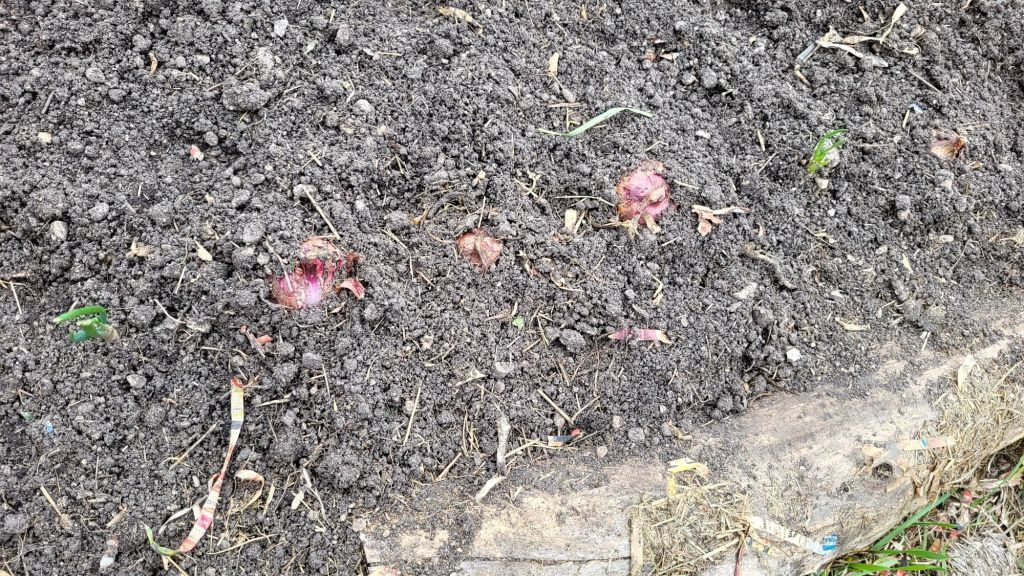
Imagine my surprise – and probably hers! – when I looked today and saw this.
All along the perimeter, Red Wethersfield onions are growing! There are so many crab grass rhizomes in there, my daughter has basically been digging them up and transplanting them.
I am totally amazed. Onions I thought had died off, with no evidence of them to be seen when that bed was harvested and the diseased looking tomato plants pulled for burning, had been there, all along, and survived the winter!
We started more Red Wethersfield onion seeds this year, too. I was going to give them one more try before giving up on them, at least for a few years. Now, it looks like we’re going to have plenty!
The bed is only about a quarter finished; it took my daughter a lot longer then usual, since she was both weeding and transplanting all the onions she was finding. Even through the crab grass growing around the edges, I can see more little onion bulbs pushing their way through!
Onions are biannual. Which means that these onions, if left alone, will go to seed, which we should be able to save.



 The Re-Farmer