The turkey is almost ready, so I thought I’d make a quick post.
It’s not the only thing that’s quick today. From this morning’s harvest…
… of orange and yellow carrots, turnips and radishes to…
… a quick pickle! A few carrots, turnips, radishes, garlic, whole cloves and whole cardamom. I made this first thing, so it would have a few hours to pickle before being included in our dinner.
I hope it’s good. 😆 I am no fan of radishes, but I will try it.
I’m heading to my mother’s this afternoon, then taking her to a medical appointment, so I thought I would bring some things from our garden to her.
I picked the potatoes from under just one Irish Cobbler plant, which had a pretty decent amount of larger potatoes. There were also small ones, so I just buried them and the plant roots again. There’s a few orange carrots, a zucchini we harvested earlier, some Roma and Indigo Blue tomatoes and a Sweet Chocolate bell pepper. While cutting some thyme, I noticed a shallot that got missed, so I grabbed that, then added a couple more we’d harvested earlier. I also cut some spearmint for her. I decided to add one of the Black Beauty tomatoes we harvested earlier, too. The softest one I could find among the lot. After bagging it up, I remembered to grab a head of garlic for her, too.
My mother being my mother, I expect to get a lot of snarky comments and backhanded insults. 😄 She’ll have issues with the brown pepper and different coloured tomatoes. She did ask me to give her some of the tomatoes to try, but then launched into a long speech about how bad it is to have not-red coloured tomatoes. And, of course, she’ll tell me how my sister brought her soooooo much from her garden, and it’s so much better, and she’s just one person, so it’s all too much, and how bad it was for me to bring more.
My mother is very predictable. 😁
But I’m giving them to her anyways. Who knows. She might actually show appreciation for a change. 😄
We did have one really nice, ripe Indigo Blue Chocolate tomato for my daughter to taste test. I’d picked three and put them in my pocket so I could use both hands. One was so ripe, it split when I bent over, so it needed to be eaten right away.
My daughter found them absolutely delicious. Nice and sweet. Juicy, but not too juicy, with a rich tomato flavour. We have others harvested that will need to be eaten quickly, and I don’t think that’s going to be a problem at all! 😄
The Indigo Blues are an indeterminate tomato, so I can expect to be able to harvest small amounts of them more often, from now one. The Romas are starting to ripen in mass quantities, so I might just wait on processing the ones we’ve picked, so we can do larger quantities all at once.
On another note completely, we did try to use the new bread machine yesterday.
Something went wrong, but I don’t know what.
I came into the kitchen to check on it, and it was off. There was still power to it – the display was showing the exact settings I started with for a basic 1.5lb loaf. It should have been showing a count down on the time. It just wasn’t running. The bread dough had been completely kneaded and was just sitting and rising the pan, so I left it. Later on, my older daughter took the dough out and baked it in the oven, so we now have one, perfect little loaf in bread jail to try.
Hmmm… I wonder. We keep our bread in a bin – bread jail – to protect it from the cats. I wonder if maybe a cat stepped on the controls while we were not around, and shut it off? We’ve set the bread machine up on the counter near the microwave, where it could be plugged into an outlet on a different breaker, and plenty of space around it for when it’s hot and baking. It’s the one counter the cats are allowed on, as they like to sit and look out the window.
That’s about the only thing I can think of, other than mechanical failure.
My daughter plans to try again, later, so we’ll see!
Who knows. I might come home to some fresh bread to try. :-)
Okay, it’s that time! I’ll be working on a serious of posts, going over how our 2022 garden went, what worked, what didn’t, and what didn’t even happen at all. This is help give us an idea of what we want to do in the future, what we don’t want to do in the future, and what changes need to be made.
I can say right now, when it comes to tubers, we had a really poor year in 2022!
We grew three varieties of potatoes, each with a different maturation rate. All were supposed to be good for storage.
They were grown in new beds, using the deep mulch method. The two larger beds had about half planted with potatoes, and the other half planted with melons. A third variety had a small bed all to itself.
The Results:
The early variety, Caribe, resulted in fewer potatoes than we planted. As you can see, there was slug damage, too.
The mid and late varieties got harvested at the same time. A lot of the All Blue potatoes seemed to have scab. The Bridget variety seemed to be clear of scab, but slug damage was a problem with both. Altogether, it was a very disappointing harvest.
Conclusion:
While we may not have gotten much out of them, the potatoes were actually quite delicious. I would be willing to grow all the varieties again.
The main problem is the slugs, and that was an issue the first time we grew potatoes using the deep mulch method.
Slugs were not the only problem, however.
The flooding took its toll. Under all that straw mulch in the above photo is a whole lot of water. Many seed potatoes simply rotted away, and among those that did grow, they never recovered enough to produce any tubers at all. It really is amazing that we got as many potatoes to harvest as we did, to be honest.
I think for 2023, we might look at getting indeterminate varieties that are good for growing in towers and try doing grow bags again. Or, we might get the same varieties, but grow them in raised beds.
The flooding we had in 2022 was more than anything anyone in the area has seen before, and it’s unlikely we’ll have a year like this again in our lifetimes. Now that it’s happened, though, we’ll know where the lower areas are and plan according, as we expand our garden beds.
Potatoes are one of those staple food crops so, in the future – once we’ve got the details worked out – we plan to grow a lot more potatoes for winter storage.
Now we move on to a crop that is more unusual for our area: sweet potatoes!
Most varieties require a much longer growing season than we have, but I did find a short season variety to try. They went into grow bags, and were not affected by the flooding.
Not that that seemed to help much.
The Results:
This picture is our entire sweet potato crop, from three grow bags.
The flooding may not have been an issue for them, but they just never did well. There are people in local gardening groups that successfully grow sweet potatoes, so I know it can be done. The problem is, I’m not entirely sure what, specifically, kept these from growing. I can think of several reasons, and it could even be a combination of them. I just don’t know.
Conclusion:
They may have been small but, when we tried them, they were delicious! I would really like to try them again. There’s only one place that I know of that sells short season sweet potatoes. I think that when we try them again, I’ll grow them in deeper containers that are black, which will help warm the soil, and mulch them earlier. We have not yet decided if we will try them again for 2023, or save it for another year.
Another new tuber we tried is actually in the sunflower family. Canada’s potato: the sunchoke, or Jerusalem Artichoke.
We got a package of 10 Jerusalem Artichokes and planted them in a bed near the garage. Unfortunately, the worst of the flooding in our yard was around the garage. There was basically a moat around it, and almost a pond behind it.
Still, it seemed to only result in the sunchokes growing a bit later. They survived, and seemed to do quite well.
The problem is, they never bloomed. In fact, they didn’t even start budding. At all.
By fall, I decided to harvest half of them, to see what we had.
The Result:
I was pleasantly surprised. The tubers I found looked quite firm and healthy, if small.
There certainly wasn’t a lot there to harvest, and I made sure to plant the largest tuber I found under each plant. So next year, one half of the bed should have just five plants in it, while the other half should have five clusters of plants.
Conclusion:
I’m not entirely sure why the sunchokes never fully matured. It could be because of the flooding and the late start, or it could be because they didn’t get enough sunlight. I did prune some branches from the trees above and to the north of them, so if that was an issue, it should be better next year.
The question is: will the tubers survive the winter? I have no idea. If they don’t, I would want to get more to plant. I taste tested them raw, while the whole family tried them cooked, and we liked them enough that they are worth keeping.
Sunchokes are something that come with warnings about being potentially invasive. I had that in mind when deciding where to plant them. Which means they should survive the winter and grow next year. If they do, as long as we keep harvesting enough of them in the fall, we shouldn’t have problems with them becoming too invasive.
The top row is all stuff we tried to grow in 2022. The only change is that the Candy Roaster seeds we got for last summer was from Veseys. We should still have some of those left, so if we wanted to, we could try both and see which does better here.
The middle row is also all stuff we tried growing last summer, except for the Chamomile, which is new for 2023.
In the bottom row, the Little Finger Eggplant is a repeat, while the Red Wethersfield onion and Mammoth Sandwich Island Salsify are new.
The Lemon Cucumber are our free package of seeds with this order. (Image belongs to Heritage Harvest) I had actually been eyeballing these as something new to try, but had decided against them for now. In fact, I wasn’t sure if we’d try growing cucumbers again at all this year. We did actually get cucumbers, and they would have been enough for our own use – but then my sister gave us massive amounts of cucumbers from her own garden, and we were overwhelmed.
We like cucumbers, but not that much!
Anyhow, if we were to order more cucumbers, it would be another dual purpose type, good for both fresh eating and canning. Now we have these, so we will at least have a fresh eating type! Plus, it’s something we’ve never tried before. I’m looking forward to it!
There were two seed orders waiting for me in the mail today. The first had the seeds I’d ordered with some trees from Veseys, earlier.
I don’t know if we’ll plant the Caveman’s Club gourd this year – it depends on how well we manage with building trellises in the spring – but we will definitely start a few of each variety of peppers. We’ll have so many varieties this year, we won’t need to start many of each, and should still have a lot.
One more order of seeds is now done! This is actually our second order with Veseys for next year’s garden.
We had intended to order our potatoes from here, as they have varieties we tried two years ago we really liked. Unfortunately, all their potatoes are currently listed as sold out. There were issues with this last year, when no potatoes were allowed to be sold out of PEI. I’d hope that wouldn’t be an issue, this year! This order ended up being just seeds. No trees or other such things that would be shipped in the spring.
One thing I noticed with their new inventory for 2023 is that their seed prices have increased substantially. I’ve seen increased prices across the board and was expecting it, but the increase seems quite a bit higher here. High enough that it actually affected some of our purchasing decisions.
As with our other seed orders, we have purchased a few things we’ve bought before. This includes the Pixie melon that we enjoyed so much the first year we grew melons, but weren’t able to save seed for, Lakeside spinach, one of three varieties we’d purchased as a collection, Lewis green beans and Merlin beets.
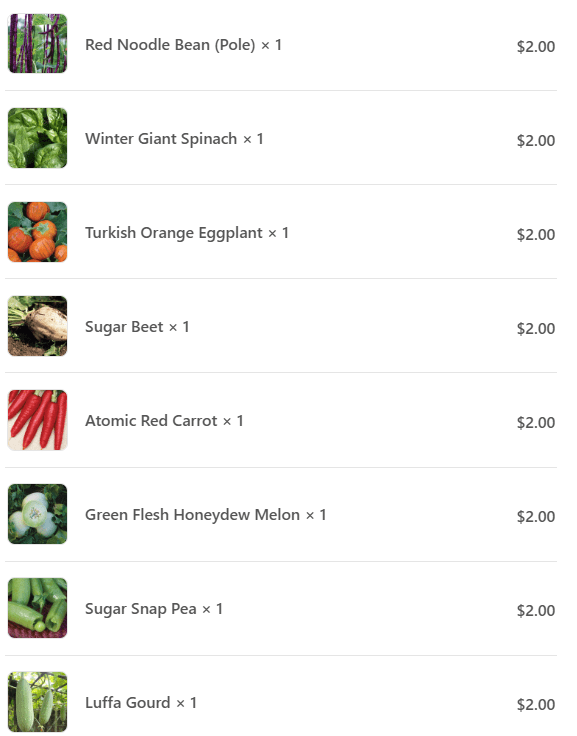
These are the new items and varieties we’ve ordered this time. All images belong to Veseys.
The first variety of purple bush bean we’d ordered before did very well, even under drought conditions. In fact, all the purple items we ordered did better. I didn’t see it listed anymore, so I decided to try this similar one. The description notes that it has “amazing flavour”.
These are noted for their exceptionally high yields, and long production season. It can be used as a fresh bean or a cooking (shelling) bean. I will have to remember to leave some of them specifically for shelling, while harvesting others fresh, so we can try it both ways.
A new variety of yellow bush bean to try that’s noted for being prolific.
Yeah, we’ve got a LOT of beans on order this year. I like to have the different colours, and a mix of types to try. With how prolific these and the other varieties are supposed to be, we don’t have to plant a lot of each. There tends to be quite a lot of seeds in each packet, so we can likely have enough to last us 2 or 3 years, at least.
This variety of shelling pea is noted for its long pods, well filled with at least 10 peas per pod, and sweet flavour. We’ve had poor results with peas for the past two years, due to weather conditions, and I’d really, really love to finally have more than a snack’s worth of fresh peas! 😁
This variety is described as the most flavourful in Vesey’s trials, and matures in only 76 days. Our first year growing melons was better than expected, while the second year’s melons were flooded out, so I’m really hoping we have cooperative weather for 2023. We really like melons in this household!
I’ve been hearing rave reviews for Delicata squash, but I also saw warnings that they were not a good storage squash. So when I saw this variety was noted as high yielding and a great storage variety, I figured it was worth a try!
I was planning to get the Oneida onion again, but choked at the price increase, so I picked these, instead. They are described as a great storage onion that does well in dry conditions, and matures 85 days after transplant.
I was going to try the Conservor shallots again, but the price increase was even higher than the Oneida onions. There was another variety that interested me, but it was already sold out. We’ve had no luck growing shallots from seed so far. Our first attempts were destroyed by cats, and the second by flooding that even killed off the shallots we planted from sets. This variety is supposed to be easy to grow, and store extremely well. Here’s hoping we succeed this time!
While we have quite a few varieties of sweet peppers, my daughter requested we get a hot variety, too. This is a high yielding variety of cayenne pepper that is ideal for growing in a pot.
I was happy with the Napoli carrots we’ve ordered before – I got two years out of the amount of pelleted seeds we got. However, their smallest size packets currently available was more than we needed, so I chose this variety, instead. It is described as keeping its sweet flavour even after months in storage, and as easy to harvest.
We actually discussed not doing corn again for 2023, and waiting until we had better soil conditions for such a nitrogen hungry plant, but I think I know where I want to grow these where they should do quite well – I hope! This variety matures in only 67 days, which solves another of our problems, too.
Yes, we have the Little Finger Eggplant, with their long, narrow shape, but I thought it would be good to have the more traditional type as well. It is described as having “tremendous yields”, and matures in only 75-80 days, so they should work out well.
Yes, we saved seed from the Cup of Moldova Paste tomato, and we do want to keep that rare variety growing, but they weren’t exactly a flavour power house. At least that’s what my daughter tells me (I can’t eat non-processed tomatoes). I still want a paste tomato, so I chose this Roma variety. I don’t know what the VF stands for, but they are supposed to be quite prolific, and mature about 75 days from transplant.
Another request from my daughters, for our culinary herb garden. It has a hardiness zone of 8-9, though, so this is going to be grown in a pot, and in a very sheltered area. I know just the micro climate spot to put it in!
This culinary variety (they also had ground cover varieties) is a bit hardier, but still a zone 4 – 8, which means it will likely be in a pot, too.
And that’s it for this order – and for any other orders until next month’s budget! Those most of what’s left that we want to get is stuff like potatoes, and more sea buckthorn to replace the ones that died – stuff that won’t be shipped until spring. Still, we don’t want to wait to long to order them, as I expect things will be selling out quickly.
We’re ordering a lot more seeds than we actually need, but if there’s one thing we learned from our 2022 garden, it’s that it’s well worth planting more than we think will be enough. In fact, we planted with that in mind, and it still didn’t cut it!
It was a chilly night last night, with temperatures dipping below freezing. As I write this, we’re at 3C/37F – just under our predicted high of the day.
It was actually very pleasant out there!
With a few frosts already past, I decided it was time to harvest the carrots.
This is all of them.
Plus the Purple Prince turnips – the only turnip variety of the three we planted this spring, that survived. Barely. Their greens were constantly munched on by insects. I’m not sure why I even bothered to harvest them. They’re so small, a lot of them got left behind in the bed, then still more went into compost when I trimmed their greens. Not much of a harvest there.
I’m surprised by the Uzbek Golden carrots, which were from a free seed packet. A lot of them were much larger than I expected.
The Black Nebula carrots where more difficult to harvest. Even with several years of amendments, the soil still gets pretty compacted, and these guys get long. It took quite a bit to dig them out!
Well, that didn’t take long… 😅
We are expected to dip to -4C/25F tonight, so these needed to be set up indoors to cure – and the only place we had available in the sun room was covered with tomatoes, still.
Thankfully, they are all laid out on screens.
I was able to stack the screens with the tomatoes and gourds, then lay out the trimmed carrots. After a day or two, we’ll brush the dirt off and go over them. Several of the biggest Uzbek Golden carrots have split, but the Black Nebula look like they were a slug favorite. Quite a few had damage at their tops. The size variety among them is pretty surprising. Quite a few of them are really big around! From the photos, I expected long and narrow.
Once we’ve assessed their condition, we’ll decide how best to store or preserve them. I suspect blanching and freezing will be the best option for most of the Black Nebula carrots, while the Uzbeck golden will be kept in the kitchen for fresh eating first.
I haven’t actually tasted any of these yet! We did harvest a few Uzbeck golden for meals over the summer, but almost no Black Nebula, because even the little ones were hard to pull. I hope they taste as good!
I took advantage of the lovely temperatures (and being in less pain) to do some more clean up in the garden. Earlier in the day, my daughter and I drove into town so she could get a new photo to renew her driver’s license, while I popped across the street to pick up a few things at the grocery store. I was thinking of making a cream of chicken soup and was about to buy some carrots, when I remembered…
We have carrots. They’re just still in the dirt.
So I went over to where the chocolate cherry tomatoes had been planted, and pulled up the Napoli (orange) and Kyoto Red (dark orange) carrots – and a single shallot! I also dug up the red onions from sets that were planted with the yellow pear tomatoes.
The new soil sifter came in handy! 😁
I’m actually surprised that we got so many decent sized carrots. The Kyoto Red were pretty small – there were two I left behind because they’re blooming, and I hope to collect some seeds. I used up the last of the Kyoto Red seeds, but I think I still have some Napoli pelleted seeds left. Those really did far better than I expected.
Then there’s that single, solitary shallot!
There were actually two more, but they also bloomed, and I’m waiting for the seed heads to dry before collection.
As for the red onions…
Most of them aren’t any bigger than the sets we planted in the first place. Given how spindly the greens were, I thought they might be rotted out, or at least soft, but nope: they are quite firm. They’re just really tiny. I think they were simply too shaded by how massive the yellow pear tomatoes got.
I was going to take them in and was trying to figure out where I could lay them out to dry a bit, until I thought to check the weather again.
We’ll be having at least a couple relatively warm nights, and no rain is expected. I just spread them out on the soil sifter and will leave them out overnight. Tomorrow, I should be able to brush the dirt off more easily, before bringing them inside.
With that in mind, I think I’ll soak some of those blue grey speckled tepary beans overnight, to include with some our garden’s carrots and onions in my soup!
Once these were gathered, I worked on taking down the hoops in the main garden area, as well as the mesh and supports over the spinach in the old kitchen garden. The spinach is a loss. They germinated, and then got mostly yellow and stopped growing.
With the mesh and netting, I laid them out as straight as I could on the ground, then rolled them up around whatever straight sticks I had that were long enough.
You wouldn’t believe how difficult that is with a yard full of kittens!
The twine I used got salvaged, too, and the shorter pieces came in very handy to tie off bundles of netting, mesh, supports and hoops.
We have a few more warmer days, and my priority right now is to get the empty bed in the main garden area prepped, and then plant our fall garlic. When we go into the city next for our stock-up shopping, I hope to pick up more hardneck garlic to plant. It’s a bit too late to order them like we have for the past couple of years.
Once that is done, I plan to work on building up some of the beds in the old kitchen garden. I have ideas for those that I hope will work. If I get at least one of those done over the next few days, that will give us a prepared bed to plant any garlic I pick up later on. There’s still the beets to harvest from that garden, but I suspect those will be going straight to compost.
Well, we decided to start bringing things in. Tonight and tomorrow night, we are supposed to reach lows of 1C/34F
While our one eggplant that is producing is small enough to give protective cover, that’s pretty much it. The rest is just too much or too large to be able to cover adequately.
The shelling beans were simply ready to be harvested, so I worked on those first.
These are the blue grey speckled tepary beans, and the are so tiny! I haven’t tried to open any pods yet. It was almost but not quite raining as I picked these, so once I got them inside, they went onto a screen and are laid out to dry thoroughly indoors before I start shelling them.
Then it was time to pull the Tropeana Lunga onions.
They are SO much easier to harvest from the high raised bed, than the onions in the low raised beds. I had to dig most of those out, because the soil is so compacted. Not here! These came out easily.
Check out that chard. Not a single leaf to harvest!
I had this wire mesh door on the picnic table under the canopy tent, where I was able to cure onions before, but with the cold temperatures, I set it up in the sun room. It is supported by a couple of saw horses over the swing bench, giving the kittens plenty of space to go underneath and have their warm and cozy naps!
These onions are a very thick onion, in the stem and the greens. They are very much like the Red of Florence onions we already harvested, but with even sturdier stems.
Next, I worked on the red tomatoes. A few of the ripe ones had been partially eaten, while others had holes like this.
Some of the holes were even still occupied!
Slugs are remarkably voracious!
This is all the red tomatoes. In the bin are the Cup of Moldova, and on the side are the Sophie’s Choice. There were very few Sophie’s choice, overall.
While I was working on these, I got a surprise visitor.
Rolando Moon showed up! I haven’t seen her in weeks! She let me pet her a bit, but mostly hung around and hissed and growled at the kittens. Except for when she suddenly showed up with a big mouse in her mouth. One of the kittens became VERY interested in her at that point. Rolando Moon can be aggressive, so I did step in, which allowed the kitten to make a jump for the tiny bit of mouse that was left. He promptly inhaled it and was sniffing for more, but with Rolando being the way she is, I carried him off.
Do you know that it’s really hard to harvest tomatoes while there is a kitten perched on your shoulders, and it refuses to leave? 😄
Next, I worked on the Chocolate Cherry and the Yellow Pear tomatoes.
There were SO many yellow pear tomatoes!
I also harvested the dry King Tut Purple Pea pods, though they were green instead of purple. I’m not sure why I’m keeping the seeds, to be honest. The last Red Kuri squash was also harvested, and now sit with the onions to cure.
I have left it to the girls to work out what to do with all the tomatoes, except for the ones that I will be keeping to save seeds from. The Chocolate Cherry, for sure. I’m told those were the tastiest. Not the yellow pear, though. I’m glad we tried them, but they weren’t enjoyed enough to bother saving seeds from. Both the Cup of Moldova and Sophie’s Choice are rare varieties, so I will be keeping seeds just to help keep them going. We will decide later if we want to stick with them next year, of we want to try other varieties as well. My daughter described both of them as good, but very mild in flavour. I think she and my husband would prefer something more intensely flavoured. We’ll see.
This bed that had the paste tomatoes is now completely empty. That means I can prep it to plant the best of the hardneck garlic I’d saved from this year’s harvest. We will need to get more, though.
This bed had the yellow pear tomatoes. There are still the red onions from sets in there, but I don’t think we’ll get anything out of them. Once those are out, this bed, and the one to the right of it, can be prepped for next year.
The kulli corn in the bed to the left still has no cobs forming, at all.
This is where the chocolate cherry were. It’s the second year we grew tomatoes here, so we will do something else here next year. I’m thinking peas.
There are still carrots in this bed. I don’t know that there are any shallots or onions left. There are two shallots that went to seed, but the seed heads seems to have stalled in development. It seems the same with the lettuce I left to go to seed. I think it’s just been too chilly for them to progress properly.
That’s it for now. Later on, I’ll head out again and look over the pumpkins, and see about harvesting the biggest ones. Pumpkins can continue to ripen after picking, if we can keep them warm, dry and in sunlight. That is a difficult combination to achieve in our household, though!
I also want to put bottles with warm water in them around the eggplant that’s fruiting, and then cover it. I may as well harvest what summer squash there is, too. We won’t be able to protect them from the cold, so chances are, they will get killed off tonight. I might be able to cover the apple gourds. They are the only ones that are immature enough to make the effort. After these 2 expected cold nights, the overnight lows are expected to be much warmer, so if they can survive those two nights, they still have a chance.
With the beans either done, or being left to dry – and the red noodle beans still don’t even have pods yet! – and the cucumbers and peas finished, there isn’t a lot to harvest on a regular basis. The carrots, turnips and beets are being left to get as big as they can before we pick them. Same with the potatoes. The peppers and eggplant could use quite a bit more time to mature. The sweet corn still isn’t ripe enough to pick. The Yellow Pear tomatoes have huge amounts of still green tomatoes on them, and are also ripening the fastest. The other tomatoes are ripening much more slowly. There are quite a few green patty pans growing, but not so much among the rest of the summer squash. The winter squash, of course, need to stay on the vines for as long as possible. What we have of it, anyhow!
These cucumber leaves show one of the reasons we want to focus on barrier hedges as we plant trees and bushes. This is all dust from the gravel road. Thank goodness my mother’s lilac hedge is there, or it would be so much worse!
The green zucchini is still having issues with the male and female flowers not blooming in sync, so pollination isn’t happening. The developing squash soon turn yellow and die off. This one has been chewed on by a mouse or some other small rodent. I suppose it’s good that the squash still feeds something!
We had a super light rain this morning, which is supposed to continue off and on throughout the day. Then we’re supposed to warm up again over the next few days. It should be interesting to see how much more things manage to ripen during our mild grace period!