Recommended: XiaoXi’s Culinary Idyll

Welcome to my “Recommended” series of posts. These will be weekly – for now – posts about resources and sites I have found over the past while that I found so excellent, I want to share them with you, my dear readers. 🙂 Whether or not I continue to post these, and how often they are posted, will depend on feedback. Please feel free to comment below, and if you have a favorite resource of your own, do share, and I will review them for possible future posts.

I hope you find these recommendations as useful and enjoyable as I have!

My very first Recommended post was for the YouTube channel Liziqi. I love the video format that makes it accessible to all, including those who don’t understand any Chinese language. Since discovering this channel, I’ve found a couple others that I now follow that are similar, yet very different. This is one of them. XiaoXi’s Culinary Idyll, which focuses on both cooking and hand crafts.

I didn’t know that, when I stumbled on the first video I saw: How to make delicious braised chicken out of stone.

Out of stone? That certainly piqued my curiosity when it showed up in my feed, recommended by YouTube.

As I started watching the video, I was perplexed. Where is the chicken? What is he going to do with that rock he dragged out of a riverbed?

By the time I got to the cooking part of the video, I was completely hooked.

How do you braise a chicken out of stone?

First, find a rock and carve it into an exquisite cooking pot.

This is a very new channel, less than a year old at the time of this writing. So it didn’t take long for me to go through all of the videos.

The first videos started off with a very different feel. At first, it was straight up cooking videos.

Other videos featured a lot more people and activities.

Then the crafting portion came into the picture – with a sense of humor!

Are you having trouble making traditional noodles by hand? That’s okay – use a machine!

First, cut down a tree…

As I worked my way through the videos, from oldest to newest, I got the sense that the makers of these were kind of feeling their way around on the focus. Where the Liziqi videos started out with just her, filming herself until she could finally hire a couple of people to do the recording for her, these videos appear to have been made with a professional film team from the start.

I’m okay with that.

The format they seem to be settling on is basically just the one guy who first makes a thing, then somehow uses that thing to prepare a food. Both of which are gorgeous.

Then you get to watch him eat. :-D

I readily admit, every time I see the guy working in his shop, I suffer from an extreme bout of tool envy.

You’ll see him doing everything from forging a frying pan (one of the few videos where he cooks food, but you don’t see it being eaten at the end), to weaving various useful objects (I will never look at a bamboo steamer the same way again!), to making things with wood and resin and…

…succulents?

While there is a lot of focus on traditional crafts, there is definitely a modern, even high tech, side to some of these videos.

While these are hardly “how to” videos, they are still quite inspiring – whether you’re looking for ideas on things to make, or ideas for cooking traditional Chinese food!

Or going fishing with a woven, waterproof hat you just made.

Even if you have no interest making the things or cooking the food, the videos themselves are beautiful to watch, and seeing his exquisite attention to detail is a pleasure in itself.

I highly recommend working your way through all of the videos.

You might not want to do it while hungry, though. ;-)

Historical cooking: chickpea soup with fried bread

One of my Recommended posts was for the Historical Italian Cooking YouTube channel. Recently, they put out a new video for a super simple dish made with ingredients we typically have on hand. Today, I was able to give it a try!

Here is the video.

You can also visit this link for the written recipe.

This is an ancient Roman dish; chickpea and leek soup, with a fried flatbread called lagana.

About the only thing we had to go out of our way to get for this recipe was the white wine.

There was one ingredient we couldn’t find, though. Durum wheat flour. Any type of flour is just now becoming easier to find, but there’s no chance of finding any out of the ordinary flours. All Purpose flour, which is what we have, is made with a blend of hard and soft red wheat. Here in North America, durum wheat tends to be used in pastas. It’s the sort of thing we’d have to go to specialty stores to find. I’m sure I could find it in the city, but certainly not locally.

So I substituted AP, since that’s what I had.

First, the soup ingredients.

Another substitute I made was to use canned chickpeas instead of soaking dried chickpeas overnight. The recipe called for 2 leeks, but has almost no other quantities given. I had 2 leeks, but they were pretty massive, so I used 2 cans of chickpeas to balance out the quantities. There’s also the white wine, some olive oil, and caraway seeds ground with a mortar and pestle. I eyeballed most of the quantities based on watching the video. :-)

The soup was started by boiling everything but the leeks in salted water for 10 minutes. Then, the leeks are added and cooking continues for another half hour.

While that’s being done, the flat bread is made.

The flour was the other thing with a quantity given: 300 grams.

Unfortunately, my kitchen scale disappeared. So we had to use a converter. I used a little under 2 1/2 cups of flour. Salt is added, then a dough is formed with some warm water. That’s it, that’s all!

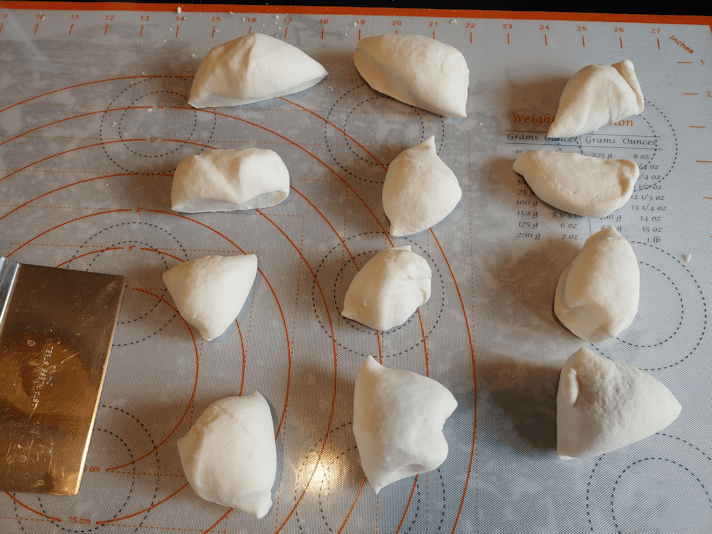
After the dough is kneaded until smooth, the recipe said to divide it into 10 pieces. There are 4 of us in this household, so I divided it into 12 pieces, instead.

The pieces of dough are then rolled out into rough circles.

The recipe calls for olive oil to be used to fry the bread. Olive oil has a low smoke point, so I modified the recipe a bit more. I added a bit of vegetable oil to increase the smoke point a bit. I was just frying in a pot on the stove, so this was more of a safety issue.

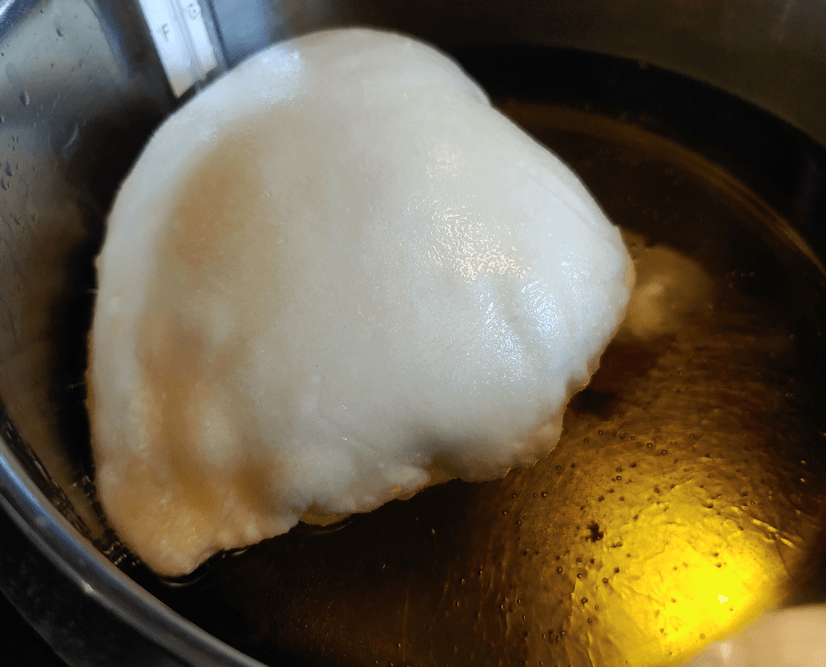
Once the oil was hot, the rolled out dough was fried, one at a time.

The dough bubbled up a bit in the video, but not into big dough pillows like this! :-D This could be because of the different type of flour, or even because of the oil blend.

Not that I’m complaining! :-D

These fried up very quickly. Maybe half a minute on each side, to get them to a golden brown, before placing them on paper towel to drain. The bubbles cracked on a couple of them, allowing oil to get into the pockets. That took a fair bit of draining! The bread was finished well before the soup itself was.

They look absolutely amazing!

Taste test time!

The soup itself was very mild tasting. Possibly because I used more water than in the recipe. I couldn’t distinguish individual flavours of the caraway or the wine, for example. No one ingredient overpowered the other.

The lagana bread had a surprising amount of flavour for something that is just flour, salt and water! The outside was crispy, while the inside was chewy. It went incredibly well in the soup. A real balance of flavours. Making one without the other would not be as good as the two together.

This is a remarkably easy soup to make. The lack of quantities in the recipe made it a bit more interesting to work out, but that just gives room to adjust to one’s one preferences!

I can definitely see us making this recipe again!

The Re-Farmer

Finding Goats (video)

I went to check out the goats at our gate after seeing them on the security camera – and they came to check out the weird human with the shiny thing in her hand…

As I write this, it’s 1C (33F), with a “real feel” of -5C (23F). It’s supposed to drop down to a low of -1C (30F) and feel like -7C (19F).

Not only do I have the light we’d used to keep the cats’ water bowl from freezing last year in the mini-greenhouse to keep the planting trays warm, but I just made a shelter for the goat outside our door, using the saw horses and the crochet’s blankets we’d used in the sun room for the cats.

Yes. I made a blanket fort for the goat.

I don’t know if she’ll use it. She is really dedicated to standing at the door.

I think I know why. The person who originally owned her had a pen built up against the house, where there was a side door. When we lived in that building, that door led to what was a shed to store inventory for when the front of the building was a general store. The shed is now here at the farm, being used to store my parents’ old belongings, and there is now a set of stairs under that door. I remember driving by and the only time I ever could see the goats was when one of them was at the top of the stairs, at the door. The set up we have must feel familiar to the goat!

But it is so chilly out there, and she won’t leave the door to go to any of the places around that she could bed down in. I am really hoping she’ll use the shelter I rigged up for her!!

The Re-Farmer

More garden bed progress – and an experiment

Today, while the girls worked on the replacement sun room door, I was able to get some progress what will be a new garden bed.

I normally like to take lots of before and after pictures, but today, I decided to experiment. I have a little Gorilla Pod with a phone holder, so I set it up to take time lapse images every 60 seconds. I ended up taking 3 sets of them, then put them together in a little video. This is the result. I hope you like it!

I started with the camera set up in a tree facing the house, but the girls don’t like having their images posted online, so when they started working outside on the door, I moved it to another location.

With images every minute, it actually missed some of the surprisingly large roots I dug out. At one point, I was fighting over a mass of roots that just didn’t want to budge. They were the remains of a group of cherry trees, some live, some not, growing through a couple of pallets that I cleared out last year. After she finished painting the door, my daughter came and helped me get it out. That thing was a beast to get rid of!

There were a few times when I tried to pull up some roots – especially the large spruce roots – but could only get so far. After removing enough soil, I would find that they were being held down by cherry roots growing across them. I would have to dig those out first, then I could pull out the ones I’d started with.

I ended up having to stop long before I was done (I would say it’s a bit more than half done right now), simply because it was getting too hot! Which is an amazing thing to say considering that, depending on whether I am looking at the weather app on my phone, or on my desktop, we’ve reached our high of either 14C (57F) or 11C (52F) out there right now. Which, in the summer, would be considered cooler! :-D

We’re not going to get all the roots out. There are just too many, and lots are quite small. As long as we can get the soil clear enough that the carrots will be able to grow straight, that’s good enough for our first year.

When we had the chance, my daughter and I talked about building raised beds at some point. I do want to do this, but when we do, these will be tall raised beds, for accessibility. So once built, they will be pretty much permanent, and we’ll have to keep that in mind when deciding where to put them. We’ll see how things go this year, as the first year we’re able to plant any gardens at all.

Interestingly, while talking to my mother as I drove her back from the hospital, she started telling me that, if she were still at the farm and my dad were still around and able to help, she would fill the area where the old garden was with trees. Which is a complete change from when we first moved here, and she kept saying we needed to plow it and plant it and garden right away, and was very upset when didn’t do that, no matter how much I explained other things were higher priority. Anyhow, I told her that planting trees there is exactly what we would like to do, and told her (again) about our wanting to plant a nut orchard and fruit trees. So she started telling me that we have to prepare the area before we start buying trees, and how I should be doing that, because once the trees come in, they need to be planted right away! :-D I assured her that yes, that is exactly what we plan to do, and will be starting to do this year. I reminded her that one of the things we were planning to do this year was plant the giant sunflowers that are tall enough to act as a wind break, so we’ll have seed heads for the birds over the winter. She told me that they had tried planting sunflowers too (I even remember them), but that the birds would eat all the seeds before they even ripened. That is, indeed, something we will have to plan for, though I do remember eating sunflower seeds that we’d grown, so at least some of the seed heads made it to harvest!

Speaking of seeds, I’m happy to say that some summer squash seeds have started to sprout, so I’ve taken the cover off the second planting tray in the sun room. They seem to like the warmth in there! Even overnight, the temperatures have been holding out well enough that I have not put them into the mini-greenhouse in the evenings.

As for the garden plot I’m working on now, it’s going to be at least a couple of days before we can get back to it. Tomorrow, we will be heading into the city for our big shop, and on Friday, we’re expected to have thunderstorms. If I can, I’ll try and get a bit more work in there, but it’s unlikely we’ll have a chance to do that before Saturday.

It’s slower going than I’d hoped, but good progress has been made.

The Re-Farmer

Recommended: Justin Rhodes

Welcome to my “Recommended” series of posts. These will be weekly – for now – posts about resources I have found over the past while that I found so excellent, I want to share them with you, my dear readers. 🙂 Whether or not I continue to post these, and how often they are posted, will depend on feedback. Please feel free to comment below, and if you have a favorite resource of your own, do share, and I will review them for possible future posts.

I hope you find these recommendations as useful and enjoyable as I have!

This week’s recommendation is a US based permaculture vlog by Justin Rhodes and family.

Now, I grew up here on the farm, in conditions I affectionately refer to as “two sticks ahead of the stone ages”. We were subsistence farmers. We grew enough to feed ourselves and our animals, we sold beef cows at auction once a year for money, and if things got tight, my parents got odd jobs to pay the bills. We had chickens and cows for as long as I can remember, plus we, at various times, had sheep (I think my parents got rid of them before I was born), horses (they came with the farm; my dad upgraded to tractors, and the horses were eventually sold) pigs, geese, turkeys, bantam chickens, and probably other critters I don’t remember. We also had a huge garden where we grew and preserved most of our food, we butchered our own meat and, of course, we had our own eggs.

So basically, I grew up in the “back to the land” environment so many say we should all be going back to. There are many positive things to say about this life, but I find that most of the people who say such things have no clue just how difficult it is, and unreliable it can be.

Then there are people who are doing it for real, and they have no illusions about such a life. They’re also making it work in creative ways.

These days, they don’t call is subsistence farming anymore, but “homesteading.” As far as I can tell, it’s the same thing, really. There are some significant differences in some things, though, and this is one of the resources I’m learning a lot from.

I stumbled onto Justin Rhodes videos through something called a “chickshaw.” It was a variation on a concept I’d never heard of before.

The chicken tractor.

Our chicken coop was an old log cabin that was previously used as a summer kitchen. The idea of having a chicken coop you could move was quite novel to me. Why would anyone even want to?

Well, it turns out there are all sorts of advantages to moving them around! Not just with chickens, but pigs, too.

Man, that would have saved us SO much work, when I was growing up on the farm!

After watching some of his videos, I now really want chickens again. Our soil could really, really use them.

There are a lot of permaculture resources out there, but I find I really enjoy this one. Part of what I like about it is that a lot of what’s covered is that, while the channel has been going since 2012 (the earliest videos start in 2015), it’s still very much a learning experience for the entire family. He talks about their failures as well as their successes, and they don’t shy away from some of the harsh realities of raising animals for food. He really gets into the hows and whys of the things they do, and his enthusiasm is contagious. They also share their knowledge, and while some is available to members only, they also have things like a free course at their Abundant Permaculture website.

There is a LOT available on their channel, on a variety of topics.

There are quite a lot of well organized playlists to follow as well.

I think that, even for those who aren’t planning to do any homesteading, it would still be useful for those interested in maybe growing more of their own food, or having a few backyard chickens. If you are thinking of homesteading some day, I definitely recommend checking this resource out.

On top of all this, now that so many people are affected by the Wuhan virus lock downs, there has been a sudden increase in people wanting to know how to grow their own food. Fast. That call is being answered, as new videos are coming out to directly address how people who may never had had gardens before can find ways to grow food for themselves and their family quickly.

The Re-Farmer

Just a bit …

… of a spring storm.

I’m not looking forward to clearing the driveway after this.

It’s supposed to continue snowing through most of the day. I was planning to go to the post office, as I’m expecting some packages, but I think I will wait until Monday! My daughter is working on Saturday, which is supposed to still be chilly. There isn’t going to be much of a window to clear the driveway so she can get to work, and I can get the rest of my husband’s prescription refills.

On Sunday, it’s supposed to warm right up again, and stay warmer for the rest of the week, even as we’re supposed to get a bit more snow. Things should melt away fairly quickly.

Which isn’t going to help us get out and about tomorrow!

The Re-Farmer

Recommended: Historical Italian Cooking

Welcome to my “Recommended” series of posts. These will be weekly – for now – posts about resources I have found over the past while that I found so excellent, I want to share them with you, my dear readers. 🙂 Whether or not I continue to post these, and how often they are posted, will depend on feedback. Please feel free to comment below, and if you have a favorite resource of your own, do share, and I will review them for possible future posts.

I hope you find these recommendations as useful and enjoyable as I have!

One of my life long interests has been human history.

Not the names and dates, wars and politics, conquerors and empires stuff.

No. My interest has always been in, how did ordinary people live? What did they wear? How did they work? What tools did they use? What kind of homes did they have? How and what did they hunt? What foods did they gather or grow? What skills did they develop? How did they do for fun?

Over the years, I found that the best way to learn about a people and their culture is through what they wore, and what they ate. It’s amazing how much everything else revolves around those two things!

In the process, I developed a love of historical cooking.

Recently, I discovered a YouTube cooking channel that has become my favorite. My daughters and I will happily sit and watch them together, one after another.

My recommendation this week is Historical Italian Cooking.

This channel has only been around for a year, but has so much going for it! They focus specifically on the recreation of dishes from ancient Roman, Renaissance and Medieval periods of the region.

It is very different than most cooking channels and, subject matter aside, those differences are why I like it so much. I’ve tried watching other videos dedicated to historical cooking, and often find myself turned off by so many things. I think what I find the most irritating about these other channels is that they try too hard to be “entertaining”. I don’t enjoy the hosts going off on tangents, chattering with the crew, or all those other things that supposedly make them seem more “authentic”.

Just cook the food and tell me about it. That’s all I really want.

This channel, for me, makes perfect cooking videos!

The first thing that makes it stand out is the format.

Most of each video is just the camera filming from above a clean, distraction free, work surface. All you see of the chef is his hands. The various containers, bowls, boards and ingredients are laid out simply and clearly. When they go through the ingredients and fresh herbs are mentioned, it cuts to their garden, and the picking of herbs. Only the chefs arms are seen.

When the actual cooking occurs, you see the fire or oven and the cooking vessels. Again, the only view of the chef is of his hands.

The other thing I love about it is the narration. The speaker has a very calm, rhythmic manner of speaking. Even in the few videos where a woman takes over the narration (because the chef lost his voice), she speaks in the same rhythmic, soothing manner.

They also enunciate their words very clearly. For me, this is extremely important. I have an auditory processing problem. Though my hearing is quite excellent, when it comes to speech, sometimes things don’t translate well between the vibrations picked up by my ear drums, and how my brain turns those signals into words. If there are a lot of distractions, or a person has a particularly strong accent, instead of hearing words, I hear gibberish. Or sometimes, nothing at all. It’s like a blank spot, part way through a sentence. Most of the time, my brain can fill in the missing information, but sometimes, it just doesn’t work. When speaking to someone, I’ll ask them to repeat what they’ve said, but most mistake my request as me not understanding the meaning of what they were saying, so they rephrase what they said, instead of repeating their words. Which doesn’t usually help at all.

The narrator(s) in these videos speak English with very strong Italian accents. If they emoted more, or spoke faster, or were any more chatty, my brain would have endless problems processing their words. Instead, their measured and clearly enunciated speaking mannerisms are exactly right for me to hear every word. And I love it!

Another thing I love about this channel is how informative it is. While the chef is, say, busily grinding things with mortar and pestle, the narration will go on to explain where the recipe came from, the history of certain ingredients, what they had to do to recreate recipes that don’t include things like quantities or cooking times and temperature, or why they chose certain ingredients when the recipe itself didn’t specify anything beyond a general description. For ingredients that are difficult to find, they give modern alternatives. They even talk about the names and words used at times. It’s a fascinating and educational experience.

It’s very clear that the people making these videos have spent a great deal of time researching and testing these recipes before finally making the videos. Their dedication to authenticity shows everywhere. Many of the dishes, bowls, cups and cooking vessels are clearly hand made, using materials that would have been used in the time periods they cover. This includes tools made of wood, terracotta and even horn.

In the process of going through their “about” section on the channel, I found they also have a website, where you can find their recipes in English or Italian.

With our internet data limitations making video watching something I have to ration, I’m happy to find this, because I am really looking forward to trying some of these recipes myself!

The Re-Farmer

Recommended: CS Brews

Welcome to my “Recommended” series of posts. These will be weekly – for now – posts about resources I have found over the past while that I found so excellent, I want to share them with you, my dear readers. 🙂 Whether or not I continue to post these, and how often they are posted, will depend on feedback. Please feel free to comment below, and if you have a favorite resource of your own, do share, and I will review them for possible future posts.

I hope you find these recommendations as useful and enjoyable as I have!

When we decided to try making mead we, of course, did research, first.

Unfortunately, what we found was a lot of conflicting information.

One source would say to just mix honey, water and bread yeast in a jug, top it with a balloon, stick it under your desk and forget about it for months.

Another source would describe starting a fermentation in one container, with daily actions, racking after a couple of weeks, and basically babying the must until it was time to bottle.

Some sources recommended using basically nothing; no other ingredients than honey, water and maybe some yeast. Others would talk about the need for various additives, ranging from raisins to nutrients to various chemicals to start or stop fermentation.

It turns out, mead making is something people can vociferously disagree on, too!

The last time I posted about our mead making attempts, I mentioned a new resource I’d found. CS Brews. This is the YouTube channel for a larger enterprise that includes a similar channel about cooking, a website called City Steading, a Facebook community, and more.

As the website name implies, this is a sort of homesteading resource for people who don’t live in the boonies, like we do. The skills and information are, of course, transferable.

My recommendation, however, is focused on their brewing videos.

Now, this may sound odd, but I don’t actually like alcohol all that much.

Continue reading