Butterscotch’s babies were extremely active in the cool of the morning. :-)
It took them stopping for a nursing break before I could get pictures!
I didn’t want to disturb them, so I used the zoom on my phone’s camera, which takes the worse pictures. :-(
I still ended up disturbing them. Ah well.
Earlier, I noticed a couple of the kittens playing around under the bird feeder (the flowers under there are totally mashed!). Something seemed odd about their actions, though, so I went and checked. It turned out they were “playing” with a chipmunk. :-( It was still very much alive and the kittens were… well… being cats about it. I shooed them away and the chipmunk just sort of set itself into a defensive stance and stayed there. When I found it let me touch it, I picked it up and carried it to the pile of maple logs near the garden shed, so it had a place to rest and recover. It was bleeding, but I don’t think it was mortally wounded. Hopefully, it will be okay.
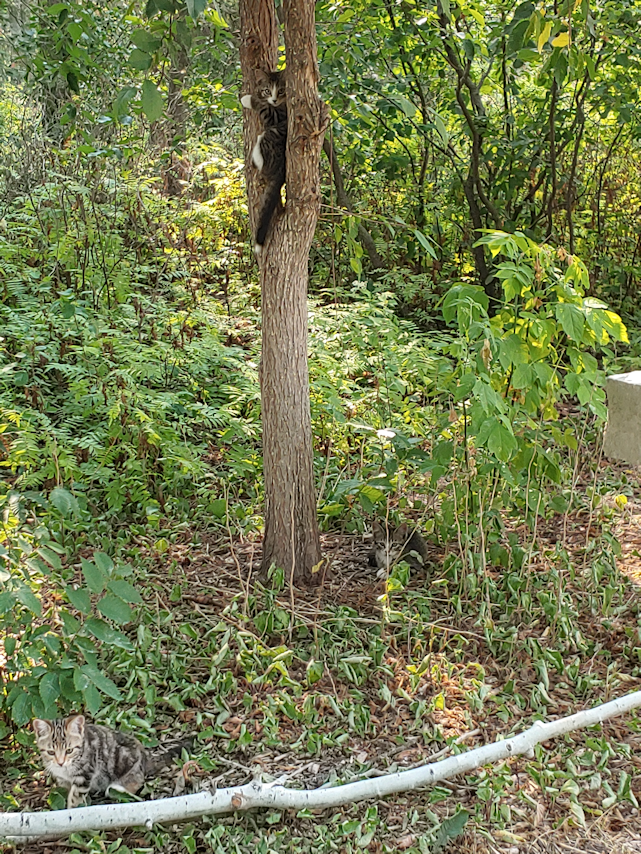
Later I found Bradicus just going nuts in this tree! :-D Chadicus is at the bottom of the tree, and Caramel is in the foreground.
Broccoli, meanwhile, was busy hunting grasshoppers in the grass. :-D
One of the things I’ve been trying to baby is our Montana Morado corn. I really, really want these to work out!
As these were started indoors, they are much further along than any other corn we have, and have been developing ears of corn for a while now. I’ve been a bit concerned about pollination, and have even been hand pollinating any cobs that look like they might get missed.
My concern?
Many of the silks have have dried up. This is supposed to be a sign that the cobs are ready to pick, but they shouldn’t be ready to pick until the end of August or so. The packet didn’t have a “days to maturity” on it, as the variety is just too knew, but in looking up maize morado, it says 120 days to maturity, so I figure this should be close.
As my daughter and I were looking the corn over and talking about our concerns over how many silks are dry, even on tiny little cobs, I went ahead and picked a cob from the plant that first developed one. This would be the largest, most mature, of all the cobs. The silks at the top were so dry, they came off as I started to peel off the husks.
So this tells me one thing, at least. Pollination is good. There are lots of developing kernels, and almost no gaps. It is also clearly immature, and just starting to turn to its mature colour.
I have to admit, that looks very… unfortunate… :-D
We did taste it, and while not particularly sweet (I was not expecting it to be), but it did taste… well… like corn.
So why are the silks starting to dry so early? Yes, it’s been dry, but we’ve been diligent about watering these.
Have we not been watering it enough? Has it been too hot, even for this variety that was developed in a warmer zone than us? Will the cobs continue to mature, even if the silk dries up as would normally happen when the cobs are ready to pick?
I don’t know, but I’ve posted the question on one of my local gardening groups. I’ve had some clarifying questions, but so far, no answer.
Crud.
Well, we’ll just keep watering them and hope for the best!
Meanwhile, on checking the Crespo squash nearby…
More, “oh, crud.”
One of the vines have been eaten, and it does not look like deer damage. The barriers we put around it might convince a deer to not bother, but they can’t actually stop anything. I’m guessing this is from one of the woodchucks.
Today was hot enough that everything has dried up again, so I set up the sprinkler on the purple corn for a while. As I was moving the sprinkler to the corn at the opposite end of the garden area, I spotted a woodchuck in the middle of one of the sunflower blocks!! It wasn’t eating anything, and there was no damage when I checked, so it may have been just passing through.
I greatly encouraged that notion, and chased it through the hedge, into the ditch. It can go to the empty house across the road!
Anyhow.
As for the corn, I guess the only thing we can do is keep watering it and hope the cobs will continue to mature.
When we first bought the corn seeds, the produce description was for maize morado. The site even had a video talking about how a cowboy from Peru brought some seeds to where he was living in the US, and was able to grow extra to provide seeds for the company. I thought I was getting a Peruvian corn. Then the story changed, and it turned out to be a purple corn developed in Montana, and now it seems the name has been changed to Mountain Morado.
While trying to look up what the days to maturity might be for this corn, I found a different seed company that is selling the actual maize morado from Peru, Kulli. I think I will try buying those for next year. The packets only have 25 seeds in them, so I’ll probably get two or three. I had hoped to have seeds to save from this year’s corn, which may still happen, but if I don’t, I will also try the Mountain Morado (again?). Between the two, I hope to have something that will grow in our zone.
Until then, we’ll see how things go with what we have now.
The Re-Farmer
update: well, that was fast! Having tapped into the wealth of knowledge in the local gardening group, I have a likely answer. The drying of the silk may show that they have been successfully pollinated.
Well, we’ve passed our forecasted high of the day and have reached 30C/86F, with the humidex putting us at 35C/95F, this afternoon. We did, however, get RAIN this morning! I was awakened by the sound of thunder, so I quickly went outside to make sure the cats and birds had food before the rain hit. The storm blew past us, but it did start to rain while I was still outside. I’ll take the nice, gentle rain, thank you very much!
Unfortunately, it looks like this will be the last rain we’ll have in a while, and tomorrow the smoke is supposed to be back. What rain we did have never reached the fires up north. :-(
While doing my evening rounds yesterday, and checking the old kitchen garden (the floating row covers are doing their job; no signs of critters trying to get under them, and our carrots are recovering!), I stumbled on a pretty green friend!
It was just hanging out on the leaf of one of the flowers that made its way through the layers of mulch we put on this garden, two summers ago. We’ve seen a lot of frogs this year (likely because all the ponds and ditches have dried up), but we don’t often see the green tree frogs.
It didn’t seem to like us giants hanging around, so we let it be, though I must admit, it is very tempting to want to hold it.
I also was able to get a picture of some furry friends.
Rosencrantz and Nosencrantz were calm enough to just watch me as I went by. Toesencrantz, unfortunately, is more skittish and was hiding.
I so want to boop Nosencrantz’s nose. :-D
While the girls and I were checking the garlic beds, I showed them this odd garlic.
It looks like garlic is forming inside the stem, and this one is getting pretty big. I’d noticed another had started to show signs of this happening a few days ago. This is only in the Racombole garlic, which is split between the two garlic beds, so the girls started looking around in the other bed, and we found several more.
This one was the strangest looking one, and it may explain what’s happening.
This looks like a garlic scape! This might explain why the Racombole seemed to have fewer scapes than the other two varieties. Instead of growing out the tops, as they should have, the scapes look like they got stuck in the bottoms of the stems in quite a few of the plants. Since they didn’t get harvested, bulbils are now forming inside the stems, eventually bursting through. Only this one had the rest of the scape emerge from the stem for us to see.
It also looks like something tried to give this one a taste!
In theory, we can keep the bulbils and plant them in the fall. Hardneck garlic are bi-annual, growing seeds in their second year. Planting the cloves, rather than the bulbils, and harvesting the scapes by passes that, allowing for large bulbs with lots of cloves to form. If we planted bulbils, we sould get small bulbs that are basically one big clove. Kind of like the garlic we had to harvest early, because the plants died back so soon.
It should be interesting to see the bulbs that form under the plants that have these trapped bulbils growing in their stems. I would expect they would be smaller bulbs, though with conditions this year, I expect all of them to be smaller. I don’t expect to have any suitable for planting next year. This year, for our fall planting, we are looking to double the amount of garlic we plant. I should order them soon; they will be shipped when ready for planting in our zone, so ordering early will not be an issue. We will just have to decide where we want to plant them this fall, as we rotate things.
I am finding that half the fun of gardening is planning out next year’s garden! :-D
Well, we seem to be back to having all the rain systems passing us by again. We are a bit cooler – as I write this, we are at “only” 26C/79F – but our humidex puts us at 33C/91F. Which I suppose helps, as we didn’t need to water the garden at all, yesterday. I probably could have left them be for another day, but I used a water soluble fertilizer on most of it, this morning.
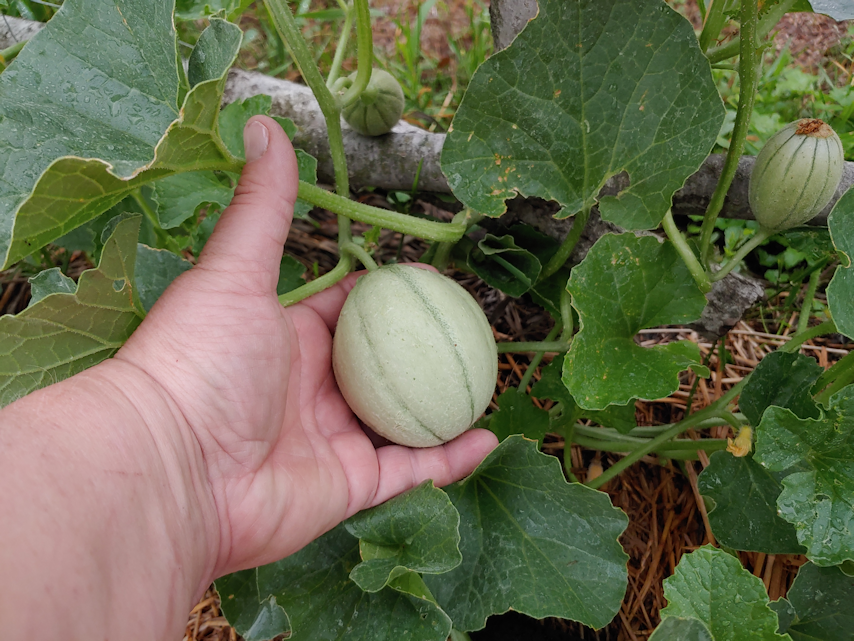
This is the biggest of the Pixie melons that I checked on this morning. I just love how perfectly round they are! :-D
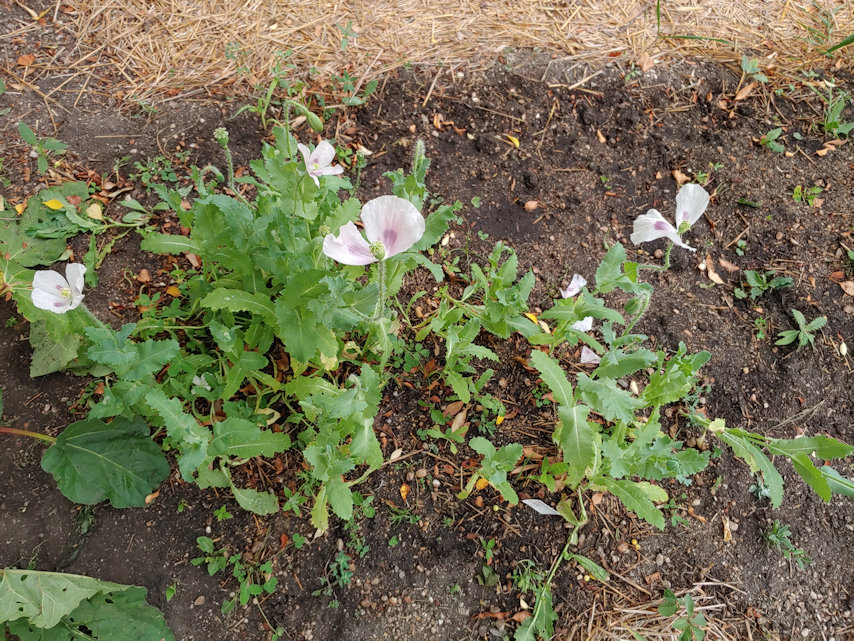
We had a whole bunch of poppies blooming this morning, including this tiny one. So far, it’s the only one with petals that are almost the pink they are supposed to be.
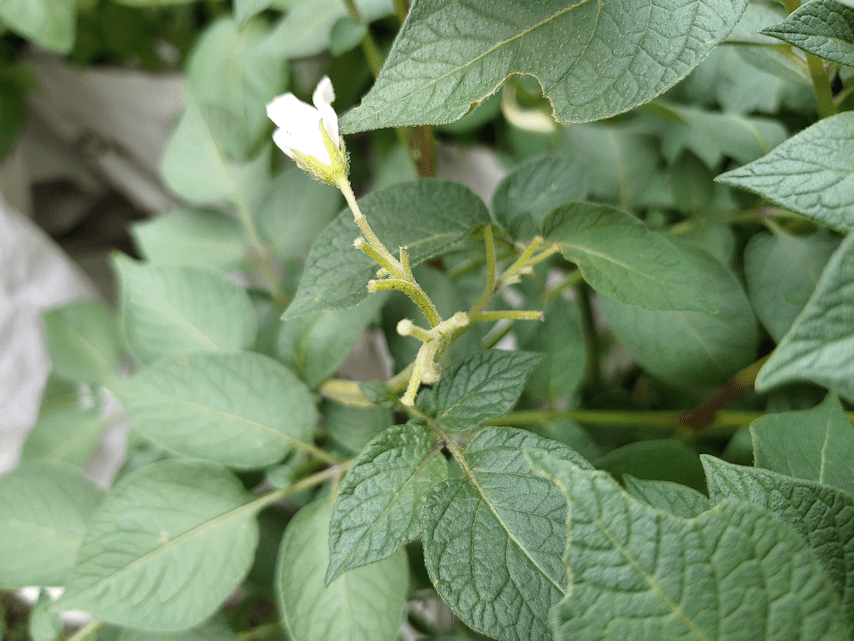
Unfortunately, the potatoes are getting more grasshopper damage these days.
They seem to prefer to eat the flowers! There is a fair bit of leaf damage, though the potatoes are doing so well, they can handle it pretty well right now. Though this seemed odd.
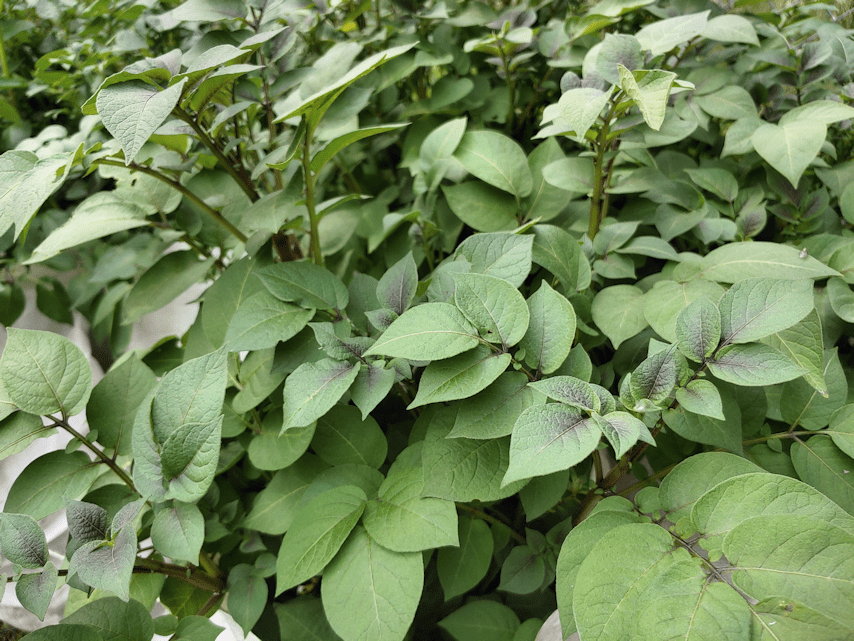
The Purple Peruvian fingerling potatoes have virtually no damage at all! I think I found only two leaves that had been chewed on. That’s it. All the other varieties, meanwhile, have quite a lot of chewed up leaves. Apparently, these potato leaves taste bad to grasshoppers! :-D
I don’t know what it is about today, but the entire household seems to be having a hard time. Perhaps it’s the humidity? I’m actually feeling an oppressive weight in my upper chest and throat that gets worse when I lie down, making it hard to sleep, and my chronic cough has been an issue, even though the rain we did get cleared the smoke out of the air. I don’t know, but we’re all barely able to drag our butts around to get anything done, and we all feel like falling asleep where we stand. Even the cats are sprawled all over the house in furry puddles, sleeping.
Speaking of furry puddles…
The big woodchuck was under the bird feeder earlier today – along with a chipmunk! You can’t really see it in the photo, but the woodchuck’s back hips are just sort of flattened to the ground, like a puddle.
It came back again later, then got some company.
The little one wandered over and started munching. They look peaceable in the photo, but when the littler one got too close to the big one, the big one attacked it! Had it flipped over on its back, teeth at its throat, in a heartbeat!
Then it let the little one go. This was clearly a dominance thing, not an attempt to do real damage. The little one didn’t fight back, but submitted to the big one. Given the size – and likely age – difference, that was probably a wise decision on the little one’s part!
With today being a day where manual labour seems to be out of the question (and there is much of it that needs to be done, but couldn’t be, because of the heat we’ve been having), I decided it was a good time to write out some plans and lists, and make some diagrams, for next year’s garden. I’ve got our catalogues out and started some wish lists, as well as working out what we want to do for next year. The girls and I will go over things and hash out details, using what we learned with this year’s gardening. Having this worked out early will be useful as we clean things up at the end of this growing season. The main thing I’m trying to figure out is what to use to build the first permanent, high raised beds, which will be where we currently have the low raised beds bordered with logs. Buying lumber is out of the question for our budget, but the barn and sheds got picked over by our vandal over the years before we moved here, quite thoroughly. The barn used to be full of salvaged lumber. I have a few ideas in mind, but it looks like it’ll be a while before we can see if they’re even possible. Ah, well. We’ll figure something out.
While heading back and forth between garden and house today, passing by the hanging bird feeder, I kept disturbing woodchucks, eating the sunflower seeds on the ground. I saw all four of them today, including the little one the girls had told me about. A few times, there were two of them at the bird seed at once.
Usually, they’d run off into the spruces, or under the garden shed. Then one of them decided to run along the back of the house, where we still have a row of various things used to hold the insulation we put around the based of the house in the winter. We just kept forgetting to move them. :-/ The little bugger decided to hide in the ceramic chimney inserts, running from one to the other, then back again. I didn’t want him using the house as a place to hide, so I tried to get him to go elsewhere, but he just wouldn’t leave the inserts.
I got close enough that I could have touched that angry looking face (not that I would have!), and he still wouldn’t run off! I finally had to get a long stick and basically shepherd him along before he finally ran to the garden shed.
Of the various woodchucks we’ve seen, there’s just the one that tends to freeze in a sort of panic mode, rather than run off like the others. He was especially unhappy that Nutmeg was with me. Nutmeg completely ignored him and kept trying to rub against me to pet him, even when the woodchuck tried running his way, saw him, froze and started to… growl? I’m not sure how to describe the noise it made!
Among the things I’ve read to use to keep woodchucks from eating the garden is to scatter cat hair around the plants, because cats are their natural predators. Which I find hilarious. The woodchucks are bigger than any of our yard cats! They also seem to get along just fine. I even saw a woodchuck drinking from the water bowl we have by the junk pile for Butterscotch and her kittens.
Last night, as I was topping up the food dishes near where kittens are, I found Butterscotch and her babies playing around the concrete steps at the side of the house. So I sat on the stairs and scattered some kibble at the bottom to see if I could convince them to come closer.
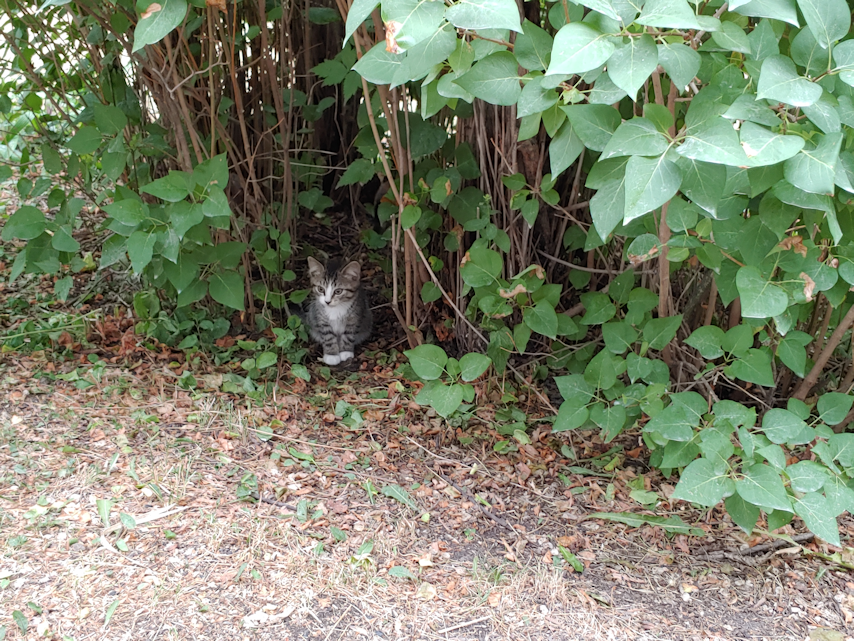
This was about as close as Bradicus got. At least I could see him! Chadicus just hid in the lilacs and peaked at me. :-D
While I was trying to get a picture of Chadicus (I never did), I heard a small noise beside me.
Broccoli had come over and was licking the container I used to carry the kibble in! :-D
Of course, I scattered some kibble on the step for her, as she ran off a little ways.
Those eyes!!!! My goodness!
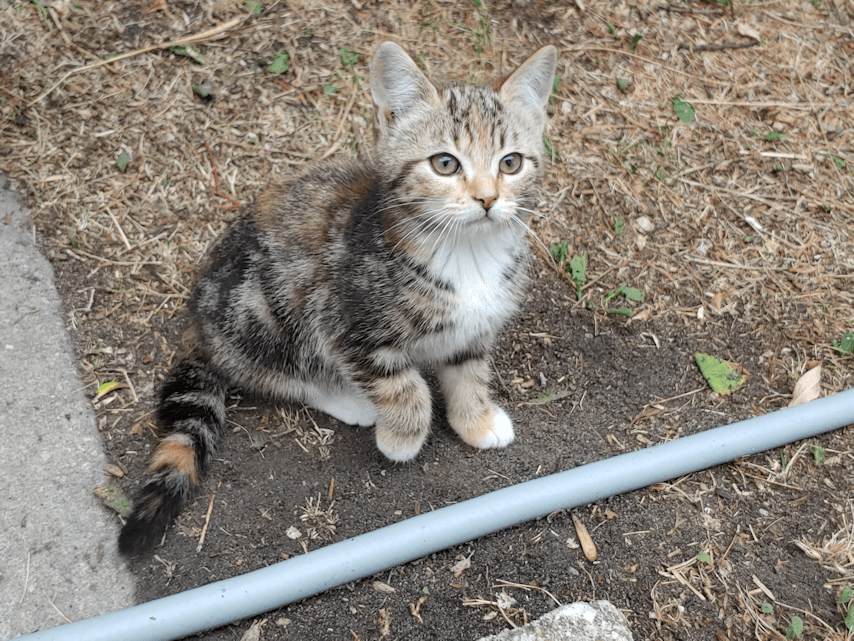
Caramel is definitely one of the braver ones. My daughter has actually been able to put Caramel on her lap and scritch her ears.
Eventually, I had both Caramel and Broccoli on the step by my foot, eating kibble, and I was even able to touch and pet both of them!! They’re not comfortable with that at all, but were interested in the food enough to put up with it. A bit.
Gosh, they are cute. I just wish Butterscotch wasn’t leading them to the empty farmyard across the road. These babies need to stay close to the house!
For the past while, we have been pretty much constantly checking the weather radar. Yesterday evening, it was getting discouraging, and the predicted overnight rain kept getting pushed back and the weather system passed us by to the south. This morning, however, I was thrilled to see a system pushing rain right over is. Granted, based on the radar images, we should have been raining right at that moment, but at least we weren’t going to be missed entirely.
We did get at least some rain last night, as the ground was still damp when I came out to do my morning rounds. It even started raining while I was out there! A very light rain; the sort of rain that, had I not been outside being rained on, I wouldn’t have been able to tell it was happening, but still, it was rain!
While checking the furthest garden beds, I was accompanied by Creamsicle Baby, who has finally started to allow us to pet him again. Frustratingly, when the cats follow us around those beds, they have a terrible habit of going into the pea trellises. This morning, I had to chase Creamsicle off the pea plants he was rolling on, only to have him come right back and start playing with the trellis twice, pulling their pegs out of the ground and getting tangled in them!
Even as I checked the garden cam this morning, I saw Butterscotch going through the pea beds, all four kittens following along, and every one of them went through the pea trellises, running, bouncing and rolling around.
Those poor peas just can’t seem to catch a break!
Other things, however, are doing quite well.
I’m really impressed by how well these Hope Black Dye sunflower transplants are doing. These are from the ones we tried starting indoors, but never germinated until well after we’d direct sown the other half of the seeds outdoors. The seedlings have pretty much quadrupled in size since they got transplanted. I don’t expect them to have a chance to reach maturity, given how late in the season they got transplanted, but part of the reason we grow sunflowers is as a privacy screen and wind break, and these might still accomplish that. Assuming they don’t get eaten. This morning, I saw deer tracks in the soil at the very ends of two bean beds, but no signs of anything new critter damage, so here’s hoping!
Every time we go out to these garden beds, we can’t help but check on the melons. They are getting so big!! This variety isn’t supposed to get as large as, say, the cantaloupes we see in the grocery store, but they are still supposed to produce lots of 4-5 pound fruit. The Pixies are supposed to reach about 1 1/2 pounds in size. I’m really, really excited about these. Melons are among my favourite foods, but we rarely buy them, as they are a treat, rather than an essential.
One of the challenges we’ve been having as been with the potatoes. Since discovering some critter damage, we unrolled the feed bags we’re growing them in to full height. If these had been indeterminate potatoes, we would eventually have done that by continually adding more soil, but these turned out to all be determinate potatoes, so there is no advantage to doing that.
Unfortunately, that meant there was nothing to support the bags, and the plants kept flopping over. Especially while being watered. If we had mulch, we could have added that to help fill the space and keep them from flopping over, but we don’t have anything right now. At least it’s been working to keep critters out, but some of the bags were flopping over to the point that I was concerned the stems would all break, and they’re still in their blooming stage.
Last night, I think I found a solution.
This is how they looked this morning, so it seems to have worked!
What I’d done is cut small holes near the tops of the bags, then tied them together with twine. The double row was tied together in groups of four, while the bags in the front were tied in groups of three. Then, just in case, extra twine was run around the front, tying them to the chain link fence. So now, the bags are holding each other up, while also protecting the plants from critters. It’s just insects we’ll still need to keep an eye on.
Hmm. One down side of finally getting some rain. There are some storms passing to the south of us, which means we’ve lost internet. The WordPress editor’s autosave has been spinning for a while, and once that starts, it doesn’t recover even once the connection is back. Which means that I can’t save my draft, and once our connection is up again, I’ll have to open whatever draft was last autosaved, then copy and paste whatever got missed into it, before I can publish it, and close this window.
Oh, the internet seems to be back again! Let’s see if I can publish this!
I just have to start with the exciting part. We actually got rain today!
Okay, so it was maybe only for about 20 minutes, but it was a nice, gentle, steady rain, and enough that after several hours, the ground is still damp. Not only that, but we’ve got a 90% chance of more rain overnight and into tomorrow morning.
Thank God!
Hopefully, by then, the smoke will finally clear out of the air, and some of that rain will hit the areas that have fires right now.
It is not going to make up for months of drought and heat, but it will certainly help. Even the completely dry, crispy grass has started to wake up and show green already.
It was lovely and cool when I did my rounds this morning, then a daughter and I went and checked all the garden beds just a little while ago.
I’m really glad we set up the chicken wire over the gourds and cucamelons. I found this critter damage this morning. It looks like something, likely a woodchuck, leaned on the wire and managed to nibble on a leaf through the gaps. Just one leaf here, and another on the other side of the chain link fence. Without the wire, we probably would have had a lot more damage.
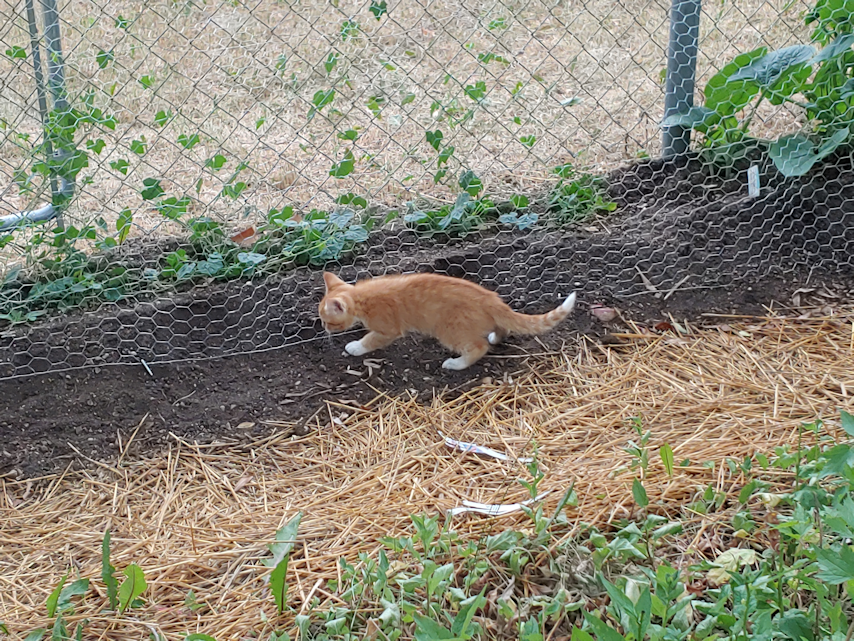
While I was checking on these, Nosencrantz was playing on the concrete block leaning on a tree nearby, so I paused to try and get her to come to my hand. I managed to boop Nosencrantz’s nose before she ran away. Toesencrantz, on the other hand, was far more interested in trying to get at a lump of dirt on the other side of the chicken wire! He could get his paws under the wire, but the tent pegs held and he couldn’t get the lump out. Not for lack of trying! So that confirmed for me that the kittens were doing the digging in the dirt. More reason to be glad for the wire! The dirt lump got broken up, so as to remove further temptation.
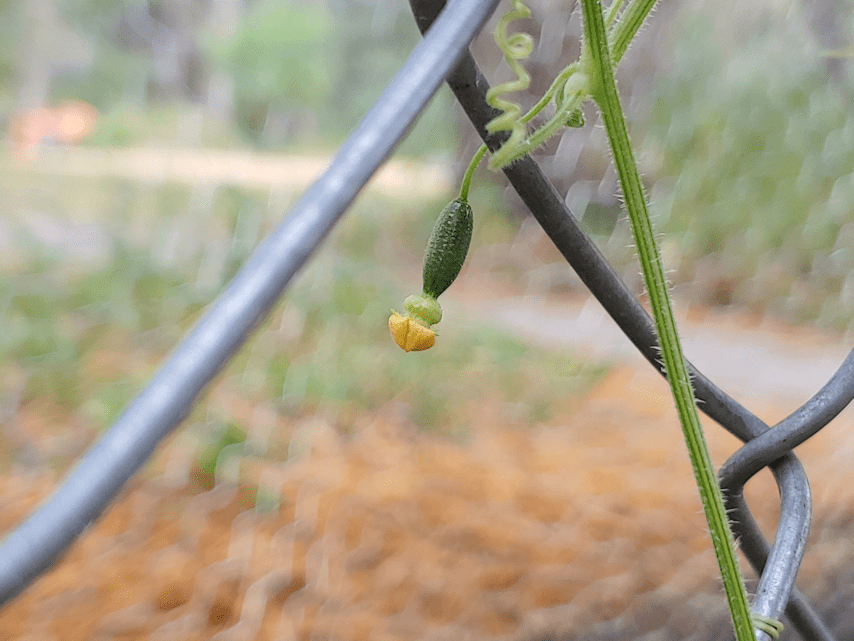
The cucamelon plants looks so tiny, but they are starting to develop fruit! The chain link fence gives an idea of just how tiny these are. I’m looking forward to seeing how they do in this location, which gets more sun than where we grew them last year. They produced quite well last year, for a plant that’s supposed to have full sun.
While checking things out with my daughter, I found new critter damage. When I checked the bed this morning, the damage wasn’t there. These are the Champion radish sprouts. Not all of them were eaten, and the purple kohlrabi sprouts next to them seem to have been untouched. Which would lead me to think it was grasshoppers, not a groundhog, except that after the rain, there were NO grasshoppers around. I didn’t see any in the morning, either, but I usually don’t, that early in the day. They tend to come out later.
Unfortunately, this bed has only the wire border fence pieces to hold up the shade cloth. We are out of the materials to make another wire mesh cover, so with the shade cloths not being used, this bed is unprotected, and there’s really nothing we can do about it right now. :-( On the plus side, it wasn’t a total loss, and I’m thinking the woodchucks, at least, are preferring the easy pickings under the bird feeder.
At the squash tunnel, we found this lovely friend, resting on a Halona melon flower. The melons, winter squash and gourds are doing quite well right now, though all the garden beds are due for another feeding. The baby melons are getting nice and big, and we keep finding more. I was really excited when my daughter spotted this, hidden under a leaf.
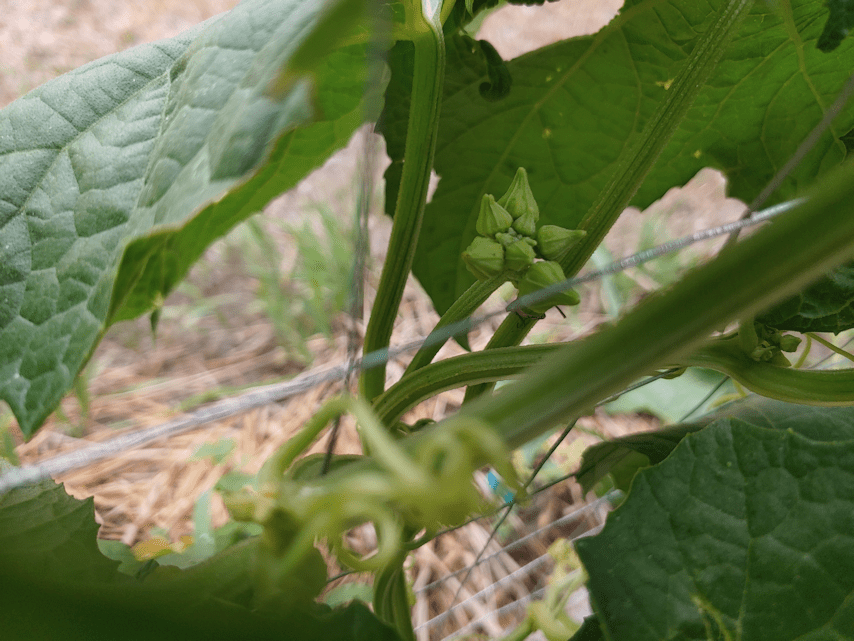
These are the first flower buds on the luffa! I was really starting to wonder about them. They started out well, then went through a rough patch, but since I started using the soaker hose, they are already looking more robust again.
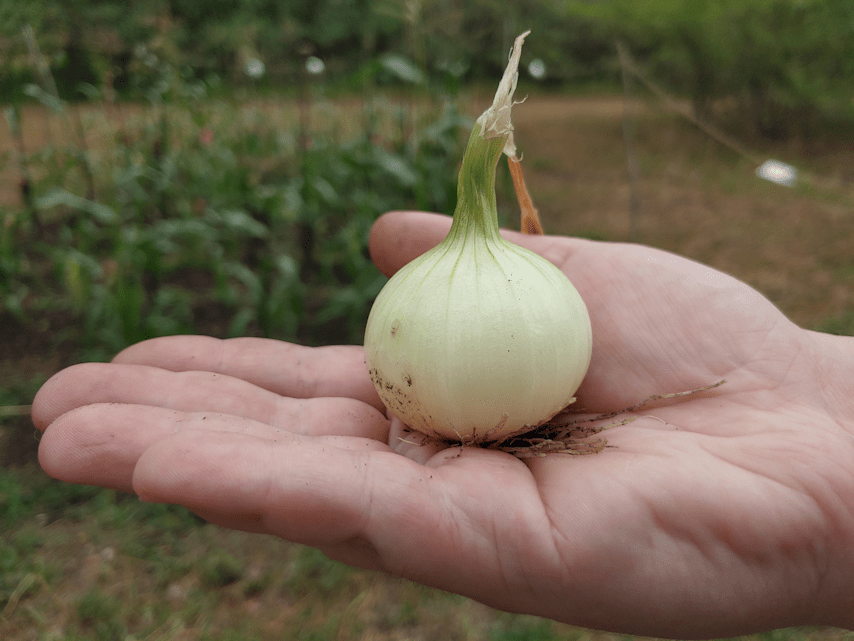
In checking the onion beds, my daughter spotted an onion that had lost its greens completely, so she picked it. It will need to be eaten very quickly. It is so adorable and round! This is from the onions we grew from seed. Though I’ve trimmed the greens of almost all the onions, we’re finding some of them with broken stems. Most likely, it’s from the cats rolling on them, as I’ve sometimes seen Creamsicle Baby doing.
We also found a green zucchini big enough to pick. I’ve checked all the plants, and while there should be at least one golden zucchini, I’m not finding any. Every plant is starting to produce fruit now, too, even if just tiny ones, and no golden zucchini. Odd. Perhaps the package was mislabeled and we got a different kind of green zucchini instead? There are differences in the leaves that suggest two different varieties, even if the fruit looks much the same.
Oh, in the background of the onion picture is the Montana Morado corn. We’re always checking them and the nearby Crespo squash for critter damage. There does seem to be some, but I am uncertain what to make of it. One corn plant, in the middle of the furthest row, lost its tassels and top leaves, but none of the others around it were damaged. It has a cob developing on the stalk, so I pollinated it by hand. Then I spotted another stalk, in the middle of the bed, that also lost its tassels. But what would have done that, while ignoring all the other plants around it? Very strange.
And finally, we have the poppies.
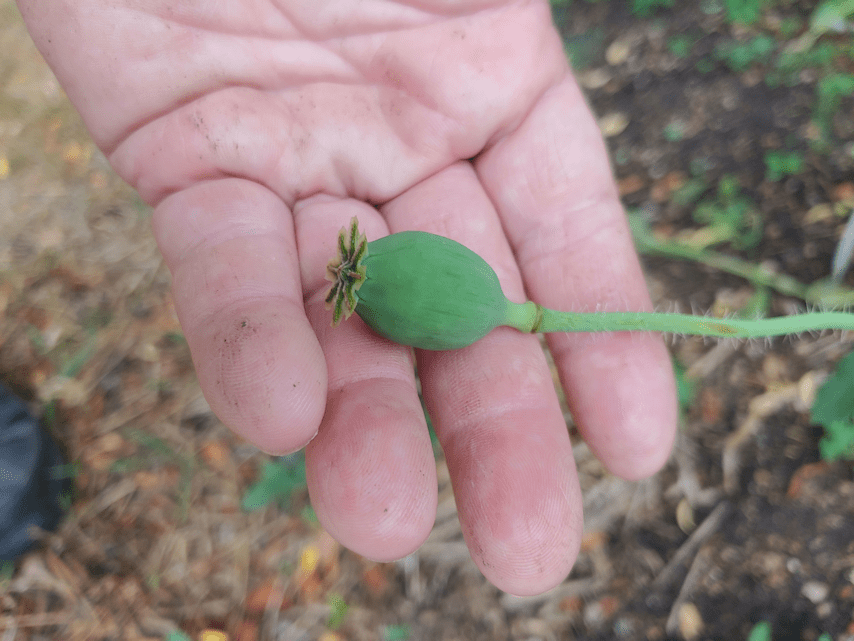
The Giant Rattle Breadseed poppies continue to bloom in the mornings, loosing their petals by the end of the day. Their pods are so tiny at that point, but in my hand, you can see the pod from the very first one that bloomed. It has gotten so much bigger!
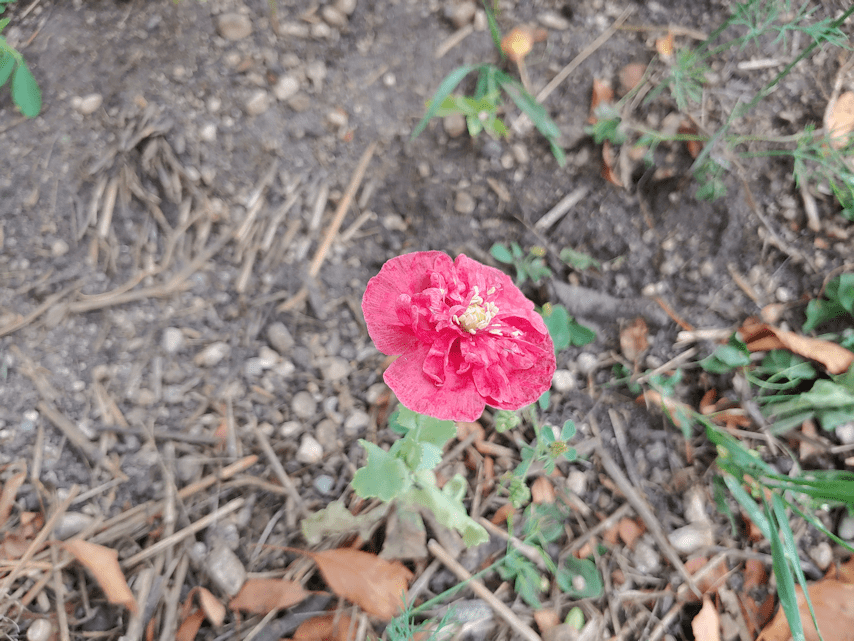
We also found a couple of these.
My mother had ornamental poppies in here, and even with the mulching and digging we did, some still survived. This photo is of the bigger of two that showed up in an unexpected place: where my daughter had dug a trench to plant her iris bulbs. Somehow, they survived, and now we have two tiny little ornamental poppies. :-D
In hopes that we will get rain tonight, we will not be doing our evening watering. If we don’t get rain, we will water everything in the morning, instead.
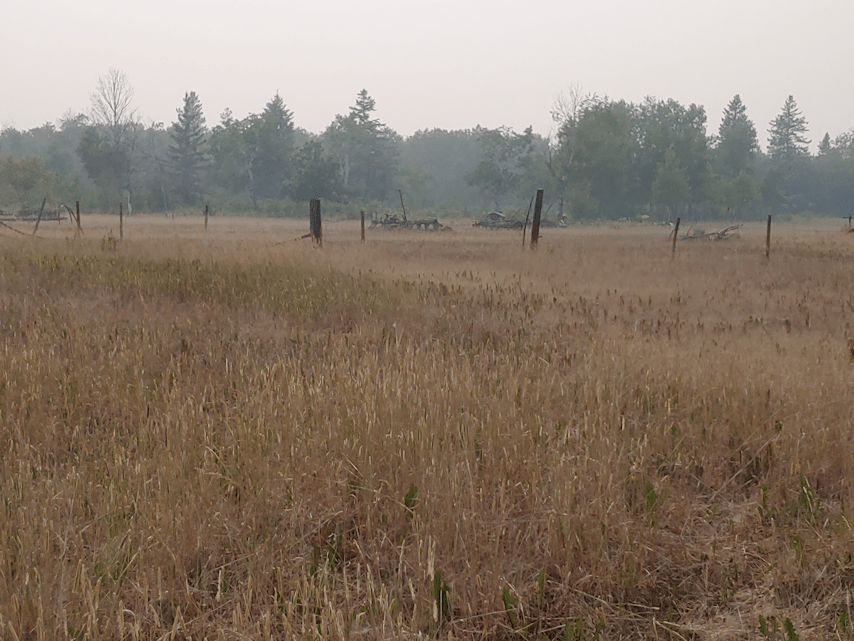
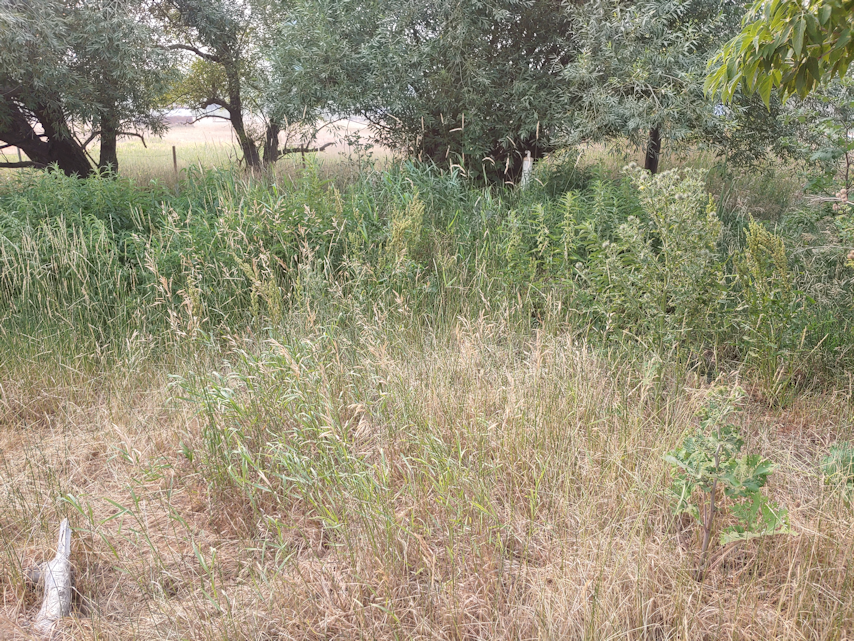
Today, I did something I haven’t done in quite a while; check things out beyond the outer yard. Everything beyond the fence surrounding the outer yard, plus the old hay yard, is rented out, and somewhat less than half of that is used for pasture.
This first photo was actually taken from within the outer yard.
Everything is bone dry and crispy, and you can see the haze of smoke from wildfires that are nowhere near us! Keep in mind that the camera automatically cleans up haze, so the view was actually smokier than this.
This photo was taken at the “gate” by the barn. You can see the renter’s electric fence wire ends here. The only green that shows among the dormant grass is dandelions, and even they are burnt red.
This is facing the areas behind the old barn. By the time the renter rotates his cattle here, this grass is typically 2, almost 3, feet high.
This old pond is typically a source of water for the cattle. I walked to the deepest part, and even there, the ground is bone dry.
Also, we would normally be able to see the neighbour’s tree line in the distance, about a mile away. In the photo, it’s just barely visible as a shadow.
This is the deepest areas of what used to be a gravel pit, but which became another dugout to provide water for the cattle. At the far end is a marshy area that eventually reaches as far as the roadway by the pond.
This is in the deep part of the old gravel pit. Most of the tracks look like they were made by deer, but I think I saw some that looked like there were claw marks. All the tracks are old. There hasn’t even been mud here for some time.
This pit used to be quite a bit deeper. Since it wasn’t being used for gravel anymore, there’s at least a couple of decades of pond sediment, decaying plants and cow manure building up at the bottom. One of these years, I would like to have it, and the pond, excavated again. Since we moved back here, this is the first time I’ve seen the old gravel pit completely dry. Even in last year’s drought conditions, there was still water in the lowest area, making it one of the few sources of water for wildlife in the area.
Here, I’m standing at the “end” of the gravel pit area. Behind me is more marshy area that extends to a “creek” that is part of the municipal drainage system, but tends to have water only with the spring runoff.
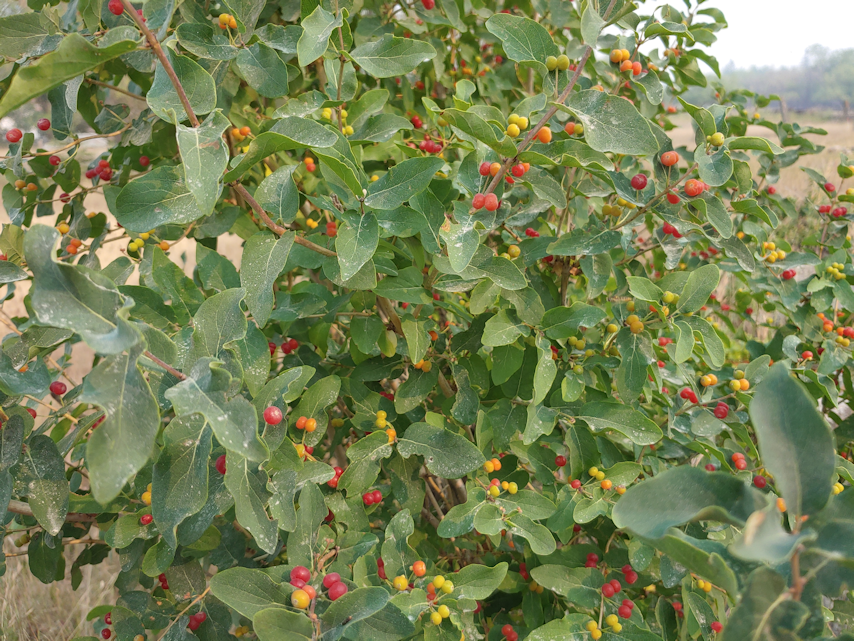
Heading back towards the house, I checked out an area that is mostly rocks and broken concrete that is overgrown with hawthorn and other bushes. This is the only thing there that has berries on it, and they’re not doing very well.
The white that you see on the leaves is dust kicked up on the gravel road, every time something drives by.
There has been a lot of road dust this year.
Another view of the pasture area, looking towards the pond.
Walking through all this, not only was everything crispy and crunchy, but ever step I took sent masses of grasshoppers flying. With things this dry, I don’t think even the grasshoppers can eat it!
There is but one area of relatively lush, green growth.
The septic field.
This is out towards the barn. Unlike a gravity field, our system pumps the greywater from the tank by the house, all the way out here. You can see the white pipe that is the outflow. It just sprays out from there. There is an entire low area beyond this that, in a wet year, forms another pond. It had been fenced off to keep the cattle out, since any water there would have septic water in it, too, but those fences have long since fallen down.
After I finished my walkabout, I set up the soaker hose at the squash tunnel, then decided to try an experiment.
Our green peas in particular are pretty much toast. Or should I say, toasted. They are still blooming and trying to grow pods, but between the heat and whatever is eating them, we aren’t going to get a crop from them.
The Dalvay peas are sold by weight, not seed count. Which means we had a LOT of seeds left over. Part of why I wanted to plant so many peas and beans near the corn, and to do it in this far flung area, was for their nitrogen fixing qualities.
So I decided to take the leftover seeds and plant them with the sweet corn.
Interestingly, not long after I started, I realized I was hearing the sound of a small engine vehicle moving around on the property. It turned out I was not the only one who decided to check conditions today. The renter had come over on his utility vehicle and was checking out all the pasture areas.
If he does rotate his cows here, I suspect he’s going to have to provide both food and water for them. Last year, he only had to provide water.
One of the things I’d like to do in the future, if we ever have the money to do it, is get those two water fountains going again. It would mean replacing our pressure tank with a much bigger one, as there had been in the past, and hiring someone to make sure all the pluming and the tanks themselves are in working condition. We don’t have cows of our own, but they would be good for wildlife, as well as the renter’s cows.
That’s something for the dreams list! :-)
I was almost done planting peas when my daughter came out to set up the sprinkler. Using a sprinkler feels like such a wasteful way to water, but for this area, we simply couldn’t water them as thoroughly as they needed, any other way. The other beds don’t have the same issues. It’s remarkable how different soil can be, even in a short distance. Since we started using the sprinkler, the corn and sunflowers have been doing visibly better.
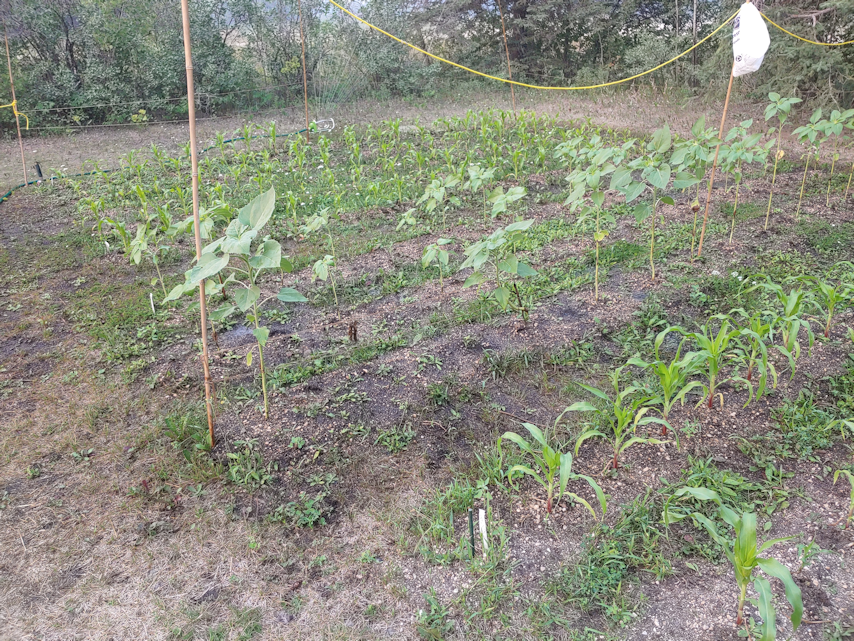
There were so many peas left in the package, I was able to plant one pea for every corn in the block-and-a-bit visible in the photo. In these, I had planted a couple of seeds of corn a foot apart, then thinned them later. In the last block, I just planted a corn seed every six inches. Most of them germinated, so there wasn’t the space to plant one for every corn plant, so I planted one every 1 – 1 1/2 feet, depending on the spacing.
I still had enough seeds to plant more among the surviving Dorinny corn. Then I still had enough to plant with the Montana Morado corn (which seems to have been replaced at Baker Creek with Mountain Morado corn). And I STILL had seeds left over! Only about a dozen or so, but wow, was Veseys ever generous with their quantities!
Now, these seeds had been left behind in a storage bin we keep by the rain barrel next to the pea trellises. Which means that they’ve been out in this heat all this time. It’s entirely possible they won’t germinate. Or only a few will germinate.
Though planting peas for a fall crop this time of year, to get a fall harvest, is something that can be done in our zone, this year is so hot, we might still have the same problem as with the ones I planted in the spring, even if they do germinate. However, that’s not what I’m planting them for. I’m planting them for their nitrogen fixing qualities. Corn are nitrogen hungry plants, and our soil is nitrogen depleted. Yes, we can use a high nitrogen fertilizer, but having a plant that will do that job is preferable. Plus, if they do germinate, the corn plants will provide shade for them, while also providing a natural trellis for the peas to grow on, as with beans in Three Sisters plantings. We only have bush beans, though, so they won’t climb the corn. People had been talking about the Three Sisters method of planting in some of my gardening groups. Some people found it worked well. Some found that the squash made getting at the corn difficult, or that there was just too much competition for nutrients, and some found peas worked better for them than beans.
So we shall see how this turns out.
As I’ve mentioned in the past, all of these far flung beds are temporary. We’re basically breaking and amending the soil in perpetration for future plans. With what we are learning this year, we are already adjusting some of those plants. We were talking about planting a nut orchard and fruit trees, which we’re going to have to do soon, because those can take years, in some cases a decade, before they start producing.
We’re going to be adding a step.
My daughters and I have been going through the Whiffletree catalog, repeatedly. With the soil conditions we have, we’re now thinking to start by adding hedges. There are several options available for zones 2 and 3 that not only produce edible fruit and do well in poor soil, but also help fix nitrogen in the soil. If they’re still available next year, we’ve decided on three different ones. Silver Buffaloberry, which is a zone 2 bush, Autumn Olives (also called Autumn Silverberry), which is a zone 3 bush that is semi-fertile, and Sea Buckthorn, which is a zone 3 bush that requires 1 male variety for every 5-9 females varieties. On top of producing edible berries, being able to grow in poor soil conditions, and acting as nitrogen fixers, these will also form a barrier that will not only give us a privacy screen from our peeping vandal, they are dense enough to form a barrier that deer can’t get through. Plus, they will be dense enough to act as dust barriers. We’ve worked out the areas we can plant in, leaving a gap over where we thing the buried telephone wires are. We never did hear back from the Call Before You Dig people, but I figured out an easy way to do it. My brother’s property is right across the road, and the lines run though his place, too. He has a gap in his spruce grove, over the phone lines. All we have to do is line up our gap with his! :-D Anyhow, after we start with these nitrogen fixing, berry producing bushes, we will then start adding fruit and nut trees in what is currently a big void in the old garden area. Little by little, year after year, we will be adding more food trees, strategically placing each of them, so serve multiple purposes. At least, that’s the plan right now! :-D
Meanwhile, by the time I was done with all the pea planting, the smoke in the air had gotten to the point that there was a haze in the yard. As I write this, I can see the live feed from the garage security camera, and I can see smoke in our driveway. We’re still getting rain in our forecast, but in millimeters. Some areas did get rain today, which I am happy to hear about, but none of it is reaching us. I would actually be okay with that, if we could at least get rain over those northern fires.
Today, we finally have cooler temperatures! According to the hourly forecasts, we should be at about 23C/73F right now, but we’re still at only 18C/64F, which is awesome. There are still predictions of rain, all of which have been passing south of us. We desperately need rain. I’ve been reading about how it’s affecting some of our farmers. Those growing things like oats have had their crops gone crispy. Cherry producers (I didn’t even know we had a cherry industry in our province!) have had their cherries bake, right on the trees.
On top of all that is the smoke. I had to make a trip into town this morning, and it’s even worse there. There are fires on the other side of the lake, which is likely why. There are no fires near us but, today, the smoke is heavy enough to affect visibility quite a bit. I was talking to my mother on the phone a little while ago, and the smoke coming into the house was so bad, I had to excuse myself for a couple of coughing fits while talking. I’ve been able to reduce my mystery coughing fits pretty well over the last few years, but with this smoke, I’ve had more in one day than I’ve had in the last 4 years since we’ve moved here. I’ve actually reversed the fan in my window to blow the smoke out, even though I would normally be drawing the cooler air in while we’ve got it.
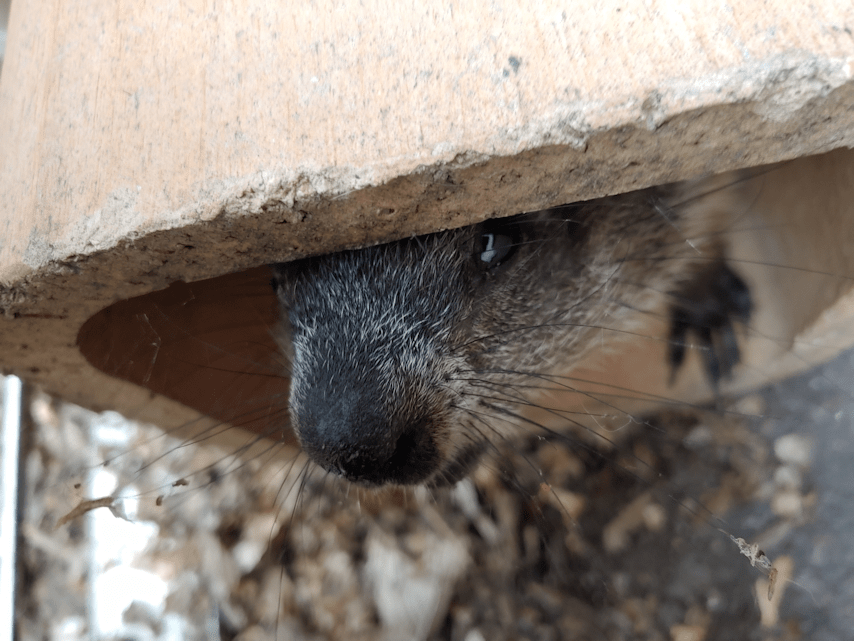
This adorable monster was eating our bird seed this morning. I saw one of the smaller ones out my window, heading to the bird feeder, just a little while ago. I should probably chase them away, but as long as they’re eating the seeds, they’re not eating my garden, so… I’m letting them be for now.
I’ve got the garden cam set up to try and see what has been eating our peas. The only things that got caught were a skunk and Butterscotch going by. Skunks are omnivores, so it could potentially be a skunk, but the one I saw was just passing through.
When doing the watering last night, I uncovered the beds with radishes, chard, kale and kohlrabi. This morning, I left them uncovered. We’re overcast, so they don’t need the shade, and if we do get rain, I want them to get some!
While talking to my mother about the current drought conditions, I mentioned that there are people whose wells have gone dry. I told her I thought my brother had said our well is 80 feet deep. It’s a number that’s been bothering me, but I couldn’t remember him saying anything different for this well. The old well in the pump shack (which predates my family owning this property), I remember him saying is about 110 feet. My mother, however, corrected me. She didn’t know about the old well, but she did remember that the well by the house is a little over 150 feet deep.
I suddenly feel much, much better. There is no way my brother would have been wrong about that, since he was heavily involved when all the work was being done, so I don’t know where I got that 80 feet from. Especially since I know we have a deep well pump. “Deep” is a relative statement, depending on the geography and elevation, but I know that in our area, even 80 ft would be considered pretty deep. However, if we’re loosing pressure while using two hoses at the same time (granted, one of those hoses had been running a sprinkler for an hour) at 150 ft in current conditions, at 80 ft, our well would probably be dry right now. Which is a rather alarming thought.
And so we pray for rain, for respite for our farmers and firefighters, and to clear some of that smoke out of the air!























 The Re-Farmer