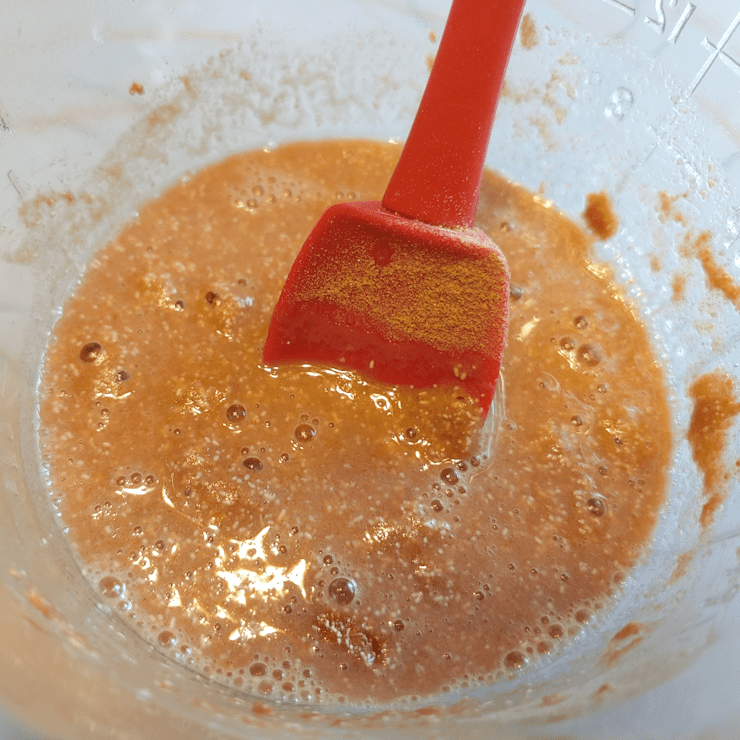
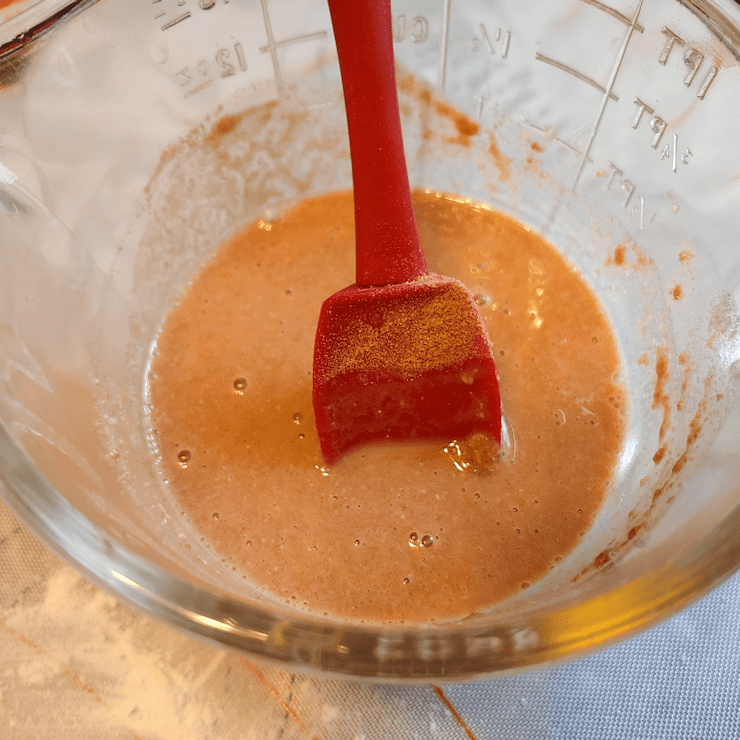
When setting the old dough to reconstitute and ferment overnight, I had some concerns about temperature. The crock was sitting on our dining table, and that room gets pretty chilly. I did warm up the rice bag we have been using to warm our fermenting hard apple cider (which is probably ready to be bottled, but we haven’t gotten around to it yet) and set it under the crock, to help keep it at least a little bit warm.
While investigating some cat noises in the wee hours of the morning, I checked it and found it was looking pretty much the same as when I’d left it. So I warmed the oven up a bit, then put the crock in, shut the oven off and left the light on.
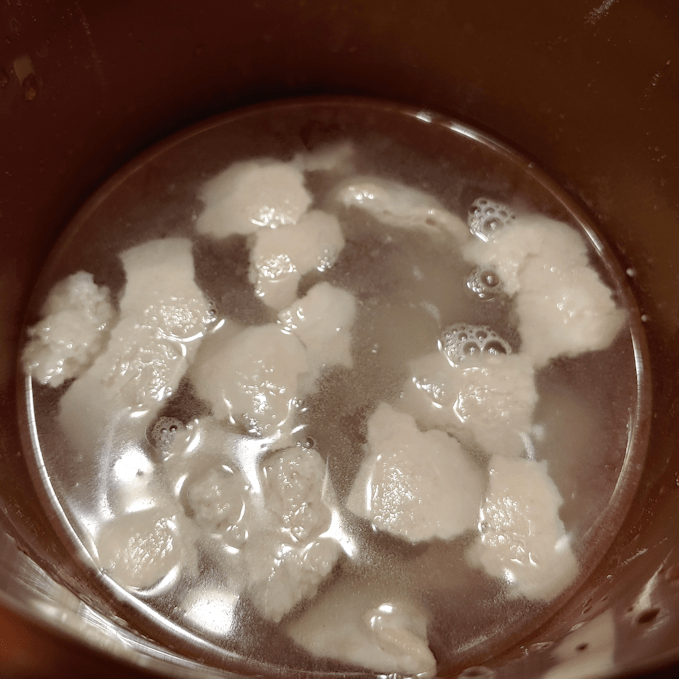
This is how it looked about 3 hours later.
Warming it up, did the trick! I’ll have to keep that in mind, as we continue experimenting.
I warmed the oven up a bit again, then put the crock back for another 3 hours or so, before I was able to start making the dough.
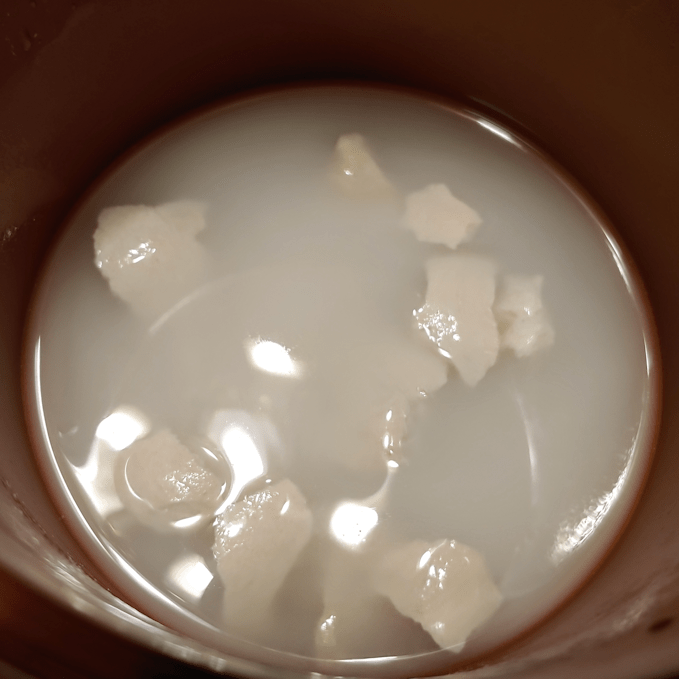
That’s looking nice and puffy!
I find it interesting that the pieces are still distinctly separate. When I stirred it, before adding it to some flour and salt in a bowl, I found the pieces separated and stretched, before starting to mix together. The water under the old dough pieces was pretty much clear until I mixed it, too.
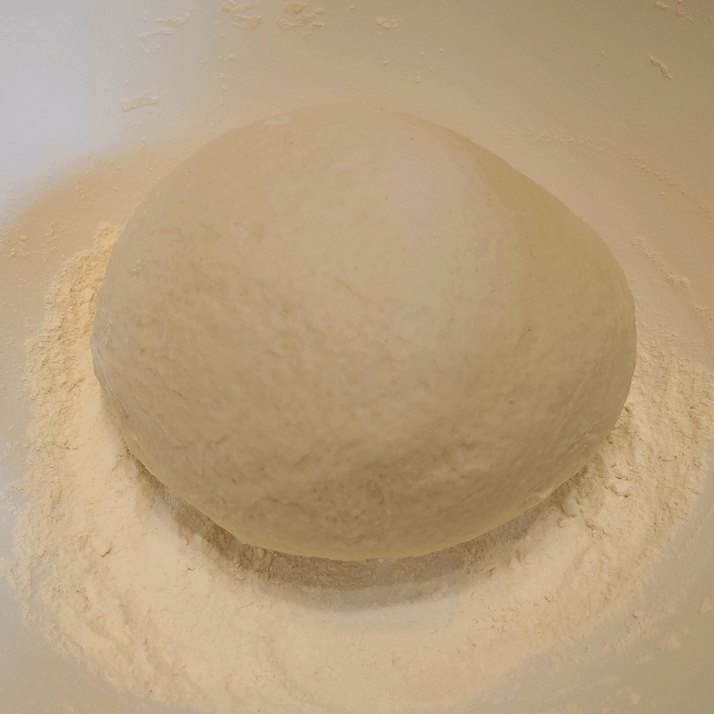
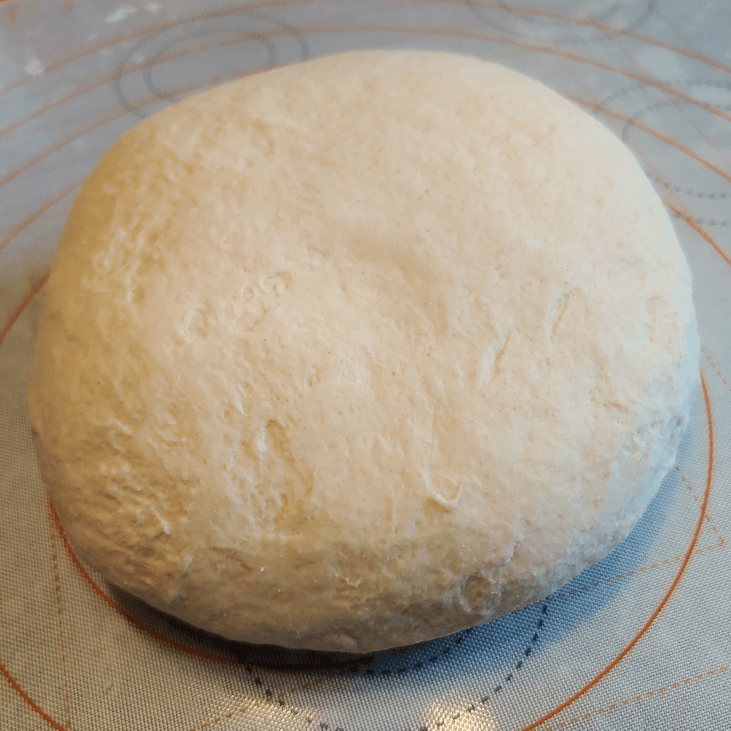
I added this to a bowl with 3 cups of flour and 2 tsp of Kosher salt and mixed it together. I kneaded another 4 – 4 1/2 cups of flour in before turning it onto my table and kneading it for another 5 – 10 minutes.
Normally, I would oil the bowl the dough will be rising in, but my grandmother would not have done that, so I used flour, instead.
With this batch, I’ve got the same amount of water as the first batch the old dough came from, but I’m using less flour. That first batch was too dense. With only a little more than 4 cups of flour in here, after I remove some dough for the next batch, I think I’ll just make one large round loaf this time, instead of two.
Next time, I think I’ll up the water and flour quantities a little bit, and make a bigger batch. I don’t think I’ll adjust the amount of salt, though. Not unless I end up doubling the recipe or something.
The dough is now covered and set aside for its first rising. I’ll give it at least an hour, probably two, before punching it down and leaving it for a second rising.
I will post again, later today, with the final results! :-)
There was a light snow overnight, and while I was out doing my morning rounds.
I noticed this, on the roof of the cat shelter.
Melted snow on the roof of the cat shelter, above the ceramic terrarium heater.
You can certainly tell where the heat bulb is!
There is no insulation on the walls or under the roof at all, so it wouldn’t take much for there to be heat leaking through, even with the aluminum shield between the bulb and the roof.
The cats are quite enjoying their warm shelter! There’s usually several that can be seen, watching me through the window closest to the heater. :-)
They will also sit inside the kibble house, even while not eating. Sometimes, I’ll spot one of the more skittish ones under the floor, watching to see if I come closer, before squeezing out again.
We still have very little snow right now. When it starts getting to where we need to shovel it, I want to make sure the cats still have access to under the shelters, as well as into them. They have claimed every bit of shelter these structures provide! :-)
Tonight, the plan was to continue with my attempt to recreate bread, as much as possible, in the way my mother remembers my grandmother baking.
I spent some time doing research on the method, but there is nothing out there that quite matches what my mother describes. I gave her a call today with more questions, and got more of the story. :-)
This video was the closest I could find to what my mother described, but it left me with a lot more questions.
Obviously, my babcia didn’t put the piece of dough into a jar and stick it in the refrigerator. They didn’t have refrigeration. The dough in the video is almost a batter. Also, did my babcia use rye flour? Since she baked only once a week, she had to have been making a LOT of bread. How much did she bake, and how much of the dough did she set aside for that much baking?
My mother had difficulty understanding some of my questions – and she’s at a loss as to why I am even bothering with all this! Using commercial yeast is just so much easier. :-D
So it took a while, but this is what I was able to find out.
My babcia’s weekly baking was for about a dozen round loaves. This was all one big batch. Her dough bowl must have been huge! She worked up the dough, using the old dough that was reconstituted overnight for leavening, then left it to rise. She then punched the dough down and left it to rise again. After the second rising, she would punch it down again, then knead and shape her loaves, laying them out on a flour covered surface. The shaped loaves would be left to rise one more time before baking in their masonry oven.
It would have been when she was forming the loaves that dough was taken out for the next batch, and all the scrapings from the wooden dough bowl and leftover bits of flour, would be incorporated into the ball. My mother says the ball of dough was about the size of a loaf of pumpernickel bread that she sometimes buys at the local grocery. That would make it about 3 – 4 cups of dough, before proofing, though I do take into account that, given her age at the time, her memory of the size might be distorted by her own small size.
Still, it’s enough information to assure me that my egg sized lump of dough is probably about the right size for a 2 loaf recipe.
I also learned that my babcia did use rye flour, as well as the wheat flour and corn flour my mother had already mentioned. Basically, whatever they had on hand. Or whatever was left, after either the Russians or the Nazi’s came through and took everything again.
It was a rather precarious existence for them!
I also confirmed that my grandmother’s dough was NOT a wet, almost batter like dough, like the one in the video above. My mother described it as being more like the sort of bread she used to bake all the time, when I was a kid. Considering that I helped her with bread baking for many years, that gives me a very good idea of what I will be looking for.
Armed with more information from my mother, I started on reconstituting our bread dough “egg” in preparation for baking with it, tomorrow.
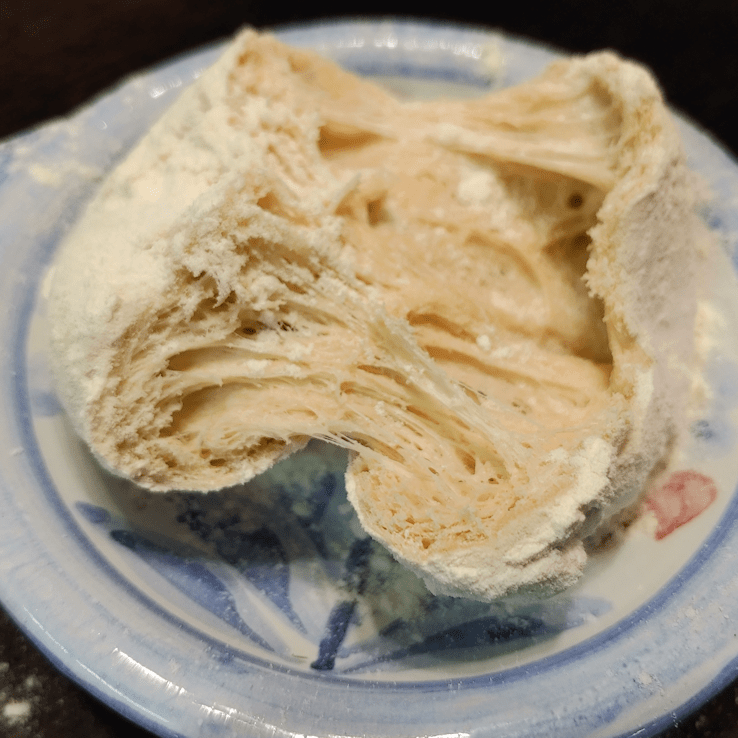
Here is how it looked, when I dug it out of the flour.
It was most definitely larger than when it first went in! Not extremely so, but enough to really notice.
It also felt a lot lighter than when it was first put in. I was very interested in seeing how it looked on the inside!
Ooooo!!! That looks amazing!
The outer shell was almost flaky in texture, and was clearly doing a great job of allowing the yeasts to continue to ferment without contamination.
It actually rather reminded me of the sourdough in this video, minus the fire.
It’s interesting to note that, historically, people did conserve their sourdough starters while traveling by putting it into their bag of flour and allowing it to dry out. What I am making now will certainly result in a sour dough, eventually, though it is not at all the same as maintaining a sourdough starter.
Since I will be making another 2 loaf recipe, I decided to reconstitute the dough ball in the full 2 cups of water that will go into the recipe. I could probably have used half that amount, without any issues, but I figured, why not sue the full amount? I wouldn’t use the full amount of water if I were, say, making a dozen loaves, like my grandmother did, but for a small batch of bread, it should be fine.
I used water that had been boiled, first, as a precaution with using our well water. Once the water had cooled down enough, I put it in a small crock style canister that I have, then added the broken up pieces of old dough.
After that, it just got a quick stir, to make sure all the pieces were thoroughly immersed.
I don’t expect this to overflow as the yeast develops but, just in case, I placed the covered container on the lid of a large mixing bowl.
Now, it just sits for the night. :-)
I am very interested in seeing what this looks like in the morning!
Okay, here it is! My very first attempt at slowly recreating my grandmother’s bread, with her use of “old dough” yeast that she kept stored in flour in between baking day. (Part 1: the story)
The first goal is to create the bread dough yeast starter, and for that, I need to make a yeast bread.
Here are the ingredients.
Water, yeast, salt and flour.
That’s it!
I used Kosher salt, as I figured that was more like what my grandmother had available to her.
For a 2 loaf recipe, I used 2 cups water, 2 tsp salt, about 2 tsp yeast, and between 5 and 6 cups of flour.
The yeast is my “cheat”. Back in the spring, when everyone started panic buying, yeast was among those things that became hard to find. One of our local grocery stores now not only stocks lots of the usual big name brand or two, but a wide variety of brands and types of yeast. When I spotted a “sourdough” yeast, I grabbed a packet, just to try it.
Since some of the dough from this batch will become the “mother” of future batched, I thought it was appropriate to use it.
The ingredients list is interesting. Both wheat and rye is used.
“Sorbitan monostearate (abbreviation SMS), or Span 60, is an emulsifier esterified from sorbitol and stearic acid with the European food additive number E491. This ingredient is mostly used in baking yeast by improving the activity of instant dry yeast when the yeast is rehydrated before use. “
Speaking of rehydrating…
For the 2 cups of water, I boiled it first, because I have doubts about our well water. We really need to get the water tested, but a full test is really expensive, so… boiling it is.
I measured out half a cup of water into another measuring cup to rehydrate the yeast. I could have done it in the full 2 cups, but the half cup cooled down to a safer temperature for the yeast faster.
The inclusion of rye in this really changes the colour!
I let it proof for 5 minutes. I don’t know if I should have proofed it longer – I have recipes that call for anything from 5 to 15 minutes. It’s bubbled up, though, so I decided to go ahead.
While it was proofing, I mixed the salt into about 2-3 cups of flour. Without a wood bread bowl, I decided not to use a plastic one, and tried “dump your liquids into a well in the flour” method.
That looks…
Unpleasant.
The next while was spent with very messy, sticky hands, incorporating the rest of the flour and water in.
Thankfully, my daughter came down to give me a hand, adding the flour and water as I kneaded it in.
Once it was all mixed in, I kneaded the dough for about 15 minutes.
I may have used too much flour. I’ll have to keep that in mind for next time.
I did notice a difference in texture from my usual bread. Although I kneaded the dough until it felt smooth and satiny, it never looked smooth.
In fact, the longer I kneaded, the rougher it began to appear!
So I went by feel rather than appearances when it came time to set it aside for a first rising.
It went into an oiled plastic bowl, turning to coat all sides with oil. After covering the bowl with a tea towel, it went into a warm oven to rise.
Earlier in the day, I had prepped a baking stone and was curing it with oil in the oven. The oven was off but still warm; prefect for proofing the dough.
Once it was in the oven and rising, I set a timer to check it in an hour while my daughter started a batch of French bread. Checking it at an hour, I decided it needed more time, by my daughter’s bread was rising by the, too. So I took the bowl out and put my daughter’s dough in the warm warm oven, and set my timer for another hour.
This is the dough, after 2 hours.
After turning the dough out to prepare the loaves, I had to make sure to do that most important part.
Collect a dough egg! :-D
This humble little lump of dough is what it’s all about.
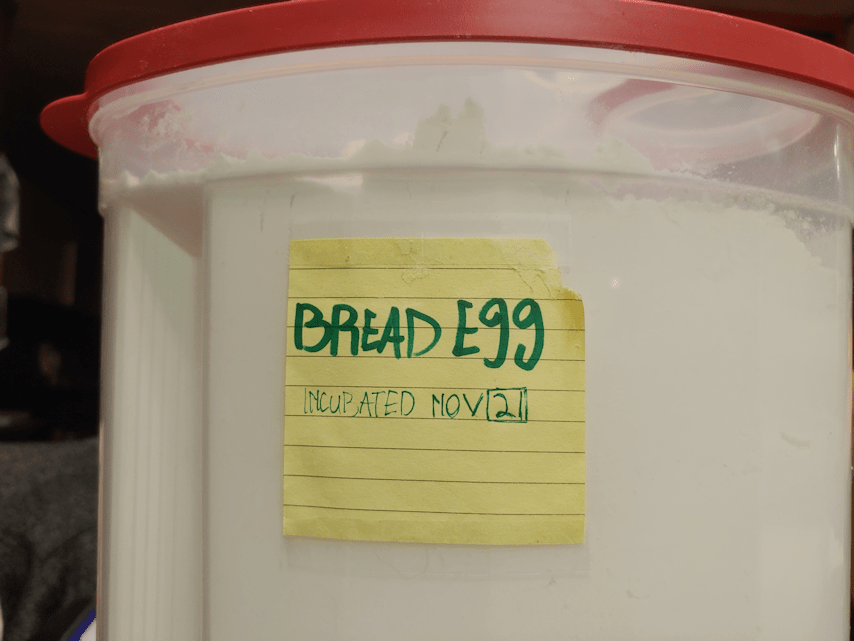
Into our flour canister it went!
I almost forget to get a picture before burying it!
My other daughter labeled the container for me.
She is a hoot! :-D
The ball of dough will now dry out until the next time we bake this bread.
After dividing the dough, I decided to form it into round loaves.
By this time, my daughter’s loaves were in the oven.
Where she forgot to take out my curing baking stone.
So they got to have their second rise on a normal baking pa, instead.
In kneading and shaping the dough, once again, the dough got rougher rather than smoother! You can really tell in the one of the left.
I then left them to rise, checking them after about half an hour.
My daughter’s French bread was done well before my second rising was done!
The ended up needing another hour of rising time.
The baking stone had cooled down quite a bit by then, but was warm enough that I transferred the loaves over, and I think that residual warmth helped them rise even more. The above photo was taken just before they went into a 400F oven.
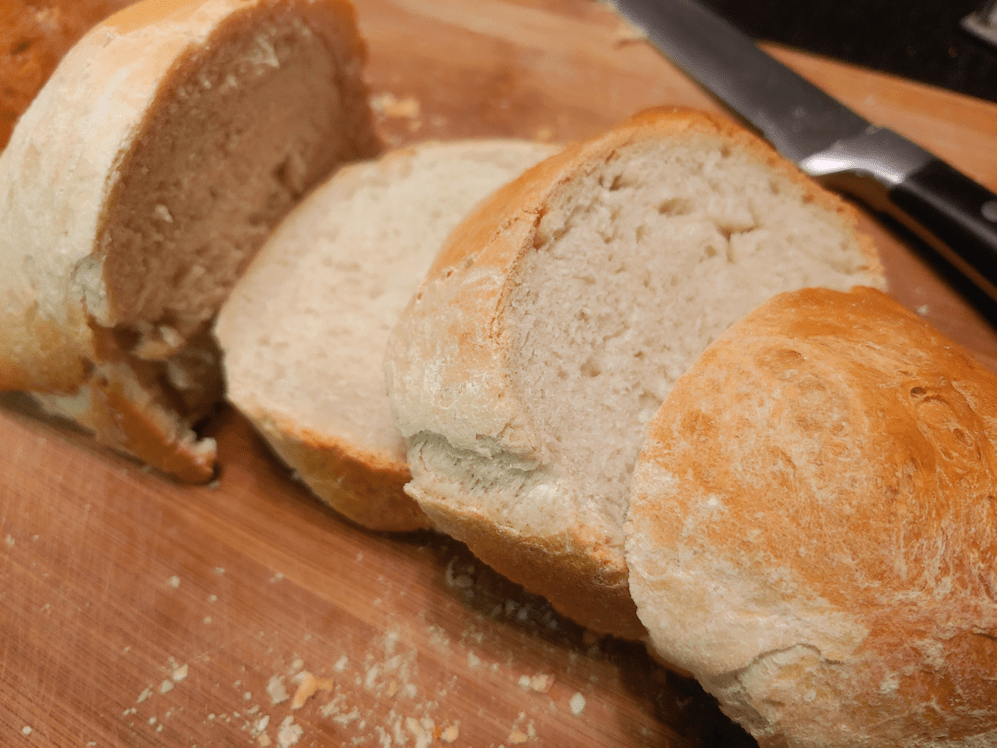
All done!
I am not sure how long they took to back. I set my timer for half and hour, then kept peaking and resetting the time for another 5 minutes, over and over. I think it took about an hour to bake.
I was quite impressed with how much the loaves rose in the process!
The next part was the hardest.
Waiting for the loaves to cool down!
For all that the loaves rose so much in the oven, they still felt surprisingly dense. I was also a bit surprised by how fine a crumb there was.
I taste tested one piece plain, one with ordinary butter, and one with a garlic herb butter.
I’m having a hard time describing the flavour. It was certainly tastey, but I think I was picking up the rye flavour in the “sourdough” yeast. It did have a “sourdough” tang, but one that is quite different from any sourdough we’ve made ourselves.
The sponge was soft, yet toothsome. The crust was crusty enough to be a good chew, but not so crusty as to cut up the mouth (something I have issues with, when it comes to most “crusty” breads).
The plain slice was tasty, but the buttered slices definitely were better. With no fat in the bread itself, the butter really brought out the flavours that were more muted in the unbuttered slice.
All in all, this very plain, very basic bread was a success.
It is, however, just the first step in the process. It’s purpose was to provide us with some dough to reserve for the next batch. Every batch of bread we make using the bread egg now sitting in the flour canister will be another step closer to recreating my Babcia’s bread.
While my grandmother did her bread baking once a week, we will probably make our first batch using the bread egg in 3 or 4 days.
I am really curious to see how it will look when we fish it out of the flour, and how the overnight soak will turn out! For a first time use, I don’t expect the flavour will be much different, but who knows? I’ve never done this before! :-D
I may have mentioned in past posts, about my mother’s memories of bread baking in pre-WWII Poland. I was fascinated by what she could tell me. With no commercial yeast available, I had thought my Babcia (grandmother) had used a sort of sourdough. I know my father remembers this; a portion of the bread dough would be set aside to continue to ferment, and be used in the next batch of bread.
My grandmother did something different. She allowed her old dough to dry.
We lost our own sourdough starter, the Sourceror this past summer. It almost made it to 2 years, but we had a real problem with fruit flies this year. Somehow, they managed to get into the container and contaminated it.
Having a big bubbling bowl on the counter has been a bit of a problem for other reasons, so the more I heard about how my Babcia saved her dough, the more I wanted to try it.
My mother’s memories go back to the late 1930’s, early 1940’s. Then WWII happened and they eventually ended up in Canada, where commercial yeast was available. After questioning her about it, this is what I’ve been able to piece together.
Babcia would bake bread once a week. She would set aside some of the dough, adding in the scrapings from the wooden dough bowl, form it into a ball, then burying the ball in the flour. The night before she would be baking bread again, she would take out the dried ball of dough, break it up into pieces, and soak it in water overnight. In would get all bubbly, and that would be her yeast for her bread baking, with the cycle continuing each time.
My basic bread recipe includes things like oil, sugar, eggs, milk… all things that I just couldn’t see handling sitting in a bag of flour for a week without going off. On questioning my mother, I learned Babcia used none of these things. It simply wasn’t available. Her bread was flour, water, a bit of salt, and the reconstituted old dough. That’s it.
The flour would have been flour they milled themselves (at least they did until the Nazi’s caught them using an illicit hand mill and destroyed it), using grain they grew themselves. My mother says corn flour was also sometimes used, which they also would have grown themselves. The ingredients may have been few, but my mother remembers it as being the best bread; especially when corn flour was added. She remembers it was light and fluffy, too.
My mother was too young at the time to remember a lot of details, though, so I did some research. I know that bread can be as basic as flour and water, but if salt is used, would that be a problem? I know that sugar feeds yeast, while salt retards it. How would having salt in the dough affect the old dough yeast cake? Also, how much dough was set aside? My mother remembers a “ball”, but as young as she was, her sense of how large that was would be distorted.
In my research, I found quite a bit about “old dough” bread baking. This gave me a lot of the information I was looking for. For some types of old dough baking, dough is set aside before the salt was added, while others were taken out after. Both work. As for how much was taken out, I eventually found a general “about the size of an egg” description.
What I didn’t find was anyone who used old dough that was stored in flour. Nor did I find any that stored the dough for weekly baking. Most described setting the old dough aside in the fridge for 2 or 3 days, at most. In some forums I found, people described using it in their daily baking. Not a single person described using their old dough the way my mother remembers her mother did it. They all used wet dough. None used reconstituted dry dough.
I have decided, instead of getting a sourdough going again (for now), I will try and recreate my Babcia’s bread.
Of course, some things I will simply not be able to recreate; at least not now. We’ll be using plain old AP flour. I won’t be adding corn flour right away. I don’t have a big wooden dough bowl like my Babcia would have had (with a wooden dough bowl, yeast would have gotten into the wood itself, adding its own layer of flavours). I also don’t have a wood burning masonry stove (something similar to this, with a sleeping area on top) like my grandmother would have been baking in.
I found some proportions for ingredients for 2 loaves that I will start with, and I will probably experiment with making some a couple of times a week before I start adjusting quantities for larger batches.
One of the main differences in this experimental process is that I don’t have a yeast “mother.” My mother has no memory of where her mother got hers from. It was always just there. She may well have gotten her first old dough from the family members she was living with (my great grandparents having already gone to Canada to start a homestead, only to not be able to send for their children as they had planned, because of WWI). However, as they saw the warning signs leading to WWII, they abandoned their farm in Eastern Poland, taking nothing but the clothes on their backs and a goat they could milk for food, to settle in Western Poland. At that point, my grandmother likely got another old dough ball from one of their new neighbours.
It’s amazing how much history is intertwined in something so ordinary as how my grandmother leavened her bread!
So this is what I will be doing in my experiment that will possibly span years.
Today, I have started a first batch of plain bread; it’s rising as I write this, and I will post about it separately when it’s done.
I will be using a commercial “sourdough” yeast I happened to find, in this first batch.
After the dough is risen and before I shape it into loaves, I will break off some of the dough and store it in a container of flour, then bake the rest of the dough as usual.
In a few days, I’ll reconstitute what should be a mostly dried ball of dough overnight, make another 2 loaf batch, then continue repeating the process.
What should happen: the flavour of the bread should change and develop over time, just as with a sourdough.
What might happen: I’ll have sucky bread that doesn’t rise properly? The dough ball will start molding? The yeast will die off and I’ll have to start over? I have no idea.
For the first few months, at least, I will stick to the same basic mix of flour, water, salt and the old dough for yeast. Eventually, I will try adding corn flour. If I do decide to modify the recipe in other ways, it will be by doing things like kneading in herbs or shredded cheese or whatever, after the dough ball has been removed. I won’t be adding things to the base recipe, like sugar, milk, oil or eggs.
After I’ve done a few batches, and assuming this works, I plan to give some to my mother to taste. Hopefully, she will remember enough to be able to tell me if I’ve succeeded or not! :-D
For many years, I would craft new decorations for our Christmas tree. It was a good opportunity to use small projects to try out new techniques and ideas. Our tree is basically a mad chaos of different styles and materials, and I love it!
Life got in the way, and I stopped doing this for many years. I was able to do a few last year, and I’m hoping to be able to continue this yearly tradition.
With so many cats in the house, though, we’re going to have a much smaller tree, set high off the ground! We’re still trying to figure out how to manage that, but the cats have inspired ideas for this year’s decorations.
Cats are supposed to not like citrus, so I will be using dried orange slices as the foundation of the decorations.
Last night, I sliced two naval oranges and laid them out on a rack in a baking pan. I set our oven to “warm” (170F) and left them overnight. I did have the opportunity to turn them a couple of times, since I was up anyway, investigating the crashing and banging that woke me up (I found Layendecker on the fridge, and a decorative jar with seashells on it was on the floor in the dining room; I’ll have to figure out how to remove the broken seashells to replace them. :-( ).
This morning, one of my daughters took a dried slice and showed it to some cats.
I don’t think they’re going to work as cat repellent! :-D
I plan to include cinnamon sticks in the decorations, too – something else that cats are supposed to not like. I don’t think it’ll help, since in the past, we’ve had cats try and steal our cinnamon apple dough decorations, right off the tree!
Well, even if it doesn’t work, we’ll have new decorations for the tree this year! :-D
Today was the day I was to finally face our vandal in court, in regards to the restraining order I’ve filed against him.
Nothing came of it.
The court date was cancelled.
I didn’t know that, of course, so I did my rounds early and made the drive out. We’ve had some snow last night, making the roads unpleasant, to that took a bit longer than expected. I’m glad I left as early as I did, but was wishing I’d left even earlier as I got stuck behind slow moving traffic!
I’d say my first warning that things were off was when I walked into the building, and there were no security guards in the lobby at the doors. In fact, aside from one person I saw going to the court office, the place was a ghost town!
I went down the hall to where the courtroom was, only to discover there were two of them, and nothing to tell me which was going to be used. Among all the Covid signs for distancing and sanitizing (oddly, nothing about masks, though we are under a mandate) I found some giving instructions to wait in the hall until one’s particular case was called, but that was it.
As I sat and waited, another group of people came down the hall, asking each other which court room they needed to go to. They eventually sat and waited, too. I didn’t pay much attention to them until I heard one of them coming back down the hall, saying “there’s no court!” They all left at that point, but it wasn’t 10:00 yet (the time court was scheduled for), so I waited until it was past 10, then headed for the lobby.
I could see into the court office, where someone was being served, and another person was waiting in the lobby, so I went back and forth between the two for a while.
Perhaps 20 minutes had passed by then. The longest time I’ve worn the face shield, and I was starting to struggle to breathe.
This really surprised me, and I tried to ignore it for a while, just lifting the shield a bit to breathe from under it every now and then, but it kept getting worse.
Eventually, it was my turn to go into the court office, and I asked about what was going on.
All court dates have been rescheduled to Dec. 18.
Well; I guess I should say court sessions will restart then, because there is no way weeks worth of court appointments will happen on one day. I’m going to have to call them to find out what the rescheduled date will be.
While our province has been under “code red” lockdown for about a week now, this morning “enhanced restrictions” kicked in. I’m guessing that’s why court was cancelled, though no reason for it was given.
As we talked, she had to step away to double check for some of the questions, and I was increasingly struggling to breathe. Once I got answers about the court date, I asked about my options in regards to serving our vandal my defense papers for the suit he’s brought against me. I’d checked the tracking number last night, and it hadn’t been picked up yet. What do I do if he refuses to accept it? She had to get someone else to answer me, because she didn’t know, and that person was on the phone. So I sat and waited about a minute.
By the time she got to me, I was so short of breath, I could hardly speak. I quickly got my answer (if he refused it, the post office would return it it me, and I’d have to serve him in person), I rushed outside and tore the mask off.
I could not believe how much trouble I was having! My breathing wasn’t obstructed at all, yet I was struggling!
I walked the block to the van and ended up sitting there for maybe 10 minutes, with the window cracked open, because I was too dizzy to safely drive.
Why was I having to much trouble??? All I could think was that, as I was sitting with the shield on, I spent much of the time looking down at my phone. The shield was right against my chest while my head was down, which probably prevented proper air flow.
Since I was in this city, I had some shopping to do, I stopped at the small Walmart that was on my way home. I figured I would have no issues, since I would be upright and walking around.
I will say that, while everyone around me was wearing masks, I had zero issues from anyone about wearing a shield. No hassles at all.
With the “enhanced lock down”, all sorts of aisles of “non essentials” were blocked, displayed wrapped up in plastic, and other displays had signs saying “not for sale”.
I was able to get the cat litter and bird seed I needed, then went through the groceries. I had a hard time finding some things, so it took a while.
By the time I was heading for the cash desk, I was struggling again, light headed and using the cart to stay upright. There was no line, though the cashiers had customers, so I didn’t have long to wait before I was guided to one that was almost done. I was so out of it, I walked right past the “stand here” line on the floor until another staff member let me know. I think the first staff member saw I was having a hard time, and let me know I could go to a different cashier, where the customer was faster at paying. I got my stuff paid for, rushed outside and removed the shield as soon as I could.
Promptly breathing a lung full of cigarette smoke, from a group of people smoking nearby.
*sigh*
It still wasn’t as bad as trying to breathe with the shield.
I got to the van and spent some time outside, bagging my stuff (I don’t bother bringing bags in, since I can bag things better myself at the van). It was enough time that I was able to recover.
I am totally blown away by how much trouble I had. This was not at all expected.
As I’m finishing this up, I still need to head out to pick up my husband’s prescription refills. From the pharmacy that will no longer let me in, even with a shield.
And now I know even a shield is a problem for me, at least after a while.
Yes, it’s only the middle of November, but the girls and I are already planning for next year’s gardening.
We learned a lot in our first year of gardening here, and will be using that information as we expand our food growing.
We have several goals and things we keep in mind when deciding what to order. First is keeping in line with our long term goal to be as self sufficient as possible. The other is to take advantage of being able to grow our own food by growing things we either can’t normally buy in the grocery store (either due to lack of availability, or poor quality in stores), or because they tend to be more expensive, or “treat” items, that we typically can’t justify spending our limited budget on. Both of these goals also allows us to go a bit wild in what we grow! :-)
With that in mind, I’ve already placed and order with Rare Heirlooom Seeds. It’s a small order; some of the things I would have bought were out of stock while, with others, we will go through the wish list to pick and choose. Here is what I’ve got ordered right now.
Giant Rattle Breadseed Poppy. I was really excited to see this new item! These are very much like the poppies I remember my mother growing, when I was a kid. I used to love eating the seeds right out of the dried poppy pods. She grew enough to make the filling for poppy seed rolls, which uses a LOT of seeds! Poppy seeds are something I love, but buy very rarely. If we have our own, I would certainly be using them every chance I get!
Kyoto Red Carrot. This is one I ended up choosing based on comments other customers left behind. It’s described as a “winter carrot”, which obviously isn’t a thing in our climate. Several people had complained about not being able to grow it well in their warmer zones. Then someone in a zone 3 – the same as us! – said they grew it as a summer carrot and it thrived. Awesome!
Strawberry Spinach. This is something I’ve actually tried to grow before, in containers on our balcony, years ago. We had limited success, largely due to weather conditions. What little we got, I liked, so I want to try them again. Both the leaves and the berries are edible, so that’s bonus, too!
Dorinny Sweet corn. I hemmed and hawed quite a bit about growing corn yet, but I decided to just go for it. This variety is from a Canadian hybrid, so it should be quite hardy to our growing zone.
Montana Morado Corn. This one falls into the “go wild” category! I chose it partly because it is a cold hardy variety, but mostly because of the amazing colour. It is also a variety that can be milled into flour; something we have included in our mid term plans. We just have to acquire a hand mill. Once we do, we will be looking into planting grains as well as corn, specifically for milling.
Other things we plan to get from this site are giant sunflowers, plus a variety of sunflowers that can also be used to make a purple-grey dye.
We’ve also got a substantial wishlist going at Veseys, which is where we got almost everything we planted last year. Those will be ordered later in the season, as their new catalogs include promo codes for discounts. With how much we plan to order, we’re going to need a discount!
This past year, one of the things we really loved about having the garden, was being able to pick and eat our own produce, daily.
As great as it was to have fresh produce all summer, there wasn’t much left over for the winter. This time, we will focus more on things we can process (the pickled summer squash was a huge hit for our family), as well as things that can be kept in the root cellar for long periods.
So for sure, we will be re-ordering the summer squash mix, with an extra packet of sunburst squash again, to go with the carrots and cucamelons (I have cucamelon tubers from this past summer, but will likely get more seeds, too).
We plan to get a variety of winter squash, with a focus on those that store well. Winter squash is something I almost never buy in stores. This will include small eating pumpkins (rather than the more popular carving pumpkins).
This time, we know to use 3 or 4 inch pots to start our seeds indoors, and to start them earlier. Maybe even get a warming mat. Some of our seeds took forever to germinate (especially the birdhouse gourds!), while others germinated fine, but outgrew their Jiffy pellets before the weather allowed for transplanting.
With potatoes, we decided to get the same amount of Yukon Gem potatoes as before (6 pounds of seed potatoes), but also get other varieties. If all goes to plan, we’ll be planting 4 varieties, including two that are noted as being good for winter storage. For these, we’re thinking of using grow bags or pots, to try and keep out the grublins that chewed holes in our potatoes.
We might get more varieties of corn, as well. We will be getting a collection of peas in 3 varieties. Peas right out of the pod are the best! A 3 variety collection of bush beans is also on the list. I love fresh beans, but in stores, they are among those things that always look a bit iffy. Eventually, we will get beans for drying, but not quite yet.
If we can figure out how to protect them from the deer, we will be getting the same collection of beets as we did before, too. A spinach collection (three varieties, each maturing one after the other) is also on the list.
We will be getting at least one more variety of carrots. We will very likely pick up a 3 variety pack of raspberry canes, too. These produce in their second years, so they will be for 2022’s garden. We’ve also been looking and onion and shallot varieties, focusing on those best for storage.
We’re looking at starting to get more trees and bushes, too. There are blueberry varieties that are suitable for our climate. Of course, we want more haskap berries. What I thought were gooseberries here turned out to be currants, so gooseberry bushes would be good to get, too. We’re also looking at mulberry, apple, plum and pear trees. All of these take at least a couple of years before they start producing, so the sooner we start planting them, the better. We will likely get fruit and nut tress from Hardy Fruit Tree Nursery. It’s one of the few places I’ve found that has cold hardy food trees suitable for our zone.
There is an extra purpose to all this planning ahead so early. We had plans we weren’t able to follow through on for last summer’s garden, in regards to trellises and other supports. Once we know what we are going to plant, and figure out where, we can use the winter months to accumulate any materials we need to buy (like cattle panels, rebar or rebar grid, tie wire and other fasteners, etc.). Most of what we want to build, we can use materials salvaged from around the property, but there will always be a few things we’ll have to buy.
With that in mind, I now have a tighter goal for cleaning up the spruce grove – something that is already behind “schedule” of our original timeline by a couple of years! We have a lot of tall, springy poplars that I want to clear out, and they will be used to build upright trellises, A frames, arbors, and more. We’re also looking to build squash tunnels. The beds we have where we planted squash last year looks like they will be permanent gardening areas, so I would like to start building up raised beds there. The walls for these can double as supports for any arches we add. Plus, I’m going to see if I can start taking down more of the dead spruces that are further from the house and garage (the ones closer will be taken down by professionals!). The wood might be usable for various projects. However, as we clear out the dead wood and open up the ground to sunlight, this will give us space were we can plant fruit trees that require extra protection from the elements.
Today, I bring to you a variation of the traditional Polish dish called haluski. You can go here for a traditional recipe with some common variations. The link will open in a new tab, so you won’t lose your place. :-)
Oddly, though my parents were both born in Poland, and I grew up with a lot of traditional Polish foods, haluski was not one of them. Mind you, when I was a kid, I hated cabbage and probably wouldn’t have eaten it if my mother did make some! Even so, my parents also took us to Polish celebrations and events in the city, and I have no memory of this dish. I did not discover it existed until within the past year or so, while looking up things to do with cabbage!
Of the recipes I found, the most basic is onion, cabbage, noodles, and a lot of butter. Some include bacon, kielbasa or a variety of cured meats, like pancetta. I tried making it with bacon, and we liked it enough that it has since become a fairly regular dish in our household. My husband is not too keen on cabbage, though. ;-)
This time, I decided to experiment with the recipe, and I am very happy with the result. The plain egg noodles were replaced with mushroom egg noodles and, because I still had some left, I included dried mushrooms as well.
The dried mushrooms are a mix of white button mushrooms, crimini and shiitake mushrooms.
The next time we dry mushrooms, we need to do a whole lot more! :-D
The noodles I used are a brand that is easily found in our area, usually in its own little display. They are made with 2% porcini mushroom granules.
While preparing the noodles according to package instructions, I chopped the cabbage and onions, cut the bacon into small pieces, and set the dried mushrooms to reconstitute in boiling water. If I were using fresh mushrooms, I would have just sliced them.
Not pictured is the butter and seasonings. The seasonings can be just salt and pepper. As I still have some left, I used mushroom salt, as well as freshly ground pepper, garlic granules and paprika. Fresh garlic can be used instead of the granules, adding them in just before the cabbage.
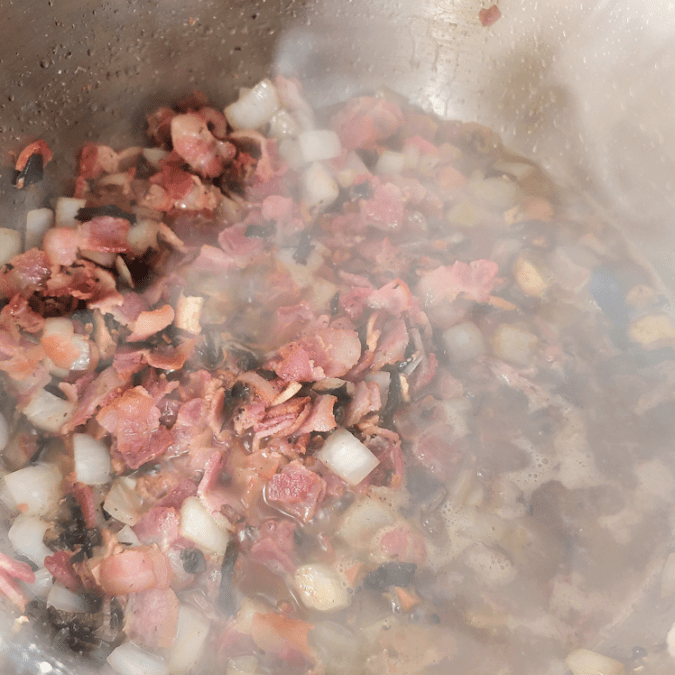
The bacon pieces were added to a large pot and fried until they started getting crispy. The bacon fat is used in place of butter at this point.
Then the onions were added and, after they had softened a bit, the reconstituted mushrooms were added. The liquid was included, too, which helped deglaze the pot. The seasonings were also added at this point.
Where I using fresh mushrooms, I would have added them to the bacon before the onions.
Next, the cabbage was added, along with a dollop of butter, and cooked until soft.
By the time the cabbage was ready, the noodles were cooked and drained.
The cooked noodles were then mixed in, along with another dollop of butter.
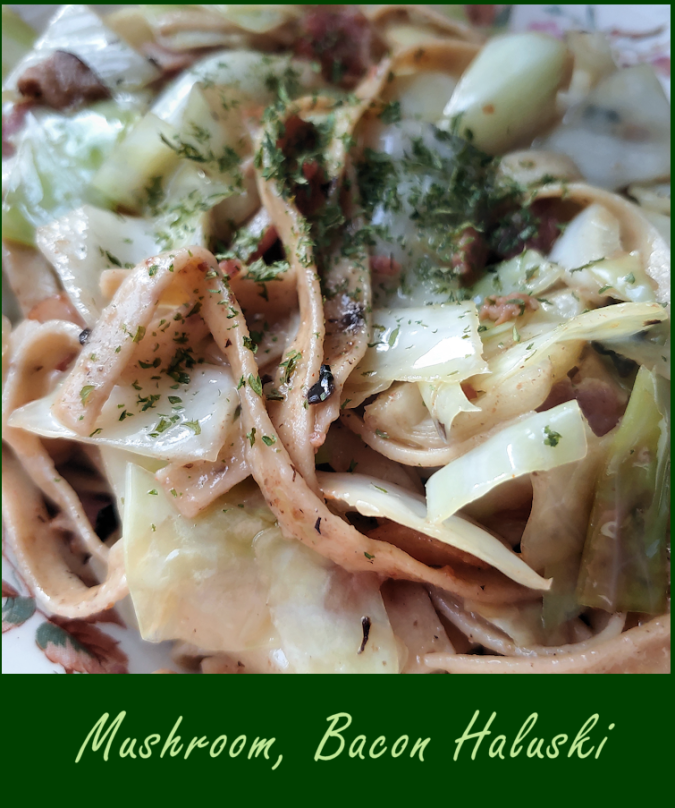
Here is the end result, sprinkled with dehydrated parsley from our garden.
The mushrooms and mushroom noodles were a very tasty modification to this traditional dish. The flavour they add is not overpowering, but there is a whole new layer of umami in the dish that works very well! I think it would have done nicely with a dollop of sour cream on top, too.
Here is the recipe! If you give it a try, I hope you come back to let me know how you like it. :-)
The Re-Farmer
Mushroom, Bacon Haluski serves 4, generously
Ingredients:
1 medium cabbage 1 medium yellow cooking onion 1 package bacon slices, 500g 1 package mushroom egg noodles, 350g 1/3 cup dried mushrooms of choice seasonings to taste (mushroom salt, pepper, paprika and garlic granules were used for this recipe) butter, as needed
Directions:
remove outer leaves from cabbage, core and chop into pieces about the same size as the noodles
chop onion and slice bacon into roughly half-inch pieces
line a small bowl with a coffee filter. Add the dried mushrooms, breaking up any larger pieces, and cover with boiling water
cook noodles according to package directions
while the noodles are being prepared, place the bacon pieces into a large pot. Cook on medium high heat until desired crispness, stirring frequently
add chopped onion and cook until the onion begins to turn translucent, stirring frequently
add the reconstituted mushrooms (the coffee filter makes it easier to pick them up out of the liquid). Cook briefly, then add the liquid the mushrooms were soaking in. Stir to deglaze the bottom of the pot.
add seasonings. Continue cooking, stirring often, until onions are soft and the liquid is cooked down until almost gone
add the chopped cabbage, along with about 1/4 cup butter (adjust quantities of butter as needed). Combine well and continue cooking, stirring often, until cabbage is at desired tenderness
add cooked and drained noodles to the cabbage mixture, adding more butter as desired
combine well. Cook until the noodles are heated through.
The kittens have been pushing the limits on things they’re not allowed to do.
Like go into our plant pots.
The problem is, if we’re not in the room, there isn’t much we can do about it!
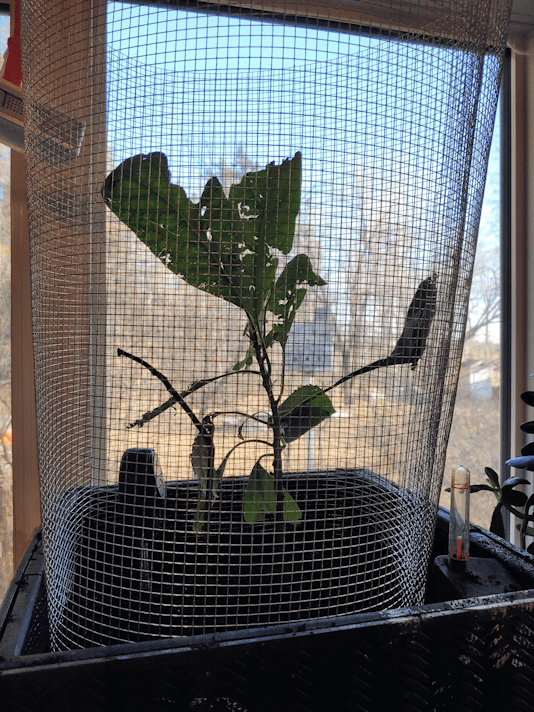
I have a large, self watering pot that had 5 avocados that I’ve managed to grow to a decent size, until one of the kittens decided she liked it as a bed. We even tried putting Duct tape, with the sticky side up, to try and stop them, but that only lasted as long as the tape was sticky!
Today, we discovered a cat had dug deep into the pot, scattering dirt everywhere.
This is not what I had in mind when I bought the hardware cloth.
There is 1 avocado and a stick left in the pot. Whatever cat did the damage had dug down enough that I could see the stick still has live roots under it, so it might actually sprout leaves again. The other one has lots of leaves with tooth marks in them, but it has managed to survive. Hopefully, it will still survive this latest feline attack!
Unfortunately, this is not the only plant they dig in, but it’s the only one I can protect with a cage like this. Along with the avocado pot, I found a pile of dirt on the carpet under the umbrella tree. After the messes were cleaned up, I went into the living room not long after and found a new pile of soil from the umbrella tree, sitting on the shelf beside it.
*sigh*
The worst are the jade trees. We have a lot of those. The leaves are toxic to cats. They don’t eat them, but they do like to bite the leaves off the plant, then chase them around the house. They break off pieces of aloe vera, too. My younger daughter has her orchids in kokedama hanging in windows, and the kittens have been trying to get at them, too!
We have a spray bottle handy for when we catch them doing stuff, but several of the kittens have decided they don’t mind being sprayed with water at all, and just sit there, looking at us, while getting soaked! :-D
How do you keep cats from getting into things, when you’re not there?
This has put us into an interesting conundrum.
What are we going to do for a Christmas tree? There’s no way we can use our usual 6 ft artificial tree. We’ve decided to use my daughter’s 4 ft Ikea tree, and see if we can put it on something higher, and have some sort of guard to prevent cats from getting up to it. Except we don’t really have anything like that. Whatever we figure out, our usual custom is to put the tree up, with nothing on it, for quite a while before decorating it, so we can train the cats to stay out of it. That has worked before, but we haven’t had so many cats in the house before.
This would be a time to have one of those trees that hang from the ceiling! :-D