Last night, my daughters and I got some hard crab apple cider going, with some minor changes from when we made it before.
I started on the apples while my daughter’s sanitized the 5 gallon carboy and set up the juicer. Each apple got cut in half, the stem removed, and any damaged bits cut off. We were able to get to the apples faster than when we made it before, so they had noticeably less bits to cut off this time around. The cut pieces went into a giant bowl with water and lemon juice while waiting to be juiced. We had a small colander set up over a bowl that we would scoop batches of pieces into, that could be kept close to the machine while I continued cutting apples
My younger daughter did the juicing again. We knew we would have more juice this time, so she set up the sanitized carboy with a funnel on a chair under the juicer nozzle; fresh, raw juice went straight into the carboy, instead of first into a pitcher, then into the gallon glass carboy.
The juicing took such a long time.
The machine could only handle getting a couple of pieces put in at a time; far less than when juicing other fruit. These are small apples that don’t have a lot of juice in them, so we didn’t get a lot for the work. After a short while, the sound of the juicer would change, and my daughter would have to stop it, open it up and peel off the shoe-leather strip of accumulated pulp that did not go into the collector, like it was supposed to.
It was past 2am by the time we were done. Which was fine for my daughters, since they are still up at night and sleeping during the day.
This is what the more than 5 gallons of apples got us.
We got about two and a half gallons of juice. We calculated roughly 5 cups of sugar for the amount of juice we had (the ratio is 1-1 1/2 pounds of sugar per gallon of juice). The handy thing about it being only half full is that, once the sugar was added, it was easy to just pick it up and shake it to dissolve the sugar. A half packet of yeast was hydrated, then added and it got another shake before being set up with the airlock.
I didn’t bother taking a hydrometer reading.
This is how it looked this morning, after having roughly 9 hours to settle.
The airlock was bubbling about every 23 seconds when I checked it, and the temperature of the liquid is 20-21C/68-70F. We’re supposed to reach 28C/82F today, so it’s definitely going to get warmer.
I’d hoped to have more juice, but it’s still more than we had last time. We do still have lots of apples on the tree to pick, if we want. We don’t have another large carboy, but we do have the 1 gallon ones, if we want to make more hard cider. I think I’d rather make more cider vinegar, but we don’t have more of the large, wide mouth jars right now. For the amount of apples we’d have, I wouldn’t want to use smaller jars. It would be a waste of jars and space. There are other things we could do with the apples, too.
Now that it looks like making hard crab apple cider is a thing we will continue to do, we want to acquire a cider press. The juicer is great for other fruit, but does very poorly with these little crab apples. There are table top versions that are reasonably priced. Building one is another option. It’s something we wouldn’t for another year, so we have time to figure it out.
I’ve been asking my mother about how my dad made fruit wine. I remember him using the same crock my mother used to make sauerkraut. I remember watching him one year, as he layered sugar, then raspberries, in the crock until it was full, then … I can’t remember. Most likely, he weighted it down then covered it with a cloth, but did he add water to it? And how much sugar to fruit did he use?
I described what I remember to my mother, and she just brushed it off. They just combined fruit with sugar, covered it and let it sit, she told me. They didn’t add water. That’s how she’s got the cherries she picked while here set up, right now. She didn’t have a lot of cherries, so it would be just a small jar. She couldn’t tell me how much sugar they used; apparently, they just winged it.
Well, whatever my dad did, his raspberry wine in particular got rave reviews. I remember picking pin cherries (those trees are now gone) that he used to make wine, as well as the hard little plums that are more stone than fruit, that we still have in the yard (though the trees seem to be dying). My parents had no wine making equipment. They used no commercial yeast (yeast for brewing was not something that would have been easily found back then). I wish I could ask my dad what he did. I don’t think my mother paid too much attention to it, and what she’s doing now is not what I remember seeing him doing. Maybe one of my siblings remembers more than I do. I should ask them. 😊
For now, though, I’m content to make hard cider with our crab apples. I prefer that over wine, anyhow. 😁
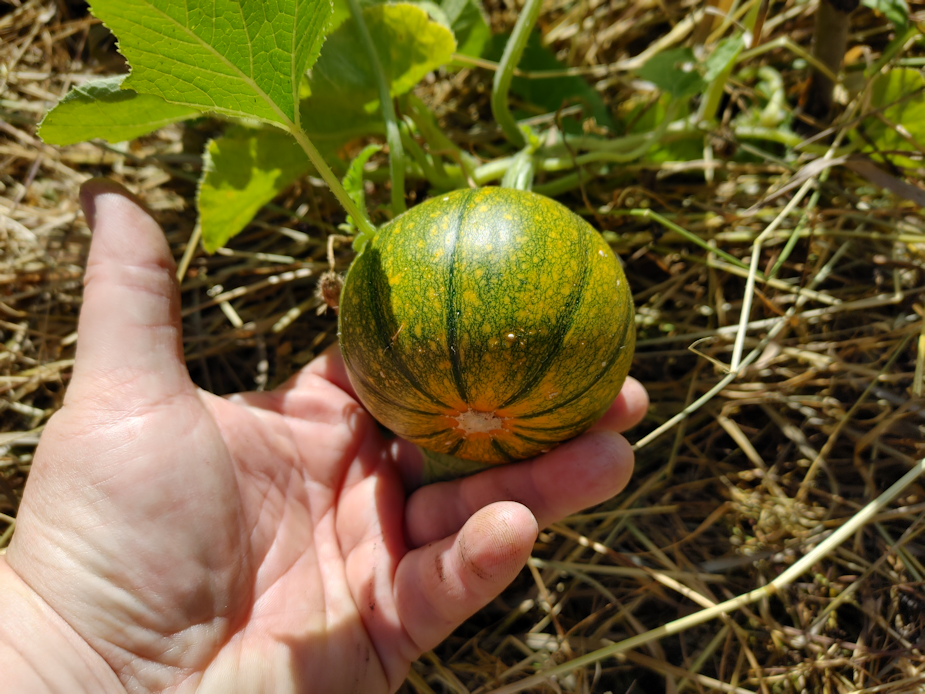
While the girls worked on the cats’ house, I did my morning rounds. No harvesting in the garden today, but check out this pumpkin!
It’s almost completely changed colour! The second one is just beginning to show the tiniest change in colour at the blossom end, but is otherwise still very dark green.
Once the regular rounds were done, I headed out with some buckets and started our first harvest of crab apples. Mostly, I just shook the branches that I could reach, then picked up what fell.
I got about 10 gallons of crab apples that way. There are still lots on the tree, but I couldn’t reach the branches to shake them. Plus, I don’t have any more buckets available.
After bringing the buckets to the house, I used the hose to fill them with water to do a cursory wash.
I had curious company.
I help!
Then the apples got transferred out of the buckets.
These corrugated plastic bins are the handiest things!!
They have holes cut into the bottom, like what you can see on the sides, but a good layer of shredded paper made sure no apples fell though, while also absorbing water from their rinsing.
Shredded paper is something else we’ve been finding very handy. We shred only paper that is compostable, like fliers and the like. Printers switched to vegetable based inks decades ago, so they’re fine. Just no glossy paper or anything like that. Those go for the burn barrel.
We’ve used the shredded paper as mulch, as compostable layers buried in new garden beds, as a base under tomatoes ripening indoors, and now for crab apples. We even keep the shredder, sitting over a recycling bag on a wire frame holder, in the dining room all the time for convenient shredding.
The first thing we will be doing with the apples is to make crab apple cider vinegar again. That is the fastest and easiest thing to get started. Then we will be making more hard crab apple cider. We have so many crab apples on the one tree this year, we should be able to make more of both this time.
The “mother” left from our previous ACV is still around, but I don’t think it would be safe to use, so I bought some apple cider vinegar with mother to use as a starter. After experimenting with using an airlock or just covering the fermenting jars with cheesecloth, I’m just going to use cheesecloth this time.
The other thing we will be able to do differently this time is to use the big aquarium to hold the fermenting jars. It is already lined with rigid insulation from when we used the space as a greenhouse, so the temperature will remain quite even, and it has cat proof covers over it. It’ll be easier to keep an eye on it in the living room than in the old kitchen.
As for the hard apple cider, we should have enough crab apples to make it worth digging out the wine making kit and using the 5 gallon bucket and carboy for fermentation. We’ll make that decision after the vinegar is started, and we see just how many crab apples we end up with. We’ll probably need to break out the step ladder to pick more apples.
A good problem to have! Especially after having none, last year.
Oh, my goodness. This took way more time and effort to make than usual! Starting with going back later in the day to record new video because I made too many goofs, the first time around. I mean, how did I accidentally say “corn” when I meant to say “peas”? Repeatedly!! 😂
It also took all day to upload the file. Yes, it’s more than half an hour long, but it still shouldn’t have taken more than 8 hours to upload.
But, here it is. A tour of our garden, including fruit trees this time. It’s been a very rough year for the garden, with some complete losses, but we do still have something to show for it, at least!
I hope you enjoy it, and please feel free to let me know what you think!
I’m happy to say that I’ve been seeing Potato Beetle around. He joined me while I was tending things in the garden, yesterday evening.
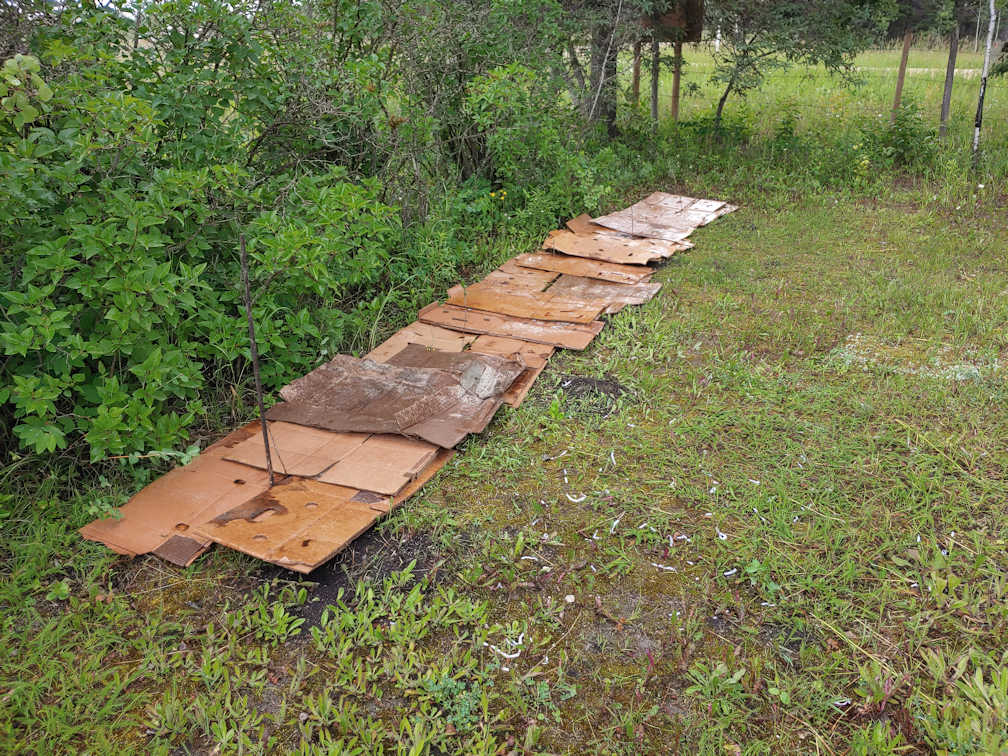
The cats do like the cardboard mulch around the silver buffalo berry!
Unfortunately, he’s a bit too spry and back to normal. He went after Rolando Moon. Then I saw him and Sad Face stalking each other. I broke that up before it became an actual fight, only to later see him stalking The Distinguished Guest!
I dissuaded them from fighting, but Potato Beetle is looking like he’s wanting to reestablish his top spot in the pecking order.
Aren’t they supposed to be less aggressive after losing their nibs?
Well. At least he’s staying close to home.
He showed up this morning, while I was putting kibble out, but he had no interest in the other trays. He wanted his personal food dish in the sun room! So I let him in and left the door open, so he could come and go as he pleased.
While doing my morning rounds, I took recordings for a new garden tour video. I’ll be working on editing it later today.
I also had a chance to pick cherries.
These are the cherries that I could reach without a ladder. I could pull some branches down, but there are still plenty higher up that need to be picked. The gallon bucket was about 3/4 full. These have been laid out in a pair of trays in a single layer, and are in the big freezer. Once they’re frozen, we’ll bag them up. I wouldn’t mind trying to make wine with these. It’s bee a long time since we’ve tried to make wine. The problem is having a cat-safe space for the carboy. There just isn’t any. 😕😒
After washing off the cherries with the hose, I starting into the sun room, only to find the netting I’d put on the swing bench, on the floor in front of the door.
The bench was occupied.
The sun room was just crawling with kittens! These three, and their mama, were relaxing, but you can just see the tail tip of the one that ran between the window and the bench. Some of the big kittens were in there, too. My presence was panicking them, though. One ran into a window, and another into the back of the inner door, trying to get out. *sigh* So I was careful to skirt around and make sure they could access the door as I picked up the netting, then brought the cherries inside. The mama ran off, too, but the three kittens in the photo, stayed.
That mama has this permanent angry expression on her face. 😄
Today is looking to be a really nice day for work outside, so I’m going to see what I can catch up on. Maybe say hello to the cows. I can see them on the security camera’s live feed, at the fence along the driveway. 😊
Mostly, though, I need to finish mowing. After working in the old garden area last time, though, I had better check the blade and see if I need to sharpen it, first!
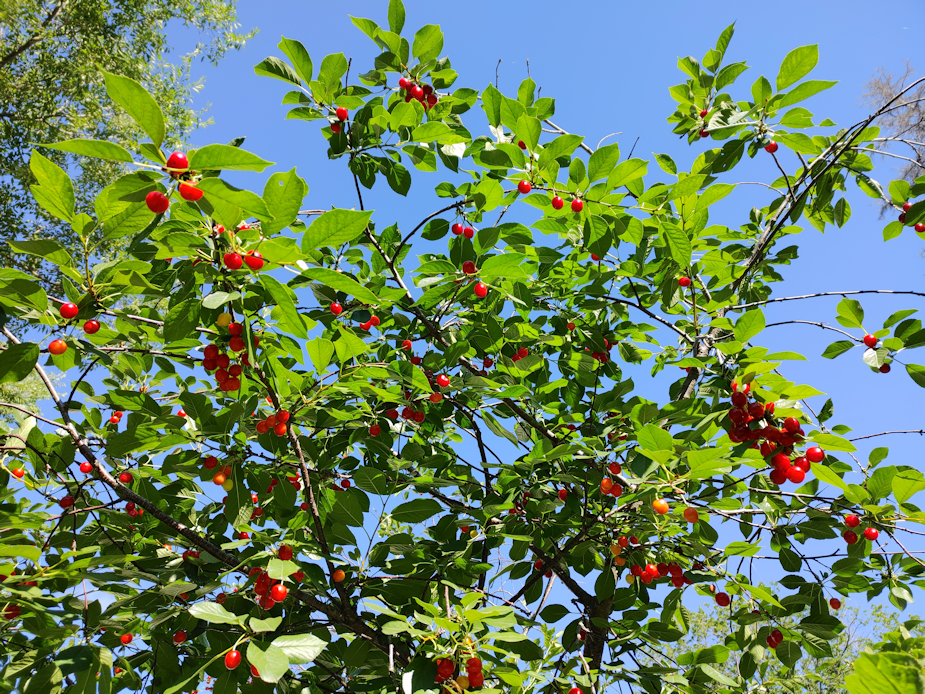
The sour cherry tree by the house has lots of ripe berries, ready to be picked. I’ll have to get the girls to do it, though. A ladder will be needed to reach the ripest ones at the top. This is the most cherries we’ve had since moving here.
We got a pretty decent amount of yellow bush beans this morning. Not enough to make it worth blanching and freezing, never mind canning, but enough for a couple of meals this time.
The purple pole beans are getting more pods, though they are still very thin. I saw the first of the green pole bean pods this morning – tiny wisps of pods! Still no sign of pods, or even flowers, on the red pole beans, while the shelling beans still have lots of flowers, but no pods that I can see.
We should be able to harvest the garlic from this bed pretty soon.
One of the Baby Pam pumpkins is starting to turn colour. This variety doesn’t get much bigger than this. From the looks of it, these are going to be the only winter squash we get out of this patch, other than maybe one kakai hulless seed pumpkin. Even the Teddy squash, which are a very small variety with only 55 days needed to maturity, will likely not get a chance to produce anything. The green zucchini still isn’t producing; they did have female flowers, but no male flowers bloomed at the same time to pollinate them. We do have some golden zucchini developing, though, and some Magda squash I should be able to pick in a few days. Maybe even a yellow pattypan squash or two.
The paste tomatoes, at least, are coming along nicely, with more of them starting to blush.
I was able to harvest more green onions from the high raised bed. Most of these will be dehydrated, and there are lots more I can harvest.
The handful of pea pods are almost all from the second planting. The first planting is, amazingly, still blooming!
Most of the onions seem to be growing well. Some of the red onions have very different shapes, and they are starting to be noticeable. I’m thinking of picking one or two for fresh eating, just to see how they taste.
The one surviving type of turnips are finally starting to have visible “shoulders”. We might actually be able to pick some, soon.
I don’t know what to make of the potatoes. They’re done blooming and we should be able to harvest young potatoes now, but I want to leave them as long as I can. The plants themselves are nowhere near as large as potato plants normally get. There was so much water in that area, I’m sure it stunted the growth of the ones that survived. I still might dig one plant up, of each variety, just to see what there is to see. Will the lack of foliage translate into a lack of potatoes, too? I was really hoping to have a good amount of potatoes to store for the winter. It certainly wouldn’t be enough to last the entire winter for the 4 of us, but it will help us decide if these are varieties we will get again or not.
Every time I’m in the garden, I’m thinking of next year’s garden. One thing is for sure. It is nowhere near big enough to meet our goal of providing sufficient amounts of food to last us until there is fresh produce again. We planted so much, with the expectation of losses, but this year the losses are just too great. Which has really surprised me. I did not expect to get less productivity this year, compared to last year’s drought. Mind you, during the drought, we were watering the garden beds every day, twice a day. This year… well, adding water is easy. Keeping water out is not. Still, even if everything had gone well, we would still probably need double the garden size to meet our long term goal. Short term is to have enough to supply our needs for at least 3 months – the hardest winter months, when we might find ourselves snowed in or the vehicles frozen.
Every year we garden, we figure things out a bit more, from what weather extremes we need to work around, to how much of anything we need to grow, to what we like enough to grow year after year. More me, half the enjoyment of gardening is analysing the results and using that information to make decisions for the next year!
That’s one good thing about having hard gardening years. You do learn more from it, than from years were everything goes smoothly.
We’ve been having rain off and one, and are still getting storm warnings for today as well. Nothing too excessive; our expected highs and lows are well within average, and the garden beds seem to be really liking it.
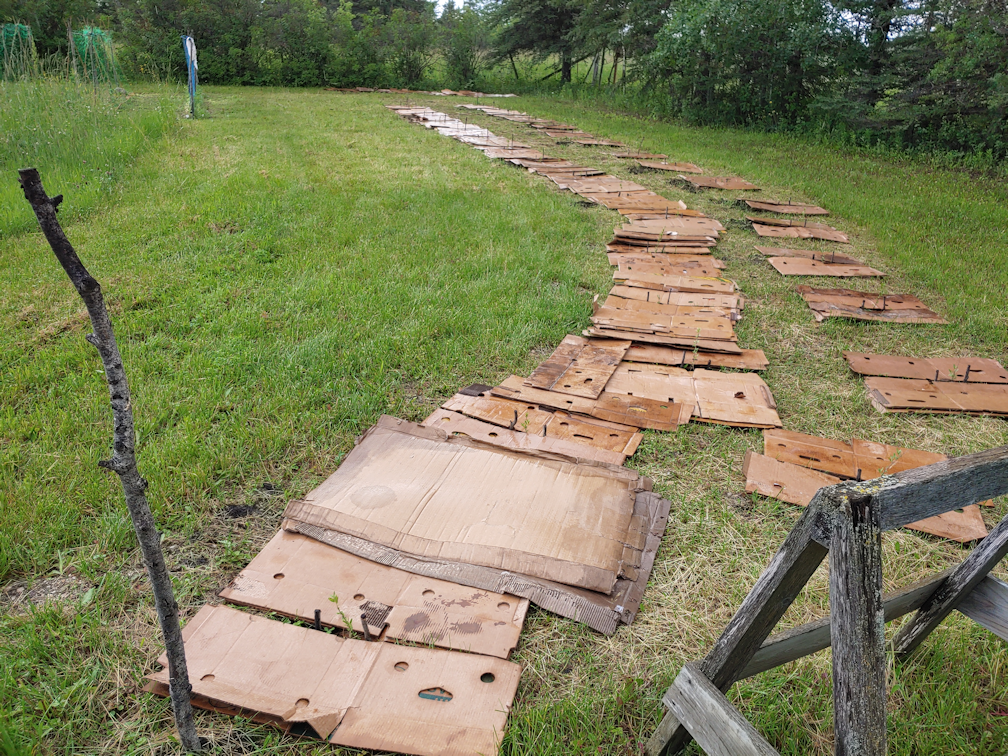
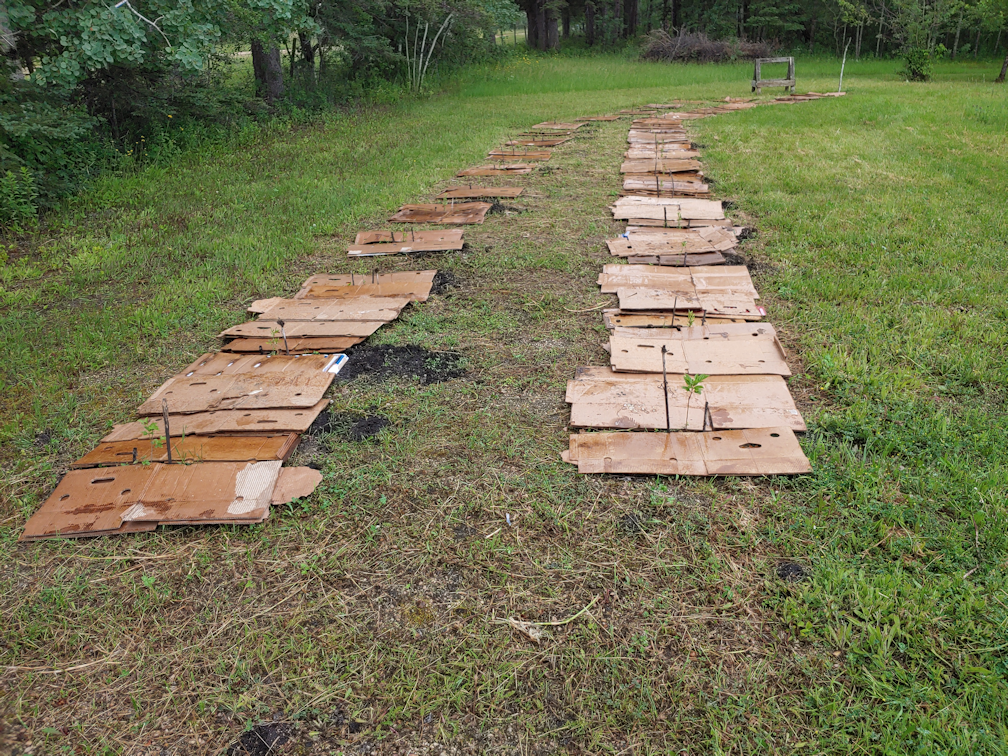
After doing my morning rounds, I was able to get the cardboard laid out along the saplings. The pile had been well rained on, which made it easier to lay them out, and less likely to get blown around if we get high winds.
This is the end I started at. The main thing was to get cardboard laid down close to all the saplings – but not too close!. The sticks I added to make them more visible (especially when using the weed trimmer) helped with that. Once all the trees had cardboard around them, I started filling in the spaces in between with what was left of the pile. It started raining again as I was working on it, which I didn’t mind at all. I’d have had to take a hose to it, otherwise.
The Sea buckthorn has all the cardboard they need, and are ready for when we have wood chips to lay on top of the cardboard.
I had enough cardboard to fill in the gaps all along one row, then start on the other, before I ran out. The priority is to cover the two rows, but if I can get enough cardboard, I want to fill in the space between them, too. That might take another 2 loads of cardboard to fill it all in.
We’re going to need a lot of wood chips to cover all this!
Once these bushes are fully grown in, this entire area should be a solid barrier of interlocking branches. There might be enough room to walk between the rows when they are fully grown, but not much. As they are bushes, once a good thick layer of mulch is laid down, they shouldn’t need anything more; they’ll basically be their own mulch, eventually. When we start planting fruit trees in the area, we’ll be working towards planting different edible cover crops into the mulch around them, but there won’t be space for anything like that with these, once they’re filled in.
The space between the saplings and the trees at the fence line is being left open as a lane to drive through. Once the berry bushes are getting to the point where they are starting to form a privacy screen, we’ll start cleaning and clearing up the rest of the fence line. Most of those fence posts in this section need to be replaced, and I want to open up access to it for that, for general maintenance – and to eventually replace the fence with something other than barbed wire! I’d like to also put a gate next to where the sign is, or some sort of fence crossing that will allow us to step over it, rather than trying to get through it. I really hate getting my clothes caught on the barbed wire when trying to go through it! :-D We’ll figure something out.
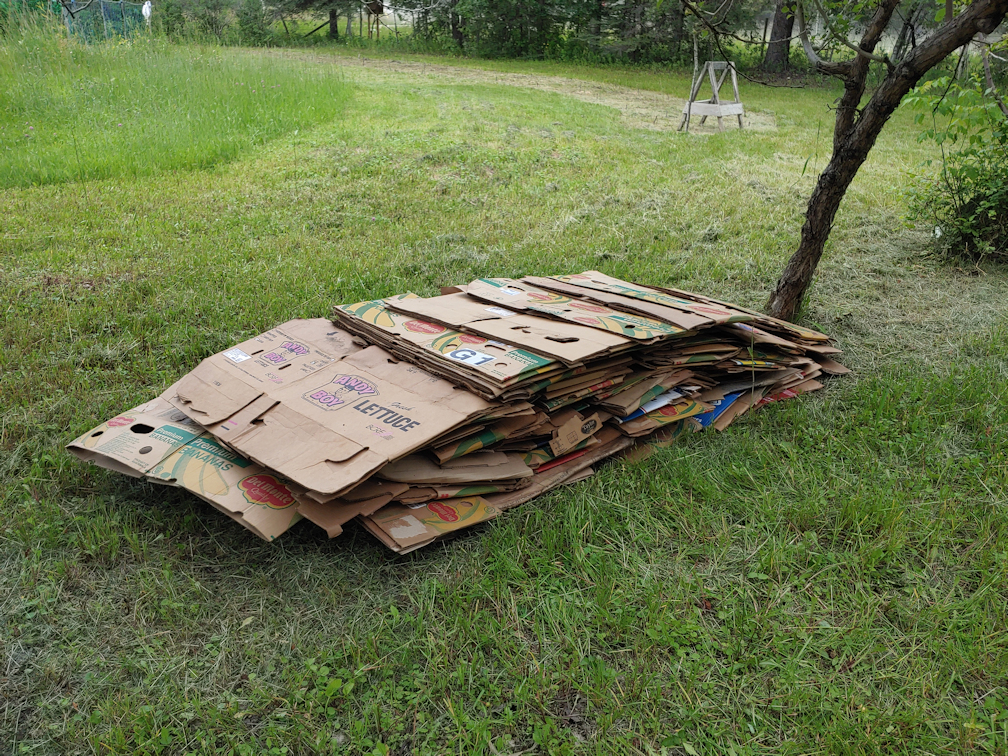
I just got back from the wonderful person who is letting me take cardboard from her food waste deliveries.
This filled most of the back of the van, with room for me to still see through part of my back window.
The stack looks so small, on the ground! :-D
The next step will be to douse ourselves with bug spray, then go through each of the boxes to remove any tape, plastic labels, etc. Once that is done, we can start laying them around the saplings as a weed suppressant. Priority is around the saplings, but the space between them will also be covered. The cardboard needs to be thoroughly soaked – rain would be very handy right now! :-D Once we have it, it will be covered with wood chips.
I will easily need at least one more load of cardboard to cover the area, so no hurry on the wood chips right now.
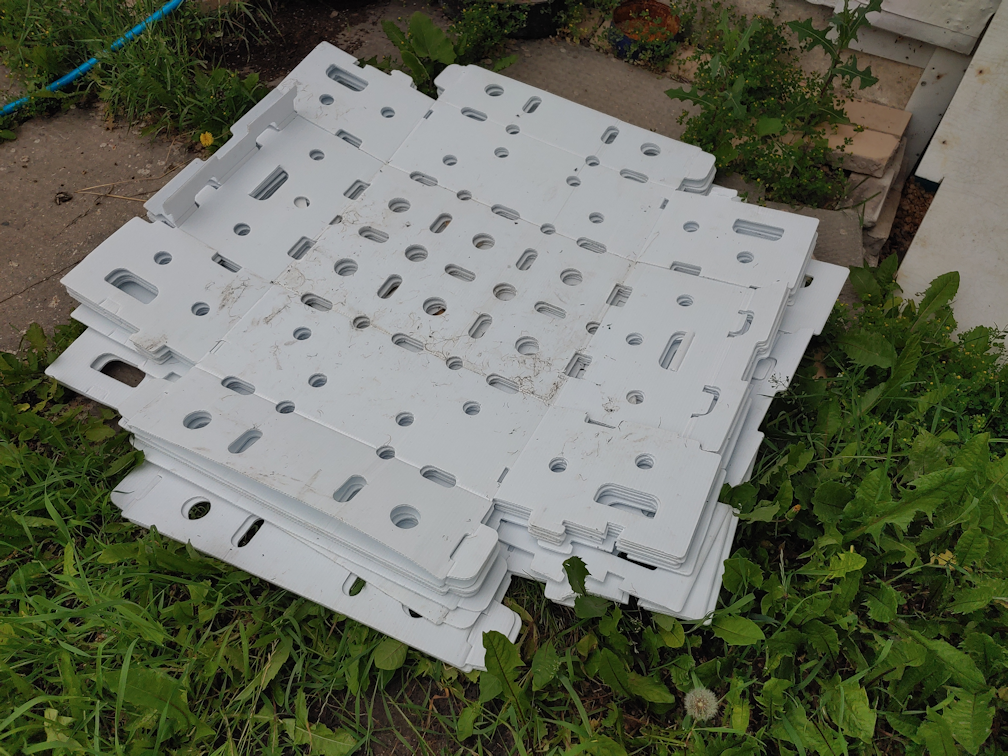
We also got a bonus with this load!
These boxes are corrugated plastic. From the looks of it, they mostly held corn. After they get cleaned off, these will work very well for when we need to store potatoes and other things in the root cellar over winter. :-) Plus, as you can see, they easily fold flat for storage. I think I got 10 or so of these. I think they will be very handy for a lot of things!
An extra bonus is, I got to see their baby chickens and turkey, pigs, donkeys and alpaca. They’re already doing a lot of things we are working towards and, once we get our chicken coop built, we’ll be able to buy chicks from them!
I am so happy to have found this family. :-)
In other things, my husband got notification that my new keyboard was ready for pick up, on Monday. I went to the post office to pick it up and there was no card in the mail box. Today is Thursday, and I stopped by on my way home, but still no parcel.
Once I got home, my husband looked up the order.
It was sent by Purolator.
So while I was unloading the van, my husband called the nearest drop off location, since we are not in their delivery zone. Normally, we would have received an automated call from Purolator, if it was being sent there. When I got back inside, he was on hold – with Purolator. It wasn’t at the drop off location, either.
It turned out to be in the city.
How we were supposed to know that, I have no idea. This information was not included in the delivery notice. It just said that it was delivered.
It’s now being rerouted to the drop off location, and we’ll get a call when that happens.
Places that don’t deliver to PO boxes are a real pain in the butt.
I headed outside earlier than usual, to try and get some work done before things got too hot. My goal of the day was to take the weed trimmer to where the berry bushes are. Tomorrow, I’m getting another load of cardboard and plan to lay it down around them as a weed barrier.
This is how it looked when I started.
I shoved the stick into the ground as a post to mark the end one of the rows of bushes.
Can you see the silver buffalo berry?
The row on the left, you can see the sawdust mulch around several of them, but the row on the right just disappears in the trimmed weeds and grass.
I ended up using sticks that were used to hold trellis lines last year, to mark where the saplings are. A few of them got two. They were so buried and trimmed material, I didn’t want to risk accidentally hitting them with the weed trimmer! I’ll be looking to make sure they all have at least two sticks marking each of them, when the cardboard get laid down.
From this end, the two saplings marked in the foreground are the two highbush cranberry.
It took adding one more length of extension cord, but I was able to trim around the sea buckthorn, too.
Since I had the trimmer in the area anyhow, I used it around all the trellises, the hulless pumpkin patch, and the bean tunnel.
The goal was to beat the heat, but I failed. By the time I was working on the bean tunnel, the thermometer attached to it was reading 30C/86F in the sun. Our high of the day is supposed to be 25C/77F, and we are now under a severe thunderstorm watch. When I headed out this morning, we were being warned of possible thunderstorms on the weekend, and just possible showers later today!
I kept at it, though, and was able to use the trimmer around the crabapple trees. The one I’m standing next to, to take this picture, died over the winter and will need to be cut away. There are a couple other sickly ones down the row that need to be removed, and the others need some pruning, but that will have to wait.
I’m hoping to be able to head out again with the lawn mower, set as high as it can go, to finish around the garden area. Even the lowest spot near the branch pile in the background is finally dry enough to mow.
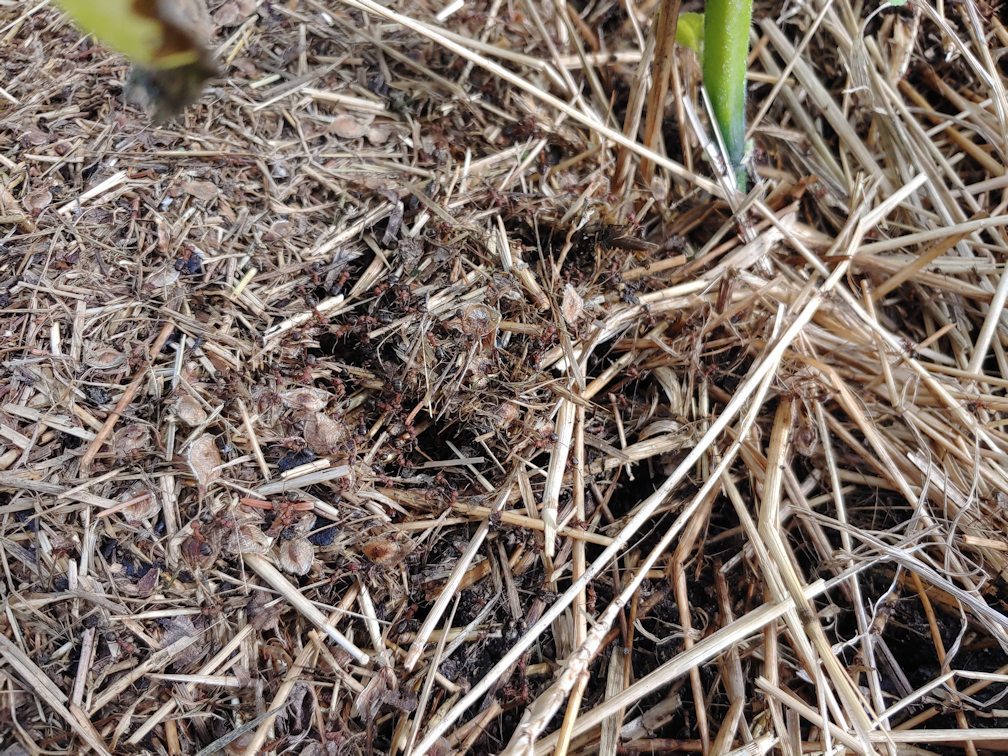
The metal ring in the foreground was something I brought to do burns over old crabapple tree stumps that were infected with a fungal disease. It’s over a taller one that hadn’t been burned completely away. Currently, the ring is full of an ant hill!
We have SO many ants this year!
In other things, whatever happened to our phone last night was no longer an issue this morning. We can use our land line again. I did get an email response from the phone company to try disconnecting all but one phone and seeing if it was still an issue, which I’d done (there’s only 2 lines to disconnect; the extra handset for the cordless phone doesn’t connect to the land line on its charger base). I wrote back to explain that it was working again this morning.
It sounds like there is a short somewhere. Possibly due to rodent damage somewhere. I’m guessing the cause of the problem is outside the house itself. If it’s a short, we could lose our connection again, at any time. In my email response, I did include that possibility. It would require a tech to come and test the lines, though. They’d be able to do that at the pedestals at the fence lines, one of which is hidden by trees in the first two photos at the top of this post, at first. From there, they would know if they have to come to the house and test again or not.
For now, I’m just happy the phone started working again on its own!
My morning rounds are taking longer, as I am able to do more in the various garden beds as I go along.
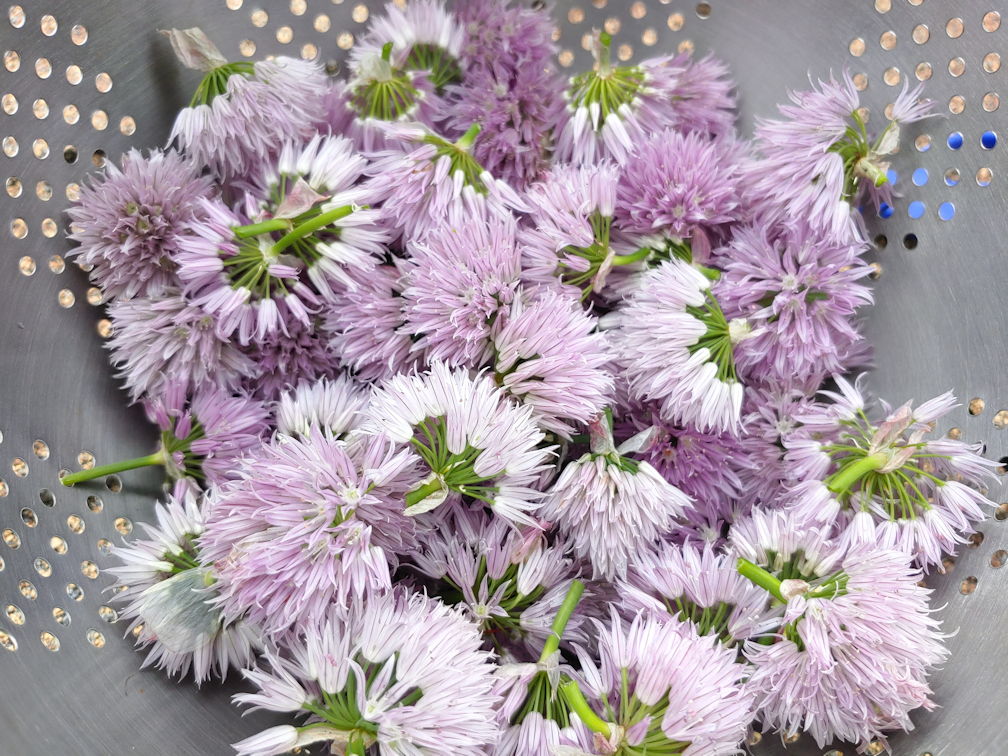
I harvested the largest of the chive blossoms, before they go to seed. While I continued with my morning rounds, one of my daughters washed and de-bugged them, then laid them out on a cooling rack in a baking tray to dry. They are in the oven, with no heat at all, to protect them from the cats. Once the wash water is dried off, we’ll stick as much of them in a jar as we can, with olive oil. Any extras will go in the freezer. Or maybe I should split them into two jars and use them all. There are more chive blossoms to harvest later on, so we’ll have plenty to infuse in vinegar, too.
Speaking of drying things, during the night that cats did manage to get at the stacked screens of drying mint leaves. We’ve lost about 2 screen’s worth of mint leaves to the floor. :-(
When I moved on from the old kitchen garden to check on the squash patch, I noticed one of the giant pumpkins was no longer upright. I thought it might be because it had grown large enough to start leaning over, but I was wrong.
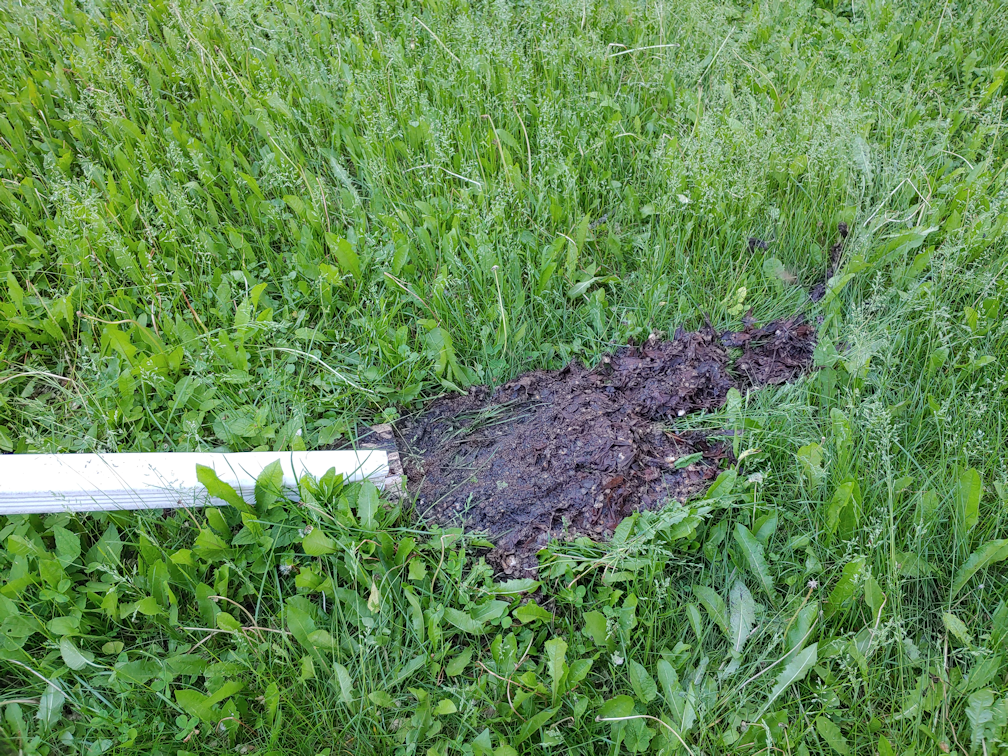
The stem is broken, right at ground level. Possibly from the high winds we’ve been having. Or…
Possibly weakened by the ant hill that has formed on that side of the pumpkin mound!
I built soil up around to support the stem again, in the off chance that it will survive, but with a break that large, I don’t expect it to. We are likely down to just one giant pumpkin plant.
Everything else in the squash patch seems to be surviving so far, and I’m seeing new growth in most. The squash that were started at 4 weeks are so very small, though. I kinda feel like maybe we should have started them at 6 weeks.
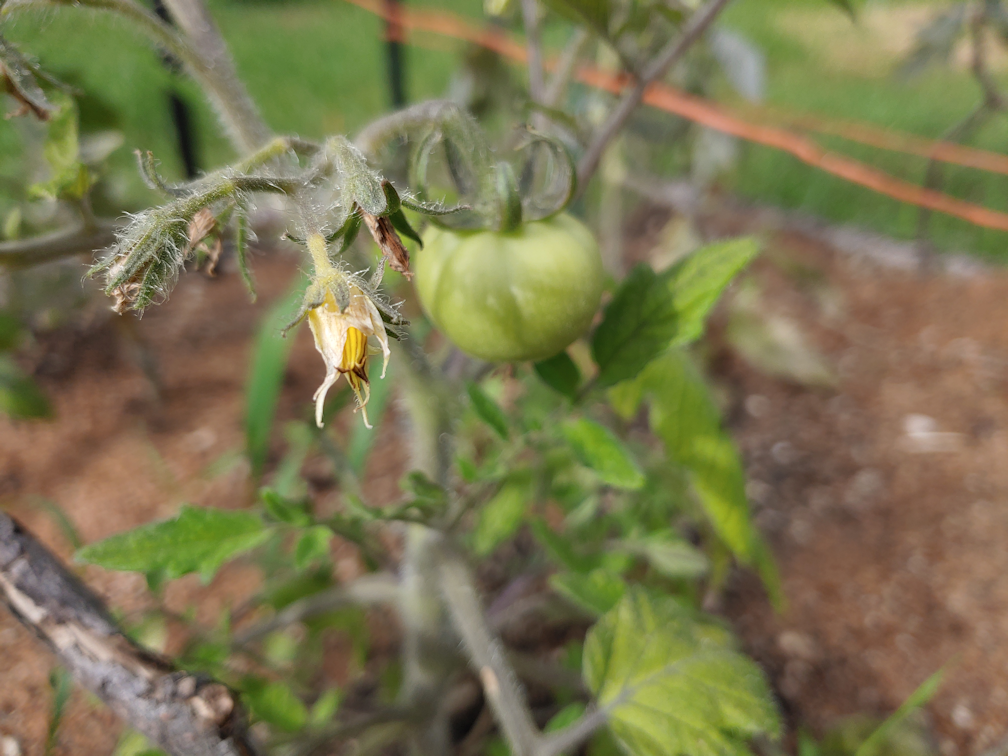
I had a very pleasant surprise in the tomato patch nearby, though!
Of course, the camera on my phone didn’t focus where I wanted it to. :-D
We have our first tomatoes forming!
These are on the Sophie’s Choice tomato plants. We got these seeds as a freebie with my order from Heritage Harvest, which was a very pleasant surprise. They have a much shorter growing season, and were started indoors at around 10 weeks or something (it’s a good thing I am using the blog as a gardening journal to record the details, because I’m already forgetting!). So I am not surprised that these are the first to start forming fruit.
We did get some rain last night, but it was light enough that much of the water in the garden was able to get absorbed by the soil, and the paths are just really wet, instead of big puddles of water. That meant I could finally do some much needed weeding in the summer squash bed, then pruning of tomatoes.
I took some of the strongest, healthiest looking branches that I pruned off the Sophie’s Choice tomatoes and transplanted them in the open spaces between the summer squash. I don’t know if I’m breaching any companion planting rules here (do tomatoes and squash go well together?), but whatever. If they take, great. If not, that’s okay, too. I specifically wanted to propagate more Sophie’s Choice tomatoes, as they are listed as extremely rare, so if I can save seed and help keep the variety going, that would be a good thing. Because they start producing so much faster than the other varieties we have, I’m not as concerned about cross pollination.
While I was weeding and tending different parts of the garden, I had Rolando Moon hanging out and keeping me company. Not wanting attention. Just being nearby.
I had to chase her out of one of the sweet potato bags, as she decided to start rolling in it! Then she jumped up into the high raised bed and lay down on some onions. THEN, she moved into the squash and corn patch, and sat on some corn seedlings!
That cat seems determined to be destructive!
Meanwhile…
The tomatoes are not the only things blooming. Two of the Styrian hulless pumpkins have suddenly burst into bloom, and they are all covered with buds again. Their first buds had been pruned away when they were transplanted. They look to still be all male flowers. I’m debating whether these flowers should be pruned away, too, so more energy can go to the plants establishing themselves more. It hasn’t been that long since they were transplanted, after all.
Anyone out there know if it would be helpful to prune the flowers off now or not?
The beans and peas at the trellises and bean tunnel are looking quite good. The cucumbers seem more touch and go. The first peas that were planted are getting quite large, and the snap peas are already large enough that some have latched onto the vertical trellis strings already. The snap peas are growing noticeably faster than the pod peas.
There is a single, out of place pea plant that showed up, right near the upright post at the start of the row. It seems to be a pea from last year that finally germinated! It germinated quite a bit earlier than the others, and I’m trying to train it up the support post, since it’s too far from the vertical lines to climb. Last year, we planted the King Tut purple peas here, so that’s what this one would be. It’s even almost as large as the purple peas we started indoors from saved seed, and transplanted against the chain link fence to climb. They are all tall enough that they’ve attached themselves to the fence and are making their way upwards, even though they are still looking kinda spindly.
The Wonderberries have been ripening, though the plants haven’t really gotten any bigger, and have what looks like weather damage. I’ve been able to taste them. They are lightly sweet, but don’t have any predominant flavour. This may be something we just leave for the birds. I’ll have to get the girls to try them, too, and see if they like them. I don’t mind them self seeding in this location, as I’d rather have the berry bushes that produce food, either for us or for the birds, than the invasive flowers.
In other things, my plans for the day have had to change. My sister never made it out to my mother’s yesterday, because my mother told her it was “too soon” to start packing and bagging things in preparation for her apartment being sprayed for bed bugs. She has a shift today, so that’s out. My brother, meanwhile, is out of town for a funeral that had been delayed until now by the lockdowns. So it looks like I’ll likely have to go to my mother’s to help out. I’ll phone her, first, once I’m sure she is back from church. My sister will be able to come out tomorrow morning, and I hope to come out in the early afternoon for the last of the packing and bagging, and moving of larger items. Then she’s back the next morning to bring our mother to her place for the night. I’ll head over in the early evening to check on the place and make sure it’s locked up while my mother is gone.
On Tuesday, I should be heading into the city for the first half of our monthly shopping, too. I will time it so I can check her place on my way home.
Which means I’ll be getting very little accomplished at home over the next few days!
I am so, so glad the girls were able to get the clogged downspouts cleared yesterday! We had a thunderstorm last night, and are currently under weather alerts for more severe thunderstorms.
This is the one, draining into the north yard, that was causing the most problems. It is under this corner that the most water is leaching into the basement. This basement does have weeping tile, but they are not working as they should anymore, and are probably clogged at this end.
There is another downspout at the south end, but it had only the short piece of eavestrough at the end to divert the water away from the house. For some reason, we’ve got about a dozen or more downspouts in the garage, so I grabbed one for them, and they set it up to extend into the bed where the dwarf Korean lilac is. With how tall the grass is in the outer yard, it was actually a struggle to get through it, to reach the barn!!
I’ll put up with the extension blocking the path along the house. It’s not as bad as the north corner, but we do have water seeping into the basement a bit in the south corner, too. The wall is partly damaged by the roots from the Chinese elm my mother planted for shade in front of the kitchen window. :-(
While they worked on that, I worked on the trellises.
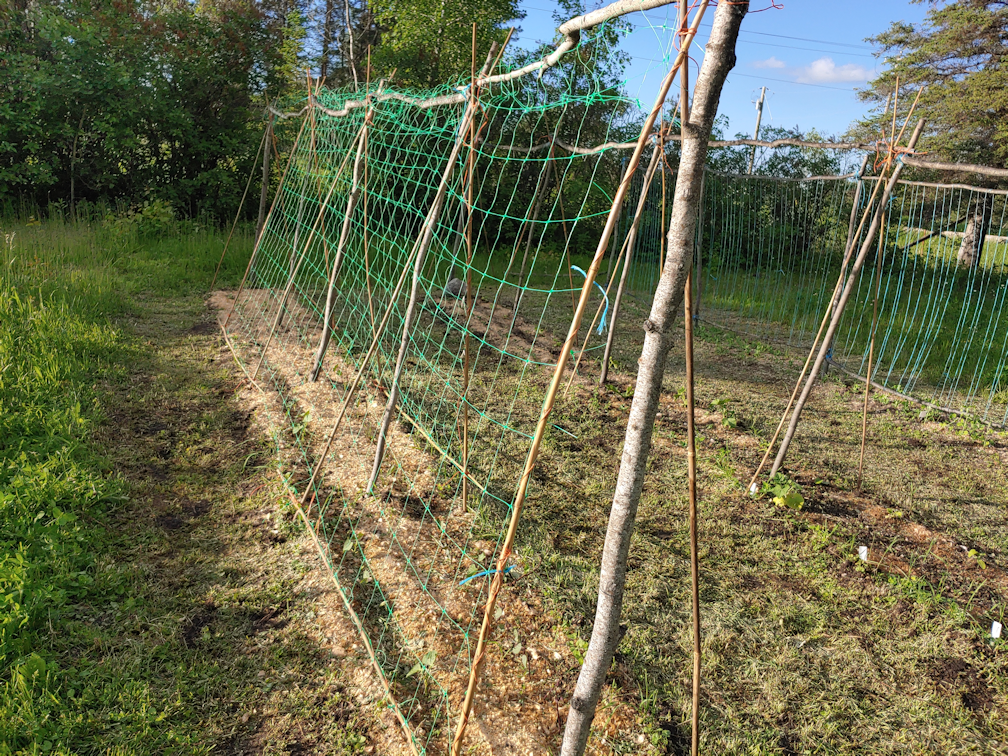
I decided I’m just going to have to buy more of those bamboo stakes once pay comes in. A pair of them was set up at each of the uprights for the two rows that need trellising. That left me with 4 stakes left. I lashed them to the bottoms of alternate A frames, for 2 on each side. To finish the job on both rows, I’ll need 10 more of these 6′ bamboo poles. Then I used the net from last year and set that up, lacing twine along the ends and at the bottom stakes, to snug it up. We need to get more of this type of net. The spacing is large enough that we can reach through to harvest our beans, peas or cucumbers. The other net we have is 1/4 inch mesh.
After this, I also put a simple rope fence around where we have squash, beans and corn planted. At this point, I just want to stop the deer from walking through it. They’re not after anything there – yet. You’ll see that set up in a photo below.
During the night, the skies opened and the rains poured down! I actually slept through it, awakened only by one exceptionally loud peal of thunder. While doing my rounds this morning, however, I could not believe how much water there is, everywhere! It must have been quite the deluge! I’m still holding out hope to be able to mow the west and north lawns, but that’s not going to happen today, that’s for sure! The west lawn is now mostly under water. Most of the north lawn as well. I’ve never seen that much open water in those areas before.
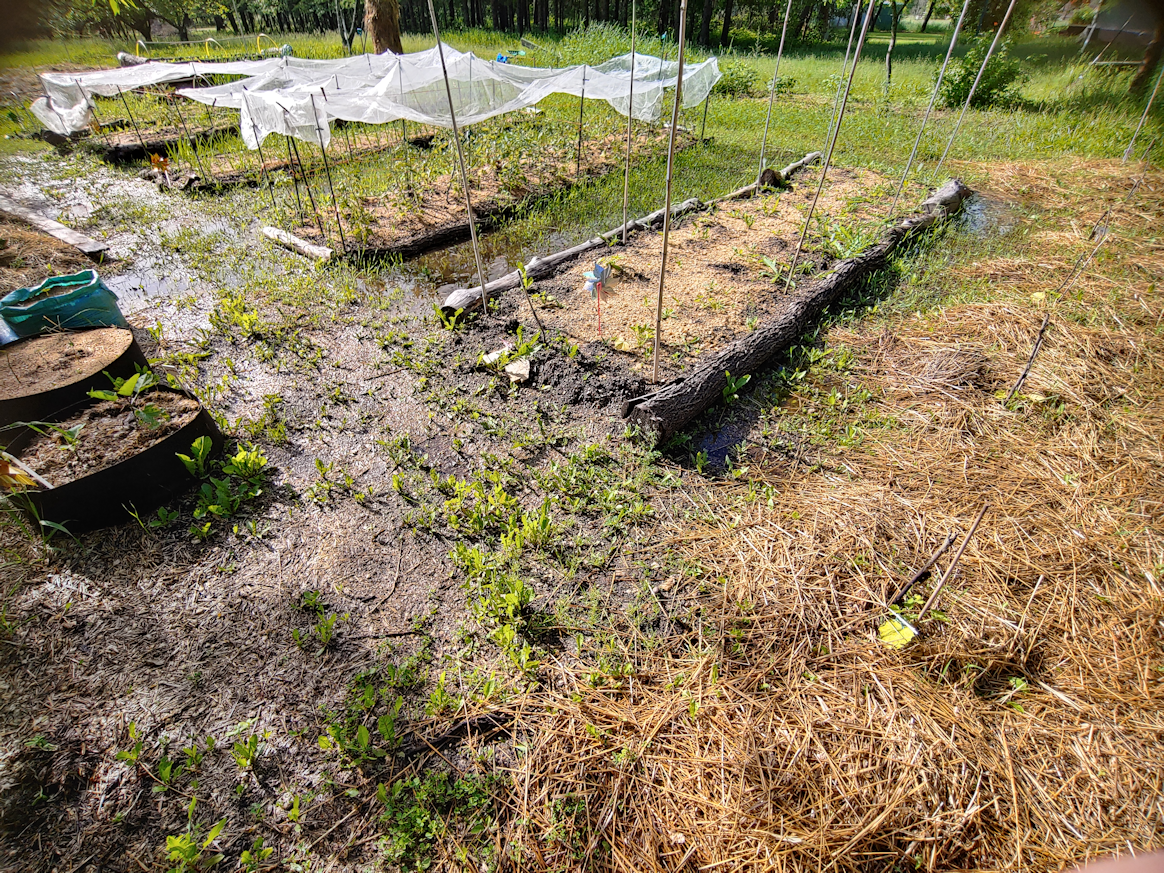
The squash patch is very wet – thankfully, the straw mulch is helping keep that under control. We’ve had paths between the low raised beds filled with puddles before, but not this much around where the grow bags and the small potato bed are.
I’m actually surprised the mosquito netting has held out. Their purpose is to keep the plants from being pounded by rain or hail, while still letting the water through, and it seems to be working. They’re only held in place with wooden clothes pegs!
I’m standing in water to take the above picture. There is even a large puddle next to the remains of the straw bale. The melons are likely good with the wet – they do need a lot of water, normally – but I’m concerned that some of the potatoes might get drowned.
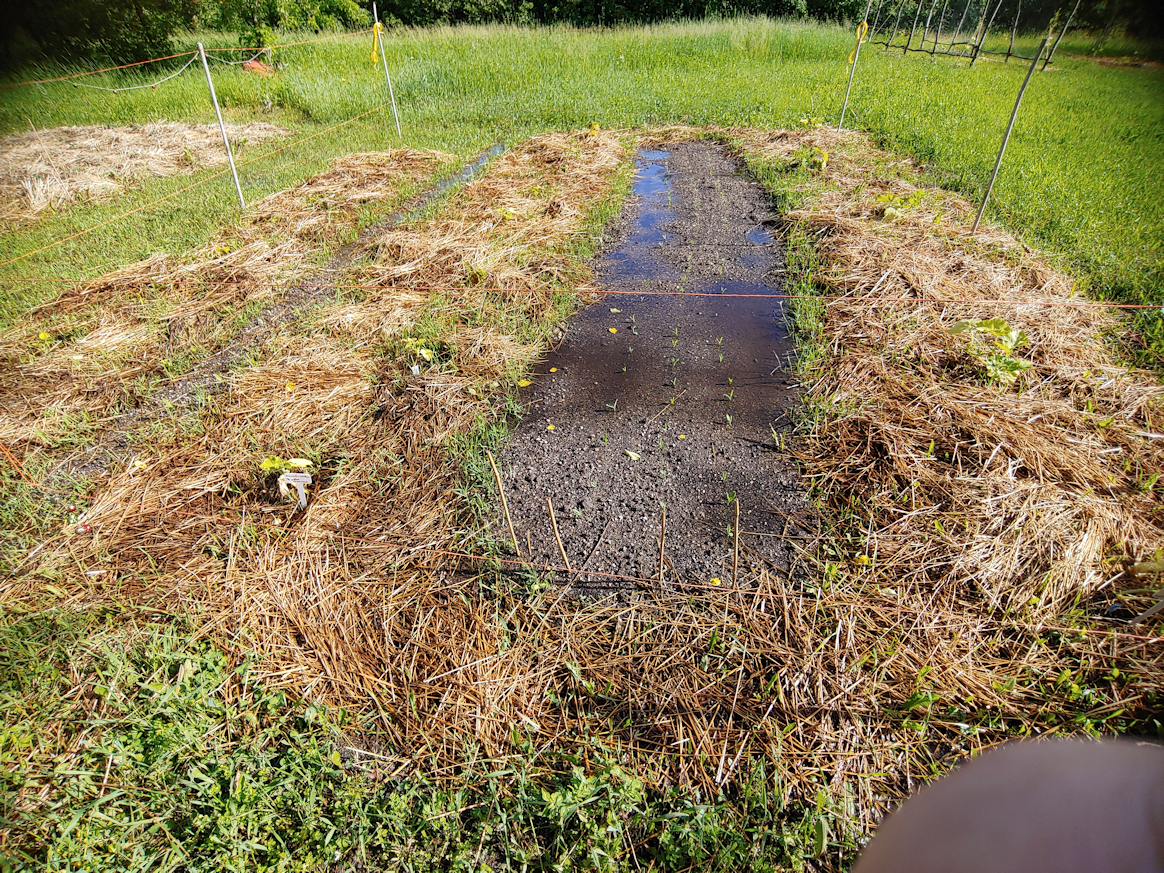
This is the patch I “fenced” off last night. I used some old conduit pipes I found in the barn and pounded them in place as fence posts. They’ve got 2 lengths of twine running around them, far enough apart that we can just bend down and step through to get to the plants. I also dangled lengths of bells in different places, so even if a deer decided to step through, it would hopefully make a noise and distract it away. I added one of the pinwheels we have to the top of a pipe for the distraction. Little by little, we’ll set up more distractions and noise makers around the garden beds. Eventually, we will probably have to put a hardware cloth fence up, to at least protect the corn.
Assuming the corn and beans survive. As you can see, the sprouting corn is under water in places. The north end of the row with the popcorn in it is all under water. Still no beans coming up next to the sweet corn. Will they survive? I have no idea.
Even the area where the trellises are is full of water. This corner of the yard has been notorious for being incredibly dry and baked hard by the sun. Thankfully, the rows themselves are slightly elevated with the addition of garden soil and mulch, and even our digging and weeding before planting means where the plants are growing, the soil has better drainage.
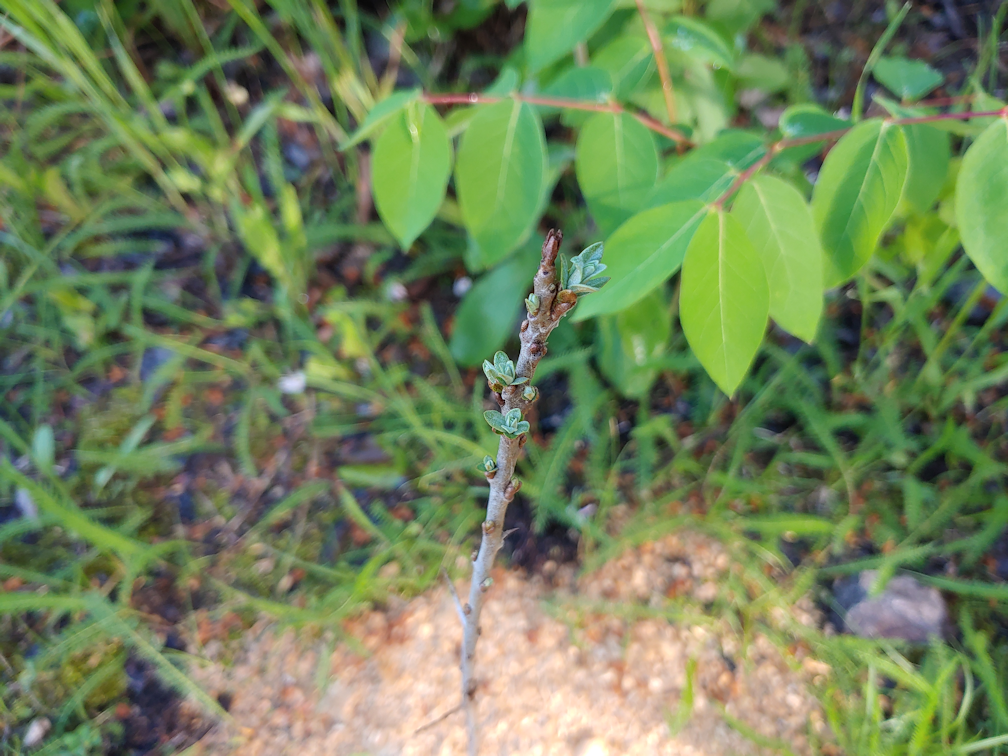
The nearby sea buckthorn is high enough to not be in puddles – and they are finally unfurling their leaves! Nice to see they all took.
The silver buffalo berry is also doing surprisingly well. Moving south, the land slowly slopes downwards, so the last 10 or so silver buffalo berry are in pools of water. At least three of those have been in water for quite a while, and are still okay. They seem to be quite resilient!
The beds in the east yard are almost surrounded by water. Remarkably, the ground cherries are doing all right. I think that grass mulch is acting as a sponge, keeping them from being drowned out completely. There are pools of water right next to the mulch.
The paths between the low raised beds, and the entire lawn in front of them, is full of water. There is basically a pond in front of the outhouse. Thankfully, the raised beds are making a difference. There is increased growth visible in the Kulli corn, and the beans between them are looking very healthy. The tomatoes and onions are also looking strong – and those onions are really taking off! The 6 transplanted garlic at the far end of the third bed may not all make it, but the rest of the garlic is finally looking like they are taking off. I figure they are at least a month behind the garlic in the main garden area.
The other beds in the south yard are all high enough to be out of water. It looks like all 10 of the sunchoke tubers planted are now sprouted; some of the tubers have multiple stalks coming up. The asparagus and strawberry bed are right next to the vehicle gate, which is full of water, but the bed is doing well. Likewise, the beds along the chain link fence, on either side of the people gate, are above water and doing well. Still no signs of white strawberries.
The old kitchen garden has a slightly different situation. We’ve deliberately built it up over the past 4 years and have the retaining wall at one end, so it’s above the water that is in the lawn surrounding it. The house itself also usually keeps parts of it from getting rained on as much, not to mention the ornamental apple trees. However, the sump pump hose drains into the sun room garden, and that pump is going off quite frequently. It drains next to the bed where we’ve got the beets planted. I shift the end every now and then, so it’s either draining straight down a mulched path between the bed and the laundry platform, or it’s draining into the mulch at the end of the bed, and partly down the path on the other side.
These are all areas that are normally drier than everywhere else. Until this year, the sump pump basically never went off, because we’d been so dry. Now, not only are we getting more rain, but there’s all that nice, clear water from the sump pump reservoir being added. There is currently so much lush growth along the house side of the old kitchen garden that the path we made using salvaged cap stones, bricks and rocks along the house is almost hidden. The high end of the beet bed is almost overgrown with mint – and I dug up and transplanted as much of the mint from there as I could, last fall. Then again in the spring, I pulled up more of it when getting the bed ready for planting! The path is also full of mint at that end, along with loads of crab grass. Moving north along the house, it’s more of those invasive wildflowers, some of which my mother planted deliberately, not knowing they were invasive, and some are the same ones we’ve got taking over all over the place. I don’t mind them in the paths too much, but they’re coming up in the L shaped bed, too, and choking out the lettuce.
We have a drainage hose for the sump pump, but it’s currently being used for the washing machine to drain outside (it sounds like whatever is causing the water to back up in the pipes is still a problem). I’d like to add an extension so that the sump pump drains further away. With the length these hoses come in, we could even move the end to different areas of the old kitchen garden that might need more water, if we wanted. The area it’s draining into right now is getting to be too much of a jungle! :-D
We had already determined that we’ll be building high raised beds for mobility reasons. For some crops, like corn, tomatoes and vining plants, we would still want to have low raised beds. High raised beds are notorious for drying out quickly and needing more water, which is why we are using modified hügelkultur methods to fill them, with all those layers of wood and organic matter acting as a sponge to hold water. This spring has shown us that even for a wet year, there are benefits to having raised beds, as they are keeping things from being drowned, too. Even a few inches of elevation or a mulch is making a difference.
When we get around to building permanent high raised beds in the outer yard, from what I’ve been seeing so far, water like this will be less of a problem. There are patches with water collecting in them, but where we are planning to build the beds seems clear. We’ll see better once we finally get that overgrown grass cut. It’s about 3 ft high, at least! I almost feel like asking one of our neighbours if they have a grazing animal we could borrow. Otherwise, it feels like such a waste to cut it all!