Our 2021 garden: morning in the garden

Well, it is getting decidedly cooler when I do my morning rounds! Fall is just around the corner, but things are still holding out in the garden.

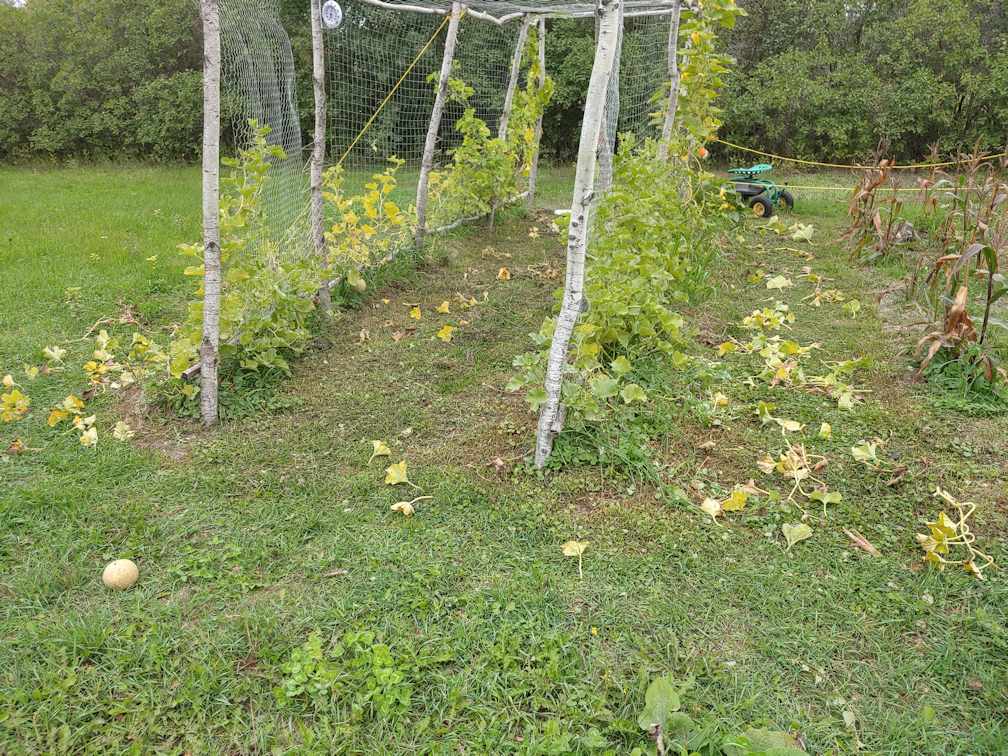
Here are the gourds growing on the south facing chain link fence. The yellow flowers that you see are the Ozark Nest Egg flowers.

If you look at the bottom right, you’ll see a white flower!

This is a Thai Bottle Gourd flower. The Ozark Nest Egg plants are going so well, they sort of hide that there is another type of gourd growing here. The Thai Bottle Gourd has leaves that are more rounded, while the Ozark Nest Egg leaves have points on them.

These gourds are not the only thing bursting into bloom.
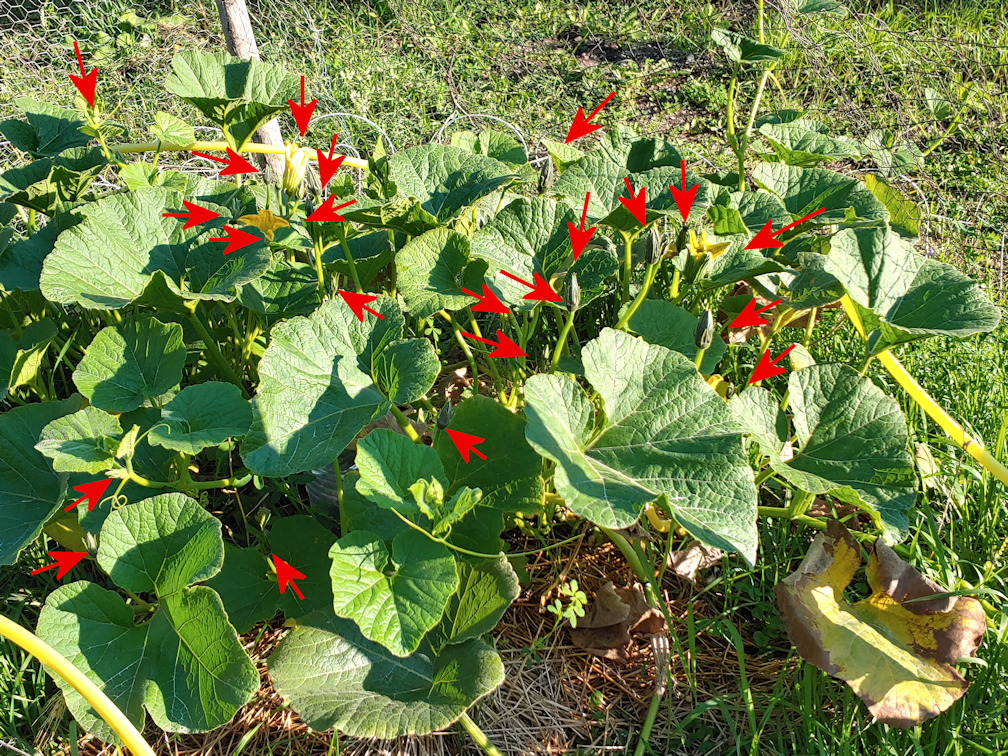
This is the Crespo squash, recovered from critter damage and growing enthusiastically! I was not able to get all of it in this photo. All those arrows are pointing to flower buds, some of which are starting to open this morning. There are probably another dozen or so on the rest of the plant off the left side of the photo.

Hidden away in the middle, I found the first female flower!
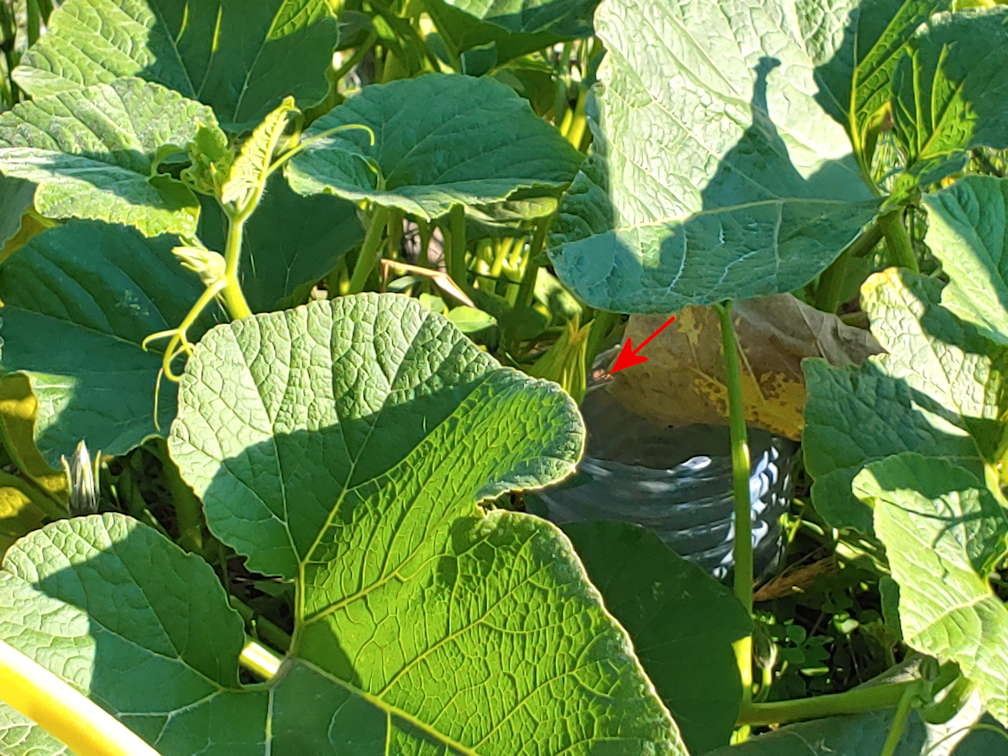
I couldn’t get any closer because of the critter barriers, but that flower bud the arrow is pointing to has a baby squash at its base. Hopefully, it will get pollinated and not die off. Under the current conditions, I would hand pollinate, but that would require moving the critter barriers. Mind you, there’s no way any fruit that develop will reach maturity.

More on that, later.

There are only a few Halona melons left on the vines, but there are probably a dozen Pixie melons that have not yet ripened.

This is the largest of them. Since it has a hammock, I check it in the mornings by lifting it at the stem, to see if it is starting to separate, but it’s still hanging on tight!

The rest are more like these two.

I’ll have to double check, but I thought the Pixies had a shorter growing season than the Halonas. They are taking much longer than the Halona to fully ripen. I’m sure the drought conditions over the summer have something to do with that, but since we’ve started having rain fairly regularly now, I would have expected them to mature faster. Ah, well. We’ll see how they do!

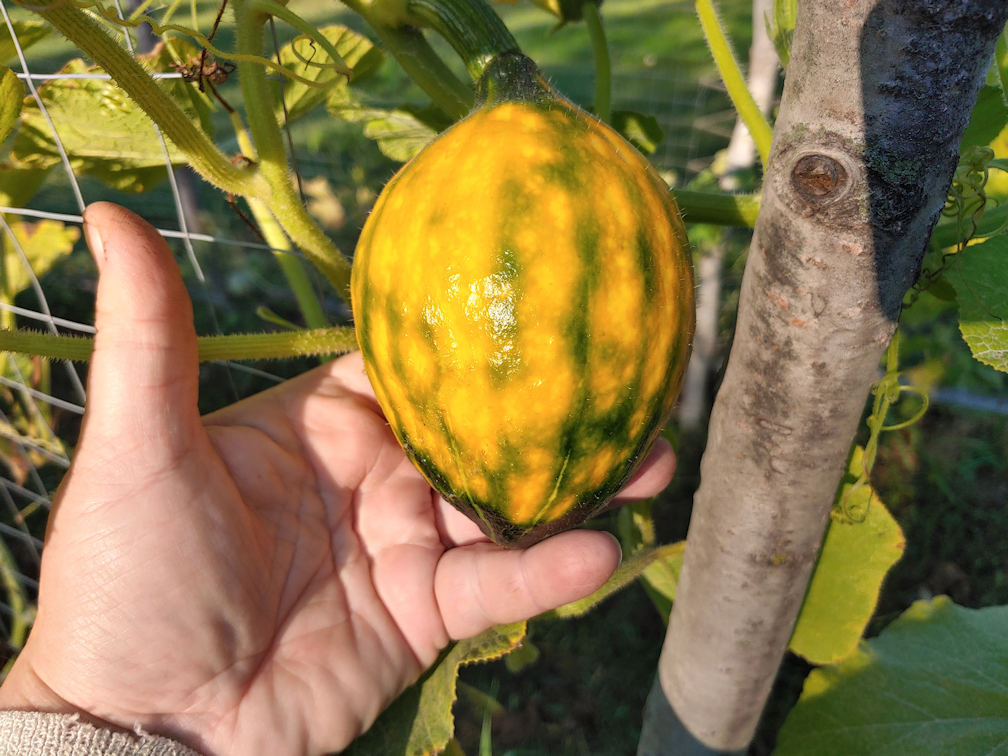
This is the largest of the developing Teddy winter squash. This is roughly half of what it’s mature size is supposed to be, so they may still have time.

Our weird mutant Red Kuri is noticeably bigger! It makes me smile, every time I see it.
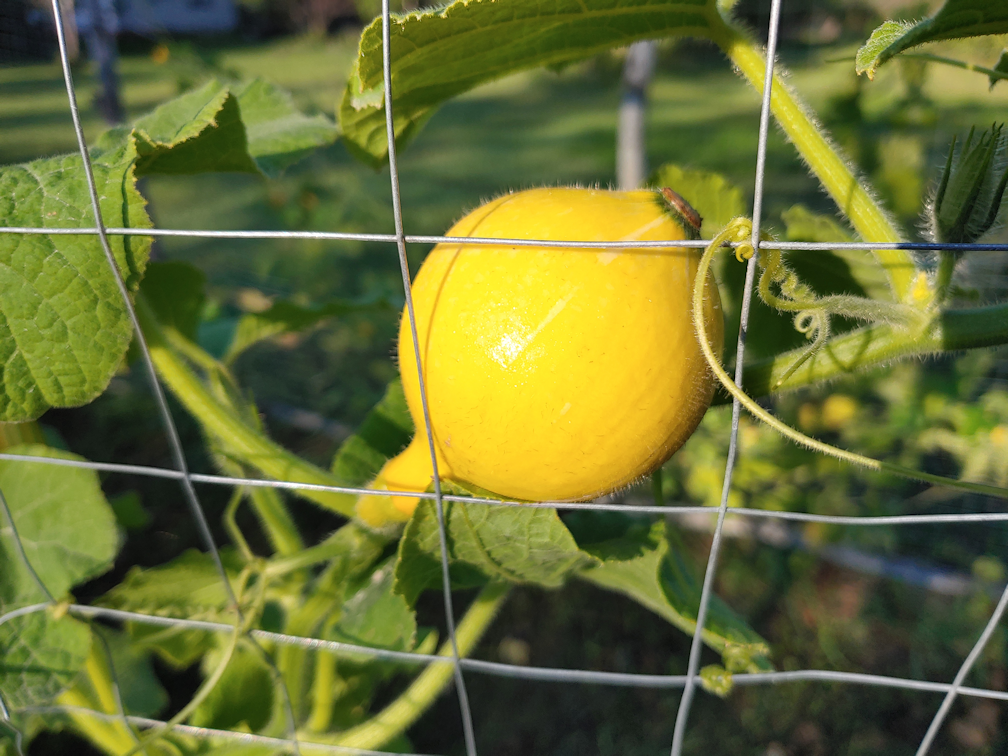
We’ve got a couple more that are getting bigger, too. This is what the mottled green one should be looking like, which is why I suspect it was cross pollinated with the Teddy squash.

Here’s something that is NOT getting bigger!

The one luffa gourd is just… stalled. The plants are still blooming, but also starting to die off for the season. I started these quite a bit earlier, indoors, and they should have had enough time to develop gourds and reach maturity, but this summer was so rough on everything, I think we’re lucky to have even this.
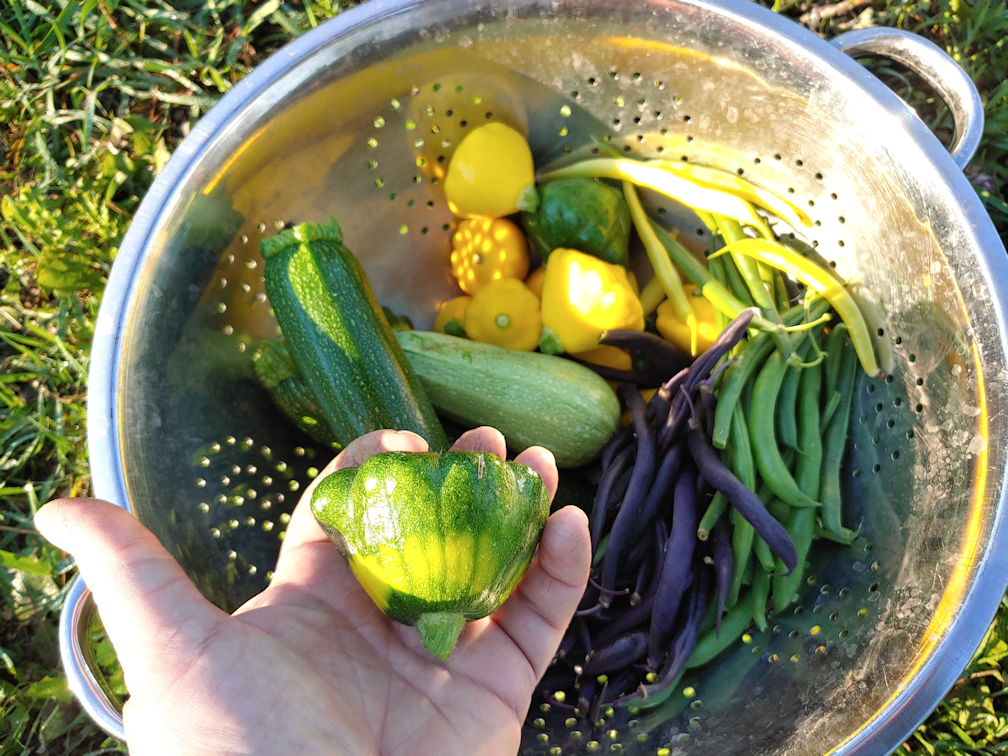
We even had something to harvest! Not every morning, but at least every few days. We even still had a few beans left to pick. In the photo, I’m holding one of the mutant green sunburst squash. :-D I’ve been trying to let the sunburst squash have more time for the fruit to get bigger, but they seem to be developing more slowly than they did last year.

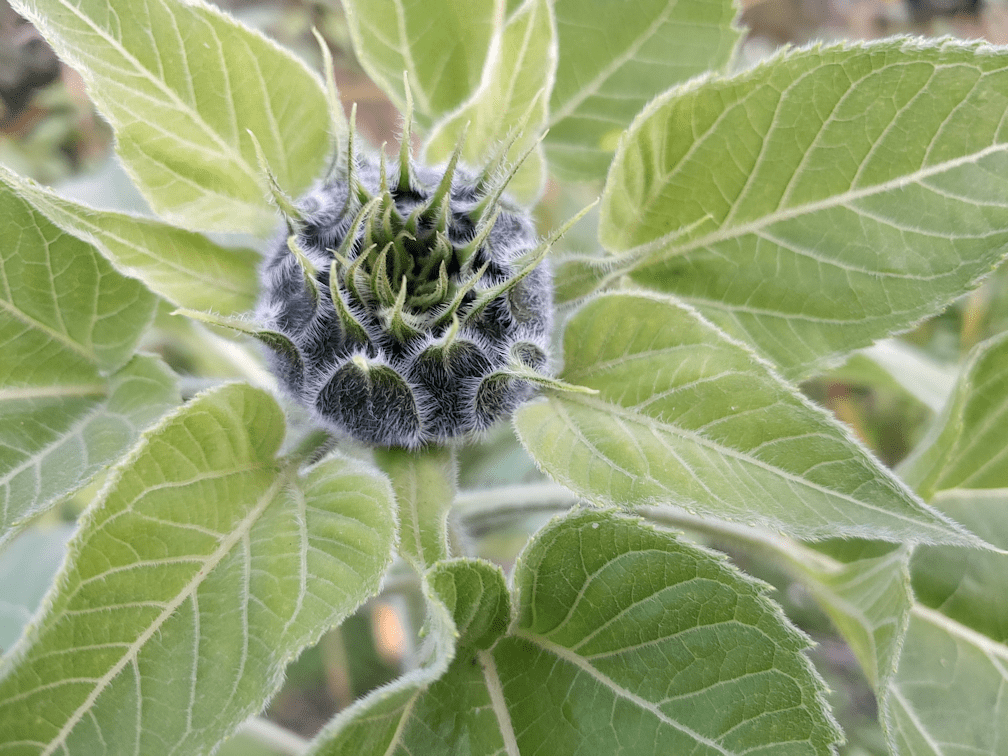
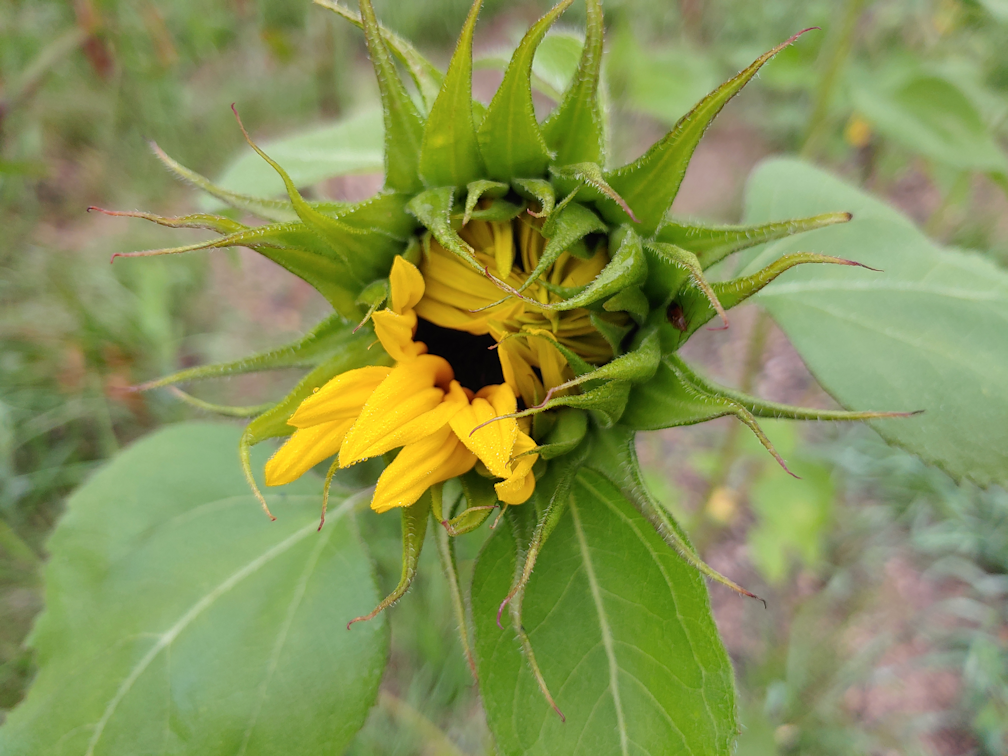
I just had to get a picture of the sunflower in the old kitchen garden. We can see it from the bathroom window, through the sun room, and it makes me smile, every time. :-)

As the season winds down, I’ve been keeping a close eye on the long term forecasts. Yesterday was our first frost date for the area, but it continues to look like we are not going to have any frost here, for a while. Of course, the forecast constantly fluctuates, and different sources have different forecasts. My Weather Network app has a 14 day forecast, and with today being the 11th, that puts the 14 day trend between the 12th and the 25th. The lowest overnight temperatures I’m seeing is for the 25th, at 6C/43F, with variable cloudiness.

My Accuweather app, however, is very different. The long range forecast on that one goes up to October 5. Up until this morning, all the overnight lows were above freezing, but this morning, there is now a single night – the 25th – where it says we will hit -2C/28F. It is also predicting thunder showers scattered about the province in that day.

If that is accurate, we have only two weeks before frost hits (which is 2 weeks longer than average, so I’m not complaining!). If we do get a frost, that will be it for the tomatoes, squash, gourds and melons. We have no way to cover any of these beds, so if we get any frost warnings, we’ll just have to pick as much as we can the day before. We should get plenty of sunburst squash, but I’m really hoping the Pixie melons and winter squash ripen before then. The gourd and Crespo squash just don’t have enough time left. Except the Tennessee Dancing gourds. They are so small, we should have quite a few to gather before the frost hits. We may be lucky, though. Aside from that one night that one app is predicting will go below freezing, overnight temperatures are supposed to stay mild into October.

The sunflowers will be a lost cause, though. There is no way the seed heads will be able to mature in so short a time. So many haven’t even opened, yet. Starting some of them indoors would have made the difference (well… except for being eaten by deer), had they been under better conditions. Not just with the weather, but the soil quality where they are growing. Had our only reason for planting them been for the seeds, they would be a failure, but they were planted there partly for a privacy screen, partly for wind break, and mostly as part of our long term plans to prepare the area for when we plant food trees there. Which means we had a success with 3 out of the 4 reasons we planted them. I do want to get more of these seeds to try them again, elsewhere.

For now, every night we have without frost is a help.

The Re-Farmer

Our 2021 Garden: still growing!

Okay, before I get into it, I just have to share a laugh.

The phone rang just as I was about to start this post. It was clearly from a call centre, from the noise I heard in the background. After the usual greetings, the very polite person told me he was calling about our Visa or Mastercard… provider? I can’t remember the exact word he used.

Of course, I found this incredibly funny and started laughing.

I don’t have a credit card.

Too funny!

Anyhow.

While doing my rounds through the garden this morning, I found some new growth happening.

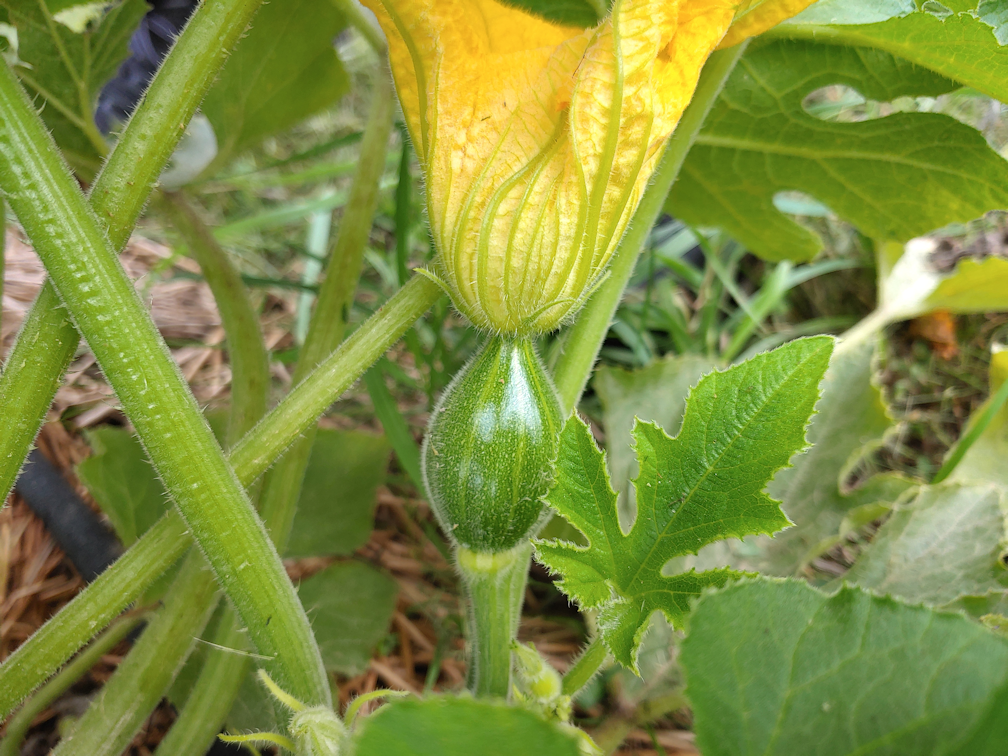
After seeing flowers for a while, now, there is finally an Ozark Nest Egg gourd starting to form! This is the first female flower I’ve seen. Hopefully, it has been pollinated and the new baby gourd will actually keep growing.

Meanwhile, among the sweet corn, I found…

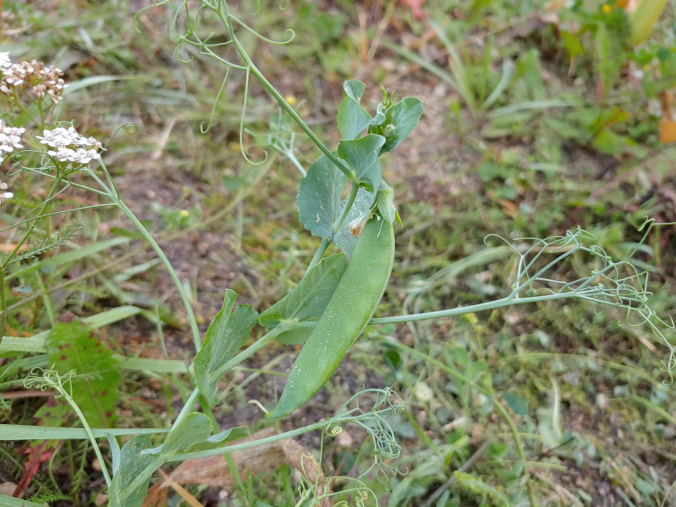
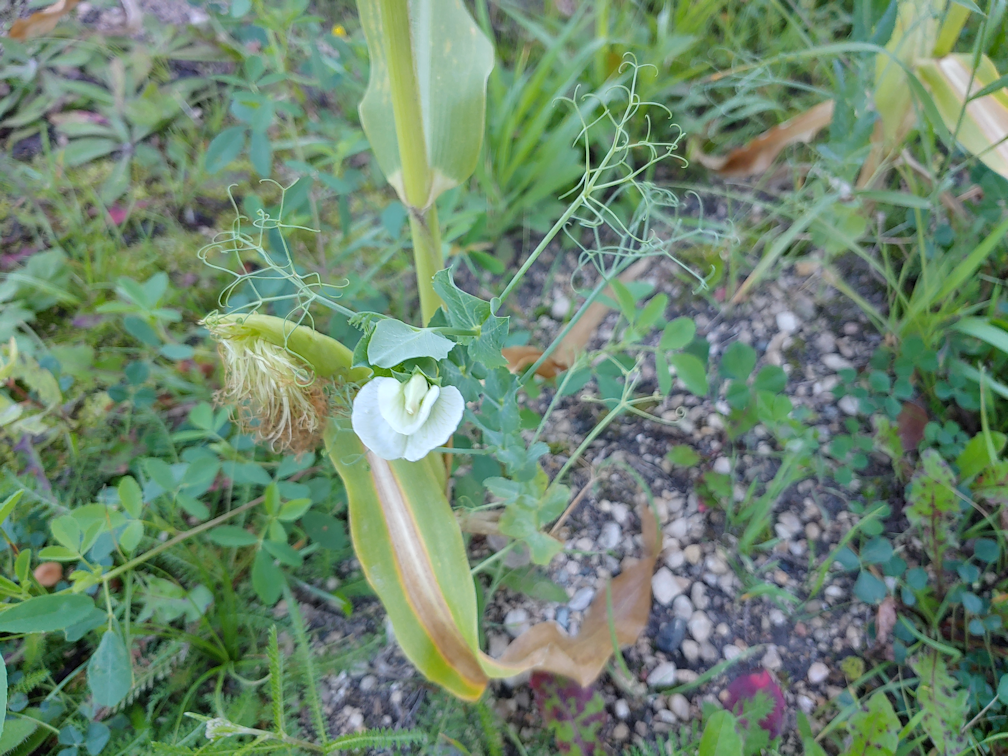
… our very first green pea pod!

These peas were planted among the corn, late in the season, for their nitrogen fixing qualities, but peas are a cool weather plant, so we might actually have a decent amount to harvest before our growing season is done.

Looking at the long range forecasts, our overnight temperatures should be cool, but it’s not until October that we’re looking at temperatures just above freezing. If that holds out, that means our garden has another 20 days or so for things to grow. The beets and the surviving carrots can stay in the ground until it freezes, if we wanted to leave them. The few chard that made it are doing quite well, though I don’t think the radishes will have a chance to reach their pod stage. If they’d been planted for their roots, we’d have a whole three radishes to pick, but none of them seem to be growing into full sized plants. The lettuce that was planted for a fall crop is just reaching a size worth harvesting baby leaves while thinning things out a bit. The seeds were well spaced to begin with, so not a lot of thinning is needed.

It’s new growth like the Ozark Nest Egg gourds, the sunflowers that have not yet opened their seed heads, and the new squash and melons that I am hoping the weather holds off for. The Halona melons have been ripening nicely, and there aren’t a lot left on the vines, but there are still lots of Pixie melons. I picked the one melon to taste test, before it was fully ripe, and have just been waiting on the rest to reach that point where they will fall off their vines. It seems to be taking an oddly long time! There are a lot of little Red Kuri squash that just won’t have time to fully mature before the cold sets in, but I hope the Teddy squash will have time to mature. They are so small, they should be able to.

A lot of people on my gardening groups have already brought their green tomatoes in to ripen indoors. With our tiny indeterminate varieties of tomatoes, I don’t know that we’ll bother. We have ripe tomatoes to pick every two or three days, and that is working out quite well.

On the down side, while I’m glad I was able to finish the extensive mowing around the inner and outer yards, by the time I was done, I was in massive pain. Especially my hips, where I have bone spurs. I’m still in a lot of pain today, so that limits what I am physically able to get done outside, as far as manual labour goes. The temperatures are supposed to remain pleasantly cool for the next while; perfect temperatures to get caught up on the heavy work outside.

But not today.

The Re-Farmer

Our 2021 garden: some pruning and cleanup – and we are forewarned!

While doing my rounds this morning, I decided it was time to do some pruning and clean up around the squash and melons.

With the summer squash, I cut away a lot of the bottom leaves, and anything dead or dying. The zucchini didn’t really need it, but the sunburst squash needed quite a bit.

Noting for next year: while I am happy with training the summer squash to grow vertically, and will probably do it again next year, I now know to make extra certain the support poles are more secure. I thought they were, but as you can see in about the middle of the squash bed, one of them has fallen right over under the weight of the squash attached to it – and I’d already added a second support pole with it! The zucchini on the far right of the photo is also tippy.

We are in a strange sort of state right now, where the squash and melons are continuing to bloom and produce, recovering for the extreme heat and dryness over the summer, but also dying off as they reach the end of their growing season. A couple of Halona melon plants were completely died off and got taken out. The single melon on the ground ground had come loose from one of those.

The three biggest Red Kuri squash are coming along nicely. The mottled green one is quite noticeably bigger. With the colours and slightly different shape, I find myself wondering if it got cross pollinated with one of the nearby Teddy squash.

Speaking of which…

There’s a new one! Of the two plants, one of them now has four squash developing on it. :-)

After I finished pruning the squash and melons, I went through the other beds, doing a bit of cleanup, and found this.

We’ve somehow lost a sunflower!

It doesn’t even look like it was bitten – there is no sign of critter damage anywhere. It looks almost as if it were cut! It’s also in the middle of a row, in the middle of a sunflower block.

Very strange.

I took the seed head inside and put it in a very small bowl, shallow enough for the barely-there stem to reach the water. :-)

As I was finishing up in the garden, the grader went by on the road, and the driver stopped to talk to me. He let me know that he’d seen a black bear – a big male – on our quarter section, and he thought it was heading for the newly dug out gravel pit for water. He’d actually seen 7 bears, just today! The most he’d ever seen in one day – and it wasn’t even 11:00 yet, at the time I talked to him. He suggested we might want to pick up an air horn to carry with us, so if we see a bear, we can use the noise to scare it off.

One of our neighbours, about a mile away, has been posting photos of a bear that’s been raiding – and destroying – his bird feeders. I would not be expecting any to come to our feeding station, though. With both bird feeders broken, I’ve just been tossing a scoop of seeds directly on the ground, so there’s not a lot to tempt them. Especially since we have zero saskatoons and chokecherries this year, and almost no crab apples, thanks to that one cold night in May. Even the ornamental apples in the old kitchen garden, which would normally be full of tiny bunches of apples, and birds eating them, have nothing. No hawthorn berries, either. Between the drought and the wildfires, this loss of berries would be quite widespread, and the bears are starving at a time they should be building up their fat reserves for the winter.

I really appreciated the grader driver stopping to let me know. I have never seen a bear in our yard, but this is not a normal year, so we will have to keep our eyes open!

The Re-Farmer

So tired, but I got it done!

I love having so much space around the house. I really do! But taking care of it is a … well… you know…

After all this rain, I got mowing done, but never had the chance to do the week trimming around the edges. The lawn needs mowing again already, even without more rain, which is a good sign. This time, I decided to do the trimming, first.

I started yesterday.

I got all the areas on the south side of the house, particularly around the kibble house, cat shelter, well cap and other things in front of the sun room that is hard to get to even with a push mower.

Then I went around the edges in the front yard, including the sidewalk to the small gate, which has sections tree roots have pushed upwards high enough the mower can’t go over anymore, without hitting it.

Doing the south yard includes trimming around the bed the haskaps are in, the bed where the white lilacs are, in between or around various trees, around the asparagus bed, around the potatoes in their bags, around the storage house on two sides, and the outside of the chain link fence. With pauses to McGyver a fix on the chain link vehicle gate that got backed into by our vandal a couple of years ago that really needs its hinges replaced, and to finally drag out some bricks and rocks from under one of the lilacs growing against the storage house.

Then the east yard got trimmed, including as much as I could into the edge of the spruce grove that has been cleared. There’s only so far I can go into there with the trimmer, as I need to get in there with the lopper to get the trees that are trying to grow back. There is a space between the house and where more lilacs and the cherry trees we are keeping, with the now-gone bird houses at either end, that is easier to use the trimmer on instead of trying to maneuver the push mower. Driving through with the riding mower is a bit tight, with the concrete stairs in the middle of the house. I also used the trimmer in an area we’ve been slowly clearing to access into the spruce grove, where we will eventually be building the cordwood shed that will be an outdoor bathroom, but for now will be access to the largest group of dead trees we need to cut down.

For the west yard, I just did the edge of the old kitchen garden retaining wall. The grass in the west yard is so sparse, I probably won’t mow it at all.

By the time all that was done, so was I, so I stopped for the night.

Today, I finished the trimming.

Sort of.

I finished the edges in the north yard, then worked around all the low raised beds in the main garden area. The ones that the onions were in have been left alone, and I’ve given up trying to weed the decimated carrot bed (which, amazingly, has recovering carrots in it!), and the paths in between have gotten so overgrown, it was getting hard to see the beds at all. That took a while to get done! While I was at it, I trimmed in between the raspberries as much as I could. Then I dragged the trimmer over to the Crespo squash and the Montana Morado corn. With the squash, I could only trim around the barriers we’ve put around it. It is recovering amazingly well, which is kind of sad, since there isn’t enough growing season left for them to develop any squash. As for the corn, I used the trimmer in between each row, being careful not to take out any of the peas that are growing with the corn, but falling into the paths. For the longer ones, I tried to get them to grow up the corn stalk they are closest to. I found quite a few pea plants that are blooming!

This area is the “sort of” part. It is so rough, the trimmer is the best way to cut the grass and weeds. Not today, though.

Then it was time to drag the trimmer over to the far garden beds.

Did I mention this is an electric trimmer?

Just as we need 300 feet of hose to reach the furthest areas of these beds, I needed 300 feet of extension cords. That allowed me to trim around the squash tunnel, most of the Dorinny corn and the transplanted Hopi Black Dye sunflowers beside them. The peas planted among the Dorinny corn are doing pretty good, too. I trimmed around the green pea trellises, too, even though there are no longer any peas growing there. Of course the purple peas and the three bean beds got done. It looks like I will be picking beans tomorrow. :-)

Then the corn and sunflower blocks got done, which meant going in between every row with the trimmer (there is just no way to weed this area anymore), again being careful not to take out any of the pea plants. Then the summer squash got done, and finally all the crap apple trees.

You know those cartoons, where a character is going through a spooky forest, and the tree branches turn into hands that clutch and grab? That’s what crab apples trees do. It’s almost impossible to walk under them without getting snagged! Thank goodness I was wearing my cap. The last time I worked under them and forgot to wear one, I found myself having to untangle branches from my hair. There is just something weird about how these apple branches catch onto everything!!

What I didn’t even try to do, besides skipping the old garden area by the purple corn and Crespo squash, is anything in the maple grove. Once again, it is so sparse, I will likely skip it.

I look forward to when the areas between the trees are filled with moss, flowers and other lawn replacements we are working towards.

Anyhow. That was it for the day!

The mowing will wait until tomorrow.

Until then, the girls are watering the garden beds for me right now. This is the first time they’ve needed to be watering since we finally got rain. That’s the longest time we’ve been able to go without watering, all summer.

The Re-Farmer

Our 2021 garden: little surprises

I am happy to say that whatever had been eating our Teddy winter squash seems to have gone away!

These little guys are still around, and getting “big”. I found a 4th one of them, too.

I love how fuzzy they are at this stage!

While looking at the other beds, I had a few little surprises.

I am not only finding more of King Tut purple pea pods, but there are more flowers, too! This just amazes me. These should have been done long ago, even under ideal growing conditions, but they’re still chugging along!

I am leaving any pods that develop to go to seed, for next year. I figure something that could not only survive our drought, but is still managing to produce, is well worth planting again!

Then there are the green peas that were planted among the corn.

Some are starting to bloom! This one is among the sweet corn in the northernmost block. These are the tiniest of the corn. The peas are a real mix in their progress. Some are barely more than seedlings, while others are growing more enthusiastically.

This is one of the biggest pea plants I found, growing among the Dorinny corn that I’m leaving for seed. I’m even finding some among the purple corn that is also being left for seed at this point.

If things stay mild, we might actually have green peas to pick. The ones we planted in the spring did not handle the drought well, and hardly any pods developed. These late planted ones are getting much better temperatures right now.

This has been such a difficult year for gardening, I’m happy with anything we get!

The Re-Farmer

Our 2021 garden: the last beet bed

Yesterday, I finally was able to tend to the last of the beet beds.

You can see why there was no hurry.

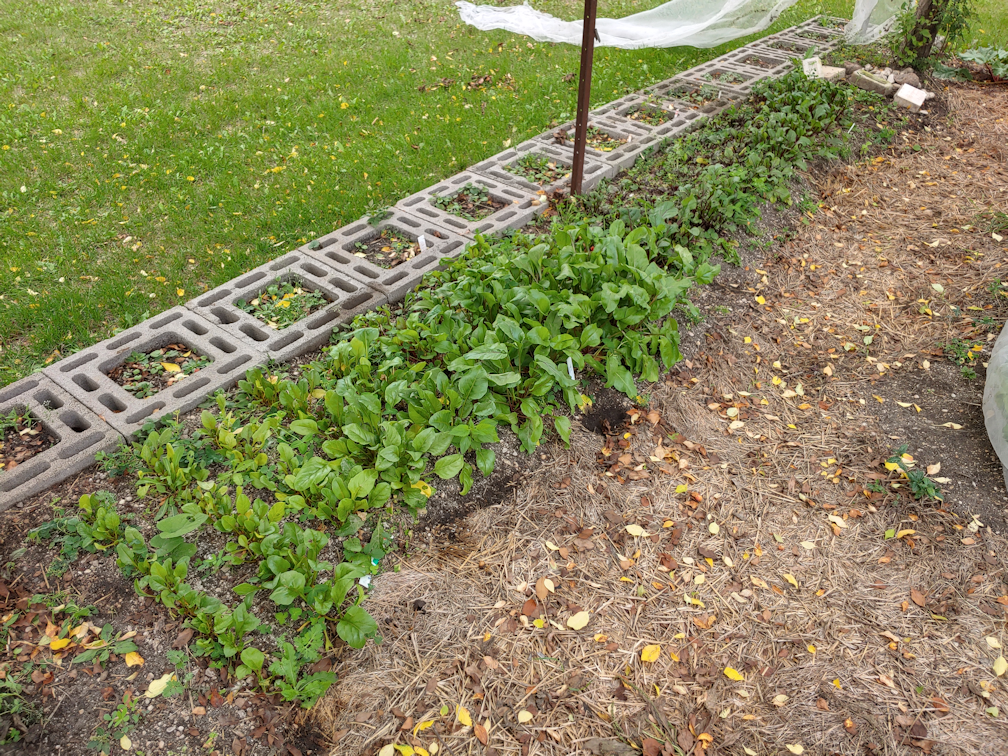
This beet bed got quite a bit of critter damage before we were able to cover it with the netting, and never really recovered. I think I lot of that has to do with the ornamental apple trees shading it too much.

This bed has four varieties of beets, planted in blocks. One variety does seem to be recovering a bit better. Those are the chioggia, if I remember correctly.

Just for the sake of comparison, this is the L shaped beet bed right next to the little one (after being weeded). These were planted on the same day, with the last seeds of all the varieties mixed together. In this bed, the critters did get at the end in the photo a bit, and it recovered a lot more, even though it has more shade than the rest of the L shaped bed. It still gets a lot more sun than the one along the retaining wall!

This is after weeding and loosening the soil a bit. The soil is really compacted for some reason (it got fresh new garden soil, just like the other beds). Very few of the beets seem to be developing their roots.

After planting the L shaped bed with the mixed seeds, I still had some left, so I scattered them in the sapce on the very left of the photo, which is pretty much right at the trunk of one of the ornamental apples. This spot never got covered. Not only did it get eaten by critters, but cats and kittens like to roll on it. Amazingly, there are still tiny little beets trying to recover in there!

Before putting the netting back, I did add pairs of sticks to hold the net above the greens a bit. Hopefully, it will dissuade kittens from jumping on it! :-D

This netting had been originally used to create a wall on the outside of the blocks to keep deer away from the lettuce that was planted there – only to have the groundhogs eat them all. To hang the net, part of it was torn so it could be placed around a tree trunk for support. That’s the tear you see at the end in the photo. The long side of the inside is pegged down snug. The long side along the retaining wall got shoved between the soil and the blocks. Though I could roll lengths of wood into the ends and weight it down with bricks, there is nothing I can do about the tear right now. I think it should be fine.

It doesn’t look like we’re going to get many beet roots out of here at all this year, but who knows? As long as the weather stays mild overnight, they will be left to grow as big as they can before we harvest them. Plus, we can still eat the greens. :-)

The Re-Farmer

Our 2021 garden: 105

First, the pretty!

The remaining Hopi Black Dye sunflower in the old kitchen garden has three seed heads forming. This is the second one to open, and the third is still just a big bud.

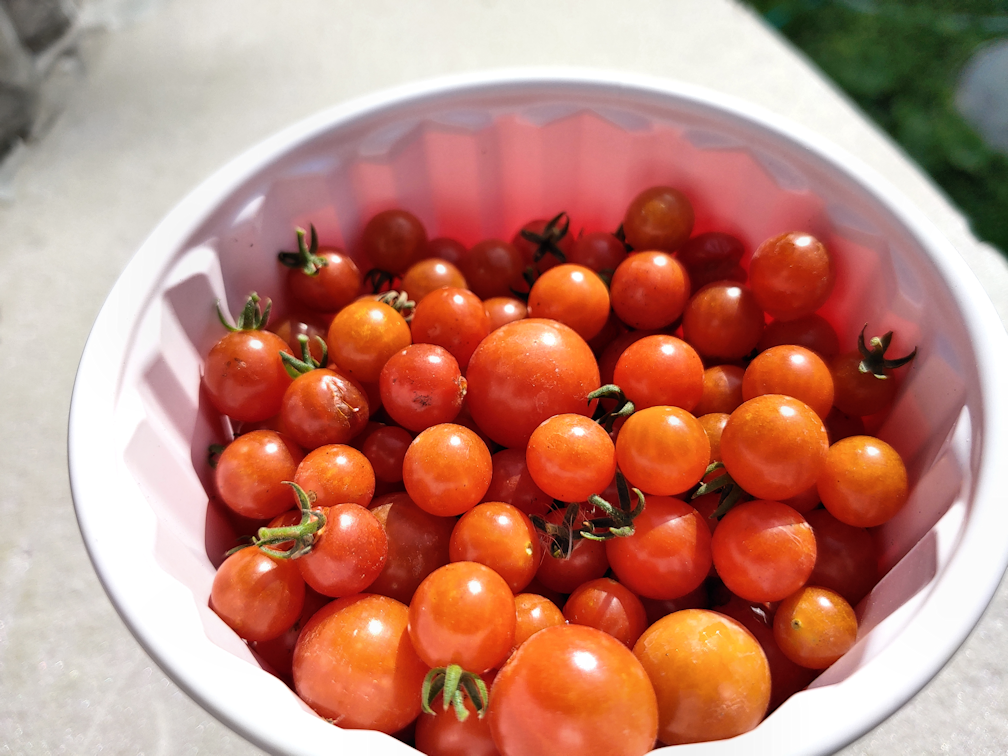
I finished my rounds with picking tomatoes. Here is this morning’s haul.

I was curious, so when I transferred them to a colander for washing, I counted them.

I picked 105 tomatoes….

… and they all fit into a Solo cup. :-D

The Re-Farmer

Our 2021 garden: morning in the garden, and thinking ahead

What a lovely morning to finish up my rounds in the garden!

There are quite a few Mongolian Giant sunflowers opening their seed heads. Hopefully, we will see the Hopi Black Dye rows in this area opening soon. They are so cheerful! :-)

I’m just so happy with how the Red Kuri squash are doing! Judging from how the stem looks, the oldest of the ripening squash, in its little hammock, is progressing quite well, and the other two larger ones are catching up nice and fast. Looking at the long range forecast, our overnight temperatures will continue to stay mild, with no frost on the horizon, which will be a huge benefit for all the plants that are recovering from the heat and drought conditions we had this summer. Lately, we’ve had enough rain that we have not needed to do any watering at all, which is helping a lot, too.

The largest of the Halona melons was ready to pick this morning, so…

… the hammock that was supporting it is now holding the larger of the new Red Kuri squash.

It has been a few days, so this morning, I spent some time picking beans.

I also thinned more of the Lounge Rouge Sang carrots.

I ended up using what vegetables we had in the fridge, as well, to make a use-watcha-got version of Hodge Podge. I used bacon fat instead of butter, all the carrots in the photo, some of all three types of beans, cut into smaller pieces, yellow onion, shallots and garlic, a bunch of little sunburst squash, a zucchini, and the chard we’d picked recently; the stems were removed and chopped to about the size of the beans, while the chopped leaves were added near the very end. Also, chunks of sausage for the protein. For a bit of texture, I tossed in some lightly crushed mixed nuts, too. Instead of water, I used vegetable broth, and the dairy at the end was a mix of sour cream, into which I’d stirred in the flour for thickening, and heavy cream. Since I used broth, no other seasonings were added.

The only downside is that the carrots turned the cream pink! :-D It was not the most visually appealing of dishes as a result, but is sure was tasty!

While going over the garden and checking things out in general, we are going to have to start working on things that need to be planted at or just before fall. We have the two wildflower seed mixes that won’t be sown until fall, but we need to start preparing the areas now. We won’t be able to do actual seed beds, as the packets recommend, but we can still clear the areas as best we can and, for one set of seeds, hopefully use the riding mower to drag the little harrow I found under the spruce trees and loosen the soil a bit.

We also have the morel and giant puffball spores to “plant”. They need to be done by about the middle of September, if I understand the package directions properly. Unfortunately, where I wanted to put the morels still has a couple of branch piles that were supposed to get chipped. The giant puffballs needs a grassy area, and we have a few options, there. We just need to make a decision before preparing the spores.

We should have good weather for working outside for the next week or so, which will be a huge help.

The Re-Farmer
Our 2021 garden; more firsts – and SO many kittens!

While heading out to do my evening rounds yesterday, I topped up the cat kibble – and got invaded by kittens!

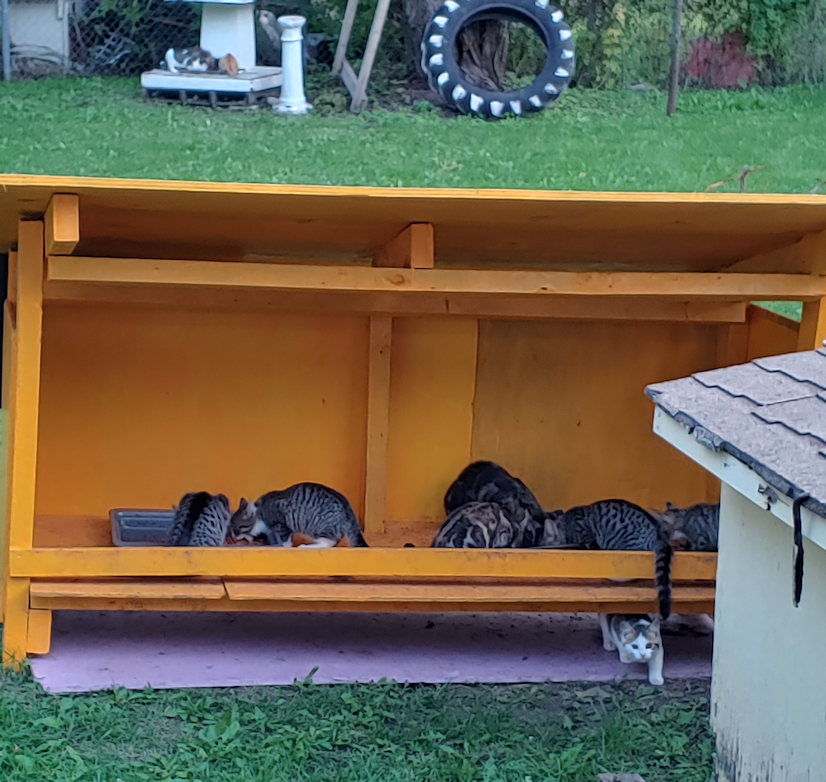
There is only one adult cat in the kibble house in the above photo, plus Rosencrantz and her two are at their private dining area under the shrine.

All three litters of kittens were running all over the yard, playing with each other! The fact that most of them stayed to eat while I took photos – even with zoom – is very encouraging. :-) It will be good for them to get used to each other, since we can expect them all to be using the cat shelter over the winter.

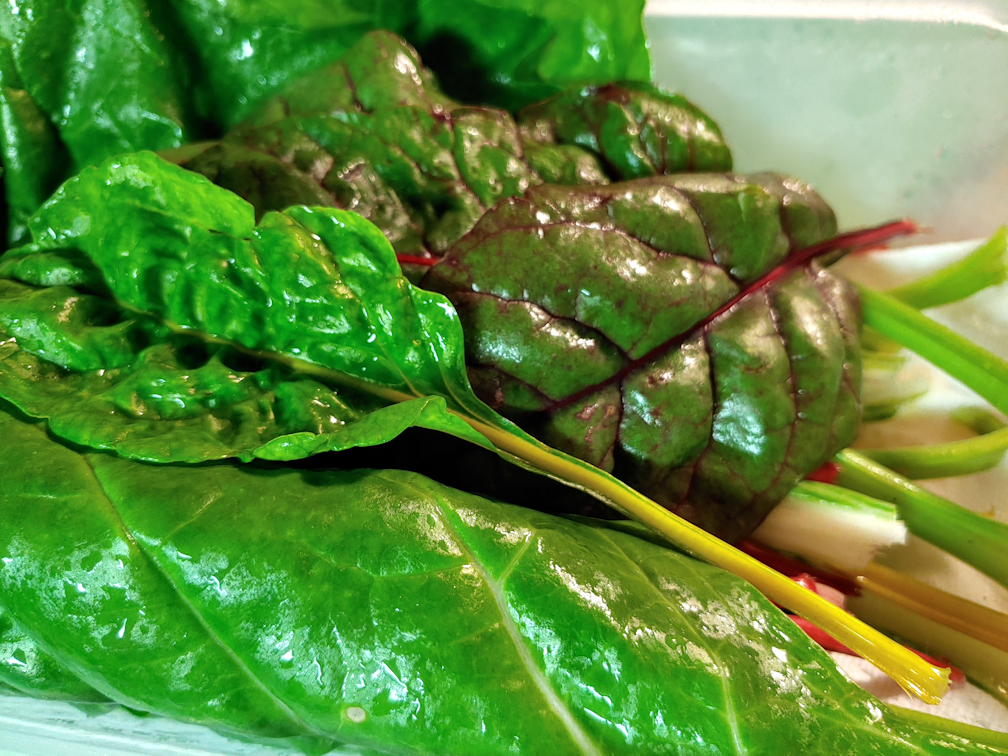
While checking the garden beds, the girls gave me a hand moving one of the mesh covers so we could collect our very first chard leaves!

These are the Bright Lights chard, with their brilliant colours.

In the other bed where we had planted chard and radishes, only a single chard plant has survived the grasshoppers, and it’s pretty small, still.

Here we have the largest of the developing Hopi Black Dye sunflower heads. These are the ones that were direct sown after last frost.

This morning, I found this.

This is another Hopi Black Dye sunflower, from the row of transplants. These are the ones that did not germinate until after the others were direct sown, so they were much smaller and further behind. Then they had their tops chomped off by deer. Yet here they are, spindly and barely knee high, yet the seed heads are starting to open before the big ones!!

Speaking of seed heads…

I collected the driest of the poppy pods. I was a bit concerned that the rain and humidity would create a mold issue, so they are now in the sun room. As you can see, some of them are even dropping seeds!

These are Giant Rattle Breadseed Poppy, and the pods should be much, much larger than this, but given the growing conditions of this year, I’m just impressed we have any at all. There are still others that are green, but starting to dry out. I am debating just leaving them be, to self sow for next year. Given how few survived, there isn’t enough for eating, other than a taste, but more than enough to keep seeds for planting in a different area next year, if we want. I wouldn’t mind even finding a spot to scatter them as if they were wildflowers, where we can access them to harvest seed pods, but also where we can leave them to self seed, year after year. At the same time, I’m thinking of ordering more of this variety from Baker Creek, plus trying a different variety of eating poppies I found from a Canadian source. This is something I don’t mind having lots of, as poppy seeds are among those things I enjoy, but rarely buy. Neither variety I’ve found are like the ones I remember my mother growing, but I believe she got her seeds from Poland.

As things are maturing, my mind seems to constantly assess for next year or, as in the case of the poppies, for a more permanent crop. For all the difficulties we’ve had with this year’s garden, due to things pretty much out of our control, we have learned a lot that we can apply to future gardens, what we want to keep, and what we need to change. Especially as we move from our temporary garden beds to our permanent ones. :-)

On a completely different note, today we had an early birthday party to celebrate my mother’s 90th birthday at my brother’s. I was my mother’s chauffeur. :-) We had a great time, and we able to see her great grandson for the first time in almost 2 years. They live in a different province, so it was fantastic that they could come out for the birthday party.

Between the drive and how long we stayed to visit, we were out pretty much all day, but my mother held out very well. She even seemed to like the necklace we got for her gift and put it on right away, though she was completely indifferent to the little bag I crocheted to “wrap” it in. Even when I suggested she could use it to hold one of her rosaries, she said nothing. Now that I think about it, I don’t even know if she took it home. I helped bring in and put away her packages, and it wasn’t in any of them, so unless someone tucked it into her purse, she doesn’t have it. Which is actually a better response than I was expecting. :-D

Some things just don’t change! ;-)

Anyhow.

As wonderful as it was to see everyone, this introvert needs a battery recharge. I think an early bed time is in order! :-D

The Re-Farmer

First low raised bed, part two: done!

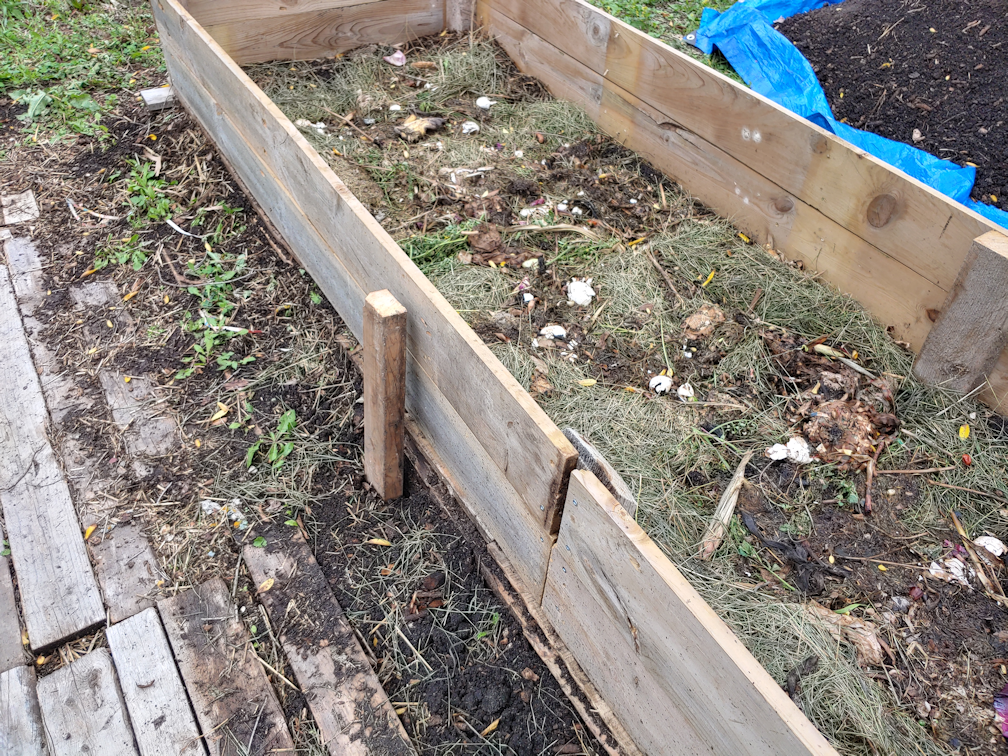
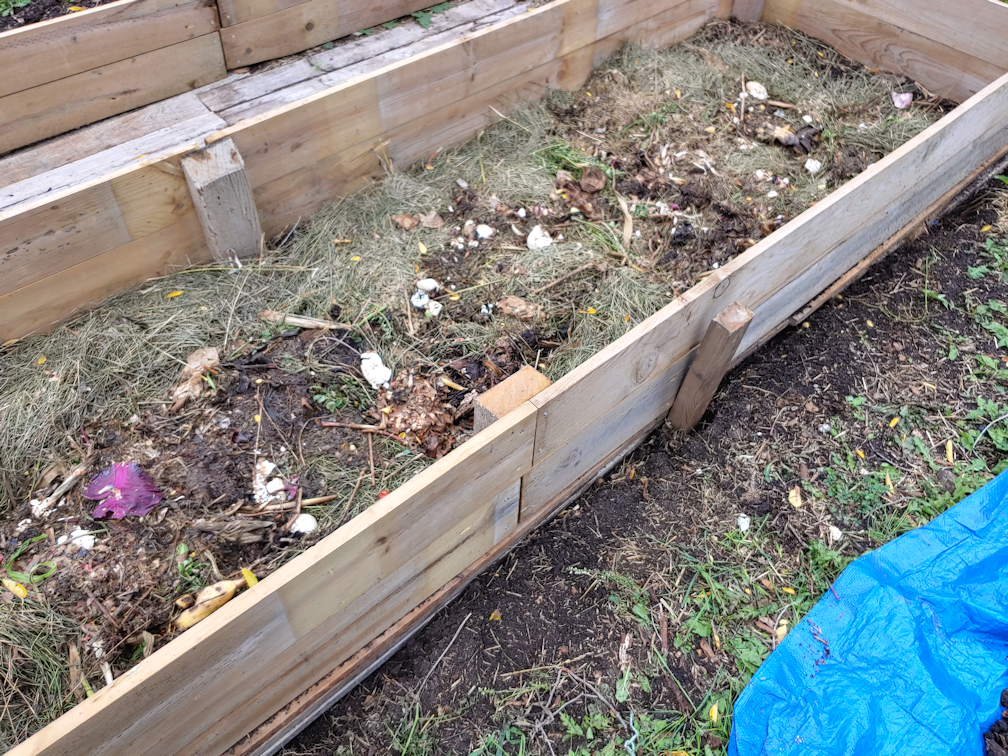
Today, I was able to get back to working on our first low raised bed. The first thing I had to do was scrounge through a shed and the barn, looking for something I could use to support the long sides and prevent them from bowing outwards once the bed is full of soil.

I found a piece that was strong enough, and long enough that I could cut it in half, first, then cut the two pieces in half at an angle, so they could be driven into the ground. Two were used for this bed, and the other two will be for the next one. The soil here is soft enough that I was able to use the pretty sledge hammer I found in the pump shack to hammer them in. I wasn’t too worried about them being perfectly straight. If this were a high raised bed, I’d be sinking posts to support them.

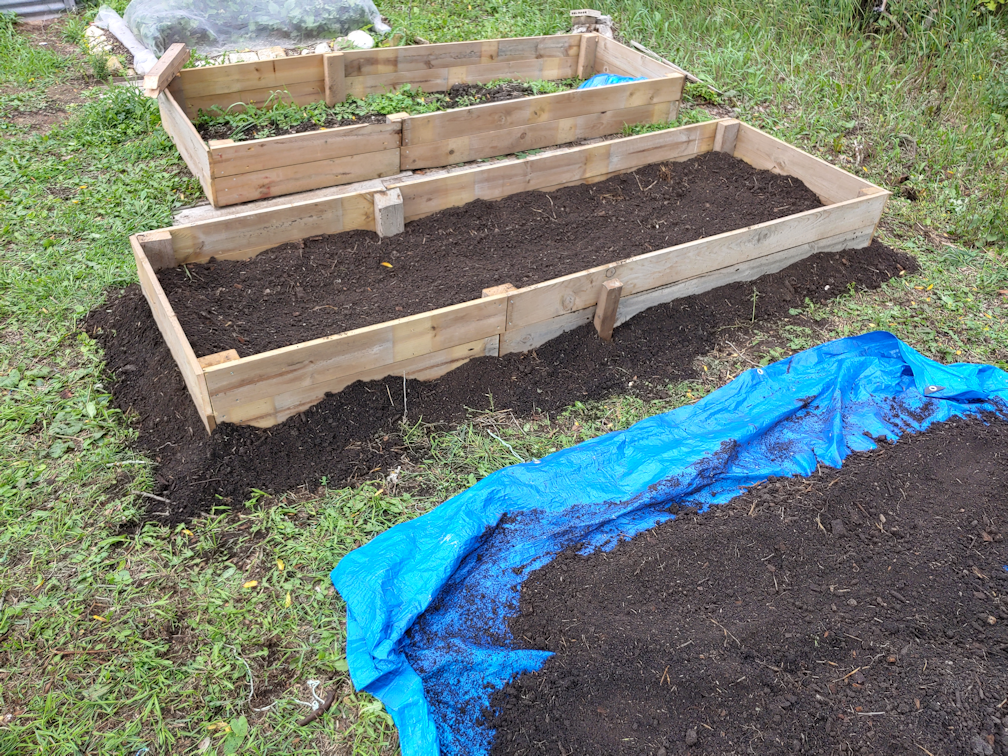
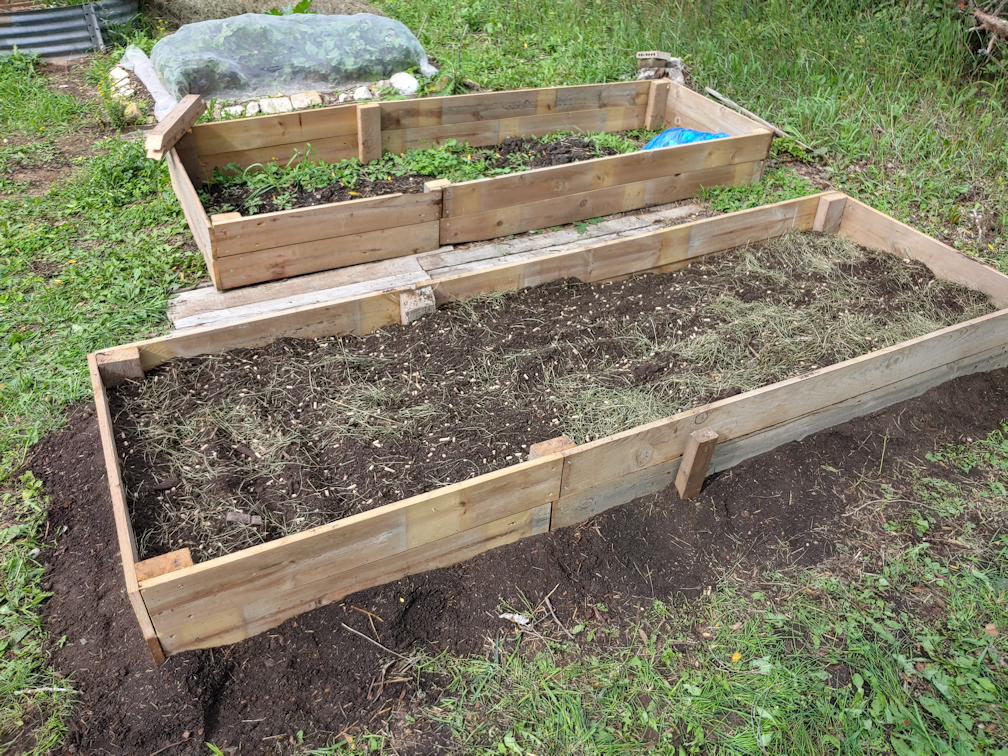
Next, I shoveled about half of the soil into the box, raking it out against the sides a bit, then added soil all around the box to bury the wood foundation. In total, that took up about 2/3 of the soil on the tarp. The wood foundation will break down over time, and I expect the whole box will slowly sink with it, but I don’t expect this to last more than a few years. Hopefully, by the time these need to be replaced, we’ll have access to more permanent materials and can replace them with high raised beds.
Now it was time to amend the remaining soil.

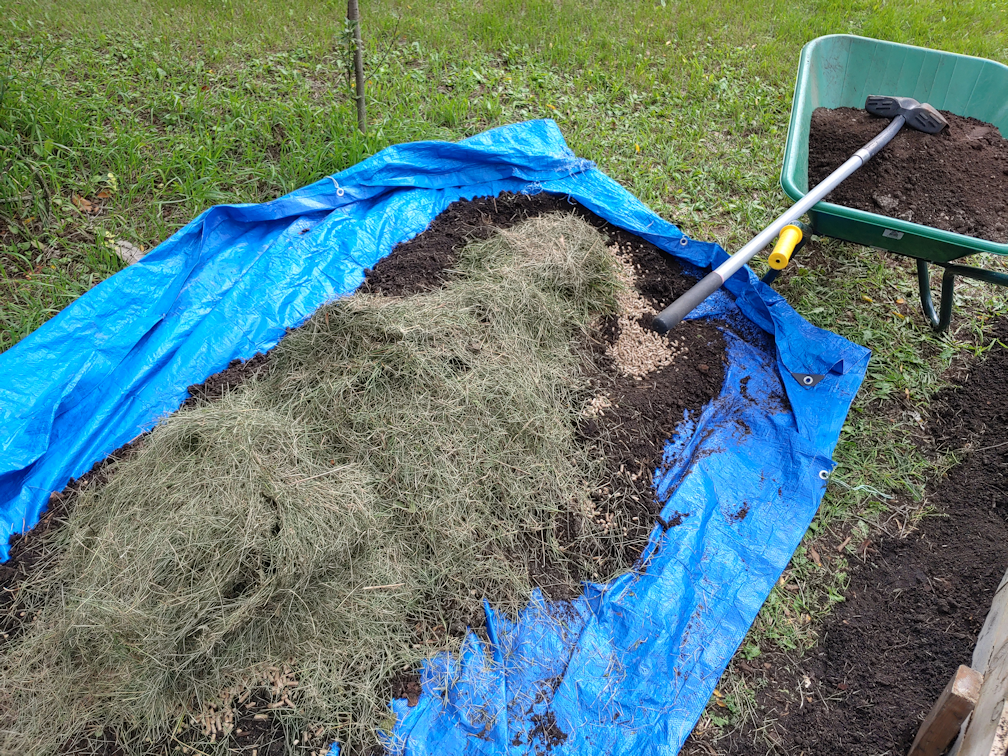
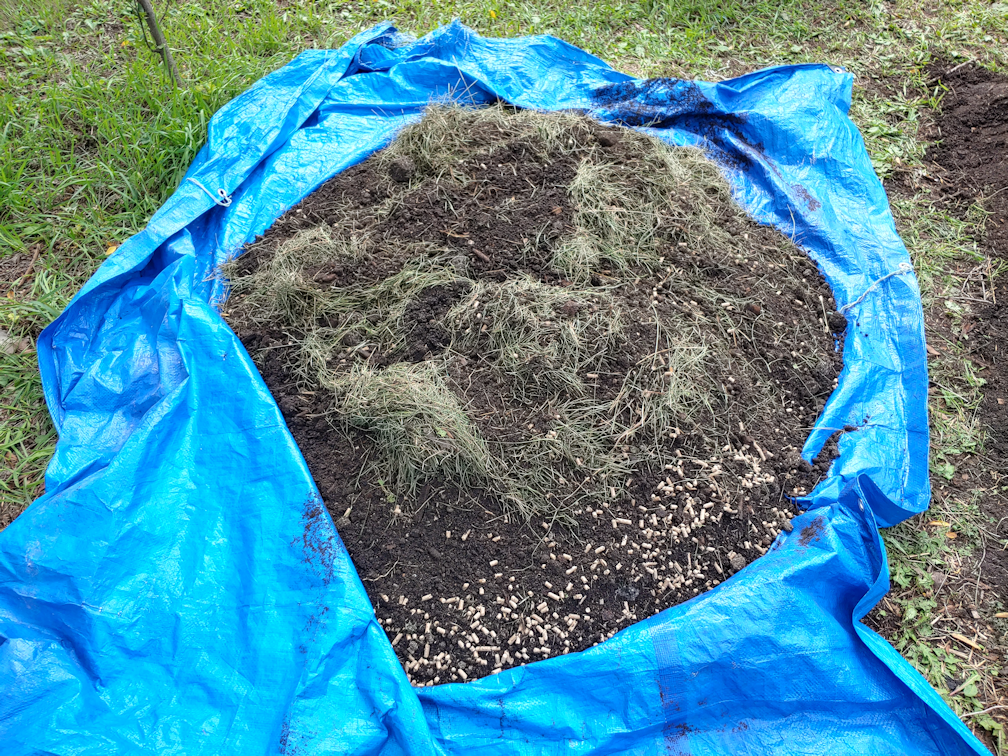
First I added about half a bag of wood pellets (roughly 20 pounds), maybe less, then got a load of the garden soil we bought in the spring.

An arm full of grass clippings was added on top of the load of soil, then a second load of soil was added.

The whole thing was mixed together using a garden fork and the tarp itself. After a while, I shoveled about a third of it into the box, then used the tarp to mix it some more, shoveled more into the box, mixed the remains with the tarp again, and by then I was able to use the tarp to heave the whole thing into the box and dump the mixture out.

Then it was time to level it all out.

I also used the back of a hoe to tamp down the soil around the outside of the box a bit. If I can figure out how to transport it, after all the beds are done, I want to bring gravel from the pit over, to put around the boxes and in the paths.

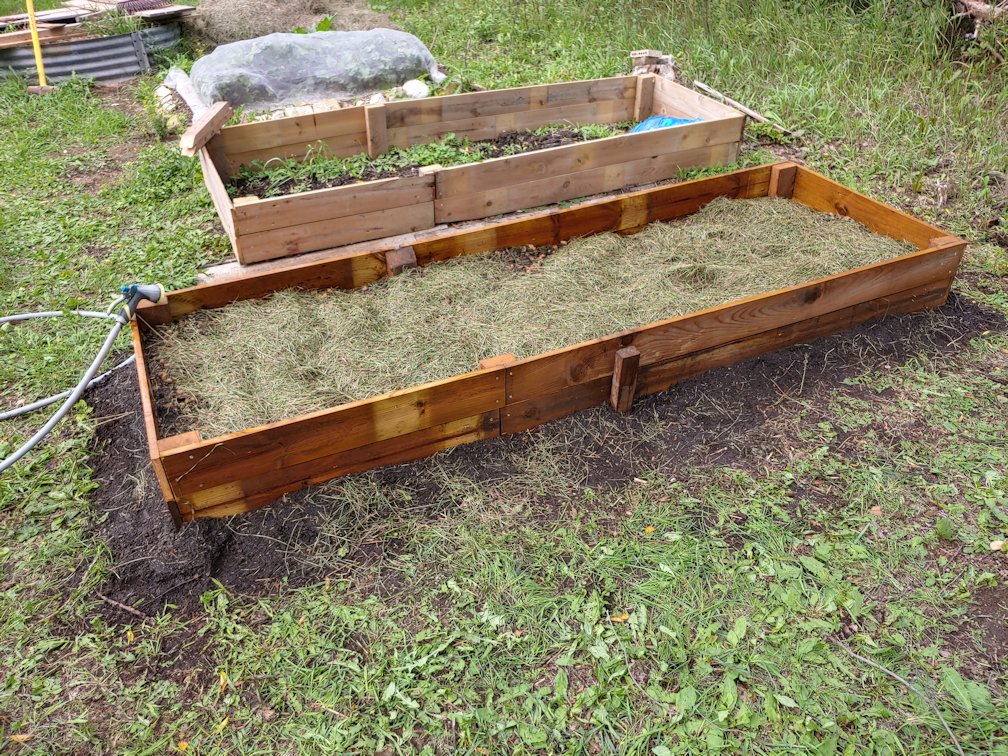
The final step was to cover it all with a grass clipping mulch and give it all a soak. It was a good chance to power wash the box itself a bit, in the process.

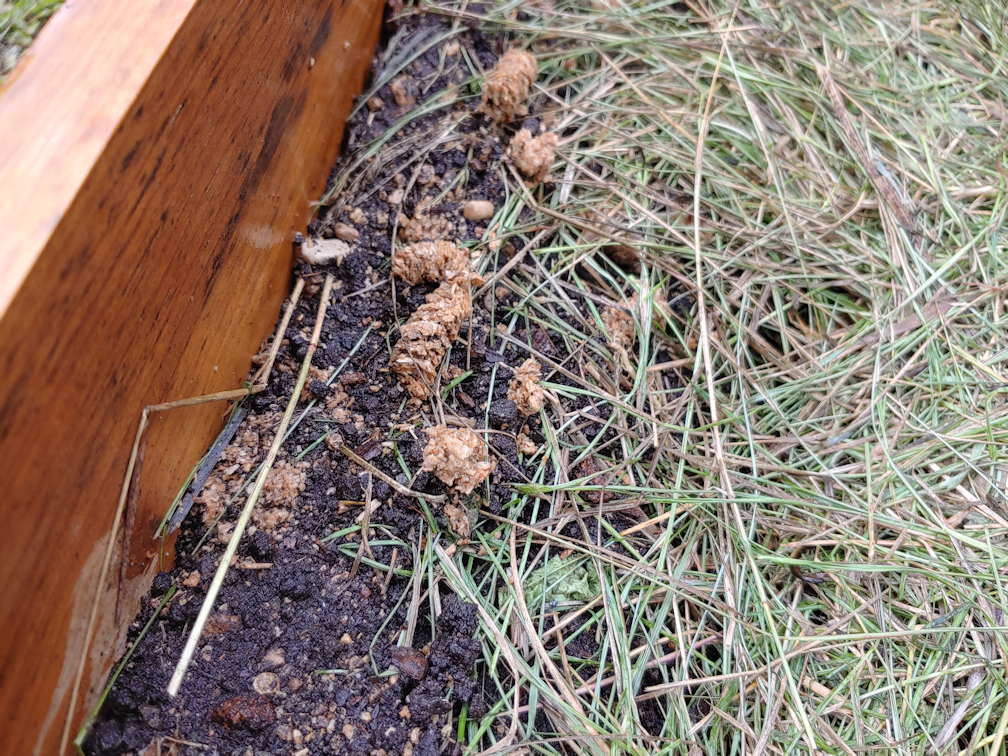
Here, you can see some of the wood pellets. This is why I decided to use these. Once the water hits the pellets, the sawdust begins to absorb it and expands pretty much immediately. Which means that all the pellets that are buried in the soil will push the soil away, breaking it up and preventing compaction. Depending on the conditions for the next while, these should decompose completely by the time we’re ready to plant into here, together with the grass clippings, adding organic matter that will keep the soil light and increase moisture retention.

As you could see from the previous photo, the box is not full to the top. It is, however, at a stage that it could be left as is, and be ready for planting in the spring. I might have a lead on getting a truck load of manure. If that pans out, and we can get some this fall, I would use some and, together with the garden soil and probably other organic material, top up the boxes. We shall see. Either way, this should all settle further over the winter, so I expect to need to add more material in the spring, before planting.

For now, the bed is done. The next two will be done the same way, though I still have to build the box for the bed that has beets growing in it. That will wait until after the second box is set up, since there’s nothing to do with that bed until the beets are harvested.

The Re-Farmer