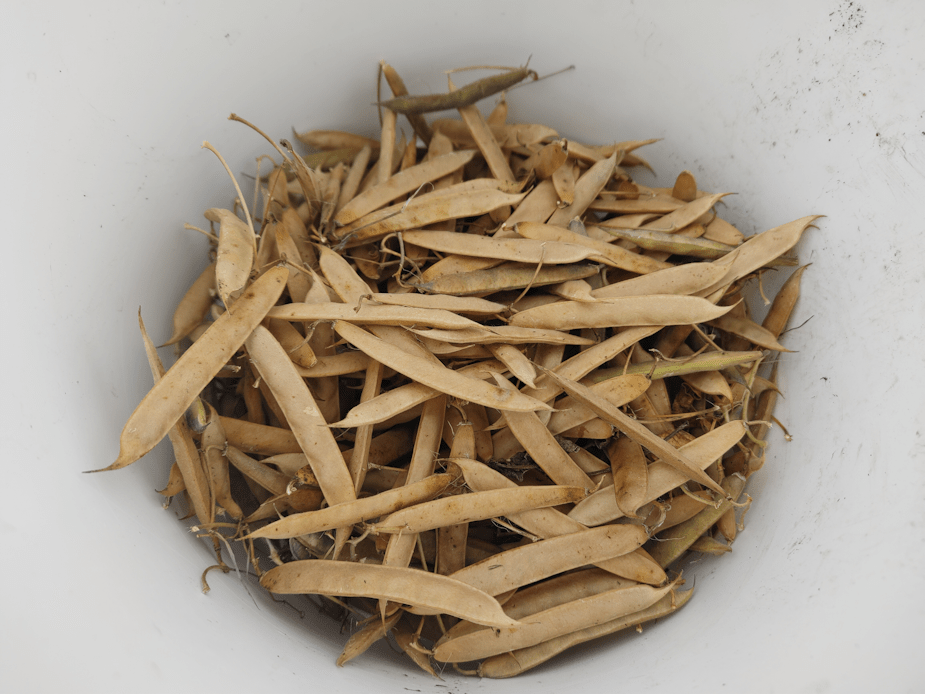
Last night, after saving some for planting next year, I picked over the blue grey speckled tepary beans we grew, then left them to soak overnight. I ended up using all of the remaining beans.
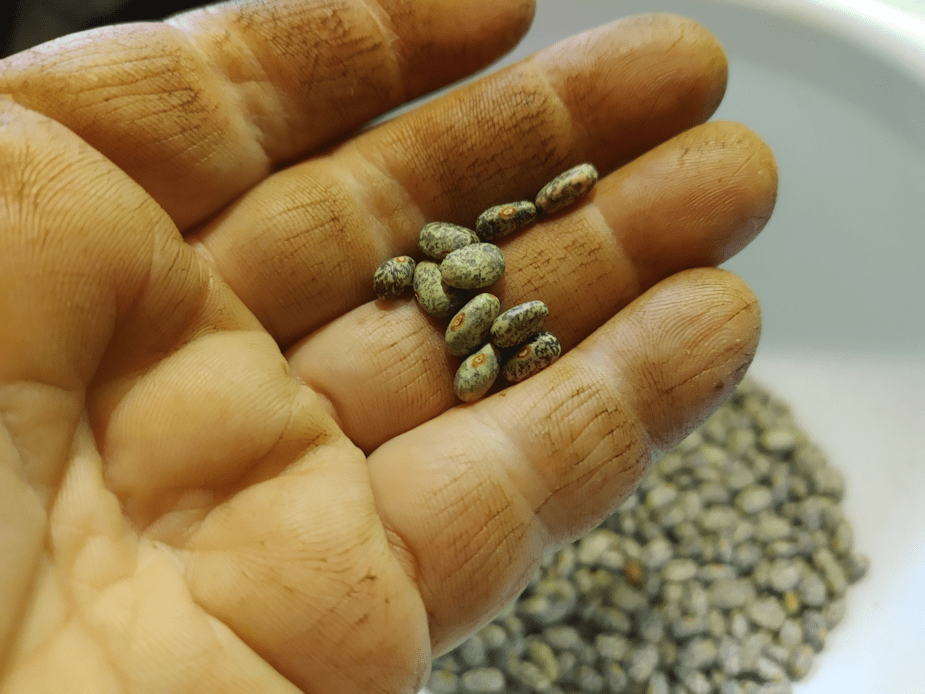
This is how they looked after shelling.
After soaking overnight, they looked like this.
The got a bit bigger, but not by much, really.
I was going to use them in a soup, and decided to cook them separately, first. This is how they looked after being cooked al dente.
The colour is off because the camera got steamed up. They did lose a lot of their colour, and I noticed they turned the water quite grey, so I’m glad I decided to cook them separately, first. Otherwise, they would have turned my soup grey!
I was going to make a cream of chicken soup, but ended up making an “everything but the kitchen sink” soup. My daughters had roasted several whole chickens, with our own potatoes, a couple of days ago. Today, I deboned what was left of them, and used the remaining roasted potatoes in the soup, too. I also used a couple of yellow onions from the garden, the single shallot I’d picked yesterday, the last bit of slab bacon we had, and all of the Kyoto Red carrots, since there were so few of them. The tiny sweet potato harvest was used up, along with the last of our summer squash – green and yellow zucchini, and yellow patty pan squash. Corn kernels, cut from the cobs, went into the pot, as well as some of the tomato sauce I’d made recently. After everything was cooked, I took the immersion blender to it for a while, adding in some whipping cream at the same time. The very last thing was a handful of shredded cheddar cheese.
I tasted the beans after they were cooked, and they tasted like… beans. 😁 I had not added any seasonings of any kinds, so they were as plain as plain could be. Once in the soup, I honestly couldn’t taste them at all. They did add a nice texture, though, and the ones that got hit with the immersion blender helped thicken things a bit. I like my soups hearty and thick!
I think they worked out rather well, but… well… Aside from what I took out to plant next year, that was an entire year’s harvest, used up in a single pot of soup! 😂 I’ve set aside twice what we planted this spring. Between that and if we get a better growing year, it would be nice to have a much better harvest next year! I also have some beans my mother gave me. I don’t know the name of them, but they are a small (though bigger than the tepary beans) white bean that she grew every year from her own seeds. She’d given some to my sister, who grew them for years. She doesn’t grow beans anymore, so she brought a pasta sauce jar – just shy of a quart – full of seeds to my mother. My mother has no plans to grow them, in her little garden plot, so she gave them to me! They’re a few years old, but there should still be a decent germination rate. Which means that, next year, we should have two different types of shelling beans to grow.
I took advantage of the lovely temperatures (and being in less pain) to do some more clean up in the garden. Earlier in the day, my daughter and I drove into town so she could get a new photo to renew her driver’s license, while I popped across the street to pick up a few things at the grocery store. I was thinking of making a cream of chicken soup and was about to buy some carrots, when I remembered…
We have carrots. They’re just still in the dirt.
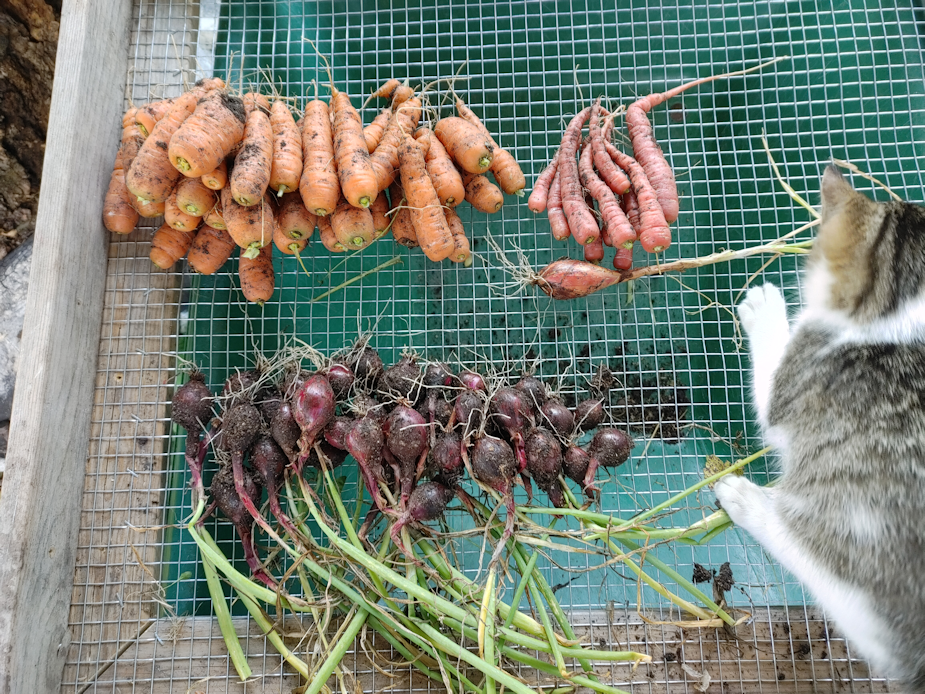
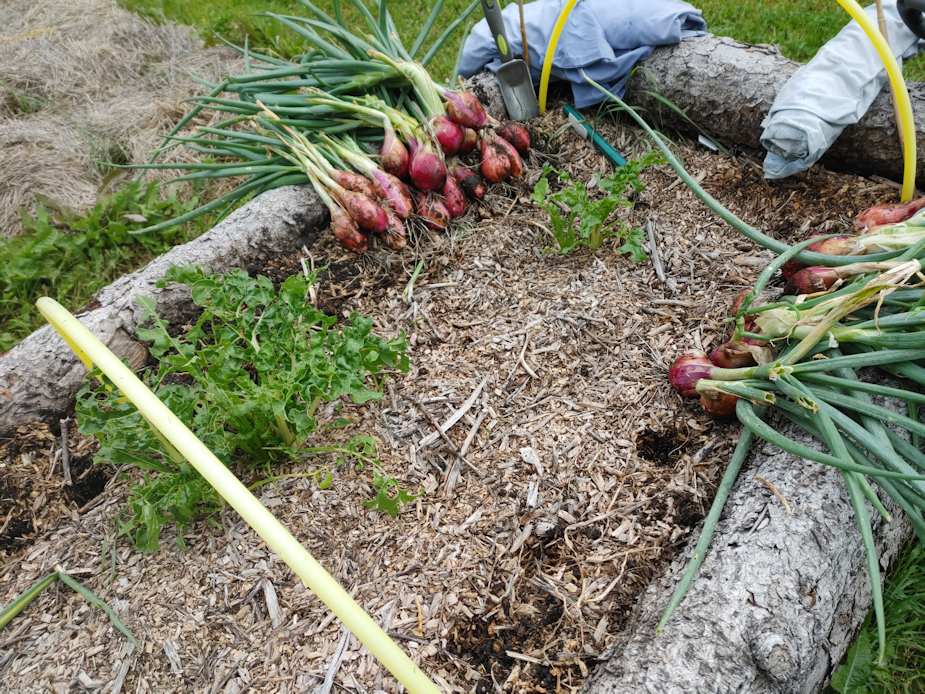
So I went over to where the chocolate cherry tomatoes had been planted, and pulled up the Napoli (orange) and Kyoto Red (dark orange) carrots – and a single shallot! I also dug up the red onions from sets that were planted with the yellow pear tomatoes.
The new soil sifter came in handy! 😁
I’m actually surprised that we got so many decent sized carrots. The Kyoto Red were pretty small – there were two I left behind because they’re blooming, and I hope to collect some seeds. I used up the last of the Kyoto Red seeds, but I think I still have some Napoli pelleted seeds left. Those really did far better than I expected.
Then there’s that single, solitary shallot!
There were actually two more, but they also bloomed, and I’m waiting for the seed heads to dry before collection.
As for the red onions…
Most of them aren’t any bigger than the sets we planted in the first place. Given how spindly the greens were, I thought they might be rotted out, or at least soft, but nope: they are quite firm. They’re just really tiny. I think they were simply too shaded by how massive the yellow pear tomatoes got.
I was going to take them in and was trying to figure out where I could lay them out to dry a bit, until I thought to check the weather again.
We’ll be having at least a couple relatively warm nights, and no rain is expected. I just spread them out on the soil sifter and will leave them out overnight. Tomorrow, I should be able to brush the dirt off more easily, before bringing them inside.
With that in mind, I think I’ll soak some of those blue grey speckled tepary beans overnight, to include with some our garden’s carrots and onions in my soup!
Once these were gathered, I worked on taking down the hoops in the main garden area, as well as the mesh and supports over the spinach in the old kitchen garden. The spinach is a loss. They germinated, and then got mostly yellow and stopped growing.
With the mesh and netting, I laid them out as straight as I could on the ground, then rolled them up around whatever straight sticks I had that were long enough.
You wouldn’t believe how difficult that is with a yard full of kittens!
The twine I used got salvaged, too, and the shorter pieces came in very handy to tie off bundles of netting, mesh, supports and hoops.
We have a few more warmer days, and my priority right now is to get the empty bed in the main garden area prepped, and then plant our fall garlic. When we go into the city next for our stock-up shopping, I hope to pick up more hardneck garlic to plant. It’s a bit too late to order them like we have for the past couple of years.
Once that is done, I plan to work on building up some of the beds in the old kitchen garden. I have ideas for those that I hope will work. If I get at least one of those done over the next few days, that will give us a prepared bed to plant any garlic I pick up later on. There’s still the beets to harvest from that garden, but I suspect those will be going straight to compost.
This morning I spent some time doing some clean up in the garden, taking off the netting from a couple of beds and removing the supports and twine. While I was at it, I decided to go ahead and harvest the Covington sweet potatoes from the grow bags. They did survive the frost, but with the cooler temperatures, anything there wouldn’t be getting any bigger.
This is it. Our entire sweet potato harvest.
They’re smaller than fingerling potatoes!
Now, I know we can grow short season sweet potatoes in our zone. In some of the local gardening groups I’m on, I’ve seen people posting pictures of their very nice sweet potato harvests. The soil in the grow bags looked good; there were lots of worms in the soil, and even mushrooms growing out the sides of the ones that tore; a sign of healthy soil. Like so much else this year, they just never really recovered from our horrible spring. This is actually more than I was expecting to find, to be honest.
Yes, I want to try growing sweet potatoes again. Whether we’ll be able to try again next year, I don’t know yet, but I do want to grow them. They would make a valuable, nutritionally dense, storage crop to help meet our self sufficiency goals.
What a rough gardening year it has been this year!
Change of plans for the day. I’m just in too much pain to be outside in a cold wind, doing manual labour. Of course, there’s no shortage of things to do inside!
The shelling beans I’d harvested a while ago, then set aside to dry, needed to be retrieved and shelled. There were a few pods that were still too green and got set aside, but this is the total haul of shelled Blue Grey Tepary beans.
I think there’s maybe 2 cups – certainly not more – in there! They are so very pretty!
And very tiny.
Now, I planted these, and I vaguely remember being surprised by how small they were when I took them out of the package, but I honestly can’t remember if they were this small. I even went back through my photos, but hadn’t taken one of the seeds, so I went to where I bought them from. There is nothing to give any perspective of the size.
Ah, well.
Later on, I’ll go pick over the beans, then select the biggest and brightest (which would be the ripest) ones to plant next year. The packet came with 50 seeds, so I figure we would need at least twice that. Assuming we actually like them. I’ll try them out in a soup or something. It won’t take much to use them all up! Especially after I take out the ones for seed saving.
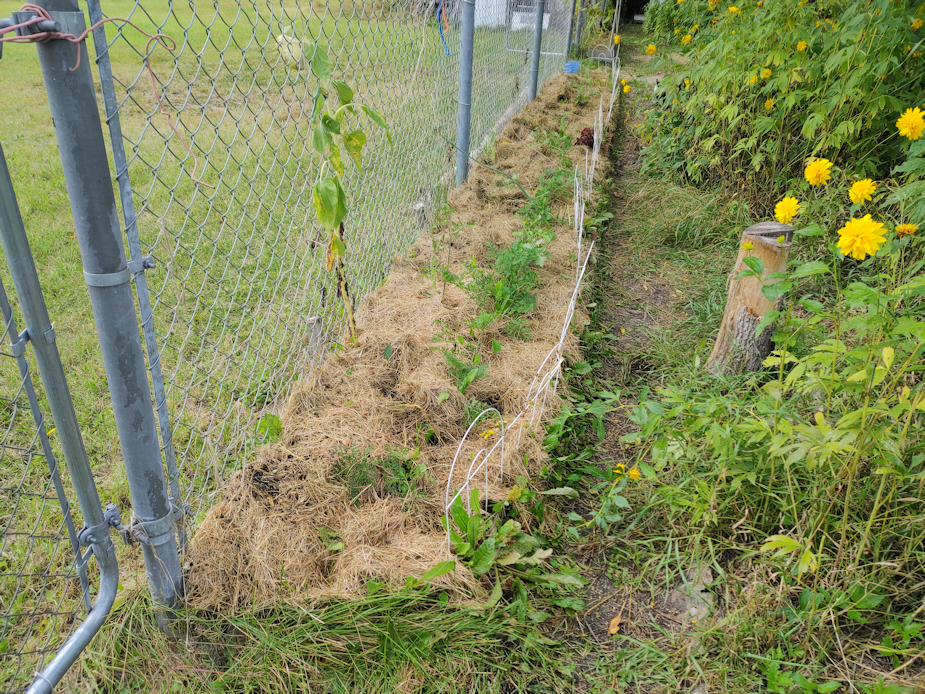
Next year, we will change up where we plant things quite a bit, mostly because we won’t be using the trellises we have now again. When we built them, it was expecting to use them just one year, not two! Right now, I’m thinking that we can plant peas or beans at the chain link fence, where we planted the chocolate cherry this year. Wherever we went up planting them, it’ll be very different conditions. Hopefully, between that and a better growing year, we’ll find ourselves with more robust plants, and higher yields!
While doing my rounds this morning, checking the remaining garden beds, I found myself giving the ground cherries a closer look.
They do have frost damage, but a lot of the leaves are still looking just fine. The entire patch is all leaning over, making it hard to reach to pick anything. I’ve found that the plants, as strong as they appear to be, are actually quite fragile, and branches break off easily. There are still so many green berries on there! I’m not too worried about missing any ripe ones that have fallen off, though. Part of the reason we chose this location, was so they could self seed and hopefully come back every year on their own.
With how big they got, and how easily they fall over, though, I’m thinking we will want to add a support structure of horizontal wire mesh. Maybe two horizontal layers of them, with a mesh of about 4 inches square. That way, the plants can grow through the wire mesh, and still be supported during high winds, or when the weight of their own branches start pulling them down.
Oh! I just remembered. I’d dug out a roll of fence wire from a shed last year. It has 4 inch square mesh. It would be perfect for the job! I’ll just have to figure out what to use for vertical supports.
But that can wait until spring.
I finally remembered to get a picture of this crab apple tree this morning.
It has SO many apples on it, and they’ve turned such an incredible red colour. They are like beautiful ruby ornaments! The apples on this tree are not really edible – at least not for humans. The birds and the deer like them, though. The apples will be left on the tree to freeze. Every now and then, in the winter, I hope to be able to get to the tree to knock some of the apples down for the deer. Otherwise, they stand up on their hind legs to reach, and end up breaking branches.
This tree still looks pretty healthy, so we will be able to keep it while we cut away the dead and diseased trees. It may not produce apples we can eat, but it will serve as a cross pollinator. We plan to eventually plant apple trees that are not crab apples, and they often need a tree like this nearby, to help with pollination. Of course, there is the one big crab apple tree that produces some tasty apples, still. We will be down to only two apple trees in this area, from the dozen or so that used to be here. They were planted way too close together, which certainly didn’t help. We just need to get rid of the diseased tree in particular, and hopefully will be able to keep the remaining trees nice and healthy.
After covering the eggplants and apple gourds last night, I went over to the trellis to check on the Ozark nest egg gourds. Having confirmed the vines were completely killed off by the frost, I decided to go ahead and pick them, this morning.
I am just so happy with how these gourds turned out! Like everything else, they had a rough start, and yet they still produces so many little gourds! A few are still more on the green side. Imagine how many we could have had if it had been a good growing year? We will definitely be growing these again, and I hope to have some seeds I can save from these.
I’d brought pruning shears to harvest them. Those vines are pretty spiny! I also harvested the Tennessee Dancing gourds. They snapped off their stems quite easily; no sheers needed. As I went around to the inside of the tunnel trellis to pick more, I spotted what at first looked like a little snake, hanging in the air!
There we have it. Our one and only Red Noodle bean. Just one! It’s about half the size it could have been.
I now have to decide if these are something I want to get seeds for and try growing again. Under better growing conditions, they should have done just fine in our area. I’d like to at least know if they are something we enjoy eating.
Here are all the gourds I gathered – and my little buddy, who kept me company the entire time! She is such a little sweetie.
I rearranged the chocolate cherry tomatoes to make room for the gourds to cure for a while. Eventually, they will be brought indoors, given a wipe down with a bleach solution, then set up somewhere to continue curing all winter. Probably in the old basement, where the cats aren’t allowed. It may get damp in there during the summer, but in the winter, it is incredibly dry, so that should work out.
The onions my daughter braided yesterday are so heavy, with such thick necks, they started falling out of their braid. I remembered the hooks I put up that held our lights for the seedlings we had set up over the swing bench, so after the gourds were laid out, I strung the onions on some sisal cord to hang them. Once they were hung up, I ended up adding two more cords to help hold the weight! These are definitely the heaviest of all the onions we grew this year!
I absolutely love those nest egg gourds. They are beautiful, and even a pleasure to hold. I have some ideas of what I can do with them. What I do end up doing will depend on how many fully cure properly. The greenest ones probably won’t, but I think most of them did get a chance to become fully ripe. This is from two or three plants. We planted four, one died, and one never fully recovered. They’re so intertwined, it’s hard to tell them apart, but I don’t think that one smaller plant ever produced any gourds. Eighteen gourds from two (possibly three) plants during a bad growing year is pretty awesome! I want to plant more next year. The Tennessee dancing gourds also did really well under the circumstances, and I hope to plant more of them next year, too!
It should be interesting, once everything is in and we can do an assessment of what we got, and use that to help decide what to do next year.
It has been absolutely gorgeous outside today. As I write this, we are at 14C/56F. Just perfect to be outside for many hours!
I was planning to build a soil sifter today, but after fussing with the trail cams this morning, I decided I needed to build a new stand for one of them, first. The gate cam had stopped working again, even though I’d just changed the batteries. The day before, there were only 3 files recorded before it stopped working. The gate is more of a security priority, so I took the new solar powered camera from by the sign and set it up on the stand at the gate. Which was not as good of a set up, but it would do.
I brought the camera that had been at the gate inside and tested the batteries. They had gone down a lot, for being used only for a day, but they were still well into the green. After checking the camera itself out for a bit, I decided to take a scouring pad to the battery contacts in the flip-down cover. Water had gotten into it at some point, and there was rust, but I had given them a scrubbing before, and things were quite dry. Still, it was really the only thing that was available to do. Sure enough, it worked!
I wanted to leave the solar powered camera at the gate, so I took the now working camera to the sign. I could screw it onto the mounting plate, but it’s a very different design. Instead of screwing into the bottom, it screws into the back. With the other camera, I could swivel it into an angle that covered the front of the sign and, because it’s a wide angle camera, it also included the road and intersection. Not being able to swivel this camera meant that it was basically facing the sign, on edge.
I figured my best bet was to use the old flag stand the camera was mounted on at the gate, and bring it to the corner by the sign. That would actually work better than having it mounted on one of the supports holding up the tipping corner fence post. Which meant making something for the new camera, that I could attach the mounting plate to, for the gate.
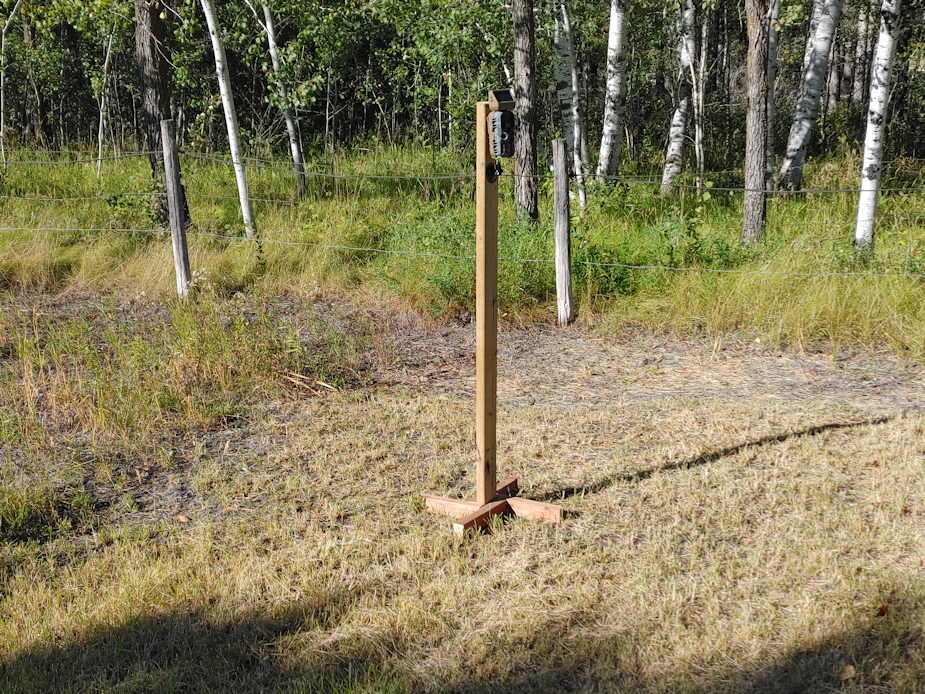
After scrounging in the barn for some scrap wood (I spotted a couple of Rosencrantz’ kittens just outside the barn!), this is what I made.
The solar panel makes the camera very top heavy. When it was mounted by the sign, there were many files motion triggered not by someone or something going by, but by the wind making the camera wobble on its mount. I made this stand taller, and attached the mounting plate low enough that I can use the strap that also came with it, to secure it more firmly and ensure no wobbles will trigger the motion sensor.
I moved the camera to the other side of the driveway, so that the solar panel will get maximum exposure to sunlight. With the wide angle lens, it also needs to be closer to the gate than the other camera. Once I find the sweet spot for coverage, I am thinking of pegging the legs to the ground, for extra stability. It would be better to have something like a sandbag, though, since I’d have to move it when mowing in the area.
Once that was done, I could start on the soil sifter.
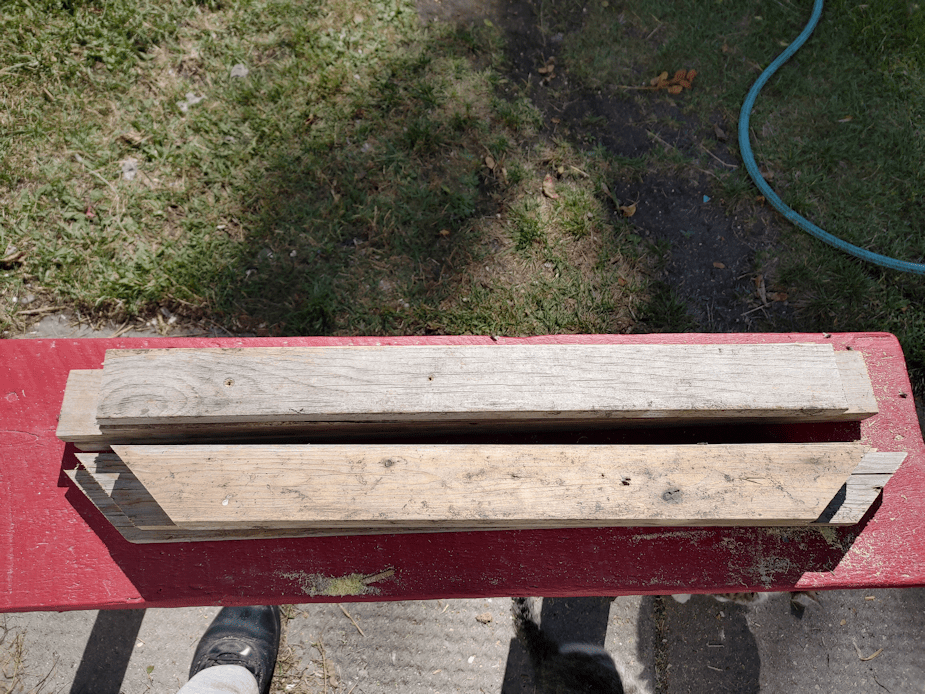
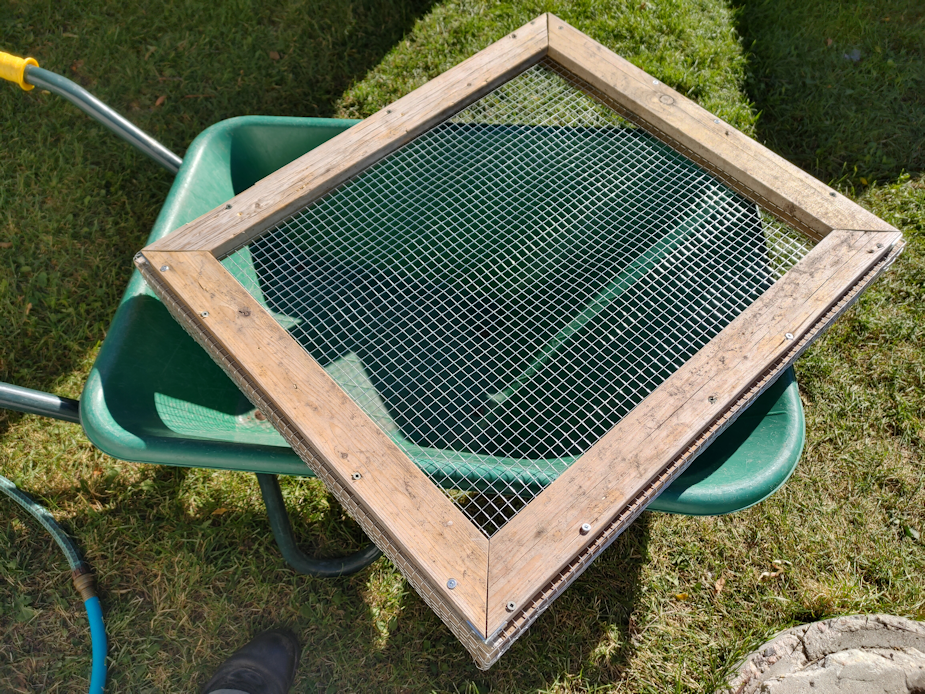
I measured our wheelbarrow and cut pieces for a 2’6″ x 2’4″ sifter. The straight pieces would form a box, and the angled pieces would make a frame.
At this point, the only thing holding the frame together are the metal right angle brackets on the corners. The frame would be secured to the box, with the hardware cloth sandwiched in between.
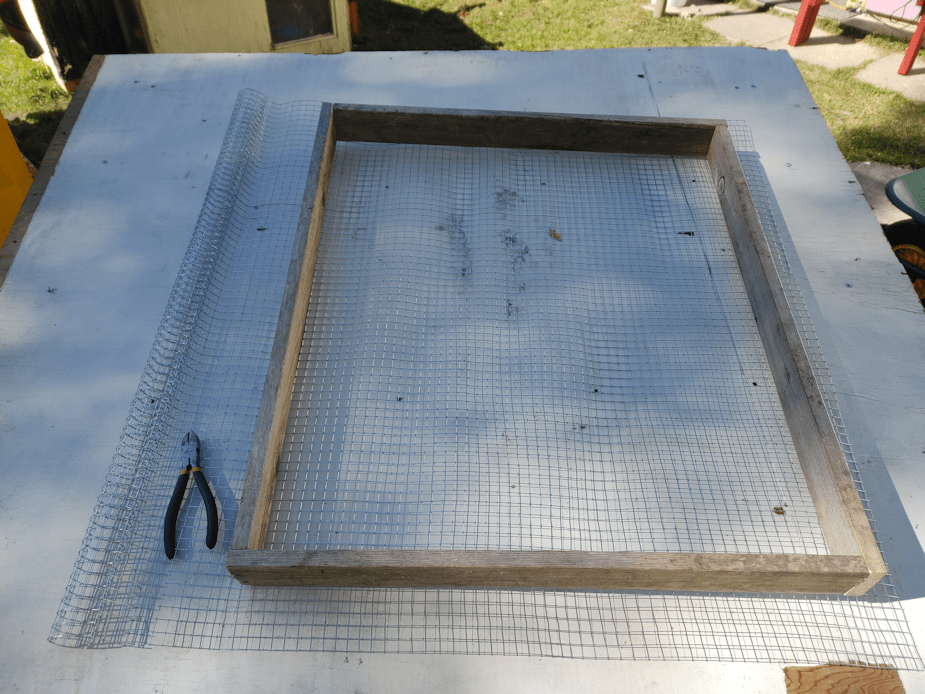
The roof of the water bowl house made an excellent surface to unroll the 1/2 inch hardware cloth, then use the box to measure out where to cut the wire. Once cut to size, I tacked the mesh to the box with a few staples, just to hold it in place while adding the frame.
There is, a problem with using salvaged wood for everything.
I should have made the frame pieces about an inch longer. I didn’t compensate for the slightly extra width the box got from how I attached them at the corners. However, the wood is warped and uneven, which meant there was no way I could match the frame to the box, even if I’d made the frame part bigger. In several places, I had to put the screws in at an angle to catch the edge of the box. I had been using a drill to make pilot holes, only to break the bit part way through, and I didn’t have another in that size. The wood is old and very dry, so it was easy to put the screws in without a pilot hold but, as you can see, the wood started to split in a couple of places. Some of the wood was already splitting on its own.
Once the frame and box were secured to each other, I folded the excess mesh onto the sides, cutting at the corners so that a piece could fold around the corner to be secured.
The mesh was secured with a LOT of staples around the outside of the box, and more staples were added to secure the mesh to the frame on the inside. These won’t hold well, though. We need a heavier duty staple gun for projects like this.
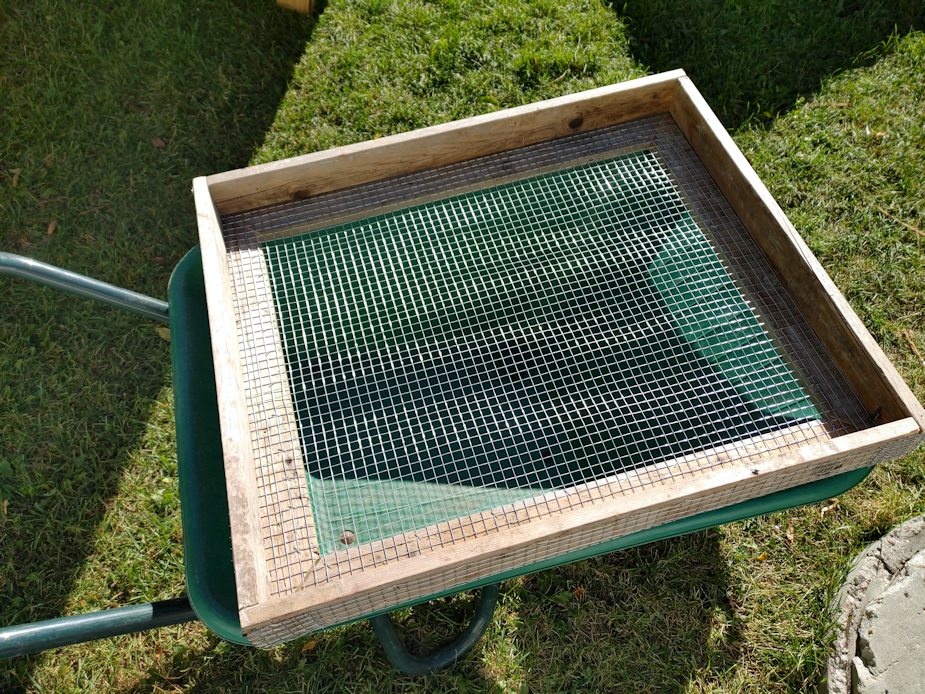
Once done and set up on the wheel barrow, I could really see how warped some of the wood it. It can’t lay flat. Which is okay. I am not expecting this to last very long, but if I can get a year or two out of it, that’ll be enough. I am planning on using it while cleaning up and preparing garden beds for next year, to sift out rocks and roots. I want to use it on the wood chips, too. The smaller chips can be used as mulch right away, while any larger pieces can be set aside until we can bring the wood chipper out and use the shredder chute to chop the bigger pieces finer.
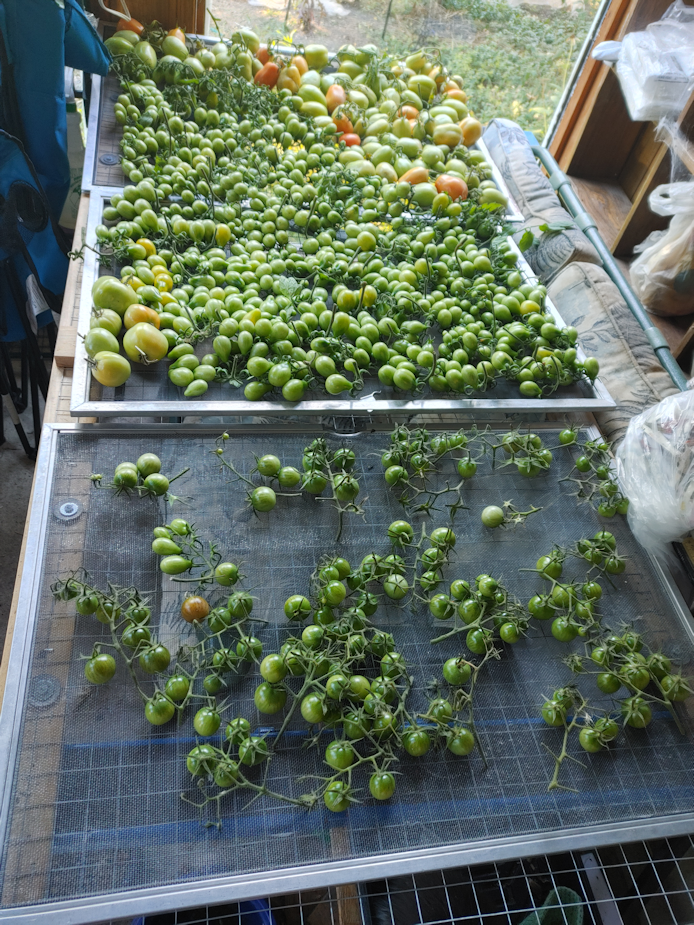
While I was working on that, one of the things the girls worked on was picking through and sorting all the tomatoes we picked. They found more slugs inside some tomatoes! The ripest tomatoes were set aside to use right away, while the greener ones were to be laid out on screens.
The problem was finding a place the screens could be laid out that the cats won’t get at.
We ended up using the sun room.
The onions were still laid out to cure on the wire mesh door we use for this, so we prepped them by trimming the roots, brushing off the dried dirt, and thinning the greens, before and my daughter braided them. It made for one very heavy braid! Once those were out of the way, we set screens up over the mesh door, and many of the tomatoes would fall straight through the mesh.
In the foreground are the chocolate cherry tomatoes. Then there’s all the yellow pear tomatoes, with the few remaining Sophie’s Choice tucked in with them. At the far end are the Cup of Moldova tomatoes.
They can stay in the sun room to ripen, though we will also be looking up recipes for using green tomatoes, too. There are plenty of ripe ones to start on first, though. Now that these ones are laid out on the screens, they can sit for a while before we have to get at them.
And the kittens can still use the swing bench, below. In fact, there was a kitten sleeping under the tomatoes when I took the picture! Unlike the inside cats, they have no interest at all in what’s on top of the screens. They just want soft, warm places to lie down and sleep!
Well, I’m certainly glad we made the preparations we did, yesterday. We did, indeed, hit 1C/34F by this morning, and got frost.
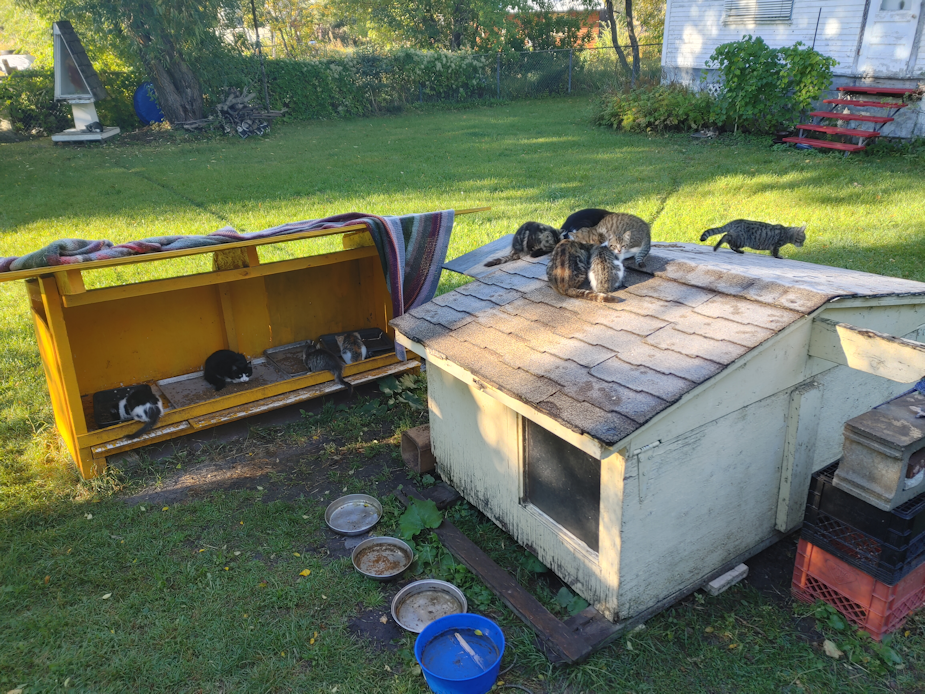
The roof of the cat house still had quite a bit of frost on it, when I came out to feed the babies. Clearly, it isn’t stopping them from enjoying kibble in what seems to be a favourite place for quite a few cats!
As expected, the frost killed off all the squash. We did leave the ozark nest egg and dancing gourds. From what I’ve read, they can handle a light frost, in that it triggers them to start drying. I’m not completely sure that was the right decisions, but I’ll know better as I check them later in the day.
The apple gourds got covered, but they still seemed to get hit with frost. It’s hard to see in the photo, but this largest of the developing gourds does seem to have some frost damage, as did a lot of the leaves, though not as much as those that were exposed in places.
The eggplant, however, looks just fine!
We’ve got one more night with colder temperatures, and then the lows will increase for a while, so we will repeat the process again tonight, and will hopefully be able to at least keep the eggplant going for a bit longer.
There’s lots of work to do over the next while, to get things ready for next year.
Well, the last of the stuff that needed to come in before tonight is done – at least as much as possible. The girls and I put bottles with warm water under the eggplants in the grow bag (the only ones fruiting) and, since they were right there, with the sweet potatoes, too. The eggplant and one grow bag with sweet potato got covered, but the sheet wasn’t big enough to cover the other two grow bags. The apple gourd also got bottles of warm water placed beside them, but we could only cover two of the three plants, so we covered the two biggest ones. As I write this, we are down to 9C/48F, and it’s supposed to keep dropping until we reach 1C/34F at about 7am. Between 6 – 8 am tends to consistently be the coldest time of day.
While I was harvesting earlier, I went ahead and grabbed a bunch of the Latte sweet corn, too. I don’t think they are quite at their peak, but I think they’re about as good as we’re going to get. There are still cobs on the stalks that were pretty small, so I left them be.
With the summer squash, I grabbed all the little – but not too little – patty pans, and the last of the zucchini.
In the above photo, the six pumpkins across the top are the Baby Pam pumpkins. The others are all hulless seed pumpkins. On the far left are four Styrian, in the middle are six Lady Godiva, and on the right are two Kakai. Tucked in with the patty pans are two Boston Marrow. There are so many little Boston Marrow squash forming, but they are just too small and have no chance of ripening after being picked. I’m not even sure Boston Marrow does continue to ripen after being picked!
The pumpkins are now all set up in the sun room. We cleared a shelf in the window, and all but one of them fit in there. The last one joined the onions on the screen. I think it should still get enough light there.
The hulless seed pumpkins are grown just for their seed, not their flesh. The flesh is probably edible, but there would be less of it than for an eating pumpkin. I will give them time before we crack any open to see what the seeds are like. At least we do have the one tiny, fully ripe kakai pumpkin harvested earlier that we could try any time we feel like it.
We planted so many different winter squash, and it was such a horrible year, I’m thankful we have as much as we do. Hopefully, next year, we will have better growing conditions. I made the mistake of calling my mother before I started this post, and talking about our garden. I mentioned that our beets did not do well this year. She started lecturing me on how to grow beets, and how they need to have the soil loosened around them, etc. I told her I knew how to grow beets (this is not our first year growing them!); they just didn’t do well this year. We didn’t even get greens worth eating. My mother then launched into how she always had such big beets, and always had such a wonderful garden (this after she’d mentioned to be before, that some years things just didn’t work) and how she only grew the “basics” and everything was just so wonderful – and the reason my beets failed was because I don’t garden like she did, and that I shouldn’t be gardening “from a book”. Whatever that means. I reminded her that I tested the soil and it is depleted. We don’t have good soil here anymore. She got sarcastic about that, and basically made it like my not having a perfect garden like she did was because I’m not doing things her way. As she got increasingly cruel about it, I called her out on it. I told her that just because she can’t understand something like soil science – which she doesn’t need to – that didn’t make it okay for her to be cruel to me over something she knows nothing about. Nor would I put up with being treated like that. I even asked her, why couldn’t she try being kind for a change? Maybe say something like “I’m sorry to hear you’re having problems”, instead of basically saying “I’m better than you.” She went dead silent, so I changed the subject, and the rest of the conversation went okay. Then she cut the call short because she saw the time, and her program on TV was started, so she had to go.
My mother is pretty open on what her priorities are. 😕
Ah, well. It is what it is. I’m just so thankful she is no longer our “landlord”, and that my brother now owns the property. There was a point, before the title was transferred, that we briefly but seriously considered moving out because of her.
Funny how something as ordinary as gardening can bring out the worst in her, though.
The weird thing is, when I spoke to my brother after he’d visited her to talk about the roofing estimates, apparently my mother had lots of positive things to say about how well we’re taking care of things here.
I guess that doesn’t include the garden! 😄
Well, I guess I should go see what I can do about that corn! 😊
Well, we decided to start bringing things in. Tonight and tomorrow night, we are supposed to reach lows of 1C/34F
While our one eggplant that is producing is small enough to give protective cover, that’s pretty much it. The rest is just too much or too large to be able to cover adequately.
The shelling beans were simply ready to be harvested, so I worked on those first.
These are the blue grey speckled tepary beans, and the are so tiny! I haven’t tried to open any pods yet. It was almost but not quite raining as I picked these, so once I got them inside, they went onto a screen and are laid out to dry thoroughly indoors before I start shelling them.
Then it was time to pull the Tropeana Lunga onions.
They are SO much easier to harvest from the high raised bed, than the onions in the low raised beds. I had to dig most of those out, because the soil is so compacted. Not here! These came out easily.
Check out that chard. Not a single leaf to harvest!
I had this wire mesh door on the picnic table under the canopy tent, where I was able to cure onions before, but with the cold temperatures, I set it up in the sun room. It is supported by a couple of saw horses over the swing bench, giving the kittens plenty of space to go underneath and have their warm and cozy naps!
These onions are a very thick onion, in the stem and the greens. They are very much like the Red of Florence onions we already harvested, but with even sturdier stems.
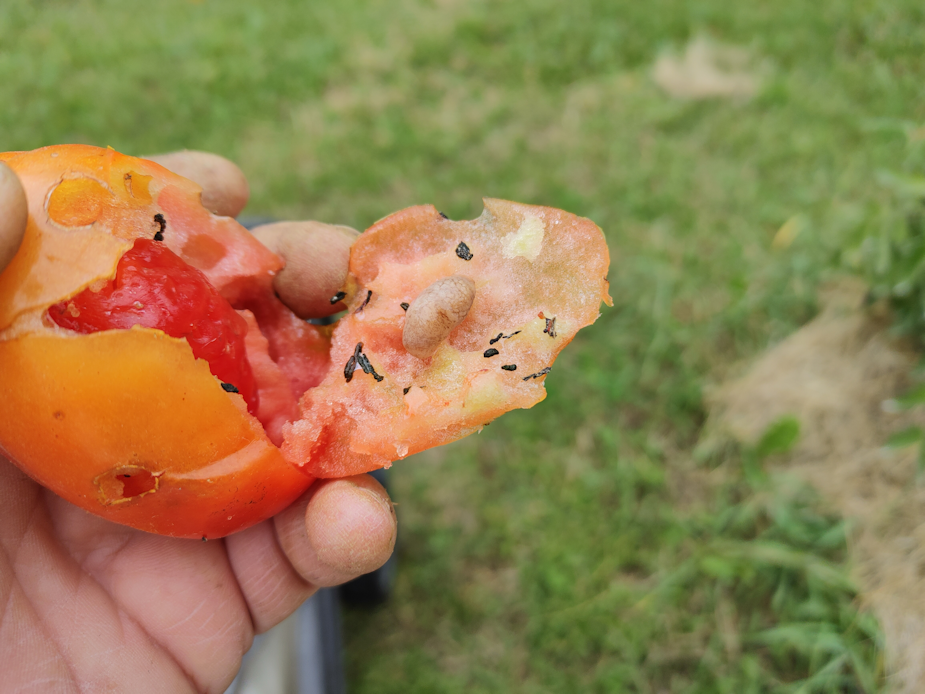
Next, I worked on the red tomatoes. A few of the ripe ones had been partially eaten, while others had holes like this.
Some of the holes were even still occupied!
Slugs are remarkably voracious!
This is all the red tomatoes. In the bin are the Cup of Moldova, and on the side are the Sophie’s Choice. There were very few Sophie’s choice, overall.
While I was working on these, I got a surprise visitor.
Rolando Moon showed up! I haven’t seen her in weeks! She let me pet her a bit, but mostly hung around and hissed and growled at the kittens. Except for when she suddenly showed up with a big mouse in her mouth. One of the kittens became VERY interested in her at that point. Rolando Moon can be aggressive, so I did step in, which allowed the kitten to make a jump for the tiny bit of mouse that was left. He promptly inhaled it and was sniffing for more, but with Rolando being the way she is, I carried him off.
Do you know that it’s really hard to harvest tomatoes while there is a kitten perched on your shoulders, and it refuses to leave? 😄
Next, I worked on the Chocolate Cherry and the Yellow Pear tomatoes.
There were SO many yellow pear tomatoes!
I also harvested the dry King Tut Purple Pea pods, though they were green instead of purple. I’m not sure why I’m keeping the seeds, to be honest. The last Red Kuri squash was also harvested, and now sit with the onions to cure.
I have left it to the girls to work out what to do with all the tomatoes, except for the ones that I will be keeping to save seeds from. The Chocolate Cherry, for sure. I’m told those were the tastiest. Not the yellow pear, though. I’m glad we tried them, but they weren’t enjoyed enough to bother saving seeds from. Both the Cup of Moldova and Sophie’s Choice are rare varieties, so I will be keeping seeds just to help keep them going. We will decide later if we want to stick with them next year, of we want to try other varieties as well. My daughter described both of them as good, but very mild in flavour. I think she and my husband would prefer something more intensely flavoured. We’ll see.
This bed that had the paste tomatoes is now completely empty. That means I can prep it to plant the best of the hardneck garlic I’d saved from this year’s harvest. We will need to get more, though.
This bed had the yellow pear tomatoes. There are still the red onions from sets in there, but I don’t think we’ll get anything out of them. Once those are out, this bed, and the one to the right of it, can be prepped for next year.
The kulli corn in the bed to the left still has no cobs forming, at all.
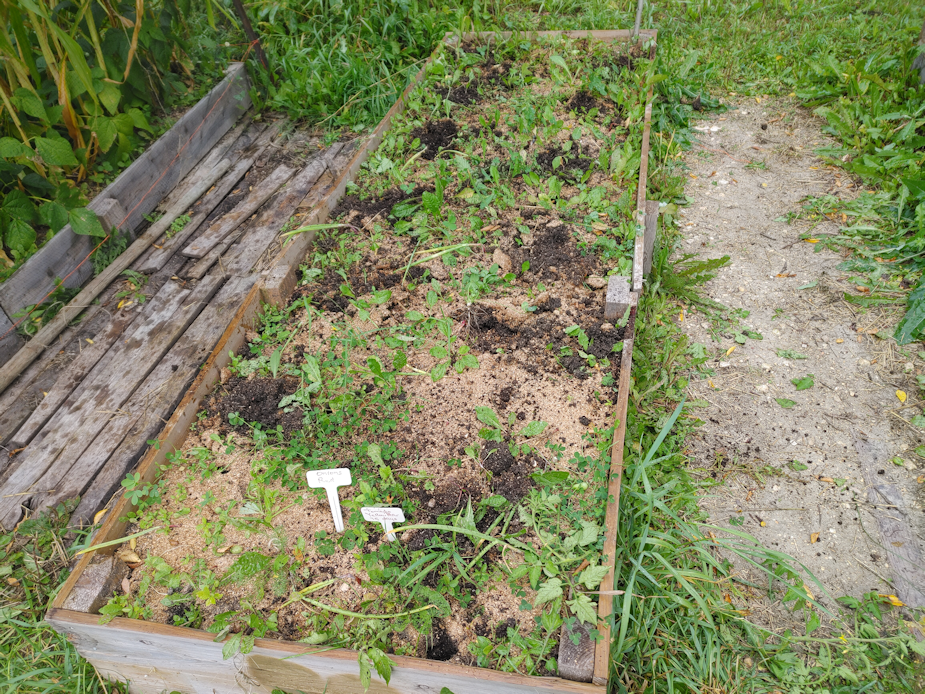
This is where the chocolate cherry were. It’s the second year we grew tomatoes here, so we will do something else here next year. I’m thinking peas.
There are still carrots in this bed. I don’t know that there are any shallots or onions left. There are two shallots that went to seed, but the seed heads seems to have stalled in development. It seems the same with the lettuce I left to go to seed. I think it’s just been too chilly for them to progress properly.
That’s it for now. Later on, I’ll head out again and look over the pumpkins, and see about harvesting the biggest ones. Pumpkins can continue to ripen after picking, if we can keep them warm, dry and in sunlight. That is a difficult combination to achieve in our household, though!
I also want to put bottles with warm water in them around the eggplant that’s fruiting, and then cover it. I may as well harvest what summer squash there is, too. We won’t be able to protect them from the cold, so chances are, they will get killed off tonight. I might be able to cover the apple gourds. They are the only ones that are immature enough to make the effort. After these 2 expected cold nights, the overnight lows are expected to be much warmer, so if they can survive those two nights, they still have a chance.
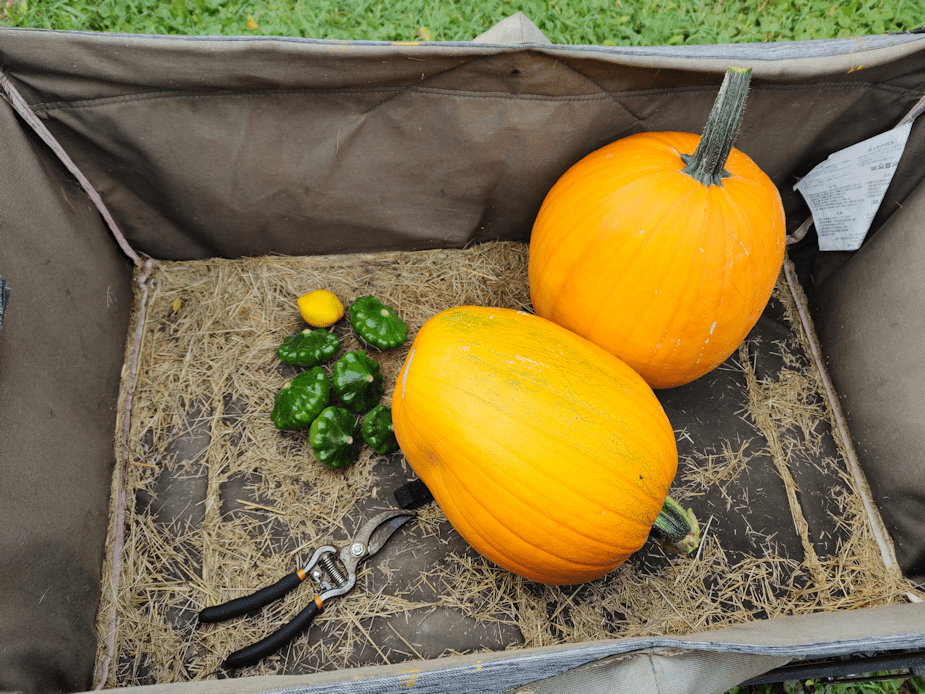
When doing my rounds this morning, I brought the wagon and some pruning shears to finally pick the giant pumpkins.
Plus a few patty pan squash.
One of the pumpkins still has a bit of green, so they are sitting in a shelf by a window to cure and continue to ripen. They are big enough that the kittens shouldn’t be a problem.
I’ve been closely looking at the other squash that are developing. Especially some of the hulless pumpkins, which are the furthest along. The longer they stay on the vine to ripen, the better, but…
I don’t know if I should just pick them all and bring them in, along with the last of the tomatoes and onions.
Looking at the Accuweather forecast on my phone, we’ll have chilly nights, but not cold enough for frost until well into October. The low for tonight is expected to be 5C/41F, BUT… when I look at the hourly forecast, it says we will reach 0C/32F by 5am tomorrow. Which means frost by morning.
Going online to the Accuweather website, however, the coldest we’re supposed to get overnight is 8C/46F by 8am. Most of the night will be 9C/48F. Not a chance of frost there.
Looking at the forecast on my desktop’s app, it says we’ll hit a low 2C/36F tomorrow night. Cold, but not likely to have frost.
I’m also not seeing any frost warnings for our area, yet.
The problem is, there are no weather stations being used for these forecasts. The closest one is also closer to the lake, so that can change conditions dramatically. Others are to the north and south of us, and far enough away that both can have quite different conditions that we do at any given time. We just don’t get accurate forecasts for our specific area, which makes it hard to plan what to harvest, or allow to ripen more!
Do I take a chance and let things be? As I write this, we are at 16C/61F, and are expected to reach a high of 19C/66F. It’s quite lovely. But those overnight temperatures… those are the potential killers.
Just to throw a wringer into the thought process, I am not feeling well today. I had a much disturbed night, partly from having to spend way too much time in the bathroom (which I now know is a side effect of the new medication my doctor is trying me on), and partly cat disturbances. We did a dump run and a trip into town today, and I had to get my daughter to drive, mostly because I was afraid I might fall asleep at the wheel. As if that isn’t enough, the weather changes are wrecking havoc on my arthritis, and I just plain hurt. Not that it matters. What needs to be done, needs to get done. It’s just a matter of figuring out what needs to be done now, or later!
















 The Re-Farmer