I headed out to do the morning rounds a bit earlier than usual. We’ve finally been able to arrange for our septic tank to be emptied (usually we try to get it done in April or May, or as soon as the snow is gone). The truck is coming some time this morning, so I wanted to make sure the gate was open.
While continuing my rounds, I checked out the Crespo squash, and they are looking great! They are all getting increasingly robust, and I’m seeing roots forming all along the main vines. Two of the vines have started blooming already!
I’m quite happy with how these are doing.
This early in the morning, everything was feeling wonderfully cool, and everything was still very wet! For all the rain we got, it did reduce the humidity, but not by all that much, really.
Which might explain this.
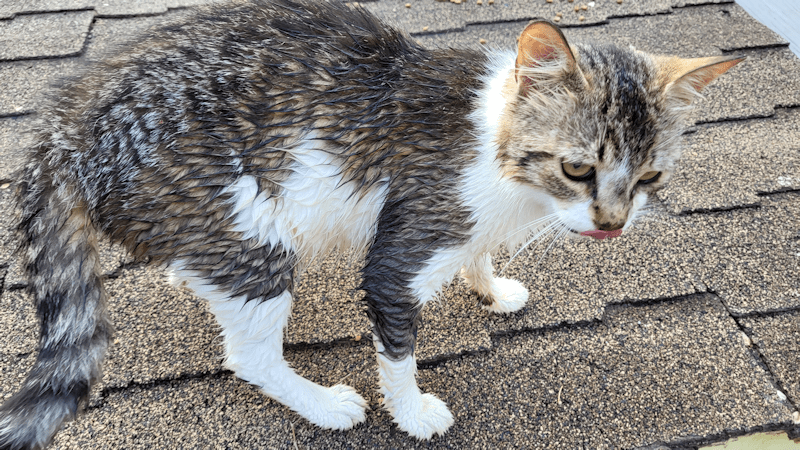
I don’t know where Gooby was when I first came out with the kibble, but he was there when I got back to the house, and completely soaked! Only Decimous had wet fur like him, but only on her lower half, not all over, like he was. All the other cats managed to stay almost completely dry!
We really, really need to get ahold of Decimous. She is so badly matted, I can see burrs stuck in her fur, there are some mats starting to dangle, I see bald patches and I’ve even found some of them in the yard. I’m guessing she’s been scratching at them. While I’ve managed to give her neck and ear scritches a few times, she mostly moves away before I can get close. Aside from trapping her (which is more likely to get other cats, first), if we even had a trap, trying to socialize her is the most we can do. It would be easier if we could offer her wet cat food, but if we did that, we’d have all the friendly cats crowding in for a treat.
Oh, and either she’s got a whole lot of mats around her belly, or she’s pregnant.
*sigh*
Well, we do what we can.
I now await the arrival of the septic truck. I want to be around when the septic guy gets here, mostly to make sure the cats stay away from the open tank while it is being worked on, and at some point I’m going to have to go out to pick up some packages. It seems that for one of them, Purolator decided not to leave the package at the store our post office is in, as they have been lately, but at the depot in the down my mother lives in. We’ve got two packages that are supposed to be in right now. When I check the tracking, it says that Canada Post had issues with delivery. Neither says they were to be shipped by Purolator, so I don’t know what’s going on there. What I really want to do is go back to bed. I got almost no sleep last night. It was finally a relatively cool and pleasant night, but I didn’t get to bed until late, and then got hit with busy brain. It wouldn’t be any better to get my daughter to drive, because I think she had an even worse night than I did.
We’ve had all sorts of things budding and blooming in succession. The most recent buds developing is the pink rose bush in the old kitchen garden.
This rose was almost dead when we first moved here. It took years to help it recover, and prune away enough of ornamental apple tree above it, so it was finally getting enough light. Now it’s starting to thrive and has SO many buds developing!
It’s past 6 as I write this, and we’re still at 31C/88F, with a humidex of 38C/100F. We’ve got all sorts of heat warnings going on. The hottest temperatures start at about 3pm, so I tried to do as much as I could outside, before we reached that point.
Today was a weed whacking day.
I was able to use the trimmer around all the raised beds. I could get in between them with the push mower, but that left a lot of tall crab grass and dandelions along the edges. The weed trimmer line can get under the logs a fair bit, so it makes quite a difference.
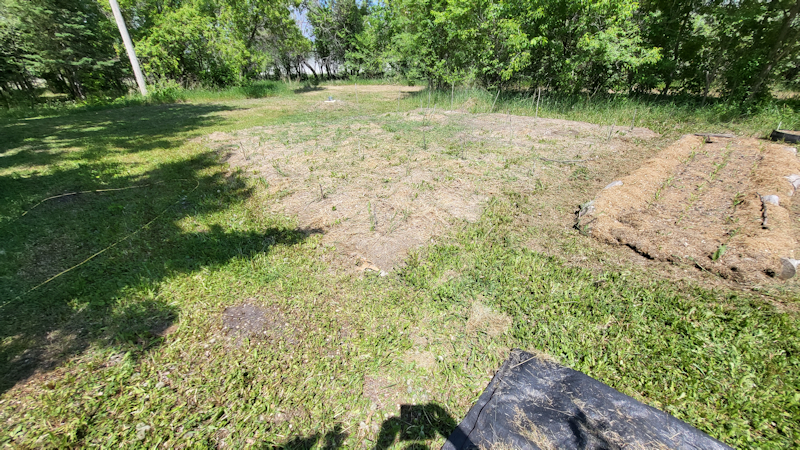
I also got the tall grass and weeds in the squash patch, then kept on going. Much of the area in the back is too rough for a mower, though my SIL did make a few passes across the area. I did the squash hill, and the corner on the left that’s in shadow.
I was really appreciating the shadows!
I did take a pause after the paths around the beds were done, to go to the post office.
My glasses were in!
The ones with the smaller lenses are what I wore as I continued working, as they were closer in size to my old glasses. They needed less getting used to. I didn’t want to be dealing with depth perception issues or head rushes while using the weed trimmer. I got use to the new prescription very quickly, though.
I’m wearing the larger lensed glasses now. Those are a lot like the glasses I used to wear through most of junior and senior high. I like the larger lenses, and I have better peripheral vision, but they do take a bit more getting used to seeing with.
After I finished the weed trimming and headed inside, I decided to try watching a movie on my desktop. I watched the entire movie, in one sitting, with zero eye strain! Not only that, but I can also tap or read messages on my phone, without having to take my glasses off!
I am quite happy with them, so far. I do feel nervous taking them on and off, though. The designs on both are a lot more delicate compared to my old glasses, so they feel very fragile. They aren’t, but it’ll take some getting used to!
After I had a chance to cool down and get used to my new glasses, I headed back outside to do a few things. One of those was to water all the garden beds. In this heat, even the stuff that is mulched is needing it.
Once again, I found so many frogs coming out from under the boards covering the Uzbek Golden carrots! I checked and saw that carrots were sprouted, so removed the boards. I set them along the edge of the bed, on top of the mulch, making sure to dampen the mulch first, so the frogs will still have somewhere moist and cool to rest under.
When watering the Spoon tomatoes I transplanted last night, I found on looking like it has slumped over in the heat. It turned out to be snapped above the lowest branch. I broke the top off the rest of the way, but the remaining stem may actually do okay.
There is more weed trimming to do, but I’m done for the day. In fact, I’m seriously considering going to bed once I’m done this post!
That is, if the cats on my bed would give me any space.
I didn’t get outside to do some work until past 8pm, when it finally started to feel cooler. Thankfully, the days are still getting longer, because it was just past 10pm when I was done, and pretty much full dark by the time I finished putting things away.
There wasn’t time to work on the big stuff, but there was some small spaces I could work on.
The first area I worked on were the 4 empty blocks in between the gourds and Zucca melon. I had some potting soil mix left, so after digging around in the blocks and pulling out any roots I could find, I added a bit of the potting soil to top up each block a bit. There were a total of 5 Little Finger eggplant seedlings, but two were still quite small, so I planted them together. We’ll see how they do and if one will need to be thinned out. I had plenty of new grass clippings to mulch around them, too. I collected a wagon load, and when the eggplants were mulched, I used the rest to finally give the asparagus bed a deep mulch. Until now, only the strawberries in between them were mulched. I was happy to see one new spear of asparagus, already at the fern state, had showed up. That makes 5 out of 6 crowns in this bed that survived last spring’s flooding… if barely!
Our spinach is just starting to get big enough to harvest a few leaves here and there, even though they were planted so long ago. As they will likely bolt quickly in this heat, my daughter went ahead and harvested the largest plants earlier today. In between the spinach, I started transplanting some Red of Florence onions. We grew these last year and really liked them. These are the first of this variety that have been transplanted, and they’re going to be shoved in every place we have room, as we go along planting other things.
Next, I worked my way across the retaining wall blocks, clearing and weeding. Every other block had mint transplanted into them, to contain them. It will be a battle to get the rest of the mint that’s growing in the old kitchen garden, but these were originally from my late grandmother, so I don’t want to get rid of all of them. They don’t seem to have handled last winter very well, and one block’s mint seems to have died (!!! who ever heard of mint dying on its own? 😄). A few other blocks got onions that survived the winter, that I found while prepping the area. Some stayed in the blocks they were found in, while others got transplanted, so that each block had 3 or 4 onions in it. In the end, I found a total of 6 blocks were free. Those got dug into to remove roots, topped up with the last of the potting soil, and then I transplanted some Spoon tomatoes into them. Each tomato got a bamboo stake they can be clipped to as they get bigger, then mulched with grass clippings. It’s not the area I wanted to grow these in, but at least we’ve got some in the ground. At this point, we could give away all the remaining transplants.
Not too bad for just a couple of almost cool hours before things got too dark to see!
After the hours spent in the heat yesterday, my older daughter was a sweetheart and fed the outside cats in the morning, and I got to sleep in a bit before doing the rest of the morning rounds. Though I watered things last night, I watered some garden beds more this morning.
Including this one.
Last night, I was just starting to see some green Lewis bean seedlings breaking soil. Overnight, both yellow and green beans have emerged, and some of the green beans already have their true leaves. It’s always amazing, how fast beans can grow!
While watering the bed with the carrots protected by boards, couple more frogs jumped out. The cool damp conditions the boards create for the carrots are conditions the frogs like too! We are thinking about what to use to make little shelters for them to use, once the boards are removed. Frogs are a good thing to have in the garden!
While the Irish Cobbler and Red Thumb potatoes are emerging, there are still not Purple Peruvians showing up in the grow bags, and those were planted first. When we used the feed sacks and grow bags before, they did really well, but now I’m thinking they might be getting too much sun and heat, where the bags are set up now. We didn’t really count on having such a hot start to spring this year!
I’m glad I tended the garden as much as I did this morning. I’m back from bringing my mother here for a visit, then driving her home again, and I am pretty wiped out. Being with her for about 3 hours took more energy out of me than working outside in the heat for 8 hours, yesterday.
That, however, is a conversation for a different post! 😄
I was able to head outside this evening and finish the transplanting I didn’t get to do this morning.
My daughter had mulched the tomatoes with shredded paper for me while I was out. I made a trench in the mulch and transplanted the Red Wethersfield onions. Almost the entire tray of onions made it into the bed. All the other beds are bordered with the yellow Talon onion. That leaves the Red of Florence onions to transplant, and there are a lot of those! We’ll squeeze them in where we can, where they can help protect other plants from insects and deer.
I hope.
So this bed is now done!
Now we have to get other beds prepared. I’m really hoping we get a good rain tonight, to help cool things down and reduce the humidity!
It’s barely 3:30pm right now, and I could easily call it a day and go to bed right now!
I tried to get out early to beat the heat, but by 7:30, it was already feeling hot and muggy. The humidity is very high, and the uncut grass is covered with dew. Which means that, when the outside cats come over for breakfast, they tend to be completely soaked!
Like this bedraggled beast.
Decimous is so matted and full of burrs! Today, however, for the very first time, I got to give him ear and neck skritches – and he let me! He even started purring. He wasn’t sure about the situation, but he did let me reach out to give skritches – not pets – a few times. His fur is so full of lumps, burrs and mats, I’m sure petting him would be somewhat painful.
I was even able to confirm something.
He is a she.
Yup. Decimous is female.
She doesn’t look pregnant, though. I’m trying to think of how we can catch her and bring her inside, so we can lavish her with love (and wet cat food) and socialize her enough to get those mats cut out of her fur!! The problem, of course, is we already have too many cats in the house. I’d have to bring her into my room and have her in baby jail for a while. That is Marlee’s favourite hangout, though, and Marlee typically isn’t too keen on other cats.
We’ll figure it out.
My priority for this morning was to get as many of the Roma VF tomatoes transplanted in the last available bed as I could.
I focused on getting the largest ones in, first. I didn’t want to do three rows, since it’s harder to reach the middle, but … well, it is what it is. I’m sure I planted them closer together htan they should be. I staggered the rows to use the space more efficiently, and was able to get 41 transplants in It took a couple of hours. I didn’t have time to transplant tomatoes around the perimeter of the bed, nor mulch it right away. My daughter shredded more of our collected fliers and other garden safe paper while I was doing this, and brought out a couple of bags. As I write this, I honestly don’t know if she was able to get back outside to lay the shredded paper around the tomatoes. After that, they’d just need to be dampened, because the tomatoes were deeply watered while being transplanted.
Speaking of which…
These are the mystery squash that showed up with two of the tomatoes. I’d reused seed starting soil from pots where things did not germinate at all, and somehow missed that there were still viable seeds as I pulled out the sticks and rocks I was finding in the mix. We’ll see if they survive. If they do, I’ll find somewhere to plant them, after we get more beds ready. Right now, aside from a couple of scattered spots, we have nowhere left to put any transplants – including the more than 20 Spoon tomatoes, none of which are out, and another 20 or so leftover Romas!
So much work to do!
Today is our average last frost date, but in some places, we’re breaking 30 year heat records. I took some garden tour videos yesterday that I’ll put together and upload later. Lots of heat warnings and warnings for thunderstorms, with possible hail, etc.
The question is, will any of that rain reach us?
Once the transplants were in, I headed out early to my mother’s, stopping to pick up some Chinese food, which was my breakfast. Previously, my mother has started to say not to get rice, because rice makes her cough. She said to get her just lemon chicken. Unfortunately, the timing was off, and I was at her place on the one day of the week they closed. Then she mentioned some of her neighbours would get just onion rings from the restaurant; they have a small North American menu along with Chinese food menu. After that, she started saying she wanted onions rings. So today, I picked up both lemon chicken and onion rings for her, and a combination platter for me.
When I arrived with the food, she was first taken aback that I came early, but I told her I’d been working in the garden, and hadn’t and breakfast. I came early so we could eat together. Then she chastised me for not calling her first, because she’d had a large breakfast (she later mentioned what she had, and it was not a large breakfast. Just not typical breakfast fare). I hadn’t planned to do this, though, so calling ahead was not an option. After I set out the food, setting hers aside on the table while I sat down with my breakfast, she started nibbling on the onion rings anyway, then suddenly demanded to know why I got the lemon chicken, too, instead of just the onion rings. I reminded her that she’d talked about wanting lemon chicken in the past, and she didn’t have to eat it all at once if she didn’t want to . She then started talking about how it’s a “temptation” for her, and if there’s food in the fridge, she eats it…
…
I’m pretty sure that’s what food in the fridge is meant for.
I think she was trying to say that she had little self control when it came to food, but had a hard time coming up with the words for it!
After I’d eaten, and she nibbled, I suggested we head out earlier. She didn’t seem to want to go out and procrastinated. It wasn’t until we were in the car and on the road that she mentioned that, next time, she would give me a list and let me do her errands for here. Her knees are increasingly giving her grief. There’s one errand I can’t do, though, and that is to go the bank for her.
So we got her errands done and her groceries put away. She wanted me to take a couple of trees home with me, along with her vegetable peelings and a plant she’s decided is blocking her window too much (it isn’t).
I did have a bit of a surprise while checking on her air conditioner, next to her plant table. For some reason, it was set to go off at 26C, which is just way too hot. I lowered that, and it turned on and starting cooling things down, but for some reason, I was also feeling heat.
Yes, her heat was also on!
I checked her thermostat.
It was set to about 26C.
So she was heating and cooling her apoartment at the same time.
I turned that right down for her!
I didn’t take any plants from her, because I didn’t want them baking in the car while I did my own errands after I finished with hers. I had to ask her where the trees came from. Basically, she’s got a little maple and an elm in the pot together, and it looked odd. Turns out she’d found them in the few feet of garden space where she has some garlic growing – pretty much the only “gardening” she does right now – so she decided they should go to the farm and stuck them in a pot.
*sigh*
She has also been gathering linden seeds and is trying to get them to grow. She’s got at least a dozen that I could see, scattered at the top of a pot of soil. Something else she has in pots and plans to send to the farm.
This from the person that was laughing at me when I showed her pictures of the garden, because I had some herbs in a pot.
Somehow, my mother has got it in her head that, because the trees around her building drop seeds, she MUST gather then, give them to me to grow, or start growing them herself, so the trees can go to the farm, because they are “free”.
I’m getting a better understanding of why we have so many problem trees right now.
Also, we have GOT to get rid of the Chinese elms. There are millions of seeds drifting everywhere, and every bit of bare soil where I’ve planted seeds or transplanted something is getting filled with them. They have very deep tap roots, even as tiny seedlings, and are so hard to get rid of! There are other elms here that don’t do this, and they’re just fine, but the few Chinese elms are just horrible to deal with!
A job for another time, though.
Anyhow.
Even though my mother basically abandoned the farm a decade ago, she still wants to control what happens here, including giving me trees to plant that are basically weeds out of her own garden space.
She brought up when we can bring her out to the farm to see things – she still has seen only photos of the new roof. I told her that, weather willing, my brother and his wife are hoping to come out this weekend with their lawn mowing equipment to do the lawns. Right now, she wouldn’t be able to get through the grass with her walker! After that, we’ll see.
Once done at my mother’s, one of my errands was to go to the egg lady’s place. While driving out there, I went through several sections of driving rain! It was so good to see! There were a few times I was sure the car was being hit with hail. It wasn’t raining at the egg lady’s homestead, though, and they sure could have used some! She just finished processing 40 chickens, and was dying in the heat!
My next errand was back at my mother’s town, and I drove into rain again. It was awesome! The temperatures dropped about 10 degrees almost instantly, from 31C/88F (“feels like” 34C/93F!), to 20C/68F. It was still coming down so hard when I was ready to come home, I sent a message to let the family know it might be slow driving. And it was.
For a little while.
Then I drove out of the rain, and the closer I got t home, the drier it got.
As of this writing, we still have had no real rain at all. There might have been a few drips here and there, but nothing more.
*sigh*
Looks like our climate bubble is back in action.
We’ll see how things turn out. If it stays dry and keeps cooling down with the wind, I might be able to get more weed trimming done. I need to focus around the garden beds, and where we need to build up the squash patch and where the permanent trellis beds will be built.
Meanwhile, my poor daughter has been busting her butt, cleaning the kitchen and trying to catch up on the dishes, in this heat!
I think I need to shut down my computer, though. It’s starting to act up in the heat. It’s a good thing I know how to touch type, because I’ve been typing entire paragraphs, without anything actually showing up on the screen for almost a minute.
So if there are a lot of typoes or strange sentences in this post, it’s because I’m typing blind right now!
Once things started to cool down, I went out to do some weed whacking. I especially wanted to get the outside of the chain link fence cleared, because the grass was getting so tall, it was interfering with the garden beds on the inside.
While trimming the grass by the gourds, I realized I was seeing something new!
This is our very first Zucca melon flower!
When we tried to grow these last year, we had four transplants, and they all got flooded out. One did start to recover, but by the end of the season, it was still smaller than this one was when I transplanted it here. And now we have a flower!
This was not the only surprise flower I saw today. While trimmed around the outhouse and the raised box beds, I saw a tree deeper in the spruce grow in full bloom. It looks like another rather large apple tree. There is another one nearby that we had uncovered while cleaning the edges of the spruce grow that had already bloomed and is done. The nearby cherries have also bloomed and are done. It should be interesting to see what we find in there in the fall!
While moving closer to look at the flower tree, I walked through the tall grass of an area we’ve been able to clear so far. It’s quite overgrown with crab grass and some of the poplars we cleared are trying to come back.
I found flowers among the grass and weeds.
There are strawberries in there! Because they are surrounded by the crab grass, the plants are a lot taller and thinner than the ones we planted with the asparagus, but they are most definitely not the very fine wild strawberries we have growing elsewhere. I have no idea why there would be strawberries in here. There is also a path of some kind of lily that started to grow after we cleared away the area of dead trees and other detritus.
You’d think, after being here for more than 5 years, we wouldn’t still be finding surprises like this, yet there they are!
Eventually, I would like to transplant the strawberries I found to someplace where they won’t be competing with crab grass to grow!
As for weed whacking the edges of the yard and around some garden beds, I didn’t finish the job, yet. There is still lots to do, but it will have to keep. It likely won’t be tomorrow; as I plan to head into the city to do our second Costco shop. I’ll be making a couple of stops along the way, and just arranged to meet my SIL for lunch, since the Costco I go to is a fairly short drive from their place.
It’s been a long day for me, even though I did end up taking a nap (woke up to find Cheddar using my hand as a pillow!), and it’s going to be a long one tomorrow, too, though in a very different way. The girls were able to put things away, bring in the plants, and close things up for the night for me while I took a break and hydrated.
With the weather we’ve been having, I have been feeling really anxious about getting the garden in “in time”, when we physically don’t have places prepared for everything yet. I feel like I’m falling behind, and everything is being planted late.
Then I remind myself.
Today is May 29. Normally, I wouldn’t be transplanting or doing a lot of direct sowing until after June 2.
Still, with the weather forecast being what it is, the more we get in the ground now, the more time we’re adding to our short growing season.
I headed out shortly after 7am this morning, to beat the heat, and didn’t come back in until almost 11. It was already feeling too hot by 8am, but I stuck it out as long as I could. My main focus was to finish planting in the beds the tomatoes were transplanted into, and get something into the high raised bed.
I’m still bordering everything with the yellow onions. I decided to plant bush beans in the high raised bed. That will make harvesting so much easier on the back!!
There wasn’t a lot of space left in the low raised beds, though that is partly because of the boards protecting the tomatoes. Once those are removed, it will open things up.
In the bed on the far left, with the Indigo Blue Chocolate tomatoes, I sowed all the Gold Ball turnips in one half, and Merlin beets in the other. These were densely planted in many short rows, more Square Foot Gardening style. When we planted the Gold Ball turnips last year, something ate them pretty much as soon as they germinated. I’m hoping surrounding them with onions will help keep away whatever ate them – I never saw any hint of what it was. I had intended to put a floating row cover over the turnips to protect them, but the space is too narrow for that.
In the bed with the Black Beauty tomatoes, I planted one long row of Uzbek Golden carrots. There was only space for the one row, which I then covered with boards. I will check under the boards daily and remove them as soon as I see carrots sprouting.
Both beds got a thick mulch of grass clippings along the outside, next to the onion transplants. Aside form helping keep the soil cool and moist, and slow down the weeds that come up from under the log boarders, the grass will also help prevent soil runoff while watering. I’ve basically used the last of our grass clippings at this point. We haven’t been keeping up with the mowing, unfortunately. Not only are the dandelions now all going to see, but in a lot of places, so is the grass!
With the high raised bed, I planted the yellow Custard beans – a new variety for us – on the left in the photo, and the green Lewis beans – a variety we’ve grown before – on the right. At each end, I stuck in a few more onion transplants. By this point, only the smallest yellow onion transplants are left, and I was planting them a bit closer to each other than usual, but I was still left with may 10 little transplants left. They’re so small, I probably shouldn’t bother transplanting them, but I’m sure I’ll find someplace to shove them into the ground!
(As an aside, while working on all this, I was happy for a breeze that kept away the mosquitoes. It wasn’t enough to keep away what turned out to be horseflies! Thankfully, they didn’t seem interested in bighting me today. Just in dive bombing my head.)
The large low raised bed you can see on the right is still completely empty. I’m considering using it for the Roma tomatoes, which are growing much faster than expected – one bin in particular is has plants so big, if it weren’t for the labels, I’d have thought they were Black Beauties or Indigo Blues that were started so many weeks earlier! Why that one bin of Romas is so much larger than the others that were started at the same time is an interesting question. I was originally wanting to plant peppers in that bed, but the Roma tomatoes need transplanting more urgently. I wont’ be able to fit all of them in there, but if I can at least get the biggest ones transplanted, that would be a good thing.
Before heading in, I made sure to water the corn bed, too. There are corn seedlings popping up now! I’m quite happy to see them. I was afraid that, with the heat and minimal rain, they might not make it. Checking the raised box beds in the East yard, I was happy to be able to see more carrot seedlings showing their true leaves, without having to look close and wonder, are those seed leaves carrots, or a weed? It’ll still be a while before the carrots are strong enough that we can safely weed around them. Right now, weeding mostly involves removing the biggest leaves from the weeds, and pulling and dandelion flower buds, and being careful not to disturb any carrot roots.
I was thinking of doing more transplanting later today but, at this point, I think the mowing is a more urgent priority. Not just because of how overrun both the inner and outer yards are getting, but because I need the grass clippings!
I also want to get in and around the garden beds and where the squash will be planted with the weed wacker.
When I came in, my weather app said it was 23C/73F. I think it felt quite a bit warmer than that! We’re supposed to reach a high of 26C/79F, with chance of a 43% chance of thunderstorm at about 4pm. I suspect I will have no problem getting out and doing the weed whacking when it’s cooler.
For now, though, it’s time to stay inside, stay cool, and hydrate!