The Crespo squash has turned out to be another one of our surprises. They are another of our “fun” choices; a Peruvian variety of pumpkin that gets large, green and warty.
I couldn’t resist.
They seemed to thrive in our climate (there was no zone information with the seeds), and were doing so well until they got repeatedly eaten! I thought for sure they were done for, and was already looking ahead to how we could protect them as we tried them again next year. I hadn’t planted many seeds, so we do still have some left over.
But now we have our mild October, and have had no frost at all, and the Crespo squash is recovering to an amazing extent!
Some of the colder overnight temperatures have done a bit of damage to the leaves, but look at those flowers – both male and female!
I actually had to rescue the one in the foreground; the flower was half way through the mesh. :-D
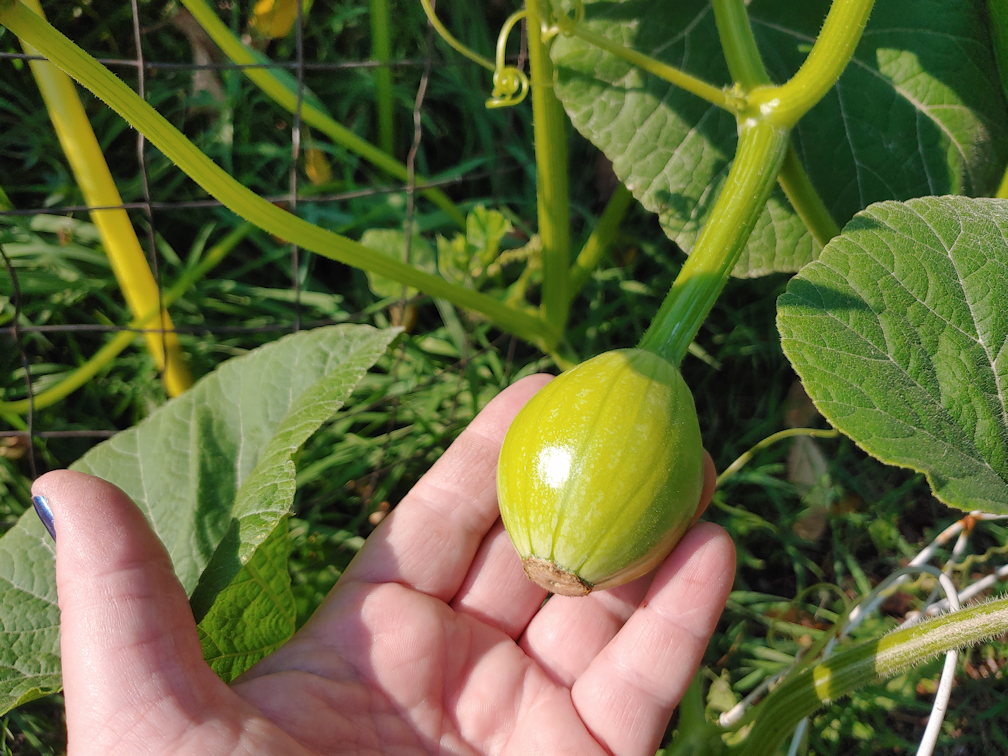
There are little squashes like this, being held high on their vines, all over the place.
Hopefully, we have enough active pollinators, because with the barriers to keep the deer out, there is no way to be able to get in and try hand pollinating them.
Some newer squash are looking bigger, and appear to have been successfully pollinated.
The very first squash that we found, way in the middle of the two plants, did end up withering away and dropping off, but these two that developed next are getting bigger and look like they are going to make it.
At least until we do get our first frost.
These are supposed to get quite large, but I don’t know how fast the fruit will grow, once they get doing. Well they have enough time to fully mature?
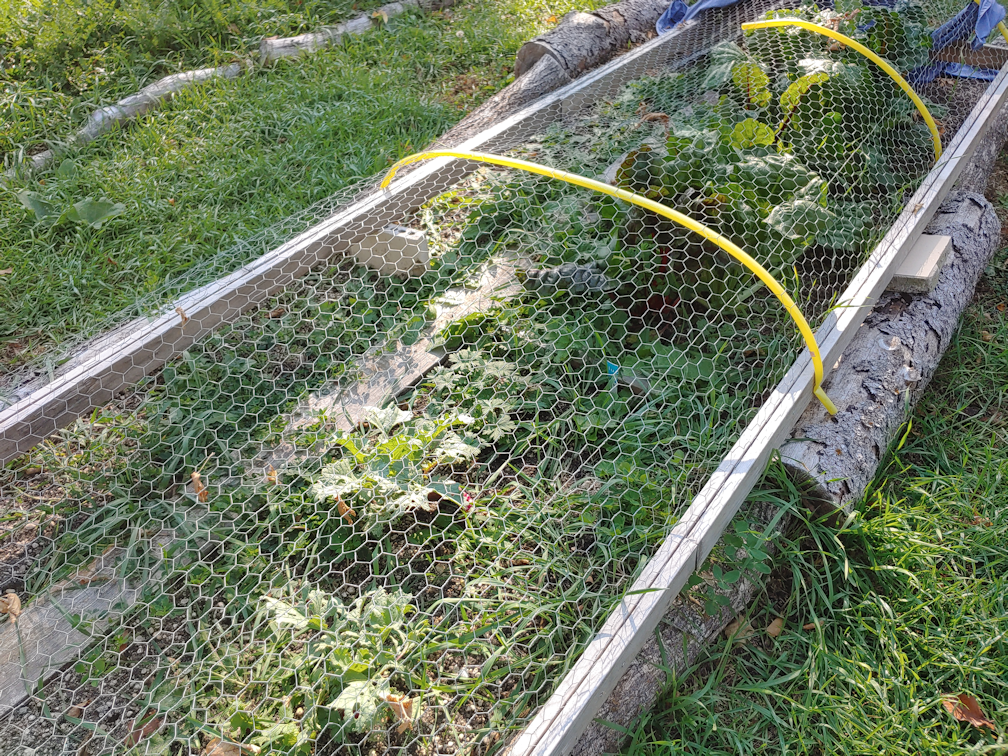
In the main garden area, which will be a permanent garden, we’ve still got the two beds covered with mesh to protect them from the deer. Unfortunately, that leaves them pretty neglected, due to the difficulty in moving such long frames.
Of the radishes we planted, there are two French Breakfast radishes that survived the grasshoppers, and they are actually now looking stronger and healthier than ever! They were so eaten up, I did not expect them to.
And just look at the big mutant radish bulb. :-D
Will they get to the pod stage they were planted for? I have no idea. Normally, I’d say it’s way too late for that, but then I look at the long range forecast and think… maybe they will?
The surviving chard, on the other hand, are just thriving! The problem is, we’re not really using them much. It’s not that we dislike them or anything. It’s just a pain to get at them.
The lettuce is also doing really well – as is that one tomato plant that showed up on its own!!
If I were not sure that deer are still passing through the garden areas, I would take the covers off completely. Then they could be tended and harvested more easily. Which won’t be much use if I come out one morning and find it all gone. Mind you, from what I’ve seen on how big radish plants get when they start to develop pods, we’re going to have to take the cover off at least that bed. And what will we do about this very strong, very healthy tomato plant that started itself so late in the season? I don’t even know what kind of tomato it is. Can tomatoes be transplanted into pots and grown indoors over the winter? I have no idea.
At least the groundhogs are no longer a problem. For them to go into hibernation so early, I would be thinking we’re in for an early and bitterly cold winter, and yet it’s supposed to continue to be warm throughout October, for as far ahead as the long range forecasts go. Plus, The Old Farmer’s Almanac is predicting a milder, wet winter for our region.
Once protected from critters and insects, we can at least say that the chard, lettuce and radishes were – eventually – a success. When we have our permanent, high raised beds, which will be only nine feet long, we will be making sure the covers we make for them will be easy to move aside as needed!
When it comes to the sunflowers, it looks like we’ll have a few Hopi Black Dye seed heads that will fully mature, but I wasn’t expecting much from the Mongolian Giants.
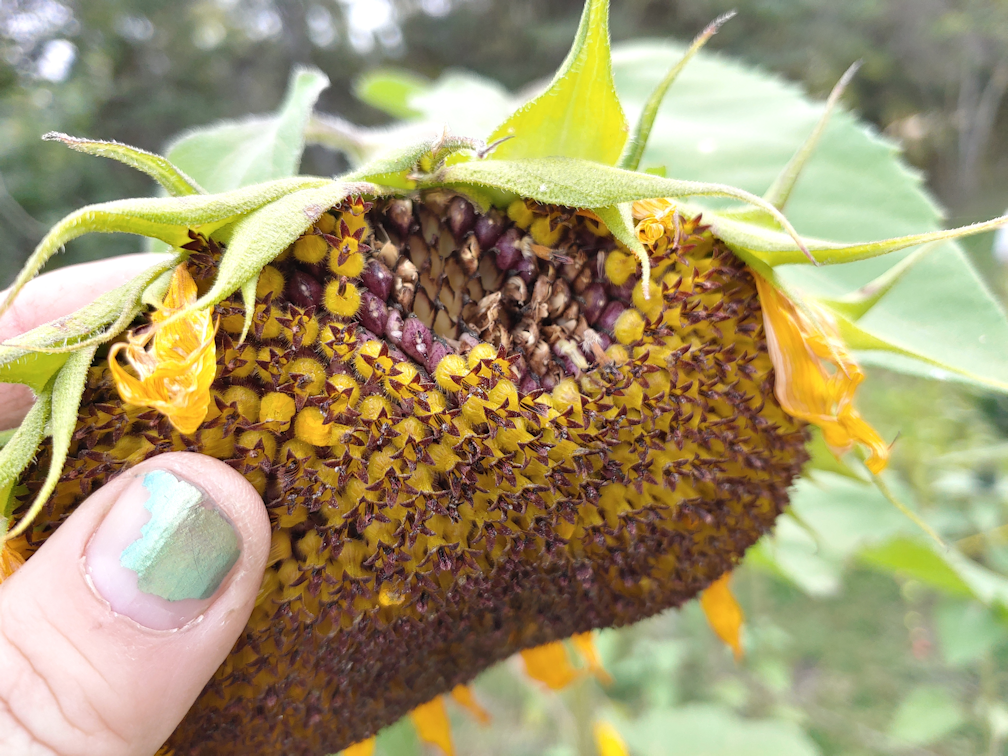
Then I took a closer look at one of the largest heads.
This is only about a third, maybe a quarter, of the size it should be, and yet there are maturing seeds in here!! There are so many developing and opening seed heads still, too. I don’t think there are any other Mongolian Giants like this one, with pollinated and maturing seeds in them, but while looking at them this morning, I did see some bees fluttering around, so who knows what will happen? It’s been such a strange growing year, there’s just no way to know anymore.
Some sad little peas among some sad little corn! This is the sweet corn block that is doing the worst, and yet they are still trying to produce little bitty cobs! We’ve got the most pea plants growing in this block, though, so at least this area should see the most improvement from their nitrogen fixing capabilities.
And we’ll even have a few peas to harvest!
The Montana Morado corn – what’s left of it – is being left to go to seed, and a few of the cobs have uncovered themselves. Which is helpful, since it lets me see how the seeds are maturing and drying on cob. A fair number of peas interplanted with them have been managing to grow, too. Not a lot of pods developing, but I’m seeing flowers around.
When it comes to the corn, I find myself waffling back and forth over whether or not we want to try growing them again next year. I still want to get Maize Morado seeds to try, and maybe we’ll do the Dorinny Canadian hybrid again. It’s hard to guess how much better the sweet corn would have done, had we not had drought conditions. The soil is nitrogen depleted, but we did use a water soluble, high nitrogen fertilizer on all the garden beds, a few times over the summer, plus were able to amend a bit with the purchased garden soil.
Is it worth trying the sweet corn again? I really love corn, but until we are able to improve our nitrogen depleted soil, is it really worth it?
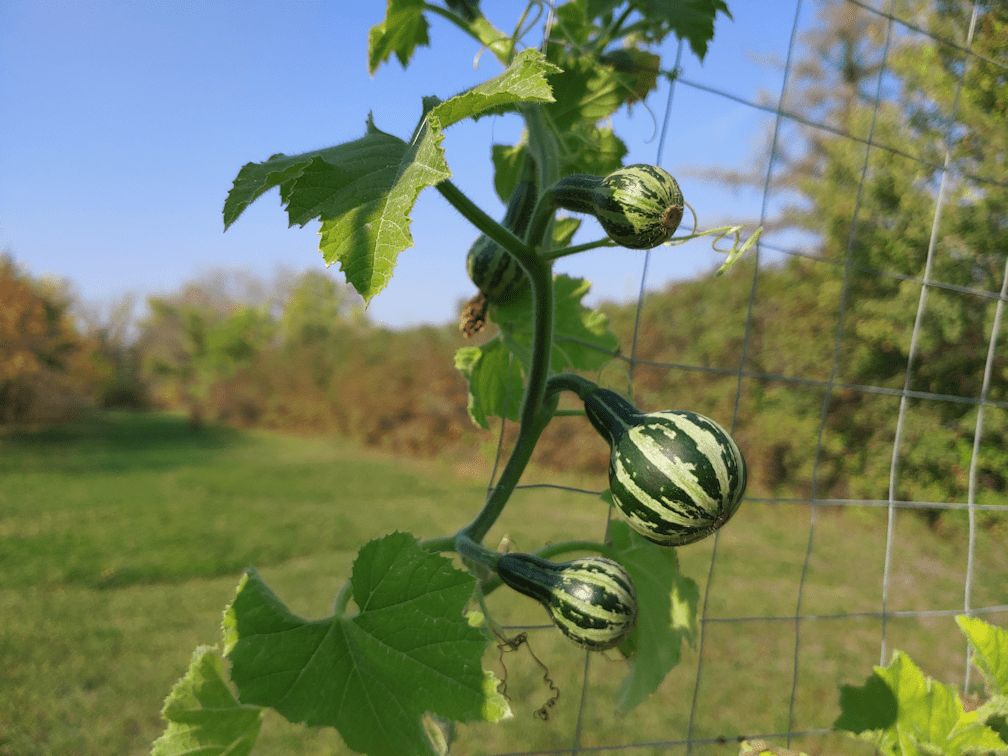
While the squash and melons are died back, or in the process of doing so, I continue to be amazed by the Tennessee Dancing Gourds.
These were one of our “fun” crops. Yes, I hope to use them for crafting purposes, but really, I just thought they were adorable and hoped that maybe, just maybe, they would grow in our Zone 3. From reviews I read when I bought the seeds, I knew they could be prolific, and the certainly have been, even with poor growing conditions.
While I’ve harvested only four mature dancing gourds, that are now drying out on our kitchen counter (protected from the cats!), there are more on the vines that are just as big, but still firmly attached.
More amazingly, the vines are still growing and blooming, with both male and female flowers. They have been doing amazingly well!
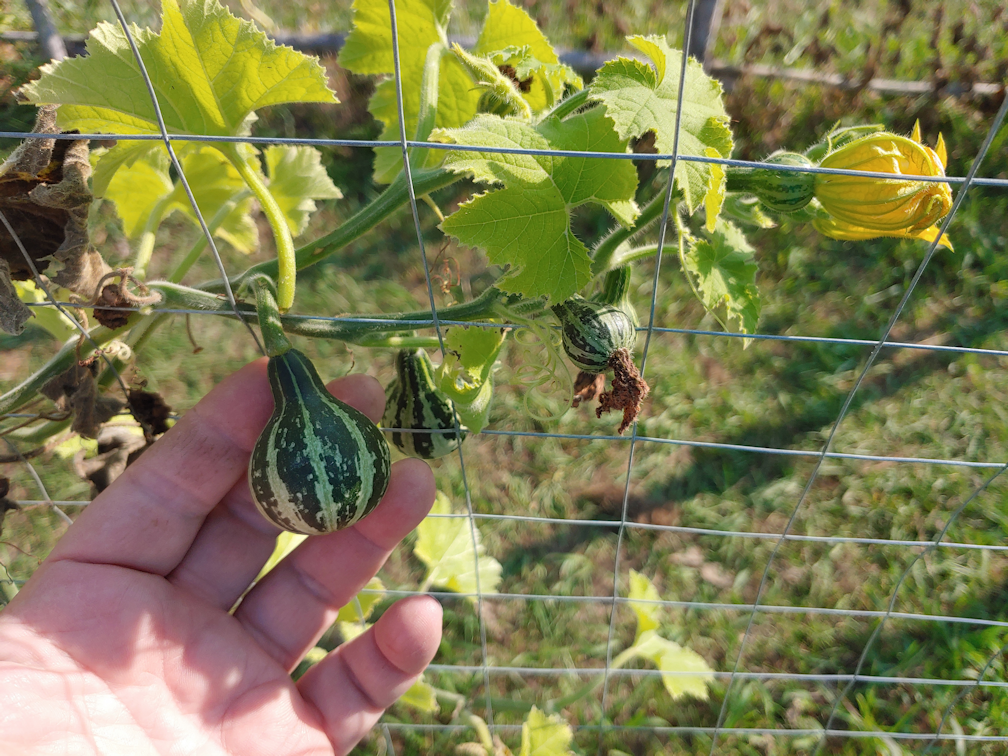
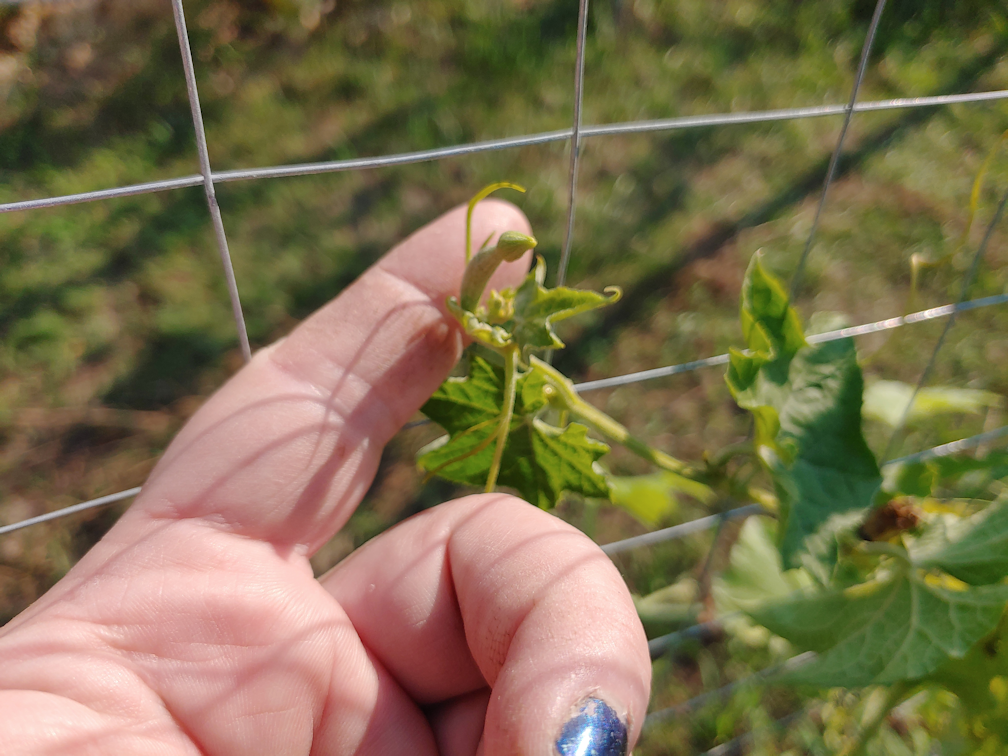
The luffa have decided to surprise me. I thought that, by now, they were basically a lost cause.
The very first luffa gourd that started to form ended up withering away, so when these ones showed up, I tried to hand pollinated them. Which I hope worked, but it’s still too early to tell.
You can just see a minuscule female flower developing, above my finger, too.
There are more male flower buds forming, and even another tiny female flower, with its tiny gourd, developing.
The vine itself is the only one that has grown enough to start making it’s way over the top of the squash tunnel.
I took this picture above my head to show the flowers that are blooming, but I was pretty blinded when I took it. So it was not until I uploaded the photo that I realized, there are gourds forming up there, too! There is no possibility of hand pollinating them, as I can’t reach them, but they might just make it!
None of the gourds we planted are zone 3, so that was a strike against them growing here, right from the start. While they would have loved the heat of our summer, it was difficult to water them adequately during drought conditions, so that was another set back. Though we have not have frost yet, we have had some pretty chilly nights, so I am really amazed they are still green, growing and flowering, while plants more suited to our zone, such as the nearby winter squash, are dying back. Especially the luffa, which didn’t even start blooming until very late, and didn’t start producing female flowers even later. It is unlikely the mild temperatures will continue long enough for the luffa gourds to fully mature, but the Tennessee Dancing gourds are doing just fabulously! I definitely want to try growing both, again. If they did this well in such poor conditions, imagine how well they’d do in better conditions?
While going through the garden beds this morning, I was just blown away by how much is still growing – and still getting a chance to grow, if the forecasts for October stay true!
The last time I had so many photos to share, I put them together into a video, but it only ever got one view. Clearly that’s not something people are interested in. So today, I will instead make a series of short posts, instead, starting with our winter squash and melons.
This is the very first Red Kuri/Little Gem squash that matures. As you can see in the photo, the vine is completely died back – except for the few inches on either side of the stem!
The vine with the next biggest one still has some green leaves on it. There had been another small squash that started to develop, but it withered away and fell off.
The other one, however, is still getting bigger, and just starting to deepen in colour. The vine it’s on has a lot of cold damaged leaves, but is still mostly green and growing, so this one may actually get a chance to fully mature.
The vine the mutant is on is also still growing, with fresh new leaves showing up even as the older ones get killed off by colder overnight temperatures. We still have not had a frost, which is the only reason we still have hope for our garden!
We are back down to the two Teddy squash, one on each plant. The others that had started to form, withered and fell off, likely due to lack of pollination. I don’t know how much bigger this well get, as they are a very small variety to begin with.
If you notice the white on the squash and leaves, no, that is not powdery mildew, or any other sort of fungal disease. That’s road dust. Even with the lilac hedge nearby, dust from the nearby road still gets through and coats things. Even the summer squash, which is furthest away, has road dust on them. Another reason we want to complete the hedge with dense bushes, and also plant taller trees. They will serve as more than wind breaks and privacy screens, in this area!
Here, you can see that the melon vines have all completely died back. All of them. And yet…
… the remaining melons are very firmly attached to their vines! Of course, they can’t grow any bigger, but I’m hoping as long as they stay out here, they will continue to ripen.
Under the conditions we’ve had, I’m really impressed with all of these. The melons managed to be quite prolific. The winter squash were not as prolific as they normally would have been, but we will at least have a few squash to try, and to see if we like them enough to want to grow these varieties again. We certainly would be willing to grow the Halona and Pixie melons again, though I think that we will try new varieties next year, to see what other varieties we enjoy eating.
We had another very foggy morning, so I didn’t head out to do my rounds, then into the garden to do a bit of harvesting, until later. It has been a few days since I picked anything. With the colder overnight temperatures, things are not ripening as quickly. Though the forecast was for overnight temperatures was for 7C/45F, we actually dipped down to 4C/40F. There were no frost warnings, but at those temperatures, if I’d known they were coming, I would have done something to help the more tender plants.
I didn’t pick any sunburst squash at all; they’re growing a lot more slowly, so I’m leaving them to get bigger. They seem to be handling the chill nights all right, otherwise.
It now looks like we will have several mature heads of Hopi Black Dye sunflowers! That would be so awesome. I might even be able to save seeds to plant next year.
The middle of the three blocks of sweet corn are a bit of a mystery. There are so many cobs like this; they have almost no husks on them, and the cobs are not developing well. It’s only this one corn block that’s like this. Very strange.
Speaking of corn, the renters started harvesting their corn yesterday, and I could hear them already out there this morning. Yesterday saw their three dump trucks going back and forth all day. When I checked the trail cam files, the newer camera, which saves 3 stills and 1 short video every time the motion sensor is triggered, had almost 340 files for me to check this morning! I noticed the trucks did not have any corn cobs in them, though. Their corn was still very green, and it looks like the entire corn plants got ground up, cobs and all. I think it was a very bad year for corn, overall, both in gardens and in fields!
That one big Pixie melon finally came off its vine today! I’m surprised by the other ones. The vines have now died off completely, but those melons are still very firmly attached! The beans are still doing amazingly well, with lots of small pods still developing, and even flowers still blooming. There are lots of tomatoes, too, but with the cooler night time temperatures, they are taking longer to ripen.
Well, it looks like things are finally warmer and drier out there right now. Time to go finish some projects outside! :-)
While doing my rounds this morning, I found a strange thing at the gate.
The twine was caught around the lock and the caribiner, which usually hangs over one side of the gate, was hooked onto the chain link.
Right off the bat, I knew this was NOT our vandal. If it were, there would have been actual damage, like the locks being glued again, or something like that.
Needless to say, I was quite curious when I sat down to look at the trail cam files. I had a pretty good idea who did it.
I was right.
When my daughter’s package was delivered, the driver tried to shove it into the gate, then used the chain to try and hold it in place. The problem is, the gate moves in the wind. When the cameras were triggered again, less than 15 minutes later, I could see the package was already half-falling. My the time my daughter came over to get the package, about half an hour after it was dropped off, it was on the ground.
It’s a good thing it wasn’t fragile!!
Going through the trail cam files was interesting for another reason: several files caught huge flashes of lighting from last night’s storm! I even saw a deer and her little one, hurrying up the driveway, while the sky light them up repeatedly.
Yesterday blew past our expected high of the day, reaching at least 30C/86F, possibly 32C/90F. That was followed by a wicked thunderstorm that passed over us around 11pm. It was awesome! Of course, we lost internet well before that. It rained enough that I found our rain barrel by the sun room, which had only a few inches of water on the bottom, full to overflowing.
We *really* need an overflow hose on that thing.
The garden loved the rain, too!
I was seeing huge new blossoms on the summer squash. Even the Ozark Nest Egg and the luffa gourds had new flowers opening. So did the Tennessee Dancing gourds, but they never really stopped blooming, so that wasn’t a lot of change.
The Crespo squash is seeing more flowers opening, too, and some of the developing fruit is noticeably bigger! These two are the ones closest to the barriers than I can get clear photos of, but there are quite a few more getting bigger like this.
The sunflowers are loving the deep watering, too. And just look at this Hopi Black Dye seed head! It is getting so very dark!
I even had a baby harvest this morning.
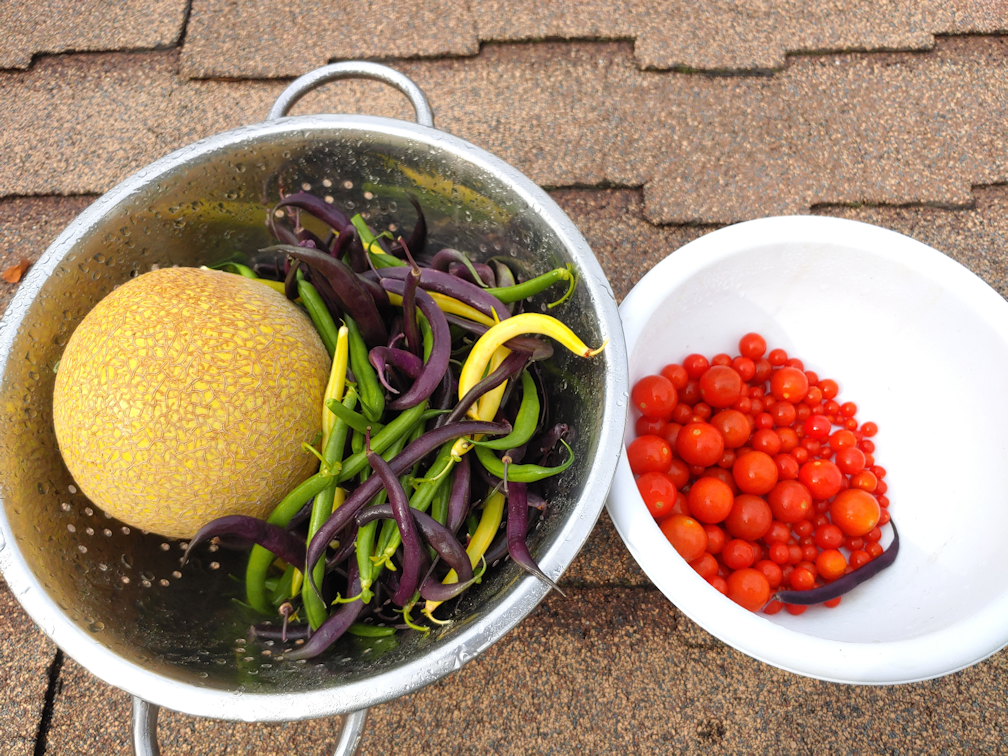
The larger melon is a Pixie melon. There are still lots of those. The little one is a Halona melon. The remaining melons on those vines are not getting any bigger, as the vines are pretty much completely died back now. Most of the melons are all very securely attached to their vines, though. This little one was feeling a bit softer, so I had it with breakfast. :-)
I even was able to pick some peas! With our first green peas, I did find a pod or two, but between the drought and the critters, that was about it. This is the most I’ve picked at once, this year.
That longest pod is the size they would all be reaching, if growing conditions were better.
I suppose I really should have left them for another day, as these were a bit on the small size, but I couldn’t resist.
I had them with my breakfast, too. :-)
The melon wasn’t as sweet as larger ones we’d picked, but it was definitely ripe. The peas were also probably not as sweet as they would have been under better growing conditions. They were both still quite tasty, though!
Last night’s storm had blown the door to the outhouse closed. I opened it again and things were still a bit damp. It’s been a few hours now, so I am going to head out and see if I can start painting!
There are quite a few more of the purple beans buried underneath. They have been, hands down, the most prolific bean producers, and if the weather keeps up the way it has been, we will be picking beans for at least another week or two! Even the yellow beans are putting out a second crop. With the drought conditions, none of the bean plants are as large and bushy as they should be, with the green and yellow beans particularly stunted, even as they continue to produce. With the green beans, that resulted in my finding bean pods that were almost as long as the plants were tall!
I had to get a bigger container to collect tomatoes with, instead of the red Solo cups we’ve been using until now. The vines are dying back, yet they still have so many ripening tomatoes!
Earlier today, I made a quick trip to the post office, before I gathered our morning harvest. The general store it is in always closes at noon on Wednesdays, so I had to do it early, but not too early; I knew the postmaster would need at least an hour from opening, to sort through the morning mail. We had some packages to pick up, but one of my daughters also had a package that was supposed to be delivered by courier, directly to our address, as it was from a place that does not deliver to box numbers.
Which has always been a problem, since our physical address doesn’t come up in searches. Like pretty much all of the roads around here, our road has two names; one is a numerical designation (part of the provincial system), and the other is our family name (a municipal thing). Many of the local roads are named after local families. It was only recently that I discovered that the road past our place has no name on the maps at all! Not even the road number. Which certainly explained why delivery companies had such a problem finding us!
My daughter was keeping an eye on the tracking number, however, and got a notification that her package was delivered to our door at about quarter to one. Of course, there was no such delivery, since the gate is locked. I could see nothing on the live feed of the security cameras, but my daughter went to see if it might have been left at the gate. Sure enough, I watched her on the camera as she got to the gate and picked up a white package. Which was on the gravel of the driveway, which also looks pretty white on the camera! No wonder I couldn’t see it!
I’m impressed that they found us, but it reminded me of something I wanted to try. Using the maps app on my phone, I found our road and took a closer look. It turned out that there is a 4 mile stretch of our road that is not labeled at all, however to the south of us, the road ends at another road, then restarts a short distance away. From where it restarts and continues south, it is labeled with the same numerical designation as the signs we have on our stop sign.
The four mile section that had no label is the only section that has our family name assigned to it. The offset part of the road with the numerical label probably has another family’s name assigned to it.
The app now has a function that allows the map to be edited. When I used that and started to select sections of the road, it simply said “unknown road”. I was able to select all 4 miles that had no label on it, then put in the name. It gave the option to add more information, so I added that it was also known by the numerical designation. I then sent the edit to Google Maps. I’ve already got a confirmation email saying “Thank you for your contribution. Your suggestion is being reviewed. Thanks for sharing your knowledge. We’ll let you know once the changes are published.”
Hopefully, that means or road will finally have a name attached to it on Google Maps, and people will be able to find us more easily! Plus, with the name rather than the number on the map, it will also match what is on not only my driver’s license, but on the licenses of several of my neighbours, too!
Speaking of which, I am hoping to get a chance to visit the one that sells pork products at the farmer’s market today. With our province’s latest draconian restrictions, organic humans are no longer allowed in “non-essential” places, even though such mandates are expressly forbidden in our laws, at both the federal and provincial levels. Vendors at markets aren’t required to be GMO though; just the customers. So I will just have to skip the market, and go right to the source! :-D
I’m quite okay with that. They are a homesteading family that are a few years ahead of where we want to be, as far as self-sufficiency goes, and I would love to see how they’ve been doing things! I may have grown up here on the farm, two sticks ahead of the stone ages, but I am more than happy to learn new, better and more efficient ways to go things! Especially since we’re only about one stick ahead of the stones ages now. ;-)
This is the Hopi Black Dye sunflower that has the one seed head that I think will have time to fully mature – and it has four more bright and cheerful seed heads opening!
I don’t know why my phone’s camera blew out this shot, but you can still see what a deep, dark purple is developing as the seeds mature.
When my mother found out I was planting sunflowers, she immediately mocked me, telling me that the birds would eat them all. This is the first sign of birds eating them I’ve seen this year. :-D
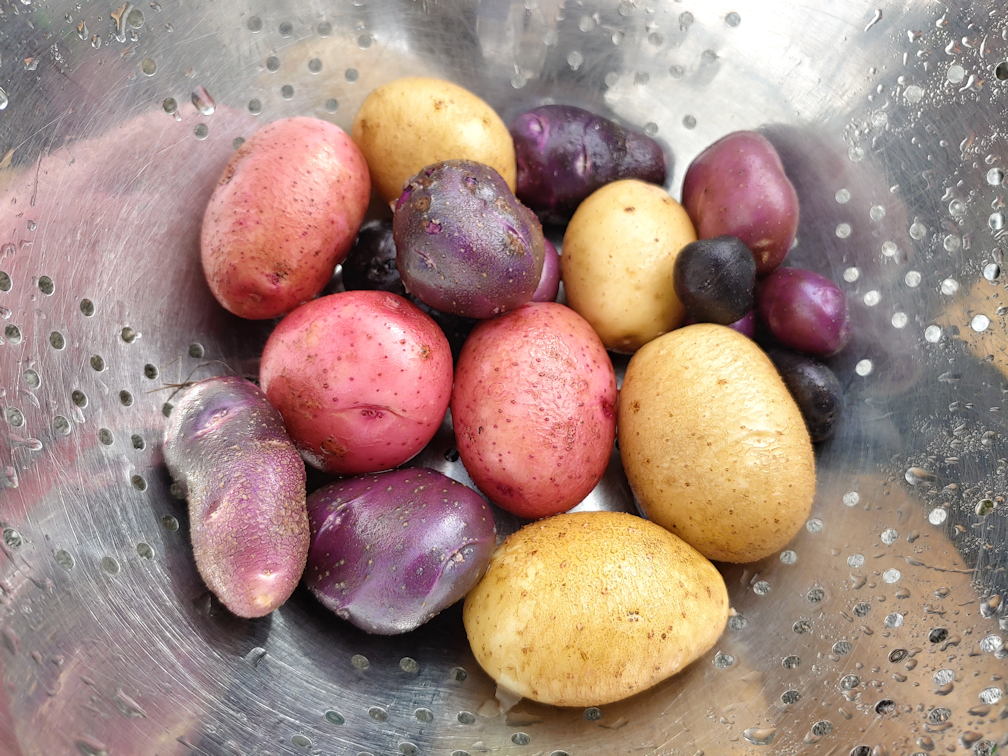
Not too long ago, while working on supper, I decided to dig into the potato bags and see what I could find.
The Norland (red skin, white flesh) and Yukon Gem (light brown skin, yellow flesh), we have picked before, but this is the first time I tried to find any of the fingerling potatoes, Purple Chief (purple skin, white flesh) and Purple Peruvian (purple skin, purple flesh). I did not find a lot, but I’m hoping it’s because I just wasn’t digging around in the right places.
I currently have them roasting in the oven with our own onions, both red and yellow, three types of summer squash, and purple beans. The only thing in there we didn’t grow ourselves was celery. Oh, and the dill we got from my brother. :-) I’ve got three chickens roasting, too, so we shouldn’t need to cook for the next couple of days! :-D
This is an “almost” first for me. I’ve made a few little videos now and then, with minimal editing, to post here on the blog. Years ago, I used to make videos on DVDs of photos for my parents, set to music and with chapters, etc. Since we were so far away, I thought it would be a fun way to share lots of photos of their grandchildren with them in a way that would be easier for their declining mobility. When I found out they never watched any of them (and in cleaning out their possessions in the house, I never found them), I stopped.
Yesterday, instead of making another long, photo heavy post, I would try doing a narrated, fall garden tour video. I have very little equipment; I recorded the audio using a headset with a microphone, and the video software I used is the same old one I used back when I was making DVDs for my parents! It took a long time to make, and a long time to upload. Thankfully, we didn’t loose our internet in the process. :-D Anyhow, in the wee hours of the morning, I finally got it done!
It is WAY longer than I would have normally done a video. Usually, I try to stay under 5 minutes, but this ended up being just over 47 minutes. I did try to explain some of the how’s and why’s of things, and I hope I did all right with that.
So please feel free to grab a cuppa, settle in, give it a watch, and please leave some feedback. I’d like to know how you liked it, if you found it informative and useful in any way, and if you would like to see more (I would NOT be making such long videos on a regular basis, but I might make some little 5 minute ones). I’d love to hear your questions, suggestions and anything else you’d like to share.














 The Re-Farmer