Today the last day of July. We’ve got about a month and 10 days before our first average frost day, though if we’re lucky, that won’t happen until much later. We haven’t even harvested our garlic yet, but when we do, we need to think about what to do with the empty beds. I’ve been considering planting some very short season crops, but there just doesn’t seem to be much point. Not with only about 40 days of growing season left, as of today, never mind from whenever any beds are harvested and open.
Which means I’m thinking about getting the garden ready for next year, rather than extending the harvest for this year.
No. It’s not too early! 😄
This timely video from Gardening in Canada talks about one option I was considering. Growing a cover crop.
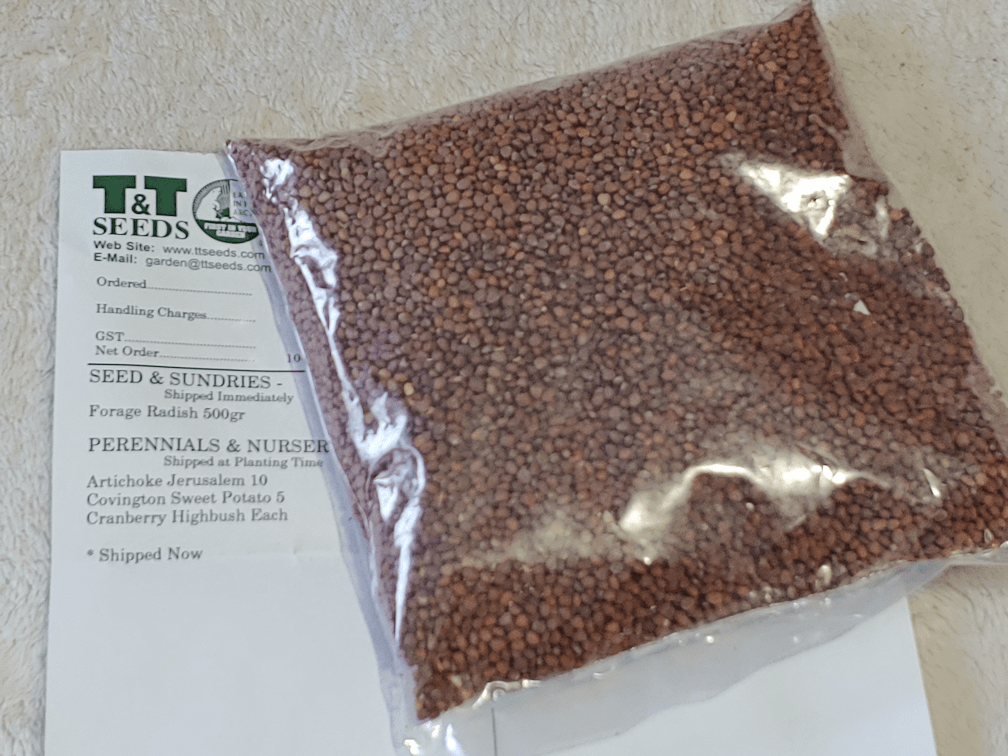
There are a lot of seeds in that bag! There are a few places I want to use them to help break up compacted soil, in preparation for expanding our garden space. Instead, we ended up unintentionally reducing garden space!
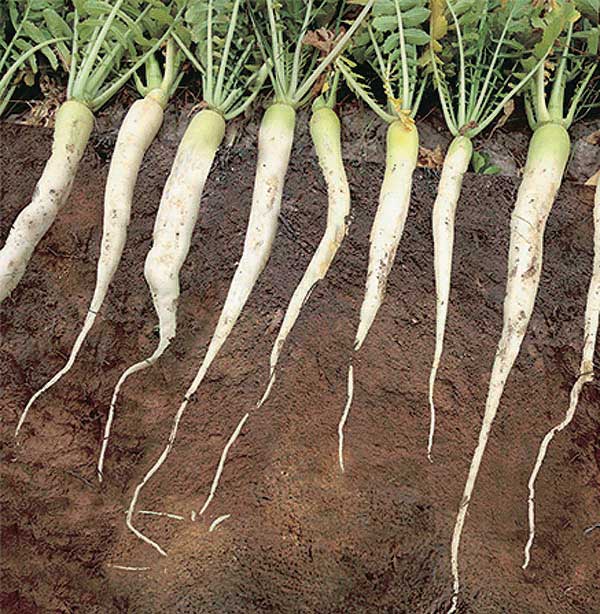
The idea is to plant them and leave them. As they grow, they “till” the soil, then add organic material as they decompose.
The only hesitation I have is our Dark Grey Zone soil, with its thin layer of top soil over gravel, sand, clay and rocks.
So. Many. Rocks.
This type of soil drains quickly and leaches nutrients. The tillage radish might increase how quickly water drains in the soil… or it will reduce the drainage by adding organic material in the sand/gravel/clay below, and act as a sponge.
If nothing else, it’s worth a try. I’ve got the seeds, after all. May as well use them before they get too old!
Today, I was able to finally get to that bed along the chain link fence, and get some potatoes planted!
I must say, though; it really was hitting home for me, how much I need higher raised beds. The narrower bed did mean I could reach across it just fine, but my goodness, the whole process was painful. It didn’t help that I was working during the hottest part of the day! We reached our expected high of 16C/61F, while the “feels like” was 21C/70F, at the time I finally got inside. I think I spent about 3 hours on the job, including hydration breaks. I was definitely not going to push myself in this heat.
Yeah, I can hear you folks from the south, giggling at me. 😉😉
Once I was done, I even remembered to take more painkillers before settling down at my computer to upload the video files I took. It doesn’t take long for the whole body to stiffen up, and I end up hobbling around looking in worse shape than my husband, even on his worst pain days!! 😄😄
I still prefer it over housework. I must say, it was great to come in when I saw done, to a house that smelled like cleaners instead of cats! 😁😁 My daughter is awesome.
I had fun putting this video together, including picking music that much better fits me and what I like.
There’s even bonus Syndol, being incredibly snuggly, while I sat in the shade to get some rest and hydration.
The 10 day forecast has changed, yet again. We went from expecting more rain and cooler temperatures to heat and mostly sunny. Tomorrow, we’re now supposed to reach 20C/68F! Which means I need to make sure to get to work on the other beds earlier in the day, before it starts getting too hot.
Which means I should probably get to bed before midnight, for a change!
Today, it was time to transplant some of the squashes we started from seed indoors.
I am really hoping we’re not jumping the gun, here, but many were outgrowing their Jiffy Pellets and really needed to get in the ground. In the future, for things that need to be started so early indoors, I am thinking it would be better to go straight into 4 inch pots, instead. That would give a more flexible timeline for getting them in the ground.
In going through the seedlings to see which ones had their true leaves and were ready to transplant, I counted out 16 in total, so I decided to do two rows of 8. I think most of them – at least the largest ones – are from the zucchini surprise mix, but after the trays got knocked over yesterday, they are all going to be a surprise! :-D
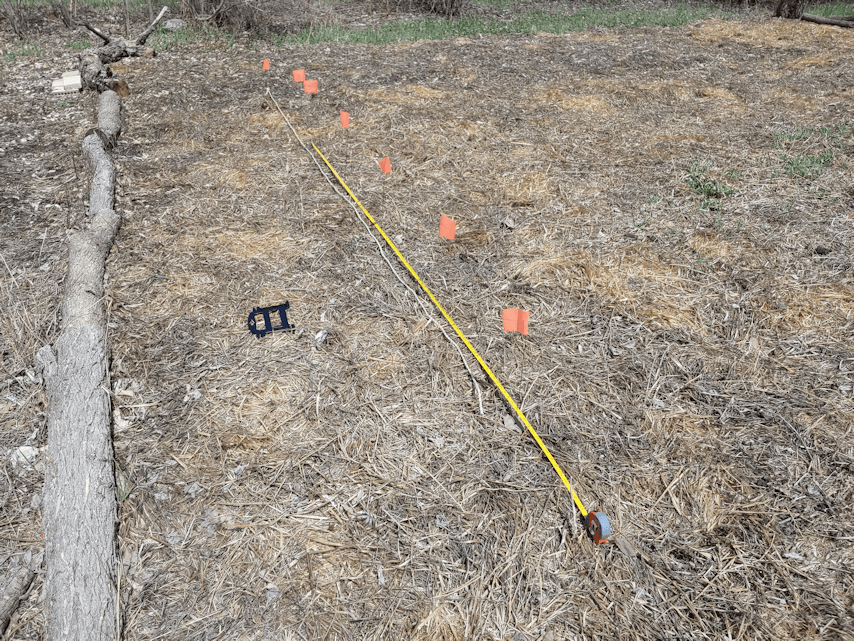
I used flags I picked up at the hardware store to mark the first row at 2 feet apart.
Though we mulched the area last summer, and the soil has improved quite noticeably, we are still dealing with lots of rocks and a soil in need of amendments. Several times, when placing the flags, I hit rocks and had to poke around to find somewhere I could push the wire in. We needed to figure out a way to get around that, and this is what I’ve come up with.
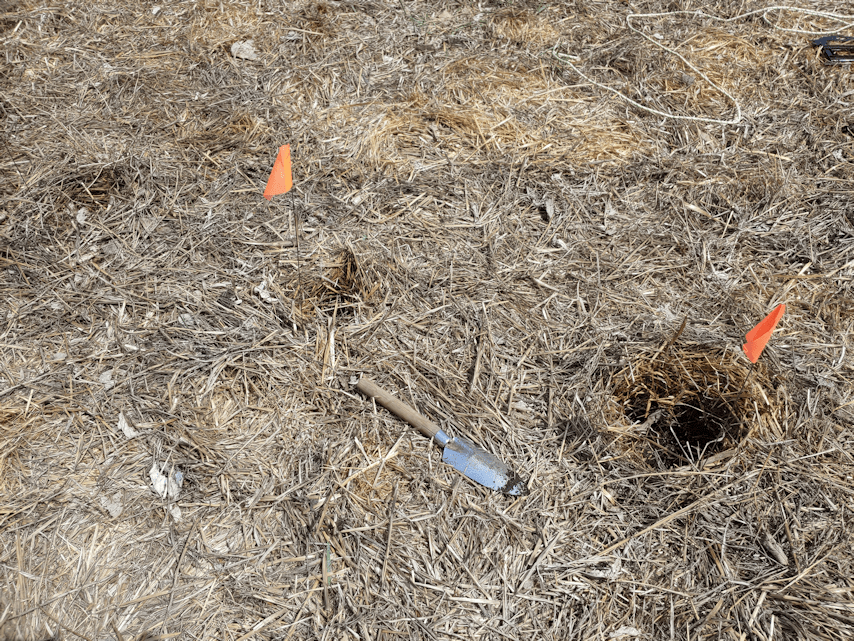
The first step was to open a hole in the mulch to the surface of the soil (removing any rocks I found in the process.
I also prepared a soil mix.
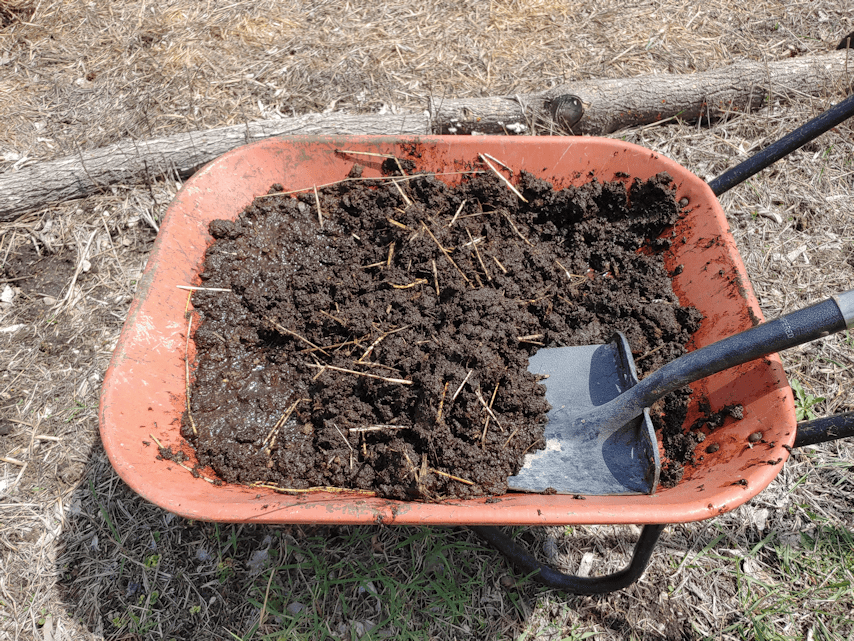
The wheelbarrow still had some straw on the bottom that I didn’t bother taking out when I dumped in a bag of garden soil I also picked up at the hardware store (only because they were on sale! *L*) and a couple of spade fulls of peat. This got mixed together with plenty of water. The dry peat was actually being blown away by the wind while I mixed! It took a while to get it wet enough for the next step.
Into each opening I made in the mulch, I added a spade full of the soil mixture. Then a hole was made in the middle of each one for the transplants, with more water added as well.
Each squash was then transplanted and secured in their own little “hill” of soil mix.
Then I mixed some more soil and peat and repeated the process for the next row, which was made about 2 feet away from the first.
Which was when I discovered I had 2 extra seedlings! LOL So I added them to the ends of the rows, taking a little bit of the soil mixture from each of the other plants, to transplant the extras into. So we now have a total of 18 surprise squashes transplanted.
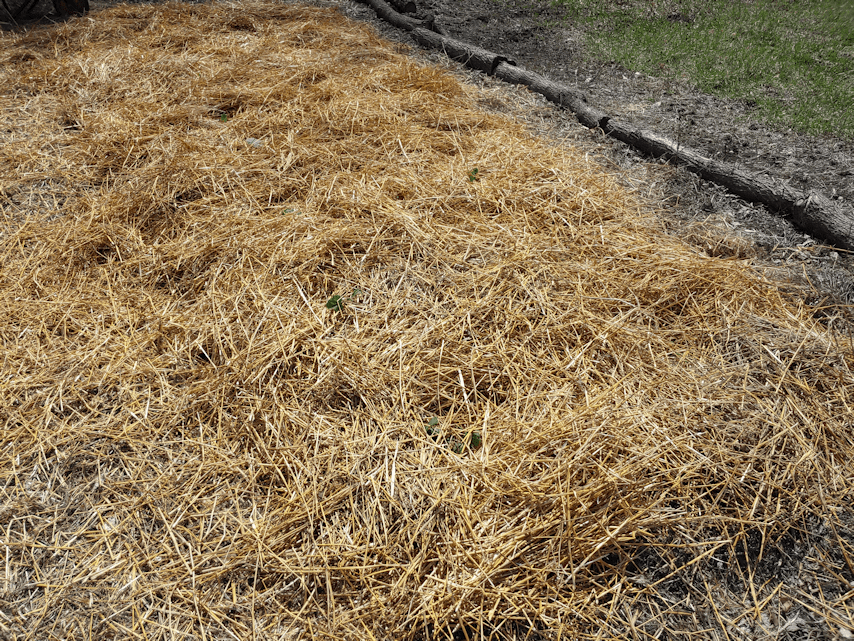
Once both rows were planted, they were mulched with more straw. When we add a trellis, it will go between the two rows.
After the straw was placed – with the wind trying to take much of it away! – I gave the bed a fairly thorough soaking, to dampen the straw. Not too much, as I didn’t want to shock the transplants with cold water in this heat! I will set up a sprinkler over it this evening. Unless the predicted showers make it to our area. It’s been quite a hot day, and the rain will be most welcome.
When I was done and inside the house, I checked the weather. My phone app said it was 18C, (“feels like 18C”) (46F).
They lie.
I checked the app on my desktop and it said we were at 26C, with a “feels like” of 28C (79 and 82F). That was certainly the more accurate one!
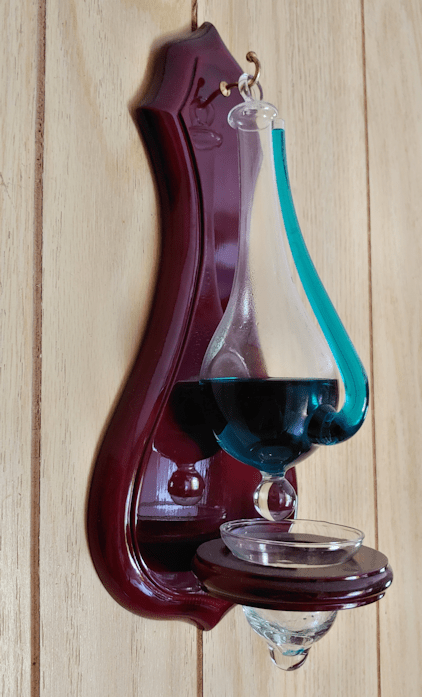
Our barometer agrees.
Since we cleaned this out and refilled it, I have never seen it this high!
We had thunderstorms predicted for the next couple of days, but now those have been pushed back to Sunday. Whether the storms reach us is always touch and go, but I’d like to find some way to cover the transplants, if we do. The straw will protect them, but only so much.
Meanwhile, we’ll be keeping watch on what’s left in the seed trays. We won’t be transplanting as much as we hoped, but right now the only thing I’d say is a total loss is the fennel. I still have hopes for the gourds to emerge! Not that I’d be able to tell which ones they are at this point. :-D
Still, I hope we’ll have a couple more rows of squash in this garden bed by the end of the month. Tomorrow, however, the plan is to get the sunflower seeds in. :-)
We shall see if planting them in their own little islands of soft, stone-less soil will work!
Yes! Finally! The weather is cooperating, and I was able to get our potatoes in!
From a previous post, this is what I was starting with.
The frames are just there to mark out where the beds will be. As you can see, there’s a fair bit of grass and weeds. It has been a while since this area had any sort of gardening done in it.
While the no-till, no-dig method we’re using is something that can be done directly on the grass, I wanted to add at least some amendments, first.
I used a wheelbarrow to mix 1 bag of manure with a slightly larger volume of peat.
After spreading it out on one of the beds with a rake, I used another bag of manure mixed with peat on the second bed. I then topped them with a thin layer of straw, making sure to use the damp straw from the bottom of the bale, where it was starting to decompose already.
I had hoped to use some material from our own compost pile, but as I dug around, I did not find any usable material. I had tried to clean out some of the older compost, from before we moved here, but as I dug around, I found more stuff I missed. Twigs and branches are one thing. It looks like people had stared to use it for garbage, and I found pieces of wood that were probably used as support stakes, plastic trays from transplants, and even a piece of fabric. There was some well composted material, but it was so full of sticks, it was unusable.
I’m thinking we will need to start a completely new compost pile somewhere else. This one is looking like a write off. :-(
So, no compost of our own for the potato beds.
Once both beds were spread with the manure and peat mixture, I gave them a very thorough watering. Even though we’ve had rain for the past couple of days, the soil was still pretty dry.
After soaking the beds, I added the potatoes. Each box was 3 pounds of seed potatoes. That worked out to 3 rows of 6 potatoes (plus 1 extra, so I put 2 small ones together) in one bed, and 3 rows of 5 potatoes in the other.
After spreading the potatoes out, I went back to evenly space them and push them gently down to have contact with the ground. With one potato, I went to pick it up, but it wouldn’t move.
???
I tried again, but it was stuck to the ground.
Amazingly, in the space of a couple of minutes, this one potato that had direct contact with the ground and shot out a 3 or 4 inch root, with capillaries! I wish I’d made the effort to take off my muddy gloves to take a photo, but instead, I dug a quick hole in the ground where I wanted it to be and “transplanted” it. I still can’t believe a potato could grow a root so deep, so fast, even after seeing it with my own eyes!
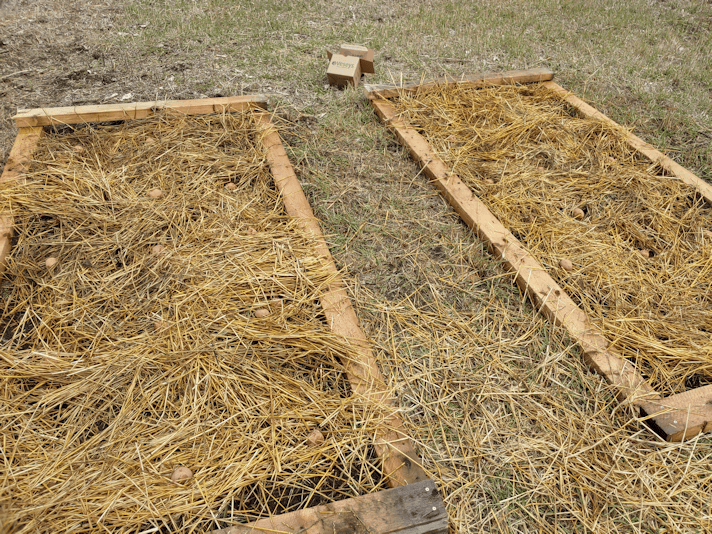
The next step was to cover the potatoes with a deep layer of straw. Again, I used straw from the bottom of the bale, where more of it was already damp and some was starting to decompose already. I made a layer roughly a foot deep.
I then scattered more peat across the top, then tamped it all down with the back of the spade. This peat is as much to add some weight to prevent flyaway straw as it is to amend the soil.
After the above photo was taken, I spent the next while thoroughly soaking the straw.
With this method, I saw recommendations of putting a layer of hay (which I don’t have, so I’m using straw) 2 feet deep. This is definitely not 2 feet deep. Over the next day or two, I plan to soak the straw some more, add another layer, then soak it again. After that, I should not need to water it much, if at all, for the rest of the growing season. I’ve heard people using this method say that no watering is needed at all, because the mulch maintains moisture as it breaks down, but I expect to need to water it at some point. It all depends on whether we have another drought this summer.
After the straw has started to settle and pack itself down, I will remove the frames to be used elsewhere.
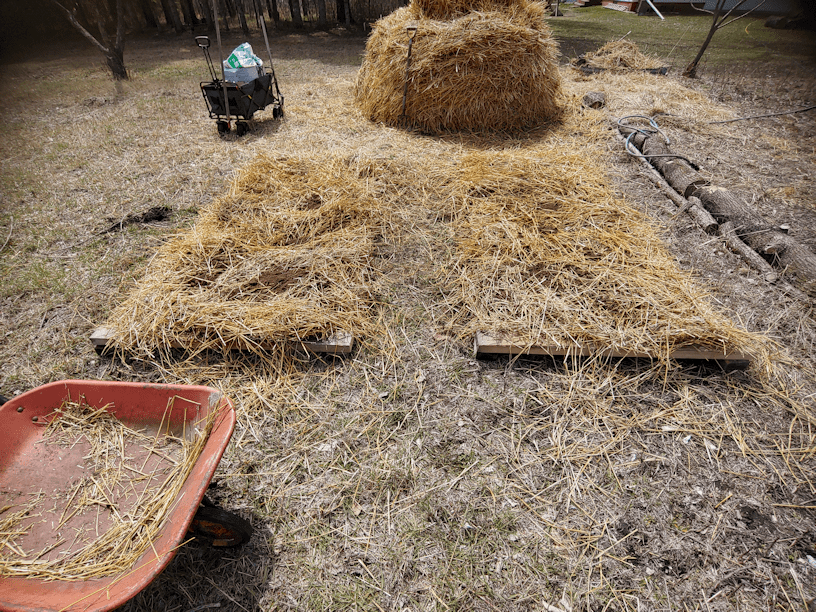
Once this was done, I checked out the area we are planning to transplant our squash seedlings. We had covered this area last year with straw, then covered with tarps, to amend the soil and try to kill off the grass and weeds. We still ended up having to use Round Up. Even covered with tarps, weeds where pushing their way through the straw and lifting the pegged down tarps off the ground!
This is how the area looks now.
The black tarps in the back are there to warm up the mulched soil on that side a bit faster.
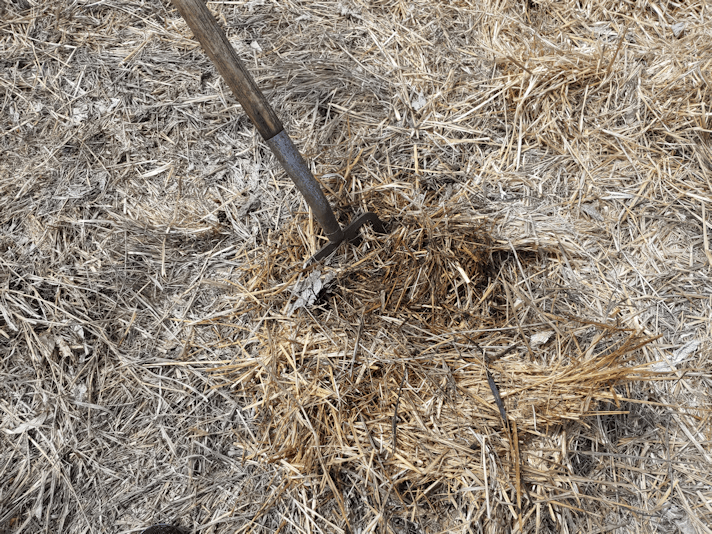
I could not do this here, last year. In fact, the soil was so hard, we were bending tent pegs while fastening down the tarps. While working on the potato beds next to this area, I would sometimes shove the fork or the spade into the ground to set it aside while I did the next thing, and ended up leaning them on the bale or wagon most of the time, because the ground is just so hard. Yet here, I could sink the fork’s tines their entire length down!
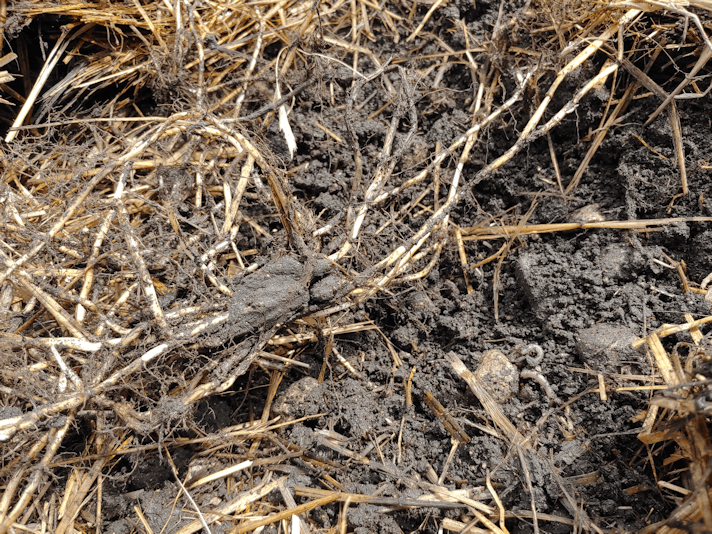
I pushed aside some of the mulch and dug around a bit. There are still a LOT of quack grass roots in there. I pulled some up, and you can see the bundle of roots in the above photo. The soil is quite “sticky”. The exciting thing was uncovering a worm. A very good sign!
Which means our efforts last year are paying off. The soil is already improving. When it’s time to transplant into the area, we will still be dealing with rocks and root systems, but the ground is now workable.
It’s amazing, what a mulch can do to improve soil conditions!









 The Re-Farmer