Analyzing our 2023 garden: corn, peas and beans

Corn and beans, in particular, were things we had so many seeds for, in so many varieties. Especially the Red Swan beans, though that was a mistake. I’d ordered a different, purple variety, because purple everything seemed to do quite well here. When I got Red Swan, instead, I contacted Veseys and they sent me another package.

Of Red Swan.

That happened a couple of times before I finally read on the website somewhere that they were out of the purple variety, and Red Swan as what they were sending out instead!

Oops.

When it came to beans, I’d hope to plant both bush and pole beans, in a variety of colours. I also wanted to try the beans my mother gave me, that trace back to what she used to grow here, when I was a child.

That didn’t happen. We simply didn’t have the space to plant many beans at all this year.

It was much the same with corn. We had many varieties to choose from. Mostly, I just wanted to have three types. The purple Montana Morado, the Tom Thumb popcorn, and one of the short season sweet varieties for fresh eating.

Well… two out of three is pretty good.

The purple corn.

As much as I’d like to grow the kulli corn, the seed source I’d found was out of stock. We’d grown the Montana Morado before a couple of years back (though we though we were getting an acclimated variety of kulli at the time), and they did well until something destroyed them.

This was all that survived from our 2021 garden.

The kulli corn we’d grown last year did absolutely amazing, growing into massive tall stalked that looked so strong an healthy – though high winds did try to take them down!

We had to add a lot of supports to the kulli corn and yellow pear tomatoes, after strong winds.

What they didn’t develop, however, was corn! Not a single tassel or cob!

So we went with the Montana Morado instead.

The Montana Morado got their own bed in the main garden area. I ordered a couple of packets of seeds, because there weren’t many per packet. It still wasn’t a lot, as far as corn goes, but this is an experiment for us. While the plants certainly didn’t thrive like the kulli stalks did last year, they at least produced cobs that we could harvest!

I waffled back and forth about interplanting beans with the corn as a nitrogen fixer, and did end up planting some Red Swan with them, late in the season, but more on that later.

Bonus for wanting the corn to use for flour is, no harvesting until the very end of the season.

There are a couple of things I wanted to do with purple corn. One was to make and try chicha morado, as the very concept of a drink made out of corn fascinated me. The other is to try making corn flour. For this year, the goal was just to have corn to try making flower, though we did try a few cobs for fresh eating.

So after the harvested cobs were left to dry even longer, the kernels were finally removed.

We got almost exactly 1 cup of kernels. Just enough to try to make into flour, though we don’t have a mill. We were debating where to try the spice grinder in small batches, or the Bullet processor we’d been given, but were concerned the hard kernels would break them.

Then, one night, I heard a terrible crashing noise and went to investigate.

I found the container of kernels on the floor. A cat had somehow knocked it down.

We lost them all.

Every. Single. One.

*sigh*

Final thoughts on Montana Morado/purple corn:

Yes, we plan to try again but, gosh, that was disappointing to lose them all like that! We might wait another year or two before trying again. My source for the kulli seeds has them again, but they are insanely expensive – and in US prices, so quite a bit more, plus shipping, in Canadian dollars.

So that will wait.

The popcorn.

We got the Tom Thumb variety, which only gets a couple of feet tall. This is actually the second year we tried to grow them, but the location we grew them in last year, flooded. This year we planted them in a completely different area, both from the flooding and the purple corn. The two types of corn pollinate at different times, but the extra space reduced the chances of cross pollination, should we want to keep seeds.

When it came time to build frames to cover the raised beds, a priority was put on one that could go over the Tom Thumb corn, to protect it from deer or racoons. I’m rather happy with how it turned out, though I do want to stabilize the corners better.

As with the Montana Morado, these were grown to be harvested after they’d dried on the cob. These didn’t even get taste tested for fresh eating, so it was a very low maintenance crop! One we got a surprising number of cobs out of.

After they had their chance to dry on the cob indoors some more, we got a surprising amount of kernels.

We got almost exactly 6 cups out of them!

Final thoughts on Tom Thumb popcorn

We did a test pop, of course.

They didn’t pop. They just burned.

So we left them to dry longer, and stored them with a desiccant, before doing another test pop.

They still wouldn’t pop.

They’ve had more time to dry out and I’ll try again, but they should be dry enough. I’ve looked up about how to harvest and process kernels for popcorn, and we’ve done all that. The only thing I can see that might be the problem is that they still have too much moisture in them. Yet, they do need to have a bit of moisture in them, as that’s basically what makes popcorn pop.

I don’t know what to make of it!

I think we still have seeds left, but I don’t think we’ll try them again. In a way, it was a waste of space to grow these two varieties of corn, instead of a sweet corn that we could eat, freeze or can. We just didn’t have the space available to grow a third variety.

In the future, I think we’ll try a flour corn again when we have more prepared spaces. If we do find that we like having flour corn and actually use it, we would need to have a much larger space available to grow in, to make enough flour to be useful. That is still years in the future. Until then, we will continue to try small amounts as testers.

Next year, I want to focus more on growing a good, short season variety of corn, and we have seeds for at least two different varieties that fit that bill, ready and waiting to be planted.

Bush beans

In previous years, we have had great success with beans. The first year, we grew three types – yellow, green and purple – in rows about 25 feet long. The purple beans did especially well!

Last year, we grew pole beans and shelling beans.

This year, I wanted to grow some bush beans, for their earlier harvest, pole beans for their later harvest, and shelling beans for dry storage.

Once again, we just didn’t have the prepared space for them.

In the end, we planted yellow and green beans in the high raised bed, which is only 9 feet long.

The yellow beans did okay, though a lot of the green beans in particular did not germinate. Most seeds were planted to fill the gabs, they they grew all right this time.

Then… this happened.

Turns out this bed is the perfect height for a hungry deer’s buffet!

We rigged a cover for the bed with poles and netting. Amazingly, the beans recovered, and we actually got some harvests!

Not a lot, but enough to include in our meals. Nowhere near enough for freezing.

Eventually, we were able to cover the bed with one of the garden bed covers we build this summer.

This worked out really well, as the netting could be lifted, and the openings of the fence wire used in the cover were wide enough to fit our arms through, so we didn’t have to remove the cover to harvest the beans. The only down side is that this netting is insane for catching on things!

One thing I found was that the slugs managed to get up into that bed!

This was a very bag year for slugs, but that will be covered more when we talk about the squash.

Still the beans did remarkably well under the circumstances!

Final thoughts on bush beans

While we will probably continue to experiment with varieties until we find ones we really like and can save seeds for, bush beans will probably be a staple crop for us. Especially purple ones, which seem to do best for some reason. Bush beans don’t need much done for them, and they are ready to harvest earlier than pole beans. Since we planted so few of them this year, we may not buy more for next year at all, and just go with what we already have.

The Red Swan beans.

There was some confusion when we got these, as I’d forgotten what I’d ordered, then realized what I ordered didn’t come in, and then… well…

I think we ended up with three bags of them, in total, by the time it was figured out!

These are a variety of bean that can be used for both fresh eating, and as a dried bean. They are also climbers. Since we had so many, when I decided to go ahead and interplant beans with the purple corn as nitrogen fixers, this was the variety I planted. I honestly did not expect them to have enough season left to produce edible beans, so it was a real surprise when they did!

They even got big enough to harvest!

They do turn green when cooked, rather than keep their red colour.

While they managed to grow pods, there was no chance they’d reach full maturity for harvesting dried seed pods. Which is okay. Having any pods at all from these was unexpected! They never even got big enough to climb the corn stalks.

Final thoughts on Red Swan beans, pole beans and dry beans

We will definitely be planting these again, with some left to mature for dry bean collection, and some for fresh eating, so we can figure out if we like them enough to keep growing. After all, there’s no point in letting all those extra seeds go to waste!

As for pole beans in general, we still want to try other varieties to see what we like, though for next year, we’ll probably go with the ones we got for this year, that never made it into the ground! Pole beans start to reach fresh eating maturity about the time bush beans are done, so having both will keep the harvests coming.

I also want to plant dry bean seeds we saved from last year that we didn’t have the space to plant this year, as well as experimenting with other varieties. We won’t go in that direction too far, though, as none of us enjoy dry beans quite enough to warrant having a lot of them. Mostly, having them will be part of our food storage and self sufficiency goals.

Peas.

Finally, we get to the peas!

This year, we planted a variety of pod peas we’ve grown somewhat successfully before, Dalvay. Previously, we’d grown them on trellises near the pole beans, way off in what will be our food forest area, as part of our efforts to amend the soil. Peas have yet to do very well for us, though they were growing in far from ideal conditions in that location. We didn’t plant in that area this year. Unfortunately, we didn’t have an alternate location ready for this year, either.

For the peas, though, I decided to plant them along the chain link fence this year, so they already had something to climb.

This area had had tomatoes growing in it for two years previously, and I felt it was time to switch up to a nitrogen fixer.

They did… okay. They certainly didn’t thrive in this location, which I found a bit strange. In fact, nothing did really well in this bed this year.

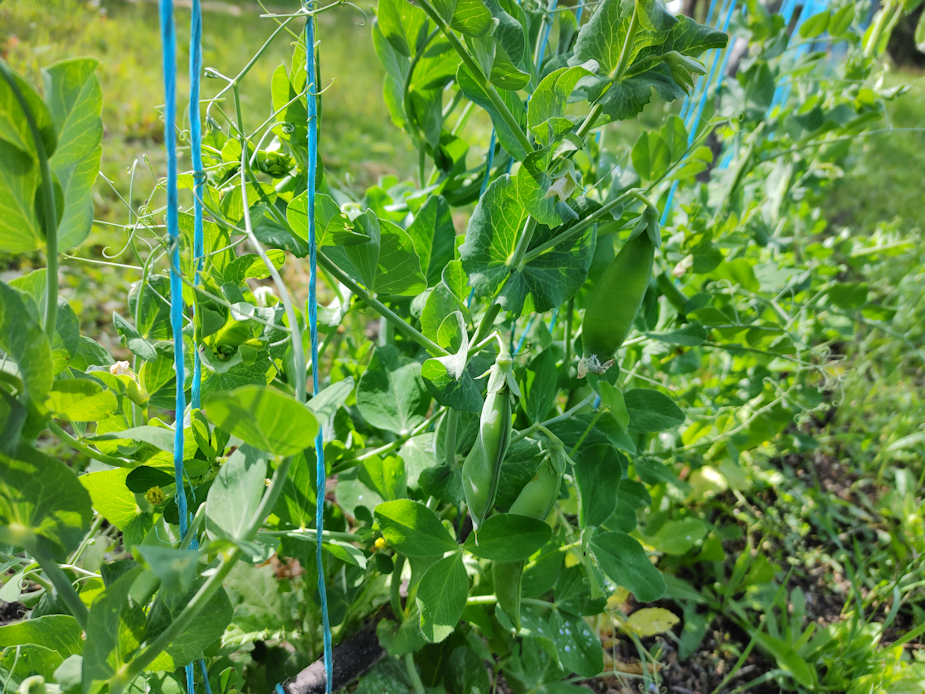
The peas did start climbing the fence, and we even got a few pods to harvest. Mostly, though, there were just a few pods I could snack on while outside.

Then one morning, I came out to do my rounds and discovered all parts of the pea plants that grew through to the other side of the fence, were gone. They all got eaten down to the same height, for the entire length of the fence!

Yup. It was the deer, again.

They did somewhat recover, only to get nibbled on again later on. We aren’t feeding the deer anymore – it’s just too expensive – so we don’t get the number we used to, but there are still a few that regularly come by. Usually, they just raid the compost pile, but every now and then, they help themselves to our garden.

*sigh*

So not only did they struggle in the new location, but with being eaten by wildlife, too!

Final thoughts on peas.

I like this variety of peas – the few times we were able to harvest them. At some point, I’d like to have enough pod peas to be able to can or freeze them!

As for why they didn’t do well in this location, when things had done well there before, I think the answer is above them.

We’ve been trying to cut back the branches on the Chinese Elm inside the fence, but in some places, that just resulted in new branches growing back even bushier. They are also too high to reach with our extended pole pruning saw.

Basically, that bed no longer gets as much light as it did over the past couple of years and, for the peas, that was a problem.

Since these trees also drop damaging amounts of seeds every spring, they are on the hit list. At some point, they are going to be taken down completely. They do, however, shade the yard and are among the few trees that are a partial wind break for winds from the south. I would rather not take them down until we have something to compensate for what we would lose when they’re gone.

However, given how much damage they are doing, we might just get rid of them and deal with the other issues later.

As for peas, I hope to plant them in different beds next year, and I’d like to try edible pod peas again. Eventually, I’d like to have both as staples in the garden.

In the end, when it comes to peas, beans and corn, the main hurdle we have is prepared beds to plant them in. We need to build a lot more raised beds of varying heights. We do have plans to build pairs of raised beds joined by trellis tunnels that has been started, and will continue to add more as we are able.

It’s the “as we are able” part that’s the problem.

Well, we do what we can with what we have available.

Little by little, it’ll get done!

Eventually.

The Re-Farmer

Morning (and evening) in the garden.

I’ve been working on another raised bed cover, with difficulty. I had to give up on plan A and switch to plan B, which involved stealing the hoops from the high raised bed. I left that for this morning, though. The beans still need to be protected from deer, though, so the raised bed cover I’d put over the carrots got moved over. With a daughter’s help, I was able to put it in place without damaging the beans, then drape the mesh over the fence wire.

That mesh catches on EVERYTHING!!!

I got a bit of a surprise, though. That bed is supposed to be 9′ x 4′ on the outside, to match the low raised beds, so the covers can be interchangeable. The low raised beds are 9′ x 3′, but with the log walls, the growing space is closer to 3′ than 4′, so that’s okay.

What I didn’t expect was for the cover to be almost 6 inches longer than the bed!

It works, though. Plus, the fence wire is open enough that I can just lift the mesh to reach in to weed and harvest, without taking the whole cover off. I also can use the ground staples to secure the mesh to the fence wire, which was not yet done when I took the above picture.

I did get a decent harvest this morning, though!

The green beans are really starting to recover from being eating by deer – they got hit a lot worse than the yellow beans. I finally picked that first yellow zucchini, and a G-Star patty pan. There is still a larger one that I’m leaving on the plant.

Last night, while doing my evening rounds, I discovered that the Black Beauty tomatoes needed help! The storm we had yesterday morning probably added to the problem. The tomatoes are getting so heavy, the entire support structure was starting to lean over with the weight, as well as more tomato laden branched hanging down. I’ve been tying them off regularly, but some still manage to escape. I’d already had to add a second support stake at the end, and last night I had to add three bamboo stakes, diagonally, to push back and hold the vertical supports.

The other photos in the slide show are from this morning. There are Spoon tomatoes starting to turn red! The earliest Sweet Chocolate peppers are starting to turn brown. (Most of the other short season varieties I started indoors later aren’t even blooming yet.) Some of the grapes are starting to turn colour, too!

I didn’t take photos, but there are more winter squash showing up, and I hand pollinated what I could. There is a single green zucchini that burst into bloom this morning – a female flower, with no male flowers blooming at all! I ended up hand pollinating it with a winter squash flower because none of the summer squash had male flowers available. Hopefully, that will be sufficient.

I salvaged some welded wire hardware cloth from the old squash tunnel this morning. Once I’m done with the raised bed cover I’m currently working on, there is one more frame left. I think I can use the salvaged mesh for that one. I’ll see if it will need hoops to support it, too. I hope not, because I’m out of useable hoops for that! There are still 2 more sections of hardware cloth on the old squash tunnel to salvage, which should be enough to wrap around the box cover over the popcorn bed. The cobs are developing nicely, which means the deer and racoons will be after it, soon!

High winds had started to knock down some of the purple corn, so they ended up getting stakes to support them. Their cobs are developing, too, but I don’t really have anything to protect that bed. I could use the fence wire for that, but it would be really difficult to manipulate and support that around the bed – and once it was up, we wouldn’t have access to tend it. Plus, the racoons would be able to climb over or squeeze through it, anyhow.

We’re looking at a high of 30C/86F today, and no rain, so hopefully I’ll be able to get some painting done today. The humidity is at 76%, though, and that certainly won’t help. Still, it needs to get done, and it’s one of the few things I can do in the heat. We’re not that hot yet, though, so I want to head back out right away and get as much done as I can before it gets unbearable!

The Re-Farmer

Our 2023 garden: how does the garden grow?

I had a couple of surprised while going my rounds this morning. The first were these…

Two more volunteer potatoes have popped up!

The one in the straw would be from the All Blue potatoes we planted there last year. The one by the log would be from the Bridget we planted last year.

I also found some ladies!

Plant ladies, that is.

I don’t know why Instagram doesn’t sort the pictures in the order I upload them. I also don’t know why some of the files end up corrupted. They look fine when I upload them, but after I hit publish, I’ll find one with issues. Ah, well.

In the above slideshow are:

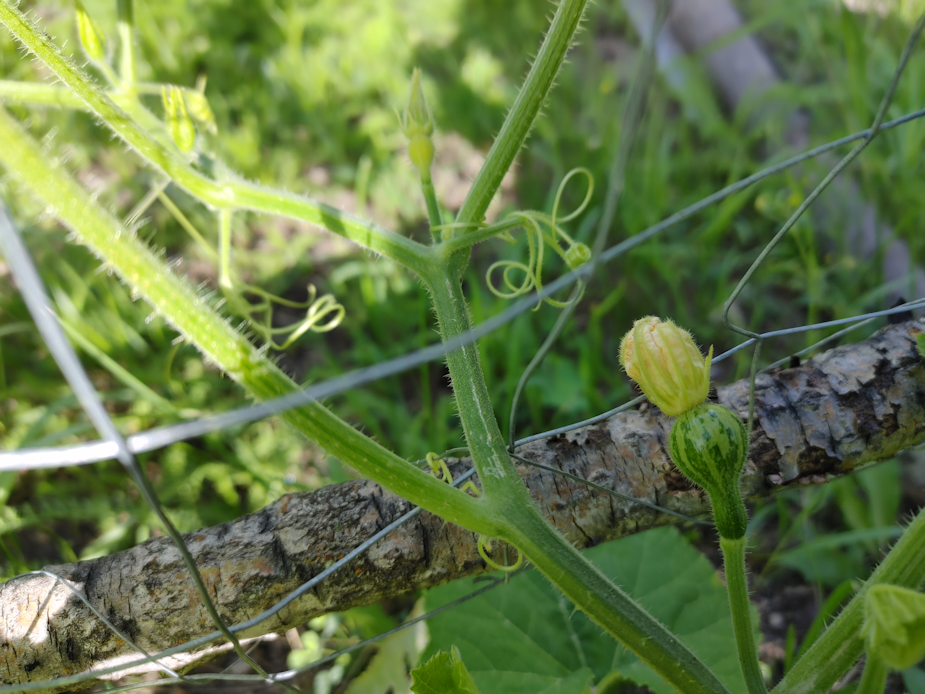
Caveman’s Club gourd: There have been male flowers for a while, so if these female flower buds survive long enough to bloom, there should be male flowers around to pollinate them.

Montana Morado corn silk: Finally! The tassels have been up and many already dropping pollen, but this is the first – and, so far, only – corn silk that has shown up. I was really starting to wonder. The Tom Thumb popcorn has tassels, too, but also had silk show up not long after. With the purple corn, there’s a much larger gap in time between them!

Goldy Zucchini: This one little yellow zucchini has been here for a few days now. It doesn’t seem to be getting any bigger, but the other flower buds seem to be at the same stage. This is the only surviving yellow zucchini plant, and the slugs are just all over it, so it’s not thriving. There had been a second one that germinated in the same hill and was starting to develop its true leaves, but there’s very little left of it anymore. I don’t know why the slugs like this one plant so much!

Honeyboat Delicata: Finding a female flower in full bloom was a very nice surprise! Unfortunately, there are zero male flowers on any of the other Honeyboat Delicata. I ended up taking a male flower from another squash to pollinate it by hand. That should be good enough for the fruit to actually develop, but we won’t be able to save seeds from it, as they would be a hybrid. Mind you, maybe we want a Delicata/hulless pumpkin hybrid. 😄

It looks like we may actually get winter squash this year. Because they are all planted near each other, any squash we get will be cross pollinated. I’m hoping we will at least be able to have mature squash to taste, and see which ones we like the most. After that, we can focus on just growing one or two varieties we like, in such a way that we can save seed.

And finally, one more nice little surprise.

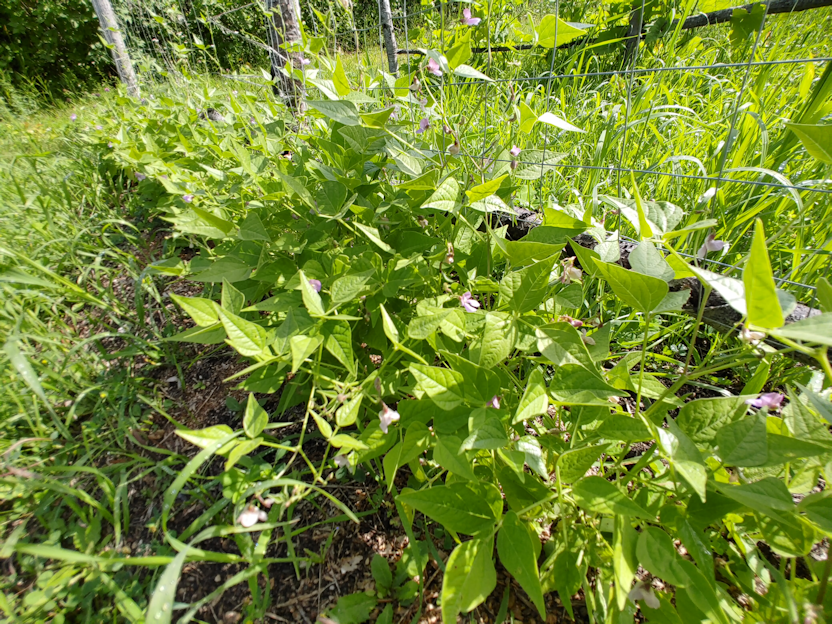
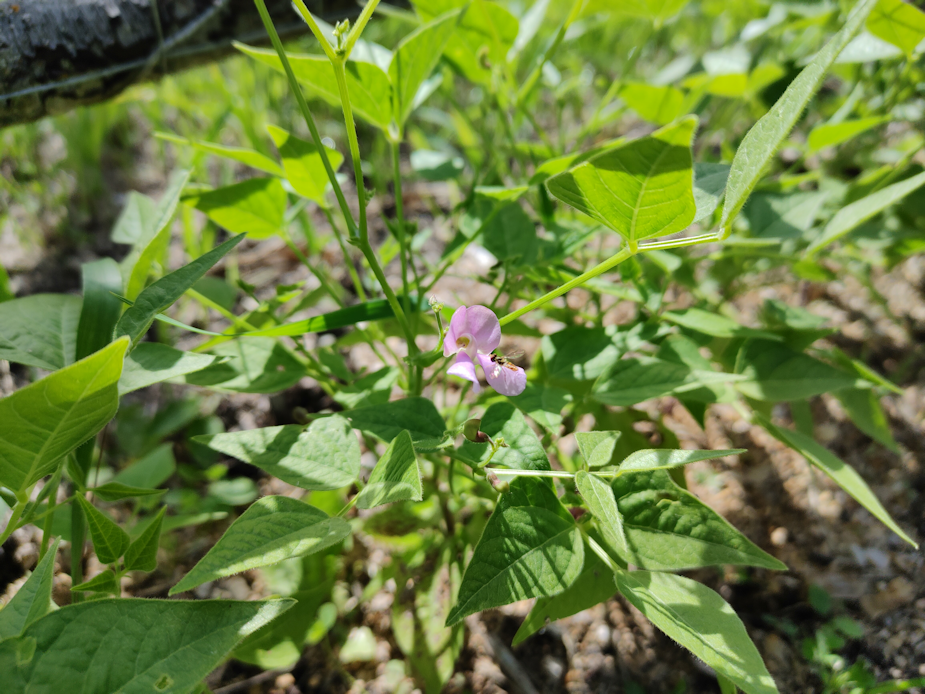
Our first beans are starting to form.

These are volunteers in the compost heap!

I have no idea what kind they are. There are no beans that we planted last year that could have ended up with viable seeds in the compost pile. Also, no beans that we planted last year had green beans with pink flowers.

I am very curious about what we will get out of these, and will probably leave at least one plant unharvested, so we can see what the dry seed looks like.

Oh, and one last little update. We had the Irish Cobbler and Red Thumb baby potatoes with supper last night, and both were delicious. I just love how the Red Thumb potatoes are pink, all the way through! We’ll be leaving the rest to harvest in the fall, but at least we know they are good, and worth growing again.

We’re past the middle of July and not having the sort of harvests we expected, had we been able to plant everything we intended to, but we will have something, at least. Looking back at garden pictures for this time last year, I can at least say we’re not “behind”. It just feels like we’re behind, because I’m seeing so many people in my Zone 3 gardening groups, posting pictures of their harvests and gardens. There are very few people in those groups that are as far north as we are, it seems.

We are definitely having good progress, though. It’s been a good growing year so far, with plenty of heat, sunshine and rain – but not too much of any of those! It’s been juuuust right.

For now! 😄

The Re-Farmer

How they turned out

Last night, after saving some for planting next year, I picked over the blue grey speckled tepary beans we grew, then left them to soak overnight. I ended up using all of the remaining beans.

This is how they looked after shelling.

After soaking overnight, they looked like this.

The got a bit bigger, but not by much, really.

I was going to use them in a soup, and decided to cook them separately, first. This is how they looked after being cooked al dente.

The colour is off because the camera got steamed up. They did lose a lot of their colour, and I noticed they turned the water quite grey, so I’m glad I decided to cook them separately, first. Otherwise, they would have turned my soup grey!

I was going to make a cream of chicken soup, but ended up making an “everything but the kitchen sink” soup. My daughters had roasted several whole chickens, with our own potatoes, a couple of days ago. Today, I deboned what was left of them, and used the remaining roasted potatoes in the soup, too. I also used a couple of yellow onions from the garden, the single shallot I’d picked yesterday, the last bit of slab bacon we had, and all of the Kyoto Red carrots, since there were so few of them. The tiny sweet potato harvest was used up, along with the last of our summer squash – green and yellow zucchini, and yellow patty pan squash. Corn kernels, cut from the cobs, went into the pot, as well as some of the tomato sauce I’d made recently. After everything was cooked, I took the immersion blender to it for a while, adding in some whipping cream at the same time. The very last thing was a handful of shredded cheddar cheese.

I tasted the beans after they were cooked, and they tasted like… beans. 😁 I had not added any seasonings of any kinds, so they were as plain as plain could be. Once in the soup, I honestly couldn’t taste them at all. They did add a nice texture, though, and the ones that got hit with the immersion blender helped thicken things a bit. I like my soups hearty and thick!

I think they worked out rather well, but… well… Aside from what I took out to plant next year, that was an entire year’s harvest, used up in a single pot of soup! 😂 I’ve set aside twice what we planted this spring. Between that and if we get a better growing year, it would be nice to have a much better harvest next year! I also have some beans my mother gave me. I don’t know the name of them, but they are a small (though bigger than the tepary beans) white bean that she grew every year from her own seeds. She’d given some to my sister, who grew them for years. She doesn’t grow beans anymore, so she brought a pasta sauce jar – just shy of a quart – full of seeds to my mother. My mother has no plans to grow them, in her little garden plot, so she gave them to me! They’re a few years old, but there should still be a decent germination rate. Which means that, next year, we should have two different types of shelling beans to grow.

The more, the better!

The Re-Farmer

Our 2022 garden: some progress, and a little harvest

It’s just past 10pm as I start this, and we’re still at 21C/70F, and the higher winds of earlier today have died down to a lovely calm. I found myself looking for reasons to get the fire going, but I really need to get some sleep tonight! Sleep has been frequently interrupted for the past while. 😕

Lack of sleep wiped me out enough that I was feeling quite ill this morning, to the girls took care of feeding the critters so I could try and get at least a couple of hours in. With Leyendecker still in recovery in my room (no, he wasn’t the one keeping me up at night!), and my daughters still having their days and nights reversed, my younger daughter has been taking her “night shift” and sleeping in my room, to keep and ear out on Leyendecker while I’m out. (He seems to be doing all right, though still having difficulties voiding, so we are monitoring him very closely) In the end, it was almost noon before I finally was able to head outside and do my rounds – minus the critter feeding.

Of course, a fair amount of that is spent checking things in the garden. Things like this.

Here we are, into September, and the Red Noodle beans are just starting to show flower buds!

This Kakai hulless squash was the first to develop and is looking like it’s ripe – but it’s about a quarter the size it should be. If the weather holds, there’s a chance we’ll have a couple more, larger ones. In fact, all the hulless pumpkins are going rather well, compared to the other winter squash. Only the Baby Pam pumpkins are managing as well. The Lady Godiva should give us at least 2 fully developed squash by the end of the growing season, with a few more little ones developing. Likewise, the Styrian variety has a couple large pumpkins that should be harvestable by the time growing season is done, with a couple more developing.

As for the Baby Pam, we have a little few bright orange pumpkins that could probably be harvested, that are smaller than they should be, but there are others that are still growing and turning colour that look like they will reach their full size – which isn’t very large to begin with.

This Georgia Candy Roaster is one of two stunted plants that were just covered in slug trails this morning!

While watering this evening, I was amazed to find female flowers among the Georgia Candy Roaster, and even one Winter Sweet. I hand pollinated them, just in case, but I think it was too late for one of the Georgia Candy Roasters.

While harvesting, I was surprised by how many Yellow Pear and Chocolate Cheery tomatoes were ready. I took the few G-Star patty pans that were on the plant killed off by a cut worm.

A few more of the Cup of Moldova tomatoes were ripe enough to pick, and into the freezer the went, with the others needing to be processed.

I keep saying I need to get those done, but the fact that they are in the freezer actually frees me up to work on other things. But that will be in my next post!

As for the garden, it’s a waiting game. So far, we’re not looking to have cold temperatures or frost for the rest of the month. With our first average frost date on Sept. 10, that is very encouraging. I plan to do recordings for another garden tour video on that date. Hopefully, thing weather will hold and things will have time to catch up.

I’d really like a chance to try those red noodle beans!

The Re-Farmer

Our 2022 garden: progress, and one last cardboard mulch

There wasn’t much of anything to harvest this morning. I picked a few shelling peas and just ate them right away. There was no point in bringing so few inside! At least with the first planting of peas. The second planting is looking like it will have a decent amount to pick fairly soon.

I really don’t know what to make of the beans at the tunnel. These are the Blue Grey Speckled Tepary shelling beans. They are so small and delicate looking. They are just barely tall enough to reach, but are managing to climb the mesh. I have no idea how big these would normally get, but for a shelling bean, I would have expected them to be at least as big as…

… the red noodle beans on the other side of the tunnel. These are much bigger plants, but there is still no sign of any vining happening. I’m not seeing any flowers, either. Given that it’s the start of August and our average first frost date is Sept. 10, I’m starting to wonder if we’ll get any of these at all. Even if we do get a super long, mild spring, like we did last year, I wonder if we’ll have any of these at all. At least the purple beans on the A frame trellis are blooming and producing tiny little pods, with vines extending well past the top of the trellis frame, while the green beans on the other side are climbing and blooming.

I have never grown pole beans before, but I really expected them to do better than this. This area did not get flooded out the way the bed with the green bush beans did.

Well, next year we’ll be moving the trellises closer to the house, and this area will be getting perennials planted in it. Parts of the area will need to be kept clear because of the phone line running under it, but not all of it. Hopefully, a new location for our legumes next year will be better.

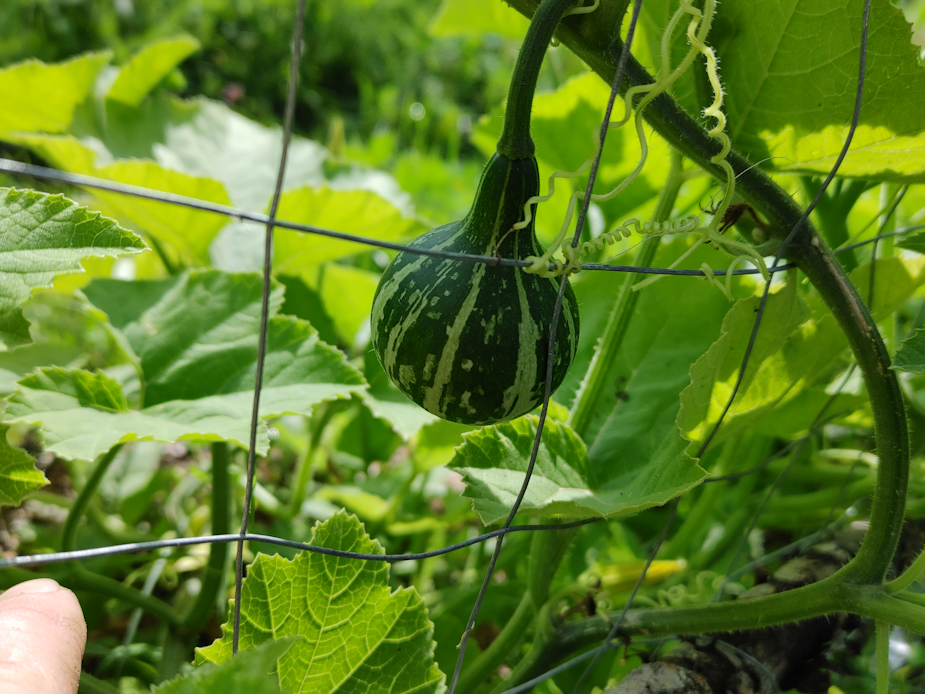
The dancing gourds are doing rather well, at least! The plants are much stronger and more vigorous this year than they were during last year’s drought. So far, there is just this one early gourd growing, though I am seeing quite a few female flowers developing. This one gourd is already bigger than the biggest we had last year. For perspective, the squares in the wire mesh are 2 inches.

In between the tunnel and the A frame trellises are some hulless pumpkins. They are the last patch without the cardboard mulch. I still had the cardboard sides from the wood chipper in the garage, so I decided to use it.

This is how it was looking. There’s an awful lot of creeping charlie making it’s way through the straw mulch around the pumpkins in the foreground. There are actually less weeds than it appears, though, just because of how they spread out.

The cardboard from the wood chipper box was very heavy duty, and had even more staples holding it together than the lawn mower box I used on the Boston Marrow. Cutting it so I could put it around the plants took some doing! Sliding the cardboard in place required quite a bit of care, too. The vines were gripping the straw and weeds quite strongly.

I placed some of the protective poles back, around the patch, and will be adding scythed hay mulch on top as I am able, but I find myself wondering if I should make a support frame for the vines to climb. I don’t know if that would actually help these or not. At the very least, I’ll be adding cord around it, to discourage deer from walking through.

There were quite a few female flowers on the vines, but I found only one male flower, so I used it to hand pollinate as many of the female flowers as were ready. While moving the vines onto the cardboard, one of them had already fallen off, because it had not been pollinated. Hopefully, the hand pollinating will help.

All three varieties of hulless pumpkin have at least some developing pumpkins. Some of summer squash is also finally picking up; the sunburst patty pans are starting to show female flowers again. The Madga squash seems to be doing the best, and we finally have yellow zucchini starting to develop. Not so much of the green zucchini, though.

At least we will have lots of the determinate tomatoes. Even the Cup of Moldova tomatoes are starting to show more of a blush in them.

If the weather holds and the frost stays away, we might still have something to harvest this fall.

The Re-Farmer

Our 2022 garden: things are trying to grow

My daughters were sweethearts and took care of feeding the cats outside for me, as I’m still feeling pretty unstable, so the cats weren’t out and about by the time I headed outside. I did get to briefly pet a kitten, though! :-D

While checking out the garden, there was some new progress – and a bit of deer damage – to find.

The Carminat beans are reaching the top of the trellis, and you can see their flower buds. At my fingers, however, you can see the stem of a missing leaf! There was a vertical row of missing leaves, a few feet along the trellis. Right about deer height! Time to find more noise makers and flashy things to set up.

On this side of the trellis are the Seychelles beans, which are starting to get pretty tall, too. None of them show deer damage, which is good, since less of them germinated. In the foreground are the self seeded (or should I say, bird-seeded) sunflowers that I left to grow. The beans can climb them, too! With the flooding this spring, we did not plant any of the Hopi black dye or Mongolian Giant sunflower seeds we’d collected from last year, so I don’t mind letting these one grow. These would be the black oil seed that we put out for the birds in the summer. We’re finding them all over the place, thanks to being spread by birds!

The first sowing of shelling peas may be about half the size they should be, but they are loaded with pods. At least on the north end of the pea trellis. Towards the south end, the sugar snap peas are barely surviving, and the shelling peas on the other side of the trellis are much weaker, too. The entire trellis gets an equal amount of sunlight, so this would be a reflection of soil conditions.

This should be the last year we use this spot for growing vegetables. Next year, they’ll be moved closer to the house, and this area will be made available for planting fruit or nut trees. We haven’t decided what to get next, yet.

The cucumber row is a mixed bag of plants that are growing nice and big, and filled with little cucumbers, and others that are barely bigger than when they were first transplanted!

I had an adorable find at the big trellis.

We have a first Tennessee Dancing gourd developing! It is so cute!

The beans on the same side as the dancing gourds are the red noodle beans. The plants are pretty large, but they are still not at the point of climbing. The shelling beans on the other side, however…

The are much smaller, but have tendrils climbing the trellis, and have even started to bloom!

The most adorable little pollinator showed up just as I was taking the picture.

I startled a bee when checking out this HUGE pumpkin flower.

Yes, it’s on a giant pumpkin plant. 😁

I’d seen some female flowers previously, but now I can’t find them, so there are no pumpkins starting to form, yet. While we are not shooting for super big pumpkins, and won’t be pruning them down to just one pumpkin per plant, it feels like it’s too late in the season for any giant pumpkins to mature. We’re near the end of July already, and none have formed, yet!

In the south yard, we finally have Chocolate cherry tomatoes! Just this one plant, yet. Of the 4 varieties we planted this year, the Chocolate cherry have been the most behind – and they are planted where tomatoes had done so well, last year. The plants themselves are getting nice and tall, and we’ve been adding supports and pruning them as needed, but there are much fewer flowers blooming, and only today do we finally have tomatoes forming. Thankfully, the other varieties are much further along.

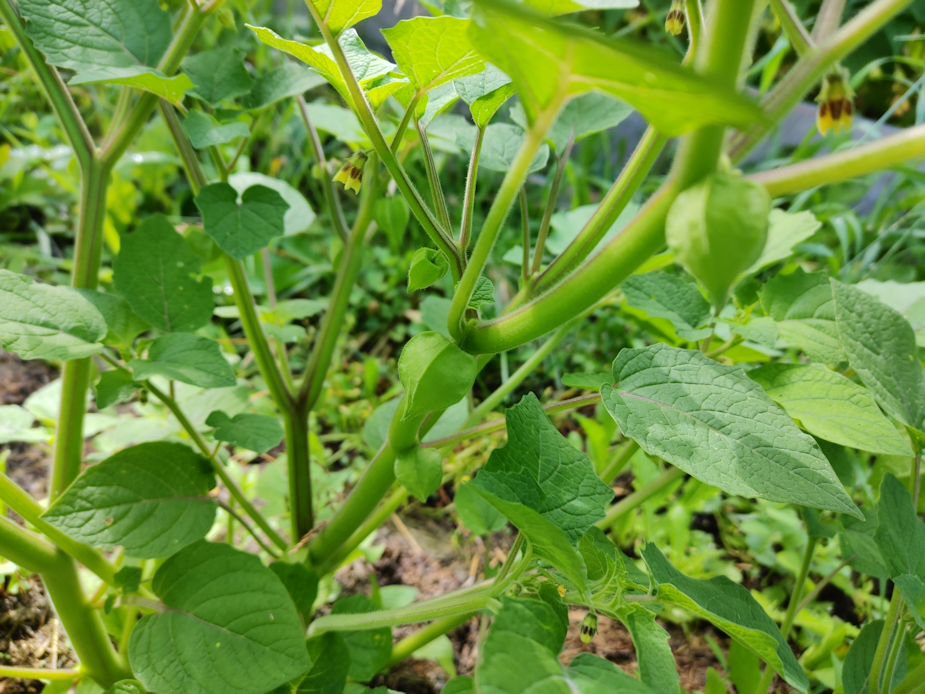
I also spotted some ground cherry fruit forming! These plants are doing remarkably well, given how much water they had to deal with this spring. It took a while, but not they are quite robust plants, and I’m happy to see them setting fruit!

Hopefully, it won’t be too much longer before we start getting actual food from the garden. Everything is so, so behind, I am extra happy to see progress like this.

The Re-Farmer
Our 2022 garden: bed prep, cucumbers, peas, beans, summer squash, gourds

Oh, my goodness, what a gardening day!

Did we bite off more than we can chew?

Maybe we did.

It was a hot and sunny day, and so many trees and bushes are blooming right now.

The regular and double lilacs are just starting to open. The sour cherries are in full bloom. The Saskatoons and chokecherries are pretty much finished blooming, but the different crab apple trees are in various stages of exploding into flowers. There are also three other types of lilacs that are starting to bud, each blooming at a different time. It’s awesome!

My first priority of the day was to prep the beds at the trellises and get them ready for planting.

What a big job that turned out to be.

It didn’t take long before I found myself pulling this bugger out. Normally, I wouldn’t have tried to take out something so big, but it was close enough to the surface that it would inhibit root growth. I’m sure I hit others bigger than this, judging by my inability to work the garden fork around them, but they were deep enough that I just left them. We may get one more year out of these trellises, but most likely, next year, we’ll be building trellises closer to the house.

This trellis was so full of roots – including tree roots! – that this one bed took me about 4 hours to do.

Thankfully, the other one didn’t take anywhere near as long!

After we’ve planted into them, each upright post is going to get it’s own pair of A frame netting supports for things to climb.

At this trellis, on the right hand side, my daughter planted all the cucumbers. On the left hand side, in the foreground, is at least two, possibly four, luffa gourds. I was using labels made out of sour cream containers, and Sharpie’s fade from those! So much for “permanent” markers!

The gourds took up only a quarter of the row. We ended up planting the last of our Lincoln Homesteader pod peas in the rest of that side.

This trellis got the remaining two varieties of pole beans. On the right are Carminat, a purple type of bean. On the left are Seychelles, a type of green bean that Veseys doesn’t seem to carry anymore.

There was some space left at the bean tunnel that got filled with 4 Tennessee Dancing Gourd and 2 luffa.

The girls, meanwhile, got the last low raised bed weeded and ready for planting.

This bed is now all summer squash. The front half has 8 Sunburst patty pan squash. The back half is split between Madga squash and Golden zucchini.

While one daughter transplanted all of those, my other daughter was digging.

We were going to make more beds, but we just don’t have the materials, so we’re winging it. My daughter dug a grid of 7×7 holes roughly 3 feet apart. Before I headed in, I used the jet setting on the hose to drill water into each hole, to help soften the soil. We’ll be transplanting winter squash, gourds and pumpkins into here, with added garden soil and straw mulch. We need to go over it with the weed trimmer to cut the grass and weeds back as much as possible, before the mulch is added.

Hopefully, we’ll be able to get this done tomorrow, but I won’t be much help with that until evening. My husband and I have our doctor’s appointments in the afternoon.

For summer squash, we do still have the green zucchini, plus the G-star patty pan squash.

I have no idea where we will be transplanting those. I also don’t know where we’ll be transplanting the ground cherries. There’s the corn to direct sow, too, if we’re not already too late for those. We have the space. What we don’t have is any sort of prepared beds left.

I’d really hoped to get everything in today, but everything just took so much time.

What a long, long day it’s been.

The Re-Farmer
Our 2021 garden: almost frost

When I woke up this morning, we were at 2C/36F

We had not gotten any frost warnings the night before, but when it gets that cold, it’s going to be too much for some things, with our without frost.

The last few days, morning and evening, we have been hearing a cacophony of geese in the surrounding fields. Something must have disturbed them this morning, because they were not only louder than usual, but I even got to see them flying overhead.

Going north, for some reason! :-D

Last night, my daughters had picked more tomatoes and a few summer squash, and this morning I was going to pick beans.

It looks like we’re now done for beans.

They may not have gotten an actual frost, but the foliage was clearly damaged. The purple beans have a lot more foliage, which protected the pods, but I could see cold damage on the green and yellow beans.

I had taken some photos yesterday, which ended up giving me comparison photos with today. Here is the Crespo squash.

This was taken yesterday afternoon.

This is the smaller of the two squash in the previous photo.

This is the larger one, yesterday (on the left) and this morning (on the right). :-(

This is one of our biggest squash. Yesterday’s photo is on the left, and this morning is on the right. This squash is shaded for longer in the morning, and you can see there is actual frost on it!

These next ones are photos from yesterday and, from what I could see, they were okay this morning.

The one that’s hanging is in a spot where it gets hit with morning sun earlier than others. The large one on the ground has foliage around it that may have protected it. Unfortunately, it’s hard to see, so I can’t actually say for sure if it was damaged or not. It’ll take a bit more time before we’ll know if they got cold damaged or not.

Then there are the Ozark Nest Egg gourds. I took these photos last night, but didn’t bother to take more this morning.

We will have a better idea as the day goes on, but as of this morning, they seemed to have no real damage at all. There are still so many little gourds all over, there are still flowers that look like they are opening, and there was no signs of cold damage, like on the Crespo squash. These gourds are in the south yard and get that morning sunlight nice and early, which may have made the difference.

The tomatoes on the south fence also looked untouched by the cold, but the one that had seeded itself in the lettuce bed looked like it was hit by frost. That bed gets shaded more, longer, this time of year. If we’d gotten a frost warning, I would have put the wire mesh cover back on and covered the bed with cloth. The lettuce is fine; it can handle temperatures even colder than this. The chard was also just fine.

It will be good when these beds all get converted to high raised beds. They get full sun in the summer, but when the sun is lower in the sky, several of them get more shade from the trees to the south. Once they are higher, they will be out of the shade, just a little bit sooner. Still, it is something to keep in mind for when we garden here in the future. It’s also another reason why I want to build permanent garden beds on the south side of the house, in the outer yard, where we don’t have so many tall trees to deal with.

As it is, we’re in the middle of October, and these have lasted far longer than we normally would have expected in our climate zone! So really, I can’t complain!

The Re-Farmer

Morning harvest, and getting named

Check out what I was able to gather this morning!

There are quite a few more of the purple beans buried underneath. They have been, hands down, the most prolific bean producers, and if the weather keeps up the way it has been, we will be picking beans for at least another week or two! Even the yellow beans are putting out a second crop. With the drought conditions, none of the bean plants are as large and bushy as they should be, with the green and yellow beans particularly stunted, even as they continue to produce. With the green beans, that resulted in my finding bean pods that were almost as long as the plants were tall!

I had to get a bigger container to collect tomatoes with, instead of the red Solo cups we’ve been using until now. The vines are dying back, yet they still have so many ripening tomatoes!

Earlier today, I made a quick trip to the post office, before I gathered our morning harvest. The general store it is in always closes at noon on Wednesdays, so I had to do it early, but not too early; I knew the postmaster would need at least an hour from opening, to sort through the morning mail. We had some packages to pick up, but one of my daughters also had a package that was supposed to be delivered by courier, directly to our address, as it was from a place that does not deliver to box numbers.

Which has always been a problem, since our physical address doesn’t come up in searches. Like pretty much all of the roads around here, our road has two names; one is a numerical designation (part of the provincial system), and the other is our family name (a municipal thing). Many of the local roads are named after local families. It was only recently that I discovered that the road past our place has no name on the maps at all! Not even the road number. Which certainly explained why delivery companies had such a problem finding us!

My daughter was keeping an eye on the tracking number, however, and got a notification that her package was delivered to our door at about quarter to one. Of course, there was no such delivery, since the gate is locked. I could see nothing on the live feed of the security cameras, but my daughter went to see if it might have been left at the gate. Sure enough, I watched her on the camera as she got to the gate and picked up a white package. Which was on the gravel of the driveway, which also looks pretty white on the camera! No wonder I couldn’t see it!

I’m impressed that they found us, but it reminded me of something I wanted to try. Using the maps app on my phone, I found our road and took a closer look. It turned out that there is a 4 mile stretch of our road that is not labeled at all, however to the south of us, the road ends at another road, then restarts a short distance away. From where it restarts and continues south, it is labeled with the same numerical designation as the signs we have on our stop sign.

The four mile section that had no label is the only section that has our family name assigned to it. The offset part of the road with the numerical label probably has another family’s name assigned to it.

The app now has a function that allows the map to be edited. When I used that and started to select sections of the road, it simply said “unknown road”. I was able to select all 4 miles that had no label on it, then put in the name. It gave the option to add more information, so I added that it was also known by the numerical designation. I then sent the edit to Google Maps. I’ve already got a confirmation email saying “Thank you for your contribution. Your suggestion is being reviewed. Thanks for sharing your knowledge. We’ll let you know once the changes are published.”

Hopefully, that means or road will finally have a name attached to it on Google Maps, and people will be able to find us more easily! Plus, with the name rather than the number on the map, it will also match what is on not only my driver’s license, but on the licenses of several of my neighbours, too!

Speaking of which, I am hoping to get a chance to visit the one that sells pork products at the farmer’s market today. With our province’s latest draconian restrictions, organic humans are no longer allowed in “non-essential” places, even though such mandates are expressly forbidden in our laws, at both the federal and provincial levels. Vendors at markets aren’t required to be GMO though; just the customers. So I will just have to skip the market, and go right to the source! :-D

I’m quite okay with that. They are a homesteading family that are a few years ahead of where we want to be, as far as self-sufficiency goes, and I would love to see how they’ve been doing things! I may have grown up here on the farm, two sticks ahead of the stone ages, but I am more than happy to learn new, better and more efficient ways to go things! Especially since we’re only about one stick ahead of the stones ages now. ;-)

The Re-Farmer