Such a good mama! plus, isolation shelter progress

Must start with the cuteness!

I spotted Adam nursing this brood in front of the sun room – and I needed to get past her! I had to go back and forth from the sun room a few times, and saw her nursing in the same spot again, but with different kittens!

She is such a good creche mama. So chill with the babies!

Not with people, though. She still won’t let us near her, and ran off when I got too close. Unfortunately, she seems to choose high traffic areas to lay down and nurse!

Meanwhile, I got a bit more progress done on the cat isolation shelter.

As I mentioned in my last post, I changed the plans a bit. The original plan was to basically have a cube with the outside frame divided into quarters, vertically and horizontally. I had it in my mind to attach the vertical pieces first, like wall joists, then horizontal pieces to support the floor boards in the second level. The problem was, how to attach the shorter horizontal pieces, with the materials I had on hand. There are brackets and braces that can be used to make the job easy and secure, but I don’t have any, and don’t have the budget to get them.

Then it occurred to me that this shelter doesn’t need vertical support. The true to size 2x4s are strong enough on their own. I’ll still add them, as they will help hold the welded wire mesh, but it’s the horizontal pieces that are more important, since they will be supporting the floor boards.

So the longer regular size 2×4’s I cut will now be mounted horizontally instead of vertically – they will be doing inside the 4′ square front and back frames, so the measurement doesn’t change. I needed two more for the shorter sides, which meant I needed to more pieces the same length as the pieces that will be the top and bottom.

In the first photo of the Instagram slide show, you can see the two new pieces that were cut. The others, meanwhile, were flipped and ready to get their other sides painted.

The rough cut true to size 2x4s sure use up a lot more paint compared to the smooth regular size 2x4s!

I still had the problem of how to attached them to the front and back frame pieces. They will be butted up against the edges. I decided to cut pieces at 45° angles that will be butted into the corners to give me something to screw into. These will be needed for the top and middle pieces of one side. I’ll need 4 more of these for the other side. I used leftover scrap pieces of true to size 2×4 I do have a short length of that left. I’ll see how these work out before cutting more. I might decide to do it a different way. Or just cut them a bit longer. That was my original intention, but the pieces I had left over weren’t long enough.

Hmmm… now that I think about it, I can use longer pieces to support the top corners of the frame, and these shorter ones to support the horizontal pieces in the middle of the frame. I’ll have to think about that some more.

I did have an issue making the 45° cuts. I’m using the miter saw I picked up at a garage sale a couple of years ago. Today is the first time I needed to make angled cuts.

I don’t know how long its been since this thing was used for angle cuts, but it had to be a long time! I had to get lubricant to get it to turn all the way, from one side to the other! But, I got it done, and am soooo happy I have this saw! Previously, I used a hand saw and miter box to make cuts like this, and that really sucks. Especially with wood as hard as this! My soil sifter’s frame would have turned out much better if I’d had this when I made it. 😄

At this point, there isn’t much more I can do until all the painting is done. Once I have the outside frame assembled, I can take the measurements I need for the cross piece that will go through the middle to support the floor, and for the vertical pieces. I’m not working with two different sizes of wood, so I don’t want to count on just doing the math.

I’m not that good at math!

After cutting the 45° angles, I was left with a bunch of equally sized triangles that I’m hanging on to; they might come in handy, later. I should have had 8 of those, but one of them fell apart, because the end of the 2×4 I was cutting off was one of the more damaged pieces.

The painting, unfortunately, is going to take a while, since it basically needs a whole day to cure. It wouldn’t normally take that long, but it’s humid enough to slow things done and keep things very tacky! About the only other thing I can do in between flipping and painting the boards is cut and start painting four more angled pieces.

Still, progress is progress, and I’m happy with how it’s going so far.

The Re-Farmer

Starry skies, shelter progress and a surprise visit

First, the cuteness!

With all the tasks outside I’ve been working on, I’ve been forgetting to take pictures of kittens!

Today turned out to be a fairly productive day. I’m actually a bit surprised, all things considered! 😄

The girls and I headed out around midnight to watch for meteors. We did see some, as well as some Northern lights.

We set up the tripod and just randomly took photos of different parts of the sky, hoping to catch something. We did catch some meteors in a few photos that were so small and faint, we didn’t see them as they happened. There were a few brighter ones that happened in between shots, and one huge, bright one with a bright green tail that flashed by. That one was awesome!

In the photos in the Instagram slideshow, the third one has the spotted streak of an airplane’s lights. We actually have a pretty busy sky with planes and satellites visible. It was a gorgeous night for starwatching, that’s for sure! We could see even more stars than the night before.

Unfortunately, once we got back inside and I finally went to bed, I wasn’t able to sleep for most of the night, so my daughters were sweet enough to take care of some of the morning stuff for me so I could sleep in. Once I did get outside, my priority was watering the garden before it got too hot. Our expected high was 27C/81F, which I’m sure we passed. As I write this, it’s past 6:30pm, and we’re still at 25C/77F, with the humidex putting us at 27C/81F.

While I was watering the garden beds, I took advantage of the fact that we have some lovely grass clippings that has been lying out long enough to start drying, and topped up the mulch on some beds. For a few, I just scooped up some armloads, but in some areas I brought out the wagon and raked up a windrow. I gathered a couple of wagon loads, but there’s still plenty left to collect. I want to make sure to collect the thickest areas, as they are thick enough to actually kill the grass below if they’re left where they are. I’ll take care of the rest, tomorrow, though.

Once the watering was done, I paused for … brunch? … then headed back out again. I had one last edge of the isolation shelter boards to paint, and then I wanted to calculated and cut the next set.

I had a few pieces I could cut out of the true-to-size 2×4’s I had, though I ended up having to cut off rotten/uneven ends before I could make my measurements on these ones. Once I got four pieces that will be joining the front and rear frames, that was it for the true to size boards. The next ones had to be cut from a regular 2×4’s. I actually need 2 more of that length, but I got distracted and forgot.

After I’d laid the newly cut boards out to brush the dust off, I was going to give the paint more time to dry and switch out the foam bumpers on the gate and replace the twine and pin for the sliding bar – all of which were disintegrating from being in the elements for several years.

I happened to step out of the garage when my phone dinged at me. I had a text message from my sister!

There is no signal in the garage, so I got it several minutes after she’d sent it, and she was asking if I was home.

It turns out she was in the area, visiting the local cemetery.

Also, did I want some cucumbers? 😄

What she didn’t say was whether or not my mother was with her. I did tell her that I’d gone to the cemetery last month and left fresh flowers at our family graves – and said no, thank you to the cucumbers. The last time she gave us cucumbers, we couldn’t finish them all, even after making a dozen jars of pickles!

I figured her ability to receive texts would be about the same as mine, so I had no idea when she was going to get my answer. I had to go to the house to get some of what I needed for the gate, and made sure to grab the gate key, as well. As I was walking back to the garage, I could see through the trees.

There was a car at the gate already! 😄

I’m glad I grabbed the gate key!

Also, as I write this, I am eating a cucumber salad my daughter made from the cucumbers my sister gave us. 😄 Not as much as the last time, though, so we won’t be overwhelmed!

I ended up giving my sister a tour of what we’ve been doing around the place, including the garden, of course. She wanted to see it as she wasn’t sure she’d make it out this away again this year. My sister being my sister, she took lots of pictures, including some with me in my grubby, torn up work clothes! 😂 Then we sat in the the shade on one of the benches I made and just talked. She was still planning on visiting my mother on her way home – and drop off more cucumbers! – so she didn’t stay too long.

As she was leaving, I followed along and worked on the gate. We use sections of pool noodles as bumpers. With where the hinges are attached to the posts, when the two halves of the gate swing outwards, towards the road, the metal gate hits the metal posts, so the bumpers prevent more damage. Small sections are also added over the hinge pins to protect them from the elements.

The pin for the sliding bar was just a long screw with its tip cut off, tied to the gate with twine. The twine was barely holding together, and the screw was rusting, so I picked up a long screw eye to replace it. I use mason line instead of twine. Having the screw eye to attach the line to was a lot more secure than just knotting bale twine under the head of a deck screw! 😄 I was even able to attach the line to the gate in a more aesthetically pleasing way, too. The only potential problem I see is that the weight of the screw’s eye might cause it to fall out, however there’s enough slack in the line that I could use it to wrap around the end of the screw eye and hold it in place.

At least, that’s the theory!

Once that was done and everything was cleaned up, it was back to the garage.

The painted boards were just dry enough to move them off the sawhorses and onto the pallet to finish trying, and I was able to get the first sides painted on the newly cut pieces.

Once all these pieces (including the two more longer ones I need to cut) are painted, I can then assemble the external frame of the isolation shelter. Once that’s together and secured to the pallet floor, I’ll be able to figure out the best way to put together the inside parts and get the measurements needed.

I’m hoping I have enough salvaged lumber to finish the frame, including the pieces that will support the floor of the second level. I have wider boards left over from another project that will make a good floor on the second level.

This above Instagram slideshow has my original sketched plans. I’ve had to change some things, but the general concept is the same. The second level will have a floor covering 3/4 of the space, but there will be room to add other things, as inspiration strikes. All of the inside stuff needs to be put in before the mesh walls or the roof are added. Though if I can figure out the best way to do it, a hinged roof would certainly make it easier to access the inside, should something need repair or replacement.

I’m happy with the progress made so far. I just hope I didn’t screw up on my math!

The Re-Farmer

Beautiful night, productive day

As I posted earlier, in the wee hours of the morning, my daughters and I had done out last night to see the Perseids meteor shower. My daughters had read that the peak viewing period would be around 3am. We even brought out the tripod so I could set my phone up and take photos.

Well, we didn’t see very many meteors, but we did get a light show!

My older daughter’s the one who actually took most of the photos. I the fourth one of the slideshow, at the top near the middle, you can just see that a meteor was caught in the shot.

It was an awesome night, too. Lovely and cool – just the perfect temperature! – with nice clear skies for viewing the stars.

The meteor shower is supposed to be visible tonight, too. I checked The Farmer’s Almanac, and it says that the peak viewing period should be around midnight, not 3am, but I guess that depends on what time zone you’re in. Either way, we plan to be out again tonight, at around midnight.

After we were done, my older daughter got back to work and my younger daughter ended up staying up as well. They have been arranging their sleep schedules so that and one of them is up and available, any time of day, and my younger daughter has the “day shift”. 😁 She was a sweetheart and took are of feeding the outside cats this morning – and washing the one kitten’s infected eyes – for me, so I could get a bit of extra sleep.

Once I got outside, my priority was to water the garden before it got too hot, then did a bit of harvesting. After I had breakfast… er… lunch, I made a trip to the post office, making sure to leave the gate open when I got back. I got some more painting done on the pre-cut frame pieces for the cat isolation shelter – three sides are now done. I then spent the next couple of hours, mowing. The driveway hasn’t been done in so long, I had to go over it twice to get it cut to the length I wanted.

I’m going to have lots of “hay” to collect! The grass is so thick in places, even this mower, set as high as it could go, was struggling!

Gosh, it all looks so much better!

Now that that’s done, I’ll get back to cutting more lengths of wood for the isolation shelter frame, so they can be painted before construction, too.

As I think about the construction, I am debating how to make the access doors. There’s going to be a main door that will swing down and convert into a ramp when it’s open. When not in use as an isolation shelter, we plan to leave it open and available for the cats to become familiar with it, and a ramp would make it easier for kittens to get in and out.

Since I don’t have salvaged windows that slide open to incorporate into the design, I am thinking of making sliding doors instead of doors that swing out. I think that will give more security for if we have a particularly feral cat inside. We’d be able to reach in and out without having to open a sliding door all the way. With a swing door, the door itself would be in the way if we wanted to open it partially. A sliding door would also be handy for releasing a cat from a trap, as it could be opened just enough to fit the end of the trap.

I’ll have to think about that, some more. Whatever I decide for the access points, the rest of the structure doesn’t need to change, so I can literally wait until the shelter frame and interior is completely assembled, then see what works best.

I’m having fun with this build! It’s going to be the most complicated thing I’ve built and, with using salvaged materials or whatever we can afford to get, the plans have to be pretty loosey goosey!

Little by little, it’ll get done!

The Re-Farmer

Cat isolation shelter progress: looking good!

When I first started thinking about the plans for a smaller isolation shelter, one thing I did not think about was painting it. That’s always been something we dealt with after the build. Paint, however, is going to be needed, to protect the wood and keep it from rotting too quickly. This is especially important, considering that I’m using salvaged wood that already had damage to it.

Given that this build is going to have a lot of stuff going on on the inside, I decided it would be much easier to paint the parts and pieces before assembly, rather than trying to reach inside to do it.

In going through our leftover paint, the can that felt like it had a decent amount in it was the peacock blue used on the floating benches (benches built on tree stumps that aren’t painted, so they’ll look like they’re floating when things grow back under them) and the folding table we cobbled together. The can of red seemed to have some weight to it, plus I also found a quarter can of white that was used to make our sign for those trying to find our address that doesn’t exist on any online maps.

I know we’ll need a decent amount of paint, so why not mix them together? They are all water based exterior paints, so mixing them would work fine.

I started off by setting up the frame pieces that are already cut.

They all needed a bit of a cleaning of dust, dirt and debris, first. Once that was done, I opened the cans to see what we had.

The blue was about half full, but there wasn’t much left of the red or the white.

I had a very pleasant surprise once they were all mixed together. I really like the resulting colour! When it’s time to buy more, which I expect to need to do before the project is done, I definitely want to colour match this!

I had looked for paint rollers and trays, and I did find the roller frames and a tray, but no rollers. I know we have some. I even remember finding one still in its package. Where they ended up, I have no idea.

So, paint brush it was.

With the frame pieces, they were pushed close together so the tops could be painted all at once. The cut ends were done, and part of exposed sides of the row, but that’s it. After they were painted, I spread them out for air circulation as they dried.

I really like that colour!

Once that was done, it was time to put the wheels on the pallet.

My original plan had been to cut away part of the slats at each corner, so the wheels could be attached to the solid wood below. They were far too damaged to bother, though. These pallets were used by the roofers. While they were working, I have a fire going to burn the branches and wood that were too big for the commercial wood chipper used when we got the branch pile cleaned out, a couple of years ago. It was cold and snowing while the roofers were working, and they would sometimes go to the fire to warm themselves. When they were done, they tossed the pallets to the still-hot ashes. So what you’re seeing on the bottom of the pallet is ashes and a bit of scorching. The pieces at each long end got the most damage, so it was easier to just break them off and pull the nails. The slats were so cracked, it was easy to break them off by hand!

The ends were also a bit too damaged, so when I used the wheels to mark off where the pilot holes needed to be drilled, I butted them up against the next slats in.

Then I had to dig through our collection of wood screws to find ones suitable to attach the wheels. The ones I’d already brought to the garage were for attaching the frame pieces together, so there are a lot of really long screws, but no shorter ones. After digging around in the sun room, among the boxes of screws that cats hadn’t managed to spill all over the floor, yet, I found some that would do. Thanks to the new cordless drill and driver set, and the set of driver tips my husband got me for Mother’s Day, attaching the wheels took almost no time at all!

My husband is such a sweetheart.

Once the wheels were on, it was time to flip the pallet over and test them out.

Oh, they are going to make moving this thing SO easy!! They might have some trouble going through the grass in the yard, but that should be manageable. I love that they all rotate 360°, too.

That done, the top got brushed clean, and it was time to paint!

Have I mentioned, I love that colour?

I plan to do just one coat of paint, and will not be painting the underside. I did make sure all the edges were well coated, though.

Once that was done, I went and took garden tour video, then checked on the frame pieces. They were still too wet to flip, so the other sides will be done tomorrow, then the edges. In between painting, I’ll be measuring out and cutting other pieces, so by the time those are painted and dry on all sides, I’ll have more cut pieces ready to paint.

So that is progress on the cat isolation shelter, so far.

Next, I need to work on the garden tour video.

Oh, I’ve just been getting messages from my brother. They’ll be coming over tomorrow, early in the morning, to bring stuff to store in the barn. They do know we haven’t been able to mow a path to the barn, but I hadn’t told him yet that we have no working lawn mowers at all. He knows, now. They won’t be staying long or making much of a visit. My SIL is allergic to cats, so they can’t come into the house, really.

I’m looking forward to seeing them! That will be a great start to the day!

The Re-Farmer

Isolation shelter build started

I’ll be honest, here. We’re really just winging it on this build, even though it’s going to be quite a bit more complex than the kibble house and water bowl shelters. It all comes done so what materials we can scavenge.

There are plans, however!

Plans that needed to change, but still plans! 😁

The original plan was for a 4′ x 4′ cube, divided up inside to have an enclosed shelter that will be insulated, a not quite enclosed shelter for a litter pan, and two levels with space for food and water bowls, and just hanging out.

We had a couple of pallets that were left by the roofers. My original intention was to dismantle them and use the wood mostly for the floor.

That did NOT work out!

The pallets are nailed together mechanically. The nail heads are deeply embedded in the wood – and the wood is quite thin. When I tried to pry them off, the wood started splitting.

Time for plan B!

The pallet will be the floor, more or less as is.

I measured the pallet’s length and width at the boards inside, and each side was slightly different. I brought over the circular saw and cut the ends flush to the outside boards. The most damaged side will be the bottom of the floor.

I could still work with 4′ lengths on two walls, and the other two will be 40″, to fit on the pallet. The shelter will still be 4′ tall.

For the main parts of the frame, I’m using the true-to-size salvaged 2 x 4 lumber in the barn. There’s hardly any of that left, but there’s enough for this project. It feels like a shame to “waste” it on something like this. The wood is old and the ends have started to rot a bit, but it’s really solid and heavy wood. It is, however, what we have, so that’s what we’ll use. Other parts of the build will have more modern, standard 2×4’s, which are not true to size, and are quite a bit lighter. We have even less of that, so we’ll have to plan accordingly.

For now, I’ve cut lengths to make the front and back panels, which will be 4′ square. The frame will be attached directly to the pallet once put together, but that won’t happen quite yet. The dirt floor of the garage is pretty level, but not flat, mostly due to shallow tire ruts. Right now, the pallet can’t lie flat on the ground. I’m heading into the nearer city tomorrow, and will be looking at what wheels are available, and affordable.

Once the pallet has its wheels, it will be able to straddle the uneven parts of the floor, and be sturdier to work on.

Once the “box” is framed out, the interior will be worked on, including things like extra surfaces for cats to lie on, something they can scratch at, and so on. Once that’s all figured out, access panels or hinged doors will be made so that the litter box, food bowls and enclosed shelter can be reached from the outside. For the enclosed shelter, what I will probably do is make an insulated box that can be removed completely, if necessary.

I haven’t fully decided on how to do the roof. It will most likely be a low slope metal roof. I just haven’t decided how I want to make the slope while not having any gaps.

Last of all, the welded wire hardware cloth will be added to those walls that are not enclosed with wood. We might not be able to pick that up until the end of the month, though. Unless we find something on hand that we can use.

Anyhow. That’s progress so far. Reworking the plans and making the first cuts for the frame.

Little by little, it’ll get done!

The Re-Farmer

Starry night, tiny harvest and not so tiny fluffball

My daughter heard a possible commotion last night, so I popped out to check on the kitties. No sign of raccoons or skunks, thankfully. It was such a gorgeous night, though, I ended up staying out for a while, and even tried to get some photos of the stars.

I was just using my phone’s camera, and I didn’t have a tripod. Instead, I rested the phone on top of the wire covers on garden beds. Which, I discovered, bounced for a while once the phone was laid down! So several of the photos have very shaky looking stars. 😄 I did manage to get shots with the streak of a satellite going by, which is neat.

We are supposed to get some rain late tonight, but I decided to water the garden, anyhow. This year’s garden is unusually full of things that require large amounts of water, and from the looks of the weather radar, the system is going to pass to the north of us, anyhow. We certainly aren’t going to be hit with a storm like what hit Calgary last night! I was seeing photos shared on some of my Zone 3 gardening groups on FB, and it was just devastating. The largest hail reported was the size of a baseball! Scary stuff!

After doing the watering, I went back and picked another handful of shelling peas.

I’m really appreciating the logs on the sides of that bed. I can step on a log and reach the peas, without stepping on any winter squash vines! While watering, I noticed a couple of vines, including one with a female flower, that were trying to climb the trellis netting. The Wild Bunch Mix package did say these were all vining types, and they really do want to climb! The trellis netting is strong enough to hold the peas and beans, but nowhere near strong enough to hold the winter squash vines, not to mention any fruit that might show up on them. I got them loose and laid them on the ground, in the process finding tendrils that had wrapped themselves around bean pods and vines, actually cutting off the bean pod in the process!

I’m hoping to have pole beans to harvest by the end of the week.

In other things, I’m hoping to get meet up with the Cat Lady tomorrow or soon after. I know she has medical appointments today. The last time she set up a vet appointment to neuter 4 of our male yard cats, covered by the rescue, a second appointment was made for this month. Then they had emergency vet car needed, which cost a great deal. The appointment is still on my calendar, though – this Thursday (today is Tuesday), for two cats, preferably female. I checked to make sure the appointment was cancelled, as I know the rescue budget was low. She said she’d contact the vet, but I haven’t heard back about that, yet. I hope to hear from her soon, because I don’t want to unknowingly be a “no show”.

Meanwhile, I got some photos of Peanut Butter Cup this morning for her to share among her contacts.

She has really turned into a beauty, and has the softest fur of all the cats! More importantly, we brought her to full health. She was the only female that was done at the time. While the males could go straight outside after a brief recovery period in the cat carriers, she needed 2 weeks. Once they come inside, they don’t go back out. That’s when we found out she had leaky butt issues, but we got that all fixed up. Gotta love that Healthy Poops stuff! Thank you, M, for sending us that first container! I never would have known such a product even existed. We have been using it in place of the ground pumpkin seeds (pumpkin is one of the ingredients) that we’d been using in the cat soup, along with lysine. All of the cats have been eating it, and it has made a real difference in PBC! No more leaky butt! Her respiratory issues have disappeared, too. We now have special shallow trays for the cat soup, big enough for several cats to eat out of at the same time, with one kept in my room for Butterscotch.

Who still refuses to leave my room!

I don’t get it.

Anyhow, I hope the Cat Lady will be able to share the photos and someone will be interested in adopting PBC.

Meanwhile, I’m basically just waiting for the post office to open for the afternoon. The special sheets for my husband’s hospital bed mattress came in yesterday, even though it was a holiday and the post office was closed! So I’ll be picking those up. If they work out, we’ll order more, and he won’t have to fight with having to use top sheets on his mattress, because regular fitted sheets are too short.

While yesterday’s lawn mowing never got finished, I did get enough done that I can park the truck in the shade of the inner yard. Then I’ll set up a work table and power tools in the garage, gather materials and get started on the outdoor isolation cage for when we can start trapping and spaying the more feral cats. Hopefully, the females! Not that we will have much control over which cat gets trapped.

As long as we don’t end up trapping skunks or raccoons, instead! I don’t think the trap that will be loaned to us will be big enough for raccoons. Well. One of the young ones, maybe, but a cat sized trap would not be big enough, nor strong enough, for an adult raccoon.

Speaking of which, the isolation cage we’ll be building has to be strong enough to keep the raccoons out. Once it’s built, we’ll set it up with the door open, so the cats can get used to it, so I would expect the skunks and raccoons to explore it, too. I don’t plan to keep food, water and a litter box in it until there is a cat actually closed up in it, but it will still provide cats and kittens with shelter in the mean time.

As for the build itself, I’ve got general plans drawn up, but ultimately, it will depend on what materials we find in the barn and the sheds. I’m hoping to incorporate at least one of the many salvaged windows we’ve got. Something that can be slid open to access the inside, rather than a hinged door.

One thing we will probably have to buy, rather than scavenge, is more hardware cloth. I’ve got most of a roll of hex type chicken wire, but a raccoon can tear through that easily.

All in good time.

The Re-Farmer

Our 2024 garden goals: review and reset

Okay, now that we’ve gone though and analysed how our garden did in 2023, it’s time to use that information to review and reset our plans for our 2024 garden.

For the past few years, we’ve done a lot of experimenting. We will continue to experiment, but some things will be set aside for now, to try again later.

Photo by Binyamin Mellish on Pexels.com

So let’s go through the different categories again.


Fall garlic, perennials and food forest items

Our fall garlic is already planted. This year, we’re just doing one variety, so we got 3 pounds of garlic and they’re planted in locations, in the old kitchen garden. Hopefully, they will survive the winter in their raised beds, and we’ll have a good harvest out of them. Garlic will be a staple crop. We might still try other varieties to find which one we like best but, at this point, it’s more about figuring out how much to plant to meet our needs.

We’ve also got the unexpected purchase of saffron crocuses planted already. I’m quite excited to see how they do. They’re zone 4 and got extra protection for the winter, but our winter has been so mild so far, they should do just fine.

Berries, fruit trees and expanding the food forest

What we do next here will depend on our budget. With fruit and nut trees, they really should be planted as early as we can get them, since they can take so long before producing. We still need to get more sea buckthorn, since we lost 3 out of a bundle of 5. We got two tiny Trader mulberry along with our Liberty apple tree. They didn’t have stock of the usual sizes they ship, so instead of one 2 yr seedling, we got two 1 yr seedlings. Those were so small, we ended up keeping them indoors. They’ve grown quite a bit and, as I write this, they have gone dormant for the winter. Hopefully, they will start budding in the spring, as we harden them off before transplanting outdoors.

We might get another, hardier variety of apple tree, but we also need to keep in mind that almost all the crab apples we have now are dying of a fungal disease, and once that gets in the soil, there’s no getting rid of it. We’re looking at hardy plum and pear trees, but I’m also keen on getting things like hazelnuts, butternuts or black walnut trees. The hazelnuts bushes, at least, will start producing in 3-5 years, unlike the much longer time needed for the bigger trees.

We have black currants that need to be transplanted out of the shady area they are in now, and the haskap probably need to be transplanted, too. They have yet to produce.

Saskatoons are on our list, as are gooseberries.

More raspberries are definitely on the list. The goal is to have different varieties that mature at different times, so extended harvesting.

I would like to get more strawberry transplants and use them as a ground cover under food forest transplants. Those are something that should to be replanted elsewhere every few years, so that would work out.

We intended to get green asparagus and more purple asparagus, in alternating years, but we are having trouble figuring out where to plant something that we can expect to produce for 20 years, so that will wait.

No change on the sunchokes. They’ll take care of themselves at this point.

We also need to figure out where to plant annuals that we can treat as perennials that we didn’t plant in 2023, like strawberry spinach, dill and other varieties of bread seed poppies.

We also need to get native wildflowers to attract pollinators growing. Those will be scattered about, and bordering other areas.


Root vegetables

Potatoes will, of course, be grown again. I just don’t know where, yet! While I like the fingerling varieties, I don’t like fussing with smaller potatoes as much, so I think this year I will focus on just two basic varieties, one a white or yellow potato, and one a red potato. Scab resistance and storability will be the main factors to consider when choosing varieties.

I think we’ll need to skip beets and turnips for a few years. I’d still like to grow a couple of radishes for their pods but, so far, none have had a long enough growing season to reach that stage, so it might be skipped. We might still grow a few radishes for their roots, for those family members that enjoy them.

Carrots, however, have done well, so we’ll keep growing those for sure. I can’t remember if I still have Uzbek Golden carrot seed left, but do want to grow those again. The only down side is that I haven’t seen a Canadian supplier, and the cost of ordering from the US is getting too high. I’ve got lots of seed for other varieties, though.


Onions and Shallots

These will continue to be staples, even as we try different varieties to see what works. I’ve just got seeds for yellow globe onions and pink shallots in, plus I need to get seeds for a red variety. It’s yellow onions we use the most, so finding something that grows well here, and stores well, is the priority over other types.


Tomatoes

We had so many tomato starts in 2023, and not enough space to transplant them!

While we liked the black varieties we experimented with, my daughters have suggested that for 2024, we stick with just one fresh eating variety, and requested it be a grape or cherry tomato type. Besides that, we will try a different paste tomato variety. Something more resistant to blight!

When cleaning up the old kitchen garden, the Spoon tomatoes still had some ripe tomatoes on them, so I just stuck those into the ground after pulling up the plants. Who knows. We might have some self seeded Spoon tomatoes next year!


Corn, peas and beans

I want to grow peas again, but would like to try them somewhere else. We have yet to have really healthy pea plants, even though we’ve managed to have some to harvest. Deer eating them is only part of the problem!

With beans, I still want to try the varieties we didn’t manage to plant in 2023, with both bush and pole bean varieties, plus dry bean varieties. If we have the space, I’d like to try the seeds I’d harvested from the self seeded varieties that grew in our compost pile. I still haven’t been able to figure out what they are, or where they came from!

As for corn, I think we’ll save experimenting with popcorn again for another year. Likewise with the purple corn. I want to focus on growing sweet corn. We have a couple of short season varieties that didn’t get planted in 2023, so I want to grow at least one of those, and a decent amount of them!


Peppers, herbs and greens

For the sweet bell peppers, my daughters have suggested we just do one variety, and they don’t particularly care what kind. They find they all seemed to taste the same. I do have a request to grow hot peppers, too. We still have plenty of seeds to choose from.

For herbs, it should be interesting to see what makes it through the winter. Did the chamomile self seed? Will the thyme make it? I normally would expect the spearmint to survive, but they’re in a pot, not in the ground, so they will likely not survive the winter. We will likely find other varieties of herbs to grow, as we convert our old kitchen garden into mostly herbs, but we haven’t decided what to try next, yet.

As for greens, we probably will skip the lettuces again, but I won’t be unhappy if the Jabousek lettuce managed to self seed. I also want to try growing the Hedou Tiny Bok Choy seeds I harvested our of the tiny little plants that survived being choked out by Chinese elm seeds.

At some point, I want to grow cabbage, but I don’t think it’ll be this coming summer.


Melons

We love melons, so we will definitely be growing them again. I just got a summer melon mix of seeds to try, plus we still have seeds left from the varieties we tried in 2023. I would love to get the Cream of Saskatchewan Watermelon growing. It’s a short season variety that I might actually try direct sowing, since starting them indoors was a complete failure!

Summer squash

These are a staple crop, and we still have plenty of seed for the green and gold zucchini, the yellow pattypan squash, and the Magda squash. I might need to get more G-Star seeds, as those seem to do so well here, but I’d also like to try a new variety of patty pans, too. If we can get control of our slug problem, these can be direct sown instead of started indoors.

Winter Squash

I want to try all the varieties we tried in 2023 again! We won’t have the space, though. We have the new Wild Bunch winter squash mix of seeds that just arrived, and those will probably take up most of the space we have available. If we have the room, I’d like to do the pink banana and candy roaster again, as they did so well. There are also others that didn’t do well that I want to try again, with better growing conditions. The main reason I am willing to dedicate so much garden space to these is for their winter storage that will provide food for us for many months.

Gourds

Gourds are something I’ve been wanting to grow mostly for crafting purposes. Especially the larger varieties, such as the canteen gourd and the African drum gourd. Luffa, of course, I want to grow for their sponges. Unfortunately, we’ve had issues with getting most of them to survive at all, never mind bloom and produce early enough to fully mature on the vine, even for varieties that I know should be able to do so, in our short growing season. I need to rethink where to grow these, and focus on improving the soil. I think that’s the source of most of our problems. These are heavy feeders, and our depleted soil needs more work. Whether or not we grow gourds again in 2024 will depend on having that sort of prepared space. They are not as high on the priority list for the upcoming year.


Eggplant

I definitely want to grow both the Little Finger and Classic eggplant again! We had the one Classic eggplant do surprisingly well. I now know not to plant any in those chimney block planters, but the wattle weave bed seems to be a much better space for them.


Salsify

My daughters had requested these, as the roots supposedly taste like seafood, and that appeals to them. With their deep roots that, from what we’ve read, are fragile, they were going to be grown in repurposed garbage cans turned into planters. It just didn’t happen. I’d like to give it a go in 2024 and see if we can successfully grow these at least once!

Sunflowers

We still have the seeds for Mongolian Giant and Hopi Black Dye sunflowers. They need to be grown while they are still viable. When we grew them before, we tried starting them both indoors and outdoors. The main problem was, the deer!

So I do want to grow these again, if we can figure out where, and how to protect them. With the Mongolian Giant, I want them to double as a privacy screen, too. Ideally, I would interplant them in the food forest area, but that’s where the deer traffic is heaviest!

Cucumbers

We still have Lemon Cucumber seeds that I wouldn’t mind trying again. We’ll see if we have the space. I don’t think we’ll bother with pickling cucumbers. The year we grew those, my sister dumped loads of cucumbers from her garden on us. We pickled as many as we could before we ended up having to toss the rest on the compost, because they went moldy before we could finish them.

We haven’t been eating the pickles.

My husband normally loves pickles. We only opened one jar, and that’s it. No one’s wanted to eat any of them, since.

I have no idea if our own pickling cucumbers would have done better, as we never had enough of a crop to pickle, though we did have some for fresh eating (they were a dual purpose variety).

Perhaps some day, we’ll try pickling cucumbers again. For now, though, if we try any, it’ll be for fresh eating, and I think the Lemon cucumber is an interesting variety I’d like to try – if we can get them to germinate and survive long enough to transplant!


So that’s my thoughts on what we want to plant. These are the other related projects we need to work on.

Raised beds

A priority needs to be put onto getting the trellis beds built. Then add the trellises and, if we have the time, join pairs of them to make the trellis tunnels we have in mind. We will also need to have portable trellises for climbers that will be planted in other beds that will not have permanent trellises built in.

The current low raised beds in the main garden area need to be rebuilt into more permanent fixtures, but the priority is to build more beds in general, first. Especially since we won’t be growing squash in the old squash patch again, and still plan to grow a lot of squash. That space will also eventually have raised beds in them.

The soil in the low raised beds, however, needs further amending, particularly to prevent soil compaction. I suspect soil compaction is the cause of a lot of our problems, even though we use mulches to help prevent that.

Rebuilding the garden tap

When I was a kid, helping my mother with her garden here, that tap came in so very handy. I hope to put a priority on getting that set up again, in a way that will last at least another 50 years! Along with the tap, which will be set up strong enough to support a garden hose attached to it, there will be a vegetable washing station and work station.

Garden shed

I want to at least get started on the base of this. We need to replace the old and rotting garden shed. I also want to do a small cordwood construction practise building. The original plan of building a 10’x10′ outdoor bathroom with composting toilet, to replace the outhouse, will be postponed. We’ve chosen a location for it, but when it comes time to fell the rest of the dead spruces, we need to be able to fell some of the trees in that direction, then drag logs through there.

So what I want to build first as a practise building is a smaller garden shed. Because cordwood walls are so much heavier, we need to prepare a base that will support that weight and not sink. That will mean bringing in gravel (now that we have the truck, we can actually drive to the gravel pit to collect some!) to cover the ground and raise the area a bit higher and level it. We plan to visit a ReStore in the city, or a salvage yard, to find concrete blocks or pavers to use as a floor, and a base for the cordwood walls.

The shed itself is planned out to be 6’x8′ on the inside, not counting the thickness of the walls. The cordwood walls will probably be 8 inches thick (for a larger building, like a house, they might be 12 or 16 inches thick, or even more), and have a shed roof, which will probably be a metal roof. The south facing wall will have a window – we have many salvaged windows, complete with frames, in the barn to choose from – and bottle bricks in the wall around it for light inside. We have doors in the barn and sheds, too, and should be able to find something we can salvage.

I want to take advantage of the cordwood construction to include longer logs in the walls, extending outside the northern wall closer to that garden tap, that can be used to build a bench and maybe a counter. Other longer pieces can be extended into the interior, closer to the roof, to build shelves on.

There are other things that are a priority that will take a lot of time and resources, but I do hope to at least get a start on the base. We really do need a good garden shed, and I’d like to build one that will last many, many years.

Well, that’s all I can think of right now. I’m sure I’m forgetting something!

We’ll definitely have our work cut out for us.

I’m rather looking forward to it!

The Re-Farmer

Progress so far

Taking a break for some food. Here are just a couple of pictures of what I managed to get done so far, today.

The first trellis bed is done. Had to mess around to get the ends of the sides the same height as the three end cap logs. Finally, just in case, I sprayed the holes each rod and rebar with clear sealant I got for the eavestroughs. The hollow rods in the middle end cap log I put in today had to be inserted at an angle, which would allow rain to drain right into the holes in the logs. The sealant isn’t made for something like this, but it’s what I had, and I think it should help. The bed is now ready to be filled.

I finally got the stump chair near the chain link fence built. Then, after adding another coat of paint to the sun room door, I painted the seat as well. Both will need one more coat.

While the day is still nice and the light holds, I’m going to tackle the felled trees in the spruce grove next.

The Re-Farmer

Trellis bed progress: first end cap done

Finally! I was able to bring over my tools and equipment, which I just keep in the utility wagon now, over to the garden and get a bit more done on the first trellis bed.

The first step was to cut the two logs set aside into 4′ long pieces. I know for sure I’ll need two per end, but these logs are thinner than the ones in the side walls, so I cut extra just in case.

Before putting one of the end pieces down, I loosened up the soil where it would be lying and tried to level it off a bit, since there was a dip near the middle of the space. Because I want these beds to be 4′ wide on the outside, after laying down the first end piece and matching it to the outer edge on one side, I shifted the other side a bit to line up with the other end.

Steel toes boots are create for kicking logs and not breaking my toes!

I started with the thickest 4′ log for the base log on this end. Using the side wall logs to mark where I needed to cut, I removed wood from the ends to fit over the side wall logs.

What a pain.

For this job, I used the mini-chain saw, a hatchet and hammer to remove the bulk of the excess wood, and even the electric chain saw to remove the excess wood.

A pain, to be sure, but much faster and easier than when I started building the high raised bed and had only hand tools!

Once I was satisfied with how the end piece fit, it was time to secure it. A couple of years ago, I’d bought some plastic coated metal rods to use as supports in the garden. The rods were hollow, and they quickly bent and broke in our rocky soil. I’ve been using the broken pieces to secure things like hoops for garden beds, but I also used some to secure the corners of the tiny raised bed in the old kitchen garden.

I decided to use them to secure the end pieces on the trellis bed, much like I already used rebar to secure the side walls. I drilled matching holes through the end pieces into the side walls, then hammered the metal rods in place.

Then I went through the other 4′ lengths to find one that fit the best on top of the first log and repeated the process. This time, though, I was having to fit them over two very different sizes of log, so that required some extra angled cuts, as well as flattening the length of both logs a bit, so they’d fit against each other better. There’s still quite a gap in between them in one place, but that can be chinked later. Last of all, they were secured with more metal rods, though the top log was thin enough that I could break one of the rods in half and use the shorter pieces.

And here it is! The first finished end cap, viewed from inside the bed.

This all took quite a while to do, so once it was done, I stopped for the day. I’ve got too many other things that need to be worked on.

I’m quite happy with how it’s working out so far.

Since the vertical posts will be added to the outsides of the bed, not down the middle as I’d planned to do originally, I will fill the bed once the other end cap is done. That way the layers of material will have at least a bit more time to break down under the top layer of soil it will get. I may even decide to get more logs to build the next bed, first. We need beds to plant in next year, more than we need the trellis part of it. The trellis posts can even be added after planting, if necessary. The priority is to have more planting space. This year’s garden is so much smaller than I had planned on, simply because I ran out of prepared spaces to plant in. I don’t want to have that situation again, next year!

So, once this bed is built and filled, it’ll be time to cut logs to size from the two downs trees we have ready right now and drag them over. These trunks are so thick, the bottom 10′ will be set aside to be used as supports for the outdoor kitchen we will be building. Using such thick logs in the trellis beds would be a real waste of material.

The first day of fall is tomorrow, and time to get work done before things get too cold is running short!

The Re-Farmer

Trellis bed progress: stripping

The plan for today had been to get the ends onto the trellis bed. Just before I headed outside, however, the power went out.

All I’ve got is an electric chainsaw, so cutting logs to size was out.

Which was fine. I needed to strip the logs of bark, first. I can see into the house from where I’m working, so I could keep an eye out for any lights back on again, letting me know the power was back.

Three hours later…

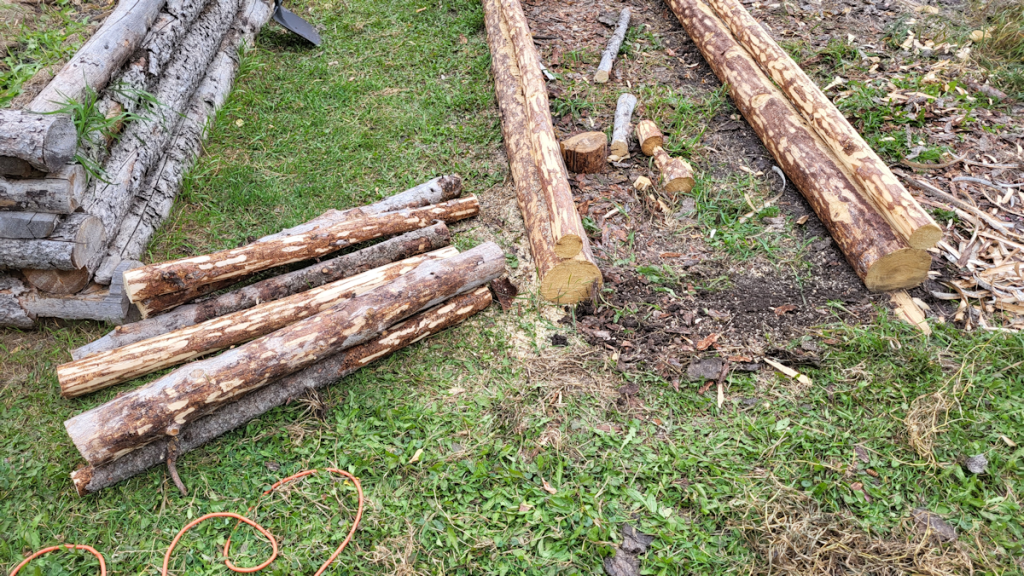
I started with the 2 dead spruces intended for the end pieces, one of which you can see on the saw horse. Then I started stripping the poplar that will be the vertical supports.

The poplar was much easier to work with, for the most part. The spruces have been dead for quite a while, so much of the barks is dried stuck to the wood. The poplar is still quite green. The draw knife could slide between the bark and the wood quite nicely, and just glide through.

Except for the branch nubs and damaged bits!

I ended up stripping them completely, as I could see critters were already getting under the bark and causing damage. The shorter lengths made them easier to handle, too, though I ended up putting the larger of the spruce logs back on the saw horse, just to stabilize it. With the lighter logs, there wasn’t enough weight to counter using the draw knife, and the darn thing kept rocking back and forth, and threatening to tip over.

Once stripped of bark, I lay them across the log walls to stay dry. Some of the logs I picked up were so damp from the grass, the undersides were covered with slugs!

After I got 9 of them done, my back was telling me it was time to do something else. So I grabbed a rope and dragged over the last 3 posts, then went back for the odd pieces. Those were light enough that I could drag 2 or 3 at a time, so that was done faster. These odd ones may or may not be usable as part of the trellis. If not, they will go into the bases of the trellis beds and buried, to break down over time.

I had just finished dragging over the last pair of odd sized logs when I saw a light on in the house. By then, I was done with this job for the day. I’ll continue tomorrow.

As for the power outage, it was likely due to high winds. Not long after ours was back on, my house sitting daughter let us know the power went out at my brother’s place, too. He’s got multiple back up generators, though, so she is just fine!

The power loss was just for 3 hours this time, but it’s a reminder on how we need to get our back ups done. Like the outdoor kitchen. With the high winds we had today, we could not have done any outdoor cooking, if it came to that. The outdoor kitchen we have planned will allow us to cook outdoors in pretty much any weather conditions.

The other thing is to get that old well checked. If all we need is new leathers for the hand pump, we’re set for water, too. Plus the outhouse will do until we build the more comfortable outdoor bathroom with a composting toilet we have planned.

Little by little, it’ll get done!

The Re-Farmer