It’s almost 6pm as I start writing this, and not only have we reached our predicted high of -10C/14F (my app says there is a wind chill of -19C/-2F, but I just got back from topping up the outside kibble, with no jacket on, and there was no wind), but it’s supposed to keep getting warmer overnight!
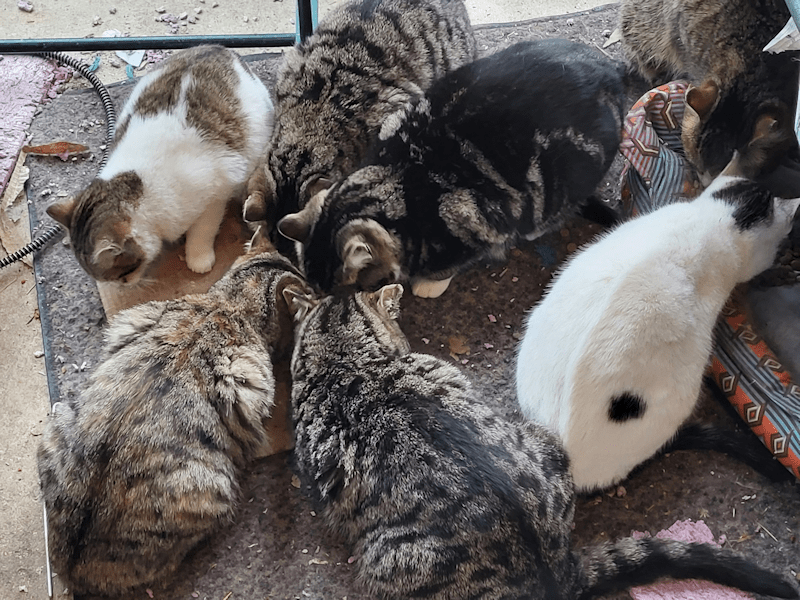
The grey tabby that has suddenly become friendly – it’s the one between the black tabby and the white and grey at the top – managed to sneak into the old kitchen while I was coming out with kibble. He not only let me pet him, but I was able to confirm he is male.
Now why can’t any of the females suddenly become friendly? They still won’t let us anywhere near them! The calicos and torties are pretty much guaranteed to be female. Not sure about the rest of the tabby cattens, besides Judgement and the newly friendly one.
They are just loving the warmer temperatures, and so am I!
I’d made arrangements to get some farm fresh eggs this afternoon. Then I got a message saying they had to make a trip to the city to try and find a part, so that got postponed until they got back. With the warmer temperatures, I’ve been feeling so energetic and antsy, I ended up going into town to pick up a few things, even though we were planning a trip to the city soon. I was home long enough to get a chicken carcass in the slow cooker to make stock when I got the message that they were heading home, so I was back on the road soon after.

Aren’t they beautiful? I love the green ones!
I am always so inspired when I visit this place. This is the same person we’ve been getting our cardboard from, to use while making new garden beds. Today, I got to meet their new additions – a pair of fainting goats, and two emus!
Emus are flippin’ huge!
This is in addition to their alpaca, horses, donkeys, hens, Guinea hens, and probably other birds I don’t know about. Once we have our coop, I’m hoping to be able to buy chicks from them, too.
While I did a small trip today, I’ve decided to do a big city shopping trip tomorrow. We’re expected to have a high from 0C/32F to 2C/36F, depending on which app I look at. I figure I may as well take advantage of the warmth. This time, we’ll be going to a different wholesale place, where I know I can get things like the big buckets of ghee and restaurant size bags of pasta. It’s time to restock pantry supplies we’ve been using when we weren’t able to make our usual big trips. We didn’t have the extreme cold we usually do, other than the past week or so, but with the holidays, December and January are always the worst months for making these trips. I’m actually looking forward to the outing, even though I’m not at all looking forward to the shopping!
My younger daughter has different plans for tomorrow. Getting back to cleaning the basement! The cats have made a mess of the new basement, and she’s using that as an excuse to do a deep clean and organization of the space. That basement, however, isn’t much warmer than outside, even with the extra insulation added around the base of the house in the winter. During our recent deep freeze, it simply got too cold to work down there. It should get much better, and stay better, from now on. She wants to get it to the point that they can paint the basement. White paint on the ceiling (which is the exposed beams of the floor above) and special anti-mold and mildew paint for the walls. I don’t know if they want to do the walls white, too, but definitely a light colour. There are quite a few lights down there, but it’s still really dark.
We have a lot of big projects planned for when things warm up. Too many, really. The girls are focusing more on the inside, and are also talking about getting flooring for the kitchen and dining room, and refinishing the kitchen cupboards. Outside, I want to get that mobile coop built (and if that isn’t possible, we’re supposed to be getting a shed given to us that can be used until we can do the mobile one). Another project that will take probably quite a long time, as we acquire materials, is the outdoor kitchen. First priority is the timber frame roof. Once there’s a roof, we can be more leisurely about what we build inside. One side will have a smoker, clay oven, a “stove” opening to fit a large wok, and a grilling area. Two sides will have moveable work stations, and the fire pit will be added. The eaves of the roof will be longer past the wall of one side, where my daughter wants to have a forge.
Since we aren’t able to build the outdoor bathroom where we want to, until after a number of dead trees are removed, I want to do another, smaller, cordwood practise building. We need a new garden shed, so we can build a smaller shed – about 6’x8′ on the inside – in the maple grove, where a couple of trees had been removed while the power lines were being cleared. That is less of a priority, but since things will need to be built in stages, as we get materials, we might actually be able to get started on it this year.
Of course, there are also the high raised beds that need to be built. The outdoor kitchen actually solves something I was trying to figure out. The dead trees that we need to take down are quite large around. Too large to be practical for the high raised beds. I was considering cutting them in half, length wise, but now I’m thinking they’d be extremely strong upright supports for the outdoor kitchen frame. We can cut the lower, thickest, part of the trunks to the length we want, and then use the rest of the trunk for the high raised beds. It’ll mean more trees need to be cut down, but we need to do that, anyhow. With more than 20 dead trees that need to be removed, that’s more than enough to do both uprights for the outdoor kitchen, and the high raised beds.
Of course, there is the garden that needs to be worked on, including building new, permanent trellis tunnels, and other mobile trellises and supports. Plus trees and berry bushes to plant.
Oh, and on top of all these projects, we still need to dismantle that shed with the collapsed roof. We’ll be salvaging parts of it for building projects, such as the chicken coop I want to build. Plus, if we get that done first, I can use the space to build the outdoor kitchen, leaving more space available for the eventual garden beds we’ll be making nearby, where we get much better sunlight.
Feeling so energetic as the weather warms is kind of dangerous. I’m starting to plan way too many things! In the end, how much we actually end up accomplishing will depend on weather conditions. Last year, the flooding prevented a lot of the work I wanted to do, and the year before that it was the extreme heat. But if all we manage is to dismantle the shed, cut down some dead trees, and start setting aside the logs to use for the timber frame, that would be good.
I am so praying for good weather conditions this year, for the garden and for all the work we need to do outside! The last two years have been so brutal, we could really use the break!
The Re-Farmer



 The Re-Farmer