I managed to get it done, just as the rain started to hit!
I think I can now officially say, our garden is in! Sure there are some things, such as fall spinach, that can be planted, but for all our expected spring planting, it is done.
Yay!
I waffled between planting along the chain link fence in the south hard, or in the trellis bed in the main garden area. In the end, I decided to go for where I knew there would be the most sunlight.
The first image above is how the bed looked, after the mulch was pulled off. Last year, we grew melons along one side, onions for seed on the other. The onions were replanted in the fall, with just one half of the bed being prepped, then covered with leaves for mulch. The other half had melons mulched with cardboard, bark and grass clippings and, in the fall, I just pulled the melon plants and left the rest in place to protect the soil.
That made cleaning the bed up much easier!
This bed does have an issue, though. You can see that – sort of – in the next two images.
To make these beds, we’re using logs as straight and even as we can find. Which is surprising difficult. Especially when looking to use 18′ logs. With this bed, on the trellis side, one of the logs was quite bent. We put that one on the bottom, with the bend going into the bed, while the top log is straight. That’s what the remaining three vertical trellis support posts are going to be secured to.
What that means, though, is that there is an entire log, just inside the top frame of the bed, in the middle. The bend is extreme enough that there’s an actual gap formed between the two logs. Over time, it won’t matter as much, as we are aiming to eventually make the beds all 4 logs high. Until then, though, the gap is getting stuffed with skinny pieces of wood, bits of bark and even grass clippings and dried leaves.
Once the mulch was removed, I went over the bed with the garden fork first, to loosen the soil and make it easier to pull the weeds. As I went along, I started to find other things besides weeds, though – and I was not at all surprised. The onions that had gone to see had dropped some of their seed before they could be harvested.
Once I got to where the onions had seeded themselves, I worked a lot more carefully, and gathered every one that I could find.
Along the way, I also found a couple of plants I recognized as the flower I allowed to grow at one end of the bed, last year. I removed those as well.
It wasn’t part of the plan, but since I had them, every since baby onion I found got transplanted. The flowers got transplanted at the opposite end of where we grew them last year.
While preparing to transplant the onions, I also carefully pulled some of the onions that were growing against each other, broke them apart, then replanted them separately.
One half of the bed had fewer onions survive than the other, so that was the first area I started transplanting onions the tiny onions. I still had enough left over that I made a second row for the rest. They filled a little over half the bed’s length before I ran out, so there’s still room to plant something else, if I wanted to.
After that, I planted the two flowers (possibly a wild salsify) I’d found, then marked off two more rows in the soil in the other side of the bed. Those were for the Hopi Black Dye sunflowers and the Red Noodle beans.
There were not enough sunflower seeds to fill the row. I spaced them about 6 inches apart, which is close for sunflowers. I don’t expect a 100% germination rate, though. In fact, I wouldn’t be surprised if none germinated. These are older seeds.
The red noodle beans, on the other hand, are fresh seed. These got planted nearer the edge of the bed, where they will be able to climb the trellis that will be built on that side of the bed. After filling the row from end to end, I had only 6 bean seeds left. So I stuck them into some of the gaps among the sugar snap peas, since they have a trellis already prepared. The planted rows then got marked off at the ends with plant stakes, so that if I decide to plant something else there, I know where the open spaces are.
Oh! I completely forgot! I was going to plant the pumpkins in this bed!
I can still do that. For those, I plan to set up plastic collars to mark where the seeds are.
In fact, I see the rain has passed and the sun is out. I’ll go do that right now!
For the next while, I’ll be going through my old posts and videos about our 2024 garden, looking at how things worked out, and use that information to decide what we will do in our 2025 garden.
These are some things that turned out pretty different from our plans. Especially the tomatoes!
I’ll start, however, with the alliums.
Garlic, onions and shallots – how it started
The garlic, of course, was planted in the fall. They went where I had the space prepared and available, which was the old kitchen garden. The long, narrow bed along the chimney block retaining wall was filled, as well as the tiny raised bed along the south side. The short section of the L shaped wattle weave bed was filled, and the last cloved were planted down the centre of the larger rectangular bed, which still had tomatoes growing in it.
With all of these, I tried to plant the cloves a fair distance away from the walls of the beds. In planting garlic in raised beds previously, most of them disappeared, while the ones planted in ground in the main garden area did really well. My conclusion is that the ones in the raised beds simply froze. Even though they were well mulched on top, there was nothing extra insulating them around the sides.
The onions and shallots were started early, indoors. The yellow bulb onions were a variety called Frontier, which was new to us, along with a new variety of shallots called Creme Brulee. For red onions, we were going to try Red Wethersfield again.
With the seedlings, the onions and shallots did well, though the Red Wethersfield onions had a rougher time of it. In the end, though, we did have quite a few seedlings to transplant.
How it went
Hit and miss.
As with everything else, the garlic was delayed. In fact, it was so long before they broke ground that I started to fear we’d lost them all. As the season progressed, however, they did very well, and we got to enjoy plenty of garlic scapes when they finally appeared!
For the onions, I try to interplant them with other things in hopes that they will deter deer and other critters from eating the things they are planted with, or in some cases, just to fill in gaps.
With fewer Red Wethersfield seedlings, I tried transplanting them among the tomatoes in the old kitchen garden, then spread the last of the seedlings in the wattle weave bed.
The yellow onions were interplanted with tomatoes in the main garden area, before the last of them went into one of the newly shifted beds, filling a little more than half of it.
For some reason, I got it in my head that the Red Wethersfield were interplanted with the sweet peppers in the high raised bed. Those were the shallots. The last few shallots went into the same bed as the last of the yellow onions. I planted them at the far end of the bed, with a space in between, so there would be no confusions over what was where, with the space in between getting direct sown with summer squash.
The unexpected surprise, however, was all the onions we found while shifting and cleaning up various beds.
While reworking the long bed at the chain link fence, I found a number of onions that survived the winter. Those got transplanted to one of the low raised beds in the East yard.
As we were weeding and eventually shifting the beds in the main garden area, we ended up finding a lot of Red Wethersfield onions we’d planted the previous year, around the Roma VF tomatoes, that just disappeared. We assumed they all died.
In weeding and shifting the other beds, more surviving onions were found, and even a couple of shallots. All of these got transplanted into the newest low raised bed, where most of the Summer of Melons were transplanted. As onions are biannual, I was very excited by this, as it meant they would be going to seed, which we could collect for next year, instead of buying more.
All of these transplanted onions took and most of them did very well. We found ourselves with many onions blooming.
How the harvest went
More hit and miss!
With the onions that were allowed to go to seed, we found ourselves with many, many flower clusters. They bloomed and bloomed and bloomed!
They bloomed for so long, I wasn’t sure we’d get any finishing their cycle so we could have seed to collect! I did end up being able to collect quite a few flower clusters that had dried on their stems and set them to continue drying out in the cat free zone. I collected the last of them, some of which were still rather green, and set them to dry in the cat free zone, after we had our first frost, which onions can handle.
Every flower in those seeds heads have three seeds in them.
We got quite a lot of seeds, just from the first batch harvested. The second batch took longer to dry out, but they eventually did, and I was able to separate out the seeds. Which meant I have seeds from yellow bulb onions from previous years (Oneida, I believe), Red Wethersfield onions, plus some shallots from previous years (I can’t remember the names of the varieties we tried before, just now), all mixed together!
The Red Wethersfield onions we planted this year, though, were a complete loss.
The cats killed them.
The yard cats just love the garden beds in the old kitchen. They loved to go in between the tomatoes in the larger rectangular bed and just chill, or they would roll around luxuriously – all over the onions! Even when I tried sticking plastic forks into the soil beside them, hoping the tines would deter the cats, they just squeezed in between them and rolled around, anyhow. When I finally cleaned up that bed at the end of the season, I did find a few tiny survivors, though. I saved them, and they can be transplanted in the spring.
The yellow bulb onions and the shallots that shared the bed with them also had cat issues! They actually grew quite well, and we did get a couple of decent sized bulbs out of them. Those where the ones that didn’t get rolled on by cats! At least, not right away. We simply could not keep the cats off that bed, and they really, really liked to lie on the onions or roll in the soil. They didn’t kill the onions, but broke the stems, which meant the bulbs could not grow any bigger.
The shallots had cats rolling on them, too, but they had the extra problem of fighting for resources. While I tried to remove as many of the elm roots that invaded the soil, it doesn’t take them long to grow back, and they send their capillary roots up into the softer, moister soil. They will even force their way through the bottoms of grow bags, as we discovered last year.
The yellow onions that were interplanted with the tomatoes fared better, even though the tomato plants ended up completely overshadowing them. More on that when I talk about how the tomatoes did, in another post.
Still, we managed to get a decent harvest, which was cured and braided, and we now have plenty in the root cellar.
The real success, though, where the shallots that were planted with the peppers. I did not really expect to have a good harvest from them, but when I started reaching around the pepper plants to pull them, I found a lot of nice, big shallots!
These, too, we left to cure, then braided, and are now in the cat free zone, where we can access them more easily to use in our cooking.
Oh, and then there was the garlic.
Usually, they would have been ready to harvest in June or maybe July.
They weren’t ready to harvest until the fall!
We did have really good bulbs, though. Not the biggest, perhaps, but certainly not small. In fact, there were enough good sized bulbs to make them worth planting!
Conclusion, and plans for next year.
Things are going to be pretty different, next year!
One thing will stay the same, and that is the garlic. Those are already planted in the bed where most of the yellow onions were. After spacing them out, I changed my mind and started them at the north end of the bed, where the shallots were, instead of the south. The south end of the bed gets shade for longer periods of the day, because of the trees closer to the house. Starting from the north end means the soil will warm up faster, in the spring.
I was really, really happy with how the shallots turned out this year. We’ve struggled to grow shallots every year, but this year they did fantastic in the high raised bed, in between the sweet peppers. As for the red and yellow onions, it was disappointing that the cats did so much damage – especially for the Red Wethersfield onions. At least we got a harvest with the yellow onions!
BUT…
We have seeds.
Lots of seeds.
This year, we are trying the winter direct sowing. I ended up making a couple of different mixes of seeds, and included onion seeds in the shakers. In the last bed that got winter sown, it got shallot seeds added in, too. So we now have several beds already sown with onions and shallots. Being cold hardy plants, they should start germinating before the other seeds in the mixes do which, hopefully, will go a long way in keeping critters away when the other seeds start to sprout.
If they sprout.
We’ll find out in the spring!
There are still plenty of seeds left, so we have the option of starting some indoors as well, if we want, but I don’t think so. We do want to keep growing onions and shallots, and if the winter sown seeds don’t survive, not starting any indoors means none to be had at all. Their growing season is just too long. I will take that change this year, though.
Onion seeds are only good for about a year. I might end up giving the rest of the seeds away or something, so they don’t go to waste.
Once onions go to seed in their second year, however, they go to seed every year.
In getting the bed ready to plant the garlic, however, I found more onions and shallots that got missed. The bed that had onions interplanted with tomatoes now has summer squash winter sown in it, and I found more missed onions while preparing that bed, too.
The Summer of Melon’s bed that had the transplanted onions in it got half-prepped for the winter. Just the side that had the onions and bush beans. (The other half will wait until spring)
All of the onions that were in there, plus the others I found in preparing other beds, were replanted in the cleaned up half of the bed. I was even able to separate them out by colour, and found myself with half the bed now planted with Red Wethersfield, and the other half with yellow onions, plus a few shallots in the very middle, as a divider.
We should have plenty more onions going to seed for us next year, too!
In the end, for all the issues we had, I would say this was one of the best years for garlic, onions and shallots we’ve had yet.
I hold out home that, with the winter sowing, next year will be even better.
One of the problems we’ve had is cats getting into the garden beds. They seemed to especially enjoy laying down on the onions!
As a result, we have a lot of onions with broken stems. Under normal circumstances, that would be a sign that the onions are maturing and ready to be harvested. If the stems are prematurely broken, the plants act as if they’ve reached maturity and won’t get any bigger.
I have been leaving them for the last while, which gives them time to develop that thicker, dry outer skin, but I didn’t want to leave them too long. So today, I harvested the first batch.
This is almost all of our yellow onions, though I did leave the ones that did not have broken stems. Normally, I would not have laid them out with the greens facing in and overlapping like that, but if the greens were hanging off the edges, they’d be way too tempting for cats to play with and drag around! Onions are toxic to cats, so we don’t want any sort of temptation like that.
After a couple of days, we’ll braid them and hang them in the cat free zone inside, aka our living room.
The potatoes that had been curing on these screens were put in cardboard boxes to store and are now also in the cat free zone. We’ll have to eat them fairly quickly. I didn’t bother picking over them to separate any for the root cellar. There just isn’t enough to make that worthwhile.
I did use some of the red potatoes with breakfast. I now know that the Red Thumb potatoes are not really suitable for making hash browns. 😄 They really wanted to mash, instead! Still tasted good, though!
I needed some garden therapy today, so I got some onion seeds started.
We have seeds for 3 types of bulb onions, 1 of shallots and 1 of bunching onions. Today, I focused on the bulb onions.
Last year, we planted our alliums in Jiffy Pellets, repurposed K-cups and cardboard flats from eggs (don’t use those. They suck. Literally. The cardboard sucked all the moisture out of the growing medium!) before finally using doubled Red Solo cups to try and make up for losses.
This year, we’re doing things very differently. I’m going to try bulk sowing. Here are a couple of videos about that.
This next video shows the transplanting.
Obviously, we are in a much colder zone than he is, so I’m adjusting accordingly.
We already had our small aquarium greenhouse prepped. The first thing I needed to do was see how many seeds we had of each type.
The Red of Florence had the most seeds in its packet. The grey seeds from Veseys are Oneida, a yellow onion. The fewest are the rarer Tropeana Lunga which, like the Red of Florence, are an elongated red onion.
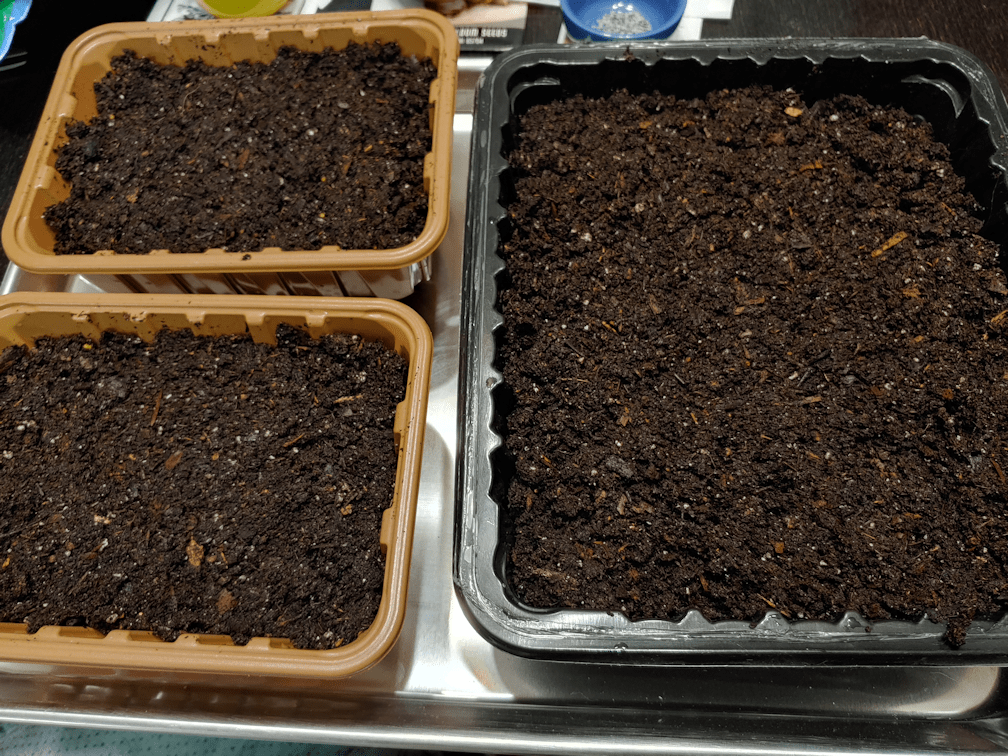
We are using re-purposed trays from the grocery store this year. The smaller ones were from mushrooms. I think the big one was from ground beef. We’ve had it for a while, so I can’t quite remember.
They got a good cleaning, and drainage holes were punched into the bottoms, then they were set into a baking pan.
They were filled with pre-moistened seed starting mix; I just dumped the remains of a bag into my largest mixing bowl and mixed in warmish water until it was evenly damp. Onions don’t need things as warm as other seeds, so no heat mat needed, but our house is on the cold side. I figured slightly warmer water would not go amiss.
The seed starting mix was pressed down just enough to make sure there would be no air pockets.
Then it was time to scatter the seeds.
Gosh, it feels so weird to sow them this densely!
I like that the grey seeds of the Oneida are so nice and visible. :-)
The seeds got a very fine misting at this point.
Then they were topped with about a quarter inch of seed starting mix, again gently pressing to get rid of air gaps. The tops got another misting, and water was added to the baking tray and left to be absorbed, while I cleaned up.
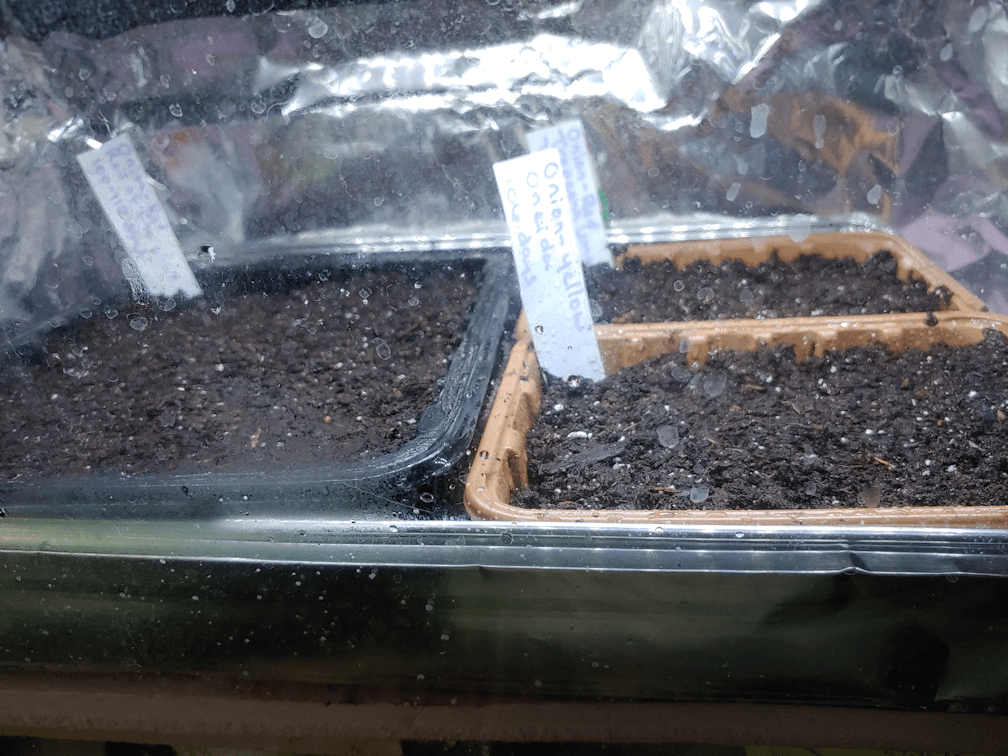
Finally, they went into the small aquarium greenhouse. The three trays fit perfectly in the oven liner tray folded into the bottom. More water was added to the oven liner tray, to water from below.
This tank has aluminum foil around the sides because the light we have for the tank is not as bright as on the big tank, and all that reflective light will help keep them from getting leggy. At least, that’s the theory!
This leaves the shallots to start next. Their days to maturity is a bit shorter than for the bulb onions. The Red Baron bunching onions need only 60-65 days to maturity, so they can be started much later.
I’m not sure how we’re going to be able to work it with the shallots, as far as space in the aquarium greenhouses goes. We’ve got some time to figure it out before they need to be started, but not much.
As for the other seeds we have in the big aquarium greenhouse, they seem to be doing fine, so far. Nothing has germinated yet, of course, so it’s too early to tell if the heat mat is making a difference. We just keep checking and adding water to the tray and misting the tops, as needed. The tray over the mat has been needing refills regularly, but today is the first time I added more water to the outer cups of the Wonderberry.
We need to get the rest of those Cup of Moldova tomato seeds started, since we want to grow a lot more of the paste tomatoes. I’ll likely start those using the doubled Red Solo cups, though we’d have to find a cat safe place to move the aloe vera pots, to make room for more seed starts. Which is a shame, because they are doing so well under the lights of the tank! So are my daughter’s orchids, one of which is blooming very enthusiastically right now, but we should be able to leave those in the tank until it gets warm enough to safely hand them in front of a window again. The aloe, however… the cats just love digging them up! :-(
Ah, well. We’ll figure it out. The main thing is that the bulb onions are started.
Plus, garden therapy was done its job. I’m feeling much more positive, now. :-)





 The Re-Farmer