Our 2026 Garden: reclaiming beds and succession sowing

I was able to get a couple of big jobs done in the garden. It’s going to be an odd growing year. We had another cold night last night, dropping to about 6C/43F It looks like the cold has killed some of the melons and at least one winter squash transplants that managed to germinate in the tray that got resown after a mouse got to the seedlings. A couple more winter squash have germinated in the tray and I’ll transplant them when they get their true leaves, but it’s really too late for them, unless we have a super long, mild fall. The next time I have a chance to check out a garden center, I’m hoping to find more winter squash, at least.

Right now, I’m thinking of what can be direct sown for succession sowing. I’ll be doing more peas and bush beans, I think, and possibly some beets, but that’s not what I sowed today.

The first bed I worked on was the winter sown kohlrabi bed.

The down side of having a cover that can keep the cats out is, it’s much less convenient to weed.

Lots of crab grass. Thankfully, the remaining mulch kept most of the elm seeds from germinating. That is getting to be a real problem in other areas. Especially inside the protective collars around the tomatoes in the bed next to this one, and in the chain link fence bed.

In the next image of the slide show above, you can see my little surprise. There are actual kohlrabi growing! Absolutely tiny, but surviving. I was going to leave them to grow bigger but, as I was clearing the weeds, there were rhizomes going right under the little cluster. I ended up transplanting them to one end – a whole four tiny seedlings that probably won’t survive, but at least there’s a possibility.

The rest of the bed got completely worked over as I pulled all the rhizomes I could. Unfortunately, there were quite a few tree roots in there, too, and there isn’t much I can do about those. In this location, the roots could be either from the elm in one direction, or the cherry trees in the other. Both are close enough and spread roots far enough to be possible. It might even had been both, not just one.

Once the weeding was done, I have the bed a deep watering. Especially in the three rows I planned to sow into, which you can see in the third image.

In the fourth image, you can see what I decided to plant. American Spinach, Rainbow Swiss Chard, and I had some seed tape of Uzbek Golden Carrots left. They are old seeds so I don’t expect a good germination rate, and I hoped there was enough to lay down a double layer.

Before sowing anything, I noticed my brother had left some cardboard in the garage for me that was just right for this bed, so I cut strips to lay it down as a mulch between the rows, plus a couple that would be used to lay over the carrots to protect them until they germinated.

I didn’t need much. I had only enough of the home made seed tape left for half a row. I thought I had more seeds left in the packet and went looking, but couldn’t find it. So I grabbed the Hedou Tiny bok choy seeds we collected last year – something got to the ones planted in the old kitchen garden. The rest of the new row in the middle got those. The carrots got covered with the strip of cardboard, but not the bok choy.

Then the spinach and chard got planted in the rows still marked by twine on either side. There weren’t a lot of seeds in the packets, relatively speaking, and both got emptied in the planting. Then the cat proof cover got set back on.

Hopefully, these will take. We do have some seedlings from the rainbow carrot mix growing, but very few. I might try planting more carrots later on, but we’ll see. The chard and spinach planted between the garlic are just not growing, and what seedlings there were seem to be disappearing. It would be nice to have some greens that survive!

That done, I moved on to reclaiming the small, square bed near the compost ring.

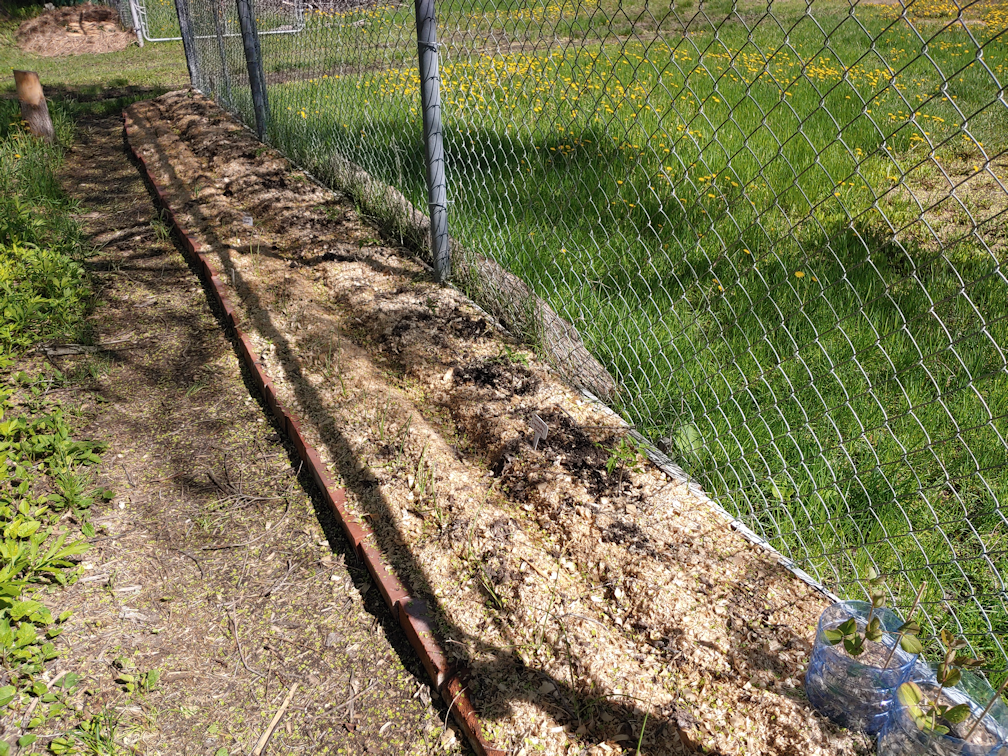
The first image is the “before” picture. The boards on the side are from a same size frame that had been around another bed. They’re pretty rotted out, but they should last at least a couple more years. They still had their screws, so I took those out, first.

In the next image, the bed is all weeded, and the soil pulled away from the sides.

My original plan had been to join the corners opposite of how the frame already in place is, but it turned out the pieces weren’t all quite the same length, so I mixed and matched to get them to line up to the existing frame as best I could. Once the corners were screwed together, I had to be careful shifting it around to lay on top of the bottom frame properly. The wood is dry and rotten enough, I could hear it cracking at the corners.

I rummaged around in the scrap lumber pile in the garage for a while, and found some pieces I could cut into eight 8″ lengths, which is the new height of the bed. Four of them were screwed into corners, and four into the middles of the sides. One side didn’t line up at one corner. After screwing the vertical support piece to the bottom board, it left a gap between the support and the top board. More rummaging in the scrap lumber pile and I found something thin enough and cut it to 4″ in length. It was a bit narrower than the gap, but nothing the 3″ screws I was using couldn’t secure.

That done, I cleared a path to the remaining pile of garden soil we bought years ago and uncovered it. I thought I might be getting two wheelbarrow loads but, in the end, only needed one to top up the bed. In the next image, you can see the finished bed, all cleaned up, topped up and leveled.

The next thing was to protect the bed from being used as a litter box!

I had decided to use the rods from my hoop kit to made supports, running to opposite corners and crossing in the middle. This time, I decided to try something different. I found a drill bit that was the same diameter as the rods in this kit and drilled holes in each corner of the frame.

Which was fine for three of the corners, but one corner is a lot more rotten. There was no solid wood near enough to line up with the rods in the other corners, so I had to make do with what was there. Hopefully, it will be enough. The hoops will not be holding anything heavier than netting, and there shouldn’t be a lot of stress on it.

In the end, it took 6 rods to create each hoop. The hoop set into the rotten corner is a bit wonky, but otherwise it’s holding.

For the netting, I decided to dig out some green dollar store netting from last year, instead of the black netting I’ve been using elsewhere – the black netting that snakes can get caught in. The green netting is quite long, and I wasn’t sure it was wide enough to simply drape over the top, so I decided to wrap it around, instead. It was wrapped low enough that the netting could be secured to the ground with ground staples in the middles, outside the frame, while also being clipped at the bottom of the hoops at each corner.

I still had a lot of leftover netting, but I didn’t want to cut it, since it’ll be used elsewhere, some other time. After fussing with the netting to gather the excess toward the top and securing it with clips, I just pulled the excess length up and over the top and back again, before securing it in place with a clip, too. You can see the final mess in the last image of the slide show above. 😄

With this bed, I might transplant the one Arikara winter squash that has germinated in the middle, and then I will likely plant bush beans around the perimeter.

But not today.

That done, I headed inside for supper before coming back out to do the watering.

Which is when the phone started ringing. I hadn’t bothered to tell the family I was outside, so when the phone started ringing, they thought I was in my office and could answer. After four calls and no messages left on the answering machine, my daughter came looking for me. I went in and saw it was my mother, which was a surprise. I’d gotten a call from the nursing home this morning – at her request – to be informed that my mother was not feeling well. They’d already informed my brother yesterday, as he’s the primary contact, and he let me know. I was told she’d had a very rough night and was doing worse today, coughing, having a hard time breathing and talking. I was informed as to what treatment she was getting, and that she’s still in quarantine. She’s not the only one that’s sick, and if enough people in her ward are ill, they have to shut it down to visitors. For now, she can get visitors that need to wear a gown and mask, which rules me out because I can’t wear a mask.

I had asked the nurse that called me to let my mother know that I knew she was having a hard time talking, so I would not be phoning her. So it was very odd that my mother would phone me! She would have gotten the message, but when I mentioned it, she didn’t say anything about getting it. She did say that the nursing home phoned me this morning because she asked them to, but I told her they’d also already contacted my brother, yesterday. I told her about the medical treatment she was getting. She knew about the antibiotics but was saying they weren’t helping – I had to explain to her that it takes at least a few days before she would feel any difference, but she expects immediate response. I told her about the medication to help with her breathing, but she couldn’t remember anything about that one, then told me whatever pills they give her, she takes. I think she’s having a harder time remembering what she’s taking and when.

Of course, she started saying how she was so sick and didn’t think she was going to live much longer. Which she has been saying for the past… five? six? or so years. Thankfully, she is in the nursing home now. She’s coming up on 96 years old, and a simple cold can be dangerous at that age.

That got her to talking about the funeral and what I thought of it, and how she was surprised to see so many people. Then she told me, in a round about way, that she wanted us to make sure that her funeral had lots of friends there. I told her, we would let people know, but didn’t mention that she’s pretty much outlived most of her friends already.

By the end of the call, her voice was getting pretty squeaky, though she sounded a lot better than I expected, and even seemed to be in good spirits. Finally being where she has wanted to be for so long has definitely made a positive difference in her, even when she’s feeling sick.

After the call, I took the time to update my brother, then headed back out to finish watering the garden beds before it got too dark.

There are a few things I want to get done tomorrow, which is Friday, because I’m going to be doing some driving around on Saturday. June is a birthday month, and Sunday is Father’s Day, so we will be combining both on Saturday, to avoid crowds. My older daughter has offered to spring for Pizza Hut, which we haven’t had in at least a year. The nearest one is about an hour’s drive away. I’ll have other errands to do as well, including a dump run, which I did not do while we had my brother’s car and the truck was in the garage. Next week has got medical appointments, my daughter’s blacksmith workshop (she’ll be bringing home a forge when it’s done), and our first stock up shopping trip. So the more I can get done in the garden in between all this, the better!

Hard to believe we’re coming up on the solstice and the first day of summer already. With the cold nights we’ve been having, it feels like it should be April or May, not coming up on the end of June!

The Re-Farmer

Our 2026 Garden: winter sowing peas, carrots, turnips and radishes

After all the rain we had, I wasn’t sure if I’d be able to work in the garden today, though today’s weather was supposed to be better. I had to head to the pharmacy, so I figured I would know when I came back.

I ended up in town a lot longer than expected!

My daughter’s prescription, that they did not have in stock yesterday, the main reason to go back to the pharmacy. My husband had ordered refills for delivery, so I figured I would get his bubble packs while I was at it. My daughter wasn’t feeling well enough to come along, unfortunately. I headed out and got to the pharmacy shortly after 11am.

That turned out to be an oops. They don’t get their inventory orders in until the afternoon. Typically around 1pm.

Also, since my husband’s refills were ordered for delivery on Thursday, and today is Tuesday, they weren’t ready yet, either. Those were left for delivery. I asked about my daughter’s meds, as I thought she got a partial refill, but no, she hadn’t gotten any of this one at all, and she needed them.

At first, I was going to head home then come back tomorrow until I remembered I was going into the city tomorrow. So I gave them my cell phone number and told them I would stay in town, and they could call me when the meds were ready.

That left me with quite a bit of time to find something to do, so I ended up doing a lot of walking!

Most places were closed for the season, but I did remember there’s a second hand store, so I went to check that out. I ended up spending a whole dollar when I left…

I already a similar drinking jar at home, but it’s colorless. They had a couple like that, but only one in this green tinted glass, so I got it.

I did enough wandering around that my left hip was starting to talk to me. Not pain – it hasn’t hurt like it used to since I got that injection at the sports injury clinic – but it started feeling like it was about to give out. By then, it was past 1:30, so I went to the pharmacy. I was just going to sit and wait, since they hadn’t called me yet, but they are so on top of their customer service, I had someone asking if I needed help before I had a chance to! It turned out they were working on my daughter’s prescription right then, so I didn’t have long to wait.

From there, I headed home, where my daughters had a late lunch waiting for me. The weather was good and things were relatively warms, so as soon as I finished eating, I decided to go for it, and headed to the garden.

My focus for today was to get winter sowing done, and I decided to do the sowing planned in the main garden area, first. The first thing I needed to do was a lot of raking of leaves! Once I had both the wagon and the wheelbarrow filled, I started at the trellis bed.

This bed already has seed onions planted along the non-trellis side. I chose the Spring Blush peas for the trellis side, and the rainbow mix of carrots in the middle.

The rows I planted in remain marked with stakes and twine. There is room between the carrots and the onions to plant something else. Fresh bulb onion transplants, perhaps, or more carrots.

In the second photo above, you can see the row of peas is shorter! There were only 25 peas in a packet. I should have bought two! I planted a pea every 6 inches or so, but it would have been good to plant the full row and have them more densely planted, in case some don’t germinate. As it is now, in the spring, I can plant something else in the remaining space that can use the trellis.

Once that was done, I covered the whole thing with a deep mulch of leaves. I actually ran out and had to get more.

Then I decided to finally use that pile of cardboard that I’ve had set aside for the entire season! I used it to cover where the next trellis bed will be built, as well as the path, to kill off the grass below. If I’d had enough, I would have put cardboard on the other paths, before I put wood chips on them as a mulch. The dandelions in particular had no problem growing through the mulch, and you can barely even tell the wood chips are there anymore. *sigh*

There was still enough time and light to work on the next bed.

The only problem was, that bed had turned into a pool!

I removed everything that was holding the plastic down and just started rolling it up. The piece of wood I used to roll up the excess is long enough to rest on both sides of the bed, so there was space below. Rolling it up meant pushing the water further and further to the end before it could finally overflow the plastic. Which meant that only the very end of the bed got an extra watering.

I left that to drain while I went to rake up more leaves.

In the next photo, you can see where I planted the Daikon radish and White Egg turnip. Those went on the outsides of the bed, leaving the middle for a spring sowing of probably pole beans. I’m planning to plant bush beans in the high raised bed.

In the last photo, the bed is mulched with leaves. Once again, the stakes and twine were left to mark where things were planted.

By this time, it was getting quite dark and it was time to stop for the day. The beds that I have winter sowing planned for in the main garden area are now done. In this area, there are still two beds that need to be cleaned up but, if necessary, that can wait until spring.

I did move my supplies over to the east garden beds. Two of those beds will get winter sowing, hopefully tomorrow afternoon, after I get back from the city. That will be the warmest part of the day. Those beds will get kohlrabi and cabbage sown into them, as those beds will be easier to cover with insect netting to protect from flea beetles and cabbage moths.

After that, I have one bed in the old kitchen garden that still needs to be harvested of alliums and Swiss Chard, and then I will be doing winter sowing in there and the wattle weave bed. The only other area that needs to be cleaned for winter sowing is the square bed off to the side of the main garden area that I’d grown the Albion Everbearing strawberries in, last year. The survivors got transplanted along the new asparagus bed, and I’ve decided the space may as well be used as a permanent poppy bed, since I expect those to self seed readily, and it can be treated as a perennial bed. However, if I run out of time to winter sow those, they can still be done very early in the spring.

So there we have it! Four more things winter sown for next year.

From the predictions I’m seeing, it’s supposed to be a mild winter, but other sources say a harsh winter. We shall see! Hopefully, the winter sowing will survive and we’ll have a head start to next year’s garden!

With how short our growing season is (I’m not counting on the newly revised averages yet), every little bit will help.

One of these years, I hope to get enough to actually can or freeze again! The last two years have been pretty brutal. If we depended on the garden for food at this point, we’d starve! :-D

Little by little, it’s getting done, and I’m feeling pretty good about it so far!

As long as the weather holds…

The Re-Farmer

Our 2025 Garden: late starts, and our largest harvest yet.

With all the extra stuff that needed to be done yesterday, I did finally get to water the garden yesterday evening. The poor Turkish Orange eggplant were drooping so badly!

This morning, I made sure to give it another watering, before things got too hot – we’re supposed to break past 30C/86F, and the humidex will make it feel even hotter! Before I did, though, I checked on things and got a harvest done.

I’ve been hemming and hawing for a while now about the corn. Being a short season corn, with only 65 days to maturity, they should have been ready to harvest a while ago but – like everything else – they were way behind. In the process of taking a closer look, I found something else.

Our very first female Arikara squash flower buds. There had been only male flowers until now, but now that we’ve got some females about to bloom, there isn’t a male flower to be seen!

*sigh*

Today is the last day of August. We’ve got one more hot day, and then things are going to cool right down, with overnight temperatures low enough that we’ll need to cover some things.

While watering, I also spotted new female flowers on the Mashed Potato and Baked Potato squash. I’ll have to check them again this evening and see if they opened up and can be hand pollinated.

Why I bother, I have no idea. They won’t have enough time to mature, and they are in beds we won’t be able to cover.

Ah, well. You never know. It’s not like weather forecasts don’t constantly change!

I came prepared to do some harvesting, including stainless steel container for the Spoon tomatoes.

I decided to go ahead and harvest some of the corn. Since the stalks had one cob each, I pulled the entire stalk on the ones that looked ready enough. Handily, the beds are right next to the compost pile.

While I was picking beans and corn, I had company.

Sir Robin was absolutely fascinated by the reflections inside the stainless steel bowl and was busy trying to catch whatever he was seeing.

Then he… well… did this!

It turns out, he’s a perfect fit. 😄

In the next picture, you can see I got a whole bunch of tiny corn cobs. This is not a large cob variety of corn, but they should have been bigger than this. A few little ones had so few developed kernels on them, they weren’t work keeping. So I just ate them. 😄

It was SO nice to finally pick a decent amount of beans! Finally!

The one Sub Arctic Plenty tomato looks like it should have been picked earlier. I think the heat got to it a bit. There was a decent amount of chocolate cherry tomatoes to pick this time.

The carrots are from the bed that was sown in the spring, rather than the ones sown in the fall. With the Atomic Red ones, it’s still somewhat of a thinning by harvesting situation. The Uzbek Golden carrots were planted using home made seed tape, so spacing was not an issue.

I’m always amazed by the Royal Burgundy bush beans. We have only three surviving plants, and one of those got chomped by a deer. Yet even that one had beans to harvest today! The plants are still really prolific, considering how small they are and how delayed their growth has been.

It wasn’t until later, when I was watering the summer squash, that I realized I missed a zucchini! Just one, though I found a couple that I was able to hand pollinate.

I’m quite happy with this harvest. Sure, we’ve had better in previous years. A harvest like this was something I had picked every couple of days throughout the summer but, for how things have gone this year, this is pretty amazing!

Also, it took forever to pick all those little Spoon tomatoes. Aside from the plants being stunted and short this year, it was pretty painful to pick them from the low raised bed. It did help that I could put a foot on the log wall when I needed to, to take some of the pressure off. In theory, I should be squatting to pick them, but I can’t squat with the condition of my knees, so I’m having to bend over, instead.

Thankfully, I got the harvesting and watering done before it got too hot. The watering got interrupted for a while as I spent some time with my brother, going over my mother’s car. It’s going to need a new battery, and that tire was almost flat again. My brother will take care of a few things on it, and we will take care of emptying it out and getting it detailed, and then it’s going to be sold.

As much as it would be good to have a second vehicle again, we just don’t have the budget to insure and fuel two vehicles anymore – and I would really use the space the car it taking up in the garage! That addition was made to be a work/storage space. My mother’s car is just small enough to fit in there, as long as the passenger side it close enough to the wall, so the driver’s side door can be opened wide enough to squeeze out. I would rather store things like the lawn mowers, snow blowers and wood chipper in there, so that the other side they are stored in can be a work shop again. When I was building the cat isolation shelter, I had to keep our vehicle parked outside for months, so that I had the space to build in.

All in good time. There is no hurry, but it would be nice if we could sell it before the winter.

Winter is on my mind a lot these days, even when we’ve got heat like today!

The Re-Farmer

Analyzing our 2024 Garden: peas, beans, carrots and greens

For the next while, I’ll be going through my old posts and videos about our 2024 garden, looking at how things worked out, and use that information to decide what we will do in our 2025 garden.

Okay, time to take a look at things that did not turn out anywhere near how we originally intended!

The Original Plan

Beans

In the past, we’ve grown lots of different beans at once, mostly with great success. We enjoyed having almost daily harvests, for both fresh eating and for the freezer, and even tried a rarer variety of shelling beans that was suitable for our short season. I’m glad I saved those rarer seeds, because they no longer seem to be available from the company I got them from.

This year, I had many different types of bean seeds. Aside from the seeds I’d saved from the shelling beans we tried, my mother gave me a jar of seeds for shelling beans that trace back to what she grew here every year, decades ago. Along with the shelling beans, I still had seeds for pole beans that we really liked, a variety of bush beans that were good for both fresh eating and shelling, and more bush beans. My plan was to grow each type; pole and bush beans for fresh eating, plus shelling beans. It was just a matter of figuring out where, as I intended to do a fair bit of interplanting.

Peas

We haven’t had much luck growing peas. Between growing conditions and deer eating them, we just never got many! At best, I’d find a few pods to eat while I was doing my morning rounds.

We still have quite a lot of seeds for shelling peas, but we also wanted to get edible pod peas. I hoped to grow enough that we could put some in the freezer, but to at least have enough for fresh eating.

Carrots

Carrots were going to be the only root vegetable for this year. I had lots of seeds for the delicious Uzbek Golden carrot, and made seed tape with a decent amount of them. We also still had pelleted seeds for an orange variety called Napoli. I wanted to grow plenty of both, so that we could freeze or can or store for the winter. Carrot seeds don’t age well, so the seeds would need to be used up. Especially the older pelleted seeds.

Greens

We actually intended to cut back on these. We’ve tried growing a variety of lettuces but, for some reason, they seem to get bitter, even if they aren’t bolting. We also found that, for the amount we actually use them, we may as well just buy them from the grocery store when we feel like it. The only exception to this was spinach. We all like spinach, but have not had much success with them over the past few years. The first year we grew them was amazing, but that was pretty much it for them doing really well. Still, we wanted to at least grow spinach this year, and that was about it for greens.

What we actually did

Beans

We tried two types of pole beans this year. Carminat, a purple podded bean, and Seychelle, a green podded bean. Both did very well the first year we grew them. They were prolific, and we quite enjoyed eating them. The Seychelle beans were interplanted with the Crespo squash. The Carminat got planted along one side of a winter squash bed.

For bush beans, we ended up with only a small space left, where we planted Royal Burgundy beans; a variety we’ve grown before and enjoyed eating.

That was it. Just three varieties ended up being planted.

Peas

For peas, I planted Dalvay shelling peas – something we still had a lot of seeds left for – on the other side of the winter squash bed the Carminat beans were planted in. We also got some edible pod peas that went into one of the low raised beds in the East yard, where a few onions we’d found were transplanted at one end. Nowhere near as much as I’d hoped to plant, but all we had room for.

Carrots and Spinach

These went into the same bed as the edible pod peas. The peas got a trellis net down the middle, carrots were planted on either side, then the spinach along the outside. The idea was, with each thing maturing at different rates, the spinach would be done first, then the peas, until the bed was left with lots of room for the carrots to grow, along with the few onions left to go to seed.

How it actually turned out

Not good.

Beans

The seeds for the pole beans must have been too old. With the Seychelle beans, I planted them by the Crespo squash twice, but we only got three survivors.

The Carminat beans had more survive, but there are a lot of gaps in between plants. I was out of seeds, though, so I tried filling the gaps with Seychelle beans. Only one, maybe two, survived.

With the bush beans, the first sowing didn’t succeed at all – and these were new seeds! I was able to buy more and tried again. This time, we had a nice, short row of bush beans emerge. They did quite well…

Until they got eaten by deer.

They recovered and started going well again.

Then got eaten by deer again.

Amazingly, they recovered again!

We did get beans to harvest from all three types. Some days, I was quite surprised by how many I was able to gather!

Peas

The edible pod peas were another one that needed to be sown twice. With the first sowing, I think 3 in total finally germinated. I bought more seeds and replanted, but the new packet had about half as many seeds, so all we got was one row in the 9′ bed.

The shelling peas did better, in that maybe half of what I planted germinated. These, I could at least “blame” it on them being older seeds.

All the peas and beans got trellis netting to climb. The shelling peas needed to be trained up theirs. The edible pod beans were better climbers. Neither variety of peas thrived, but the edible pod peas did better, and got quite tall. I ended up having to put netting around the entire bed they were in, though, after discovering some eaten by deer. Even with the netting in place, deer were able to reach higher parts of the plants and eat them!

Carrots and Spinach – plus chard, kohlrabit and Jebousek lettuce!

We were only able to plant the Uzbek Golden carrot seed tape; one row on either side of the peas. I hoped to plant more elsewhere, but there just wasn’t the space for it. They did okay, even as we lost control of the weeds in this bed. The real surprise was when several of them went to seed! Carrots are biannual, so they should not have gone to seed in their first year.

The spinach did very poorly. They sprouted, but only a few got leaves large enough to be harvested, and even then, not enough to be worth harvesting at all.

Once it became clear the spinach was done for, I pulled them out and tried planting chard. I had some seeds for two varieties that got mixed up (a cat got at the baggie the seed packets were in and chewed them up!), so those got planted in the same space the spinach did.

They didn’t do well, either, and I only partly blame that on losing control of the weeds in that bed.

Meanwhile, with the Purple Caribe potatoes that failed, I found myself with a gab in the bed that needed filling. I’ve been wanting to grow kohlrabi for some time, with zero success. The first time was almost a success until they got decimated by flea beetles. I think slugs got the other attempts.

I had seeds, though, so I tried them as a fall planting, and amazingly, they started out doing really well!

Until the cats started rolling on them.

They survived the cats, though, and I had some hope to actually have kohlrabi to harvest.

Meanwhile, next to where I planted the kohlrabi, a self seeded Jebousek lettuce appeared. We got these as free seeds a couple of years ago. The first year, the seedlings got almost completely choked out by elm tree seeds. The few that survived, we allowed to go to seed and just left them. The deer ate them, but some did survive to go to seed, so we had a couple show up the next year. They got left alone, too, and went to seed, though I believe they got deer eaten, too. So when a couple of plants showed up again this year, with the kohlrabi nearby, I set up netting over the bed. It didn’t keep the cats out, but it mostly kept the deer out. The wind kept blowing the bottom of the netting loose, no matter how many ground staples, bricks or rocks we used. Which is how deer managed to get at them, anyhow. But they recovered! In face, on of them ended up growing two new stems around the eaten part, and we allowed them to go to seed.

How it ended

Beans

Considering how few bean plants actually survived, pretty darn good. We barely had enough beans to harvest fresh for a few meals, but we enjoyed having them at all. I would still recommend the Carminat and Seychelle varieties of pole beans, and the Royal Burgundy bush bean is such a survivor!!!

When I found some Carminat pods that got missed and were getting too big for fresh eating, I left them, and now we even have seeds saved!

Peas

The peas did poorly over all. We never really had more than a few pods to harvest. Mostly, there would be two or three that I would harvest to eat while I was doing my morning rounds.

Carrots

While we never had a lot of them, I was really happy with the Uzbek golden carrots. They are really tasty, and I would definitely recommend the variety. As for the ones that went to see, the flower clusters never actually produced developed seeds, so I don’t know what to make of that.

The Greens

I wish I knew what was going on with spinach in our garden. We had that one amazing year, plus one decent year in the high raised bed, and that’s it.

The first year we grew chard, they did well, but they didn’t do well this year. Again, I’m not sure why.

The kohlrabi… well…

The flea beetles got them.

I really wasn’t expecting that to happen so late in the season, but they just showed up one day, and the poor plants were black with them.

As for the Jebousek lettuce, they went to seed which I happily collected at the end of the season.

Plans for 2025

Things are going to be very different next year!

With our winter sowing, I ended up making three mixes of seeds. One of them is all root vegetables, including the last of the pelleted carrot seeds and some of Uzbek golden carrots. I also added four different beet varieties, one variety of turnips, four varieties of radishes, plus saved onion seeds. Basically, I just emptied out my old seed packets. How many will actually germinate, I have no idea. We shall see in the spring!

Another mix I made is all greens. The last of our Swiss Chard (two varieties), four varieties of spinach, two of kohlrabi, and the Hinou Tiny Bok Choi seeds I’d saved from the few plants that survived being smothered by elm tree seeds, last year. This mix also has both onions and shallots from saved seed added in.

I ended up making a third mix of seeds. These include two types of sunflowers, Dalvay shelling peas, plus a few King Tut pea seeds I’d saved from previous years, the last of my Royal Burgundy bush beans, a tiny amount of Montana Morado corn seeds that I managed to save after the cats knocked the entire bowl of seeds over and, of course, onion seeds.

Basically, I used this as an opportunity to finish off packets of older seeds, of seeds that I had only a few of.

We do still have other bean seeds that I want to grow. I don’t think I need to buy more seed, but can use what I have. I also want to try edible pod peas again. It will all depend on how many garden beds are available, really. All our plans to expand the garden again seem to get kiboshed, so we’ll see how that actually turns out.

I still have plenty of Uzbek Golden carrot seed tape and loose seeds, and they need to be planted, as the germination rates drop quickly with carrots. I can see sticking those in any place we have room for them.

With greens, if the winter sowing fails, we likely won’t try to plant more (though I do still have several varieties of lettuce seed we could sow) and the bed would probably be given over to something else.

In the end, I think the priority for next year will be with beans, as they seem to do the best here, even with the odds stacked against them. If we have the space to give over to them, I’d really like to plant those rarer shelling beans, and collect more fresh saved seed. We had only a small amount to cook and taste when we grew them, and they are well worth it.

Peas, beans and carrots are things that are staple crops for us, with some types of greens being bonus. We will probably still be trying new varieties, especially with peas, as we try to find something that will successfully grow here, but if things go as they should, they will be part of our garden, ever year.

The Re-Farmer

Our 2024 garden: winter mulching

It’s supposed to start snowing later, so it’s a bit of a now or never day to get those beds mulched before the ground freezes! I’m so glad my mother decided to have me come over to her place tomorrow instead of today.

If you scroll through the Instagram slide show above, you’ll first see the carrots that we are overwintering in the soil, harvesting them as we need to, rather than harvesting them all at once and having to process them for the winter. Quite a few people swear by this, and say the carrots taste so much better when stored this way. There was the remains of a pile of grass clippings next to that bed, so it was the fastest to get done. I used up pretty much the entire pile – I didn’t bother digging too far into the snow around the edges – and piled it right on top of the snow layer. The snow will also act as an insulator, as well as add needed moisture, come spring time. I put the cover back on, partly as a way to store it, but also to keep the grass clippings from being blown away. This is the only bed where that would be an issue.

Next is the old kitchen garden. All the garlic now has a thick layer of mulch, plus the chamomile, thyme and strawberries grown from seed are covered.

I also finally picked that last big luffa gourd. I’d forgotten about it! It’s now sitting in the living room to dry out.

I also remembered to put a deeper mulch on top of the saffron crocuses, plus a nice, thick “donut” of mulch around the Liberty apple tree. Both are zone 4 plants, so they need extra protection in our zone 3 temperatures. Some time ago, I added the tree protector. It’s wrapped around the stem and the bamboo stake together until it reached the bottom branches, and then got wrapped around the bamboo stake. As the sapling gets taller, the wrap can be adjusted accordingly. This area also has the fencing wire around it, so it should be safe from deer, but this will also protect from rabbits and other critters. Mind you, the yard cats do a great job of keeping the small critters under control, so we don’t have any rabbit or mouse problems, but there are other creatures that might try to eat a nice, juicy young sapling!

All of this pretty much finished off the huge pile of grass clippings that was next to the high raised bed! There’s just the dregs along the edges, buried under snow. Those are really full of crab grass rhizomes, anyhow. I was pulling quite a few of those out of even the deepest parts of the grass pile!

Last of all, we covered the asparagus and strawberry bed, and the sunchokes. We ended up not harvesting any. I decided to leave them to propagate, and we’ll have more plants to harvest from, next year. In theory. Instead, I decided to use the loppers to cut the stems and lay them down while my daughter raided the straw pile for more mulch.

The surprise was discovering half the sunchoke plants had lost their tops! Some time between when I did my morning rounds, and when we came over to tend to the bed, a deer had come around and eaten them!

The straw we used is what had been moved off the area the trellis beds are going on. It had been used for our Ruth Stout method of growing potatoes and melons that instead got flooded out, in our 2022 garden. So it’s had some time to break down, and the pile was quite damp! We used most of it to make a nice, deep mulch over the asparagus/strawberry, and sunchoke beds.

In the spring, these mulches will be removed (the carrot bed should be empty before then) to allow for the plants underneath to get sunlight and warmth and start growing. In the wattle weave bed, the chamomile should have reseeded itself by now. The thyme in there might actually survive the winter. It’s hard to say, as they are close to the wall of the bed, which means they’ll get cold from the side. Even with the mulch, they might freeze too much. This is why I made sure to plant the garlic well away from the walls of the raised beds they are in.

If all goes well, we’ll have a nice head start to our 2024 garden!

Oh!!! I just found out our lysine order is in already!

Time to go get the mail!

The Re-Farmer

Our 2023 Garden: planting carrots! (video)

Okay, this is a first. Planting something in April!

We had a bed prepared and covered with plastic over hoops for the soil to warm up more, so that is where I started. All of the carrot seed tape we made fit into the bed, with even a bit of room to spare. After that, another bed was finally prepared and covered with more plastic, and in a couple of days, it will get spinach planted in it.

I tried an experiment this time, setting up an old phone to take a time lapse video of both jobs.

Plus some random cat appearances.

The time lapse made for a short video. I hope you enjoy it!

The Re-Farmer

Analysing our 2022 garden: carrots, turnips and beets

Okay, it’s that time! I’ll be working on a serious of posts, going over how our 2022 garden went, what worked, what didn’t, and what didn’t even happen at all. This is help give us an idea of what we want to do in the future, what we don’t want to do in the future, and what changes need to be made.

This year was quite a mixed bag, when it came to our root vegetables!

Let’s start with the ones we had more success with. Carrots.

We planted 4 varieties of carrots in 2022. Two varieties were seeds left over from the year before, and one was included in a seed order as our free gift. The older seed got planted between tomatoes and onions/shallots in the low raised bed by the chain link fence. The new seeds were planted in a low raised bed in the main garden area, along with a couple of varieties of turnips.

The Results:

The old seed – Kyoto Red and Napoli – seemed to start out well enough, but like so many other things planted in this bed, they were affected by the flooding. Especially at the end near the vehicle gate, which is the lowest area.

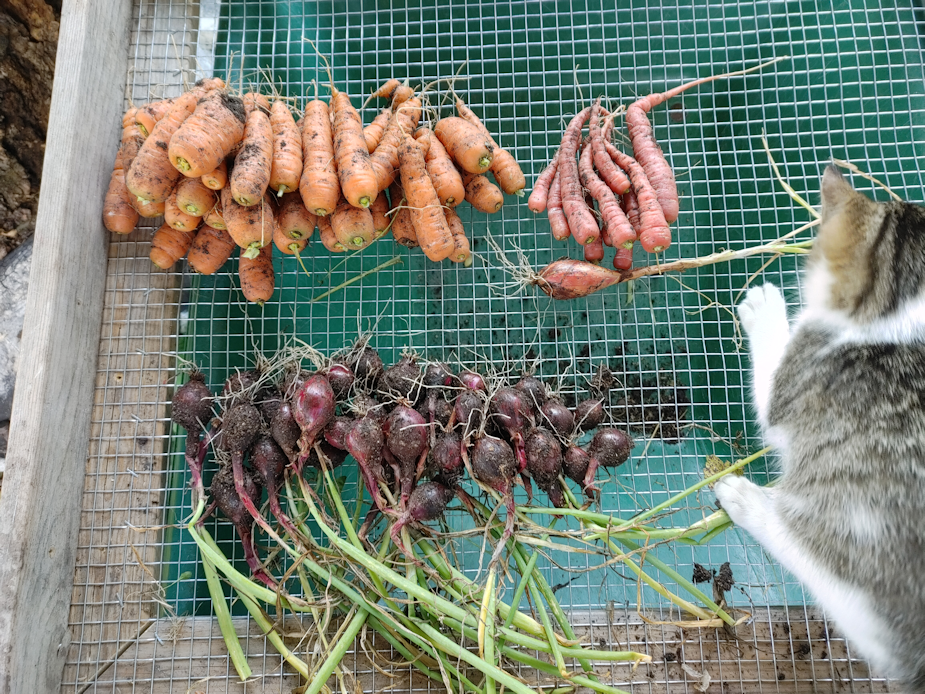
Still, we did manage to get a small harvest of both. A couple of Kyoto Red (the darker carrots on the right) bolted, so I left them to go to seed, but they never finished blooming before it got too cold.

Then there were the Uzbek Golden carrots (the free seeds) and the Black Nebula carrots.

It’s hard to tell in the above photo, but we got a lot of Black Nebula carrots – and a surprising amount of Uzbek Golden carrots! The free seeds didn’t have a lot in the packages, so I was pleasantly surprised by the quantity that we harvested.


As you can also see in the above photo, the turnips didn’t do so well!

We planted three varieties of turnips. Gold Ball, Purple Prince and Tokyo Silky Sweet. One variety we got as free seeds, Gold Ball, were planted near the Uzbek Golden carrots, and then the Purple Prince you see in the photo were planted at the end of the same bed.

More of those, plus the Tokyo Silky Sweet, were planted in other beds, shared with onions, spinach, and peppers.

Those were a total loss!

The Gold Ball turnips germinated quickly – and were just as quickly completely destroyed! Something completely decimated their leaves. The Purple Prince also were badly eaten, but enough survived to get that tiny little crop you see in the picture.

In the other beds, I know I saw some start to germinate but they, too, promptly disappeared! A total and complete fail.


Finally, there were the beets. We had four varieties to plant. They went into a small bed in the old kitchen garden, protected by netting.

They, too, were a complete loss!

The Results:

They had a decent germination rate, but that’s about it. They barely grew at all. Eventually, we took the netting off and pretty much abandoned the bed, other than watering them and occasionally weeding out the mint that kept trying to take the bed over again.

When it was time to clean up the bed for next year, however, we did find a tiny, sad little crop!

That’s all we got.

This is the third year we’ve grown beets and have never had a really good crop, but this was by far the worst year. We can’t even blame it on things like deer and groundhogs eating them! Nor can we blame the flooding we had, because this garden is next to the house, and slightly elevated. There was no flooding in that garden, even with the sump pump’s hose ejecting into one of the paths. Everything drains away from the house. Even one of the bottom corners, which was near where water collected and formed a moat around the storage house, is elevated enough to not be affected by the flooding.


Conclusion:

With the carrots, things went pretty good, all things considered. For 2023, we will be trying a different variety of orange carrot, mostly because of how much the Napoli carrot seeds increased in cost. We enjoyed the flavour of all the carrots we grew, and I’ve ordered more Uzbek Golden carrots as well. I really like their nice, crisp texture.

As for the Black Nebula carrots, they are good, and I’m glad we tried them, but we won’t be growing them again; at least not any time soon. These are a very long carrot, and our soil compacts very quickly, which made thinning by harvesting pretty much impossible to do. When cooked on their own, their colour is very dramatic, but when cooked with something else, like in a soup or stew, their intense colour can make things look very… unappetizing! We still have lots, stored in a bin in a chilled location, and have discovered they very quickly become white, with capillary roots! It makes them look moldy. 😄 This isn’t a bad thing. Those little roots are collecting just enough moisture to keep the carrots firm and crisp, but they have SO MANY of these little roots, it actually makes it hard to clean the carrots in preparation for cooking.

So for 2023, we will still be growing carrots, but just two varieties.

As for the turnips… I don’t know that we’ll bother growing them again in 2023. When we do try them again, we will have to make sure that they are under floating row covers, as soon as the seeds have been sown. Turnip greens are supposed to be good for salads, too, but we never had a chance to find out if we liked them or not. I would have loved to try the Gold Ball variety. The main reason we wanted to grow turnips in the first place is because their bulbs are a good storage crop, making them something we want to include in our goals of self sufficiency. So we will definitely be trying them again. Just maybe not in 2023.

Finally, there are the beets.

I don’t know what went wrong with those. They should have done well, where they were. My daughters like beets, however, so we did order one variety to grow in 2023. I think we’ll have to be more selective on where we plant them.

Root vegetables are definitely going to continue to be a challenge for us, given what the soil it like here. It will take time – and more raised beds! – for us to amend the soil until root vegetables can reach their full potential. Which is something we’ve already been working on, and have long term plans for.

The Re-Farmer

Our 2022 garden: going through the harvest

The sun room is starting to get too cold and night to leave our harvests in it anymore. This morning, I went through them and binned them up.

All of the carrots, both types, filled one bin enough that the lid can’t quite close. Those will need to be taken care of quickly. The Black Nebula carrots are already getting wimpy!

All the gourds will go someplace warm and dry to finish curing.

The Tropeana Lunga onions are growing rather than curing, so they will go to the kitchen for fresh eating and dehydrating.

The hulless seed pumpkins that have ripened the most will be moved inside to ripen some more, while the remaining ones were shifted around on their shelf to get more sunlight. We should be able to get away with leaving those there for a while longer.

The tomatoes that are ripening were laid out in a single layer on the bottom of a bin to go inside for further ripening. The green ones that have shown no signs of turning colour by now are not going to, so they all went into one small bin. I picked through them in the process of sorting through, and the more wizened ones went into compost. The rest will go to the kitchen as we decide what to do with them. The problem is, I’m not the tomato person in this household, so I’m not exactly inspired over them!

Now that these are clear of the sun room, we’ll be able to continue cleaning out and partially reorganizing the sun room for the winter.

The Re-Farmer

Our 2022 garden: harvesting carrots and turnips.

It was a chilly night last night, with temperatures dipping below freezing. As I write this, we’re at 3C/37F – just under our predicted high of the day.

It was actually very pleasant out there!

With a few frosts already past, I decided it was time to harvest the carrots.

This is all of them.

Plus the Purple Prince turnips – the only turnip variety of the three we planted this spring, that survived. Barely. Their greens were constantly munched on by insects. I’m not sure why I even bothered to harvest them. They’re so small, a lot of them got left behind in the bed, then still more went into compost when I trimmed their greens. Not much of a harvest there.

I’m surprised by the Uzbek Golden carrots, which were from a free seed packet. A lot of them were much larger than I expected.

The Black Nebula carrots where more difficult to harvest. Even with several years of amendments, the soil still gets pretty compacted, and these guys get long. It took quite a bit to dig them out!

Well, that didn’t take long… 😅

We are expected to dip to -4C/25F tonight, so these needed to be set up indoors to cure – and the only place we had available in the sun room was covered with tomatoes, still.

Thankfully, they are all laid out on screens.

I was able to stack the screens with the tomatoes and gourds, then lay out the trimmed carrots. After a day or two, we’ll brush the dirt off and go over them. Several of the biggest Uzbek Golden carrots have split, but the Black Nebula look like they were a slug favorite. Quite a few had damage at their tops. The size variety among them is pretty surprising. Quite a few of them are really big around! From the photos, I expected long and narrow.

Once we’ve assessed their condition, we’ll decide how best to store or preserve them. I suspect blanching and freezing will be the best option for most of the Black Nebula carrots, while the Uzbeck golden will be kept in the kitchen for fresh eating first.

I haven’t actually tasted any of these yet! We did harvest a few Uzbeck golden for meals over the summer, but almost no Black Nebula, because even the little ones were hard to pull. I hope they taste as good!

The Re-Farmer

Our 2022 garden: morning harvest, and a survivor

Here is today’s morning harvest. 😊

I found a little round cucumber lying on the ground and picked it, leaving the others to get a bit bigger. There were a few peas to pick, as well as some carrot thinnings. I would have thinned more of the purple carrots, but they are a very long variety, and our soil just doesn’t want to give them up!

I grabbed some of the smallest Red of Florence onions for today’s cooking, and decided to grab a few little turnips, too. There was one Magda squash I went ahead and grabbed. There was also a single green zucchini, and one large-ish sunburst squash, that I left to get a bit bigger.

The yellow bush beans are almost done. I couldn’t see very many developing pods left as I picked these. The purple Carminat beans are very prolific! There are so many more of them, compared to what’s on the green pole beans.

In that pile of green pole beans, however, there were two extras.

They are from this one little bush bean plant, grown from a leftover seed of our first planting of green bush beans under the sweet corn. The second planting of green bush beans are starting to develop pods, while this lonely original had a couple ready to pick.

I’m happy that this year, we at least have plenty of these two varieties of beans. The Red Noodle beans still show no signs of blooming, though they are at least starting to climb the trellis more. I’m curious about how the shelling beans will turn out, given how incredibly small and fragile the plants turned out to be. There are a lot of pods developing, too.

We planted so much this year, with hopes of having lots of food, in many varieties, to have over the winter. I always expect to have at least some losses. I didn’t expect to have so many total, or near total losses! Which makes me extra thankful to have what we do have.

The Re-Farmer