Our 2024 Garden: transplanting Crespo squash, San Marzano tomatoes, and direct sowing pole beans

Today was a productive day!

After I finished my post earlier today, my daughter and I headed out for a dump run, then errands. We ended up going to the smaller city for her shopping, so that I could pick up some cat food at a better price at Walmart. By the time we got home, it was well past 3 and, I’m happy to say, starting to get a bit cooler!

After having a late lunch, I headed outside to finish at the new low raised bed.

Before I got started, I prepared a 4L size water bottle by removing the top and punching holes in the bottom, then brought over protective rings and support posts. The support posts were long enough to reach from corner to corner on the bed, so I used them to find the centre. That is where I partially buried the water bottle. This way, we can add water into it, and it will drain out the bottom and water the roots of the plants nearby. We’ve done similar in the past, including the first time we tried to grow Crespo squash, and it has worked well.

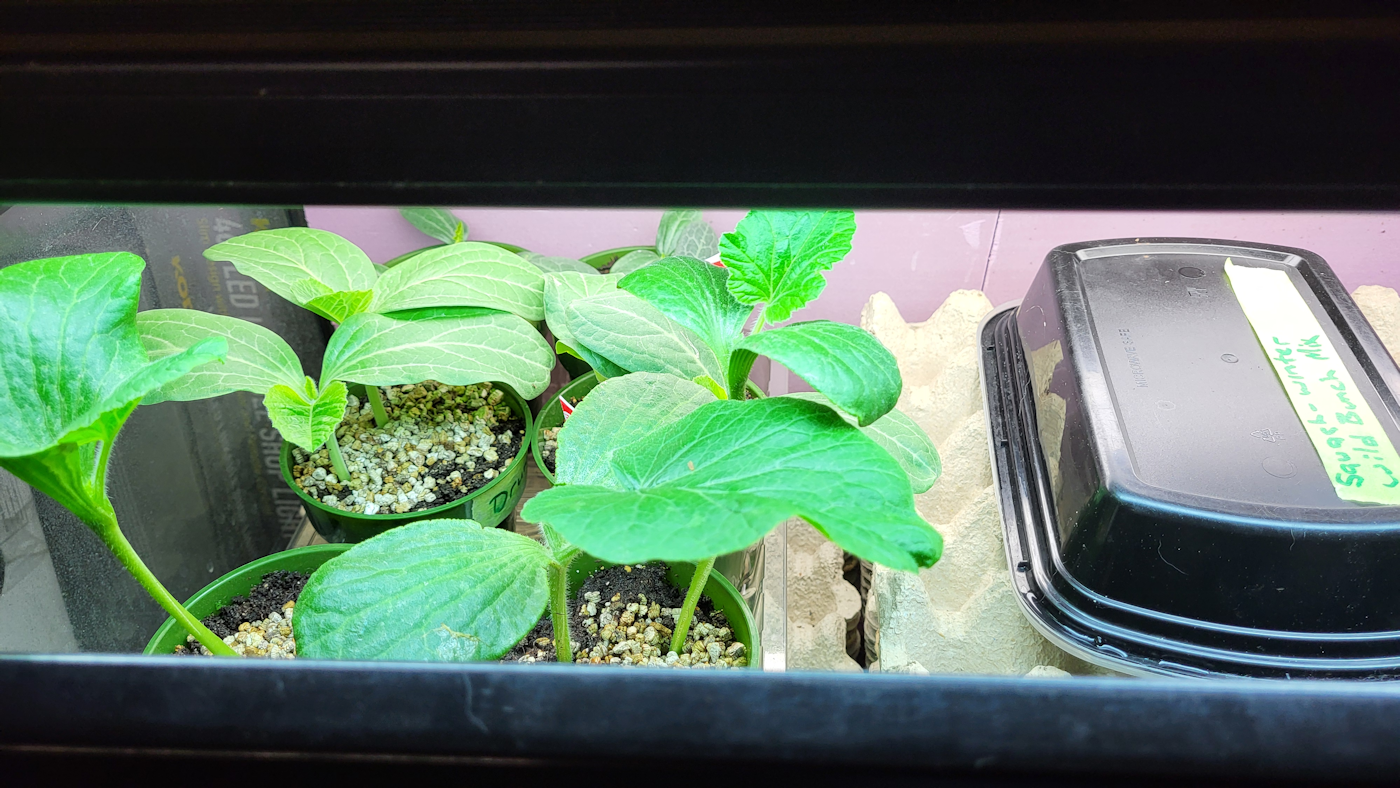
The pot with the single Crespo squash was the one where the stem had broken when the cats knocked the bin holding the pots off the table. I had it supported with a pair of bamboo skewers. Unfortunately, as soon as the skewers were removed, it immediately bent over at the break, almost snapping off. I had intended to plant it deep enough to cover the break, as the squash will develop adventitious roots, but I had to be so careful not to break it completely! I planted it in a protective ring and ended up filling the ring to the top with soil to support the stem. It still ended up lying on the soil. I just made sure it was running towards the side I wanted to train it towards, as it gets bigger – if it survives!

The other pot had two squash in it. I was planning to separate them, but the roots were too entwined, so they were planted together. They, too, ended up with their protective ring filled almost to the top with soil. They both got well watered, and I added water to the reservoir in the middle – which drained much faster than I expected! I ended up filling it again, a couple of times. before I was done.

With how the light hits this area, I decided to plant a row of beans along the east and west sides of the bed. I chose Seychelles pole bean seeds left over from a couple of years ago, that did so well for us when so many other things did not! These are a very straight green bean, and they were quite prolific.

Once the beans were planted and well watered, I set up supports to create an A frame, then added 4″ square netting. This will be enough to keep the deer from getting at the squash, while still being open enough to reach through to weed or pick beans. The beans themselves are planted about 8 or 10 inches from the side, so they will also be protected by the netting until they get tall enough to start climbing it. Hopefully, we’ll have a decent germination rate. The germination rate was excellent when we grew them before, but after a couple of years, I would expect it to be far less.

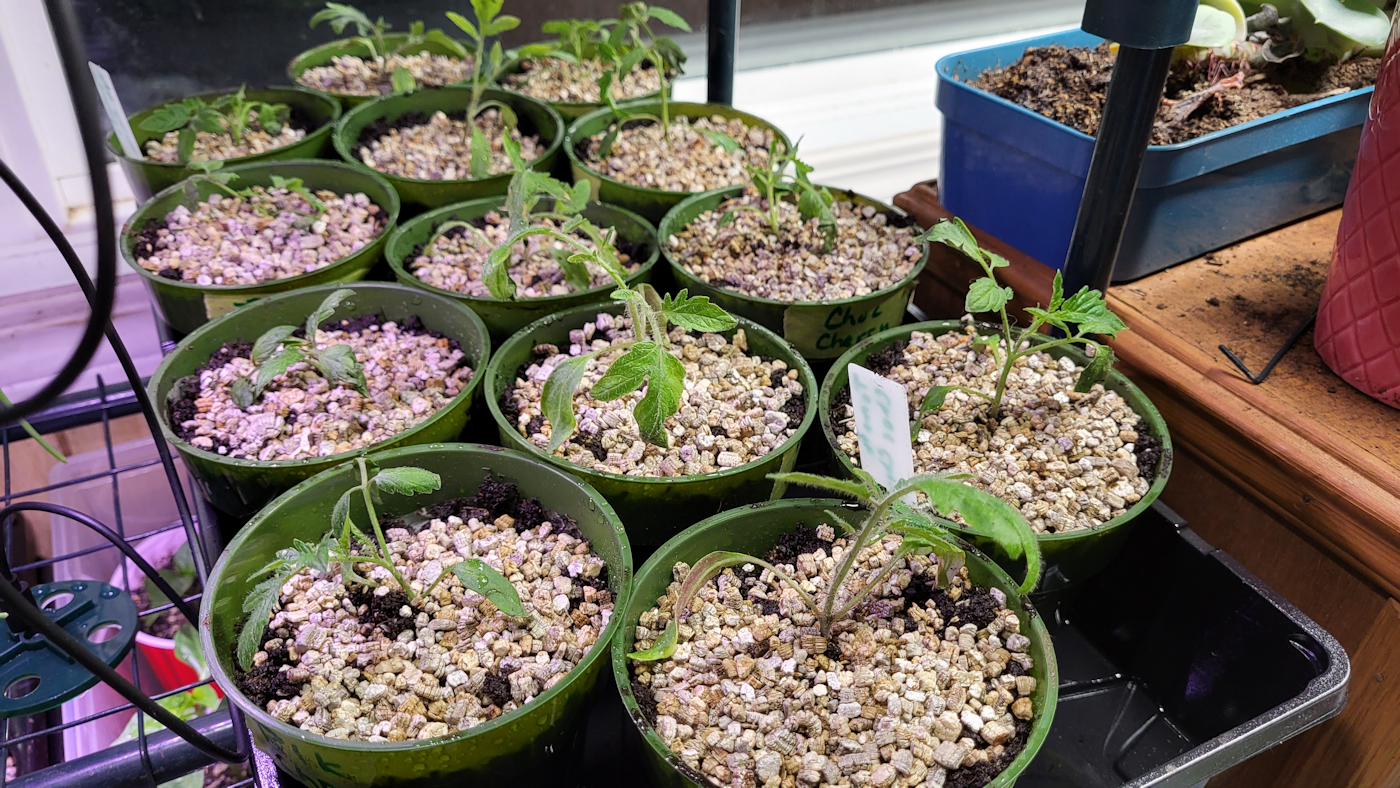
Though it was starting to get late, the days are so long right now, I decided to do more transplanting. The San Marzano tomatoes needed to be transplanted, and I decided to see if the retaining wall blocks could be used for that.

Aside from the chives in the corner, I planted mint in alternating blocks. Unfortunately, there’s some sort of plant in this garden that is more invasive that even crab grass or creeping Charlie! The mint is struggling to come back this year, and this plant is choking them out! I pulled as much as I could around the mint, but they’re so mixed together, there really isn’t much I can do.

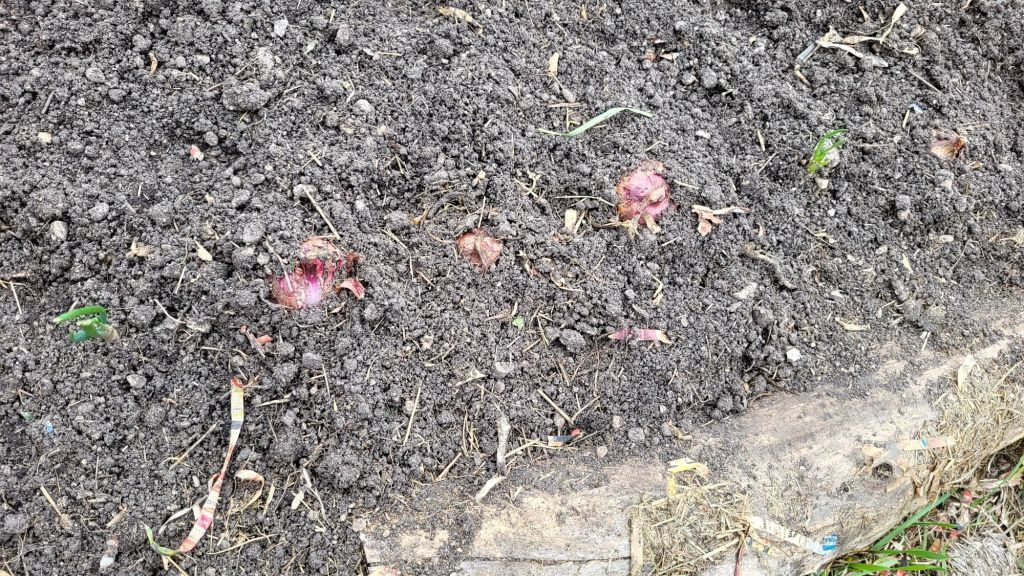
In the other blocks, there was a lot of this plant to clean out as well. A couple of blocks still had some onions growing in them. There had been more, but they were choked out by this invasive plant.

I was able to clean up 10 blocks for the tomatoes, including two of blocks with a pair of onions in them that still had room for a transplant. I used my pH meter and was surprised the soil was just as alkaline as everything else. These blocks have been amended with peat in the past, and the cement itself can increase the acidity of soil. That meter’s needle was a hard 8. So I worked some sulfur granules into the prepared blocks, too. I wonder, at times, what the reading would be if I had a meter that went higher than 8! Even the solution in my soil test kit maxed out at 7.5. Ah, well.

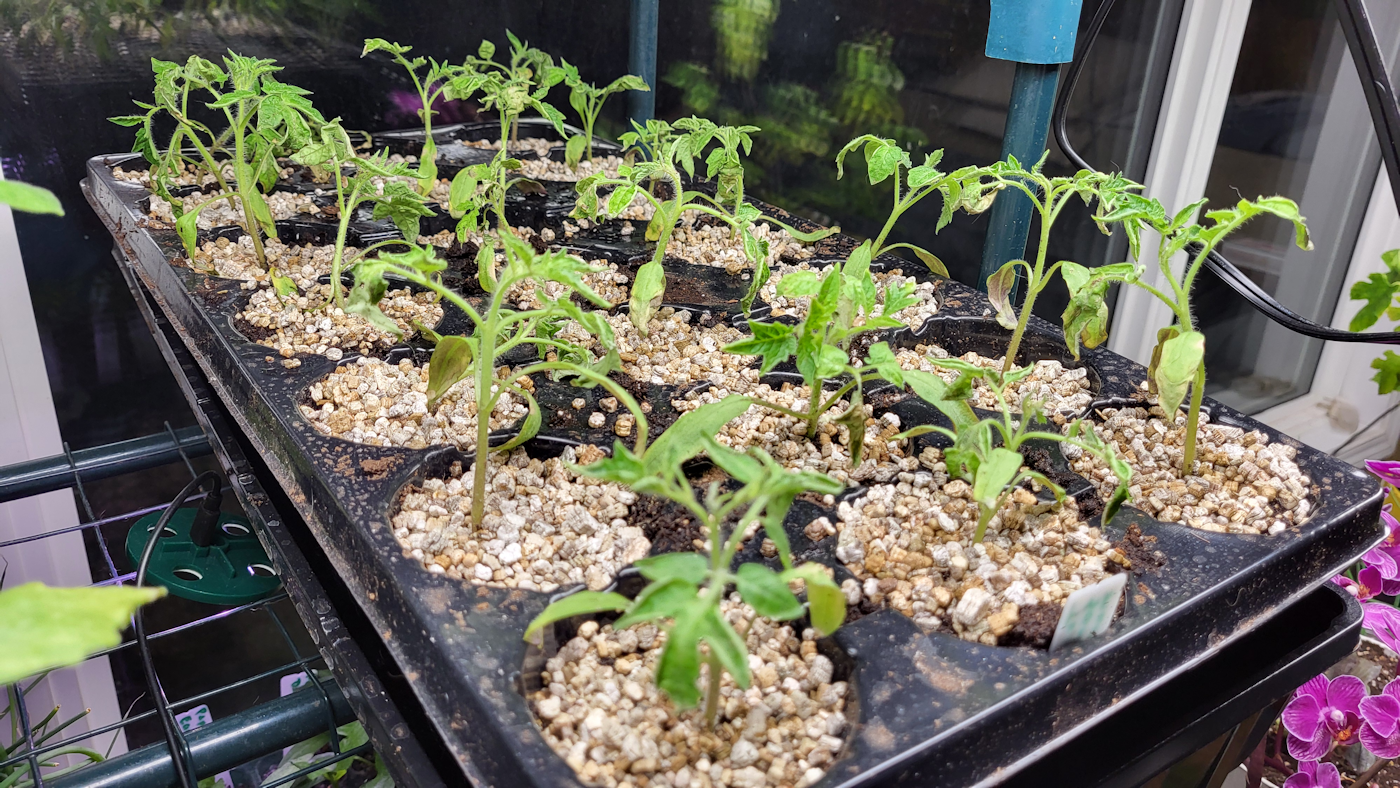
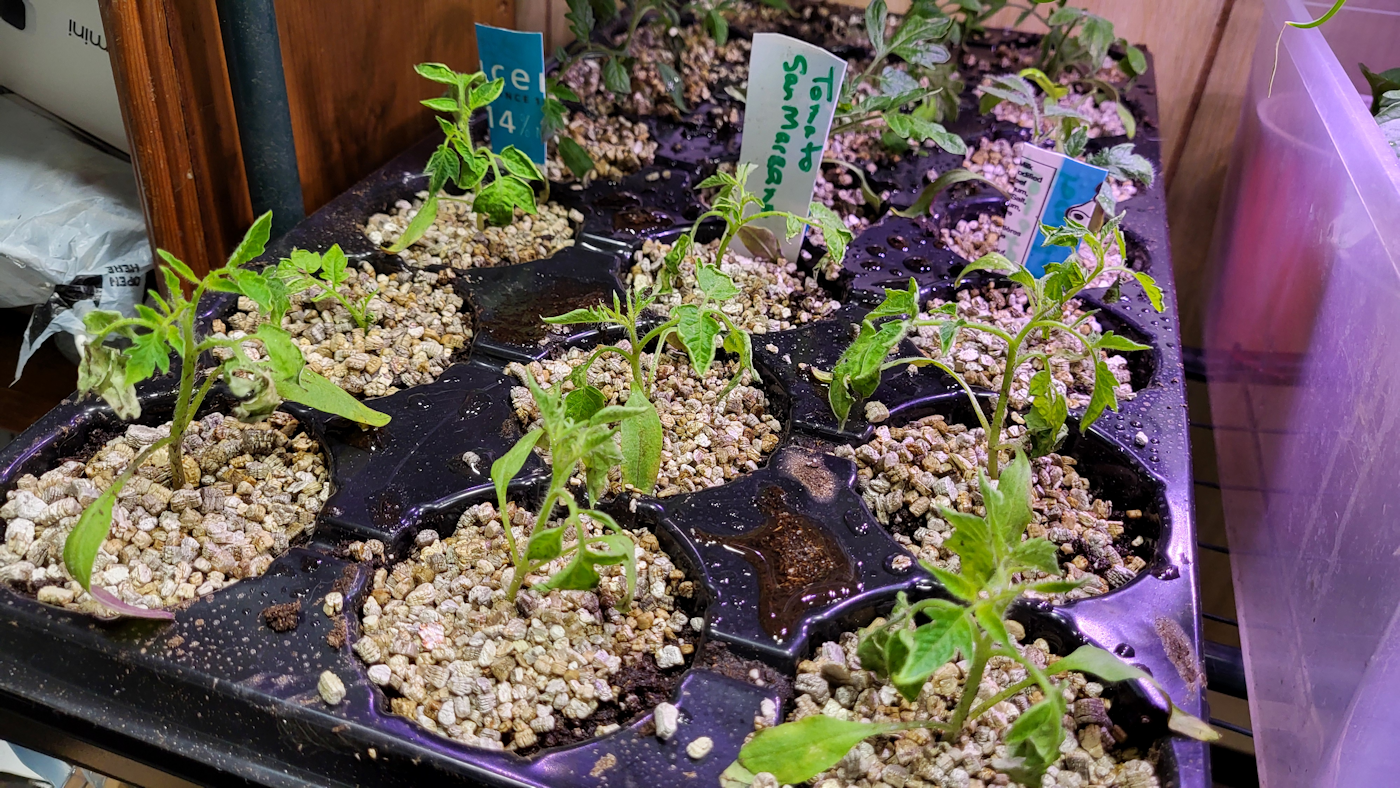
In the tray that had the biggest, healthiest tomatoes, there should have been 9, but there were only 7 surviving. One of them was even starting to bloom! The last three blocks were planted with the smaller tomatoes that almost didn’t survive being moved to the sun room. This was the tray that had tipped and spilled after I’d topped up the soil in the cells, so they’ve had just a rough time, over all! After transplanting the three strongest looking ones, there’s maybe 5 or 6 left. There’s one, I’m not sure is going to last much longer. I don’t know where I’d transplant these right now, but being as small as they are, they can stay in the tray longer.

Each of the transplants got a bamboo stake that will be used to support them as they grow. They will likely need more as they get bigger, but that can be added later. Last of all, they got a very thorough watering. Hopefully, they will do okay here. The ornamental apple trees cast quite a bit of shade, even with the pruning we’ve done over the years, but we’ve grown tomatoes in these blocks before, and they did okay.

Once everything was put away, I did one last prep. There are three pots on the landing outside the main doors. Last year we grew herbs in them. I have decided to grow summer squash in them this year. This way, even if we don’t end up having the space to direct sow in the main garden beds, we’ll at least have some summer squash in the pots to enjoy!

One of the pots had spearmint in it, but it did not survive the winter. Another had a mix of thyme and oregano. The one oregano that survived to be transplanted had bloomed and gone to seed, and I was going to see if any of the self-sown seeds germinated, but decided having summer squash was a priority. The biggest pot had lemon grass in it and, wow, were those roots every hard to clean out!

One of the new seeds we got for this year were are a white patty pan, so I’ll plant some of those, for sure. We have both green and yellow zucchini, and I haven’t decided which of those I will plant, yet. If we still have some Magda seeds left, I want to plant some of those. We really like them, but they are the ones that have been the hardest to grow! With some of the seeds being a few years old, I’ll plant at least three per pot, and see how many germinate.

The pots are prepped, but the planting will be done tomorrow.

With so many winter squash that need to be transplanted, they are a priority for the low raised beds that are already shifted, with or without frames. Tomorrow, my daughter and I will finally drag the second 18′ log out of the spruce grove – between the rain and the high winds, we haven’t gone into the spruce grove since she got this last one cut to size! We have enough logs to frame one bed, so that will make things a bit easier.

Things may change, but I’m thinking of planting the winter squash in the middle of the bed, in a long row, then planting more pole beans on either side. We won’t be able to do an A frame support structure, like over the Crespo squash, but we should still be able to rig up a quick trellis for them, later on.

With how many winter squash we have, and how far apart they need to be planted, the two shifted beds might not be enough for them all. The drum gourds and the pumpkins will probably need their own hills. I’ll figure that out, later. We’ll be transplanting melons into the first of the trellis beds, all along one side, where the trellis supports will be added, later, but again, we probably won’t be able to fit them all in. Since they will have a trellis to climb, they can be planted closer together, but I don’t expect to fit them all in that bed. Something else we’ll need to figure out!

Still, today was a productive day, and it feels rather good to have fewer trays to return to the sun room for the night!

The Re-Farmer

What a weird time of year

A lot of what I write about in this blog, besides cats, has been about gardening. We’ve had a lot of unexpected challenges, so I’ve been spending a lot of time doing research and watching gardening videos.

Videos like this.

A very useful video about harvesting onions.

So why is this a weird time of year?

Because this video was just published a few hours ago. It’s May 30.

It’s May 30, and he is HARVESTING his onions.

He also has garlic scapes to harvest.

Onions can take anywhere from 90 to 120 days to maturity. Which is why we start our onion seeds indoors earlier than anything else.

We haven’t even transplanted our onions yet. They can handle the cooler nights, but they will be transplanted around and in between other things, not in a bed by themselves.

While our garlic was planted in the fall and is growing quite nicely right now, we probably won’t see scapes for another month.

It’s one thing to reading blogs or watching videos of harvests from people that are living in the southern hemisphere. It’s quite another to see this happening here in the norther hemisphere, and there are SO many channels I follow that are harvesting from huge, lush gardens right now. Even in places with climates that are actually cooler than ours, or at least don’t have our extremes of bitter winters and scorching summers, but have a longer growing season.

It’s downright surreal at times!

The Re-Farmer

Our 2024 Garden: starting to rework the low raised beds (video)

As I write this, the video I made is still uploading, so I’ve scheduled this to be published tomorrow morning.

One bed is prepped and ready for logs to be placed around it. My younger daughter is working in the spruce grove to get them for me, but has to clear away pieces of trees and branches that have fallen in high winds, and other debris, just to reach them. She handles heat even worse than I do, and the humidity sure didn’t help. She ended up needing to use a cane to get around the house until the painkillers kicked in.

She’ll have tomorrow to recover, though. The rain started up again this evening, with thunderstorm warnings. It’s supposed to keep raining all through tomorrow (meaning today, by the time this is published). A good day for me to be helping my mother out with her errands.

Sunday is supposed to be sunnier, though rain is expected to start again in the evening, so we might get a few hours of work in during the day. Then the rain is supposed to be back on Monday.

This weekend is a long weekend, when many people will be putting in their gardens. While we could probably direct sow some things, our area still has a while to go. Looking at the 14 day forecast is frustrating, since it seems to change every time I look at it, but at one point I was seeing predictions of overnight temperatures dropping below freezing in the last few days of May. When I look at it now, though, it shows a few chilly nights, just above freezing, and then overnight temperatures are predicted to be considerably warmer. Once I look into June, the daytime highs are all supposed to be 20C/68F or higher, for the entire month!

Of course, that might change completely, the next time I look.

Well, whatever ends up happening, we’ve got a lot of hard work to do before we can plant in the main garden area.

The low raised beds have been wildly overrun by crab grass in particular, with some beds heavily invaded by dandelions, and at least one has a pretty bad infestation of Creeping Charlie. Since they all need to be heavily reworked anyhow, we’re going to go ahead and redo them. Or, more specifically, I’ll be doing the weeding and shifting. My daughter will be harvesting and processing the dead spruces to build walls around them. This late in the game, I’ll be happy if we build them just one log high. They just need to be done! We can add more height to them, as time goes buy. Once these low raised beds are reworked, we can switch our focus back to building the trellis beds. Those will require even more work, since we’ll be bringing soil in from what’s left of the purchased garden soil pile, as well as layers of organic material at their bottoms.

For transplants, we’ve got the winter squash and melons, which will take up the most space, tomatoes, peppers, eggplant, onions, gourds, some thyme and Orange Butterfly Flower (a milkweed) plus the mulberry saplings to transplant. Depending on the space available, I want to direct sow summer squash, shelling peas, bush beans, pole beans and more carrots, plus the dwarf nasturtiums. If we really do well for space, I’d like to plant at least one variety of corn, but I don’t expect that to happen. There will be a fair bit of intercropping, plus we plan to have things growing vertically as much as possible, so that should help with space. Still, there are quite a few things I expect to skip entirely this year, like cucumbers, beets, radishes, chard and lettuces, simply because I don’t expect to have the prepared space for them. Mind you, things like radishes and chard can be planted later, after the garlic is harvested and those beds are freed up.

Weather willing, I hope to be able to get at least one of the low raised beds weeded and shifted over in a day. With one done today, there’s four left to do. If the weather forecasts are at all accurate, that means they should be done by the end of next week. Then the log walls need to be placed and secured, and the soil amended with sulfur granules. Hopefully, that will also get done by the end of next week, because the week after has me doing a lot of driving around, from getting my mother to a medical appointment, to our monthly stock up shopping, to hopefully being able to connect with a friend that is back in Canada for a while.

It’s a very busy time of year!

The Re-Farmer

Our 2024 Garden: hardening off begins, and new growth

We had rain all night, with a foggy morning. We’re supposed to get possible showers this afternoon, with thunderstorm warnings for the night, and roughly the same tomorrow. Hopefully, this rain is reaching the fires to the north of us in adequate amounts. Currently, we’ve got 5 forest fires burning, with 2 still listed as out of control. That’s actually down two fires from when I checked, yesterday.

With the overcast morning, it was a perfect day to set the transplants outside to begin hardening off. Just a couple more weeks, and we can start transplanting them into the garden.

Oh, my sad, sad San Marzano tomatoes!

While I took out the trays in the sun room, my daughter brought the last of the trays that were in the mini greenhouse frame in the living room. As of now, the only things left in the house are three pots in the aquarium greenhouse; one Zucca melon that’s finally breaking the surface and one Pixie melon. There’s a second Pixie melon that has yet to emerge. The seeds that were left for pre-germination, however, have shown no progress. The Zucca seeds will be going into the compost, as they are starting to show signs of mold, but the three remaining Pixie melons look completely unchanged.

Most of our trays of transplants fit on the folding table we made, while a few went onto the set up we made above the seat of the laundry platform. A handy spot, though I always feel nervous going up those steps while carrying trays of plants. I’m never quite sure my knees won’t just give out at some point. Stairs and I do not get along, at all! 😄😄

While continuing my rounds, I checked on the bed with the peas, carrots and spinach planted in it. Of the first peas that were planted, there is one sprouting. I did see what might possibly be a second one, but it’s so tiny, I’m not sure yet. The second planting doesn’t have anything showing yet.

I checked the Royalty raspberries, as usual, and we are finally seeing new growth at the bottom of one of last year’s canes. These were supposed to be first year canes, which should have fruited for the first time this year, but they ended up producing berries last year, then dying back. I contacted Veseys about it and they assured me they would come back this year. So far, they are right about one of them! However, this does mean that any growth we get this year should not produce any berries until next year.

In other things…

I counted 25 yard cats this morning, though at least one or two more showed up later on. When I saw Broccoli while I was still setting the food out, I went around to the garden shed and left some food in a dry spot, then checked on the babies. They seem a bit more active. I ended up leaving some food for Broccoli not far from her baby nest.

With everything being so wet, and more rain and possible storms to come, I decided this was a good day to make a run to the nearest Walmart to get a few things. That took enough time that the transplants were brought back inside when I got back. We’re actually seeing a bit of sunshine, peeking through the clouds right now, too.

As I write this, it’s just past 2pm, and we’ve reached 16C/61F, with the humidex making it feel like 20C/68F. We’re supposed to get just a bit warmer before the end of the day. With how muddy things are, a lot of what we need to do outside has to wait. Very frustrating!

Ah, well. It is what it is! We just shift gears and do other stuff, like going into town for some errands, a bit earlier than planned – which I will cover in my next post. 😊

The Re-Farmer

Our 2024 Garden: planting everbearing strawberries

Much to my surprise, I’m feeling pretty good today, after the unexpectedly difficult work I did yesterday afternoon.

With the bed prepared, the Albion Everbearing strawberries we got from Veseys needed to get into the ground.

There are 10 photos in the Instagram embed, below.

I got the strawberries through one of their $20 specials. This was supposed to be a package of eight, but there turned out to be nine in the package. Bonus! Thanks, Veseys!

I’d gone to their website yesterday, to get the planting instructions. The first step was to set the roots to soak, while I continued working on the bed I prepared yesterday – which I found covered with kitty footprints, this morning!

I decided to add more soil, so I brought over the last of the amended soil left from when we redid the bed against the chain link fence. The extra soil from making the bed narrower has come in very handy!

After leveling off the new soil, I made holes to plant in and filled them with water. The instructions said to spread the bare roots over a small hill of soil, so I added soil back to make one in each hole, while the water was being absorbed. Next, the bare roots were spread over each hill, and soil pulled back around them, making sure the growing tops were above soil and supported.

After that, I brought over some straw that has been in the potato grow bags last year, and carefully mulched around each plant. I wanted to make sure the hills of soil were well covered so it wouldn’t erode when watered, as well as packing extra around the outside, to make it less likely for water to wash the soil out under the frame. Once that was all in place, it got a deep watering. Yes, we’re expecting rain this afternoon, but with our weird little climate bubble in our area, it could pass us by completely and we might not get more than a few drops.

From the information on the Veseys website, they recommend pruning away the flowers in the first year, to have stronger and more productive plants the next year – except for everbearing varieties. These are everbearing, so there will be no need to prune them.

Which means we should have strawberries to harvest this year – if they survive being transplanted!

I don’t assume anything will make it, anymore! 😄😄

The Re-Farmer

Our 2024… er… 2023 garden: We have survivors!

I just finished doing my evening rounds – it is so gorgeous out there right now! – which gave me a chance to see how far my daughter got on the garden bed she was weeding.

Before I left this morning, she asked me which beds needed to be worked on, and if there were any surprised to watch out for, like fall plantings of some kind. I said no, we did the fall garlic in the old kitchen garden beds this year, and those were the only fall plantings we had.

The bed she started on is where we planted the Roma VF and Red Wethersfield onions, last year. The tomatoes ended up not very healthy, and seemed to get blight near the end, but the onions… they just disappeared. The seedlings I transplanted around the perimeter seemed to be doing well at first, and then they were gone. Not dug up. Just died away. So I definitely had plans for amending this bed, and we were most definitely not going to be planting tomatoes in it, again.

Imagine my surprise – and probably hers! – when I looked today and saw this.

All along the perimeter, Red Wethersfield onions are growing! There are so many crab grass rhizomes in there, my daughter has basically been digging them up and transplanting them.

I am totally amazed. Onions I thought had died off, with no evidence of them to be seen when that bed was harvested and the diseased looking tomato plants pulled for burning, had been there, all along, and survived the winter!

We started more Red Wethersfield onion seeds this year, too. I was going to give them one more try before giving up on them, at least for a few years. Now, it looks like we’re going to have plenty!

The bed is only about a quarter finished; it took my daughter a lot longer then usual, since she was both weeding and transplanting all the onions she was finding. Even through the crab grass growing around the edges, I can see more little onion bulbs pushing their way through!

Onions are biannual. Which means that these onions, if left alone, will go to seed, which we should be able to save.

What an awesome surprise!

The Re-Farmer

Our 2024 Garden: potting melons

We had pre-germinated seeds ready to put into pots, but I was almost out of seed starting mix, so it’s a good thing I ended up doing a shop today.

Of the four Zucca melon seeds in the container, two were starting to germinate. With the Cream of Saskatchewan Watermelon, four out of five seeds germinated – and two were getting almost overdue for planting!

At first, I thought four of five Sarah’s Choice seeds had germinated, but it turned out the one of the seedlings had gotten big enough that it dropped its shell completely! So we’re five out of five on those.

As for the Pixie melons, I could see a couple of seeds starting to open up, but they are not at all ready yet. They, and the two remaining Zucca melon seeds are set aside now, to give them more time.

I was originally going to use one of the large celled trays for these but, at the last moment, I decided to use individual 4″ cardboard pots. I don’t know how long it’ll last, but I used a marker to label the pots directly, before filling them with pre-moistened seed starting mix. With some of the Sarah’s Choice seeds, the roots had grown between the layers of paper towel and spread quite a bit, so I tore the paper round them rather than risk damaging the roots by pulling them through. I now have all of the pots in a tray over the heat mat, with water on the bottom for the pots to absorb, rather than absorbing water from the premoistened growing medium.

As for the Summer of Melons blend, all the pre-germinated seeds but one have fully emerged.

We now have quite a lot of squash and melon seedlings going! Hopefully, they’ll all survive transplanting, but we have enough that we can afford a few losses. What was that poem again? Four seeds, all in a row; one for the blackbird, one for the crow; one to die and one to grow! Something like that.

I’m glad I got at least one gardening job done today, without making my messed up right arm any worse. 😁

The Re-Farmer

Our 2024 Garden: first direct sowing! (video)

Okay, so I’ve scattered seeds and such, but today is the first day for direct sowing. It was such a gorgeous day for it, too!

I planted all the edible pod peas from the package, minus the ones that split apart as they soaked between damp paper towels overnight. Not a lot of carrots were planted; I’ll include them between other things, over the next while. I’ll probably do the same with more spinach. Basically, they’ll be space fillers and ground covers until it’s too warm to plant them anymore.

The box frame cover got worked on first, then set aside, since I put in the old salvaged T posts to hold netting for the peas to climb. I couldn’t drive them in very far, so they will need to have support added to them before any trellis netting is added, so they don’t get pulled into the bed by the weigh of the peas – or the net, for that matter! I intended to add a third post in the middle, but hit something hard. Possibly one of the branches set at the base of the bed, when it was first built and filled. Or a rock that got missed.

I found my pH meter and did a reading. No surprise the pH is still at 8. I even stuck it into the compost heap nearby, and the needle barely moved. I had a bit of an ah-ha moment earlier today. Well, more like a “duh, of course” moment. Maritime Gardening did an April garden tour video and was taking about how acidic his soil is, and mentioned that liming the soil can make the soil more alkaline.

Liming.

Lime.

Garden lime.

Which is made out of limestone.

Which is what we are sitting on top of.

Our area has limestone quarries and commercial gravel pits – we even have our own little gravel pit – with limestone based sand and gravel below a very narrow band of topsoil.

Of course our soil alkalinity is maxing out the pH meter. How could it be any different? *smacks forehead over what should have been obvious*

Increasing the acidity is going to be a challenge, that’s for sure. The use of raised beds will make it easier, at least.

Our order of sulfur is supposed to arrive by Thursday. Once we’ve got that in, we’ll be able to start amending the various beds with it, to increase the acidity. My husband actually ordered 2 different bags. One bag is 90% sulfur, 10% betonite clay. The other is guaranteed 99.5% elemental sulfur, but both are supposed to be broadcast evenly, then worked into the top 6 inches of soil, at a rate of 250g/10m² (0.5lb/100ft²). These low raised beds are 27ft², so they shouldn’t need much but, from what I’m reading, the more alkaline the soil, the more sulfur is needed (which makes sense), plus our soil type would also need more, for it to make a difference. Even so, it won’t actually do much for us this year; if we were treating a field, we’d be adding it to the soil a year before planting a crop. Any amending we do this year will mostly benefit what we grow, next year. Once we’ve started incorporating it into our soil, though, we should test the soil every few months to see how much difference it has made. Still, every little bit will help.

While it will be slow going to increase our soil acidity, using sulfur is supposed to be one of the quickest ways to do it!

Anyhow…

In the early evening, the girls and I went around the yard, checking things out and enjoying the longer daylight hours and warmth. We blew past our predicted high and reached 16C/61F! Plenty of trees and bushes have leaf buds showing. It took some searching, but we were thrilled to find a few shoots of snow crocuses and grape hyacinth emerging through the leaf litter. We even spotted the leaves of two tulips that had emerged near the saffron crocuses! These were not there, this morning!

We are getting into that period when everything starts to just explode into new growth.

Before long, we’re probably going to be complaining over how hot it is! 😂😂

For now, I’m just really happy to get some progress done outside. We’re supposed to get some rain next week, but we should have plenty of lovely days like today, to get things done outside!

The Re-Farmer

Our 2024 Garden: potting progress

Well, I ended up doing a bit more than I expected to, yesterday evening!

The first thing I did as plant a few more pre-germinated Wild Bunch winter squash seeds. To make space, I changed out what the pots were sitting in.

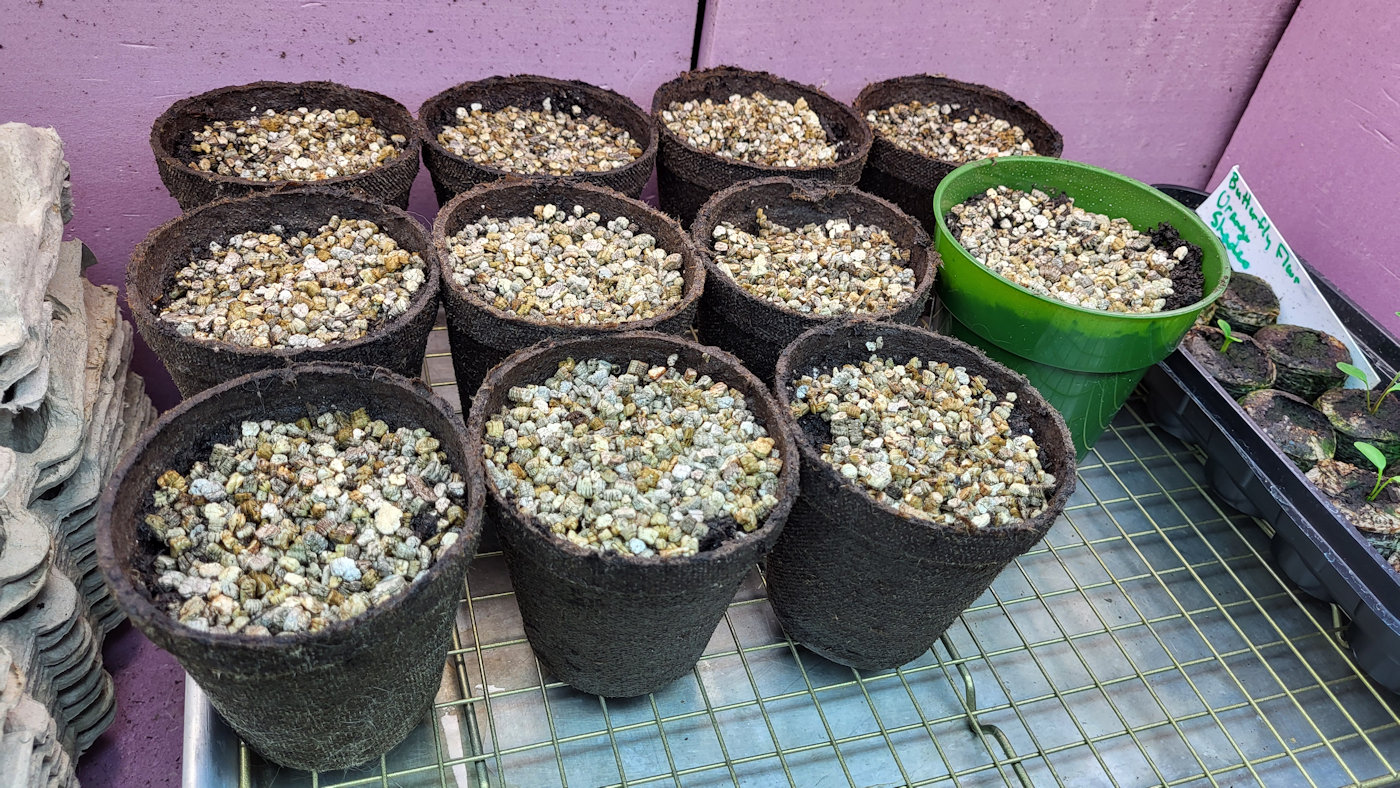
They are now in a baking pan, over a cooling rack, to allow air to circulate under them. This is a recommendation from Gardening in Canada, as a way to keep the pots from getting moldy or starting to fall apart. The problem, though, is they can’t be bottom watered while on this, which means they’ll be watered mostly by misting.

I would love it if Costco got another shipment of these baking pans. They are basic, 9×13 pans and were very affordable. I didn’t realize just how good the price was, until they were gone and I tried finding more, elsewhere, only to find they cost 4 or 5 times more! Even the restaurant section of the wholesale store I checked out was ridiculously expensive.

Also, that’s the last of my 3″ biodegradable pots from last year. The new ones I got are 4″ pots, which is what the green plastic one is.

Speaking of “biodegradable” pots. The last thing I potted was the coffee tree I got for my daughters. I repurposed a pot that we’d planted thyme in, last year. The thyme had been started in one of these biodegradable pots and the whole thing was potted up. Unfortunately, the indoor thyme got forgotten about and died. It was set aside until tonight, when I finally went to remove the dead thyme – and pulled out a pot! It was completely whole; only brittle from being so dry. No degradation occurred while the plant was still alive, at all. That is not how these pots are supposed to be! When it comes time to plant these outdoors, I will most likely break the pot up so that at least the roots won’t be constrained. If I can remove them completely without damaging the roots, I will!

But I digress…

After potting the pre-germinated seeds and rearranging the aquarium greenhouse to fit them, it was time to work on the San Marzano tomatoes. I decided they needed to be done, even though they are still recovering from their accident, as they were just getting too crowded. I used another deep cell tray to transplant into, but instead of filling it with seed starting mix, I use a Pro Mix potting soil I picked up today. As usual, I premoistened the soil, first.

Good grief, there were a lot of sticks in it!

I can’t even say it’s a brand problem. My second bag of Miracle Grow seed starting mix was full of sticks, too. The first bag of Miracle Grow had them as well, though not as bad. The first bag of seed starting mix I got – Jiffy, I think, but I can’t remember for sure – was probably the best of the lot, with only a few sticks in it, but it was also a much smaller bag.

Once the new tray was full of potting soil, I went through the San Marzano seedlings. A couple were pretty much dead, so I just pulled them. After removing and potting up the “spares”, I top dressed the ones left behind with vermiculate, then set it back at the window.

They are definitely still in rough shape. I hope that, now that they have more room, a bit of fresh soil and the vermiculite, they will recover faster.

As for the spares I transplanted out, there were only 9 strong enough to transplant to the new tray, plus one that got transplanted into a cell in the original tray that lost its seedlings to the fall.

I’m honestly not sure these will all survive. 😞 We shall see!

That left 12 cells available. I had the small tray with 12 cells planted with three different types of tomatoes in them, so I decided to thin those by transplanting. With the Chocolate Cherry and the Black Cherry, there were 4 “spares” to transplant out, but with the Forme de Coeur, a couple of cells had 3 seeds sprouting when I thought I’d planted only two, giving me 6 “spares” to plant out.

Once I started working on them, though, I realized I would have to plant all of them out of the little tray, so once these were done, I planted the remainder into 4″ plastic pots.

The outside rows of 4 pots are the Black Cherry and Chocolate Cherry. I didn’t have room for all the Forme de Coeur, though…

… so the last one went into the bin with the peppers and thyme.

Hopefully, I didn’t want too long to transplant these from those little trays! This one’s looking particularly rough. 😞

I hadn’t planned to be filling an extra fourteen 4″ pots, so these ones were filled with a mix of seed starting mix and potting soil.

The other small tray with the peppers in it will need to be potted up, too. I’ll probably use Red Solo cups for those, since I only have 4 or 5 of the green pots left, and the new biodegradable ones I got, I’m saving for the winter squash. For the peppers in the small tray, I don’t think I’ll thin them by transplanting, though. Instead, I’ll just keep the 4 strongest seedlings of each variety.

Speaking of room, I need to make a decision on these guys.

These are getting large enough they’ll need to be moved out of the aquarium greenhouse. The question is, do I try to thin by transplanting, or do I just thin them?

Who am I kidding. I can’t bring myself to just yank and kill off so many strong, healthy seedlings! However, transplanting them means 7 more pots, on top of the 6 already here. I can fit them in the mini greenhouse frame at the window, if I can move out the onions and shallots.

Hmmm… onions are a cool weather crop. I could start hardening them off and transplant them outside.

Speaking of planting things outside, the last thing I did for the evening was set the snap pea seeds between wet paper towels for the night. Tomorrow, they go into the ground!

I love having cool weather crops that can be planted so early – earlier than usual, this year. I’m hoping the long range forecasts are at least close to accurate! Even if things end up cooler, this is stuff that should survive anything but an unseasonal deep freeze. Hopefully, we’ll soon be seeing our garlic coming up, as well as the snow crocuses.

Spring may finally have arrived!

The Re-Farmer

Our 2024 Garden: starting winter squash and chitting, on a chilly day (video)

We got quite a bit of rain overnight! Enough to completely fill the rain barrel I’d returned to the corner of the sun room. When I came out this morning, I had to put the diverter back on!

It was still raining ever so slightly while I was out (I counted 31, maybe 32 cats this morning). The only garden related stuff I did was to take the mulch off the sunchokes and asparagus beds – the last beds that needed to be uncovered – so they can thaw out faster.

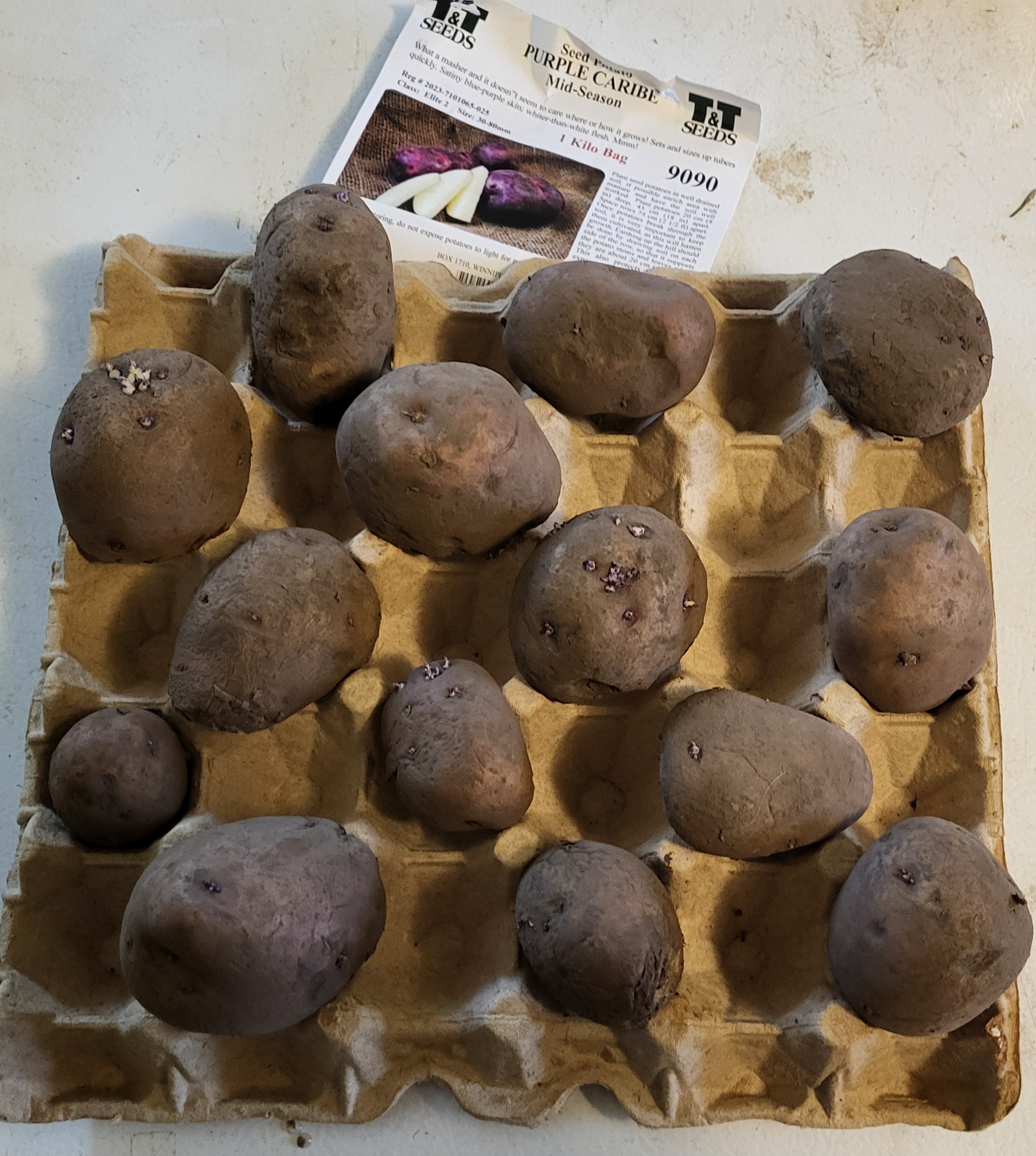
The rain looks like it has stopped, but it’s too muddy and chilly to do the work I had intended to do outside today. I did end up setting out the Purple Caribe potatoes to chit in the old kitchen.

A couple of them were large enough that I cut them in half, and those ones are perched on the carton in such a way that they will have air flow under them, so the cut areas will dry out.

Looking at how many 1kg give us, I’m rethinking where we will put the 2kg of German Butterball potatoes. My thought had been to put them where the squash were planted last year, but that’s a huge space. I’d basically just have one row of potatoes. So now I’m thinking we might use one of the low raised beds, instead, where the soil should be softer.

We really need to think about increasing the acidity of our soil. It is very alkaline, and pretty much everything we are growing needs soil that is at least a little acidic. We should pick up a bale or two of peat, but that has a very minor and slow effect on acidification. A lot of the usual soil amendments, like adding compost, actually increases the alkalinity, which is the last thing we need. I ended up running errands in the small city yesterday and was looking for Sulphur, but saw nothing. We do have a box of fertilizer we found when cleaning out the old kitchen years ago that is for acidifying the soil; it’s meant for azaleas, but should work for other things, too. If it’s still good. Does water soluble Miracle Gro have an expiry date? I have no idea how old this stuff is. The box was opened but, based on how full it looks, it may only have been used once!

Since today was an indoor kind of day, I started pre-germinated some winter squash.

We’re at just under 7 weeks before last frost, which I hope is enough time for these. Not knowing what varieties are in this mix means we will have different days to maturity among them. I’m still hoping to be able to start some other varieties of winter squash as well – ones we actually know what they are! I’m just not planning to grow entire rows of each. With pre-germinating the seeds, I can start just a few of each and not have to be as concerned about germination rates like when they’re sown into pots or pellets.

I’ll need more pots, though.

Among the last seeds I want to start indoors, by about 3 weeks before last frost, are several types of melons.

Last year, we started so many squash and melon seeds, then had entire trays where nothing germinated. A real waste. I think we’re going to have a much better success rate using the pre-germination method. It should be interesting to see how much of a difference it makes, as time goes by.

The next few days are supposed to continue to be colder and wet, with possible snow, with Friday having a high at, or just below, freezing (it’s Tuesday as I write this). By Sunday, we’re supposed to be back up to the double digits (Celsius), but our overnight lows will be staying close to freezing through most of May. We don’t expect to be direct seeding anything until June, but there are quite a few cold tolerant things we’ll be able to direct sow once the current cold snap is done.

May will be our month for building more raised beds, and harvesting more dead trees to build with.

There is so much that needs to be done!

Weather willing, we’ll have more prepared garden spaces than we had last year, but I’m not sure we’ll reclaim enough to match what we were growing in – well, trying to! – the year before.

Little by little, it’ll get done.

The Re-Farmer