I’m just going to post this photo for now; I took some video and will upload that later.
Until then, this is what I was able to harvest today.
We did get another frost last night. I was out doing my rounds early enough to see some frost still on the ground. Once again, there was no frost warning and, according to the official past 24 hours record, we never dipped below 6C/43F, while I know I saw 4C/39F on my app when I checked before heading out this morning.
I should get one of those high/low thermometers that have needles to mark the highest and lowest temperatures on the dial.
So for now, all the stuff affected by the frost has been harvested that could be harvested. I left the melons, because they look like enough of the vines survived for ripening to continue. We’re supposed to warm up over the next while, so that will give more time for things like the melons, peppers, Spoon tomatoes and the one eggplant to ripen. The other things, like the carrots and onions, can handle frost so they’ll be fine for quite a while longer.
When I woke this morning and checked my weather app, just before it refreshed itself, I saw something I did not want to see!
2C/36F
Considering the time of that reading, it was entirely possible we had frost last night.
We had no frost warnings at all before I went to bed.
Not that we could have done much about it. All those support poles and trellises are great, but make it impossible to cover the plants. At least not with the material we have. The squash patch is just too big.
When I first started my rounds after feeding the outside cats (I tried for a head count and saw 26 or 27. I may have double counted one) and headed towards the gate cam, I was somewhat encouraged. Usually, even if we have a light frost, I would still see signs of it in the shaded areas along the driveway long after it melted elsewhere. I saw only dew.
Then I started checking the south garden beds. Everything looked fine as I made my way through. Even the Little Finger eggplant in the concrete blocks, and the Caveman’s Club gourd, seemed unchanged.
Then I saw the squash growing in the compost pile.
Still, this area is a lot more shaded than others, especially in the mornings. The nearby beds of onions, carrots and the popcorn cobs drying on their stalks are frost hardy, so they were fine.
Going to the sign cam, I pass the Crespo squash patch. That spot doesn’t get shade until the sun is at its lowest in the winter, so even this time of year it gets the full morning sun.
The leaves were all drooping, and I think I might even have seen the remains of frost glittering on some stems. It’s done.
When I got to the main garden area, I was a bit more encouraged. The plants supported on trellises seemed to fair better. The melons did show some cold damage in areas, while others looked just fine. Even the tomato plants seemed mostly all right. Much to my surprise, all the pepper plants in their grow bags looked absolutely fine!
The squash patch, unfortunately, was completely done in. Half the patch gets more shade than the other. In the heat of the summer, the plants that got more shade were doing better than the ones that got more sun but, right now, it’s the rows that get more sun that are looking less damaged than the others.
I’ll leave them alone for now, and see what happens over the next couple of days.
The old kitchen garden, much to my surprise, was fine. Even the luffa! The peppers here also showed no signs of cold damage, the Classic eggplant and all the transplanted tomatoes in their plastic shields seem completely unaffected. Even the Spoon tomatoes looked undamaged, and I was able to pick a bunch of them.
What’s frustrating is that there were NO frost warnings. I found a site that gives temperatures for the past 24 hours, and I did find it dipped to -2C/28F at around 6am – in the city! When I did a search for our area, plus the areas north and east of us, where I know there are weather stations, the lowest recorded temperature was 5C/41F Yet, my own app showed we were at 4C/40F at a time when the past weather chart was showing 7C/45F.
Today, we’re looking at a high of 17C/63F, with an overnight low of 6C/43F Those overnight lows have been consistently wrong on the high side. Which means that we’re not getting any of the frost warnings that would normally be set off, once the temperatures are expected to drop low enough, even as the real temperatures drop below that warning threshold.
Again, there’s not much we could have done, but we would have at least picked all the remaining tomatoes and brought them inside. Including the mostly green tomatoes still out on screens under the market tent.
As things warm up today, I’ll head back out and reassess the damage.
I’m not sure what to do about the winter squash. All those big, beautiful Pink Banana and candy roasters! They are not fully ripe, but if we leave them out and the vines die back, will they continue to ripen? We certainly won’t be able to store them for the winter, but I don’t even know how edible they are at this stage.
So, in theory, we can bring them inside and lay them out to continue to ripen. Since they won’t store for the winter at this stage, we could cook them and freeze them, instead.
I don’t think that will work with the melons as well, but those plants might survive.
Unless we get another frost with no warning again.
This morning, before I intended to continue working on the trellis bed, I wanted to transplant those volunteer tomatoes into the old kitchen garden.
Yes, it’s September, and our average first frost date is the day after tomorrow, but if the frost holds off long enough, they just might have a chance!
It was also a good time to amend the bed the Irish Cobbler potatoes were in. After removing the remaining mulch and loosening the soil (and finding a few tiny potatoes that got missed!), I worked in a bag of cow manure. I also noticed a couple of spaces in the walls where the grass clippings used as chinking was gone, so I found some scrap pieces of wood to put over the gaps on the inside.
Once the bed was prepared, I went and dug up the volunteer tomatoes. I don’t even water that bed anymore, so the soil was very dry. None of it stuck to the roots at all! I laid them out gently on one of the baking sheets we use to transfer seedlings in and out while hardening them off. Those are so handy! We need more of them, but Costco no longer carries them. They are SO much more expensive, elsewhere!
Anyhow.
I had seen one volunteer tomato had died; all it’s leaves just shriveled up for some reason. I left that one, but I still ended up digging out 9 tomato plants! All but one of them are where we’d had Spoon tomatoes planted, 2 years ago. I kept track of the one that came up where cherry and grape tomatoes were planted last year, and the year before.
I’d already given the bed a fairly decent watering, but once I knew how many transplants I had, I dug a hole for each of them, then gave each hole a deep watering. As for the transplants themselves, I trimmed off the lowest leaves and buried the bare stems all the way to the first set of leaves.
I happened to have exactly the right number of plastic rings that had been used to protect the peppers, etc. in the wattle weave bed, so those got put around each tomato plant. These will not only protect them from overnight chills, but from rambunctious kittens, too!
At this point, my alarm went off, reminding me that the post office was open again after lunch. I have a subscription on lysine for the outside cats, and it was in. When I got there, however, I had a pleasant surprise.
My saffron crocus bulbs were in! When I checked the tracking, it was telling me the package would arrive on Monday, so this was a pleasant surprise.
It also changed my plans for after I finished with the tomatoes.
Since we had to pull up all the Roma tomatoes, I had a lot of bamboo stakes available. I pushed in a pair of them inside each plastic ring. These will keep the wind from blowing them away – and the cats from knocking them about – and if the weather holds long enough for them to survive, they will be supports for the tomato plants, too.
I also had the soaker hose that had been used on the Roma tomato bed. It’s pretty long, though, so I was able to run it back and forth and around every plastic ring, using tent pegs to hold it in place on the curves.
Last of all, the mulch got returned.
It’s ridiculously late to be transplanting tomatoes in our area, but I wanted to give them a chance!
That done, I could move on to the saffron crocuses, which needed to be planted right away.
These are actually a zone 4 plant, and we’re zone 3, so they went into the same protected area we have our zone 4 apple tree, and where the girls planted tulips. This area has a mishmash of wire surrounding it, to protect them from the deer.
There are 20 bulbs in the package, and the need to be planted 4 to 8 inches deep, and 3 inches apart. I was originally intending to plant them in a 4 x 5 bulb block, in an area I was pretty sure there were no tulips growing, but after poking around with a garden fork, that went out the window pretty fast. The area is so full of large roots!
I ended up being able to start a longer trench, so I went with 2 rows of 10 bulbs, instead.
The instructions specifically said to NOT amend the soil with manure of fertilizer, to water them when planted, but to not water them again unless it was drought conditions.
In clearing out the soil, so many weed roots were removed that there was hardly any soil left. I would have to get soil from the remains of the truck load of garden soil in the outer yard we bought a couple of years ago.
After removing the top 4 inches of weed roots and dirt, I loosened the bottom with a cultivator tool, then gave the trench a very deep watering. Then I loosened the soil some more, tried to level it off a bit, and watered it some more!
After that, I went and sifted some garden soil into the wheel barrow to fill the trench, before getting the bulbs.
I did not expect them to be so…
…hairy.
The bulbs got laid out in two rows, 3 inches apart, then buried. I ended up needing to get a second small load of soil to cover them well. They got about 6 inches of soil, maybe a bit more, on top. It will, however settle over time. Compaction is another concern. I wanted to give them a final watering, but not with out a mulch, first!
Thankfully, we still have lots of grass clippings handy for mulch!
Once a thick layer was in place, I gave it another deep watering. I wanted that new soil, which was quite dry, to be moistened. The mulch is great for keeping the soil below moist, but if the clippings are very dry, they actually prevent moisture from getting through. The top will get wet, but the bottom – and the soil below – says dry. Kinda like how thatch works. So I made sure the mulch itself was very wet, all the way through, so that the water could moisten the soil, too.
Given the temperatures we can hit over the winter, these will need more protection before the ground freezes, as well the apple tree. It’s already sheltered and protected from the north and, now that the dead and dying trees are cut away, it gets full sunlight and warmth. Still, extra protection will be good! When the leaves fall, we can use that to mulch the entire area. In the spring, though, the mulch of the crocuses will need to be pushed aside, leaving only a light layer to protect the soil. The alternative would have been to plant them in pots and bring them in every winter, and frankly, I have no interest in doing that. It’s hard enough to protect our house plants from the cats! They’d just love some big pots of soil to dig in. 😄
Once the mulch was in place, I spread out the soil that had been removed as evenly as I could, and that was it.
We now have tomatoes transplanted that, if they survive, will be for this year, and bulbs planted for next year! These crocuses boom in the fall, so it will be quite some time before we know we will have any saffron to harvest.
Bulbs typically triple their flower output year over year. A package of 20 bulbs should produce enough saffron in the first season for the average family to enjoy sparingly.
Triple their output every year? That would be amazing!
I really hope I didn’t screw up by transplanting these so early. They all need really long growing seasons, though. It was either transplant them, or pot them up, and I really didn’t think they’d benefit from being potted up.
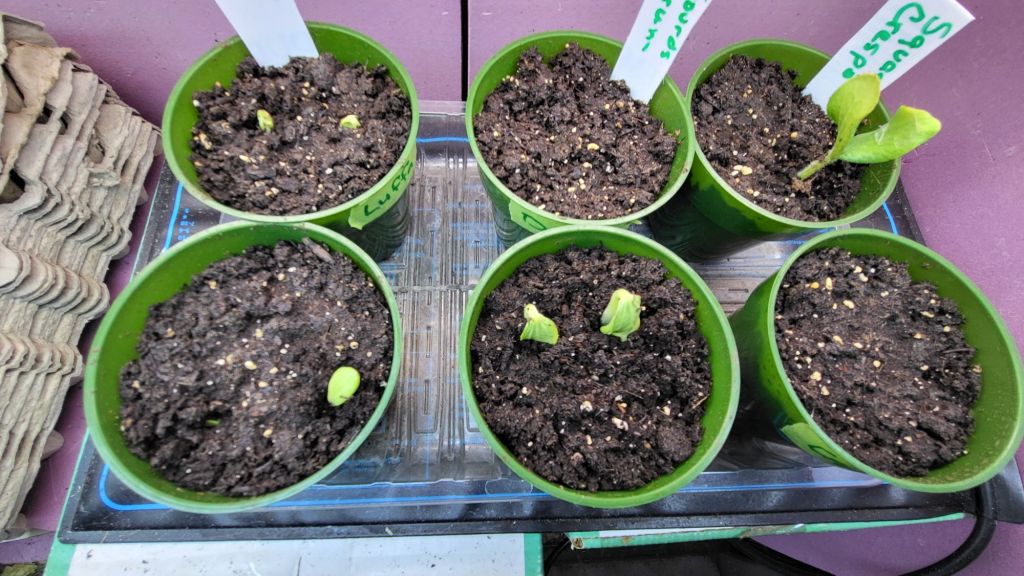
So here it is: today’s transplanting of Zucca melon, African Drum gourd, Caveman’s Club gourd and Crespo squash.
I actually thought I had two Zucca melons to transplant, but when I looked at the label, I saw that the smaller one was a drum gourd. It’s a good thing I labeled them or I would have been in for one heck of a surprise at the end of the growing season.
Assuming these survive getting transplanted. Also, assuming they don’t get eaten by something along the way!
The Re-Farmer
June update: I discovered the file got corrupted somehow, and re-uploaded it. Let me know if you see problems with it! Thanks.
I had to go to the nearest Walmart to get cat kibble this morning, and took advantage of the trip to get a few more little things. It was insanely busy with people. We’re coming up on a long weekend which, for many people, is the traditional time to put in their gardens. It’s also when a lot of people open up their cottages for the summer, so it was busy everywhere! All the garden centres and greenhouses are open now.
For us, today is 2 weeks to our last frost date. That means it’s time to sow our Montana Morado corn!
Which, of course, is never as simple as just putting things in the ground!
I chose to plant these in the low raised bed we grew summer squash in, last year. As with just about everything else, the squash did very poorly last year. It was, however, the bed that needed the least amount of work done on it before I could sow.
Not by much, mind you.
After removing the grass mulch from last year, I had a whole lot of weeds to dig out. Mostly crab grass. That stuff is brutal!
The entire bed got worked over with a garden fork to loosen the soil. Then I had to go back over it to pull out as many weeds and roots as I could. Aside from using the fork to loosen the soil even more to get the roots and rhizomes out, it was very handy to support myself as I worked. I also used a board across the bed to step on, so I wasn’t stepping directly on the soil.
We really need to get more high raised beds built. This was very hard on the back. I suppose it would have been easier if I could kneel down to work, but my knees are shot, so I’m bending from the waist, for the most part.
While working towards the north end of the bed, I started finding more tree roots, from the nearby trees that my mother allowed to grow in what used to be garden space.
More reason to get those high raised beds done!
When the weeding was done, I went to get the seeds and a rake to level the bed. I brought a container to pour the seeds into and see how many there were. There was supposed to be at least 75 seeds.
I counted 94!
Once the bed was leveled, I took the board I had to support my foot while weeding, and used it to mark off three long rows. I wanted to stay well away from the edges. The crab grass is the worst along there, as the roots make their way under the log edging. Then I used the handle end of the rake to punch holes along the rows every 6 inches or so. Typically, it’s recommended to plant 2 or 3 seeds every 12 inches, but I’m doing dense block planting. I also hate wasting seed, so I planted one seed every 6 or so inches. This should be good for pollinating, and if some of the seeds don’t germinate, the resulting gaps won’t be too large.
I lost a seed while planting, though, so there’s “only” 93 in. 😄
Everything was well watered, of course. I always water before putting the seeds in, then again once they’re done.
Once planted, I put a thick layer of grass clippings all around the edges. The ends don’t have logs to hold the soil in, so hopefully the grass clippings will help keep it in place, too. Mostly, it’s to try and keep the weeds from creeping in from the edges. Once that was done, I put a very light mulch of grass clippings over the planted area. Basically, I just shook bunches of grass and let the wind blow it on. I wanted enough clippings to protect the soil, but still keep it light enough that the corn won’t have any problem pushing through.
Once the corn is up, I will might interplant some bush beans in between the rows. Maybe. I did that with the kulli corn we planted last year, and they got huge, but never reached the point of producing cobs. I now think that there was too much nitrogen in the soil in that bed. High nitrogen leads to lots of plant growth, but can result in lower yield. Or, in our case, none at all. With how densely these are planted, though, interplanting with something like beans might be too much.
Once that was done, I decided to take a chance and do some transplanting.
The Sweet Chocolate peppers that were started back in February have gotten nice and big. Normally, I wouldn’t dare transplant them before our last frost date, but I’ve been eyeballing the forecasts and decided to take the chance. It was either plant them now, or pot them up. The German Winter thyme that was started at the same time were also quite ready to be planted.
While I was transplanting, I got my daughter to cut the tops and bottoms off of some distilled water jugs for me. Since my husband needs to use distilled water for his CPAP humidifier, we have lots of those! Hopefully, they will help protect the peppers during any cool nights. In this bed, they will be easy to use row covers if we get frost warnings, too.
I had three pots with thyme to transplant – a fourth one was transplanted into a pot to stay in the house. I don’t think they’ll need any protective covers unless we get actual frost.
Eventually, I want to plant the chamomile in here, though it’ll be a while before those are big enough to do that. The spearmint and oregano we started from seed are not doing well. I might buy oregano transplants, which would also go into this bed. Spearmint is not something I usually see in stores as transplants, so we might skip those this year and try again next year. The second variety of thyme we planted at the same time as the chamomile doesn’t seem to be doing as well as the German Winter thyme has. We’ll see how they do over the next couple of weeks.
Once again, while working in this bed, I was quite impressed by how moist the soil was under the wood chips. The mulch is really doing its job!
Oh, there was one thing about transplanting the peppers that has made for a learning experience.
We started the seeds in bio-gradable pots that are designed so that they can be transplanted directly into the soil, pot and all, with no root disturbance. When the peppers needed to be potted up, they went into the larger Red Solo cups that way – except for a couple that were thinned by transplanting.
When taking the peppers out of the cups, the ones that were still in those bio-degradable pots… were still in the bio-degradable pots! They were actually rootbound inside a pot within a pot. So when I transplanted them, I removed the shells of pots they were in. The pots were very soft and easy to break off, but hardly any roots had tried to grow into them.
I still have some of these pots and seed start trays. I’ll use them but, in the future, I think we’ll skip buying those. A bio-degradable pot isn’t much use if the roots can’t get through them after being potted up!
So this is now done. The first corn is planted, and the first peppers and herbs are transplanted.
The corn is meant to be planted at this time. I just hope I didn’t jump the gun with those peppers!
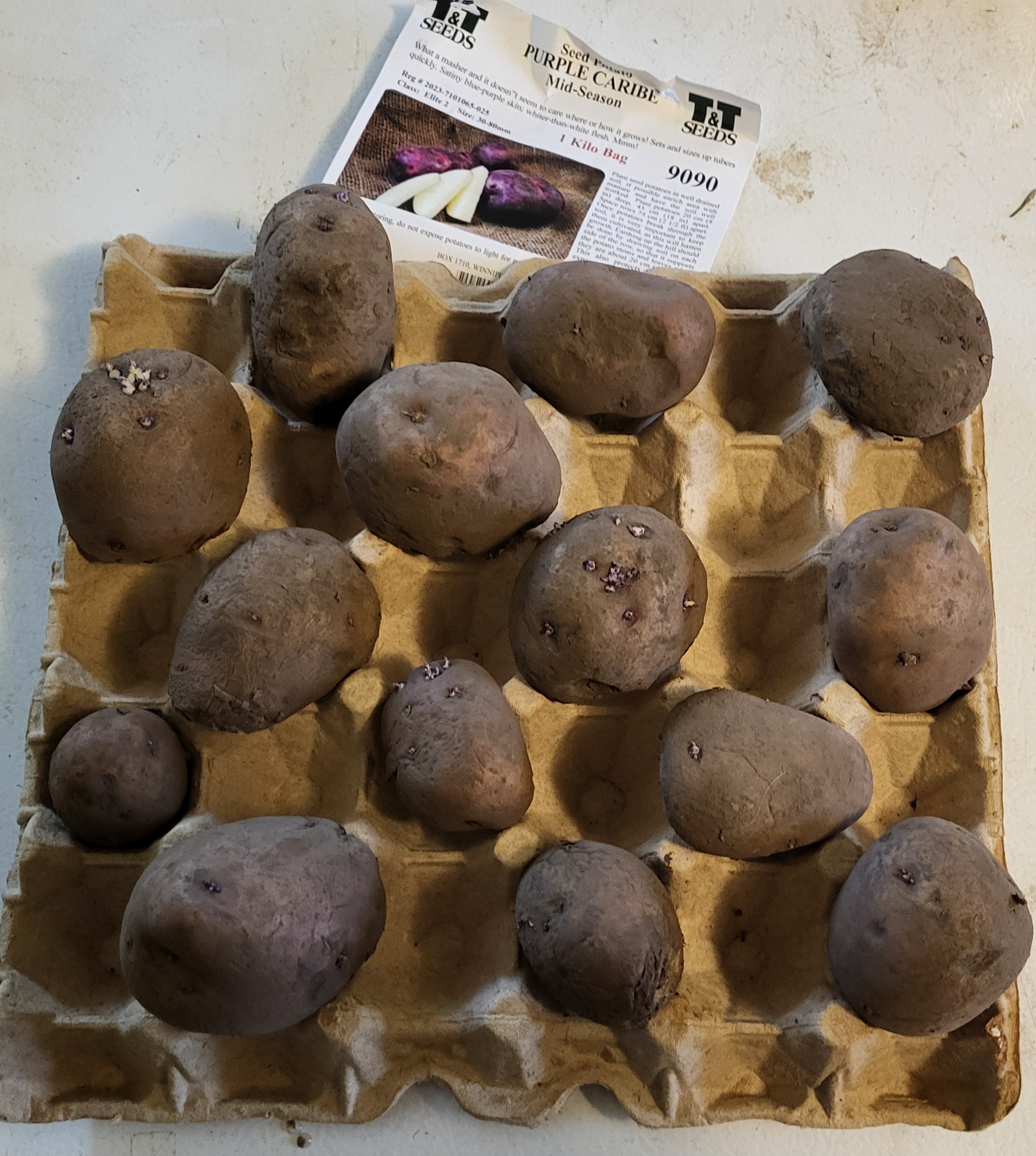
I thought we would have more than enough old feed bags to use for both types of potatoes we have left to plant, but I was wrong! The Purple Peruvian fingerling potatoes alone, took 14 of the 19 bags we had!
I made a quick little video with the photos I took. It’s less than a minute and a half long. 😁
The first time we grew potatoes in feed bags, we were intending to do the tower thing, expecting to add more material to the bags several times throughout the summer. Then we found out that potatoes come in both determinate and indeterminate types – and we had determinates. They aren’t the right kind for growing in towers, so there was no benefit to adding more material. The plants got huge, though, and the bags couldn’t support them. With that in mind, this time I made sure to add quite a lot of straw to the tops of the bags. It should help support the plant stems, and hopefully the bags as well.
So now we have to figure out how and where to plant the Red Thumb fingerling potatoes.
I wonder if there are too many to plant in that bed along the old kitchen garden retaining wall I just finished reworking?
We’re in that time when we can start transplanting things that can handle frost which, for us, is the onions and shallots. I started hardening them off earlier than the other transplants. It’s going to be very hard to resist transplanting more before our last frost date! Not only are we having a very warm May (today was supposed to reach a high of 18C/65F, but as I write this, at almost 6:30pm, we’re still at 20C/68F), but the long range forecast is showing warmer overnight temperatures well above frost risk. The problem is, long range forecasts are notoriously unreliable!
So, we continue to take it slow and continue to harden off the transplants. There is still lots to do to make room to plant not only all the transplants, but all the direct sowing we have planned, too.
This tiny little bed in the old kitchen garden is where the shallots are going, because we have the fewest of those. This is a new variety of shallots, and the first to actually really survive to the transplant stage.
Keeping the cats out of the living room made a bit difference!
I planted fairly densely, but there were still a few plants left. After taking this picture, the bed got a thorough watering. We will have to add a mulch as soon as the transplants are strong enough.
The last little transplants went into one end of the wattle weave bed. It has a thick layer of wood chips on the top that I had to move aside to reach the soil. Protected by the wood chips, the soil was nice and damp!
So those are now in.
I foresee only one problem.
The cats have gotten used to using the garden beds for napping and playing!
I’m hoping to avoid having to cover the beds, but we might not have a choice. For now, they have no interest in the wet ground.
In other things, I went through our collection of feed bags, and had more than I thought. We’ve got 11 bird seed bags (20kg size) and 8 deer feed bags (18kg size). More than enough for the remaining potatoes. The only difference between the bags, besides the label, is that the bird seed bags are longer.
I’m still not sure where to set them up. The best place I can think of is at the far side of the main garden area, but I really don’t want to be hauling garden soil that far, if I can avoid it! Ah, well.
Our peas are finally in! They could have been planted as soon as the ground could be worked, which was a couple of weeks ago.
This row is about 20 feet long. We could succession sow peas elsewhere, but I think that this might actually be enough. Assuming a high germination rate, of course.
I really like fresh peas, though, so if we have the space to grow more elsewhere – together with some corn, perhaps – they certainly won’t go to waste!
Well, I wasn’t able to get progress images of what my daughters did, but I did get to set up another time lapse video later on. I was able to reclaim the bed by the chain link fence and sow one variety of bread seed poppies.
Having the rake handle break on me while I was clearing outside of the chain link fence was a bit of a downer! We had others I could have used, but I just kept using it, anyhow. It got the job done!
Also, I had a lot of cats visiting me while I worked!
I hope you enjoy the video. 😊 If you select to watch it on YouTube, you can hit the like and subscribe buttons, if you wish.
My daughters were out early, taking care of some planting for me, so here are some “after” pictures. 😊
The first area they worked on were the bald patches in the maple grove.
These are where the branch pile we got chipped last summer had been sitting for about four years. The first thing they did was use the thatching rake to break up and loosen the soil, then raked it smooth. For the patch in the foreground, they made sure not to get too close to where we’ll be digging a trench to replace the water line from the house to the garden tap. I ordered two packets of alternative lawn mix, which they sowed and watered and tamped down. From the website:
This mix contains annuals and perennials of daisies, poppies, sweet alyssum, soapwort, nemophila, viola, thyme, chamomile, clover and fine fescue.
Hopefully, they will not only fill in the bald patches, but will also naturally spread themselves in the maple grove, and maybe choke out the bell flowers that have been so invasive here!
In the time it took me to finish feeding the outside cats and switching out the trail cam memory cards, not only had they finished this area, but they finished planting the spinach, too!
The only thing left to do by the time I came out was to add the floating row cover. I bought a couple of these from a dollar store to try out. I’m not sure we’ll get more. It seems very fragile. At some point, I should buy a whole lot of tulle fabric. For the spinach, however, it’s more about keeping the critters from eating them than for insects. I just hope the cats will stay off of it. Otherwise, we’ll have to add hoops. I’m still shooting to build proper covers for these beds soon, but I don’t know when I’ll be able to pick up the lumber I need, so this will do until then!
The next cool weather crop I need to get in is at least one variety of bread seed poppies. I keep forgetting about them! I’ve decided to clean the vine off the chain link fence and put them in the bed we unsuccessfully tried to grow white strawberries in, last year. That can be the permanent spot for one variety. The other cool weather crop we can get in this early are peas, which will be planted along the chain link fence where we had tomatoes last year.
After that, things will need to wait until closer to our last frost date, so we’ll have time to prepare and finish more beds.
It feels so good to be able to get stuff into the ground!
Oh, and I got my first shipping confirmation from Veseys, for the smaller order that got processed a couple of days ago. It is our 3 pack of raspberries!
Royalty raspberries; image belongs to Veseys.
The expected delivery date is May 8, but I wouldn’t be surprised if they arrived earlier. I look forward to getting shipping notices for the apple, mulberry and potatoes!