Eggs, three ways!

Today, we did the final preparations for our Easter basket.  Which required an extra trip into town to get more eggs!

We eat a lot of eggs.

I see chickens in our future.

We tend to do eggs at least 2 ways.  This year, with the pickled pink eggs, we have 3 varieties.

First up, here is how the pickled pink eggs turned out.

Pickled pink eggs

Pickled Pink eggs, after 3 days in the pickling liquid.

Of the 12 eggs we pickled, I went over them and picked the 8 best, leaving 4 for us to taste test.

They are quite delicious.  The pickling gives the eggs a very solid, dense feel, and the tang after 3 days in the pickling liquid is just right.

We then got two pots of 18 eggs each going.  One included the onion skins I’d been setting aside for the past few months, along with a splash of vinegar and a dash of turmeric, for extra colour, in the water.  Onion skin dyed eggs for the Easter basket are called kraszanki (kra-SHAN-kee) in Polish.  The turmeric is my own addition.  The eggs are hard boiled until they reach the desired colour; these were boiled for probably 45 minutes.

Onion skin dyed eggs

Always cook extra, in case of breakage!

Of the 18 eggs, 6 broke, leaving an even dozen for the basket.  It’s unlikely we’ll be able to fit all of them in.

The other batch of eggs were boiled for 10 minutes.  The hot water was replaced with cold until they reached a temperature where they could be handled.  Using the back of a spoon, the shells were cracked all over.  After that, they were returned to the stove to boil again, this time with 3 Tbsp black tea leaves, 1 tsp sugar, a tsp of five spice mix (or, as we did today, the equivalent spices I had on hand) and 1/2 cup soy sauce.  They were then cooked for another 45 minutes or so – again, it’s until the desired colour is reached.  The original recipe I’d found for these said to cook them for 3 hours!  We’ve never cooked them that long.

Here is what they looked like, after being drained and rinsed.

Tea dyed eggs

Once they were cooled down, it was time to peel them.

Out of the 18, 7 got damaged while being peeled.

And that is why we cook so many extra eggs! :-D

Peeled, tea dyed eggs

In all the years we have done these eggs, including years when we’d cooked them for much longer, the coloured parts have never looked this intense!

I wonder if our well water has something to do with it?

Meanwhile, I dug out some of my collection of little bowls (I adore little bowls, so I’ve got quite a few) and other pretty dishes to hold the other basket ingredients.  Some of the vinegar and olive oil were transferred to small pitchers with liquid tight stoppers.  For the butter, we whipped some with parsley and fresh garlic.  The salt we’re using this year is Himalayan sea salt.  We are including a mustard this year, too.

Each item in the basket has symbolic meaning.

The bread symbolizes Jesus, who is the “bread of life.” Eggs symbolize the resurrection and new life.  Kielbasa (sausage) represents God’s favour and generosity.  Ham is a symbol of joy and abundance.  Bacon (which we don’t usually include, though sometimes we include prosciutto, instead) represents God’s mercy, as well as generosity.  Butter is a reminder of the good will we should have to all.  The butter is traditionally shaped into a lamb, but we usually have plain or herbed butter decorated with a cross made of cloves.  Some years, we’ve had a lamb made out of marzipan.  The lamb, of course, symbolizes Jesus.

Horseradish, with its strong, bitter flavour, reminds us of the Passion of Christ.  When made into a spread sweetened with beet juice, it represents both the pain of Christ’s crucifixion and the sweet joy of resurrection.  Salt is a reminder for us to be the “salt of the earth” and symbolizes prosperity and justice.  Cheese symbolizes moderation.

We’ve included olives and olive oil in our baskets, symbolizing peace, wisdom and hope.  Vinegar is there to remind us of the crucifixion, when Jesus was given vinegar (also translated as sour wine) on a sponge to drink.  We sometimes include mustard – preferably a type in which the seeds are still visible – to represent faith.

A candle can also be included, to symbolize Christ as the Light of the World.  The baskets can be decorated with spring flowers, greenery and ribbons to represent new life and the resurrection.  A bottle of red wine is also appropriate to include, to symbolize the blood of Christ.  Then the whole thing is covered with a fine embroidered or lace cloth.

The blessing of the baskets, called Święconka (shvye-CHONE-ka is a rough approximation of how it’s pronounced) in Polish, happens on Holy Saturday.  The blessing of the baskets is one of my fondest childhood memories.  Some years, I would have my own tiny little basket to carry (okay; tiny is a relative statement in our family…) for the blessing.  They would all be laid out at the front of the church, on the steps leading up to the altar.  I loved looking at all the different ways people did their baskets, and the different things they would include.  There is plenty of room for variety in this tradition!  I saw all kinds of breads, fruit, and eggs decorated in all sorts of ways.  With so many baskets, the church was soon smelling so good!  There was such a sense of anticipation – so very appropriate, as we anticipated celebrating the resurrection of Christ.

Whatever traditions you have for Easter, I hope that it brings you much joy and peace.

The Re-Farmer

Sourdough Cornmeal Pancakes

It’s been ages since I’ve made these, and they are absolutely my favourite pancake recipe, ever.  They’re just a bit of a PITA to make. :-D

The original recipe called for sour cream.  I substituted yogurt “cheese”, which my daughter described as “sour cream 2.0 – like sour cream, but MORE”. :-D  I was out of yogurt cheese, but I still had some of our homemade yogurt, so I quickly made some.  It took two batches to get the amount I needed for a double recipe, and I also have some whey for our next bread baking.

So I’ll start with instructions on how to make small batch yogurt “cheese” for a sour cream substitute.

Needed:
About 1/2 cup yogurt
2 coffee filters
fine sieve/strainer that will fit over a measuring cup
2 cup measuring cup

  1. Place the strainer over the measuring cup.  (If yours has a heavier handle like mine does, you might need to have something next to it to prop it up.)
  2. Line the strainer with 1 coffee filter
  3. Pour in the yogurt.  Let sit to drain long enough that, when you pull the coffee filter inwards, then let it fall back again, the yogurt stays behind cleanly.  About an hour or so.  You will find the outer edges are thicker and the middle is still soft.
  4. Draw edges of coffee filter in and lift out the yogurt.  Place the second filter into the strainer.  Gently roll the yogurt into the new filter, so that the softer middle is mostly on the bottom of the filter.  Leave to drain until desired thickness.
  5. At this point, if you want it to drain faster, or want a thicker “cheese”, fold the filter sides over the yogurt to completely cover it.  Place a small, flat object (I used one of the many tiny dishes in my collection) over the filter, than add a weight, such as a can of beans, on top.
  6. When at desired consistency, remove from coffee filter, place in a sealed container and refrigerate.
  7. Reserve the liquid for bread baking.

The 1/2 cup of yogurt will yield about 1/3 cup yogurt “cheese”, depending on how long you let it sit to drain.

And now… on to the pancakes!

This recipe is modified from “Cornmeal Pancakes” in The Sourdough Cookbook by Rita Davenport.

ingredients

The amounts pictured here is for a DOUBLE recipe of Sourdough Cornmeal Pancakes.

Here is the ingredients list for a SINGLE recipe.

1/2 cup cornmeal
1/2 cup all-purpose flour
1 tsp baking powder
1/2 tsp baking soda
1/2 tsp salt
2 tsp sugar
1 egg
1/2 cup sourdough starter
1/2 cup milk
1/2 cup sour cream (or thick yogurt or yogurt “cheese”)
1 1/2 Tbsp vegetable oil

20180220sourdough.cornmeal.pancakes

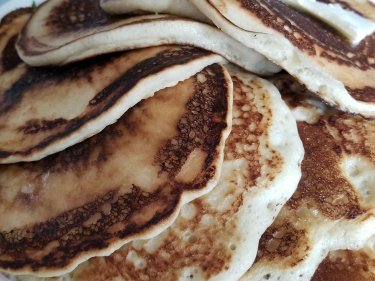
Sourdough Cornmeal Pancakes

  1. In a medium bowl, combine all dry ingredients, then set aside.
  2. In a small bowl, beat the egg, then mix in milk and starter.
  3. Add egg mixture to the dry ingredients and stir until just moistened.
  4. Fold in oil and sour cream or sour cream substitute.
  5. Preheat and oil frying pan.  Cook 1/4-1/2 cup of batter per pancake for a minute or two, each side.

Note: kitchen chemistry!  When the wet and dry ingredients combine, the acidic sourdough starter and sour cream/yogurt cheese will react to the baking powder and baking soda, causing it to bubble up.  The batter will still be very thick, but light and fluffy at the same time.  Be gentle with it, to keep those bubbles for light and fluffy pancakes!

I like these with nothing but a bit of melted butter on them, but of course you can top them with whatever you want.

I hope you enjoy these as much as we do!

The Re-Farmer

My Non-traditional Slow Cooker Chili

I do love my slow cookers!  I’ve got two 8 quart sized cookers, and have found they are the perfect size for us.  Especially for making something like chili; it’s enough to feed us for a couple of days, making life much simpler!

The chili I make is not at all traditional.  In fact, I’m sure it would horrify true chili aficionados!  :-D  I’ve looked through various recipes and they either use ingredients I never tend to have – or ones I can’t use.  My chili has no heat to it.  At all.  You see, for some reason, I have these massive crevasses in my tongue.  It seems to be a hereditary thing, as my father had them, as does one of my daughters.  The oils that cause that spicy heat gets into them, and once there, there’s nothing I can do to alleviate the pain of it.  So as much as I love the taste of spicy food, I can’t actually eat it.

Which makes me sad.  Because I love Indian food.

Ah, well.

So here is my non-traditional, totally mild (though you can make it spicy, if you want), slow cooker chili.

Remember; this is for a big slow cooker, so feel free to cut the recipe in half.  I’m pretty loosey-goosey with the quantities, too.

chili-groundbeef

First up, start browning the ground meat.

I like to use lean or extra lean ground beef, but I’ve also made it with combination of beef and pork, or beef and turkey, since those three ground meats are all pretty inexpensive at Costco.  I used a family size pack of lean ground beef, which was about 5 pounds, and browned it in batches and transferred it to the slow cooker liner using a slotted spoon, so what little fat there was in the pan, stayed in the pan.

chili-onion

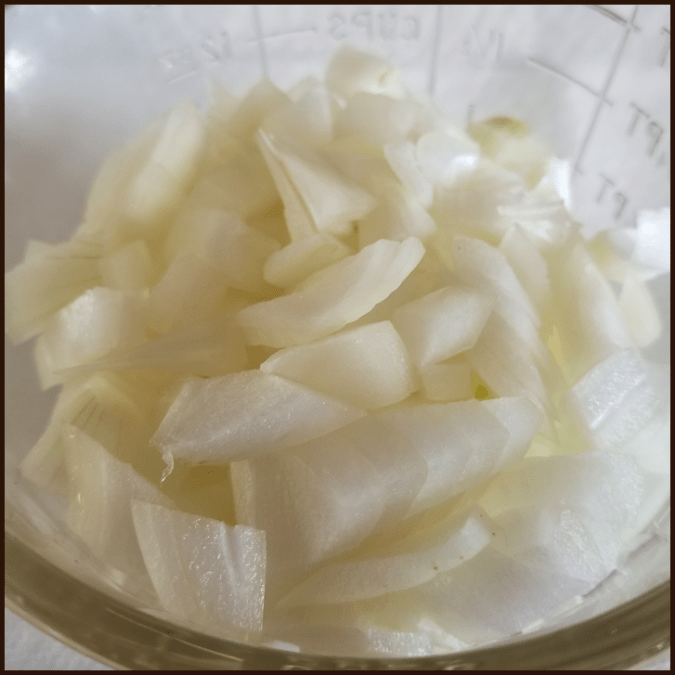
While the beef was browning, I chopped up a large yellow onion.  I like leaving the chunks a bit on the large side.  Just because.

I added the onion to the last batch of browning beef.

chili-carrots

Next on the chopping block; 4 or 5 small carrots.

I usually use about 5, but used only 4 this time.  I finished off one bag and didn’t feel like starting another.  I like to chop carrots smaller, too.  This made just under a cup of chopped carrots.

chili-sweetpotato

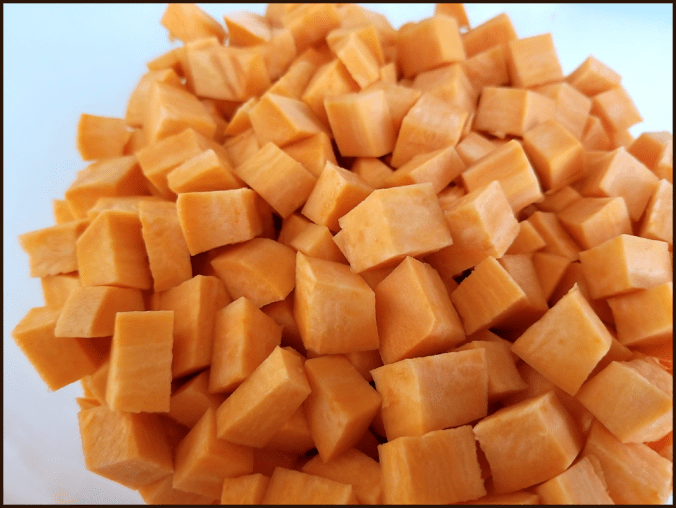
Then I chopped up 2 small sweet potatoes.

Yes, sweet potatoes.

I don’t think I’ve ever seen a chili recipe with them in there, but it was something I decided to try some years ago, and it’s been a permanent addition, since.  I like to chop these even smaller than the carrot.  The idea is for them to be so soft that they disintegrate into the chili when you mix it at the end.  There’s something about the creamy smoothness of it that really appeals to me.

chili-crockpot.prep

After the meat and onions were browned, I added the chopped carrots and sweet potato, then 1 can of mixed beans and 1 can of white kidney beans (both 19 oz cans, drained and rinsed).

I like to change up the can with one type of beans, but I always include 1 can of mixed beans.

chili-crockpot.ingredients

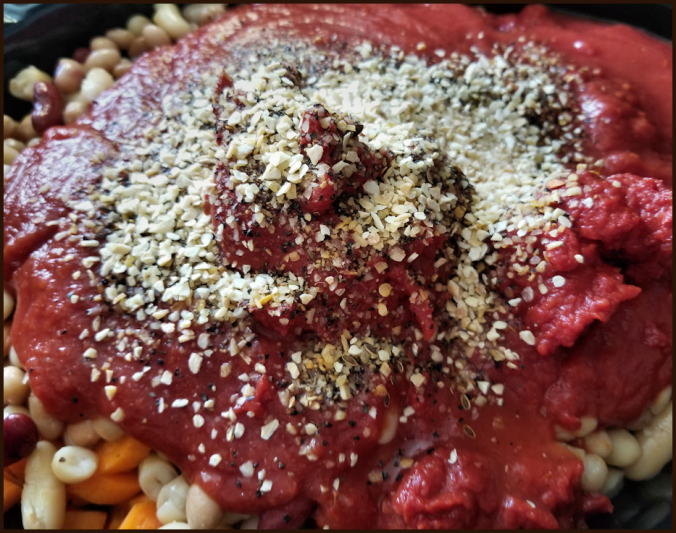
Next up is a large tin of crushed tomatoes, a small tin of tomato paste, seasonings and water.

The seasonings are typically whatever I have handy; usually a steak spice mix and garlic. Slow cookers are where dried foods are in their element, so I used dehydrated garlic pieces that I’ve been able to find.  Strangely, I hardly ever saw them before our move, but our local grocery store carries it!  In refill packages, too, so it’s really cheap. :-)

The 4 of us have very different preferences when it comes to seasoning, so I tend to use a light hand with it, then everyone can add their own later on.

chili-crockpot.readytocook

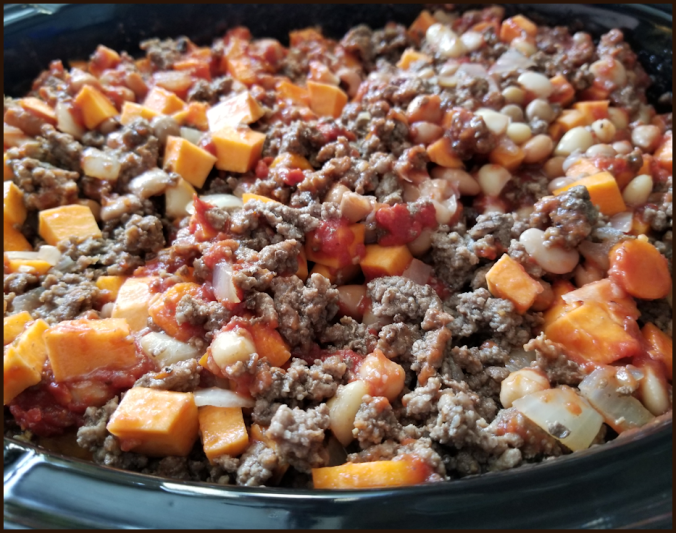
Then mix it all together!  Not an easy task, with the crock so full!

Add more water, if needed.

The water is another one of those loosey-goosey measurements.  Food in slow cookers release their own moisture, so they need less added to begin with.  How much to add is a judgement call.  I find it’s safer to add less at the start, then check after it’s been cooking a while.  If it seems to need more, I’ll add boiling water, so it won’t cool the slow cooker down too much.

I then set the slow cooker on low for 5 hours.  I did end up adding more water part way through.  In the time it took to finish adding the water and stirring everything, I increased the time a bit to compensate for lost heat.

chili-crockpot.withoutcream

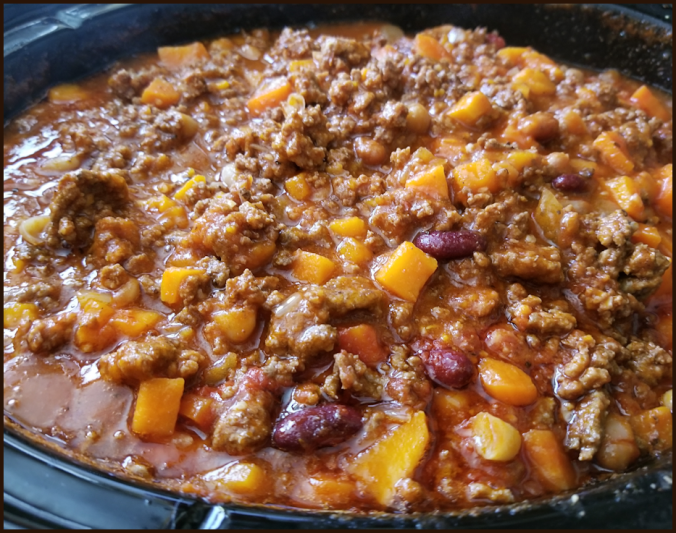
This is what it looked like when we got back from town.  There was a bit over half an hour on the timer at this point.

This would be the time to give it a taste and adjust the seasonings, then give it a good stir.

I then stirred in my final ingredient.

chili-crockpot.withcream

Whipping cream.  About 3/4 cup.

That was another one of those “Hmm… I should try this” experiments I’d made some years ago that stuck around.

At this point, I like to stir it very thoroughly to break up the sweet potato pieces.  I then returned the cover and left it for the last few minutes to make sure the cream was warmed through.

Between the sweet potatoes and the cream, we have ourselves a wonderfully rich and saucy chili.

chili-bowl

Top your bowl with some shredded cheese, sour cream or some yogurt cheese (which, sadly, we are now out of), and enjoy!

Here’s the recipe:

Non-traditional Slow Cooker Chili
for: 8 quart slow cooker
cook on low for 5 hours

Lean or extra lean ground beef (family pack; about 5 pounds)
1 large onion, chopped
4-5 small carrots, chopped
2 small sweet potatoes, chopped small
1 tin mixed beans (19oz), drained and rinsed
1 tin white kidney beans (19oz), drained and rinsed
1 tin crushed tomatoes (796ml – 26oz)
1 tin tomato paste (170gm – 6oz)
4 cups water (to start)
Seasonings to taste (steak spice mix, dehydrated garlic or garlic granules, salt, pepper, etc.)
hot water, as needed during cooking
3/4 cup whipping cream, or to taste
shredded cheese for topping (or sour cream, or yogurt cheese)

  1. Brown beef and onions.  Drain and transfer to slow cooker liner.
  2. Add chopped vegetables, beans, crushed tomato, tomato paste, 3 or 4 cups of water and seasonings.  Mix. Cover.
  3. Set slow cooker to low for 5 hours.
  4. Check after a couple hours to see if hot water is needed.  Add if necessary and stir.
  5. Shortly before done, taste and adjust seasonings as desired.
  6. Stir in whipping cream.  Cover and let warm through for final cooking time.
  7. Serve topped with shredded cheese, sour cream or other toppings of choice.


Sourdough Banana Bread Muffins

While my husband and I ended up being away for far longer than expected, our daughters did some baking.  Along with the now regular baking of 4 loaves of sourdough bread, they made sourdough banana bread muffins with chocolate chips, modifying a recipe they found for banana bread online.

It was a marvelous treat to come home to!

20180213sourdough.bananabread.muffin

Sourdough Banana Bread, with muffin variation

Ingredients:

3/4 cup sugar
1/2 cup butter
2 brown bananas
1 egg
1 cup starter
1 tsp vanilla
1 1/2 cups flour
1/2 tsp soda
1/2 tsp salt
3/4 cup nuts, chips, etc.

  1. preheat oven to 350F
  2. cream butter and sugar
  3. add banana, egg, vanilla.  Beat like hell.
  4. slowly mix in starter.
  5. mix in flour, soda and salt
  6. stir in your choice of nuts, chocolate chips, etc.
  7. pour into greased loaf pan
  8. bake for 60 minutes or until inserted toothpick comes out clean.

For muffin variation, add paper liners to 20 muffin cups.  Fill 3/4s full with batter and bake for 20 minutes, or until toothpick inserted comes out clean.

Home Made Yogurt – Day One

I hadn’t intended to make this again so soon, but my daughter and I were able to make a quick trip into town and she made a passing comment about how we should make yogurt again.  I’ve been thinking of it since I posted about using the liquid from making yogurt cheese in bread baking, so that was all it took to convince me to get what we needed to make some now.

Making yogurt is really pretty easy.  The main thing is to have a warm place for the bacteria to do its thing for the hours it needs.  I’ve found leaving it in a warm oven with the light left on overnight to be adequate, but there are other methods.

Since that is my preferred method, it’s a two day process.  I use a full gallon of milk, and plan to use half of it to make yogurt cheese tomorrow.

Along with the ingredients, a candy thermometer is needed, and containers you can sterilize to store the yogurt in, later.  Any container that can handle being scalded, with an air tight lid, of the appropriate size for your amounts will do.

The recipe I use is from Whole Foods for the Whole Family, from La Leche League International.  I have a 1991 printing of it.  It’s a very handy cookbook, if you like to make things from scratch.  I modified the recipe for larger quantities, so I’ll include both the original quantities, and my own variation (in brackets).

This recipe uses plain commercial yogurt as a starter.  Make sure you check the label to see that it says something like “active bacterial culture” or “live bacteria” on it.

Do not use the optional gelatin if you’re planning to make yogurt cheese.  The gelatin serves only to make a firmer yogurt.

20180128-yogurt1

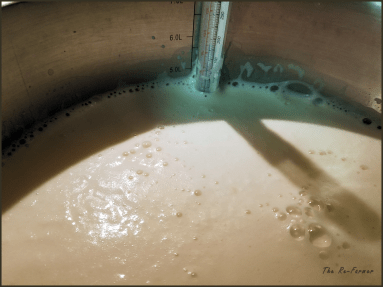
4L milk, scalded

Yogurt

4 cups milk (4 litres/1 gallon)
1 cup powdered milk (4 cups)
2-4 Tbsp plain yogurt (1/2 – 1 cup)
2 tsp (8 tsp) unflavored gelatin, softened in 1/4 cup (1 cup) cold water – optional

  1. Scald milk.
  2. Cool to 95 – 155 degrees. (The recipe does not specify, but looking at my candy thermometer, it must refer to Celsius, not Fahrenheit)  Check with candy thermometer to be sure.

    20180128-yogurt2

    Yogurt starter and powdered milk stirred in.

  3. Stir in powdered milk and yogurt.  Add optional softened gelatin.
  4. Pour into sterilized jars, a baking dish with a cover, or a thermos rinsed with very hot water.  (Because I use an entire gallon of milk, I leave it in the same container I heated it in and cover it with a lid.)
  5. Place into or on a yogurt maker or use other heat source.  A thermos just needs to be wrapped in a towel.
  6. Put in a warm place and allow to incubate at 95-155 degrees until yogurt sets.  It can take from 3-9 hours, depending on your heat source.  Check after 3 hours to see if it is set by tilting the container or tapping it with the heel of your hand.  When set, refrigerate immediately.

Maintaining the temperature is vital; too cold, and the milk can go sour.  Too hot, and it will kill the bacteria.  The recipe lists several options for maintaining the right temperature, but a few of them a fire hazards, so I won’t bother including them. :-D

Yogurt cheese isn’t really cheese at all, but is has a texture similar to cream cheese and makes a wonderful spread.  To make it, you’ll need cheese cloth, and somewhere to hang it.

Which I don’t have.  So I have to figure something out for tomorrow.

Anyhow… to make yogurt “cream cheese”

  1. Line a colander with 2-4 layers of cheesecloth.  Place the colander over a bowl, then dump home made yogurt onto the cheesecloth.  Pull up the corners of the cheese cloth and tie them together so it can be hung.  Suspend the resulting bag of yogurt over the bowl and leave overnight. (Or just a few hours, depending on how thick you want it)
  2. Reserve liquid in bowl for bread baking.
  3. Remove yogurt cheese from bag and refrigerate.

Fair warning: getting the yogurt cheese off the cheese cloth can be a messy job!  Also, the outside will often be drier than the middle, so you’ll probably want to mix it together.  If you wish, you can mix in some dried herbs or garlic or otherwise experiment with it.

More, tomorrow!

The Re-Farmer


Black Olive and Cheddar Sourdough variation

For the past while, we’ve been using Sir Sour Alot to bake 4 loaves of bread, every other day.  Give or take.  We’ve been using the Quick and Easy Sourdough Bread recipe each time because… well… it’s quick and easy.

When it came to the final kneading of the dough, before shaping into loaves, that’s when we would get creative and start kneading in other ingredients.  Garlic powder, grated dry Parmesan or Asiago cheese, or both together (both from the Bulk Barn), rolled oats, shredded cheddar cheese, etc.  Whatever we have in the cupboard that we thought to try.

Yesterday I needed to make a quick run into town, so I was able to pick up a can of sliced black olives.  I used half the can, chopping the black olives up finer, and kneaded it in to half the dough, together with about a cup of shredded cheddar.  (We kneaded rolled oats into the other half.)

We also used warm potato water, drained from the potatoes I’d made for supper, as the liquid.

20180125-olive.cheddar.sourdough.loaf

This is what they looked like, by the time the other loaves were done in the oven and I was about to put these in.  When kneading the shredded cheddar and olives into the dough, the cheddar basically disintegrates and gets completely worked into the dough.  So you can’t really see it, but you sure can taste it!

It took all our will power to finish off the last of the previous baking we did before going into the fresh loaves!  Two of which went into the freezer as soon as they were completely cooled.

This morning, we tried the olive and cheddar loaf, toasted.

20180126-olive.cheddar.sourdough.toast

It was so incredibly delicious, we’re now thinking of making ONLY olive and cheddar bread from now on!

Since Sir Sour Alot expanded so enthusiastically last night, maybe we’ll do some extra baking tonight.  I even picked up more cheese – old, rather than medium, cheddar, for the extra tang.

So, to summarize, to the basic recipe we made the following changes:

  • substituting potato water for regular water in the recipe.
  • adding chopped black olives and shredded cheddar cheese (medium) to the dough during the final kneading.

I look forward to when we can start making yogurt cheese again.  After draining the liquid off the yogurt to make the cheese, I would use the liquid to bake bread, and it’s even better than potato water.

The Re-Farmer

Alaska Sourdough Hotcakes: comparison

These are the hotcakes I made yesterday.

This is what I did with Sir Sour Alot last night.

Today, I made more hotcakes, using the transformed Sir Sour Alot.  These are the results. Continue reading

Almost Alaska Sourdough Hotcakes

I say almost, because I don’t have an Alaska sourdough starter.

Yet.

I will be working on that later today, and when it is ready, I will make another batch to compare.

Basic Sourdough Hotcakes
(adapted from Alaska Sourdough)
Note: make sure the mixing bowl you use has enough room for the batter to expand.

2 cups sourdough starter
2 Tbsp sugar
4 Tbsp oil
1 egg
1/2 tsp salt
1 scant tsp baking soda; full teaspoon if starter is very sour.

Mix together all ingredients except soda.

Heat pan or griddle.

Dissolve soda in a tablespoon of warm water. Fold soda gently into batter.  Batter should immediately begin to expand and become light and fluffy.

Cook on prepared pan or griddle.  Place cooked hotcakes on hot place and serve immediately.

I like to put some butter onto the hotcakes as soon as possible after transferring them from pan to plate, while waiting for the next one to cook.  That way, the butter is melted into the hotcake before it gets to the person eating it.

These hotcakes have a very strong and robust sourdough flavour.  Which makes sense, since it’s got no additional flour, and only egg and oil for additional liquid.

For this recipe, I use an 8 cup measuring cup as a mixing bowl; that way I can measure the 2 cups of starter first, then add everything else, and still have room for the batter to expand.

Sourdough Dinner Rolls

Today was our first yeast bread using Sir Sour Alot.  The recipe is very basic.

Typically, with yeast breads, I like to do things like use oatmeal, seeds or grains, or knead in herbs or shredded cheese.

For this one, I didn’t play around.  When my pantry is better stocked, I will get more creative. I didn’t even double the recipe, like I usually do.  So these buns were much tinier than what I typically make! :-D

It was quite a success.

The sourdough flavour is still quite mild with this baby starter, but it is identifiable.  A bit of butter melting on the still warm buns is heavenly!

20180107_1509582064642697.jpgSourdough Dinner Rolls
(adapted from The Sourdough Cookbook)

1 Tbsp active dry yeast
1/2 cup warm water
1 egg
1 cup sourdough starter
2 Tbsp sugar
1 tsp salt
3 Tbsp oil
3 – 4 cups all-purpose flour

Sprinkle the yeast over the warm water and set aside for 5 minutes, or until bubbly.

In a large bowl, beat egg.  Stir in sourdough, sugar, salt and oil, then stir in the softened yeast mixture.

Add 2 cups of flour and beat until smooth. *

Continue beating in small amounts of flour to make a soft dough. **

Turn dough out onto floured surface, then wash and grease the bowl and set aside.

Knead dough, adding flour as needed, until smooth and elastic. **

Place into prepared bowl, turning to oil all sides.  Cover loosely and set aside in a warm place to rise for about 2 hours, or until dough is doubled.

Oil large baking sheets and set aside.

Punch down the dough, then divide into 24 pieces.  Shape the pieces into rolls and arrange on prepared baking sheets.  Cover with a towel and set aside to rise for about 45 minutes or until doubled in size.

Preheat oven to 400F.

Bake for 20 minutes or until golden brown. ***

* How much flour needed can change based on things like humidity.  When I made these today, the first 2 cups was almost all that was needed.  I mixed in maybe half a cup more with this batch.  Likewise, rising times can change dramatically.  I placed the bowl in the oven with the light on for warmth, and it took only about an hour to double in size.

** Sourdough breads will have a slightly stickier dough than those made without sourdough starter.  This is normal.

*** Ovens can be quite variable.  Check after 10 minutes.  Of our two pans of buns, the first one was ready in 10 minutes.  The other in about 15.