Today was definitely on the chilly side. Even overnight; apparently, we dropped to 3C/37F last night, which is colder than was forecast. I’m glad we got that plastic over the winter squash!
We’re supposed to drop to 4C/39F tonight, which means we can expect it to get colder. I never removed the plastic cover on the winter squash, though. We got rain last night, which means the squash didn’t get any natural watering, but I do have the soaker hose still set up with them. I rarely used it, as filling their collars with water several times was more efficient. Today, however, I lifted one corner of the cover, hooked up the hose, then covered it again, letting the soaker hose run for an hour.
We did reach our expected high of 12C/54F this afternoon, so the girls and I took advantage of it to get some final harvests done on some things.
I started off in the East garden beds, pulling most of the corn (I left some stalks just to have a bit of protection for the bush beans). There were very few cobs to harvest and, as you can see, they were very small. I did find some yellow bush beans to harvest, though, then later found a few of the Royal Burgundy in the main garden area.
The chocolate cherry had the most to pick green. There were a few Black Beauties and Sub Arctic Plenty to pick. These are now sitting near the window in the cat free zone (aka, the living room) to ripen.
I also picked as many dried super sugar snap pea pods as I could find, as well as the dried radish seed pods. The girls, meanwhile, pulled all the spoon tomatoes, then sat with the plants to pick up the ripest ones. That took long enough that I finished first, then joined them. We made sure to not have any little stems on them before adding them to the bowl. It’s a lot more difficult to get those off if they’re left for later! With the Spoon tomatoes, we did NOT harvest the green ones. They’re so tiny, it really wasn’t worth doing it. So those went into the compost with the vines.
I suspect we’re going to have another year of compost tomatoes next year, and that most of them will be Spoon tomatoes!
Later on, before covering the eggplant and peppers for the night, I harvested a couple of kohl rabi and Turkish Orange eggplant. I have no idea if the eggplant is right, but at this point, it’s unlikely the greener ones will finish ripening, even with protective covers. The plants were already drooping from last night’s cold, in spite of the cover and bottles of hot water to help keep them a bit warmer. I chose the two that looked the most orange, but the rest still have green on them. I don’t think eggplant is something you can pick and will ripen indoors, like tomatoes and peppers can.
The kohl rabi I picked are pretty small, and there are just a few left, but I wanted to snack on them. That bed is almost done.
While the day was chilly, it was quite warm in the portable greenhouse! We have kept the “door” rolled up for quite some time but, yesterday, my daughter unrolled it half way and pulled the zippers down.
The thermometer in there was reading over 30C/86F, late this afternoon!
I’d moved our succulents and coffee plant into there yesterday evening. I’m glad I remembered to, as they likely would not have survived the night, but they would be very happy with the heat they got today! I’m hoping to keep those outdoors as long as possible, as they seem to be doing much better than in our living room.
In the next photo, you can see our first male luffa flower starting to bloom. They fell off when I moved a leaf to get the picture, but there were ants climbing around the stem and base of the flower. Which means, pollinators are still getting into the greenhouse. I still plan to hand pollinate, should the opportunity arise.
My daughter and I were checking on it when we spotted our first female flower buds starting to form. No visible baby luffa yet, they were were too small, but we knew they were female flowers, and those form in singles, while the male flowers form in clusters.
As of now, we no longer have any tomatoes in the garden. There are still bush beans, which will probably be killed off by the cold tonight. I’m debating when to just pick the green peppers and bring them in. I’m really surprised by how well the summer squash is holding out. I don’t expect things like the pumpkins, melons, bush beans, the stalled pole beans or sunflowers to survive tonight’s cold, but you never know. Things like the remaining radish plants that still have greener pods on them, the root vegetables, kohl rabi, chard, and even the tiny onions we’ve got growing in the old kitchen garden, can handle frost. We harvested some herbs at the last minute but I haven’t covered that bed with anything. The basil probably won’t make it, but I think the other herds might. We shall see in the morning.
Meanwhile, I’m now going to find some suitable containers, set up something to watch, then start opening up those dried pods and collect their seeds!
With all the extra stuff that needed to be done yesterday, I did finally get to water the garden yesterday evening. The poor Turkish Orange eggplant were drooping so badly!
This morning, I made sure to give it another watering, before things got too hot – we’re supposed to break past 30C/86F, and the humidex will make it feel even hotter! Before I did, though, I checked on things and got a harvest done.
I’ve been hemming and hawing for a while now about the corn. Being a short season corn, with only 65 days to maturity, they should have been ready to harvest a while ago but – like everything else – they were way behind. In the process of taking a closer look, I found something else.
Our very first female Arikara squash flower buds. There had been only male flowers until now, but now that we’ve got some females about to bloom, there isn’t a male flower to be seen!
*sigh*
Today is the last day of August. We’ve got one more hot day, and then things are going to cool right down, with overnight temperatures low enough that we’ll need to cover some things.
While watering, I also spotted new female flowers on the Mashed Potato and Baked Potato squash. I’ll have to check them again this evening and see if they opened up and can be hand pollinated.
Why I bother, I have no idea. They won’t have enough time to mature, and they are in beds we won’t be able to cover.
Ah, well. You never know. It’s not like weather forecasts don’t constantly change!
I came prepared to do some harvesting, including stainless steel container for the Spoon tomatoes.
I decided to go ahead and harvest some of the corn. Since the stalks had one cob each, I pulled the entire stalk on the ones that looked ready enough. Handily, the beds are right next to the compost pile.
While I was picking beans and corn, I had company.
Sir Robin was absolutely fascinated by the reflections inside the stainless steel bowl and was busy trying to catch whatever he was seeing.
In the next picture, you can see I got a whole bunch of tiny corn cobs. This is not a large cob variety of corn, but they should have been bigger than this. A few little ones had so few developed kernels on them, they weren’t work keeping. So I just ate them. 😄
It was SO nice to finally pick a decent amount of beans! Finally!
The one Sub Arctic Plenty tomato looks like it should have been picked earlier. I think the heat got to it a bit. There was a decent amount of chocolate cherry tomatoes to pick this time.
The carrots are from the bed that was sown in the spring, rather than the ones sown in the fall. With the Atomic Red ones, it’s still somewhat of a thinning by harvesting situation. The Uzbek Golden carrots were planted using home made seed tape, so spacing was not an issue.
I’m always amazed by the Royal Burgundy bush beans. We have only three surviving plants, and one of those got chomped by a deer. Yet even that one had beans to harvest today! The plants are still really prolific, considering how small they are and how delayed their growth has been.
It wasn’t until later, when I was watering the summer squash, that I realized I missed a zucchini! Just one, though I found a couple that I was able to hand pollinate.
I’m quite happy with this harvest. Sure, we’ve had better in previous years. A harvest like this was something I had picked every couple of days throughout the summer but, for how things have gone this year, this is pretty amazing!
Also, it took forever to pick all those little Spoon tomatoes. Aside from the plants being stunted and short this year, it was pretty painful to pick them from the low raised bed. It did help that I could put a foot on the log wall when I needed to, to take some of the pressure off. In theory, I should be squatting to pick them, but I can’t squat with the condition of my knees, so I’m having to bend over, instead.
Thankfully, I got the harvesting and watering done before it got too hot. The watering got interrupted for a while as I spent some time with my brother, going over my mother’s car. It’s going to need a new battery, and that tire was almost flat again. My brother will take care of a few things on it, and we will take care of emptying it out and getting it detailed, and then it’s going to be sold.
As much as it would be good to have a second vehicle again, we just don’t have the budget to insure and fuel two vehicles anymore – and I would really use the space the car it taking up in the garage! That addition was made to be a work/storage space. My mother’s car is just small enough to fit in there, as long as the passenger side it close enough to the wall, so the driver’s side door can be opened wide enough to squeeze out. I would rather store things like the lawn mowers, snow blowers and wood chipper in there, so that the other side they are stored in can be a work shop again. When I was building the cat isolation shelter, I had to keep our vehicle parked outside for months, so that I had the space to build in.
All in good time. There is no hurry, but it would be nice if we could sell it before the winter.
Winter is on my mind a lot these days, even when we’ve got heat like today!
I’ve never seen anything like it before. I was looking at it with my daughter later on and we were wondering about those yellow things near the tassels. As I was handling it, that widened yellow section snapped right off. The inside was like a sponge. Very odd!
I wasn’t expecting to harvest anything this morning, but I did end up gathering a few things.
There was one ripe Sub Arctic Plenty tomato, plus I saw some Chocolate Cherry tomatoes through the greenery that I went ahead and grabbed. Turned out only one of them was really ripe, but the others will ripen indoors. I could only find a couple of yellow bush beans to harvest.
I went ahead and harvested the largest of the kohlrabi, which all turned out to be purple Vienna. I was smart this time and used the loppers to cut them free, rather than a knife. One of them looks like a giant pine cone or something! I suspect that one will be more woody in texture.
After harvesting the kohlrabi, I decided to weed out the invading mint by harvesting it, too. I’m not sure what I want to do with it yet. I might just make a big pot of fresh mint tea.
Good for the digestion.
We had another rather cold night last night, with the low dropping below 10C/50F. Today’s high is expected to reach only 18C/64F – which is the perfect temperature, to me! It would be good for the garden, too, if it weren’t for the lows.
Over the next few days, things will get warmer, and possibly even reaching above 30C/86F, with lows above 20C/68F. Which will hopefully give the garden a chance to make up for the occasional cold night.
Looking at the long range forecast into September, the lows in the first couple of weeks look like we might be getting frost around the expected average of September 10. If not frost, then some things will at least need to be covered for the night.
I am beginning to suspect we will not only not have the long, mild fall this year I was hoping for, but possibly an early winter. For the past week or so, I’ve started to see more garter snakes on the roads.
They would normally start returning to their dens in September, not August.
Well, if things done get a chance to fully mature this year, I hope to at least be able to do the planned winter sowing, just before the ground freezes, so we can get a head start on next year. If how things worked out this year is any example, this may be the best way to ensure reliable harvests from year to year. We’ll also need to really focus on the raised bed covers, as they get built, so that we can use them to extend our growing season as much as possible.
It’s definitely been a mixed bag with how things are in the garden this year! I’m rather looking forward to after it’s all done, and I start doing my annual garden analysis posts.
For the next while, I’ll be going through my old posts and videos about our 2024 garden, looking at how things worked out, and use that information to decide what we will do in our 2025 garden.
Some things managed to work out pretty well, even with our rough start in the garden!
The Original Plan
Corn
Corn is something we’ve tried to grow a few times. The first year, we grew several varieties with some being grown more as part of our long term plan to break up soil that had never been gardened before, and prepare the area for a future food forest. I’ve also been trying to grow kulli corn – a deep purple Peruvian variety – for a number of reasons, though we’ve found ourselves growing Montana Morado, instead. Some worked well, some didn’t.
With our garden size actually being reduced after a flood year, instead of expanding, this year we weren’t necessarily going to grow corn at all. We just didn’t have the space prepared for such a nitrogen hungry plant.
However, I had a couple of short season sweet corn varieties I wanted to try somewhere, so when I found myself with larger spaces between winter squash transplants in the second bed, I chose Yukon Chief, which had the shorter growing season: a mere 55 days!
Peppers
We have been trying different varieties of peppers to find the ones the family likes most. Personally, I can’t eat peppers, so I have to rely on their feedback for this. Last year, we had a mix of success and fail with peppers. This year, my older daughter requested one type of hot pepper, and we figured we should probably cut back on the number of varieties to try out this year. So far, no one has really found enough difference between the varieties of sweet peppers to really choose any one type over the other.
Eggplant
We’ve tried two varieties of eggplant before. The first we tried was Little Finger, which was grown in grow bags. They didn’t thrive, but we did have a few little ones we could harvest that we did enjoy. We later learned that nearby elm trees had roots invading the grow bags – a whole row of them all along the north end of the garden, near the self seeded elm and maple trees my mother allowed to grow after she transplanted the raspberries they’d started growing through.
We tried them again another year, but they fared even worse, growing in one of the concrete chimney block planters by the chain link fence. It wasn’t until this spring that I found the blocks were completely choked out by elm tree roots.
So this year, I wanted to try them again, in a completely different area!
The Classic eggplant was new to use last year. Only one seedling started indoors survived. It went into the wattle weave bed and the plant grew strong and healthy, though it was late in producing. In the end, we had one roughly palm sized eggplant to try, plus a couple smaller ones.
I wanted to try both again, this year. I was rather liking the idea of being able to grow enough eggplant to make baba ganoush, or cook nice big slices of them over an open fire.
How it went
Corn
I was really, really happy with this variety! Having something that matured so quickly was amazing!
Sure, I probably planted them too close together, but that didn’t seem to bother them too much.
They do not grow very large cobs, but the corn was so tasty, I could eat them raw!
There were two problems, though.
One was, high winds. After they got mostly flattened after a day of high winds, I did what I could to straighten them and support them, only for them to get flattened again from another direction.
The other was, racoons. I’d actually harvested all the corn – or thought I did – when I found I’d missed a few cobs. I decided to leave them to dry on the cob, so harvest seed at the end of the year. That never happened, because the racoons tore them apart and ate them.
*sigh*
Peppers
Wow, did we get peppers!
The hot peppers – Cheyenne – were started much earlier indoors. For the sweet peppers, I still had seeds for a collection of early varieties, plus a variety that did very well last year, and even a few seeds left from one I’d tried to grow a previous year.
I ended up planting a few of each, thinking the older seeds would have a lower germination rate.
Which was sort of true.
We ended up with quite a lot of the hot peppers. They went into a raised bed in the East yard, in between the two varieties of eggplant.
The sweet peppers all went into the high raised bed, later to be interplanted with shallots.
They all did really well! Especially the ones in the high raised bed. They got so full of peppers that got so big and heavy, I found myself having to add supports to some of them – and others actually broke their stems from the weight!
What they didn’t do was ripen much.
As with everything else this year, they were well behind. I did have some I could harvest, with the purple Dragonfly and Purple Beauty peppers ripening fastest, then some Sweet Chocolate but I ended up harvesting a whole lot of unripe peppers before they could be killed off by frost.
The good thing about peppers is, they keep ripening after they’ve been harvested.
I did end up with enough peppers ripening indoors that some could be cut up and frozen, while others got dehydrated. The family actually got tired of eating peppers, like they did with tomatoes!
The exception being the hot peppers.
My oldest daughter is the only one that can eat them, and even then, just small amounts. These aren’t even an exceptionally hot variety of pepper, either!
We did try dehydrating a bunch. We don’t have a dehydrator, and use the oven for that. Unfortunately, the peppers made it so that we could barely stay in the kitchen while they were dehydrating, because breathing the fumes caused our lungs to start burning!
Once they were dry, though, they went into a jar. They should be processed into a powder, but no one wants to do it and accidentally end up breaking powdered hot pepper.
There was a LOT of green hot peppers, though, and they ripened very well indoors.
What I ended up doing was stringing them, and they are now hanging in the cat free zone (the living room) above where the heat vent is, to dry. It’s a lot slower, but it doesn’t create fumes.
Eggplant
We ended up with quite a few surviving transplants this year, which was really nice. They went into a low raised bed with the hot peppers. For this bed, I covered it with cardboard and thick paper as a mulch, then cut openings to transplant through. I moved the box frame cover onto it, and set up sheets of plastic around it to create a sort of open greenhouse situation, since the eggplants and peppers are all heat loving plants.
The plastic ended up being torn off by high winds.
Later in the season, I was able to try again, using stronger plastic and running paracord both inside and outside the plastic to keep it in place, which you can see in the last photo in the slideshow below.
The plants themselves stagnated in growth for a while, until things dried up enough that I could mow some lawn. Once they got a nice grass clipping mulch on top of the cardboard and paper, they really started to grow and bloom.
Eggplants have such lovely flowers.
We were able to harvest some small eggplant towards the end of the season, before they all got harvested ahead of a killing frost.
The setbacks means they never got particularly big, but they were big enough to get a taste of them!
My conclusion, and thoughts for next year.
For the corn, I most definitely want to grow them again. While I am happy with the Yukon Chief, I want to try the other variety, next year. I can’t remember the name of it right now, but it matures in 65 days, I believe. Wherever we end up planting them, I want to make sure to have something set up to support the plants so they don’t get knocked over by high winds as they get bigger. I have a few ideas that would involve fence wire or something like that, set up horizontally, for the stalks to grow through.
I also want to find more kulli corn seeds to try again, but maybe not next year. We shall see. I might buy some seeds (if they’re not sold out again), just in case we end up with enough garden real estate available. If it doesn’t happen, though, I’m hoping the few Montana Morado seeds that got included in the mix along the chain link fence will survive the winter and grow. For the number of seeds in there, if they do survive, I expect to have to hand pollinate them. Then I will leave them on their stalks to dry, and save more seed for next year.
We’re still trying out different varieties of sweet corn. Once we figure out what we like that grows well here, we will want to dedicate a larger area of garden space to be able to grow enough that we can can or freeze some. For now, my single packet of I think only 50 seeds will be enough.
As long as we can keep the racoons out of them!
For the peppers, we won’t need to grow hot peppers again for a very long time! I don’t think we want to grow so many sweet peppers again, either. I’m debating, for next year, picking up a variety that grows smaller “snack size” peppers, instead, but I haven’t decided yet.
As for the eggplant, I’m happy with how they did, under the circumstances. I do want to grow them again. I probably won’t grow them next year, though. I want to save the garden real estate for staples, instead.
Given what a rough start we had this spring, all of these did way better than expected, so I am very happy.
Corn and beans, in particular, were things we had so many seeds for, in so many varieties. Especially the Red Swan beans, though that was a mistake. I’d ordered a different, purple variety, because purple everything seemed to do quite well here. When I got Red Swan, instead, I contacted Veseys and they sent me another package.
Of Red Swan.
That happened a couple of times before I finally read on the website somewhere that they were out of the purple variety, and Red Swan as what they were sending out instead!
Oops.
When it came to beans, I’d hope to plant both bush and pole beans, in a variety of colours. I also wanted to try the beans my mother gave me, that trace back to what she used to grow here, when I was a child.
That didn’t happen. We simply didn’t have the space to plant many beans at all this year.
It was much the same with corn. We had many varieties to choose from. Mostly, I just wanted to have three types. The purple Montana Morado, the Tom Thumb popcorn, and one of the short season sweet varieties for fresh eating.
Well… two out of three is pretty good.
The purple corn.
As much as I’d like to grow the kulli corn, the seed source I’d found was out of stock. We’d grown the Montana Morado before a couple of years back (though we though we were getting an acclimated variety of kulli at the time), and they did well until something destroyed them.
This was all that survived from our 2021 garden.
The kulli corn we’d grown last year did absolutely amazing, growing into massive tall stalked that looked so strong an healthy – though high winds did try to take them down!
We had to add a lot of supports to the kulli corn and yellow pear tomatoes, after strong winds.
What they didn’t develop, however, was corn! Not a single tassel or cob!
So we went with the Montana Morado instead.
The Montana Morado got their own bed in the main garden area. I ordered a couple of packets of seeds, because there weren’t many per packet. It still wasn’t a lot, as far as corn goes, but this is an experiment for us. While the plants certainly didn’t thrive like the kulli stalks did last year, they at least produced cobs that we could harvest!
I waffled back and forth about interplanting beans with the corn as a nitrogen fixer, and did end up planting some Red Swan with them, late in the season, but more on that later.
Bonus for wanting the corn to use for flour is, no harvesting until the very end of the season.
There are a couple of things I wanted to do with purple corn. One was to make and try chicha morado, as the very concept of a drink made out of corn fascinated me. The other is to try making corn flour. For this year, the goal was just to have corn to try making flower, though we did try a few cobs for fresh eating.
We got almost exactly 1 cup of kernels. Just enough to try to make into flour, though we don’t have a mill. We were debating where to try the spice grinder in small batches, or the Bullet processor we’d been given, but were concerned the hard kernels would break them.
Then, one night, I heard a terrible crashing noise and went to investigate.
I found the container of kernels on the floor. A cat had somehow knocked it down.
We lost them all.
Every. Single. One.
*sigh*
Final thoughts on Montana Morado/purple corn:
Yes, we plan to try again but, gosh, that was disappointing to lose them all like that! We might wait another year or two before trying again. My source for the kulli seeds has them again, but they are insanely expensive – and in US prices, so quite a bit more, plus shipping, in Canadian dollars.
So that will wait.
The popcorn.
We got the Tom Thumb variety, which only gets a couple of feet tall. This is actually the second year we tried to grow them, but the location we grew them in last year, flooded. This year we planted them in a completely different area, both from the flooding and the purple corn. The two types of corn pollinate at different times, but the extra space reduced the chances of cross pollination, should we want to keep seeds.
When it came time to build frames to cover the raised beds, a priority was put on one that could go over the Tom Thumb corn, to protect it from deer or racoons. I’m rather happy with how it turned out, though I do want to stabilize the corners better.
As with the Montana Morado, these were grown to be harvested after they’d dried on the cob. These didn’t even get taste tested for fresh eating, so it was a very low maintenance crop! One we got a surprising number of cobs out of.
After they had their chance to dry on the cob indoors some more, we got a surprising amount of kernels.
We got almost exactly 6 cups out of them!
Final thoughts on Tom Thumb popcorn
We did a test pop, of course.
They didn’t pop. They just burned.
So we left them to dry longer, and stored them with a desiccant, before doing another test pop.
They still wouldn’t pop.
They’ve had more time to dry out and I’ll try again, but they should be dry enough. I’ve looked up about how to harvest and process kernels for popcorn, and we’ve done all that. The only thing I can see that might be the problem is that they still have too much moisture in them. Yet, they do need to have a bit of moisture in them, as that’s basically what makes popcorn pop.
I don’t know what to make of it!
I think we still have seeds left, but I don’t think we’ll try them again. In a way, it was a waste of space to grow these two varieties of corn, instead of a sweet corn that we could eat, freeze or can. We just didn’t have the space available to grow a third variety.
In the future, I think we’ll try a flour corn again when we have more prepared spaces. If we do find that we like having flour corn and actually use it, we would need to have a much larger space available to grow in, to make enough flour to be useful. That is still years in the future. Until then, we will continue to try small amounts as testers.
Next year, I want to focus more on growing a good, short season variety of corn, and we have seeds for at least two different varieties that fit that bill, ready and waiting to be planted.
Bush beans
In previous years, we have had great success with beans. The first year, we grew three types – yellow, green and purple – in rows about 25 feet long. The purple beans did especially well!
This year, I wanted to grow some bush beans, for their earlier harvest, pole beans for their later harvest, and shelling beans for dry storage.
Once again, we just didn’t have the prepared space for them.
In the end, we planted yellow and green beans in the high raised bed, which is only 9 feet long.
The yellow beans did okay, though a lot of the green beans in particular did not germinate. Most seeds were planted to fill the gabs, they they grew all right this time.
Then… this happened.
Turns out this bed is the perfect height for a hungry deer’s buffet!
We rigged a cover for the bed with poles and netting. Amazingly, the beans recovered, and we actually got some harvests!
Not a lot, but enough to include in our meals. Nowhere near enough for freezing.
Eventually, we were able to cover the bed with one of the garden bed covers we build this summer.
This worked out really well, as the netting could be lifted, and the openings of the fence wire used in the cover were wide enough to fit our arms through, so we didn’t have to remove the cover to harvest the beans. The only down side is that this netting is insane for catching on things!
One thing I found was that the slugs managed to get up into that bed!
This was a very bag year for slugs, but that will be covered more when we talk about the squash.
Still the beans did remarkably well under the circumstances!
Final thoughts on bush beans
While we will probably continue to experiment with varieties until we find ones we really like and can save seeds for, bush beans will probably be a staple crop for us. Especially purple ones, which seem to do best for some reason. Bush beans don’t need much done for them, and they are ready to harvest earlier than pole beans. Since we planted so few of them this year, we may not buy more for next year at all, and just go with what we already have.
The Red Swan beans.
There was some confusion when we got these, as I’d forgotten what I’d ordered, then realized what I ordered didn’t come in, and then… well…
I think we ended up with three bags of them, in total, by the time it was figured out!
These are a variety of bean that can be used for both fresh eating, and as a dried bean. They are also climbers. Since we had so many, when I decided to go ahead and interplant beans with the purple corn as nitrogen fixers, this was the variety I planted. I honestly did not expect them to have enough season left to produce edible beans, so it was a real surprise when they did!
They even got big enough to harvest!
They do turn green when cooked, rather than keep their red colour.
While they managed to grow pods, there was no chance they’d reach full maturity for harvesting dried seed pods. Which is okay. Having any pods at all from these was unexpected! They never even got big enough to climb the corn stalks.
Final thoughts on Red Swan beans, pole beans and dry beans
We will definitely be planting these again, with some left to mature for dry bean collection, and some for fresh eating, so we can figure out if we like them enough to keep growing. After all, there’s no point in letting all those extra seeds go to waste!
As for pole beans in general, we still want to try other varieties to see what we like, though for next year, we’ll probably go with the ones we got for this year, that never made it into the ground! Pole beans start to reach fresh eating maturity about the time bush beans are done, so having both will keep the harvests coming.
I also want to plant dry bean seeds we saved from last year that we didn’t have the space to plant this year, as well as experimenting with other varieties. We won’t go in that direction too far, though, as none of us enjoy dry beans quite enough to warrant having a lot of them. Mostly, having them will be part of our food storage and self sufficiency goals.
Peas.
Finally, we get to the peas!
This year, we planted a variety of pod peas we’ve grown somewhat successfully before, Dalvay. Previously, we’d grown them on trellises near the pole beans, way off in what will be our food forest area, as part of our efforts to amend the soil. Peas have yet to do very well for us, though they were growing in far from ideal conditions in that location. We didn’t plant in that area this year. Unfortunately, we didn’t have an alternate location ready for this year, either.
For the peas, though, I decided to plant them along the chain link fence this year, so they already had something to climb.
This area had had tomatoes growing in it for two years previously, and I felt it was time to switch up to a nitrogen fixer.
They did… okay. They certainly didn’t thrive in this location, which I found a bit strange. In fact, nothing did really well in this bed this year.
The peas did start climbing the fence, and we even got a few pods to harvest. Mostly, though, there were just a few pods I could snack on while outside.
Then one morning, I came out to do my rounds and discovered all parts of the pea plants that grew through to the other side of the fence, were gone. They all got eaten down to the same height, for the entire length of the fence!
Yup. It was the deer, again.
They did somewhat recover, only to get nibbled on again later on. We aren’t feeding the deer anymore – it’s just too expensive – so we don’t get the number we used to, but there are still a few that regularly come by. Usually, they just raid the compost pile, but every now and then, they help themselves to our garden.
*sigh*
So not only did they struggle in the new location, but with being eaten by wildlife, too!
Final thoughts on peas.
I like this variety of peas – the few times we were able to harvest them. At some point, I’d like to have enough pod peas to be able to can or freeze them!
As for why they didn’t do well in this location, when things had done well there before, I think the answer is above them.
We’ve been trying to cut back the branches on the Chinese Elm inside the fence, but in some places, that just resulted in new branches growing back even bushier. They are also too high to reach with our extended pole pruning saw.
Basically, that bed no longer gets as much light as it did over the past couple of years and, for the peas, that was a problem.
Since these trees also drop damaging amounts of seeds every spring, they are on the hit list. At some point, they are going to be taken down completely. They do, however, shade the yard and are among the few trees that are a partial wind break for winds from the south. I would rather not take them down until we have something to compensate for what we would lose when they’re gone.
However, given how much damage they are doing, we might just get rid of them and deal with the other issues later.
As for peas, I hope to plant them in different beds next year, and I’d like to try edible pod peas again. Eventually, I’d like to have both as staples in the garden.
In the end, when it comes to peas, beans and corn, the main hurdle we have is prepared beds to plant them in. We need to build a lot more raised beds of varying heights. We do have plans to build pairs of raised beds joined by trellis tunnels that has been started, and will continue to add more as we are able.
It’s the “as we are able” part that’s the problem.
Well, we do what we can with what we have available.
While doing my morning rounds, I found some new critter damage around. Both corn beds were hit, though not too badly. A few other things were nibbled on, including the way too under ripe Boston Marrow that I had left on the vine. It had gotten about 6-7 inches long and was even looking like it was trying to ripen since the plant was hit by frost. Now, there’s just a bit at the end of the stem left.
Thankfully, the critters seem completely uninterested in the peppers, melons, carrots and onions!
So this morning, I harvested the corn, starting with the popcorn.
In the first couple of photos above, you can see the damage. The slugs were quick to take advantage of the situation!
I did gather all the fallen kernels I could find. I don’t want them reseeding themselves in this bed.
There were still a decent number of cobs to harvest. The stalks will be used in the layers filling any new beds we manage to get done this year.
I took advantage of the chicken wire on the box frame and set out the cobs to dry out in the sun and wind. I moved the pinwheels over, to keep the birds out. We’ll bring them inside at the end of the day, as we have no place to set something like corn to cure, outdoors. Things like onions and tomatoes get ignored, but the skunks, racoons and birds would have quite a good time with the corn!
Obviously, this is still not a lot of popcorn. This is a test crop. Once things are will dried out, we’ll make some popcorn from in and see if we like it. If so, we’d be wanting to plant a whole lot more than this, to provide enough popcorn for the family! If we don’t find it’s worth it, we’ll test other varieties until we find something we like enough to keep growing.
Even with having a few critter damaged cobs that were worth salvaging, the losses were a lot higher in this corn. Some of the stalks didn’t even develop cobs in the first place. The few cobs we had were also set out on the wire to dry. In the second photo, you can see spots of white in places. Those are kernels that were chewed on, revealing a snow white interior!
Again, there isn’t much there, but we’ll have enough to make some corn flower to try out. I still want to try growing the South American kulli corn and acclimate it to our area, but if this corn’s flour turns out nice, I’m certainly not going to turn my nose up to a glass gem variety that’s bred for norther climates.
When it comes to growing something like corn with the goal of self sufficiency in mind, once we have found varieties we like, we would need to grow a LOT more to have enough to preserve/store. This year, we didn’t even have the space to try any of the sweet corn seeds I got! If we are going to be growing sweet corn, flour corn and popcorn, not only would we need more space to get the quantities we would need, but they’d have to be kept well apart from each other, so avoid cross pollination. Which may not be too much of a problem, since the different types of corn would start pollinating at different times of the year, but it would still be a good idea.
The bed with the purple corn still has beans in it that survived the frost. They are just there to fix nitrogen in the soil, as corn is such a heavy nitrogen feeder. I don’t plan to harvest any more of them, and the plants and roots can be left in the soil to break down, when the bed is prepared for the winter.
On a completely different topic…
As I was about to bring the purple corn to the chicken wire, with the popcorn, when I saw Broccoli going by – with three kittens following along! This would be a second litter for her, as she was among those that had kittens really early in the season. One looked like a tortie, one looked like a tuxedo, and one seems to be a long haired black and white – more black than white. I saw that one later on, in the shelf shelter, where I’d put some kibble earlier in the morning. I was only able to get a brief video, but my hands shake quite a bit, which is greatly exaggerated when zooming in.
So… three more babies. 😑 I’ve lost complete track of how many there are this year!
My next surprise was not as adorable.
I came into my room to find a couple of small bins filled with crafting material, and the stuff that was on top of them, crashed onto the floor among other things that got dragged down as they fell. A couple of the kittens have discovered the top of the wall shelf and are very determined to get up there, no matter how much I try to block it off!
After cleaning that up, I went to my computer. I don’t know what they stepped on, on my keyboard, but all the shortcut icons in my task bar were gone. Even the start button was greyed out, like when you put the cursor over it. Except, the cursor wasn’t even near it. I tried clicking on the start button, and nothing. I did get that spinning icon that shows when the computer is busy with something, but it wouldn’t stop or go away. I ended up having to do a hard shut down and just hoped it would revert to normal when restarted. Thankfully, it did, and I was able to upload files from my phone and start this blog post!
We really need to start letting the bigger kittens out of the “isolation ward”. I’d hoped to have at least a couple adopted out by now, but still no takers. The problem with letting them out is, they’d eventually make their way into the new part basement, where we keep a number of litter boxes. The girls will need to kitten proof it as best they can, first. There are places the kittens could get into that the adult cats can’t fit in anymore, where they could potentially come into harm or just plain get stuck.
Speaking of the girls, my house sitting daughter will be home in a few days! It will be good to have her back. I’m not sure she’ll feel the same, though. She’s been in a cat free house, with no one to clean up after but herself, for several weeks now! 😂😂
They’ve already got plans for a Hannibal marathon when she gets back, so she’s at least looking forward to that! 😁
Well, time to grab a late lunch, then get back outside. It’s a beautiful day out there, and I want to get as much done out there as I can!
The one in the straw would be from the All Blue potatoes we planted there last year. The one by the log would be from the Bridget we planted last year.
I don’t know why Instagram doesn’t sort the pictures in the order I upload them. I also don’t know why some of the files end up corrupted. They look fine when I upload them, but after I hit publish, I’ll find one with issues. Ah, well.
In the above slideshow are:
Caveman’s Club gourd: There have been male flowers for a while, so if these female flower buds survive long enough to bloom, there should be male flowers around to pollinate them.
Montana Morado corn silk: Finally! The tassels have been up and many already dropping pollen, but this is the first – and, so far, only – corn silk that has shown up. I was really starting to wonder. The Tom Thumb popcorn has tassels, too, but also had silk show up not long after. With the purple corn, there’s a much larger gap in time between them!
Goldy Zucchini: This one little yellow zucchini has been here for a few days now. It doesn’t seem to be getting any bigger, but the other flower buds seem to be at the same stage. This is the only surviving yellow zucchini plant, and the slugs are just all over it, so it’s not thriving. There had been a second one that germinated in the same hill and was starting to develop its true leaves, but there’s very little left of it anymore. I don’t know why the slugs like this one plant so much!
Honeyboat Delicata: Finding a female flower in full bloom was a very nice surprise! Unfortunately, there are zero male flowers on any of the other Honeyboat Delicata. I ended up taking a male flower from another squash to pollinate it by hand. That should be good enough for the fruit to actually develop, but we won’t be able to save seeds from it, as they would be a hybrid. Mind you, maybe we want a Delicata/hulless pumpkin hybrid. 😄
It looks like we may actually get winter squash this year. Because they are all planted near each other, any squash we get will be cross pollinated. I’m hoping we will at least be able to have mature squash to taste, and see which ones we like the most. After that, we can focus on just growing one or two varieties we like, in such a way that we can save seed.
I have no idea what kind they are. There are no beans that we planted last year that could have ended up with viable seeds in the compost pile. Also, no beans that we planted last year had green beans with pink flowers.
I am very curious about what we will get out of these, and will probably leave at least one plant unharvested, so we can see what the dry seed looks like.
Oh, and one last little update. We had the Irish Cobbler and Red Thumb baby potatoes with supper last night, and both were delicious. I just love how the Red Thumb potatoes are pink, all the way through! We’ll be leaving the rest to harvest in the fall, but at least we know they are good, and worth growing again.
We’re past the middle of July and not having the sort of harvests we expected, had we been able to plant everything we intended to, but we will have something, at least. Looking back at garden pictures for this time last year, I can at least say we’re not “behind”. It just feels like we’re behind, because I’m seeing so many people in my Zone 3 gardening groups, posting pictures of their harvests and gardens. There are very few people in those groups that are as far north as we are, it seems.
We are definitely having good progress, though. It’s been a good growing year so far, with plenty of heat, sunshine and rain – but not too much of any of those! It’s been juuuust right.
Ever since I found that one giant pumpkin plant with a broken stem, I come out in my morning rounds, expecting it to be yellow and withering away.
Which is most certainly NOT happening! Even with an ant hill almost right up against it, that pumpkin is still green and growing!
How remarkably resilient!
This morning, I decided to fill in gaps by the sweet corn. There is no sign at all of the green bush beans that were planted along one side.
These are the beans I picked up to replace them; Stringless Green Pod. Odd to have a description instead of a variety name, but this brand does that a lot. At only 50-55 days to maturity, there is no issue at all with direct sowing this late. With the other beans we’ve planted, we’re still in the window of successive sowing for our area. There were also enough seeds to plant them on both sides of the sweet corn rows, which is what I’d intended with the seeds from last year we’d planted. There just wasn’t enough of them left to do both sides.
With all the water that got into this area, I’m actually a bit surprised we got as much corn sprouting as we did, but both the Latte and the Tom Thumb corn have plenty of seedlings. While planting the new beans, however, I could see the soil was crusting at the top.
Time for mulch.
I used roughly half of a 40 pound bag of stove pellets. The Tom Thumb corn got a slightly thicker layer of pellets, since there is nothing else planted with them. After the beans start coming up, we’ll see if more needs to be added there or not. The beans themselves are intended to act as a mulch for the corn, so it may not be needed.
Normally, after soaking down a layer of pellets, I’d use the back of a fan rake to spread the sawdust evenly. Not an option when added around seedlings like this. I gave them a good soak, then came back later and used different pressures of water to break up the pellet shapes and spread the sawdust out more. This should both help keep the soil from drying out and crusting on the surface, but also absorb and hold water if we get another deluge.
My next goal of the day is to do some mowing in parts of the outer yard. The area I did with the scythe can now be done with the push mower, and I want to at least clear along the sides of the driveway and in front of the chain link fence. My BIL and his family are coming out tomorrow evening, and it would be nice for them to have somewhere to park. :-D
I get to break in my new boots in the process. Not that they seem to need breaking in! My steel toed shoes have been falling apart for a while, but I have the hardest time finding footwear that fit my wide, messed up feet. I usually get a men’s size 9, triple wide, just to be able to get my feet in, but a lot of styles rub or pinch in the wrong places, because they’re made for the average man’s foot. My feet are shorter and wider than average. Just like the rest of me. ;-) The end result is that even if I find a pair that fits, the shoes bend with my feet in places they were not designed to bend. With the stress in the wrong parts of the shoe, they always end up cracking and splitting in the same places.
I wreck shoes rather quickly.
My husband, darling that he is, ordered a pair of work boots for me online. He chose a men’s size 9 1/2, triple wide, lace up boots with zippers on the inside, so they can be removed without undoing the laces.
They came in yesterday.
I was really not expecting much. I figured they would be too big, but there is no consistency in sizing at the best of times. Online shopping is much, much worse.
Much to my shock, not only did they fit, but they seem to fit perfectly! It actually feels bizarre to wear them. I’m just not used to this. Not only are they wide enough for my feet, but they’re not too long; there isn’t a huge empty space in front of my toes, like there usually is. They are even bending in the right spots as I walk!
There are only a couple of issues. The first is that I can’t lace them up all the way to the top, because of my over developed calves. Which is fine. I can’t even lace up my snow boots all the way, so I’m used to that.
The second issue involves the zipper area. There is a gusset under the zipper, and the top of it rubs against the skin of my leg. More on the left leg than the right, and to the point of considerable pain. I ended up stuffing my pantlegs into the top of the boot to stop it.
The solution to that is, I have to wear them with tall socks.
I never wear tall socks.
Usually I wear ankle socks. If I wear sport socks, I fold them down to the ankles, like Bobby socks. If they don’t get folded down, they fall down, anyhow. It’s those overdeveloped calves again.
Not much choice, though. If I don’t wear them, I’ll ended up bleeding.
So far, I’ve just been wearing them for normal walking around. We’ll see how they do with the constant walking while mowing the lawn. So far, the boots seem to be keeping the socks from falling down like they usually do.
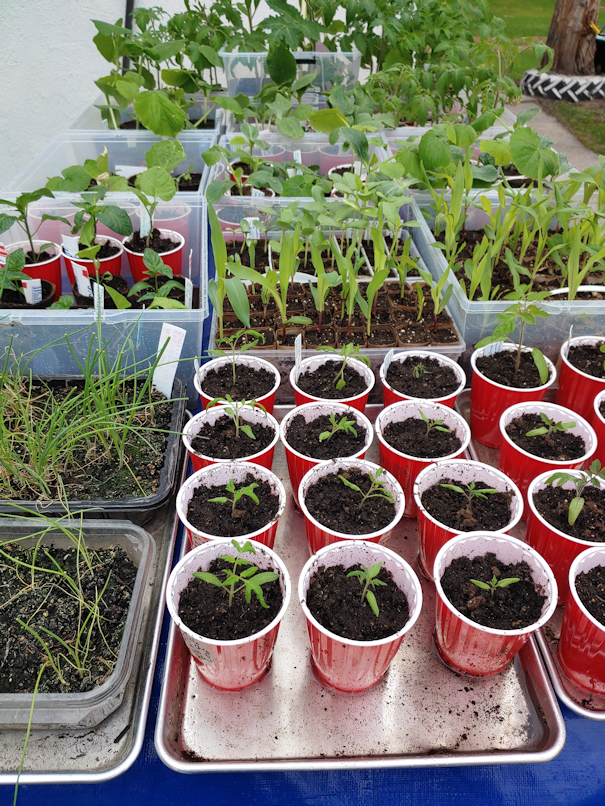
It was a bit cooler and overcast this morning, but still pleasant enough to get the plants outside for a couple of hours.
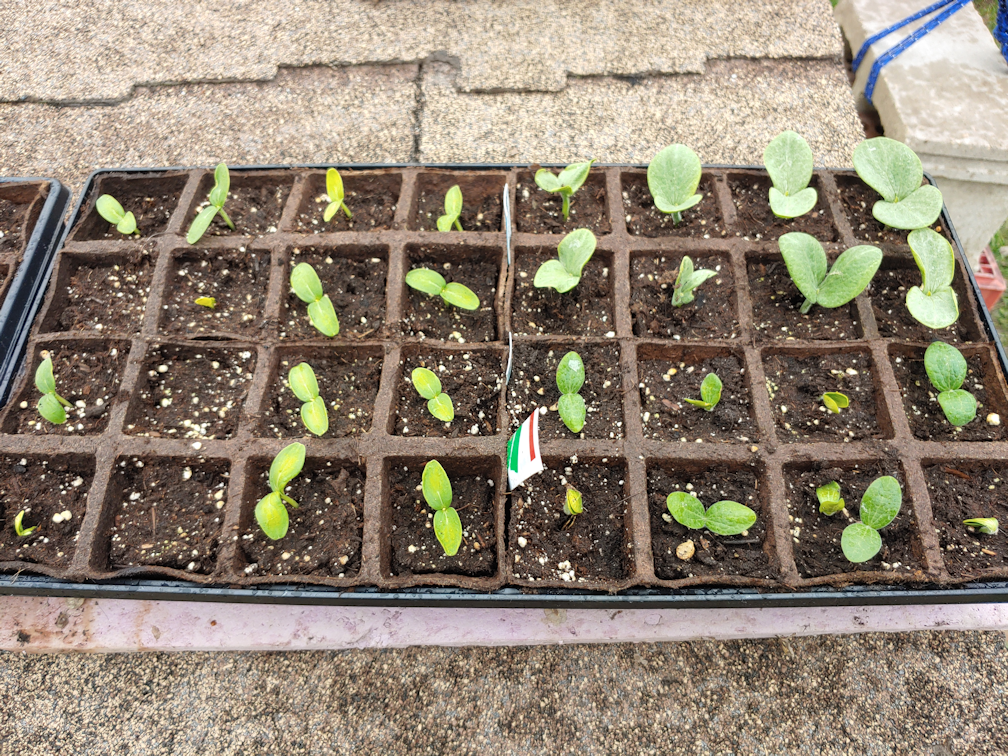
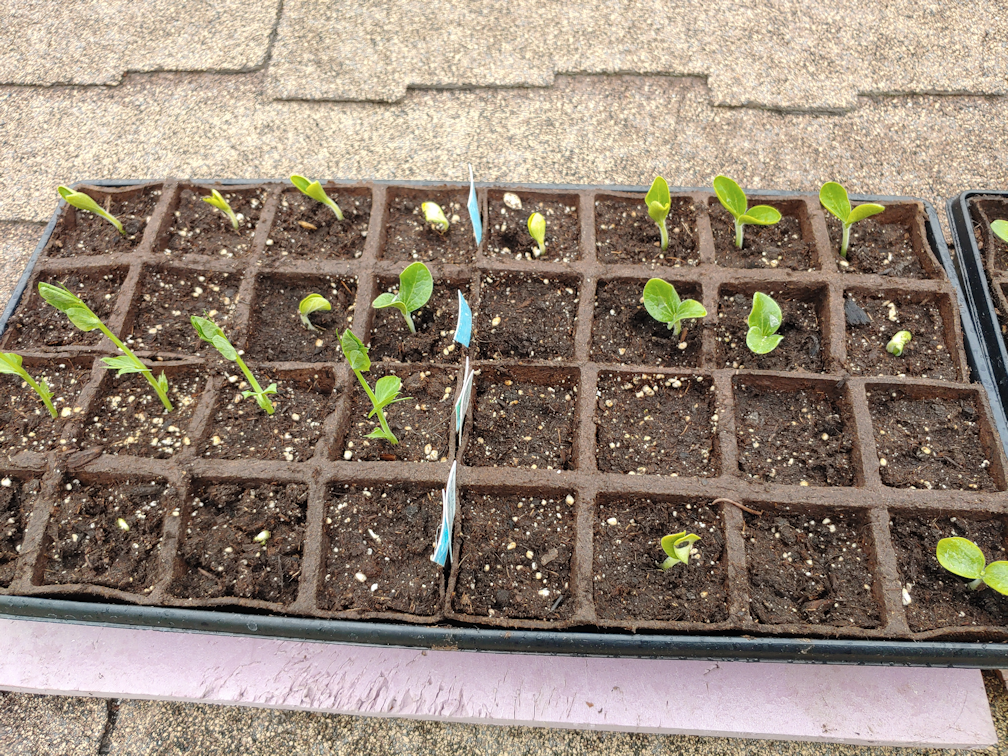
I am really happy with the newest seedlings. This tray has the cucumbers in the left half, with the Teddy and Red Kuri winter squash on the right. It took so long for the winter squash to germinate, I wasn’t sure they’d make it, but we have 100% gemination!
The purple peas in this tray are getting nice and big. The summer squash in the other cells took a long time to germinate, too, but they seemed to get a boost after I put the warming mat under them. It’s hard to see, but even the green zucchini is finally germinating, next to the peas. I thought the Magda squash had started to germinate, but not quite yet. We had less success with those the last 2 years we planted them, too. Our first year, we had only 2 surviving plants. Last year, there was just the one. Magda squash just seems to have a harder time of it.
So far, only 2 of the yellow zucchini have germinated. Last year, we had some germinate, but when they started producing fruit, they were green, and we no yellow zucchini at all. I’m hoping that won’t happen again, this year!
The transplants seem to be quite liking their time outdoors, and even the newest little tomatoes in the foreground are looking generally robust.
We have 3 Crespo squash – and they are budding! Would you look at that!
I considered pinching them off, but these first flowers would be all male flowers. The next batch of buds should be both male and female. So I’m thinking to just leave them? I don’t know. There is very little information out there on how to grow Crespo squash. They do seem to be very enthusiastic growers!
While moving the blooming Wonderberry in and out of the sun room, we have been brushing the 3 plants against each other, in hopes to pollinate them, just in case. I don’t know how if they are self pollinating or not. Nowhere I’ve looked about them even mentions pollinating.
The transplants were left out for 2 hours today, which gave me time to work on our very first direct sowing – and transplanting – in the high raised bed.
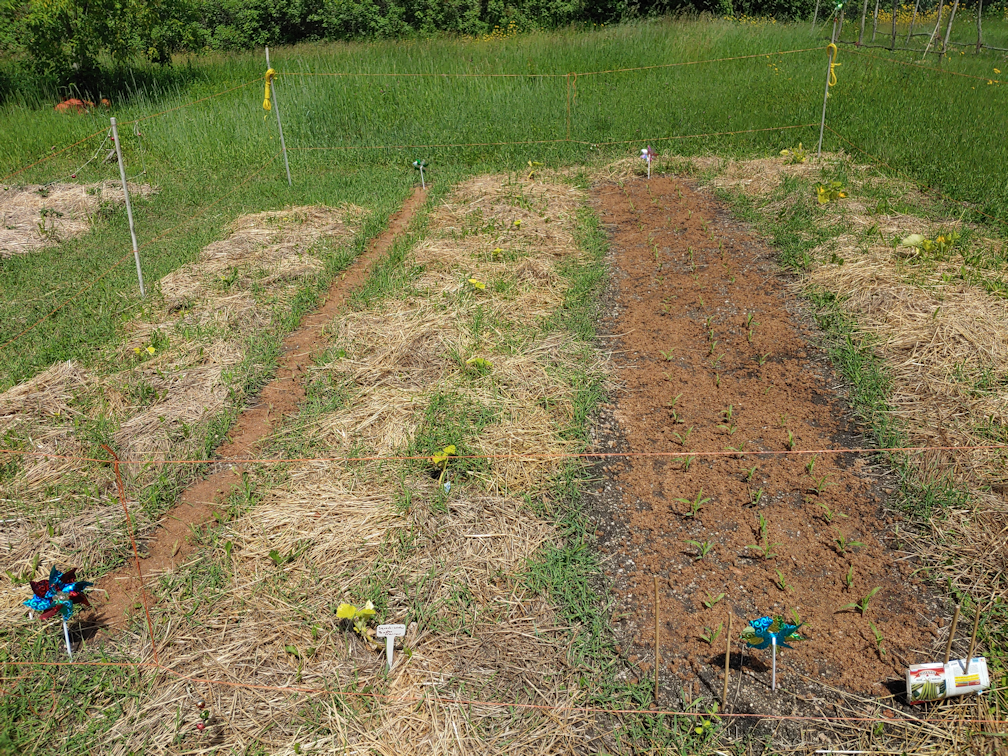
The first thing to do was dig trenches through the wood chip mulch, so that things could be seeded/planted into the soil beneath. We have three varieties of spinach seeds from last year, and for this bed, I chose Lakeside, which is the fastest maturing variety of the three. The tray of onions I grabbed are the red onions, Tropeana Lunga, which should look like this when they mature…
This image belongs to Heritage Harvest Seed. You can see what else we ordered with these, here.
By planting the onions around the spinach, they should help with keeping away harmful insects, and maybe even keep hungry critters away. The high raised bed is buffet height for deer, though, so we will be covering them later.
There is space to do a second planting of spinach in two weeks, which will also finish off the seeds we’ve got left of this variety.
The largest Tropeana Lunga seedlings filled the two outside rows, but there were still a few tiny seedlings left. The size that would be considered not worth planting. I hate to just toss seedlings, though, so I ended up sticking them in the soil at the base of the raised bed on the north end. When this was a low raised bed, it was quite a bit longer, so the soil is softer on that end. If they take, great. If not, that’s okay, too. We don’t have a lot of this variety, so I’m hoping to be able to overwinter a couple of bulbs to go to seed next year.
I was left with nice, soft potting soil in the tray the onions seedlings were growing in, so I used that to gently top the spinach seeds, and put just a little around each onion plant, more to keep the wood chips from falling onto them than anything else.
I have to say, I LOVE the high raised bed to plant in! It was completely pain free, with no strain on my joints. Well. I suppose that doesn’t include my arthritic fingers, but I didn’t even notice pain in my hands, either. It took me less than half an hour to plant into this bed
I didn’t bother watering these, since it was already starting to rain by the time I was finishing up. It’s been raining off an on, ever since. My daughter and I got a bit damp when we headed out later on, to figure out exactly where to plant our tree order when it comes in. With 30 silver bison berry to plant, those were the ones we need to figure out the most. They should be planted 3-4 ft apart. Since we are doing these as a privacy hedge, we will planting them 3 feet apart, with most of them along the east end of the garden area, leaving a lane just wide enough to drive through, if necessary, between them and the fence line. Taking into account where the phone line is buried, we’ll be able to plant two staggered rows of 10, though as we get closer to the spruce grove, we many need to jump the rows closer to the fence itself, to keep that driving lane open. There is a branch pile that will be in the way of any lane we leave open, but we’ll still be able to plant around it.
We’ve got 5 sea buckthorn that will be planted nearer the north fence line, to close a gap in the lilac hedge. Any remaining bison berry can also be planted along the lilac hedge, and still keep the lane over the telephone wire clear. This will leave a gap in the privacy hedge, once they’ve grown to full size, that will need fencing or a gate to close it off from deer.
The Korean pine are a whole other issue. Originally, I wanted to plant them in the space between the north side of the spruce grove, and the crab apple trees. These, however, have an 18 foot spread. At their mature size, they would completely fill that space, and we need at least some of it to be kept open to drive through. The alternative was along the north side, which would make an excellent wind break, but with that 18 foot spread and the lilac hedge, we’d be planting them on top of the phone line. Not going to happen.
Which means we’ll have to plant them in the outer yard.
Just past the fence on west side, which has a gate that leads into the garden, there is a space where we can plant 2 of them. Then there is the gate to the secondary driveway – our “emergency exit”, if you will. It was through here that one of our truck loads of garden soil was delivered.
The remaining 7 seedlings will need to be planted on the other side of that back gate, along where there is already a couple of rows of spruces, with some willows at the south end. If we plant them 18 feet apart (we might go with 16 feet), we will have a row of seedlings matching the length of the existing shelter belt trees.
The only problem with this is that the south end is currently under water.
Still, knowing that this is a low spot will help. We can make sure to basically build things up a bit, so that the seedlings will stay above water during spring melt.
Then we’ll have to make sure to put something over them to protect them from being eaten. I don’t know that deer would eat Korean pine, but they could certainly damage them, just by walking over them.
We have not yet received a shipping notice for the trees, but with so many holes to dig, the earlier we get started, the better. Hopefully, by the time they do arrive, we’ll be ready and can plant them right away.
Oh, I just double checked my order! We’re not getting 9 Korean pine. We’re getting 6.
Which means we won’t be digging holes in water, after all. :-D
It’s going to feel weird getting our little 2 yr old plugs and planting them so far apart. Especially since they will grow very slowly for the next 3 years. Which is exactly how my mother ended up planting so many trees way too close together! :-D
Oh, my goodness. I just checked the short range weather forecast, and it’s changed yet again. We’re supposed to get more rain over the next couple of days, then for the two days after that, we’re supposed to get a mix of rain and snow!
What I planted in the high raised bed should be cold hardy enough to handle that, but we might cover it anywhere, just in case, at least for the night.
Last year, May was a very warm month. On this exact day last year, we had a new record high of 30C/86F. The record low for today, -4C/24F, was set in 2002.
After a long, cold winter, it seems we’re getting a wet cold spring.
Still, there are things we can plant. I just hope things warm up decently in June, so we can get the warm weather transplants in!
I am happy to say that whatever had been eating our Teddy winter squash seems to have gone away!
These little guys are still around, and getting “big”. I found a 4th one of them, too.
I love how fuzzy they are at this stage!
While looking at the other beds, I had a few little surprises.
I am not only finding more of King Tut purple pea pods, but there are more flowers, too! This just amazes me. These should have been done long ago, even under ideal growing conditions, but they’re still chugging along!
I am leaving any pods that develop to go to seed, for next year. I figure something that could not only survive our drought, but is still managing to produce, is well worth planting again!
Then there are the green peas that were planted among the corn.
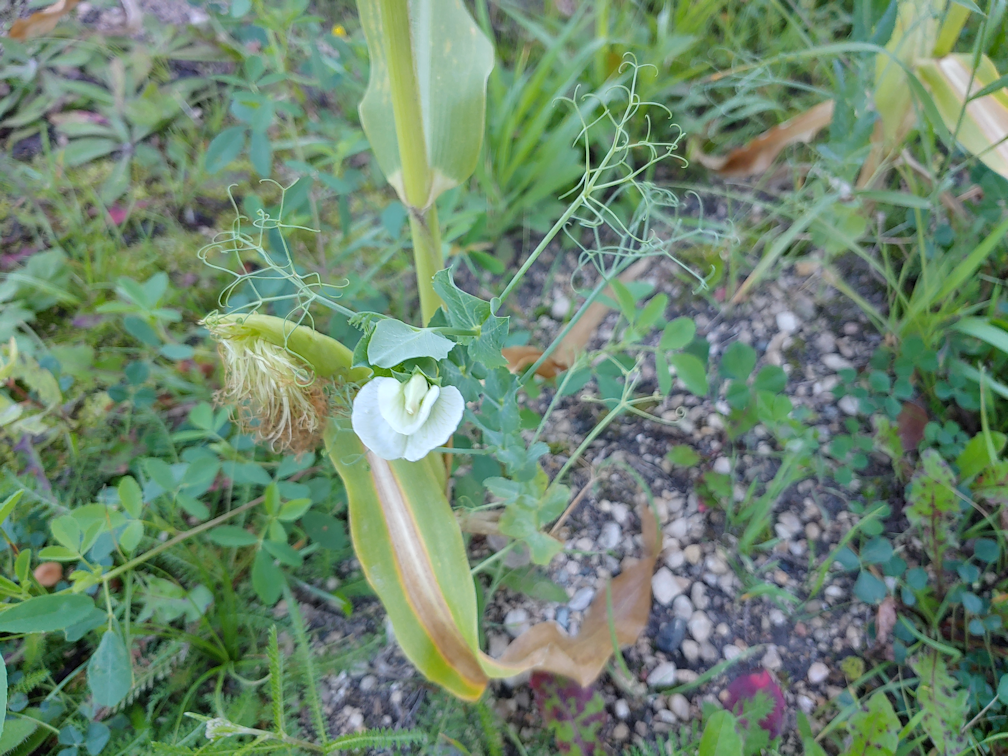
Some are starting to bloom! This one is among the sweet corn in the northernmost block. These are the tiniest of the corn. The peas are a real mix in their progress. Some are barely more than seedlings, while others are growing more enthusiastically.
This is one of the biggest pea plants I found, growing among the Dorinny corn that I’m leaving for seed. I’m even finding some among the purple corn that is also being left for seed at this point.
If things stay mild, we might actually have green peas to pick. The ones we planted in the spring did not handle the drought well, and hardly any pods developed. These late planted ones are getting much better temperatures right now.
This has been such a difficult year for gardening, I’m happy with anything we get!







 The Re-Farmer