Flavored Salts: Raspberry Wine

Though I made five different flavored salts at once, I will be doing a post for each flavor separately.

flavoured.salts.five.mixes

Using wet ingredients to flavor salt requires a fair bit more time.  The typical recommended ratio for a red wine salt was 3 cups wine to 1 cup salt.  I chose to use a locally made raspberry wine I found, instead.  Most bottles are about 3 cups, but we had to taste it, too!  Which means the actual amount of wine we used as about 2 1/2 cups total.  Of course, feel free to adjust quantities to your taste!

Also, the raspberry wine tasted much like the raspberry wine my father used to make!  I’m not a big wine person, but I think we have a winner, here!

The wine will be reduced to a syrup, which means 3 cups of wine works out to roughly 3 Tbsp syrup.

Raspberry Wine Salt

Ingredients:

  • 3 cups raspberry wine
  • 2 cups Kosher salt

Also needed:

  • baking tray lined with parchment paper
  • saucepan large enough to allow roam for foaming
  • very strong stirring spoon
  • food processor or coffee/spice grinder
  • jar with lid
flavoured.salts.raspberrywine.1

Step 1: pour the win into a saucepan and bring to a boil.  Reduce heat to a gentle boil.  Continue cooking until the wine is reduced to a thick syrup.

flavoured.salts.raspberrywine.2

For the raspberry wine we used, it took about 45 minutes to reduce to a syrup.  Near the end, it began to really bubble and foam.

flavoured.salts.raspberrywine.3

Once reduced to a thick syrup, remove from heat and let cool briefly.

flavoured.salts.raspberrywine.4

Step 2: stir in the salt and mix to thoroughly coat the salt with the syrup.  This is where I had to switch to the stronger mixing spoon!

flavoured.salts.raspberrywine.5

Step 3: spread the salt and wine mixture onto the parchment paper lined baking sheet and spread evenly.  Place into the oven with the light on and the temperature at the lowest setting.  After an hour or so, turn off the oven but leave the light on.  Leave overnight to dry. 

Note: you can take the baking sheet out every now and then and turn the salt – this can be made easier by using the parchment paper to fold the salt over itself, then spreading it evenly again.  After doing this, reheat the oven to the lowest setting again, then shut it off, leaving the light to help maintain the heat.

flavoured.salts.raspberrywine.6

Step 4: once thoroughly dry, remove the baking sheet from the oven.  Break apart the salt and crumble it with your hands as much as possible.  There will still be some clumps.

Step 5: using a food processor or spice grinder, pulse the salt in batches, just enough to break up the clumps.

flavoured.salts.raspberrywine.7

Step 6: after processing the salt mixture, transfer it to a jar, or divide among small gift jars, and seal.

Links for all five flavors made:

Rosemary Lemon
Scarborough Fair Garlic
Mushroom
Raspberry Wine
Bacon


Flavored Salts: Bacon

Though I made five different flavored salts at once, I will be doing a post for each flavor separately.

flavoured.salts.five.mixes

Bacon Salt

Ingredients:

  • 1 package thin cut bacon, cooked, cooled and crumbled
  • 2 cups Kosher salt
flavoured.salts.bacon.1

Also needed:

  • food processor, coffee/spice grinder
  • small rubber spatula
  • jar with lid, large enough to have room to shake the salt, or a mixing bowl
  • a larger funnel or canning funnel would also be handy

Note: the bacon needs to be cooked until very crisp, then drained of as much fat as possible.  I find the easier way to do this is to cook the bacon in the oven.  Line a baking tray (a 13×9 inch jelly roll pan works well for this) with aluminum foil and top with an oven safe cooling rack.  Lay your bacon slices out on the rack.  It may take some finagling to get them all to fit!  Cook the bacon in a 350F oven until dark and crisp, flipping the slices about half way through.  Once cooked, place the bacon on paper towels to get rid of any surface fat.  Go ahead and crumble it up with the paper towel in the process.  Leave the bacon on paper towel to cool completely – I left it overnight.

Step 1: using grinder or processor, pulse the bacon pieces in batches until they are quite fine. 

Note: the bacon may quickly become paste-like, and stick to the sides.  Use the rubber spatula to scrape it off in between batches.

Step 2: measure 2 cups Kosher salt into a jar.

Step 3: add the bacon bits to the salt and shake.

flavoured.salts.bacon.2
I should have used a bigger jar!

Note: it may be necessary to use a mixing bowl to combine the salt and bacon.  Use your hands to rub the bacon into the salt and break up any clumps, then transfer to a jar, or divide into small gift jars.

Due to the fat content that may still be on the bacon, this salt is best stored in the refrigerator.  

Links for all five flavors made:
Rosemary Lemon
Scarborough Fair Garlic
Mushroom
Raspberry Wine
Bacon

Flavored Salts: Mushroom

Though I made five different flavored salts at once, I will be doing a post for each flavor separately.

flavoured.salts.five.mixes

Dry salts are made with a basic ratio of 1 tsp flavors to 1/4 cup coarse salt.  Feel free to adjust to your own personal tastes!  For the salt, you can use Kosher salt, pickling salt, sea salt, or any coarse salt you prefer.  I used Kosher salt, which is fine enough to not need further grinding, but coarse enough to maintain a nice texture.

flavoured.salts.mushroom.1

Note: you can use any dried mushroom you prefer for this mix.  I used a gourmet blend from Costco. 

Mushroom Salt

Ingredients:

  • dried mushrooms
  • Kosher salt

Also needed:

  • food processor, coffee/spice grinder or mortar and pestle
  • jar with lid, large enough to have room to shake the salt
  • a larger funnel or canning funnel would also be handy

Note: you will need about 4 tsp powdered mushroom for 1 cup of salt.  I used quite a bit more dried mushroom than needed for my 2 cups of salt.  After grinding it down to a powder, I measured out what I needed for the amount of salt I had, then put the rest into a sealed jar to use as flavoring during cooking.

flavoured.salts.mushroom.2

Step 1: grind the dry mushrooms to a powder. 

flavoured.salts.kosher.salt

Step 2: measure the Kosher salt into a jar.

flavoured.salts.mushroom.3

Step 3: measure our your mushroom powder and add it to the salt.  Cover and shake thoroughly.

flavoured.salts.drysalts.2
flavoured.salts.drysalts.1

Step 4: Label your jar and set aside for about a week, out of direct sunlight, to give the flavors time to meld, giving the jar a thorough shake on a regular basis.

If desired, measure out portions of the combined mixture into gifting jars.

Links for all five flavors made:
Rosemary Lemon
Scarborough Fair Garlic
Mushroom
Raspberry Wine
Bacon

Flavored Salts: Rosemary Lemon


Though I made five different flavored salts at once, I will be doing a post for each flavor separately.

flavoured.salts.five.mixes

Dry salts are made with a basic ratio of 1 tsp flavors to 1/4 cup coarse salt.  Feel free to adjust to your own personal tastes!  For the salt, you can use Kosher salt, pickling salt, sea salt, or any coarse salt you prefer.  I used Kosher salt, which is fine enough to not need further grinding, but coarse enough to maintain a nice texture.

Rosemary Lemon Salt

Ingredients:

  • lemon zest
  • dried rosemary leaves
  • Kosher salt

Also needed:

  • food processor, coffee/spice grinder or mortar and pestle
  • jar with lid, large enough to have room to shake the salt
  • a larger funnel or canning funnel would also be handy

Step 1: measure out the lemon zest and rosemary leaves (see note below).

flavoured.salts.rosemarylemon.1
Dehydrated lemon zest and rosemary leaves.

Note: For 1 cup of salt, you will want about 4 tsp ground rosemary/lemon mixture.  I made mine using 2 cups of salt, so I used about 3 rounded tablespoons total (1 Tbsp = 3 tsp) of the lemon zest and rosemary leaves, to get approximately 8 tsp after grinding.

flavoured.salts.rosemarylemon.2
Lemon zest and rosemary leaves, ground together.

Step 2: grind the rosemary leaves and lemon zest together, to a fairly fine powder.

flavoured.salts.kosher.salt
Two cups Kosher salt.

Step 3: measure out your salt into a jar.

flavoured.salts.rosemarylemon.3
Kosher salt with rosemary, lemon zest powder.

Step 4: add ground rosemary and lemon zest to the salt.  Close the jar and shake thoroughly.

flavoured.salts.drysalts.2
flavoured.salts.drysalts.1

Step 5: Label your jar and set aside for about a week, out of direct sunlight, to give the flavors time to meld, giving the jar a thorough shake on a regular basis.

If desired, measure out portions of the combined mixture into gifting jars.

Links for all five flavors made:
Rosemary Lemon
Scarborough Fair Garlic
Mushroom
Raspberry Wine
Bacon

Cat water heater – follow up

Okay, so this is where we left off last night.

20181111.water.heater3

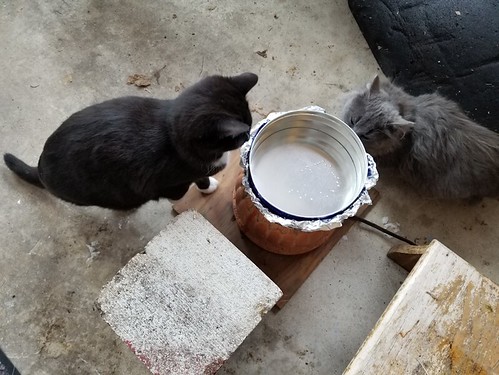
When I checked on it last night, however, I found that the aluminum foil did not prevent water from dripping down.  After looking around for something that might work, I decided to commandeer one of the containers we have been using for the cat kibble.  A heavy bottomed frying pan that the handle had broken off, long ago.

Some time during the night, however, it got knocked over.  We could see the light glowing through the drainage holes in the terracotta pot through the bathroom window.  When I went out to do their food and water in the morning, I found a small ice patch where the water had spilled.

I am guessing that, when it got to hardly any water left, the cats knocked it over while trying to reach it.

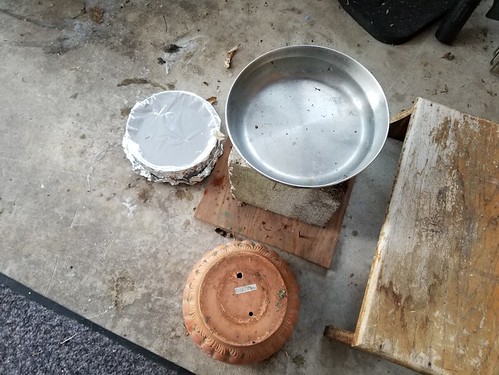
I decided to go with the concrete block.

20181112.water.warner,take2.A

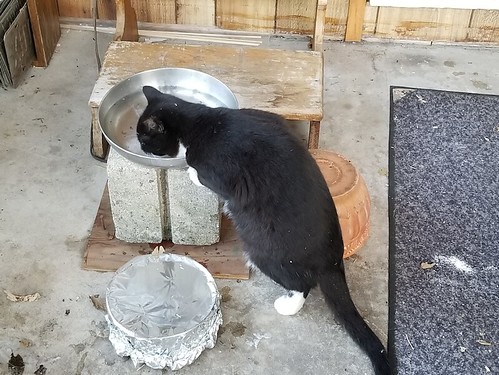
I am hoping the weight of the block will make up for it resting on the edges of the light fixture.  It seemed high, though, so I moved it closer to the kneeler, and put the pot and tin upside down near it, so the cats could sit on them, if the wished.

20181112.water.warner,take2.B

Which promptly got ignored. :-D

At least with the block, though, he can put his paws on the corners to stabilize himself.

When we checked it again, hours later, it had been knocked off again, but it was also completely dry.  There was no new ice. Again, it seems that they knocked it over only when the water was almost gone.

So I’ve put it back, and filled it with more water than I had before.

As for the heat; it is clearly working, in that the water is kept from freezing, but neither the pot nor the block seemed to warm up at all on the sides.  There is no radiant heat coming off.  The heat of the bulb is enough to keep the water from freezing directly above, but not enough to fight off the cold on the sides.  I had hoped it would provide at least a little bit of warmth that way, but it I’d probably have to go up to a 100 watt bulb to accomplish that, at which point I think it would be too hot at the base of the pan.  That cats, at least, know how to use their own body heat to keep them warm! :-)

The Re-Farmer

Cat water heater – let’s see if this works!

A set up to keep the cats’ water from freezing is now set up in the sun room.

We will know by tomorrow, if not tonight, if it will work.

Here is the set up.

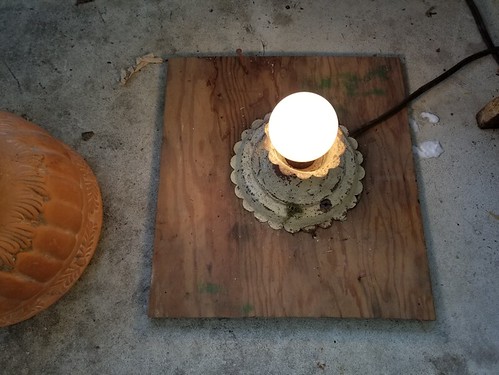
First, the heat source: an incandescent light bulb.

20181111.water.heater1

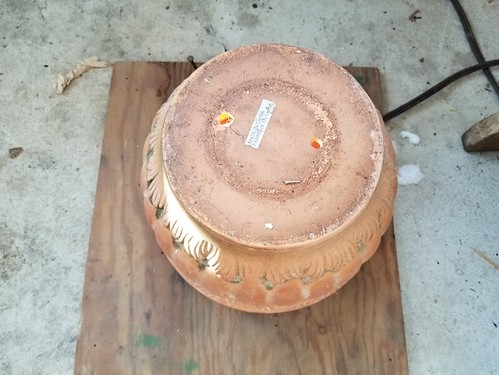
This is what my brother had used under the kitchen sink, to keep the pipes from freezing while the house was empty.  The first potential problem I saw was the fixture holding the bulb.  While the opening in the concrete block I had would fit the bulb, no problem, the fixture looked too wide.  So I had a terracotta plant pot as a back up.

There was already a 60 watt bulb in the fixture.  The various instructions I’d read called for a maximum 40 watt bulb, but these were all on sites in US states that don’t get as cold as we do!  So I kept the 60 watt bulb.

20181111.water.heater2

The plant pot is what I ended up using.  The cement block was not stable.  I could have removed the fixture, but it’s what was holding the bulb upright.

The narrower bottom (now top) of the pot meant I could not use any of the containers we are currently using for water.  So I dug around in the Old Kitchen and found a cookie tin.

20181111.water.heater3

The tin is not completely water tight; there’s a slight drip at the seam.  So I used aluminum foil around the base, which will also serve to stabilize it.

That left an issue of height.  The cats were immediately curious (and Doom Guy was drinking the water in the tin as soon as I had it on the floor, before I put the foil on), and I could see that there were potential issues for them to reach the water if it gets low.

To solve that, I put the concrete block near it, for them to sit on.  Between that and the kneeler, they should be able to reach the water.

The terracotta pot should absorb and radiate a gentle heat as well.  I would not be surprised to find cats huddling up to it at some point.

For now, though, they are very curious about the whole set up, and even having fun playing around it!

Which means on of the things we have to watch out for is them knocking the water right off the pot.  We’ll be keeping an eye on them!

The Re-Farmer

Home Made Chicken Stock

The following is a “use watcha got” recipe to use up the carcasses of your cooked chicken (or turkey).  This stock is cooked down to be more concentrated, and should result in a rather firm, gel-like consistency when cool.

Decide ahead of time how you will store your stock, and prepare in advance as needed.  I used pint sized canning jars and sterilized the canning funnel, jars, lids and rings during the last hour or so of cooking.  You could also pour the stock into ice cube trays for freezing, or use freezer bags.

You will also need a colander and bowl large enough to hold your stock, plus a sieve and cheesecloth for straining.  Having a giant measuring cup is also very handy to stain into, making it easier to pour the stock into jars.

Ingredients:

bones and skin from roasted chickens (or turkey)
pan drippings
onion and/or leeks
garlic cloves
vegetables such as carrots, celery (including leaves), celeriac, parsnips
herbs such as rosemary, thyme, savory, sage, bay leaves, ginger, parsley or dill
peppercorns
salt; optional
cold water
optional additions: lemon or orange zest, a splash of apple cider vinegar or white wine vinegar

homemade.chicken.stockNote: Quantities will depend on how many carcasses you are using.   For 3 carcasses, I used 1 large onion, a whole head of garlic, 4 carrots, and whatever herbs I had handy in my cupboard.

Seasonings will also depend on how the chickens were seasoned when cooked.  When I roasted ours, I first rubbed them with lemon juice and put the lemon pieces, with some bay leaves, into the cavities.  I also rubbed lemon salt, paprika, pepper and oil into the skin.  Because of this, I was able to be light on the salt and pepper when making the stock.  What salt I did use was lemon salt.

  1. Place your chicken bones and skin into a large stock pot.  Scrape pan drippings in (cooled pan drippings may be gelled, which is awesome).
  2. Add onions, cut into large pieces (skin can be left on, if you wish), or leeks cut into 2 inch or so chunks.
  3. Crush garlic cloves with the side of a large knife (skins can be left on, but I like to remove them) and add to the pot.
    Note: If you don’t have fresh onions or garlic, dried can be used.
  4. Vegetables do not need to be peeled.  Just scrub them, and remove the root ends.  Chop them into about 2 inch pieces, then add to the pot.
  5. Add fresh or dried herbs and other seasonings of your choice.
  6. Add peppercorns (or ground pepper, if that’s what you have) and salt.  If you’re not sure about the salt, leave it for later, after tasting.
  7. Add enough cold water to cover everything by about 1 or 2 inches.
  8. Bring to a boil, then reduce to simmer.  Do not stir, as that will make your stock cloudy.
  9. Simmer for about 3-4 hours.
  10. Place a colander over a large bowl.  Carefully pour everything in the stock pot, into the colander.  Gently lift out the colander, allowing to drain, and set aside.  Colander contents can be discarded.
  11. Wash the stock pot out and place back on the stove.  Pour the stock, through a sieve, back into the stock pot.
  12. Taste for seasonings.  Adjust as desired.
  13. Bring the stock to a boil.  Reduce heat and continue to simmer the stock down until reduced by 1/3rd.
  14. Line a sieve with several layers of cheesecloth and place over a bowl or large measuring cup.
  15. Gently ladle the stock into the lined sieve.
  16. Fill prepared containers with strained stock (in batches, if need be) and seal.
  17. Refrigerate or freeze, as desired.


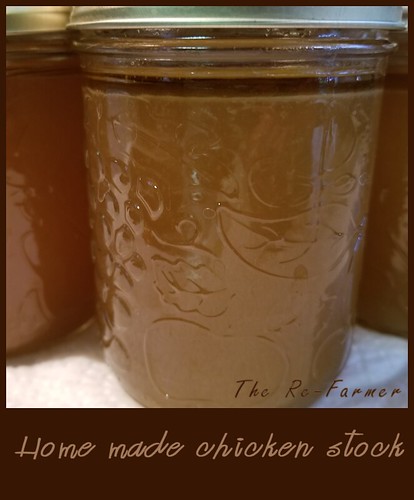
Using the carcasses of 3 chickens, I was able to fill 11 pint sized canning jars (all the ones I had available), plus have 3 cups of stock left over.

The second cooking down of the stock concentrates it a bit; if you wanted to, you could continue to cook it down more, for an even more concentrated stock.  Keep this in mind when you use it, as you may need to water it down a bit.

Enjoy!

The Re-Farmer

Makin’ Mayo

Today, my daughters cracked open a new jar of mayonnaise that we bought just a couple of days ago, and discovered the seal was cracked.

Which means it had been sitting in our cupboard, with the vacuum seal broken.

So, that got thrown out.

Since we weren’t about to drive into town just to buy a jar of mayonnaise, and I happened to have the ingredients, I made a quick batch.

This is an easy mayonnaise recipe from the home economics cookbook I got from when I was in junior high school – a cookbook that is still one of my most used, because it’s filled with basic recipes like this one.

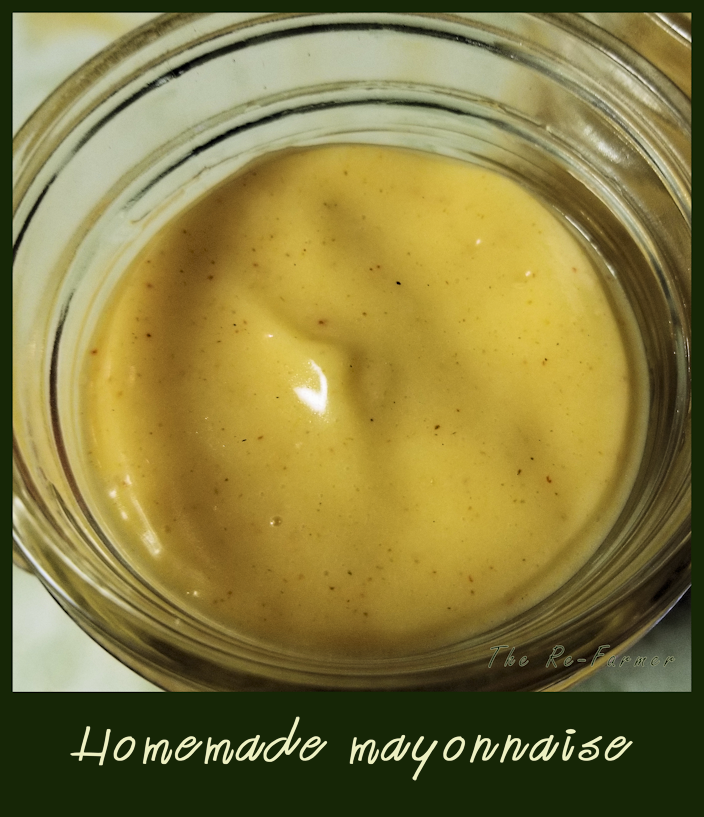
Homemade Mayonnaise

I also have these handy little pint canning jars to use to store it, too. :-)  Since this is an uncooked version, I sterilized them first.

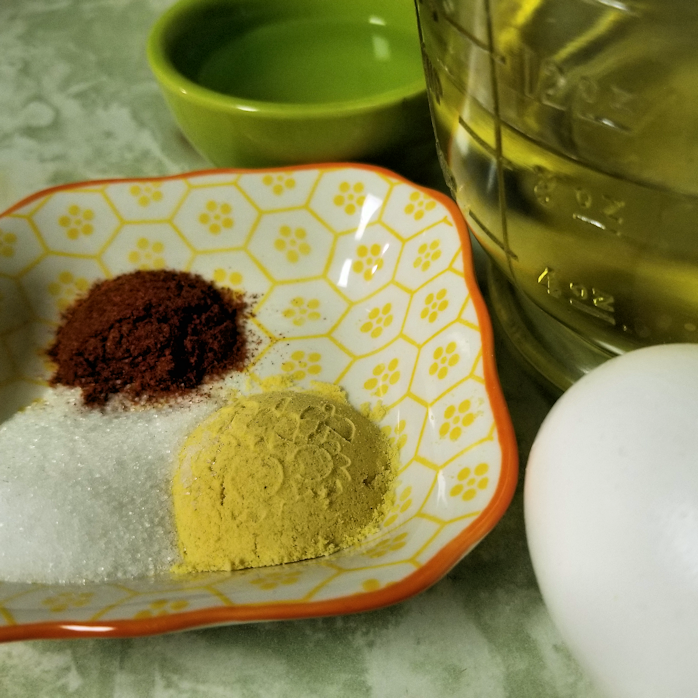
mayonnaise ingredients

The ingredients are pretty basic; dry mustard, salt, paprika (that is the amount in the recipe; when I’ve made it in the past, I usually used just a pinch), a large egg, vinegar and oil.

While you can adjust how much paprika is used, to taste, the quantities of the rest of the ingredients should stay the same.  That doesn’t mean you can’t get creative, though!  I’ve made this using olive oil, and avocado oil can be used as well.  You can use one egg, or two egg yolks.  Instead of white vinegar, try another light vinegar, such as white wine vinegar.  I wouldn’t use a dark vinegar, such as balsamic, as it would be overpowering, but go ahead and try it, if you want.  I’ve even successfully used prepared mustard instead of dry (not the bright yellow kind, but there are a lot of flavourful Dijon mustards out there that will work quite well).

The important thing about making mayonnaise is in creating the emulsion.  The original recipe was written before electric mixers were common, and the instructions say to add the oil, one drop at a time, while beating vigorously until it thickens!  Even with an electric mixer, it’s important to add the oil slowly.  Just a thin drizzle.

The need to thoroughly beat in the oil, as it is slowly being added, requires a bowl that is small and deep.  I used my 4 cup measuring cup, because even the bowl that came with my stand mixer was too big for a single recipe.  If I had doubled it, it would have worked fine.

If you are using a blender, immersion blender or food processor, however, the blades turn so quickly, it emulsifies before you know it!  Just add the oil in a steady stream.

Here is the original recipe, with my modifications added in [brackets].

Mayonnaise

1 tsp dry mustard [can use equal amount of prepared mustard, such as a dijon]
1 tsp salt
1/2 tsp paprika [can be reduced to taste, or none at all for an almost white mayonnaise]
1 large egg or 2 yolks
1 cup salad oil [can be any vegetable oil, olive oil, or avocado oil]
2 Tbsp vinegar [white vinegar or any light vinegar of choice]

  1. In a small but deep bowl, mix spices and egg
  2. Add oil one drop at a time, beating constantly until and emulsion forms (mixture thickens). [If using an electric mixer, pour the oil in a steady stream no larger than a pencil.]
  3. Beat in 1 Tbsp vinegar and the remaining oil in larger quantities. [Using an electric mixer, you can add all the vinegar now, or after all the oil has been added.]
  4. Add remaining vinegar and beat vigorously. [Pour into sterilized container.] Refrigerate.


Hint: let the egg come to room temperature, first.

Note: if the emulsion refuses to form and “breaks” (one of the reasons buying mayonnaise can be preferred!), it might still be rescued.  Take an egg yolk and beat it in another small, deep bowl.  Then, slowly add the broken mayonnaise, a little bit at a time, while beating vigorously.

If that still doesn’t work… well… there’s always the grocery store! :-D

The Re-Farmer

Fixing the garage door

With the snow starting to show up, I had no excuses.

Time to fix the garage door.

Back in April, the old handle on the door simply fell off.

20180427handle

It wasn’t the original handle to begin with.  I have no idea what was holding it in place, really, since there were no screws.  Just the bar running through.  There had to be something inside the handle, but I never found the pieces.

We were in no hurry to fix it, since leaving the door open was so handy, though we didn’t expect to have to deal with cows getting in. :-D

I got a new handle, but on taking things apart on the inside, found the old cable ends to be quite frayed, and I wouldn’t be able to thread the end through the inner handle again.  So I got new cables, too.

Then the parts and pieces just stayed in the garage, managing to not get lost after being tossed about, including when a cow knocked into the bin they were on.  Thankfully, things fell INTO the bin, and not onto the dirt floor. :-D

So here is the fix I did today.

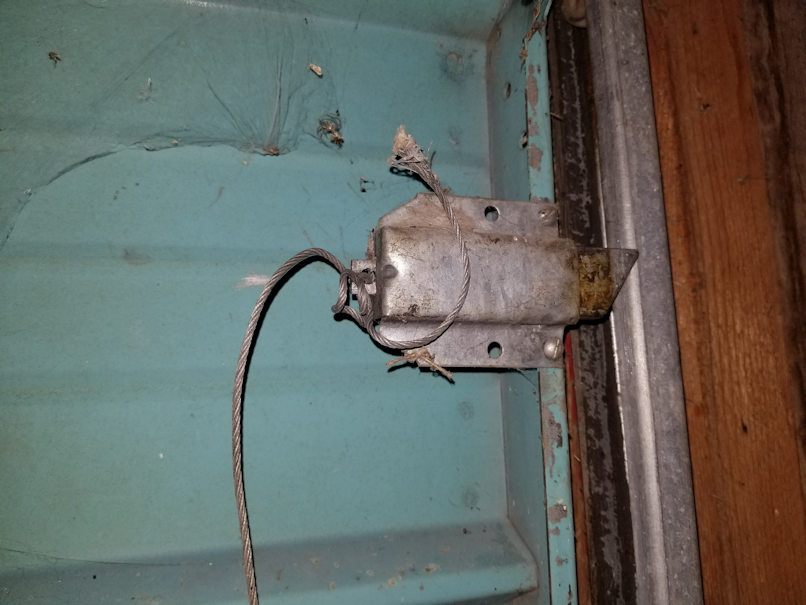
20180924.garage.door.fix.1

Here is the latch end, with the old cable still attached.  This end wasn’t as frayed as the others.

And… I just realized, that’s a dead spider in the old web above it.

Ew.

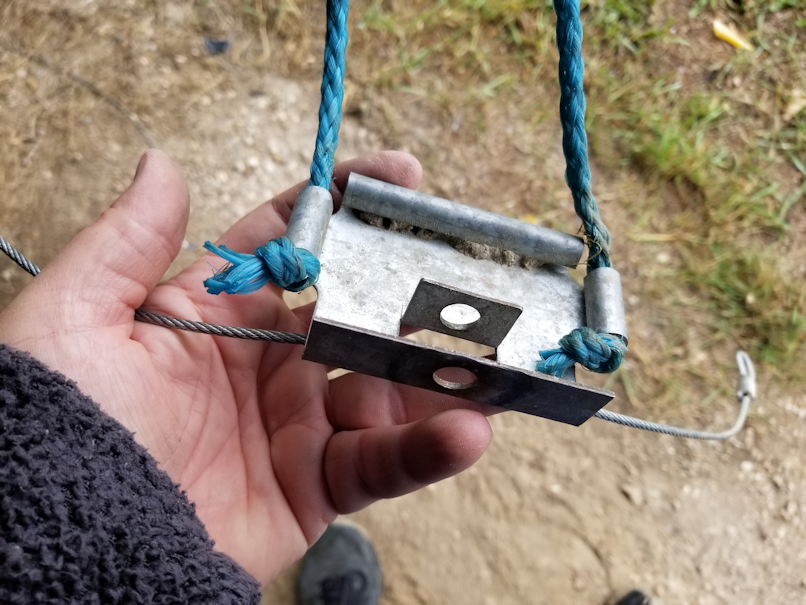
20180924.garage.door.fix.2

This is the underside of the inside mechanism that the handle attaches to and opens the door.  I have threaded a new cable through it.  The new cables came with loops on one end, as you can see in the photo.

The non-loop end of this cable was later affixed to the door on the side opposite of the latch.

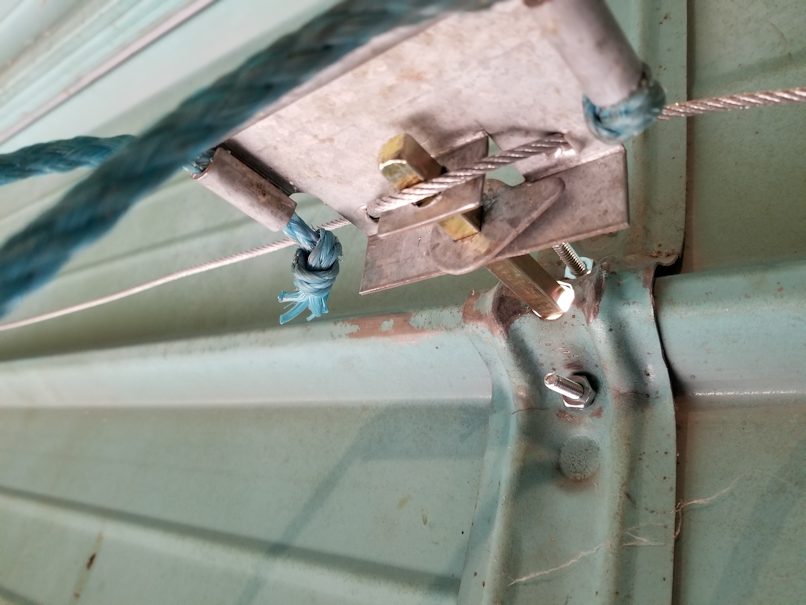
20180924.garage.door.fix.3

Here is the assembled door handle mechanism, which took some doing to get right – including reversing things from the first time I put it together, because I couldn’t remember which way that washer was supposed to go.

The door handle came with wood screws, so I had also picked up nuts and bolts to use instead.

That special washer is essential to how this works.  Without it, the squared post of the handle would just spin in place.  That washer ensures the entire plate turns, pulling the cable, which in turn pulls the latch on the side of the door.  You wouldn’t believe how many times that thing almost got lost!  And I have no idea where we would have found another, if it had disappeared.

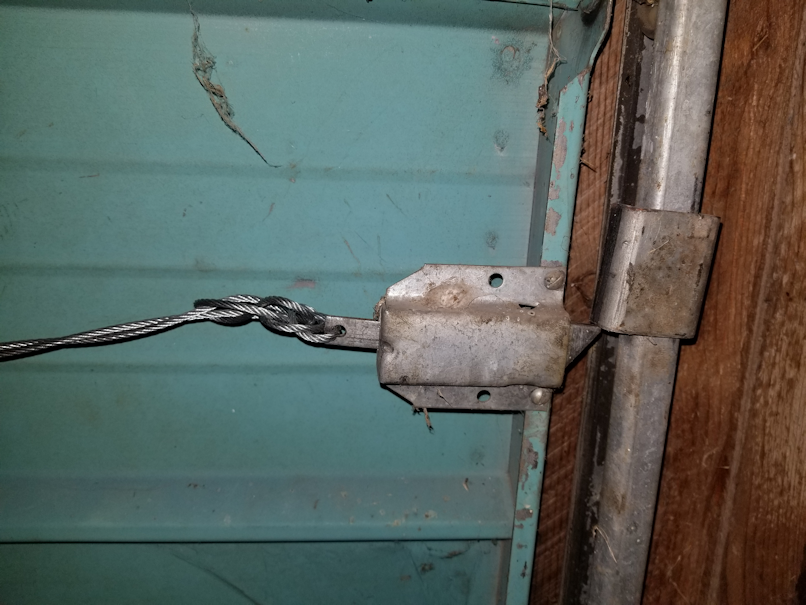
20180924.garage.door.fix.4

Here is the latched door, with the new cable.

(The dead spider is gone…)

When the door closes, the latch catches on the plate, but as you can see, there’s not a lot catching!  This was an issue before the door handle broke.  When closing the door, we often had to slam it several times before the vibration moved the latch far enough out to catch on the plate.

At one point, after assembling it all, but not tying off the new cables completely yet, I tested the door by closing it from the outside.

Then I couldn’t open it.

The cables had loosened when I shut it, resulting to so much slack, turning the handle did nothing but wiggle them!

It’s a good thing there are other ways into the garage!

There needed to be at least some slack on the cable, though.  Without it, the cable prevented the latch from springing back far enough to catch on the plate at all.

20180924.garage.door.fix.5

The old cables were kept in place with knots.  The new cables came with S hooks, so I used both of them, facing opposite directions, to attach the two cables together.  I figure that, this way, even if one fell of, the other wouldn’t.  And it would still be easy to remove the cables if needed at some point.

The door now opens from the inside with a quick twist of the plate.

20180924.garage.door.fix.6

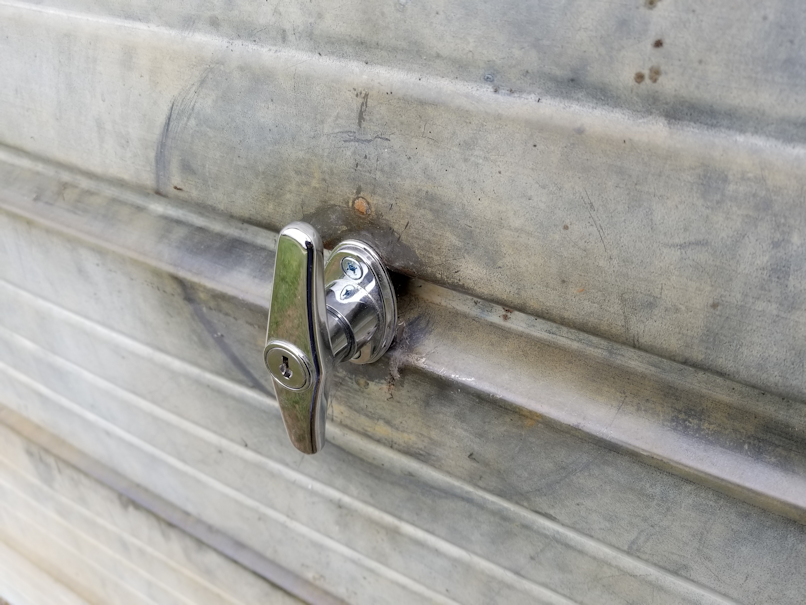
The new handle came with a lock and two keys.  I can’t imagine bothering to lock it, since there are two other ways to get in that have no locks (or even door knobs), so it’s not like it would solve any security issues.  But I guess it’s good to have.  So long as we don’t loose track of the keys!

Another thing off the list of stuff to get done before winter. :-)

20180924.garage.door.fix.7

That was a much dirtier job than I expected it to be! :-D

The Re-Farmer

Home canned chili

Last night, I made up some chili in the slow cooker, for ourselves and my mother when she gets home form the hospital.  You can see my recipe here, though I slightly modified it this time.  I added a rutabaga with the vegetables, an extra can of beans, and used two cans of crushed tomatoes, instead of one, plus tomato paste.  I also skipped the cream.  Lots of fibre and iron in here, which my mother will need for the next while.

This morning, I put up 12 pint sized jars of the chili.

20180913.home.canned.chili

I don’t have the equipment to pressure can these, but these are not intended for long term storage.  Done this way, they should last 6 weeks or more, in the fridge.

I found a flat bottomed, rectangular roasting pain with rack while cleaning the Old Kitchen.  It was the perfect size to hold all the jars.  I put the jars on the rack and, after setting kettles to boil water to scald them, added hot tap water to the roasting rack, so there would be no chance of anything cracking.  I scalded the lids and rings in a stainless steel bowl, then poured boiling water into all the jars to disinfect them all.  I scalded my jar funnel, too.  I am so glad I picked that thing up!!

Once the jars were scalded and emptied, I could use the roasting pan to carry them all together to the crock pot.  I left the hot water in the pan.  To fill the jars, I would put some chili in, then use a (scalded) fork to poke at it and get out any air pockets, fill it the rest of the way (with a half inch head space) then poke at it again to get rid of the air pockets.  After removing the funnel, I popped a lid in place, then moved on to the next one.  Using the roasting rack made it much more organized.

Once filled, I put on the rings, but did not tighten them all the way, then moved them all onto some paper towel to cool slowly.  Once fully cooled, I’ll tighten the rings the rest of the way.  Not too tight, though.  I don’t want my mother to have a hard time opening them!

This took up about half of our 8 quart crock pot of chili.

So I had chili for breakfast. :-D

The Re-farmer