Today has been a very windy and rainy day, but I still managed a bit of progress on the cat isolation shelter. I kept the garage door closed because of the weather, or course. Usually I have it open for light and fresh air, but the winds were blowing in from the south today, and that door faces south. I was surprised by just how much that door was rattling and shaking in the wind, even with the truck parked outside, right in front of it, acting as a bit of a wind break!
All was warm and dry inside the garage, though, so that worked out well.
I decided to work on the frame that will be supporting the clear roof panels, starting with the board that would support the piano hinge in front.
The piano hinge has 18 screw holes in each half, and came with its own little baggie of screws. I started by centering the hinge on the board, with a plan to attach the hinge at each end, then continuing on the shelter itself.
I had problems with the very first screw.
The head broke off!
If the screws that came with it were going to break that easily, I was not going to use the rest!
I did have the remains of a box of small screws that I used on the catio roof that were the right size, so I used those, instead.
After securing the hinge to the board at each end, I set it up on top of the shelter. I dug around the garage and found a strip of aluminum thin enough that I could use it as a spacer between the frame and the board. The board had a slight bend in the middle, so that got weighted down with a couple of bricks.
I didn’t have enough screws for all the holes in the hinge, but there’s enough to hold it in place. I’ll have to pick up more screws later to finish the job.
In the first photo above, you can see some of the empty screw holes. I made sure the ends and the middle were secure. I supposed I could use the screws that came with it for the rest, but it’s not worth potentially filling the holes with broken screws I won’t be able to get out later.
Once that was in place and the spacer removed, I had three boards to attack to the hinged piece. I used one to work out exactly how I wanted them positioned. The overhang is slightly longer in the front than the back. After marking where it lined up with the frame, I used that to mark the other two boards.
I spent a fair bit of time making sure they were exactly where I wanted them, then screwed them in place.
That left three ends in the back that needed something to keep them from wobbling around when the roof pieces are attached.
Once again, wood lath to the rescue!
The distance from one side to the other is 4′, which is the length of the wood lath. I find the most even piece out of the new bundle I could find, and simply nailed it to the ends of the roof supports.
If you click through to the next photo above, you’ll see what it looks like, open. Instagram doesn’t work with having both portrait and landscape orientation photos in a slide show, so things are a bit cut off in the image. The end of the roof support reaches the rafters!
While the piano hinge would allow for the roof to open all the way flat, the overhang will let it open only so far. Later, I might at something that can be used to hold it propped open, but that can wait.
Last of all, I added another piece of wood lath under the three boards. You can see it in the last photo. I lined it up with the edge of the frame, and then used wood glue to secure it, with the bricks to weight it down as it dries. This piece is to make sure the boards don’t slam right against the frame when it closes. It will eventually be further secured with nails.
The roof panels will not be added until last, though.
From this, I started working on attaching the front door/ramp. After checking how it fit into the opening, I cut a small piece of wood to attach under the horizontal top, as a stopper for the ramp.
It was remarkably difficult to attach this to the underside of the 2×4! Quite awkward, and one of the screws seem to be hitting something harder in the wood.
The next step is to attach the hinges to the door, then to the frame, but that’s when my husband came to the garage to let me know my daughter needed help with the taps. There is no signal in the garage at all, so they couldn’t message me to ask me to come to the house.
Well, at least I got a bit done!
Once the door/ramp is on, and a latch installed, it’ll be time to add the clear panels – which still need to be cut to size! It’s starting to look like we won’t be able to set up the table saw in the sun room, after all, so I’ll need to figure out some other way to cut it. If I can keep it from vibrating too much, I could use a jig saw.
I’ll cut it by hand with the pull saw, if I have to.
Ever since my brother told me this stuff can possibly shatter while being cut, I’ve been incredibly hesitant about using any of the tools we have.
It’s so close to being done, but there have been so many interruptions!
Of course, getting those shut off valves and installing them so we could have running water in the house was most definitely a higher priority!
For those who have been following this blog for a shorter time, I’ll give a bit of a back story.
When we moved into this “perfect” house, at the request of my mother, we of course found all sorts of problems all over the place.
One of those was the hot water leaking in the bath tub. The rust stain below showed this was not a new problem.
When we had septic backing up into the basement (again) a few years ago, we had a plumber come in to auger the floor drains. While he was here, I asked him about the leaking tap. He asked me some questions I couldn’t answer, like whether or not the pipes could be access from the front, of if they had to be accessed from the bedroom on the other side of the wall.
There is no access panel, there.
When my father got running water and an indoor bathroom for the house, in the early 70’s, the bathroom walls were covered with waterproof paneling make to look like tiles.
The tub surround was installed on top of this paneling, with arm bars added later on.
The caulking for the tub surround was coming loose, and we had no idea what the state of the caulking on the fake tile paneling underneath was like.
The plumber gave us an estimate of $400 to replace the taps – he thought he could fix them, but we wanted to replace them – but he told us the tub surround would have to be removed, and that was not something he did, so we would need to be prepared to replace that.
With this information in hand, we got a replacement faucet set with level taps in stead of knob style – something better for arthritic hands.
We also picked up a new tub surround, adhesive and caulking.
Which has all just been sitting there all this time.
After the illegal lockdowns and various economic disasters, I eventually called the plumber to ask for a new estimate, but he never called back. Considering all the hits to our finances recently, from now having payments on the truck, replacing multiple desktop computers, etc., it really didn’t matter much.
Of course, over time, the leak just kept getting worse. The strangest thing was that, if only the cold water tap was turned on, the hot water tap would start leaking!
Well, today, it finally happened.
My daughter was just finishing her shower, went to turn off the hot water, and the tap just kept spinning and spinning!
Which bring us to another problem with the plumbing in this old house.
A severe lack of shut off valves.
To shut the water off for the tub, we had to shut off the water for the entire house.
Once she was able to get out of the shower, my daughter started working on taking off the taps and faucet.
The one with more rust on the inside was the hot water tap.
Click through to the next photo, and you’ll see the inside of the faucet.
The rust and scale I can understand, but cobwebs???
My daughter then had to start tearing off the tub surround, starting with the one behind the taps.
That was a messy and difficult job.
We then learned three things.
First, we would have had to access the taps from the other room to be able to replace them. We might still have to.
That will require almost emptying by husband’s bedroom. The only thing that wouldn’t need to move would be his hospital bed.
Then we’d either have to remove an entire sheet of paneling – which is what I think has been done over the years – or cut an access panel. Either way, it’s going to be a major issue for my husband.
Second, the rot in the fake tile paneling is really bad. I expected it to be bad, but… yuck.
No, I’m not going to post picture of it.
The water damage extends all around the tub, but the other two walls are not as bad as we feared.
Still, we’re going to have to cut off at least the bottom 16″ of the paneling (4 “tiles” high), then see how bad the damage is, behind it.
Third, this is going to take a long time to get fixed. We don’t even know what we’re going to need to do to get it all useable, yet, anyhow.
Meanwhile, the entire house is without water.
That meant a trip to the hardware store for a couple of Shark-bite style shut off valves.
My daughter then spent almost 3 hours installing them, with me as her flashlight holding assistant. It was incredibly awkward, and hard to get at.
Once they were finally installed, we added a sealing tape around each end of the valve, then went over that with electric tape, just to be on the safe side. We had to install a shut off valve in the hot water pipe to the laundry sink, and it now leaks every time we turn it on to use the tap. That on is an actual Shark-bite brand, and one end never gripped properly.
The first image above is the cold water pipe. That one had to be installed directly above the sump pump reservoir, which made reaching it a bit precarious. It was the easier one to install, though!
If you click through to the next photo, you’ll see the hot water pipe, which is just off where it branches to the kitchen and laundry, and next to the pipe that goes up to the toilet tank, and next to the furnace duct…
That pipe didn’t have as much play in it, either, and my daughter ended up having to cut off more pipe just to be able to get it into the valve end.
To top it off, there was all the water to deal with. My daughter did the hot water tap first, and after the first cut, the water just wouldn’t stop flowing! We ended up having to drain the hot water tank and open other taps, and still had to kept lifting the pipe at a bend to try and get more water out of the pipe. The cold water pipe did that, too, but not as much as the hot water pipe!
Needless to say, my daughter was feeling wet and gross by the time it was all done.
The important thing, though, is that they work. We could turn the water back on for the rest of the house!
While my daughter was finally able to leave, I stayed to monitor the refilling of the hot water tank. We couldn’t just turn the valve on all the way, as it would drain the pressure tank faster than the well pump could fill it again, which causes problems for the pump.
Yes, that still needs to be replaced, too.
Every now and then, I’d have to shut the valve off completely and let the pump finish filling the pressure tank before opening it up again, to stop the grinding noise it was making!
After the hot water tank had time to fill for a while, my daughter turned its breaker back on, so it could start heating up, too.
Then we had to run all the taps in the house to get the air out of the pipes.
That will be all we do about the tub for today!
While we figure things out there, we’ll all be sponge bathing for the next while – and I can’t even guess how long it will take for us to be able to use the tub and shower again! I supposed if we are at least able to install the faucet set, we could use the tub to wash in, and make sure not to splash. We just won’t be able to use the shower until this is all done.
*sigh*
It’s a pain, to be sure, but right now, I’m just thankful that the rest of the house has water, and it’s just the tub/shower that’s out of commission! We’ll just have to deal with things as they are.
All the areas needing mesh were done, with the mesh first tacked on with staples. For the short sides, I started securing the mesh with wood lath across the bottoms. I then spent a bit of time working out how best to start framing for the clear panels that will be sliding doors, while further securing the mesh on the bottom half.
The clear panel, which still needs to be cut to the sizes I need, is a quarter inch thick. The wood lath is also a quarter inch thick, though individual pieces have variations in width, so that will work out perfectly for sliding channels.
For this side, I added long, vertical pieces of wood that would both secure the wire mesh on the bottom, while also starting to form a frame around the opening that the clear plastic will be covering. This is so that the panel will slide towards the back, over the section that’s insulated and covered.
If you click through to the next photo, though, you’ll see my problem on this side.
The floor boards were placed flush with the edge on the other side. A couple of boards were slightly longer. When covering the section on this side, I took advantage of that and rested the first piece of wood lath right on top of the parts that stuck out, then worked my way up.
There was no way a door panel could slide across with those there. Mostly, it was the one piece that stuck out the furthest, but a second piece had to be dealt with, too.
Thankfully, I have a pull saw with a very thin and flexible blade – a Bear Saw, which I think is a model, not a brand. You can see how flexible the blade is in the next photo of the slideshow. I was able to saw off the parts that stuck out, then use a rasp to take off any bits that were left.
In the last photo, you can see the rest of the framing in place. Some of this will be hidden from view when the sliding channels are complete.
For the sliding door’s channel, I will need to set pieces across the top and bottom, positioned so they will be flush with the panel. I’ll need to find the thickest and straightest pieces for this part!
I am pretty sure I’ll need to add more framing pieces, but I won’t be positive until I have the panels as a guide.
I’ll probably give a bit of extra space for the panel at the top, so it’s not too snug – but not too much space, or it’ll wobble when being opened and closed. Once those pieces are fixed in place – and I’m sure the panel can slide over the covered and insulated section unobstructed – two more vertical pieces will be added that will overlap the top and bottom of the panel, holding it in place.
If we need to remove the panel for some reason, it can be slid right out one end.
The mesh for this section was just a square, but I made sure not to secure it too high. There needs to be enough space for the clear panel that will cover the front of the top level to have the overlap it needs to be screwed in place.
The covered section is over the opening to the second level, so there are no floor boards at the bottom. The bottom piece of wood covering the insulation was lined up with the horizontal frame piece, which made the whole thing slightly lower than the cover on the other side. That gave me room to put a long piece of wood lath across the top as well as the bottom. The rest was done pretty much the same as the other side.
That was it for today. Tomorrow, we need to get the table saw set up so we can cut the clear panel pieces.
Once the clear panels are in place, the door/ramp on the bottom will be installed. Last of all, the roof will be assembled. I have some handles I can add to the sides to make it easier to move it around, too. They were meant for something else, but are needed here, more.
After that, it’s done until we can pick up more paint! With or without paint, though, we can bring it over to the house and set it where the cats can start checking it out and getting used to it.
We’ll need to pick up more heat lamps so that we can have one to set up inside the upper level of the isolation shelter during the winter. Even with insulated walls, the plastic room and clear panels have no insulation. They may be good for passive solar heat during the day, but not very good at night!
I just checked online and the lamps I had in my wishlist are on sale right now, so I’ve just ordered a pair of clamp lamps and a pair of ceramic heat bulbs. I think we still have a timer laying around, too. If it has a light sensor, we can set it up like the one in the cat shelter, so that it will automatically turn the heat on at dusk, then off during the day.
Hopefully, the cats will get to enjoy the shelter soon. Especially the ladies we’re building it for, and their post trap and spay recovery period!
After yesterday’s lumberjacking, we were pretty sore this morning, but not as bad as I expected. Still, my daughters were sweet enough to feed the outside cats in the morning, so I could sleep in a bit before doing my morning rounds.
My daughters had some shopping to do in town, so my younger daughter and I left after my morning rounds were done. One of her stops was the pharmacy, forgetting that today is a statutory holiday in Canada, and the pharmacy was closed.
I did notice that a BBQ food truck was out so after our last errand, I checked it out. I had enough cash on hand to get some take out to bring home as a treat. I miss food trucks! 😄 There’s actually quite a few in the region, but where we are just doesn’t have the population base to support one.
One thing I noticed while I was waiting for the food was a sign on the nearby hardware store. Along with cycling through their hours, specials, etc., they show the local temperature. According to my apps, the hottest I was seeing was 26C/79F with a “real feel” of 29C/84F at home. The sign, however, was showing a temperature of 32C/88F! Judging by how I was feeling while standing in the shade, I’d say the sign was right.
We really ought to get ourselves a weather station. I did find the parts of one while we were cleaning up the house, but the outdoor reader was (still is, actually) mounted to one of the steel clothes line poles, so the readings would be quite off!
Speaking of the weather, we started to get alerts for severe thunderstorms this afternoon. Looking at the weather radar, I could see spots of storms, scattered like confetti, sweeping across the prairies.
So far, none have hit us. The most we got was a smattering of rain. I was outside at the time, working under a tree, and never noticed until I saw parts of the sidewalk were wet!
This is what I was working on.
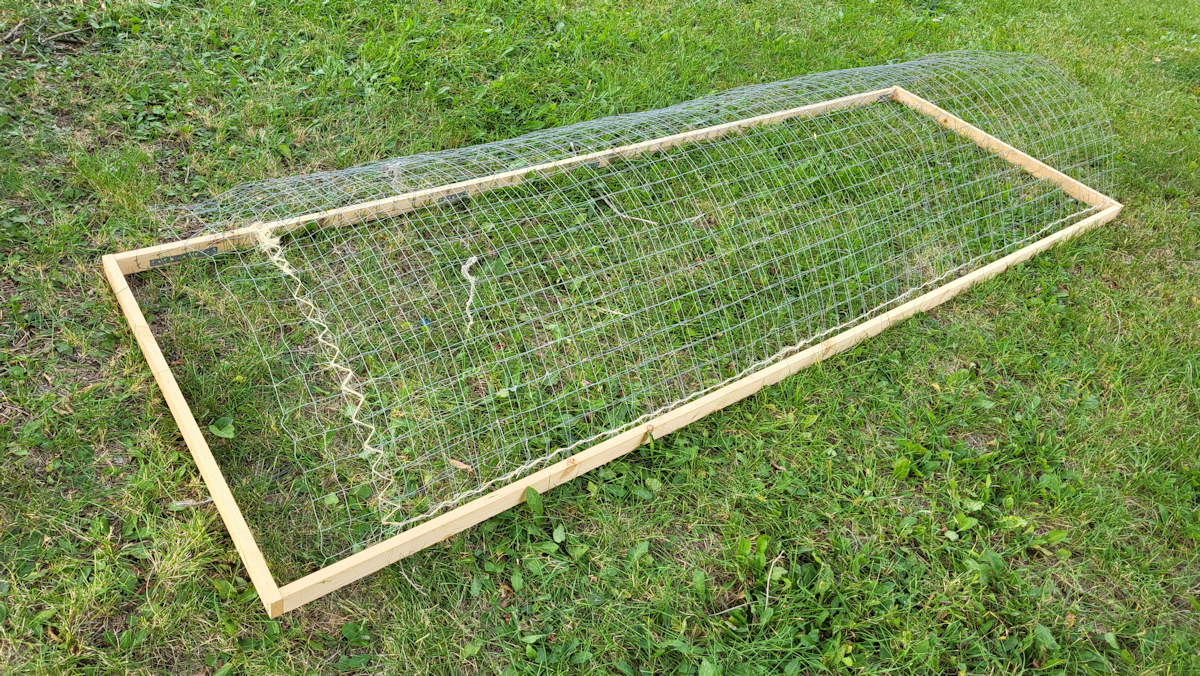
The last frame for a raised bed cover now has wire on it.
Of course, it was more of a pain than expected.
The wire I used was 2″ hardware cloth salvaged from the old squash tunnel. The roll is 4′ wide, so I could just use the length, rather than cutting strips, like I had to with the fence wire and the plastic hardware cloth. I was going to cut it to 9′ until I realized I had close to double that, so I folded it almost in half.
Putting the first side on was fairly easy. I used the steel strips again, as they are a lot more secure. In the past, for wire like this, we used staples, and there’s no way staples would hold this in place while being manhandled on and off raised beds.. The only real hard part of attaching the first side was having The Phantom suddenly decide she absolutely had to have attention! She’s been making strange lately, and I thought she was getting more feral, but not today!
Also, as she rolled around, I could see a single active nip. I had been wondering, as she never looked pregnant, if perhaps she were infertile, but she does have a single kitten somewhere.
Speaking of kittens, they were all over the place, and more of them are showing red and/or sticky eyes. None as bad as the two we regularly bring inside to wash their eyes, thankfully, but my goodness, it’s bad this year!
Anyhow… where was I? Oh, yes… the wire.
Once the first side was attached, getting the second side done was a real pain. The two layers of wire mesh kept getting stuck on each other and misaligning. After fighting with is for about half an hour, at least, I finally got some jute twine and wrapped the length of it near one edge, from the fold to where one end was a few inches shorter than the other, then secured the short end as well. Only then could I finally attach the other side to the frame.
Unfortunately, I started to run low on the short screws I was using the attach the steel strips. I had just enough to secure the length, but only on the bottom edges. What it needs is more of them to secure the wire to the top edges, to keep it from pulling away.
So… more of that size of screw is on my shopping list. I did try to secure it a bit better using the staple gun, but didn’t finish. Even with the steel straps, they will easily pop out.
Aside from securing the wire to the frame some more, I am thinking it will probably need more support. The wire can hold itself up, but it bends very easily. It would take next to nothing to crush the arch. If a cat decided to jump on it or something, it would collapse completely. I think I have a couple more lengths of the PEX pipe, but I would want at least 4 preferably 5, to support the wire.
So the cover is done to the point that it can be used, but needs a bit more to make it stronger.
For this one, I’m glad I decided to fold the hardware cloth in half rather than cut it too length. If it were 1″ squares or less, it would be stronger, but with 2″ squares, it’s relatively flimsy. It will be okay when we use other strips of the 2″ hardware cloth on the box frame to protect the bed with the popcorn in it, but not so much as a self supporting arch.
So, here are our experimental results.
The first one we built was the box cover, designed specifically to go over taller things like the Tom Thumb popcorn. It is intended to support wire, shade cloth, etc., as needed. It is probably the most structurally sound of the frames we made. It is unlikely we will need to build more like this, simply because things we grow that are taller are more likely to need other types of support or protection.
I can see two problems with this design. 1) Once the sides are wrapped in wire, there is basically no way to tend the bed without removing the entire cover, and 2) for anything needing a cover this tall, removing it would require 2 people, to avoid damage. If, however, it were wrapped in fabric mesh or netting, it could be done in such a way that the netting could be lifted for access. Fabric won’t keep the racoons out, though.
Conclusion: I’m happy with it. This frame is worth making again, if we ever need to protect tall plants, but there would be little need for more, based on our current garden needs.
The second one used fence wire we found in a shed. The fence wire turned out to have varying sizes of openings, from 6″ square to 6″ x 3″ The roll was just over 3′ wide, so we had to cut 3 strips to fit into the frame, with overlaps. I went with 5′ long strips to create a high arch, which worked out well for the bush beans.
The first problem we found was with how the vertical and horizontal wires were joined. Each intersection has a wire wrap, adding significant thickness to those spots. We were using U nails to attach them, hammering them diagonally over the joins to secure them. Between the nails themselves and the thickness, this was far more difficult than it should have been.
The wire itself was stiff enough that a couple of screws snapped in the frame’s corners, which resulted in them starting to rotate. Thankfully, we had a couple of scrap 9′ lengths that cut wonky, and were able to add those to the inside of the frame, sandwiching the fence wire in between. That also strengthened and secured the corners.
We currently have the frame over our bush beans, with netting on top, to protect the beans from critters. The wire wraps at each intersection is a problem, as the net catches on them, but aside from that, it’s ideal. The net strip is wide enough that I’ve even been able to secure the edges with ground staples into the soil under the frame, too.
Conclusion: I’m really happy with this one. I’m able to lift the netting and harvest through the fence wire without having to move the frame. If I can find 6″, or even 4″, square welded wire fencing, instead of the wrapped wire, that’s what I would use to make the majority of future covers. It’s strong enough to support itself. I could probably use 6′ lengths for an even higher arch, and it could still support itself, plus any shade cloth, insect netting, greenhouse plastic, etc. Though we would not use U nails again, and go with the steel strapping, I would still be good with that double thickness of wood on the long sides, which makes the whole thing much more structurally stable, while also securing the wire. In the future, I can see most of any new covers we make to be like this one, with a few modifications.
The third one is the one with the “rigid plastic” hardware cloth. Which turned out to not be very rigid at all. This is when I remembered I had the steel strapping and used that to secure the mesh. After the first hoops I tried to use, snapped screws in all the corners, I had to add extra pieces of wood inside the short ends. Switching to PEX pipe hoops worked much better, and the steel strapping worked well to secure the hoops, too.
The plastic hardware cloth rolls came in 3′ widths, so it took three lengths to cover the frame, which then had to be lashed together. I went with 4′ lengths this time, for a lower arch compared to the fence wire cover. Once the hoops were snugged in place and trimmed to size, I used garden twist ties to secure them to the mesh and prevent them from being pushed sideways.
With the outward pressure of the hoops, this frame had a couple of screw eyes added to the middle of each long side and cord strung across, to keep the sides from bowing outwards.
Conclusion: This frame is definitely the most aesthetically pleasing of them all. It’s easy to move around with 1 person, and the lower arch is good for shorter crops. I would not, however, use this plastic hardware cloth again. It creates too much shade. Which is great if I have it over a bed of lettuce, but obviously, it wouldn’t be good to use over something that needs full sun. I also would rather have the flexibility of using whatever cover I need for a particular bed. I want these frames to be interchangeable as possible, whether a bed needs shade cloth, greenhouse plastic, or frost protection. If I need to use hoops for support again, the PEX pipe is definitely the way to go.
Last of all is the frame done today, so I’ll just go straight to the conclusion:
Conclusion: As this one didn’t need any extra wood added to the sides or ends, it is the least structurally secure, but that’s an easy fix. I would not use this 2″ hardware cloth again, though, for the same reason I wouldn’t use chicken wire. It’s just not strong enough, and bends too easily, even doubled up.. It will also need support hoops added at some point. It’ll be used, but that’s about it.
As we build more high raised beds, we will also build more covers Experimenting with the different materials has shown me a lot of what works best for our needs – and what to avoid! Armed with this information, I’ll know what to keep an eye out for and pick up as the budget allows, to have on hand for when we have more beds to protect!
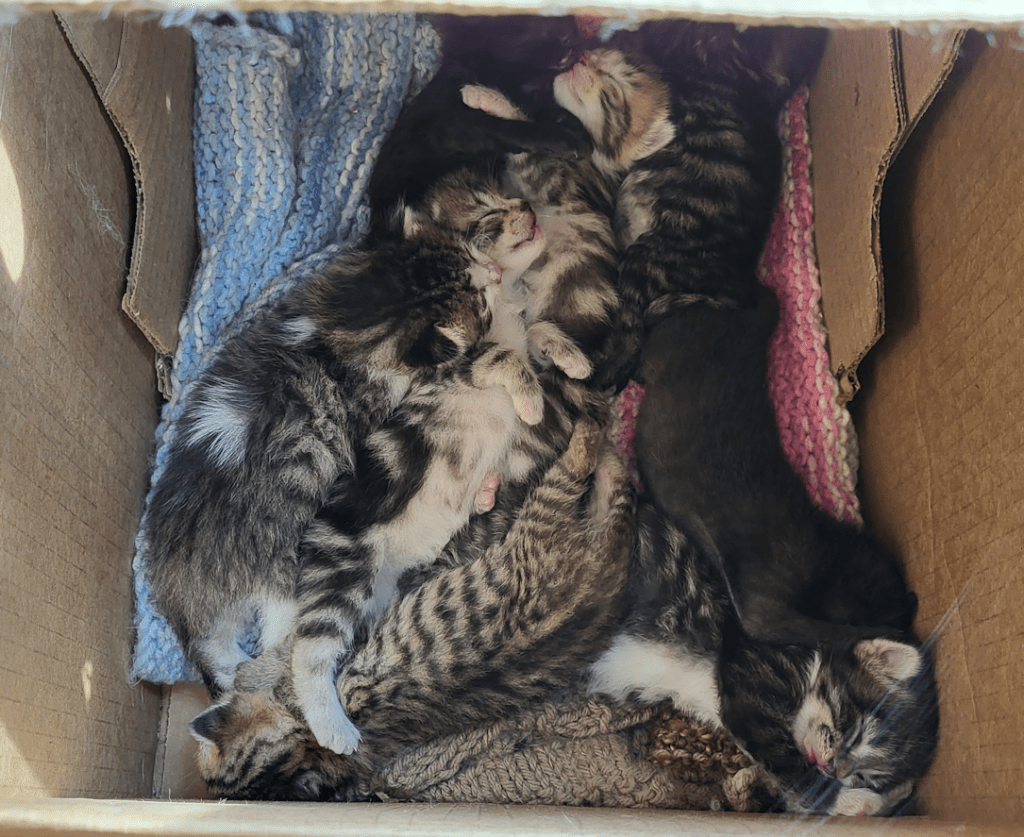
When heading out earlier, I carefully checked on the babies, and they seemed very comfortable in their new nest!
I’ve seen the mama around, but not in the sun room. While she was willing to put up with me when I put the evening kibble out, once she’d eaten, she kept her distance. I was concerned when I started hearing the kittens from the sun room, but she was going in the other direction, so I made a wide circle around her to use the main doors, in hopes she would go towards the sun room to get away from me but, instead, she went up the sidewalk to the gate. So I went inside to not disturb her, and hope that she hears her kittens and tends to them. Earlier, I even made sure to leave little piles of kibble around where the nest is, to treat her when she does.
This is what I started working on while outside.
What a flippin’ pain to attach the fence wire to the frame! I was using U nails (aka: staples) to attach them, but they were the biggest problem. They were poorly cut, and the ends were often jagged instead of pointed. There was really nothing we could do about that, either. I also had to hammer most of them to be more closed, so that they wouldn’t splay while being hammered into the wood.
I tacked a section of fence wire to the ends first, the added the third section to the middle, so that it overlapped the end pieces evenly. Once that was tacked in place, I went back and added a U nail over every joint in the wire, with my daughter holding the frame steady and passing me the best U nails out of the bag that she could find. I would not be at all surprised if the U nails simply popped right out.
I was very frustrated with them.
Ideally, I would strength the whole thing by sandwiching the fence wire between another piece of wood, but the horizontal and vertical pieces of fence wire are joined by one being wrapped several times over the other, making each join triple the thickness of the wire on its own. It would still work, but there would be a larger gap between the boards than I would want. It would certainly make the corners more stable, though. Hmm… We do still have a couple of 12′ pieces that were cut wonky. Maybe I could experiment and try it with just one frame.
By the time I was hammering the last of the U nails in, it was starting to rain again, so we left the other half for another time.
Once inside, I was going to start supper, but the girls took that over and are working on it as I write this. We did decide that there really wasn’t enough of the potatoes I picked earlier for the four of us – we do like our potatoes! – so I went out and harvested some of the Red Thumb potatoes, too.
That colour is amazing! These are red all the way through, too.
After passing them on to my daughters to prepare, I went back out and harvested some fresh dill leaves from the self seeded dill we have along the edge of the old kitchen garden, to go with the new potatoes. When the old kitchen garden is set up to be more of an herb garden, we plan to include a variety of dill that is grown more for its leaves than for the seed heads, since that’s how we use it the most. We have another variety that is more for pickling, and we plan to sow those somewhere further away, where we don’t mind them self seeding and can treat them as a perennial.
I’m really looking forward to trying these potato varieties!
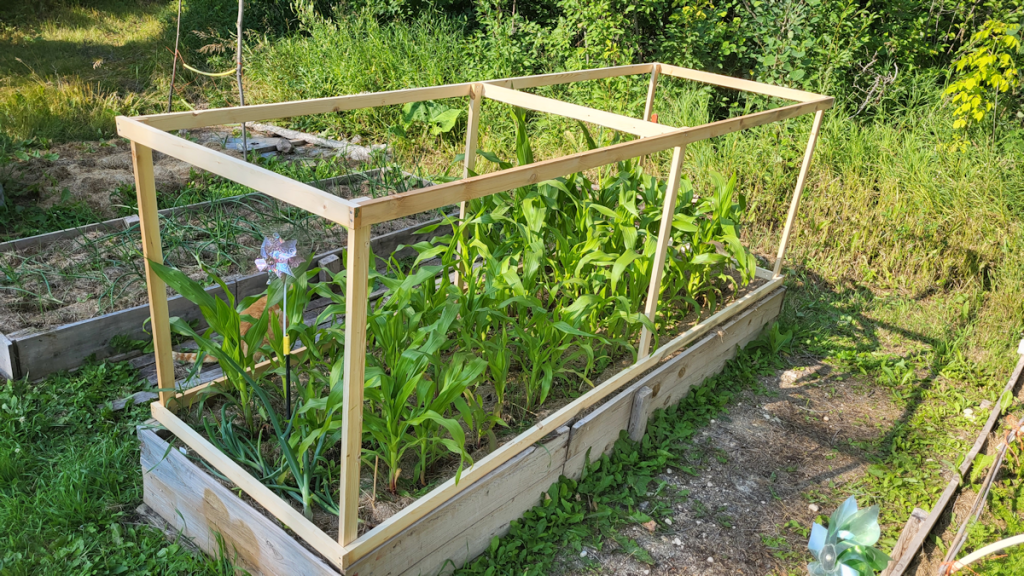
This afternoon, my daughter and I were able to get the first raised bed cover done! The frame, at least. We worked on the one intended to go over the popcorn first, as it was the most involved.
Here is the finished product!
It is now ready to support whatever cover material we choose for it. The question is whether or not I will be attaching something to it permanently, or if I want to attach something in such a way that we can take it off and attach something different, later.
Considering that this bed will need protection from deer and racoons, something permanent would be most logical. I have enough chicken wire to wrap around the sides, at least, but racoons will tear right through that. I might have to pick up some 1/2 inch hardware cloth. Until then, however, we could probably still put the chicken wire around it temporarily.
As you can see, the cover doesn’t fit exactly over the raised bed. That was expected. The bed itself has become wonky over time. Not only have the sides been bowing out, but some of the boards are warping. One warped board you can see in the photo has bent outwards enough, it actually snapped one of the screws that was holding it to the 2×4 join.
We will have to find a way to lock the cover onto the walls of the bed, too, or it could simply get knocked right off by a determined critter.
I’m pleased with how it turned out. The frame itself is lightweight, but sturdy. It can be carried by one person, though having two people is preferable, if only to lessen the chance of the frame being twisted or dragged.
We cut extra pieces when prepping the boards, and there are enough to make 3 more frames. I will be away tomorrow afternoon with my mother, but my daughter might be able to get it done while I’m out. They will be much easier, since it’s just the basic rectangle, exactly the same as the bottom part of the frame in the photo above. The only difference is that I plan to add eye hooks to the middles inside the long sides and use cord to keep it from bowing out. I’m still debating whether they will need corner braces. That will partly depend on how they hold up to having the fence wire attached permanently to them. I would rather add them after the fence wire is attached, anyhow. It will be easier to add braces with the wire in place, then add the wire with the braces in place. Since I have to go to the hardware store, anyhow, I will try to remember to look at metal corner braces as a possible alternative.
Today, after many, many delays, we finally got some progress on those raised bed covers we need to build!
My daughter and I set up the folding table we made using the legs we found when cleaning up the new basement, and a section of 3/4 plywood found in the pump shack. The hard part was finding level enough ground for it, and still be close to the outside outlet. We ended up putting it almost against the house, and that’s where we set up the miter saw. Then we moved the swing bench that’s been sitting on the sidewalk block patio under the kitchen window for the past while, so we could set up the table saw close enough to plug it in without an extension cord.
The first thing we tried to do was cut the 12ft long 1″x4″ boards in half, lengthwise. My daughter, sweetheart that she is, found where the saw blade could be adjusted up and down. My husband and I had tried everything to raise that blade and finally concluded it couldn’t be raised. Turns out, it was just badly rusted and that’s why it wasn’t moving. !! I wonder how many years it sat in that shed before I found it?
The first two boards we cut in half did not go well! My daughter was feeding the board from one side while I supported it from the other, but it just did not want to stay against the guide. We ended up with some wobbly cuts! So we cut the others shorter first, then cut them in half. We measured the beds first to confirm the dimensions. The side boards total 9′ long, but then there’s the width of the end boards; I forgot I’d attached those to the ends of the side boards, and not to the insides. That made the beds 9′ 2″ long. The end boards were 3′ 1/4″ long.
So we will be cutting 9′ and 3′ for the cover frames.
The boards were exactly 12′ and 1/4″ long, so we just measured off the 9′ and cut it. The cuts take off a fraction of an inch, so the remaining sections should be almost exactly the right length for the short ends.
It was much, much easier to cut the shorter lengths in half on the table saw!
All the pieces are now cut. The 3′ lengths are in the front, then the 9′ lengths. In the back is one of the two first 12′ boards we cut in half, with the wonky cuts. The other one was used to cut more 3′ lengths, since being a bit wonky won’t be an issue for some parts of the build.
There is also one board at the top of the photo that was set aside because it has damage on it in two places. We will still be able to use the undamaged parts at some point.
As for the plans, I sketched what I had in mind out for my daughter.
We will be building four 9’x3′ frames, but two of them will be used in one cover. The Tom Thumb corn is going to need taller protection from deer, so two frames will be joined by 3′ vertical supports. One more support will be added across the top in the middle, to keep it from bowing outwards. I also plan to add screw eyes inside the middles and tie a cord across, to keep the sides from bowing out. A cord that close to ground level will be less in the way of growing plants.
At this point, we could just put a net around it, though if we wanted this over a bed with taller plants in it, we could potentially add hoops to the top for extra height.
That box frame is the one we need to get done first, as the corn is most at risk for getting eaten. Between the deer and the racoons, it’s going to become an issue in the near future! If we want to keep racoons out, though, we’ll have to use hardware cloth and find a way to secure the cover to the frame, so they don’t just knock it off.
The other two frames will have rounded tops. We have some wire fencing with 4″ squares that I plan to use with one of them, making a slightly higher cover. The fence wire can then support things like netting, plastic or shade cloth, as needed.
With the other, I was thinking of using the hoops that are currently still over the carrot bed, but… now that I’m looking at the plans, I realized we have enough of that wire fencing to use on both frames. We could make them different heights, for different needs. A shorter one, for example, would be handy for shorter produce, or to create a mini greenhouse over newly sown beds. A taller one would be great for plants that grow higher, but not high enough to need that box cover we’ll be putting over the corn.
As we build more high raised beds, the plan is to stick to the 9’x3′ size, so that these covers can be used interchangeably on any of them. We’re doing three covers for now. One of them should be useable on the high raised bed we have now, which currently has hoops to protect the beans from the deer. The box bed with the red onions does not really need a cover, except maybe to keep the cats from lying in it, or the birds from digging in the mulch. Over time, we plan to build enough covers for all the raised beds we make.
As for cutting the pieces, I was really happy. We will definitely need to get a new table saw, as this one was having issues. It will do for now, though. What I was really excited about was the miter saw. I bought it at a garage sale, and this is the first time we’ve tried to use it. Of course, it didn’t come with an instruction manual! Which is fine. It’s easy enough to figure out.
Up until now, I’ve been using a hand saw to make cross cuts. No matter how careful I am, I always end up making crooked cuts, and there are always those little bits of wood that break before the saw can cut them that need to be sanded. So excited to get beautiful clean cuts! Plus, the speed of it was fabulous!
Once the cutting was done, I realized we would not have enough screws to assemble them all, so we decided to go into town and get more. The table and miter saws got put back into the sun room, and the cut pieces went onto the table we used for the miter saw. We were getting hints of rain, and we didn’t want to take a chance. It’s a good thing we did, because there was a downpour while we were out!
When we got to the hardware store, we drove around the block a couple of times but could find no parking, so my daughter offered to buy us lunch! By the time we were done, things were no longer so busy, and I was able to park and run in.
Before we left home, I took a pair of calipers to the water pipe leading from the house to the garden that needs to be repaired. It’s a 1 inch pipe. After finding the screws we needed at the hardware store, I went looking for a flexible PVC coupling with metal clamps. The smallest size they had was 1 3/4″. That would leave too big of a gap for the clamps to be able to seal it on a 1 inch pipe. I talked to an employee, and showed her the picture I took of the calipers on the water pipe, which also showed the crack in the pipe very clearly. She tried to find something else that would work, but there wasn’t anything they had. In the end, she recommended I talk to a plumber.
What I will most likely do is go to the hardware store in my mother’s town, which is where I first had the flexible coupling recommended as a possible fix. They are a bigger store with a larger plumbing section, and may have a smaller size coupling in stock. If worse comes to worse, we can order them online. In fact, I’ve already found some sized specifically to fit on 1″ pipe.
As you can tell, I’m really hoping to avoid having to dig up and replace the entire length of pipe!
By the time we got home, the downpour my other daughter told us about was done! I don’t know if it’ll be dry enough for us to start assembling the first cover today. We’re supposed to get more rain, too.
This is where I really wish the storage shed wasn’t full of my parents’ stuff, that my mother insists we keep and is constantly afraid someone might come in and steal. As if anyone would be interested in the bags and bags of their old clothes, boxes and boxes of household stuff, or their old furniture. My late brother had used that building as a workshop, but that was more than 10 years ago. We never had a chance to even see what all was still in there, as my brother and his wife had already started moving my parent’s things into there before we moved in, and it was being used as storage for other things even before then.
So we make do with working outside, when the weather allows!
Well, this project has been delayed repeated for about a month now. One more day won’t hurt, if it comes to that!
With last night’s storm, I was happy to see the tree my brother cut down that got hung up on other trees had fallen closer to the ground. It’s not going to drop any further, though. It’s now hung up between the trunks of a group of trees. We can, at least, reach most of it better, though, so we’ll be able to work on it eventually.
With today’s slightly cooler weather and a nice, clear day, I started working on getting those dead spruce trees my brother cut down for me, out of the bushes.
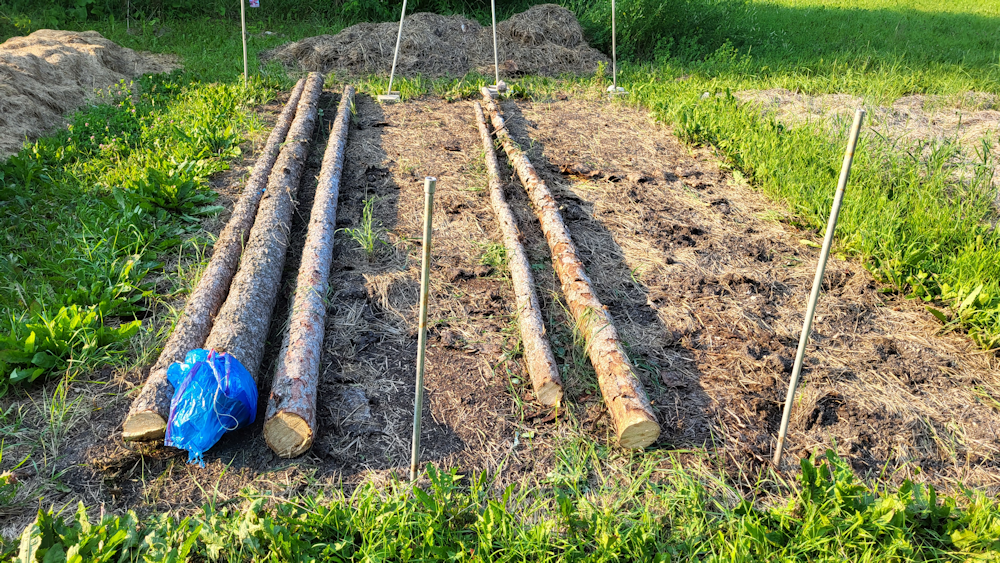
I took photos and will eventually put it all together in a video but, for now, this is what I managed to get done today.
Gosh. That doesn’t look like much, now that it’s done! 😄 It did, however, take a LOT of prep work before these logs could finally be dragged over.
The two trees that were on the ground were almost completely hidden by underbrush. I used the weed trimmer to clear a path to them first, then did a bit around the trees themselves. There were too many hidden branches, though, so I had to shift gears.
The top of the first tree extended a lot more than I thought it did. I used the little mini-chainsaw pruner to clear the branches, then remove the most crooked section of the top, before working my way down the trunk. I had the wagon nearby to put the branches in, and made a few trips to the branch pile near the fire pit, cleaning up as I went along.
Once I got it clear enough, I was able to pull the entire trunk out from under the stuck tree, then continue removing a few more branch stubs. Next, I measured 18 feet from the thick end of the trunk, and used the electric chain saw to cut it. I used a rope to drag the top part through the trees and into the garden, which was harder than it should have been. I neglected to roll it over and check it, first. There turned out to be a stub of a broken branch at the end, acting like an anchor!
Needless to say, I made sure to check the 18′ piece before I dragged that away, too!
The top of the tree is around 16-17′ long. Too short and thin to make the long walls of the beds, but it will do nicely, cut into 4′ lengths, to create the end walls.
The other tree that was flat on the ground was looking very crooked – spruces tend to be like that at their tops – and I thought it was shorter than the first one. As I cleared more dead branches and tried pulling it out from under the stuck tree trunk, I realized it was a lot longer, and thicker! In fact, when I finished clearing the branches and measured out 18′ from the end, I was still at the far side of the stuck tree! It was simply too big to pull out first, like I could with the first tree.
The top was moved first. I hadn’t bothered to measure it, since I figured it would be too short, but when I dragged it between the posts that are 18′ apart, it almost reached, end to end! The thinner top, though is still pretty crooked, so it will likely not be used as a side wall.
Then it was time to drag out the rest of it. I rolled it around to cut away any branch stubs that might cause problems, but the trunk was quite a bit larger and heavier, and getting caught on things. While I was working, I was constantly finding very old and rotting branches and pieces of tree trunks hidden in the undergrowth, that have clearly been there for many years. They made for a rough surface to drag on. I ended up tying a plastic bag around the end of the trunk, to reduce friction. It helped a lot but, by then, I was getting pretty hot and tired, so I got a daughter to pause making supper to come help me drag it out.
While working on this tree trunk, I found the fourth tree my brother had cut down. It is another big one, and he felled it in the opposite direction. It’s almost completely hidden, not just by undergrown, but other trees, and I’m honestly not sure how I’m going to get at it.
As for the tree that’s stuck, that one is even bigger. This is one that’s going to have the thickest 10′ cut off and taken to where we plan to build the shelter for the outdoor kitchen we plan to build. These trunks are far too thick to use for raised beds, as they would take up a lot of growing space. Rather than cut them in half or something, we will instead use them as vertical supports for the shelter.
But I was not about to work on either of those logs, today.
I started to put things away, but I really wasn’t happy with having done only two trees. Especially when there were other thinner dead trees, right there.
Yup. I ended up cutting down another tree.
Gosh, that thing felt so light, after fighting with the big one! Even though I used a hinge cut, it still fell off to one side and got a bit hung up on other trees. It was easy to get loose. I just put the rope around the trunk near the stump and pulled it until it fell the rest of the way. It also fell across the stuck tree, which made it much easier to work around.
Then it was just a matter of clearing a few branches – there weren’t very many at the bottom half – measuring out and cutting 18′ and dragging it out.
The top of the tree is resting on top of undergrowth, and I left it there for now. I am not sure how much of it will be useable. It won’t be useable for the walls on the raised bed, but it might be useful in other ways.
I’m still going to have to cut down one more smaller tree for this bed. There’s one that looks like it’s similar in girth as the log with the plastic bag on the end. I’m planning to make these beds 2 logs high, but I want the bottom logs to be the bigger, thicker ones.
This time I have the draw knife, so I want to de-bark the logs and cut away any remaining branch nubs, lumps and bumps. I didn’t do that for the high raised bed, and I can see that it would be much better to do it than not.
I want to get at least one bed built, with the vertical trellis supports in place, before cutting down more trees for the second one. Ideally, I’d put in the vertical supports for both beds, along with the horizontal supports to make a trellis tunnel, right from the start, but we’re going to have to work on things piecemeal for now. Plus, we will be building at least one, probably two, more of these, so this one is the learning experience!
I’m happy with the progress, and I’m paying for it now, but I’m actually not having as much trouble as I’ve had in the past. Of course, tomorrow might prove me wrong, but it seems my body is finally starting to handle things better. Yes, I’m stiff, my left knee tried to make an escape, and a thigh tried to go into a conniption fit, but I’ve certainly had far worse pain, stiffness and joint instability after far less work.
It just feels so good to finally be able to work on this!
It’s so bright out right now, I didn’t realize it’s past 9pm, and I haven’t done a blog post yet!
I’m tired.
A good tired!
I finally got the chainsaw out and cut down trees that will be used to build our trellis tunnel.
I started out doing some clean up, first. Several of the apple trees that were discovered when I first cleared this area were dead or partly dead. I cut away the dead parts, which left only a couple of spindly trees.
Then I dropped a poplar on one of them!
It wasn’t supposed to work out that way. The tree was actually falling exactly where I meant it to. Then some branches got hung up on another poplar, which just kept bending and bending until the tree I cut down rolled off, directly on top of the apple tree!
I can’t say it’s a loss, though. As far as I know, these trees have never produced fruit, because of where they are. My mother says she planted them, but they were whatever crab apple seedling she found, so it’s unlikely any fruit they produced would even be edible. My mother had no understanding of how apples need to be grafted, not grown from seed, until I explained it to her. To her, it was all about them being “free”. I know my dad grafted apple trees but most of those died, and only the suckers remain.
Anyhow.
Cleaning things up opened the space to get at the trees I was after. Some of them could only fall in one direction – onto the fence! The fence is already breaking apart, so I wasn’t too worried. It actually handled having trees drop on it several times, surprisingly well! The power line that runs from the garage to the outlet on a fence post I was using had a lot of slack, so there was no risk to it.
A couple of the trees that fell over the fence had to have their trunks cut into two shorter pieces so I could get them free of the fence. I made sure to cut them in such a way that the straightest parts of the trunk were still at a useable length for both. Altogether, I’ve now got about a dozen logs, most of which are long enough that I can get at least a couple of lengths for vertical supports out of them.
While cutting down select poplars, I was also able to finally cut up and removed a dead, rotten tree that had fallen three years ago. I needed to clear it to access the last tree I wanted to cut down. While it was too rotten to be useable for building something, it was still solid enough that the wood can be used as fire pit fuel. 🔥🌭 I was even able to remove some of the little stumps I’d left all over the place, waiting until I had the tools to cut them to ground level. I kept them high, so that they could be seen and avoided, though I still found myself almost tripping over some of the shorter ones!
It was 24C/75F when I finally had to stop – and we were still expected to get warmer! The next step for the logs will be to cut them to length for the vertical supports on the trellis tunnel, then drag them over to where the tunnel will be built. We also need to cut down some of the thinner dead spruce trees, which will be used to form mid-height raised beds at the bases of the trellis tunnel. Once we have the materials, hopefully the build will go quickly.
I gotta tell ya, by the time I was dragging that last tree over to the pile, then cleaning up, I was moving real slow! I was certainly glad I remembered to bring a water bottle out with me. Getting dehydrated in this heat would not have been good.
Tomorrow is supposed to be a cooler day, but we’re also supposed to get some rain, so we’ll see how much I’ll be able to get done while using an electric chain saw.
In other things, the transplanted squash and gourds seem to be handling their transition well. Even the Sweet Chocolate peppers are showing no signs of transplant shock at all! That’s quite encouraging. If the weather holds, I might start transplanting out the biggest, oldest tomatoes. The beds they’ll be going into still need preparation, though, so we’ll see. Ultimately, it all depends on the weather.
I think some pain killers and an early bed time are in order, now!
Well, today has turned out to be a pretty miserable day, weather wise. It’s 9C/48F right now – as warm as we’re going to get today – but the “feels like” is at 6C/44F. After the heat we’ve had in the last while, this is sweater weather. A few weeks ago, it would have been t-shirt weather! 😄
There was some wind, but the direction changed, so I felt I could bring the transplants out for a few hours. They need to get used to the chill, too, before getting in the ground.
I had intended to take down some trees to use to build our trellis tunnel, and was planning to haul out the electric chainsaw and an extension cord. We do have a power outlet on the fence along the road that I could hook up to. There was, however, a constant threat of rain. The trees I singled out are not very large, but straight and tall. I could take them down with hand saws, but I really wasn’t up to that.
So, I worked to solve a problem, instead.
This one.
This is the bed the shallots were transplanted into.
Which the cats promptly started to lie on.
I put the largest of the old window screens we use for things like curing onions, etc. in the fall to cover it. It’s not quite bit enough, and I kept having to put it at more of an angle because, of course, the cats still went on top of it. Sometimes, I’d find one corner pressed down inside the bed. No damage to the shallots, but that’s just been luck, so far.
So this bed needs protection from the cats, with a decent amount of height to it. I rifled through some material we used to make covers for the long, low raised beds in the main garden area for wood. Those frames had started to break apart over the winter, but I was able to take them apart, and some of the wood was still useable. I brought over three lengths, which you can see in the background of the photo.
This bed is 4′ x 2′ in size, and the boards I brought over were 8′ long, so I was able to cut one in half for the sides of a frame, choosing the board with the least damage. From a second board, I was able to cut the end pieces, which are 2′, minus the thickness of two boards. Nothing is exact, so after marking 2′, I used the edges of the boards to mark of the actual length needed.
This would have been a good day to use the miter saw I got at the garage sale awhile back, but I would have had to bring it outside to use it, and I didn’t want to risk it getting rained on.
I took progress photos and will probably make a video of the process when it’s done, but I had to stop before it was finished. This is what it looks like, now.
The chicken wire and hula hoop pieces were salvaged from the old frames. You can also see that I used small pieces of wood to reinforce the corners, using 3″ long pieces of wood. I had planned to just nail them in place, but didn’t have good nails for it (I’ve never seen the tip of a nail bend like that before… 😲), so I had to use screws for those, too. I did break out the drill to make pilot holes. Thankfully, the rain held off while I was using it.
Gooby really wanted attention while I was working. Not good when using cutting implements or power tools!
To finish it off, I need to add chicken wire to the ends, plus add a support across the top – because you just know that a cat will try to climb or jump on it! I’m still debating whether I want to add a third hoop in the middle. For such a small frame I normally wouldn’t bother, but with the cats… it might just be worth it.
I had to stop because it finally started to rain too much to stay out in it. I had already brought the transplants back into the sun room.
What I’ve done here is basically a miniature version of what I want to build for the box beds the carrots and spinach are planted in, so in a way, this is a test run. Doing the ends is going to be a finicky, to work around the curves. Chicken wire is nice and flexible, at least.
So for now, the shallots are still not really protected, since the cats can just walk right through the open ends, but with the weather the way it is right now, I think they’re more likely to be hiding out in various warm shelters. This is the coldest it’s been outside since they were kicked out of the sun room, so we could use it as a greenhouse.
I don’t know how long this cover will last, but I used the least damaged wood and made sure to reinforce the frame at the corners. Given the small size, it has a pretty good chance of lasting a few years, I think.
The one last thing I’ll need to figure out is the best way to secure it to the frame. I don’t need to latch it or anything like that. I just need to make sure it doesn’t get pushed off. I had considered making the frame sized to fit inside the logs, but with their uneven surfaces and dimensions, I decided against that. Plus, having contact with the soil will make the wood rot faster, and it’s old and weathered enough as it is. I might take advantage of those corner braces and make “legs” that extend down the outside of the bed, so that if something does push against it, it won’t move more than a little bit.
But that can wait until later. For now, it really needs those ends closed off!









 The Re-Farmer