Makin hay, while the sun shines!

Or, in my case today, raking leaves and planting wildflowers!

This afternoon, we reached our expected a high of 8C/46F, with some lovely sunshine and NO high winds!

What a difference that makes.

We did get some rain this morning, but by the time I headed out after lunch, you couldn’t tell we’d had any.

My first job of the day was to rake up some leaves to mulch the wattle weave bed.

Not all of it. Just where the wild strawberries and herbs are growing.

This was the first time I used the pair of hand rakes my brother and his wife gave me. Now that they’ve sold their property, they are living in a townhouse, and have no need for gardening tools anymore. I don’t think these were ever used before!

They work really, really well! The only complaint I could have about them is the straps for the hands are on the small side. At least for broad simian hands like mine! 😄

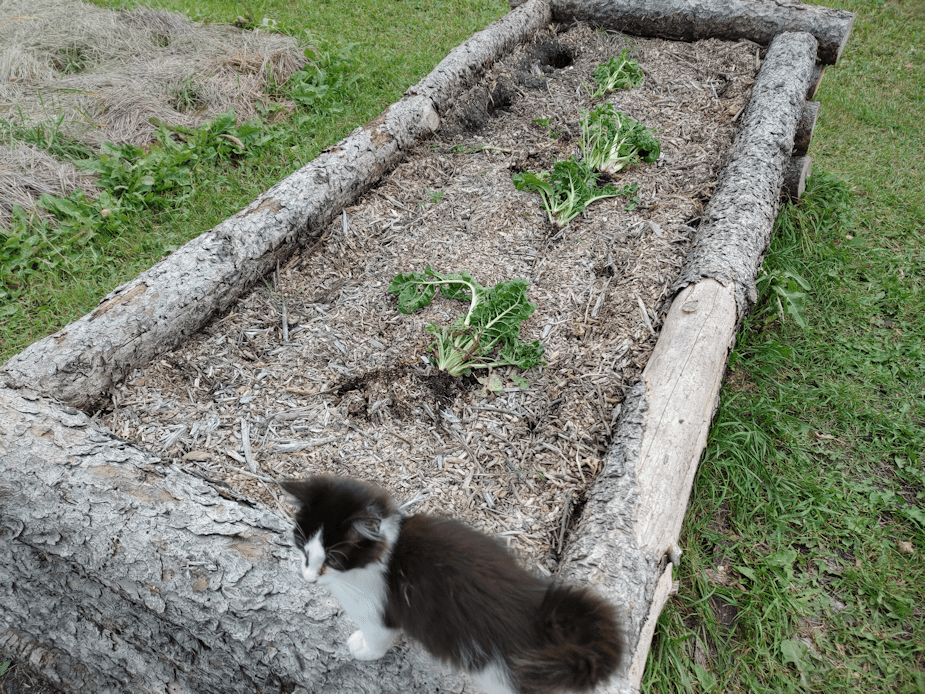
Oh, gosh. I just realized what I caught a kitten doing in the other mulched bed in that first photo.

*sigh*

The next photo is the packaging for the hand rakes, though Instagram cut part of it off, even though I have it set to “original size” on the slideshow. The website says uncleweiner.com (not an affiliate link). A rather unfortunate name, but a good product!

Oh… gosh. They are located in Prince Albert. That’s… double unfortunate! 😂😂😂

In the last photo, you can see I had a helper when it came to mulching the Albion Everbearing strawberries in the main garden area. I put the chicken wire back over it to keep the leaves from being blown away but, as you can see, it doesn’t lie flat on the strawberry bed. Little Magda quite enjoyed going under there!

That done, I got another wagon load of leaves and started on the patch that’s been covered by the insulated tarp all summer.

After removing the old T posts and a board I’d put around the edges, to keep it from blowing away, I peeled off the tarp. That was unexpectedly difficult. All along the edges, Creeping Charlie had started growing on top of it. It turns out that some of them set their roots into, or even through, the tarp!

So the first thing I did was drag the tarp out to the front yard, where I have one hose still set up. The tarp was spread out to its full size. After hosing it down for a while, I went over it with a stiff bristle broom to get rid of the bigger debris, then used the hose to pressure wash it as best I could. It then got another scrubbing with the broom and a rinse.

For now, I’ve left it out where it is, to dry off as much as possible. Unfortunately, there are some holes in it. Some are tears from winds that happened a couple of years ago. Others were caused by weed roots pushing their way through and into the insulation layer! So parts of it now have water on the inside of the tarp. Not much I can do about that. I don’t have tarp tape, but I do have clear Gorilla tape, so I hope to at least patch up the bigger holes – if they are dry enough! Eventually, the other side will need to be cleaned, too.

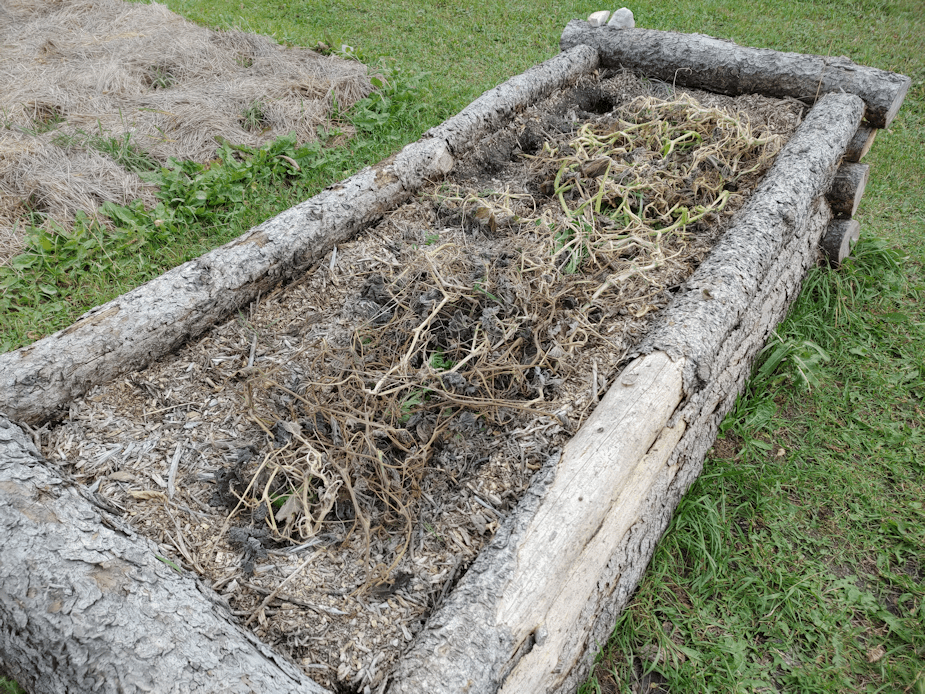
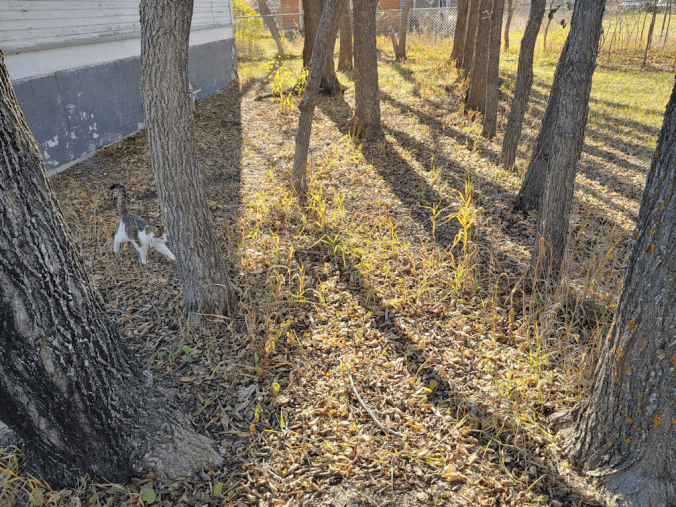
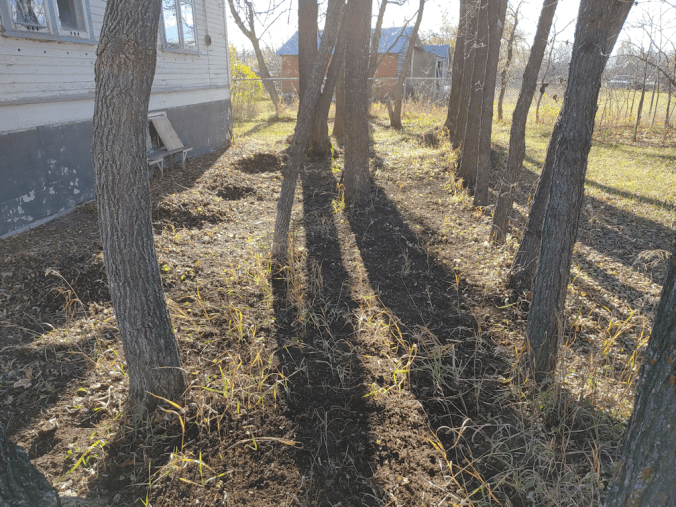
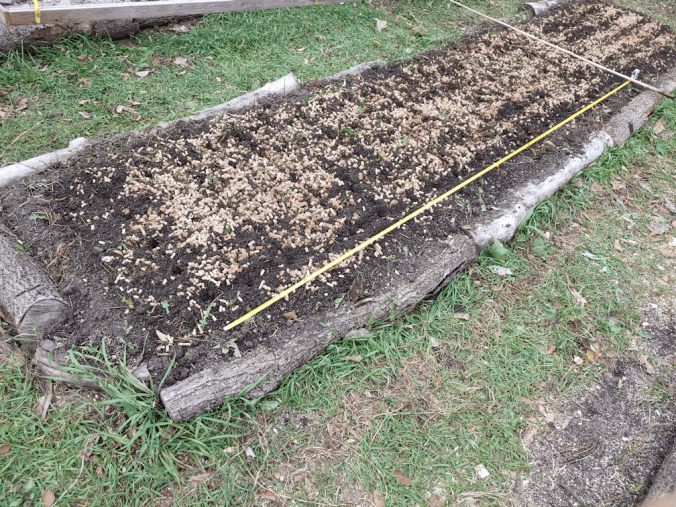
That done as much as could be for now, it was back to the patch of soil it covered. In the second picture, you can see how it looked after the tarp was removed. Most of it does look dead but, along the edges, you can see white lines of roots extending into the what will be the growing area.

The soil needed to be loosened for the seeds, so I used the landscaping rake for that – and promptly found a roll of wire, buried in the soil! When we first moved here, this is where most of the chimney blocks and all the ceramic flues had been stacked, along with bricks and other odd things, and even garbage. We cleaned it up, but clearly missed this piece of wire!

The entire area got raked from the inside out, so as to pull the living roots out of the growing area, while also loosening the soil for the seeds.

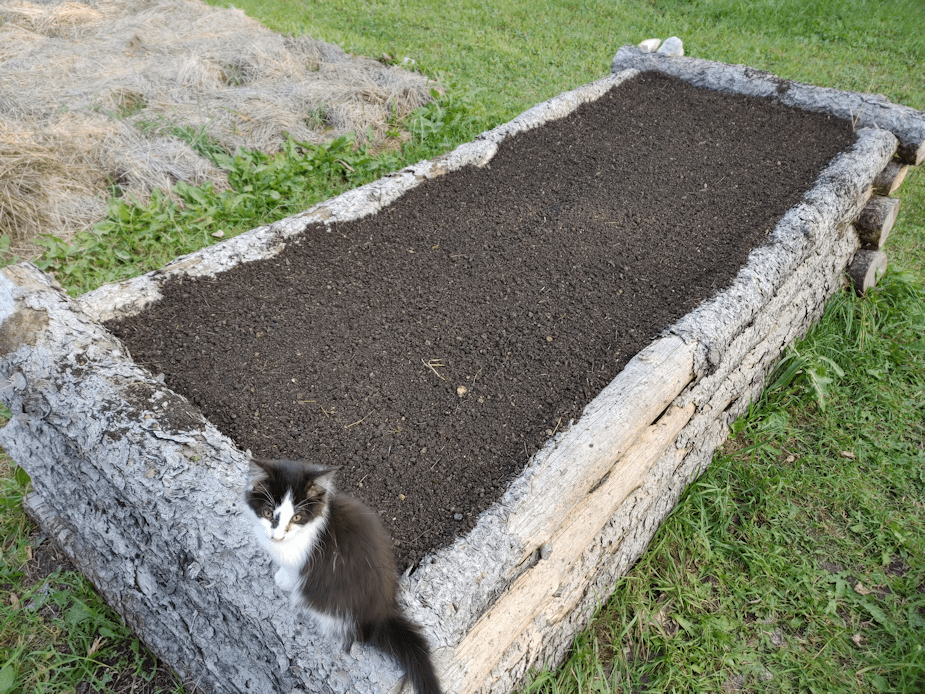
As you can see in the next photo in the slideshow, the cats were very interested in what I was doing!

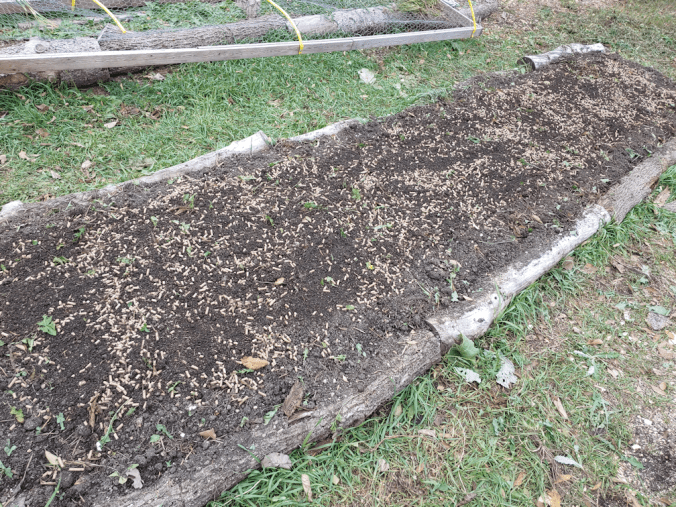
After the soil was loosened, I took the container of seeds shaken up in some seed starting mix, and scattered it evenly – I hope – over the area. Then I drew the back of the rake back and forth over the area to cover the seeds a bit.

While chasing away cats that figured this was a big new litter box, just for them!

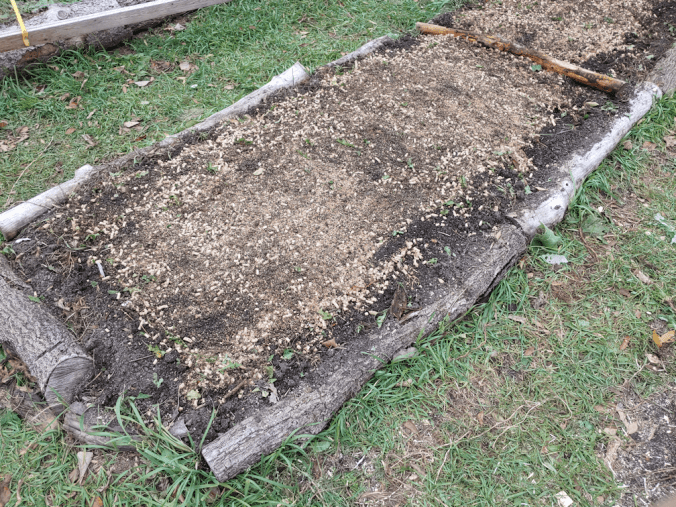
Last of all, I scattered a wagon load of leaves over the entire area. This layer of leaf mulch is not as thick as on the garden beds. I was trying to more or less emulate how it would be, if leaves had fallen naturally on the ground. They will not be removed in the spring.


These seeds are a Western wildflower mix, so they should be able to handle the winter temperatures just fine. Any that succeed in germinating should have little problem growing through the light mulch.

The seed mix description doesn’t tell everything that’s in this mix. It just says “This mix includes Lupins, Poppy, Coreopsis, Flax, Blanket flowers and much more.” It should be interesting to see what comes up next year!

Image belongs to Veseys

One packet of seeds is supposed to be enough for 1000 sq ft. I used two packets. Technically, this means this area should be very densely sown. I’m not going to assume they’ll all germinate. We’ve tried to plant these plus an alternative lawn mix in areas nearby, and only some of them took – a year after they were sown! – and in only one area.

Still, if all goes well, enough of them will germinate that they will choke out any weeds that might otherwise spread into the area, and the wildflowers will spread their own seed further into the maple grove.

By the time that was done, it was starting to get close to sunset, to I moved on to things to go in the front yard. One of those was to clean up the flower bed the haskap bushes are planted in.

The first two photos in the above slide show are before and after shots. The dead flower stalks were clipped with loppers for a chop and drop. The old mulch I’d pulled off the garden bed at the fence was then raked on top along one side, and leaves along the other edges were raked up and added to the other sides. I don’t mind if the mulch reduces the number of flowers here. They get so tall, they cover the haskaps! Now, they are a mulch for the haskaps, and the lilac at one end.

I also snagged a couple of bricks and broken pieces of sidewalk blocks from the pile in the foreground. I keep thinking the catio is going to blow away, now that it’s wrapped in plastic for the winter. A corner of the plastic did tear off in yesterday’s winds, so that got tacked back into place, and there is now a weight on each corner of the roof.

I finally got around to laying out the hoses, to get the kinks and twists out. Once they moved, I was able to get to the old basement window to clean it up, then switch the summer window for the winter one. There was more to clean up than usual this year. The kittens have been using the area in front of it as a little box. 🫤 The window is now clear, though, and has a cover leaning over it. Eventually, we will pick up a window well and cover for around this window. The window wells are pretty affordable. The covers can sure get expensive, though!

That cleaned up and done, it was time to roll up and tie off the hoses. I ended up using a garbage can, laying it on its side over a hose, then rolling it with the hose around it. Doing it that way prevents the hose from twisting and kinking, though in these cooler temperatures, any kinks that were in the hoses when I laid them out were still pretty bent up when they were rolled up. Those are now ready to set aside for the winter.

Aside from finishing cleaning the insulated tarp, this is it for winterizing on the south side of the house. Tomorrow, I’ve got some things I want to get done in the main garden area. Our high is expected to be only 4C/39F tomorrow, but the day after is now expected to hit 9C/48F. I might wait for the warmer day before breaking out the chain saw to clean up the dead spruce tree that fell on the crab apple tree.

How much I get done tomorrow, though, may be up for debate. I felt really good while working outside, but once inside and sitting for a while, all my joints are stiffening up. Including my hands. I’m having a heck of a time typing right now. I forgot to take painkillers before I started this post.

Hopefully, I will finally get a good night’s sleep, and that will help. What I’d really love is have a hot soak in the tub, but it’s not worth the risk of injury, trying to get in and out. Sitting on the bath chair in the shower just isn’t the same, though!

Ah, well. It is what it is!

Whatever happens tomorrow, it felt great to be working outside, and I’m quite happy with the progress I was able to do while I had the chance!

The Re-Farmer

Our 2024 garden: planting garlic Plus updates

Yes!!! The garlic is in!

On my way home from running errands yesterday, I was able to stop at the post office and found our garlic order had come in earlier than the tracking information has said, the last time I looked. Since I then ended up going to my mother’s to get her to a dentist, that meant the garlic went into the ground today.

Before I get into that, though…

I followed up with my mother and, sure enough, she isn’t going to fill her new prescriptions. She already takes sooooo many pills, you see.

She also feels great. My mother has an amazing constitution!

The pharmacy had called her about the prescriptions, she told them how she was feeling and what she was doing (at least she’s following the instructions about things like swishing with salt water), and he said he would hang on to her antibiotic prescription for her, just in case she needed it.

I brought up about getting her dentures done after things are healed up, to fill the empty spots, but she’s already hedging on that. When I mentioned she might have problems eating (she already was, with the top tooth breaking off), and she told me she’ll just eat soft food. *sigh*

We’ll see how that goes.

On another note, I also found a message from the financing company when I came in from planting the garlic. They’ve found a deal that fits our budget, and have already told our mechanic to look for a vehicle that fits the amount. Which is pretty much what I’d told our mechanic we could afford payments on, almost two years or so ago, when I first asked him about getting a vehicle. Whatever we get will be $10,000, maximum, after taxes. The only thing was the banking records I’d sent in to show proof of income. Since I logged in to my bank account, it only had my name on the statements, even though it was for a joint account. It looked like the income was in my name, instead of my husband’s. So we were able to get around that, and the final confirmations can now be made. After that, it’ll just be waiting for our mechanic to find a vehicle for us that’s within the price limits.

I’m really trying not to get my hopes up, but wouldn’t it be amazing if he found something in time for us to be doing our big monthly shops in the city?

So… that’s done as far as can be for now.

Meanwhile, I got some gardening for next year done!

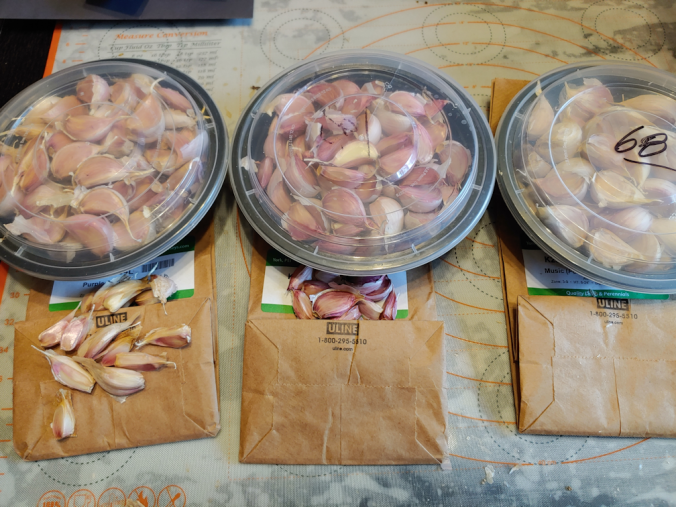
We ordered only one type of garlic this year; three pounds of Purple Passion hard neck garlic.

Since the bed I’d intended to plant them in still has the Jebousek lettuce that I’m allowing to go to seed in it, we had to change our plans. I decided the old kitchen garden, where we’d planted the red thumb potatoes, would do.

I wasn’t sure how many cloves we’d have, so I decided to prep both the long, thin bed, and the end of the wattle weave bed. The old mulch was removed and the soil loosened. I’ve got one bag of sheep manure left. Though I kept the bag covered with a mat, it was still quite wet from the last time it got rained on, so I spread it out by the hand full. I used about half the bag on the two beds, then worked it into the soil. Once that was done, I gave the beds a deep, thorough soaking.

I then left the water to be absorbed and went inside for a while. When I came back out, I soaked it again, then moved over to the tiny raised bed. The shallots in there could have been harvested a while ago, but I was letting the self seeded poppy pods dry out, first. There were still a few tiny green pods, but I left those. Once the pods were trimmed, I could remove the cover and pull out the poppy plants, the self seeded dill, and some of the weeds, then gather the shallots. They’ve been there long enough, they’re already cured.

In the photo with the gathered shallots, you can see some seedlings above them. Those are Chinese elm. They have remarkably long and persistent tap roots. Once the shallots were gathered and removed, I made sure to carefully loosen the soil first, so I could get those out without breaking them.

This bed was redone last fall and, my goodness, the soil was so nice and loose! Almost no compaction at all. It was great! Once it was all cleaned up of weeds and roots, I worked in a few hand-fulls of manure, too.

While I was working on that, my daughter was able to come out and help. She started by separating all the cloves from the bulbs while I finished with the tiny raised bed. I figured it could be a back up bed, in case there were more bulbs than could fit in the other two beds.

By the time the tiny raised bed got a good soaking, my daughter had finished separating the cloves from one bag, though she did find one bulb had started to rot. Only one clove out of that one was salvageable.

In the past, we planted two types of garlic in a pair of low raised beds. By spring, one bed was almost a complete loss, while the other had maybe half of them survive. Since the ones that survived all seemed to be closer to the middle of the bed, it seemed that they had frozen, even under the mulch. We can mulch the top, but not the sides. So for these ones, I wanted to make sure they were planted away from the sides. I used a stick that had been used as a garden marker to make holes to put the cloves in. With the long, thin bed, I made three staggered rows. It took about 1 1/2 bags to fill them. In the wattle weave bed, it is wider at the end, then narrows a bit as it goes towards the corner, so I was able to get a couple of rows with 4 cloves, then the rest with 3.

I fit the rest of the second bag in there, with room for only 4 cloves from the next bag. My daughter finished planting those, then counted the rest, while I started making planting holes in the tiny raised bed. That bed could only hold another 17 cloves, in three staggered rows, and my daughter counted about 32 or 36 – they moved around in the bag, so she wasn’t sure.

There was only one place that made sense to plant the remaining cloves, and that was the bed with the volunteer tomatoes transplanted into it.

So while she planted in the tiny raised bed, I pushed aside the mulch in the bed with the tomatoes, made more planting holes at the end by the rose bush, then down the middle, working around the soaker hose, making sure I had more than enough, then watered each individual planting hole with the jet setting on the hose. In the end, the remaining cloves fit all down the middle, between the rows of tomatoes, and we didn’t need to plant closer to the wall at the end of the bed.

If we hadn’t been down that one bulb that had gone soft, we would have had to try and find yet another spot to plant a few last cloves! As it is, we just managed to fit them all.

After all the cloves were covered, they got watered again to settle the soil around the cloves, then lightly covered with mulch. The mulch itself got a light watering, just to dampen it. When things start to get colder overnight, they’ll get a thicker mulch but, for now, it’s more to protect the soil.

I am quite happy to have so much garlic planted! The only thing is that, if we get the mild fall being predicted, they might actually grow too much before winter hits. That’s where a good, thick mulch will come in handy.

It feels so good to be already started on next year’s garden!

The Re-Farmer

Our 2023 garden: spinach, beets and radishes

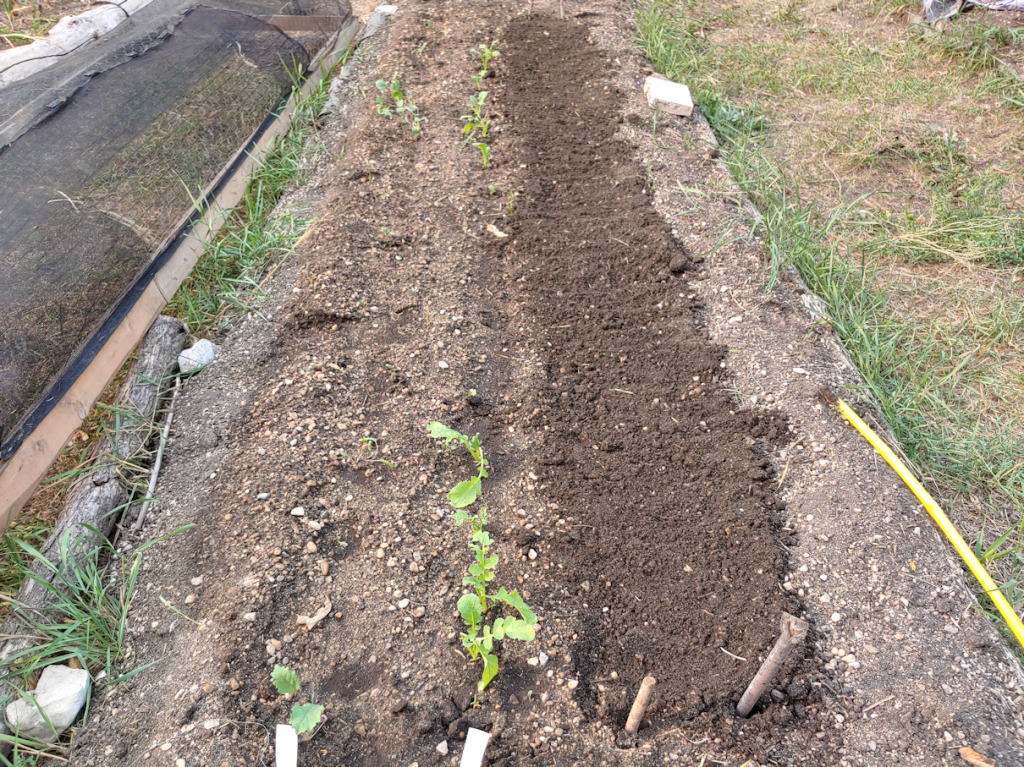
I finished preparing the bed we harvested the garlic from, and sowed for a fall harvest.

I chose Cherry Belle radishes and Bresko beets. I wasn’t sure how many seeds I had left, so I brought two different varieties of spinach. I was able to sow the Lakeside variety, which is what we planted in the spring. I was so impressed with how they didn’t go bitter, even when they started to bolt, I definitely wanted to sow those again.

I used the boards I’d brought out to shelter the tomatoes from the wind in the spring and laid them out around the edges, where weeds are such a problem, as well as across the middle to divide the bed into three sections. I ended up adding a couple more boards at the ends, too. Aside from hopefully keeping the crab grass at bay and dividing the bed, they also give me something to step on while tending the middle rows.

The first thing I did was give the entire bed a watering, using the cone setting on my sprayer for more even coverage. Then I used a hoe to trench out three rows in each section. Those got a watering on the jet setting, because I wanted to drive the water deep. Even though I’d already watered the bed, the moisture didn’t get very far, and the trenches were quite dry. The water also leveled out the soil in the trenches, so they weren’t so deep.

Next, I used grass clippings to mulch along the boards and in between the rows. Once the mulch was down, I used a broken piece of bamboo stake to make the rows the seeds would be planted in.

I picked up a seeder at Dollar Tree, and this is the first time I used it. It worked rather well. In the photo are the beet seeds, which were easiest. The rounder radish and spinach seeds did sometimes get a bit out of control, though! 😄

The beets went into the middle sections, the spinach at the end closer to the house, and the radishes at the far end.

Once the seeds were in and lightly covered, I used the flat setting on the hose to water each row and settle the soil further around the seeds. The grass clippings were toasted dry in the sun, so I used the cone and shower settings to soak the mulch. Last of all, I used the jet setting to clean the loose grass clippings off the boards.

What I will probably do later is put some kind of cover over the whole thing. I think we have some mosquito netting long enough for it. I mostly want to keep the insects from eating the greens. Last year, the radishes seemed particularly vulnerable. As they get bigger, they will definitely be tempted for the deer, too!

We were at 26C/79F while I was out there. Another reason to make sure the bed got extra watering! The two northernmost rows of squash were wilting in the heat again, so I’ve got the sprinkler going on those. Squash need a lot of water, anyhow! I had been concerned that the two southern rows would have trouble because they get so much more shade, while the two northern rows basically get zero shade from sunrise to sunset. With this year’s heat, that shade it turning out to be helpful! Last year, with the flooding, it was the other way around. The squash that were in full sun strove mightily to recover from the flooding, while those in shade basically had no chance at all.

For the next week to ten days, we’re going to see increased heat. Depending on which app I look at, we’ll either have no rain at all, have several days or rain, or several days of thunderstorms! It’s awfully hard to plan things with such conflicting information!

The Re-Farmer

Our 2023 garden: garlic planted, and topping up the high raised bed

Earlier today, I made a trip into town to hit the hardware store. I found the screws in the size I needed, though the cost was insane. A box with only 100 screws was $12.99 – about $4 more than the last time I got a 100 count box! Still, we’ll be able to finish the water bowl shelter now.

I also picked up a glass cutter. We have one somewhere, but I have no idea what happened to it. While I was in the city yesterday, the girls worked on clearing the broken glass from the inner pane of one of the sun room windows. There are still pieces that are firmly attached at the sides. Until that’s done, we can’t let the cats into the sun room. Hopefully, we’ll be able to get that cleaned up soon.

I was really happy to find the lever type door handle I was looking for. Just a simple, inexpensive handle for an interior door. It was easy to install, and it now no longer hurts to open my door!

Later on, my older daughter and I headed out to do some work in the garden, including planting these.

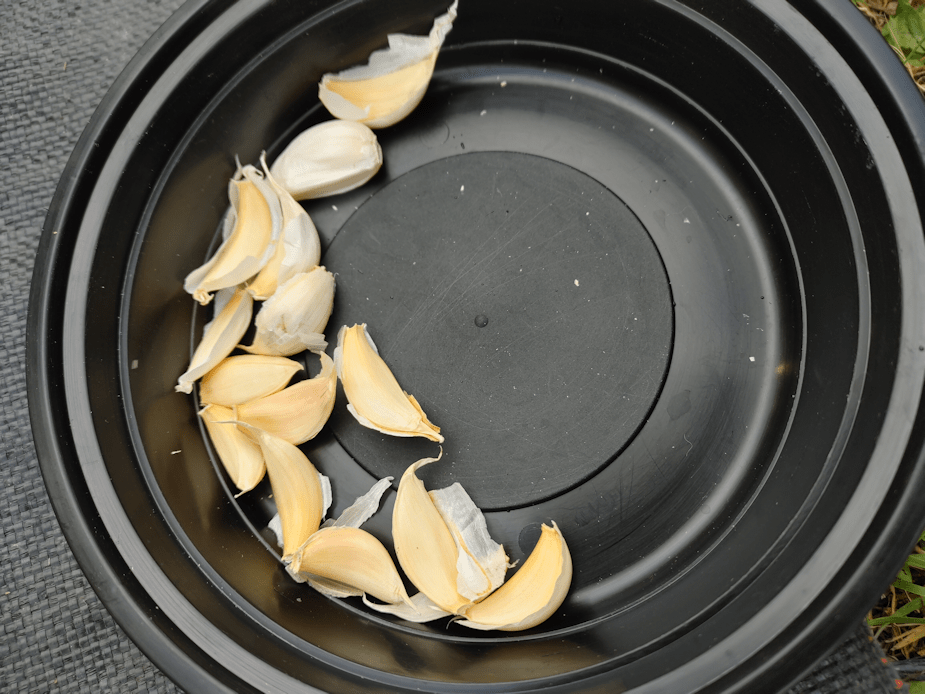
The Nootka Rose garlic on the left are a soft neck garlic. On the right, above the cloves, you can see the hard necks from the middle of the bulbs. They do make it easier to break the cloves apart! The cloves are larger, and there are fewer of them. Of the four bulbs, one of them had only three cloves!

The soft neck garlic has nothing like that in the middle. Just smaller and smaller cloves. I’ve never planted soft neck garlic before. While the hard neck garlic should be planted in the fall, in our climate zone, we can plant soft neck garlic in the spring – but we’re planting both now.

We moved the mulch aside and planted them the same way as the first row we planted a few days ago. The row in the middle of the bed got the hard neck Music variety, because there are fewer of them. Less reaching needed when it’s time to harvest!

After laying out the cloves to see how to space them, the kittens absolutely would not leave them alone! They also really, really wanted to dig in those freshly uncovered rows!

After planting, the rows were lightly covered to reduce compaction while watering – and protect from kitties.

Which didn’t work very well. Several of them started digging in to them to poop! One wouldn’t stop even while being directly spayed with the hose!

*sigh*

We did eventually persuade them to go elsewhere.

With the Nootka Rose garlic, there were enough that we planted only the largest cloves.

The remaining smaller cloves are now in the kitchen for us to taste test. 😊

That done, my daughter did some other clean up and gathering of support poles, while I turned my attention to the high raised bed.

The chard remains were pulled. They’re actually looking better after several frosts then they have all summer, now that there are no longer grasshoppers eating them. We were never able to eat any of it!

As expected, the soil level has dropped a fair bit, as the organic material buried in layers below, settle. It looks like some mice may have been trying to tunnel in one corner.

I have no doubt Rolando Moon has taken care of that problem for us already.

The last of the vines from the squash patch were added for more organic material – then smashed as flat as I could get it before adding fresh soil. The remaining soil sifted from what is now the garlic bed came in quite handy!

It had settled enough that it took three large wheelbarrows full of soil to top it up! I probably could have gotten away with two and a half, but it’s going to continue to settle, so a little extra is fine.

It then got a light, thin mulch of grass clippings before I gave the whole thing a thorough watering. I just want to protect the soil surface, not insulate it. In the spring, the mulch will be removed so the soil can warm up and thaw out faster.

We haven’t decided what to plant here next year, yet, but I think we should give it at least one more year for the upper layers to break down before we try to plant any deep root vegetables in it.

I feel like I’m really behind on preparing the beds for the winter. The girls aren’t able to help as much as usual, either. My younger daughter has been having knee issues to the point that she’s now using a cane to get around the house. She did try to go to a doctor about it, about 2 years ago, but it wasn’t taken seriously because she’s so young. It was already a battle to get her to see a doctor in the first place, so that certainly didn’t help. Anyhow, she does the best she can but, right now I’m actually the most able bodied person in our household. Which is kinda scary, considering how much I’m hurting this year! I didn’t expect my hands to be the main problem, though. Usually it’s my wrecked knees and feet. They’ve actually been relatively good, lately. Either that or the pain in my hands is making it seem like they are better.

Ah, well. We do what we can. It won’t be the end of the world if some beds don’t get weeded before winter and need to be done in the spring. There are other things that are higher on the necessity list.

Little by little, it’ll get done.

The Re-Farmer
Our 2022 garden: fall planting, garden progress, and exciting news!

I’m just going to start with the exciting news.

The tree guys came today! They’ve been here all morning, and have just headed into town for a lunch break. They have finished the big pile in the outer yard. When they come back, they’ll do the small pile by the garage, then work on the piles in the maple grove.

Now, when the owner of the company came here for an estimate, we talked about getting as much done as possible for 3 hours, because that’s what my budget is.

When the guys came this morning and I was walking around with one of them, showing him where the piles were, and where they could dump the chips, he told me I’ve got them all day. He knew I had cash for them, and whatever else it cost, we can pay them as we are able.

!!!!

Which is good, because that big pile took about 4 hours to do.

Meanwhile…

Check out the sunflowers we have opening now! We did not plant any sunflowers this year, though it had been in the plans. There are a few things we didn’t plant, with how crazy this spring was. And yet, we have several sunflowers growing, all planted by the birds. And it looks like the extra bit of fertilizer they were in helped, too! 😉

The Little Finger eggplant in the black grow bag are blooming! It would be awesome if we actually got some eggplant before the first frost hits.

I finally got to working on the cleaning up the lettuce bed.

I kept at least two of each variety of lettuce to go to seed.

After working on pulling out as many weed roots as I could, I decided it was not worth trying to plant anything at the end closest to the house. There’s just too many things spreading into there.

On the left is the Bloomsdale spinach I already planted.

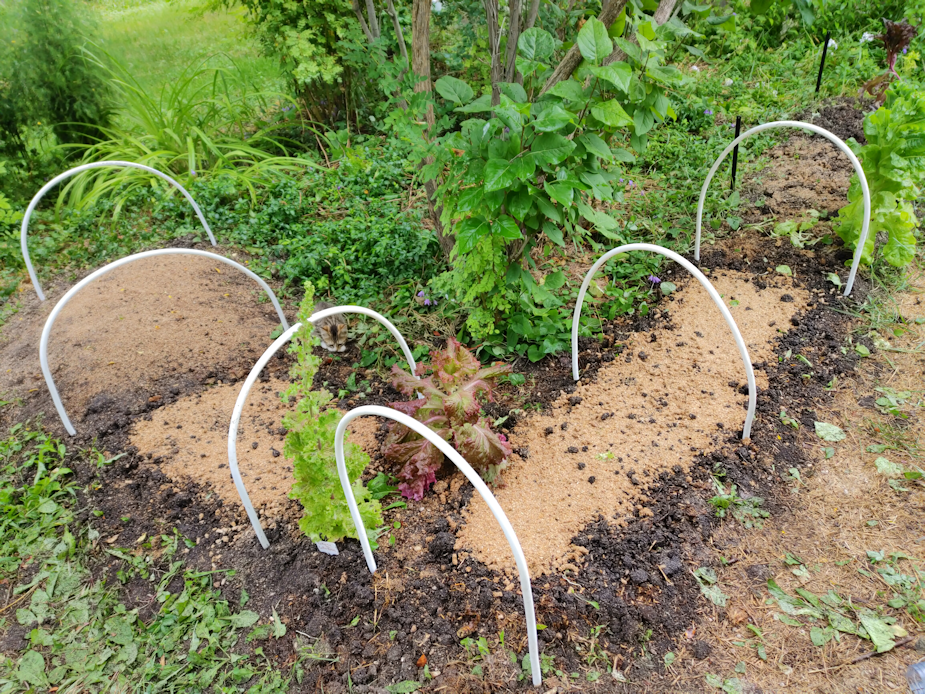
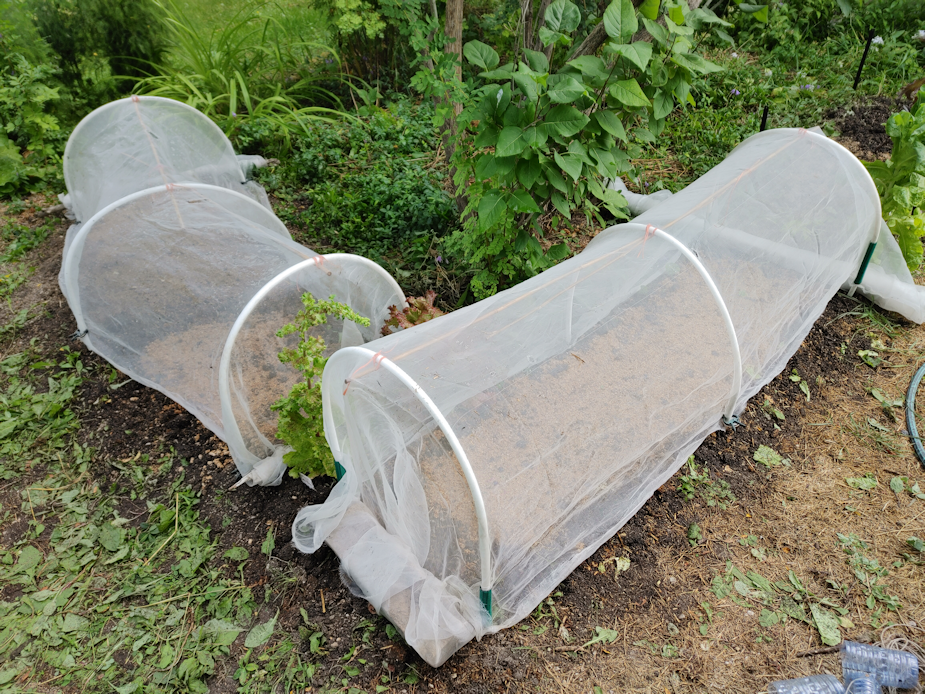
Between the kittens and the grasshoppers, I decided these needed to be covered. I had some longer plastic coated metal stakes I got last year. The metal was hollow tubes, and they bent and broke easily in our soil. I ended up breaking some of them in half, to have me a bunch of shorter rods. I finally got to use the PEX tubing I picked up for this purpose. They fit over the metal stakes perfectly.

The small space near the Bloomsdale spinach got more Bloomsdale in it, while the longer space got Hybrid Olympia spinach planted in it.

After lashing the last of my 6′ bamboo stakes to the middle of the hoops, I grabbed the shorter pieces of mosquito netting from the main garden and set them up here. They are not pegged to the ground. I’m hoping to not need to do that. As they are now, it would be a simple matter to slide the slips up the hoops to be able to reach under. The excess on the ends are rolled around boards, which can also be easily moved, if needed.

The netting does have holes in it, so insects could still get in, but not as much.

When cleaning up this bed in the fall, I’m hoping to start adding walls to build it up higher. I’m just not sure what I’ll have available to use for that. I don’t expect to make high raised beds here, but I do want to have something in between a high and a low raised bed. Partly to make it easier on the back, but also partly to get it up and away from all those invasive plants! That and working around the lilac is a pain. This bed will be a maximum of 2′ wide, so we’ll be able to each all of it from just one side.

Oh! I see the tree guys coming back on the garage cam. Yay!

I am just so excited by the fabulous job they are doing!

The Re-Farmer

Our 2022 garden: new growth, surprise growth, fall planting and our biggest harvest yet.

There is some lovely growth happening in the garden right now.

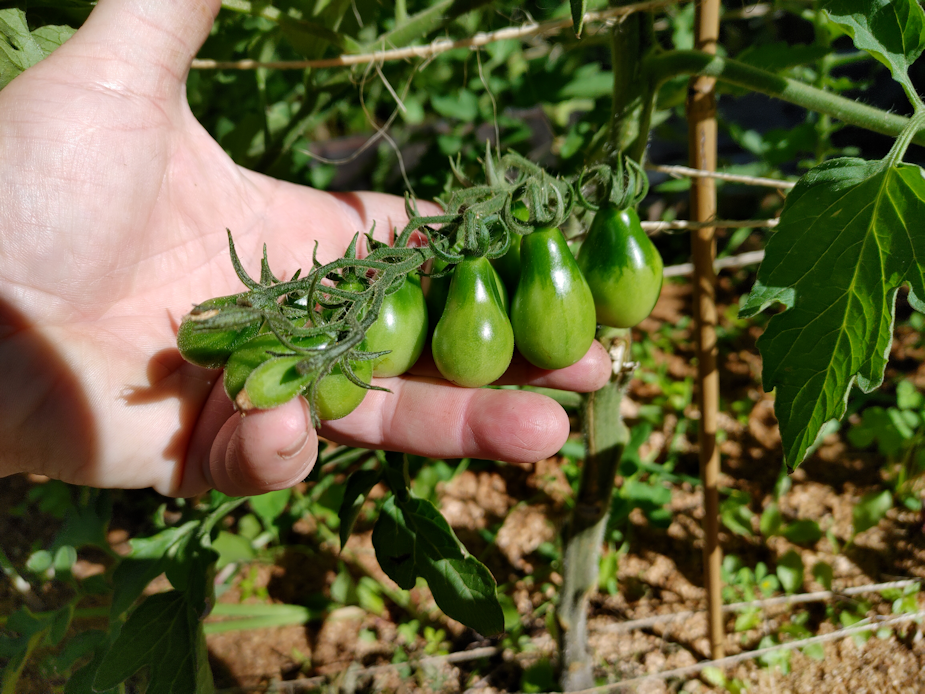
While we have lots of Cup of Moldova and Sophie’s Choice tomatoes ripening on their vines, these Yellow Pear tomatoes are looking to have a good crop, too. They are actually turning out larger than I expected for this variety. It should be interesting when they finally start turning colour!

These Carminat bean pods are getting so very long! I love their gorgeous dark purple.

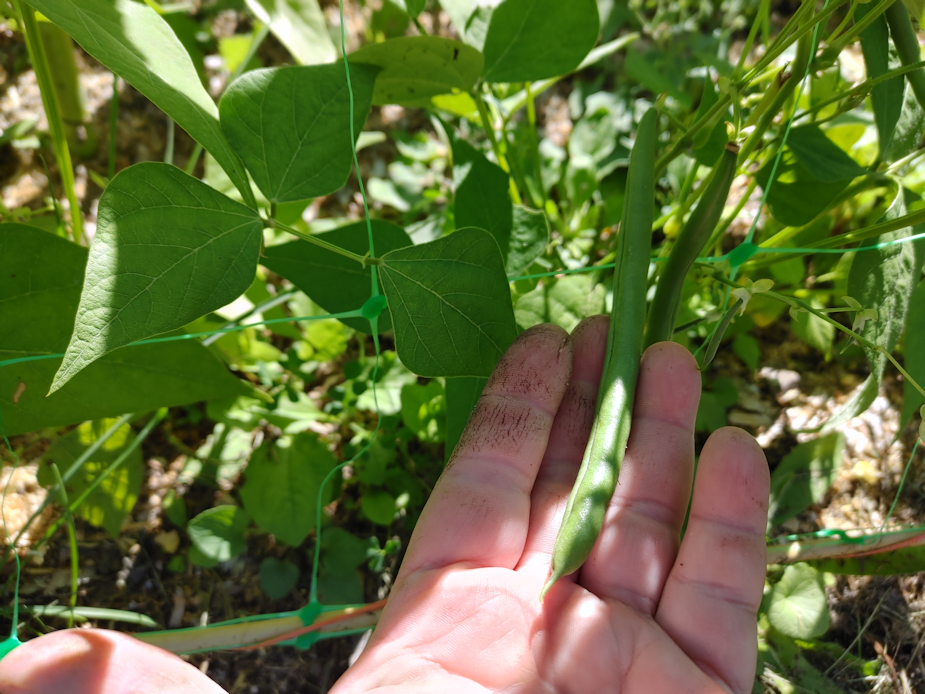
With the purple pole beans, we can see quite a few pods developing, though the vines are still trying to extend their reach, and blooming all the way. The green pole beans (sheychelles) have wispy little pods forming, too.

Then I started weeding and discovered a hidden surprise.

There are ripe pods hidden among the greens! It turns out these beans start developing right near the ground, unlike the Carminat, which have no flowers or pods at all near the ground.

Awesome!

After finding these, I made a point of looking more closely at the Blue Grey Speckled Tepary beans – the shelling beans – too. They’ve been blooming for a while, but are still such tiny and delicate plants.

Sure enough, I found time tiny pods starting to form. Since these beans are for shelling only, they’ll just get weeding and watering until the pods are all dried.

We actually have yellow zucchini this year! Last year, I was sure we had at least one germinated, but after transplanting, all we got were green zucchini. So I am happy to get some this year. Especially since we still don’t have any green zucchini developing! We did have female flowers, but there were no male flowers blooming at the same time to pollinate them.

We are finally getting more Sunburst patty pan squash, too. There was also one Magda squash ready to harvest.

All the squash are SO far behind. The squash patch, which is mostly winter squash, and the summer squash bed should be enveloped in plants. It’s unlikely we have enough growing season left for most of them, but we should still get something from the smaller varieties.

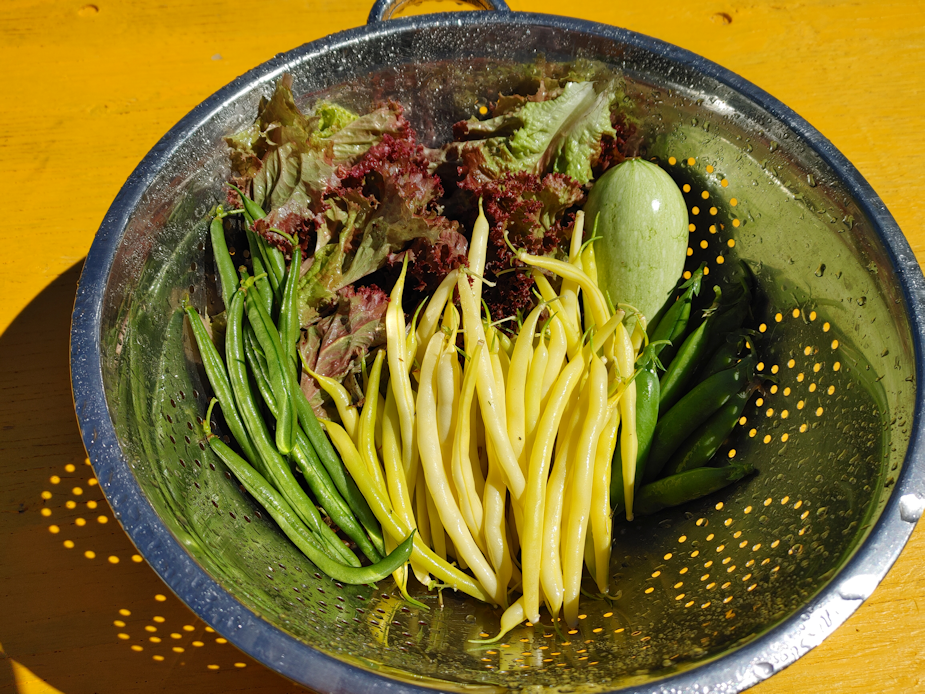
Here is this morning’s harvest!

Yes, the peas are still producing! There was only a handful to harvest from the second planting, but it’s the most I’ve been able to pick in one day, this year. We have both the yellow bush beans, and the green pole beans.

With the lettuce, we normally just go in and grab however many leaves we want. This time, I harvested the plants in one area of the L shaped bed in the old kitchen garden, so that the space can be used again.

I was planning to plant fall spinach elsewhere in the main garden area, but changed my mind.

It’s just a small area for now. As more of the bed gets cleared, I’ll plant more.

We got another harvest in this morning, too.

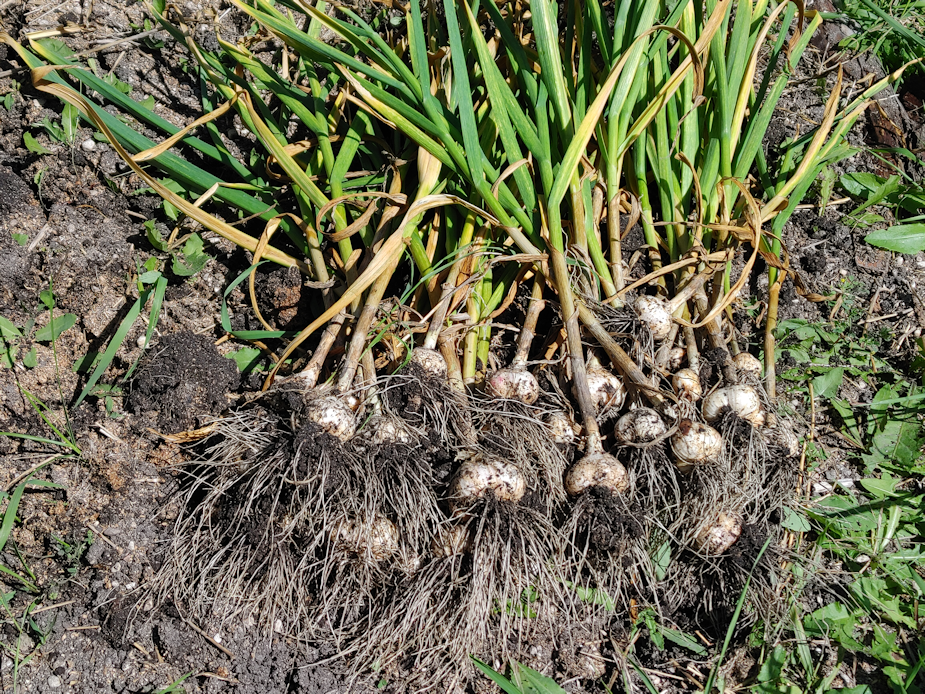
This is the garlic from the bed in the main garden. There isn’t a lot, but they are much larger than last year’s drought garlic!

The other garlic is quite behind, so it might be a while before we can harvest those.

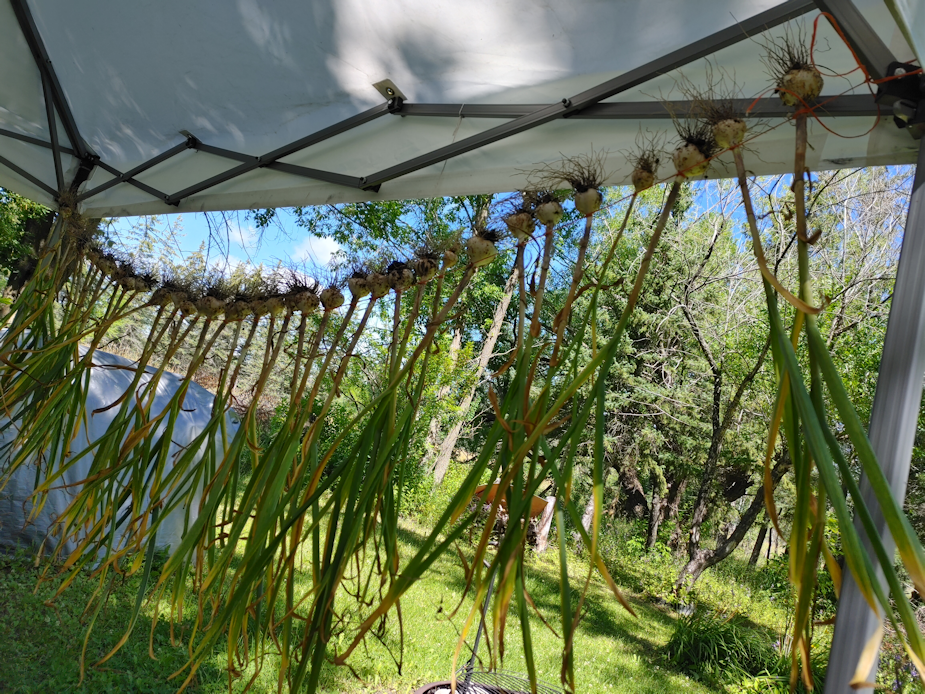
The freshly picked garlic is now strung up under my daughter’s old market tent, where it can get plenty of air circulation as it cures, and we won’t have to worry about it being rained on.

I am quite thrilled by how well these garlic did!

The Re-Farmer
Scrambling to catch up, and a court update

Today turned out to be a lovely day. Sunny, and at a high of 8C/46F, warmer than predicted. It made it very hard to believe that there is a storm and blizzard coming our way, starting tomorrow! While my phone’s weather app has been saying a blizzard was coming since yesterday, it was only until early this afternoon that my desktop app changed its forecast and began giving weather alerts.

After losing so much time yesterday, today was a day to scramble and get the essentials done. The rest will wait until spring.

Last night, the girls lifted the roof on the cat’s house, cleaned it out and replaced the old straw with fresh. Unfortunately, the heated water bowl had to be removed; the cord’s sheath had cracked, right where it contacted the bowl itself, exposing wire. That is unfortunate, as the heated water bowl made a huge difference last winter! So far, however, we are still expected to have mild temperatures, so we won’t need to plug in the electricity to the shelter. Which is good, because I forgot to buy a new 9V battery for the fire alarm we have in there. The ceramic terrarium bulb we have in there for warmth is well shielded, but we still want to have the alarm functional as a safety precaution.

I don’t know of the cats are happy with the clean up. I haven’t seen them in there, yet!

When I headed out this morning to do my rounds, I counted 20 cats.

But only Nosencrantz was willing to pause for a photo! :-D

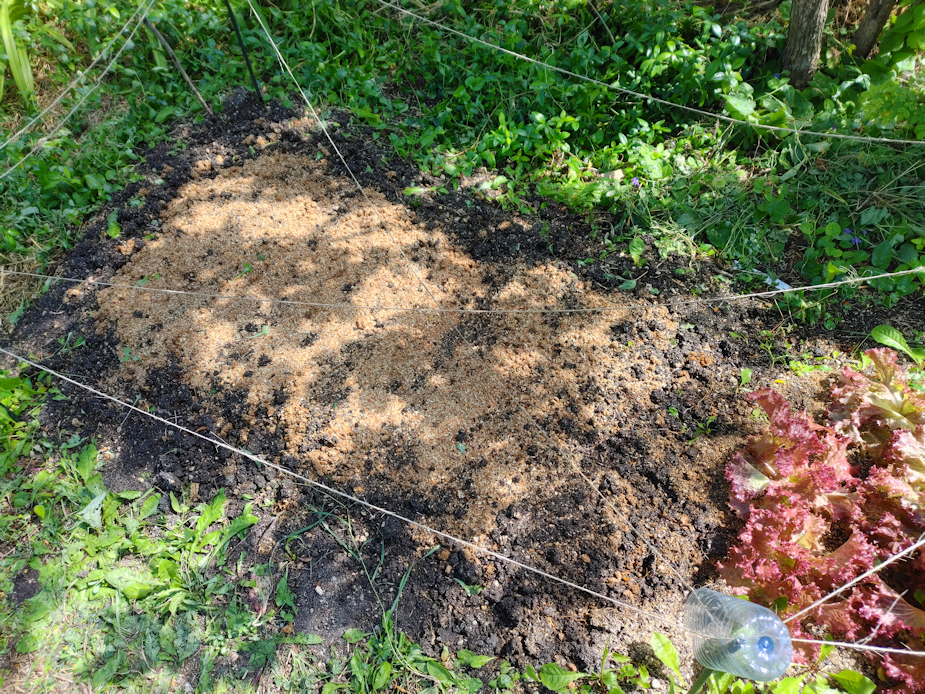
One of the things I took care of while doing my rounds was to finally scatter some wildflower seeds.

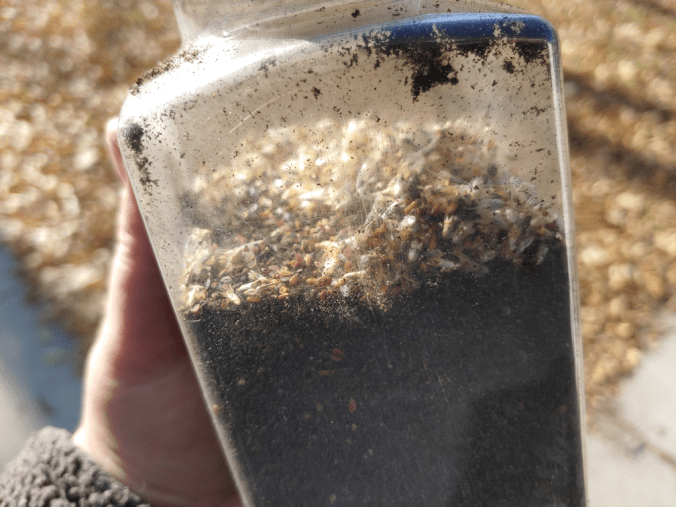
I had two packages of wildflower seeds that were meant for the area outside the yard, in front of where the new sign is. Eventually, I want that entire strip to be filled with wildflowers for the pollinators – and so I don’t have to mow it anymore! I used a bulk sized spice shaker and some soil to scatter the seeds evenly.

This was something I expected to do in the middle of September, but it was just too warm. I didn’t want to risk the seeds germinating too early, and getting killed off when winter temperatures arrived. With the storm coming, these will get covered with snow and should be good to lie dormant until things melt in the spring.

Last night, the girls also used the insulated tarp we found in the garage a while back and used that to cover the septic tank, instead of straw. It’s large enough that it could be used, folded in half. It was full dark by then, so they just weighted it down with some fence posts. This morning, I shifted it a bit to get it right up against the house, then pegged it down.

As you can see by the two pegs on the right, I hit some rocks in the process!

By the time I pegged that down, I was done my rounds and headed inside to go through the trail cam files while eating breakfast. It was rather funny to see all the files of my mother and I, when I took pictures of her at the new sign. It feels so weird to see myself on video! :-D

By the afternoon, things had started to warm up nicely, so I headed outside.

The first thing I wanted to get done was scatter a different wildflower seed mix in the yard.

This one was an alternative lawn mix, for shade and partial shade, of flowers native to Western Canada. This double row of trees is really hard to tend, so I settled on this as the location for the seeds. Unlike the area in front of the sign, though, this one needed to be raked, first.

The first raking was to remove the leaves and debris, then it got raked again to loosen the soil surface a bit. There were some maple and willow suckers coming out of old stumps that needed to be pruned as well.

Then the packet – one larger packet of seeds – got added to the shaker with some soil and thoroughly mixed before being scattered on the raked ground.

Then, the leaves got raked back, as a mulch.
I look forward to seeing if this works in the spring!

One of the priorities on our to-do list was to finally repot our house plants. They’ve been hit with overnight frost, but amazingly, the aloe vera was still alive! They were overgrowing their post, though, so most of them ended up in the trench of the third low raised bed, to break down, except the biggest one that was too big to be buried in there, so it went to compost. I ended up transplanting 4 or 5 strong, healthy little aloe vera for the girls to bring inside later. The umbrella tree looked dead, but I pruned it back and repotted it, because it does actually seem to still have life to it! I would hate to have lost that thing. It had been doing so well, even with the cats constantly trying to get into it!

One of my daughters was working on commissions, so she could only come out to help briefly. My other daughter tried to help, but she was feeling sick and looked so horrible, I sent her inside. Poor thing felt so bad! She did, however, get the last hose put away for me, and was kind enough to run into the basement to shut off the water to the taps.

Once the water was shut off, I opened the back tap and put one of the new insulated hard covers for the taps on it, then finished putting up the rest of the insulation we put around the bottom of the house. This area had been left until we were done with using the taps, and the septic was covered. The front tap still needs its cover, but it is much more convenient to get at, so it can wait a bit.

Along with some other clean up, I did finally make it to the squash tunnel to prepare it for next year, but was only able to do one side before I had to go in for an expected phone call. The rain barrel was turned on its side and weighted down, the long tools and rolling seat went into the old garden shed, and the storage bin we kept to hold shorter tools and various other things we might find handy, went into the sun room. The things we have left undone are all things that will be okay if they wait until spring. It was just time to finally put the tools away!

Then I made a quick run into town to get a few things we thought we might run out of. The predicted storm is supposed to hit the south of our province, but it’s hard to know if we’ll get hit by it as well, or just catch the edges of it. At the very least, we expect to lose internet more often. That happens any time there is bad weather to the south of us. Though it is supposed to start with rain, we might get about a foot of snow, over two days, at which point we won’t be going anywhere for a while! I had already planned on tomorrow to be a baking day, and the last thing I wanted was to runout of ingredients in the middle of something!

Meanwhile…

I got an email from our vandal’s lawyer asking if I were available for the case management session on Monday. That went back and forth for a while. It turns out it will not be with just me, him and our vandal. It will be with the same judge that we’ve been in front of, this whole time.

My brother will not be able to make it, but we don’t want to delay this any more, so I took it. I feel more confident knowing that the judge will be there. The unfortunate thing is that it is going to be at 9am – in the big city, not the closer, small one we’ve been going to all this time. Worse; the court offices are downtown. So not only will I have to leave unfortunately early, just to make sure I have time to get lost among all those one way streets, but it’s going to cost more in fuel, and I’ll have to pay for parking. Minor things, but with costs going up, there just isn’t much wiggle room in the budget! Very annoying. But, it’s that, or wait a year for a trial. :-/

So that has been confirmed.

I am both looking forward to getting it done so quickly, and dreading it.

At least, by then, wherever snowfall we get from the storm will no longer be an issue. There will be plenty of time for any road clearing needed to be done by then!

As for our scramble to get stuff done, no, we weren’t able to finish it all, but the essentials are done, and the rest should be all right to wait until next year.

Speaking of next year, we’re made progress there, today, but that will be the topic of my next post! :-)

The Re-Farmer
On growing garlic

This year, I joined a number of gardening groups on social media. Either local groups or cold climate/zone 3 gardening groups. It’s pretty cool to see how many first time gardeners have been joining the groups and asking all sorts of questions.

This is the time of year for planting hard neck garlic, as we did yesterday, and there is a LOT of discussion on these groups right now, and people are sharing some really good links.

One really good video I saw shared was uploaded just yesterday, and it give a lot of good information. I think you’ll enjoy it, too.

He talks about hard neck garlic, soft neck garlic, seed garlic and even using store bought garlic, too.

I didn’t realize Elephant garlic isn’t actually garlic!

He talks about lots more, including harvesting “wet garlic”, which was something I wondered about when checking our own garlic last year.

Among the most discussed things I’ve been seeing in the gardening groups has been how deep to plant the cloves. There is a LOT of differing, even conflicting, advice. The thing is, the conflicting advice isn’t necessarily wrong. There can be quite a bit of variance, based on climate zones. For those in zone three, like myself, this was an excellent link that was shared. I also found this video, specific to planting garlic in zone 3.

I found it interesting that he says to leave the curing garlic out in the rain!

For those who aren’t necessarily in colder climates, here’s a video from MI Gardener (published September, 2018)

A lot of gardeners on my groups get seeds from MI Gardener, too, and are very happy with what they get.

There is a lot of information and advice out there, but if you can’t follow all of it, you know what? You can still get good garlic! We didn’t plant our cloves as deep as recommended for out zone, yet they survived the Polar Vortex just fine. We don’t have compost or manure to add, and we still got decent sized bulbs. That’s one of the beauties of gardening. You can do all sorts of things “wrong”, and chances are, you’ll still get decent results. What works in your own specific garden may also be quite different from what works in other places, too, so it will always be a learning experience.

Which is half the fun of the whole thing!

For those reading, do you have other things you plant in the fall? I’ve read about a number of vegetables that can be seeded in the fall, and plan to try it in the future, as we get our garden more established. If you plant garlic, do you plant hard or soft neck varieties? What works for you?

The Re-Farmer
Our 2021-22 garden: garlic is in!

When it became clear we would be using our low raised beds to plant the garlic when it came in, I thought about how much space the garlic we planted last fall had taken, and thought we might be able to plant all three varieties in one bed. Maybe one and a half.

Boy, was I wrong. :-D

The garlic is sold by weigh so, technically, we got the same amount of seed garlic as we did last year, but when I opened the bags, it just seemed like… more.

It’s a good thing I take pictures and document everything, because I was able to look at last year’s post and compare.

The photo on the left is from last year, the one on the right is the garlic that came in today.

I even just happened to lay them out in the same order! The Purple Stripe is actually less than last year. Seven bulbs instead of eight, but this year’s bulbs were more consistent in size. Last year, we got seven Rocambole, but this year there is nine. The Porcelain Music had eight bulbs last year, and this year there is nine.

Separating hardneck garlic cloves is rather a lot more difficult than the soft neck garlic at the grocery store! :-D

Last year, we planted all the cloves. Even the little ones. The Porcelain Music had fewer cloves per bulb, but they were all large. With the other two, I separated out the little cloves for eating, and kept the larger ones for planting.

Which turns out to have been a good decision!

Last year, I planted the cloves at approximately six inches apart, but this time, I actually measured and marked a six in grid. Which was SO much easier now that the bed is raised up higher! Now I’m thinking I must have been closer to four or five inches, when I planted last year. At six inches, I filled one bed almost completely with Purple Stripe. There were maybe three prepared holes that did not get a clove planted in them. Which means this bed has 82 cloves planted.

The second bed got the Rocambole, which actually had more cloves. This bed is just a little bit longer than the first one, which gave me an extra row. I had exactly enough cloves to fit! That gives us 90 Rocambole garlic in that bed.

The third bed here still has beets in it, but thankfully, we finished cleaning up the carrot bed, yesterday.

The first thing I did was add half a bag (about 20 pounds) of hardwood pellets and work them into the top couple of inches of soil. Then the bed got watered, so the pellets would start absorbing moisture.

As with the other bed, I marked off a six in grid, though with this bed being so much lower, I did it by dragging a bamboo stake to mark the lines, first, then poking holes in where the intersected. Far less painful doing it that way!

I marked far more than I needed. Having just cleaned this bed out, I know that the edges get invaded by crab grass pretty heavily, so I tried to keep further away from the edges. I marked out 5 rows but, knowing I had fewer cloves with Porcelain Music, I laid the cloves out along four rows, first. I turned out to have exactly enough to fill a 4 x 13 grid, making for 52 cloves.

Which ended up being pretty much exactly half the bed. I placed the piece of wood across to mark how far the garlic is planted, so we know how much space we have when we plant something in the other half in the spring.

While I was working on the third bed, my daughter covered the low raised beds with a grass clipping mulch before moving on to other areas of the garden, then I used grass clippings the last bed. I hope to replace it with straw, when the bale comes in. The mulch has to be removed in the spring, once the overnight temperatures are warm enough. The garlic should be showing through the mulch by then. That is fine with straw, but the grass clippings may be too dense for the garlic to work its way through, so when the straw comes in, I plan to replace the grass clippings with it.

All three beds were finished with a fairly decent watering. Mostly to dampen the mulch than try and soak through it. We are still expected to warm up over the next few days, so this should be enough for now. Later on, as overnight temperatures drop and before the snow comes to say, we’ll cover the beds with plastic.

One thing is for sure. Working with the newly framed low raised beds is SO much better than the ground level beds, even though those ones are technically considered raised beds, too. It was easier to mark out distances, easier to reach the middle, and much MUCH easier on the back. Everything went so much faster because of this, too. I look forward to when all our garden beds are at least this high, or higher!

We had originally intended to double how much garlic we planted this year, but I am glad we decided not to, at the last minute. We would not have had enough beds ready to plant them all, if we had!

It should be interesting to see how these do next year. Not only will be be able to compare with the highly amended low raised beds in the same location as last year, but also the third bed in the main garden area. The low raised beds get full sun (meaning, at least 6 hours), but are shaded longer in the morning by the spruce grow and nearby Chinese elm. The third bed has nothing to shade the morning sun, and is far enough away from the trees by the house that it’s not affected by evening shadows, either.

Our 2022 garden now has its first plantings!

The Re-Farmer

Our 2021 garden; fall planting, and shallot surprise

Now that it’s “cooled off” again to 32C/90F (feels like 34C/93F), I headed back to the garden to remove the shade clothes and get those photos I promised.

Our surviving (barely) French Breakfast radishes, and rainbow chard.

Now that one of the beds has a window screen mesh covering it, I decided to take a chance.

I planted lettuces.

On the far left are the surviving purple kohlrabi, and in the middle are radishes. I forget which variety at the moment.

I had our four varieties of lettuce together in a slide lock bag, and they spilled a bit, so I planted the mixed up seeds at the bottom of the bag. So we are going to have lettuce surprise when they start to sprout!
Moving the cover on and off is still a two person job. The length of the cover makes it a bit too wobbly. We definitely need to make the permanent beds shorter, just for that!

A nice thing about the window screen mesh is that it slows down and breaks up the water, so it lands more gently. We don’t have the hose nozzle set on anything high pressure, but these surviving seedlings are still spindly and weak from being under those water bottle covers to protect them from insects and critters. With the mesh covering the ends, I have at least some hope that these lettuces will have a chance to survive. At this point, it’s the grasshoppers, more than the critters, that are an issue.

Once this was done, I decided to harvest the shallots. I’d been weeding the bed while watering this morning and accidentally pulled one up. I didn’t think they were doing well; many of the green parts had withered away completely, and I could no longer see where they were, while others just looked like they were struggling. The one I accidentally pulled up looked surprisingly large, so I left it there, to collect with the others this evening.

I was very pleasantly surprised!

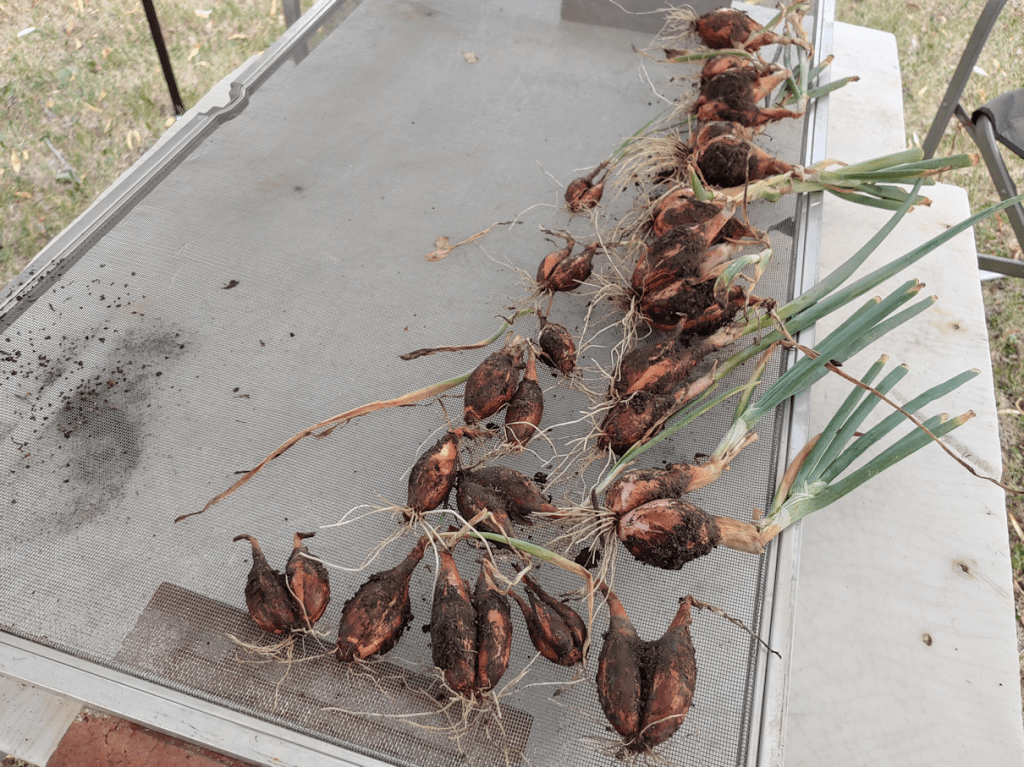
As I started digging them up, I found they were much larger than expected. The one way at the far end in the photo is almost as big as an onion!

Then I accidentally dug up a shallot there there was no sign of any growing there anymore, and it was far larger than I expected, too. So I went back over the row and dug into each spot I knew I’d planted a shallot, and found several more! They are the smaller ones with no, or almost no, stems.

For now, they sit on a window screen, raised up on bricks for air circulation, to cure for a while. I’m quite pleased with what we got. Our original shallots, started from seed, were destroyed by the cats, so these ones are from sets I bought at the grocery store. There was only a dozen sets per bag, so I got two bags. A far cry from how many we would have had, if the ones from seed had survived, but way better than nothing at all! This is just awesome!

Tomorrow morning, I think I will start harvesting some of the onions. They are not all ready, but some of them definitely are. We have quite a lot of them, so I don’t mind harvesting and curing them in batches!

Being able to harvest things already, and even plant things for a fall harvest, kinda makes up for all the problems we’ve been having with the drought, critters and insects! We may not have as much as we hoped to in the spring, but we will still have food to harvest, and that’s the important part!

The Re-Farmer