Ginger Bug, on the Rocks

Okay, I finally got a photo that didn’t totally suck!

Here is our very first Ginger Bug pop.
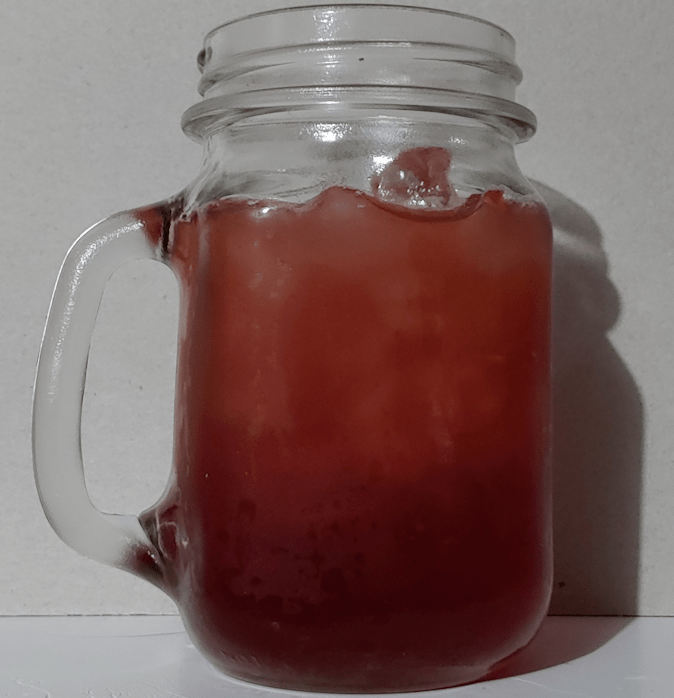
Our very first attempt at making fermented pop, using a Ginger Bug.

We used a house brand, cranberry raspberry cocktail for the base, which also contained other types of juice in it. The predominant flavour was actually apple.

The juice and ginger bug mixture stayed at room temperature in a plastic bottle for a week. Every day, we would give the bottle a squeeze to see if it was getting harder, which would show that fermentation was happening and gases were starting to expand. Then one morning, I walked past and saw the bottle looking like it was about to tip over! The bottle was rock hard, and the indented base had been pushed outwards under the pressure, causing it start tipping!

I immediately put it in the fridge to stop the fermentation process, but not before I opened the bottle enough to relieve some of the pressure!

When we taste tested it the next day, there was quite a bit of pressure release when I opened the jug, but in pouring it out, there was surprisingly little fizz. It’s more like a barely noticeable effervescence, with a light tingle on the tongue.

Honestly, it really just tastes like juice. None of us noticed much of a ginger flavour in there, and the predominant flavour is still apple. I found it very sweet, so when I had another glass the next day, I watered it down, about 50/50. I found it to be nicer that way.

In researching how to make this, one of the things I’d read was that, after moving it to the fridge, it needed to be drunk within a few weeks, because it loses its fizz. So far, that has not been true! Every time I’ve taken the bottle out, it’s been rock hard again, and there’s no lessening on the sound of gas being released when it’s opened!

As for the glass in the photo, I admit, this is an adulterated drink. I poured it over quite a bit of ice, rather than watering it down.

I also added about an ounce of our hard crab apple cider!

My goodness, that does work rather well!

The ginger bug drink is very sweet, while the hard crab apple cider is a bit on the sour side, and the two balance each other out quite nicely.

I now have a new bottle of cranberry raspberry cocktail mixed with the ginger bug starter. That’s the last of the juice I got for this. I think next time, we’ll try making a fruit syrup out of what we’ve got in the freezer and see how that works out!

This is definitely something we’re enjoying.

The Re-Farmer

First Ginger Bug Pop: Cran-Raspberry Cocktail

When it was time to feed the ginger bug, I decided it was time to start our first batch of fermented pop (aka: soda).

In looking for recipes and instructions on how to actually use the ginger bug, I found myself with some issues. One was the ratios of ginger bug to liquid, which tended to be for only a quart of liquid. Which seems a ridiculously small amount. Mind you, there’s four of us that will be drinking it, so that might have something to do with my perception. ;-) The most useful I found was to use 1/2 cup of ginger bug to 7 1/2 cups of sweet liquid. Pretty basic.

It was the fermentation container that seemed to be all over the place. Some sights said to ferment the ginger bug in a jar covered with cheese cloth or coffee filter. Others said to put it in a sealed jar and open it up every day, to release gasses. Some said to put it in a container with an airlock. All of these then said to bottle the finished beverage, usually recommending swing top bottles, but sometimes plastic bottles. Then there were those that said to pour the mixed liquid straight into swing top bottles for the fermentation period.

In the end, I decided to use one of my husband’s distilled water containers. We get distilled water for his CPAP humidifier, and I’ve started keeping the empty bottles to use in the garden.

We’re accumulating quite a few of them.

So this gives me a food safe container in a gallon size that has a sealable cap.

We started by measuring out 7 1/2 cups of the Cranberry Raspberry Cocktail I got for the purpose and pouring it into the jug, to judge if we would be doubling the recipe or not. We decided to go ahead and do another 7 1/2 cups, for 15 cups in total.

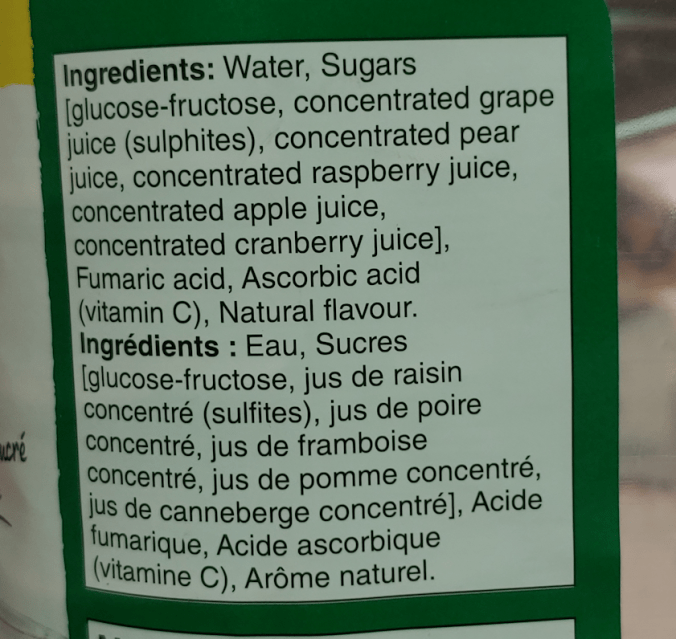
This is the ingredients list for the Cranberry Raspberry Cocktail. Which also has juices from grapes, pears and apples. The important part is that it has sugar in it, which means I did not have to add any sugar to feed the yeast during fermentation.

Pouring and straining the ginger bug out of the 750ml canning jar we are using would be messy, but we happen to have a ladle small enough to fit into the wide mouth jar, so we used that to ladle the liquid into a measuring cup through a strainer. Very few ginger pieces got caught in the process, so that worked out very well.

I found the amount in the juice bottle odd. 3.78L? A gallon is 4.5L, isn’t it?

Then I remembered; US gallons and Imperial gallons are not that same. LOL That is 1US gallon of juice. The distilled water bottle, however, gets referred to as a “gallon”, but is actually 4L.

Whatever. The end result is, a decent amount of headspace at the top of the water bottle, even after adding a cup of ginger bug liquid.

There was still some juice left behind, so the daughter that was assisting me, chugged it. It may be “cranberry raspberry” cocktail, but she tasted mostly apple!

No matter. It should still make an interesting carbonated drink!

We then replaced the cup of liquid removed from the ginger bug with our drinking water – the stuff we buy, rather than our well water – and fed it with some more ginger and sugar before putting it back in the cupboard, safe from the cats.

Then the fermentation bottle got labeled and dated. I figure we can wait a few days and, if the ginger bug is nice and bubbly after being used, we’ll start another batch.

For now, this bottle will stay out at room temperature. Every day, we’ll give it a squeeze. As long as it has give to it, it’ll stay out, but once it feels hard, that means it’s fermented enough and will be transferred to the fridge, so it doesn’t explode. From what I’ve read, this can take anywhere from 4 to 10 days. The house is fairly cool, so I predict it will be closer to 10 days.

Once in the fridge, it will need to be drunk within a few weeks, or it will lose its carbonation.

If it tastes any good, it’s unlikely to last that long. Not between four people!

I’m looking forward to seeing how this works! If it does work well, we will experiment with other liquids to ferment and keep track of which ones we like. :-)

The Re-Farmer

Ginger Bug Progress

Well, we are into our third day of starting our ginger bug. It got its third feeding last night, and third morning stir today.

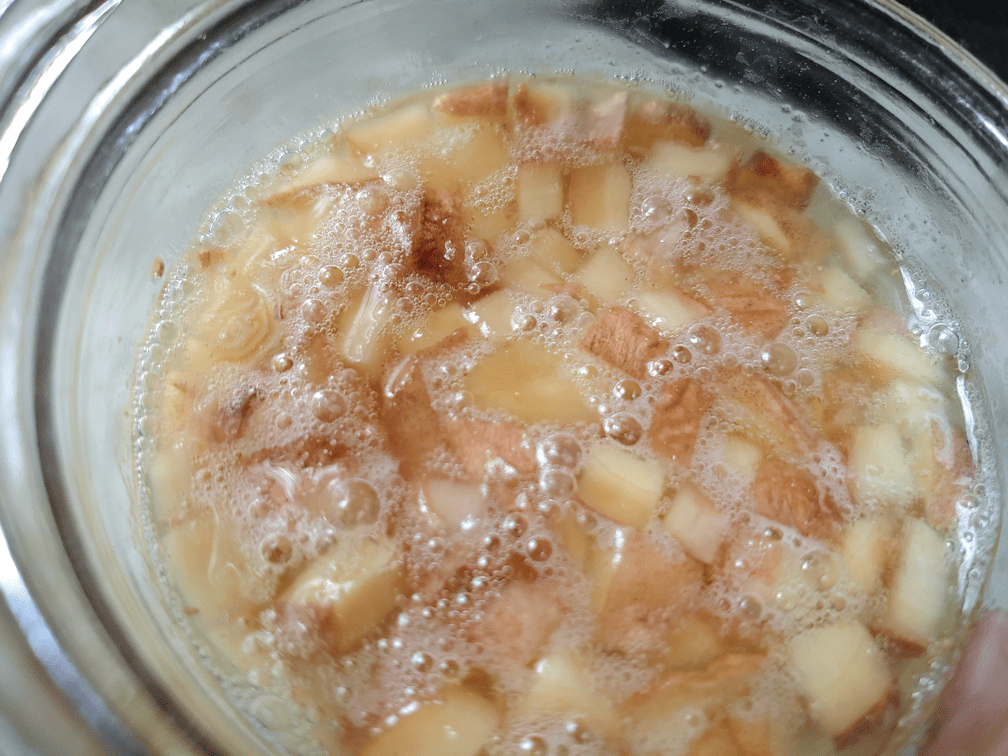
Look at those bubbles!

While researching how to make this, I saw sites that said it could be used after three days. Others said to wait four to ten days. All seemed to agree that it could be used once it starts bubbling.

Which means we should be able to start fermenting some pop, any time now!

I picked up some cranberry-raspberry juice to try first. There should be enough for at least two or three 8 cup batches. The recipes I’ve been reading said to use 7 1/2 cups juice to 1/2 cup ginger bug. Eight cups is not a lot, though.

Time to go back over the various instructions I’ve found and confirm the next steps we need to take. Then I have to decide on what container to use. Depending on what we go with, we might do a double recipe. We shall see!

The Re-Farmer

Starting a Ginger Bug

No, I’m not talking about our furry Ginger Bug! I’m talking about using the actual roots.

In keeping with our stocking up on the assumption we’ll have a month or two where we can’t get out to do any sort of shopping, we’ve been thinking not only of essentials, but those little things that improve on quality of life. One thing that we considered is liquid refreshment. Drinking plain water gets boring, fast – and we buy our drinking water. We really should have tested our well water by now, but to get the full testing done is very expensive and time dependent. We’d have to take a sample and drive it to the lab in the city as quickly as possible. Even just getting a sample bottle requires going to another town. One I haven’t been to since I was a kid and went to a cattle auction with my dad. So that will just have to wait again.

Our usual default drink that isn’t plain water is tea, and my older daughter has already taken care of that department. She went through the sale section of David’s Tea and ordered 13 different types of tea! They should arrive in the mail this week.

The other thing we do enjoy is pop (soda). Usually Coke Zero for my husband and I, while our daughters prefer Ginger Ale. I actually don’t like Ginger Ale on it’s own, but love it mixed with fruit juice. There’s something about that carbonation that really hits the spot.

Which is why I’ve decided to start fermenting our own pop. It’s supposed to be all healthy and everything, but really, I just want to make a thirst quenching fizzy drink.

To start the process, we need to make a ginger bug and get the fermentation process going. I meant to start one a few days ago, but got busy with other things, so I finally got it started last night.

The basics of a ginger bug is fresh ginger root, sugar and water.

I looked at a lot of websites and videos, and there is a lot of conflicting information, of course. Some say to leave the skin on the ginger, because that’s where the yeast it, while others say to peel it, and it’ll ferment just fine. Some say to grate the ginger, others say to use a fine shredder, and still others say to just chop it up. Some were very specific about using a wooden spoon to stir the bug, while in some videos, I saw people using metal spoons to stir. Of course, the quantities and ratios of ginger:sugar:water are all different. With all this, everyone seemed to have very successful ginger bugs, so I figured things were pretty flexible! Then there is the container to put it in. As an open ferment, some cover the jar with cloth or a coffee filter, while others keep it in a sealed jar. Which, to me, seems to really increase the risk of an explosion.

So I just sort of took it all in and did my own version.

I decided to chop the ginger into a small dice, going with the sites that said it made it easier to strain the liquid out later. I don’t like floaties, if I can avoid them! I left the skin on, because peeling ginger is a pain in the butt.

As the ginger bug needs to be fed, I chopped extra and put the excess in the fridge.

I decided to use:

3Tbsp ginger
3Tbsp sugar
2 cups water

I put the whole thing in a 750ml jar to have room to add more ginger and sugar, and for stirring. I also used some of our purchased water, rather than our well water. If I were to use our well water, I would have boiled it and let it cool to room temperature, first.

I could have used an elastic to hold the coffee filter on, but I find a canning ring is much handier.

The jar itself is now stored in a cupboard. Not because it needs to be tucked away, but to keep the cats from knocking it off the counter or something!

It not needs daily tending and feeding until it gets fizzy.

Which means it will get stirred every morning, then fed every evening.

While that is fermenting, we need to think about what to make with it! Of course, we can make basic ginger ale, but as I mentioned, I’m not really a fan of plain ginger ale. Apparently, you can use sweet tea as a base, so that’s always an option, though I am leaning more towards things like cranberry juice or pomegranate juice. I don’t normally buy juices; I find them way too sweet. There are many options, though, and I’m looking forward to experimenting!

The Re-Farmer