More progress on the cat isolation shelter

As soon as I was done tending to sick kitties, doing my morning rounds and grabbing a quick breakfast (a piece of pie my daughter made using that winter squash we had to harvest early – breakfast of champions!), it was back to work on the isolation shelter.

The horizontal piece that will be supporting the second level floor needed to have its other side painted, plus I needed to cut the horizontal pieces and paint them, too.

Well, I didn’t quite get to start on that right away. I had to clean up a cat mess, first!

Among the things I brought to the garage, just in case I might need them, was a container full of odds and ends that the cats had knocked onto the floor over the winter. When the girls tried to clean it up in the spring, they didn’t have the chance to try and sort through everything. When I brought it to the garage, I dug out the cardboard base that had been under the wood chipper when we unboxed it – a large, flat surface with sides on it that I could use as a tray. I dumped it all into there and took a look, then set the whole thing on top of the stack of scavenged lumber I’d brought over.

Of course, I had to move it while digging for pieces I could use, and set it on top of the lath bundles above.

Then forgot it there.

Some time during the night, some critter – likely a cat – knocked it upside down.

I immediately had a new game to play.

“Find all the nails before my tires do”.

Since I was picking them up anyhow, I brought over a bunch of repurposed sour candy containers (my husband had bought a case of them) I had intended to use for seed and sorted them as best I could. Some odd things ended up back in the cardboard “tray”, some of the screws were the same as what I was using on the isolation shelter build but, mostly, it was finishing nails of various sizes – some ridiculously tiny. I ended up filling three containers of those!

Getting them out of the dirt floor was the worst. Eventually, though, I was able to grab handfuls and just lay them on my work table. Once everything was clear of the lumber, it was much easier on the back to go through the last of them on the table!

I think it took me at least an hour, just to clean up all those nails. When I’m done building the shelter and cleaning up so we can park the truck in the garage again, I’m going to have to make sure to rake the dirt floor towards the walls, and triple check to make sure nothing got missed. The last thing we need is for a nail or screw in one of our tires!

That done, I could finally access the lumber I needed! Specifically, the two pieces of standard size 2x4s.

Unfortunately, both pieces were so dirty, I had to bring the hose over and actually scrub them clean. One of them looked like it was covered with ashes.

I first measured around the bottom half of the shelter, where the verticals will go. Those were all about 18″. I say “about”, because one side is, for some reason, slightly different, and I had to cut one piece about an eighth of an inch longer. Then the top half got measured. It was the same thing; I needed 22″ pieces, except for one, that needed to be just a tiny bit longer.

I was able to cut all the 18″ lengths, but after cutting three 22″ length, I ran out of 2×4 The remaining piece left over was way too short. I did have one piece of true-to-size 2×4 left that I could have cut a 22″ piece out of, but I didn’t want there to be a single piece with different dimensions.

So I went hunting in the barn.

I didn’t find any scrap 2×4’s, but I did find a pair of large baking trays, like the one we found in the basement and are now using under the water bowl shelter for kibble. I figured we might find a use for them, so I brought them out. Then I checked the shed near the barn. Happily, I found a single piece of 2×4 long enough that I could cut a final 22″ length. It needed to be scrubbed clean, too.

Once all the pieces were cut, I set them outside to dry in the sun.

Since painting them was out of the question until they were fully dry, I decided to drag out the leftover boards from when we build the raised bed frame covers, and start cutting floor pieces. For some reason, I had it in my mind that they were 1×6’s, but they were 1×4’s. They’ve been stored against a wall in the side of the garage my mother’s car is parked in. Normally, that would have been fine, but we’ve had such wet weather, the dirt floor got damp, even that far into the garage, so they needed to be brushed clean, too.

At least they weren’t as bad as the 2x4s I had to scrub with water!

I thought I would have to rotate my work table to fit the 12′ lengths, but it turned out I didn’t have to. I was able to move the miter saw to the far end of the table, which gave me just enough space to fit a board. Most of the floor pieces for the back of the shelter needed to be 4′ long. Once the first cut was made, space was no longer an issue.

With the first board I used, though, there was too much damage in one area, so one of the 4′ lengths couldn’t be used. I might still be able to use part of it, though, for something else.

One board needed to be cut shorter, as it will go between the frame pieces. With these being standard 1x4s, while the frame is true-to-size 2x4s, that one board has a bit of wiggle room. I set the others where they will go in the shelter, and found they were about 2″ short of the centre line.

I then had a decision to make. I could leave it as is, and have a slightly larger opening for a cat to access the second level, or I could cut another piece and have a smaller opening.

Then I remembered, I has some old 1×3 boards we found in a shed some years ago. Was one of those long enough to cut 4′ off of it?

Why yes. Yes it was!

So now the floor will extend just an inch past the centre mark.

Once those were all cut, I painted them, along with the second half of the 2×4 that will run across the centre, to support the floor boards. The floor boards only need to have their tops and ends painted, except for the two boards that will be at the ends, which needed to have one of their edges painted, too.

At that point, since the verticals were still drying, I was pretty much done for the day – but I was then left with a conundrum.

I was expecting to use triangle blocks to attach the vertical pieces, but I would need 32 of those. I had a few from earlier cuts I’d set aside, and cut as many as I could out of some of the other scrap ends I had left. I ended up with 16 triangle blocks in the true-to-size 2×4 scraps, and only 4 in the regular 2×4 scraps. The vertical pieces are all regular 2×4, so if I used those 16 pieces, they’d all be wider than the pieces I was using them to join.

Plus, I’d have to cut gaps in floor board pieces to fit around the verticals. If I were to use the triangle blocks, I’d have to cut much larger gaps, and I am not about to try and go all journeyman on things, to cut them to fit over the angles on the blocks.

There was an alternative, though.

Inside I went, did some searching, then made a call to the local hardware store, for a pocket hole jig.

Then had one small kit in stock! Plus, it was only about $20, so quite affordable.

I asked them to set it aside for me, then headed into town.

Once I had the kit, I just had to use it right away!

I did a few test drills on some scrap wood, then drilled pocket holes on all the vertical pieces. They’ll be joined from the narrow sides.

Tomorrow, they’ll be painted, including inside the pocket holes.

That done, I checked on the boards painted earlier. They were pretty much dry!

So I set the horizontal piece that will support the floor in place at the centre marks. Unfortunately, it turned out to have just the slightest twist to the board, but not enough for it to be a problem. It’s still a nice, tight fit, so I didn’t need to add wood glue, or even anything to hold it until I could screw it in place.

I then laid the floor boards on top. They won’t be permanently attached for a while yet, but I’ll be able to measure things and see how many boards will be needed to cover one side of the remaining space.

While working on all this, I decided to make some major changes to the inside of the shelter.

My original plan was to have an insulated shelter box, with an access door, on one side of the back half, while the other side, with an access door, would have a litter box. The front would be open screen, except for the front door, which would swing down to form a ramp when open.

Then I decided to make a separate insulated box that can be taken in and out of the shelter for cleaning. That way, it could be smaller and more cozy.

The top half was going to be open, with spaces for cat beds, food and water bowls and whatever. It would also have an access door to reach the food and water bowls.

Altogether, that would have made for three access doors on the bottom level, and one for the top level.

As I was setting the floor boards and seeing how things fit, it occurred to me.

There’s really no specific reason to have the shelter box on the bottom, other than I happened to draw it that way.

Building all this on the bottom level would be rather more difficult than on the top level.

Instead, the bottom level can be screened in on all sides, except for the door/ramp. The litter box can still be kept in the bottom level. Any spilled litter can just be swept through the gaps in the pallet base. If I want, I can still add a shelf or two between some of the vertical supports for a cat to lie on, but nothing that would need more than reaching with a brush to sweep off through the doorway.

The top level can have the solid back wall, plus an access panels on each side. One to take the shelter box in and out. We can even make two of them. One, an insulated winter one, and the other a more airy summer one. A second access panel would be to reach the food and water bowls. I’m still trying to work out how to make these as sliding doors, rather than swinging doors. I still don’t know what I have available to make the doors out of.

I wonder if we have some small pieces of half inch plywood hiding in one of the sheds somewhere? I’ve gone through them so often, looking for specific things, I would not necessarily have noticed other things.

All that, and I’m still not 100% decided on how to do the roof of this. Ideally, it would be hinged for access, too.

That can wait, though. Gotta do the interior stuff, first!

In the end, I had to force myself to stop and leave painting the verticals for tomorrow. I’d been out there for most of the day and was getting really tired and hungry, but I wanted to keep on going! I want to get this thing ready as quickly as possible.

Oh, that reminds me. While at the hardware store, I looked at their supply of hardware cloth (welded wire mesh). They only had quarter inch size. I am looking for half inch. That will be the one thing we have no choice but to buy, as there is nothing suitable that we can scavenge here. I think I do have a small amount left in the sun room, but not enough for the entire shelter, that’s for sure. We probably won’t have a budget for until the end of the month. Still, that’s one of the last things that will need to be done, so that’s okay.

I’m rather pleased with today’s progress – and with my new “toy”!

The Re-Farmer

Finally visible progress on the isolation shelter!

For the past while, all the stuff that’s been done on the cat isolation shelter has been preparing pieces before assembly.

Which meant that, while progress was being made, it didn’t really look like much progress was being made!

Well, today, all that prep work finally paid off.

Assembly has begun!

I’m not going to go into too much about the assembly now; I’ve decided I’ll be making a voice-over video of the process when it’s done, so I can go into more detail. For now, here’s the short form.

The first thing I did was mark the centers of all the cut lengths on all sides. I even remembered to bring my carpenter’s triangle this time – and I got a lot of use out of it, today!

The front and back panels, which will be 4′ square, got assembled first. These used the true-to-size 2x4s for the outside, with a single regular 2×4 across the middle.

Of course, that didn’t turn out as easy as expected.

The regular size 2x4s turned out to be a fraction of an inch too long. With the first frame, I ended up recutting it too short, but was able to use the piece I’d cut off, sanded down until it fit, to fill the gap. With the second piece, I used the miter saw’s blade to basically shave off a bit at a time until it fit, so I didn’t have to fill a gap again!

Once the front and back panels were done, I used the side pieces and the centre marks to work out where to attach the triangle blocks. Once those were attached to the front and back panels, the panels were attached to the pallet, with the cross pieces to make sure they were spaced properly.

Once the first panel was attached flush with one edge of the pallet, that officially became the front of the shelter. The bottom cross pieces were set in place along the short sides of the pallet – making sure all the corners were at 90° – before the back piece could be attached, then the side pieces were attached to the pallet as well.

The top cross pieces were then added, which also set the front and back panels correctly, and finally the middle cross pieces were added.

Once it was all together, I rolled the whole thing out of the garage and through the grass. The wheels handled the grass just fine, and it was quite easy to move around! One of the last things I’ll do is add some handles to use to move it around but, for now, I can just grab the frame.

None of the joins are prefect, of course. In fact, some of them are downright messy. But, the corners are square and the whole thing is extremely solid and stable, and that’s what’s important!

Once that was done, I was able to use the funky calipers my daughters got me for Christmas a few years ago to measure the distance inside the frame, at the centre mark. A 2×4 was cut, checked and double checked for it, then got half painted. Since I had the paint out anyhow, I covered a few spots on the frame that needed touching up.

This cross piece will support the floor. The floor in the back half will be from one side to the other, while the front half will be from one side to the middle, leaving an open space for any isolated cat to access the upper level.

That was as much as I could get done today. Tomorrow, the other half of the cross piece will be painted. Until that’s dry, I won’t be able to measure and cut pieces for the floor, but the bottom half of the back panel will be walled in, so I should be able to start measuring, cutting and painting boards for that, as well.

The boards I have that are left over from another project are 12′ long, though. I’m going to have to rotate the table I have the miter saw on, to have the space to work with them!

As I’m doing all this, I’m always turning things around in my mind about what should be, or can be, done on the inside before the whole thing gets the welded wire mesh added, since none of it can be done once the mesh is in place. I find myself thinking of adding something across the front or side to hold food and water bowls, slightly elevated and secured somehow, so they don’t end up knocked about. If I do that, I might change things up so that the front door, which will be made to swing down and become a ramp when left open, is in front of where the litter box will be, instead of in front of where the sleep cubby will be.

I’ll think more on that, as the floor boards are added, as well as the vertical pieces that will need to be added to support the access doors and panels. I also want to include things like a scratching post and other spaces for cats to lie on.

I wonder if we have any scrap carpet somewhere that can be used for this? I know we have a roll of carpet in the barn, but it’s been sitting there for probably at least 10 years, of not longer, and I doubt it would be useable. There might be something in the storage shack, but it would be hard to find anything under all of my parents’ belongings.

Still, it might be worth a look!

If we have cats that have to be in this thing for possibly weeks at a time, I want it to at least be fun and interesting for them!

Have I mentioned that we’re sucks for the cats?

The Re-Farmer

Isolation shelter build started

I’ll be honest, here. We’re really just winging it on this build, even though it’s going to be quite a bit more complex than the kibble house and water bowl shelters. It all comes done so what materials we can scavenge.

There are plans, however!

Plans that needed to change, but still plans! 😁

The original plan was for a 4′ x 4′ cube, divided up inside to have an enclosed shelter that will be insulated, a not quite enclosed shelter for a litter pan, and two levels with space for food and water bowls, and just hanging out.

We had a couple of pallets that were left by the roofers. My original intention was to dismantle them and use the wood mostly for the floor.

That did NOT work out!

The pallets are nailed together mechanically. The nail heads are deeply embedded in the wood – and the wood is quite thin. When I tried to pry them off, the wood started splitting.

Time for plan B!

The pallet will be the floor, more or less as is.

I measured the pallet’s length and width at the boards inside, and each side was slightly different. I brought over the circular saw and cut the ends flush to the outside boards. The most damaged side will be the bottom of the floor.

I could still work with 4′ lengths on two walls, and the other two will be 40″, to fit on the pallet. The shelter will still be 4′ tall.

For the main parts of the frame, I’m using the true-to-size salvaged 2 x 4 lumber in the barn. There’s hardly any of that left, but there’s enough for this project. It feels like a shame to “waste” it on something like this. The wood is old and the ends have started to rot a bit, but it’s really solid and heavy wood. It is, however, what we have, so that’s what we’ll use. Other parts of the build will have more modern, standard 2×4’s, which are not true to size, and are quite a bit lighter. We have even less of that, so we’ll have to plan accordingly.

For now, I’ve cut lengths to make the front and back panels, which will be 4′ square. The frame will be attached directly to the pallet once put together, but that won’t happen quite yet. The dirt floor of the garage is pretty level, but not flat, mostly due to shallow tire ruts. Right now, the pallet can’t lie flat on the ground. I’m heading into the nearer city tomorrow, and will be looking at what wheels are available, and affordable.

Once the pallet has its wheels, it will be able to straddle the uneven parts of the floor, and be sturdier to work on.

Once the “box” is framed out, the interior will be worked on, including things like extra surfaces for cats to lie on, something they can scratch at, and so on. Once that’s all figured out, access panels or hinged doors will be made so that the litter box, food bowls and enclosed shelter can be reached from the outside. For the enclosed shelter, what I will probably do is make an insulated box that can be removed completely, if necessary.

I haven’t fully decided on how to do the roof. It will most likely be a low slope metal roof. I just haven’t decided how I want to make the slope while not having any gaps.

Last of all, the welded wire hardware cloth will be added to those walls that are not enclosed with wood. We might not be able to pick that up until the end of the month, though. Unless we find something on hand that we can use.

Anyhow. That’s progress so far. Reworking the plans and making the first cuts for the frame.

Little by little, it’ll get done!

The Re-Farmer

Welcome to 2024!

Syndol says hello.

I counted 37 this morning! As I was returning to the sun room after doing my rounds, Syndol kept reaching out and grabbing at me, until I finally picked him up for a cuddle. He so loves to be cuddled!

If this morning is a sign of how our year is going to be, it’s going to be a messy, destructive one!

I woke to discover a cat threw up on my bed. It’s a good thing it’s such a big bed, or I would have rolled over, right on it. So I’m doing laundry right now!

My husband woke to find his mouse on the floor and his cowboy hat knocked over. His wired ear buds the hat was protecting were completely chewed up.

He’s keeping his door closed now.

Which reminds me: the door the girls were measuring for is not for between the rooms uo there, as i thought. It’s for over the stairs.

When my parents were still living here, a frame of 2×4’s was made around the bottom of the bannister to hold a plywood cover that was flush to the floor upstairs. This was so that they weren’t heating the upstairs in winter, when they weren’t using it. We’re not sure what happened to that plywood cover. So the girls want to cut a new cover to size so that they can keep the cats out while they sleep, and have it hinged and rigged to easily open and close as they need to use the stairs.

Oh, we don’t have a land line anymore. For about a week or two, people have been having trouble reaching us by phone, getting crackling noises, or it would go straight to machine. Then, a couple days ago, a light started blinking on the phone base I’d never seen before. It’s the “hold” light. The display says “home line busy”. Apparently, the phone thinks we’ve got it put on hold, but it won’t turn off. When I try listening, there’s just a crackling noise.

Something similar has happened before. The repair man replaced a jack in my husband’s room to fix it. My husband used to have a corded phone set up there, but he unhooked it and has no phone hooked up at all, now.

We suspect it’s the same jack that is the problem, and that it got sprayed by a cat, though to be honest, I can’t really see signs of that. The problem is, my husband has his room set up in such a way that it’s not really accessible. We are going to need to rearrange things. That room is so small, it means actually taking things out of the room. Except his hospital bed. Because it’s extra long, it can only be taken out by dismantling it. It can’t be moved around in the room without taking pretty much everything else out, first.

So we have to clear all that up, just so we can see what we are dealing with, and for a repair man to access the jack to test it. We also need to arrange it so we have access to the section of wall against there the bath tub is. We still need to replace the tap and faucet, but are not sure it can be accessed from the front, once the tub surround is removed. If it can’t be accessed from there, we’d have to access it from the bedroom, and right now, it’s blocked by a wardrobe. There is a closet in this room, but it’s currently being used to store some of my late father’s belongings. Between my husband’s hospital bed and the little table that’s holding his medications fridge, the closet it completely blocked off.

It will be a huge job, but one that’s overdue. We haven’t been able to clean that room properly in ages.

To be honest, I need to do the same thing in my room. How I have it set up, with my “office” in one corner, and my craft table completely covered with stuff to try and keep the cats from getting into things they shouldn’t, it’s a disaster. I would love to be able to get the wall shelf out and replace it with more functional selling, but aside from not having replacement shelving, I’m not sure how to take it out. I’ve asked my mother about it, but all she could tell me was that she thought it was brought in, in two parts. Which I figured it had to have been. I just can’t figure out where it came apart! What I’d really like to do is set my bed up on the other side of the room, but there’s a heat vent there.

Ah, well. We’ll figure it out.

What a start to the new year!

The Re-Farmer

Another quiet day and thoughts on the cats

Today is the third Sunday of Advent; the day of Joy.

For me, at this point in my life, Joy is having a quiet, boring life! 

We don’t have any running around and errands to do, so it’s another day of domesticity. I am considering whether or not to run an errand today or tomorrow, as it looks like we don’t have quite enough kibble to wait until I do the city shopping on the 20th; my husband’s CPP Disability comes in early in December, so we’ll be doing the bulk of our stock up shopping for January before Christmas.

We are at -4C/25F right now and might warm up another degree. We’re getting light snow every now and then; just enough that it looks like fog in the distance when I check the live feed on the garage cam.

I’m happy for the milder temperatures, for the outside cats.

The older and larger ones are fine. It’s the youngest ones that would probably not have survived this long, if we had more typically average temperatures for this time of year.

I counted 35 this morning, I think. It could have been 34. As I was finishing my rounds, I spotted Sad Face by the old dog houses near the outhouse. This is the closest thing to evidence I’ve seen that those old dog houses are actually being used for shelter. 

With the inside cats, we’re having a “fun” time. Though we had spent well over $600 on medication for ear mites to treat all 16 cats we had in the house at the time (not counting the kittens, yet), it seems it didn’t take. We had two types of medication. One type was drops squirted into the ear, but they didn’t have enough doses for that many cats on hand, so the last few doses were the (more expensive) type that is applied to the skin between the shoulder blades.

We’re pretty sure those were the ones that didn’t take.

So now they all have ear mites again, including the kittens. Plus a couple of the cats just have a really hard time cleaning their own ears. Poor Ginger. He’s got it the worst. Particularly in the ear he can’t clean at all, on the side he’s missing a leg. Somehow, Toni is managing it with just one front leg – for now. Then there’s our old grandma that moved out with us. She’s getting on in years, and we can see she’s starting to show her age. So she’s not doing as well with cleaning her own ears, either. 

We certainly can’t afford to buy medications for all of them again. The clinic wouldn’t even be able to sell them to us without seeing at least one cat first, because it’s been more than 3 months since we’ve brought a cat in to that clinic. The kittens that got fixed recently would have been treated for ear mites while they were getting spayed/neutered if the vet saw any, but those would come back rather quickly if all the other cats have them.

I’ve been told that an alternative is to treat their ears with mineral oil, every day for 10 days, and that should kill off the ear mites.

Which means doing all the cats, every day, for 10 days.

I just had to make a list to count and, unless I forgot someone, we’ve got 21 cats in the house right now, including 8 kittens. This, after losing three kittens, Marlee escaping and disappearing, and adopting Nosencrantz out after her escape and unwillingness to come back indoors.

We’ve decided to give it a try. If nothing else, it’ll help clean their ears.

So my younger daughter and I have taken on the task. She holds the cats down while I use mineral oil and some paper towel to clean out their ears. It’s only been a few days, so far, and I can already tell the difference. Some cats actually looked really clean and clear from the start. Others… it’s rather horrible!

Some of the cats are good about it. We have a couple that fight us off quite a bit. Then there are the ones that complain loudly, because their ears are so bad, it’s uncomfortable. Ginger has started to connect the unpleasantness of being manhandled with some relief, afterwards, so he’s already becoming more co-operative.

All of the cats look hilariously bedraggled, with their oily ears and heads.

The mineral oil we have is pharmacy grade (we’re going to need to pick up more, before we’re done!), so it’s safe for them to groom it off. It’s sold as a laxative, though, so… we may have some explosive results after a while!

Between the cost of food, the lysine, vet treatment, etc., is getting ridiculous. Yes, we do have a rescue that’s helping us, but it’s basically just one person running the show. There is the huge rescue in our province that the Cat Lady left that will work with rural communities like ours, but there’s a reason she left them. It seems the bigger the organization gets, the less they become about the animals, and more about the money and the politics. 😥 That and it turns out, when the Cat Lady was still with them (and paying out of pocket for things they were supposed to cover), they had issues with us, and claimed we were just “breeding cats” – as in, on purpose, instead of doing the best we could to prevent just that. Heck, population control is one of the biggest reason we’ve got so many cats indoors! And why we sought help to adopt cats out, get them fixed, etc. Nothing like connecting with a rescue, only for them to get upset with us for having cats that need to be rescued… When they tried to adopt out a pair of kittens from us to someone in BC that turned out to be a hoarder, she left them, started her own rescue, and found local homes for them, instead.

With the Cat Lady in the middle of moving right now, plus it being a time of year with so many holidays, we can’t expect to accomplish much right now.

So what options do we have? I’m not prepared to call the municipality had have them send someone out with a gun. 

One option has come to mind.

We could become a rescue, ourselves.

I’m not entirely sure how it works, but if we could start a non-profit rescue, we would have access to resources we don’t have, on our own, including funding and tax benefits, and maybe being able to support fosters, etc. that would help us find forever homes for the cats. Not all of them, of course, since we do need yard cats out here in the boonies, but they need to all be fixed!

Oh, my husband just came by and reminded me of another cat I forgot to count.

We have 22 cats inside.

Once things have settled down for the Cat Lady, I will talk to her about it and see if that is a reasonable option. Perhaps we could even become a branch of her own rescue or something like that.

Well, time to get my butt off the computer. It’s almost time to oil up some ears!

The Re-Farmer

Trellis bed shift

I’ve been analyzing that side wall of the trellis bed with the bowed log on the bottom, and decided we needed to make a change.

The plan had been to cut joins into the horizontal logs and the vertical posts, then secure them in place. There will be four of posts, about 6′ apart but, the more I looked at it, the more I realized that in order for the posts to be in line with each other, I’d have to cut away far too much wood. It would weaken them too much.

There was one solution, though, that could be done before the end pieces were attached. The pairs of logs are attached to each other, but not to the ground.

So I snagged my daughter and some rope, and we reversed the wall.

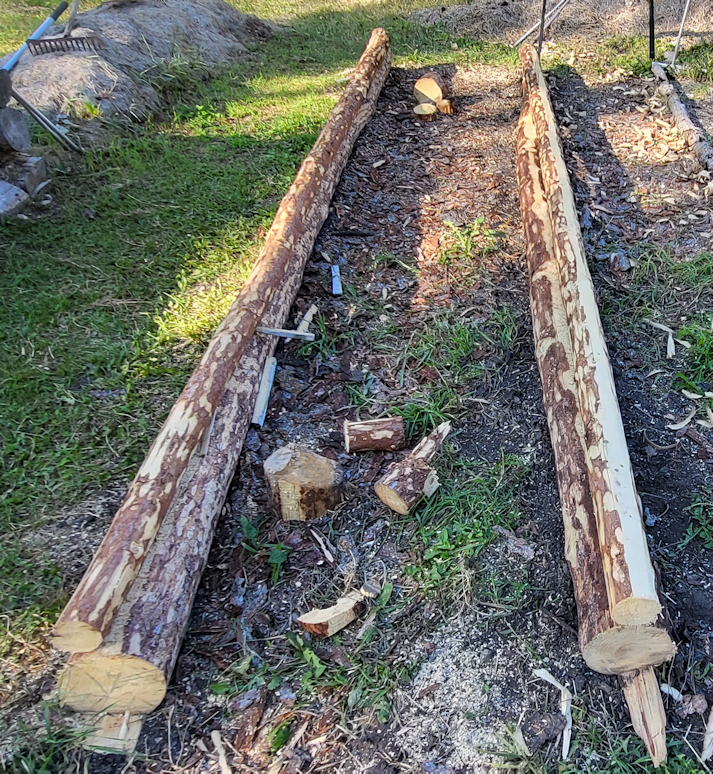
I neglected to take photos at the start. To carry the logs, we wrapped some rope around the ends and used them as handles to lift and carry the logs around to face the other way. It was awkward, but it worked.

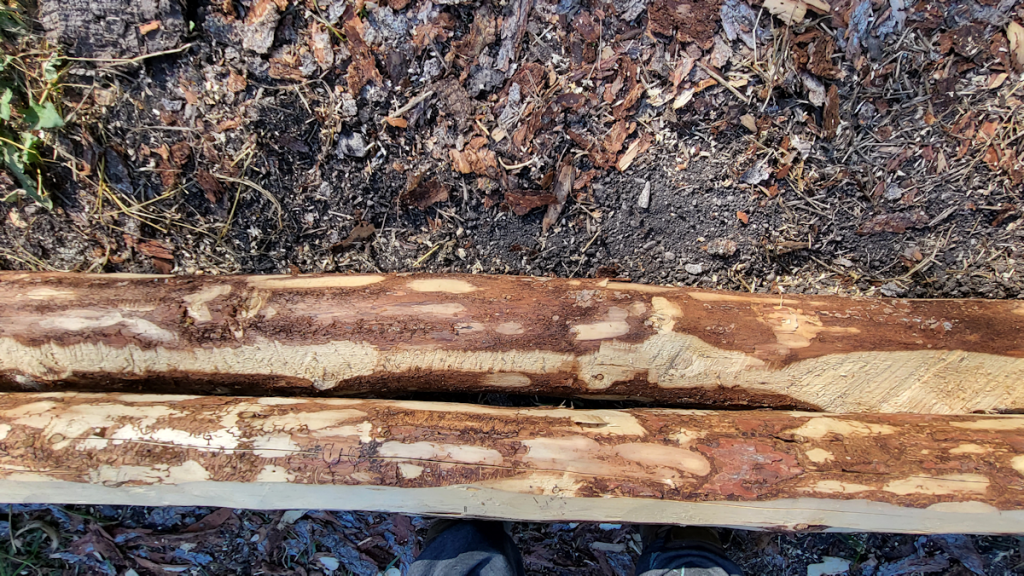
The rebar that joins the logs goes all the way through. At the end in the foreground, barely an inch goes through. At the far end, there’s almost 3 inches of rebar that could be jammed into the ground as we lined up and set the logs in place again. Since I cut the ends of the walls in line with each other, we had to make sure they still matched, so that the walls at the ends will be straight once they’re added.

This shows better, why I decided to switch it around. You can see where I used the chainsaw to flatten the top of the base log, for the other log to rest on! 😄 That worked out on the ends, at least! This is where the bow sticks out the furthest, pretty much in the middle. The vertical posts would have been on either side of this section. The top log is pretty straight, so I’ll probably just flatten the logs where they will come in contact, rather than actually cut joins.

But that will be done after the end pieces are added. Technically, once those are in place, we could still move the entire bed if we had to, but that would not be a very good idea!

The Re-Farmer

Fourth raised bed cover done – mostly – and my conclusions

After yesterday’s lumberjacking, we were pretty sore this morning, but not as bad as I expected. Still, my daughters were sweet enough to feed the outside cats in the morning, so I could sleep in a bit before doing my morning rounds.

My daughters had some shopping to do in town, so my younger daughter and I left after my morning rounds were done. One of her stops was the pharmacy, forgetting that today is a statutory holiday in Canada, and the pharmacy was closed.

I did notice that a BBQ food truck was out so after our last errand, I checked it out. I had enough cash on hand to get some take out to bring home as a treat. I miss food trucks! 😄 There’s actually quite a few in the region, but where we are just doesn’t have the population base to support one.

One thing I noticed while I was waiting for the food was a sign on the nearby hardware store. Along with cycling through their hours, specials, etc., they show the local temperature. According to my apps, the hottest I was seeing was 26C/79F with a “real feel” of 29C/84F at home. The sign, however, was showing a temperature of 32C/88F! Judging by how I was feeling while standing in the shade, I’d say the sign was right.

We really ought to get ourselves a weather station. I did find the parts of one while we were cleaning up the house, but the outdoor reader was (still is, actually) mounted to one of the steel clothes line poles, so the readings would be quite off!

Speaking of the weather, we started to get alerts for severe thunderstorms this afternoon. Looking at the weather radar, I could see spots of storms, scattered like confetti, sweeping across the prairies.

So far, none have hit us. The most we got was a smattering of rain. I was outside at the time, working under a tree, and never noticed until I saw parts of the sidewalk were wet!

This is what I was working on.

The last frame for a raised bed cover now has wire on it.

Of course, it was more of a pain than expected.

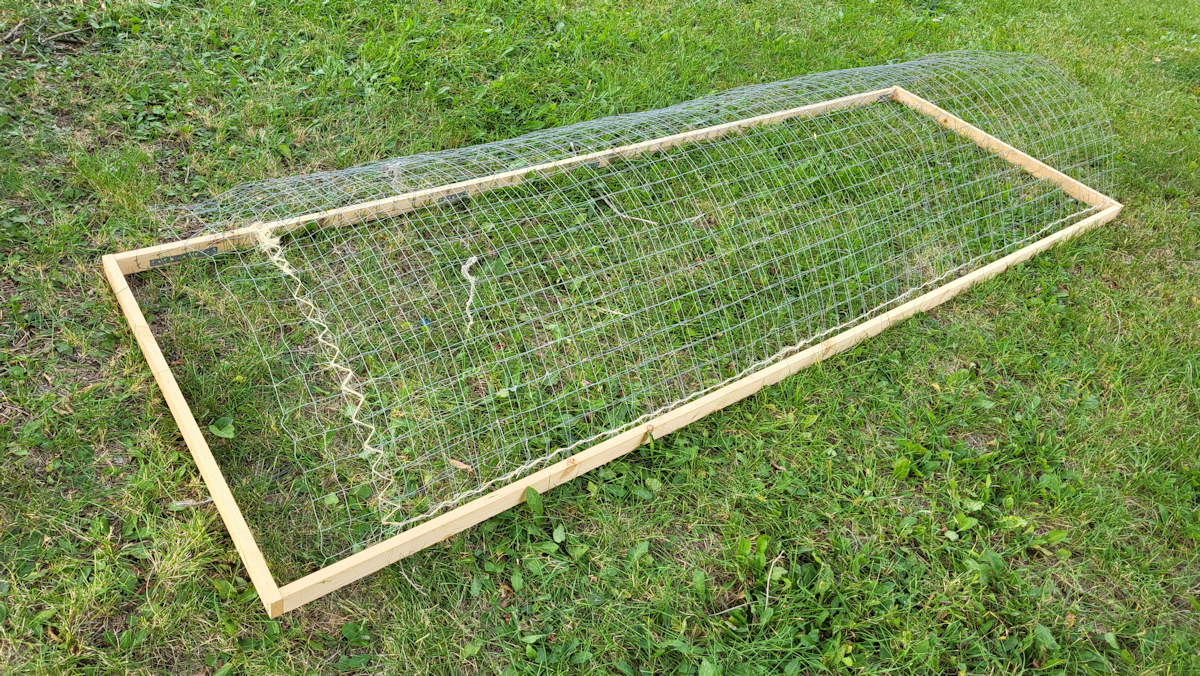
The wire I used was 2″ hardware cloth salvaged from the old squash tunnel. The roll is 4′ wide, so I could just use the length, rather than cutting strips, like I had to with the fence wire and the plastic hardware cloth. I was going to cut it to 9′ until I realized I had close to double that, so I folded it almost in half.

Putting the first side on was fairly easy. I used the steel strips again, as they are a lot more secure. In the past, for wire like this, we used staples, and there’s no way staples would hold this in place while being manhandled on and off raised beds.. The only real hard part of attaching the first side was having The Phantom suddenly decide she absolutely had to have attention! She’s been making strange lately, and I thought she was getting more feral, but not today!

Also, as she rolled around, I could see a single active nip. I had been wondering, as she never looked pregnant, if perhaps she were infertile, but she does have a single kitten somewhere.

Speaking of kittens, they were all over the place, and more of them are showing red and/or sticky eyes. None as bad as the two we regularly bring inside to wash their eyes, thankfully, but my goodness, it’s bad this year!

Anyhow… where was I? Oh, yes… the wire.

Once the first side was attached, getting the second side done was a real pain. The two layers of wire mesh kept getting stuck on each other and misaligning. After fighting with is for about half an hour, at least, I finally got some jute twine and wrapped the length of it near one edge, from the fold to where one end was a few inches shorter than the other, then secured the short end as well. Only then could I finally attach the other side to the frame.

Unfortunately, I started to run low on the short screws I was using the attach the steel strips. I had just enough to secure the length, but only on the bottom edges. What it needs is more of them to secure the wire to the top edges, to keep it from pulling away.

So… more of that size of screw is on my shopping list. I did try to secure it a bit better using the staple gun, but didn’t finish. Even with the steel straps, they will easily pop out.

Aside from securing the wire to the frame some more, I am thinking it will probably need more support. The wire can hold itself up, but it bends very easily. It would take next to nothing to crush the arch. If a cat decided to jump on it or something, it would collapse completely. I think I have a couple more lengths of the PEX pipe, but I would want at least 4 preferably 5, to support the wire.

So the cover is done to the point that it can be used, but needs a bit more to make it stronger.

For this one, I’m glad I decided to fold the hardware cloth in half rather than cut it too length. If it were 1″ squares or less, it would be stronger, but with 2″ squares, it’s relatively flimsy. It will be okay when we use other strips of the 2″ hardware cloth on the box frame to protect the bed with the popcorn in it, but not so much as a self supporting arch.

So, here are our experimental results.

The first one we built was the box cover, designed specifically to go over taller things like the Tom Thumb popcorn. It is intended to support wire, shade cloth, etc., as needed. It is probably the most structurally sound of the frames we made. It is unlikely we will need to build more like this, simply because things we grow that are taller are more likely to need other types of support or protection.

I can see two problems with this design. 1) Once the sides are wrapped in wire, there is basically no way to tend the bed without removing the entire cover, and 2) for anything needing a cover this tall, removing it would require 2 people, to avoid damage. If, however, it were wrapped in fabric mesh or netting, it could be done in such a way that the netting could be lifted for access. Fabric won’t keep the racoons out, though.

Conclusion: I’m happy with it. This frame is worth making again, if we ever need to protect tall plants, but there would be little need for more, based on our current garden needs.

The second one used fence wire we found in a shed. The fence wire turned out to have varying sizes of openings, from 6″ square to 6″ x 3″ The roll was just over 3′ wide, so we had to cut 3 strips to fit into the frame, with overlaps. I went with 5′ long strips to create a high arch, which worked out well for the bush beans.

The first problem we found was with how the vertical and horizontal wires were joined. Each intersection has a wire wrap, adding significant thickness to those spots. We were using U nails to attach them, hammering them diagonally over the joins to secure them. Between the nails themselves and the thickness, this was far more difficult than it should have been.

The wire itself was stiff enough that a couple of screws snapped in the frame’s corners, which resulted in them starting to rotate. Thankfully, we had a couple of scrap 9′ lengths that cut wonky, and were able to add those to the inside of the frame, sandwiching the fence wire in between. That also strengthened and secured the corners.

We currently have the frame over our bush beans, with netting on top, to protect the beans from critters. The wire wraps at each intersection is a problem, as the net catches on them, but aside from that, it’s ideal. The net strip is wide enough that I’ve even been able to secure the edges with ground staples into the soil under the frame, too.

Conclusion: I’m really happy with this one. I’m able to lift the netting and harvest through the fence wire without having to move the frame. If I can find 6″, or even 4″, square welded wire fencing, instead of the wrapped wire, that’s what I would use to make the majority of future covers. It’s strong enough to support itself. I could probably use 6′ lengths for an even higher arch, and it could still support itself, plus any shade cloth, insect netting, greenhouse plastic, etc. Though we would not use U nails again, and go with the steel strapping, I would still be good with that double thickness of wood on the long sides, which makes the whole thing much more structurally stable, while also securing the wire. In the future, I can see most of any new covers we make to be like this one, with a few modifications.

The third one is the one with the “rigid plastic” hardware cloth. Which turned out to not be very rigid at all. This is when I remembered I had the steel strapping and used that to secure the mesh. After the first hoops I tried to use, snapped screws in all the corners, I had to add extra pieces of wood inside the short ends. Switching to PEX pipe hoops worked much better, and the steel strapping worked well to secure the hoops, too.

The plastic hardware cloth rolls came in 3′ widths, so it took three lengths to cover the frame, which then had to be lashed together. I went with 4′ lengths this time, for a lower arch compared to the fence wire cover. Once the hoops were snugged in place and trimmed to size, I used garden twist ties to secure them to the mesh and prevent them from being pushed sideways.

With the outward pressure of the hoops, this frame had a couple of screw eyes added to the middle of each long side and cord strung across, to keep the sides from bowing outwards.

Conclusion: This frame is definitely the most aesthetically pleasing of them all. It’s easy to move around with 1 person, and the lower arch is good for shorter crops. I would not, however, use this plastic hardware cloth again. It creates too much shade. Which is great if I have it over a bed of lettuce, but obviously, it wouldn’t be good to use over something that needs full sun. I also would rather have the flexibility of using whatever cover I need for a particular bed. I want these frames to be interchangeable as possible, whether a bed needs shade cloth, greenhouse plastic, or frost protection. If I need to use hoops for support again, the PEX pipe is definitely the way to go.

Last of all is the frame done today, so I’ll just go straight to the conclusion:

Conclusion: As this one didn’t need any extra wood added to the sides or ends, it is the least structurally secure, but that’s an easy fix. I would not use this 2″ hardware cloth again, though, for the same reason I wouldn’t use chicken wire. It’s just not strong enough, and bends too easily, even doubled up.. It will also need support hoops added at some point. It’ll be used, but that’s about it.

As we build more high raised beds, we will also build more covers Experimenting with the different materials has shown me a lot of what works best for our needs – and what to avoid! Armed with this information, I’ll know what to keep an eye out for and pick up as the budget allows, to have on hand for when we have more beds to protect!

The Re-Farmer

So much done!

I am so happy right now!

Absolutely wasted, and will probably be sore and barely able to move tomorrow, but happy!

My daughter and I got so much done today. But first, the cuteness!

Would you look at that flat pancake of a kitten!

This one actually allows me to pet it, and even pick it up at times.

After our failure this morning in getting a shelter over the stump bench, I decided we may as well cut down the dead tree beside it. I was then going to clean up the bench and get at least one coat of paint on it.

Well, it didn’t quite work out that way.

First, the dead spruce…

The first photo is the “before” image. Instagram crops things weird, and their crop options suck, so you can’t see the bench in that one.

Which direction to get it to fall was the issue. No matter where it fell, it would be landing on something. The thing was to get it to land on something with the least amount of damage. So I tried to get it to fall on the bench, in the middle, where it has the most support. It would still be hitting the big maple on the way down, but not as much of it.

As you can see in the second photo, it came down about as perfect as could be! One maple branch broke off and that was it.

My daughter and I then cut off all the branches; me with the chain saw, her with the electric pruner/baby chainsaw.

Once the branches were clear, I cut away the few bits of wood that were holding the trunk to the stump still, then cut the end flat. We then measured out 18′, and cut it with a few inches extra. This log is the right size to match the largest log we’ve got for the trellis bed. The two largest logs will be the bottoms longs for the sides, then the thinner ones will go on top.

Next, we cleared away all the branches and extra pieces. There was another stump that had originally been intended to be part of the stump bench, but it was too rotten. That finally got cut down to ground level. The new stump was also got trimmed lower, though not quite to ground level. Maybe we’ll put a planter on it or something, at some point. 😊 We also used a rope and dragged the 18′ piece over to where the trellis bed will be built.

It was SO much easier to grad that big log with two people!

This is the third dead spruce we’ve cleared out of this one little section. At least one of them was killed off by the Virginia creeper that had been allowed to attach itself to it. This tree that we had cleared away had still been alive until last year or so.

Then, since I had the chain saw handy, and 200 ft of extension cord, I took advantage of it.

First, I dealt with the crab apple trees.

The easy part was cutting away the remains of a dead crab apple tree that was off by itself. In the photos with the dead spruce tree, you can actually see it through the dead branches of the fallen tree.

In the above photos, the first one is in between two large crab apple trees. These were suckers growing out from around the remains of trees that died long ago. They were much harder to cut away and clean up, because they were so tangled up in the two live trees. In one of those, I cut away some dead branches, too.

Now that the suckers are gone, there are branches from the live trees hanging really low, as they are no longer being held up by the suckers!

The second photo shows where the single dead crab apple tree had been. Between the freshly cut stump and the next live tree are another three stumps cut to ground level, plus two more behind where I’m standing to take the photo. Way too many trees were planted way too close together!

There is still one more at the very end that will need cleaning up. Again, the original tree had died long ago, and there are just suckers growing. There may still be one that produces tasty apples; another that I knew for sure had good apples broke in a storm last year and didn’t recover. We’ll see if any of the remaining ones are worth salvaging, but they won’t be ripe for at least another month.

My daughter made many trips to the branch pile past the fire pit, clearing away as I cut. As we were finishing up, I decided to take a closer look at the stuck tree my brother had cut down for me. I wanted to see if I could safely cut away the dead tree it was stuck on. There were actually a couple of trees that were holding it up. One was a small spruce that got bent under the fallen trunk. Sadly, I had to cut it, even though it was still alive. I could see that even if I got the bigger tree cut away, the little one would still hold up the tree we were trying to access, and cause the tree we were after to roll towards other trees, rather than fall to the ground

I was able to cut through the little spruce’s trunk, but with everything so jammed together, nothing moved. I was, however, able to get a good look at the dead tree the fallen tree was stuck on.

It wasn’t a tree.

What you’re seeing in that first photo is a tree top. You can see that, at some point, the tip had broken off, and two branches grew upwards, forming a double top. This is pretty common for spruces. As the tree my brother cut down fell and got caught on other trees, it broke this tree top. As it slowly continued to fall lowers in high winds, the tree top ended up vertical, with its broken end on the ground as it it had grown there!

In the second photo, you can see the tree with a broken off top that I think it came from.

So I grabbed the rope my daughter and I used to drag the 18′ log out, and wrapped it around the bottom of the tree top. I wasn’t able to get it completely off, as there were branches getting caught, but it is no longer holding up the stuck tree. Since I had also cut the other little tree, that came off its stump and fell, too. Finally, the stuck tree came down! No, it’s not on the ground, but that’s just fine. It’s only being held up by its own branches and undergrowth now, and it completely accessible!

We can now clear it, cut it to size and drag the pieces out.

But not today! My daughter and I were both completely beat by then. Thank goodness it was a “cooler” day, with a high of “only” 27C/81F.

So… we didn’t paint the bench and, with possible thunderstorms or showers starting tomorrow afternoon and over the next few days (depending on what app I look at), it may not get done for possibly another week.

That’s okay. The bench and the folding table I want to also paint won’t melt. It just means we work on something else, instead. Like finally continuing that trellis bed!

I’m just so happy we were able to get all this stuff done. It feels so good!

The Re-Farmer

Trying to get things done

It was supposed to start getting cooler today. I guess a high of 28C/82F is “cooler” than a high of 30C/86F, but it sure doesn’t feel that way. As I write this, it’s 26C/79F and I’ve been driven inside by the heat.

My daughters headed out much earlier in the day. They took care of feeding the outside cats before clearing the area we will be planting the saffron crocuses when they come in, and pruning away some of the dead, overhanging branches. They also fought with that last carport support for me. They couldn’t get it completely together, but it’s close enough that it’ll work. For all the trouble it is to put it together, it’s almost as difficult to take it apart, too.

Thanks to them, I was able to actually sleep in a bit. At least as much as the kittens would let me! 😁 I even had breakfast before going outside for a change! In the slow cooker last night, I put in a whole bunch of our own garden vegetables – both green and yellow patty pan squash, a yellow zucchini, green and yellow bush beans, two massive cloves of garlic – that largest bulb we had that had to be used because it was starting to split apart was made up of only 4 cloves! – along with a family size package of ground beef, browned, and two cans of crushed tomatoes, plus salt and pepper for seasoning. It was set to low for 8 hours. My husband and I both had it for breakfast, and it was quite good. What we don’t eat today will be frozen in individual portions for heat and eat meals.

Here are some things from the garden from this morning.

The mystery squash are starting to show patterning. They almost look like those cross pollinated zucchini we were given last year, but the plant is a vine type, not a bush type.

The mesh covered bed was something I did last night, while doing my evening rounds. I had noticed the grass mulch in between the rows were getting spread out to the point of covering the seedlings and starting to kill them. Last night, I saw the culprits in action. Robins! They’re just digging around in the garden bed and spreading the grass clippings. So I dug one of the rolls of mosquito netting out of the garden shed to lay over the bed.

Then I put it back and got a different roll that was long enough to cover the bed. 😄

This should protect the seedlings from the grasshoppers, too.

I was seeing lots of pollinators today. The one in the photo actually seemed to be stuck in the flower, so I moved off a leaf that was pressing into it, and it eventually crawled out, then stopped for a rest! Though there were lots of pollinators, I still hand pollinated the open female squash blossoms I found, just to be on the safe side. I’m so happy to be seeing so many of them!

I got a picture this morning, of some modifications I did to the melon bed last night. I added more cross pieces closer to the top, then strung twine around it for the vines to grow. The metal pieces I used were longer, so I decided to take advantage of that and strung twine to the ends as well. We’ve been regularly trying to train the vines to keep climbing upwards, so things are more open below, for more air circulation, light, pollinator access. The melons are all blooming like crazy right now, and I’m finding lots of female flowers! Because this bed it so densely plants, I’m leaving it to the insects to pollinate. 😁

Last of all, we have our very first harvest of ripe Spoon tomatoes!

After checking out all the garden beds, I started to work on the carport thingy. I moved the whole thing to where it’s going to be set up, then tried to stand it up. My thought was that, if I could get at least the first supports set up on the rebar stakes hammered into the ground, setting up the rest of them will get easier and easier.

Which probably would have been true, if I could set up that first set of supports at all!

I got one end over a piece of rebar (you can see some of them in the grass; they’re a sort of aquamarine colour), but the other end twisted in another direction, and simply would not twice back again. I brought the other ones closer and, of course, one of the side pieces popped off the middle piece. I was able to push the canopy up to access it and put it together, but it’s a looser join and it won’t take much for it to come apart again. Moving more pieces around, I’m pretty sure another side piece popped off.

Clearly, this wasn’t going to be a single person job. When both girls are available at the same time, we’ll work on it together.

With that job having to be set aside, I checked out where the crocus are going to be planted, then decided to take down part of a dead tree. As much as I could, using the battery operated pruner/mini chainsaw. There’s one fairly large tree that has finally died, but the main trunk will need a full chainsaw to cut it down.

I also pruned off a large branch from on of the ornamental crabapple trees in the old kitchen garden. I got as far as cutting the branch into smaller chunks, but that was as far as I could handle. It wasn’t quite full sun where I was working, but enough to make me really feel the heat! So those branches will be cleared away later in the day.

Short range forecast shows temperatures will continue to cool down slightly. I look forward to being able to stay outside longer and actually finish the jobs I start!

The Re-Farmer

Beaten by the heat

I managed to get a few things done before the heat finally drove me indoors. I had my lunch and a break in the blessedly air conditioned living room, then went back out again.

Alas, I was defeated, but not just by the heat.

As I write this, my computer tells me it’s 29C/84F out there. This is what the sun room thermometer shows.

Yeah, that reads 36C/97F. That’s with shade and the ceiling fan going. It felt cooler to go into the sun room than being outside.

Before it got too hot, though, the first thing I managed to do was complete our third raised bed cover. Here is how it looks, over our carrots.

I have to admit, it’s the best looking cover I’ve made so far! Appearances aside, there things I would both do, and not do, again.

The first is, I won’t use that plastic hardware cloth again. Aside from the “rigid” plastic being not rigid at all and needing support, the plastic mesh is thick enough to actually cast shade. Which would be great for a day like today over, say, a bed of lettuce or something. However, we don’t have lettuce growing in full sun right now and, as you can see, those carrots don’t need any more shade! However, it will protect them significantly. For more complete protection, I would close off the ends, too.

The second is, those hoops I took off the high raised bed worked MUCH better than the ones I tried using before. These were cut to length from a roll of PEX pipe, and I would definitely use more of this in the future. Once the hoops were secured and holding the plastic mesh taught, the excess was cut off, which was easy to do with just pruning shears. The pruning shears also turned out to be the best tool to cut the steal strapping I used to secure the mesh and the hoops to the wood. An added bonus with having the hoops is that, if this cover were used over a larger bed or directly on the soil, the ends of the hoops could be put over stakes to secure them.

The next thing I decided to do was see if I could assemble the parts and pieces for the carport thingy we found in the barn. The metal pieces had been stored in the hay loft, but the cover piece(s) were in the main area of the barn.

I didn’t realize what they were and used one of them to cover the pile of garden soil by the barn, which is why it’s so dirty in the photo. It wasn’t until I saw that the metal supports had no horizontals that I realized what the pockets in the “tarps” I found were for. Once I figured it out, I took it off the garden soil pile and tried to clean it, but it’s still pretty stained.

Each of the supports is in three pieces. Two side pieces that are hollow aluminum tubes, and one top piece that is the same material, with steel inserts at the ends to join with the side pieces. I tested it out with one set of supports, first, scrubbing the rust off the steel and wrestling the pieces together, then sliding it through a channel in the cover.

As expected, the support was far longer than the cover is wide, which would make for open sides. Which I am good with, but it does make me wonder if that’s how it’s supposed to be, or if the second cover is supposed to be used at the same time. That doesn’t make sense to me, since it would have an open “seam” at the top, from end to end. I’ve never seen this thing assembled, so I’m just guessing.

The test done, I brought the other pieces over. I plan to set it up above the tree stump bench by the main garden area, so I can paint it and not worry about it being rained on. There will be room enough to bring the folding table over for painting, too.

All the pieces got scrubbed down, removing rust and dust (at least I hope it was dust). To assemble it, I worked most of a side piece into one of the channels in the cover, then attached a top piece.

What a pain that turned out to be.

After more scrubbing, liberal use of WD40 and, in some cases, flipping the top piece to use the other end, I got them together.

Maybe not perfectly snug in places, but close enough.

After that, the pieces were long enough to push the rest of the way through the channels in the cover, and still have a couple of feet sticking out to add the other side pieces.

After much fighting, I got them together.

Excpet for one.

I fought with this long enough that I had to get out of the heat and take a break before going back out and fighting with it some more, but I just can’t get it any farther than this. I’ve scrubbed both the top piece insert and inside the side piece tube. I scraped around, and there is nothing blocking it. I even found a tire iron that fit in the tube and tried using it to scrape and possibly widen the opening. I checked to see if the side piece had been flattened in any way, and it was not.

It simply will. Not. Go all the way in.

I finally had to go in to get out of the heat for the rest of the afternoon, and will likely try again later. It’s possible that, as the day cools, the metal will shrink enough for the pieces to finally slide together.

Part of the frustration is that, aside from the straight section where the pieces join, the tupes have bends in them, so I can’t even hammer them together from the other side!

Oh, and one more thing. There are six sets of supports.

I got 10 short lengths of coated rebar to hammer in the ground to secure the supports. I’m short two! Dangit! While I was at the store, I considered getting two more, just in case, but figured I already had two extra. For some reason, I thought there were only 4 supports for the canopy, maybe 5.

Ah, well. As long as the ends are secured, it shouldn’t matter if a set in the middle is not.

It’s starting to cool down outside. I’m going to go feed the outside cats and do my evening rounds, then fight with it again.

The Re-Farmer