Garden bed and kibble house progress

Today’s high was supposed to be 19C/66F. I don’t know if we reached it, but with the blustery winds, it never felt that warm. I’ve been keeping a close eye on the weather, and my app on my desktop includes historical data for each day, including 30 year record highs and lows for various data. I noticed that today had a record high for snow of 14cm/5.5in in 2019. In fact, we set record highs for snow on the 10th, 11th and 12th, all in 2019. We were just coming to the end of our second year here, so I went looking at my blog posts for those dates.

Ah, yes. I remember that blizzard!

The amazing thing is that, just days later, all that snow was gone, and while we were still cleaning up storm damage, everything was back to green and sunny!

Depending on which app I look at, however, we might be getting a mix of snow and rain starting tomorrow night, and by Friday afternoon, we’re expected to get between 3-6cm (roughly 1-2 inches) of snow.

That meant my focus was preparing to build up walls around the L shaped bed in the old kitchen garden.

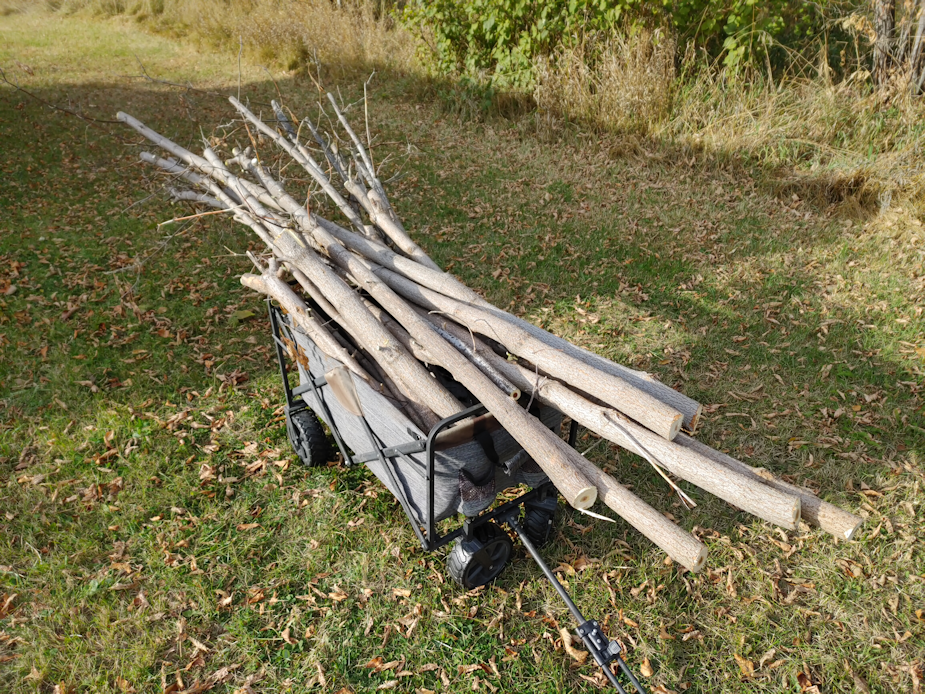
I went through the maple pieces I’d cut yesterday and started cutting them to size, cutting points on them, and debarking some of them.

I had lots of furry help. So much help, one of the kitties got plumb tuckered out!

From the longest, straightest pieces of maple, I cut three into 4 foot lengths. Then I went through some of the strongest pieces to cut four 3 foot lengths, then four 2 1/2 foot lengths. After that, I just cut as many 2 1/2 foot lengths from the thinner straight pieces as I could get out of them.

I used a hatchet to cut the points on all of them. That was probably the most unpleasant part of the job. Not so much for the thinner pieces, but for all the thicker ones. I’m ambidextrous for most things, left handed when it comes to fine motor control, but for some things, I am completely right handed.

Using a hatchet is one of those things, and my right hand has been in terrible shape lately. I had difficulty gripping the hatchet, and had to stop frequently to give my hand a break.

The draw knife was awesome for debarking the wood. It’s still quite green and came off easily. I don’t have a way to secure the pieces I’m working on well, so there were quite a few times when I was pushing instead of drawing the blade – and it works just as well that was, too. For some of the thinner pieces, though, it was easier to just use a knife to debark them.

Also, no, that is not rust on the blade of the draw knife. It’s stained with tree sap.

The stack of the thinnest pieces did not get debarked. It would have taken forever and, at their sizes, it would have been awkward. The pieces that will be taking the most stress, however, have been debarked.

That all took a few hours.

Then it was time to get to the garden bed. I pulled the lettuce I’d left to go to seed (it looks like we’ll get seed from just one of them) and got ready to prep the bed. Without walls, soil was falling into the path and the inside of the L shape, and I don’t like wasting good soil!
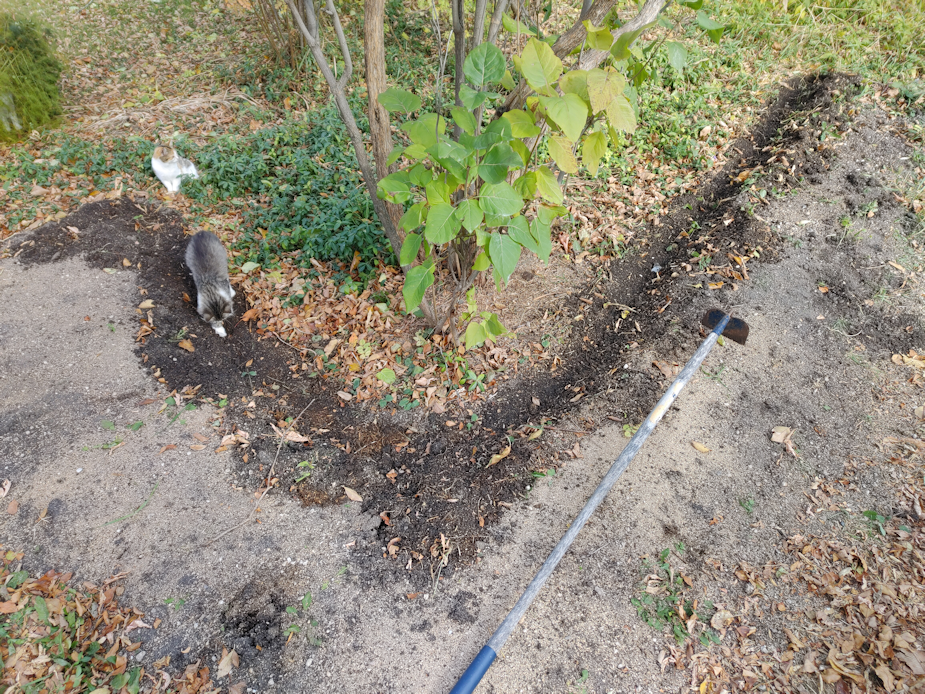
I used a hoe to draw some of that soil back into the bed, and level off the edge, where the uprights will be going.
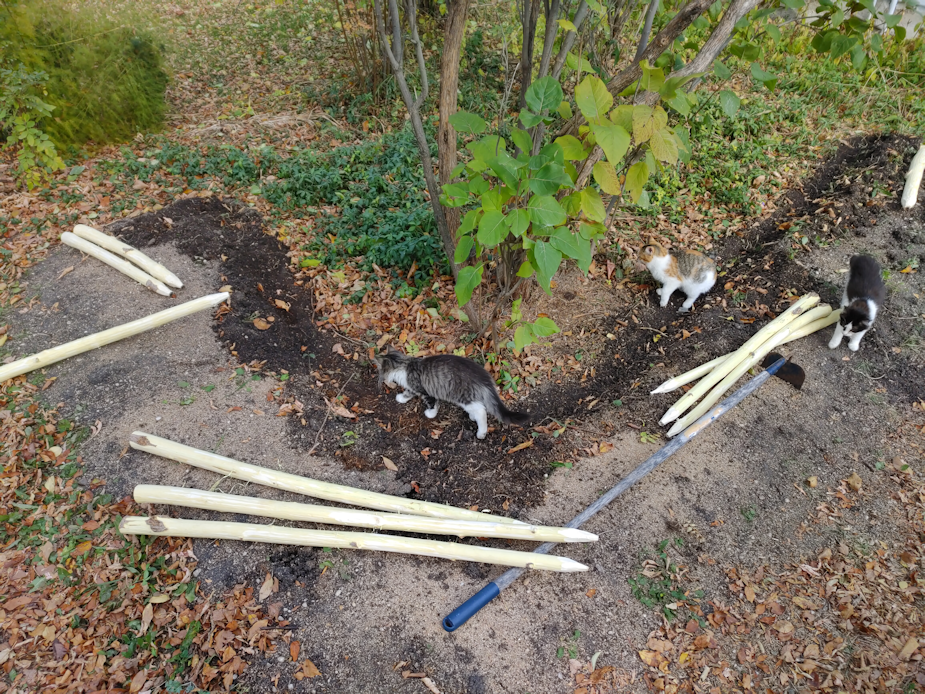
The three longest pieces will form a triangle at the inside of the bend. When we start weaving branches through the posts, these will be taking the most stress. Working out from there, one 3 ft piece will go along the short end, and three down the long end. If I have enough materials to do it, I plan to build up the wall higher at these posts, as much to wall around the lilac as to create a wall for the bed.

The four 2 1/2 ft pieces are for the corners at the ends of the bed.
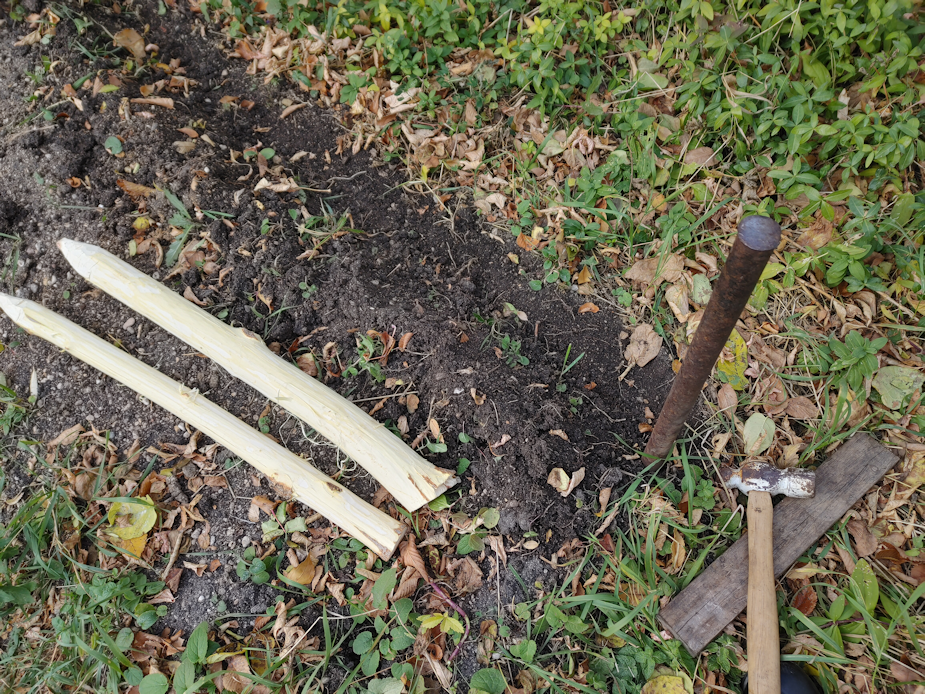
To install the posts, I used the pencil point bar and hammered it into the ground.

Unfortunately, that old hammer doesn’t have the right handle on it, and the head fell off again. I had to switch to a sledge hammer.

I really didn’t want to switch to the sledge hammer.

Ah, well. It worked better. I’m just going to be in a world of hurt, tonight!
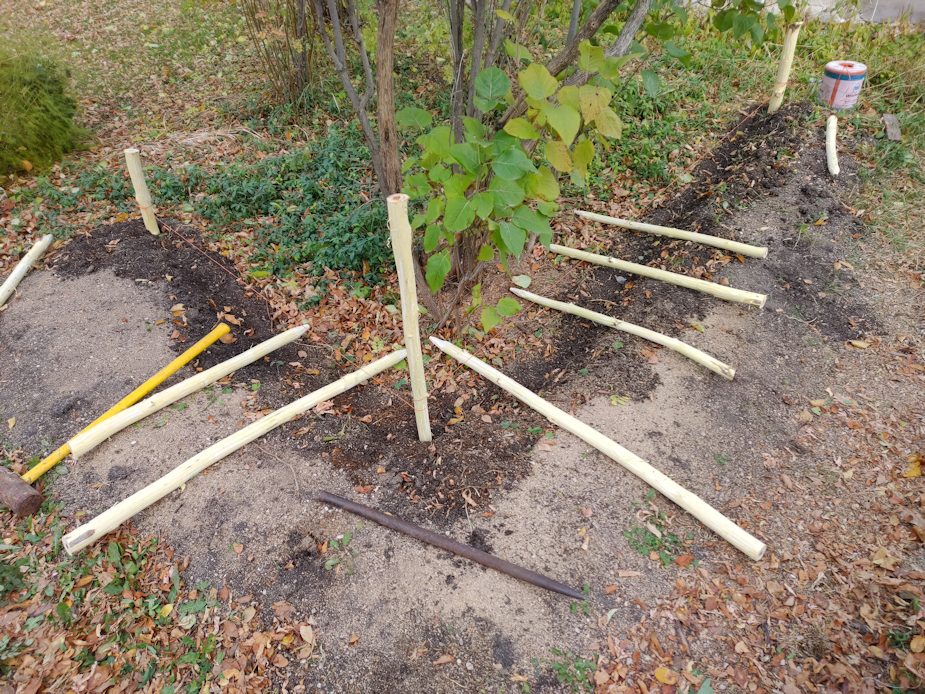
I started by placing three posts in, then tied twine between them as guides for the rest of the posts. Then I laid out the spacing for the remaining two 4 ft posts, and the four 3 ft posts.

At this point my daughter, who had been working on putting salvaged shingles on the kibble house, ran out of roofing tar. I’d only picked up a small can for patch jobs, never expecting to need more.

So I left my daughter to continue pounding in the posts while I went into town to pick up more tar, and a few other things while I was there. When I came back, I found my daughter lying on a tarp on the ground surrounded by kittens. She is having much more success at socializing than I am!
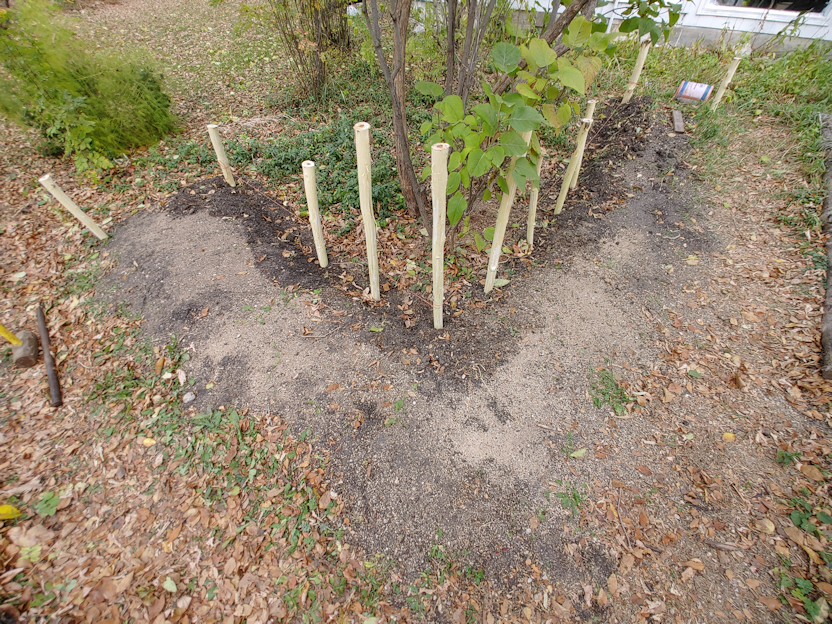
She had even pounded the other two corner posts at the ends of the L shape.

The weather was starting to get worse, so I quickly filled in the gaps with the smaller 2 1/2 ft posts.

The long end of the L shape will be only 2 feet wide, so the end posts needed just one more added in between them, plus three more along the north side. The short end of the L shape needed only 2 more to fill the gap. Since this end can be accessed from three sides, we’re okay with it being wider than 2 feet, so the end posts there got two more in between. The rest of the posts will be for the outside of the L shape.

From the looks of it, I’m going to need to find more pieces to be able to finish the outside of the bed, but I’m not concerned about that right now. It’s the inside of the L shape that I need to get done first.

By this time, however, dark clouds were rolling in and it was starting to look like rain, so I left the job at this point and focused on cleaning up and putting away anything that might blow away. My daughter, meanwhile, finished the roof of the kibble house.
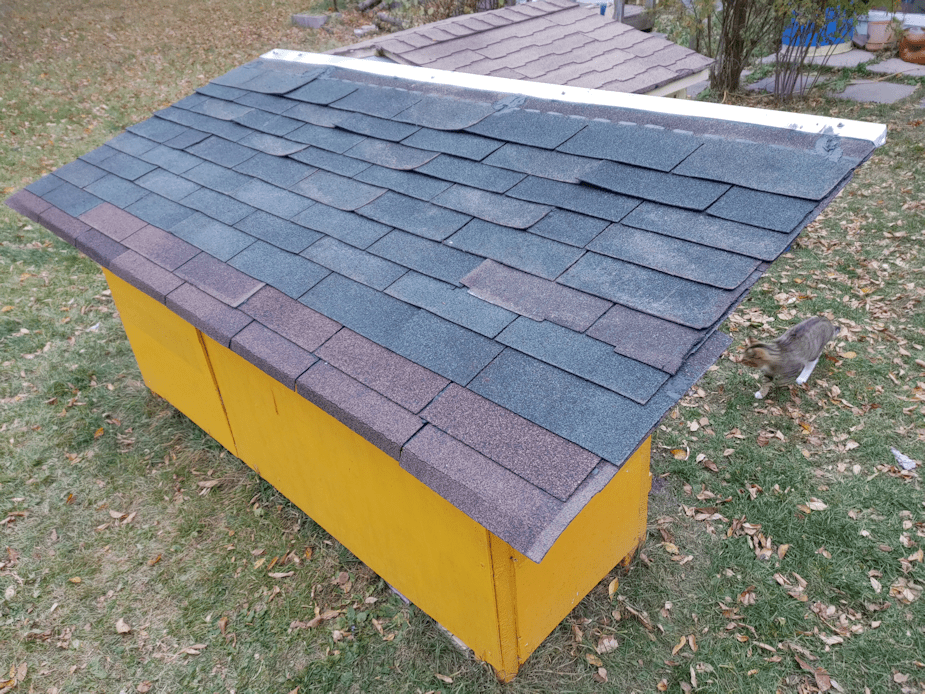
The green shingles are almost 50 years old and are in pretty rough shape. The brown ones are better, but they’re almost 30 years old.

The water bowl house roof is thinner plywood, so we’ll be using pieces of metal roofing that we’ve been scavenging for various things since we’ve moved here. If we used shingles, the nails we have would go right through by nearly half an inch, and that would be a problem! I dragged a piece of metal roofing out from the barn that we can cut in half and lay side by side to cover the roof of the water bowl house, but I also spotted a stack of corner pieces. I brought one over, and helped my daughter put it on the edge of the shingles on the kibble house. I found a bin of metal roofing screws in the warehouse, so I grabbed a bunch for when the water bowl house is done, and my daughter used a few of those to install the metal cap on the edge of the roof, using the screw holes that were already in the metal – after making sure to put some tar under each hole, first.

Almost everything about the kibble and water bowl houses has been done using scavenged bits and pieces we’ve found around the property, and a lot of it is pretty old and starting to rot. We don’t expect these to last long, but using paint and even decades old shingles will help them last longer. At some point, it’ll be nice to be able to build versions using new materials, all well measured and cut and leveled, etc. But this will do for now.

Once this was done, I set up a longer extension cord I found that was in good shape, and was able to plug in the cat’s house. We lifted the roof and put in the high density rubber mats I’d dragged out of the barn, which will help insulate the floor. There’s a thick scrap yarn crocheted blanket that is laid out on top of the mats, too. We will not be using straw this year. As much care as we have taken with the terrarium heater bulb, I would much rather not have straw in there! The heat bulb is working fine, with the heat shield still in place, and the timer is set to light sensor, so it will turn on when it gets dark, then off again when it gets light. The smoke detector was tested, too, and it’s working fine.

Once the water bowl house is done and set up where it will go, we’ll be able to plug in the heated water bowl through the cat’s house entry, too.

Tonight, the cats will have a warm and cozy place to stay if they start feeling too chilly. I especially hope the tiniest kittens will start using it!

As for me, I’ve pain killered up and hope I’ll be able to continue in the old kitchen garden tomorrow. For the weaving, I plan to cut the willow branches and use them right away, while they are still very green and flexible.

I really hope this works out. Otherwise, that’s a lot of work for nothing! Well. Not for nothing. Now that those posts are in, even if wattle weaving doesn’t work, I could still use them to hold whatever we find to use instead. It’s all fly-by-the-seat-of-our-pants work, anyhow!

Which is half the fun. 😊

The Re-Farmer

Multipurpose clean up

Today did not work out at all as planned. My daughters and I were originally going to take my mother to a marsh in the area to see the migrating birds – something my mother tries to do every fall. Unfortunately, my daughters weren’t feeling well, so we’ll be rescheduling that. We only have today and tomorrow for good weather, though, so I was going to go over to deliver some thanksgiving dinner to her and, if she felt up to it, maybe head to the marsh anyhow. Before heading over, I pulled my mother’s car out of the garage to do a bit of fall clean up – and discovered a flat tire! I pumped it up, then used our van. I couldn’t see anything that could cause a flat, and when I came home, the tire was still holding air, so I don’t know what’s going on there. I’m just glad I decided to clean out the car first, which requires moving the car out of the garage. Where her car is parked is so tight, I might not have seen it before leaving, if I hadn’t. I’ve left it out so we can check the tire any time we’re outside.

So there was no going anywhere with my mother, since it’s difficult for her to get in an out of our van. Instead, we had thanksgiving dinner together with the food that I brought. I am happy to say that she actually tried and enjoyed the peanut soup (after having an angry outburst over the fact that I brought soup at all), and even the roasted vegetables – though she did do a double take when she spotted a sunchoke, asking me what it was. When I told her, she started lecturing me about how I shouldn’t be growing “strange” things – after she had already eaten it! 😄

Overall, it was a good dinner, and I’m glad we were able to do it, in spite of some of the very strange attacks she came up with during conversation. 😄

It also meant that I was able to get home with the conditions still good enough to get some work done outside – though it did get very windy!

I need to build a wall along the “inside” of the L shaped bed in the old kitchen garden. Given what materials we have on hand, I was thinking of doing a wattle weave. I had intended to use lengths of maple suckers that I need to clear out of the maple grove, but after looking more closely at them, none of them were suitable for weaving, nor did they seem adequate for supports.

While bringing kibble to the tray in front of the pump shack, I took a closer look at some maple growing next to it. There was a maple that had been cut down, and suckers have been growing out of the stump for some years, to the point that they were getting into the power line running into the pump shack.

Lots of nice, straight and strong suckers, that would make good upright supports.

So that’s what I worked on today.

At some point, we should come back to the stump with a chain saw and try and clear it away even more. Maple stumps will send up suckers from the stump of a dead tree for ages, if something isn’t done to make sure it’s completely killed off. From what I could see, this maple has been cut down at least twice over the years, and been trimmed of suckers a number of times, too.

You can see where the power line attaches to the outside of the pump shack and runs in. That dangling board used to be attached to the side of the shack somehow. Something needs to be done about that, since it’s supposed to be supporting the line, not hanging off of it! Some of the suckers I cut away had branches tangled up in there. I’m very glad to have them clear of the shack!

I saved the straightest pieces. Hopefully, they will be easy to debark I wouldn’t want them to root themselves and start growing.

There was a lot of material that could not be used, too.

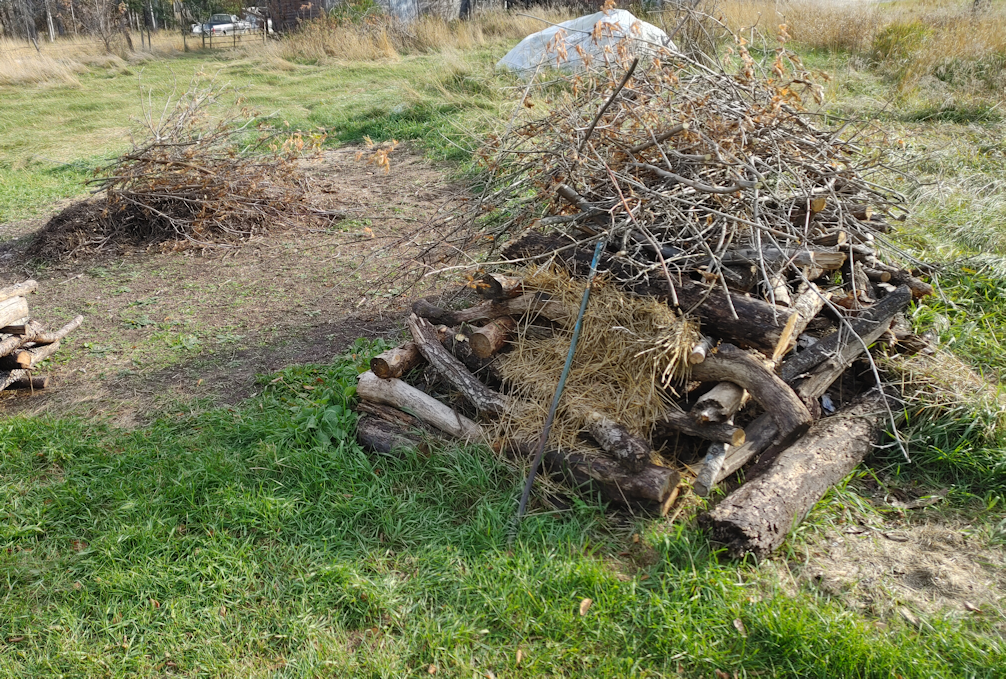
At first I put the cleaned up branches on the pyre stacked over the burnable garbage that’s too much for the burn barrel. On a calm day, we’ll have ourselves a bonfire! I ended up putting the last of the branches on the mostly composted bits that are left over from the branch pile that got chipped, just because there was getting to be too much on the bonfire pile.

I like being able to get more than one job done at once. I got to do some necessary clean up by the pump shack and it’s power line, and at the same time acquire materials to use for a garden bed or two!

As for the branches needed to weave around the uprights, I should be able to prune away suitable pieces of willow branches from the trees in the yard. Trees that have already been trimmed professionally to clear branches from the power line to the house, and that we need to keep trimmed. Willow is very enthusiastic about growing new branches after being pruned, and it’s been a couple of years. I’m just not sure we’ll have enough to do the wattle weaving I have in mind, but there are other willows in other areas in and around the yard that could probably use a good pruning, too!

I’m looking forward to trying to figure it all out, tomorrow. The temperatures are supposed to drop after tomorrow, but we’re also still expecting rain rather than snow, so it shouldn’t be too bad to get work done outside.

Now, if the wind would just die down, that would be great!

The Re-Farmer
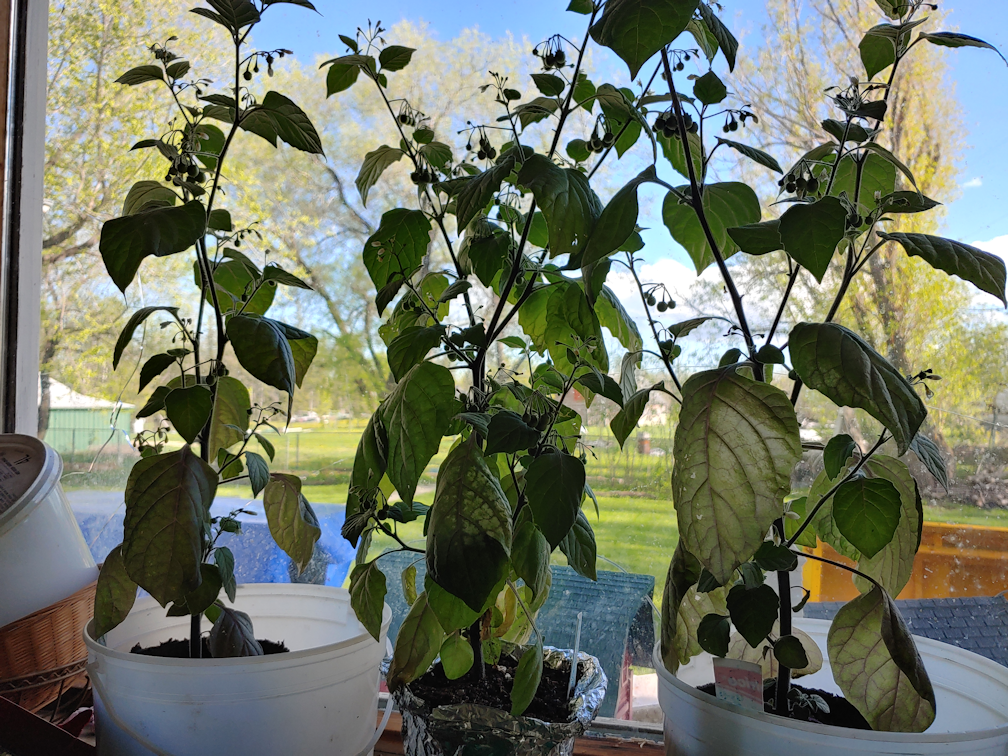
Small builds, and green tomatoes

It has been absolutely gorgeous outside today. As I write this, we are at 14C/56F. Just perfect to be outside for many hours!

I was planning to build a soil sifter today, but after fussing with the trail cams this morning, I decided I needed to build a new stand for one of them, first. The gate cam had stopped working again, even though I’d just changed the batteries. The day before, there were only 3 files recorded before it stopped working. The gate is more of a security priority, so I took the new solar powered camera from by the sign and set it up on the stand at the gate. Which was not as good of a set up, but it would do.

I brought the camera that had been at the gate inside and tested the batteries. They had gone down a lot, for being used only for a day, but they were still well into the green. After checking the camera itself out for a bit, I decided to take a scouring pad to the battery contacts in the flip-down cover. Water had gotten into it at some point, and there was rust, but I had given them a scrubbing before, and things were quite dry. Still, it was really the only thing that was available to do. Sure enough, it worked!

I wanted to leave the solar powered camera at the gate, so I took the now working camera to the sign. I could screw it onto the mounting plate, but it’s a very different design. Instead of screwing into the bottom, it screws into the back. With the other camera, I could swivel it into an angle that covered the front of the sign and, because it’s a wide angle camera, it also included the road and intersection. Not being able to swivel this camera meant that it was basically facing the sign, on edge.

I figured my best bet was to use the old flag stand the camera was mounted on at the gate, and bring it to the corner by the sign. That would actually work better than having it mounted on one of the supports holding up the tipping corner fence post. Which meant making something for the new camera, that I could attach the mounting plate to, for the gate.

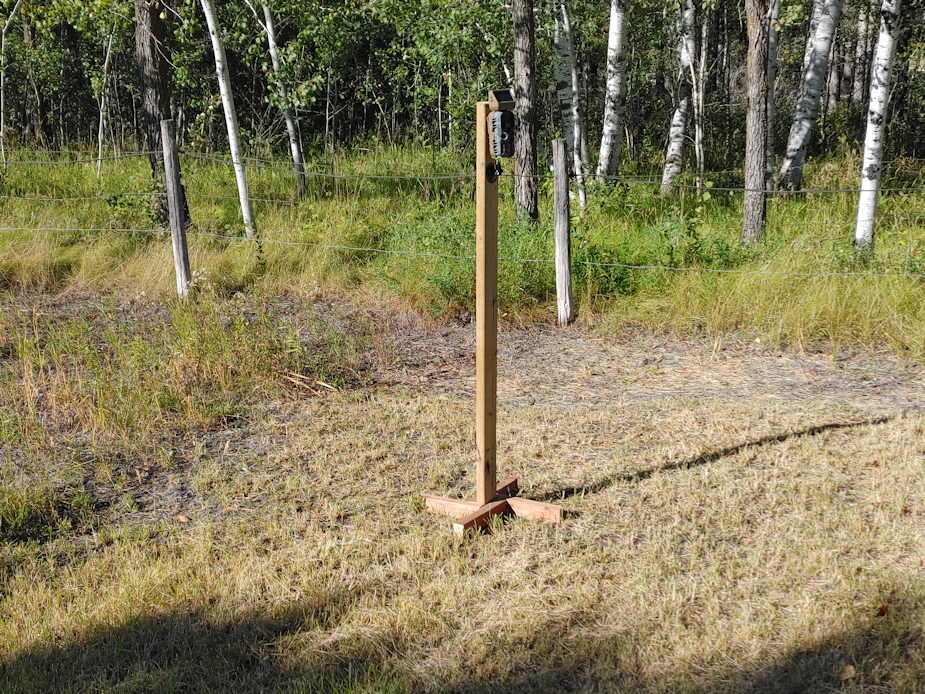
After scrounging in the barn for some scrap wood (I spotted a couple of Rosencrantz’ kittens just outside the barn!), this is what I made.

The solar panel makes the camera very top heavy. When it was mounted by the sign, there were many files motion triggered not by someone or something going by, but by the wind making the camera wobble on its mount. I made this stand taller, and attached the mounting plate low enough that I can use the strap that also came with it, to secure it more firmly and ensure no wobbles will trigger the motion sensor.

I moved the camera to the other side of the driveway, so that the solar panel will get maximum exposure to sunlight. With the wide angle lens, it also needs to be closer to the gate than the other camera. Once I find the sweet spot for coverage, I am thinking of pegging the legs to the ground, for extra stability. It would be better to have something like a sandbag, though, since I’d have to move it when mowing in the area.

Once that was done, I could start on the soil sifter.

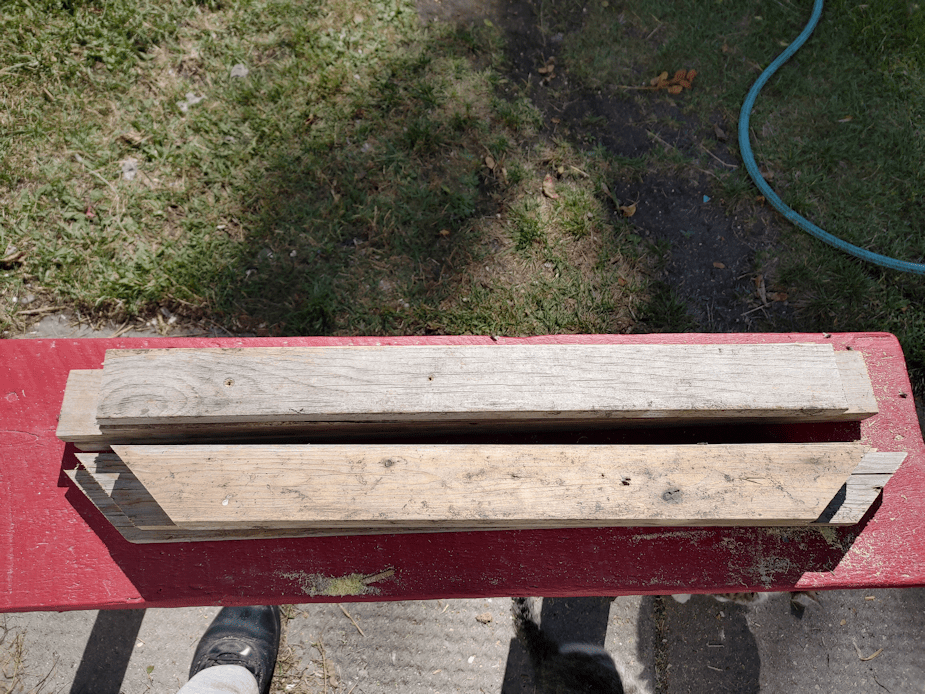
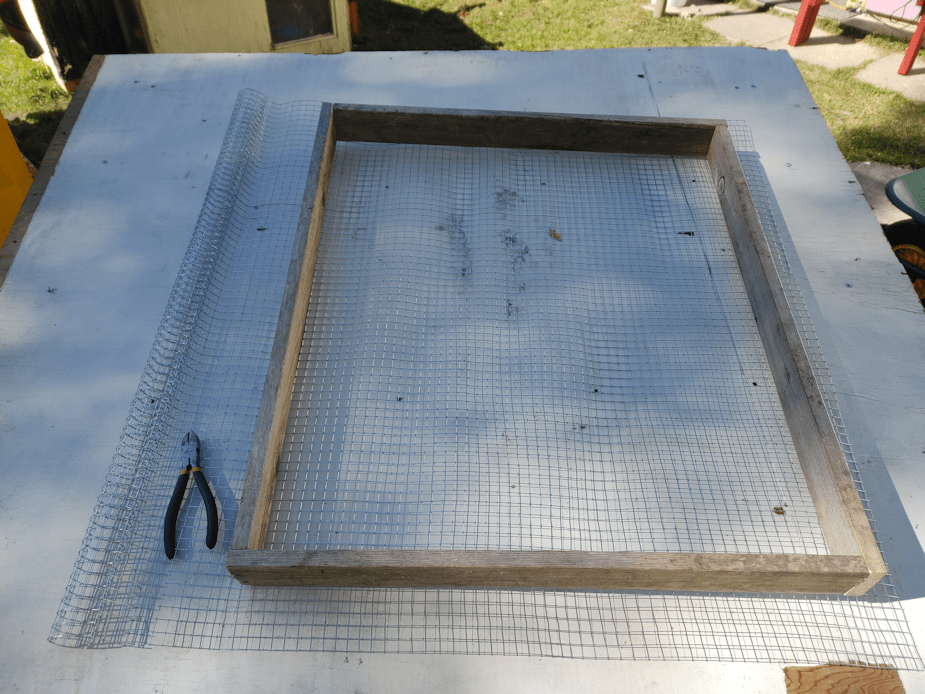
I measured our wheelbarrow and cut pieces for a 2’6″ x 2’4″ sifter. The straight pieces would form a box, and the angled pieces would make a frame.

At this point, the only thing holding the frame together are the metal right angle brackets on the corners. The frame would be secured to the box, with the hardware cloth sandwiched in between.

The roof of the water bowl house made an excellent surface to unroll the 1/2 inch hardware cloth, then use the box to measure out where to cut the wire. Once cut to size, I tacked the mesh to the box with a few staples, just to hold it in place while adding the frame.

There is, a problem with using salvaged wood for everything.

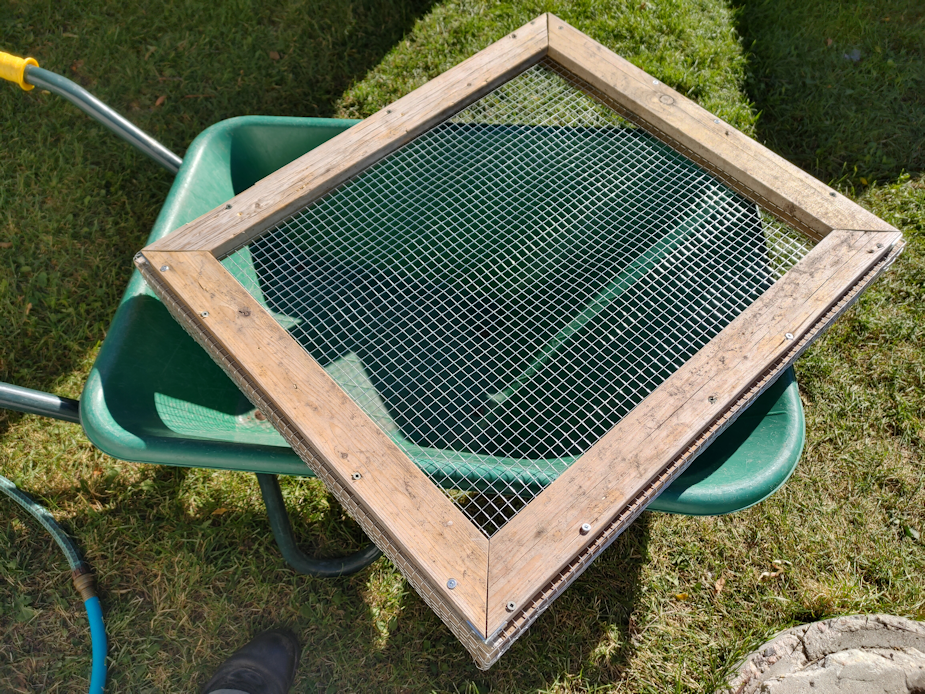
I should have made the frame pieces about an inch longer. I didn’t compensate for the slightly extra width the box got from how I attached them at the corners. However, the wood is warped and uneven, which meant there was no way I could match the frame to the box, even if I’d made the frame part bigger. In several places, I had to put the screws in at an angle to catch the edge of the box. I had been using a drill to make pilot holes, only to break the bit part way through, and I didn’t have another in that size. The wood is old and very dry, so it was easy to put the screws in without a pilot hold but, as you can see, the wood started to split in a couple of places. Some of the wood was already splitting on its own.

Once the frame and box were secured to each other, I folded the excess mesh onto the sides, cutting at the corners so that a piece could fold around the corner to be secured.

The mesh was secured with a LOT of staples around the outside of the box, and more staples were added to secure the mesh to the frame on the inside. These won’t hold well, though. We need a heavier duty staple gun for projects like this.

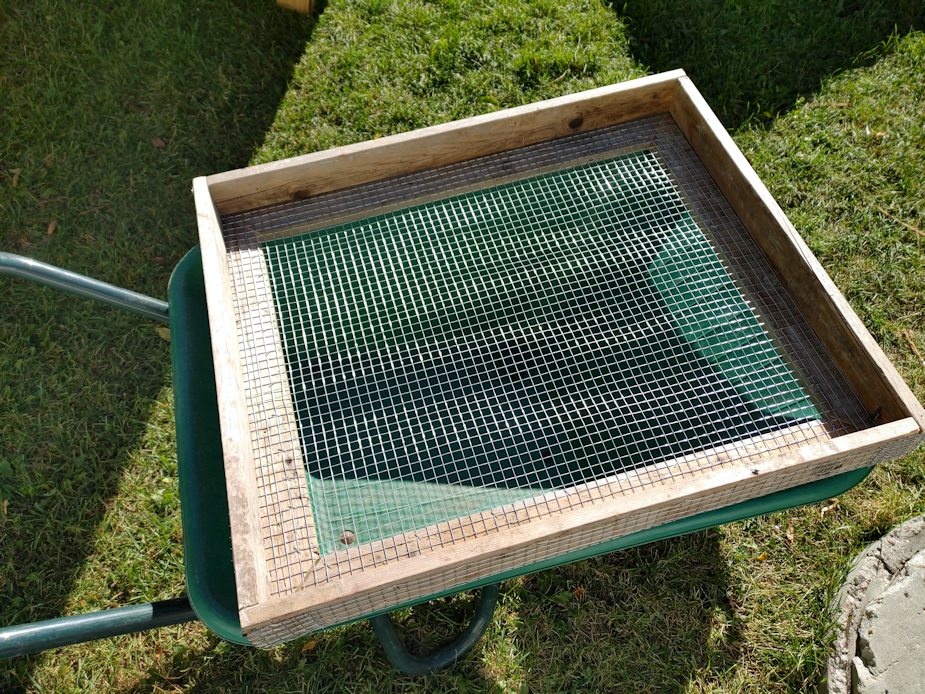
Once done and set up on the wheel barrow, I could really see how warped some of the wood it. It can’t lay flat. Which is okay. I am not expecting this to last very long, but if I can get a year or two out of it, that’ll be enough. I am planning on using it while cleaning up and preparing garden beds for next year, to sift out rocks and roots. I want to use it on the wood chips, too. The smaller chips can be used as mulch right away, while any larger pieces can be set aside until we can bring the wood chipper out and use the shredder chute to chop the bigger pieces finer.

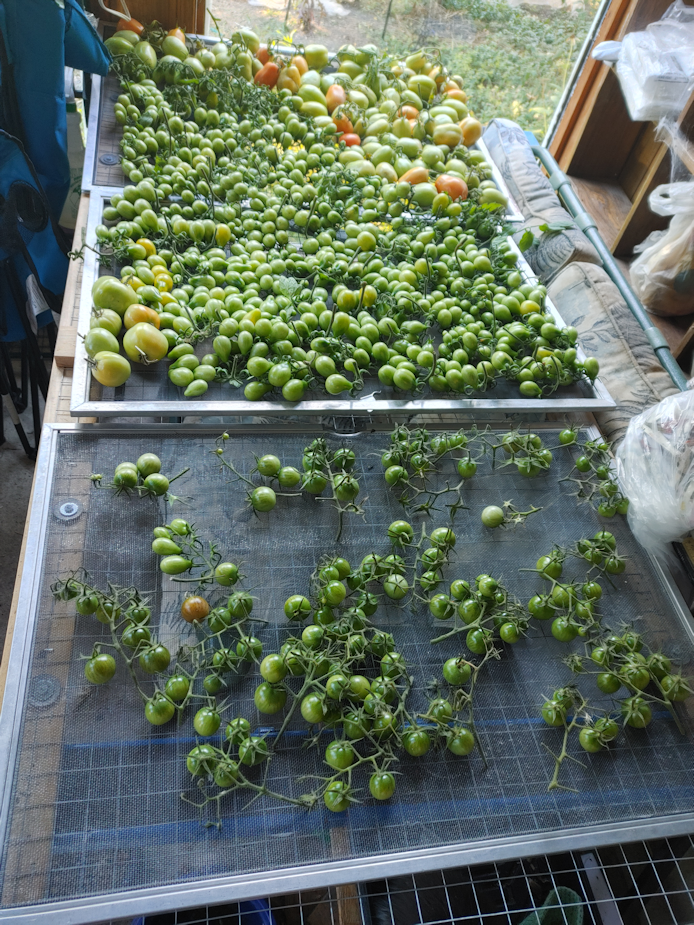
While I was working on that, one of the things the girls worked on was picking through and sorting all the tomatoes we picked. They found more slugs inside some tomatoes! The ripest tomatoes were set aside to use right away, while the greener ones were to be laid out on screens.

The problem was finding a place the screens could be laid out that the cats won’t get at.

We ended up using the sun room.

The onions were still laid out to cure on the wire mesh door we use for this, so we prepped them by trimming the roots, brushing off the dried dirt, and thinning the greens, before and my daughter braided them. It made for one very heavy braid! Once those were out of the way, we set screens up over the mesh door, and many of the tomatoes would fall straight through the mesh.

In the foreground are the chocolate cherry tomatoes. Then there’s all the yellow pear tomatoes, with the few remaining Sophie’s Choice tucked in with them. At the far end are the Cup of Moldova tomatoes.

They can stay in the sun room to ripen, though we will also be looking up recipes for using green tomatoes, too. There are plenty of ripe ones to start on first, though. Now that these ones are laid out on the screens, they can sit for a while before we have to get at them.

And the kittens can still use the swing bench, below. In fact, there was a kitten sleeping under the tomatoes when I took the picture! Unlike the inside cats, they have no interest at all in what’s on top of the screens. They just want soft, warm places to lie down and sleep!

The Re-Farmer

Have I mentioned I’m a suck for the cats?

It was a gorgeous afternoon and evening yesterday. Not only a pleasant temperature, but even the mosquitoes weren’t as bad. I didn’t want to go back inside when I was done what I needed to do!

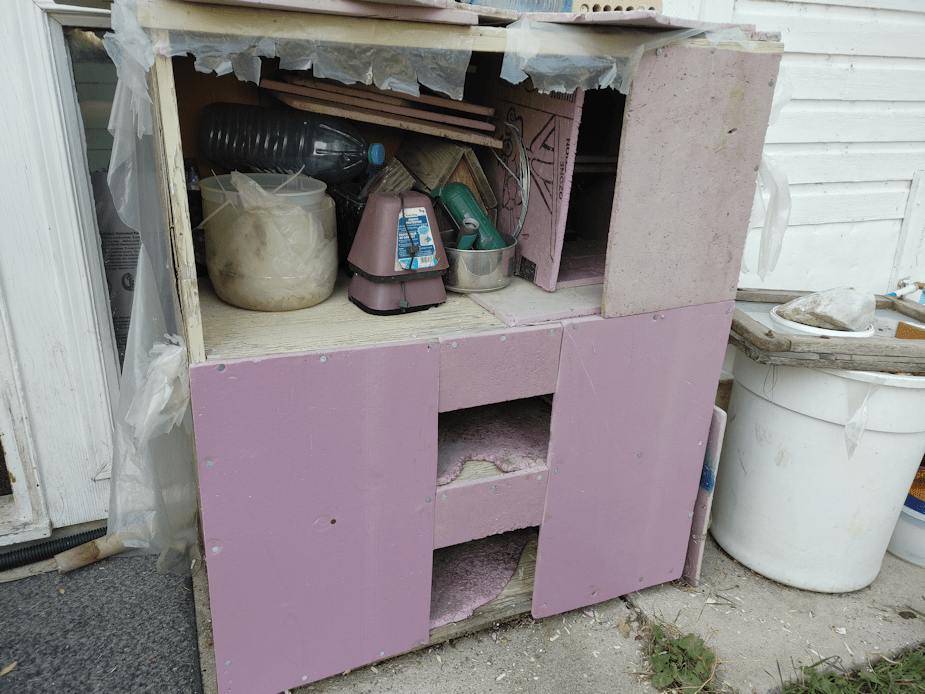
One of the things I did was re-do the shelf shelter for the cats. I noticed that the little kittens have been climbing all the way to the top shelf, which was actually use to store stuff, and have been snoozing in a corner, where I’d stacked some smaller pieces of rigid insulation.

The insulation over the bottom two shelves were getting ratty, so I decided to empty the whole thing, give it – and some of the insulation pieces – a hose-down and redo it.

Including making a next in the corner of the top shelf for the kittens, even though it meant not being able to fit everything back in again!

The sheets of insulation lining the bottom shelves were used again, since they fit the best and, aside from a few edges, still intact. When covering the fronts, I left the openings wider than before. When startled, the cats would dash out, catching on the edges of the insulation, sometimes hitting them hard enough to pull them right off the nails holding them to the shelf. I decided to try reducing the height of the openings. I want it open enough for them to easily get in and out, but small enough to let less of the weather in. Hopefully, they won’t get ripped right out by a startled cat!

As for the top shelf, I tucked a small pedestal plant stand in the corner and used it to support two levels with the rigid insulation for the kittens to lie on. There’s more space in front with an insulated floor, and there is insulation along the side and back walls, too. An extra piece across the front, and the kittens have their own little cubby hole to settle in.

Now I just need to clean up and redo the outside of the shelf. It had been wrapped in plastic to protect the wood from snow and rain, with an extended “roof” of rigid insulation, but the wind tore the plastic to shreds, and the cats have broken up the insulation. I’d like to find something sturdier to replace them with.

After I had emptied, swept and hosed down the inside, I had to give it time to dry before continuing, so I started another project.

A new cover for the rain barrel.

A couple of years ago, we made covers for the rain barrels out of window screen mesh and hula hoops. One for the barrel at the corner by the sun room, and the other for the barrel we fill with the host, at the far corner of the garden. The covers were partly to keep debris out, but also to make sure no critters fell into the barrels.

After a couple of years, however, the plastic hula hoops became brittle and started to crack. The cover for the garden barrel had been stored in the old garden shed for the winter, and it looks like something chewed holes in the mesh, too.

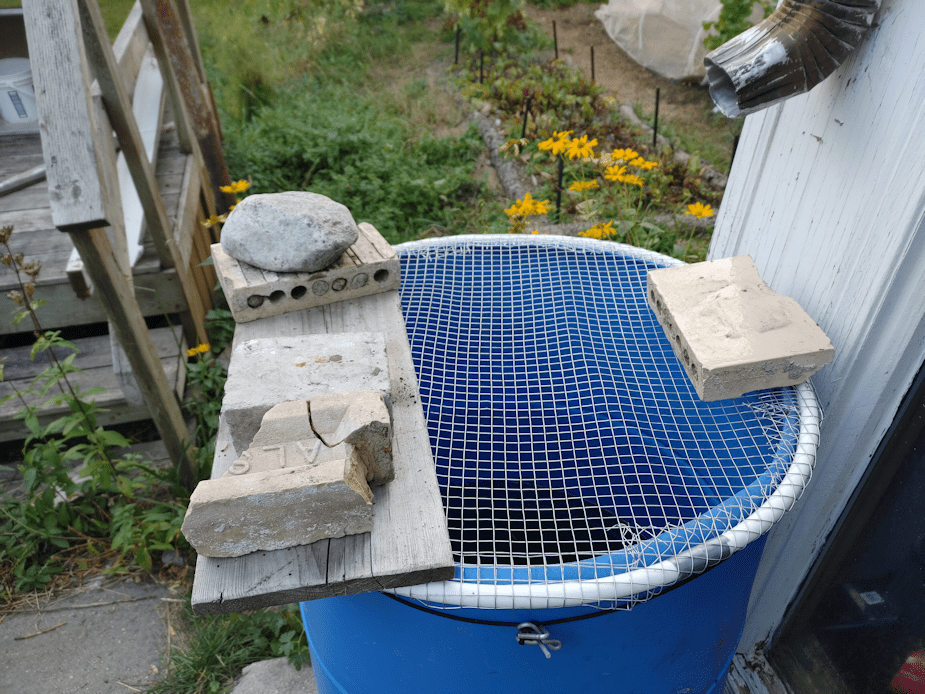
The sun room barrel’s cover is held in place with a board weighed down with bricks. When the barrel is getting full enough that more rain would cause it to overflow, the board and bricks hold the rain diverter in place.

Not long ago, I found the cover and its mesh broken up. Something had jumped onto it or something. The mesh had torn, but thankfully whatever did it, did not end up trapped in the water. Then we heard a commotion one night, and I came out to find the board and its weights, and the rain diverter, all knocked off the barrel, and the cover damaged even further. I put the board and its weights back, then found some pieces of rigid insulation to cover the rest of the barrel, with weights to hold them in place, to ensure no critter could access the water, until a new cover could be made. Even that ended up being pusher around a bit, as if some critter was trying to get at the water below – even though we have several bowls of fresh water critters can drink from. A new cover had to be made quickly.

Which is what I did while the shelf shelter was drying.

The materials used are much sturdier!

I considered using some chicken wire, but the openings are too large and the wire too easily broken. I went with some half inch hardware cloth I had, instead. The hoop is the same PEXX tubing I used to make arches to support netting over the old kitchen garden beds you can see in the background.

I used the barrel itself to measure the size needed to make the hoop, then cut a square of the hardware cloth to size, removing excess mesh from the corners to make it closer to “round”. The hardware cloth is a lot stiffer than chicken wire, but the extra strength is, I think, well worth it being such a pain to wrap around the hoop. Definitely glad for gardening gloves! The last step was to use a hammer on the underside to get the mesh right up against the hoop as tightly as I could.

There was, however, one problem.

The top of the barrel is not round. It’s more of an oval shape, and a wonky oval at that. The old hula hoop I’d used before was quite a bit larger than the top of the barrel, so it didn’t matter, but this hoop was cut for a more snug fit. The less sticking out, the less likely a critter will knock it off, even with the weights. I thought I’d still made it large enough to fit over, but the barrel’s shape was just too wonky.

I ended up tying some paracord around it as tight as I could, then used a metal tent peg to twist the cord even tigher.

Yeah. That bend up piece of metal was a tent peg.

Between the paracord pulling the top of the barrel into a more round shape, and the hammering of the hardware cloth tight against the hoop, I was finally able to get it in place. The board and weights were added to support the diverter when we need it, and the extra brick at the back, just in case something knocks the board off again, so the whole thing doesn’t flip off.

I might still add window screen mesh to this, since things like small frogs or insects, as well as small debris, can get through the half inch mesh. As it is right now, a cat – or even a racoon – could jump onto the cover and it’ll hold their weight without issue. The PEXX tubing will also last a lot longer, too.

All in all, I think it worked out rather well for using stuff I got for other projects! 😁 It didn’t even take that long to do. It took long enough for the washed out shelf to dry, at least.

So we now have a shelf shelter for the cats all cleaned out and ready for winter – on the inside, at least – and a cat and other critter proof cover for the rain barrel.

Ah, the things I do for the kitties!

The Re-Farmer
Our 2022 garden: ground cherry, popcorn and we surrender!

The rain held off this afternoon, so I headed out to where we finally decided to transplant the ground cherries.

After thoroughly dousing myself with mosquito repellant!!

This spot by the compost heap has been covered with that sheet of metal for about 2 years. The metal was placed there as something to put grass clippings on top of, so they’d be easier to collect and use later on.

Isn’t it amazing that, even while under metal, things were still trying to grow under there? !!

The soil was so soft under there, I could easily push the garden fork deeper than the length of the tines, and probably could have gone deeper if I’d wanted to. The ground was also pretty saturated, so it was muddy work to loosen the soil and pull out any roots – including some thoroughly rotted roots from the old tree stump under the compost pile nearby! No watering needed after they were planted, that’s for sure. In fact, I’m a bit concerned it might be too wet for them. We shall see.

The groundcherries got a good mulch with some of the grass clippings I had to move off the sheet of metal in order to move it. Here, they can be left to self seed, and hopefully we’ll get them year after year. We’ll just have to make sure they don’t spread too far and become invasive, which I’ve heard some people have had problems with.

The sheet of metal, meanwhile, is now sitting on top of the tall grass and weeds next to the ground cherries, weighted down with rocks to keep it from blowing away. Hopefully, it will help keep the crab grass and other weeds from invading the ground cherries.

When my daughter came out to help, we went looking through all the garden beds, talking about what needed to be done in each, before she started working on where we decided to plant our corn.

First, she dug a fairly narrow trench for the Tom Thumb popcorn, between the green patty pans and the Boston Marrow. These have a slightly longer growing season – 85-90 days – so we wanted to get them in first.

After she dug the small trench, she moved to the space between the Boston Marrow and the Lady Godiva pumpkins. There’s more space there, and it’s where we will be planting the Latte corn, which needs only 65 days to maturity, and bush beans.

While she worked on that trench, I used the hand cultivator to loosen up the smaller trench, pulled out the bigger rocks, and as many weed roots as I could. Then it got a layer of shredded paper, and finally a about 1 1/2 wheelbarrow loads of garden soil was added. I also removed the divots of sod and dumped them under some trees. They are so full of roots and rocks, it wasn’t worth the time to try and salvage any of the soil.

The Tom Thumb popcorn only grows to about 4 feet. The instructions said to plant them 5 or 6 inches apart, and in rows 36 inches apart, in blocks of at least 4 rows.

Obviously, we didn’t do that.

What we did do was plant two rows, with all the seeds about 6 inches apart. Once the soil was ready, my daughter had finished removing sod in the other area, so I just went down the prepared row, poking pairs of holes into the soil while my daughter went along behind me, dropping the little bitty corn seeds in! :-)

I’m glad we got those planted, because the next job was a killer.

In the second space, I went over it with the hand cultivator to get some of the bigger rocks out, and the more obvious roots. There’s just no way we could get rid of all the roots. While I worked on that, my daughter used one of the old, busted up wheelbarrows to get grass clippings. A full recycling bag of shredded paper went into the bottom, then grass clippings got scattered over the paper.

After dumping the remaining soil in the wheelbarrow in, my daughter went to get more soil with the good wheelbarrow, while I used the old one to remove the divots of sod.

I was reminded of just how badly broken up that old thing was! I’m amazed we got away with using it for as long as we did. In the end, I had to switch to the other old wheelbarrow. It’s smaller and also busted up, but at least it didn’t try to tip over every time I dropped a piece of sod in it, or roll away!

After a while, however, my daughter was waving the white flag. It was pretty hot, and very humid. For all the bug spray we used, we were just sweating it right off. The mosquitoes were after my daughter more than me (I reapplied bug spray, several times!), and after all the back breaking labour of removing sod, she was just done.

After she escaped the clouds of mosquitoes, I managed to move some more of the sod – using the good wheelbarrow! – before switching to getting a couple more loads of soil, and that was it. I surrendered, too! I think we did manage to get half of the area covered with fresh garden soil. The other half will probably need at least 4 – 6 more loads of soil, depending on how full the wheelbarrow is. It’s a fair distance to haul the soil from the pile in the outer yard, and we have to go around through the smaller person gate, rather than the closer vehicle gate, because there’s water there again, so we can’t get away with over filling it.

It’s a good thing the Latte corn and the bush beans we will be planting with them don’t need a lot of time to grow, because we probably won’t be able to work on this area tomorrow, and not just because I’m driving my mother to another medical appointment. We’re supposed to start raining again tonight, with thunderstorms over the next two days – complete with overland flow flooding alerts! I’ll be using my mother’s car to drive her. Hopefully, that one patch on the road near our place will stay solid enough by the time I am coming home, that her little car will get through. Anyhow; with the expected weather, we might not be able to finish this area and plant the Latte corn for several days.

By the time we’re done in this area, it will be quite intensely planted. Between that and the straw mulch we intend to add, I’m hoping that should keep the weeds down. Before that gets done, we’ll have to remove the rest of the sod and the piles of rocks scattered about.

It would have been much easier if we could do the carboard and straw like we did for the potato beds, but we just don’t have the carboard for that. We could get more later on, but we really wanted to get these in as quickly as possible. This will be the last direct sown seeds, besides any successive sowing we might do for a fall harvest.

This is also about as close as we’re getting to the “three sisters” method of planting. Hopefully, doing it this way will have the same benefits as the more traditional way. The only real problem I foresee is being able to access the bush beans to harvest them, when everything is all grown in. If we focus on putting the corn in the middle and the beans on the outside, we should be able to reach them okay. It’ll be trying to walk around the Boston Marrow and hulless pumpkins that will be more of a challenge, I think! With the Tom Thumb corn, it will be less of an issue, since they won’t be harvested until the cobs are completely dry on the stalk. Once the mulch is down, there’s not going to be much more needed for them.

If nothing else, this will be a learning experience.

And an experience in humility, as we get driven away by hoards of mosquitoes, trying to eat us alive!

I’m now going to go borrow my husband’s bath chair and shower off the smell of insect repellant now!

The Re-Farmer

Out of order, but it’s getting done

It had been my intention to work on clearing out that last low raised bed in the main garden area, at the very least, but once I got outside I changed my mind. There was less standing water in the yard, and the grass was getting out of control, so I decided to try mowing.

We have a large yard.

I was also using the collection bag to save those wonderful grass clippings to use as mulch. It doesn’t hold much, so there was a lot of stopping and starting to empty the bag.

After several hours, pretty much the entire inner yard was done. There was just one place that still had so much water that, even with the mower set higher than usual, it was just too deep. I even opened up the gate in the fence near the fire pit and mowed into the outer yard. I like keeping a lane in the grass to the back gate mowed, as an extension of the driveway. There’s too much water do to it in the usual areas, but I was able to clear a lane from the fire pit area, to where the lane would be. If we absolutely had to use the back gate, we would be able to drive through the inner yard to access it. We certainly wouldn’t be able to get through, the usual way!

Another of the goals will be to trim away some small trees taking over a corner, then mowing the areas where we will be planting the Korean Pine.

But not today!

Did I mention we have a large yard? :-D

The rest of the main garden area should get a once over with the mower, before going over it again with the weed trimmer, as close to the ground as possible, but I was just too exhausted to work on that today.

The ornamental apple trees are starting to bloom. So are the sour cherry trees, and all the lilacs are developing buds. Finally! That shows me that things have finally really warmed up, hopefully enough. I don’t know that we ever got frost last night, but the sweet potato slips are fine. I’m leaving the covers on them for one more night, though. Tonight is supposed to be the last cooler night, though I’ve noticed the forecasted overnight low has changed to quite a bit warmer than before.

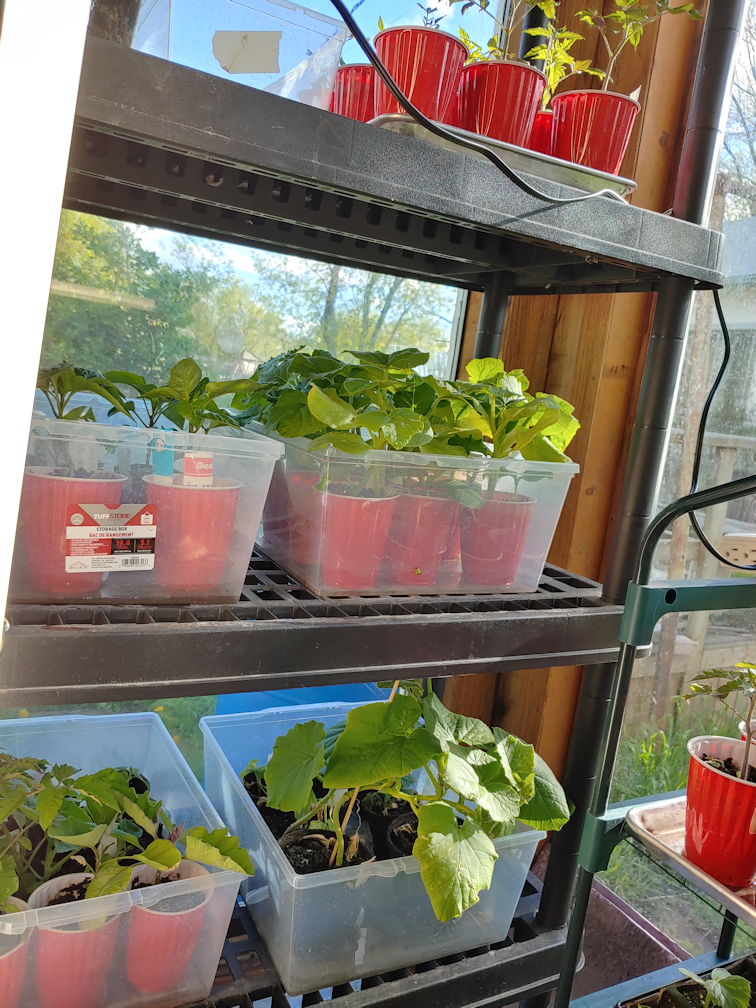
Tomorrow, we start transplanting everything. The sun room is turning into quite the jungle!

We’ve had a very high germination rate this year – a huge improvement from last year! Even the Yakteen gourds, which I restarted, have a few seedlings. Some things had seeds germinate weeks apart, but they still made it. We even have a second tulip tree sprouting! We’d pretty much lost all expectation of any more tulip trees, or any paw paws, germinating, so that was quite a nice surprise.

Another nice surprise is that all the turnips have started sprouting already! My goodness, that was fast.

Today, the girls finished transplanting the silver buffalo berry, and prepped to plant the sea buckthorn tomorrow. After that, it’s just the Korean Pine for this year’s food forest additions.

My priority tomorrow will be to get the newest low raised bed next to the compost pile topped up and ready for planting. The Kulli corn will be going in there, and I want to get that done as quickly as possible. They really need to be transplanted soon. If we start them indoors again, I won’t do the toilet tube pots. It worked well enough, and it certainly saved space, but the seedlings quickly needed more room to thrive. Even if they were in just the red Solo cups, they would have fared well longer. Once the corn is transplanted, we’ll have to make sure to put a net around it right away, so they don’t get eaten!

The girls will start transplanting tomatoes along the chain link fence in the south yard. We have more tomatoes than will fit there, though, so others will be planted in the low raised bed that I finished prepping yesterday. There are so many, we might have to the last one that still needs to be weeded, too.

It’s going to be a flurry of transplanting over the next few days. The sun room is going to look so empty when we are done! :-D We will also be direct sowing the pole beans at the squash tunnel, along with the 2 canteen gourds that are trying to claim their way out of their pots right now. Then there are the two types of corn to direct sow, and I honestly don’t know where we’ll be planting those. We’re really behind in preparing beds, but once those trees came in, they became the priority. Mowing and using the weed trimmer is also going to higher on the priority list, since the winter squash is going to be planted throughout the old garden area, not in prepared beds. Basically, we’re going to dig holes, add some garden soil and the transplants, and mulch around them. The grass is so tall right now, though, we couldn’t possibly get that done until it’s cleared.

Little by little, it’ll get done!

The Re-Farmer

Our 2022 garden: sad garlic

I’m mentioned in previous posts, that two of our garlic beds are not doing well. We planted all three beds at the same time, last year.

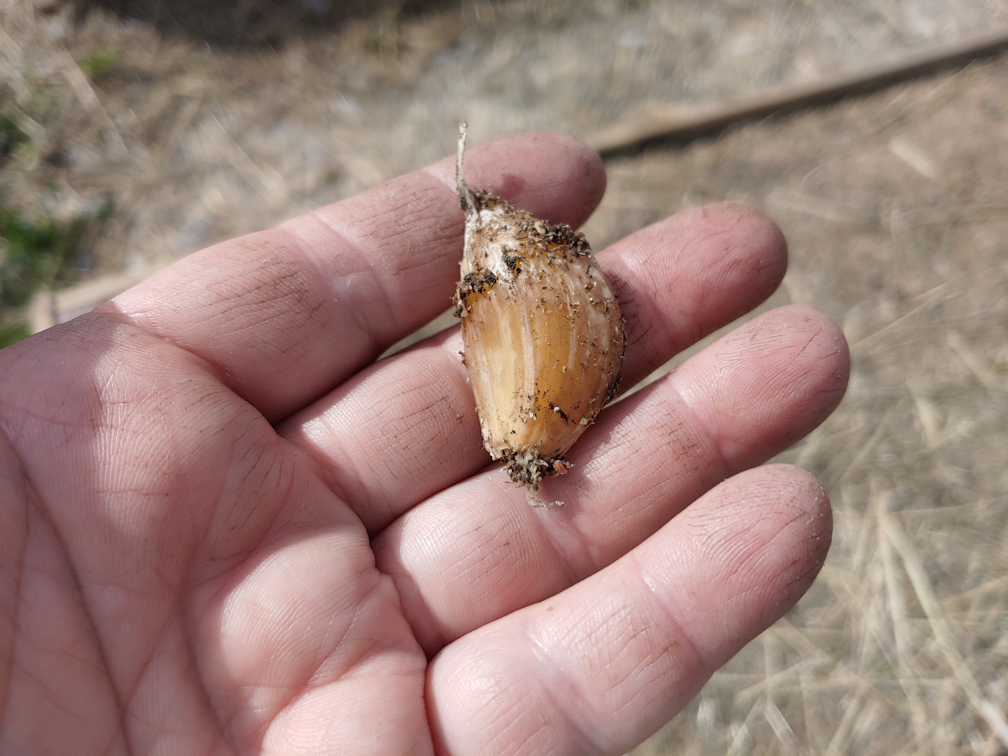
While doing my rounds this morning, I caught one of the yard cats being… inappropriate… in one of the low raised bed and chased it off. On checking the damage, I saw it had dug up one of the cloves we planted last year.

That is most definitely a dead clove. You can see that it had started to sprout, which would have been the fall growth before the snow fell. It does seem like cold killed a lot of these off.

This garlic is from the bed planted with Rocambole garlic.

There were 90 cloves planted in this bed. This morning, I counted maybe 7, including what looked like a tip just barely breaking through.

The bed with Purple Stripe in it is doing a bit better, in that there are more emerging, but it still looks like less than half have survived the winter, and they are all so very tiny.

I am curious as to why these beds did so poorly over the winter, while the Porcelain Music planted in the low raised bed in the main garden are doing to very well right now. Could it be, that the slightly higher boxes offered less protection than the lower, log framed bed?

Well, whatever the reason, I hope what few have survived manage to do well, even if they are quite a bit behind in growth. It may just mean we’ll be harvesting them later in the summer.

The Re-Farmer

It works!

Here’s hoping it stays working.

Today, we finally had a chance to test out the washing machine as the appliance guy described.

And by “we”, I mean mostly my younger daughter, who pulled out the dryer so she could get to the back of the washing machine, pausing first to remove the broken flexible drier hose and getting the new one ready. With me as the person to pass her tools, she popped the back panel off the washing machine to find the air hose he described.

Which is when we discovered that when he said “back panel”, he meant the small back panel of the electronics at the top, not the large back panel of the machine.

The small panel took a lot more effort to get off. We ended up having to pry it off with a butter knife. !!

His instructions were to blow into the air hose (which turned out to be MUCH smaller than I expected) to make sure it wasn’t clogged. My daughter figured out where the end of the hose was, how to get it off, and tested it.

While we manually pumped water out of the tub, we couldn’t quite get all of it, so when she blew on the hose, we could hear air bubbles in the tub.

Which was good. It meant the hose wasn’t clogged.

That meant the next step was to do an empty wash cycle. After everything was put back together, we plugged the washer in and started the empty test load.

After we taped the spare sump pump hose to the end of the washer’s drain hose, running it out the window of the storm door. We still weren’t sure about the drain pipe in the wall being unclogged enough to not spray water all over the place again.

One of our other concerns was the washer’s tub. It was still lower than it should have been, and I was concerned something got broken under it. My daughter pointed out that it did still have water in it, so that was likely why it was lower.

With nothing in the tub, the timer set itself for only 35 minutes. She and I both stayed and watched through the window in the lid, her behind the machine and me in front of it, for the whole time.

I gotta tell ya, we were just thrilled when the washing machine actually stopped adding water when it was a few inches deep, just as the appliance guy said it should, and again when it finally reached the rinse cycle and actually drained properly, with no leaks in the cobbled together hoses leading outside.

Part way through, my older daughter came by to see if she could help. I got her to fill a container of water so we could test the drain pipe. It seemed fine, but with the washing machine going, we couldn’t be sure things weren’t gurgling further down the pipe.

Once the washer was done, with everything working fine and even the tub lifting itself up as high as it normally does, we tested the drain pipe again. This time, while my daughter poured the water down the drain as fast as the funnel would let her, I had my head in the kitchen sink, listening to the pipes.

Normally, we’d be hearing all sorts of gurgles. We always have. This time, I heard nothing.

Just to be on the safe side, though, we used the last of the Max Gel drain de-clogger, both in the kitchen sink and the drain pipe. While that was left to sit for half an hour, my daughter and I pushed the washer back into place, then she started working on the dryer hose.

She was able to get it on the fitting in the wall easily enough, but the one coming out the dryer is slightly larger. The hose is held in place with an iron spring clamp. I was expecting a screw clamp. The spring clam is such a pain! It took her almost an hour to get it on. It simply did not want to fit around the pipe from the drier, and the hose, at the same time.

While she fought with that, I waited on the drain cleaner, (and kept an eye on a roast in the oven) and boiled up a kettle of water to flush them both with. Usually we just run hot water, but the kitchen sink is far from the hot water tank and takes forever to get hot. Once the drains got their boiling water treatment, I ran the hot water in one sink, listening to the drain in the other.

Not a gurgle to be heard.

I honestly think we got finally got the pipes clear.

After all the troubles we’ve been having, though, we aren’t confident.

My daughters had to do some laundry, so as soon as the dryer hose was finally attached, they decided to give it a go. While the washing machine tub seems to be behaving properly, they’re still going to do a couple of small loads, instead of one big one – and the washing machine’s drain hose is still set up to drain outside!

The problem with the drain hose is that the only way we can be sure if it’s clear enough is to actually let the washing machine drain through it. There’s nothing else we have that can push that much water, under that much pressure, though the drain pipe. If it does start backing up again, we’ll end up with the same mess all over again.

For now, we’re going to baby the darn thing, with small loads, until we’re sure the tub can handle the weight before increasing it.

Then we’ll test out the pipes.

The Re-Farmer

Garden prep – getting work done outside

Oh, what a lovely, lovely day! I was able to get things done that have been waiting for a day like today.

Before I get to that, though, take a look and who I found.

Possibly the same grog (groundhog) I saw this morning. It was at a space under the fence critters use to get through the chain link, but there’s water there right now. Because I was so close, it wanted to run through, but didn’t want to go through the water! It ended up running down the fence towards the junk pile, and I didn’t see it again until I was back in the house. The girls told me it was at the feeding station outside our living room window! I could tell it was the same one because it’s got burrs or something it its fur.

Then, as I sat down at my computer to upload photos, I saw two grogs running across the driveway towards the inner yard.

*sigh*

We’re going to have our work cut out for us!

Anyhow. Back to business!

The first thing I wanted to get done was lay out the salvaged black tarps (or whatever they are) in the main garden area.

Click on the images to see them larger.

In the background, you can see sticks coming out of the ground where a groundhog’s den used to be. It took shoving those sticks into the hole and burying them to finally get it out of there. They will be trimmed, later.

The black plastic should help warm up the soil, while also killing off the grass and weeds. We will be growing potatoes here, using the Ruth Stout deep mulching method, to start reclaiming this area.

When we’ve used these tarps before, we’d weigh the edges down with rocks, bricks, fence posts – whatever we could find. Since then, I found a big bag of cheap metal tent pegs, so I used some of those to pin the tarps down. The ground is thawed enough that I had no problem pushing them through – except for the rocks.

So. Many. Rocks.

I think only one tent peg actually made it through with minimal problems, and even then, I could feel it pushing past more rocks.

We have three types of potatoes on the way. Two at 5kg/11 pounds and one at 1kg/2.2 pounds. We will likely break the spaces covered by the tarps into 4 beds with paths, if only to make things easier to reach. We may plant the two 5kg types of potatoes here, and find somewhere else of the 1kg of potatoes. Maybe use one of the two grow bags I picked up on sale, for such a small amount.

The next area I wanted to work on was the chimney block bed along the chain link fence. The last 4 blocks had been brought over and were waiting to be placed.

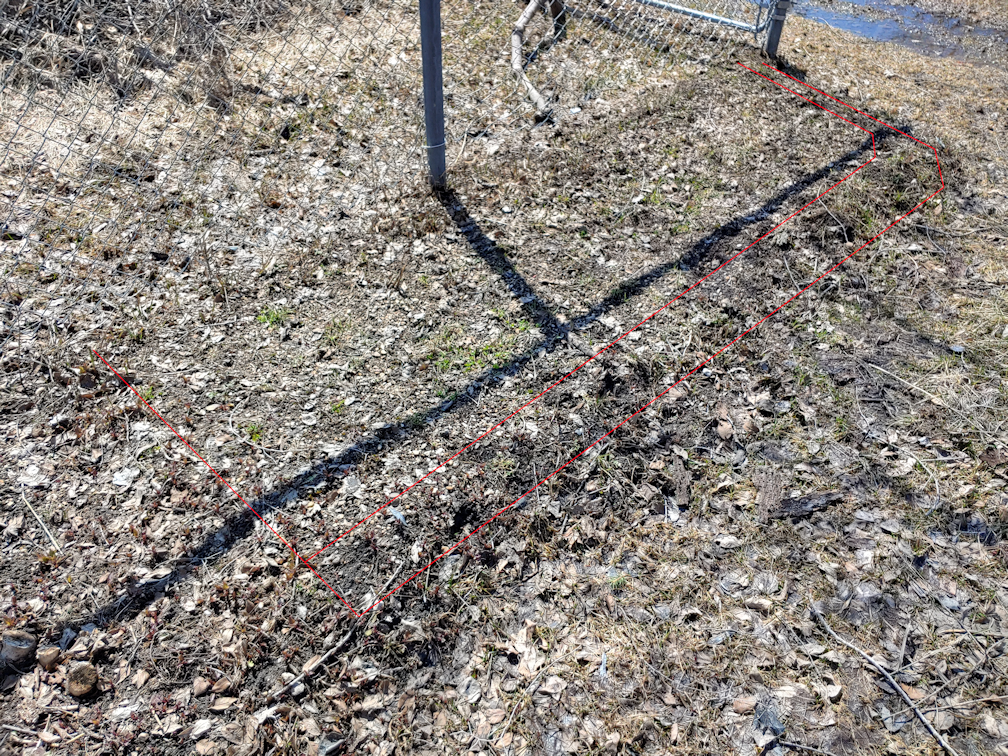
At this point, all I wanted to do was level off the soil with a hoe, then line the blocks up along the fence. The ground slopes downward along this area, and the gap under the chain link increases along the way. When we built the bed here last year, we had to add boards along the fence to keep the soil from washing away when we watered things. It didn’t work as well as in the other bed (the one now bordered with bricks, in the background) because of all that space under the fence. Having these blocks will solve the erosion problem.

The blocks won’t be filled quite yet. I want to put some more organic material at the bottoms before returning the soil, and adding more, if needed. The ones we filled last year look like they could use some topping up, too.

Next, it was the garlic and asparagus beds.

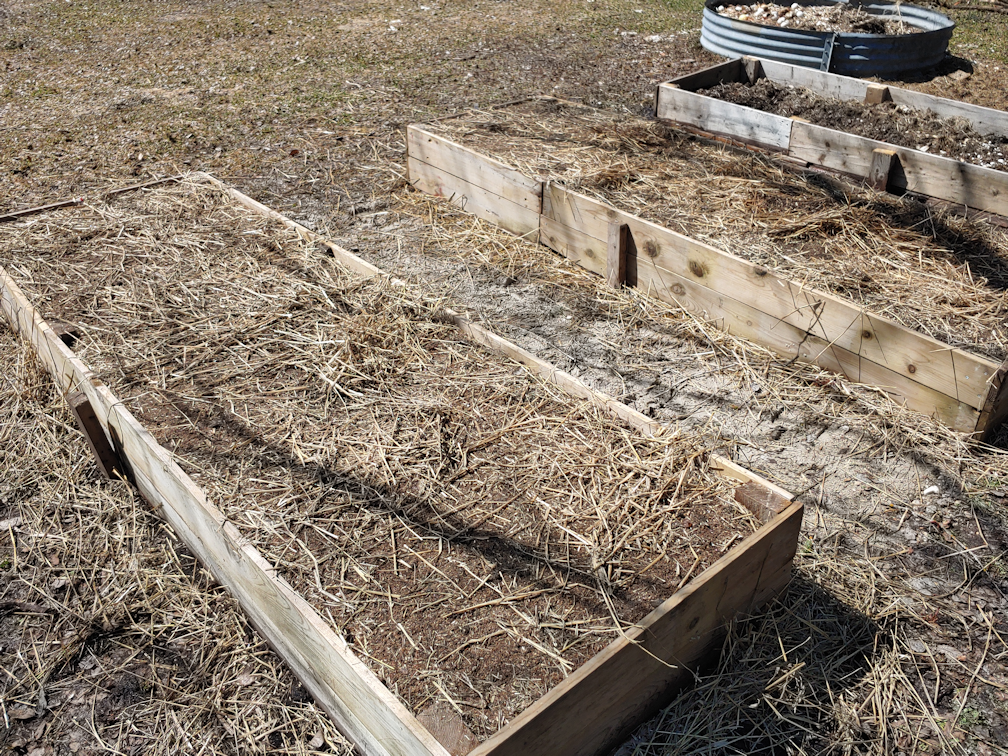
I’ve been reading up and watching videos about growing asparagus – which is not yet showing – and it seems they do well with deep mulching (as well as being planted together with strawberries, which we might do). The garlic beds have mulch on them that I have decided to take off, and move to the asparagus.

First, the garlic beds.

Click on the images to see them in a larger size.

Pulling back the mulch, I can feel that the soil has thawed around the edges, but the closer to the middle, the more frozen it is. In the photo on the right, you can see some of the ice crystals exposed as the mulch was pulled back.

Also, this is oat straw, and quite a lot of seeds got caught up with the straw. I was seeing quite few sprouting grains, like the one in that second photo! (click to enlarge)

Both beds are now uncovered. The bed that’s in the back was more frozen than the one in the foreground. I couldn’t pull off some of the mulch because it was stuck in ice.

Now that there is no longer mulch insulating the ice, it should be melted by the end of the day. We’re at 18C/64F as I write this, so it won’t take long for the beds to thaw, and the garlic can start growing again.

As for the straw mulch…

The red lines mark there the asparagus is, plus there is a narrow band around it, where we shoved in some tiny onions that were really too small for transplanting, but we didn’t want to just toss. They didn’t do well, which is not a surprise, but what is a surprise is that the bulbs survived the winter and are starting to grow! So when the mulch from both garlic beds was added over the asparagus, I made sure it was not really covering where the onions are.

Who knows. We might ended up being able to collect Norstar onion seeds this year!

The asparagus planted here is a purple variety, and this is its second year. Two years from now, we should be able to start harvesting them. We also plan to get green asparagus crowns, but we’ve got so many things to plant this year, it sort of went by the wayside. I’m still not sure where we’d want to plant them, since it would be permanent.

Maybe here?

When we first cleaned out there area, there was a tire planter that was a car tire cut in half around the circumference, the tire flipped inside out, and still attached to the rim, which raised it up a bit. I had dug it out and tipped the soil onto the ground, discovering it was covering the stumps of a maple – which promptly started to send up suckers! Then we discovered that the planter had been for a type of flower that spreads through rhizomes. Which means I inadvertently spread a weed.

When we built the bed here last spring, we used carboard to try and kill things off first, then layered straw and soil on top of the carboard, to make the new bed. We planted strawberry spinach. If any of them sprouted, we had no way to tell, and they didn’t last long. Instead, the bed was filled with all sorts of other things we didn’t want in it.

So today, I took my nice, new garden fork to it, broke it up and pulled out as many roots and rhizomes as I could find. I then scrounged in the garage and found a couple of pieces of panelling, which I placed on top of the space between the two beds, for something to stand on, and also to smother out more of those flowers!

The little stumps are something we’re going to need to get rid of, too.

I’m not sure what we’ll be planting here. Maybe some squash or gourds, which can be heavily mulched and has large leaves to further shade and kill off anything we don’t want to be growing here.

That was it for outside garden prep. I also adjusted some things in the sun room.

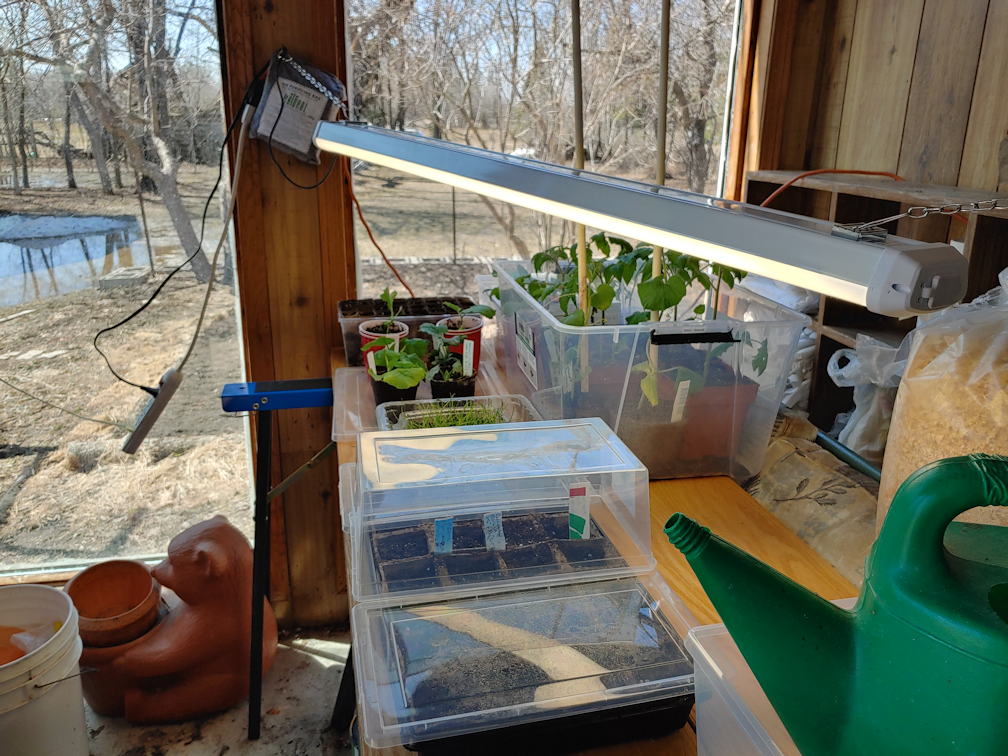
The bright LED shop light that had been used on the inside of the plant shelf got rigged to light the new growing platform over the swing bench. This may be a “sun” room, but it’s not a greenhouse, and this far back from the window doesn’t get much direct sunlight at all.

Also, I’m happy to say that it looks like the two little peppers I thinned out of the other pots have perked up and may actually survive!

Once these were all taken care of, I started to dismantle the broken canopy tent frame. I could only do part of it, because I only brought a Phillip’s screwdriver with me, and the rest of them need a hex tip. Which I have, but I’ll continue it another time.

I still can’t get that one leg out of the soil. I can move it around, and the ground is thawed out for at least a couple of feed, but I just can’t pull it out. We’ll have to dig it out! The amount of force from that falling piece of tree must have been amazing to push that leg, with the flat plate on the bottom, through frozen ground must have been something else! So glad it didn’t land on the BBQ, or it would have been destroyed!

While working on the frame, I noticed the window in the back of the storage house had its cover knocked off, so I went over to put it back. Before I did, though, I could see it was wet under there, so I put my phone on flash, stuck it through the window and took some blind shots.

Oh, dear.

With how the water had formed a moat around the storage house, not coming up to the house itself, I thought it might have been pretty dry. Talk about wrong! It’s a lake under there! The kitties have lost their largest shelter.

This is also the brightest I’ve ever seen it under there. I’m not usually there and taking pictures, this time of day!

Well, no surprise that the entire storage house has been slowly sinking if it gets like this during wet years!

In the 14 day forecast, there are a couple of days where we are expecting light showers, but beyond that, we’ve got all warm and sunny, or mostly sunny, days for a while. That is going to be a huge help in giving the soil a chance to absorb more water, and the high water levels to drop or drain away. That means more chances to prepare garden beds for planting!

I’m having so much fun right now… :-D

The Re-Farmer

This morning’s rounds

There have not been a lot of cats around lately, when I first come out!

I did see others as I went out and about, but nowhere near as many as usual. I think they are enjoying the lack of snow and drying ground, and heading out further afield.

There is a tabby that hangs out with Junk Pile and her kittens, snuggling so close together, I’ve found myself trying to see if there’s a second litter in there, and they’re sharing the parenting. It’s really hard to see in there; the windows are dirty on the inside, and we’re not going to lift the roof to clean them right now, or Junk Pile will move her kittens somewhere else.

I saw The Distinguished Guest walking around. I noticed him limping a while back, but now he’s not putting any weight on that leg at all, but hopping around three-legged. We won’t let me near him, so I can’t check it. Usually, if he starts eating in the kibble house, I can at least pet him, but he didn’t go for the food at all.

The snow is pretty much completely clear in front of the sign cam, other than what’s in the ditches. This spot here is where I spread the wildflower seeds. I am a bit concerned that the gravel and clay from the road that ended up over here will prevent them from germinating. That puddle is there because road dust pushed over with the snow had enough clay in it to form a poll that isn’t draining as it would if it were on just soil.

I broadcast the seeds quite widely, though, so I hope at least some of them will make it!

I did NOT do the walking to check on the flooded out areas. The water continues to recede, and we’re just waiting for the repair crews to get to them. I’ve been walking 3-4 miles total, every morning, for about a week now, and as much as I love the walking, my broken old body is telling me I need to take a break.

I might even listen to it.

Or I might do the walking later in the day. ;-)

We’ll see!

The snow cleared around the yard enough that I could start picking up some of the larger branches. The smaller ones will wait until things dry up more, and we can go around with the wagon or wheel barrow.

I was also able to finally clear the broken canopy tent frame away from the BBQ and picnic table. I was able to collect the tent pegs, too, and the new BBQ cover is now properly pegged to the ground.

I still had to deal with this, though.

I was able to pull the leg part way out of the ground.

If you look at where the leg goes from dry to wet, that’s how much of the leg the fallen piece of tree pushed into the ground.

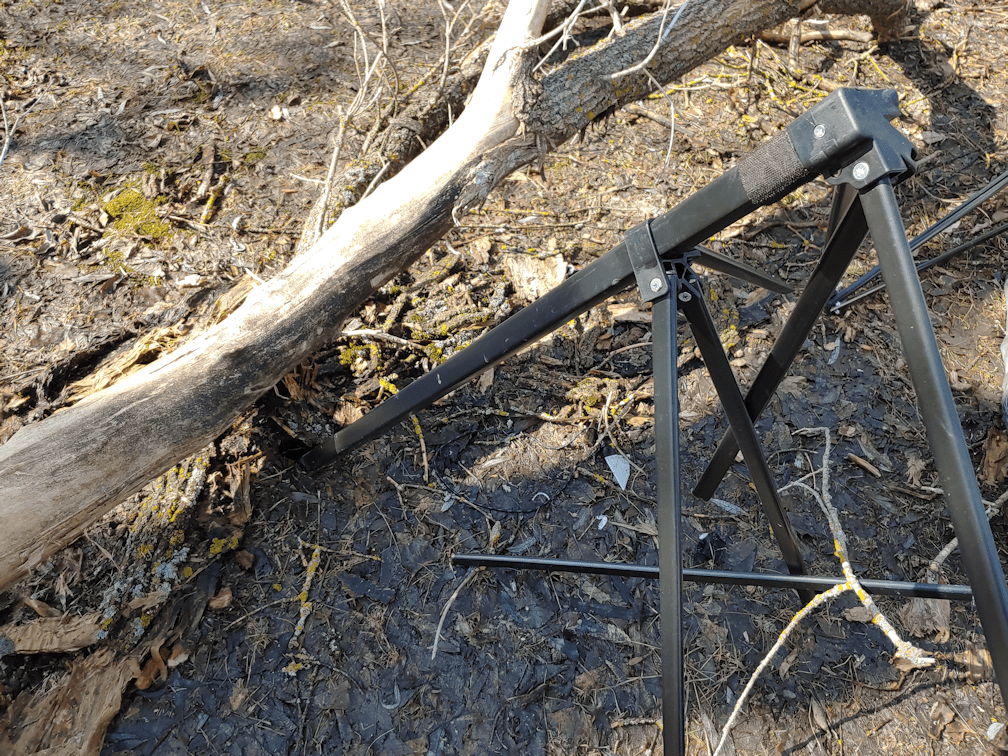
There’s still the base of the leg, which has a flat plate where tent pegs can be used to secure it. It was difficult to work with, because the rest of the canopy frame is still attached to it. I noticed the screws were standard Phillip’s head, so I got a screwdriver and was able to separate it from the rest of the frame. Unfortunately, while trying to wrestle it out of the ground, the leg started to bend. !! I didn’t want to break it off completely, and then have to fight with a much shorter piece, so I left it for now.

Once I realized how easily the frame can be taken apart, without the need for proprietary tools, I got pretty excited. We can take the whole thing apart and salvage the unbroken pieces. I’ve been needing stronger materials to use as supports in the garden. The unbroken pieces will work perfectly. And you can never have enough screws and bolts!

So that’s going to be a task for later today. Dismantling the frame, and seeing how much of it can be salvages. :-)

It’s going to be a good day for working outside. We’re already at 16C/61F, and are expected to reach 20C/68F this afternoon.

There is a lot of work outside that we can finally get started on! I’m almost giddy with looking forward to it!

Okay, yeah, it’s still mucky out there, but I can still get things done! :-D

The Re-Farmer