It was a rough night for me, last night. Very little sleep, and the pain levels are just high enough to make any position uncomfortable after only a short time. Thankfully, my husband was well enough this morning to head out do all the food bowls for the cats, and refill the bird feeder, allowing me to postpone the rest of my morning rounds until later in the day.
Once I did get out, the first thing I noticed was the haze. I know we don’t have fires nearby, but we’re getting smoke. I’ll have to check the fire maps later, and see what the current status is.
The other thing I noticed was Junk Pile cat. Who looked at me and growled.
Now, why would she do that?
Because she had brought her kittens over, and they were around the cat shelter! I saw some furry little butts disappearing behind it, so I carefully went around, giving them lots of space, to check on the potatoes and grapes. I saw a little grey and white kitten run across to the storage out, while a little tuxedo squeezed under the cat shelter.
A tuxedo?
Yup. She had more kittens with her this time! There were at least three, possibly four. I was just catching glimpses of them, though later on I saw the tuxedo under a tree by the storage house, watching me from a safe distance.
I am so glad she’s bringing her babies over to the food bowls!! Hopefully, they will be moving into the inner yard now.
Before finishing my morning rounds, I got the hose going to refill the water barrel at the far beds. Unfortunately, it is still leaking. I’ll have to pinpoint exactly where, then empty it enough that it can dry and I can try sealing them again.
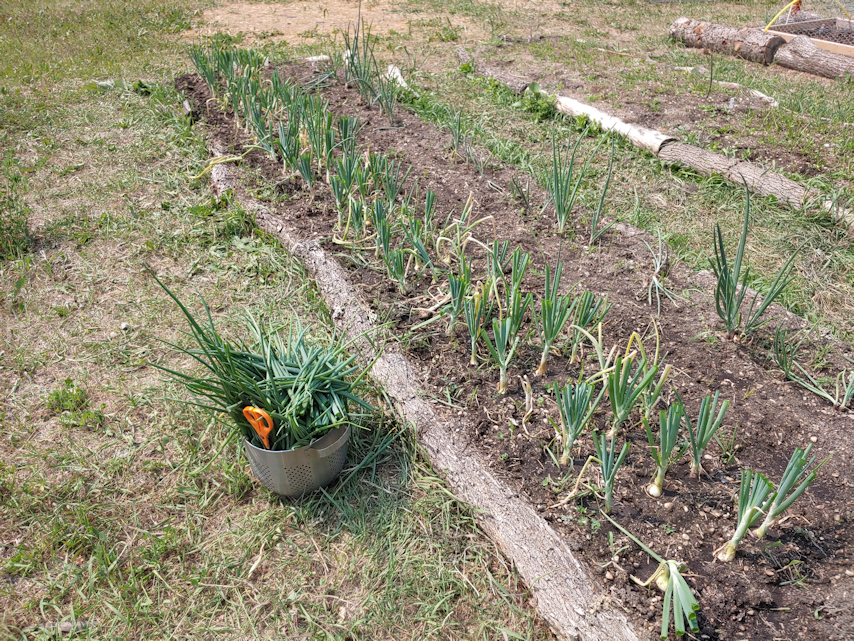
Once everything else was done, I came back outside to give the onions a hair cut. :-D
It was on one of the gardening groups I’m on that I saw someone post pictures of the green onions they had just harvested and bagged up for the freezer. I know it’s recommended to trim onions grown from seed, down to about 3 inches, before transplanting. I hadn’t thought about trimming them, other than to gather greens for the day’s cooking, before harvest. The gardener that posted the pictures said that trimming them meant more energy going towards growing the bulbs. If the greens start falling over, the onions stop growing for the season. I knew that last part, but it never occurred to me that the growing season could be extended by trimming. I’ve never grown onions before, and the onions my mother grew were left in the ground to come back, year after year, so I never saw her doing that, either.
The yellow onions sets that I bought locally got really large greens. I quickly ran out of space in my colander, and had to come back to do the bigger shallots, then the other onion bed. The red onions (from sets) and the other yellow onions (from seed) did not have as many large greens, but the colander still got pretty full again! All the greens completely filled our giant metal bowl. Thankfully, it has a lid, because the cats were VERY curious! It’s full enough that the lid is sitting on top of greens, but at least that cats can’t get at them. Onions are toxic to cats, but that doesn’t stop them from being very curious about them!
We’ll have a lot of washing of greens to do, and then they’ll be coarsely chopped. We will probably dehydrate a couple of pans of them in the oven, and the rest will get frozen.
We’re going to have enough to last us quite a long time! :-)
I love how, every day, there seems to be something new or different in the garden!
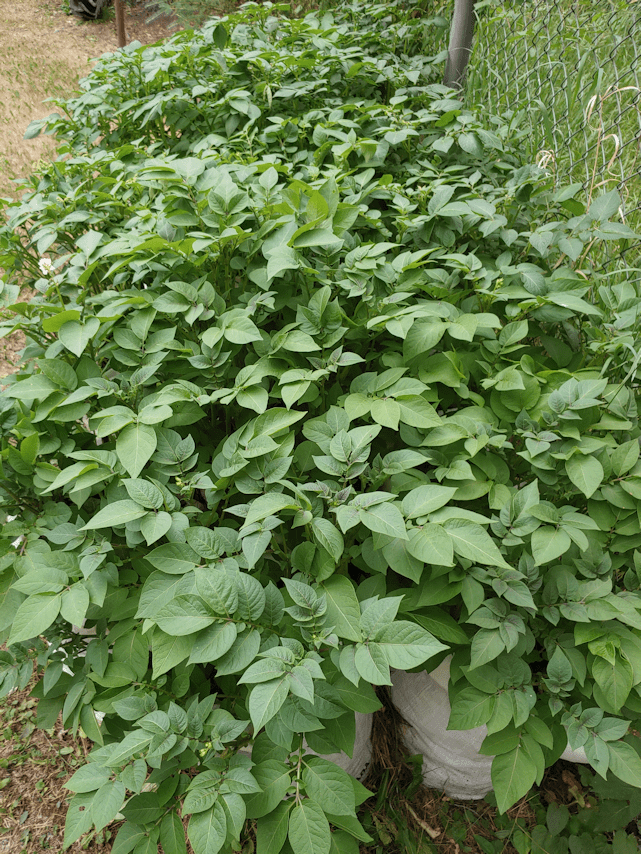
While doing my rounds, one of the first things I do after putting food and water out for the cats (or like today, just water, as my husband was feeling good enough to go outside and do their food), is check the nearby potatoes.
They are so huge and lush, you can barely see the grow bags! Of everything we planted this year, nothing is doing as well as the potatoes.
Hopefully, that means we’ll have lots of potatoes, and not just lots of greenery!
Potato flowers are such pretty little things!
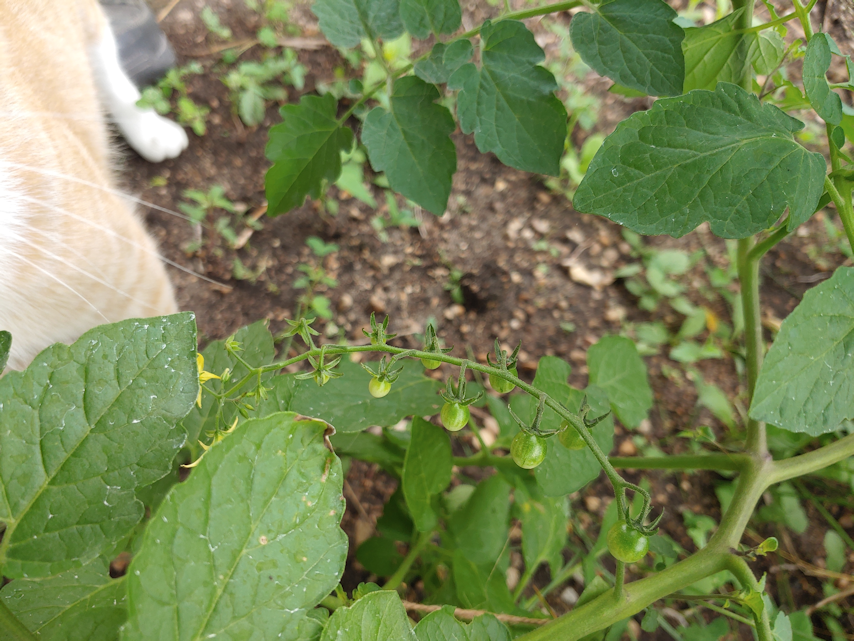
While checking the tomatoes, I tried looking for the baby tomatoes we’ve been seeing and had a hard time finding them. Then I found this “huge” spray of tomatoes I’ve somehow missed seeing all this time!
“Huge” being a relative terms, for the world’s smallest tomatoes! :-D
While heading back down the driveway after switching out the trail cam memory card, I had to pause to get this photo.
There are less of these flowers than last year, and they are blooming later. Like so many other things, they had been damaged by that one cold night in May, and it’s taken this long for them to recover. We don’t water down here at all, and we’ve had no rain, so it’s amazing to see them at all. Such resilient flowers!
I was weeding the big carrot bed this morning, which is rather difficult right now. I sometimes wonder why I bother, considering how much they’ve been eaten. I accidentally caught a remaining carrot frond while pulling up a weed, and pulled a carrot up with it.
I’m… kinda glad I did.
If they have this much root after all they’ve been through, there is still a chance for them! We won’t get any big carrots, and my hopes of having enough to can are certainly dashed, but we might still have something worth harvesting.
As for this little guy, I washed it off with the hose and ate it, and as small as it was, it was tasty.
So that’s encouraging.
I had another surprise waiting for me in the old compost pile nearby.
Amazingly, there are more mystery squash coming up, next to the stems of the chewed up ones!
Of course, nothing will come of them after sprouting this late in the season, but we might at least see them get big enough to determine what they are.
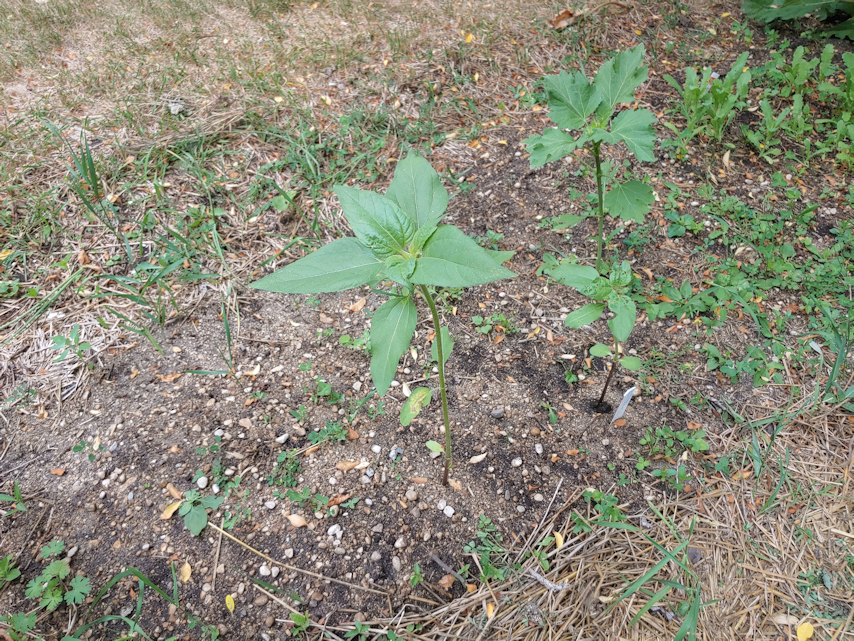
I find these two Hopi Black Dye sunflowers in the old kitchen garden very interesting. The bigger one was the first of the seeds we started indoors to germinate. That was after the ones we’d direct sown outside had already germinated. The smaller one, which has the label next to it, germinated some time later. Right now, both of these are bigger than the ones that germinated first, in the large beds. The difference, of course, is the soil. The other ones are planted in an area that has not been amended or planted in before, while these are in a garden we’d been working on for 3 summers already
As for the tall plant behind the smaller sunflower, we still don’t know what it is. :-D
I was happy to see that many of the poppies have seen quite a growth spurt, and the ones that were under rhubarb leaves are getting stronger.
Then there is this plant, nearby.
When we were preparing the bed next to the retaining wall, there was a compact plant growing in it. Unsure of what it was, other than “some kind of flower”, we dug it up and transplanted it between the rhubarb and the chives. It quickly grew from a compact, bushy plant to the tall, leggy thing you can see in the photo.
I also now recognize it, though I still don’t know the name.
Do you see those sprays at the ends? With the small round things hanging down?
When it starts blooming, this plant has lovely, delicate little flowers.
Which then become some of the most annoying little burs, ever. It isn’t possible to go near one of these without ending up with masses of tiny burs stuck in your clothes, that are harder to get out than burdock! I’ve had some get so thoroughly stuck in my clothes, not only was I not able to get them completely out, but they managed to stay stuck after several washings!
After I took this photo, I pulled it up. Even though it is in the flower bud stage, it still tried to stick to my clothes!
It did not go into the compost, but into the fire pit for eventual burning.
If we ever get to light the fire pit this year. I suspect not.
While things have finally cooled down today – in fact, it actually got chilly last night! – and we are no longer getting heat warnings on our weather apps, we are now getting air quality alerts. There are a number of fires burning in our province right at the moment. I’d actually been smelling wood smoke for a while before we started getting the alerts, and with our heat and dryness, I was very concerned. None of the fires are near us, thankfully, but we’re still getting some of the smoke.
Today will be our coolest day for the next while, with a high of only 18C/64F so I will be taking advantage of it and getting things seeds sown in those empty spinach beds! :-)
It was a hot and windy day today, and my younger daughter and I ended up making a quick run into town, but we did get some decent progress in the garden.
My older daughter braved the hottest part of the day and added more soil to the 15 summer squash mounds.
I waited until it was cooler.
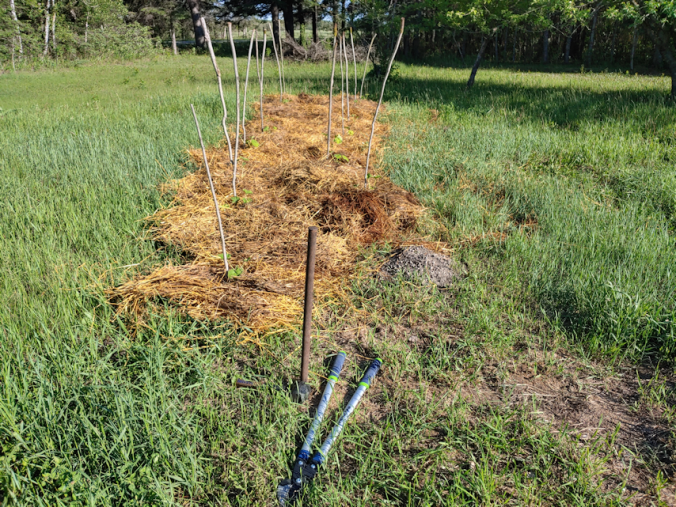
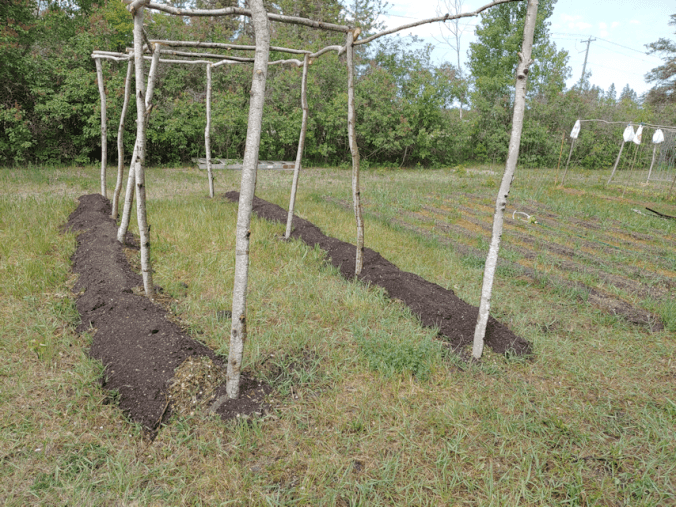
I added a stake near each plant. The stakes are some of the smaller poplars we cleared our of the spruce grove, trimmed to about 3-4 feet in length. In the foreground of the photo, there is a metal bar stuck in the ground. It has a point at one end. I can’t remember at the moment, where we found it, but it was a happy find! I used it, and a mallet, to make holes in the ground. Then the stakes, skinny end down, were pushed in as far as I could, beyond what I managed with the steel bar, then the soil carefully stomped down to secure it. As close to the plants as they were, that meant mostly just on one side. Once those were in, the area was mulched with straw. The idea is to secure the stems of the squash to the stakes, as they grow, and pruning the bottom leaves, little by little. We shall see how that works!
Also, I really need to get this area mowed, before the next rains come!
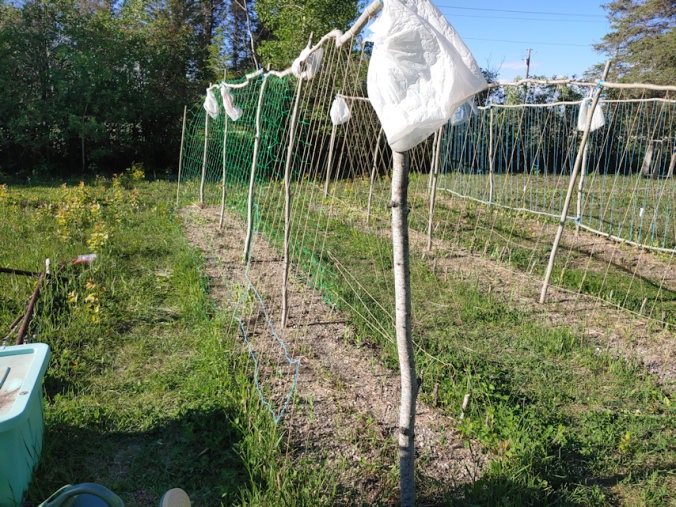
I had found some trellis netting, so my daughter finished the last sections of pea trellis with that, along with adding soil to the summer squash. The peas are getting tall enough to start climbing! The peas I planted later, to fill the gaps left by those that did not germinate, are sprouting, too. I’m really looking forward to having fresh peas! I can’t remember the last time I had fresh-from-the-garden peas.
If you look to the left of the photo, you can see what is a problem in this area: all those tree seedlings! They are spreading through root systems, like quack grass. Usually, I would have mowed over them by now, but we’re going to have to cut them back by hand this year.
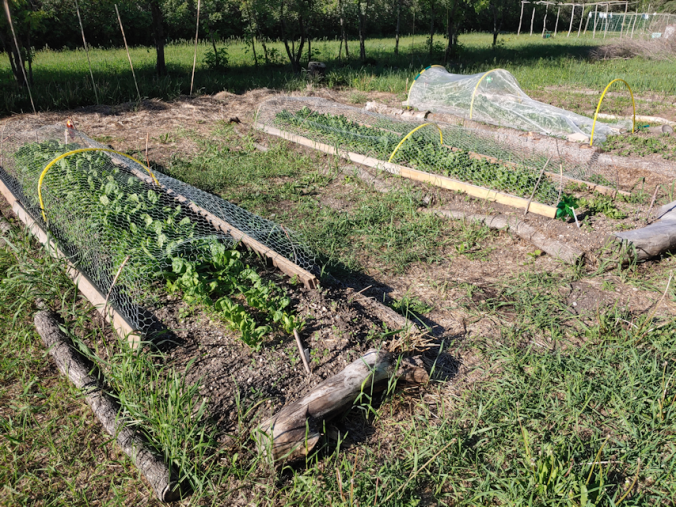
My younger daughter, meanwhile, went all out and thinned all three spinach beds.
Yes, this was taken after the beds were thinned!
The furthest one, under the netting, is the one that got the most deer damage, but parts of it are doing well. You can see at the end of the closer beds, the smaller spinach at the ends the deer got at.
With the spinach she gathered, I currently have two trays drying in the oven, and made myself a huge spinach salad for supper. The reason we went into town was to get ingredients to make spinach dips. Both cold and baked versions. :-) I’m really looking forward to that!
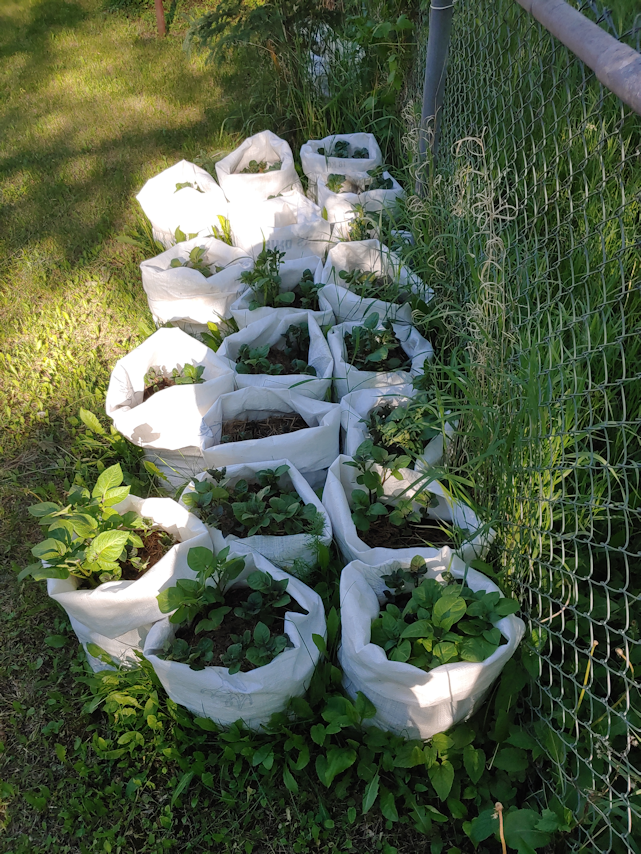
This last one is just to show how well the potatoes have been doing! At this rate, some of them are going to need topping up, soon! I’m very excited to see how productive these will be at the end of their season.
With today’s progress, my goal for tomorrow is to get working on that squash tunnel. The luffa needs something to climb! :-D
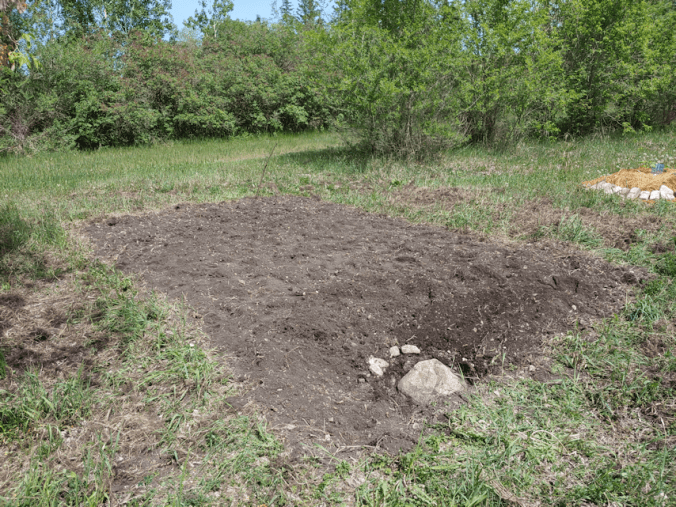
Today, I built what should be the last garden bed for the year. This one is for the climbers.
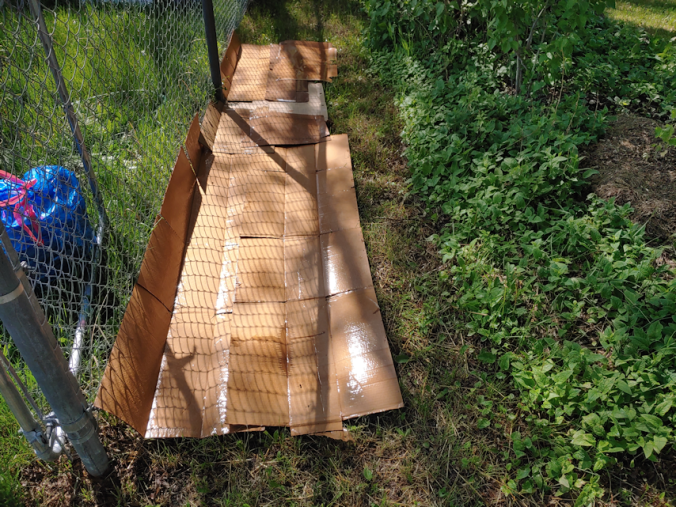
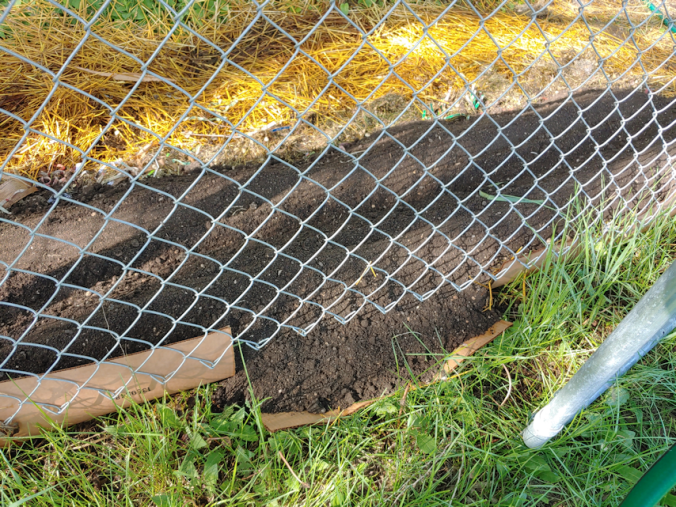
Here is what the space looked like when I started.
The original plan was to use the remaining chimney blocks, like the one in the photo, as planters along the chain link fence, but they remain in the basement until we can figure some thing out, and it is not a priority.
We’ve been saving up our cardboard, and had just enough to create a barrier layer, which got a thorough soaking.
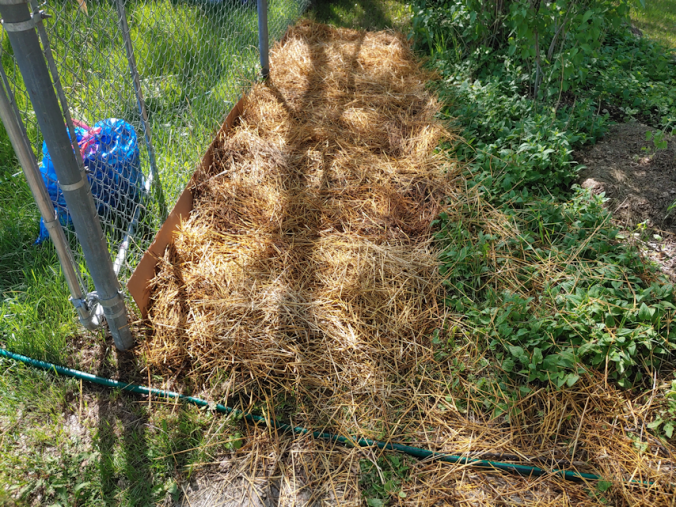
The next layer was the straw, which is also the mulch to cover the path between the new bed and the flower bed beside it. I was able to get some of the straw at the bottom of the bale that has had time to start breaking down, too, which was great! This layer, like all the layers, got a thorough soaking – after I beat it flat with the back of a fan rake.
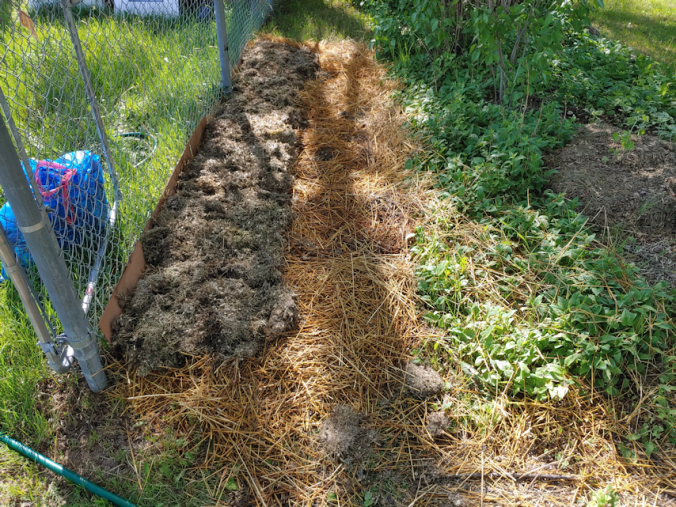
Then, because we had some, I emptied our kitchen compost along the fence line, which got tromped on before a soak.
There wasn’t much. We don’t get a chance to accumulate much for the compost pile. It tends to get used right away!
We still have grass clippings, so a thick layer of it got laid down.
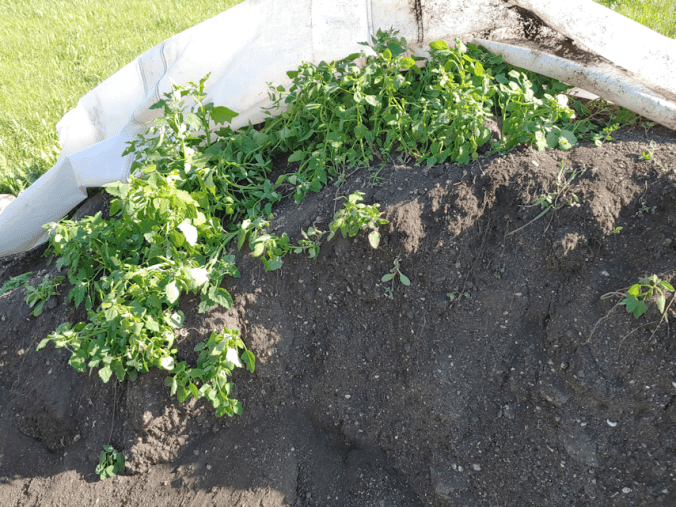
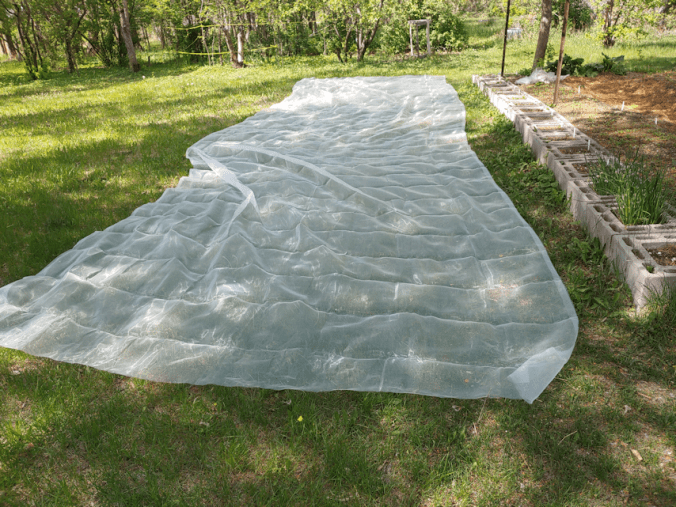
We’ve been keeping our compost-safe paper for shredding, and I had a bag full to add for another layer. After giving it a soaking, my daughter tromped it down for me, while I went to get a load of soil. This was from the nearby tarp covered pile in the outer yard. When I pulled back the tarp, I just had to call the girls over to take a look!
The white tarp allowed enough light through for the weeds to start growing, and grow they did!! They were huge!
These are mostly lambsquarter, which are supposed to be edible and very healthy. Better than spinach!!! At least that’s what the breathless Pinterest images that have started to show up in my feed are all exclaiming. Maybe some day we’ll try them, but for now, they are growing in places we want other things to be growing (or, in the case of our soil pile, nothing to be growing!), so we’re pulling them. Still, it was something else to see how big they got under that tarp! It actually is encouraging, since we plan to build polytunnels and high raised beds in the outer yard, eventually.
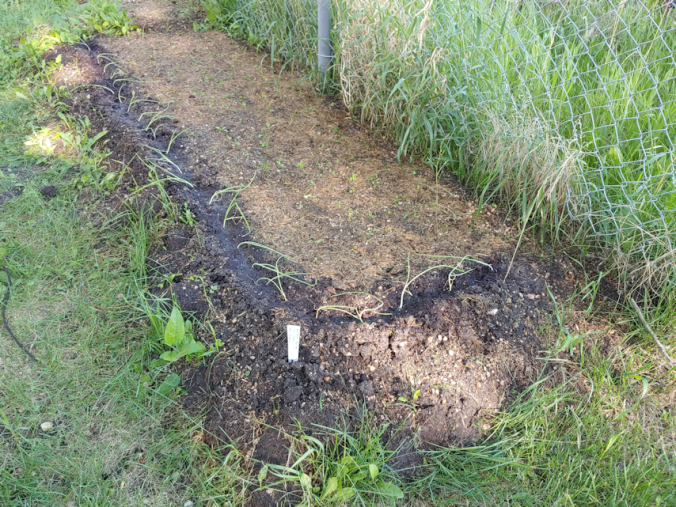
Finally, a thick layer of garden soil was added to the new bed, with a trench down the middle to hold water. My daughter did catch me before I made the new bed too wide. With the one we made for the tomatoes, we’re finding it a bit hard to reach, even though we ended up narrowing it down when we added more soil for the transplants. We’ve noticed the same issue with the beds of spinach, carrots and onions. They’re only about 3-4′ wide, but they are low beds right now, and we’re short. It’s hard to reach the middle while bending down so far; our balance goes off kilter. Especially for my daughters who, unlike me, have not had their generous proportions surgically reduced. That really affects center of balance! It would not be an issue with the tall raised beds we plan to build, but we need to remember that, for low beds, they need to be narrower. Especially if we can reach from only one side, like these along the fence.
One thing that was an unexpected issue is that the chain link fence on this side is higher above the ground at the bottom than on the other side of the gate.
Which means that the damp cardboard flaps against the fence couldn’t quite hold the soil in some places! Which is fine. We’ll work around it.
After filling the trench in the soil with water to soak it, I brought over the cucamelons that have sprouted (most did not, but that’s okay; we planted way more than needed!), as well as the gourds. The bucket and plant pot have the cucamelon tubers in peat that I dug up from last year, to see if they would grow this year. Time to dump them out and find out if they survived!
They did not.
Aside from a few wispy root clumps and what may have been the dried outer skin of a tuber, I found nothing. They had completely decomposed.
Well, that just left me with some peat I could make use of.
So I widened the trench I’d made before, added some peat to it, and watered it again.
Then it was time to do the transplanting.
The cucamelons were all in their own Jiffy pellets, so they were easy to space out. I planted even the tiny ones. If they make it, great. If not, at least they had a fighting chance! Our cucamelons from last year were quite prolific, even in less than ideal conditions. This location gets much more light, so I expect them to do even better, here. If all grows well, this fence will be completely covered with climbing vines!
Of the gourds, the pot that had 2 Ozark Nest Egg seedlings had sprouted a third! I’d forgotten I’d planted 3 seeds in the cups. The pot that first sprouted still had only one, plus there is the one Thai Edible Bottle gourd. These are in Jiffy pots, so the ones with just one seedling in them got planted whole. The one that had three in them, I gently broke it open along one side and sort of unrolled the contents to separate the seedlings. One of them just sprouted today, so it’s unlikely to survive, but who knows? It might do even better than the others. :-) I believe in you, little sproot!
That done, I had some more transplanting to do. I’d put the last of our Norstar onion seeds into a Solo cup, and they not only sprouted, but are starting to form bulbs!
The girls and I had talked about where to put them, and the border of the asparagus bed seemed the best place.
The onions are shallow growers, and there’s plenty of space between them and where the asparagus are, so this should be fine. At this stage, I doubt they will reach full maturity, but they will help deter critters and insects. There were more seedlings than would fit here, so I added the last of them in front of the Mosaic Mix tomatoes. There had been some bunching onions transplanted there before, but they were the tiniest, wimpiest ones that we probably shouldn’t have bothered with, and only 3 were still alive. Which is fine. There are more bunching onions in front of the Spoon tomatoes. We’ll see how these ones do!
That’s pretty much it for the transplanting. We should probably plant the one Hopi Black Dye sunflower that finally sprouted. Since there’s just the one, I’m thinking of planting it somewhere else, like in the old kitchen garden. The pink celery will go into a pot that we can move in and out of the sun room, as needed, but they are way too tiny to do anything with, yet.
Which means that tomorrow, it’s back to the other garden beds. The pea trellises need to be finished, the squash tunnel needs to be worked on, and the summer squash needs a garden soil top up, before getting mulched with straw. Somewhere in there, I need to actually mow around the main garden beds. It’s getting pretty out of control around there! For the old garden area, I’m seriously considering using the weed trimmer, instead. It’ll take longer, but I won’t have to worry about hitting rocks or lumps of soil with the lawnmower. Also, of course, weeding. Especially in the corn and sunflower blocks. All the stuff that barely grew there before have had the most moisture and inadvertent tending since… ever, and they’re really liking it! :-D
The main thing is that, aside from the pink celery and that one sunflower, we’re done the transplanting! Anything else that didn’t germinate by now, isn’t going to. We won’t be tending those pots anymore.
Aaaannnndd….
It was getting late, so I paused and took the pink celery seedlings indoors, then went ahead and transplanted the one Hopi Black Dye sunflower in the old kitchen garden, in the bed we planted the poppies in. So that’s done now, too!
We’re taking a break from our push to get the squash and corn transplanted today. Lots has been done, with lots more to do, but we just had to stop for a while.
My daughters didn’t take any photos of what they were doing, so I just have “after” pictures to show.
This is the summer squash. We have only 15 transplants; quite a few did not germinate, but we do have some of all 4 varieties. There’s an extra hill. Later on, straw will be added around the hills for mulch, and I will be adding stakes near the transplants, to train them to grow vertically. This is supposed to help prevent fungal infections or rot from touching the soil, increase air circulation, make it easier for pollinators to get to the flowers, increase yield and make it easier to harvest. The bottom leaves are supposed to be pruned away, and it will also be easier to water them at the roots.
At least, that’s how it’s supposed to work. We shall see!
Next, they started building the beds at the squash tunnel. Priority for planting here are the luffa and dancing gourds and the winter squash. Oh, and the little pumpkins. We have quite a lot of melons to transplant, too, but if there is no room here, there is a lot more space where the sunflowers were planted last year.
What they were working on those, I worked on the new corn block.
I had turned about 2/3rds of it last night, so I didn’t expect it to take too long to finish.
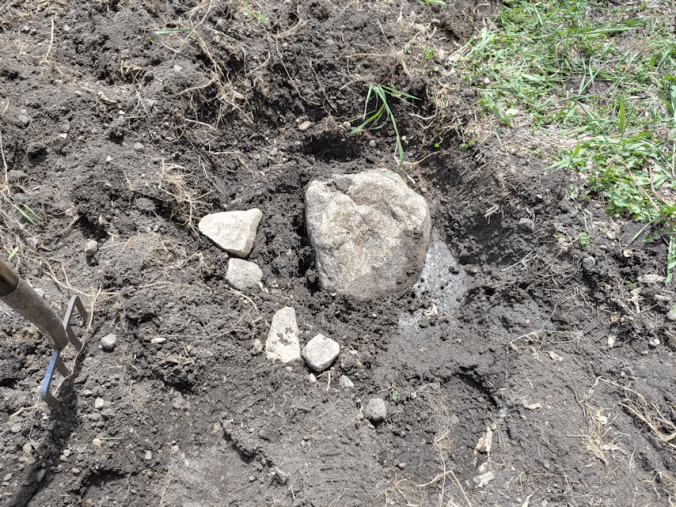
Then I hit something, right near the end. Of course, I was hitting rocks the whole time, but usually I could just move the fork a few inches and keep going. Not this time!
I ended up using a space to dig around the rock. I dug up a few other rocks, but part of it seems to continue below where the soil is still undisturbed.
I used water pressure to clear the stone and try and see how much further it went, but that wasn’t much. My younger daughter decided to give it a try, and ended up bending the fork, trying to move the rock!
So… it will stay. :-D
The next step was to take out as many roots, rocks and start leveling things off.
That stick coming out of the ground in the background is a tree root. I have to grab something to cut it with!
For this part, I had a garden claw with a long handle we found in the basement when we were cleaning it out. What a back saver! You can see, all around in the grass, where the roots, crab grass and weeds were tossed. Rocks got tossed under trees, so they wouldn’t be “found” with the lawn mower. Of course, it’s not possible to get all the roots out, but I got most of them.
Finally, I could go over it with the thatching rake, which picked up a few more roots that I missed, as well as some rocks, and leveled it off a bit. I chose not to bury the big rock again, as it was so close to the surface. I’d rather see it and know it’s there, than forget about it and plant something on top by mistake.
One thing about this area; it has the deepest top soil of any part of the old garden, yet! I didn’t reach gravel until I started digging deeper to try and get around the big rock, and while I found other chunks of rock, I just barely reached the gravel layer. This is the soil my mother is talking about, when she talks about how great the soil used to be. Except for the rocks. She didn’t remember the rocks! :-D
The next step was to mark out for planting. I counted the corn plants this morning, and there are 65, plus a couple of bitty ones that probably shouldn’t be transplanted, but I likely will, anyways. I wasn’t sure if I’d have enough space, but with rows 2 feet apart, and the transplants 1 foot apart in each row, I will have enough space.
While the soil may appear good, all the soil tests I did showed a lack of nutrients, so it will still be amended. I used the flags to lay down grass clippings. I lay them out in rows, but I don’t mind them spilling over into the paths in between, to help keep the weeds down.
After this photo was taken, I used a watering can and rainwater to wet down the grass clippings, since the hose and sprinkler were needed at the other end of the garden.
Then we headed inside. We reached 30C/86F while we were out there! So we will take a few hours indoors and let things start to cool down before we continue.
We have predictions for rain tonight, and possible severe thunderstorms by tomorrow afternoon. They might even hit us. :-/ If it does look like we will get a severe storm, we have things we can use to cover the squash to protect them, though the corn would be on its own. It is, however, in a more sheltered area of the old garden. We shall see.
We might still hit our goal to get all the transplants done here by this evening! After that, we have transplants for the south yards, but they are not as urgent and can wait a bit longer.
As for me, I’m seriously thinking of joining all the cats on my bed for a short nap. I’m so tired, I have been falling asleep while writing this!
I’m going to be hurting so much by the time all this done, but it’ll be worth it!
Pretty much all of the squash, both winter and summer, that we chose are small varieties that mature quickly. The one exception was the Crespo squash. Of the 6 seeds we planted, one came up and got quite large. After we moved our seedlings from the aquarium greenhouses to the sun room, a second seedling sprouted.
That’s good enough for me!
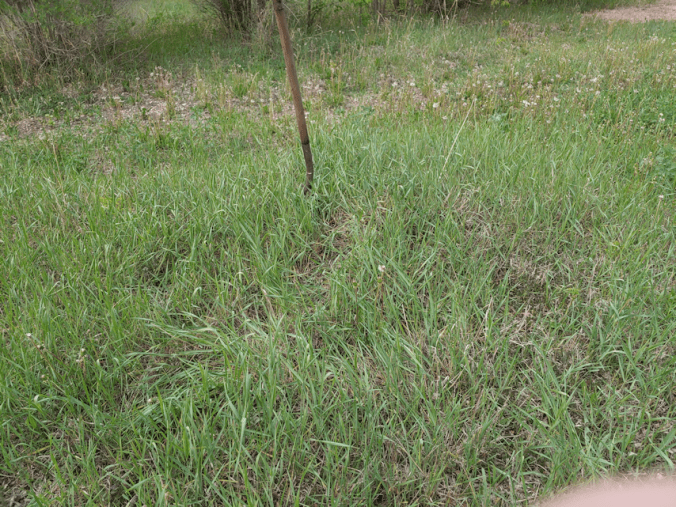
As these are supposed to grow quite large, we decided they will get their own space. Near where we will be transplanting the Montana Morado corn is a very rough area; one of the worst areas from the shoddy plow job that was done before we moved out here. The plow had been turned in this tighter area, creating a particularly large lump of soil in the process.
I figured, we may as well take advantage of it, and turn it into a squash hill!
Yeah. That’s basically a dirt and crab grass hill my garden fork is stuck on. I’d already started to loosen the soil at the top of it. The grass is so tall, you can hardly tell there’s a hill there!
I used the hose and water pressure to soak and break up the soil, which made it easier to pull out vegetation and roots. And rocks, of course. There are always rocks!
It was also the first level of watering, and boy did the soil need it!
The next step was to layer on some straw, which got thoroughly watered while a daughter brought over our kitchen compost bucket. When that got added in, it got another watering. If we had other organic matter I could have layered on there, I would have, but this will have to do.
Hhmm. I neglected to take a picture of the next stage, which was to bring over a wheelbarrow full of garden soil to top up the hill. After creating a bit of a hole in the middle, that got another level of watering, then a bit more garden soil was added, to level it off. That got another watering in the middle. After the straw was added all around it, everything got another watering. The straw will help keep the soil from washing away, as well as keep down the weeds and help keep the soil moist.
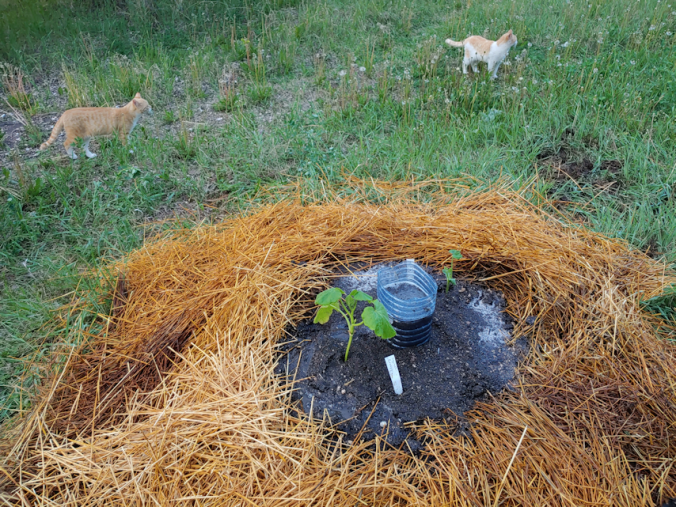
Finally, the squash got transplanted. Since there was one plant per cup, they got dropped right in, with almost no root disruption.
I still had a little bit of the peat and soil mixture we used for the tomatoes left in the kiddie pool we used to mix it in. That got turned back into dirt soup, and was added around the seedlings.
To help with watering them at root level, I cut the bottom off of one of the distilled water bottles we get for my husband’s CPAP, and buried it top down in the middle of the squash hill. Another spade full of soil was added around the container, because it kept trying to float out of the hole it was buried in! :-D
The final step was to pull some of the damp straw up around the seedlings.
While the plants are small, we will make sure to water the straw to keep it, and the squash hill, moist but once they get bigger, we’ll be able to deep water them at the roots, through the container in the middle, and avoid getting their leaves and stems wet.
The entire hill got another watering, and it was done!
I really hope this does well. I honestly have no idea how these will grow in our zone. In doing searches for it, I am just finding the Baker Creek seed listing, and my own blog posts!
The heat has kept us indoors, for the must part, but a daughter and I did make a trip into town for some errands. I took advantage of the trip to see if the dollar store had stocked up on pinwheels and whirlygigs. They have not, but I did get their last hula hoops, to use as supports in the garden beds.
The post office was one of our stops, and happily, the mosquito netting we ordered has finally come in!
My daughter had ordered it to protect our lettuces in the retaining wall blocks, and the beets planted near them, from deer.
We used the T posts that I was never able to remove when we cleaned up the fence that used to be around this garden. Like most of what we’re doing this year, this is temporary, so we just used rope, tent pegs and clothes pins to drape it over the plants. It was long enough that we cut some off at one end, to use somewhere else. Holes and slits were cut into sections of it so it could be tied to the ornamental apple trees.
It should be interesting to see how it holds out if we get the potential storms over the next couple of days. I don’t expect the clothes pins to hold, but it’s attached to the trees solidly enough, it shouldn’t blow away completely. Meanwhile, it should be able to withstand normal rain and winds.
Even though we were doing this in the shade, it was still ridiculously hot, and we didn’t even try to do anything else outside.
I think the different things we’re using to startle away the deer seem to be working. The tulip cam is being triggered by wind blowing the dandelions in front of it. Other than that, we’re seeing the odd cat going by, or a bird on the ground in front of the camera. Nothing is going for the tulips, and aside from that one day, there have been no deer picked up by the camera. Not even a skunk, and I saw two of them in the yard, yesterday!
I’m thinking of moving the camera to overlook the big garden. Depending on where I set it up, it should be able to cover the beds near the house, as well as anything large enough that goes near the far beds. That should tell us if deer are still trying to go through the old garden area or not.
The forecasts have changed again, and they’re now predicting storms 2 days from now, instead of over the next couple of days. Once things cool down some more, and we go out to do the evening watering, we can move the trail cam over. The leftover mosquito netting is so light, I might just set it over the last spinach bed as a floating row cover, until we can build another wire mesh cover.
If this netting works out, we will order more. If not… well. We tried! :-D
We had a solid rainfall last night. With the sunflowers, tomatoes and bunching onions just transplanted yesterday, I was concerned over how they held up. I was happy to see that the tomatoes were looking very sturdy, and even the little bitty onions were looking stronger. It was the sunflowers that I was most concerned about, but they were also looking strong. Even the couple that were looking wimpy as they were being transplanted are standing strong, though the twine supports we added certainly helped that.
While moving seedlings out of the sun room this morning, I included the tray with the cucamelons. Not many of them germinated, but they are so prolific, we should still have lots. This same tray is where I’d planted the Hopi Black Dye sunflowers.
I had a surprise waiting for me.
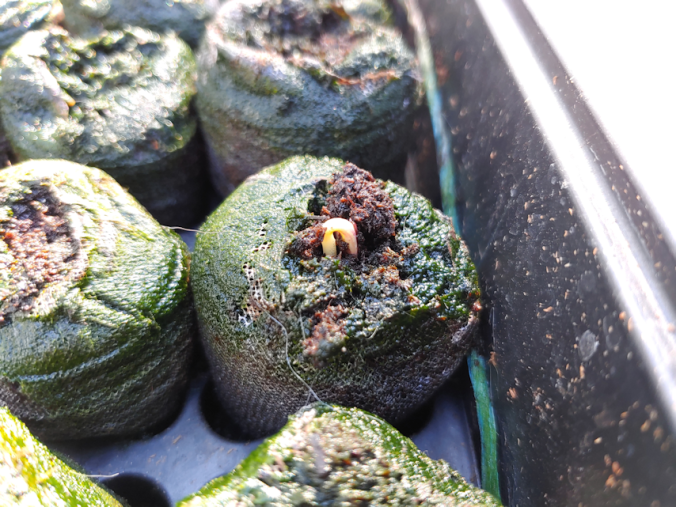
The very first Hopi Black Dye seedling has emerged!! At this point, I thought for sure they were gonners. If I’d had any idea that they could take this long to germinate, I would have started them back in February!
I have no idea if more were germinate, or even if any will reach a point where it’s worth transplanting them. It’s so late in the season, but then, we do that the others that were direct sown, and who knows when those will germinate!
Meanwhile, we have another first this morning.
Our first harvest of spinach! Yes, we’ve been sneaking the odd leaf every now and then for a while, but they’ve reached a point where they need to be thinned out, so this morning I grabbed some from each bed. I could have had a lot more, but I could only reach so far under the two beds with chicken wire over top. Later on, when I have a second person to help out, we’ll move the covers off and thin them out properly.
After I finished cleaning the spinach, it was all I could do, not to just sit there and eat them all! Instead, I’m not eating some in an egg dish my daughters made for me for lunch. :-)
Things got hot really fast this morning, and it’s only going to get hotter. We’re supposed to hit 29C/84F this afternoon, 34C/93F tomorrow, which risk of thunderstorms, and 35C/95F with chance of thundershowers the day after. If we do get storms, we have enough things to use as cloche to protect the tomatoes, but I don’t know how we’d be able to protect entire rows of the sunflowers.
This type of weather is the sort of thing the squash would actually like – if they were already well established outside! We’ll continue making beds and transplanting, but will have to take steps to be able to protect them from storms as well.
For now, I’m just excited about our new sprout, and fresh spinach!!!
Today was nowhere near as productive as I intended it to be. Ah, well.
I headed out early in the day to the nearer small city, to pick up a few things we couldn’t get during our big city trips. The first stop was Canadian Tire, where I was able to get more of the stove pellets we’re using for cat litter now; we now have enough to last the month or more. A day or so after the frost we got, we could see that it did damage the new Heritage raspberries I’d bought as a gift for my daughter. They will recover, but they won’t do will this year. So I went looking to see if I could got more, but they were completely out of stock for raspberries. I resisted the temptation to buy blueberries, instead. Blueberries need acidic soil, and ours is very alkaline. We do plan to have blueberries, and once we decide on where we will plant them, we will have our work cut out for us to amend the soil to something they can do well in.
I hoped to get more chicken wire, but they only had 2′ wide rolls in stock. I ended up getting a 4′ x 50′ (1.2m x 15.2m) roll of 4 inch square wire mesh fencing. I even remembered to pick up a new hose nozzle to replace our broken one. Paid a lot more than I usually do; I usually get the Walmart cheapies, but I figured it was worth paying for quality for a change.
Then it was across the way to the Walmart to get more cat food and a few more little things, including a garden hose for the front of the house. It’s only 50′ but it’ll be enough to water the old kitchen garden, and as far as the grapes. Which, I am happy to say, are actually showing leaf buds! I thought for sure they had been killed off this winter, but they survived! Yay!
The down side of making the trip is that it basically wiped me out. I’ve been pushing myself too much of late and, while it feels good to do it, this broken old body doesn’t recover like it used to. :-( Once the girls unloaded the van and put everything away, I ended up crashing for a couple of hours. By the time I was mobile again (to find lunch waiting for me! <3 ), I still wasn’t up to doing much. Particularly since we were getting into the hottest part of the day. So we waited a couple more hours before heading outside.
I am really happy we got the new hose and nozzle!
While my daughter watered the old kitchen garden and anything else she could reach on that side (and planted that mystery bulb I found among the tulips), I started watering the north east garden beds until my daughter could join me. It was very handy to have her using the hose on some beds, while I used the watering can on others. Though we hadn’t needed to water this morning, by this time of the day, everything was thirsty again. Especially the newly planted corn and sunflower blocks.
While watering the Dalvay peas, I decided it was time to fill the gaps.
I figured that whatever was going to germinate, already has, and what hasn’t by now, isn’t going to. With these peas, we had a lot of seeds left over, so I went around with a bamboo stake and poked holes in the gaps between the seedlings, sowed new seeds, then covered the holes with fresh soil. Then the beds got thoroughly watered again.
That’s one thing about this area. It’s almost impossible to over water out here.
The King Tut purple peas also have gaps where seeds did not germinate, but there were no extra seeds left over from that packet, so whatever has come up is all we’re going to have for this year. We’ll still have a decent number of plants, and they are supposed to be rather prolific, so I’m hoping they work out.
And that’s about my limit for today. Other than bringing our transplants that are hardening off back into the sun room for the night, my body is letting me know that I am done like dinner!
I think maybe getting to bed before midnight would be a good goal to shoot for, this evening… ;-)
The crab apple trees near the old garden area are starting to bloom. Not all of them yet, but this one was looking gorgeous, today. :-)
This morning, after all the garden beds were watered, my older daughter and I got to work on the corn and sunflower blocks. She started by making furrows for the seeds and watering them, then I followed behind to plant.
We managed to get 2 corn blocks done, with radishes planted in between, when we stopped for lunch. It started raining, and for a while I thought we wouldn’t have a chance to finish, but it did get done! Mind you, I was getting rained on while planting the last seeds, but not enough for it to be an issue. :-)
These are the three types of corn that got planted today. At the far end in the photo, is the Sweetness, then Early Eh, and finally the Montauk, in the foreground.
Because the soil is hardest packed the further north we go, we planted the April Cross Chinese Radish, a Daikon type radish, in the northernmost corn block. The packet had much fewer seeds than I expected, so we were able to include them in only 3 of the 5 rows. There was enough Red Meat Watermelon Radish to interplant with the remaining two blocks of corn. Hopefully, both varieties will help with breaking up the hard soil and, once harvested, will give the corn’s roots more room to grow into. This is really late for radishes to be planted; they can be planted as soon as the soil can be worked, however with their short growing season, it should still work out.
The blocks of 3 rows were for the sunflowers. The Mongolian Giant got planted in the block to the north; with how big they are supposed to get, I figured that would work out better. There aren’t a lot of seeds in the packets, but at 2 ft apart, I did end up filling two rows. There will still be the transplants to include, about a week from now. The 3 row block that’s to the south got the Hopi Black Dye sunflowers. The flags mark the block with the Hopi Black Dye and, not being a giant variety, they were planted 18 inches apart. That filled 2 rows as well. Not a single one of the packet we started indoors has germinated, so there is nothing to transplant. We will have more Mongolian Giant transplants than will fill in the one row left in that block, so we might end up splitting them between the two blocks. I didn’t think ahead, and planted seeds on the northern rows. Any Mongolian Giant transplants could end up shading the Hopi Black Dye – though with zero germination from the first packet, I wouldn’t be surprised if none of these germinated, either. I am at a loss as to why the ones we started indoors completely failed to germinate.
Now that these beds are done, we have some time before we can start transplanting, which should be enough time to get the squash tunnel built, and create more beds for them and the other transplants that need them.
Two weeks from now, if all goes well, all the planting (not counting successive sowing) should be done!


























 The Re-Farmer