Our 2021 Garden: our Morado mystery

In choosing garden seeds this year, we kept a lot of things in mind. Choosing food that we’ll actually eat, choosing foods for long term storage, choosing foods we would eat more of, if they were more affordable at the grocery store, and choosing foods just for the fun or challenge of it.

One of the things I picked for the fun and challenge of it is corn that is such a deep, dark purple, it looks black.

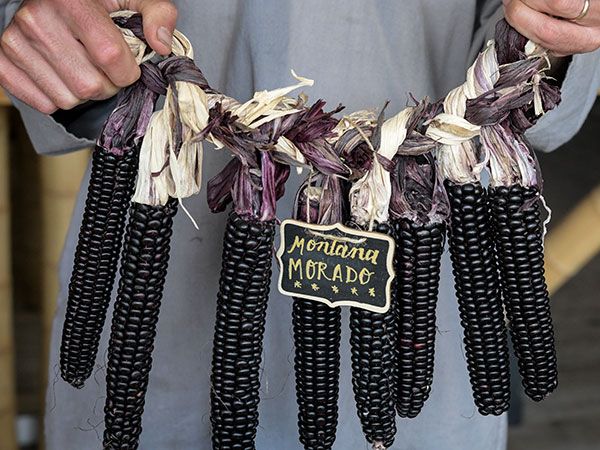
This image is from the Baker Creek website, where I got our seeds from. I chose it not only for it’s unique colour, but because it is a corn that can be used to make flour; something we have plans to do in the future.

Maize morado is a Peruvian corn, and I found the story behind how Baker Creek got their seeds to be really interesting.

The question is, how do I grow a Peruvian corn, in a Zone 3 prairie environment? So I started looking for people who had already tried to grow maiz morado.

I didn’t have much luck.

I did find things like this video from 2015.

Yeah. They didn’t do too well. I found an earlier video, and saw that these were the Kulli variety, also from Baker Creek.

I found a few other videos, and noticed one thing in particular. They started out with very few seeds. One guy had only five seeds, and of those five seeds, he got one corn plant that he had to hand pollinate, and only one ear of corn, which he intended to save the seed from to plant the next year. I found no follow up on that. Another person had planted 8 seeds, starting them indoors, but he deliberately intended to cross pollinate them with local varieties, to develop a hardier strain. He stopped posting videos soon after, so there was no conclusion to his experiment. All of these were older videos. Of the ones that showed the end product, they got very tall corn plants – 8 feet tall or more – very few cobs, and very few developed kernels on those cobs.

We have one advantage, in that our packet says it has a minimum of 75 seeds in it. At the very least, we should have plenty of corn plants and the wind can do the pollinating!

There is something else, though.

In spite of what the Seed Stories video from Baker Creek says, these are not Maize Morado.

They are Montana Morado.

From their website:

This variety is a northern adapted homage to the legendary Maiz Morado/Kulli corn from Peru. Ed Shultz, the accomplished and passionate open pollinated corn breeder who spent 30 years selecting this dark purple variety, explains that Montana morado is was actually selected from the Painted Mountain corn.

https://www.rareseeds.com/store/vegetables/new-items-2021/montana-morado-corn

These are apparently not from Peru at all.

These are shorter and stockier than the Peruvian Morado strains, and are bred for Northern gardens.

Except this is Montana, which means for us in Canada, it’s bred for Southern gardens.

Will this strain work here? Aside from a few articles about the development of the strain, I am finding nothing about people actually growing it, and how. It may simply be too new a strain. It’s all pretty much a mystery.

So we’re going to be flying by the seats of our pants on this one.

The plan right now is, we will start them indoors in the second half of May. As corn is not something that is normally started indoors, and their roots do not like to be disturbed at all, we will be using toilet paper tubes to start the seeds in. The tubes will be left open ended in a container, so that when it’s time to transplant them, they can be put into the soil, tube and all, with zero disruption to the roots. Hopefully. As their roots tend to grow more downwards than outwards, the open bottoms should mean no root constriction, while the cardboard tubes break down in the soil.

Unlike the one gardener whose video I found, we do not intend to deliberately cross pollinate, so these will be planted at the opposite end of the garden from the other varieties. With wind pollination, the only way to be absolutely sure no cross pollination happens anyway would be to put bags over the developing corn, and then hand pollinating.

I’m not that dedicated to preventing cross pollination.

I am hoping that this one packet of seeds will give us enough corn to be able to have some for fresh eating, maybe even freeze some, and hopefully even try making some chicha morada to drink, but mainly to keep some for seed to plant more next year. Then we will repeat the process until we eventually get a mill and can try grinding some for flour.

Along with the Montana Morado corn, I’d ordered a variety called Dorinny Sweet – a Canadian hybrid – from Baker Creek. We will be direct sowing the Dorinny Sweet, and plan to save seeds from those, too. The Veseys three pack of Peaches ‘n Cream varieties I also ordered was more because I wasn’t sure the Baker Creek order would make it past the border, and while we will have plenty of corn for fresh eating and preserving, Peaches ‘n Cream are just about sustenance, not any particular interest in the variety. They’re the Russet potato of the corn world, in my view. :-D

Well, that’s the plan.

Who knows. Things may even work out to the plan! Either way, I’m looking forward to trying out this variety of corn, and seeing how it handles our climate.

The Re-Farmer

Our 2021 Garden: getting organized

I needed to divert myself with positive thinking, and what better way to do that than to think of gardening!

Also, I am striving mightily to NOT start those tomatoes yet, so sitting here and writing about starting them is keeping me from starting them. :-D

I will explain shortly.

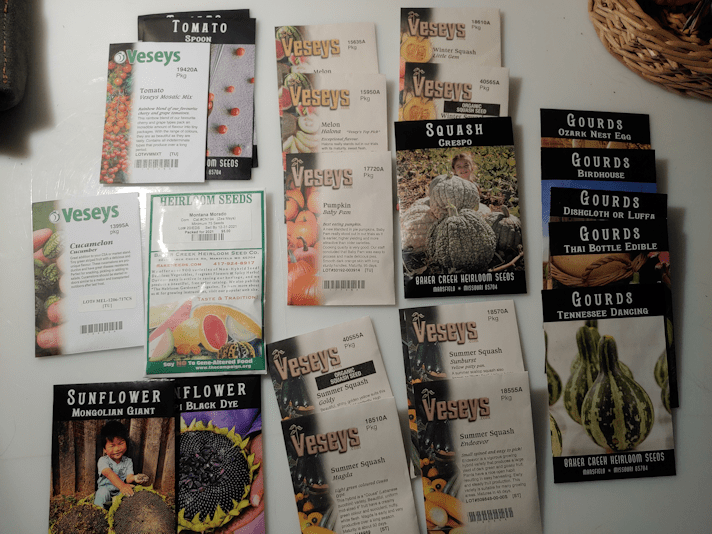
First, I went through the seed packs and took out the ones that need to be started indoors. Here they are.

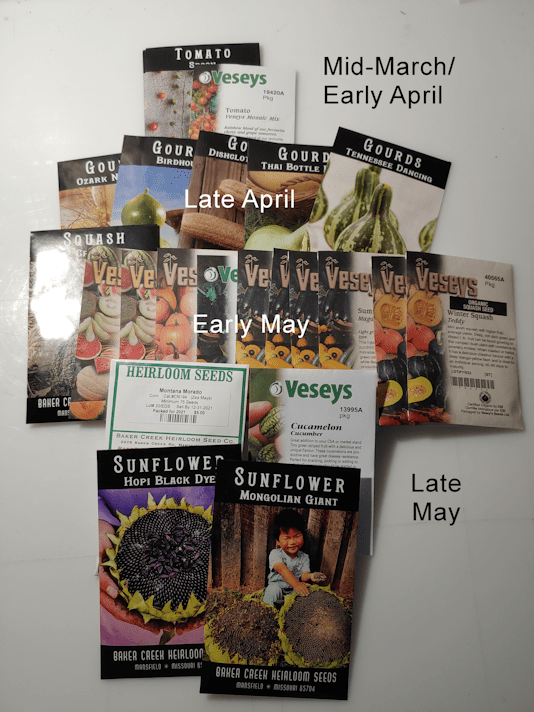
Then I worked out which ones need to be planted when. Here they are, in order of when they should be started indoors.

You can probably see where I might be having some problems.

Right around May.

It’s the tomatoes that are teasing me. I’ve never grown tomatoes before, and the Spoon tomatoes in particular are a new variety. Even in the reviews, I saw no one in Zone 3 that grew them. In my research, I have found articles from people in our zone who experimented with different tomato starting times, and they generally found that starting them earlier did not benefit them in any way. And yet… there are Zone 3 gardeners who have already potted their seedlings up. The down side of giving up social media for Lent is, I’m no longer seeing the gardening groups about it! But there are other resources and, at the very least, waiting another week will not cause problems. However, if you are a Zone 3 gardener who has experience growing tomatoes from seed, please do feel free to leave a comment! I am eager for the voice and advice of experience!

Next on the calendar are the gourds, in late April. Ozark Nest Egg, Birdhouse, Dishcloth/Luffa, Tennessee Dancing and Thai Bottle gourds. How many we plant of each will depend on how prolific the variety is expected to be. I’ve read that the Tennessee Dancing gourds, which are quite tiny, are extremely prolific. We’ll probably plant just a couple of seeds of those, and shoot to have one plant, while we’ll probably look to have 3 or 4 Birdhouse gourd plants. I learned from last year, not to jump the gun on our frost date of June 2, but we also need to keep in mind that we could still get a frost after that date, so I’d rather have more plants than less.

All of these will be trellised in some way.

Then there is early May.

Oh, my.

All the winter and summer squash, pumpkins and melons need to be started at the same time! Our winter squashes are Teddy and Little Gem. They’re small and I expect them to be fairly prolific, so we probably won’t be starting the entire packets of seeds, but we will likely plant at least half, depending on how many seeds are in the packages. We also have the tiny Baby Pam pumpkins, and I expect them to be fairly prolific, so we’ll likely plant half a package. The Crespo squash, however (listed as a type of pumpkin on the website) get huge, and will likely have fewer fruit per vine, so we will likely plant the entire packet of seeds.

The summer squash include Magda (light green), Goldy (yellow) and Endeavor (dark green) zucchini. Last year, few of them survived the late frost, so we didn’t have many of them. Even the surviving plants were not as prolific as the varieties normally are. We definitely want to have at least 3 or 4 of each. As for the Sunbrust squash, I got an extra packet of those, and we intend to plant two packets of seeds. They were a favorite last year, and we look forward to having lots!

The melons, Pixie and Halona, are small fruiting varieties. There don’t seem to be a lot of seeds in the packets, so we will likely plant all of them. Hopefully, they will be prolific.

A lot of these will be staked or trellised.

Next are the cucamelons and Montana Morado corn in late May. By which I mean, mid-May, so they’ll be ready to transplant after June 2.

We will be trying the cucamelons two ways; I potted up tubers from last year, which should mean getting an early start on them when they are transplanted in the spring, but we will also start a few indoors. It should be interesting to see what differences there are between them. Assuming the tubers survived their winter in the un-insulated old kitchen.

As for the corn… I have been researching that and I’m going to save my thoughts on those for their own post!

Then there are the sunflowers; Hopi Black Dye and Mongolian Giant. This will be another experiment. I got two packets of each. Last year, we direct sowed our giant sunflowers, then sowed another giant variety to make up for the losses from the first batch. They never really had the chance to fully mature. This year, we will start one packet of each, indoors, then will direct sow the other packets when we transplant the first ones outdoors. It should be interesting to see the difference.

Finding the space for all these starts is going to be a challenge. I’m hoping that, by the time we need to start so many seeds in early May, we will be able to use the sun room instead of fighting for space in the aquarium greenhouses. Last year, it was a somewhat chilly spring, and that wasn’t an option. However, if we can provide some sort of heat overnight, it might work this year, even if we get another chilly season.

While all of these need to be started indoors, there are also some things we will be able to direct seed “as soon as the ground can be worked”, which means in mid to late May. The bread seed poppies, kale and kohlrabi, peas, etc. will all be direct sown before any of these are ready to be transplanted. A lot of local people start putting their gardens in on the May long weekend, including transplants. If we had the things necessary to properly protect transplants from frost, I probably would do the same, but we don’t. Our attempts to protect them last year were not particularly successful. :-/ So we will wait for June on the transplants.

Now I just have to hold off another week, before starting those tomatoes!! :-D

The Re-Farmer

Our 2021 Garden: back ordered Veseys seeds are in!

My daughter’s birthday gift is not the only thing that came in the mail today!

The very last of our outstanding seed orders are in.

Yay!!!

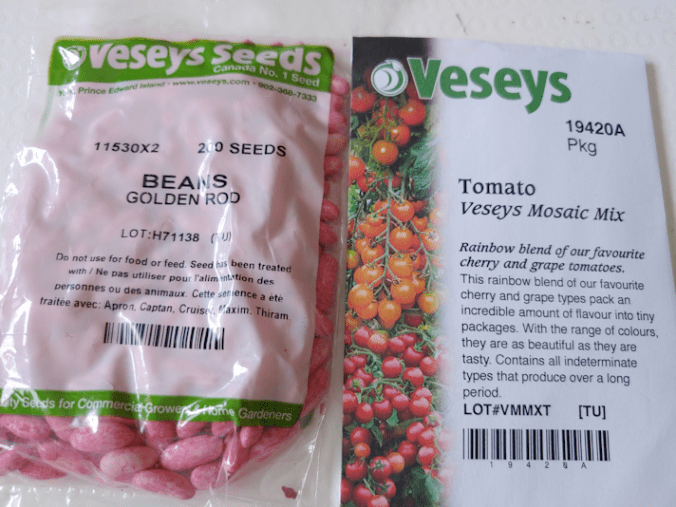
The yellow beans are the last of a three colour collection we ordered, so we will have yellow, green and purple bush beans to grow.

I’m really happy to have the tomatoes in now. They need to be started much earlier than most things. Based on our frost date, we would be starting them after the first week of April, but other zone 3 gardeners I know have not only started their tomatoes, but have already repotted them!

We won’t be planting all the seeds; just a few for our first year growing tomatoes. The space we intend to plant them will fit about 8 or 10 plants. More than enough to meet our needs, since they’re basically for just one person! While other things we need to start can wait until the onions we’ve got in the tanks now are moved to the sun room, there is space enough in the big tank to fit some tomato starts. A project for this weekend, perhaps.

We’ve got a lot planned for our second year of gardening since moving here, but I think the best part is overhearing a daughter saying, “I’m so excited about gardening!”. We’ve never been in a position to garden on this scale in their lifetimes, and I’m thrilled that they are so looking forward to it, too!

The Re-Farmer

Our 2021 garden: one last surprise! (updated)

I wasn’t expecting to do another post today – and certainly not another garden post – but I just had to! I’ve had two awesome things happen since my last post.

One is that I got an email confirming our back ordered seeds from Veseys has just been shipped! It’s only two packets of seeds; the cherry and grape tomato medley, and the third variety of bush beans we had ordered. Now, the only things left outstanding are the items that will be shipped in time for planting in our zone. I’m really glad I ordered all these back in December. Quite a few of the varieties we ordered have since gone out of stock.

Then there is the other exciting bit.

Have I mentioned I have an awesome brother?

Have I also mentioned he has an equally awesome wife?

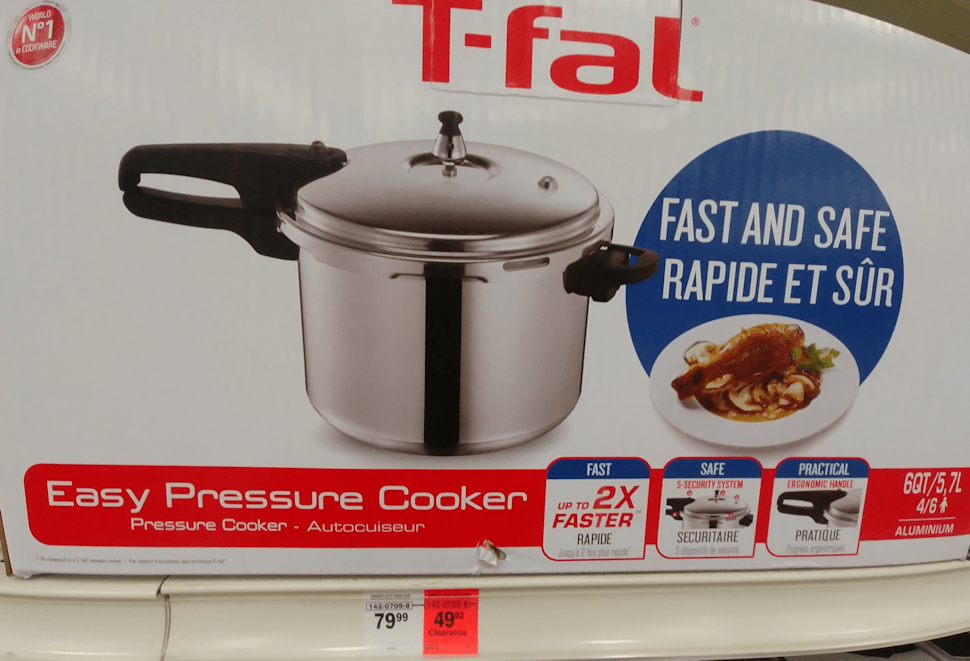
I got a call from her this evening, asking me to check my email. She had sent me this photo.

You see, I had asked them to keep an eye out for a pressure canner for me and this evening, while on their way to a romantic dinner out, they stopped at a Canadian Tire. Because who can turn down a quick run into Canadian Tire?

They found a pressure canner (yes, I know; it says cooker, but it’s the same tool) in stock!

It’s even one that was on some of the “top 10” lists I’d been looking at. Plus, it’s on sale!

Did I want her to pick it up for me?

Yes. Yes, I did!

Then, just moments after we hung up the phone, she called back. Since she was there, in the canning supplies section anyhow, was there anything else I wanted?

She found a couple of boxes of wide mouth snap lids to pick up for me as well.

We are now all set for both hot water bath and pressure canning, this fall.

My sister in law is awesome!

The Re-Farmer

Update: So… about that pressure canner…

As Carolee pointed out in the comments, this is a pressure cooker. I have read about them being used as canners, found instructions for them, etc. It was in the canning section, being sold as a pressure canner. It should be good. At least for small jars, like we would be using. At that size, I knew we’d never fit quart jars in there, but we aren’t planning on pressure canning anything in that size.

However, I asked my sister in law to go through the instructions to see, and apparently there is NOTHING about using this model as a canner in the instructions. Which is a bit irritating, since that’s what it was being sold as.

In the end, we’re going to keep it, rather than ask them to return it. That was a really good sale price, and we will make use of it in other ways.

We’ve been looking online for pressure canners around the province. I found one in the city, selling for $450. Well beyond our budget. I found another in a closer hardware store that was smaller and more affordable, but it’s not in stock. I am trying to avoid using Amazon, so I tried looking at more direct sources and manufacturers. They’re all in the US which means that, with the dollar difference, shipping costs and hidden expenses, I just assume it will cost double what the listed price is. Some are still affordable, but… out of stock, of course.

We will keep looking, but if how things are now is anything to go by, it looks like we will be freezing, dehydrating and pickling vegetables, rather than canning them! I do want to can things like meat, chili, soups and stews, too, and for that, we will need a pressure canner. We’ve canned chili before, but that was to keep them in the fridge for quick meals. Which was really handy. I’ve also canned soup stock but, again, it had to be refrigerated and used fairly quickly. In the long term, I want to have shelf-stable produce, and there is no getting around needing a pressure canner to ensure the food stays safe. Ultimately, we can do without. We have alternatives.

Our 2021 garden: Baker Creek order arrived!

I made it to the post office while running errands today, and had a small package waiting. I just sort of assumed it was for my daughters or my husband, but nope! It turned out to be my last minute order from Baker Creek. I am totally shocked that it arrived already! When I placed the order, they had a notice saying that, for orders outside the US, it could take as long as 3 months to arrive. It has only been two weeks since I got the shipping notice! This may well be the fastest any of our seed orders have come in!

Which means that right now, not counting the items that will be shipped in the spring in time for planting, we have only a couple of back ordered seeds that we’re waiting for. One is our third variety of beans, and the other is a medley of cherry and grape tomatoes. The tomatoes are the only ones I’m concerned about, since they need to be started indoors, but not until April or May, so we still have time.

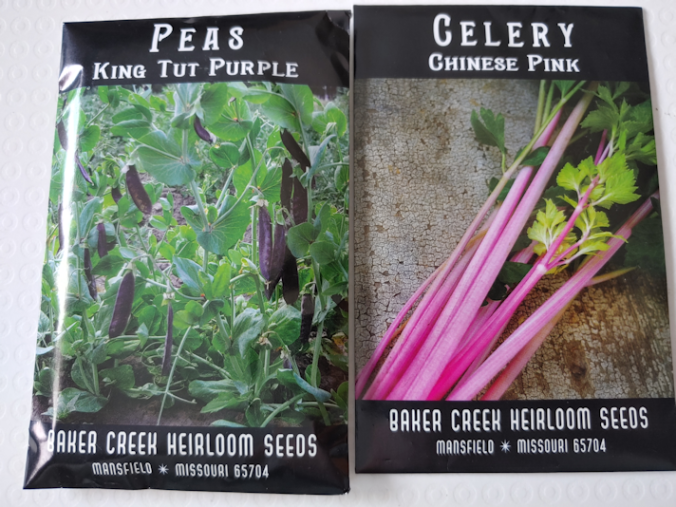
Here is what we got today. (All links will open in new tabs, so don’t worry about losing your place! :-) )

While talking about and planning for the varieties of seeds we already had, the girls noticed we unintentionally have been leaning towards a rather purple theme. These are now intentionally on that theme! We had only one variety of peas, so that was my excuse to get the King Tut Purple peas.

The Chinese Pink celery was chosen not just for the colour, but because it’s supposed to be easier to grow in our climate than the usual European varieties. We’re really excited to see how these turn out!

Our three varieties of lettuces have turned in to four! Thanks to the free packet of Buttercrunch lettuce, we have one green type to go with our deep reds and purples. Merlot, Lunix and Lollo Rossa.

As lettuces are cool weather crops, these will likely be planted in the shadier old kitchen garden, though with so many varieties, and other things we intend to plant there… well, it’s not that big of a garden!

That’s okay. We’ll figure it out.

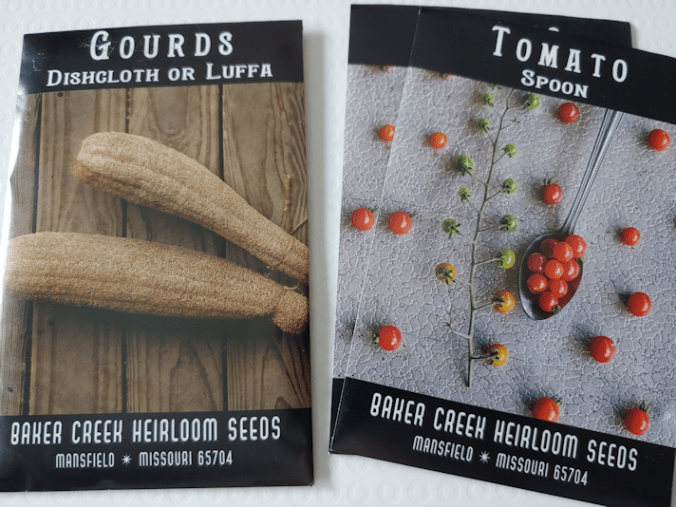
The Spoon Tomato is another new one for Baker Creek (I can’t remember why I ordered two packets…) and these were ordered for my older daughter; the one person in our household that really likes tomatoes! My husband does, too, but not as much. These are so tiny and adorable, I might even try tasting them, even though fresh tomatoes normally make me gag.

Hmmm. I just took another look at the write up on the website, to try and remember why I ordered two packets. Probably because I noticed that the packets have a minimum seed count of 15. Since we’d be starting seeds in groups and thinning them, that would be why I ordered two. However I noticed in a review, a person commented that these will self-seed, because it’s basically impossible to harvest them all. We will have to keep that in mind when we transplant them outdoors!

The Luffa gourds are something I ordered just for me. I don’t know that we’ll even be able to plant any this year, but with how quickly seeds have been running out again this year, I figured I’d better get them. As it is, I’m planning to try growing just a couple of each variety, rather than planting entire seed packets, so I’ll likely try starting some of these indoors, too. They are edible when young, but I’m interested in them for the sponges.

It will be a real challenge to grow any of the gourds in our climate. I think I’m up for it!

Now I’m even more excited about getting those loads of soil. Thanks to TurboTax fixing that bug I discovered, I was able to file my husband’s tax return this morning. I’d tried before going to bed last night, but our internet was down again. My return should come in faster because of the glitch. As soon as it does, I’m ordering the soil!

Then I’m going to go shopping for a chain saw. :-D

The Re-Farmer

Our 2021 garden: Layout

Okay, so my last post actually uploaded, so here’s hoping this one works, too!

I mentioned previously that the girls and I have been going over the layout of the grounds we have to work on, trying to figure out where we will be planting things. Today, I worked up a new diagram on the computer, this time keeping the satellite image in the background.

This is what we’ve got to work with; what I call the inner yard.

The long blue lines at the bottom (which is South) are fences. Black lines are around the house, storage house and garage. The one yellow line extending from the house is an important one for us to remember, when it comes time to making our permanent garden beds in the outer yard. There are pipes buried under there; water from the well next to the house, leading to the barn and to water fountains that were used when my parents still had cattle, and the septic pipe that diverts to the septic field, well away from house and barn. Since we plan to build accessible raised beds, and hopefully a polytunnel and/or greenhouse, we need to make sure to keep that area clear, in case we ever need to excavate it for repairs to the pipes.

The masses of green are treed areas. The spruce grove is on the right. The little yellow dot in there is where we will be planting the mulberry tree that will be arriving in the spring. We need to clear away dead spruces and underbrush, but there will be enough mature trees around it to protect it from the elements. Necessary, since it is a zone 4 tree and will need extra protection.

The blue rectangles are existing beds. The two little ones along the spruce grove are where the hard neck garlic is planted. I’ve marked where I will be making a third bed in that area. This is the only place we have soft soil, exposed when I cleaned up where the wood pile used to be. While clearing away the dead trees and underbrush around there, we will also be clearing the space where we are planning to build a cordwood shed to be used as an outdoor bathroom with composting toilet. No pit! The existing outhouse is between those beds and the garage to the south.

The blue next to the house is the old kitchen garden area, with its retaining wall of chimney blocks that we planted cucamelons in, last year. This is a bit of a problem area, overshadowed by two ornamental apple trees. There is also a double lilac, a honeysuckle and some roses in there that we will have to work around.

Then there is my mother’s old garden area!

The existing beds marked in blue are where we grew our squash and potatoes. The two little beds to the right are where the potatoes where. Summer squash were in the larger, North-South oriented beds. The long skinny bed on the north side had birdhouse gourds in it, but those got killed off by frost. The three East-West oriented beds had started out as pumpkin mounds, but when I cleaned it up for the winter, I turned them into larger beds.

The green rectangles are potential new plots. The slightly darker green ones are pretty much decided on, while the lighter green ones are in areas that are probably not worth putting beds in, but we could if we needed to. There is a row of self sown trees to the North of the existing beds that we really should take out; they should never have been allowed to grow there. They split my mother’s old garden area in a way that made a substantial part of the garden unusable. There’s also a chokecherry tree growing, all by itself, in the gap between two light green squares.

There is also a green garden area marked along the fence line to the south of the house. There should actually be two of them, on either side of the person gate, which is near that yellow line. On one side is where we will be planting cucamelons, using the chain link fence as a trellis. The other side will have tomatoes. Hopefully. The seeds have not arrived yet, so that will depend on whether they get here in time to be started indoors.

The bed I will be making next to the hard neck garlic will probably be for our 2 varieties of beets. Either that or carrots, given how soft the soil is there. We have 4 varieties of carrots to plant, so we’ll see.

The garden by the old kitchen will likely have our poppies, lettuces, and possibly the pink celery that will hopefully arrive in time.

The three beds that used to be pumpkin hills are where we will plant our three varieties of spinach. The longer beds on either side will have the bulb onions, likely interplanted with the purple Kohlrabi (onions repel insects that go after plants in the cabbage family). The former potato beds will have the shallots and bunching onions, and will likely have something interplanted with them, too. Possibly kale. We got purple kale as free seeds from Baker Creek, and we seem to be going with a pink and purple theme this year, so … we’ll see.

Speaking of purple, to the left of the existing beds is where we are planning to plant the purple corn. There are areas that can fit potential beds to the north and south. This whole area has to be carefully planned. Where the current beds are now will be permanent garden areas; I’m not so sure that where the corn will be planted will be included. With the horrible plow job that was done before we moved here, the area we’ll be putting the corn is the roughest (another reason we need that load of soil!), but where I’ve blocked off space for the corn is the best part. To the south, there’s too much shade from trees, so if we do make beds there, only shade friendly vegetables can be planted there. To the north, it’s basically lawn, and was never part of the original garden. I’ll touch on those areas, later.

Let’s leap over to the massive area on the right (east). There will be alternating blocks of corn and sunflowers there. We have 3 varieties of peaches and cream corn, and 2 varieties of giant sunflowers. We may interplant our 2 varieties of peas with the sunflowers, which can provide very strong supports for the peas to climb, while the peas fix nitrogen into the soil.

Legumes are supposed to be good to plant near corn, as corn depletes soil of nitrogen very quickly. We have 3 varieties of bush beans and, while I am considering staking them (which is supposed to help prevent fungal disease, rot and insect infestations), they are not climbers, so we won’t be interplanting them with the corn. They will go where I have two long strips near the big block. They are not as long as the block for corn and sunflowers, because of shade from the row of crab apple trees.

The other blocks will be used to plant summer squash, which I want to try staking this year, plus winter squash, gourds and melons on trellises and/or arches. Possibly peas, if we end up not interplanting them with the sunflowers. We have one more variety of corn that will be among those blocks, too.

We have two types of radishes, which will be interplanted with other things. Likely corn. Even though we will be able to buy soil that will enable us to do all this (barring some sort of emergency that takes up the funds), much of this area will later have fruit and nut trees planted in it. Anything we do to break up the soil will make it easier for us to dig holes to plant trees into.

It is with that in mind that we are breaking ground in areas that were never part of my mother’s garden. The area where we will be planting the corn and sunflowers is all grass, as is the strip along the north side. That row of self-sown trees is in the old garden area (my mother had a raspberry patch there, and when she transplanted the raspberries, she left the saplings). The old garden area extended a small plow’s width past them – and they are probably why the plow job on that side is as rough as it is (though it could also be that the person who did the plowing may have been drunk at the time). Planting on that north strip is another area we need to be wary of, as there are telephone lines buried somewhere in there.

There are a few other things we will be planting that are not on the layout. There are no potatoes on there. We are going to try using grow bags, or something similar, for our 4 varieties of potatoes this year. They will likely be set up in the south yard, near the storage house (the building marked off to the west of the house in the middle).

We also have to consider where we want to plant the purple asparagus. It has to be somewhere where they can stay for their 20 years of productive life! We also need to think about where to plant the strawberry spinach, which I’ve learn will self seed! So for those, we need to think about more permanent locations.

As you can see by the dark green lines around the inner yard, we are surrounded by trees. The spruce grove will need a lot of cleaning up, as it has so many dead and dying trees. There are a lot of poplars that are taking it over the south side of the spruce grow, and along the fence to the road, where my parents had planted elms and more apple trees. The apple trees there are too shaded to be able to produce. As I clean up all the little poplars, they will be used to build trellises and arches. As we can, we will plant more spruces in the spruce grove again! :-D Eventually, I want to take out the fence leading to the road – it’s barbed wire, and many of the posts are already rotted and falling over. For now, though, it is needed in case the renter’s cows get through the fence around the outer yard again. :-D

The area on the far right, past the fence line and trees, is a flat area next to the ditch by the road. The north side of that area is going to be prepared for planting a mix of wildflower seeds in the fall. I want to make sure this area doesn’t get taken over by trees, as has happened on the other side of our driveway, which causes a number of problems, so we’ve been mowing it. Which is hard on the mower! Introducing native wildflowers will help solve that problem, while also encouraging native pollinators. That will be good for our future fruit and nut trees.

One of the problems with figuring out where to put things is that it’s really hard to maintain a perspective of just how much space there is, versus how much space we’ll actually need for what we’ll be planting! Things might change quite a bit, even based on how many of what we start indoors germinates. Everything is flexible, but this does give us a general idea of what we have to work with.

Oh, and somehow, we need to keep the deer out of all this!

That will probably be the biggest challenge of all.

The Re-Farmer
Oh, I’m so excited!

It’s easy to get excited about things today. As I write this, we are at a balmy -18C !!

Okay, the wind chill is at -27C, but that’s okay. We’re at -18C! And our predicted high is -15C! It’s feeling like spring out there!

For my friends in the US, -18C is 0.4F, -27C is -16.6F, and -15C is 5F.

Last night, we did hit temperatures of -33C/-24F with a wind chill of -37C/-35F, so this is a huge increase in the space of about 14 hours. Not only that, but by the 22nd, just 5 days from now, we’re supposed to reach 2C/36F

I don’t know how we’re going to handle all that heat. LOL

Even the deer are happy. I took these shots, after I’d done the morning rounds.

I had seen two deer at the feeding station, but by the time I came back with my phone to take pictures, there were three!

Cabbages was watching them – and didn’t run away when I came close to take pictures!

When I headed out this morning, there wasn’t a yard cat in sight, which concerned me a bit. With the increased temperatures, I expected to see them all over. Then I saw the fluffy white flag in the outer yard! :-D My brother’s dog had come to visit the kitties, and they were all in hiding. They did eventually come to the kibble house, and indulge in some warm water, though.

I’m starting to think that the terrarium heat bulb inside the cat’s house has stopped working. I can see by the red light on the timer that it is still getting power when the light sensor is triggered. However, that spot on the roof where the snow would melt is not clear, even after I shoveled off most of the snow and things have warmed up in general. We have no thermometer inside (something we intend to add, later in the year), so the only way to tell would be by lifting the roof and manually checking the ceramic bulb.

Which is not going to happen, any time soon! Unless the heated water bowl gets unplugged again, we are not lifting that roof. :-D

I ran our van while I was switching out the memory cards on the trail cams. The coolant levels are where they are supposed to be, which is good. It’s still making a whining noise, but I no longer think it’s the cold serpentine belt. I think it’s the power steering, right next to it. Something else to get checked. *sigh*

Trading the locations of the trail cams seems to have worked. When I switched the memory card in the new camera, the display screen inside activated without my having to warm it up with my hands, first! We had a busy day at our gate, yesterday. The older camera, which is set to take only short videos, had 44 files for me to check. The new camera, which is set to take 3 stills, then a short video, had 233 files waiting for me! It did have a hard time with night shots, but it was taking stills with an internal temperature of -25C/-13F before stopping completely. The other camera was still recording, and I finally saw what has been close enough to trigger the motion sensors, but too far for the infrared flash to light up. I could just barely see the shadow of a deer walking though the far end of the driveway, by the road.

So the camera set up is working better now, which is the important thing.

And now for the thing that I’m really excited about!

As the girls and I were pouring over the diagram of the property, our need to buy soil – and a lot of it – is something we just can’t get away from. It’s not even that we don’t have the years it would take to build up the soil, as we originally planned, but that we don’t have the organic material to do it. We just don’t produce enough compost, don’t have enough yard waste, and don’t have access to the amounts of manure and other amendments we need, in the quantities we’ll need.

I’ve tried to find out how much it would cost to get a dump truck load of garden soil through various sites, but I don’t know how much a dump truck would hold in the first place. We don’t plan to have a load spread onto the garden area. We just want a pile that we will spread ourselves, where we need it, as we need it. Most of where we are planting this year is going to be temporary, anyhow, so we will be very selective on where we put purchased soil.

Then there are all the different mixes you can get. Some sites I found offered a basic 3 part mix of soil, compost and manure, while others offered up 4 and 5 part mixes, with additional amendments. Of course, the more in the mix, the higher the cost, but without knowing how many square yards I’m even after, there was no way to figure out how much it would cost. The only thing I really had to go by was how much my older brother paid for loads of soil, but he wasn’t buying garden soil. He was buying things like fill and gravel. Still, it gave me the closest thing to a ball park figure I was able to find.

Today, I decided to call a local company. They have a yard just a couple of miles away from us, and we pass it every time we go to town. I knew they did gravel, but in passing the yard, I could see they had soil, too. Was it fill? Topsoil? Garden soil? I had no idea.

So I called them up and asked if they had garden soil, and was told, yes, they did. Then he began rattling off four of the five part mix they have! He couldn’t remember the last one, but it includes both cow and sheep manure, as well as a type of sand, to make it lighter. I’m guessing the one he couldn’t remember was compost. With the companies I found online, this would be their high end premium mix, but for this company, it’s the only mix they have!

I asked about load sizes, and their truck holds 10 – 12 square yards of garden soil, and we would be charged only $25 a yard.

And because we are so close, that would include the cost of delivery!

A load of 12 square yards would cost about $300. I’m assuming there would be taxes on top of that.

That is about half of what I was expecting it to be.

My older brother happened to call not long after, and when I told him about it, he was astonished at the price. He also wondered if a single load would be enough, but at this price, we’ll be able to get two!

I’ll be calling the company back to arrange delivery around April. That gives us time to figure out where we want to have the soil dumped. If we’re getting two loads, I’m thinking maybe get one for the inner yard, and one for the outer yard, but I really can’t think of where we can place a truck load in the inner yard.

We’re already looking forward to what we’ll be able to plant this year. That we’ll be able to afford the soil is just icing on the cake! We were talking about waiting until we get our tax returns to do this, but the cost is so much lower than expected, we could even be able to do it from our normal budget, even if we’d have to split it between two months – so long as we don’t have anything break down! :-D

I just realized something.

We can get a dump truck full of premium garden soil for less than the cost of getting a cat spayed.

Something seems wrong about that!

:-D

The Re-Farmer

Our 2021 garden: bunching onions started, and sprouts!

Finally! The last of our onion seeds have been planted!

These were the bunching onions; a variety called Red Baron, from Veseys. They have red root ends instead of the usual white.

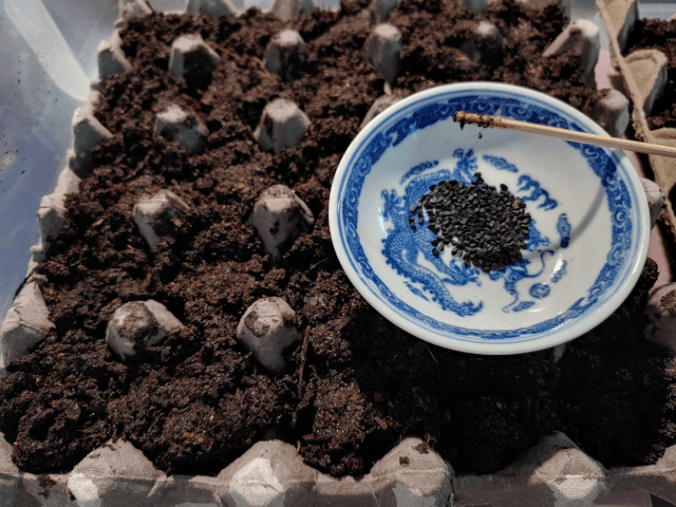
Using the dampened blunt end of a bamboo skewer made planting the seeds really easy. I could pick up a single seed at a time (two, if I really wanted to), press it into the growing medium, then cover the seed, all with the skewer. I put two seeds in each cell (though I think I might have lost track and double planted a couple! LOL), which left me with about half a package left over.

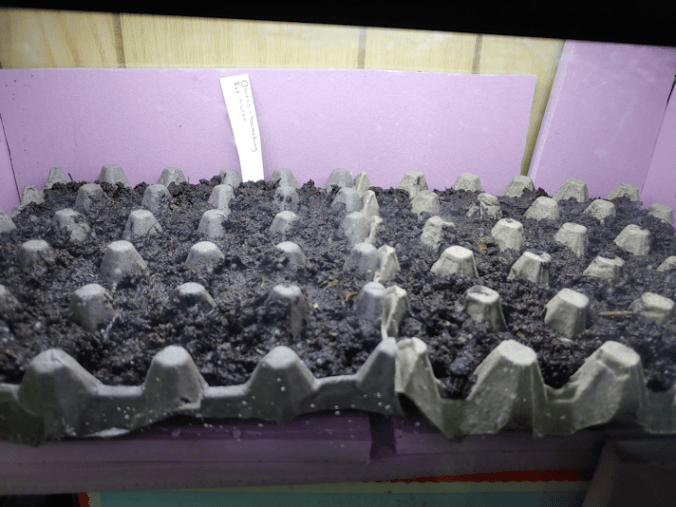
Then the trays went into the 20 gallon fish tank. It’s a bit snug, and I’ll likely have to fight a bit to get them out again later, but there is enough room at each end to move them, to get a grip under the tray supports.

This tank has a lid with the light fixture attached under it. I had thought that would be enough, but my daughter has already caught a cat on the lid, reaching through the opening in the back for the filter and hoses. I’m going to have to find a way to block that off, while still allowing air circulation!

Meanwhile…

The first onions we planted, the Norstar bulb onion, now has sprouts large enough to see in a photo. :-D

You can also see how some of the K-cups are drier on the top. I’d already sprayed them this morning, and we’ll likely have to spray them again this evening. The peat pellets, at least, are holding their moisture quite well.

Special note: when using loose peat to start seeds, soak it with water before putting it in pots or cells!

As an aside, I am happy to say that my husband’s prescriptions got delivered today. I had asked for them to call first, so I could unlock the gate, only to get a phone call saying they were already here! So I quickly threw on some boots and a coat and dashed out to meet them.

Of course “dashing out” doesn’t mean the same thing on the farm than it did when we lived in the city! LOL

When I mentioned I had been expecting to be called in advance, so the gate could be unlocked for them, I was told they’d actually tried to call from the driveway, but couldn’t get a signal. They had to drive up the road about a quarter mile before they could get enough signal to call me.

The driver then commented that he recognized me, and he even remembered my name, as well as my parents! Unfortunately, even though we were outside and on opposite sides of the gate, he was wearing a mask, so I had no clue who he was. It turned out he was the principle when I was in school! He even remembered my husband from high school. Small world! :-) I have no idea why he and his wife were delivering prescriptions for the pharmacy, but I was happy to see them. :-)

My husband has gone over the new meds, and it turns out that the changed prescription isn’t for something he’s on right now. Another medication he used to be on years ago has been added back on, which is why I remembered the name when talking to the doctor about it. I’m losing track of them all! There are some very serious possible contraindications, mostly respiratory. With the setting on his CPAP as high as it already is, that, at least, is not as much of a concern while he’s asleep. It explains why the doctor was so hesitant to change my husband’s medications. He’s already maxed out on the doses of most of his other medications. Hopefully these changes, which will continue to be slowly adjusted over the next few months, will finally get the pain levels under control, and his quality of life will finally start to improve!

Among our goals with our permanent garden beds is for them to be accessible. High beds with wide spaces between them. It would be good for him to be able to get out with his walker, among growing things. :-)

There is more benefit to gardening than being able to grow food!

The Re-Farmer

Van stuff, and we have emerged… :-D

Yesterday, I made a point of running our van and my mother’s car for a while, to warm up the engines.

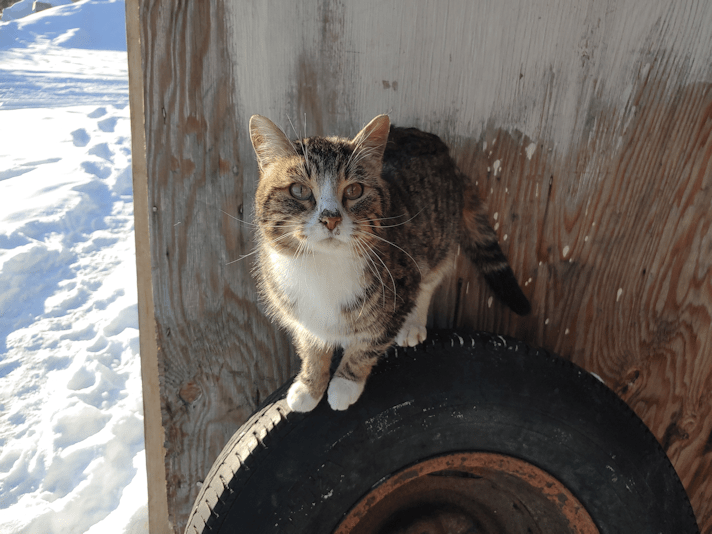
The doors to where my mother’s car is parked are sagging, so they open on their own unless they are blocked with something heavy. I’ve been using one of the many tires scattered about to do that. The cats have been loving it. Even in the cold we’ve been having, the black rubber gets quite warm in the sun!

Potato Beetle really wanted attention! :-D

The van keeps making a noise, even after it’s been running a while, so I popped the hood to take a look.

The noise is coming from the serpentine belt, which is what I expected, but then I noticed something else.

I was basically out of coolant/anti-freeze. ?!?

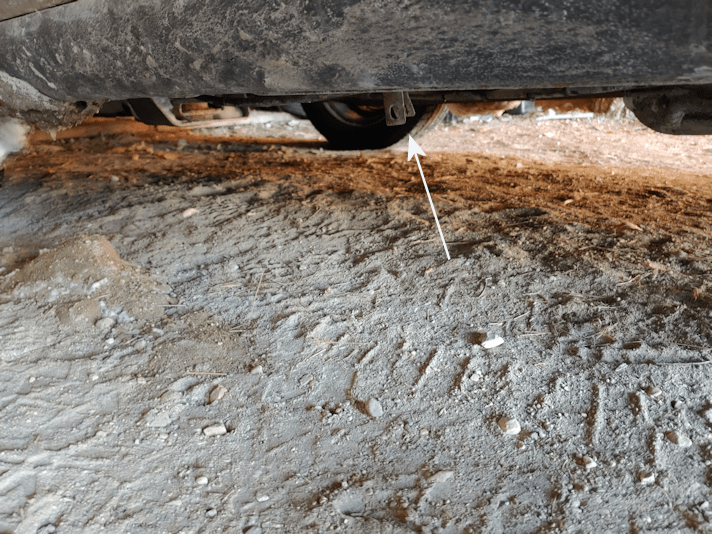
I had some in the garage and topped it up a bit, but decided to check under the van to see if there was some sort of leak. The most efficient way to do that, for someone who can’t get down on the ground, is to use my phone to take pictures.

I didn’t find a leak, but when I uploaded the photos to my desktop so I could see better, I did find a mystery.

What the heck is that? This is under the driver’s seat. I don’t know enough about what’s under vehicles to know what that is. I’ll have to look it up.

Meanwhile, I hooked up the OBD II reader and it actually worked this time, so I did a scan.

One thing came up as an issue, code P0404. I looked it up, but what I found really didn’t tell me much. The EGR valve is what got recently replaced, so this could related to what the mechanic told me about how carbon in the lines he couldn’t reach to clean might come loose and cause some stuttering, etc. I’ll have to give him a call.

On the plus side, my mother’s car was running better, so when I headed out to do my rounds this morning, I made sure to grab the keys and get it warming up.

This morning was the first time in a long time where the temperature and the wind chill were both warmer than -30C for a change!

The cats were quite enjoying the comparatively warm conditions! Poor Nosy is still looking miserable, and he really wanted attention. When holding him, he’s actually taken to grabbing my hand and pulling it to his face, for me to scritch his neck.

It’s warmed up enough that I will be switching out the memory cards on trail cams regularly again, though I had to take the new camera inside and switch to warm batteries again. I took the opportunity to reverse it’s location with the older camera. It is now in full sun, which should help with the frozen battery problems.

Once that was done, I used my mother’s car to go to the post office/general store. It’s just a few miles away, so I felt confident it would be fine.

My mother’s car is a hatch back, and always makes rattling noises in the back. It makes a lot more rattling noises when it’s cold! :-D

While getting the mail, I picked up some more coolant/anti-freeze for the van. Once at home, I topped up the reservoir a bit more. Later today, I’ll run it again for a while.

Meanwhile…

It’s been over a week since we were able to get the mail, so we had lots waiting for us. Including…

More seeds! Packed by Emma. Thank you, Emma! :-D

This was from the order I placed as birthday presents for the girls. :-D The purple asparagus crowns and the black iris will be shipped later, just before it’s time to plant them, for our zone. As of now, the only seeds outstanding are from my last minute order from Baker Creek. They have been shipped, so it’s now in the hands of the US and Cdn postal systems. We’re not expecting them for quite a while. I just hope we’ll get them early enough to start the spoon tomatoes indoors!

Last night, I used a satellite image of the property to create a line diagram of the inner yard, marking off where the house, storage house, fence lines and trees areas are. After printing it out, I drew in where we have existing beds and a few other details. The girls and I have been going over it, trying to figure out what to plant, where, and sketching it in. There is going to be a fair amount of inter-planting – especially with the Daikon radishes, which will be used to help break up the soil. I was amused to discover this type of radish is known as “pile driver” radishes. :-D Among the things we need to consider are the permanent locations. The asparagus, for example, can be expected to produce for 20 years, and the strawberry spinach is self sowing. Once we have a better idea of what we’ll be doing, we’ll make a bigger version of the line diagram to consult as time goes buy. We fully expect to change things up when it comes time to actually plant/transplant, but at least we’ll have a general overview.

Another thing we got today was the catalog I ordered from T&T Seeds. This is the seed catalog from my childhood. :-D I’m glad I got the physical catalog, because I find it much easier on the eyes than their website. :-/ There are quite a few things they carry that few others carry. One of them that caught our attention is the Forage Radish. From their website:

Help loosen your soil! Forage Radish or Bio Drilling. White radishes are quickly becoming a popular cover crop, as growers planting them are seeing benefits beyond commonly used cover crops, such as rye and clover. Forage radishes can improve the soil and environment. With taproots that can grow several feet deep, forage radishes bore holes into the ground, loosening the soil, hence giving them the nickname “tillage radishes.” The deep roots penetrate many layers of compacted soil, with the thin lower part of the taproot reaching 6 feet or more during the fall. After the cover crop dies in the winter and roots decompose, open root channels can be used by subsequent crop roots to grow through compacted soil layers.

Which is exactly what we need. They also carry sugar beets, which can also be used to break up soil like ours, though that’s not a selling feature. Plus, if we wanted to, we could actually try making our own sugar. Or just use them to feed the deer. At some point, we will be getting animals, so it could be one of the feed crops we can grow. Just one of the possibilities we will keep in mind, over the years.

In going over our map and figuring out where to plant, it really is hitting home how much we’ll need to actually buy a whole lot of soil. We will also have to find a way to efficiently water plots that will be well away from the house. Our current 300 ft of hose will not be enough! Things like drip irrigation, soaker hoses, or even lengths of PVC pipes with holed drilled into them that we can attach a hose to, are things we’re considering. For some things, just burying plastic containers of varying sizes, with judiciously placed holes drilled into them, next to plants that need deep watering are an option. They just need to be filled with water, which will slowly drain into the soil near the plants. We have already been keeping all kinds of containers that can be used that way, ranging in size from small water bottles to 5 gallon water jugs so, for us, that will probably be the easiest option.

At one point, I was amused by the realization that, while we are planning our garden for this year, we are also already planning our garden for next year… and the years after! We’re having a blast with it, too. :-)

I have one last photo to share with you before I finish this post. It’s completely off topic, but I can’t resist! One of my constant battles with the cats is that, as soon as I get up from the computer (which is frequent), my (very worn out) chair gets instantly occupied by a cat. Usually Cheddar.

Last night, I had this group waiting for me. Beep Beep and her babies, Saffron and Turmeric. :-D

Those faces! They’re like owls. :-D

It’s a lot more challenging to remove three cats, since any one I’ removed jumps back the instant I’ve turned my back while removing the next one!

They are certainly entertaining. :-)

The Re-Farmer

Frosted!

Thanks to my dear brother and his wife, I had plenty of kibble to feed the kitties this morning. I would have emptied the bin this morning, otherwise.

Ginger was out and about, and covered in frost!

While the tips of their fur makes them look chilled, when I pet them or pick them up (at least the ones that allow me to!) feel surprisingly warm. Their winter undercoats are doing the job of keeping them somewhat insulated.

Once again, the heated water bowl was almost completely frozen over! I made sure all the water bowls were filled with warm water, before doing the kibble. Their food bowls are full, but even dry kibble must get pretty hard in these temperatures, as they definitely prefer the new kibble, which would be slightly less frozen! :-D The thermometer in the sun room has shown it to be typically half the outside temperature or warmer, so when we are in the -30’s C outside, it’s at about -15C. (-22F and 5F). So everything in there is definitely frozen, but the cats seem to find it better.

While filling the water bowls, I made sure to look into the cat house.

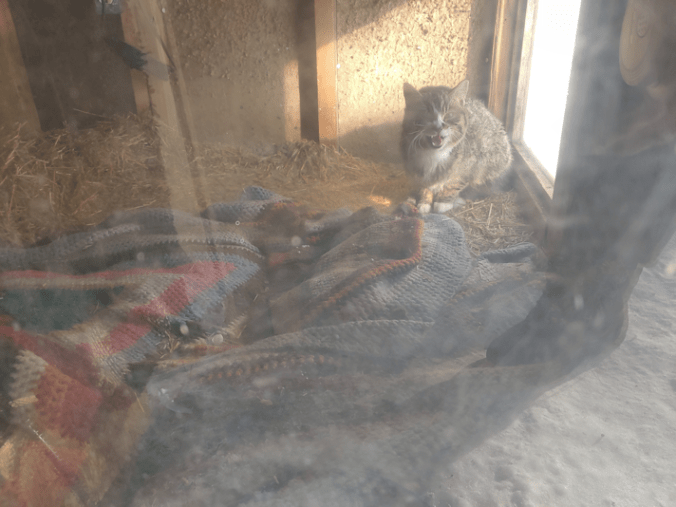
There had been at least three cat in there, but only Nostrildamus is socialized enough to not run off when I come near. I got the picture of him in mid meow! :-D

In the upper left of the photo, you can see the timer the heat bulb is plugged into. It had been propped against some screws in the joist, so that the light sensor faced the window, but it keeps falling half off one of them. I have not tried to put it back, since it just means it will turn on earlier than if it was facing the window, and warm things up. The cats do love sitting in the sun of that one window! What I’d love to do before next winter is find a way to make another shelter for them that takes advantage of passive solar heat. I was thinking of making a smaller version of the kibble house to hold the water bowls. I’m sure we have some old windows in the barn that can be used as a roof and maybe even a back wall.

As I was coming back from putting feed out for the deer and birds, I found Creamsicle Jr had shown up in the kibble house. I only got a brief look at his injured eye, and while the fur is still dirty around it, the eye itself is looking almost normal again.

I did not run the van or my mother’s car this morning, as the cold was already getting to me. I wasn’t up to having to open up both sets of garage doors so I could run the vehicles, in a wind chill of -46C/-51F I’ll bundle up again and head out after I finish this.

Check out our long range forecast!

Look at that!!! Not only are we supposed to consistently keep warming up over the next while, but by the 22nd and 23rd, we’re supposed to be around 0C!! (32F) Things will actually be melting!

Assuming the weather actually cooperates, and this polar vortex doesn’t decide to just hang out even longer. It has messed up the forecasts a few times, now.

I’ve been thinking warm thoughts in response. Which has meant looking at the websites of seed companies. I’ve gone so far as to start an account with Heritage Harvest Seed, and have been filling my Favourites list! We don’t need more seeds, and much of what I’ve added are sold out, anyhow. It’s still fun to look. I love the little write ups that come with each item. Half the time, the thing that convinces me to add something to my Favourites is the words “extremely rare!!” I love the idea of keeping rare varieties going. We’ll have the space to do it, as we clean up and prepare more of the property and eventually expand into the outer yard. Even if we don’t necessarily grow things for our own use, they won’t go to waste, and we’ll have the privilege of space to grow them for their seeds. With this company, I can be sure that they will grow in our climate, too, since they are even further North than we are, though we’re in the same zone. From other cold climate gardeners I’ve been hearing from, the company has an excellent reputation.

I will just have to resist the temptation of ordering more seeds when we already have so many, and more on the way!

Our internet connection repeatedly cutting out should make that easier. Most of the time, it means pages don’t load well, or don’t load completely. Oddly, the most common thing that will not load, no matter how many times I try reloading a page, is the “like” button. !!

Now it’s time to see if I’ll be able to publish this post now, or have to try again later! :-D

The Re-Farmer