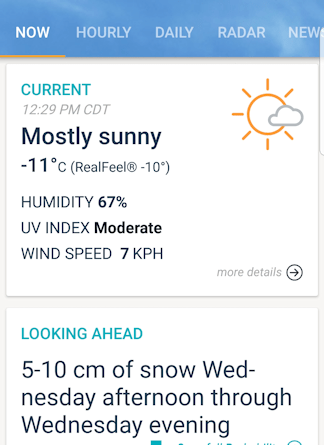
We… don’t have rain. :-(

So much for weather forecasts.

For all the lower temperatures and overcast skies, and forecasts of 80% chance for rain, there has been none today.  Going into town with another errand, my daughter and I played a bit of Pokemon Go.  In the game, which is linked to local weather in some way, showed pouring rain on our maps.  In the real world, there wasn’t a drop.

Once home again, I did a quick check around the yard and garden area.  After talking to my mother yesterday, I learned that the trees in the flower garden are not cherry trees, after all, but ornamental apple trees.  The cherry trees, she tells me, are in the spruce grove, behind where the wood pile used to be.  No sign of blossoms there, yet.  I am not sure why edible cherries would be planted among spruce trees, while ornamental (I assume that means they don’t produce anything edible) apples are planted next to the house.

20180518.apple.tree.west

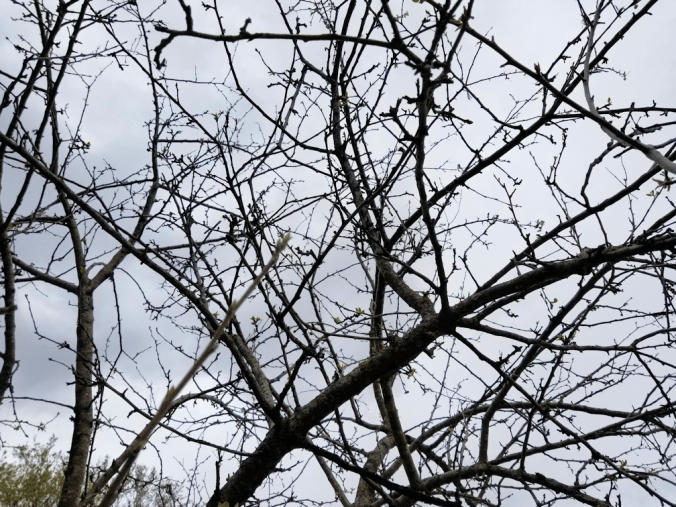
The apple trees in the flower garden are leafing and budding up nicely, too.  The row of apples (all varieties of crab apples, as I recall) are barely in leaf.
20180518.apple.trees.north

Planted on the north side of the spruce grove, they wouldn’t have anywhere near as much sun as the ones in the flower garden, which is the most likely reason why they are so much slower to revive for the season.

20180518.early.lilac.buds

On the far side of the garden, along the fence line, the lilac border is showing flower buds already on some bushes.  I was looking for a sign of the chokecherry tree that used to be there.  The lilac border runs the entire length of the fence line now, but when I was a child, it was only about half the distance, and the chokecherry tree was at the end of the row, about the middle of the length of the garden at the time.  I may have found it, but can’t be sure, as it’s behind lilac bushes.  The tree I saw that might be it also seems to be dead; likely the chokecherry tree was choked out by the lilacs. :-(  I will see if I can confirm that with my mother one of these days.

20180518raspberrie.bushes

This is part of a row of what appears to be raspberry canes, though it’s hard to identify them among the scrub and without any leaf buds to be seen.  On one side, it’s almost right up against a row of spruces.  On the other, I can see that it was plowed within inches of the stems.  They would be getting light only in the early hours of the morning, now that the sun is rising so much farther to the north than it did in the winter.  By about 9 or 10 am, they would be in shade until sunrise.  We’ll see what raspberries we get this year, if any.  Most varieties of raspberries have canes that produce in the second year, before dying back.  At that point, the spent canes should be cut away, but that is something my parents never did, as far as I can recall; they just let them be until it was decided to transplant them.  I remember when they were planted on the far side of the garden, beyond where a row of trees is now planted.  At the height of raspberry season, we could pick several ice cream pails’ worth of berries in the morning, then come back by evening and have more ripened berries to pick.  On our list of things we eventually want to plant are three different varieties of raspberries, each with a different harvesting period, so we could have raspberries from July through September.

Whenever that happens, we will be sure to plant them somewhere that actually gets full sun.

The Re-Farmer

How Does the Garden Grow?

As we clean up around the house and yard, we are starting to discover where things are growing, and even what some things are.

These pictures are of the biggest of my mother’s flower gardens, at the old kitchen.  It actually has a fence around it and everything.

Here is what I am seeing in it, now that growth is starting to happen.

20180513.garden.cherry

I am enjoying the sight of leaves and flower buds on this cherry tree.  It looks like we have a second, smaller one.  I look forward to seeing them in full bloom!

20180513.garden.chives

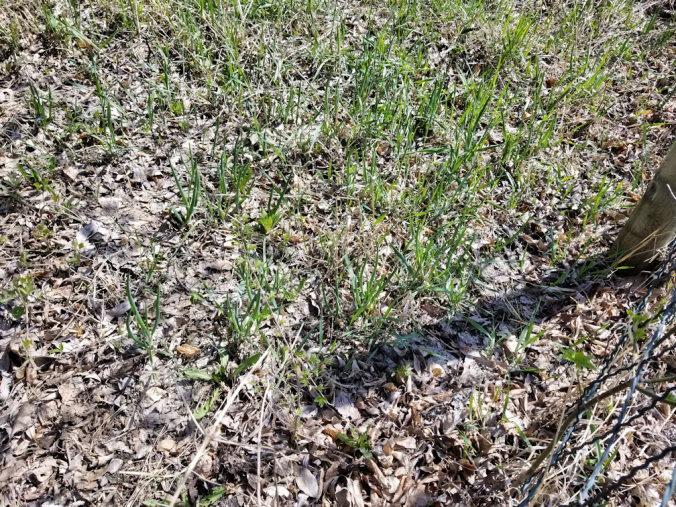
Under the bigger cherry tree, outside the garden fencing, chives are coming up.  Plus what looks like an onion, over on the right.

20180513.garden.rhubbarb1

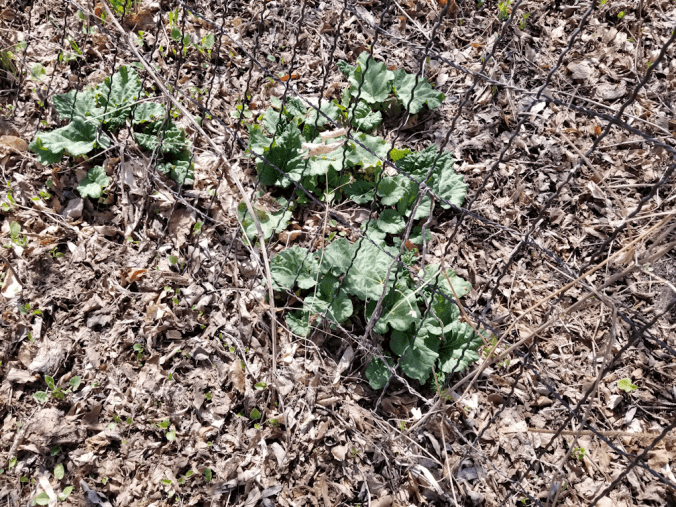
There is also some rhubarb growing just inside the garden, near the base of the tree.  I am happy to see it.  I love rhubarb!

20180513.garden.onions

Near this rhubarb, there appears to be a whole lot of onions coming up.  It should be interesting to see what all we find once we get to raking in here.  Though my mom has always called this a flower garden, she’s had onions planted in here for as long as I can remember, though there may have been some years without them.  I remember tomatoes planted in here, too.

20180513.garden.overrun1

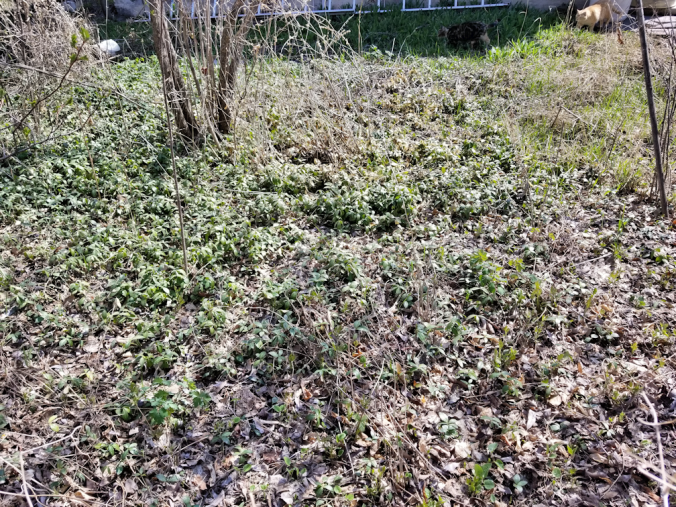
The middle of the garden is completely overrun with these plants.  My mom told me the name of them, but I don’t remember what it is.  She had planted them, only to discover they are quite invasive, and has told me that she would like me to get rid of it.

That is not going to be easy.

20180513.garden.wild.columbine

Along the outside edge of the garden, I can see some wild columbine starting to come up.  Next to what looks like a wild rose?  I like wild columbine.  So do hummingbirds. :-)

20180513.garden.rhubbarb2

Around the corner, on the opposite side of the garden, there is a whole bunch more rhubarb.  Hmmm!

20180513.garden.asparagus

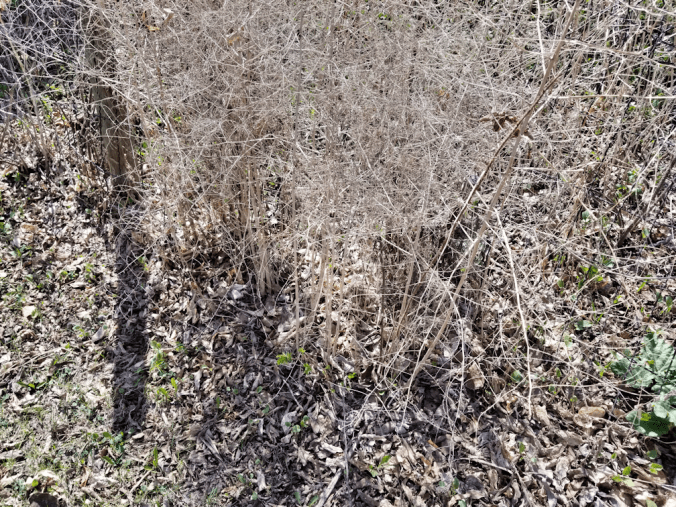
This tangled mass of last year’s growth is asparagus fern.  We have had it for as long as I can remember; as a child, I used to love looking at the fine sprays of greenery.  What I don’t remember is us ever eating asparagus!  I think it may have just been too much of a hassle, so my mom left it to itself.  I’m hoping to get it cleaned up soon, and see if there is new asparagus growing.

20180513.garden.overrun2

Then there is this mass of greenery, near the house, under a rose bush.  I have no idea what it is, or even if it was intentionally planted.

The soil is rock hard and bone dry.  It’s going to take a lot of work to get this garden going again!

I think it will be easier if we start by removing the fencing, which is falling down.  Even the fence posts are starting to fall over.

I do hope we get some rain soon.  There hasn’t been anything more than a few sprinkles all spring.

The Re-Farmer

Doesn’t quite match

Here’s a good illustration of how different micro-climates can be!

This is a picture of the thermometer outside my office window.

20180408-122936thermometer

That reads a VERY balmy 13C.

This is the actual temperature, in a screen shot from my phone, which is getting readings from a weather station maybe 5 miles from us.

20180408-122936weather.screenshot

These were taken moments apart, shortly before 12:30.  It is now about 1:45, and the thermometer outside is reading 21C, while the weather station is reading -9C.

These little pockets of warmer temperatures are why my mother had been able to grow things that were rated for zone 5, when we live in a zone 3.  Or zone 2B, if I were to go by my Veseys catalog, which conveniently includes our hardiness zone right next to my name and address.

Granted, my mother also had two green thumbs.  Even when she was downright brutal with her plants, when it came to transplanting, tending, or even just weeding, they absolutely thrived.

These are the sorts of things we need to keep in mind when we get around to planting around our yard.  What can grow on the East side of the house (more shade, wind tunnel) is going to be very different from the West side (more sheltered, mix of sun and shade).  The main garden, to the more exposed North, is going to be very different from anything we try to plant in the more sheltered South yard.

I’ve started up a list of things we might consider planting.  I want to focus on things that produce trees, but I also want to encourage pollinators.  I’ve made up a list of flowering plants that both attract pollinators and deter deer.  I may love having the deer come and visit our living room window, but I don’t want them eating our garden!  I am thinking a border of pollinator friendly, deer deterring plants, around any areas of food plants we end up including.  My daughters and I will be making another list of vegetables.

Not for this year, I don’t think, but very likely next year, at least to start.

Any gardeners out there that have had to deal with things like this?  What sort of solutions have you come up with?

What sorts of things would you be considering, in a situation like ours?  Big yard, huge main garden area, many small garden areas, wildlife, and lots to clean up before we can start!

The Re-Farmer