We’ve got some decent progress around the yard over the past few days.
The haskap bushes have been transplanted.

Getting them in was not without it’s casualties, however.
Continue readingWe’ve got some decent progress around the yard over the past few days.
The haskap bushes have been transplanted.
Getting them in was not without it’s casualties, however.
Continue readingThings are getting busy all over the place!
Including in our maternity ward.
Continue readingYesterday, the girls needed to pick up stuff not available locally, so we made a trip into the city.
While we were out, a wonderful, long rain came through our region.

We could actually see the difference in the trees between when we drove into the city, and when we drove back!
The only down side is that we had also been getting strong winds. Enough to blow over the bird feeder stand in its summer location. The hanging feeder fell apart, but thankfully, it just pops back together easily. I was needing to refill it, anyhow.
I also finally saw birds using the bird bath, in its now location. So I’m happy. :-)
I had nothing I needed to get in the city myself, but of course I was checking things out. Especially the garden centres. One of our goals is to plant food trees, so I’ve been checking out the varieties of apples – I’d like something other than crab apples! – that can grow in our region, as well as anything else that produces fruit, nut or berry.
I ended up buying our first food trees.

Also known as haskap, these berries were on my list. I’ve never actually had one before, but they can be used like blueberries, raspberries or strawberries. Part of why I included them on my list was due to their extreme hardiness. These babies can withstand -45C temperatures! They are also an early producer, with ripe berries (after the second year) by mid-June.
This is a variety that needs male and female plants to pollinate, and when I saw there was only one of each left, I grabbed them. We won’t expect berries in their first year, but we should have plenty, next year.
What we now have to do is figure out where to plant them. They require sun and shade, can grow 5-10 ft high, and should be planted about 4 feet apart. We thought of taking out more of that spirea by the storage house, and planting them near the grapes, but with the size and spacing needed, I’m moving away from that idea. They could be planted in one of my newly mulched beds in the south yard. They will also be easy to water, there.
Something to figure out over the next couple of days. :-)
I’m really looking forward to seeing how these grow!
The Re-Farmer
The trees are starting to put out their leaves, which means the pollinators will be out soon.
Time to put up the mason bee hive we picked up a while back.
We decided to place it near the crab apple trees, since that’s where the most flowers are soon going to be. That meant attaching it to one of the spruce trees.
Which… the box isn’t really set up for.

Under the disc that covers an opening into the butterfly space, there is just this to hang it with. Which might work in some areas, but I can see this falling in the wind, so easily.
I figured I’d try bungee cords, instead.
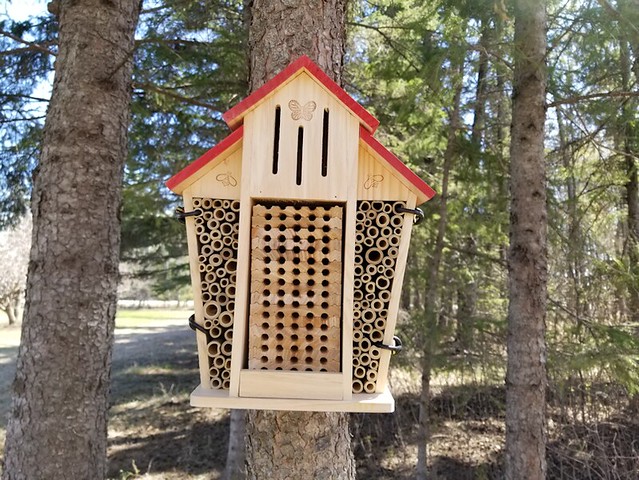
I had to find a tree small enough that my pair of cords could reach around both the width of the tree, and the depth of the hive.
I also turned it away from the apple trees, so it won’t have the north winds blowing right into the openings. This tree is also surrounded by other trees, providing shade and shelter as well. The next thing I want to do is provide a water source; just a shallow dish with some smooth rocks for the bees and butterflies to land on. I already have appropriate rocks. I just need to find an appropriate container and the right place to set it. Between watering the bird bath and the bee dish, there should also be enough mud available for the bees to use in the hive.
We’ve never had anything like this before, so we shall see how it works out. In the future, we plan to plant bee and butterfly gardens – well away from the house, since my husband is allergic to stings. (Most of the local bee species don’t sting, so it’s more honey bees, wasps and hornets that are of concern.) One of my brothers even has milkweed on his property, so I hope to get some growing here, too. If it does work out, I plan to get more of these, in different styles.
Also in future plans are setting up bat houses and maybe even purple martin houses – both do a great job of eating mosquitoes!
The Re-Farmer
Well, today was certainly a productive day outside!
I decided to see how much I could get done on the old kitchen garden today, and ended up finishing the job! So I’m happy. :-)
When I came out of the house, I startled cats in all directions, including that new grey ball of fluff. A few of them even hung around while I moved things around the garden to prepare.
Yay! I can tick “straw bale” off my list of things we need to get/do before winter!
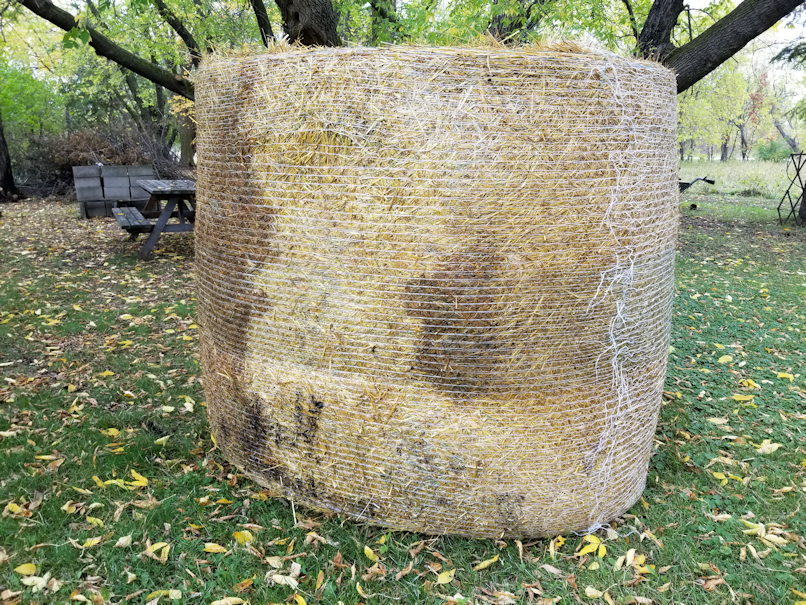
The renter was taking his bales off our field today, and this beauty was just delivered.
That is going to be enough for so many things!
The main thing is to cover the top of the septic tank – the other thing on the list is getting that emptied, and I’ve already contacted the company about when they’re going to be in the area again. There will be enough to cover that entire corner. I’ll be able to put a nice, thick layer on the small garden by the Old Kitchen. The girls plan to rake some leaves to layer on to there today, too, so we’ll be able to build up lots of organic matter onto it. This garden slopes, so I’m loosely planning to eventually build a low retaining wall at the west end, and find a way to do the sides as well, to level it off.
We will also be able to put new straw into the old dog houses the cats use as winter shelters, and insulate the outside of them, too. I want to see if I can move those to more sheltered places, first, though.
We might even still have enough left to use the remains of the bale as a throwing target. :-D
Oh, I am so happy!
It’s the little things that make life good. :-D
The Re-Farmer
When we moved out here to take care of the farm for my mother, one of the things we knew is that this first year would be a year of discovery. With the yard in particular, I wanted to get an idea of what was growing where. Sure, my mother could fill in a few details, but she hasn’t lived here in a few years, and isn’t going to remember everything.
As summer progresses, and things come to bloom in their seasons, I am making more and more of these discoveries.
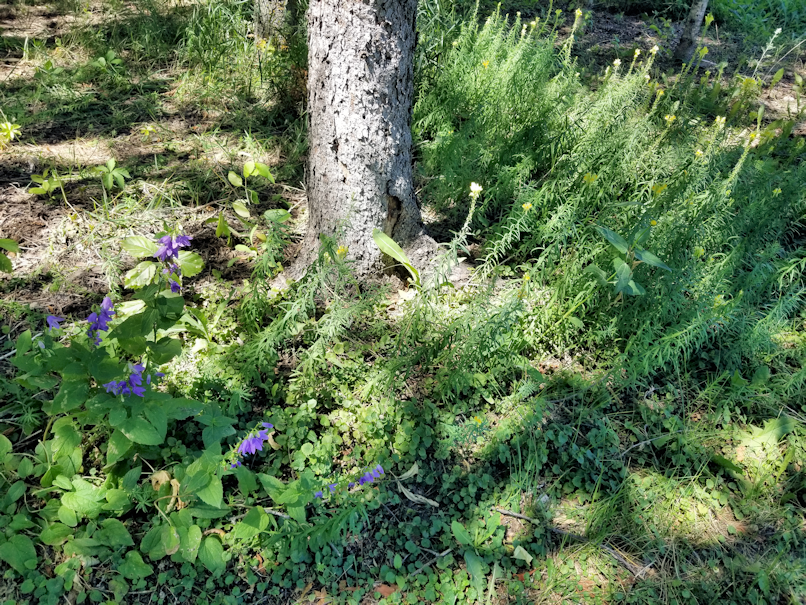
This is at the base of one of the dead spruce trees I’d pulled a whole triffid of vines out of, not long ago. When I was going around here with the weed trimmer, I avoided this area, partly because I could tell it wasn’t just a whole lot of overgrown crab grass and weeds, partly because I wasn’t sure what was hidden in it. I’m glad I left it. :-)
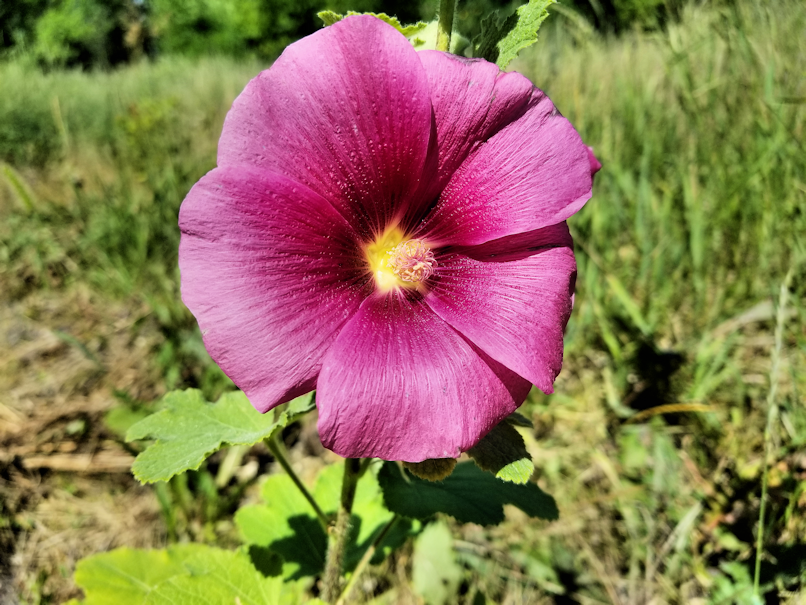
The main garden area is completely overgrown right now, much to my mother’s dismay, but I did try to explain to her that I wanted to see what was there.
In the middle of some tall grass and burdock that I’d pulled, there is this splash of colour. There is another next to it that’s more white than pink. Just the two of them, in a sea of grass!
I will see about transplanting these somewhere, to salvage them, later on.
There were a couple of areas with a lot of thistles that I pulled when they were larger (easier to pull), but I didn’t get all of them. There is another type of thistle, with fewer but larger leaves and spines, that grows much larger flower heads.
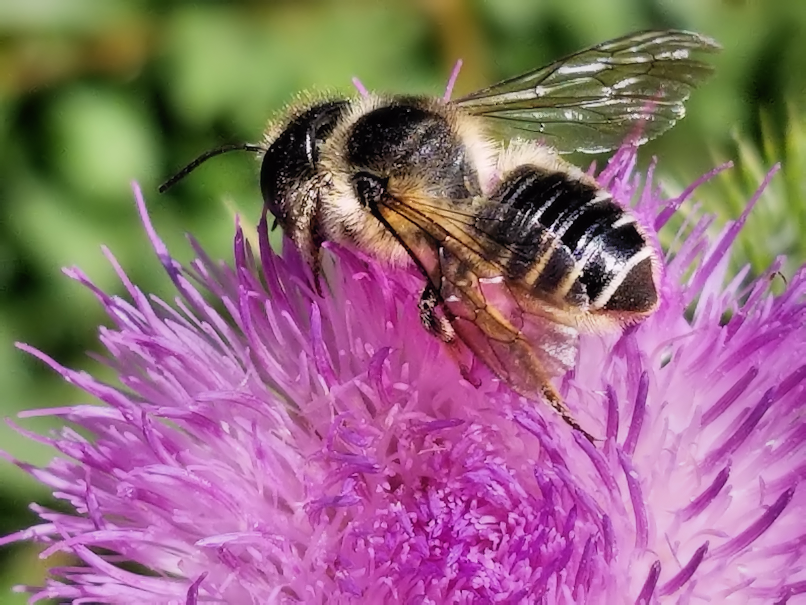
The bees and butterflies love them.
There’s only a couple of these big thistles. I will leave them for the insects and pull them out just before they go to seed.
There were many more random flowers and raspberries (I picked almost 2 cups of raspberries while taking these photos – far more than I expected to get out of them!) growing in between the trees in the maple grove, including in areas where I’d already used the weed trimmer.
The girls and I have been talking about what we’d like to do, and it turned out we’re all on the same page. When things are cleaned and cleared out, we want to plant, in some areas, a variety of wildflowers and bulbs that will naturally spread. The rows of trees are not the same distance apart, so I’m thinking of keeping the widest area clear, and planting between the rows that are closer together. If we’re careful about what we select, we can encourage them in these areas to not only make it look pretty, but to reduce maintenance. No grass to mow or weeds to trim. We’ll just have to make sure there is plenty of grassy areas, too (or maybe moss) to walk in. Plus, I’d like my husband to be able to enjoy the space, too, and not have to worry about getting stung, since he’s allergic to stings.
Finding that balance, and thinking years into the future, will be the key in deciding what we do. We don’t want to be in the same situation, years down the road, that we are in now with the spirea and the vines!
Until then, we’ll just enjoy the blooms as we find them!
The Re-Farmer

While doing a check around the yard for downed branches, I went past the remains of the raspberry patch along the big garden. There I found the first ripe raspberries of the year!
There are so few surviving raspberries left that I don’t expect much more, but now that they have started to ripen, it will be good to check them every day until the season for them is done.
Next year, I hope we will be able to start up a new raspberry patch in a better location, and with other varieties as well. :-)
The Re-Farmer
The heat is on for the next few days, with some thunderstorms predicted by the end of the week. This will limit what we can do in the yard, and when, for a while.
After dropping my younger daughter off for her first shift at her new job, I decided to finish up the sun room. I’ve emptied it out completely, and mopped the concrete floor. I’d originally intended to take a hose to it, but there is nowhere for the water to drain.
I mopped that floor three times, with many changes of water. I swept it as much as I could, but there was just so much dust left behind!!
It is now drying, so I figured this was a good time to make a post. :-)
Yesterday was our day of rest, and I took advantage of it to just walk around, checking things out now that it’s all as green as it’s going to get, and thinking ahead.
After I finish with the area I’ve been working on for the past while, I intend to slowly work my way through the maple grove to the garden area.
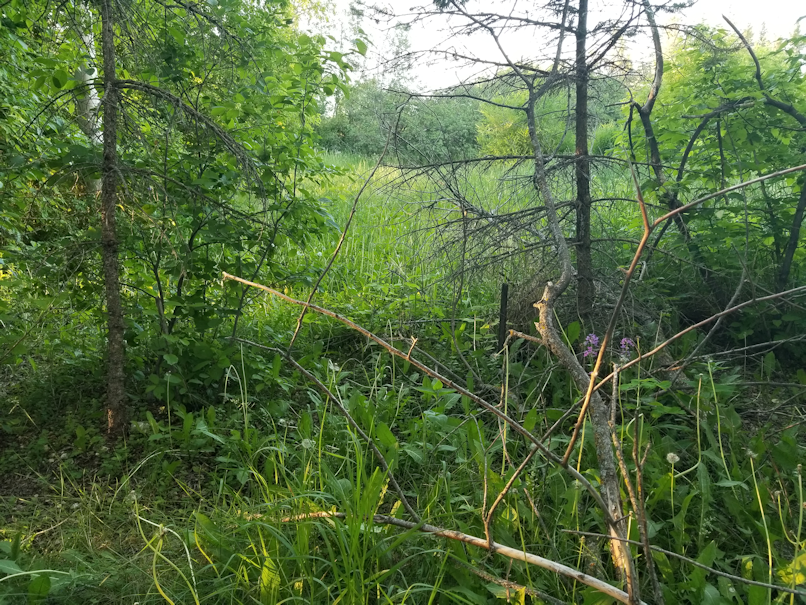
There was a time when this space was a path to the garden. I think that stick next to the dead spruce tree is marking one side of where it used to be.
As you can see by the dead branches in the foreground, there’s more than dead spruces blocking the old path. There is where there are a bunch of maples that had been cut down, cut into pieces, then left there. I don’t know who started the work and then stopped part way through; for all I know, it was my late brother, which might also explain why it was left unfinished.
Before we can even start on taking down the small dead trees (the big ones will wait until we have a chain saw), I will have to clean up all the deadwood on the ground.
We’re going to have several years worth of fire wood for cookouts, by the time it’s done!
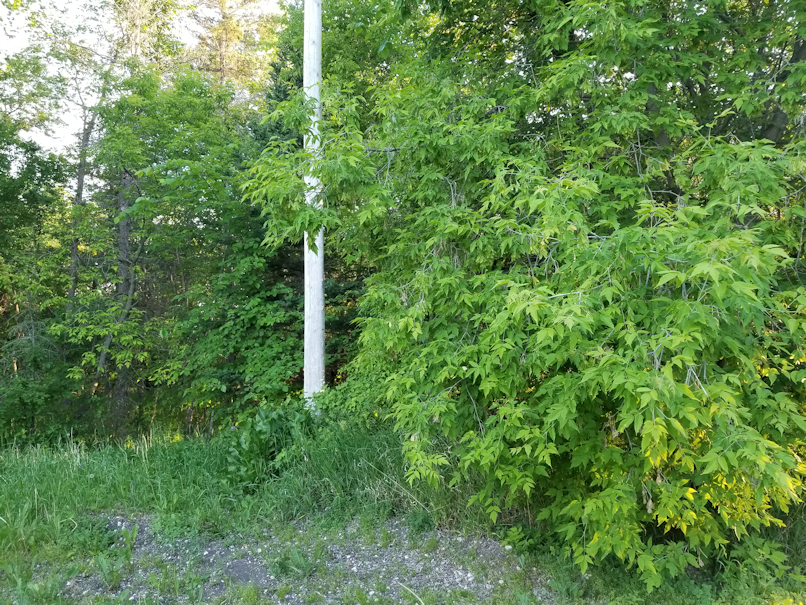
I squeezed my way through to check out the West end of the garden space. There, I discovered a huge mass of horseradish! My mother had told me she’d transplanted some there, but that the younger of my brothers had plowed too close to the pole and dug it up, so she transplanted it again, under a spruce three nearer the house. Clearly, she missed some, and it is thriving!
When I was younger, this area was pretty much all open. Now, there is a dense, virtually impenetrable wall of trees where I remember we once had a cabbage patch. From what I could see, along with the usual maple, elm and black spruce, I believe there is also some Colorado blue spruce and birch.
Unfortunately, the trees near the pole are tall enough that they are reaching the power lines! I think they are still clear enough, though, that we can safely cut them down without hitting the the lines. At the very least, we will need to thin the area down. It is so dense, everything is fighting for survival. I can tell quite a bit of it is deliberately planted, such as the Colorado blue spruce (not a native species) and the row of birches, plus the rows of black spruce, but I’m pretty sure there is quite a bit that is self sown. Some of the black spruces, perhaps, and most likely the maples and elms. I am hoping to save as much as I can; the birches look pretty good, but I will likely be removing 2 out of every 3 trees in the rows of spruces. Though just removing the dead ones might achieve the same goal. I would really like to save the Colorado blues.
A number of years ago, the Canadian government was encouraging people living on farms to plant more trees and shelter belts. They had a program where people could sign up and order all kinds of trees, shipped to them for free. I have no idea if this program is still available, but I know lots of people took advantage of it. I am thinking that this is how my parents ended up planting so many of the trees I’m finding, including the shelter belt outside of the yard, along where the cow fence is now.
After checking this area out, I took a look at the North fence line. At this end, there are a number of trees that look like they were deliberately planted, along with some obvious self-sown ones. There is a gap between the big trees and the fence line, which is good. I’d like to clear that gap, so that the fence is accessible. Once the lilac hedge starts, though, I couldn’t see the the fence line at all, and couldn’t tell if there was a space between the bushes and the fence. While walking along the lilacs to try and see, I did find a couple of chokecherry trees.

There are quite a few berries forming, though a lot of them seem to have insect damage to them. We shall see how they do throughout the season.
Eventually, I found a gap in the lilacs and went to see how close to the fence line they are and found…

… some mystery wire.
I have no idea what kind of wire this is, other than it is NOT fence wire. I can’t even see anything nearby that it might be from, or that might explain why it is here.
Something else I’m going to have to clear out and add to the haul-away pile.
The lilacs, meanwhile, are well into the fence line. Not going to be able to clear a path out. Ah, well.
As I was finishing up, I went past a bush my mother planted by the clothes line platform. I had ruthlessly pruned it down, because it was in the way of trying to hang things on the line.
It seems to have like the pruning, because it is now completely dense with foliage, and covered with flower buds, including one early bloomer!

Based on how many buds I’m seeing, by the time this bush is in full bloom, we’ll hardly be able to see any leaves at all; it’ll be a mass of white!
I’m rather looking forward to seeing that.
Well, I think the sun room floor has had enough time to dry. Now I have to decide what to put back, and what will have to go into storage!
By the end of the day, we should finally have a usable sun room. :-)
The Re-Farmer
It was much more pleasant working outside in the cooler temperatures! We were heading well towards 30C today.
One of the first things I wanted to do when I went back out was to empty the second tire planter and move it out.
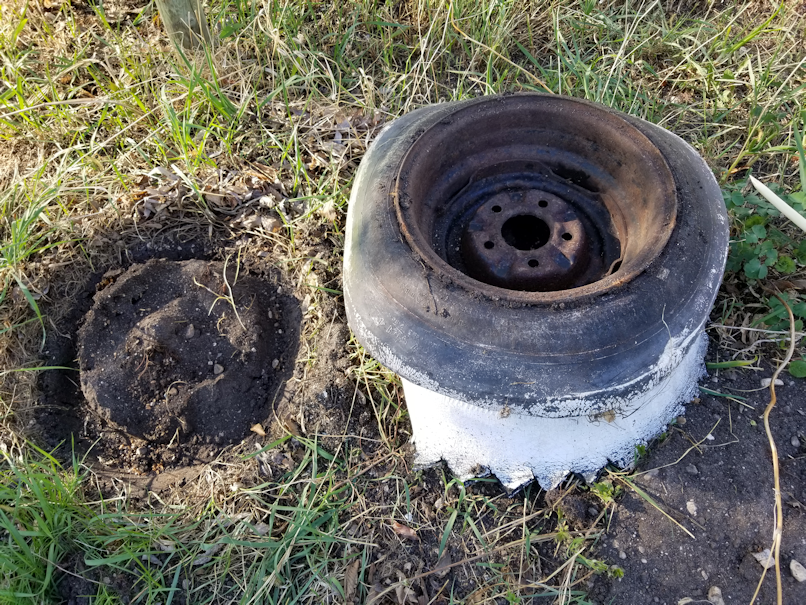
This one still had the other half of the tire attached as a base.
Also…

It was on top of an ants’ nest. The rim was full of ants, some carrying eggs, trying to find their way back to the nest.
I left the planter right where it was. I can get it out tomorrow! :-D
For the garden itself, I focused on trimming, pruning and cutting. There were a few rose bushes at the fence line that I was going to leave, but determined that they were not deliberately planted there, so I took them out. I pruned the apple trees a bit, and cut away deadwood from trees and bushes alike. I cut away lots of those vines, and so on.
Then this happened.
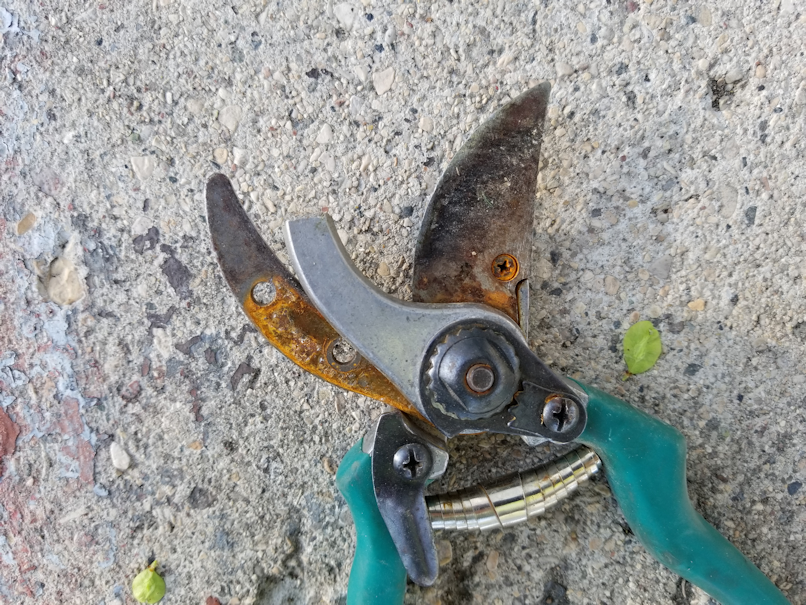
One of the problems we’ve found since moving here, is that so much of my parents’ stuff is gone. The good, working stuff, that is. Tools, equipment, supplies… This was a fully functioning farm and, after 40 + years of farming, my parents had pretty much everything anyone could need, and then some. What we’re finding now is basically the left behind junk. Like these old pruning shears. My husband was able to sharpen them, but they were clearly not going to last long.
Still, I didn’t expect a chunk to actually break off like that!
We’ll have to add “pruning shears” to our list of purchases. Or, should I say, bump it up higher on the list.
So I made do with a small hand saw. There is a large collection of old saws (and axes) here, with most of them being quite large. I remember using smaller saws that would have been perfect for the work I was doing, but I have not seen any of them, anywhere. Instead, we are using my older daughter’s hand saw, that she bought for herself a few years ago.
It did the job. That’s the main thing.
Here is the garden now, from the south west corner.
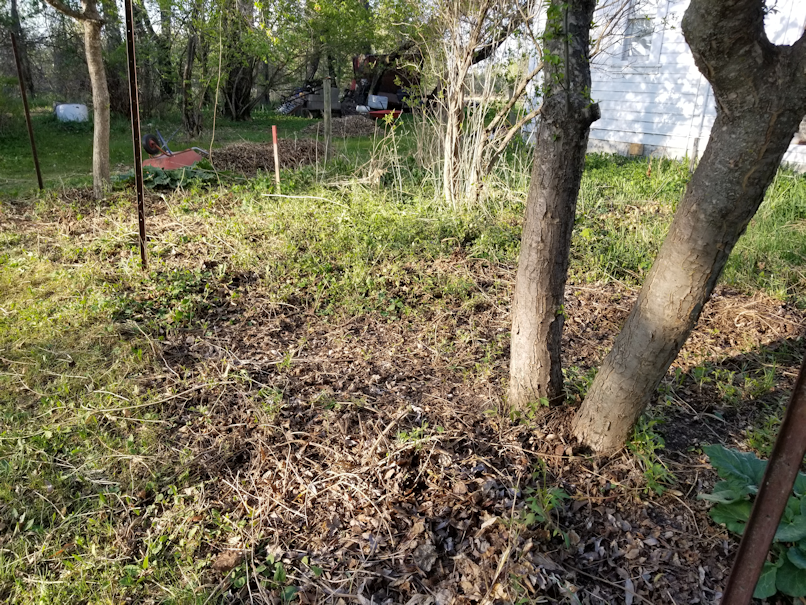
Clearing that west fence line was the most work.
Here is the garden from the north west corner.

There is still a stick in there, that is supposed to me marking something my mom planted, but I don’t think there’s anything there anymore. I’ll check more thoroughly when I start raking, tomorrow.
The fence posts are going to take a bit more effort to remove. I can wiggle them from side to side quite a lot, but can’t pull them out.
All in all, a very good day’s work!
The Re-Farmer


