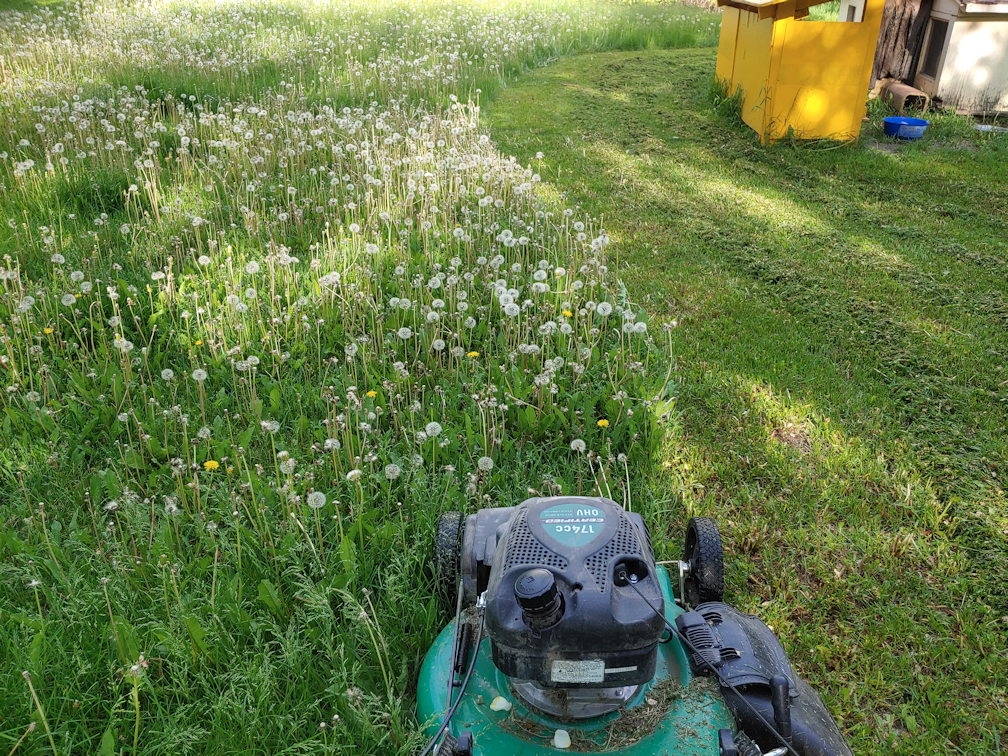
I started my morning rounds early, to beat the heat, and decided to mow some of the lawn, while I could.
We can’t even use the clippings as mulch, as it’s so full of dandelion and Chinese Elm seeds.
The kittens were under the cat’s house. They were not happy with the noisy machine. One ran out and under the laundry platform. The mamas, weren’t happy, either, so I tried to get that area done as quickly as possible.
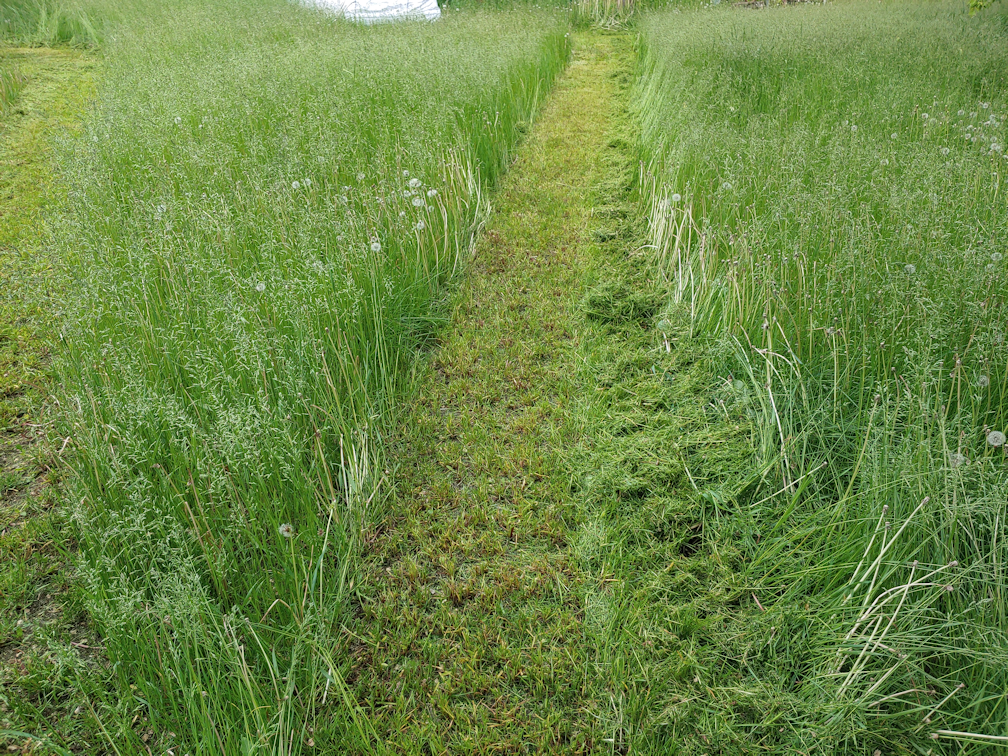
I did only the south lawns for now, but did make a point of mowing paths to the burn barrel and electricity meter.
This area has not been mowed at all, this year. I want to restore the rusted blade on the scythe and give it a good sharpening. At this point, it would probably be easier to scythe the grass in the outer yard, than mow it.
The grass was still quite wet and the ground still squelches, but there was no standing water, at least. I just had to frequently stop to unclog the expeller opening of wet grass.
The white rose in front of the sunroom is amazing! The honeysuckle are in full bloom, too, and even the dwarf Korean lilacs are starting to open. Right now, the yard is filled with the fragrance of roses. The pink rose even has loads of buds. Far more than we’ve seen on it before. It took 4 years, but we have got it growing again!
Nice to see some of our native pollinators out. Bumbles are my favourite. 💕
I don’t know that we’ll be able to finish mowing the inner yard today. We are still getting storm predictions, but they all seem to be missing us. We shall see. For now, I’m just happy to get as much done as we have!
This morning, a daughter and I took Beep Beep and Fenrir to the vet, which meant doing the morning rounds a bit earlier.
At least it’s light out, now.
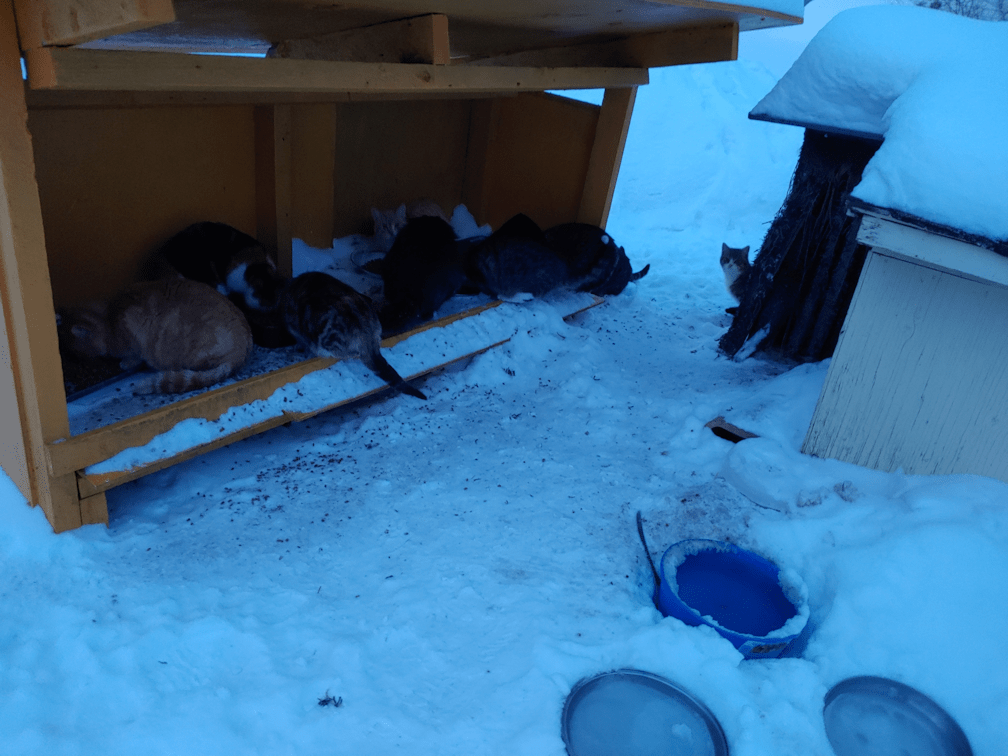
The heated water bowl was empty again.
Because Beep Beep and Fenrir needed to fast, I had them closed up with me, overnight. Which meant I didn’t get a lot of sleep. I had cats trying to claw the door open from both sides! When I made the mistake of going to the bathroom before going to bed, I had Beep Beep escape, dashing down to the basement. I caught her before she ate anything, though. Then I tried to get her back into the bedroom, only to have Fenrir escape. I caught her, only to have Beep Beep escape again, and she was NOT going to let me catch her! I finally had to snag a daughter to catch her, then hang on to her while I dashed into the bedroom, grabbed Fenrir and held on while my daughter quickly tossed Beep Beep onto the bed before any other cats got in.
I had only one carrier in the room with me, but that was enough for me to be able to get out of the room long enough to grab the second one, this morning. I had both carriers on the bed, with Beep Beep in the hard sided one (where she was trying to claw her way out!) before doing the inside cat morning routine and warming water up for the outside cats. Before heading outside, I went to move the carriers closer to the old kitchen door for later.
When I walked into my room, I found Beep Beep and the carrier gone from the bed.
!!!
I found it on the side of the bed, sitting as if it had been placed there. :-D She had managed to roll the carrier completely off the bed, and it landed right side up!
The plan was to do the critter part of my morning rounds first, then get my mother’s car started and warming up, so I made sure to hang my purse inside the sun room, so I could just grab and go.
It’s a good thing I did.
The old kitchen door into the house hadn’t latched properly behind me. Looking in from the sun room, I found it crawling with exploring cats!
Thankfully, my daughter was able to take care of that, while I went to my mother’s car – after scraping away more ice and snow, just to be able to open one of the doors wide enough – and getting everything ready so we just needed to grab the cats and go.
The drop off went well, with my daughter taking the time to warn them about some of their quirks. We just happen to be bringing two of our “meanest” cats this time. :-D
I still haven’t been able to connect with our mechanic, so we swung by the garage to see if I could talk to him about our van. Unfortunately, though it was supposed to be open, he wasn’t there. He’s on his own, so if he has to get anything, there’s no one to do it for him and he has to lock up. :-/ Hopefully, we’ll get another chance, later.
Once we got home, I was able to spend more time with our recovering kitties.
Nosencrantz doesn’t like to leave her favourite spot under the light bulb. It burnt out last night, but I found one last full spectrum bulb in our stash of incandescent bulbs – this light is meant for seedlings, not cats! :-D – but it’s brighter than the old one, so I wasn’t sure if she’s still like it. She clearly has no issues!
Butterscotch, meanwhile, has switched favourite beds! Usually, we find her in an enclosed box bed on the bottom shelf, but now she’s gone up a left and has been hanging out in the open bed. We’ve also been finding her loafed under the ceramic heat bulb more often, too.
She accepted pets, but had no interest in leaving her bed! :-D
Meanwhile, we have already heard back from the vet. They were checking details about our arrangement with the organization that’s helping us with all this, in regards to the shots and deworming and the like, as was arranged when we brought in Butterscotch and Nosencrantz.
Beep Beep had already been done and they were about to start on Fenrir. Since I had her on the phone, I brought up what they had found with Butterscotch, and how far gone her uterus was, and if there was anything similar with Beep Beep. It was quite a bit larger, and looking a bit worn out, just from having to many litters, but it was not so badly damaged as Butterscotch’s was. We don’t know how old either of them are, but I think we can now safely assume that Beep Beep is the younger one. For all we know, Butterscotch is her mother.
So we will get a call back later, to let us know when they can be picked up.
Meanwhile, the cat lady messaged me last night, with a reminder to have Beep Beep and Fenrir start their fast. While I had her, I asked about Cabbages.
Yesterday was her last day on antibiotics. Yay!! She’s eating quite a lot now, and today, she be moved out of the cage, to their “cat room.” In a few days, she will have a buddy joining her. That would be the more recent frozen cat they picked up, that lost its ears.
I’m just amazed by how quickly she’s bouncing back from being at death’s door the way she was!
If you would like to contribute to our fundraiser to reimburse the cat lady for Cabbages’ vet bills, click on the button below, or click here. If you would like to read more about it, click here.
So now we are just waiting for the call from the vet, for when we can bring Beep Beep and Fenrir home. Since they are both inside cats, we won’t have to do any isolating, but we’ll be keeping a litter box, food and water in my office/bedroom for a while, so they don’t have to go far.
The next trip to the vet, in a couple of weeks, we’ll be taking cats in, and they won’t be coming back. The cat lady will be taking them to fosters for recovery, and then they will be adopted into forever homes. As she’s able to book dates with the vet, we’ll keep doing that for the rest of the adoptable cats (the males are already fixed, as is one female) through March and April. By then, we should be able to start snagging outside cats, starting with the ones we can catch easily (which all happen to be male). Then, once it’s warm enough to do so safely, she will lend us traps for the outside cats that we haven’t been able to socialize at all.
It’s going to be weird, to not have so many cats around!
Agnoos, checking out Aunt Rolando Moon, in the tree above. :-)
Bright and sunny, and not much wind chill. My husband was even up to going outside to feed the cats. I didn’t find out until today, that he did it in bare feet and with no coat! Yeah, he’s one of those people that wears shorts in the winter, but bare feet??? Yikes!
He’s been chastised thoroughly on that. He’s diabetic, and doesn’t feel his toes at the best of times!
Yesterday, I made a small shopping trip, giving my mother’s car a run in the process, to do the Walmart part of our shopping. Today, my younger daughter and I made it into the city and did a Costco trip – but not before swinging by the post office and picking up a very large, very light box for my husband. He ordered a whole bunch of plain, medium weight yarn, in bright colours, and plans to get back into knitting. :-)
I haven’t been up to doing Costco in a while, now. With the colder temperatures, we did that part first. No worries about the van baking in the sun. Even with insulated bags and ice packs, anything frozen would be starting to thaw, just from the trip home. This time of year, the insulated bags are as much to keep things from freezing, as they are keep them cold! Then we hit the international foods store where, among other things, I was able to get a free turkey with my points. :-) We’ve already got a turkey thawing out for Christmas, and we’re doing prime rib from our quarter beef pack for New Years, so it’s just there for when we want something other than beef. :-) My daughter had her own shopping list, too.
Which means that we have been able to do the bulk of our monthly shop for January, and without having to buy much meat at all, it meant we had the budget to do things like finally buy a set of pans to replace the ones we’ve got that, after getting the new glass topped oven, we discovered were no longer flat bottomed! :-D
I even was able to swing by a Staples and buy the cyan ink I needed for my printer. The ruddy thing simply stopped working when it ran out, even when I just wanted to print in black and white. In fact, it wouldn’t even do the automatic head cleaning anymore, so once I installed the ink and did a test print, there were all sorts of gaps in the blocks of colour, and there was black in the yellow! I did 5 test prints, and it was still really bad. I couldn’t do a sixth test print, though.
I’m now out of yellow, and almost out of magenta.
I know head cleaning uses up a lot of ink, but not that much!
*sigh*
So we still can’t use our printer. None of the places we usually shop at carries the ink I need, so that means another trip to Staples. It might even be worth it to make the trip tomorrow.
*sigh*
I don’t remember the last time I’ve gone shopping this close to Christmas!
We have always had pretty modest Christmases. For us, it’s about celebrating the birth of Christ together as a family. My husband’s sister was finally able to move back to this province and get a house in the city (she had to back out of buying a house here earlier in the year, when the province she was living in clamped down on their police state and no one was allowed in or out of the province. At least if you were Canadian) and she’s having a Christmas dinner. She knows my husband can’t manage that sort of thing anymore, so we’ll be doing a Skype call with them, instead. With how crazy things have been this year, we aren’t doing gifts at all. Not even hand made ones. Maybe we’ll do some for Three Kings Day, our last day of Christmas, instead.
We got the last things we needed for our Christmas and New Year’s dinners. Since we normally make pretty much everything from scratch, we are all excited about getting boxes of mixed frozen appetizers. Our once a year treat! :-D
It did make things challenging when it came time to unload, though. Most of the stuff was small enough, or flat enough, to fit, but then there was that turkey… :-D It was like playing Tetris with packages of meat to get it in there.
So, aside from a possible trip to get that ink (which might wait until after Christmas, but I’ll need to do it soon), we are DONE!
Oh, my goodness, what a difference having that new chainsaw made!
But before I could break it in, I needed to drag down the stuck tree, so I could use the wood in the high raised bed. Thanks to my husband very securely attaching the hooks I got to the rope I got – rope rated to 450 pounds – it was a simple matter to use the van to pull it out.
My goodness, where those top branches ever entangled! When I started pulling it, it didn’t fall, but stayed stuck until I got far enough that the tree was no longer dragging on the ground, but lifting up. At which point, it rolled up and got dragged over the compost ring, then finally it broke free from the branches and dropped.
Right on the cherry trees we are intending to cut away, so there’s no loss there!
After replacing a large divot of sod that got dragged out, I then used the baby chain saw to start cutting away the branches, and cutting away the top of the tree.
Then it got rolled onto the compost ring, so the rest of the branches could be trimmed off.
Finally, it was time to break out the new chainsaw!
Of course, I took the time to read the manual, first, then added chainsaw oil to the reservoir.
Then I measured out and cut a pair of nine foot lengths from the tree trunk.
The bucksaw does a great job, but the chainsaw did in mere seconds what would have taken me probably 5, maybe even 10, minutes, per cut, by hand!
Then, while I dragged the logs over to the high raised bed, I helped a daughter move the rest of the tree trunk aside, so they could set up the wood chipper. They cleaned up all the dead branches from the tree, as well as the little cherry trees we’d cut away to access the last tree we’d cut down.
They spent more time prepping the branches to fit the chipper and shredder, than actually doing the chipping and shredding! Unfortunately, the little spruce branches were so twisted, they ended up clogging the shredder chute to the point that my daughter had to take it off to unclog it. Once that was cleared up, they did a few celebratory shreds before heading inside to start on supper.
Meanwhile…
I started working on the high raised bed by first taking it apart! I cut away the notches in the base logs so that the cross pieces would sit lower, and no longer have that gap that was there before. I also was able to clean up the cuts and make adjustments, as needed.
The new nine foot lengths were thicker than I thought, so after I put the bottom cross pieces back, I used the new logs for the next level.
I ended up not needing to cut notches in them at all. Instead, I was able to just adjust and cut the notches in the next level of cross pieces to fit.
It was SO much faster and easier to cut the notches with the chain saw! Pretty much every notch we’d cut before needed modification.
I used smaller, thinner, logs at the top, which turned out to be a pain. These are from higher in the tree, which meant they were not as straight, and had more little branch stubs all over. I ended up having to trim logs along their lengths to get rid of lumpy bits, so things would sit against each other better.
Then I went and cut two more four foot lengths to do the last cross pieces.
There we have it! The high raised bed is built!
Standing next to a corner, it’s just barely reaches my hip. For mobility and accessibility purposes, we could probably have gone higher than this, but I think this will be fine.
Now, we just need to fill it! We’ve got old logs for the bottom, with corn stalks, leaves, grass clippings and garden waste to layer in. I’ll add thin layers of soil in between each layer of organic matter before topping it off with soil for about the depth of the top logs.
That will be a job for tomorrow!
I may have had to juggle the budget a bit to get that chainsaw, but it was worth every penny. There is no way I could have finished this today, without it. In fact, I have my doubts I would have been able to finish it before winter, at the rate things were going!
About the only other thing we might end up doing with this is maybe get some short pieces of rebar, drill holes through the top couple of logs and set the rebar in them to really make sure the logs stay in place.
It’s really a horrible, messy, slapdash job, but it will still probably last us many years.
Now we just need to cut down more dead trees, so we’ll have the material to build more!
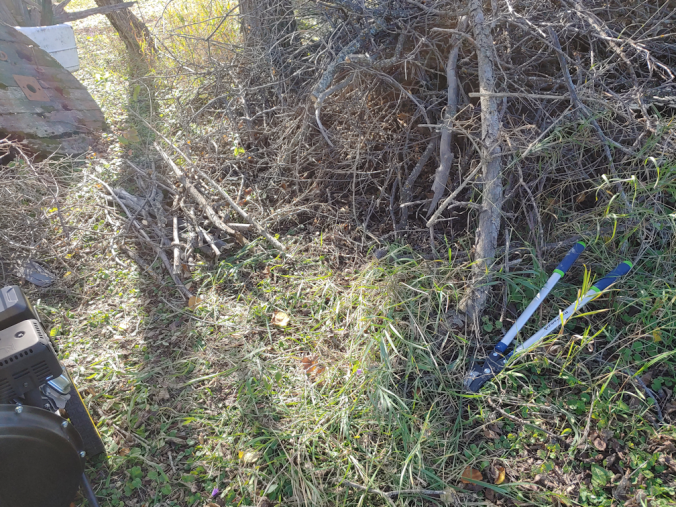
With the lovely weather we’ve had, the branch piles are dry enough that I went out to do some chipping.
This time, I took the chipper into the maple grove to start on one of the branch piles near the old garden shed. In this location, I didn’t bother bringing the collection bag, since the wood chips would be used in the nearby garden beds.
Before I started chipping, I sorted and pruned through the branches for those small enough to go into the shredder chute, and those big enough – and straight enough – to go into the chipper chute. Just enough to clear space around the chipper and get started.
The first thing I discovered once I started it up without the collection bag is, there is a LOT of air pressure coming out of that thing!
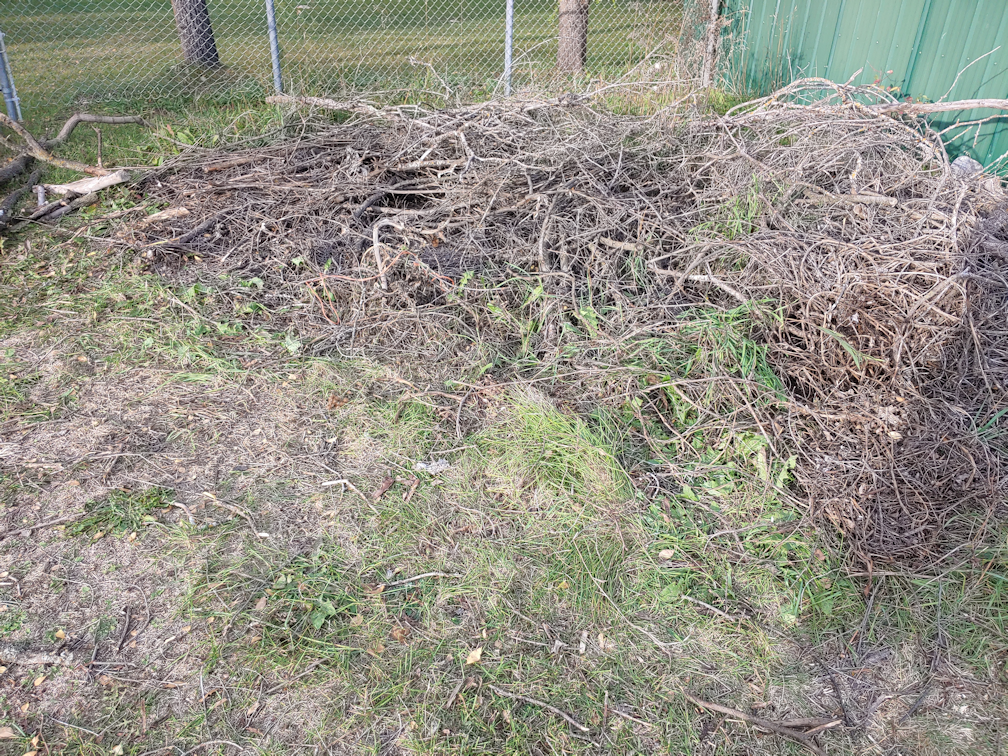
This photo is after I’d chipped the first batch of sorted branches. Look at that hole the air made in the soil! That was after only about 15-20 minutes of chipping.
Here I’m working on the second batch of branches. When I started, the branch pile had extended out to where you can see the larger stick pile, and where you can see the taller grass in the foreground.
Getting the branches ready for chipping or shredding took a lot more time than expected. This is a big part of why…
The red lines in this picture trace a single branch. This was pruned from an apple tree, and they are the worst for branches and twigs going in all directions! The branches that were big enough to go into the chipper chute not only had to be cleared of any twigs or side branches that might get hung up in the opening, but they also had to be relatively straight, to avoid getting jammed.
After chipping and shredding a second batch, I sorted through the branches until my daughter came out to tell me supper was ready, which was my cue to stop for the day.
In the photo, pile 1 is the larger branches for the chipper. Pile 2 are the twigs up to 1/2 inch in diameter for the shredder. Pile 3 is the wibblely, wobblely, twisty branches that can’t go into the chipper. There is also a pile 4 started, well away from the work area, for the larger branches and tree trunks that are larger than 3 inches in diameter.
When I started the second batch, the chips were being blown around so much, I rifled through the junk pile behind the garden shed and found a piece of rotting plywood to use as a deflector. By the time I was done, the hole was so much deeper, I put the brick down. The next time I bring out the chipper, it will hopefully prevent the air pressure from making the hole even deeper.
Also, there’s basically no chips! All those branches, and there’s next to nothing. Yes, a lot of the chips are blown around the area, but even so, the branches got reduced to a very small amount of chips. I did make quite a dent in the pile, too. It basically shows that these branch piles are more air than wood!
The amount of time spent trimming and sorting the branches to fit is much more than I expected. It’s not that big of a deal when working on one of the little piles in the trees, but it’s going to be insane when working on one of the big piles. For those, it might still be worth hiring the tree company with their massive chipper. They don’t need to do any trimming at all, and can shove whole branches into the chute. When I got an estimate done, the guy figured it would take 6 hours to do the two big piles in the outer yard, the one by the garage, and the piles in the maple grove. It took me about 1 1/2 hours to do the amount of sorting and chipping I did today. At that rate, if the girls and I were all sorting and chipping at the same time, we might be able to finish the pile I was working on today, in maybe 4 hours – and we would still have the bigger pieces and twisted branches left over to deal with, most of which their chipper could handle.
I will continue to focus on the smaller piles in the inner yard. Hopefully, next year, we will have the budget to get the tree guys to come out with their monster machine to do the big piles. :-) Meanwhile, we can also use the chipper each time we work on cleaning up the spruce grove, cutting down those dead trees, and not be adding to the piles anymore!
Oh, what a lovely day we’re having today! As I write this, we are at 17C/63F, which is a couple of degrees warmer than forecast. We’ve got beautiful blue skies and sunshine, though it was a bit winder than I would have liked – only because I needed to do some spray painting.
While the girls cleaned the eavestroughs, then brought the pieces of insulation from the barn to put around the based of the house, I started with spraying the sign I’m working on with reflective paint. With a white base, the reflective paint is not visible. Later this evening, I want to try taking a picture of it with flash, which should show me how well it worked. According to the label on the can, it works better with a light coat than with a heavy one, so as long as I got good coverage, it shouldn’t need another coat.
That done, I grabbed the baby chainsaw with the one charged battery (I forgot to switch them in the charger!) and did quick work on the high raised bed. After taking about an inch more off the notch on one side, that was done. I had enough juice left in the battery to start cutting away excess on the top of the end piece, where the next log will rest. I didn’t get very far, though.
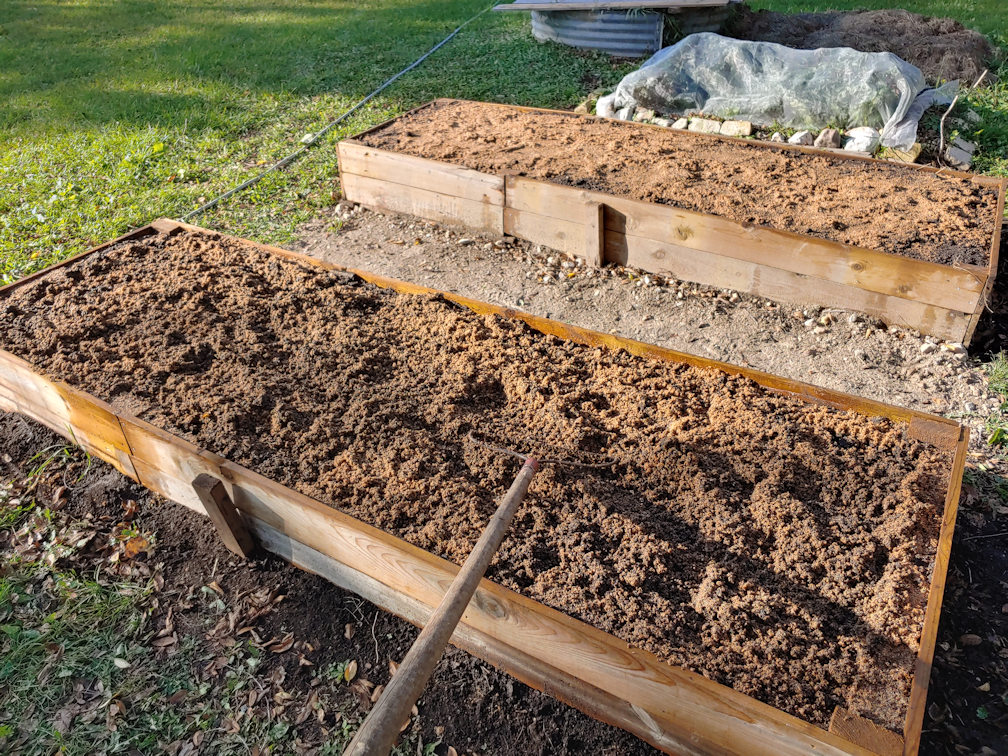
Those little jobs out of the way, I got to work on the big job! Topping up the low raised beds, so we’ll have somewhere to plant the garlic when it arrives.
One of the beds wasn’t filled as much as the other, so I started with that one, first. We had soil from the potato bags in the kiddie pool, and there are still 10 bags of fingerling potatoes, so I decided to use it as filler, as it had already been amended with organic material. With all the rain we’ve been having it was very wet and heavy! While filling the wheelbarrow, I could see some nice, fat, happy worms in there, too. :-)
It filled a couple of wheelbarrow loads, with some soil being left to weigh down the kiddie pool, so it doesn’t blow away. I even found a couple of little potatoes that got missed in the process! After spreading it around evenly, I added another three wheelbarrow loads of the garden soil we bought in the spring. I’m really glad we were able to get two dump truck loads! We’d have been out by now, if we hadn’t, I’m sure.
After the one bed was filled, I brought another three wheelbarrow loads of soil for the second bed, then leveled them both with a garden rake.
Next, I split a 40 pound bag of hardwood pellets between the two beds, and worked them into the soil. One of the things we found with the new garden soil is that, over time, it gets really hard and compact. Since we don’t have any compost or manure to help prevent that, the pellets should do the job.
After working the pellets into the top couple of inches of soil, both beds got thoroughly watered, until the pellets reverted to sawdust. They absorb quite a lot of water in the process.
The sawdust does tend to rise to the top, though, so after they got a solid soak, I worked it back into the top couple of inches again.
They are actually a bit fuller than I had intended. The garlic will get a heavy layer of straw mulch after they are planted, so having it a bit lower would have help keep it from blowing away. The beds will settle, though, plus they will be covered with plastic, before we get snow that stays.
If all works as intended, these beds, with their layers of wood and lighter organic material in them, should require almost no watering, even if we have another summer of drought. If we had a wet summer, they should have good drainage, too.
I do find it kind of funny that I had to get these two beds ready for the garlic, because the other beds we have, in the old garden area, still have things growing in most of them! Not counting the one that’s being converted to a high raised bed right now, the only one that’s completely empty had onions growing in it, so I wouldn’t want to plant another allium in it.
It should be interesting to see how the garlic does in these beds!
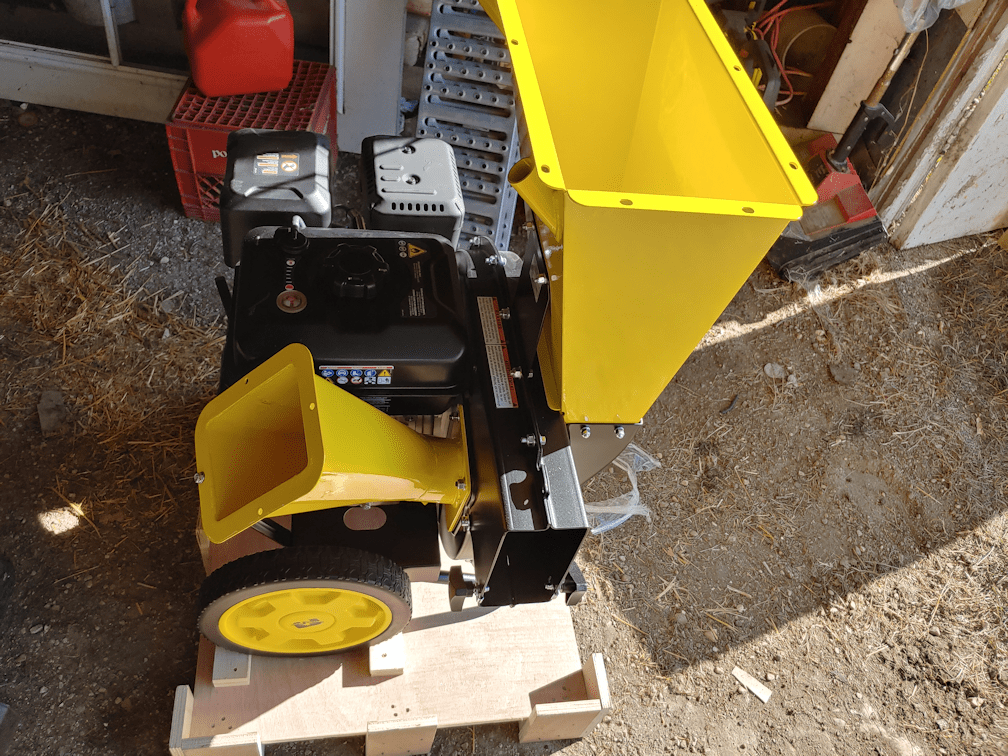
I got the chipper assembled, and we’ve tested it out. Here’s how it went.
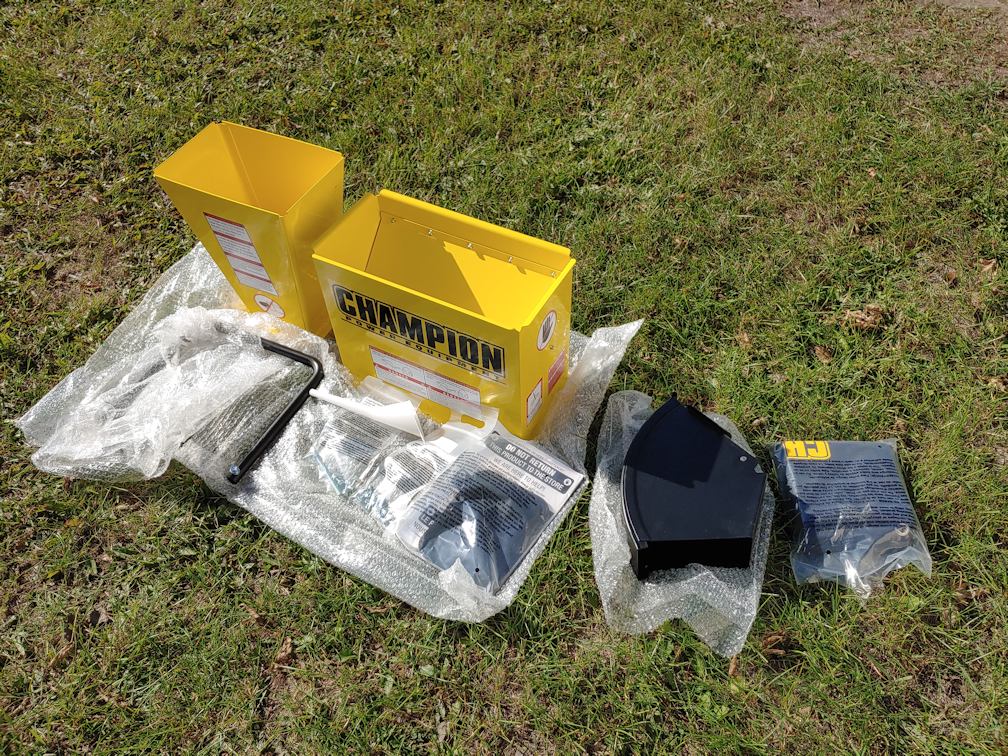
This is after lifting the box off, and removing the bubble wrap around that biggest chute. It was deep in that chute, under other stuff, that I found the instruction booklet.
Which included detailed instructions on how to remove the chipper from the box. :-D
Time for assembly!
The tops of the shredder chute had to be put on first, then the handle. It wasn’t until that was on that I could grip it well enough to manhandle the chipper over the blocks holding the wheels in place, and the rest of the assembly was done outside.
Which didn’t take very long at all. :-)
Once it was together, I had to go and get fuel and oil. We had only a few litres of fuel left for the lawnmowers, so I had to refill the 20L jerry can anyhow. This thing takes 10W30 oil, and everything else we’ve got – including our van – uses 5W30. Oh, except the new push mower. That uses 0W30.
In reading the manual, it said to put in about 1.1L of oil, no more.
The oil, however, comes in quarts, or 946ml Which meant needing 1.16 quarts to max the oil level.
I bought two and filled it with one. The level should be checked before each new use, or at least waiting until after it has had several minutes to cool down, so I’ll see if it needs to be topped up the next time we use it.
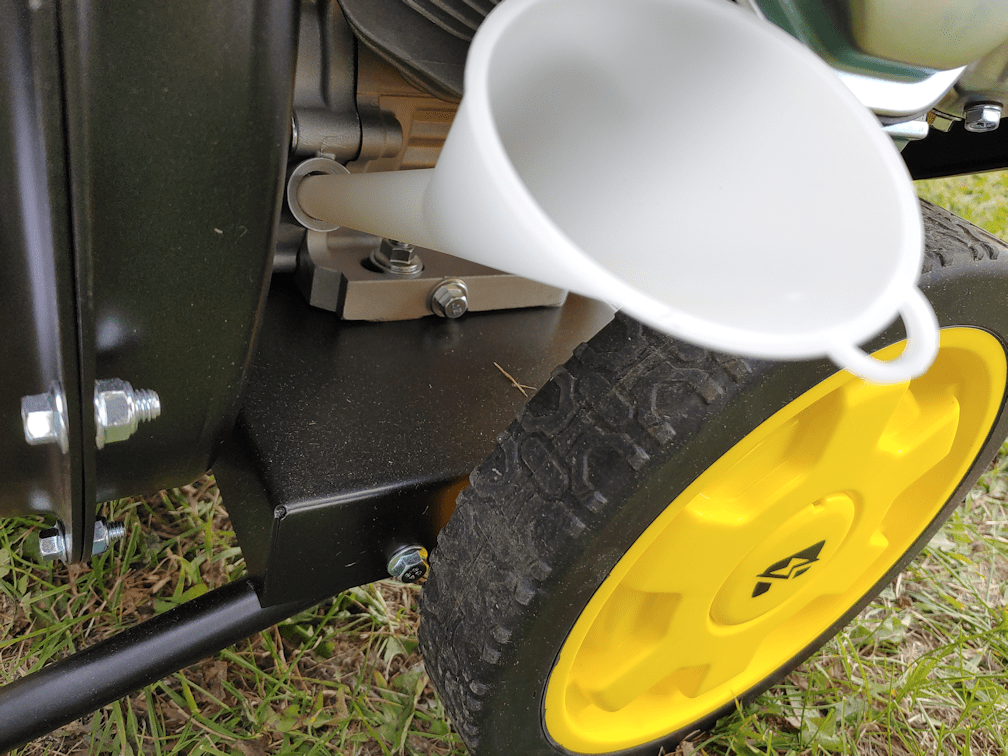
It came with its own oil funnel, which was greatly appreciated. The opening is tucked well under the engine, and the oil funnels I already have would not have reached, nor fit in the space!
The fuel tank on this thing is pretty massive! If I had not gotten more fuel, I would not have been able to fill it.
A couple of appreciated features. One is the removable gadget in the tank opening, with the red fuel level marker. The instructions made a big deal about not overfilling, and this makes a very handy visual reference. The other appreciated feature is the fuel gauge. Love it!
There was just one down side to the fuel tank, and that was with the cap itself. It takes a surprising amount of uumphf to turn the cap, and I couldn’t do it with my right hand at all, due to a combination of arthritis pain and that injured finger. My left hand has arthritis pain, but I still had enough hand strength to open the tank. Hopefully, over time, it will get easier to open.
Once it was all filled up with oil and fuel, I spent a bit more time going over the instructions before we were ready to test it out.
Ear protection is a must!
We also need to get more safety glasses. The pair I have got all scratched up somehow, to the point that I couldn’t see through them!
My daughter brought over the loppers and starting breaking down branches for me, while I set up the collector bag. It’s attached with only a drawstring. It held well enough once the chipper was started, but there were gaps that allowed chips to go shooting out over the fuel tank and around the engine. I’ll have to figure out if there is some better place to attach it. There is nothing in the instructions other than saying to put it over the diverter.
The collector bag is very durable, and I love the zippered bottom that makes it very easy to empty.
My daughter and I started on the branch pile closest to the garage to test it out. She had a bit of a surprise!
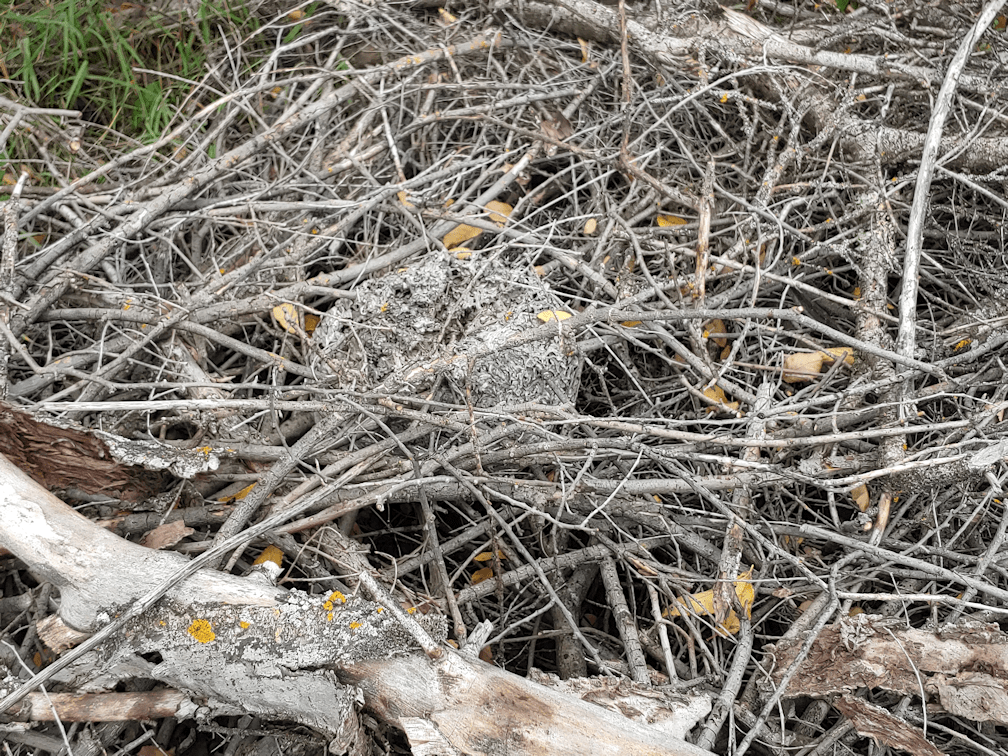
There was an old wasps nest in it. It was an active nest last year, so there were no wasps in it this year, but she didn’t know that when she uncovered it!
The chipper is also a shredder. The larger chute at the top is for leaves and small things, including branches no more than 1/2 inch in diameter. With this pile, that’s the chute we ended up using the most.
With the smaller chute, the maximum diameter is 3 inches, however that’s not just the width of the branch. If there is a bend in the branch, or any knobby bit from a smaller branch that was pruned off, it could be enough to prevent the branch from fitting.
The pile had a lot of very bent branches.
The worst of them, plus any pieces we had to cut off to allow the remaining branches to fit, got set aside. They will likely go into the burn pile.
We went through about 1/4 to 1/3 of the pile in about an hour. We did have to stop to take apart the smaller chute and remove a piece that got stuck. There was a little bit of a side branch sticking out just enough to catch on the opening under the rubber guard.
All those branches gave us this.
The larger pile is in the garden, near the high raised bed I am working on. The small pile is what built up under the chipper itself, that had blown out the top of the collection bag.
The chips are quite small. Smaller than the chips we had when the arborists came and cleared trees from the power lines and roof. I am quite happy with that. This will be used as we layer organic matter in the high raised bed, and will also be used as mulch, so the finer the better!
I’m also happy with how much less space the chips take up, compared to the branches they came from!
Another thing I really like about it; how easy it is to move around! This chipper is designed only to be moved manually; it’s not of a size that can be towed by, say, our riding mower. Which is perfect, because some of the places we will be using it in, don’t have space for a tow vehicle.
This thing is going to make such a HUGE difference in our clean up progress! It’s going to take quite a while to chip away the branch piles, but we have been adding to those piles for four years now, so that’s to be expected! Best of all, as we continue clearing away dead trees, we’ll be able to chip the branches right away, rather than dragging them over to the piles and making them even bigger.
After a quick run out to hit the farmer’s market, and then town, I decided to finish painting the inside of the outhouse while there was still enough light.
I’m glad I did. :-)
Here are the “before” pictures.
I had a few drips, while working on the top and ceiling. :-D
It was a bit tight to get photos of the inside, front!
There are a LOT of nooks and crannies around that door frame.
I actually started with the door. I figured I should get that done first, just in case it needed to get closed at the end of the day, so it would have more time to dry.
Then I worked on the most difficult areas around the door. For such a small amount of square footage, it took quite a while to get that done! Painting the inside of the door frame turned out to take quite a while, too, as there are a lot of gaps that I needed to squeeze the brush into.
Once the front was done, I methodically worked my way to the back. Of course, I found more staples and tacks that I missed! :-D
Since I wasn’t planning on taking off the toilet seat, once the sides were done, I painted the seat box under the toilet seat first. The lid leans against the back wall when it’s open, so I wanted to give the paint at least a little while to dry before having to close the lid again. On the plus side, there are only 2 points of contact under the seat, so even if still wet, closing the lid wouldn’t mess the paint up too badly.
Here are the “after” shots.
This time, I remembered my phone has a “panorama” setting. LOL
Yeah, I painted the toilet lid. Sort of. It had so many drips on it, I just went ahead and used the lid to get excess paint off the brush. :-D
And here it is, with the painted door.
While doing a second coat will take a lot less paint, I suspect we will need to buy another can. Those nooks and crannies took a lot more paint to cover than expected. Especially when I came across wood that had pieces fall out, or had a very rough finish. One of the beams supporting the corner still had bark on it, and winding gouges on the surface from insects. All of this ended up needing extra paint to get into the various holes and surfaces
What a difference!
One of the things we’ll have to do is put some sort of non-slip… something… on the metal sheet in front of the outhouse. It can get slippery when it’s wet.
After a second coat of paint, we’ll put the mirror cabinet back in – my daughter suggested just putting the old one back, rather than digging out the one in the basement, because then we’d just have to find somewhere to store the old one, anyhow! :-D Also, she noticed we had a chain latch, still in its package, that we can use on the inside, so we don’t have to buy a new latch. It will be mounted on the top cross piece of the door, so I won’t be trying to mount a latch where old screw holes have already damaged the wood. I’ve decided that, for a light, I will pick up another one of those LED, battery operated light switches. We have two of them in the house that come in very handy; one is set up in the bathroom to use at night instead of turning on the very bright main lights, and another is set up in a very dark corner where one of the upstairs litter boxes is kept. When we get one for the outhouse, I want to mount it across from the mirror, to take full advantage of reflected light. We’ll need some sort of dust, critter and insect proof container to keep toilet paper in, and maybe some wet wipes or something. The girls plan to put art on the walls. :-D
The next time something happens and we can’t use our indoor bathroom again, we will at least have someplace pleasant to go! :-D The only other thing is, we now have to empty the pit of all that gravel the groundhog dug up. It will be important to get that done before winter, because if we get any normal amount of snow, when it melts in the spring, we’ll have a big puddle in front of the outhouse, and the back of the garage, and water will drain into the pit again. The gravel is high enough in there, that there is no longer room for it, which would force the water above the floor boards. Mind you, it would probably end up draining into the groundhog’s den, but there is nothing we can do about that.
The main thing was getting at least this first coat of paint done, then digging out the pit. If we don’t have a chance to fix the roof before winter, I want to at least put a tarp or something over it. The rest can be done slowly, as we find the time.
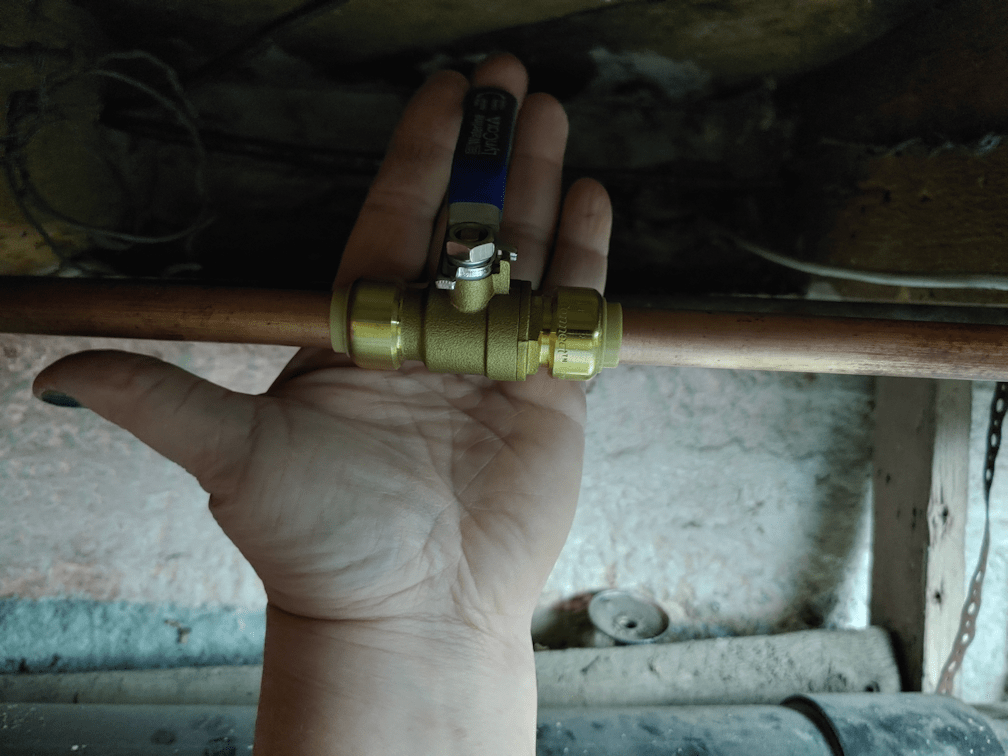
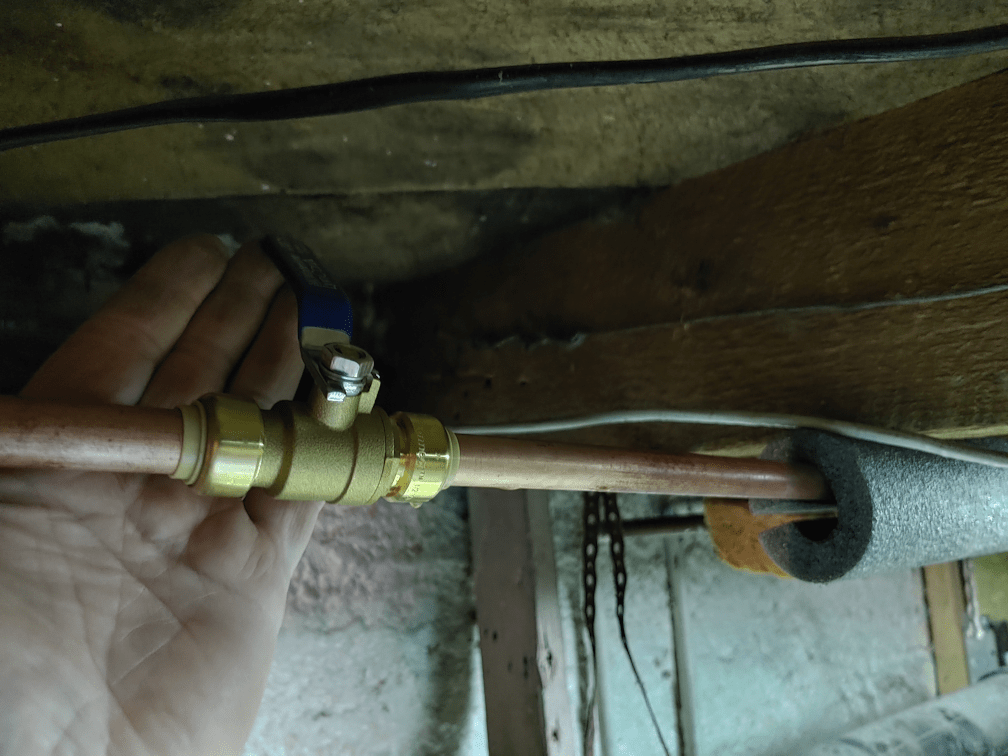
With the help of my younger daughter, we got the shut off valve installed on the hot water pipe.
Ha!
Just kidding.
My daughter did all the work. I took pictures and passed her things.
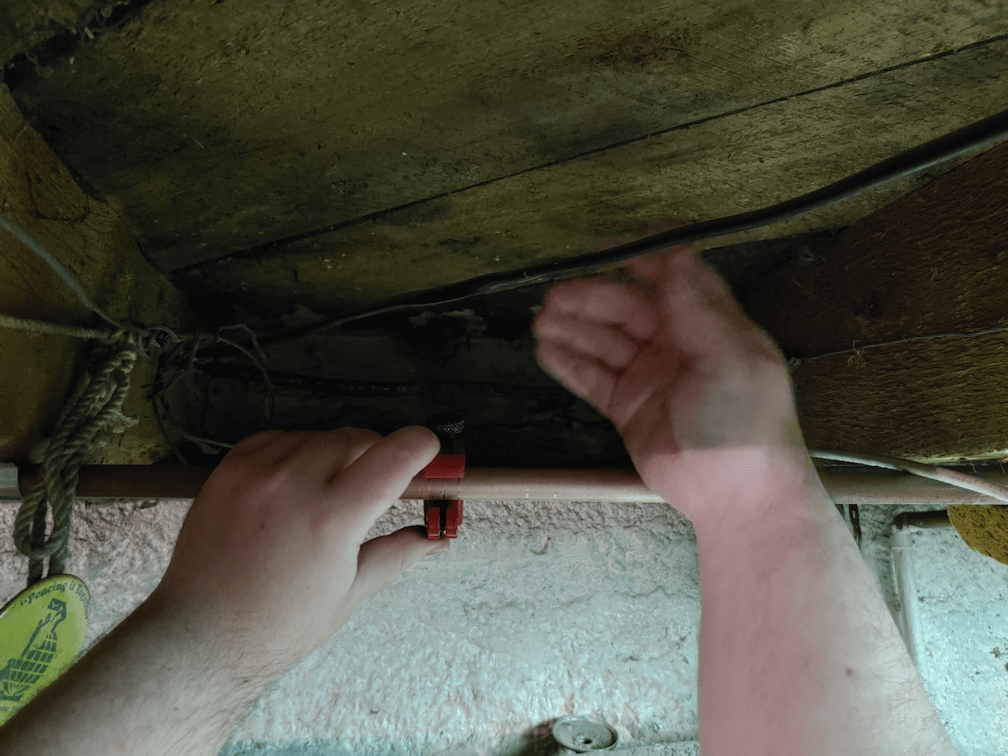
The first thing we needed to do was take off the “clamps” holding the pipe to the exposed floor joists above, on either side of where the pipes were in contact with each other and, I believe, the source of the vibrating noise that is so alarming. The “clamps”, however, were small strips of aluminum, hammered into place with finishing nails. We never did get the nails out. My daughter ended up ripping the aluminum off, instead. !!! While my daughter worked on that, I shut the water off to the hot water tank, then opened the tap to drain the pipe.
One of the things she noticed while trying to remove the aluminum strips is that the hot water pipe was actually bent upwards at this point. No wonder the crossed pipes were so jammed together.
Once there was a bit of flexibility in the pipe, it was easier to access and work on, too.
After deciding where to put the valve, the pipe got scrubbed clean, then the shut off valve was used to place marks on the pipe, so we could see where to cut it, and later see that the pipe ends were far enough inside the valve once installed. Thanks to needing to fix the kitchen sink a while back, we did have a nice little pipe cutter for the job. :-)
About two inches of pipe was removed, to make room for the valve.
The cut ends then got scrubbed and sanded, inside and out.
Then is was just a matter of sliding it in, and making sure the pipe was as far as it needed to go. The water to the tank was turned back on so we could test it for leaks, then the valve was shut off.
The whole thing took about 10 minutes.
With the valve in place, there is no water to leak at the tap, but if we need to use it for some reason before the tap can be replaced, we can just turn it on, use the tap, then shut it off again. Very handy.
Meanwhile, there is still the issue of the pipes.
For some reason, we have short lengths of pipe foam in the basement. It’s meant for a width of pipe I don’t see around. I put a section on the pipe, under the floor joists the pipe had been clamped to. It was just long enough to go under both.
I didn’t have any foam that was thin enough, so I jammed an old sponge I’d been using before, in between the two pipes that had been in contact, to absorb vibrations. I’d tried to squeeze it in before, but there was no give at all. I could only get it part way under, so it didn’t really stop the noise, though it seemed to make it better.
Now I am just waiting for someone to use the enough water to trigger the well pump, and see if the noise is still there.
We didn’t add a shut off valve to the cold water pipe, yet. For that, we’d need to shut water off to the entire house, and the pipe is behind the hot water pipe, so it will be harder to reach. That can wait until we are putting on the new taps.
I am quite pleased with how this worked out. I keep expecting things to go horribly wrong. :-D
I love having so much space around the house. I really do! But taking care of it is a … well… you know…
After all this rain, I got mowing done, but never had the chance to do the week trimming around the edges. The lawn needs mowing again already, even without more rain, which is a good sign. This time, I decided to do the trimming, first.
I started yesterday.
I got all the areas on the south side of the house, particularly around the kibble house, cat shelter, well cap and other things in front of the sun room that is hard to get to even with a push mower.
Then I went around the edges in the front yard, including the sidewalk to the small gate, which has sections tree roots have pushed upwards high enough the mower can’t go over anymore, without hitting it.
Doing the south yard includes trimming around the bed the haskaps are in, the bed where the white lilacs are, in between or around various trees, around the asparagus bed, around the potatoes in their bags, around the storage house on two sides, and the outside of the chain link fence. With pauses to McGyver a fix on the chain link vehicle gate that got backed into by our vandal a couple of years ago that really needs its hinges replaced, and to finally drag out some bricks and rocks from under one of the lilacs growing against the storage house.
Then the east yard got trimmed, including as much as I could into the edge of the spruce grove that has been cleared. There’s only so far I can go into there with the trimmer, as I need to get in there with the lopper to get the trees that are trying to grow back. There is a space between the house and where more lilacs and the cherry trees we are keeping, with the now-gone bird houses at either end, that is easier to use the trimmer on instead of trying to maneuver the push mower. Driving through with the riding mower is a bit tight, with the concrete stairs in the middle of the house. I also used the trimmer in an area we’ve been slowly clearing to access into the spruce grove, where we will eventually be building the cordwood shed that will be an outdoor bathroom, but for now will be access to the largest group of dead trees we need to cut down.
For the west yard, I just did the edge of the old kitchen garden retaining wall. The grass in the west yard is so sparse, I probably won’t mow it at all.
By the time all that was done, so was I, so I stopped for the night.
Today, I finished the trimming.
Sort of.
I finished the edges in the north yard, then worked around all the low raised beds in the main garden area. The ones that the onions were in have been left alone, and I’ve given up trying to weed the decimated carrot bed (which, amazingly, has recovering carrots in it!), and the paths in between have gotten so overgrown, it was getting hard to see the beds at all. That took a while to get done! While I was at it, I trimmed in between the raspberries as much as I could. Then I dragged the trimmer over to the Crespo squash and the Montana Morado corn. With the squash, I could only trim around the barriers we’ve put around it. It is recovering amazingly well, which is kind of sad, since there isn’t enough growing season left for them to develop any squash. As for the corn, I used the trimmer in between each row, being careful not to take out any of the peas that are growing with the corn, but falling into the paths. For the longer ones, I tried to get them to grow up the corn stalk they are closest to. I found quite a few pea plants that are blooming!
This area is the “sort of” part. It is so rough, the trimmer is the best way to cut the grass and weeds. Not today, though.
Then it was time to drag the trimmer over to the far garden beds.
Did I mention this is an electric trimmer?
Just as we need 300 feet of hose to reach the furthest areas of these beds, I needed 300 feet of extension cords. That allowed me to trim around the squash tunnel, most of the Dorinny corn and the transplanted Hopi Black Dye sunflowers beside them. The peas planted among the Dorinny corn are doing pretty good, too. I trimmed around the green pea trellises, too, even though there are no longer any peas growing there. Of course the purple peas and the three bean beds got done. It looks like I will be picking beans tomorrow. :-)
Then the corn and sunflower blocks got done, which meant going in between every row with the trimmer (there is just no way to weed this area anymore), again being careful not to take out any of the pea plants. Then the summer squash got done, and finally all the crap apple trees.
You know those cartoons, where a character is going through a spooky forest, and the tree branches turn into hands that clutch and grab? That’s what crab apples trees do. It’s almost impossible to walk under them without getting snagged! Thank goodness I was wearing my cap. The last time I worked under them and forgot to wear one, I found myself having to untangle branches from my hair. There is just something weird about how these apple branches catch onto everything!!
What I didn’t even try to do, besides skipping the old garden area by the purple corn and Crespo squash, is anything in the maple grove. Once again, it is so sparse, I will likely skip it.
I look forward to when the areas between the trees are filled with moss, flowers and other lawn replacements we are working towards.
Anyhow. That was it for the day!
The mowing will wait until tomorrow.
Until then, the girls are watering the garden beds for me right now. This is the first time they’ve needed to be watering since we finally got rain. That’s the longest time we’ve been able to go without watering, all summer.