It’s a chilly, damp and dreary day today. You know what that means?
Gotta do something gardening related!
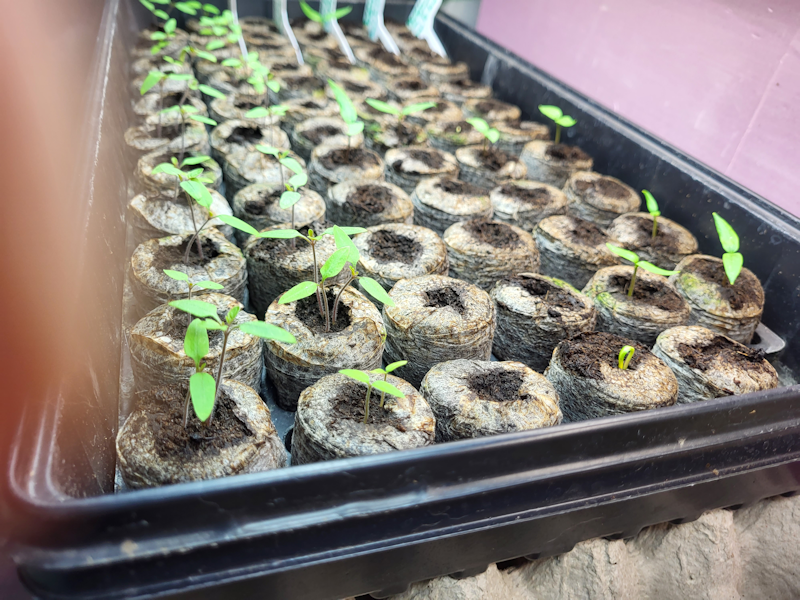
Today, I potted up the Indigo Blue Chocolate tomatoes.
I’d started them in a peat tray with two rows of four square cells. One row for the tomatoes, one for the Little Finger Eggplant. I planted 4 seeds per cell, which got me 11 plants, which is quite a good germination rate.
I wish I could say the same for the eggplant! Only three germinated, so I replanted. As of today, I have finally seen one tiny, barely visible seedling, germinating. Hopefully, that means we’ll see more, soon.
In other things, yesterday I finally saw the tiniest, microscopic oregano seedling, and this afternoon, there was an equally tiny spearmint. The Roma tomatoes sharing the tray, however, are doing great. I’ll have to get more soil for potting up. Quite a bit more. The Roma and Spoon tomatoes will need to be potted up, and eventually the peppers sharing the tray with the Spoon tomatoes will need potting up, too – there are finally more and more of the peppers germinating!
I’m going to start running out of shelf space for the plant trays! It will be good when things warm up enough to start moving trays into the sun room – and start keeping the yard cats out! Last year, we set up a surface using a couple of saw horses and an old closet door I found when cleaning the outhouse over the swing bench, which worked out really well. We’ll have to work out something better to support the lights, though. We’ve got a few weeks to figure things out.
We’ll also have to figure out what to use to protect the plants when it’s time to harden them off. Last year, we used the frame of my daughter’s market tent, with an unused, home made bed frame made out of plywood on it. This kept the plants high enough that none of the cats went after them. The market tent is being use now, though, and the bed frame got painted and is now in the basement, keeping litter boxes raised off the concrete floor – just in case things get wet again. I think I saw a folding table in one of the sheds – it’ll take some doing to access it to confirm, and see if it’s big enough. The problem will be how to keep the cats off, since it would be about half the height of the frame we used before.
We’ll come up with something!
It just felt good to do at least a little big garden related, today!
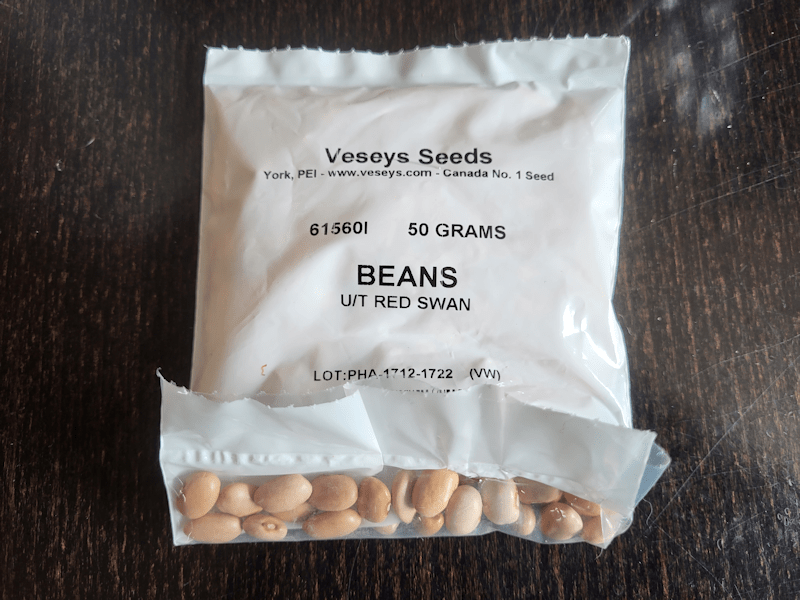
Our last packet of seeds that were backordered from Veseys finally came on. Or, I should say, I finally picked them up. I’m pretty sure they arrived last week. We just weren’t able to get out while the post office was open.
Wow! I just looked them up at Veseys, and boy am I glad I ordered them so early! The price has really gone up since then! This is the description for them.
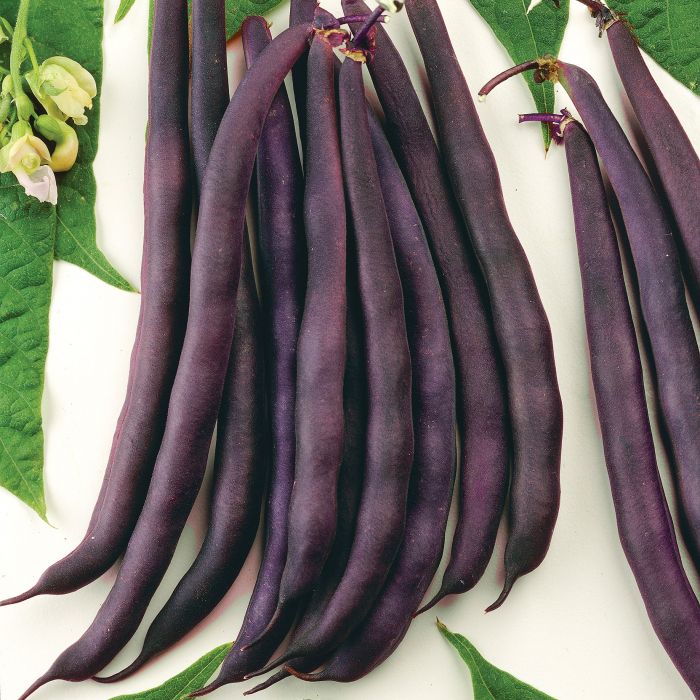
Stringless and unique. Red Swan is a great fresh or cooking bean that is stringless! Bred by crossing a pinto and bush bean, Red swan blew our trial staff away with its yields and ornamental presence. Pods emerge red and mature to rose-purple at 5-6″ long. Red swan kept producing late into the season for multiple harvests and pods hold onto their flavour well at every size. Matures in 60 days.
We have had good results with purple things – beans, lettuces, carrots – so I hope these “red” beans will also do well. Plus, it’s a dual purpose bean. I should remember to plant half of them for a dry storage bean, and the other half for picking fresh.
Meanwhile, here is how some of our seedlings are doing.
The trays in the big aquarium greenhouse are doing well. The germination rate for the Roma VF tomatoes is really high! So if the germination rate for the Spoon tomatoes, and some of those seeds were 2 years old! Still no herbs, but at least there are more peppers starting to show up. I’ve read that peppers can take up to 21 days to germinate, so I hope we will have more showing up. Especially with the cayenne. There’s still only one of those.
Ugh. My phone focused on the wrong place! Ah, well.
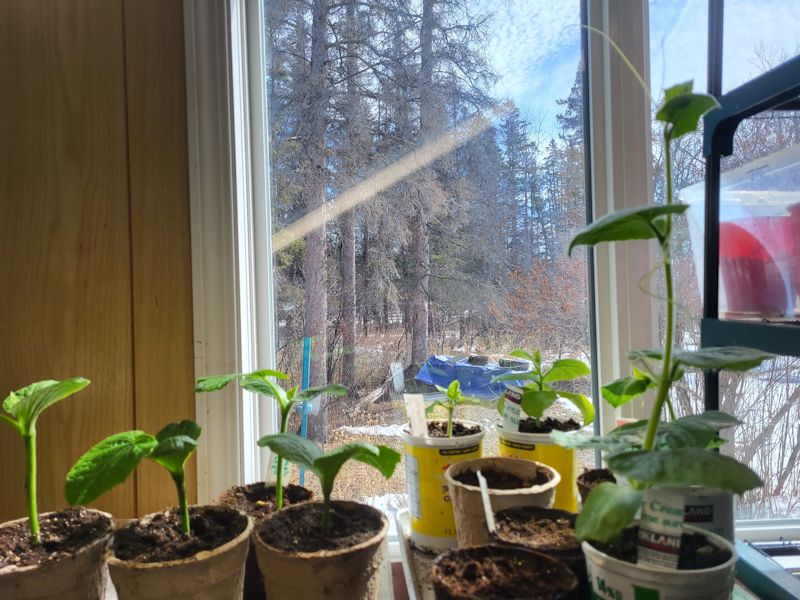
I am just amazed by that one zucca melon on the right! Not only by how tall it’s getting, but that its stem it so strong and holding itself upright, with no support! Last year, they never got this big, even after transplanting. They have such a huge fruit, it’s interesting to see that this is a climbing vine. I’ve had to make sure the tendrils don’t wrap around anything.
There are still just the two of them, though, and just two African Drum gourds, even though I did plant more seeds. We did bring a heater into the living room, but can only use it when someone is around to supervise, so while we’re able to get the room warmer, it may still not be enough to warm up the growing medium. The Crespo squash are looking good, though, with one still in its original pot, and the three that were thinned by dividing.
As for the rest, still no Classic eggplant, and none of the reseeded Little Finger eggplant or luffa have terminated. There are more tiny strawberries emerging, and I think it’s about time to pot up the Indigo Blue Chocolate tomatoes.
I might have to change up how the lights are over the seedlings. This area gets some good sunlight in the mornings, but the more trays are in the mini greenhouse frame, the less light there is for the lower trays. I have to find some way for the lights to reach the lower trays a bit better. They seem to be doing okay so far, though. I’ve been switching them around and rotating them every couple of days or so, but as we take more trays out of the aquarium greenhouses, I won’t have the room do to that for long. We’ll also have to find more surface area for trays; the potted up tomatoes are going to take up a fair bit of space!
I didn’t have time to post this before heading into the city. We had an excellent visit, and ended up leaving an hour or so later than we should have. It was dark by the time we left, and with all the reflections on the damp roads, it was extremely difficult to see where the lanes were. We also very quickly realized we needed to stop as soon as possible and clean our headlights! Thankfully, there is a gas station just outside the city on our route – and the prices were 5 cents cheaper than when we filled on the way out. Gas prices were really weird. In the town my mother lives in, where we usually stop for gas, the prices had gone up from 154.9 cents/liter to 160.9. Usually, the prices are cheaper in the city, but we were passing gas stations at 169.9! This one station outside the city is usually a penny or two higher than inside the city, so it was very strange to see it lower than everywhere else. My daughter was a sweetheart and cleaned all the headlights and windows while I got the gas, and my goodness, did it make a difference! It was still very cautious driving, though. Not because of road conditions – those were great. It was being on constant lookout for deer! Thankfully, we only saw one, running away from the road, but there are so many of the around this time of year, I consider that very lucky.
So what did I find that I would have posted about before leaving?
This lovely surprise!
When I turn the lights on in the morning, I would always lift the dome on this tray to check the pots while getting the condensation to drip into the tray a bit. There wasn’t a single sprout this morning. After making our second basket and putting it in the living room for safe keeping, I took the time to look at the tray that had been moved off the neat mat, to see if any more peppers had sprouts. None had, but I realized I was seeing green through the condensation of the dome on the new tray. I couldn’t believe how many tomatoes has sprouted in such a short time! I’m also surprised they sprouted earlier than the herbs. Those seeds are so tiny, they are practically surface sown, so I figured they would be visible first, for sure. Nope. Not a single herb seed has germinated yet.
With the tomatoes sprouting, though, the dome now stays off.
Now, if only more of those peppers – and any of the Classic eggplant – would start sprouting!
For a while outside, the wind picked up and I could see the snow coming down horizontally out the window! From what I’m hearing the roads are in terrible condition, and quite a few people posted online that they started to go somewhere, only to turn around immediately. Everyone is being told to stay home. A number of roads have been closed, particularly in the South. For our area, it looks like the worst of it has passed by, and things should be getting better from now on, though there is a second system on the radar that might make it as far as us later. Maybe.
A good day to be inside and doing garden stuff!
The first thing I needed to do was start some new seeds.
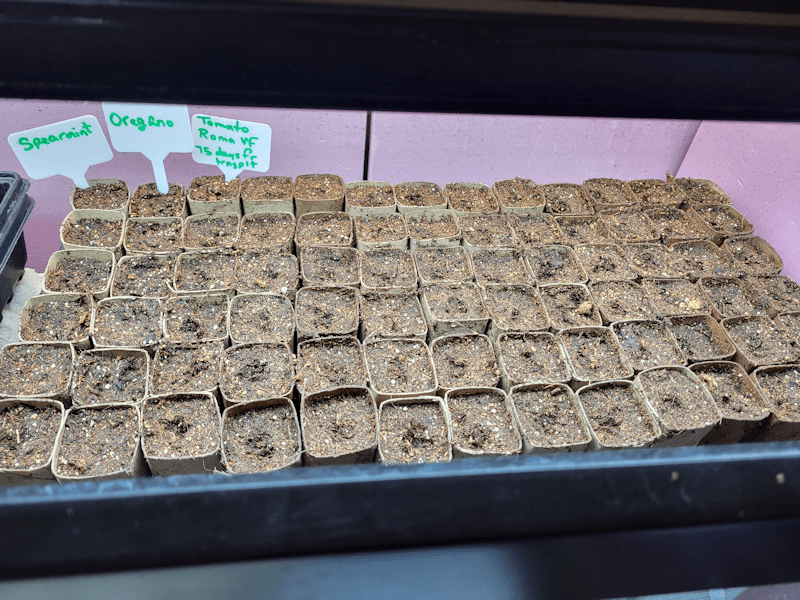
There were only three things that need to be started in the 6-8 week range; spearmint, oregano and the Roma tomatoes.
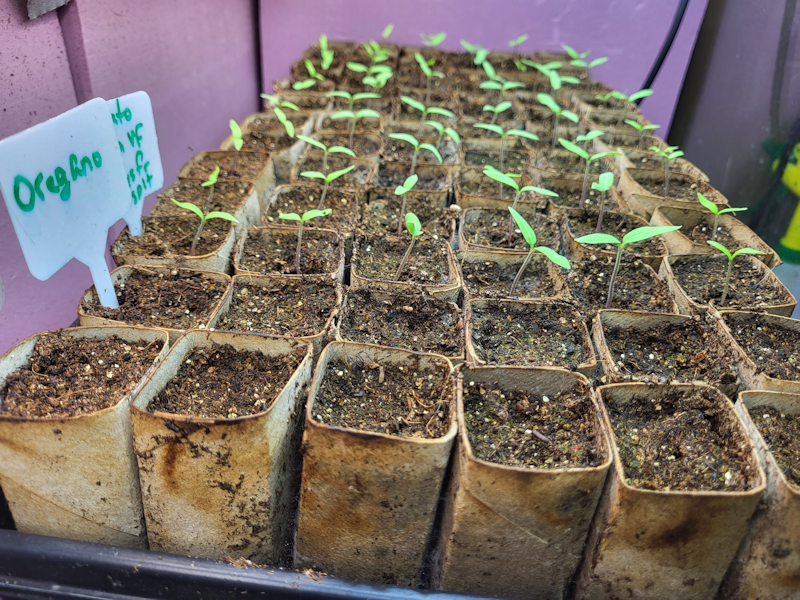
The oregano and spearmint seeds are so miniscule! We don’t need a lot of either, so there was more than enough for our needs. There weren’t a lot of seed in the tomato packet, so I actually counted them to work out how to use the tray. There turned out to be 67 seeds in the packet. Usually, for “pots” the size of these toilet paper rolls, I would plant two seeds per pot, but with so few seeds, only one got two seeds and the other 65 got a single seed each. Romas are a tomato I want to have a lot of, so we can do tomato paste and sauces again at the end of the year.
The herbs each gone one row in the tray. Here, the tray is on the heat mat, and it now has a dome over it, too.
This is the tray that had been on the heat mat. There are some cayenne, Dragonfly and Early Sensation peppers sprouting. And look at all those spoon tomatoes!
The strawberries and Classic eggplant got moved out entirely, and are now in the small aquarium greenhouse, still on the little bin to lift them closer to the light. The hardware cloth cover for the tank is no longer needed to keep the cats out, but it is still needed to hold the light fixture. We couple put the light back under the tank’s lid and use that, but this way, there is still plenty of air flow.
This done, I decided to do some potting up. First, I thinned by dividing the Crespo squash…
They are on the aluminum sheet in the photo. Of the two pots, one had all three seeds in it germinate, and they all have their own pot now. The second pot, I left for now. You can see a second seed did start to germinate, but it seems to have just stopped growing.
In the baking tray, you can see the Zucca melon, at the bottom right of the picture, are doing well! Those tendrils are reaching out to climb, and I’ve already had to unwrap the biggest one from the mini greenhouse frame. The drum gourds in the back are doing okay, but I think it’s just too cold for them to grow much right now.
I’d reseeded more Zuccz melon and drum gourd, but none have germinated yet. There was a drum gourd seedling that died after I’d put more seed in the empty pots, and I was considering adding more drum gourd seeds to it. Not anymore! That pot has now been “potted up” into the stronger, lighter coloured pot, and contains an experiment.
Last year, we had purchased seeds for Tulip trees and pawpaws. We had a single Tulip tree germinate, only to die soon after. Nothing else germinated. Their containers had been moved between the sun room and the shelf just outside the sun room. No surprise that cats would eventually knock them around, and that was it for any chance of germination. They were planted in a seed starting mix, which I ended up adding in to the big bowl I use to moisten the starting mix before putting it into pots to start new seeds. I ended up finding one of the pawpaw seeds that actually looked robust, so I stuck it into the available pot. Who knows? Maybe it’ll sprout!
Today, I had dumped our last bag of seed starting mix into the big bowl with what was left from before and was mixing water in with my hands when I found another pawpaw seed that looked like it was fresh out of the package we got them in. So I stuck that into the pot I’d put the first one in. The pot is damp, though, so it broke. I grabbed one of the new biodegradable pots I bought and the whole thing fit perfectly inside it. Cool! Now we have two pawpaw seeds to potentially sprout!
As I went back to mixing water into the seed starter mix, I found three more pawpaw seeds! None of them showed even the slighted bit of rot or damage!
They all went into the experiment pot.
I have no idea if they will germinate, but it would be awesome if they did!
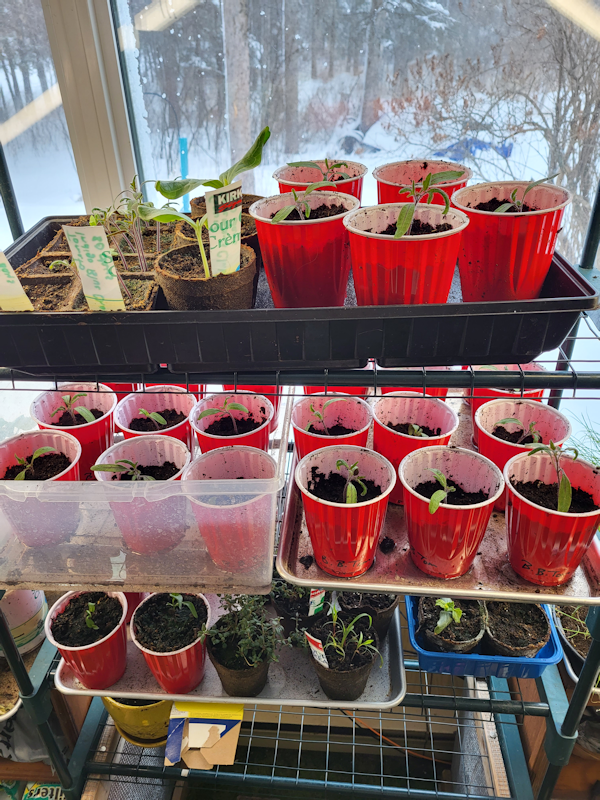
Once the herbs and tomato seeds were planted and things were shifted around, I decided it was time to pot up the Black Beauty tomato seedlings. The germination rate for those was really high, and they were starting to get too big for the square potting cells they were in. I had a bag of potting soil ready for potting up, and went with Red Solo cups to transplant them up into.
I filled them about half way with soil, and buried the stems of the seedlings about half way when transplanting. As they get bigger, we can keep filling the cups with soil, allowing for more roots to develop along the stems. The baking tray holds 12 cups, while the bin can only hold 9, which left 5 more to go back into the tray they had been in before. The smaller Indigo Blue tomatoes don’t need potting up yet. Sadly, there are still only three Little Finger eggplants; the pots I reseeded show no signs of germination yet. Again, I think it might just be too cold by the window, even though the whole thing is over a heat vent.
Lower down, you can see the tray that has the first peppers we planted, in the red cups they were potted up into, next to the German thyme and lemon grass. The yellow plant pot below has one of the pots of German thyme transplanted into it, which we will be keeping indoors. In the blue mushroom tray is the luffa. We still have just one plant. The other 3 pots were reseeded, but still nothing.
And finally, here are the onions and shallots! It’s been a while since I showed how they were doing. I suppose we could give them hair cuts, but that may not be beneficial. Gardening in Canada did a video about it, and I trust what she says.
My daughter’s orchids got moved to the shelf beside the onions. I hope they do okay, there. They’re pretty far from the heat vent.
That is it for now! The next seeds we will need to start are the 4-6 week seeds, and I think I have only 1 or 2 things that needs to be started in that range. After that, it’s all stuff that needs 3-4 weeks before last frost date. There are a few seeds in that range that I plan to experiment with, starting some indoors and direct seeding others, to compare how they do.
Being able to work on gardening stuff while it’s snowing outside feels really good!
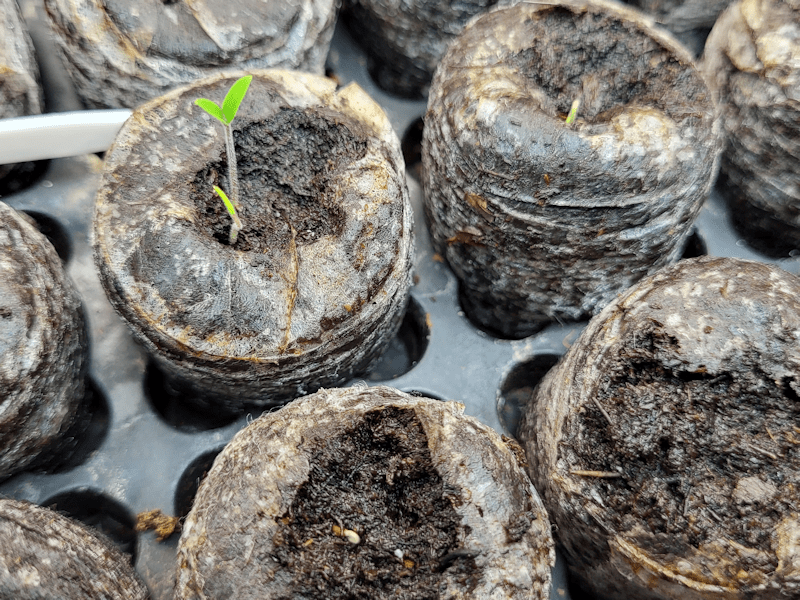
I few days ago, I spotted our first Spoon tomatoes, but they are so fine and spindly, I waited until today to try and get a photo.
Still no sign of peppers, but there’s about 8 or so tomatoes sprouting, and signs of more seedling elbowing their way to the surface. They are so bitty!
Speaking of bitty, we also have our first strawberries sprouting!
Growing strawberries from seed is totally new to me, so I’m pretty happy to see these. Over time, I want to have lots of strawberries, so if growing them from seeds works, that would make it much more affordable compared to buying transplants or bare roots. We’ll probably still do both. I want to use them as a living ground cover around the silver buffalo berry bushes. Those are nitrogen fixers, so it would be a good combination, and when the bushes start getting too big and start shading out the strawberries, we can just transplant them somewhere else.
I am so looking forward to having our own berries. We all love them, but they are so expensive to buy! My younger daughter was asking about growing blueberries, but they need acidic soil. Ours is very alkaline. We will need to find a spot and focus on lowering the pH so we can plant some. Once we clear more of the dead trees out of the spruce grove, we might be able to get some good spaces in there. I’ve read the spruces increase soil acidity, so I will want to do some soil tests and see how it is now.
There’s a certain downside to ordering a lot of seeds. Namely, a tendency to forget what I already have, what I’ve ordered, or even what I wanted to order, but decided not to this time.
It helps to organize the packets at least a little. For me, the main thing is to have them divided into bins for what needs to be started indoors, and what can be started outdoors. I sort them more, within the bins, but those are my two most important distinctions.
As I worked on the seeds that needed to be started indoors the earliest, went through our garden plans, and even browsed the catalogs, online and off, every now and then I’d think… “huh. I thought I ordered another type of eggplant.” Specifically, the most common eggplant we see in the grocery stores. Then I figured I must have changed my mind and decided not to, this year.
Today, I got a shipping notification from Veseys, letting me know that my last packet of seeds, a purple bean variety, that was back ordered are on their way. After this, it’s just the live items that won’t be shipped until late May, before our last frost date.
Looking back at the original order confirmation to remind myself what would be coming in May, I noticed something else on the list.
Classic Eggplant.
I did order them.
They should have been started a week ago.
Where are they?
I went through all the Veseys packets in my “start indoors” bin. Nothing.
I got about half way through my “direct sowing” bin, when I found the packet, tucked in amongst the root vegetables.
Oops!
So, I quickly got them going!
There aren’t a lot of seeds, but we don’t need a lot of plants, since this is a “lets find out how they grow and if we like them” year. I had some 10 cell square peat trays, but only used half of one. If I’d found the seed packet earlier, they would have done in with the peppers and Spoon tomatoes that I started earlier in the week, instead of having 2 rows of tomatoes. Ideally, though, they would have been planted at the same time as the Little Finger eggplant.
Here they are, in the large aquarium greenhouse. They really ought to be on the heat mat, but there’s no room, so I added a small bin to raise them closer to the warm lights, and set it up with the strawberry tray. No sign of those, yet, but when I checked under the dome over the large tray, I think I actually saw some tomatoes elbowing their way to the surface!
It’s a bit late, but these only need 75-80 days, so we should still have time. I planted two seeds per cell, and still have some seeds left. If we get only 50% germination, that’s still enough for our needs for this year. We like eggplant, but we don’t buy it often.
The snow on the driveway is pretty hard packed, but there are a few softer areas where tracks show up. This morning, I was seeing some unusual deer tracks.
Then I checked the gate cam files.
I watched at least 7 deer, over three videos, coming in. Later, the camera caught three of them running out again, at full speed!
That certainly explains what I was seeing in the snow this morning!
I have another slight change in plans today. I was going to meet a woman in a parking lot for a great deal… 😉 The homesteader I buy most of our eggs from is going to be in the town closer to us with a load of eggs at a certain time and place, so I figured that would be a good time to get a couple more flats
Then I got a phone call from my mother. I had bought an extra dozen eggs for my mother as a surprise a while back, and she was wondering if I would be getting more eggs. She wanted to get another dozen for her Easter basket – eggs she wouldn’t need to colour!
So I contacted the egg lady, letting her know how many I was after. She’ll have enough, so I’ll be getting eggs for both ourselves and my mother. Though it’s a bit early for Easter!
The funny thing is, I’ll be going to the town closer to us, getting the eggs, then driving to my mother’s place, which is in a town between our place and the egg lady. So instead of saving some driving, I’m at least doubling it! 😄 I don’t mind, though. I’m glad my mother liked the eggs I got her! Last time, though, she ended up with all brown eggs. This time, I’ll make sure she gets a few in other colours.
With that in mind, I’ve slightly postponed starting seeds today. I was able to pick up more Jiffy pellets to refill a tray, which is now set up and hydrating. Tomorrow, the rest of our peppers – all early varieties – and some Spoon tomatoes will be started. Depending on how much room I have in the tray, I may even fit in some Purple Beauty bell pepper seeds from last year. That was all I have that need to be started indoors in the 8-10 week range. We’re currently at about 9 weeks before our last frost, so next week I hope to start the seeds that need 6-8 weeks.
I’m going to have to figure out how to raise the mini greenhouse frame higher, in a secure manner, because we’re eventually going to need the shelf space. Where the shelves and frame are sitting, they get excellent sun in the morning, but the bottom shelves of the mini greenhouse are in the shadow of the wall under the window. I know how I can get it higher. It’s that “secure manner” that’s a bit more of a challenge.
Looking at the newest seedlings in the large aquarium greenhouse, I could see roots making their way through the biodegradable pots the Crespo squash are in. They need to be potted up! Right now, there are three, big healthy seedlings in one pot, and a new one coming up in the other pot. I’ll see if I can thin by diving. I’d hoped to have larger biodegradable pots to pot up to, but I’m just not finding them. I suppose I could order online, but by the time they get here, it’ll be too late. So they will go into plastic transplant pots.
We did lose that one sickly drum gourd, but the others are doing well. The Zucca melon, however, is really thriving. Both still have pots that were reseeded, so we might get more of each.
The thyme is doing so well, I’m thinking of eventually potting up one of the bunches into a permanent pot for growing indoors, while the others get planted outdoors. We have a second variety of thyme to start, but not for a few more weeks. I’m curious to see the differences between the variety. As small as the current seedlings still are, they have SUCH a strong fragrance when the leaves are handled.
I am quite happy with the new, cat proof living room set up. It’s really making things much easier this year!
I love it when seedlings suddenly burst out of the ground and grow so fast, things are different every time I check on them!
When I checked on them yesterday, I could just see one Crespo squash starting to shoulder its way through the soil. Near the end of the day, I could see two emerging and one more just visible. I also spotted one eggplant peaking through. By the time I shut down the lights for the night, the eggplant was up, with signs of more starting to emerge, plus signs of one Caveman’s club gourd.
This morning, two of the Crespo squash are fully up, with the third one almost there – and the soil in the other pot looks like something might be breaking through soon, too. There are still more tomatoes emerging, and more eggplant peeking through. Still just one Caveman’s club gourd visible, so far.
As for the older seedlings, it looks like all the ones that got potted up have survived, though one drum gourd that did not need potting up doesn’t look like it’s growing. There had been two in that pot and one died. I was hoping the second one would make it. We shall see. The other two that were thinned by division are growing, and the third pot was reseeded, so I hope there will be more to transplant once the garden is ready. The more there are to transplant, the better the chances that at least one will reach maturity!
I’m happy to see so many seedlings emerging now. Soon, these will be moved off the heat mat to make room for the next batch of seed starts.
Today, I potted up most of our seedlings, among other things.
For the larger seedlings, I thinned by dividing, so the zucca melon and a couple of drum gourds are now in their own larger pots. The pots where nothing germinated now have new seeds in them, including the luffa on the side.
The four cells of peppers are now in 7 red solo cups. The thyme and lemongrass did not get thinned, just transplanted into deeper biodegradable pots.
I also got the strawberry kit done, and that little tray is in the aquarium greenhouse with the other seed starts. Every time I look at in there, the Black Beauty seedlings are bigger, and I can spot more of them breaking through the soil. They are practically exploding in growth! I even spotted a couple of Indigo Blue tomatoes breaking through, too!
In about a week, we’ll need to start the next batch of seeds, which will include all the remaining short season peppers and the paste tomatoes. I’m quite glad we have the living room cat proofed, so we can shift things around more freely. Yesterday, my daughter was using the room and Fenrir teleported in, as she tends to do. My daughter thought it might be okay, since she was in there to supervise. She turned her head for perhaps 30 seconds, and suddenly Fenrir had a mouth full of onion greens!
Onions are toxic to cats.
My daughter was able to catch her and get the greens before she actually ate them. Thankfully, there is no apparent damage to the onion seedlings!
So much for even one cat being allowed in, with supervision!
Yesterday was the first day of spring. Check out our spring garden!
😄😄😄
It’s going to be a while before we can start building the trellis tunnels (we will be starting closer to the high raised bed, and I hope to eventually have two or three, though maybe not this year), never mind planting anything!
BUT!!!
We do have other signs of spring.
When I shut the lights off for the night, I found two Black Beauty tomatoes had emerged! There had been no sign of them when I turned the lights on in the morning. I could just make out the “elbow” of a third one, and this morning I can see there is a second “elbow” emerging. These are in the cell just below the one with the visible sprouts.
Today, I plan to pot up some of the transplants, and try to start seeds for some losses. We are down to one luffa, two pots of zucca melon still have had no germination, along with one pot of drum gourds, so I’ll see if I can get new ones started, though I won’t bother putting them in the aquarium greenhouse. Their current location above a heat vent should be warm enough. I did remove the plastic cover on the mini greenhouse, as I think the lack of air circulation may be contributing to the losses, and even some of the bigger seedlings have started to look unhealthy.
I stopped at a grocery store to pick up some milk for my mother, and ended up picking up a seed kit. One of the things I wanted to do later on was get strawberry transplants – quite a few of them, depending on the budget – and plant them as a living ground cover around the silver buffalo berry. Last year, the transplants cost about $3 or $4 each. The kit was only $4. So I’m going to try growing strawberries from seed, which will hopefully give me more to transplant than I would be able to afford if buying transplants. And if they fail, it’s not an expensive fail. So that is something else I plan to work on today.
Oh, and I’d better call the plumber about our bathtub before I forget again! After that, I’ll know if I have to be making a trip to get a tub surround and the replacement taps I want.













 The Re-Farmer