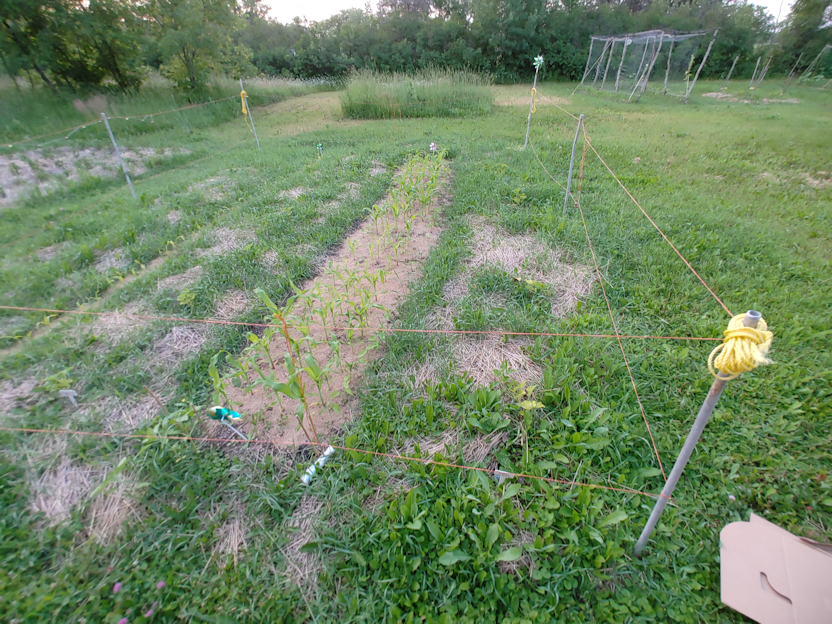
Since we weren’t going to get any cooler, I headed out before I lost light, to see what I could do with the small batch of cardboard I got today. There wasn’t much, so I decided to use it here…
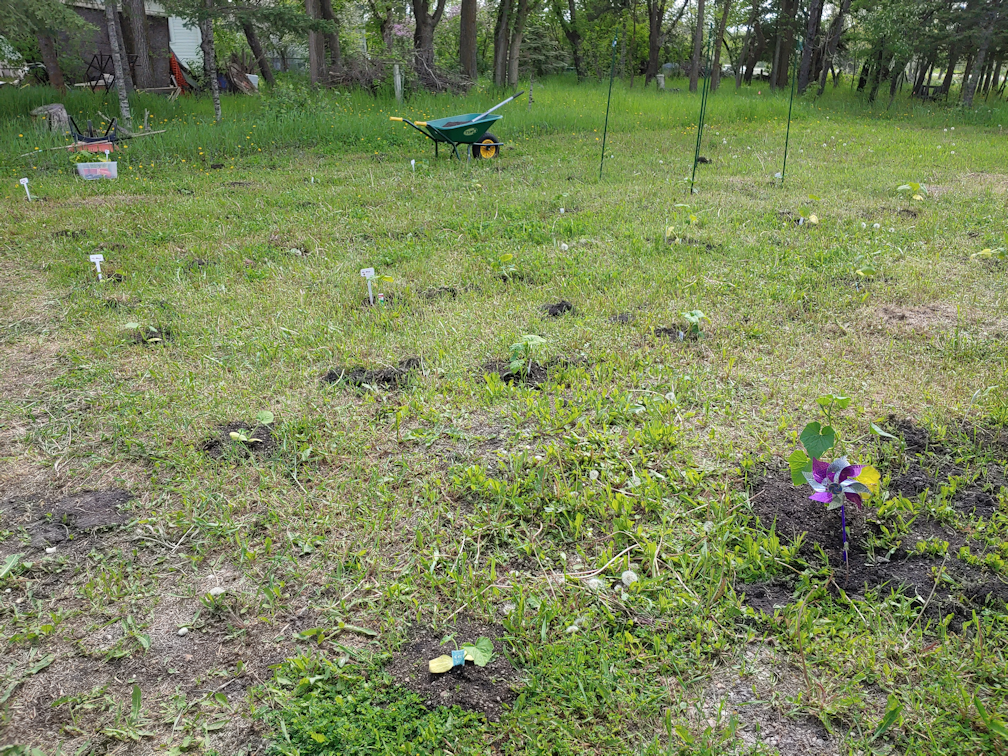
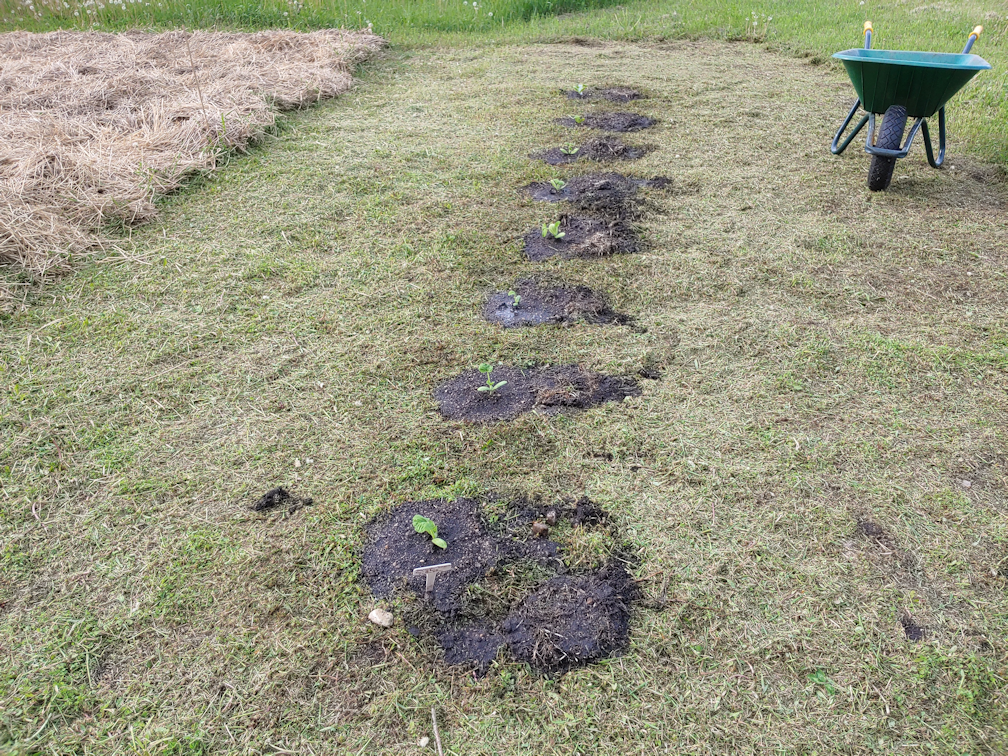
To the right of the sweet corn are five Lady Godiva hulless pumpkins, barely visible in the grass and weeds coming up through the straw.
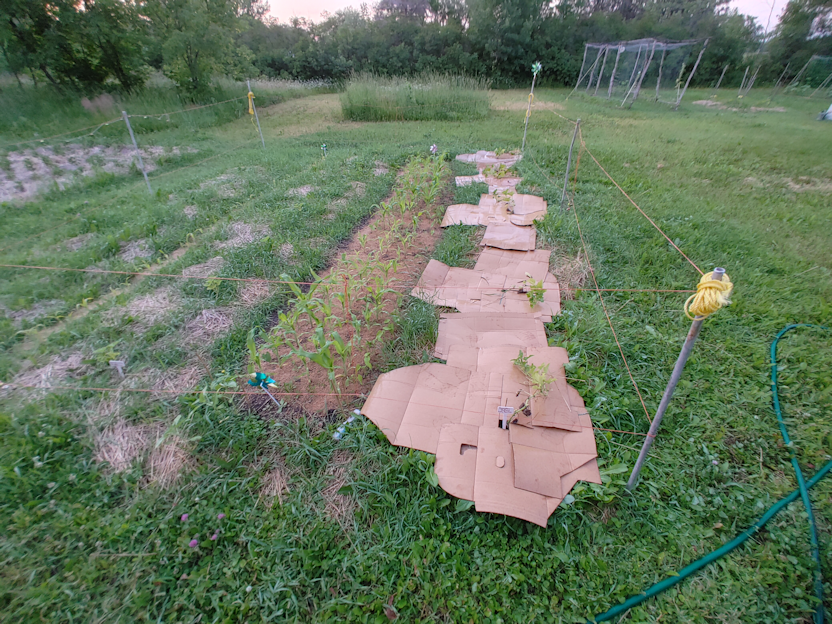
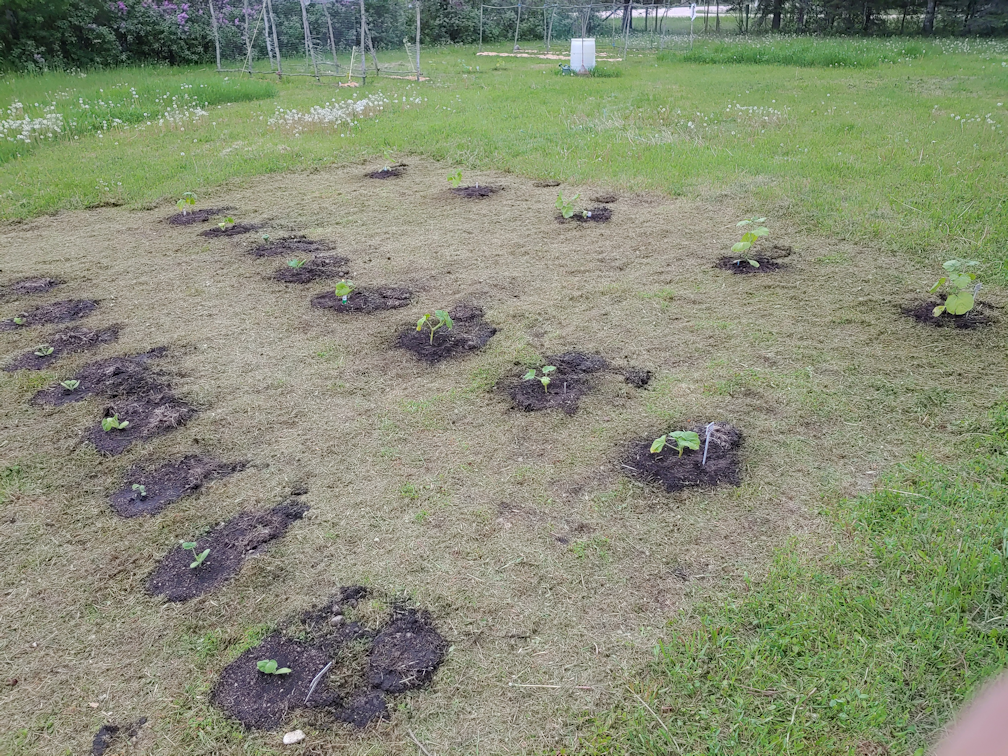
Once the cardboard was down, you could see that the plants are actually fairly large! Smaller than they should be for this time of year, but still larger than most of the squash. In fact, all the hulless pumpkins seem to be doing better than most of the other squash.
After laying down the cardboard, I gave it a soak, then tromped on them to flatten them a bit. I would have stomped the grass down before the cardboard was laid down, but I didn’t want to risk accidentally stepping on a pumpkin plant. As we get more cardboard, the Boston Marrow and the G-star patty pan squash will be done first, then any spaces in between will be covered, including beside the rows of corn.
We need lots more cardboard for this.
Once this was done, I went to check the other garden beds and found a wonderful surprise.
Our first summer squash! There’s a second, smaller one on another plant. I’m really happy, not just to finally see some vegetables, but because this is a Madga squash. The first time we grew them, only 2 plants made it, and last year we had only one. They did not produce as much as the other summer squash, either. This year, we’ve got 4 surviving plants, and they’re the first to produce fruit!
We also got a second harvest this evening.
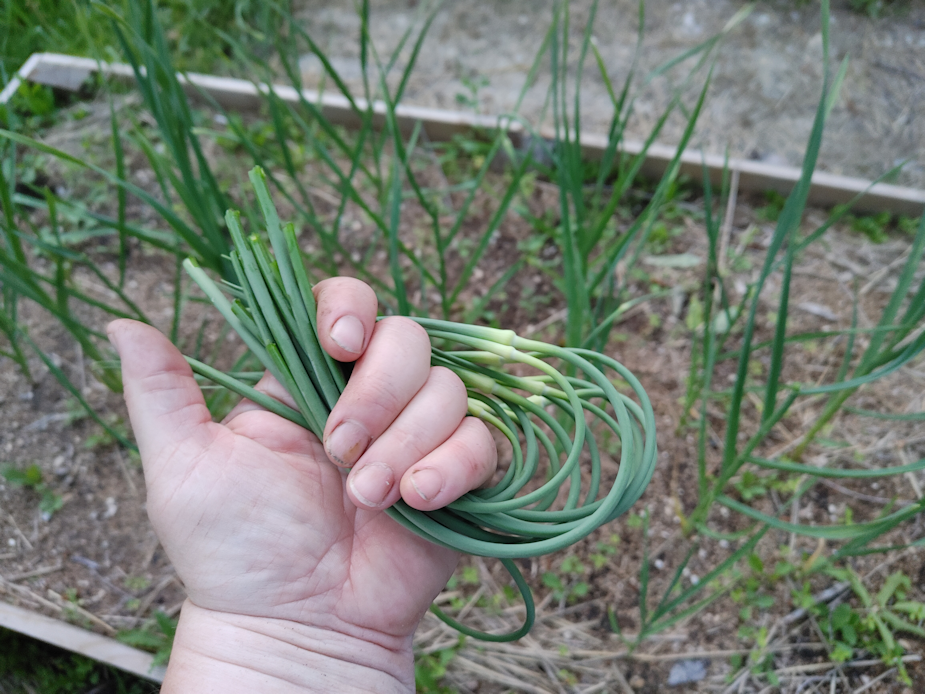
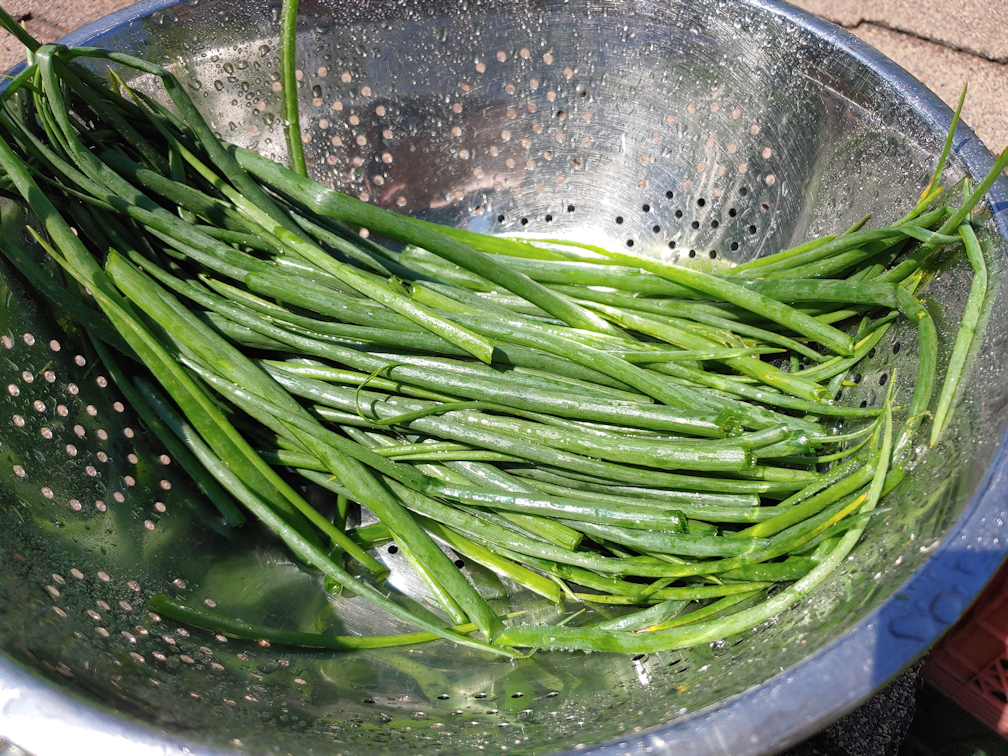
The garlic bed that is so far behind the one in the main garden has scapes ready to harvest! This is almost all of them. There’s just a very few left that aren’t ready to pick yet.
It may be late in the season, but at least we’re getting something from the garden!
Today is working out to be slightly cooler than yesterday; it’s coming up on 6pm as I start this, and we’ve been at 28C/82F for some hours. We’re not expected to start cooling down for at least another hour. Longer, if today is at all like yesterday.
It was getting pretty late last night before I finally headed outside, fogging myself in mosquito repellant, and started on the squash patch.
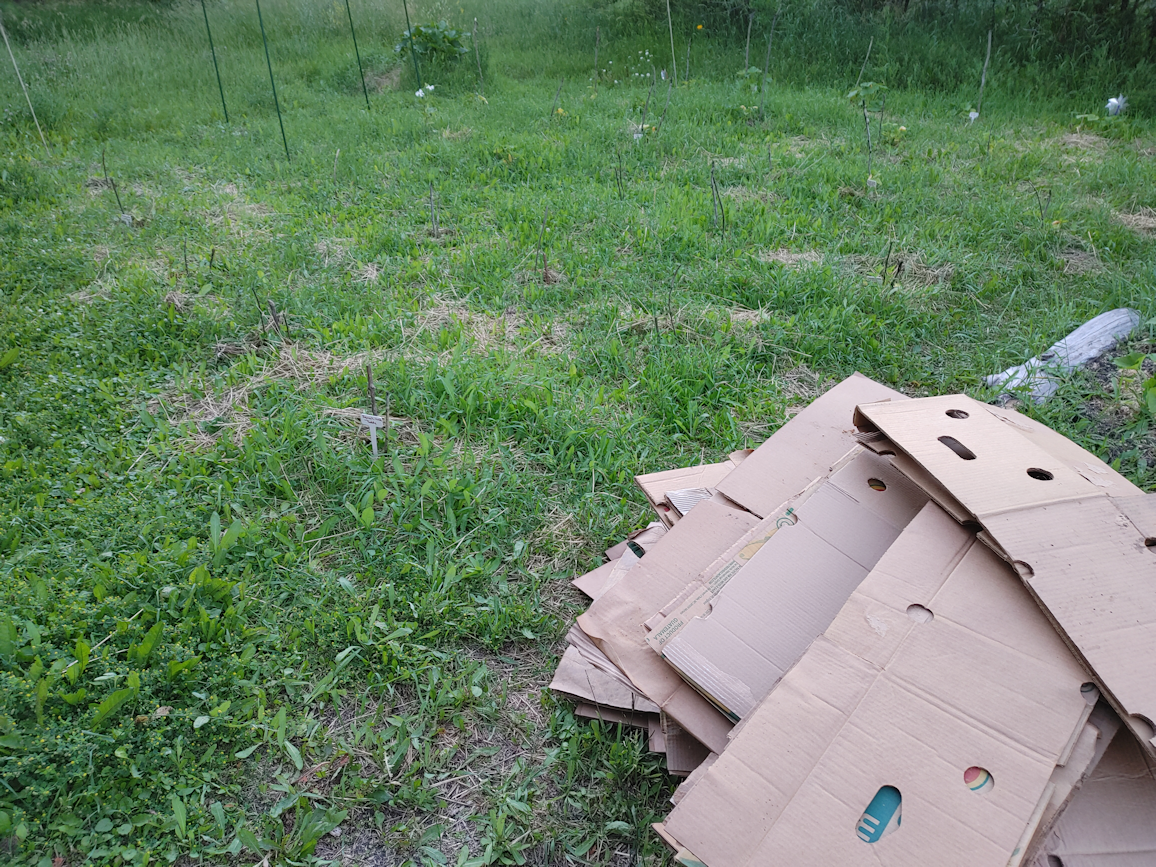
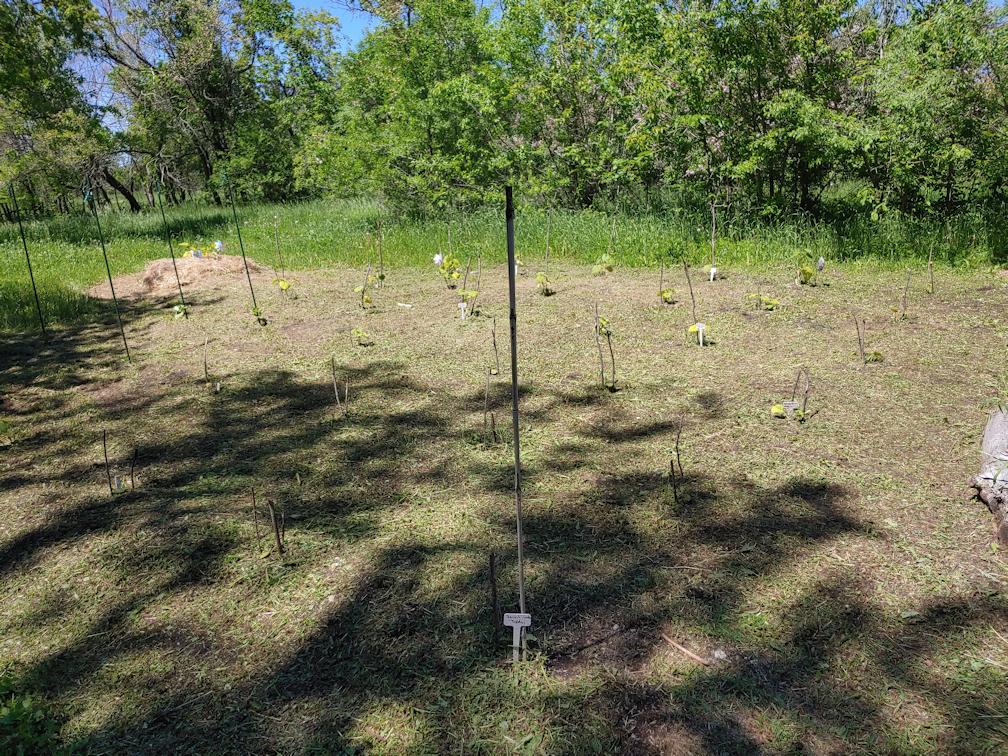
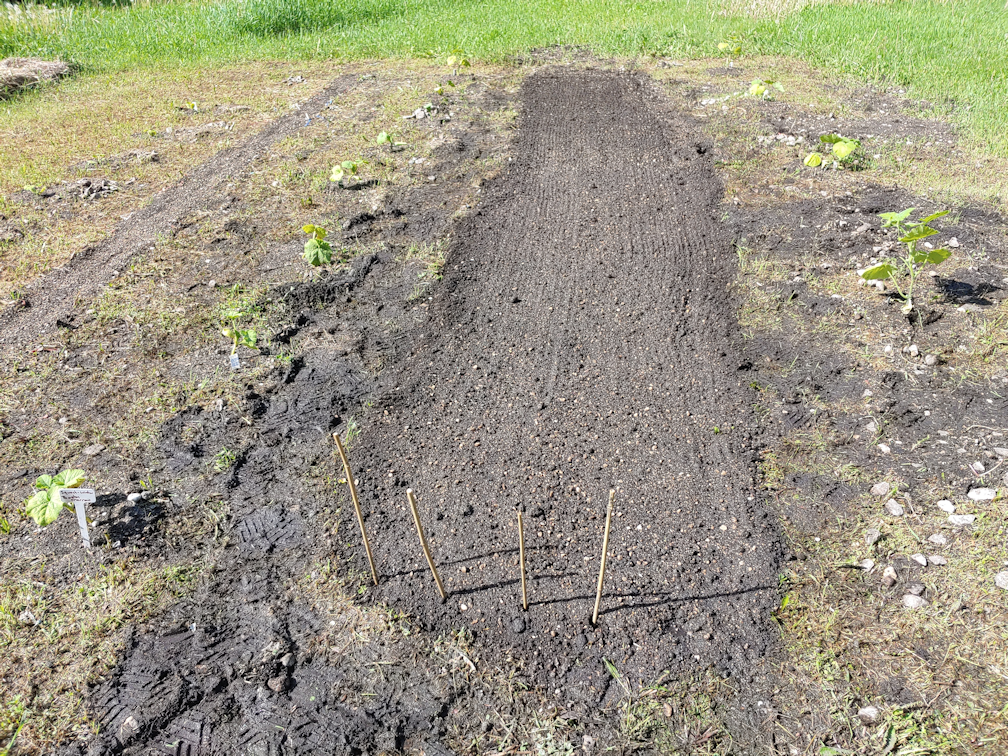
I did remember to take a before picture. Every pair of sticks shows where there is a summer or winter squash, a pumpkin or a gourd. The straw mulch we laid down may help keep the soil cool and moist, but it isn’t thick enough to choke out the weeds. It also makes weeding – or even using the weed trimmer – impossible.
One of the apple gourds is relatively robust. The hulless pumpkins, Baby Pam pumpkins and Crespo squash plants are also doing comparatively well. The green zucchini, Teddy, Georgia Candy Roaster and Winter Sweet winter squash, however, are all very tiny. They should all be much, much larger for this time of year.
I am hoping that using the cardboard to smother the crab grass and weeds around the squash plants will help. I did things a bit differently this time. Previously, when preparing an area with cardboard to be covered with a straw mulch, I laid down flattened boxes in overlapping layers, making everything at least 2 layers thick. The overlaps were 4 layers thick or even 6 layers, depending on how they ended up overlapping.
Obviously, I couldn’t do that, here.
Most of the boxes were roughly the same dimensions; there were a lot of banana boxes in the pile! When flattened, they made long rectangles. I cut each in half, so that I could lay each piece down as a single layer, positioning 4 such pieces at right angles around each plant. That meant two boxes for each plant – mostly. I barely had enough cardboard to finish the job, but some of the boxes were large enough that I could cut them down further, and use just one box around a plant. I got them all done, with no cardboard to spare at all.
It was a brutal job.
For all that I used mosquito repellant, I was still being swarmed. Any spot that didn’t get sprayed was attacked. It’s one thing to find myself being bitten in the butt because my shirt shifted as I bent over. It’s quite another when they would fly under the lenses of my glasses and go for my eye lids. Yes, I actually got mosquito bights on my eye lids! On top of that, because of the heat, it wasn’t long before I sweated off the repellant. At which point, I was just a mosquito buffet! By the time I was putting down the last pieces of cardboard, I was spending more time flapping my arms and doing the mosquito dance than anything else!
By the time I was done, it was quite dark, so an after photo had to wait until the morning. We did have a small thunderstorm during the night. As usual, the bulk of the system blew right by us.
None of the cardboard blew away, however! That was my big concern. Interlocking the pieces of cardboard seemed to have done the trick.
As we get more cardboard, I do want to fill in the spaces in between, but the squash and corn patch needs to be done, first. For now, this should help. I’ve picked up a slow release, granular fertilizer that will be applied soon. I just don’t want to be feeding the crab grass as well as the squash!
Hopefully, I’ll be able to get another van load of cardboard, soon. I did manage to get a few boxes today, when I stopped at the post office/general store. Possibly enough to do one row in the squash and corn patch. We shall see.
Another thunderstorm is being predicted for tonight. I do hope it actually happens, and gets swept northward. Not only to help cool things down here, but there are some major fires to the north of us. At least one of the reserves had to be evacuated yesterday. Rain would certainly help get those under control. For all the flooding we had this year, most of it affected the south of our province. The further north you go, the less affected it was, which means those areas will still be prone to fires.
Just out of curiosity, I checked our 30 year temperature records for today. We’re still at 28C/82F as I write this. Our average for today is 26C/79F. The record high was 33C/91F, set in 2011, while our record low was only 6C/43F, set in 2000. So we’re pretty normal for this time of year. If our spring hadn’t been so awful, this would have been a very productive gardening year.
It’s hitting the girls in their upstairs “apartment” the worst. My younger daughter just cut all her hair off, to help keep cooler. Their switching to sleeping during the day and being active during the night hasn’t been working that well this year; the nights are simply not cooling down much. As a surprise for them, I made a trip to a Canadian Tire this morning, and got one of those Arctic Air cooling fans. I’d much rather have picked up a portable AC unit for them, but not only are they ridiculously expensive, there aren’t any in stock in most places right now. The window AC units are much more affordable, but there is only one window it could possibly be installed in, and it won’t fit with the way that window opens. In fact, that’s true of all our windows. Best bet would be to actually have one installed through a wall, not in a window. Since we don’t actually own the house, that’s not something we’re going to start doing!
We’ve got some heat for the next few days – today reached 28C/82F, and we’re expected to keep getting hotter for a few more days before starting to drop a few degrees, with possible thunderstorms in the forecast. Temperatures are still pretty close to average, though, so nothing like the heat waves we got last year.
Still, it does mean that some garden beds need to get watered, which I try to do in the morning, though some need an extra watering by evening, too, depending on how exposed to the sun the beds are. Yesterday evening, while checking the beds, I found a nice little surprise but didn’t get pictures until this morning.
The bed where we planted 10 bare root white strawberries has been largely ignored, since none of the strawberries had come up. Last night, however, I decided to give it a bit of a weeding, anyway, and lo and behold, I found a single strawberry plant had emerged!
No sign of any others, unfortunately, and I certainly don’t expect we’ll get anything out of the one this year, but hopefully we’ll be able to keep it alive and protect it over the winter, and it’ll do better next year.
While weeding the rest of the bed, I found a volunteer!
The soil in this bed is from the bags we used to grow potatoes last year. It looks like we missed one! We grew 4 varieties, so we won’t know which it is until there’s something to harvest, but from the looks of it, and the colour of the stems, I’d say it’s one of the two purple varieties we grew. Awesome!
After carefully weeding as much around them as I dared, I gave them a watering. They were so wimpy from the heat, they just flattened. The potato was perked up by morning, but the strawberry was still having a hard time holding itself up. Hopefully, with some of the weeds pulled away, it’ll grow stronger. If I could be sure none of the other strawberries will come up, I’d cover the bed with a mulch to help them out. I might still at least give them a light mulch.
A lovely surprise this morning is that the Giant Rattle poppies are starting to bloom! There were three flowers this morning, and this is the largest of them. These are from seeds we collected last year. With the heat waves and drought, they didn’t do well last year, and produced pods much smaller than they normally would have. This year, they seem to be doing better, though I’m still expecting smaller pods. We did get seeds for another variety of bread seed poppies that we meant to plant somewhere else, but with the weather conditions we had this spring, that just didn’t happen. If all goes well, we’ll collect more seeds from these in the fall for planting (and maybe have enough for eating, too!), and next year, we’ll be able to plant both varieties.
As I wrote this, things are finally starting to cool down a bit. The heat lingers late into the day, and it gets hot surprisingly quickly in the morning – when I started my rounds, it was already 24C/75F. The last of the spinach in the high raised bed has been pulled, and I am planning to plant some chard in there this evening. The two varieties we have from last year are Fordhook Giant and Bright Lites. I’ll probably mix them up a bit. There were 2 rows of spinach in the high raised bed, so I’ll likely just plant one tonight, and do the other in a week or two.
Aside from the 2 varieties of spinach I picked up to plant at the end of the month, we do still have seeds of one variety from last year. The spinach in the low raised beds are a complete fail. I was weeding the beds this morning and there are some seedlings, but they’re barely there and look like they’re already bolting, even though they’re less than 2 inches tall! A couple of varieties of turnip are also complete fails, though I think they got eaten by insects. There is one variety that is growing, but they are struggling, and the leaves are riddled with tiny holes. I never see the insects causing the damage, though. We’ll see how they manage. Sadly, one of the losses was the Gold Ball turnips. They simply disappeared. Not one left, though they were among the first to sprout. There were very few seeds in the packet, so there is nothing left to reseed. These were among the free seeds we got, and I was looking forward to trying them. It reminds me of the first radishes we got last year; a daikon type, and watermelon radishes. They sprouted quickly, and were just as quickly gone. Something to keep in mind for when we plant them again in the future.
In other things, I have been very slowly working on scything the hay in the outer yard. I have to be careful not to over do it, even if I feel like I can do more. I know that if I over do it, I can end up out of commission for days. If I do a couple of swaths an evening, it’ll slowly get done. The fun part yesterday was that, when taking breaks, I was able to play with a couple of kittens. Two of them are okay with being picked up, now, though they don’t really like getting caught. The mama is not happy, though. I saw no signs of them this morning, so I’m afraid she might have moved them. I still put food and water out, as they may simply have been staying in the cool of the branch pile while mama was eating at the kibble house.
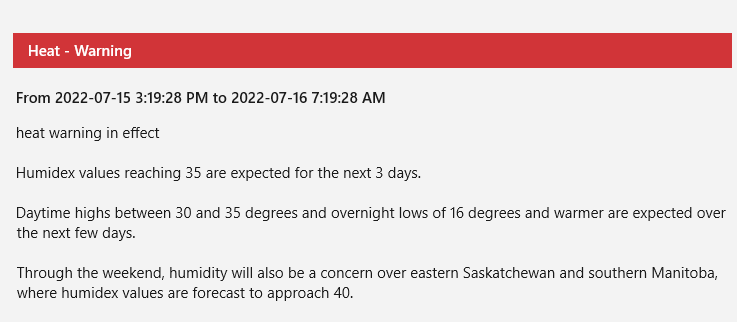
Oh, wow. As I was writing this, my weather app suddenly starting showing this.
For those in the US: 35C = 95F, 16C = 61F and 40C = 104F.
None of this matches the forecast for our area, though. The daytime highs aren’t expected to go above 30C/86F, and that just for one day. The overnight lows, however, are not expected to go below 20C/68F. Definitely some mixed messages, here!
Also, the current temperature has gone back up to 27C/81F instead of continuing to cool down!
At least there is some rain in the forecast, though with our weird climate bubble over our area, that will likely to right around us! 😄 Early morning watering will continue!
Hopefully, this will be good for the heat loving peppers, eggplant, squash and melons, and they will have a nice little growth spurt.
I find myself once again thinking of what my brother and his wife said about their years of gardening. If they had to live off what they grew in the garden, they’d starve to death! Between the weather, the insects and the critters, you just never know what’s going to make it.
Still hoping for a long, mild fall to make up for the long, cold spring!
I just spent a bit of time going back over garden photos from last year. For all the drought and heat waves we had, the garden was well ahead of most of this year’s garden. It’s amazing how much the extended cold and excessive moisture has set things back. At this time last year, I was picking at least a few summer squash, and even beans in the morning. As much as they struggled in the heat, the peas were starting to produce pods. The melons were setting fruit and looking really prolific, and even the Mountain Morado corn was starting to develop cobs. The cherry tomato mix and spoon tomatoes had sprays of green tomatoes, with some ripening and ready to eat, soon after.
This morning, I was able to give more onions a hair cut.
These are onions from seed, taken from the high raised bed, which had the most, plus a few from one of the low raised beds. We picked so many from the onion sets last time, most of these went straight to getting dehydrated.
Kitchen shears makes the job to much faster. After a more thorough washing, then trimming off the browned tips, it was quick work to snip them into small pieces. As I write this, they are in the oven under the warm setting, at 145F (the lowest temperature our new oven can go).
Even with the onions, there’s a difference. They they are looking pretty good, last year they were developing bulbs by now.
I got to taste our first strawberry from the transplants! It was so very sweet! Not the one in the photo; that one’s not ready yet. Nor the first one that developed. That one rotted before it ripened for some reason. There are plenty more developing, and lots more flowers, though, so I hope we will have a decent amount from our 4 little plants. Hopefully, they will also develop runners that we can propagate, to have more plants next year. :-)
Still nothing from the bare root white strawberries we got, though. Looks like a total loss, there.
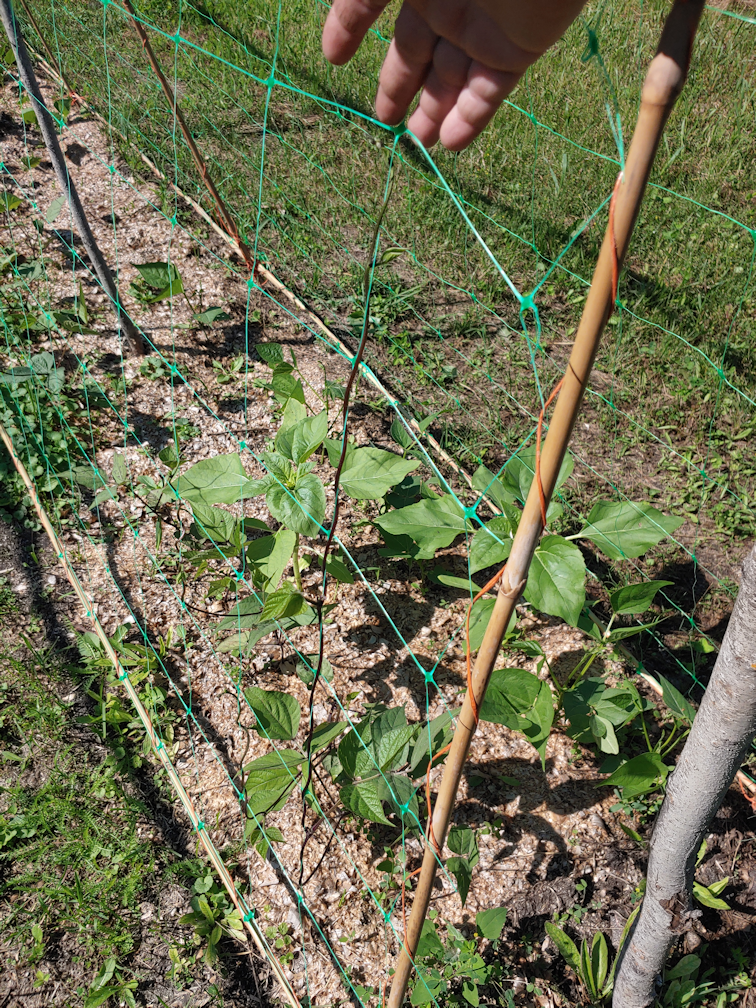
Some of the Carminat pole beans are getting very enthusiastic about climbing! The pole beans on the other side of the trellis aren’t quite there yet. There are a couple of self seeds (or should I say, bird-poop seeded) sunflowers that I am allowing to grow. There are some in other beds that I’m letting grow, too.
I was sure the beans I planted at the tunnel were also vining types, but I’m starting to think they are actually a bush bean. They are getting bigger, but so far, I see nothing to show that they are climbers!
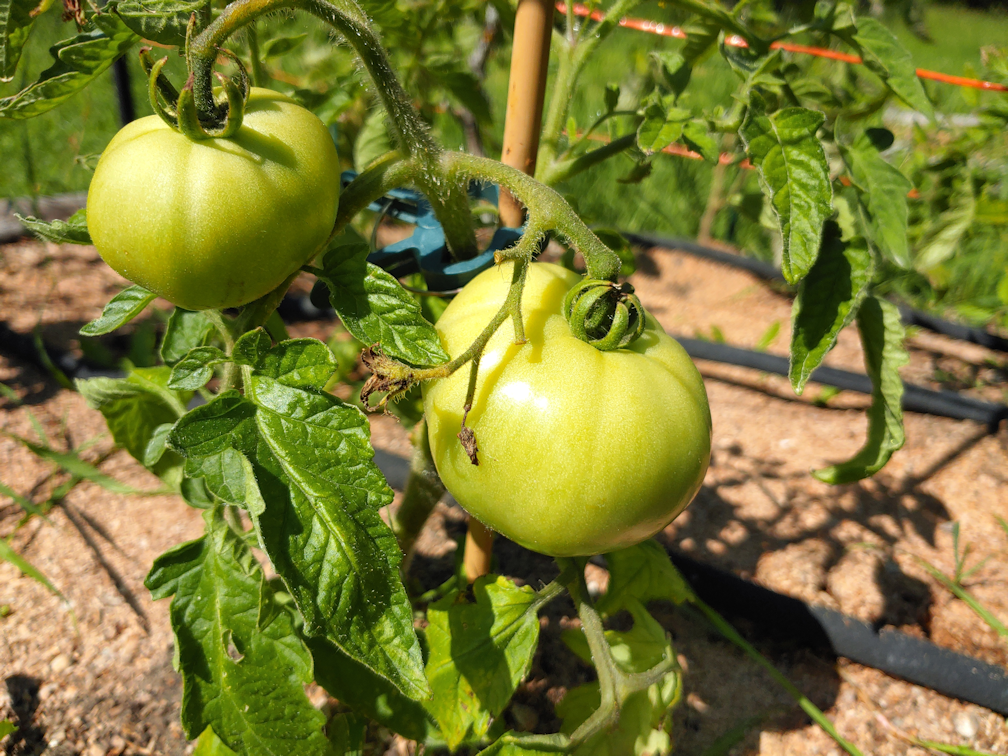
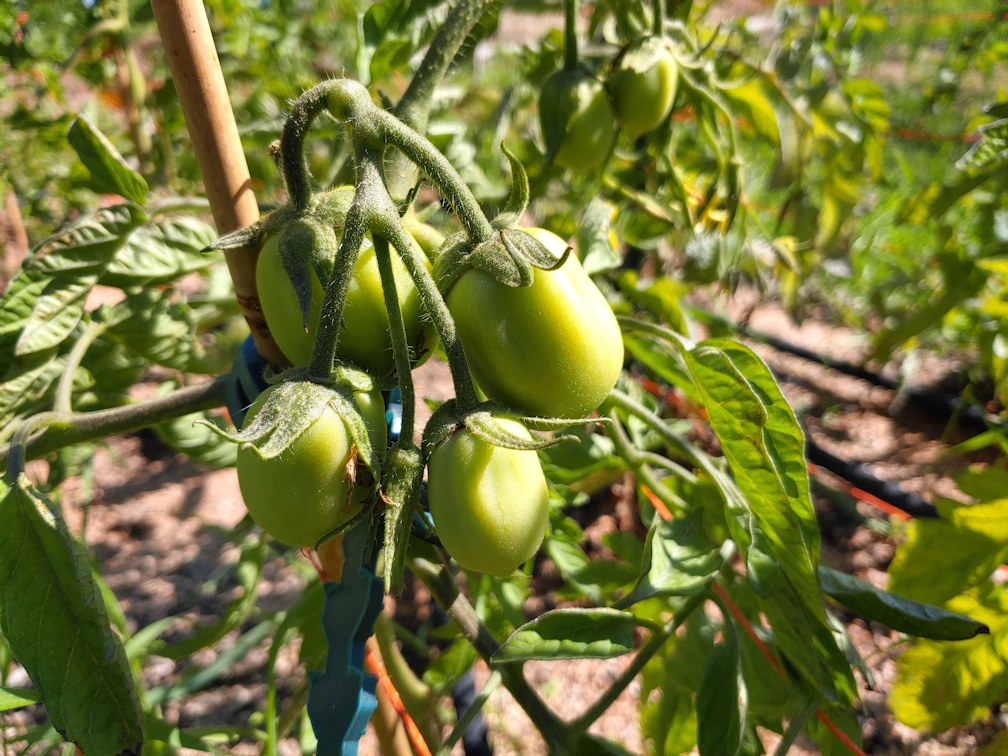
While the Chocolate Cherry and Yellow Pear tomatoes are not showing fruit yet, the tomatoes that were started so much earlier indoors are really starting to fill out! Almost all the plants are starting to show fruit now. The photo above is one of the first Sophie’s Choice tomatoes to develop, and it’s getting surprisingly large, from what I can tell for the variety.
There is a distinct shape difference between the Sophie’s Choice and the Cup of Moldova tomatoes. In fact, it looks like the row that I thought was all Sophie’s Choice actually has a few Cup of Moldova in it. There are a LOT more of the CoM than the SC tomatoes.
The big surprise are the giant pumpkins. Do you see that flower above? And all the buds around it, both male and female?
That’s on the pumpkin I found with a broken stem. The one I didn’t think would survive. Turns out that pushing the broken surfaces together and burying them was enough to save it.
The rest of the squash nearby are not really doing well. Most are still very small, and even the ones that are growing more are nowhere near as big as they should be for this time of the growing season. I am starting to think we might not get any of the winter squash in this patch (the Red Kuri at the chain link fence is doing really well, at least), and we’ll be lucky to get any summer squash, too. The melons are all so small, I just don’t see them making it. Squash and melon all need lots of water, but it looks like they still got too much, this wet-wet spring, and just aren’t recovering. Unless we have a ridiculously long and mild fall. Some of the hulless pumpkins seem to be doing better, but I still don’t think they’re recovered enough to get a crop this year.
We planted SO much this year, and it seems much of it is going to be wasted effort. Hard to believe that it’s pretty much all having a much harder time this year, with so much moisture and more average temperatures, than last year with the heat waves and drought. I would have expected it to be the other way around. Looking at what is working and what isn’t, it definitely confirms that we need to go with the high raised beds. Even the low raised beds, while better than what’s at grade, are not all doing as well as one would expect. The tomato bed is the only thing I would say is doing really well. Most of the onions are doing all right, though even the shallots from sets planted near the Chocolate Cherry tomatoes are struggling at one end of the bed. Though the bet was raised about 4 inches when we framed it with bricks, the end near the vehicle gate had a lot of water around it. So much, it even looks like the shallots at the end were largely drowned out. At least there are more, further down the bed, that escaped nature’s wrath!
I’m struggling with disappointment right now. We planted more then we “needed”, with the expectation that we’d lose some, so that we could at least still be able to preserve food for the winter. Now it’s looking like we’ll barely have fresh produce for the summer.
With company coming tonight, I headed out this morning to do a couple of errands.
I’m glad I was able to do at least a bit of mowing around the driveway yesterday, so our guests will have someplace to park. Even if the grass had not gone to hay, I couldn’t have mowed all of it, as there is still open water along one side of the driveway.
Definitely a place to dig a drainage ditch.
As it was, just mowing along the edges took quite a bit of going back and forth, even though I had the mower set higher than I usually do. The rest will have to be done with the scythe.
Since all the dandelions have seeded and died back, we could actually keep the hay we scythe for mulch in the garden, now. As long as we cut it before the seeds are fully developed. Otherwise, we’d just be planting lots of grass in our garden!
My errand of the morning was to head to our little hamlet’s general store/post office/gas station/liquor store to pick up some booze for our guests. We’re all out of our home made hard cider (looking forward to making more!).
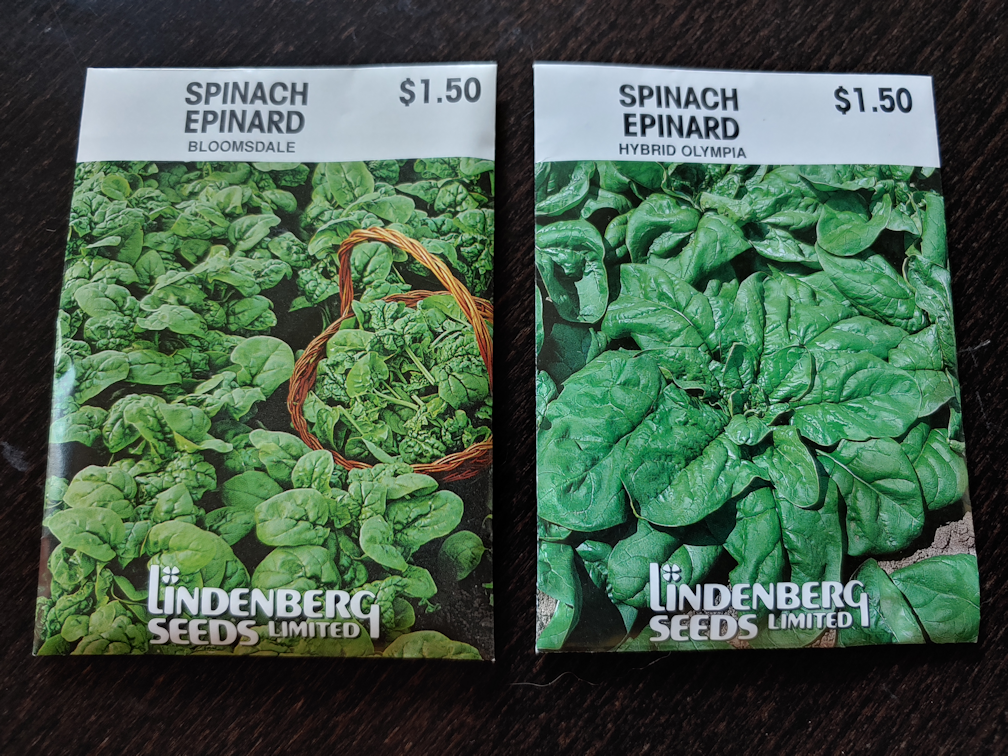
They have a small seed display from Lindenberg Seeds Ltd, and I ended up picking up a couple of packets.
The spinach we planted in the high raised bed is doing well. The spinach we planted in the low raised beds, not so well. In fact, they’re barely there. I can’t tell if they’ve been eaten by insects, or if it was just too wet for them. I know they haven’t been eaten by critters, because the beds have onions planted around them, and if anything had gone through, the onions would be flattened in places. They care completely undisturbed.
We do have seeds from one variety of spinach left, if I remember correctly, but I decided to pick up two more. Bloomsdale and Hybrid Olympia. It’s getting too for spinach now, though. These will be planted at the end of July/early August for a fall harvest. Hopefully, we will have generous quantities like we had last year, that we can dehydrate for later use. It was very handy to be able to add a spoonful of dry spinach to dishes every now and then. We’ve been out for a while, though, and I miss it!
Spinach is definitely one of our favourite greens, for all of us.
My morning rounds are taking longer, as I am able to do more in the various garden beds as I go along.
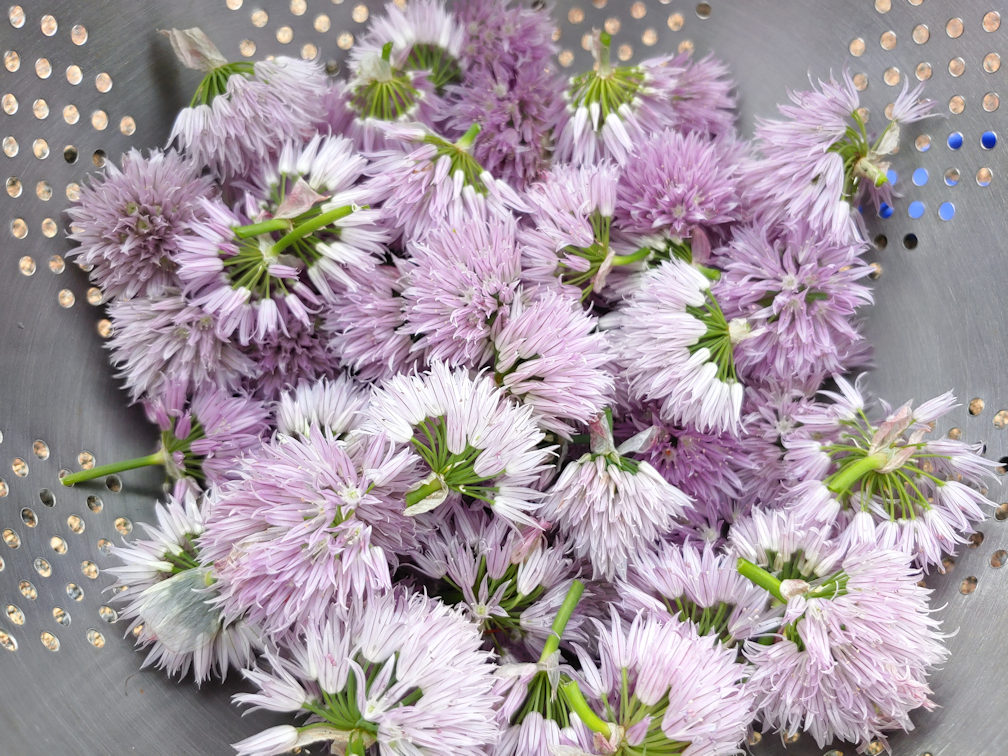
I harvested the largest of the chive blossoms, before they go to seed. While I continued with my morning rounds, one of my daughters washed and de-bugged them, then laid them out on a cooling rack in a baking tray to dry. They are in the oven, with no heat at all, to protect them from the cats. Once the wash water is dried off, we’ll stick as much of them in a jar as we can, with olive oil. Any extras will go in the freezer. Or maybe I should split them into two jars and use them all. There are more chive blossoms to harvest later on, so we’ll have plenty to infuse in vinegar, too.
Speaking of drying things, during the night that cats did manage to get at the stacked screens of drying mint leaves. We’ve lost about 2 screen’s worth of mint leaves to the floor. :-(
When I moved on from the old kitchen garden to check on the squash patch, I noticed one of the giant pumpkins was no longer upright. I thought it might be because it had grown large enough to start leaning over, but I was wrong.
The stem is broken, right at ground level. Possibly from the high winds we’ve been having. Or…
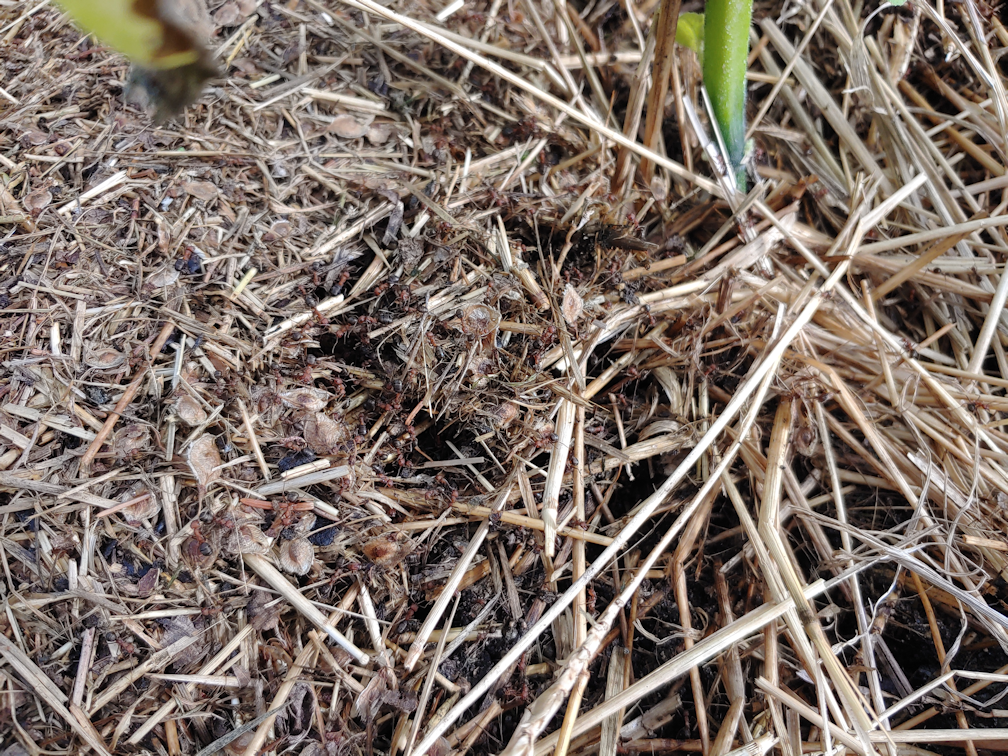
Possibly weakened by the ant hill that has formed on that side of the pumpkin mound!
I built soil up around to support the stem again, in the off chance that it will survive, but with a break that large, I don’t expect it to. We are likely down to just one giant pumpkin plant.
Everything else in the squash patch seems to be surviving so far, and I’m seeing new growth in most. The squash that were started at 4 weeks are so very small, though. I kinda feel like maybe we should have started them at 6 weeks.
I had a very pleasant surprise in the tomato patch nearby, though!
Of course, the camera on my phone didn’t focus where I wanted it to. :-D
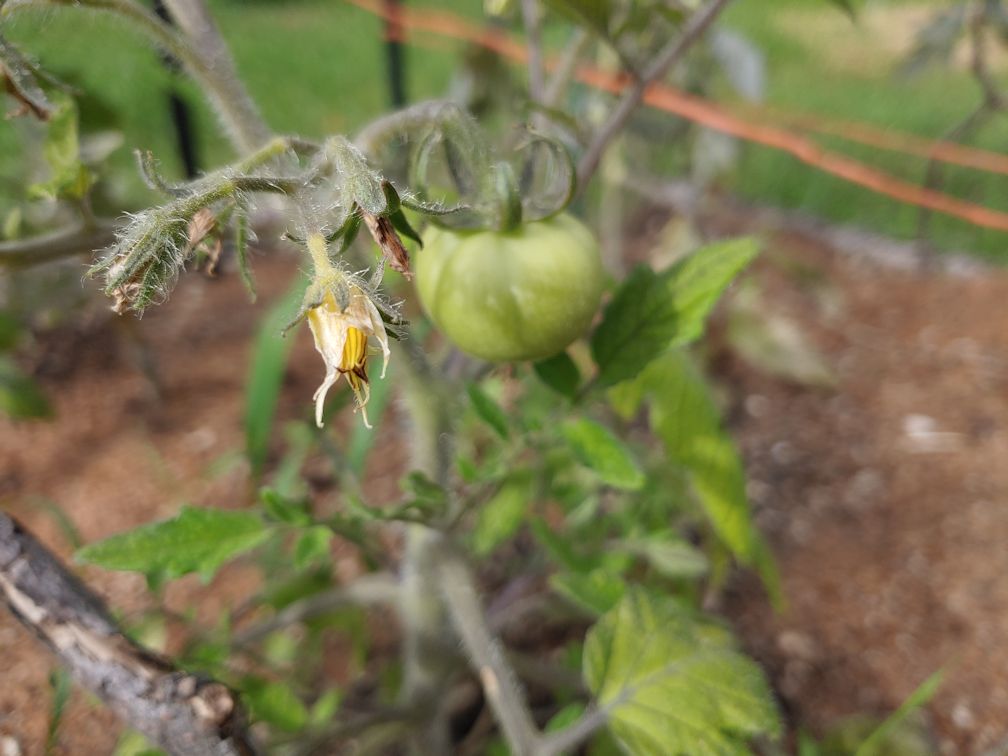
We have our first tomatoes forming!
These are on the Sophie’s Choice tomato plants. We got these seeds as a freebie with my order from Heritage Harvest, which was a very pleasant surprise. They have a much shorter growing season, and were started indoors at around 10 weeks or something (it’s a good thing I am using the blog as a gardening journal to record the details, because I’m already forgetting!). So I am not surprised that these are the first to start forming fruit.
We did get some rain last night, but it was light enough that much of the water in the garden was able to get absorbed by the soil, and the paths are just really wet, instead of big puddles of water. That meant I could finally do some much needed weeding in the summer squash bed, then pruning of tomatoes.
I took some of the strongest, healthiest looking branches that I pruned off the Sophie’s Choice tomatoes and transplanted them in the open spaces between the summer squash. I don’t know if I’m breaching any companion planting rules here (do tomatoes and squash go well together?), but whatever. If they take, great. If not, that’s okay, too. I specifically wanted to propagate more Sophie’s Choice tomatoes, as they are listed as extremely rare, so if I can save seed and help keep the variety going, that would be a good thing. Because they start producing so much faster than the other varieties we have, I’m not as concerned about cross pollination.
While I was weeding and tending different parts of the garden, I had Rolando Moon hanging out and keeping me company. Not wanting attention. Just being nearby.
I had to chase her out of one of the sweet potato bags, as she decided to start rolling in it! Then she jumped up into the high raised bed and lay down on some onions. THEN, she moved into the squash and corn patch, and sat on some corn seedlings!
That cat seems determined to be destructive!
Meanwhile…
The tomatoes are not the only things blooming. Two of the Styrian hulless pumpkins have suddenly burst into bloom, and they are all covered with buds again. Their first buds had been pruned away when they were transplanted. They look to still be all male flowers. I’m debating whether these flowers should be pruned away, too, so more energy can go to the plants establishing themselves more. It hasn’t been that long since they were transplanted, after all.
Anyone out there know if it would be helpful to prune the flowers off now or not?
The beans and peas at the trellises and bean tunnel are looking quite good. The cucumbers seem more touch and go. The first peas that were planted are getting quite large, and the snap peas are already large enough that some have latched onto the vertical trellis strings already. The snap peas are growing noticeably faster than the pod peas.
There is a single, out of place pea plant that showed up, right near the upright post at the start of the row. It seems to be a pea from last year that finally germinated! It germinated quite a bit earlier than the others, and I’m trying to train it up the support post, since it’s too far from the vertical lines to climb. Last year, we planted the King Tut purple peas here, so that’s what this one would be. It’s even almost as large as the purple peas we started indoors from saved seed, and transplanted against the chain link fence to climb. They are all tall enough that they’ve attached themselves to the fence and are making their way upwards, even though they are still looking kinda spindly.
The Wonderberries have been ripening, though the plants haven’t really gotten any bigger, and have what looks like weather damage. I’ve been able to taste them. They are lightly sweet, but don’t have any predominant flavour. This may be something we just leave for the birds. I’ll have to get the girls to try them, too, and see if they like them. I don’t mind them self seeding in this location, as I’d rather have the berry bushes that produce food, either for us or for the birds, than the invasive flowers.
In other things, my plans for the day have had to change. My sister never made it out to my mother’s yesterday, because my mother told her it was “too soon” to start packing and bagging things in preparation for her apartment being sprayed for bed bugs. She has a shift today, so that’s out. My brother, meanwhile, is out of town for a funeral that had been delayed until now by the lockdowns. So it looks like I’ll likely have to go to my mother’s to help out. I’ll phone her, first, once I’m sure she is back from church. My sister will be able to come out tomorrow morning, and I hope to come out in the early afternoon for the last of the packing and bagging, and moving of larger items. Then she’s back the next morning to bring our mother to her place for the night. I’ll head over in the early evening to check on the place and make sure it’s locked up while my mother is gone.
On Tuesday, I should be heading into the city for the first half of our monthly shopping, too. I will time it so I can check her place on my way home.
Which means I’ll be getting very little accomplished at home over the next few days!
After a few hours of waiting, things dried up enough that I could do some much needed weed whacking in the garden.
Most of the yard still squelches when we walk through the grass – grass that is getting so tall, it’s actually hard to walk through! Not only are all the dandelions gone to seed, but the grass is going to seed, too!
The first place to work on was the large squash patch.
I’m not happy with how much shade some of them are getting. They get full sun early in the morning, though, so with the total hours of sunlight, it should be okay. It’s a shame my parents planted more trees on the south side of the garden. I’ve since learned my brother got them those trees to add to the shelter belt in the outer yard, but my parents didn’t want to go out that far. Now, the shadows are covering more than half of the old garden area on this side. :-(
Some of the squash seedlings are still so small, they could not be easily seen through the overgrown grass and weeds. I used taller sticks and stakes to mark the corners, then smaller sticks to mark the smaller squash. Then I went ahead and added sticks to all of them, with pairs of sticks to support the larger squash so they’d be out of the grass. In the end, I added a pair of sticks to all but the gourds with the tall metal support stakes, as much to protect them from accidental weed whacking as to mark where they were. I trimmed right down to the ground as much as I could. I am glad to get this done before adding the straw mulch. I really didn’t want to add it on top of the overgrown crab grass and weeds.
Then, since I was there with the weed trimmer anyhow, I kept working around all the beds and the straw mulch where the potatoes and melons are planted. I didn’t need to trim around where the other squash, corn and beans are planted, since that area got done in preparation for planting.
I had grabbed the second 100 ft extension cord from the garage, so with about 250 ft of extension cord, and judicious placement of a spade to make sure the cord didn’t drag across the squash and corn patch, I was able to reach the bean tunnel.
The bean tunnel got a thorough trimming before I moved on to the hulless pumpkins. For these, I decided to give them three support poles each. These poles were used to support summer squash last year, and some still had the twist tie wire that was used to fix the stems to the poles. Those were used to go around the three poles and hold the vines off the ground and protect them from the weed trimmer. I also had some left over sifted garden soil in the wheelbarrow, so I added that around the bases of the support poles to help hold them in place, being careful not to go too close to the stems. I didn’t want to bury the stems, as that could cause the stems to rot.
These pumpkins are now ready for a mulch, too.
I stopped at this point, as I wanted to get to the post office before it closed, then go on into town. I want to use the weed trimmer around the trellises and, if I can reach, around the sea buckthorn and silver buffalo berry. That will be a job for after the squash patches are mulched.
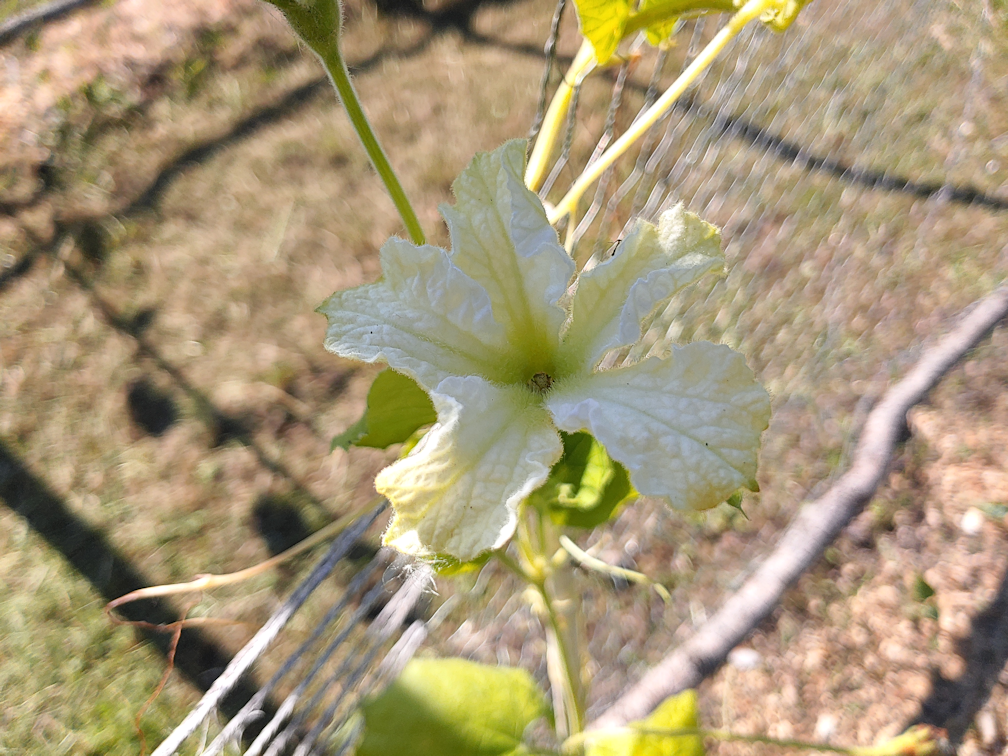
The canteen gourds are blooming! I probably should have pinched off the flower buds when I transplanted them, as they haven’t really gotten any bigger, but I forgot. We shall see how they do. Their flowers are very pretty!
We are starting to get weather advisories and heat warnings for the weekend. Tomorrow, we’re supposed to approach 30C/86F, and the day after – Father’s Day – we’re supposed to reach the mid-30’s (35C is 85F). While I was working on the bean tunnel, the thermometer there was already reading 30C in the sun. Which means the best time to get the mulch down will be early tomorrow morning, while it is still cooler.
Going to bed early tonight would be a good idea! Hopefully, the cats will even let me sleep… :-/
Yes!! It’s done! I can now officially say, we have finished spring planting and transplanting everything! Whether we do a fall planting or not, we’ll decide on later, but right now, everything that will be growing this year is in.
Not that the work is done, but the focus gets to change, and the pressure to get it all in, in time, is gone.
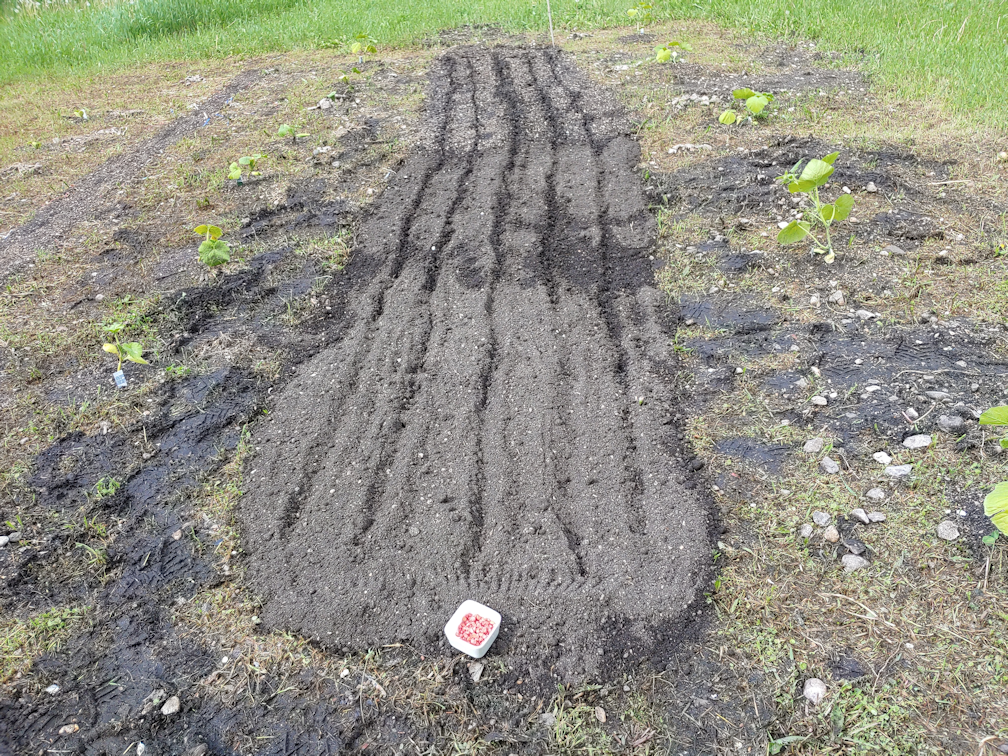
The first thing to get done was finish the bed for the last of the corn and beans.
It took another 3 1/2 wheelbarrow loads of soil to top of the rest of the bed. You can really see the difference between what we laid down earlier, and got rained on. I’d taken out the rest of the sod divots, but we still need to gather the rocks.
The bowl in the photo is holding some of the inoculated Latte bi-colour corn seeds. It came as a pack of 200, but that’s less than half the pack, and some went back into the bag. The corn was planted in the three rows in the middle, that are marked off. The plan was to have bush beans on either side, but we only had enough of the Lewis green beans from last year to fill the one side.
The only other beans we had were pole beans, so we left the last row.
Also, I’ve run out of labels that won’t fade in the sun. It’s a good thing I’m using this blog as a gardening journal! :-D
Now, all that’s left here is to mulch the area with straw.
I then decided to go ahead and transplant the Yakteen gourd. The were 4 sprouts in one pot, while the other two pots still had nothing!
The largest plant went into an empty spot in a row of cantaloupe type melons (one of the grocery store melons we saved seeds from), because one of the seedlings withered and died before we could transplant them.
The two smallest seedlings were planted together. Here, they are in a pair of empty spots in one of the rows of Kaho watermelon. The seeds in those spots never germinated, so the space is being used for the gourds.
It feels so good to be all done planting!
Which meant it was time to work on other things…
One of the low raised beds did not have supports of netting yet, so I dug out the rest of the bamboo stakes in the garden shed and use the unbroken ones. This bed has all summer squash, and it not something I expect we’ll need to cover for any reason, so we just need supports to put netting around it, if we need to. Last year, the groundhogs were enjoying themselves some squash, but nothing was bothering the plants, so if we need to put netting around them, it wont be until they are quite a bit larger.
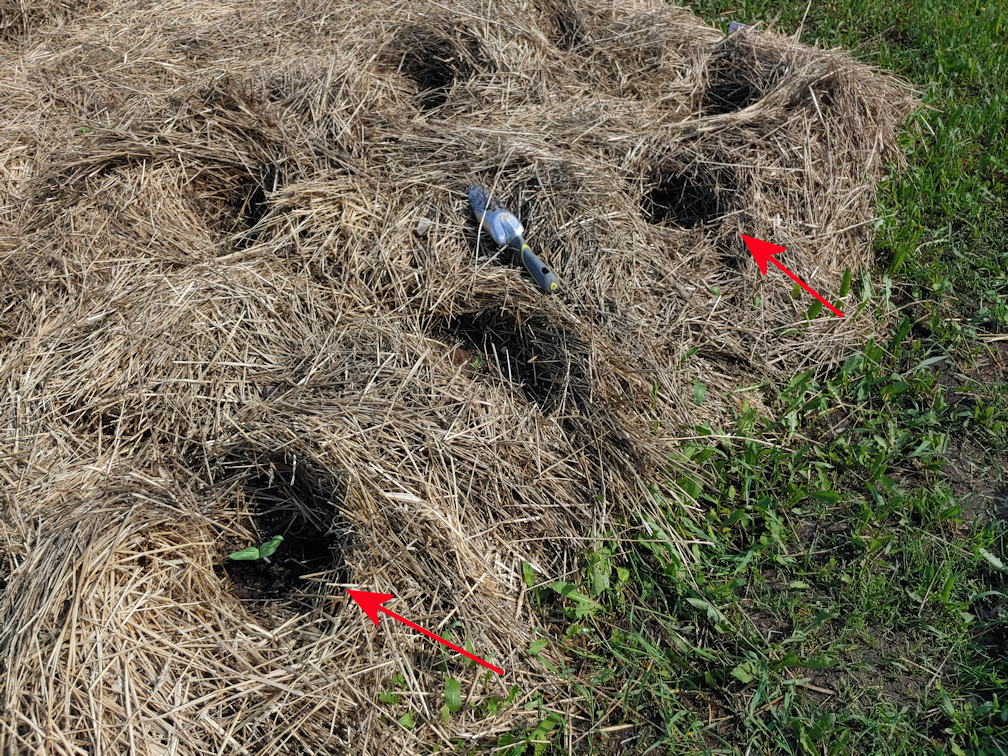
In the low raised beds with the upright supports, it didn’t have the twine strung around yet. Because of the logs, the spacing was really off. I ended up grabbing a couple of sticks, which the arrows are pointing to, to fill in the gaps.
The hoops in the background got a couple of bamboo stakes tied across the tops.
Now, all of these beds have supports on them, whether for netting or shade cloth or whatever we need.
I think we’ll take a bit of a break and let things dry up a bit. I’d still like to take the weed washer into the larger squash bed before we lay the straw mulch down.
Then we need to put the A frame supports at the two trellises beyond the bean tunnel, for the cucumbers, peas and more pole beans, as well as mulch the hulless pumpkins that got planted out there, too.
I’d be excited for the progress, but I’m just too tired. I’ve been pushing my limits a lot, lately, and it’s catching up with me. A bit of a breather, and I should be back up to snuff in no time.
She says, optimistically… ;-)
On top of this, it’s been a busy phone day. My husband had a phone appointment with the doctor to talk about his lab results, and a slight change to one of his medications because of it. Then my husband made another phone appointment… for me! I was outside, weeding, when the call came, so he sent me messages to let me know, but with muddy hands, even if I get the notifications, I can’t check my phone until I’ve washed my hands. It’s a good thing I came in when I did! The appointment was to talk about my own lab results, but first I got a call from home care to talk about my mother. The guy then called my mother and booked an appointment for and assessment next week, which he has asked me to be at. Then he called me back with the appointment time – and a concern. Because of her bed bugs, he’s going to have to be wearing the appropriate PPE, but they wouldn’t consider even doing an assessment if the potential client wasn’t going to do anything about their bed bugs. My mother told him she didn’t have an appointment, because when they asked (who? when?) in her building, who had noticed bed bugs in their units, she didn’t say anything – because she didn’t want to bother anybody!
*sigh*
I explained to him what my brother had done, and that it’s being arranged by schedule. I ended up getting the name of the site manager for her town, which I was able to pass on to my brother.
Then I had my telephone appointment with the clinic, which was basically to tell me nothing has changed. I consistently have one reading that is “on the high side”, but still within normal, so they want to keep an eye on it. All because, back in 2005 or 2006, I took a short term medication with a side effect the doctor wanted to monitor for the duration. Ever since then, everyone’s misunderstood why that was on my file.
One of the other things I did was send an email to the company I ordered the shed from. I asked a couple of questions about the amount charges and what shipping company would be used. Mostly, I’m feeling the waters to see what kind of response I get. Given the time frame for when we’re supposed to receive the boxes, if I don’t get a response soon, I will assume they are not legit and cancel the order and ask for my money back. The problem is that, in looking them up, I’ve found both that they are a scam site, and that they are not the best, but not fake, either.
The rain held off this afternoon, so I headed out to where we finally decided to transplant the ground cherries.
After thoroughly dousing myself with mosquito repellant!!
This spot by the compost heap has been covered with that sheet of metal for about 2 years. The metal was placed there as something to put grass clippings on top of, so they’d be easier to collect and use later on.
Isn’t it amazing that, even while under metal, things were still trying to grow under there? !!
The soil was so soft under there, I could easily push the garden fork deeper than the length of the tines, and probably could have gone deeper if I’d wanted to. The ground was also pretty saturated, so it was muddy work to loosen the soil and pull out any roots – including some thoroughly rotted roots from the old tree stump under the compost pile nearby! No watering needed after they were planted, that’s for sure. In fact, I’m a bit concerned it might be too wet for them. We shall see.
The groundcherries got a good mulch with some of the grass clippings I had to move off the sheet of metal in order to move it. Here, they can be left to self seed, and hopefully we’ll get them year after year. We’ll just have to make sure they don’t spread too far and become invasive, which I’ve heard some people have had problems with.
The sheet of metal, meanwhile, is now sitting on top of the tall grass and weeds next to the ground cherries, weighted down with rocks to keep it from blowing away. Hopefully, it will help keep the crab grass and other weeds from invading the ground cherries.
When my daughter came out to help, we went looking through all the garden beds, talking about what needed to be done in each, before she started working on where we decided to plant our corn.
First, she dug a fairly narrow trench for the Tom Thumb popcorn, between the green patty pans and the Boston Marrow. These have a slightly longer growing season – 85-90 days – so we wanted to get them in first.
After she dug the small trench, she moved to the space between the Boston Marrow and the Lady Godiva pumpkins. There’s more space there, and it’s where we will be planting the Latte corn, which needs only 65 days to maturity, and bush beans.
While she worked on that trench, I used the hand cultivator to loosen up the smaller trench, pulled out the bigger rocks, and as many weed roots as I could. Then it got a layer of shredded paper, and finally a about 1 1/2 wheelbarrow loads of garden soil was added. I also removed the divots of sod and dumped them under some trees. They are so full of roots and rocks, it wasn’t worth the time to try and salvage any of the soil.
The Tom Thumb popcorn only grows to about 4 feet. The instructions said to plant them 5 or 6 inches apart, and in rows 36 inches apart, in blocks of at least 4 rows.
Obviously, we didn’t do that.
What we did do was plant two rows, with all the seeds about 6 inches apart. Once the soil was ready, my daughter had finished removing sod in the other area, so I just went down the prepared row, poking pairs of holes into the soil while my daughter went along behind me, dropping the little bitty corn seeds in! :-)
I’m glad we got those planted, because the next job was a killer.
In the second space, I went over it with the hand cultivator to get some of the bigger rocks out, and the more obvious roots. There’s just no way we could get rid of all the roots. While I worked on that, my daughter used one of the old, busted up wheelbarrows to get grass clippings. A full recycling bag of shredded paper went into the bottom, then grass clippings got scattered over the paper.
After dumping the remaining soil in the wheelbarrow in, my daughter went to get more soil with the good wheelbarrow, while I used the old one to remove the divots of sod.
I was reminded of just how badly broken up that old thing was! I’m amazed we got away with using it for as long as we did. In the end, I had to switch to the other old wheelbarrow. It’s smaller and also busted up, but at least it didn’t try to tip over every time I dropped a piece of sod in it, or roll away!
After a while, however, my daughter was waving the white flag. It was pretty hot, and very humid. For all the bug spray we used, we were just sweating it right off. The mosquitoes were after my daughter more than me (I reapplied bug spray, several times!), and after all the back breaking labour of removing sod, she was just done.
After she escaped the clouds of mosquitoes, I managed to move some more of the sod – using the good wheelbarrow! – before switching to getting a couple more loads of soil, and that was it. I surrendered, too! I think we did manage to get half of the area covered with fresh garden soil. The other half will probably need at least 4 – 6 more loads of soil, depending on how full the wheelbarrow is. It’s a fair distance to haul the soil from the pile in the outer yard, and we have to go around through the smaller person gate, rather than the closer vehicle gate, because there’s water there again, so we can’t get away with over filling it.
It’s a good thing the Latte corn and the bush beans we will be planting with them don’t need a lot of time to grow, because we probably won’t be able to work on this area tomorrow, and not just because I’m driving my mother to another medical appointment. We’re supposed to start raining again tonight, with thunderstorms over the next two days – complete with overland flow flooding alerts! I’ll be using my mother’s car to drive her. Hopefully, that one patch on the road near our place will stay solid enough by the time I am coming home, that her little car will get through. Anyhow; with the expected weather, we might not be able to finish this area and plant the Latte corn for several days.
By the time we’re done in this area, it will be quite intensely planted. Between that and the straw mulch we intend to add, I’m hoping that should keep the weeds down. Before that gets done, we’ll have to remove the rest of the sod and the piles of rocks scattered about.
It would have been much easier if we could do the carboard and straw like we did for the potato beds, but we just don’t have the carboard for that. We could get more later on, but we really wanted to get these in as quickly as possible. This will be the last direct sown seeds, besides any successive sowing we might do for a fall harvest.
This is also about as close as we’re getting to the “three sisters” method of planting. Hopefully, doing it this way will have the same benefits as the more traditional way. The only real problem I foresee is being able to access the bush beans to harvest them, when everything is all grown in. If we focus on putting the corn in the middle and the beans on the outside, we should be able to reach them okay. It’ll be trying to walk around the Boston Marrow and hulless pumpkins that will be more of a challenge, I think! With the Tom Thumb corn, it will be less of an issue, since they won’t be harvested until the cobs are completely dry on the stalk. Once the mulch is down, there’s not going to be much more needed for them.
If nothing else, this will be a learning experience.
And an experience in humility, as we get driven away by hoards of mosquitoes, trying to eat us alive!
I’m now going to go borrow my husband’s bath chair and shower off the smell of insect repellant now!
The squash bed prepared by my daughter has been filled!
Some things went in some odd configurations. It’s going to take some doing to remember everything, even with the labels.
In my previous post, I’d stopped for a break after getting the Kakai hulless pumpkins, and the Crespo squash, started in the squash bed. As expected, the rest went much faster.
I’m so tired right now, I’m not sure I’m going to remember everything I planted in here at all! :-D
At this corner, the four Endeavor green zucchini got transplanted, running parallel to the low raised bed. This way, they will be easily accessible for harvesting throughout the summer.
There was a bit of space at the end of the row the green zucchini was planted in, so a couple of Teddy winter squash were planted there, and the remaining 6 were planted in a block in the next couple of rows. The Teddy squash has a growing habit similar to zucchini, so I wanted to make sure they were near the path, so we shouldn’t have too much trouble getting by while tending the low raised bed, or the green zucchini.
Next to the Kakai hulless pumpkin, I planted the Baby Pam pumpkins. There was six of them, planted in a 3 x 2 block. These are a smaller pumpkin that are supposed to be excellent for pies.
The poles are with the Apple gourds. I can’t remember if they’re climbers or not, but they are the only gourds in this bed, so I wanted to make them easy to spot.
I know we had some Ozark Nest Egg gourd seedlings, but as I planted them, I got a closer look and it does seem the are all Apple gourds. I don’t remember the Ozark seedlings dying off; if I had noticed, I would have tried planting more! I have no idea what happened to them.
Fit into the remaining spaces are the Georgia Candy Roaster and Winter Sweet.
Of the 7 x 7 grid my daughter dug, I did not plant anything in the south row, as it was too far into the shade. So this squash bed has been planted in a 7 x 6 grid.
The next step will be to mulch this area with straw. There had been thunderstorms forecasted, but now they’re just saying showers – those storm predictions keep going away! Still, we want to make sure the mulch is down as soon as possible.
If I can, though, I’ll see if I can get in with the weed trimmer first. It’ll be more difficult, now that the seedlings are planted, but it will make a big difference later in the season.
There were still seedlings to be transplanted, however. Which means a whole new section needed to be claimed. We were hitting 25C/77F, though, so I went back inside to take a hydration break, though I ended up making a dash to the store to pick up more bug spray. I’d just bought some, and we were already running out. They didn’t have a lot of options – normally we get something that will repel ticks, too, but there was none available. Still, with how fast we’ve been going through them, I got two.
For the rest of the transplants, I decided to start transplanting here.
In this area next to the potatoes, the grass I’d cut was growing back faster that the squash bed I’d just finished planting in, so I couldn’t make do without using the weed trimmer.
I worked in sections, starting out with an area large enough to include walking paths.
I had a couple of bins of transplants already at the garden, so I started on those, first.
These are the G-Star, green patty pan squash. The plants will be more compact compared to the winter squash, and they will be more easily accessed from the path between them and the potato and melon bed. I started by digging the row of holes then, using the jet setting on the hose, drilled into the soil and into the divots to blast as much soil back into the holes as I could, while leaving the roots and rocks behind. Then each hole got a spade full of sifted garden soil, and finally the squash were transplanted.
That process was then repeated for the next row, for the Boston Marrow. There were three pots, but so many of them germinated, I was able to plant eight. Which is probably quite crowded, even though I spaced them out more, as I think these will sprawl quite a bit as they grow.
Once those were in, I went to get more transplants – and found the only squash left were both hulless pumpkins!
Oops. I’d intended to plant them further apart. I would have put the Boston Marrow in between them, if I’d thought ahead. Ah, well.
I chose to plant the Lady Godiva variety here, because there was 5 seedlings, to the other variety’s four.
The last four, the Styrian hulless pumpkins, went next to the bean tunnel. I wasn’t able to use the weed trimmer here, though. I had to add another length of extension cord, but for some reason, it just wouldn’t run. I think there’s an issue with one of the extension cord plugs.
Oh, I almost forgot!
While watering the beds out here earlier, I noticed that we now have peas sprouting! The ones my daughter planted at the finished trellis. There are 2 varieties, and both have broken ground. :-)
So here we have it! That last of the squash, gourds and pumpkins are now transplanted! As with the others, these will also need a straw mulch.
We might end up finishing off the bale, soon!
As of tonight, the only things left to transplant are the ground cherries and the Yakteen gourds. The Yakteen gourds will be filling in some gaps in other places. After talking about it with my daughter, she suggested a place for the ground cherries that I hadn’t thought of. Next to the compost ring, there’s a spot where we’ve got grass clippings sitting on top of a sheet of metal. That metal has been there for about a year now, so it should be just fine to plant into. We’ll just have to find ways to use up the grass clippings that are there! :-)
I am so glad to finally have the transplanting done! Where we’re planting them is far from ideal, but they should be fine, I think.
We still have corn to direct seed. We’ll check the days to maturity and see if we still can, or if the seeds will just have to wait until next year. There are other seeds I’d hoped to plant this year, but they will have to wait until next year. They should have been sown back when everything was flooding. There is no longer enough of a growing season left for them.
While I was working on all this, my younger daughter took care of some other jobs, including doing a burn. We haven’t been able to get the burn barrel going for a while, and it was over full of the cat litter sawdust. That meant she had to stay and tend the fire for several hours.
She had just reached the point where she could put the cover on and finally let it smolder away on its own, when I came by to the pile of garden soil for one last wheel barrow load. Previously, I’d been sifting soil from the remains of the pile near the squash bed, but what’s left of that is so full of roots, it’s not worth the effort anymore. Later in the season, we’ll break up what’s left of it and use it to level off that area which, like so many other spots around the old garden area, is really rough, making it difficult to mow.
While sifting soil into the wheel barrow from the other pile – which went so much faster, as I was able to work from an area that hadn’t been taken over by weeds, yet – my daughter and I both heard a strange sound.
Coming from the branch pile.
A teeny, tiny mewing sound!
There are still kittens in there! Well. At least one. I’ve seen the mamas taking their kittens out of there, so this may be different litter? I have no idea. It’s going to still be a while before we start seeing the moms bringing their babies to the kibble house.
We’ll have to keep our eyes out for them. :-)
So, there we are. The squash transplants are finally done!
Looking at the 14 day forecast, we’re looking at highs hovering around 20C/68F during the day, and the lows hovering around 15C/59F, which fairly regular showers throughout. Which should be just excellent for the garden! It would be so good to finally have a good growing year.
As for me, I am wiped out. A daughter has been kind enough to take care of my laundry for me, I’ve taken my pain killers, and am more than ready to go to bed!
























 The Re-Farmer