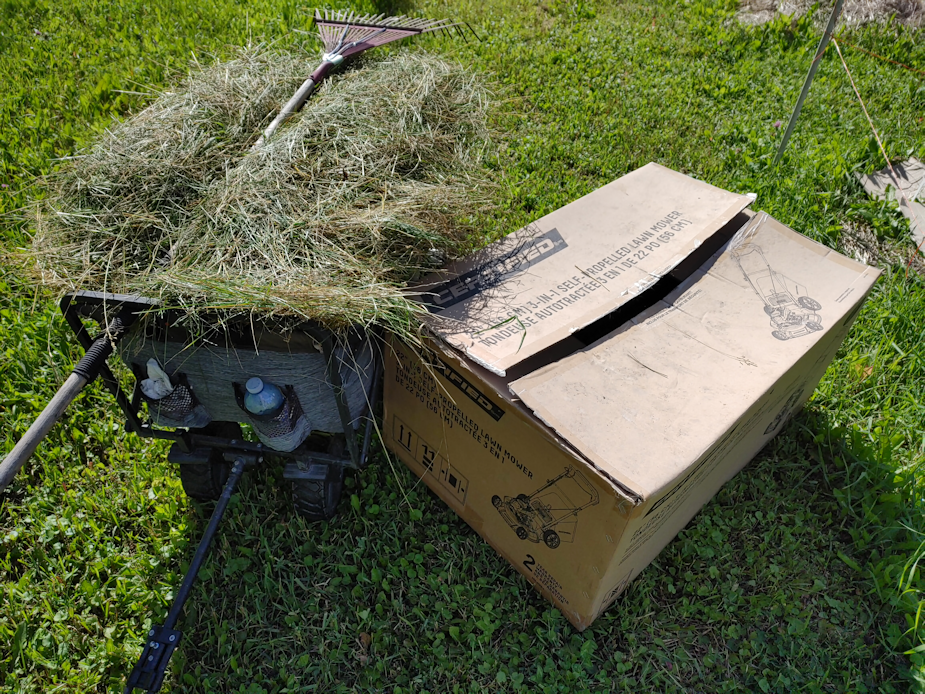
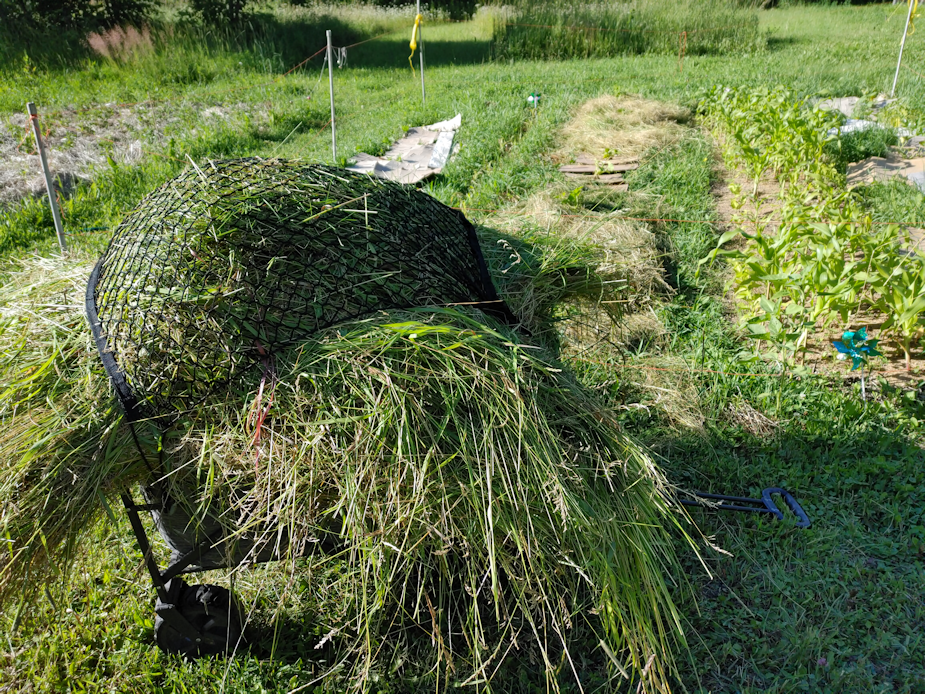
Here is the pile of grass clippings my daughters hauled over last night.
This is actually just what they raked up along the driveway, where it was thickest. There were other parts of the outer yard they hadn’t done, where the clippings were much thinner.
I didn’t even try using the bag on the lawn mower. I would have been stopping to empty it way too often. It is more efficient to just rake it up after.
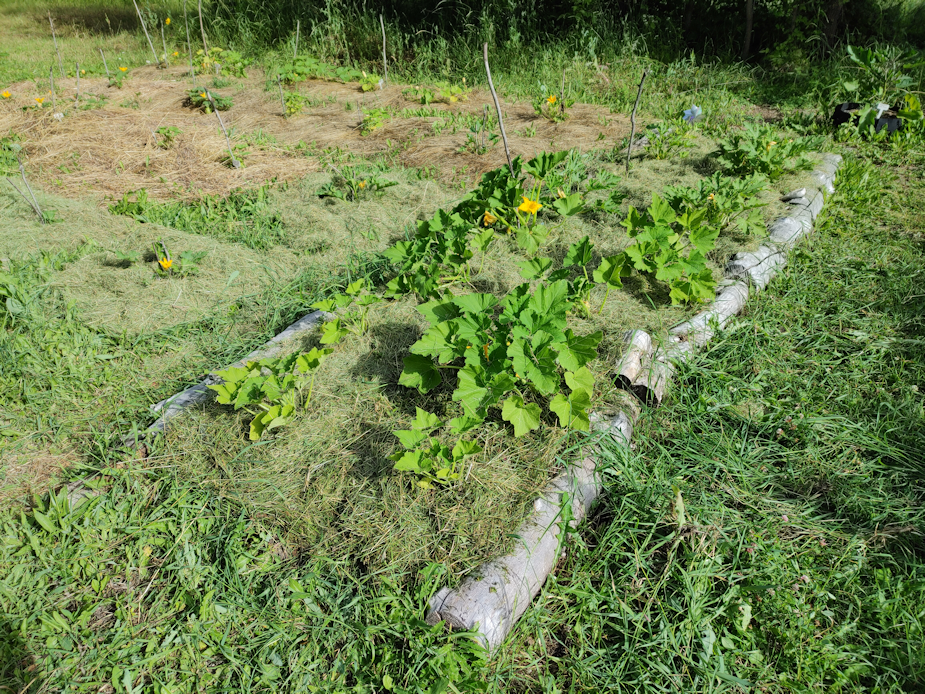
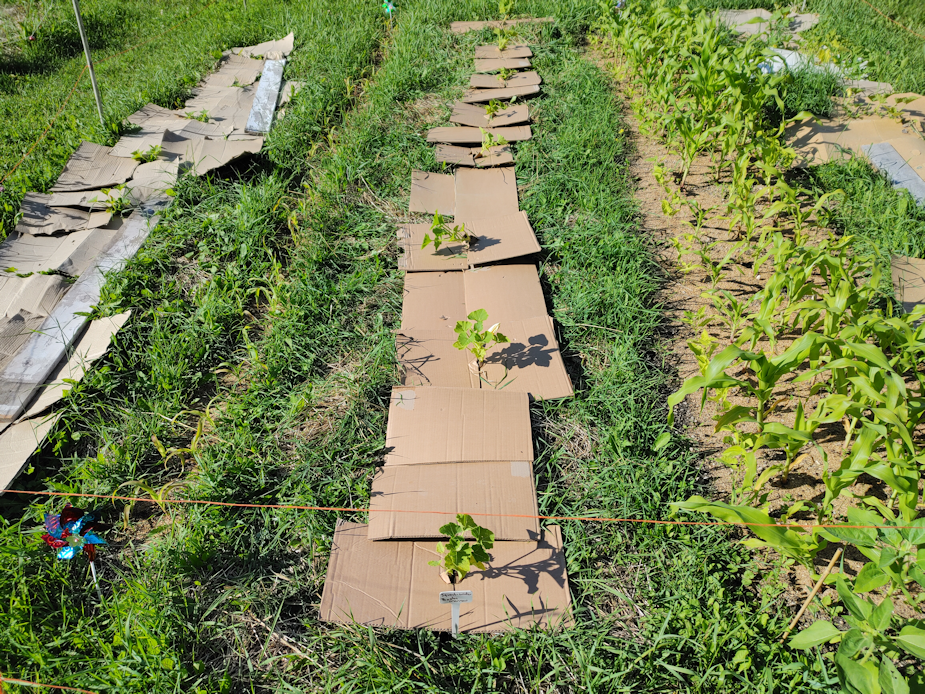
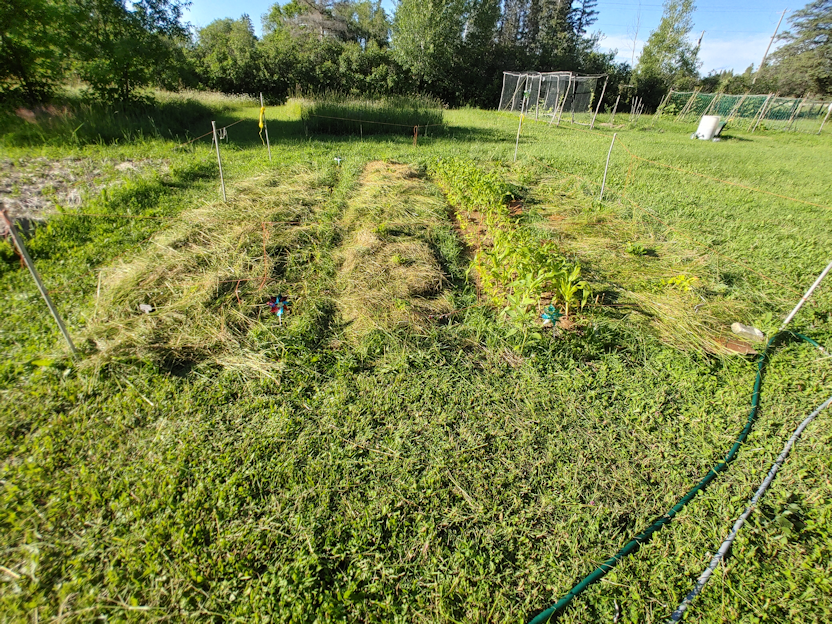
It was enough to FINALLY finish mulching the squash patch! Just on the cardboard around the plants themselves, though. As I’m able, I will continue to mulch the paths in between, to keep the grass and weeds down.
There was enough left over to mulch all but one end of the summer squash bed. Since I had continued to mow around the main garden area yesterday evening, I didn’t have to go far to rake up more clippings to finish mulching the bed.
I was also able to thoroughly mulch around the Styrian hulless pumpkins, out by the trellises.
At this point, any other mulching that gets done is bonus. The Lady Godiva hulless pumpkins could use more mulch to fill in the spaces between the plants, and I also want to mulch more around the sweet corn and green beans, as well as the popcorn, if I can. I still have more scything to do, so I should have enough to get all of that done, too.
It has been a very rough year for most of the squash. They are a fraction of the size they should be. Finally getting them all mulched should help them at least a little bit! Whether or not there is enough growing season left for them – especially the winter squash – it still in the air. Some varieties should still have time but with others, I don’t expect anything at all anymore.
That’s not going to stop me from trying to help them along, though!
While most of our garden is behind, with a few outright fails, we do have a few things doing well.
So far, we have five Red Kuri squash developing, and I just pollinated a new female flower this morning. The plants themselves are doing well in this location, growing in the chimney block planters. I really hope we will have more of these, and that there it enough growing season left before first frost. We quite liked the ripe one we were able to taste test last year.
I’m really impressed with the ground cherries! I had my doubts that they would make it after transplanting, as this spot got so incredibly wet, but survive they did, and are now wonderfully robust. The first time we tried growing ground cherries, it was in a container on our balcony. It did well, but these are doing even better. There are so many fruits forming! While watering a couple of nights ago, I noticed something light coloured on the ground that turned out to be a fallen ground cherry that had ripened faster than all the others.
I ate it.
It was delicious.
My daughters are surprised I like these so much, as they are related to tomatoes. Whatever is in fresh tomatoes that makes me gag is not in ground cherries, I guess. I find they have such a wonderful sweet-tart flavour. I don’t think the rest of the family are big fans of them. That’s okay. More for me!
Part of the reason we chose this location is because I’ve read they self seed easily. I’ve even seen it on lists other gardeners have made for “things I regret growing” because they can almost be invasive.
I just don’t see that as being a problem. I would love it if we had more! And if they fill in this area, that’s okay, too.
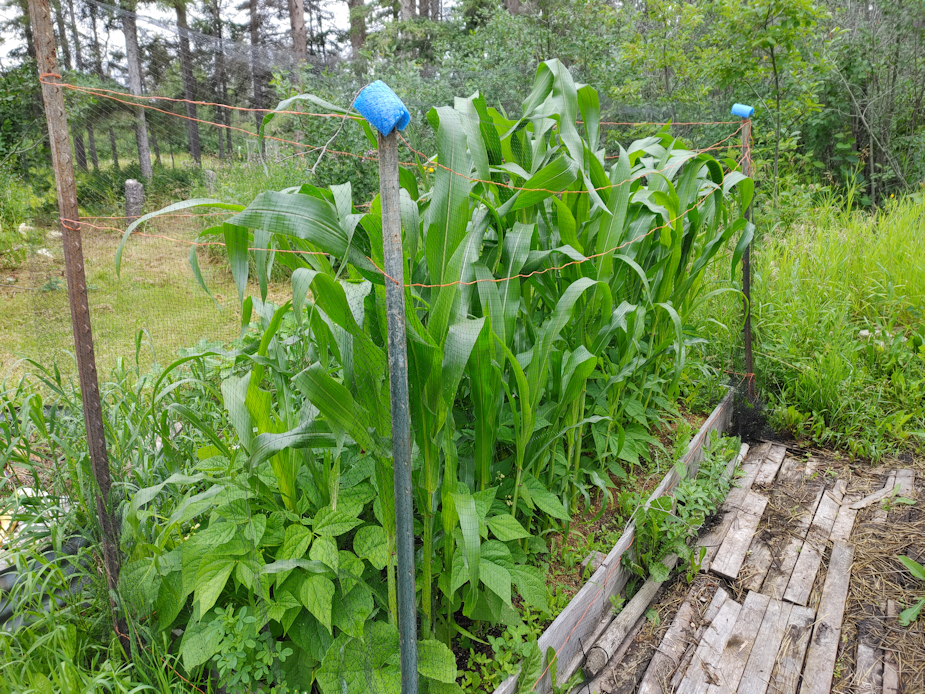
In the background, you can see the kulli corn and the yellow bush beans. Both are doing very well in that new bed. The corn took quite a while to recover from being transplanted, so I’m very happy to see how well they are growing. No sign of silks or tassels yet, though.
The Yellow Pear tomatoes, on the other side of the corn, are also doing well. The plants are much taller and fuller than the ones in the main garden. Their fruiting is not as far along, though. Which makes sense, since they were started indoors at 4 weeks before last frost, while the ones in the main garden area were started 10 weeks before last frost.
Speaking of which…
While checking to see if any suckers needs to be pruned away, I noticed one of the Cup of Moldova plants seem to be falling over, even though it was staked. Looking closer, I found the clip had come loose – and had a tomato trying to grow into it! I tried to be careful about removing the clip, but the tomato fell off in the process. The plant is now once again secured to its stake.
As for the tomato, slightly wounded and deformed by the clip, I brought it inside. It should continue ripening.
The Cup of Moldova and Sophie’s Choice tomatoes are looking quite prolific! The Sophie’s Choice plants are much shorter and stockier. One of them is so short, there is no way for me to clip it to its stake. The stake is basically just there for the plant to lean on, but the bigger the tomatoes are getting, the more it’s leaning in the other direction.
Ah, well.
We are greatly anticipating being able to start processing tomatoes. Mostly, I want to make tomato paste, which takes a long time to cook down, so we will probably do crushed tomatoes, too. Pretty much the only thing we use other than tomato paste is crushed tomatoes in chili.
I’ll have to go over how to save tomato seeds again. It’s more complicated than with other seeds. My mother had always saved seeds from her tomatoes, but she just dried them. None of that letting them ferment in water, thing! 😄 It worked for her, but my mother always did have two green thumbs!
With our average first frost date being Sept. 10, we have just over a month of growing season left. There is still time for productivity! In the end, it all comes down to the weather.
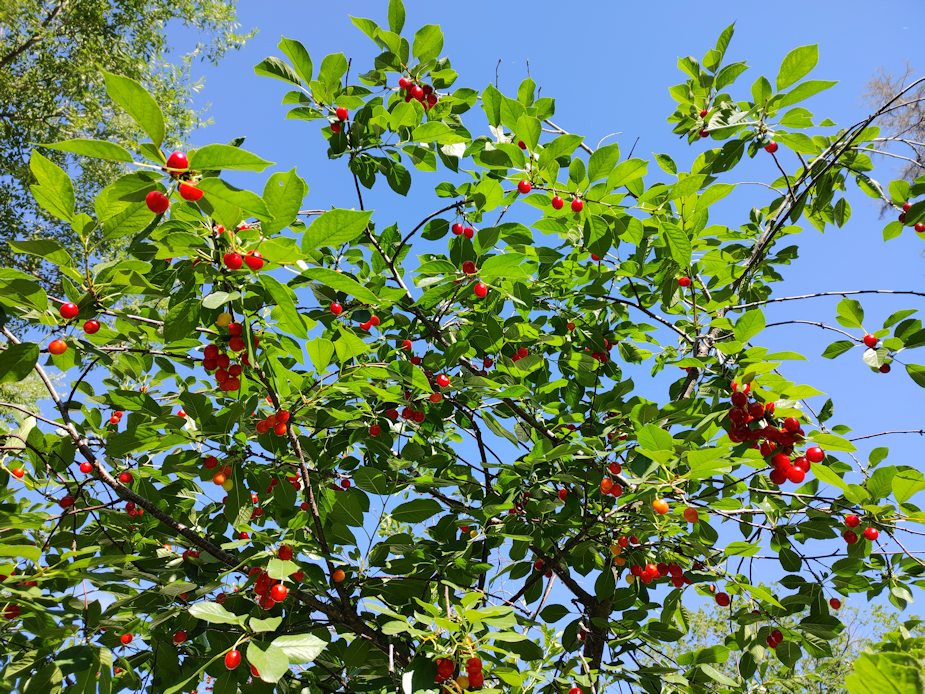
The sour cherry tree by the house has lots of ripe berries, ready to be picked. I’ll have to get the girls to do it, though. A ladder will be needed to reach the ripest ones at the top. This is the most cherries we’ve had since moving here.
We got a pretty decent amount of yellow bush beans this morning. Not enough to make it worth blanching and freezing, never mind canning, but enough for a couple of meals this time.
The purple pole beans are getting more pods, though they are still very thin. I saw the first of the green pole bean pods this morning – tiny wisps of pods! Still no sign of pods, or even flowers, on the red pole beans, while the shelling beans still have lots of flowers, but no pods that I can see.
We should be able to harvest the garlic from this bed pretty soon.
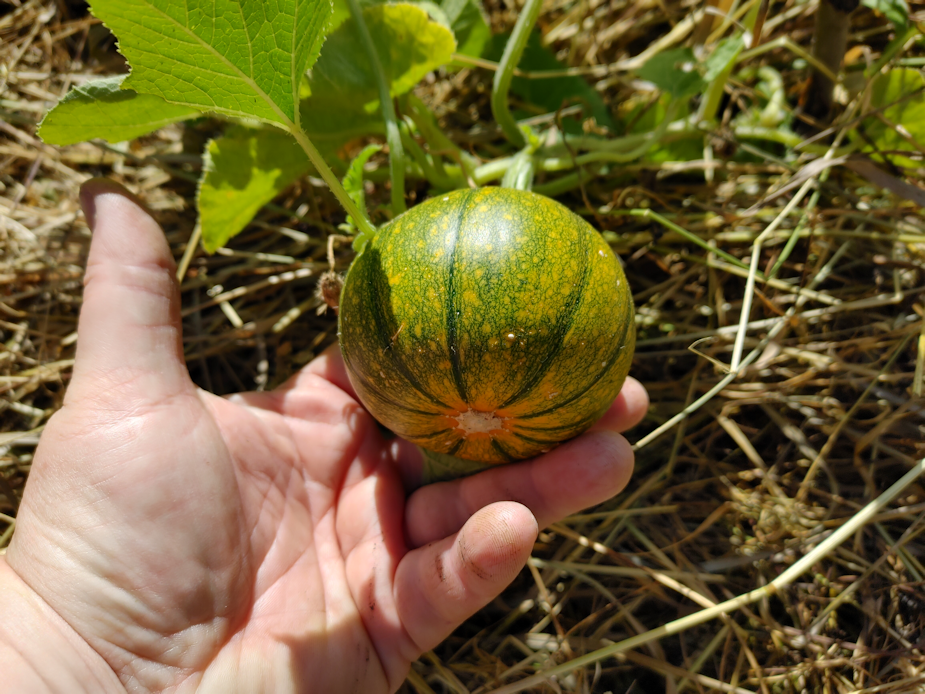
One of the Baby Pam pumpkins is starting to turn colour. This variety doesn’t get much bigger than this. From the looks of it, these are going to be the only winter squash we get out of this patch, other than maybe one kakai hulless seed pumpkin. Even the Teddy squash, which are a very small variety with only 55 days needed to maturity, will likely not get a chance to produce anything. The green zucchini still isn’t producing; they did have female flowers, but no male flowers bloomed at the same time to pollinate them. We do have some golden zucchini developing, though, and some Magda squash I should be able to pick in a few days. Maybe even a yellow pattypan squash or two.
The paste tomatoes, at least, are coming along nicely, with more of them starting to blush.
I was able to harvest more green onions from the high raised bed. Most of these will be dehydrated, and there are lots more I can harvest.
The handful of pea pods are almost all from the second planting. The first planting is, amazingly, still blooming!
Most of the onions seem to be growing well. Some of the red onions have very different shapes, and they are starting to be noticeable. I’m thinking of picking one or two for fresh eating, just to see how they taste.
The one surviving type of turnips are finally starting to have visible “shoulders”. We might actually be able to pick some, soon.
I don’t know what to make of the potatoes. They’re done blooming and we should be able to harvest young potatoes now, but I want to leave them as long as I can. The plants themselves are nowhere near as large as potato plants normally get. There was so much water in that area, I’m sure it stunted the growth of the ones that survived. I still might dig one plant up, of each variety, just to see what there is to see. Will the lack of foliage translate into a lack of potatoes, too? I was really hoping to have a good amount of potatoes to store for the winter. It certainly wouldn’t be enough to last the entire winter for the 4 of us, but it will help us decide if these are varieties we will get again or not.
Every time I’m in the garden, I’m thinking of next year’s garden. One thing is for sure. It is nowhere near big enough to meet our goal of providing sufficient amounts of food to last us until there is fresh produce again. We planted so much, with the expectation of losses, but this year the losses are just too great. Which has really surprised me. I did not expect to get less productivity this year, compared to last year’s drought. Mind you, during the drought, we were watering the garden beds every day, twice a day. This year… well, adding water is easy. Keeping water out is not. Still, even if everything had gone well, we would still probably need double the garden size to meet our long term goal. Short term is to have enough to supply our needs for at least 3 months – the hardest winter months, when we might find ourselves snowed in or the vehicles frozen.
Every year we garden, we figure things out a bit more, from what weather extremes we need to work around, to how much of anything we need to grow, to what we like enough to grow year after year. More me, half the enjoyment of gardening is analysing the results and using that information to make decisions for the next year!
That’s one good thing about having hard gardening years. You do learn more from it, than from years were everything goes smoothly.
It’s coming up on noon, and we’ve already reached out high of 27C/81F, with the humidex at 29C/84F. Usually, we don’t reach our high until about 5pm! They’re also predicting rain, though, so hopefully that includes our area, and things will cool down a bit.
Some things seem to like the heat, though.
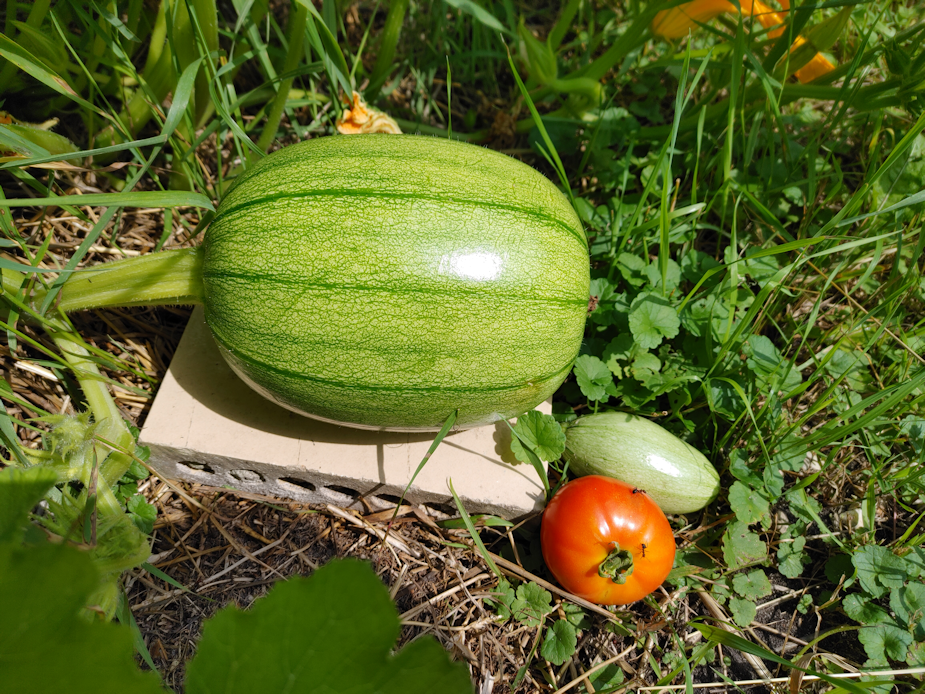
That one giant pumpkin is noticeably bigger, every day!
I put our very first tomato that I just picked, and a Magda squash, down for perspective.
Those ants were all over the tomato, immediately!
I have since placed an ant trap at the hill. The main part of the hill is next to the other giant pumpkin plant, and it’s looking like the ants are finally starting to damage it. I put traps next to two other ant hills as well. Usually, I prefer to leave them since ants are pollinators, too, but these ones have to go. There are plenty of other hills in the area, so it’s not like we’re making much of a dent in the population by doing this.
Here we have this morning’s harvest. Our very first tomato – Sophie’s Choice. I will leave the family to taste test it, since I can’t do raw tomatoes. They make me gag. Which, I’ve learned, is a thing, similar to how cilantro tastes like soap to some people, but not others!
Those pea pods are the first peas from our second planting. Remarkably, the first planting of peas is still green and trying to produce.
I didn’t pick any yellow beans tomorrow. There should be a good amount to gather tomorrow, though.
On another note, I got to pick up and pet the black and white kitten with the black splotch by its nose. I was happy to see it, since I did not see it at all, yesterday. It did not run away when I came by, and had no issues with being picked up and cuddled.
There wasn’t much of anything to harvest this morning. I picked a few shelling peas and just ate them right away. There was no point in bringing so few inside! At least with the first planting of peas. The second planting is looking like it will have a decent amount to pick fairly soon.
I really don’t know what to make of the beans at the tunnel. These are the Blue Grey Speckled Tepary shelling beans. They are so small and delicate looking. They are just barely tall enough to reach, but are managing to climb the mesh. I have no idea how big these would normally get, but for a shelling bean, I would have expected them to be at least as big as…
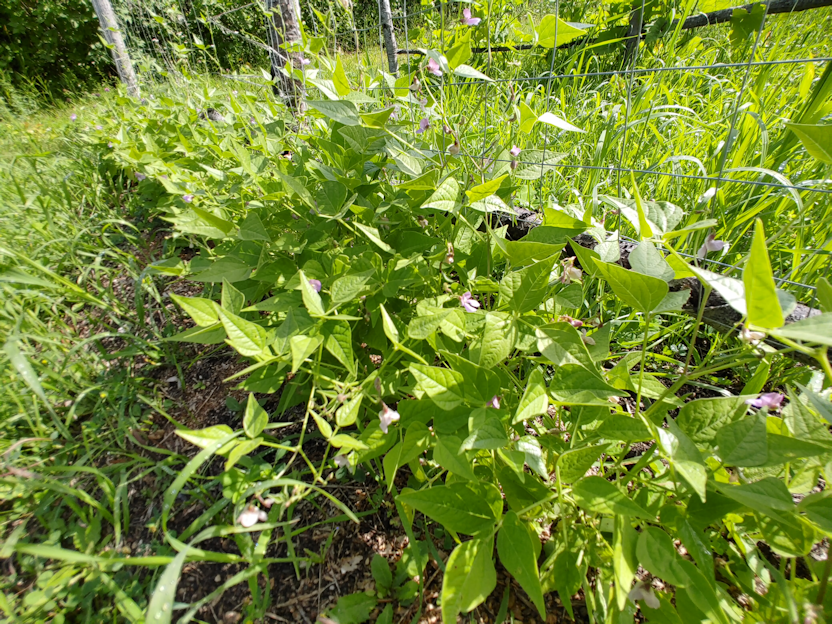
… the red noodle beans on the other side of the tunnel. These are much bigger plants, but there is still no sign of any vining happening. I’m not seeing any flowers, either. Given that it’s the start of August and our average first frost date is Sept. 10, I’m starting to wonder if we’ll get any of these at all. Even if we do get a super long, mild spring, like we did last year, I wonder if we’ll have any of these at all. At least the purple beans on the A frame trellis are blooming and producing tiny little pods, with vines extending well past the top of the trellis frame, while the green beans on the other side are climbing and blooming.
I have never grown pole beans before, but I really expected them to do better than this. This area did not get flooded out the way the bed with the green bush beans did.
Well, next year we’ll be moving the trellises closer to the house, and this area will be getting perennials planted in it. Parts of the area will need to be kept clear because of the phone line running under it, but not all of it. Hopefully, a new location for our legumes next year will be better.
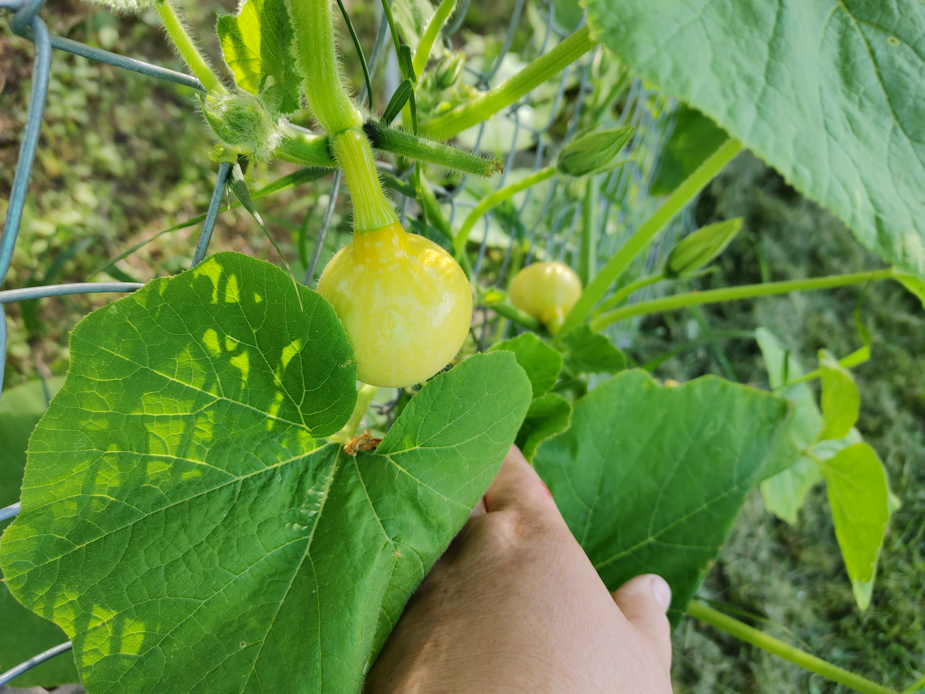
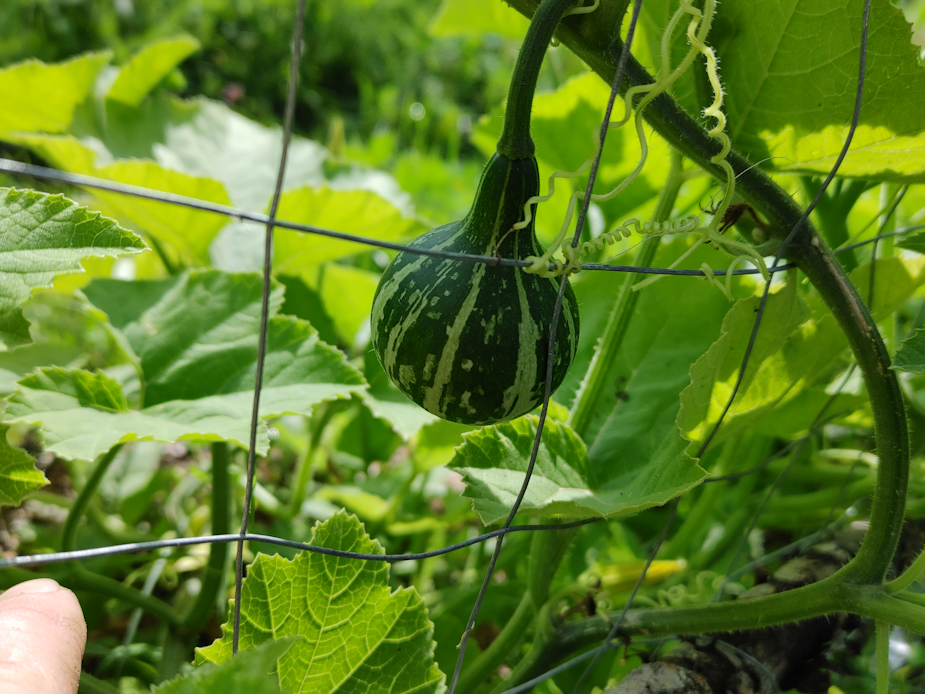
The dancing gourds are doing rather well, at least! The plants are much stronger and more vigorous this year than they were during last year’s drought. So far, there is just this one early gourd growing, though I am seeing quite a few female flowers developing. This one gourd is already bigger than the biggest we had last year. For perspective, the squares in the wire mesh are 2 inches.
In between the tunnel and the A frame trellises are some hulless pumpkins. They are the last patch without the cardboard mulch. I still had the cardboard sides from the wood chipper in the garage, so I decided to use it.
This is how it was looking. There’s an awful lot of creeping charlie making it’s way through the straw mulch around the pumpkins in the foreground. There are actually less weeds than it appears, though, just because of how they spread out.
The cardboard from the wood chipper box was very heavy duty, and had even more staples holding it together than the lawn mower box I used on the Boston Marrow. Cutting it so I could put it around the plants took some doing! Sliding the cardboard in place required quite a bit of care, too. The vines were gripping the straw and weeds quite strongly.
I placed some of the protective poles back, around the patch, and will be adding scythed hay mulch on top as I am able, but I find myself wondering if I should make a support frame for the vines to climb. I don’t know if that would actually help these or not. At the very least, I’ll be adding cord around it, to discourage deer from walking through.
There were quite a few female flowers on the vines, but I found only one male flower, so I used it to hand pollinate as many of the female flowers as were ready. While moving the vines onto the cardboard, one of them had already fallen off, because it had not been pollinated. Hopefully, the hand pollinating will help.
All three varieties of hulless pumpkin have at least some developing pumpkins. Some of summer squash is also finally picking up; the sunburst patty pans are starting to show female flowers again. The Madga squash seems to be doing the best, and we finally have yellow zucchini starting to develop. Not so much of the green zucchini, though.
At least we will have lots of the determinate tomatoes. Even the Cup of Moldova tomatoes are starting to show more of a blush in them.
If the weather holds and the frost stays away, we might still have something to harvest this fall.
This morning was our date with the vet, to get Potato Beetle, Big Rig and Tissue spayed and neutered, as arranged by the Cat Lady.
I had a chance to text with her last night, as she reminded me to have them fasting. She herself was going back to the hospital today. The poor thing has been in and out of hospital all summer, and yet she still manages to help with cats. She just brought home a couple more because they were sick, and no one else was willing/able to take care of them. She is so awesome!
She did warn me that there is a shortage of vets, and there was a possibility of cancellation. So when my phone started ringing while I was driving with the three cats, I had a sinking feeling. Of course, I couldn’t answer while driving. It started ringing again, then I suddenly started getting notification noises, one after another. *sigh*
The calls were from one of the staff from the clinic – but she was calling from home! When she couldn’t get through to me, she called the Cat Lady, and both of them were trying to text me at the same time, letting me know that the vet wasn’t coming in today. All surgeries were being cancelled.
I got all these when I parked in front of the clinic.
After responding to both of them, the lady from the clinic said she would call me when she got into the office to reschedule, then I headed home.
The cats were not happy with all this. I was concerned about Potato Beetle. He’s already been stuck in the sun room for over a week. Yes, he has cool places to lie down, and we make sure there’s a frozen water bottle in his water bowl, the ceiling fan is going, and the small box fan I found the the garage is set up. Still, it gets quite warm in there and, as much as we try to go over and pay attention to him, he’s mostly all on his own.
Thankfully, the clinic was able to reschedule us for this Friday, so tomorrow night, we do the fasting again.
Since we no longer to dash to and from town to deal with the cats, I took advantage of the change in plans and decided to do our Costco trip today, instead of next week.
But first, I had to do my morning rounds, switch out the memory cards in the trail cams, and check the garden beds.
The Carminat pole beans finally have pods forming!
The one giant pumpkin is growing so fast!
I looked around and finally saw another pumpkin forming. Just to be on the safe side, I hand pollinated it. The vines of the two plants are overlapping each other, but as far as I can tell, this one, plus another female flower I found that is still just a bud, is on the same plant as the pumpkin that’s growing so big. The second plant has lots of male flowers, but I can’t see any female flowers on it.
I’ll keep checking and, as I find them, I’ll hand pollinated them, just to be on the same side.
Which I am also doing with the Red Kuri (Little Gem) squash, in the south yard. These are doing really, really well here. I have hand pollinated several female flowers already, and I can see more budding. I’m happy that these are doing so well, because these may be the only winter squash we get this year!
The cherry tree by the house is doing well, too. This is the most we’ve seen on this tree since moving here. The other trees at the edge of the spruce grove have nothing. Being close to the house seems to be providing the microclimate it needs. I don’t know the name of this variety; only that the original tree was from Poland, which has a longer growing season than we do.
The cherries at the very top look ripe, or close to it. We’ll have to bring over the step ladder and start picking them!
Speaking of picking things…
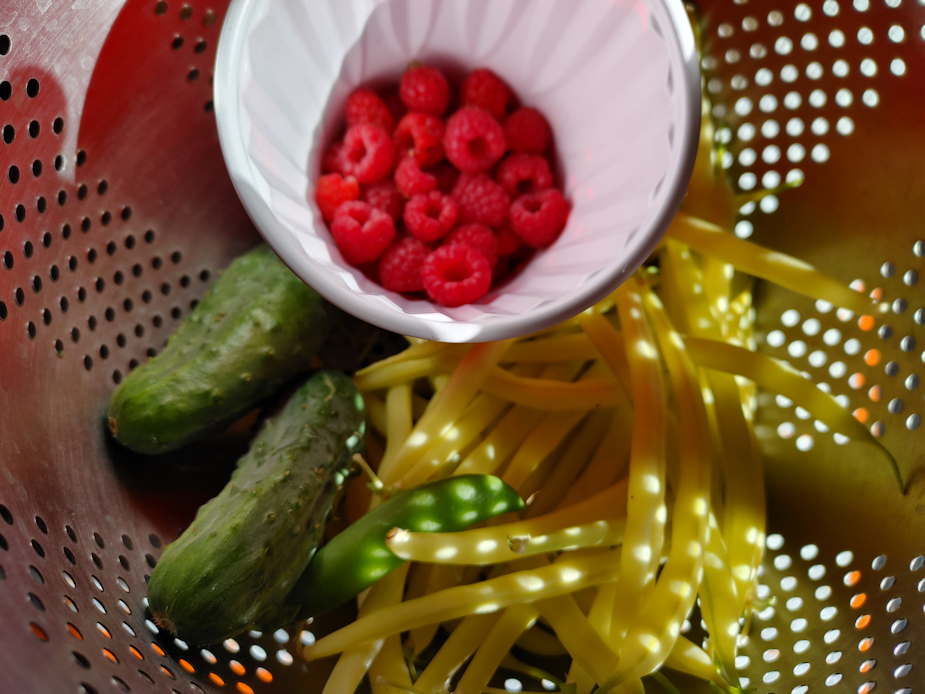
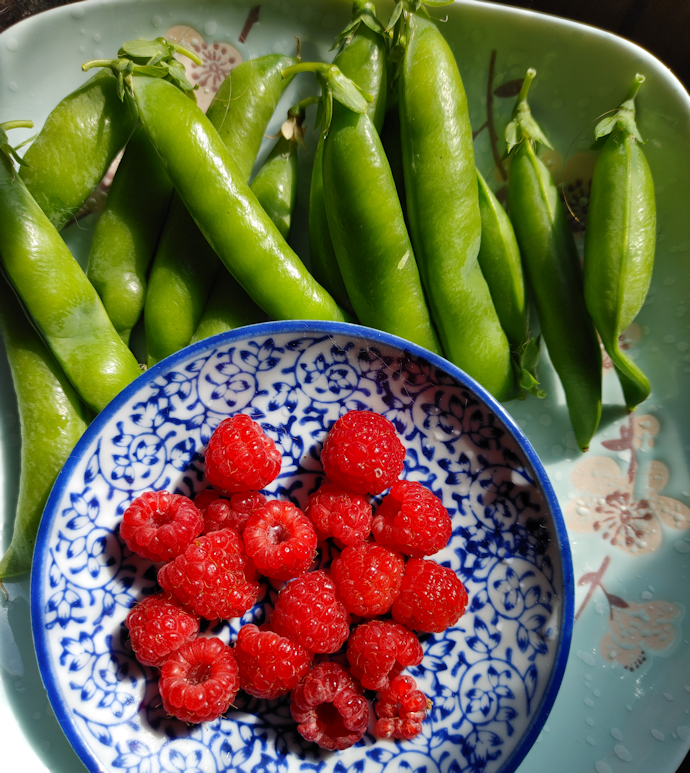
This is this morning’s harvest. Along with the bush beans, there was a single pea pod from the row that was planted first. That row is almost done, but the ones that were planted later have quite a few pods that should be ready to pick in a few more days.
I also picked our very first two cucumbers! I picked this variety as it is supposed to be good for both fresh eating and pickling. Whether or not we’ll have enough to make pickles, I’m not sure yet, but we at least have these ones to taste test now!
There was also a few raspberries to pick. Maybe 3/4’s of a cup in total.
It’s not much, but it’s enough to enjoy with a meal. Certainly better than nothing at all!
That done, I was off to the city to do the last of our monthly stocking up, but that will get it’s own post. 😊
The kulli corn was starting to get restricted by the protective netting, so my daughters re-wrapped the bed for me this morning. It no longer has a “top”, so the corn can reach its full potential height of 8 ft now. They also did it in such a way that it is now easier to reach under the netting and into the bed. I was able to do a more thorough weeding. With the bush beans under the corn growing so vigorously, there wasn’t much to weed, though I definitely wanted to pull out the burdock that had managed to start growing in there!
In the process, I realized that there were actually some beans ready to harvest!
There it is! Our very first harvest of bush beans!
I suspect these yellow beans will be the only bush beans we will have a chance to harvest. I don’t think we’ll get anything from the green bush beans planted near the sweet corn. Though they were a second planting, after the first ones did not germinate at all, they had more than enough time to reach maturity, but I don’t think they will. They are just not thriving.
Hopefully, I’m wrong on that.
The pole beans at the A frame trellises are blooming, but no pods are forming yet. The shelling beans are blooming and trying to clime the tunnel trellis, but are very tiny. The red noodle bean plants are much bigger, but they aren’t even blooming yet – and the tunnel trellis was planted before the A frame trellis was ready!
At least we’ve got these yellow beans. They are doing great in that new low raised bed!
Meager, to be sure, but we’ll be having more, soon!
They are hard to see through all the leaves, but these are yellow bush beans developing under the kulli corn. We might be able to actually harvest some in a few days!
I am so looking forward to fresh beans from the garden!
There had been predictions for more rain this afternoon, but when things stayed dry, I headed out with the scythe.
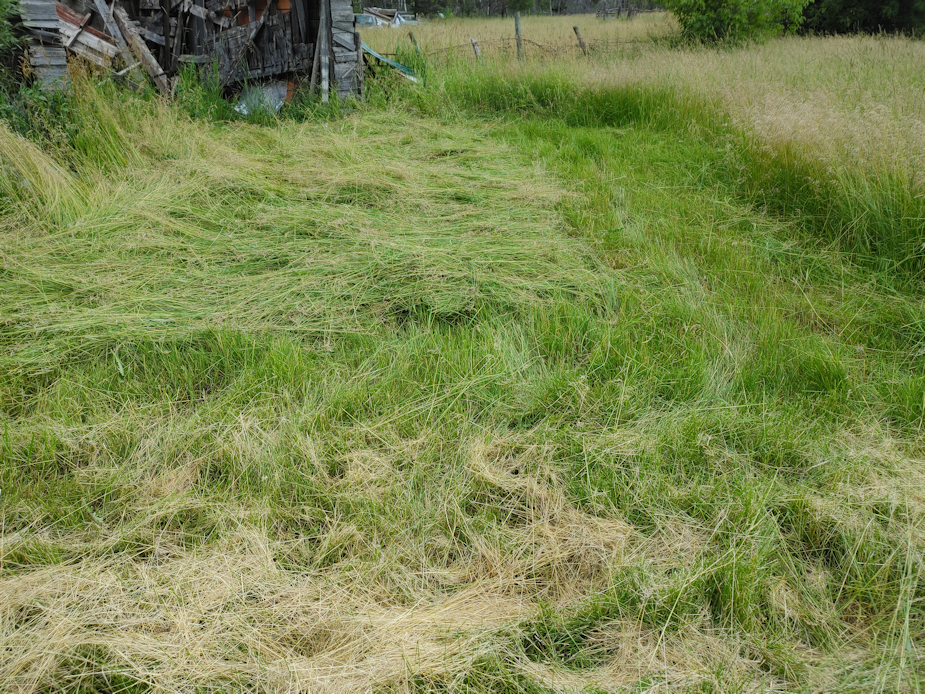
I worked on the area where the hay is still upright, and not flattened to the ground by wind. I took this picture when I thought I was done with scything for the day, but ended up cutting one more swath.
This means we can now access the shed we want to dismantle, now that the roof collapsed over the winter. We still need more space to stack things. I suspect much of it will go into a burn pile, but I know there is some good lumber that can still be salvaged in there, and I want to make sure there’s someplace to put them that’s off the ground. Once the remains of the roof is cleared away, I’m thinking of dragging out the old metal garage door that’s leaning against one wall and laying it on the ground, and using that to stack lumber on top of. If all goes well, we’ll have the materials to build a chicken coop that can handle our winters. I’d really like to build one on wheels, so we can set it up in different places, as needed. I hope to use the chickens as part of our gardening plans, as well as for eggs and meat.
We shall see how that works out.
Meanwhile.
In the foreground of the photo, you can see some of the dried hay from when I tried using the weed trimmer to cut this. I gathered all the previously cut hay into the wagon and hauled it to the garden.
The Boston Marrow really, really needed some help with all the grass and weeds that had grown through the straw mulch. I have not been able to get more cardboard, however…
I did have the box from when we bought the new lawn mower last year in the garage. It’s a really, really heavy cardboard, and there were so many strong metal staples in two of the corners, it was easier to just cut out that part of the cardboard, after removing all the tape I could.
Because the cardboard is so heavy, and I had just one box, I cut it up into many smaller pieces. Then, for each Boston Marrow, I cut a piece with an opening in the middle, to fit around the plants. Once each plant was done, I filled in the spaces in between with the remaining pieces.
I was short one piece to finish!
Ah, well. Close enough.
The dried hay in the wagon, however, was not enough to mulch all the squash, however. So I went back and got the freshly cut hay.
Thanks to the net that came with the wagon, I was able to jam all of it into the wagon.
It was enough to almost completely finish mulching the area.
Because there was no mulch on top of the cardboard I’d already laid down around the green patty pan squash and the hulless pumpkins, not only did the cardboard dry quickly in the sun, but pieces kept getting blown around. In this bed, it was bad enough that I weighed them down with some boards, as best I could.
Thankfully, there was enough hay to mulch all the individual squash plants, but not enough to finish filling in the spaces between the hulless pumpkins, nor to fill in up to the corn. It will be sufficient for now, though. Once the hay was down, I wet it enough that the cardboard below would be damp, too.
The green patty pan squash plants are so tiny, they’re completely hidden by the hay! I did make sure they were not covered. Honest. 😄 As small as they are, after all this time, there is still the possibility of a crop out of them. They have only 55 days to maturity. I’m hoping that, now that they’re mulched and not fighting for nutrients – and they’re no longer drowned out! – they’ll perk up, and we might have something to harvest by the end of August.
The cardboard being blown around is a problem in the big squash patch, too, but there was no more hay. I decided to use some of the remaining straw bale.
I only got one load done. Just enough to mulch two Baby Pam pumpkin plants.
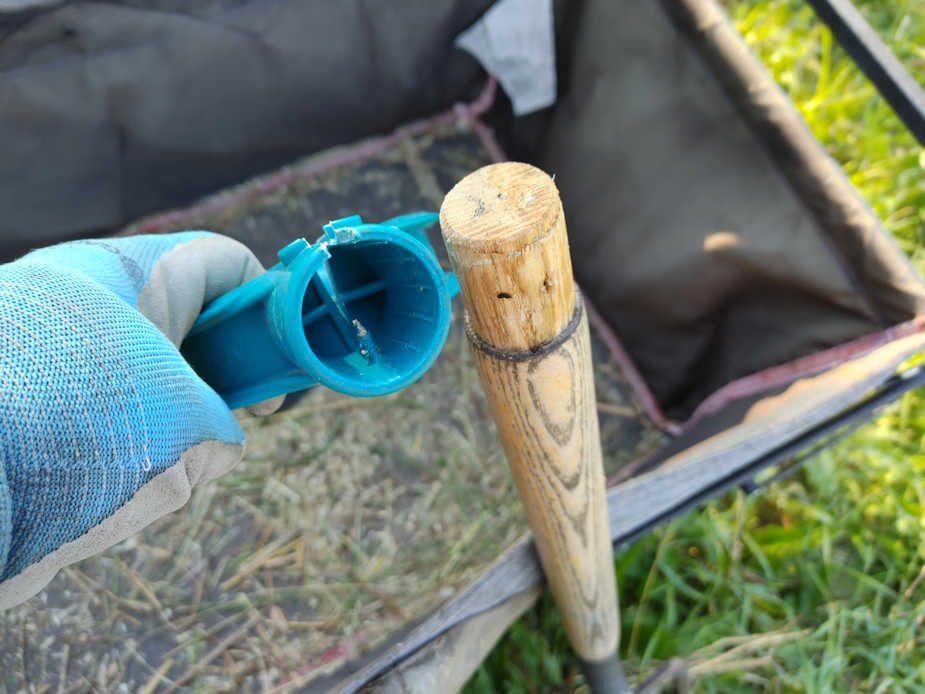
This is one reason why. The handle on our new garden fork broke off!
The other reason is, while pulling the straw off the bale, there were clouds of what look to be mold spores being kicked up. I really didn’t want to be breathing that stuff!
Well, there’s a whole area just north of the garden that’s too overgrown to mow. I’ll start scything that to use on the nearby squash patch, so that I’m not having to use the wagon to bring it over.
But not today. Probably not tomorrow, either, as I will be out and about for much of the day. Saturday is supposed to hit 28C/82F, but if I get started scything early enough, I should be able to escape the heat. The hottest part of the day is typically around 5pm, so there should be plenty of time.
While checking on the garden (and putting back cardboard mulch that was blown around), I spotted some new growth.
This is an apple gourd! I’m hoping it was pollinated and will continue growing. It looks like 3 of the 4 apple gourd plants are going to be productive, but this one is definitely the largest and strongest. The fourth one remains barely visible!
We have two more Baby Pam pumpkins developing! I hand pollinated these ones myself, just in case, and it seems to have taken. That makes a total of 3 of these pumpkins trying to grow. As these are a small, short season variety, we might actually have ripe pumpkins to harvest this fall.
The kulli corn is getting nice and tall! It’s time to take the net off and see if we can wrap it around the side, leaving the top open, for the corn to reach its full height.
Those bean plants are huge! This bed was made with trench composting, and it seems to have made a difference.
Rearranging the net will give a chance for some weeding, too, but it doesn’t look like this bed is having weed problems! 😄
The nearby ground cherries are getting very robust!
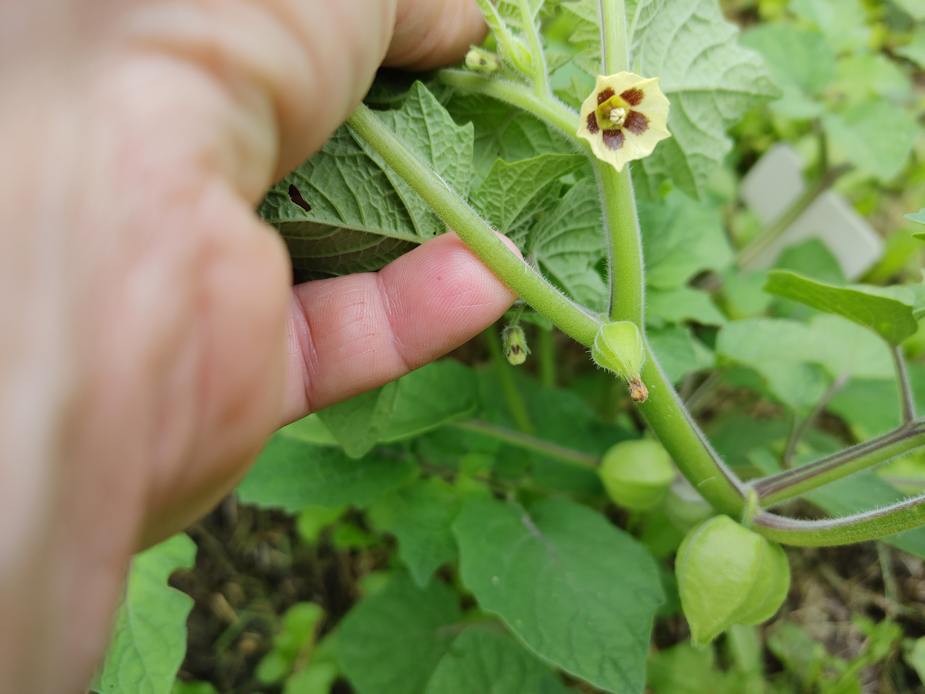
This is what ground cherry flowers look like. :-) I’ve finding quite a few flowers, and developing fruit. I’m looking forward to these!
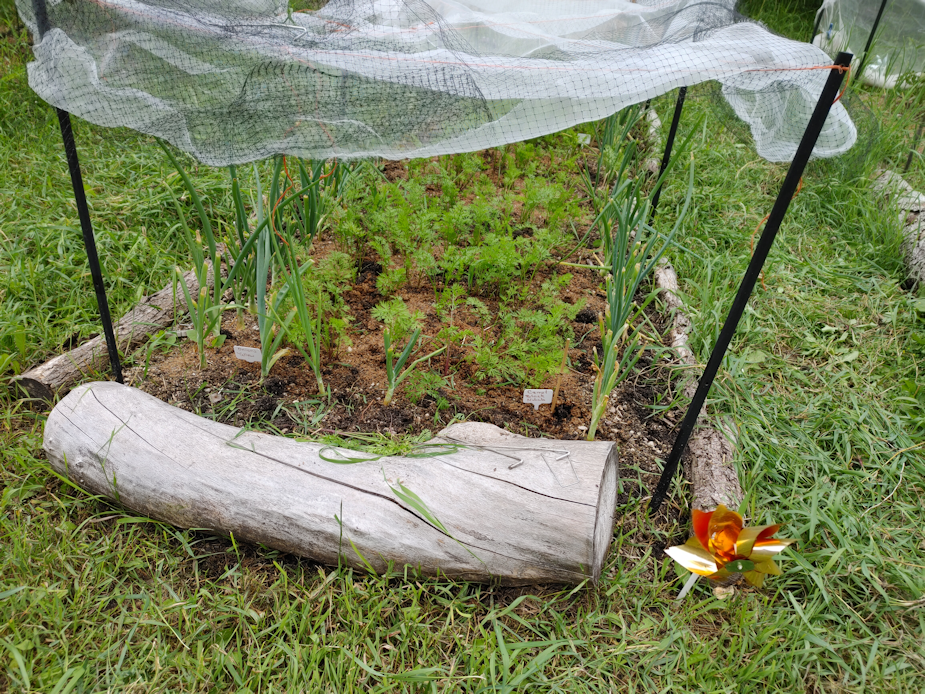
I was finally able to settle in and weed this overground bed. The netting around it may keep the groundhogs away from the carrots, but it prevents casual weeding, too.
Unfortunately, I did end up accidentally pulling a couple of purple carrots in the process. It’s really hard to pull up crab grass next to carrot greens!
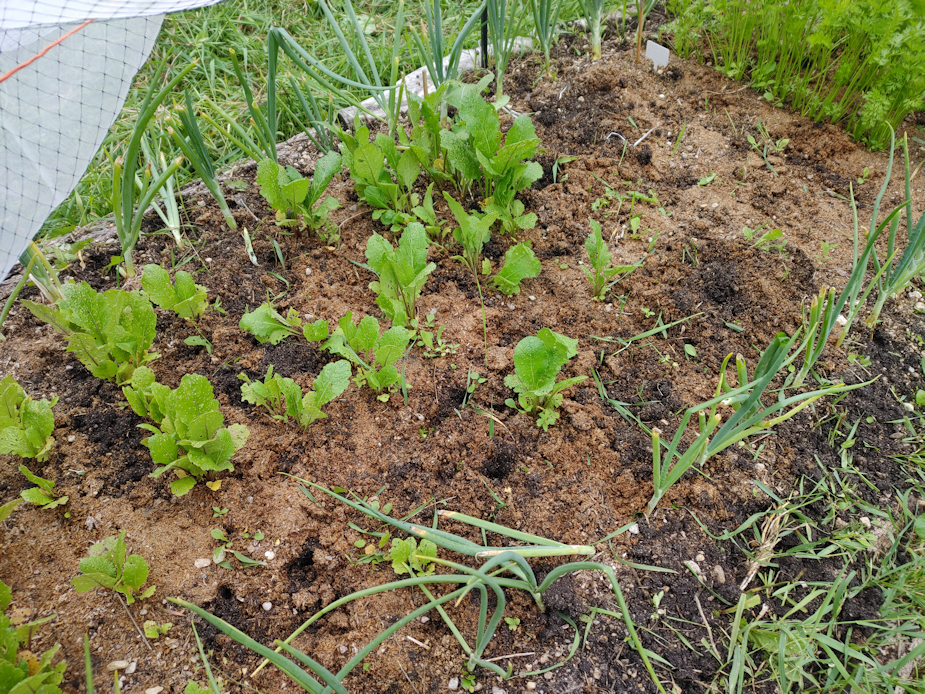
There aren’t a lot of the one type of turnip, but at least there’s something. The Gold Ball turnip are simply gone. They were the first to germinate, and disappeared almost immediately. I’d hoped that, while weeding, I might find some survivors, but there’s nothing. I don’t know what ate them, any more than I know what is leaving so many holes in the other turnips. We planted 3 types of turnips, but only one has survived – so far.
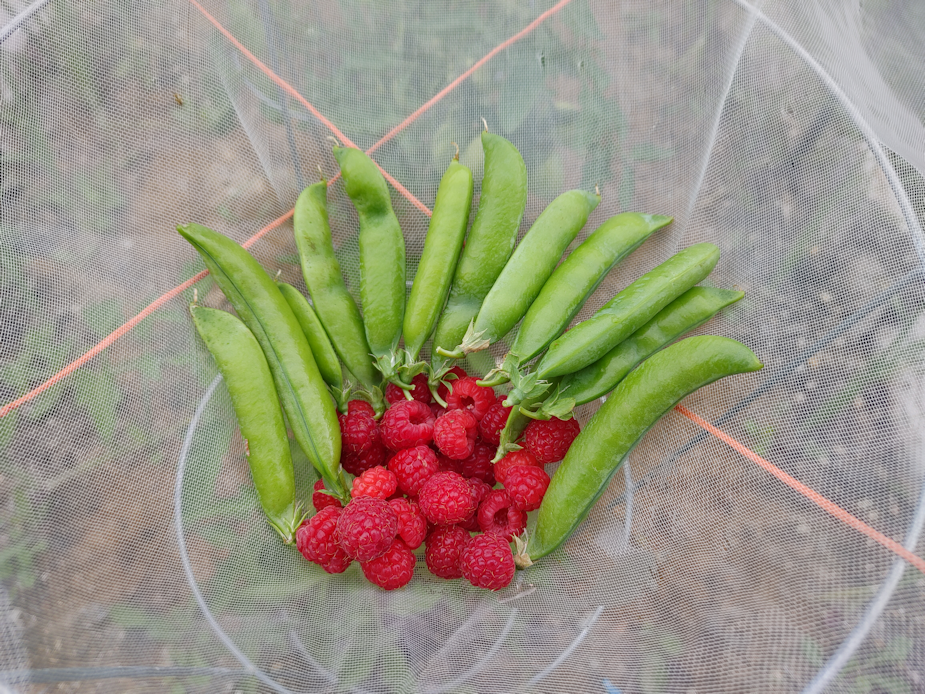
I did manage to have a sad little harvest this morning. A handful of the shelling peas, and a few raspberries.
Which is better than no harvest at all!
While at my mother’s, yesterday, we went looking at the garden plots outside her apartment. She has one little corner with some low maintenance plants in it, but some of her neighbours have better mobility and are growing a remarkable amount of vegetables in those little plots. One person has peas. They are pretty much twice the size of our own peas even though, from the stage of the developing pods, they had to have been planted later than our own. Even so, they were smaller than pea plants should be.
It’s been a hard gardening year for so many people!