Analyzing our 2024 Garden: strawberries and herbs

For the next while, I’ll be going through my old posts and videos about our 2024 garden, looking at how things worked out, and use that information to decide what we will do in our 2025 garden.

Our plans for herbs and strawberries have had some rough times!

The Original Plans

Strawberries and herbs are among those things we intend to have as our more perennial food garden items. Most herbs can’t survive as perennials where we lived, but some might, and others will reseed themselves, if left to their own devices. Over time, we plan to use the old kitchen garden as… well… a kitchen garden, since it’s right against the house, so it will eventually have a lot of herbs in it. As for strawberries, these are something we expected to interplant in various areas, as well has having dedicated beds of them.

How it started

Herbs

Last year, we started tried a few herbs, in pots and in the wattle weave bed. We had a single oregano seedling survive, some spearmint, a non-specific thyme variety and lemongrass in pots. In the wattle weave bed, we had chamomile and German Winter thyme.

This year, we started only oregano and German Winter thyme indoors.

None of the oregano germinated.

On removing the mulch in the spring, I had some hope that the thyme in the wattle weave bed had survived, but they did not. So that’s where the new thyme got transplanted.

The chamomile, however, had reseeded itself!

We also have mint in the chimney block retaining wall, which trace back to my late grandmother’s garden, plus chives in one corner of the retaining wall, that come back every year.

Strawberries

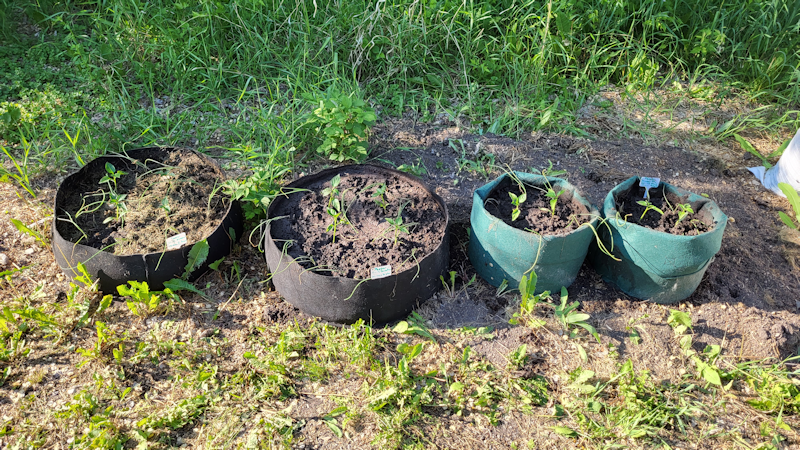
We had four strawberry plants in the asparagus bed. They should have spread their runners and expanded by now, but the deer kept eating them. They did, however, survive the winter, and started growing again as soon as the soil warmed up.

The real surprise were the tiny strawberries we grew from seed last and transplanted into the wattle weave bed. As they were planted near the outside edge of the bed, I had some doubt that they would survive the winter, even under the mulch. They not only survived, but they thrived!

This year, I did buy some bare root strawberries, and they got their own bed. You can see how that worked out in this video I made.

Thanks to those elm trees, what started out as a very productive squash hill (the first place we tried growing Crespo squash) was barely recoverable. I could only hope that those layers of cardboard would keep the capillary roots from spreading upwards.

The main thing, though, is that we had some new, everbearing strawberries planted that I hoped would do better here, than the ones by the asparagus did!

How it went

Not too bad, for the most part.

Herbs

The German Winter Thyme did well again, in the same spot we grew them last year. We had the Black Cherry tomatoes growing behind them, and filled in empty spots with Red Wethersfield onion around them. The cats rolled all over the onions, but didn’t roll on the bushier thyme.

The chamomile grew and bloomed, but there wasn’t as many as last year. The Red Wethersfield onion was also planted around them and got rolled on, but the chamomile survived the cats.

The mint did okay but actually had to fight off an invasive flower (possibly creeping bellflower, but we never let them grow big enough to confirm) that keeps trying to choke them out, even in the chimney blocks! Which is saying a lot, since mint us usually the invader. I was able to do limited weeding, but these are growing in from below and it’s pretty much impossible to get them out completely. Basically, I just had to weed them enough for the mint to be able to get bigger, then they could crowd out the weed.

The chives, on the other hand, were their usual enthusiastically growing selves.

Strawberries

I was surprised at how well the ones by the asparagus did. They’re a few years old and normally past their prime, but we did get a few ripe berries out of them.

Then the deer ate them.

Deer really seem to love strawberry leaves!

Even putting a makeshift fence around them was not enough to deter the deer.

*sigh*

The new Albion Everbearing strawberries did really well. They grew and spread runners, which I spread around and set the leaf clusters against the soil to root, so we could expand them to other areas in the future. I had thoughts to use them as a ground cover in our budding food forest, for example. They bloomed and developed berries, and we even had a few ripe ones to taste.

Then the deer got them.

I didn’t have a fence around the bed, but I did have poles with flashy pinwheels to startle them away, but it wasn’t enough. I put a net around the bed and they started to recover, only for a deer to actually tear through the netting and get at about half of them. I had a short length of chicken wire I could put around the side with the hole, but by that time, there just wasn’t much season left for them to recover in. There was new growth, though, so I’m hoping they survived.

*sigh*

The runaway success story, though, is the tiny variety of strawberries we grew from seed. Being in the old kitchen garden, the deer don’t get to them, I guess. Too close to the house? I don’t know. They got big and bushy, strong and healthy, and were very prolific! I was really impressed with how they did.

Conclusion and plans for next year

Herbs

I had visions of having fresh culinary herbs to use with our cooking as needed throughout the summer, and gathering blossoms and leaves for herbal teas.

The problem is, we keep forgetting we have herbs in the garden.

With the chamomile, I didn’t want to harvest any blossoms as there weren’t that many this year, and I wanted them to go to seed, instead.

I did remember to use the thyme a couple of times, but that was it. I didn’t even harvest any to dehydrate.

In past years, we gathered fresh mint leaves to make fresh mint tea, but just never got around to it this year. In past years, we used chive blossoms to make infused oils and vinegars, but that didn’t happen this year, and I ended up deadheading them so they wouldn’t spread seeds all over the grass outside the chimney blocks.

Basically, we had so many things happening this year, including lots of things breaking down, that we just didn’t have the spoons left to do this stuff this year. We also went from a very wet late spring to a very hot summer that made doing anything outdoors more difficult.

As for the strawberries, those wonderfully prolific little strawberries – I don’t know if they are a while strawberry, or an alpine variety – the seed kit didn’t name them – that did so well…

The berries themselves just aren’t that big a deal. We have native wild strawberries in the maple grove that manage to produce berries even while choked out by creeping bellflower, and those have an intense strawberry taste. They’re just really tiny. These ones are larger, but they don’t have that intense wild strawberry taste. If they’re not perfectly ripe, they’re actually rather bitter. For that brief time of perfect ripeness, they’re good, but not as good as, say, the Albion Everbearing strawberries.

So while they are a success, they are essentially taking up space that we can grow something more suitable for a kitchen garden.

Which means that, in the spring, I will try and find a good place to transplant them, where they can grow wild.

I might actually transplant the Albion Everbearing strawberries into the old kitchen garden, where they will have better protection from the deer! I really want to expand our strawberries, because we love them so much. The ones with the asparagus, I’m considering a lost cause at this point, but if we can keep the Albion everbearing ones going and spreading, that would be fantastic.

We currently have the larger rectangular bed in the old kitchen garden winter sown with the “greens” mix – spinach, chard, kohlrabi and tiny bok choi, and if the strawberries get transplanted, they will likely go into the long, narrow bed along the retaining wall. So that leaves most of the wattle weave bed (assuming the chamomile reseeds itself successfully again) and the tiny raised bed potentially for herbs.

I’ve picked up seeds for basil and fern leaf dill, though I have seeds for other dill and herbs as well. I don’t know that I will try growing thyme again this year, and oregano just doesn’t seem to want to germinate for us, so I think I will try different varieties this year. If the winter sown greens actually survive and grow, and we have things to harvest, I think we will be more likely to remember to harvest herbs, too.

We will definitely have to find ways to keep the cats off the garden beds, though. I’ll need to build a cover to fit over the larger rectangular bed. The wattle weave will probably get hoops and netting.

The problem with all these barriers to protect our garden from cats and wildlife is, it makes it hard to weed and water them, too!

Next year, however, the old kitchen garden will be a lot further along in being a kitchen garden, too, so that would be another step towards long term goals. It’s slow going, but we are managing to eek our way towards them!

The Re-Farmer

Our 2024 garden: teeny tiny thyme

We have sproooots!

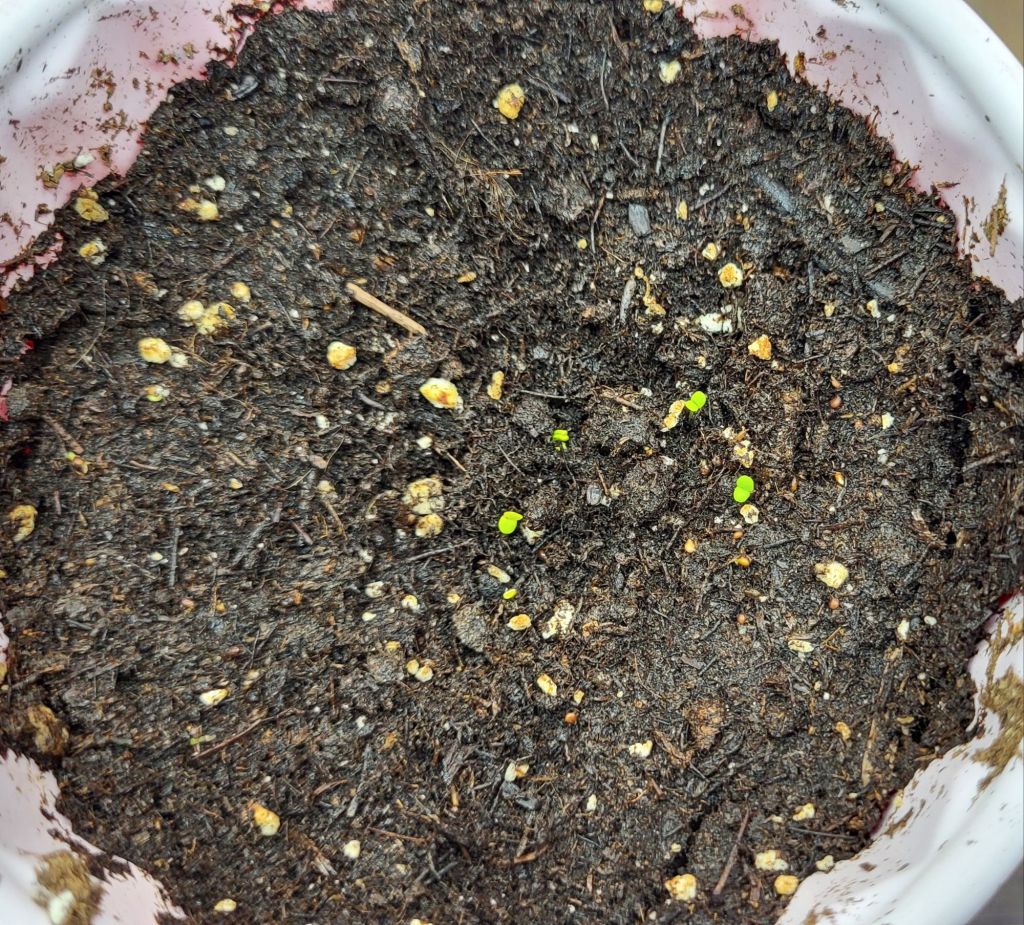
The German Winter Thyme has sprouted.  Gosh, they are so tiny!  I actually had to wait a day before I could get a picture where they could be seen for what they are.

I expect the oregano to sprout next – unless we have problems like last year.  It will be a while longer before I expect to see the peppers sprouting.

We made the living room a cat free zone to protect our house plants.  It has a huge east facing window and gets lots of light for a brief period in the morning.  After that, it’s a pretty dark room.  It’s not too bad for the plants near the window, but our huge jade tree… well… one of them… is against a wall in the middle of the room.  We have another that’s gotten just as big, but with needing the window for seedlings, it’s off to one end of the shelf it’s on, and no longer in front of the window.  The only light it gets is from the shop lights I have over where the seedlings and small plants are. 

Then there are the aloe Vera.  They’re on plant shelf near the older jade tree, which puts them pretty low down. 

The old jade tree is not doing well.  I regularly rotate the pot, so all sides eventually get light – not easy to do, with such big branches, so close to the wall!  Unfortunately, I can see the leaves are getting thinner and less succulent, and a lot of leaves are simply shriveled up.  It does get adequate moisture, and is in a self watering pot.  It’s just not thriving in this location.

There is no room for it, anywhere else. 

What we need is a light fixture along that back wall.  When we moved here, there was a light fixture in the corner where the big aquarium greenhouse is now.  It reaches floor to ceiling, held in place with pressure, and has 3 lights that could have their directions adjusted.  It’s in the storage shed now.  If that thing still works, we could set it up with standard bulb sized grow lights, near the Jade tree.  Those types of grow bulbs are more affordable, anyhow. 

Looks like I need to trek through the snow and see what I can find in the storage shed.  I hate going in there, though.  Every time I do, I’m afraid a cat might sneak in behind me and accidentally get closed in.  That shed is so full of my parents’ stuff, we can’t even access most of it, anymore.  Lots of places for a cat to hide!

I should grab a daughter to go with me and stand guard!

The Re-Farmer

Our 2024 garden: herbs and peppers

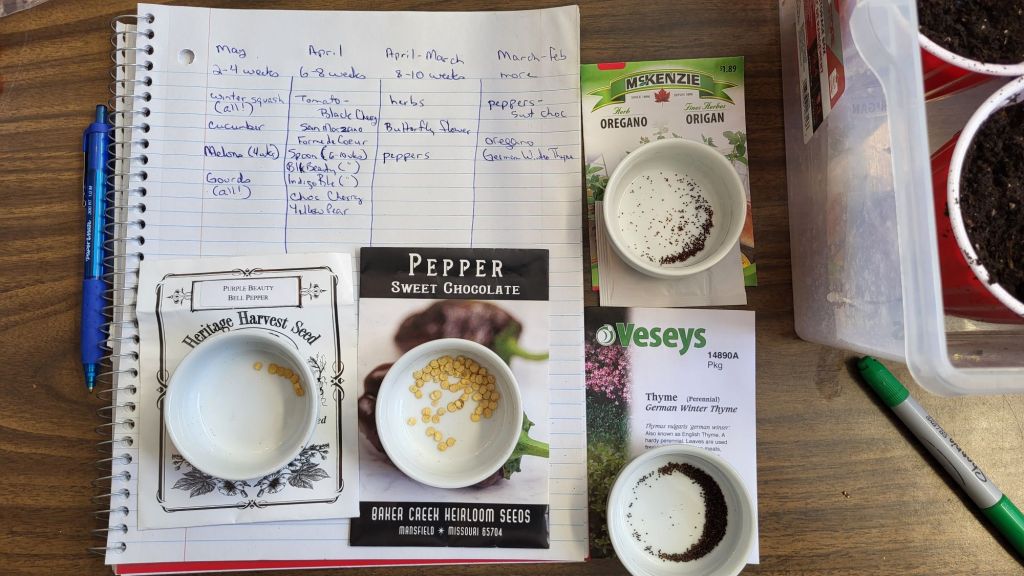
Today, I did some seed organizing.

After marking out the weeks backwards from our June 2nd last frost date on our calendar, I then went through my bin of seeds and organized them by when they need to be started indoors. Then I picked out the ones I could get started now.

We won’t be starting everything that we have seeds for.

Starting from the 3-4 weeks list:

I still haven’t decided if we’re going to plant any gourds at all this year. There are several I really want to grow, but we just don’t have the space. With the winter squash, we have the new packet of mixed winter squash seeds to try, plus one type for pies my daughter asked for. With the mixed seeds pack, we will of course want to plant the entire package, and see what we’ve got! I would still like to try the Honeyboat Delicata squash again; the few we got didn’t get a chance to fully mature, but they were great in the pie my daughter made! We also really liked the Pink Banana and Georgia Candy Roaster. There are other varieties that didn’t do well that I want to try again, just so we can decide if we like them or not, but that will depend on how much space we have. The problem is, there are a LOT of things that need to be started in that 3-4 week time span. I’m still not sure if we’ll do cucumbers this year. I’d rather use the space for the melons and winter squash. We’ll be skipping the hulless seed pumpkins this year, but I really want to try the Crespo squash again. Last I saw, Baker Creek didn’t carry the seeds anymore, so I want to successfully grow at least one to collect seeds from!

As for the tomatoes in the 6-8 week list, we’ll not be planting all that we have seeds for. We’ll do the San Marzano paste tomatoes for preserving and the Black Cherry for fresh eating. The free seeds we got are tempting me greatly, and I always want to grow more Spoon tomatoes! They’re just fun. I want to start quite a lot of the San Marzano, but not as many of the cherry tomatoes. I don’t want a situation like last year, where we ran out of space and had to give away so many transplants!

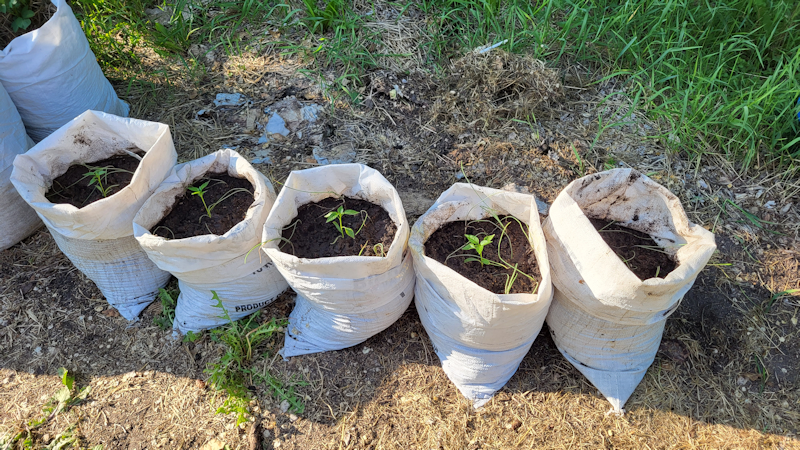
From the 8-10 week list: the Butterfly Flower is a type of milkweed, so I definitely want to get those going. We have three varieties of “early” peppers that I waited to start last year. They have such a short growing season, technically we could direct sow them. It didn’t work out. They didn’t get to produce, though with most of them I now know that the grow bags they were planted in were invaded from below by roots from the nearby Chinese elm. So we’ll definitely need to keep that in mind, when deciding where to transplant them this year. I will be starting fewer seeds, shooting for at least 2 plants per variety in the garden, but between the 6 varieties I’ll be starting this year, we’ll still have plenty for our needs. Hopefully, my family will have peppers of each kind to try, so we can decide which varieties we like enough to keep growing, year after year.

You’ll notice there are no summer squash on my list. Those got moved to the direct sowing bin. I’m not going to have the space to start them indoors. As long as I can keep the slugs away from them, they should be okay to start outdoors.

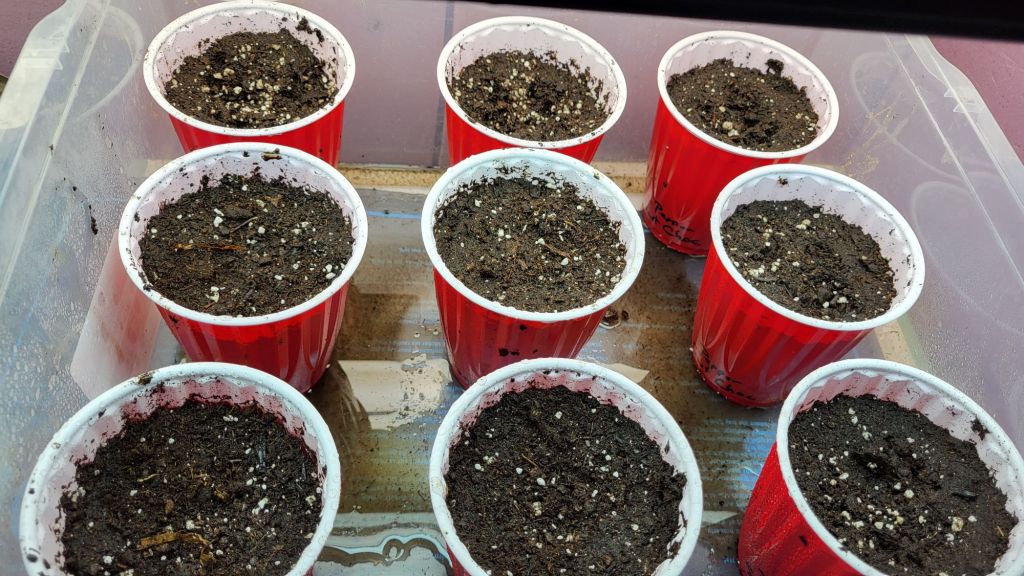
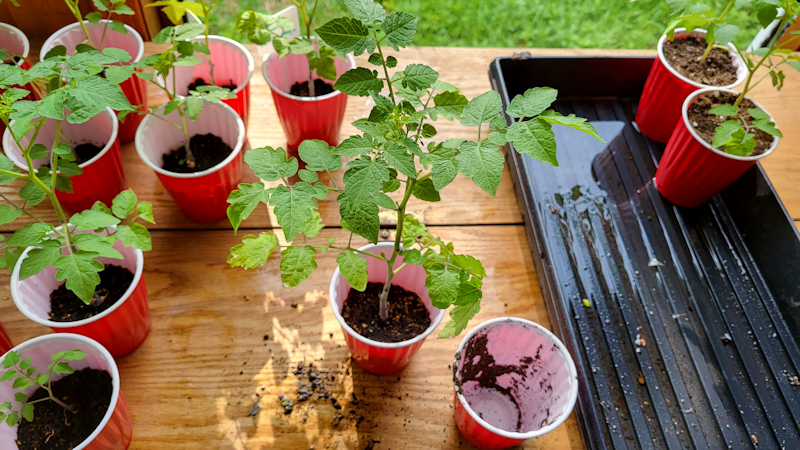
There were four things I could start today. Since I was after fewer plants per variety, I decided to go with the Red Solo cups to start them in, rather than the larger trays with smaller grow cells.

With the herbs, I’m just doing the oregano and German Winter Thyme again. The chamomile we planted last year should have self seeded, and we’ll see if the spearmint survived the winter in their pot. We ended up not using the lemongrass at all, so I’m not trying them again this year. We’ll plan out our herbs more, as time goes by. The herb seeds are so incredibly fine – especially the oregano! They got surface seeded over the pre-moistened seed starter mix, then covered with a light dusting of dry starter mix to just barely cover them, followed by a spritz to moisten the tops. Vermiculite would have been better, but I don’t have any. The herbs went into two cups each. With such tiny seeds, there’s no way to know how many I managed to sprinkle onto them. I still had seed left over, too, so if they don’t take, I can try again. The oregano really struggled last year, and I ended up with only one surviving seedling to transplant. That one plant did well, at least! They were started in the little Jiffy pellets last year, so I hope they do better in the larger cups and a different growing medium.

I decided to go ahead and plant the last of our Purple Beauty seeds, which are two year old seeds. The first time we planted them was a year of drought and heat waves, and they did very poorly. Last year, what was planted in that bed also struggled, so I think it’s more a problem with the soil in that bed. I split the last 7 seeds of Purple Beauty between two cups.

The Sweet Chocolate peppers were the one pepper that we were actually able to harvest mature peppers from last year, and they were also the only ones I started quite early. We saved seed from them, too, but there was still plenty in the packet, so I used those. There was enough to plant three seeds into each of three cups, with plenty of seed left over. I had intended to do just two cups, like the others, but the bin they’re in for bottom watering holds 9, and I just had to fill in that last space! Yeah, it’s a bit OCD, but I have an excuse. If there are gaps in the bins, the cups tend to fall over more easily when the bins get moved around.

So these are now in the big aquarium, on the warming mat.

The next seeds don’t need to be started until the second half of March, at the earliest.

Must… resist… starting too early!!!

😂

The Re-Farmer

Analyzing our 2023 garden: peppers, herbs and greens

We tried a whole bunch of new things in this category, this year! It was the peppers that we were particularly interested in getting going.

Peppers are something I’m growing for the rest of the family – I can’t eat peppers myself, much like I can’t eat fresh tomatoes. Which is unfortunate. I love the shape and smell of them, and when I’m prepping them for the family, they look so fresh, crisp and delicious! Yet every time I’ve tried to eat a pepper, it makes me gag. Even when they’re cooked, I still find myself wanting to gag, which is not a problem with cooked tomatoes. Oddly, though, I can eat jalapeno poppers, and quite love them. How does that make sense? My husband and daughters, meanwhile, love their fresh, raw peppers. So I wanted to try a variety of bell peppers this year, plus my daughter specifically requested hot peppers.

We did try to grow peppers last year – our terrible, no good, growing year! – and almost got some purple peppers. Just a few tiny, misshapen ones off of plants that did not thrive in a bed where nothing really grew well. They pretty much did the best of all the stuff we planted in that bed.

We did still have some of last year’s seeds left, but this year we went with new varieties.

One was the Sweet Chocolate bell pepper. I also ordered a collection of early sweet peppers, for their short growing season – Early Sunsation, Early Summer, and Dragonfly, all of which are different colours. For the hot pepper, we got a variety called Cheyenne.

With our short growing season, the Sweet Chocolates got started indoors quite early, along with some gourds and herbs.

The German Winter Thyme and the Lemon grass both needed an early start, too. Lemon grass is a zone 8, heat loving plant, so those were going to go into a pot in a sunny and sheltered location, when it was time to transplant.

With our short growing season, these were all started in early February. A lot of people on my local gardening groups started their peppers in January! The other varieties we had were specifically for our short season, and I must say, I had to really fight with myself to not start them until much later! Those got started in late March. In theory, I could have direct seeded them.

After filling 4 rows, I filled the last two rows with Spoon tomatoes.

We started a lot more seeds than we needed, on the assumption that they wouldn’t all germinate.

Well, we had pretty much a 100% germination rate!

As for other herbs, in early April we started oregano, spearmint and the Roma VF tomatoes.

We tried these in toilet paper tube pots, which we hoped would allow us to pot them up/transplant them still in the biodegradable tubes, without disturbing the roots.

Finally, we started chamomile seeds and a nameless variety of thyme, towards the end of April.

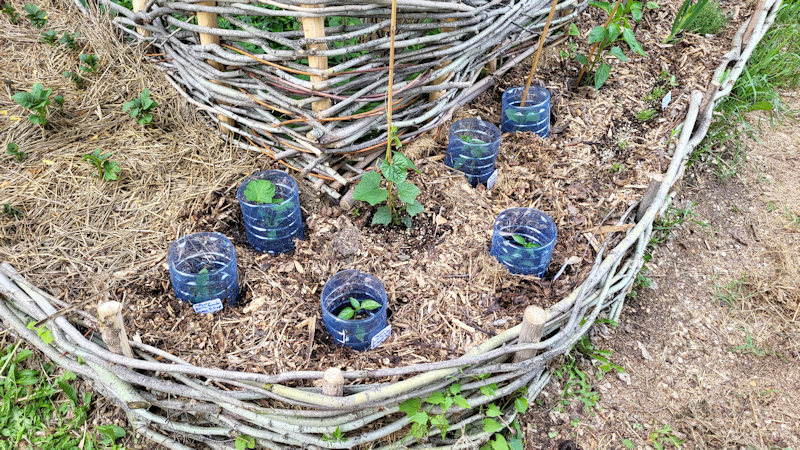
The first ones to be transplanted outside were the Sweet Chocolates, into the new wattle weave bed.

The peppers got protective plastic rings around them, as this was well before our last average frost date. I eventually needed to add sticks to keep the wind from blowing them askew, later adding supports for the peppers as well.

In front of the peppers, you can see where the German Winter Thyme was planted. At the end of the bed are the last spindly shallots. Beyond the thyme is an onion that came up on its own! Later, the chamomile would be transplanted near where the single onion is, as well as the strawberries from seed planted in between things all along the front of the bed.

As the days flew by and we weren’t getting other things ready as quickly as planned, I ended up planting more peppers in the wattle weave bed, just in case.

I chose one each of the early bell peppers, and one hot pepper. They got plastic rings to protect them, along with a couple other things I will cover in a different post.

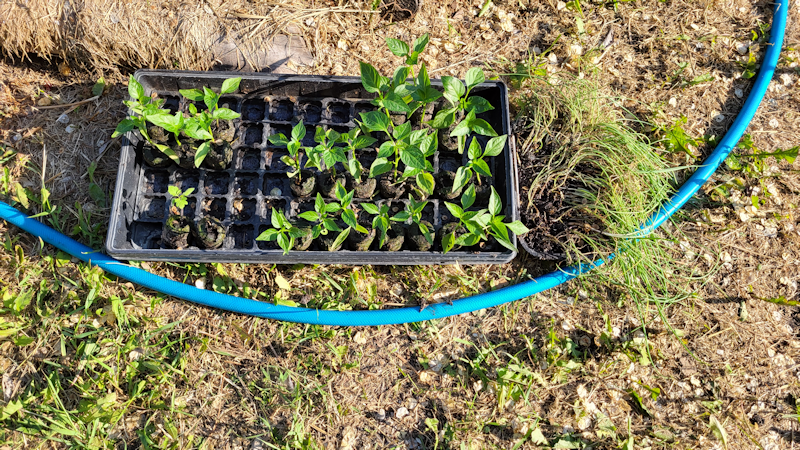
We did eventually transplant more of the peppers in grow bags, together with Red of Florence onion, but we had so many seedlings, they were included in the Great Transplant Giveaway!

Some things, however, did not need to be transplanted at all, and could be direct sown. When it came to greens, we were actually going to skip trying to grow lettuce this year, and just grow spinach.

Spinach can be sown before last frost, so they went in, in late April.

After the seeds were sown, the bed got a floating row cover, to protect them from critters. This was just a dollar store row cover, and it tore astonishingly easy!

We did enjoy some nice harvests of the spinach, too. At least, with these first ones. After the garlic was harvested, spinach was one of the things we planted for a fall crop, and we got nothing. I think something ate the seedlings!

We found ourselves with some free seeds that we decided to try. One of them was a tiny variety of Bok Choy called Hedou. The other was a Czech variety or lettuce called Jebousek.

So how did it all work out?

It was a mixed bag!

The Peppers

The Sweet Chocolates, having been started indoors the earlier, had a head start, grew quite large and were the first to have mature peppers we could harvest.

The first ones we harvested were in August. They can be eaten while still green, but we waited until they turned the chocolate brown they were supposed to, when mature. They bloomed continuously, right up until the first frosts started to hit. We did try to cover the peppers on chillier nights, and that helped. Their location in the wattle weave bed was also much more protected than the grow bags in the garden.

As for the short season varieties, they did not do as well. The ones in the grow bags started off all right, but then sort of stagnated. We did get a few Dragonfly peppers to harvest, and there were other peppers developing when the first frosts hit.

The hot peppers had the most fruit developing, but all of the peppers planted later were slow in maturing. In the end, we harvested everything unripe and set them to finish maturing indoors.

We had mild temperatures extending for quite a long time, though, and the final harvest was in October! In the photo, you can see a couple of purple Dragonfly peppers, and the rest that are visible are the Sweet Chocolate. There were hot peppers under there, too. Unfortunately, we covered grow bags too late one night, and the frost caused too much damage.

Once indoors, the green peppers that were not frost damaged did continue to mature. As I write this, we have a few hot peppers left that have turned red. The Sweet Chocolates are the only remaining bell peppers, they’ve all matured, and are currently strung up to dry. The rest were either already eaten, or had to be tossed due to frost damage causing them to start molding.

When cleaning up the garden beds for the winter, I discovered what I think may have been the reason the grow bag peppers and onions failed to thrive. I discovered the soil was filled with tiny tree roots that had grown in from below!

They were all like this grow bag, turned inside out.

No wonder they didn’t thrive!

As for the ones in the wattle weave bed, the hot pepper seemed to do fine, though late in developing, but the others seems to stagnate, too, and I’m not sure why!

Final thoughts on peppers

When it comes to the bell peppers, the family isn’t really finding enough difference in flavour to say they like one variety over another. They all just sort of taste the same, so they don’t really care what variety we grow next! I do have a request for hot peppers again. We still have seeds for all of these, so we don’t need to buy more, if we don’t want to. If we do grow the short season varieties again, I will most definitely start them indoors earlier. We’ll also have to be more thoughtful on where to plant them, to ensure they get shelter and a warmer microclimate. We might use grow bags again, but if we do, it won’t be anywhere near those trees again!

The Herbs

Our eventual goal is to turn the old kitchen garden into mostly an herb garden, along with other things that we might use in the kitchen frequently. This garden is right next to the house and sheltered, and gets lots of sun, except where the ornamental crab apple trees are an issue. Those will be pruned back more, over time. It also now has all low to mid height raised beds, with the possibility to add height to some of them, as needed.

The German Winter Thyme did quite well in the wattle weave bed, except for one transplanted group that suddenly died part way through the summer. The Chamomile also did well, and was blooming enthusiastically.

The spearmint got its own pot. We had only one oregano seedling survive – barely – so it was planted in the middle of a pot and surrounded by the other variety of thyme. The Lemon grass got its own pot, too. Everything in the pots seemed to do surprisingly well, though the Lemon grass didn’t get anywhere near as large as they should have.

Final thoughts on herbs

There’s really been just one problem with the herbs we grew.

We keep forgetting about them.

Which means, we weren’t using them.

Oh, we did use some thyme, oregano and a bit of spearmint, during the few times we remembered them. We didn’t use the chamomile or lemon grass at all. We weren’t sure when to best harvest the chamomile, which we wanted to dry for tea, and I never got around to looking it up, because I kept forgetting they existed. My daughter were wanting to try the lemon grass, but weren’t sure how to use it with the type of cooking we tend to do.

I don’t know about the chamomile, but with mulching the wattle weave bed like we did for this winter, it’s possible the German winter thyme will come back. The chamomile may have reseeded itself.

We never bothered doing anything to the pots. I suppose it’s possible the spearmint and thyme will come back in the spring; we’re having a very mild El Niño winter, so the pots shouldn’t freeze solid. I doubt the oregano will survive, though being in the middle of the pot, it’s more protected than the thyme around it.

These are all herbs I want to continue to grow, though, and as we further develop the old kitchen garden, I think we’ll get into the habit of using fresh herbs and not forget that they exist!

The Greens

With the spinach, they did better after we gave up on the floating row cover. Thankfully, no critters seemed interested in them! We’ve had spinach do both really well, and really poorly, and that happened again this year. The spring sowing was fine. The fall sowing was a complete fail.

We’ll definitely keep growing spinach, though. It’s just a matter of where, and making sure critters don’t get to it!

As for the lettuce and baby Bok Choi…

What a disaster!

Oh, they started sprouting just fine.

Then the Chinese elm started dropping their seeds.

There are four of them along the chain link fence, plus one by the house, plus more past the garage.

When those seeds start falling, everything is covered. The emerging seedlings were buried and choked out, and there was nothing we could do about it!

Those trees have got to go. They are causing all kinds of damage, with their billions of seeds and their sidewalk heaving, basement wall cracking roots.

Much to my surprise, however, a couple of baby Bok Choy actually survived and promptly bolted.

I left them be as they developed seed pods that managed to dry before the first frost hit. I was able to save some seeds!

There was a surprising number of Jabousek seedlings that survived! Enough that we even used some of the leaves in sandwiches. They didn’t seem to get bitter, even after bolting.

Once they started blooming, I left them be. Unfortunately, it took such a long time for their seeds to develop, they got hit with frost, first. I suppose it’s possible the earliest bloomers dropped seeds, but that bed is going to be reworked in the spring (I held off to let them finish producing seeds) to make it narrower, so it’s unlikely that any seeds dropped will germinate. We probably won’t grow any lettuces next year, but I certainly won’t complain if this variety shows up on its own!

I most definitely want to try growing the Bok Choy seeds we kept. We never got to try them, and I’m very curious! We do like Bok Choy, but very rarely buy it.

So that’s it for peppers, herbs and greens and, I must say, getting this written was brutal! It took me all day, just to get started, as so many things kept popping up that needed to be done. Then, once I did finally get started… I swear, I’ve never been interrupted while writing so many times in my life! Most of which was because I saw on the critter cam that racoons were in the sun room. !!! I did try using the talk feature to yell at them, and they did leave at first, but after a while, they’d just look towards the camera, then ignore my voice!

If anything I’ve written here seems at all disjointed or not to my usual standard of writing or its full of typos that I’ve missed, that would be why! 😄😄😄

The Re-Farmer

Our 2024 garden: winter mulching

It’s supposed to start snowing later, so it’s a bit of a now or never day to get those beds mulched before the ground freezes! I’m so glad my mother decided to have me come over to her place tomorrow instead of today.

If you scroll through the Instagram slide show above, you’ll first see the carrots that we are overwintering in the soil, harvesting them as we need to, rather than harvesting them all at once and having to process them for the winter. Quite a few people swear by this, and say the carrots taste so much better when stored this way. There was the remains of a pile of grass clippings next to that bed, so it was the fastest to get done. I used up pretty much the entire pile – I didn’t bother digging too far into the snow around the edges – and piled it right on top of the snow layer. The snow will also act as an insulator, as well as add needed moisture, come spring time. I put the cover back on, partly as a way to store it, but also to keep the grass clippings from being blown away. This is the only bed where that would be an issue.

Next is the old kitchen garden. All the garlic now has a thick layer of mulch, plus the chamomile, thyme and strawberries grown from seed are covered.

I also finally picked that last big luffa gourd. I’d forgotten about it! It’s now sitting in the living room to dry out.

I also remembered to put a deeper mulch on top of the saffron crocuses, plus a nice, thick “donut” of mulch around the Liberty apple tree. Both are zone 4 plants, so they need extra protection in our zone 3 temperatures. Some time ago, I added the tree protector. It’s wrapped around the stem and the bamboo stake together until it reached the bottom branches, and then got wrapped around the bamboo stake. As the sapling gets taller, the wrap can be adjusted accordingly. This area also has the fencing wire around it, so it should be safe from deer, but this will also protect from rabbits and other critters. Mind you, the yard cats do a great job of keeping the small critters under control, so we don’t have any rabbit or mouse problems, but there are other creatures that might try to eat a nice, juicy young sapling!

All of this pretty much finished off the huge pile of grass clippings that was next to the high raised bed! There’s just the dregs along the edges, buried under snow. Those are really full of crab grass rhizomes, anyhow. I was pulling quite a few of those out of even the deepest parts of the grass pile!

Last of all, we covered the asparagus and strawberry bed, and the sunchokes. We ended up not harvesting any. I decided to leave them to propagate, and we’ll have more plants to harvest from, next year. In theory. Instead, I decided to use the loppers to cut the stems and lay them down while my daughter raided the straw pile for more mulch.

The surprise was discovering half the sunchoke plants had lost their tops! Some time between when I did my morning rounds, and when we came over to tend to the bed, a deer had come around and eaten them!

The straw we used is what had been moved off the area the trellis beds are going on. It had been used for our Ruth Stout method of growing potatoes and melons that instead got flooded out, in our 2022 garden. So it’s had some time to break down, and the pile was quite damp! We used most of it to make a nice, deep mulch over the asparagus/strawberry, and sunchoke beds.

In the spring, these mulches will be removed (the carrot bed should be empty before then) to allow for the plants underneath to get sunlight and warmth and start growing. In the wattle weave bed, the chamomile should have reseeded itself by now. The thyme in there might actually survive the winter. It’s hard to say, as they are close to the wall of the bed, which means they’ll get cold from the side. Even with the mulch, they might freeze too much. This is why I made sure to plant the garlic well away from the walls of the raised beds they are in.

If all goes well, we’ll have a nice head start to our 2024 garden!

Oh!!! I just found out our lysine order is in already!

Time to go get the mail!

The Re-Farmer

Our 2023 garden: morning harvest and how things are looking

I didn’t pick any bush beans for a couple of days, so there was plenty to pick this morning!

I also grabbed a few Gold Ball turnips, Uzbek Golden carrots – a first harvest of those – and snagged a yellow zucchini. There’s some green ones starting to grow, and one that is almost ready to harvest, but not quite!

I uploaded other photos onto Instagram. As you go through these, can you please let me know if any of them look like the files got corrupted somehow? I am having problems with viewing batches of photos like this. They look fine as I go through the process, but after they’ve been published and I view them, there are usually visual changes to some of them. Some are so bad, I can barely see the image, so I delete the whole thing and start over. I had to do that with this batch, and I still see problems. The images are at least identifiable, though!

Please let me know if you see it to, or if it’s just my computer messing up!

The first image is of the North Georgia Candy Roaster squash that is getting SO big, so fast! It seems to be getting noticeably bigger, every day! There were also a lot of new female flowers among the candy roasters and the Pink Bananas.

There is a little patch of allium flowers that come up every year through a crack between sidewalk blocks and the laundry platform steps. They are in full bloom right now, and the bees loves them. I tried taking photos and just happened to catch the bee as it flew off to another flower head!

The earliest Sweet Chocolate bell peppers are turning colour quite nicely right now.

The next photo, of the chamomile flowers, looks like it has a block of purple over all but the top of the photo. Do you see that too?

The chamomile are blooming quite enthusiastically right now.

The very first luffa flower has opened – and is being pollinated!

Last of all is the first flower on the Classic Eggplant. Check out those spikes on it!

On another topic entirely, I brought one of the yard kittens in, so my daughter and I could wash its eyes out. They were completely stuck shut. As soon as the dried gunk was softened enough that the lids started to open, they started oozing more gunk! It’s nose was all gummed up, too, and somehow a tiny piece of flexible plastic was stuck to it! My guess is it was from the strips of plastic that covered the adhesive on the new roof tiles. We’re still finding them blowing around.

We got the kitten cleaned up as best we could, then set it outside again, but not before my daughter got a picture of it. The Cat Lady is going to be coming for Ghosty soon. I hated to asked, but I sent her the picture and asked if they would be able to take a second sick kitten.

She had to check with her husband, who was monitoring their cat that just came out of surgery not long ago. Their cat seems to be doing all right, so she will take the sick kitten. With its eyes gumming up so much, it tends to stay by the house a lot, so we should be able to find it and catch it, once we know she’s on the way.

The down side is, the rescue’s budget for August already done, having gone towards spays. Which means they’ll be taking on these two, out of pocket! They’ve already spent thousands on just two cats in the past, but they’re still willing to take on these two. The other downside is, once they’re all healthy, it’s been difficult to adopt cats out. Partly because she wants to keep them! 😄 I do expect Ghosty will get adopted out easily. She is a rather unique looking kitten. A bit freaky at times, too! She’s got blue eyes, and when the light hits them just right, her pupils glow red. We think she might have partial albinism. Her eyes are still sticky, too, but she has gotten much better since coming inside.

The Cat Lady commented that the strain causing these problems is particularly bad this year. Not just with so many sick cats, but so many kittens dying this year, too. So it’s not just at our place! We’ve found so many dead kittens this year, plus losing Question, even after bringing her inside. We’re still tossing the outside cats’ kibble with lysine to help their immune systems, but it’s the little ones that are suffering. The adults seem just fine, but with the littles, it seems that as soon as they start getting weaned, it’s just not enough.

Well, we do what we can! I feel bad asking the Cat Lady for help, though, but after Leyendecker, we just don’t have the budget to take another cat to the vet. The Cat Lady’s rescue runs on donations, but they do a lot out of pocket, too. Her husband, thankfully, makes good money, but it’s still a lot to cover out of pocket!

Ah, well. I’m just glad she’ll be able to take Ghosty and this other kitten. She is so awesome!

The Re-Farmer

Our 2023 garden: transplanting done!

Now that the tomatoes and pepper transplants have been set up in town for give-aways, the remaining transplants have been done!

These are the pictures I uploaded on Instagram.

First image is the Indigo Blue Chocolate tomatoes that have started to develop.

In the matching pots are the herbs. The single oregano transplant is in the middle of a pot, surrounded by the second variety of thyme we have. The second pot has all the spearmint. For the pot themselves, I put a few inches of grass clippings on the bottom to keep the soil from falling through the drainage holes. Most of the soil is actually recycled out of other plant pots, with only a bit of a top up of garden soil, then the transplants were carefully mulched with more clippings. Doing the transplants freed up a couple of metal trays, so they’re now being used as drain trays.

We had already transplanted a couple of rows of onions in between the spinach earlier. The remaining spinach that bolted was pulled up, and my daughters took care of harvesting the remaining leaves. They discovered the Susan really, really likes spinach! We had to check to make sure spinach is okay for cats, and once that was confirmed, my daughter would hand her a leaf every now and then, as she stripped them off the stalks. It was amazing to watch her gobble them down! Even Fenrir came over and tried stealing some leaves, and got a few given to her, too.

We definitely need to stick to this variety of spinach. As bolted as they were when the plants were pulled, the leaves are still not at all bitter!

Now, the bed that had the spinach is completely filled with Red of Florence onions. There were still onion transplants left, so I cleaned up a bit more of the spaces the lettuce and bok choy were planted, in the bed along the chain link fence. Much to my surprise, there are quite a few lettuces that survived the smothering drifts of elm seeds. As for the bok choy, we’ll be lucky if the three or four I found survive at all. The empty spaces in the rows got planted with the remaining onion transplants, including a few yellow onions, and the other variety of red onions we’ve got. There were enough Red of Florence onions left that, after transplanting from end to end between the remaining lettuce and bok choy, I made holes in the mulch along the outer edge of the bed and kept on transplanting, filling about half the length of the bed. By the time I was putting those in, only really tiny ones were left. If they survive and develop fully, great. If not, we’ll still have lots.

Next, I worked in the wattle weave bed, and noticed one of the Sweet Chocolate bell peppers is getting quite big! The plant is still blooming, as are the other plants, so I expect we may get a decent harvest over the summer.

The tiny strawberry plants grown from seed got transplanted out. One of the three bunches of winter thyme did not survive being transplanted, so that left a gap I could fit several strawberries in. I did take out the self-sown walking onion as I kept transplanting strawberries wherever there was space between the herbs and bell pepper. It was neat having that onion show up on its own, but I don’t want walking onions settling into this bed. The strawberries are planted pretty close together, but it’ll give them a chance to get bigger, before they get transplanted to somewhere else next year.

There was still one surviving squash that I’m about 95% sure is more luffa, so I transplanted that next to the other two, and transferred the protective plastic ring to the new one. Hopefully, it won’t get shaded out by the potatoes too much.

I didn’t get a picture, but there was one last tiny Spoon tomato that emerged from the only Jiffy pellet that hadn’t had anything germinate when I potted them up. One of the Spoon tomatoes that got transplanted into the retaining wall blocks got broken, and is just a stem with a single branch, now, so I planted the baby tomato plant in the same block with it. Hopefully, at least one will survive.

And that’s it. These are the last of the surviving transplants – though when I went to get the trays, I spotted a hulless pumpkin seedling show up in one of the trays! All the other trays left behind are with things that did not germinate at all, for some reason. The Cream of Saskatchewan watermelon. Both varieties of cucumbers. The Birds Egg and Apple gourds, and a few other things. I’m not sure what to make of a zero percent germination rate. Since so many things have this habit of suddenly germinating, later on, I am not quite ready to count them as a loss, but even if they did germinate, for most of them, it’s too late in the season for them to be able to reach full maturity by the end of the growing season.

While I was walking around, setting up to transplant the onions, I kept hearing a cracking sound from the spruce grove. The cracking really started to increase, so I stopped to watch as the one tree my brother cut down for me that got stuck on other trees, started to fall. It got hung up again, but there was enough wind that it fell further still. It’s still stuck on other trees, but is now at about a 40° angle, instead of an 80° or so angle! It should make it easier to finally get it down the rest of the way, I hope. That one tree is almost enough to build a complete bed in the size I’m after!

After so many delays and distractions, it felt so good to finally get progress done outside! The one thing I want to do before working on those trellis beds is re-sow some of the summer squash. Then, it’ll be time for some manual labour!

I’m quite looking forward to it.

The Re-Farmer

Our 2023 garden: got a few small tasks done

I headed outside when things started to cool down and gave the garden beds another watering. I also snagged the trays of Spoon tomatoes and “potted them up”.

Which was just taking off the lower leaves and adding more soil to the cups. These were all so tiny when they were transplanted from the Jiffy pellets, the cups were barely half full of soil. Even now, a couple of them are so small, the cups still couldn’t be filled to the top. A few of the largest ones, however, actually seem to be showing the beginnings of blossoms!

We’ve got 30 of these, plus the Romas, and I still don’t know where they will be planted. It all depends on how much progress there is on the new trellis beds that still need to be built!

Next, I transplanted the lemongrass.

I treated the pot a bit like filling a raised bed; on the bottom, I put a layer of grass clippings, which got a good soak, then potting soil. The potting soil was really dry, so it took quite a bit more soaking to get it moist.

For the lemongrass, I decided to break them up and plant them individually, instead of in groups. That meant breaking up the biodegradable pots. These had been started in smaller, square, biodegradable cells of the same material, so when I potted them up, I just put the whole starter cell into the bigger pot.

For biodegradable pots, they sure don’t break up easy. They were still pretty rootbound in the original cells! So I pulled those pieces out, too. Considering how much handling the roots got, I really hope they survive!

Once transplanted and watered, I very carefully mulched with grass clippings. This pot is set up on the concrete landing of the stairs in front of the main doors. A good, warm microclimate for an herb that needs much warmer temperatures than what we usually grow here. It’s going to get pretty baked, though, so the clippings will help moderate the temperatures as well as protect the soil and transplants. Once the clippings were in place, I was going to give it one last watering.

The handle broke off the sprayer.

*sigh*

I bought is at part of a 2pc set, so I did have another nozzle I could use. I just don’t like it very much. It’s the kind where the spray is adjusted by turning the tip of the spray head. It doesn’t spray very well. Ah, well. Something else for the list of broken things to replace!

Then I finally!!! finished the cover over the shallots bed.

The ends are now closed off, so no cats can walk through and use the shallots as a bed!

As I was finishing this off, I could hear thunder that seemed to be coming closer, so my daughters and I quickly got the rest of the transplants inside. According to them, we did have smatterings of rain today, while I was in the city, and even had a very brief downpour last night! I never heard a thing. There sure wasn’t any sign of it when I watered the garden beds this morning.

Whatever system I was hearing this evening, it passed us by. A good rainfall really would have been nice! It got so very muggy out there!

Tomorrow is supposed to be another hot one, with no expectation of rain at all, so I plan to get an early start. The largest tomatoes need to be transplanted, but I want to put in the supports for the indeterminate Indigo Blue Chocolates first. The Black Beauties can be staked individually.

Which means an early bed time for me, and hopefully a good sleep!

The Re-Farmer

Our 2023 garden: herbs are sprouting!

I planted chamomile and the second variety of thyme just a few days ago.

Two mornings later, when turning the aquarium lights, I spotted sprouting chamomile! By the afternoon, some thyme was coming up, too!

They were so tiny, though, I didn’t even try to get a picture until this morning.

They are still quite miniscule, but I can see more thyme coming up, while every single peat pellet has chamomile coming up.

I’ve never seen anything germinate this quickly! Meanwhile, I still have just a single oregano (I’m thinking of reseeding those) and just a few spearmint, that were started near the beginning of the month, and they are still barely any bigger than the chamomile sprouts are now! It seems the peat pellet trays are doing much better than using seed starter mix in toilet paper tube pots.

This afternoon, I will be heading out to help my mother with grocery shopping. Depending on the timing of things, I hope to pick up some more potting soil before coming home, so I can finish potting up the tomatoes.

I’m still just blown away by how quickly these germinated!

The Re-Farmer

Our 2023 garden: thyme, chamomile and seedling statuses

Today, I started a planted a small tray with herb seeds. After this, no other seeds need to be started for another 2 weeks or so, though I may want to start some of the larger squash or gourds a bit earlier. We shall see.

This is the state of things in the big aquarium greenhouse. The little one is now empty, as things don’t seem to do well in there. I have my theories, but I don’t know why, for sure.

At the top is the tray seeded half with chamomile, half with thyme. Neither packet specified what variety they were. The chamomile is from Heritage Harvest, which grows their seed in a location further North than we are, so I know they can grow there. The other is from McKenzie Seeds. The variety we started a few weeks ago is German Winter Thyme. We’ll see how they differ later.

Those chamomile seeds, though. Wow, are they ever tiny! Almost like dust. That’s where using the point of a bamboo skewer to plant them comes in very handy!

So those are now in the heat mat. The tray that was there before, with the tomatoes I potted up, and its remaining tomatoes and herbs, has been left out on the “table” we made with the saw horses. The oregano and spearmint are still just barely germinating, but I think they’ll be okay there.

In the middle of the above image is the one surviving luffa, now in a plastic pot because the peat pot was starting to fall apart. I didn’t have the soil to pot it up to something larger. I’ve given up on the other three pots I’d seeded. This one doesn’t seem to be doing well, so I thought it might benefit from being back on the warming mat. We did set up a heater in the living room, but we can’t leave it running all the time, and I think it’s just too cold in there for something like luffa.

At the bottom is the tray of Spoon tomatoes and four varieties of peppers that are still in the large aquarium greenhouse. I’m happy to see so many more peppers finally germinating. Some of them really took a long time! Once we have more potting soil, I want to get those Spoon tomatoes divided and potted up. There’s about 20-25 36 seedlings. They’re so tiny compared to the other tomato varieties! They seem to be doing well, though, and should be fine in here for a bit longer. That will give the peppers more time to grow before they get potted up, too. We don’t need a lot of each variety, since we’re in the process of discovering what we actually like. It would be nice if we had extras to share – though the last time I tried to do that, everyone turned down the offers, because they enough of their own stuff growing!

Well, we’ll see how it works out, once we start planting all these outside!

About two months from now. 🤨

The Re-Farmer