I almost forgot to get a “before” picture, so the first image is after I’d already cut away a couple of cabbage heads.
I got a dozen heads loaded up in the wheelbarrow. I left the stems and outer leaves for now. Those will be composted into the bed, later on.
Everything was very wet with dew, so I laid them out on the table under the canopy tent to dry. They have since been brought in, but are still a touch damp, so they’ve been laid out in the cat free zone. A couple of them have very loose heads, so those will be used right away. My older daughter was thinking of making some cabbage soup, or even just roasting them.
We won’t have any purple savoy cabbage heads to harvest. None have formed. The leaves, however, are still edible. The youngest ones, at least. So I might find something to do with those at some point.
After the cabbage was laid out, I got the wire mesh divider from the basement and set it up on a couple of sawhorses, then took all the garlic hanging around the perimeter of the canopy tent down. They were rather damp, too, and one bulb was quite soft, so that one got set aside. The rest were freed from the cord they were hanging from, and laid out through the wire mesh of the divider. I hope that this will allow them to finish curing properly, and they didn’t get so damp from the rain that they rot or start sprouting, instead! The largest ones will be set aside for planting this fall.
Also, Gouda photo bomb. 🧀🐈
The insect netting that was protecting the cabbage actually had things growing through them along the edges of the bed. I got as much as I could out, while stretching the net out to full size on the grass. Later in the afternoon, I hung it on the clothes line and took a hose to clean it off a bit, before it gets folded and rolled up for storage.
I think I will harvest all of the Golden Boy celery next – except for the two that have gone to seed, which I will leave to collect later. My older daughter seems to be mildly allergic to fresh celery, so we haven’t been using it a lot. I’m thinking to dehydrate it, then powder it to make celery salt.
Hmmm… There’s only so much I can fit into my oven to dehydrate, so maybe I’ll just harvest a couple of bunches at a time to dehydrate. I’ve dehydrated celery before and it’s amazing how small the pieces get!
I was able to get a new handle for my garden fork today, so I’ll be able to harvest the potatoes relatively soon, once the ground is dry enough.
Or I’ll get my daughters to do it, depending on how I feel after my surgery.
Today was another hot one, with the temperatures reaching at least 34C/93F. I don’t know what the humidex was, but the humidity levels reached 80% at one point. For all the fans and the AC going, much of the house felt like being in a sauna.
… and now tomorrow is also expected to reach a high above 30C/86F, too. We continue to be under a Severe Heat Warning.
Which meant I was outside early again this morning, to water the garden before it got too hot – though the overnight temperatures never dipped below 20C/68F and was climbing again fast as I headed out.
I had a couple of surprises this morning.
The first was while I was putting out food for the outside cats, and found this very hungry little one, by the sun room door.
It was also extremely hungry. I let it be. I was putting frozen water bottles into the cats’ water bowls at this point, and spotted a larger skunk at the shrine food bowls. It ignored me while I was at the insolation shelter. Then I went to the catio, and that’s when I spotted the little one. It was running through the grass like I wasn’t even there, going straight for Mama.
It ran over my foot, pausing a moment, then continuing on to the mama.
I literally could have reached down to pet it!
No, I didn’t try.
If you click through the slide show above, you’ll see it with the mama, and then a short video of them going up and down the sideway to the house.
They are just too cute for words!
Once the cats were taken care of, and the skunks moved on, I watered the south garden beds. Before heading to do the main garden area, I went past the seed starting tray on the step and checked it. There are more seedlings popping up, but one of the cells had a big green leaf blown onto it, covering any potential germinating seedling. So I went to brush it away.
On the down side, some seedlings I saw pushing their way through the soil yesterday are gone. Something got to them. Something small enough to get through that netting.
Still, it looks like we’ve got a decent number of survivors.
I’m particularly happy by how that Arikara squash is doing! It’s already much larger and healthier than when we tried to grow them last year. There’s just the one plant. I do hope it gets enough time to produce squash to maturity, as this is a rare variety, so I want to be able to save seeds from it.
In the last image of the slide show above, there is a new little tomato I spotted yesterday. There’s a whole two of them in the entire tomato bed right now, though there are lots of flowers now. This one is a Blueberry tomato. The other is a Manitoba tomato. Still no sign of any Orange Current tomatoes in this bed, nor the Chocolate Stripes tomato in the main garden area.
Most of the rest of the garden is doing well. The green cabbages under their insect netting look visibly bigger between the morning and evening watering. Even the red noodle beans look like they might be getting bigger. I’m still concerned that they will just stagnate, like they did last year. The bush beans in the high raised bed are blooming like crazy, and the more recent sowing of carrots is actually surviving, while the earlier sowing of Rainbow Mix carrots are looking like we can start thinning by harvesting, too.
With the temperatures rising above 30C/86F, we are going to avoid going anywhere. Tomorrow, however, I do need to at least go to the general store to get another 40 pound bag of kibble for the outside cats. I’ll be doing that right after the morning watering, before things get too hot for the truck.
July is a birthday month. My daughter has said she will pay for the take out treat (it’s my turn to choose, and I chose Chinese food) but, after looking at the weather forecast, we decided it will wait until Wednesday! Absolutely no one wants to do any cooking in this heat. The oven is being used to dehydrate scapes, on the “keep warm” setting”, anyhow.
I’m seriously considering sleeping on the couch tonight, near the AC. I should have done that last night.
I may not be able to handle the heat like I used to, but I am glad the garden is handling it as well as it is. There’s at least that one positive we can make out of it!
Today, we’ve had rain off and on throughout, with a brief period where the sun actually came out. As I write this, we are under a severe thunderstorm alert, which is a whole lot better than the tornado alerts other areas were getting. Large swaths to the south and west of us got storm damage and at least one tornado touching down. We are very fortunate in our location. Even today, I could hear thunder, but all the storms went around us. Our weird climate bubble has protected us again!
I did get a chance to do my morning rounds, if a bit on the late side, in between rain. I was able to harvest more scapes.
At this rate, I’ll have enough to dehydrate a bunch, which will then be ground to a powder. I did that last year and it was the handiest thing ever!
Some time back, I had moved the seed tray of winter squash, melons and cucumber off the portable greenhouse frame and set it in the open on our front steps. I don’t know why I bothered, and yet…
The first image is of a Golden Hubbard seedling from the second sowing that finally germinated. The second image is a Canary Yellow melon.
Yes, I’ll transplant them somewhere, even though the chances they will produce fruit that reaches maturity is very low. Especially the Hubbard squash, which needs 95-110 days for maturity. The melon needs 80 days. We have maybe 70 days before our average first frost. Still, we have had years where we didn’t get frost until well into November. This year is supposed to have a Super El Nińo which, in our region, usually translates into heat waves and drought.
I actually poked around in the seed starting mix in the tray, and it looks like we will actually have more things popping up!
Yes, I will transplant anything that does. Chances of them reaching maturity may be low, but possible. I’d rather give them the chance. It certainly doesn’t hurt to try.
This afternoon, during that brief period we had sunshine, I got out the shake and feed fertilizer we picked up during our Costco trip. The instructions say to work the granules into the top couple of inches of soil, but that’s not really an option. Especially with the mulched beds. So I just scattered it. This stuff can also be applied in water. Between the rain we’ve been having and watering the garden in between, the plants will get something out of it. The granules are supposed to be a slow release over 3 months. Every little bit will be a help.
We shall see soon enough, I guess!
Meanwhile, I finally got around to editing the garden tour video I took on the last day of spring. I got one of my daughters to watch the video when I was done to check for any errors I missed or let me know if anything should be fixed or changed. When I messaged them to ask if one of them could come down, my older daughter was able to do it.
Apparently, it’s hilarious. She burst out laughing several times. Mostly because of the cats, but a few other things, as well. I wasn’t trying to be funny, which is probably why it actually was. It just finished uploading onto YouTube, so here it is now!
It took a while, but it looks like we’re going to be having hot days consistently for the next while, with warmer nights than the cold that has been setting back the garden.
I was able to spend most of the day working outside. Even with the heat, it felt good!
I started off by finishing the weed trimming around the cat shelters and the south and west yards.
The down side is that the weed trimmer is loud enough I didn’t hear the message my husband sent me, letting me know the prescription delivery was almost here. Before putting the weed trimmer away, I stopped to clear around the step to the electricity meter. When that was done, I was hearing some strange metallic noises and could not figure out where they were coming from.
It was the delivery driver, squeezing through the gate with my husband’s prescription!
I met up with him and I let him know, the gate isn’t actually locked. It’s just a carabiner. We chatted for a bit – he lost some of his tomatoes to all the rain we’ve been having – while I opened the gate for him so he could see how it works. I explained that we’re making sure it stays closed right now, in case the renter’s cows get through the electric fence, so they don’t end up on the road.
After putting away the weed trimmer, I popped in to give my husband his meds, hydrate, then break out the riding mower. The south-west and west yards haven’t been done recently; my SIL did the south-east, east and north yards on the weekend.
One thing about the south west yard is, the grass is very dense there. The other thing is, it has not been infested with creeping Charlie. Which means the grass clippings were thick enough that they could actually smother the grass below, and that I can use these clippings as mulch.
When I was done with the mowing, I headed in for lunch. By the time I came out again, the heat and sun had already dried almost all the clippings! I was able to rake up and cram all of it into the wagon.
I had a single Arikara squash the germinated, and it was getting too big for the tray’s cells. I had a place prepared for it in the square raised bed, so I transplanted it there, gave the whole bed a good watering (no sign of the beans, yet), mulched it would grass clippings then, after I got the second photo in the slide show above, watered it again partly to moisten the grass a bit.
That done, I moved to the next bed.
This is the bed that we resown with spinach, chard, Hedou tiny bok choy from saved seed, and the last of our Uzbek Golden carrots. This bed already had strips of card board in between the sown rows, plus a strip over the carrot seeds to help keep them cool and damp until they germinate. If they germinate. There are old seeds.
I was very impressed when I got the cover off the bed.
There were SO MANY little bok choy seedlings! I think I even saw some spinach and chard trying to break ground. No sign of carrot seedlings yet, though. Too soon to expect to see any of those.
I very carefully laid the grass clipping mulch on top of the cardboard. Then everything got a watering before I put the cover back on, which is what you see in the second image..
Then it was time to move to the next bed, with the purple savoy cabbage. This one needed some extra work.
I’d pulled as many of the self seeded radishes as I could, finding more cabbage seedlings than I expected. There was still a lot of empty space, though. I used my little hand cultivator to clean up the gaps and weed, then thinned by transplanting some of the larger and stronger cabbage seedlings. The first image above is after the clean up and transplanting. I left some of the groups of seedlings, in hopes they will grow stronger and can handle transplanting,
That got a grass clipping mulch, too, doing my best not to bury the cabbages! Once mulched and watered, the cover was returned.
There was just a bit of the grass clippings left after this, so that got tossed onto the compost ring.
This all took a fairly long time so, when it was done, I headed back in for supper before getting back to it, this time to do the watering with the fertilize applicator. With our Dark Grey Zone soil, all this rain would have washed away quite a lot of the nutrients.
All together, these jobs took up most of the day, and the old bod is really feeling is right now. Just waiting on the pain killer to kick in!
I’m glad I got it all done, though. I’ll be out with our first stock up shopping trip in the city tomorrow, and then there’s my daughter’s workshop on Saturday, so I won’t be getting much done at home! I do need to visit her soon, though. She is no longer in quarantine. It will have to wait. With all the driving around I’ll need to be doing, I won’t be getting much else done over the next while.
I still have to edit the garden tour video I took. I’m just too tired to work on it today, though. I’m actually having a hard time writing right now, deleting partial sentences because I forgot what I was writing and I’m falling asleep at the keyboard.
Here is what I have been able to manage before the temperatures reached the point of risking heat stroke. I’ve been getting up at about 5am, when the ski was getting light, and outside by about 6 am. Of course, the yard cats got taken care of before I started on the garden. Aside from stopping for lunch and hydration, I was able to stay out until about 1pm before the heat and sun drove me inside. We’ve been hitting “only” about 30C/86F instead of the 34C/93F we’d been hitting before. Tomorrow evening, thunderstorms are supposed to start rolling in and stay day day after, through to the next morning. I want to get as much planted and protected as possible before that hits.
There are barely visible leaves hidden by millions of seeds. This is just one of seven Chinese elm around the front yard. The green seeds are already dropping a bit but, once they turn brown, they will drop in drifts. I’ve covered the newly finished bed along the chain link fence with netting, but seeds are still getting through. Before they start dropping for real, I’m going to have to find something else to cover them. Something finer than the current netting, but not as fine as the mosquito netting we’d used before, that would turn into a sail in the wind. Enough to cover the strawberries on the other side of the people gate.
I’m not sure what’s available out there. I’ve been looking at netting at various stores, but the dollar store seems to be the only place that has anything that might work.
For now, though, I need to get things in the ground.
First, what I was able to get done yesterday.
This first bed I worked on was the smallest; the tiny raised bed with herbs in it. Click through to see the slide show.
I transplanted the summer savory and Russian tarragon into here. I’m actually surprised they survived. They were doing so poorly before I “up potted” them to the snail rolls. The Russian tarragon seems okay, but the summer savory is still insanely leggy. I would not be surprised if they don’t make it.
As for the other herbs in the bed, the one type of oregano in the top left corner is doing really well, and spreading. The bottom right is the Greek oregano and it went through a rough patch, but is recovering. The lemon balm in the top middle has also been doing well. On either side of that, in the middle, is the sage. Those seemed to have died back when we got hit with that cold spell, but they are leafing out quite nicely now. In the top right corner, the lemon thyme seemed to have died off, but is starting to grow back again. The thyme that was in the bottom left corner died off completely, so that’s where the summer savory went. The tarragon went where the basil was last year.
That one got done nice as fast, which is why I started with it first.
Next, I started on the bed against the retaining wall that I finished reworking last year. Again, click through for the slide show.
The first thing to do was get hoops ready and find netting – I ended up not using the netting in the first photos, as it was too short. Then the leaf mulch was removed into the wheel barrow. I reworked the bed a bit to remove any weeds that started invading. The cats had been digging in it in one spot and leaving me “presents” that had to be removed, too.
Then the hoops needs to be set in place. For those, I picked up some zip ties rated to 50 pounds. Even setting the hoops as low as they could go, they were pretty high. The first piece of netting I’d found, cut for use for something else, several years ago, was a bit longer than the bed, which meant there wasn’t enough length to close off the ends. Thankfully, I had another leftover piece of netting that was more than long enough.
The hoops divided the bed quite handily into 5 sections, so I planted 5 different types of summer squash. Green Scallop Bennings, Lemon, Early Prolific Straightneck, Yellow Scallop and Gold Rush zucchini.
I planted a couple of seeds each, in groups of four, setting collars around where I planted them. Then I set 4L size water bottles with the bottoms cut off, upside down, into the ground in between each group of 4 collars, for watering. They each got stakes set inside them to 1) keep them from blowing away, 2) allow for any critters that might fall in to have a way of getting out and 3) partially block the opening so the water doesn’t flow out too quickly.
Finally, last of all, the netting was put over the hoops, which is barely visible in the last picture. I picked up some plastic clothes pegs to use as clips to hold the netting in place on the hoops and on the retaining wall side. Ground staples are holding it in place on the garden side.
Everything got a very thorough watering, first the entire bed in general, and then filling the upside down water bottles. That bed was pretty dry!
For now, that bed is done. Later on, I might transplant some onions in between, or maybe some marigolds. Or I’ll just set a straw or leaf mulch around it. I’ll thin the squash as needed and, eventually, the netting will be removed as I plan to train them to grow vertically.
That done, I moved on to the main garden area and the high raised bed.
It’s hard to see, but that soil thermometer was reading about 20C/68F!!!
I brought over the Red Wethersfield onions to transplant among the bush beans. The onions were transplanted first, with a short row at each end, and a row straight down the middle. The Tricolor beans mix were planted until I ran out of seeds, which were enough to do all of one side, and about half on the other. The rest of that row was finished off with the Gold Rush yellow beans.
The handy thing with the hoops and netting on this bed is that it’s fairly easy to lift the netting and secure it at the top of the hoops, giving plenty of space to move around in. At some point, though, the bush beans might get too big for the netting. We shall see.
That done, I moved to the flower bed at the end of the high raised bed. With that one, I could use the bamboo stake rolled up at the side to lift the whole side up and over, so there was plenty of room to work in.
Not very much room for what I transplanted, though!
First up was clearing away the invading weeds (creeping Charlie is viciously invasive!!), being careful not to disturb the nasturtiums I’d direct sown that survived.
For some reason, I got it in my head that I’d started nasturtiums indoors, but I hadn’t.
I brought over the largest flowers that desperately needed transplanting. The Crackerjack Marigold were the biggest, and they went in closer to the high raised bed. They have flower buds on them already.
The dwarf Cosmos actually had a couple of open flowers on them!
White flowers.
These are supposed to be red.
Not sure what happened there.
Oh, dear. I just got a notification on my phone. Thunderstorms possible in the next hour. So much for starting to storm tomorrow evening!
I’m going to have to pop out and get the remaining transplants in bins protected.
Be right back…
Well, that’s done. I hope the transplants in the greenhouse frame will be okay. They are too big to cover in their bins, but we set covers on the shelves above them that should provide enough protection, and secured everything so it won’t get blown away.
Looking at the weather radar on my desktop, I’m not seeing any side of potential storms, or even rain, coming up over our area. My phone’s weather app, on the other hand, has bumped up the thunderstorm timeline. It’s entirely possible the system will miss us entirely.
I really hope we just get a nice rain. Something the transplants won’t get damaged by.
So… where was I…
Still yesterday’s work…
The last bed I worked on was the short side of the L shaped wattle weave bed, where I transplanted the Florence Fennel.
The first image is after I removed the leave mulch, but before I weeded, cleaned up and loosened the soil.
The Florence fennel got really big in those snail rolls! For their size, they should have been transplanted long ago.
There turned out to be a dozen transplants, plus one tiny one that I probably shouldn’t have bothered with, but I stuck it in between a couple of others, anyhow. You never know.
Today, I carefully added some of the leaf mulch back in between the fennel, so now the still drooping stems are on mulch rather than damp soil. Hopefully, they will perk up soon!
That was it for yesterday, before I went inside to get away from the heat. I never made it back out. The girls ended up doing the evening watering for me. I went to bed early to get an early start today.
This morning, I wanted to get tomatoes in. I have four varieties, and I wasn’t sure if they would all fit in one bed, but in my garden map, I did have an idea of where I would plant any that didn’t fit.
This is the bed I recently got cleaned up and covered – though a determined cat still managed to dig into a gap in the plastic!
After moving the plastic and doing a bit of weeding and loosening of soil, I got some of the household compost my brother gave me and worked that into the soil as well.
The first variety I planted were the largest; the Manitoba tomato. There were 10 of them and, being the largest, I set them along the north side of the bed, so they wouldn’t shade out anything else as they got bigger.
I used the protective collars to help space out the plantings before digging holes. The collars actually helped by keeping the sides of the soil from falling in. The bed was pretty dry, so I made sure to deeply water each hole first. The collars helped with that, too, keeping the water where I needed it.
After transplanting the tomatoes, I added one of my heavier 6′ tall plastic coated metal stakes against each collar, than used garden twist ties to carefully secure the transplants upright.
Then it was time to move on to the next ones, which were the Blueberry tomatoes. There were only six transplants, and they all went into a block at one end of the bed.
Those got transplanted and secured to stakes as well. Each of the stakes get lined up with the previous ones, in case I want to add horizontal supports between them, later on. Beyond support for the tomatoes, the stakes will keep the protective collars from blowing away. They’re not pushed deep into the soil, so as not to entrap the tomato’s roots.
After counting out how many transplants were in the last two snail rolls, the rest of the bed got planted with the Orange Currant tomatoes.
These were a lot smaller than the others. I planted in fourteen collars, which filled the remaining space while lined up with that first row of 10, though the last collar got two tiny transplants. We’ll see which of them survives and grows! They all got the plant stakes added, but I ran out and the last ones got bamboo stakes instead.
Everything then got watered around the collars. Doing a deep watering also allowed me to use the shower setting on the nozzle to gently level off the soil around the collars.
Another bonus to using the collars. It makes it easy to mulch the bed, deeply, right away.
The first image is after the soil was watered, around the collars. Then I got a wheel barrow load of straw and set it around all the collars, with particular attention put into a thick layer around the edges, where the crab grass and other weeds tend to push their way through. Then the straw itself got watered, so it wouldn’t act as a thatch.
I just checked the time stamps on the photos. This one bed took me three hours.
Then I went inside for lunch before heading to the main garden area.
I’m not sure what happened there, but I am “missing” photos. I suspect that when I thought I was taking progress shots, my fingers may have been too damp for the touch screen to read my tapping on the screen to take the picture.
Ah, well.
I had thought that this bed might get the last of the tomatoes, the peppers and the celery.
I ended up including the Caspar eggplant as well, because I had the space.
First thing to do, though, was remove the plastic protecting the bed from cats.
The first thing that needed to be transplanted were the Golden Boy celery. These were way too big.
I had decided that things would be transplanted in short rows across the bed, since I wasn’t sure how many things I’d have room for. The celery ended up taking only three rows, even though I tried to space them out as much as I could. As usual, I watered the trenches before planting. This variety of celery is not supposed to require blanching, so I didn’t need to dig too deep, but I still ended up with new trenches in between the rows as I pushed the soil against the transplants.
I filled those with compost.
Then I laid down a straw mulch, which is one of the pictures that didn’t take. I made sure the deepest mulch was around the edges of the bed, where that blasted creeping Charlie keeps trying to creep! I made sure the soil around the celery was moist before adding the straw, then wet down the straw. I kept up that pattern with the straw for everything else.
Once the celery was in and protected, I transplanted the California Wonder bell peppers. These were the largest of the transplants, and there were the most to plant.
Somehow, I missed getting any progress pictures at all, even though I stopped at each stage. I used collars to first space out where they would go, then did the usual loosening of soil, setting the collars, deep watering in them, then transplanting. I had six collars, though one of them got two tiny peppers in it.
For these, I used cheap tomato cages to secure the collars and protect the peppers. Because the collars were so close together, I could only fit them on the outside collars, which were still touching each other, so the middle peppers will still be supported, as they grow.
Next, I did the Caspar eggplant, which were really tiny. They really struggled to grow in our cold basement!
I got progress photos for those, at least!
There were two large seedlings and two tiny ones, so I set up three collars and planted the little ones together. Straw mulch and watering process was repeated.
Next were the Sweet Chocolate peppers. There were only three surviving peppers. There had been a fourth one but it was so small, I didn’t even try to plant it. Not even with another plant.
The last picture was taken before I added the straw mulch, and then I guess I forgot to take one last photo after that was done.
At this point, two hours had gone by and we’d reached our high of the day. I was baking in the sun, so I tucked the last transplants – a snail roll of tomatoes, and another of hollyhocks – into the shade and went in.
I’d hoped to head outside once things cooled down but, even if we don’t get the thunderstorm I got a warning notification for, it’s not going to start cooling down until about 8pm – another two hours from when I’m writing this.
With the thunderstorm warning, my daughter and I went out and the bin with the transplants is now safely secured and protected in the portable greenhouse frame.
Tomorrow, depending which app I check, we’ll either start storming at 10pm, or we’ll have scattered showered and thunderstorms starting in the afternoon.
My hope is to be able to get our Costco stock up trip finally done. I’m not looking forward to it. There are fewer and fewer things priced better there that make it worth the trip.
The weather app on my phone now says thunderstorms all day tomorrow, rain during the day on Wednesday with more thunderstorms by evening. If it’s accurate, the earliest I’ll be able to continue in the garden will be Thursday.
I might be taking my daughter into the city on Wednesday for a follow up medical appointment at the Women’s hospital, unless it becomes a telephone appointment. I don’t think she got the call today that was supposed to let her know, one way or the others.
At least my husband’s medical appointment on the same day is a telephone appointment, as is mine on Friday. Next week, however, I’m headed to the nearer city for my ultrasound.
Somewhere in there, I need to visit my mother, too.
Unfortunately, with all the troubles we’ve been having with the truck – which has earned its name of Damocles – I dread driving anywhere further out. Especially to the city. We don’t have much choice, though.
Ah, life on the Canadian prairies. One extreme to the other. A short while ago, we were still getting snow and overnight temperature at or below freezing.
Today, we reached a high of 25C/77F – I don’t know what the humidex was – and passed 20C/68F by about 8 or 9am.
I headed out a bit earlier than usual to do the outside cat stuff. Then I checked the garden shed. Sure enough, the raccoon and her babies were still there. I decided to very carefully and as quietly as possible, take out as many things I expect to need in the next while.
I heard a lot of loud chittering as I was taking things out, most sounding like they were coming from the littles. They seemed to be chittering more about trying to latch on than what I was doing. The mama barely moved. After I cleared away things that were on top of the wheeled garden chair they are under, I stuck my phone into gaps to get the first three pictures.
Those are such roly poly babies! There are at least three, possibly four.
The last photo is most of the stuff I removed.
That roll of netting is long enough to go completely around the trellis bed, so I am saving it for this, if we need to do it again, as it would be way too long for anything else.
After that, I headed in for breakfast, iced up a water bottle, then got started on the covered bed that I wanted to plant our potatoes in.
In the first picture, you can see how it’s been since the fall, minus the bricks waying it down – something has dug holes through the plastic.
As you can see in the next picture, the solarization didn’t really work, and it was more like a greenhouse. So the first job was to loosen the soil and weed it. Especially at the end where the excess was rolled up, which was packed with creeping Charlie.
That stuff is just nasty.
Once weeded, I got it all leveled out, while leaving the soil thermometer in place. That soil is quite warm!
By this point, I was really starting to struggle with the heat and had to go inside for a bit. After grabbing a light lunch, I headed back out with the potatoes. I have 5 pound bags each of Viking and Yukon this year. Not a lot for our useage needs, but that’s all we have the space for right now.
In the photo where the potatoes are laid out, ready to be buried, you can see a board across the middle. That’s to mark between the two different types of potatoes in the same bed.
Next, the bed had to be protected. I decided to use the long roll of mosquito netting this time, which isn’t very wide, so I used shorter stakes. These were salvaged from a broken market tent and are all from pieces broken in half. The broken ends got pushed down so the end with the screw holes were at the top.
I had to gather things next, so I set up a cheap dollar store sprinkler hose over the potato bed. Double duty: I could start watering the bed while doing something else, and it kept the cats off while I wasn’t there to keep them away.
One of the things I had to go was get the roll of netting which, as you can see in the next picture, Gouda was using to nap on!!
In the past, I have strung twine from support to support, along the sided and crossing the middle. I wanted something stronger than that. This bed is 18′ wide, and I have 6′ bamboo stakes, so I ended up attaching three along the top of each side to hold the mesh up. The stakes were spaced out just under 6′ apart, allowing for some overlap. I used the screw holes in the supports and wire from one of the hoop kits I got to hold them in place. I still had to put the stakes deeper into the soil so that the netting could be secured to the ground on each sides. The sides are secured with ground staples.
Yes, I took the sprinkler hose out. It was a pretty terrible hose – but then, you get what you pay for, and this did not cost very much! It was just there for the moment, anyhow.
After I took that last picture, I gave the bed a very through watering.
Then I went inside, because I was getting dangerously overheated. I kept myself hydrated, but was feeling very exhausted. It was around 2pm by then, and I decided to nap for a couple of hours. I would then continue when the temperatures were starting to drop.
I passed right out and slept for three hours.
During this time, the girls took care of things like the outside cat feeding and starting supper.
We are going to need to get the AC going in the living room, and the onion snail rolls have been sitting on top of it, so I decided it was time to take them outside. Onions are hardy and I’m not worried about them, plus I need to start transplanting them as soon as possible. They are meant to be planted in between other things, as we go. The frame for the portable greenhouse is sitting in the shade near the shrine, so I put them there. I’ll need to start moving some of the trays from the basement out there, too.
Then it was back to the main garden area, where this is one bed that didn’t get cleaned up last year I wanted to prepare.
As you can see in the first couple of photos, the creeping Charlie is a real problem.
I had put the soil thermometer in there earlier, and it was reading a couple of degrees cooler than the first bed. By the time I removed it, though, it was just as warm as the first bed I tested! Having that plastic over the bed didn’t seem to make much difference. So much for solarization!
This bed turned out to be so filled with tree roots, too. I pile the creeping Charlie aside, half filling the wheel barrow, so it could be disposed of further away. I’d burn it, if I could. Getting those out means losing a fair bit of soil, too. In the fourth photo, you can even see some of the finer tree roots on top. I pulled out as much as I could, but somewhere under there is a major root. I was hitting it every now and then with the garden fork, but couldn’t lift it up at all.
No root vegetables in this bed, for now!
Once it was cleared and prepared, I gave it a thorough watering. For all the rain we had, that soil was pretty dry. Then I covered it with the plastic that had been over the bed the potatoes are in, covering the holes with scrap boards.
The potato bed is going to be a problem. I kept having to chase the cats off the netting! It stretches enough and is low enough that their weight pulls it down to the ground. Ideally, there would be horizontal supports across the top, joining the vertical supports, but I don’t have anything the right length.
At least they won’t be using it as a litter box.
I’ll have to figure something out.
By this time, it was around 8pm and the temperatures were downright pleasant. We’re expected to drop to 8C/46F tonight, but after that our overnight temperatures are expected to be no lower than 10C/50F On Thursday and Friday, we’re supposed to break 30C/86F, and the overnight temperatures are expected to be close to 20C/68F. It’s supposed to cool down a bit in the second week of June, but that’s a relative statement by then!
For the next while, with the exception of days where I have to drive into the city or something like that, my pattern is going to change. I’ll be getting up earlier to work outside while it’s cooler, then be inside (and probably nap) at the heat of the day before going out again when the temperature starts to drop. With the heat, I’ll be watering things in the morning. Possibly in the evening, too.
I have a couple of beds to take care of in the east yard, plus prep the old kitchen garden bed along the retaining wall. In the beginning of June – after I’ve done all our city trips and vet trip – I should be able to start direct sowing. I’m really trying to focus on getting each bed covered in some way to protect them from the cats. The one area I won’t be able to do is where I intend to plant corn. That area is currently covered by a black tarp/landscape cloth/whatever it is, and has been for several years. Everything under it should be dead by now. I need to move that aside and prepare blocks to plant corn in and, possibly, interplant them with winter squash. That area will simply be too large to cover. I’ll have to figure something else out.
It’s going to be very busy in the garden for the next while!
Not in the photo is Adam, who very enthusiastically took pets. No sign of Slick today, anywhere.
My goal for today was to start the 4-6 weeks before last frost date seeds. After going through them, I decided on some herbs, caraway, chicory and chamomile, some French Double Dwarf marigolds, some Early White Vienna kohlrabi I picked up, just in case the winter down bed doesn’t make it, and Bi-Colour Pear gourds.
I pre-moistened a bag of seed starting mix with hot water and had the heater going. That basement is way too cold for this, but it’s our only option this year. The six new seed snails got their own metal tray. The Bi-colour Pear gourds have fairly small seeds, so I went ahead and did a snail roll; for the squash, etc. with larger seeds, I will go back to using the planting trays.
All the rolls got topped with vermiculite after the seeds were sown and covered with soil, except the chamomile. Those seeds are so tiny, they got covered with vermiculate only.
Speaking of which…
My brother and SIL came out today to take care of some things and I was able to see them shortly before they left. They were out by the barn as we were talking and the pile with trees growing out of it came up. The trees are self seeded and need to go, as does the pile. I’d been told it was some sort of insulation under there.
My brother informed me that no, it is vermiculite.
We’re talking a truck load, and it’s been sitting there for at least 20 years. It used to be covered in taps and plastic, and I can still see some shreds of that, but over the years a thick layer of moss has grown over it, dead branches had been tossed on top and, along with the self seeded maples, there are a bunch of self seeded raspberry bushes growing on one side.
When my brother gets his old tractor with the front end loader going, he will help me move that pile out. It’s in the way, and I don’t want trees growing in this location; they would eventually block access to the barn. Now that I know it’s vermiculite in that pile, I might actually be able to use it in the garden!
If it’s still good. It’s not exactly “clean” anymore. Some patches got exposed and they’re looking pretty… moldy? We’ll see when the time comes.
Anyhow…
Once the new seeds were planted, the tray was set aside, and I removed the tray with the celery snail rolls in it so I could reach it. I got another metal tray out for the next rolls.
I got rid of the dead luffa entirely. Poor thing.
I decided to “pot up” the Russian Tarragon and Summer Savory seedlings into one snail roll. The tarragon looks pretty good, but I don’t think the summer savory is going to make it. We’ll see.
For this is part, I used what I had left in my bucket of sifted potting soil, which was still damp from when we used it last. The bucket had been sitting on the concrete floor, and the damp potting soil was COLD. I’m really hoping that doesn’t cause too much shock for the seedlings. I used it to “pot up” the four varieties of tomatoes by unrolling them, adding the potting soil, then rolling them back up again. I also potted up… I think it was the Crackerjack marigolds, but I’m suddenly drawing a blank on that.
The rest did not get potted up, partly because I was almost out of potting soil. The potted up rolls are thicker now, so everything is now on three trays, with the two big rolls of celery in a tray to themselves now. The celery is really big! They are a short season variety, and I probably started them too early for this specific variety.
Once the three trays were set back up on the shelf under the shop light, I returned the plant lights on one side, then set up the heat mat on the work table, in front of the shelf, where the second plant lights can reach. At least the new seed rolls will be a bit warm on the mat.
So that is finally done.
I didn’t try to get much done outside today; I’m very tired and hurting. It was a warmer day – our high is 18C/64F – though we also had high winds. We even got a smattering of rain.
Unfortunately, we’re dropping down to a low of 2C/36F overnight, and that’s our high for tomorrow. Over the next few days, the highs and lows were be just over or just under freezing. Even when we start warming up by next weekend, those overnight lows are going to stay around the freezing mark. We aren’t expected to get warmer until the third week of May, and the long range forecast shows us still expecting lows below freezing at the beginning of June.
Right around our old last frost day, which is what I’m going by, rather than the updated average.
Tomorrow, I finally have my doctor’s appointment – the one I had to cancel twice because of the truck issues. I won’t be losing much by being out, though, as it’s supposed to be not only cold, but very windy, too. Over the next while, I’ll need to focus on cleaning up and preparing a few more garden beds, including the one at the chain link fence that is going to be redone completely again.
I have a strong suspicion our winter sown beds aren’t going to make it this year. There were a few things where seedlings had already emerged when I removed the mulch, but I can’t see them anymore. Not even in the bed I was able to cover with the 6mm plastic. I hope I’m wrong, but these are all things I can direct sow before the last frost date. I’ve even reordered a few things, so I can replant the same varieties in the same places, if they don’t work out. The soil surface is all so dry – and yes, I’ve been watering what I could. I’ve now got hoses set up at both the front and back taps, though I need to make sure the water is shut off at the house and the hoses are empty, so there’s nothing to freeze in them overnight.
Hopefully, even though it’s going to be pretty chilly for the next few days, I’ll be able to get some progress on the garden beds that need preparing.
Meanwhile, we’ll see what the doctor has to say tomorrow about the issues I’ve been having.
I had to make a run into town late this morning, so we didn’t even start on finishing the chicken coop assembly until much later in the afternoon. Which was fine, because it turned out to be an absolutely lovely day today.
The first thing I worked on was reinforcing the interior roost, then securing them in place.
Each corner got one of these flat braces. My original intention had been to have the horizontal roost resting on top of the vertical support, but it was difficult to get proper measurements through the tiny opening I had to work in. The roosts ended up too short by enough that I instead trimmed them about a quarter inch shorter so that they would fit in between the vertical supports, instead of on top. While the corner braces would hold them in place, these were cheap dollar store braces and I was concerned they wouldn’t hold the weight of chickens without bending or breaking. These flat braces are higher quality and will hold. The wood itself will break before those give out.
To secure the roosts, I had to use a little kitchen step ladder to be able to reach from above at the front, to set the roosts in place and line them up, while making sure they were flush against the front and back walls. There is just a bit of a height difference because of the white edging I had to account for. Both roosts had a vertical that sort of bent away from the wall, so I used one of the pieces for later in the build, jammed at an angle to brace the wonky side in place. Once they were solidly flush against the walled, I screwed them in place from the outside. Each end got three screws. Later on, I’ll use some sort of sealant on the screws to protect the wood from moisture.
The coop now has a roost on each side, on the inside.
The next stage of the build was to add the roosts that came with the kit, which were to be mounted underneath, on either side of where the ramp would be. For that, I needed an extra pair of hands and asked my daughter to come help. After I went inside and looking up online, just how they were supposed to be attached. The pictographs were really useless for that and even an image I’d shared with my daughter, showing how high off the ground they were supposed to be secured, looked like there was something else entirely going on.
She ended up basically taking over the build, and I was her assistant. Mostly because she can actually get down on the ground, and I can’t.
This time, though, we set a sheet of plastic on the ground as a drop sheet. Last time, my daughter was crawling around on the ground, she later discovered she managed to get cat poop on her pants. Ick.
Getting the exterior roosts in place was definitely a two person job. Especially for the front. With the area for the door empty, the sides sides were slightly spread out, and I had to push the entire side in and hold it in place while my daughter screwed the roosts in place.
After that, the floor between the two sides had to be installed, then the hinged ramp attached to the floor. That was all my daughter, as there was no room for me to do anything other than hand her screws.
That done, we had to attached the door to the frame by the hinges. There were a couple of plates that I’ve been using as spacers every time we had to attach a hinged door. After the door was hung, those plates were added across the insides of the frame’s corners at the opposite side, to stop the door from going past the frame when closed. Then the latch was added to the top, and the door and frame could be attached to the coop.
With the ramp on hinges, that could be lifted up and out of the way, so my daughter could go inside and screw the door frame to the coop. The ground isn’t level, so my job was to line up edges and corners and hold them in place – which required actually lifting the coop itself slightly, on one side – until my daughter got enough screws in to hold it in place, and she could do the rest without me holding things.
Once the door and frame were in place, there were a pair of cross pieces to attach between the top of the door frame and the back mesh wall of the coop. These were part of the roof supports.
The roof was the next thing to do, and it took a lot of figuring out what the pictographs were showing. We noticed some pre-drilled holes in some pieces and had to look at instructions a couple of pages later to see what they would be used for, and we could tell which direction they were supposed to face.
The roof supports were assembled in two parts before they could be set on top and secured to the coop. Then we could finally put on the plastic roof panels.
Which was more of a pain than it should have been.
First, was figuring out which side was up, as both sides were identical. They had pre-drilled holes in them that needed to line up with the supports they would be screwed into. Then there were the overlaps. After much shifting and flipping and trying again, it was the pre-drilled holes that determined which panel edge went on top of the other. It was not the way I would have expected it to, when it comes to drainage, but it was the only way one screw could secure both edges at the same time.
Once we got that figured out, and the panels were centered and lined up, we could finally start screwing them into place. For this, my daughter was using the little step ladder a lot, and we found a different problem. The ground was too soft and the legs of the ladder started to sink! I had a small piece of plywood nearby that I could put on the ground under one set of legs, which worked out very well. When it was time for my daughter to move the ladder to reach another section, I just kept moving the board.
We found other problems, though.
The screws for this part of the build are quite short. Too short for where the panels overlapped. After some digging around in the garage, I found a few that could replace some of the screws along the seams, but then we had a whole different problem along the front. For all the care we took to line up the pre-drilled holes with the supports below, the entire row of pre-drilled hold along the front were just a touch too far. The boards in that part of the roof were slightly warped. Probably from sitting in the box in the garage for over a month in the winter. There were extra longer screws in the kit and my daughter ended up using those, and not using the pre-drilled holes, to secure the roof panels. Some of the screws went in crooked and the tips got exposed, but not anywhere I chicken could hurt itself, so we weren’t too worried about it. We’ll have to go over the roof with sealant in places, anyhow.
Once the roof panels were on, the only thing left was to attach the hooks and eyes that would be used to hold open the two front doors for air circulation. For that, the hooks were first attached under the roof, and then we could use those to decide where to attach the screw eyes at the height we wanted the doors to be held open at. In spite of using a measuring tape and marking out where to attach them, we ended up doing one door at a different height than the other. The white edging in one of them had marks already on them that I mistook for the marks I’d made below! Which is fine. As long as they can be held open.
That done, the coop was officially assembled. We just had to move it.
Slight problem. The hinged ramp. With the roof in place, it couldn’t be lift up like when my daughter worked under it before. What we ended up doing was lifting is as high as we could through the open door, then quickly shutting the door before it could drop. We still had to push the ramp up through the wire mesh so the door could be closed but, once it was, the door itself held the ramp up and out of the way.
It wasn’t easy to move the hole thing. We were able to get grips on each end, because the wire mesh is on the inside of the coop, so there was enough of a lip on the frames that we could get our fingertips under there. The main problem was me and my janky elbows. I could hold the weight for only short distances before I could feel them giving out.
Still, we managed it, and set it up in front of the retaining wall, where the ground seemed to be the flattest.
It’s still not level, but at least the whole thing isn’t being twisted out of shape by uneven ground.
Where is how the finished coop looks, with all the doors closed, plus the back, which has no doors of any kind.
You can really tell in the side views, how the ground is sloping! In the front and back views, you can see the screws holding the inside roots in place.
The coop was designed with the roosts below as a way of not having to deal with lots of chicken poop inside. With the added roosts sheltered inside, we’ll be adding bedding. The nesting boxes will probably get straw, but I plan to get pine shavings for under the roosts inside.
With the coop right up against the retaining wall, we can potentially secure it to the blocks so it won’t get blown over in high winds.
We will probably not be able to keep it there, though. It is facing west and the sun can shine right through the wire mesh, the sides might create too much shadow for the garden bed behind it.
One of the things I want to do if find a way to add wheels to it, so it will be easier to move around as needed. It might be easier to just make a pair of wheeled platforms that can be tucked under the ends, then removed once the coop has been moved.
This coop will work out fine for when we get our first chickens, and for the summers. It is not the strongest of structures and definitely not suitable for a Canadian winter, but the plan is to build a polytunnel in the garden this year, so that we can move the chicken coop into it for the winter. It will do until we can build a proper, sturdier, chicken coop. We’re just getting a few chickens to start; enough to supply us with eggs. Over time I want to get more, including meat hens, so we will need to expand things quite a bit. It will take time and materials we don’t really have, but at least now we can get started.
Meanwhile, we can get ready for the chicks to arrive at the end of May. We’ll need feeders and waterers (the ones my parents used are still in the old chicken coop, but I don’t know that any of them are useable, after so many decades since my parents had chickens), both for while we have the chicks in a brooding pen indoors, and for when they get moved outside.
Something else that will be coming at the end of May is our order of basket willow. I got an email from the nursery with several shipping dates available, and I requested the latest one. That will give us time to prepare where we will be planting them, beyond the outer yard, and working out how to protect them from the renter’s cows.
On a completely different note…
It is confirmed that Slick lost her litter. While working outside, I heard a commotion and it was Slick. She’s gone into heat again, and had a whole crowd of dudes wanting their turn with her. She was not happy about it, either. I sent a quick message to the rescue and they want me to trap her as soon as possible. I don’t think we’d be able to trap her specifically, though. However, she has been super friendly when we do the morning cat feeding, and we might be able to get her into the big carrier. Tomorrow morning, my daughter is going to come out with me to try and get her. If we can manage it, she’ll go to the rescue for however long it takes for them to get her spayed, then she will come back here.
The yellow celery (Golden Boy celery) had outgrown their tray. They needed potting up.
The question was, how to do that without damaging their roots?
That’s the down side of scatter sowing such tiny seeds. Especially when the germination rate was so high!
I decided the best way to do it was to set them into a seed snail roll.
As with the onions, I wanted to use potting soil rather than a soilless seed starting mix. That meant, more sifting. Which had its own challenge. Wearing a dust mask again was out of the question. I just can’t wear a mask anymore, and trying to last time was really awful. Yet not having some sort of protection was also out of the question because of how much dust sifting the dry potting soil would raise up.
My solution turned out to be pretty simple. The clear plastic garbage bag I use to protect my work surface is large enough to cover the entire bucket, and have enough slack that I could grip the handles of the colander I am using as a sifter and shake it. Yes, small amounts of dust did come out from below, but this was at floor level and it wasn’t an issue.
Before I started, I emptied the old, cracked tray I was using to collect the big pieces. This is what I got.
The depth of the soil barely reached my second knuckles. Meanwhile, just look at all those pieces that got sifted out! Totally insane. This bag was purchased last year, and I’ve heard that a lot of people were having the same issue. A few sticks is pretty normal, but nothing to this extent. It wasn’t even just one brand, either. Hopefully, the companies have gotten better at making sure their raw material is properly composted before bagging it up and sending it out!
The first picture is the “before” shot. You can see how dense they are. The tray is bottom watered, and roots are showing out the opening. Roots that would be quite entangled. How to get the seedlings out and apart, then transplanted, gently?
In the second picture, you can see what I decided to do. I had a tray (a thoroughly cleaned and repurposed meat tray that we’ve had for a few years now) that was wider and flat. I carefully moved the whole clump over into the tray, then very gently started to loosen the seed starting mix to untangle and free up the roots a bit.
Then I got some hot water and thoroughly moistened the sifted soil. The seed starting mix the seedlings was in was really quite cold. Not good! I wanted to transplant them into soil that was at least a bit on the warm side.
I had prepared a strip of packing material – this time, using a clear repair tape I happen to have, instead of painters tape, to join three sections to make one long strip. I started out by laying a thin layer of soil over about 3/4 of the strip, as I wasn’t sure just how much of it I would need to use. Then it was time to VERY carefully and gently pull apart and set out the seedlings.
I was able to get all of them in, and did add more soil to the roll to fit them all.
The remaining seed starting mix got added to the bucket of sifted soil. I added more hot water and mixed it all up before adding another layer of soil to the roll; just enough to cover the roots.
Before rolling it, I added strips of masking tape to the end, so it just needed to be lifted into place, with the tape already handy to close up the roll.
With the two layers of soil in there, the result was a pretty thick roll. I could use the plastic underneath to hold the soil in at the bottom, but there wasn’t much that could be done at the top, and soil was falling out. Once it was taped closed and the roll set upright, I found a few seedlings had fallen out with the soil. I found some gaps and carefully set them back in. I then used some of the soil that fell out to fill in the top of the roll and support some of the seedlings that seemed to need it more.
Now, it’s back in the tray under the shop light. Both trays were empty of water, so I added warm water to the trays to maintain bottom watering.
While I was doing all this, I had the heater going. It’s aimed under the shelf I have the trays on. The thermometer is kept at the far end, and the temperature was only about 13C/55F. Holding my hand under the shelf, though, I could feel it was a lot warmer just under the trays. So I set up the thermometer next to the tray with the snail roll, which is at the far end from where the heater is.
The first picture shows the “potted up” celery back in their tray. After setting up and leaving the thermometer for a while, I got a reading, which you can see in the next photo above.
It’s just barely touching 25C/77F! This is great, as cold is the big issue here. The ambient temperature really should be about 20-24C/68-75F
Since the heat is under the trays, that will warm up any water that is in them which, in turn, will warm up the soil and seed starter mixes. Not by a lot, but enough to hopefully keep the chill off the roots. Plus, it will be better for the fresh pepper and eggplant seeds I sowed to hopefully replace the ones eaten by a mouse or whatever it was.
The hygrometer reading is low, though. Ideally, it should be between 50% and 60% – even 70% for some plants. Hopefully, the bottom watering and occasional misting helps counter the ambient humidity at least a bit.
The celery seedlings now have a nice deep roll to spread their roots into, so they should be good in there for a while.
Hopefully, they will survive this! I seem to remember that I used the entire packet of seeds for this, so there’s no trying again if they don’t make it.
The first thing I noticed when I started it this morning was that the clock’s time was wrong. I’d reset it yesterday. Which means, we lost power to the console during the night, and it came back.
As my daughter and I were starting the drive, we were talking about what’s been going on with the truck, and how weird it was for the tire warning message and light to not be there anymore.
Then, just shy of the highway, less than 2 miles from home, both the light and the message came on.
*sigh*
We had left earlier than usual to meet someone from the rescue to get our top loading cat carrier back, but also to stop in the town my mother is in (again). We picked up a couple of energy drinks and sandwiches for breakfast, then went to the feed store to pick up the lysine. They were still closed, though, so we kept on going to where we were arranged to meet up. We had plenty of time to eat our sandwiches and just sit and talk.
Once we had the carrier again (they even cleaned it!), it was off to the city and Costco.
I could not believe how full the parking lot was, for a Wednesday morning! It was really busy in the store, but the bigger surprise was as we left. There was a huge line to the customer service desk, running all the way to the main doors outside. I don’t usually see that kind of line except after Christmas.
Still, we got what we needed to get here; anything left on our list will be done on our next Walmart run.
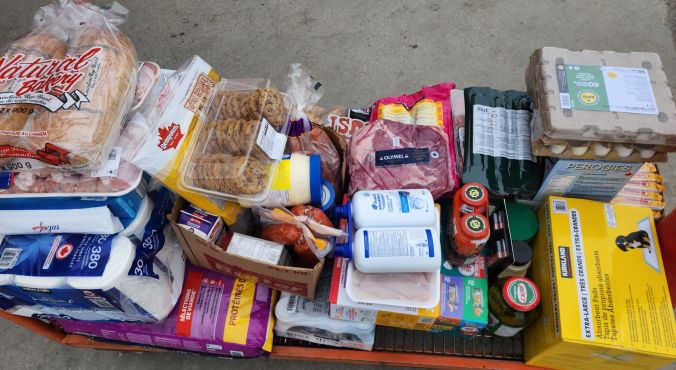
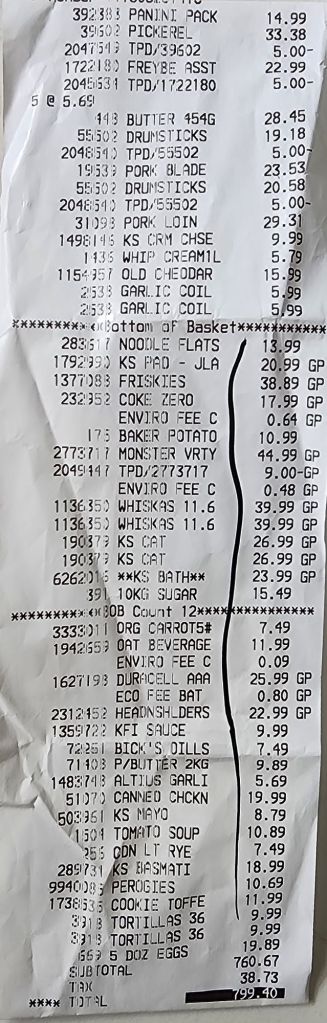
There is is. $760.67, before taxes. After the cart was re-loaded, we had to stop and my daughter reorganized things. Because of the crowds and line to the Customer Service desk, we had to do it outside. As our stuff was being scanned, a guy showed up to load the cart and he basically just threw everything onto the flat cart with no attempt to be secure or even logical about it. My daughter and I are both very keen on packing and stacking things well, so it was hard to watch! 😄
This picture was taken before my daughter was done reorganizing so no, those eggs did not stay balanced on top of the pierogi at the end of the cart!! 😄
This is what we got today.
We did get cat supplies, though with the generous donation, we should only need maybe one more 40 pound bag of kibble before the end of the month for the outside cats. We didn’t need any for the inside cats, so the two 9kg and two 11.6kg bags are all for the outside cats. I think the price on the 11.6 kg bags went up. Either that, or they were on sale that last time I remember getting them.
We also got a case of canned cat food and a case of XL puppy pads. We now have enough canned cat foot that we won’t need to pick up more for the rest of the month. Usually, I get a couple smaller cases at Walmart to have enough for the month.
For non-food items, we got our toilet paper, AAA batteries, and some more Head and Shoulders that gets used as an anti-fungal body wash.
For beverages, we got a case of Coke Zero and a case of Monster. The Monster variety pack had replaced one of the flavours from before, and it’s to one I like but haven’t been seeing in stores much at all lately, so I’m happy. It was also on sale, so that was bonus. There is also a 3 pack of oat milk for the girls.
In dairy, we got a 4 pack of cream cheese, a carton of whipping cream, a block of Old Cheddar cheese, plus 5 pounds of butter.
For meat and other protein, there is a double flat of 60 eggs, a panini pack of sandwich meats, some pickerel fillets for the girls, two big packs of drumsticks that were $5 off at checkout, a pork blade, a pork loin, and a variety pack of dry sausages that was on sale. I also got two garlic coils, as the price was almost half what they are, locally. Oh, and some canned chicken. The price on that seems to be staying under $20 for six cans of late.
There is also a bag of carrots – organic, but they were on sale, and we didn’t see any non-organic ones anywhere, a 20 pound bag of Russet potatoes, frozen perogies, a case of ramen noodles, a bag of basmati rice, a case of tomato soup, large jars of mayo, peanut butter, and pickles. There is a two pack of butter chicken sauce, a shaker of powdered garlic (which, oddly, had more product for a lower price than the granulated garlic I usually get), and a large bag of granulated sugar.
For bread products, I got a 2 pack of rye bread and we got two packs of tortilla wraps. Finally, as a treat, my daughter selected from toffee and chocolate chip cookies.
Note that we did NOT get any beef. We haven’t been able to afford beef at Costco for a while, now. Lately, I’ve been picking up the odd package on sale, locally. The last couple of times I was in town because of the truck, I got some stew meat and some ground beef with sale prices much better than Costco these days.
Once the truck was loaded up, we filled the gas tank. Costco gas was at $1.239/L instead of $1.359/L everywhere else! It cost $51.69 to fill the tank.
On the way home, we stopped at the feed store and picked up the lysine. It came in adorable little 1kg buckets from a different brand this time. The price went up, so the two of them cost $67.20 after taxes. The containers I got before had been $20 each. Still better than buying it elsewhere.
When I saw the buckets, I commented on them, and that I would probably be keeping them to reuse. The woman behind the counter completely agreed with me – you can’t have too many buckets!
She also asked me if I was still wanting to get chicks.
I said yes, absolutely.
She asked if I was after a specific breed or anything like that, and I said I just want laying hens. She named several breeds, and I was fine with any of them. Then she asked about the date I’d want them, snowing the hatchery’s schedule on their white board.
There was no way we’d be ready for them in April! I told her, we need to be able to assemble the chicken coop first, which means, no snow on the ground. (Yes, I know; they’ll be in a brooder for weeks, first, but I still want to have the coop assembled and ready, before we get them.) So she put me down for the latest date they had, which is May 27. She has two other people who are interested in getting a smaller number of chicks than the 24 chick minimum the hatchery sells them for. I told her that, with our coop, we can have a maximum of 10 chickens, so we can go under, but not more than 10. So she will talk to the other two people and see what can be worked out to split an order of chicks between us, as well as splitting the shipping costs. With three people, we’ll be paying $15 each for shipping instead of $45.
Hopefully, we’ll be able to work something out with the other two people and get it all arranged and ordered. I’m flexible on the delivery date, too, as long as it’s not in April! She said, all three of us have said we are flexible on things, so this should work out quite well.
My daughter had been waiting in the truck all this time, so once we were back on the road, I updated her about the chicks discussion.
I think she is actually starting to look forward to having chickens! My daughters had been very reticent about it. Especially her sister. They have online friends who keep chickens, and my older daughter had commented about chickens getting sick, and we wouldn’t be able to take them to a vet.
Well, no, but we would be getting what we need to treat them ourselves! The feed stores carry medications and supplements for chickens, as well as feed. There’s lots of info out there on treating chickens.
Then we got to talking about where to set up the coop.
Ideally, I’d like to have it where we can easily see it, which would be in the south yards. Most of it isn’t level, and some significant portions of it floods in the spring, so that likely won’t work. I mentioned I was thinking of having it sheltered in the maple grove, or even where we currently have a pile of maple logs from the trees cleared away from the roof. The ground under that log pile is quite level, and I can see it out my bedroom window. Inside the maple grove would be more sheltered and there are fairly level spots there.
My daughter suggested we set it up against the retaining wall blocks at the end of the old kitchen garden. I had considered that area, but it would have to be at the northernmost end, as the south end is next to an area that gets deeply flooded in the spring. It’s not as sheltered from the wind, but it does get more light than if it were in the maple grove.
The other thing to consider is being able to secure the coop from being blown over in high winds. We’ve previously talked about getting panels that we can set around the mesh sides on windy days. The roosts are under the floors of the nesting boxes, rather than inside. There are three nesting boxes, with access from outside, at each end of the coop. When we assemble it, I want to find a way to attach a couple of roosts in the space in front of the nesting boxes, so they can roost for the night indoors, and not be exposed to the wind.
Ultimately, though, where we set up the coop will be temporary. I still plan to have some sort of polytunnel or greenhouse of some sort over garden beds in the main garden area. The coop and chickens would spend the winter inside that. So while we will need to secure it to make sure it doesn’t get blown over in high winds, we still need to keep it mobile.
I quite enjoyed talking it out with my daughter!
Anyhow.
Once at home, I had to drive up to the house to unload. I had some concerns on whether or not I’d cleared away enough snow before my body gave out. Especially the area I pull into behind the garage, so I can back up to the house. Sure enough, while in 2 wheel drive, I got stuck. I switched to 4 wheel drive and was able to back up. It was hard to tell, but I think that shuddering had started up again, while I was reversing in 4 wheel drive. The distance was so short, though, I really couldn’t say for sure. I just made sure to switch back to 2 wheel drive as soon as I was stopped, so I wouldn’t forget later.
Then it was the assembly line to unload the truck into the house. Last of all, my daughter and I took the kibble bags into the old kitchen. The whole time, we were constantly needing to make sure Sir Robin didn’t get into the house! He so wants to be inside!
Once the last of it was done, I left my older daughter to put things away while I grabbed some hot water and did the outside cats early. My younger daughter took over doing the kibble while I topped up the water bowls. Once all the cats were distracted, I was able to drive the truck out of the yard. I only had to scoot two of them away, first!
So there was have it. Finally. Our Costco stock up trip is done!
We will still need to do the Walmart and Canadian Tire trips, but that’s not as urgent, and there isn’t a lot we need to get there.
What I do need to do is visit my mother! I am planning to do that tomorrow afternoon, so I’ll be calling her tonight to let her know. My sister should have been able to visit her today. Maybe. During the drive home, we hit some pretty crazy blowing snow conditions, but it did clear up before we got home. As I write this, we are at our predicted high of -13C/7F, but the wind chill is -28C/-18F
Oh, my! Not only are we warming up over the next few days but, as I write this, we’ve got a high of 6C/43F forecasted for Sunday! 6C!!!! Wouldn’t THAT be nice!!
So, tomorrow (Thursday), I visit my mother. The day after, I have my doctor’s appointment. Saturday, I want to make a trip to the dump. Just a regular garbage and recycling run, though; my mother’s old mattress and box spring, and the broken office chairs, will have to wait for another day. Monday, my daughter has a doctor’s appointment. After that we don’t have anything scheduled until my dentist appointment near the end of the month, but March is also a birthday month for my older daughter. For her special birthday dinner, she usually chooses Pizza Hut pizzas. So at least one more trip there (no one delivers where we live. 😄)
Well, our mechanic has said, we need to drive the truck often. Mechanically, it’s running fine, with the possible exception of the shuddering in 4 wheel drive that comes and goes. I can just keep it in 2 wheel drive until absolutely necessary. They’ve checked and re-checked, and they can’t find anything wrong that could be causing it. The weird electrical thing has only affected the console and radio. The dashboard display has not been affected.
It’s still hell on my nerves, though.
The main thing is, we have transportation again, AND we finally got our first stock up shopping trip done – a week later than usual!


 The Re-Farmer