Also, she seems to now be more expecting and accepting of her wet cat food delivery. She didn’t growl at me this morning, as I used the food delivery back scratcher to drop it as close to her face as I could. She didn’t even bother leaving the cat cave while I was doing the kibble this morning, and simply waited, nursing her babies. Once the food was delivered, she didn’t hesitate to start eating, too.
This afternoon, she did leave her babies briefly after I came out with the second feeding of the day, but went back before I was done refilling water bowls. She didn’t growl at me until I stopped to try and get photos and video of her.
My younger daughter has been having a rough time getting sleep (with both cats and high pain levels to blame), so she ended up awake all night. This morning, she was a sweetheart and shoveled the plow ridge away, and cleared the end of the driveway before going to bed for the day. We haven’t bothered to try and clear the rest of the driveway, or the turn around space in the yard to back up to the house. Though our high of the day was just below freezing, it was bright and sunny, and things are melting all over. I considered doing the Costco run today, but decided against it.
I did make a quick trip into town and stopped at the hardware store to pick up a heat mat. Unfortunately, they were all out. I did stop at the grocery store for a few things, but I will do the Costco run tomorrow. There is a Canadian Tire across the street from the Costco I go to, and I’m hoping they will have a heat mat…
… because our pre-germinated seeds need to be potted up!
The first image has the 4 Sunshine squash and the 6 Mashed potato squash. As you can see, their seed leaves are emerging from the shells.
In the second image, with the 2 Arikara squash and the 5 Baked Potato squash, are just going wild with their roots, as well as the seed leave emerging!
In the last image, the luffa now has 3 out of 4 seeds showing radicals.
I have everything ready to pot these up, except a second heat mat. The eggplant and peppers won’t start showing for a while, yet, and those need to be on the heat mat. The luffa will go into peat pots, so they can fit into the tray with them and be warm, but the rest of the squash will be going into the large celled tray. I might have to just hang out in the basement with the heater on and warm things up. I can also use hot water in the tray to help warm up the seed starter mix, too. The basement, however, was at only 10C/50F when I went down this afternoon. That would be really warm, if I were outside in the sun, but in the basement, it feels cold!
Those germinated seeds need to be put into the seed starting mix, though.
I think I’m going to take the chance and just do that today, then go hunting for a second heat mat for them, tomorrow.
Well, it has stopped snowing – for now. We’re supposed to get a brief snowfall again later this evening.
I am so glad we got our first stock up shopping trip done yesterday. I got a call from home care saying there wasn’t anyone to do my mother’s med assist in the evening, due to unsafe road conditions. !!! The problem is, if the road conditions are too unsafe for the home care worker to drive to my mother’s town, it would be equally unsafe for me or my siblings to do it. After explaining the situation to the shift supervisor that called me, she said she would look into things can call me back. Thankfully, they were able to find a home care worker that didn’t have to drive into my mother’s town, and could juggle schedules so she could do my mother’s two evening med assists.
While waiting for her to call me back, I checked the road conditions, just to be sure. Our provincial government website for road conditions is notorious for not being up to date, so when I saw it listing our highway was “partially snow packed”, I checked a local highways group on FB. Some people had made the drive on the highway I’d be taking and things were certainly not very safe. Our gravel roads, of course, have not been plowed yet, but I did see cars driving past our place. The danger isn’t so much the snow, but that it’s snow on top of ice from our recent warm weather melting things all over.
So I was very, very happy and thankful when I got the call back saying they’d found a way to get my mother’s med assist done!
What better way to spend my time when it’s too snowy to do anything outside, besides shovel?
Work on garden stuff, of course.
With the basement being as cold as it is, I headed down to get the heater going and seeing what I could do to prepare for potting up the pre-germinated seeds. Premoistening the seed starter mix works great, but it has resulted in the mix being far colder than if it were dry. I set things up so that the heater was blowing right over my giant metal mixing bowl to help warm it up, along with the rest of the room. Then I checked on the seeds.
They are looking great! We have a near 100% germination rate!
In the first photo, we have the Sunshine squash. It’s hard to see on a couple of them, but yes, all four of them have radicals emerging. The other, with six seeds, are the Mashed Potato squash. It’s hard to see with some of them, but they have all germinated.
In the second photo, you can see that all three Arikara squash have germinated. The five seeds are the Baked Potato squash, also all germinated.
Next are the luffa, and so far, two of four have germinated. I would not be surprised if the last two also germinated by tomorrow.
In the last photo, I have a large-celled tray prepared and set up in front of the heater to pot all but the luffa into. That will leave three empty cells.
I might have to invest in another heat mat, though. That little heater can only do so much in such a big room! We don’t have any bigger heaters. The basements are not heated. The old basement is where the furnace is and it actually does get warmer. I considered setting up in there, but it doesn’t have enough outlets available to plug in a heat mat or grow lights.
For now, in the tray I’m using to hold the seed starts now, I made sure to add warm water to the base for the eggplants and peppers in peat cells. With the heat mat, the peat was drying out, which would draw moisture out of the seed starter mix, so I have to made sure those stay damp. The heat mat would also keep the water in the tray warm, which helps. The luffa will be potted up into individual peat pots, since they will be transplanted into large pots in the little portable greenhouse we got, while the winter squash will go into various garden beds. The luffa pots can go back to the tray the eggplant and peppers are in and will stay warm, but the second tray with the winter squash is going to need to be warmed up as well.
I should be able to get a second heat mat in town, but there’s no going anywhere today. Possibly tomorrow, if road conditions are improved. Otherwise, Sunday would be the earliest.
The seeds should be okay in their damp paper towels for now. Even if the first leaves start to emerge, they can be potted up. I just don’t want them to pot them up, only to get killed off by cold!
Well, we’ll see how it works out over the next couple of days.
I was happy to see an envelop from Vesey’s today. These were the part of a larger order I made that could be sent right away. It was just two packets of seeds, and one of them was flowers, but I did want to get the peppers started right away.
With a days-to-maturity of only 70-75 days from transplant, starting the Sweeties Snack Mix this late should be okay. This mix of small sized bell peppers are something I actually see regularly in the grocery store, sold in packages with red, orange and yellow peppers, just like what is supposed to be in this seed mix. I’ve even bought them a time or two, so I know the family enjoys eating them. Which is good, since these are the only peppers we’re growing this year. We still have both dried and frozen peppers from last year!
While I was handling the moistened seed starter mix, I could tell it was way too cold for the seeds. The thermometer I have set up on the work table reads a consistent 10C/50F – which may have felt warm while I was outside, felt cold while in the basement! The container I use to hold the pre-moistened seed starter mix, however, is enameled steel, and it was sitting on the concrete floor.
Oops.
I now have a different set up and it no longer rests on the concrete floor. Hopefully, that will make a difference for the next time I have to start seeds!
I brought down a little heater and set it up to warm things on my work table. Since I had to wait a while, I did some clean up in the root cellar. We didn’t get to the last of the winter squash in time, and a bunch had to be cleared away. I decided not to put them in the compost ring, though. Instead, I spread them out in different areas to see if they would seed themselves. It’s more likely that they will be eaten by critters, but if a few seeds survive, we might have “wild” squash plants growing.
Once those were out, I took the time to clean and sanitize the shelves before getting back to the seeds. The only things we have left in the root cellar right now are onions and garlic. We keep forgetting that they are there!
As for the peppers, because these are a mix, there’s no way to know how many of each colour of pepper we’ll get. Depending on the germination rate, I might thin by transplanting. They should be fine on the heat mat for now, but once things start germinating, I’ll have to find some way to keep things warmer in there, since I’m not about to leave a heater running unattended in the basement.
Ah, well. We’ll figure it out!
Meanwhile, we’ve started our earliest seeds for now. The net ones I start should be the tomatoes, and those won’t need to be started for at least a week. The seeds set to pre-germinate should be potted up, by then. Hopefully, the bulbs for the other light fixture will have arrived. Not only does that fixture have a built in timer, but it also puts off a bit of warmth. The one that’s down there now doesn’t seem to get very warm at all.
It should be interesting to see how things work out, in this year’s seed starting dungeon!
This is so much later than in past years, so we’ll see how it works out. We’re doing things a lot different this year!
While we are going to deliberately aim to have fewer transplants there year, I did plant extra seeds, just in case some don’t germinate. Of course, pre-germinating the larger seeds will make it easier to know if there are any problems with germination. With the eggplant, I used a 10 cell seed starting tray from last year and just filled it. Each cell has two seeds in it, though I think the very last seed I planted was actually two stuck together. Way more than we need, but we’ll see what the germination rate turns out to be.
I don’t plan to start any other seeds until the first week of April. Hopefully, some of the winter squash will have started to sprout before then, and can be planted. I am a bit concerned about the heat mat, though. It didn’t feel any warmer, by the time I left. I need to check it again later. It might not be working!
Okay, I just dashed down to the basement (… well… “dash” may be a strong word to use for me. 🤣) and checked, and yes, the heat mat IS working! I hope it’s got enough heat. The basement seems to stay at about 10C consistently right now.
This is way different than using the big aquarium as a greenhouse!
Well, we shall see how it works out. Worse comes to worse, I will sacrifice the heater in my bedroom!
While I was out and about today, I found myself standing in line at the grocery store, right near a seed display. So, of course, I went looking.
Yeah. I bought more seeds.
In going through my seeds, I was thinking of what slicing tomato to grow this year. I had decided on doing the Spoon tomatoes, and will make a point of saving seeds from those, but for the family, I wanted a slicing tomato and a snacking tomato. I saw the two varieties of black tomato seeds we grew a couple of years back, and somehow completely missed the packet of Forme de Couer tomatoes (I think it was stuck to the back of another seed packet) that we grew last year. The black tomatoes took such a long time to mature, I figured it was worth getting these to try.
Sub Arctic Plenty tomatoes, which need only 40-59 days to harvest, after transplanting outdoors. In the next photo, you can read that this variety was developed in Alberta specifically for our prairie climate, is a determinate tomato and does not need staking.
The “It grows here” guarantee is a nice touch.
Well worth the try. Hopefully, it will even taste good.
After I finished doing my evening rounds early and tending to the new mama in the sun room, I got my daughter to help me take some things to the basement, then we went through the packets of tomato seeds together, so she could help choose one more variety.
We ended up with two.
For a snacking tomato, I’ll start some Chocolate Cherry tomatoes. My daughter, however, spotted the packet of Black Beauty tomato seeds. While these took forever to ripen, and had a tendency to split like no other tomato we’ve grown, she says they were the most delicious tomatoes we’ve grown to date.
So we will have two types of slicing tomatoes. One short season variety and one long season. Depending on how things work out, the Sub Arctic Plenty tomatoes should be done and harvested just in time for the Black Beauties to start ripening.
That makes four varieties of tomatoes we will be growing this year, and I will make sure to NOT start too many seeds! With the different places we’ve tried tomatoes before, I have a better idea of where I will transplant these. Most definitely not in the blocks along the chain link fence, for starters! I figure I will shoot for four transplants of each variety. That should be enough for out needs, since we will not be freezing or canning any tomatoes we grow this year.
Either tonight or tomorrow, I will head back into the dungeon and set some seeds up to pre-germinate. The tomatoes will wait until the first week of April, but there are other things I can start now.
I have decided to go ahead and try the luffa again, after all. They will get transplanted into large pots and be kept in the new portable greenhouse we got for the entire growing season.
I will also start pre-germinating seeds for winter squash, but I think I’ll sow the Turkish eggplant right away into seed starting mix, rather than pre-germinate them. I don’t feel like pre-germinating smaller seeds. I will pre-germinate the melon seeds, but not until April.
Today, started bringing seed starting supplies to the basement, and went through some of my seed inventory for potential seed starts.
In past years, I would have had all sorts of seeds already started. Things have changed a lot with our winter sowing experiment. We have quite a variety of seeds already planted, taking up quite a few beds, which I need to plan around. I’m not going to assume we will have any new beds ready to plant in for this year, and will just focus on what we have ready right now.
With that in mind, here is a video I took while going through my bin of seeds that would be started indoors.
I won’t actually start seeds indoors until at least a week from right now, with some things to be started in April. That should give enough time for my seed orders to come in. Aside from a few varieties of winter squash, herbs and tomatoes I want to start, we will have the new varieties of eggplant, mini bell peppers and a honeydew melon I want to try this year. This time, I will not start as many seeds of each for transplanting this year! Last year, I had not expected to have 100% or near 100% germination rates on so many seeds. We had so many things to transplant, there wasn’t much space left for direct sowing.
I have decided I will go to a Walmart tomorrow to pick up a few things, and will pick up some seed starting mix while I am at it.
I forgot that the aquarium light with the timer on it has a bulb that needs to be replaced; this fixture holds two bulbs. For now, I have brought down the fixture with one larger bulb that came with our big tank. Meanwhile, I’ve placed an order from Veseys for a pair of 4 foot T5 bulbs. I’d had a hard time finding the right bulbs elsewhere and, when I did find them, they were shockingly expensive. Veseys had the best price I’d found, even taking into account the extra shipping cost for bulbs, but by the time I was ready to order them, the size I needed was sold out, and then I simply forgot about it. So those are now ordered and should be on their way soon.
The first day of spring is coming soon. I was planning to do our first “garden tour” video on that day, but I will be going to my mother’s. I might just do it tomorrow, before I head out, instead. We are supposed to have a steep temperature drop, from an expected high of 6C/43F on the first day of spring, to -10C/14F the day after. Things are going to be really slippery around the yard after all the melt! It’s already pretty treacherous in places, while I do my morning rounds.
Anyhow. I hope you enjoy the video. I used a new chest harness my husband got for me to hold the phone I was using to record video. While editing, I did find my voice was a LOT louder than typical when I record video, and had to adjust the audio volume down. When I had to sit down to continue recording, I was concerned things were too close to the camera, but I think it worked out okay, in the end. Please feel free to let me know what you think.
Okay, I did say, months ago, that we did not need to order seeds this year.
I also said that I knew I probably would order more, anyhow! 😄
I’ve placed two orders so far. One was with MI Gardener, and I just got the email notification that they have been shipped. I explain what I chose, and why, in this post. Most are “back up” seeds, in case our winter sowing experiment fails.
I also placed an order with Veseys, but this was more for the food forest. The seeds ordered were so that I could take advantage of a promo code to get free shipping. I explain what I ordered there, and why, in this post.
So, why am I ordering even more seeds?
I mean, besides the fact that I just want to… 😄
Well, this order is with Heritage Harvest Seeds. It’s actually been a couple of years since I’ve ordered from them. They are a small heirloom seed company that is even further north than we are, so as far as climate and growing season goes, I know anything I order from there should grow here.
Another reason is, more back up seeds!
This is what I ordered today. (all links should open in new tabs)
At the top of the list is Cream of Saskatchewan Watermelon. We tried growing these last year, and one one tiny little watermelon out of the only surviving transplant. I want to try them again, but this time give them more dedicated space, rather than having it share a bed with a whole bunch of melons. I do still have seeds left, but they are a couple of years old, so I want to have some fresh seed.
Next is the Arikara squash. This is a variety of winter squash I have been eye balling for years. I chose is specifically due to its rarity, with the goal of saving seeds. From the website description:
Originally grown by the Arikara Indians of North Dakota, This squash is oblong with pinkish orange skin and a green star on the blossom end. The Arikara Indians picked the blossoms and dried them for winter use. A very good storage squash that can be used for soup. (90 days to maturity) Extremely rare.
I may not grow these this year, as I have other winter squash we want to grow, and if I’m looking to save seeds, I don’t want to risk cross pollination. We shall see how things work out.
I also ordered more White Scallop Squash. We had issues growing them in containers last year – they simply did not germinate – but did finally get some in one of the garden beds. By then, it was so late in the season, I’m amazed we had any to harvest at all. The last of the seed went into the winter sown bed with all summer squash. These are back up seeds, in case none survived the winter.
In my MI Gardener order, I did order sugar snap peas. This time, however, I ordered Super sugar snap peas! 😄 From the website:
One of the sweetest and crunchiest snap peas available! The 3 inch pods are delicious eaten raw or cooked and are very productive. A favorite of all who try them! Tall vines to 6’ in height.
If we have the space, I’d like to try both varieties of sugar snap peas we’ll have this year. If we end up with space for only one variety, I’d like to try this one, first.
Last of all, I ordered two packets of Yukon Chief corn. Last year, we had two short season varieties to choose from. Yukon Chief and Orchard Baby. We did Yukon Chief first, due to it’s super short growing season. This year, we will be trying the Orchard Baby. Hopefully, if we can keep the racoons from eating them first, we’ll be able to save seed. We did really like the Yukon Chief, though, so I ordered two packets this time, for next year, and plan to save seed again.
One of the changes at Heritage Harvest is that they now have a $20 minimum order. We’ve never had problems with having our seeds shipped with regular mail, but apparently, others have. Solving the problem meant to have expedited mail with a tracking number, but the extra cost of that only makes sense with orders of at least $20. That brought our final cost to Cdn$36.50
Except it didn’t cost us anything. At least, not anything out of budget.
One of the payment methods is PayPal. This year, we actually got payment for ads on this blog (it took 3 years!), which was sent by PayPal in US dollars. It went into my personal PayPal account, and I left it there, so I used that to pay for this order. Which got converted to US$26.45 at the current exchange rate.
Which worked out quite well, I think.
So that’s what I got today; a combination of things to plant this year, and next year, and back up seeds, if the winter sowing didn’t work.
I have to admit, I had to mightily resist ordering more. They have the Tropeana Lunga onions that grew so well for us when we tried them a few years ago. I was also tempted by the Amish Bottle Onion, simply because of its rarity (and the shape, which I find easier to cut when cooking). I even seriously considered the Yellow of Parma onion, for its excellent storage and up to 1 pound size. We have so many of our own onions seeds, though – as well as seed producing onions – that we may never need to buy onion seeds again. I also want to try the Red Mangel, though that would for a time when we have animals, to grow as feed. There are just so many things I want to try!
This will do for now, though. We have more than enough seeds for this year, and years to come!
We just need to keep expanding the garden beds for now, and grow what we can in the beds we have available now.
Okay, I wasn’t really planning to buy more seeds this year. Not exactly.
With our winter sown beds, which are detailed in the video below, we actually have a lot already planted for this year’s garden…
… that’s IF they survived the winter.
If they didn’t, then we’re not going to have a whole heckuva lot at all, because I finished off seed packets in doing this method.
There are a few things that I am thinking to start indoors – especially now that we have the portable greenhouse – but other things I will likely buy as transplants in the spring. Decisions will be made in the spring for that.
In the end, though, I broke down and made an order with MI Gardener. I’ve been looking at Canadian seed sources but, in the end, it came down to price. I’ve been really shocked by how expensive some seeds have gotten, even with very low seed counts in the packages, at a number of the sites I’ve bought from in the past. Plus, some of the things that interested me were either sold out or no longer available.
I didn’t even make a large order. Just a few things, some of which I probably won’t even plant this year.
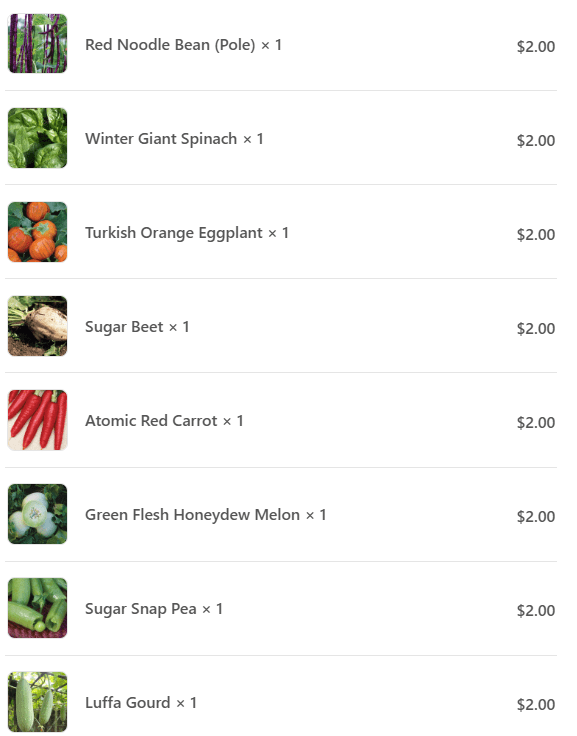
The first item in the list is red noodle beans. We tried growing these a few years back and ended up having a drought and heat waves that year. They grew, but I only found a single pod when I was cleaning up for the end of the season, and it was the saddest, skinniest little thing! Along with the bush beans I have winter sown, I want a pole bean and a shelling bean. We have plenty of bean seeds, but no red noodle beans, and I’d really like to try those out.
Next is Winter Giant Spinach. I winter sowed all our spinach seeds so, if they don’t take, this will be our fallback planting.
Next is Turkish Orange Eggplant. We grew Classic and Little Finger eggplant last year. This year, I want to try a different variety. I’m not sure we’ll grow them this year – we’ll see if the order comes in early enough to start them indoors – but it will be an option. If nothing else, we can try the portable greenhouse to extend the season.
I got a package of sugar beet, but don’t expect to plant them this year. I want to actually try and make sugar with them, so this is going to be one of those “fun” things I like to include in my garden every year.
We have more than one variety of carrots winter sown. We still have more Uzbek Golden carrot seeds, if the winter sown ones don’t take, but it would be nice to have another variety as a back up seed.
We did the Summer of Melons mix last year. This year, we still want to grow at least one variety of melon. My younger daughter prefers honeydew types over cantaloupe types, and this Green Flesh Honeydew variety seems to have a short enough growing season to make it worth trying. We have other melon and watermelon seeds already on hand we can try this year, but we will definitely be scaling back from the number we grew last year!
Next are some basic sugar snap peas. I have shelling peas already, and want to have both types.
Last of all…
Yup.
I’m going to keep trying!
I ordered some luffa seeds.
If they come in early enough, I might try them this year. I’m not completely decided on where we will set up the portable greenhouse but, once we do, I will try growing the luffa there in pots, rather than transplanting them into a garden bed.
That’s it, that’s all. A whole 8 items.
All of these together came to a grand total of US$23.50, including shipping. Granted, with our Canadian dollar tanking so much right now, it will probably be closer to Cdn$50, but that would still be less than if I’d try to order these, or similar varieties, anywhere else.
[update: the order was processed, and it came out to Cdn$34.82]
The other things we will need to order or buy for this year’s garden will be things like potatoes and fruit trees. They wouldn’t be shipped until closer to our local last frost date of June 2, so we have time. We just have to settle on what we will be getting this year, first.
I have never ordered from MI Gardener before, but have heard nothing but excellent things about them, so I look forward to getting and trying out these seeds this year!
It’s cold AF out there, which means I’m thinking of the garden!
We are doing things very different this year, though.
The first major change is that I winter sowed a number of garden beds in the fall. You can see what and where, in this last garden tour video of 2024.
In previous years, I would have already at least started onions and shallots by now, and possibly some peppers. With the winter sowing, however, I have – hopefully – a head start on all these. I combined old and new seeds in various combinations into shakers before scattering them onto prepared beds and deep mulching them.
This is what I’ve got already sown.
Garlic – saved cloves
Seed combo 1: root vegetables Carrots: Uzbek Golden and Napoli Beets: Bresko, Merlin, Cylindra and Albino Turnip: Purple Prince Radishes: French Breakfast, Champion, Cherry Belle and Zlata Onions: saved seed (mix of red and yellow bulb unions) Note: left over seeds from this mix were planted in a final bed with saved Jebousek lettuce seeds added in
Seed combo 2: Summer squash mix Sunburst pattypan White Scallop pattypan Magda Green zucchini: Endeavor Yellow zucchini: Goldy
Seed combo 3: Kitchen Garden mix Swiss Chard: Bright Lights and Fordhook Giant Spinach: Space, Lakeside, Bloomsdale and Hybrid Olympia Kohlrabi: Early White Vienna and Early Purple Vienna Bok Choi: Hinou Tiny (saved seed) Shallots: saved seed Onions: saved seed
Seed Combo 4: tall and climbing (mostly) Sunflowers: Mongolian Giant and Hopi Black Dye Peas: Dalvay shelling peas (not saved seed) and King Tut purple peas (saved seed) Bush beans: Royal Burgundy Corn: Montana Morado (saved seed) Onions: saved seed
Flower Combo 1 Nasturtium: Dwarf Jewel Mix Butterfly flower: Orange Shades (milkweed) Forget Me Not
Flower Combo 2 Western Wildflower Mix
Perennials: Strawberries: Albion Everbearing and an unknown variety of small strawberries, plus whatever survives in the asparagus bed Purple Asparagus Sunchokes Onions for seed
So that is quite a lot of stuff that’s already been sown!
In theory, because they were heavily mulched, plus have an added layer of snow to insulated them, these seeds should start germinated as soon as the soil warms up enough.
In theory.
There are two things that I expect will reduce the germination rates.
First, I used this as an opportunity to use up some older seeds. Most of the summer squash, for example, is seed that’s 3 or 4 years old. The white scallop squash were new for last summer, so those should have a higher germination rate. Considering how many seeds were scattered in one bed, having a lower germination rate is not a bad thing. It would have me from having to thin them.
Second, these polar vortexes we’ve been hit with. While all the beds were mulched, the temperatures got so cold, it’s entirely possible a lot of these seeds have been killed off. I still expect some to come up – the onion and shallots, beans and peas are, I think, most likely to survive the cold. At this point, however, I will be amazed if we get anything. In fact, I’ll even be surprised if our Liberty apple tree survived, for all that we made sure it was planted in a well sheltered microclimate.
In the spring, once the snow starts melting away, I will need to remove the mulch so that the soil can warm up faster. With some beds, like the one in the old kitchen garden, I am hoping to be able to put one of the covers over them with plastic to warm them up faster. With the summer squash bed in particular, I’m hoping to arrange enough hoops or something so that it can be covered for its entire 18′ length. That bed will also need extra protection from slugs.
Aside from these winter sown beds, this is the space we still have available.
In the main garden area.
There is the low raised bed that will eventually be paired with another bed, yet to be built, to form a trellis tunnel. Right now, one half of that bed was cleaned up and replanted with onions that we gathered seed from, last year. I was able to do all red onions along one half, and all yellow onions along the other. The other side of the bed is where we had melons last year, and that half is still open for planting.
That leaves three other 18′ beds that are available. One has the logs to frame it, and those will be permanently joined once things thaw out in the spring. The other two have no log frames, yet. We have some dead spruces that are either cut down or have fallen down that we can use for that, but that will be worked on throughout the summer, or until whatever we plant in the beds are too big to work around.
There is also the bed with the Albion Everbearing strawberries in it. Those should survive the winter. Given the trouble we had with deer eating them, what I will probably do, once the ground is thawed out enough, is transplant them into the old kitchen garden – more on that later. Once that’s done, the bed will be available for something else.
As we are able, we intend to add many more beds to this area, focusing first on the trellis beds to the East, then reclaiming what has been a squash bed for the past few years to the West. This will require harvesting more dead spruces for materials, so it may be slow going. Last year, we got very little progress done, largely because of the weather!
In the Old Kitchen Garden
There is just one rectangular bed in the old kitchen garden that is winter sown. That leaves the tiny raised bed, the retaining wall blocks and the long, narrow bed against it, and the L shaped wattle weave bed.
For the long bed at the retaining wall, I will be doing some changes. Along the inside of the bed, it is bordered with a couple of logs to make it a lower raised bed. The top log is too crooked, so we can’t raise the soil level any higher, as it ends up falling through the gaps. I’ve decided I will remove that crooked long, but keep the straight bottom log, and then harvest willow branched and coppiced maple to wattle weave on top of it. This bed also has some short logs on the ends of the retaining wall blocks. The vertical sticks we used to hold those in place have started to break up, so I will probably replace those with a wattle woven wall, as well. Once this is done, we can add more soil to make it a slightly higher raised bed and not have soil falling into the path anymore.
The short side of the L shaped bed is where I am thinking of transplanting the Albion Everbearing strawberries. Considering how well the strawberries we grew from seed are doing there, I think that will work out.
As for the strawberries that we grew from seed, in the long side of the L shaped bed, while they are doing very well and are very prolific, they aren’t that good of a strawberry. Those will be transplanted out, but I haven’t decided where, yet. It will be somewhere that they can be left to grow wild and spread naturally.
That bed also had thyme we transplanted in, and chamomile that self seeded, in it. It’s unlikely the thyme survived the winter, but it’s possible the chamomile self seeded again. We shall see in the spring.
The tiny raised bed needs no work on it. Just the cover needs some maintenance from the cats using it as a hammock.
Then there are the retaining wall blocks. A lot of them have mint in them that we expect will come back. The ones with chives in them will come back, for sure. As for the remaining empty ones, they don’t get a lot of light and the growing space gets overtaken by an invasive flower that comes in from below, very quickly, so we will need to give a lot of consideration over what can be planted in there.
Chain link fence
We have a similar issue with the chimney block planters at the chain link fence, except it’s elm tree roots, not flowers, that have invaded those blocks! These need to be treated as a container garden, when it comes to what gets planted in them. Nothing really seems to do well there. Partly because of the invading roots, but also the blocks themselves would also be making the relatively small amount of soil they hold more alkaline. We will need to make sure to continue to amend the soil with sulfur granules or other acidifiers, more than other areas (our soil is already quite alkaline).
The other chain link fence bed is winter sown, but in the fall, I’m hoping we can finally redo the bed with permanent walls. Right now, we have scrap boards against the chain link fence to hold the soil in, and bricks around the other side and the end that are simply resting on the soil. I want to make this bed higher – to make it easier on my back, if nothing else! I need to come up with something better to go along the chain link fence; the old boards I found were already starting to rot, so they won’t last much longer. For the rest of it, I wouldn’t mind doing more wattle weaving, but that needs a LOT of long, straight, narrow, flexible branches, and we just don’t have that. What we do have will probably be used up this spring when I add wattle weaving to the narrow bed in the old kitchen garden.
The next area at the chain link fence is the asparagus bed and the sunchokes. The sunchokes should be fine, and need almost no maintenance. The purple asparagus is likely a lost cause. We should have been harvesting asparagus for the past two years and, while some are coming up, spring flooding has really set them back. The strawberries interplanted with them try to do well, only to get eaten by deer, in spite of protective measures. There is nothing we can do about the spring flooding, even though it doesn’t flood there every years. We could try making a higher raised bed but I really don’t think it’s worth the effort to dig up the asparagus, build a higher bed, and replant them, in this location. Especially with elm trees so close, as their roots are so invasive. I still want to grow asparagus. We’ll just have to find a better place to do it.
The East garden beds
We currently have one winter sown bed in the East yard. That leaves two more 9’x3′ beds, plus a new 4′ square bed, available.
The compost ring is in this area, and I fully expect lots of things to start growing out of there this year! One year, we had lots of mystery hybrid squash show up. Last year, it was almost all tomatoes, though some potatoes (which never got harvested) also showed up. With what we’ve been tossing in there after preserving the harvest, I wouldn’t be surprised if more tomatoes, squash, melons and even bell peppers started to grow in there.
Those are the areas we will have available to plant in this year, right from the start.
There are a few things that I will want to start indoors for spring transplanting. Others, I will probably buy transplants, instead. Here are some things I’m considering.
Tomatoes: We ended up growing a lot more tomatoes than intended, and way more than we use. For this year, I’m thinking we will just grow a cherry or grape tomato for the family to snack on. We don’t need to do paste or sauce tomatoes again this year. If we do grow a slicing tomato, it will be just a couple of plants. We do have tomato seeds we can start, but are severely limited in space for starts this year, so I might just buy transplants. We shall see.
Peppers: we’ve been experimenting with short season varieties to figure out what the family likes, which had us growing away more than needed. We’ve saved some seed but, again, we don’t have a lot of space to do starts. If we grow peppers again this year, I will probably buy two, maybe three, transplants and that’s it.
Corn: last year, I tried a super short season variety. This year, I have seeds for another short season variety to try. Just enough to see if we like them. This year, I will see what I can to do set up supports around the corn before they get big, as we have a real problem with the stalks being blown over by high winds. We also need to find a way to keep the raccoons from eating them!
As for the Montana Morado corn that was winter sown, there were very few seeds. I’d collected the kernels from what plants survived when we grew them a couple of years ago, and we were intending to test them out as a corn flour. Before we could do that, the cats knocked the container over during the night, spilling it all over the floor. I’d swept them up and threw them away, not thinking that they could still be used as seed. Over time, I would find a few kernels here and there that got missed and saved those. If any of these winter sown seeds survive, I am hoping to use them to collect more seed. We shall see.
Peas: we have the shelling peas winter sown, but I would like to grow some edible pod peas, too. The family likes those better.
Beans: we have bush beans that are winter sown. I would like to grow at least one variety of pole bean, and one variety of shelling bean. We have lots of bean seeds to choose from.
Melons: we do love our melons, but this year, I think we will plant only one variety of melons, and one variety of watermelons. These would need to be started indoors, in late April.
Winter squash: last year, we tried the Wild Bunch mix and had such a high germination rate, we didn’t have the space to grow any others! Two 18′ beds were filled with winter squash. Last year, we also bought two varieties of winter squash my daughters wanted to try, so I want to try those this year. They will need to be started indoors around the end of March or mid-April. I’ll have to check the seed packets again to be sure.
Potatoes: normally, I would have ordered my potatoes by now, for spring delivery, but just haven’t done it. We do want to grow potatoes – and a lot more of them. I’m just not yet sure where we could plant them right now. If worse comes to worse, we can buy our potatoes from stores in the spring, instead of ordering them online.
Salsify: we got seeds for these a few years ago, but never got around to actually growing them. This year, I’d like to finally do that! I’ll have to double check the packages to see about starting them indoors or not.
Herbs: I have quite a few varieties of herbs. I need to check which ones need to be started indoors. The long term plan is for things like herbs, greens and other things we use in the kitchen frequently, to be grown in the old kitchen garden, since it is closest to the house. The problem is, we keep forgetting to actually use them!
Flowers: my daughter particularly want to grow flowers but, in my seed cache, I have a packet of Crego Mixed Colour Aster seeds. These were given out in the memorial cards of an old friend that passed away suddenly, last year. I would like to find someplace to plant them in her memory, this year.
Wheat: a few years back, I got a rare, heritage variety of Marquis wheat seeds. If we have a free bed, I would like to finally plant them. I only have a couple of packages, so we won’t have enough to use them for anything. I will be growing them solely to save more seed for future planting. At some point, we hope to reclaim enough growing area to plant a small field of wheat and have enough to actually use to make flour, and still save seed. Mostly, though, I want to keep a heritage variety alive.
So that’s the general plan for now. Very little is going to be started indoors this spring.
If the winter sowing doesn’t pan out, we’re going to have a much smaller garden!
It will be a few months before we will know of they survived these cold snaps. Hopefully, we’ll be able to tell early enough to know what seeds or transplants we’d need to buy to replace them, before it’s too late in the season.
For now, we have reached our high of the day; -20C/-4F, with no wind chill.
Time to warm up the truck and go to the post office!
For the next while, I’ll be going through my old posts and videos about our 2024 garden, looking at how things worked out, and use that information to decide what we will do in our 2025 garden.
Okay, here is where we talk about everything else. The perennials, the food forest and so on.
Sunchokes, asparagus, grapes, zucca melon and walking onions
Sunchokes: last year, I didn’t harvest any at all so that we would have more growth and a larger harvest this year.
That plan worked out rather well! We got quite a lot of sunchokes, and the largest ones were replanted for next year. We’re still learning what to do with them, but this is something we know grows here and will come back every year.
The only downside is that I found quite a few tubers with chonky caterpillars burrowed into them. Some burrowed all the way in, where they died. Some, with half their bodies still sticking out of the tubers! I have no idea what these are, and need to figure out how to get rid of them.
Asparagus: We planted these purple years ago, and should be harvesting them by now.
We are not.
In planting the crowns, a trench was dug about a foot deep, then the bed itself was hilled to give them depth they are supposed to have.
Then we discovered that, in wet springs, a moat forms around our garage, including through the vehicle gate into the yard.
Which is where the asparagus is planted.
At that depth, even though the bed itself is above water, the crowns would be saturated.
We need to find another place to grow asparagus. I don’t know that we’d be able to salvage this purple variety. The challenge is finding a place where they can be left to grow for the next 20 years – and not get flooded out!
Grapes: In cleaning up around the storage house, we found two grape vines my mother had planted. We made a trellis for them and have been trying to keep the spirea from invading them, every since. Last year was the first year we looked to be getting a really good harvest.
The very morning I was planning to harvest them, I came out to find the trellis knocked down on one side, and all the grapes gone.
Then one morning – while taking recordings for a garden tour video! – I discovered all the grapes gone, again. They had disappeared overnight.
Racoons.
I want to transplant these, perhaps on either side of an arbour they can climb on. Maybe closer to the house, where we can better protect them from racoons!!!
Zucca melon: This is one of those things I’ve been trying to grow for years. They are supposed to get huge – up to 60 pounds – and actually grow in our climate. They never seemed to do well.
This year, I thought we’d finally get some. We had strong and healthy transplants, and they went into the kiddie pool raised bed, so they wouldn’t get the elm tree roots invading them.
The slugs got them.
*sigh*
Next year, I want to try them again, but this time in the new bed the Crespo squash did so well in.
I just have to find a way to keep the slugs off!
Walking onions: When we first moved here, every spring, a single walking onion would appear along the edge of the old kitchen garden. There used to be a fence and a tire rim planter, with a tire cut in half and flipped inside out as the “pot” near that spot.
Every year, this one onion would grow, then something would smash it flat.
One year, I managed to keep it from getting broken long enough that it formed bulbils. I took some of those and planted them along the south side of the tiny raised bed nearby, where they would get full sun while being protected by the logs making up the raised bed wall.
At the same time, that side of the old kitchen garden was cleared as best we could, and my daughter planted flower bulbs as a border. We eventually added logs on the outer edge as a protective border, with a couple of openings line with rocks or bricks to walk through. In placing the logs, I was very careful to place one log outside of where I knew that one onion was.
It never came up after that.
The bulbils we planted, however, grew and thrived. When they formed bulbils, those were harvested to cook with, rather than allowing them to reach the ground and spread. We don’t want them to take over! These should continue to come back, year after year.
Milkweed, saffron, tulips and other flowering bulbs, wildflowers and … salsify?
Milkweed: When starting seeds indoors, I started some Shades of Orange Butterfly flower – a type of milkweed. Very few seeds germinated, and the ones that did, did not do well. When we were finally able to start transplanting outside, I was at a loss on where to put these sad little seedlings, as these were something I wanted to reseed itself, year after year.
Then I found one of our yard cats, passed away. He was buried in a bed that was supposed to get poppies in it, but we completely lost control of the weeds in it. After he was buried, I transplanted the milkweed on his grave, in hopes they would survive. They did not.
Tulips: My daughters planted tulip bulbs in an area of the west yard, not far from the old kitchen garden, several years ago. We had gotten rid of some dead crab apple and other trees around there, and there is a lilac hedge behind it – lilacs that are doing much better, now that they are not overshadowed by dead and dying trees! It’s a well sheltered and protected area – from the weather, at least!
Deer love to eat tulips.
After several disappointing years of tulips being eaten just before they started to bloom, we were starting to think the poor bulbs weren’t doing well enough to store energy to survive the winter.
After having to remove one last diseased crap apple tree, and the remaining stump of one that died long ago, we put in some fence posts and surrounded the entire area with bits and pieces of salvaged wire fending and chicken wire, with one side tied in place to serve as a gate for accees.
This year, much to our surprise, we had the most tulips blooming, ever! We even had some coming up in areas they hadn’t been in ages, and we thought for sure they had died.
Best of all – no deer damage!
I look forward to the tulips finally being able to spread through the area, as we originally planned for them.
Grape Hyacinth and snow crocuses: On the other side of the lilac hedge where the tulips are, is part of our maple grove. A few years ago, in one section, we planted 200 grape hyacinth bulbs. In another section, we planted snow crocuses. The hope was that they would spread and grow and eventually take over those areas, so we wouldn’t need to mow or weed trim it anymore.
This year, we did get both, but neither did as well as the year before. I think our late spring, with heavy rains and flooded out areas, was too much for them. They should continue to come back, year after year, though, and hopefully continue to spread and fill the areas they were planted in.
Wildflowers: I had picked up Western Wildflower and Alternative Lawn mixes of seeds. After we had a couple of branch piles chipped, we were left with bare patches of soil in the maple grove, and we tried planting them there. If any of them survived, though, I don’t know. We did have some things come up this year that might have been from these mixes, but I can’t say for sure. There was one that came up that I was very diligent about pulling and destroying, though. I don’t know if it was part of the mix, but we have them all over in the spruce grove. They have beautiful sprays of tiny flowers that turn into tiny little burs. If you walk anywhere near them, you’ll find your pant legs and sleeves covered, and they do NOT want to come out! Worse than burdock! They are almost as invasive as creeping bellflower or creeping Charlie.
We have an insulated tarp that we put over our septic tank. It’s large enough that we fold it in half to use it. When the tank was uncovered in the spring, I laid it out in the maple grove nearby and weighted it down. It stayed there all summer, in hopes of killing off anything growing under it, which was mostly creeping bellflower.
When it was pulled off, I found some things were still growing along the edges, but most of the weeds under there did seem to have died. I put the Western Wildflower mix into a shaker with some seed starting mix I still had and, after clearing and loosening the soil first, scattered the seeds over the area, raked it again to cover the seeds, then mulched it, as was done with the winter sown garden beds.
Hopefully, it will work this time, and we will have native wildflowers growing in this patch. If all goes well, I would want to harvest seed heads from it to scatter throughout other areas of the maple grove. There are just a few areas where we want to maintain clear paths of grass. The rest, we want to be taken over with flowers of all kinds.
I have not yet decided were to try the alternative lawn mix, again.
Salsify?: In preparing garden beds, I found a plant growing in an area I needed to dig up. I recognized the leaves as something that has been growing and blooming pretty wild. They are quite pretty, so I dug it up and transplanted it into one end of the low raised bed with the seed onions and Summer of Melons mix.
It grew very well, bloomed beautifully, and developed huge seed clusters.
Any time a seed cluster looked like it was ready to be blown away with the wind, I plucked the seeds and scattered them in the same area at the far end of the bed, where they could sprout next year.
As for what they are, it was suggested they might be salsify, which is something we actually have seeds for that we wanted to try growing. The roots apparently taste like seafood. The seed catalogs only had photos of the roots, not the flowers, but in looking online, the flowers did look like they could be salsify. When cleaning up the bed in the fall, however, the roots were completely different. Certainly not a tap root that one could use like a carrot or parsnip! It’s possible that just means they are a different variety of salsify, but I don’t know. Whatever they are, though, we might have ourselves quite a lot of them in that one spot where I was dropping the seeds!
The Food Forest: apple, haskap, mulberry, raspberries, sea buckthorn, silver buffaloberry, highbush cranberry and Korean Pine
Liberty Apple: this is the first variety of eating apple we’ve planted. It is a zone 4 apple, but we planted it near the lilac hedge by the old kitchen garden, where it should be more protected. It survived its first winter. Hopefully, it will survive this winter, too. It will be a few years before it starts producing fruit, though. We just need to keep it alive! As it grows, I’m hoping to be able to esplanade the branches, too.
Haskap: We planted these years ago, and we should have been getting lots of fruit by now. Unfortunately, they are not doing well where they are planted. I suspect it is because they are between an elm tree and a lilac bush, and there is too much competition for resources. There are also flowers that come up around them every year, but their root systems are very different, so I don’t think they could be a problem. I am thinking we should transplant them where we will be having the bulk of our food forest, but my daughters are concerned that transplanting them will kill them off.
The main problem, though, is that the “Mr. Haskap” variety, which is meant to cross pollinated with the “Mrs. Haskap” variety, blooms earlier. At most, we’d find a couple of berries, here and there, and that’s it. This year, we actually had the most berries yet.
A small handful of them. Which meant we at least had a chance to taste them!
They are very tasty.
I still think we need to transplant them.
Mulberry: last year, we ordered a Trader mulberry – a zone 3 variety. This is the second time we’d tried mulberry, and the first was killed off by a late and severe spring frost.
They were out of the 2 year size, though, and were instead sending out two 1 year seedlings, instead. They were so tiny, we didn’t transplant them at all. Instead, we potted them up and kept them indoors through the winter.
This spring, they were planted along the north edge of the property, in our main food forest area. Because these can get quite big, I wanted to make sure they were positioned where they would not overshadow other fruit trees. There is a lilac hedge along the fence line, and one of them was strategically planted in front of a gap in the hedge, where the deer have been getting through. This allowed me to plant it slightly tucked in among the lilacs for extra protection from the elements, until they get bigger. The other one was planted the distance recommended for the size they can get. There, I pruned back the lilacs to tuck it further in, in line with the first one. Both got well mulched, and have some salvaged wire fence around them, to protect them from critters.
This is their first winter. Hopefully, they will survive, and in a couple of years, we will get to find out what mulberries taste like!
Raspberries: My mother has grown raspberries here for as long as I can remember. They also pretty much grow wild. She had last transplanted raspberries in an area on the south side of the main garden area, under a crab apple tree and a chokecherry tree.
Not a good place for them.
There are also other trees planted between the house and the main garden area; my parents added more of the years, encroaching on what used to be part of their garden, rather than on the north side of the property. As a result, they create a lot of shade in places that used to be able to grow lots of vegetables.
We did get small amounts of raspberries to enjoy, though and raspberries, being raspberries, spread. In this case, near the crab apple tree, there had been a compost ring. When it was full, I moved the ring to another location and started to dig into the old compost pile, expecting to be able to use it.
That’s when I found out someone had been using it for garbage. I also found lots of larger branches in it.
After cleaning out as much garbage as I could find, we left the pile to break down more.
Then the crab apple tree got the fungal disease that’s killing off so many of them and died. I cleared that away, which has actually improved things, as the raspberries on that end now get more light.
The raspberries have taken over the old compost pile and are thriving in it, so this past summer, we had quite a lot of raspberries.
Which is good, because the purple variety of raspberries we got for the food forest area did not do well.
They actually produced fruit last year, which was their first year. I was expecting to get berries in their second year; most raspberries produce on second year canes. This year, only one of them survived the winter, and being a first year cane, did not produce. It also didn’t grow well.
We also have a couple of raspberries I bought for my daughter. They were planted in the main garden area, near the trees that are causing us so much trouble.
It turns out, deer like raspberry leaves, too.
They are now protected, but we’ll have to transplant them somewhere away from those trees!
Raspberries are something we want to grow lots of. We are working towards having early, mid and late season varieties. Along with the purple and red varieties, we want to add in a golden variety.
We were supposed to get more for this year, but the budget did not allow for it.
What we might end up doing is transplanting some of the ones in the old compost pile into the food forest area, too.
Sea Buckthorn: We bought a 5 pack of sea buckthorn, which were planted in the north east corner of what is now our main food forest area. The lilac hedge sort of peters out by this point, creating another gap the deer were taking advantage of. After planting them, they got a buck and pole fence put over them to protect them and keep the deer from running through the space.
They didn’t all make it. I suddenly can’t remember if we have two or three left. Sea buckthorn, however, needs one male for every 4 females for pollination. No male, no berries. It’s unlikely we have one of each, so we need to replace the ones that died. Which we intended to do this year, but the budget did not allow for it. The ones that did survive, though, do seem to be doing okay.
Silver Buffaloberry: These were purchased as a bundle of 30. Their placement was deliberate to double as a privacy fence as they reached full size. So far, we have lost maybe 3 in total, which is pretty darn good. It will be a few years before they reach full size and start producing berries. The berries are edible, but if it turns out we don’t like them, they will be good for the birds.
Highbush Cranberry: At the start of the two rows of silver buffaloberry, we had a pair of highbush cranberry. For some reason, the deer kept eating one of them. It is currently protected by and old saw horse, directly over it. It has survived! Both will also need several more years before they start producing fruit.
Korean Pine: I keep forgetting about the Korean pine, because they are the only things planted in the outer yard. We started off with 6 seedlings. We are down to three. They are supposed to be slow growing for their first few years, then start shooting up. This year should have been that first year of increased growth. They’re still quite small, protected under their chicken wire cloche. Unfortunately, we haven’t been able to give them the care they should be getting. If only one survives, though, I’ll be happy. It’ll be years before we’ll have pine nuts to harvest, but one mature enough tree would be able to provide more than we need.
Conclusion and planning ahead
It was certainly a mixed bag with how these things went this year.
When it comes to these more permanent things, both food and flowers, we are in for the long haul. These are things that can take years to get where we want them to be.
We had intended to expand this year but our biggest struggle has been with the budget. Aside from everything becoming more expensive, we had so many things that needed to be replaced or repaired this year.
Oh, I just realized, I forgot one more thing: our rhubarb!
We have two patches on opposite corners of the old kitchen garden. The one in the south corner has given us rhubarb to harvest every year, but the one in the north corner has struggled. They both have ornamental crab apple trees growing over them, but the south one manages to get more light. The north one had some dead branches that got cleaned away this year, though. Between that and, I believe, the heavy rain we got this spring, the rhubarb in the north corner was the best we’ve ever seen!
At some point, though, they will need to be transplanted to a better, more open, location. That can wait a few years, though.
Which is pretty much the thing with all our plans for growing food. The ultimate goal is to be as self sufficient as possible. Part of that goal is to have as many things that are either perennial, or will seed themselves, year after year. I’m no spring chicken, and I know my years of mobility are limited. I’m already pretty broken.
Along with planning what we will be growing year after year, we are also thinking 2 years, 5 years, 10 years ahead. We want to add more fruit trees, and even nut trees, though there are few that will grow and produce in our zone 3 climate. As we add animals to our mix, growing food for them will also be part of the planning.
We’re in it for the long haul, though.
It’s a bit different in our situation, in that we don’t own this property, but have the freedom to do this. In the long term, this property could end up belonging to my brother’s grandsons. So all these things that we are doing could ultimately be there to benefit two little boys currently living in another province!
Who knows?
We just do what we can for now. I’m just thankful that we are here, and that we have such a good working relationship with my brother. Everything we do here is a benefit for him, too.



 The Re-Farmer