Starting hard crab apple cider: a long night!

Last night, my daughters and I got some hard crab apple cider going, with some minor changes from when we made it before.

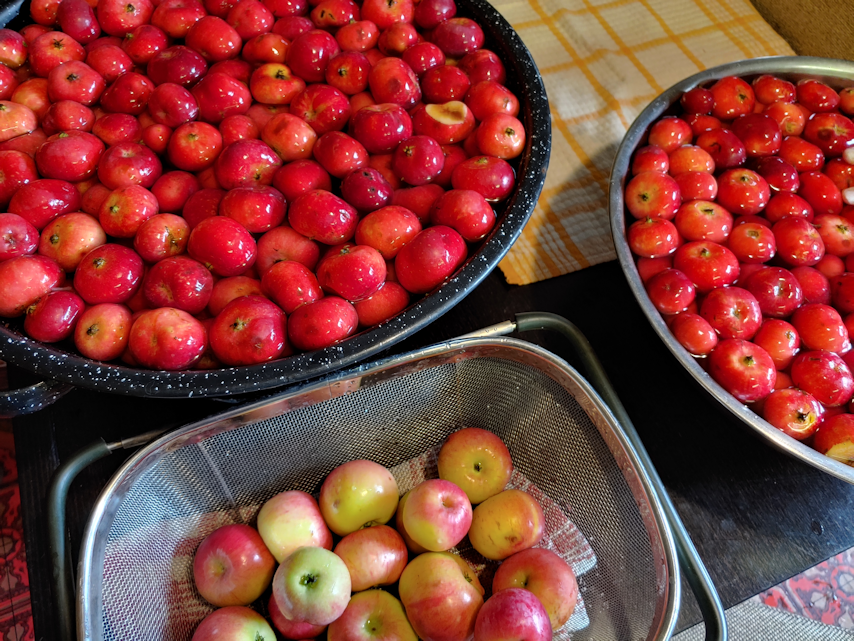
I started on the apples while my daughter’s sanitized the 5 gallon carboy and set up the juicer. Each apple got cut in half, the stem removed, and any damaged bits cut off. We were able to get to the apples faster than when we made it before, so they had noticeably less bits to cut off this time around. The cut pieces went into a giant bowl with water and lemon juice while waiting to be juiced. We had a small colander set up over a bowl that we would scoop batches of pieces into, that could be kept close to the machine while I continued cutting apples

My younger daughter did the juicing again. We knew we would have more juice this time, so she set up the sanitized carboy with a funnel on a chair under the juicer nozzle; fresh, raw juice went straight into the carboy, instead of first into a pitcher, then into the gallon glass carboy.

The juicing took such a long time.

The machine could only handle getting a couple of pieces put in at a time; far less than when juicing other fruit. These are small apples that don’t have a lot of juice in them, so we didn’t get a lot for the work. After a short while, the sound of the juicer would change, and my daughter would have to stop it, open it up and peel off the shoe-leather strip of accumulated pulp that did not go into the collector, like it was supposed to.

It was past 2am by the time we were done. Which was fine for my daughters, since they are still up at night and sleeping during the day.

This is what the more than 5 gallons of apples got us.

We got about two and a half gallons of juice. We calculated roughly 5 cups of sugar for the amount of juice we had (the ratio is 1-1 1/2 pounds of sugar per gallon of juice). The handy thing about it being only half full is that, once the sugar was added, it was easy to just pick it up and shake it to dissolve the sugar. A half packet of yeast was hydrated, then added and it got another shake before being set up with the airlock.

I didn’t bother taking a hydrometer reading.

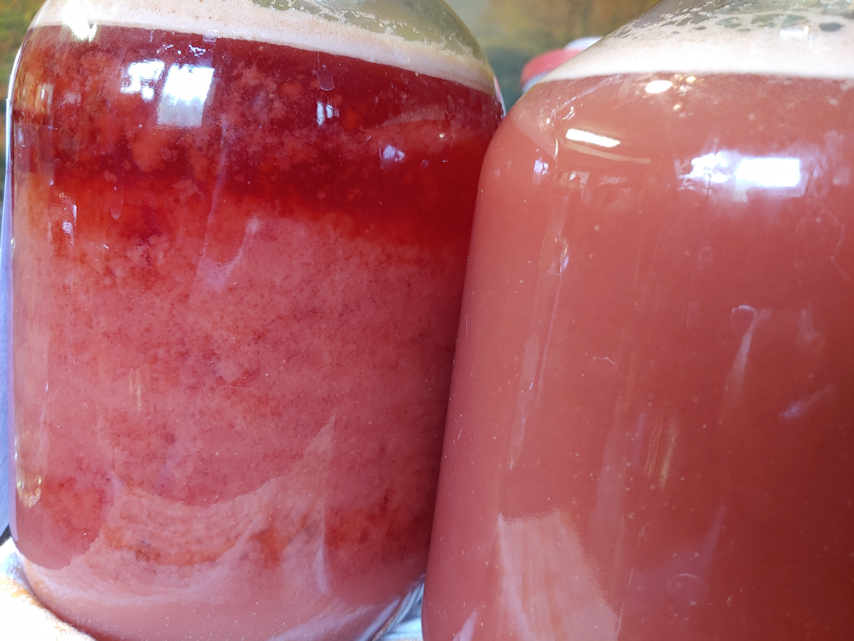
This is how it looked this morning, after having roughly 9 hours to settle.

The airlock was bubbling about every 23 seconds when I checked it, and the temperature of the liquid is 20-21C/68-70F. We’re supposed to reach 28C/82F today, so it’s definitely going to get warmer.

I’d hoped to have more juice, but it’s still more than we had last time. We do still have lots of apples on the tree to pick, if we want. We don’t have another large carboy, but we do have the 1 gallon ones, if we want to make more hard cider. I think I’d rather make more cider vinegar, but we don’t have more of the large, wide mouth jars right now. For the amount of apples we’d have, I wouldn’t want to use smaller jars. It would be a waste of jars and space. There are other things we could do with the apples, too.

Now that it looks like making hard crab apple cider is a thing we will continue to do, we want to acquire a cider press. The juicer is great for other fruit, but does very poorly with these little crab apples. There are table top versions that are reasonably priced. Building one is another option. It’s something we wouldn’t for another year, so we have time to figure it out.

I’ve been asking my mother about how my dad made fruit wine. I remember him using the same crock my mother used to make sauerkraut. I remember watching him one year, as he layered sugar, then raspberries, in the crock until it was full, then … I can’t remember. Most likely, he weighted it down then covered it with a cloth, but did he add water to it? And how much sugar to fruit did he use?

I described what I remember to my mother, and she just brushed it off. They just combined fruit with sugar, covered it and let it sit, she told me. They didn’t add water. That’s how she’s got the cherries she picked while here set up, right now. She didn’t have a lot of cherries, so it would be just a small jar. She couldn’t tell me how much sugar they used; apparently, they just winged it.

Well, whatever my dad did, his raspberry wine in particular got rave reviews. I remember picking pin cherries (those trees are now gone) that he used to make wine, as well as the hard little plums that are more stone than fruit, that we still have in the yard (though the trees seem to be dying). My parents had no wine making equipment. They used no commercial yeast (yeast for brewing was not something that would have been easily found back then). I wish I could ask my dad what he did. I don’t think my mother paid too much attention to it, and what she’s doing now is not what I remember seeing him doing. Maybe one of my siblings remembers more than I do. I should ask them. 😊

For now, though, I’m content to make hard cider with our crab apples. I prefer that over wine, anyhow. 😁

The Re-Farmer

Making hard crab apple cider; will it work?

Today was our first attempt at making hard apple cider. We are using the remaining apples from the one crab apple tree we have that produces the most amazing, sweet, delicious little apples, after using some of them to start an apple cider vinegar.

When we first moved here and saw how many crab apple trees we had around the property, we looked into what was needed to make hard apple cider. At first, we didn’t think it would be anything we could do, or at least not anytime soon. Making hard apple cider, we found, required using a large press to crush whole apples, then sealing up the resulting juice to ferment a few months.

We didn’t have a press, and with so many other things on the go, we were not about to build or buy one, either.

Then I found the CS Brews YouTube channel, now called CS Mead and More. I liked it enough to include it in my Recommended series.

They started making hard apple cider, using store bought juice. Sometimes, right in the container it was packaged in!

We could make hard apple cider without having a press, after all!

One of the things we found when cleaning up this place after moving in, was a juicer exactly like the one we had to leave behind when we moved. I think one of my siblings bought it for my mother, but she hardly used it. Everything was still in its original packaging, even!

We decided to try making hard cider using our own juice.

Now, making it using store bought juice in the bottle they were sold in works, because everything comes pasteurized and sanitized off the shelf. Basically, enough juice needs to be poured off to make room for the sugar and yeast, an airlock gets put on, and you can leave it to ferment to get a very basic hard apple cider.

Of course, doing it the traditional way, with a press, the juice didn’t get pasteurized or filtered or anything.

We decided to try making our own hard crab apple cider with raw, unpasteurized, unfiltered juice. The juice would be going straight from the juicer to the sanitized gallon jugs, so the chance for contamination would be very lower.

Lower than trying to do it the old fashioned way, that’s for sure!

The first step was to clean the apples and de-stem them. They didn’t have to be cored, but the stems would cause problems with the juicer.

The crab apples from the one tree completely filled my two largest bowls. Though I cut away some obvious nasty bit, I wasn’t worried about light bruising. I also have the not-quite ripe apples from the tree that broke in the wind storm.

It’s a good thing we had so many of these apples this year, since I had to toss the cider vinegar, and start over again.

Juicing the apples turned out to be more difficult than expected. It was made slightly easier when we found a way to raise the juicer high enough that a 1L pitcher could fit under the spout. We had 2 one gallon jugs, and a gallon is about 4L, so I could use the pitcher to loosely measure how much juice I was putting in. However, these little apples don’t have a lot of juice in them, and their pulp kept jamming the machine. My daughter kept having to stop the juicer, open it up and peel away the pulp that accumulated on the perforated metal cone inside, instead of going out the back. The pulp was so dry, it could be taken off in ribbons!

Using information I got from one of the hard cider making videos, I used 2 cups of sugar per gallon. Each got 2L of juice before I put in a bung and shook the heck out of them to dissolve the sugar.

Look how pink that is!!

Also, you might notice the liquid is not at the same level. Though these are both 1 gallon jugs, one is actually bigger than the other. They are 1 gallon at about the “shoulder”, which leaves space for the fermenting liquid to bubble up a bit.

I also used the same wine yeast we’ve been using for everything else; I don’t know the specific strain of yeast, but it’s basically what is available for a non-sparkling wine from the local brewing supply store. Again, following what I saw in the video, I dissolved about a tsp of yeast in a bit of juice, then added it to the full jugs, after getting a hydrometer reading.

After the yeast was added, they got another thorough shaking, then the airlocks were put in place.

I’m also trying to be more diligent about recording everything. I have to admit, I still don’t understand the hydrometer information, so I wrote down all three readings. It has a “potential alcohol by volume” measure right on there, but I keep reading that it isn’t any good, and that it’s better to use the specific gravity reading. It doesn’t help that I can barely see the tiny numbers and lines in the first place!

I found it interesting that the readings for the 2 jugs that were made up identically, are slightly different. It’s possible that the different sized jugs means that one does have slightly more juice in it than the other, and that could explain the difference.

The juice is not only incredibly pink, but incredibly cloudy! They were, of course, just shaken when this photo was taken. You can tell which one got finished first, as the cloudiness is already starting to settle.

We have set the jugs up on a side table in the dining room for now. It’s not a particularly bright room, it’s warmer than the old kitchen, and we can keep an eye on them. I just took a look at them, after they’ve had several hours to settle. I will have to take a photo of them during the day. They look very different right now! The sediment has settled to the bottom, and the clear juice in the middle is looking a deep, deep pink – but there is a significant layer of lighter pink foam at the top! I used the temperature gun on them, and got different readings, depending on where I aimed it. The top, where the foam is, was fluctuating between 19C and 20C (66-68F). The middle was around 17-18C (62-64F), while the bottom, where the sediment has settled, is 17C (62F). Which I think is good.

Also, I’ve turned the thermostat up for the house. It was set just below 15C/59F when the furnace turned on earlier today, so I’ve upped it a few degrees! So the ambient temperature will not be too cold, either.

I have no idea how this will turn out. Will the fact that we used raw, unfiltered juice be a benefit, or a disaster? Will we get something that tastes horrific, or wonderful? Considering how great the apples themselves taste, I would hope the resulting hard cider would be its match. I have no idea. This is a total experiment for us!

As for the remaining apples, it took so long to juice enough to fill the jugs that we didn’t juice the rest of them. I had started cutting them up to cook them into a dessert, but realized I didn’t have the energy for that left, so they ended up in the freezer! Meanwhile, my poor daughter had been standing at the juicer for so long, her back was starting to give out on her! We couldn’t even plug it in somewhere where she could sit down, since there are so few outlets in this house.

Here’s hoping the end result is worth it!

The Re-Farmer