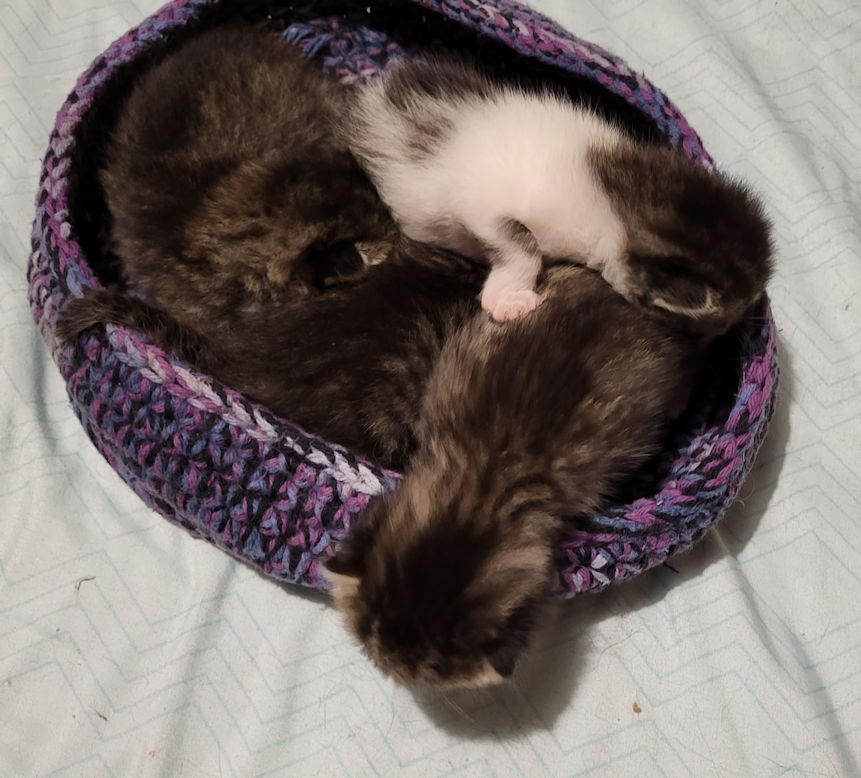
Would you look at these happy critters?
This was taken in the late afternoon. This morning, they did get the food I used the slow cooker to make for them overnight. They dug right in!
Unlike the inside cats. They turned their noses up and their cooked food! Even when the girls gave them some of the canned cat food we still had, putting it right on top of the food cooked for them, they ate around the cooked food, but left the canned cat food that was on top of their cooked meal.
So I gave the rest of it to the outside cats, after feeding them with kibble, and they dove right into that, too!
Our inside cats have gotten fussy!
Yes, I was able to get cat food today – and we even have a vehicle now!
More on that later.
But I am getting way ahead of myself!
Last night, I got a call from my mother. She started talking about her appointment on Thursday – tomorrow.
I had completely forgotten about it! I was supposed to drive her to the city for to get her wet macular degeneration treatment.
We no longer had transportation.
My sister is next closest, but they are out of province right now and won’t be back until Friday.
Which leaves my brother, but he would be working.
Meanwhile, my mother started to say, oh, I don’t know if I should go… with my health like it is…
Yes. She was seriously considering stopping treatment that will save the vision in her eye and possibly improve it.
She even mentioned, she noticed a slight improvement. Which is amazing, after only one treatment!
I told her, we’ll find a way to get her there. Even as we were talking, I was sending a message to my brother and SIL, but while I could see that neither of them were seeing it yet.
So I told her I would call her back as soon as I knew anything. I had no idea when that would be.
With everything going on, though, I was burning out, so I tried to go to bed early.
Of course, that didn’t work.
Which was for the better, I guess, because after a few hours, I got responses.
Long story short…
They are lending us a car!
My SIL would drive out in time to get here for when the tow truck was scheduled to arrive. I would drive her back to their place, then take the car home.
That’s a LOT of driving, but there really wasn’t any other way to do it.
Have I mentioned my brother and his wife are amazing?
After that assurance, I could finally fall asleep!
This morning, my routine of softening kibble for the outside cats with hot water got switched up to transferring their food out of the slow cooker and giving it time to cool down before heading out. It was still a bit on the hot side, but they seemed to be just fine with that!
After feeding the outside cats this morning and doing my rounds, I made sure to open the gate – we were now expecting the tow truck, the prescription delivery, and my SIL to arrive – my younger daughter and I unloaded the aluminum off the back of the truck, then covered the sorted bags with the tarp.
It’s already blowing off, even though we tied it down!
After the back was clear, I took the time to put all the straps and bungee cords – the ones we used, and the extras in the truck – into the back-of-the-seat organizers we got. That set up is going to work out quite well!
Then, while I was at it, I moved our roadside emergency kit out to put in the car later, did some general clean up and even remembered to take out the disabled parking placard and the card we need to show the attendant when we go to the dump.
Not that we’ll be making a dump run in a loaned car! Not if I can help it. But we won’t have the truck for probably a week, so I figured it would be good to have, just in case.
The truck was booked to be picked up at 11am, so my SIL was shooting to arrive at our place at about that time.
It was past 11 when I got a call from the CAA Dispatcher, asking about our location, since our physical address don’t exist on any maps.
After giving country directions for the driver’s notes, we knew it might still be a while, but the truck was ready and there was no need for any of us to be around when the tow truck arrived.
My SIL hadn’t arrived yet, either, so I sent them a quick message, then popped into the sun room to tie off the outside door and keep the wind out – when I noticed there was a car parked near the truck! My sister had already arrived!
I quickly finished, grabbed what I needed and headed out – just in time to hear my phone ding, with her response to my earlier message! 😄
We were soon on the road back to their place when I realized, I hadn’t called my mother yet. My SIL offered to stop at my mother’s so I could tell her in person, which I gratefully accepted.
When we got there, I dashed in – only to find her walker was not by her door. I still knocked, even as I was looking around to see if she was in the hall. Then I went around the building, in case she was sitting outside.
Nothing.
So we went driving to the various places she might have walked to. Even the pharmacy, which is the furthest away. No sign of her, and none of the staff that know her had seen her.
We finally went back to my mother’s place, in case she came back while we were gone.
Still not walker outside her door.
I do have a spare key, though, so I figured I could let myself in and leave a note. I get my keys out and am ready to unlock it but, out of habit, I knocked first…
… and hear my mother’s voice responding from inside!
Her door was unlocked, so I let myself in.
She was at her dining table, her finished Meals on Wheels meal in front of her…
… and her walker sitting beside her.
!!
It was such a relief to find her!
I quickly told her about getting loaned a car (and messages my SIL that my mother had been home this whole time!), and that I’d be driving her to her appointment tomorrow. I even told her, my SIL was in the car waiting for me, so I couldn’t stay long. We worked out what time I could be coming over tomorrow and what time we needed to be on the road. Then she started asking me, why was I in a hurry?
I reminded her, my SIL was waiting for me in the car.
Well, why doesn’t she come in to say hi?
Because we can’t stay long. We have to drive to their place, then I have to drive the car home…
I wasn’t going to even bother saying more than that. The reality is, after decades of verbal abuse from my mother, my SIL finally said, no more. My mother has outside said that, just because she is married to my brother, she isn’t family. My SIL has never been anything but kind to my mother – probably more than any of us, to be honest – and even now, still says many positive things about my mother, but she will no longer allow herself to be abused. If my mother says she is not part of the family, then she will stay away.
My mother has zero understanding that her behaviour hurts people so much, and drives them away from her. The kinder people are to her, the more abusive she is towards them.
Except that’s changing with me. I have been putting my food down, hard, on her behaviour without reciprocating and – amazingly – she has stopped a lot of what she had been doing since we moved out here. At her request.
Tomorrow’s timing arranged, my SIL and I were back on the road.
At this point, I may as well say it. This blog is anonymous in real life, too; my family and neighbours know nothing about it.
My brother has been moving things over to here in preparation for retirement. Part of that was looking at selling their acreage. They hadn’t put it up for sale, but serendipity stepped in, and they found a buyer. The possession date is Nov. 1, so they have to get everything they’re not selling or otherwise getting rid of, here to the farm. Meanwhile, they are moving into a townhouse near the city, and today, I got to see it for the first time!
I think they are going to be really happy there – and happy not having the property to be concerned with. Especially since they are stuck with this farm that they can’t sell. Something else my mother doesn’t understand. This property has been a burden they took from her, but in her mind, she “gave” my brother “everything”. So now they will no longer have two acreages to pay takes, insurance and upkeep for!
After a tour of their new home and a brief visit, I got to drive their car home.
I have never in my life, driven anything so luxurious! What a dream it is to drive! It’s not even a new car (just newer than our truck) or high end. It’s just a basic vehicle, but – oh, my goodness, it is gorgeous!
They are also slightly closer now, and the Walmart I was planning to go to was on my way home.
I was able to get four bags of kibble and a 32 pack of canned cat food. The Cat Lady also ordered us a donation of kibble on Amazon, which is supposed to arrive on the 29th, and we will actually be able to pick it up now.
Of course, I also got a bit of groceries for us – almost all of this, courtesy of my older daughter. She says she will help pay for repairs on the truck, too, though it will take some time to transfer from PayPal, which is how her clients pay for their commissions from her.
I hope we never again get to a point where we run out of kibble like we did today! We will especially need to stock up over the winter. With no back up vehicle anymore, if things go wrong again, or we get snowed in again, etc., we are hooped.
Which would be a good time to bring up… if anyone is in a position to help, we do have a donation button! 100% of donations go towards care of the cats, whether it’s food, spays and neuters or other vet car. Today, we spent more on food for the cats than for ourselves again, and we’ll have to watch to make sure it lasts until CPP Disability comes in – we will hopefully be picking up our repaired truck by then.

Oh! I just got a message from my daughter. She has caulked up the tub surround. Twelve hours before it can be exposed to water. Twenty-four before it can be touched.
Yeah, we still can’t use our tub and shower. Aside from assisting now and then, I have left this job entirely to my daughters!
But I digress, once again…
After doing the shopping, I headed to the town nearest us to get gas. My SIL had stared off with a full tank, but with all the driving, it was down to half already. When I got to the station, I asked the attendant to put in $30, hoping that would make a dent in it, and went inside.
After I was done and heading home, I realized that $30 had filled the tank!
I’m so used to the truck. At current prices – $1.299 right now – that would have been barely a quarter tank. I forget how much bigger the truck’s tank is than a car’s!
It felt really good to be driving with a full tank!
Once at home, I drove up to the house to unload, then made sure to feed the outside cats so I could safely move the car.
Oh, the happy, happy kitties! They were quite hungry!
After parking the car in the garage, I just had to giggle over how much room there is! With the truck, I have to squeeze as close as I can to the counter at the far wall, just to be able to close the door.
That done, I headed inside and started getting ready to feed the inside cats. That included taking their trays of the food they got this morning that they wouldn’t eat – it even still had remains of canned cat food on it! – and giving it to the outside cats.
The outside cats had already polished off all the food I’d given them earlier, and eagerly dove into the food the inside cats turned their nosed up at!
The inside cats, meanwhile, were happy to get their kibble.
The snobs. 😄
So things are looking up again, thanks to my awesome, awesome brother and his wife. With them being in the middle of moving, being down a vehicle will be an inconvenience for them, so I appreciate this beyond words. They are just the best!!
Tomorrow is going to be another long day of driving – and another day of not being able to get anything done in the garden. The goal had been to have several beds cleaned up and prepared for winter sowing by now. We’ve got just one warm day between now and November – and the long range forecast now shows snow within the first 10 days of the month! Granted, when these seeds are planted, we do NOT want them to germinate, but we don’t want them to freeze, either.
Well, what happens, happens. We’ll work with what we get.
What else can we do?
The Re-Farmer




 The Re-Farmer