Our 2021 garden: squash tunnel, day two

Well, I’d hoped we could actually finish the squash tunnel today, or at least get the side cross pieces at the top done, but we didn’t get quite that far.

But, progress was still made.

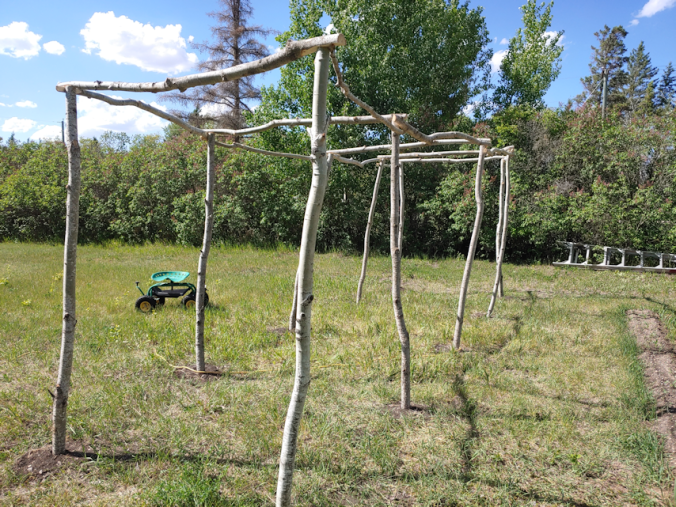
Most importantly, we got the supports up in the post holes.

In refilling the post holes and tamping the soil down, a few of them did need to have more soil added. A good way to reduce some of the lumps in the old garden, left from when it was last plowed before we moved here.

It’s very… rustic looking. That’s a trend now, right? :-D

And no, that middle pole isn’t actually tilted. The tree it’s made from is bent. All the pieces are wonky in shape! :-D

It’s also still very flimsy right now. Joining them at the sides with cross pieces should fix that.

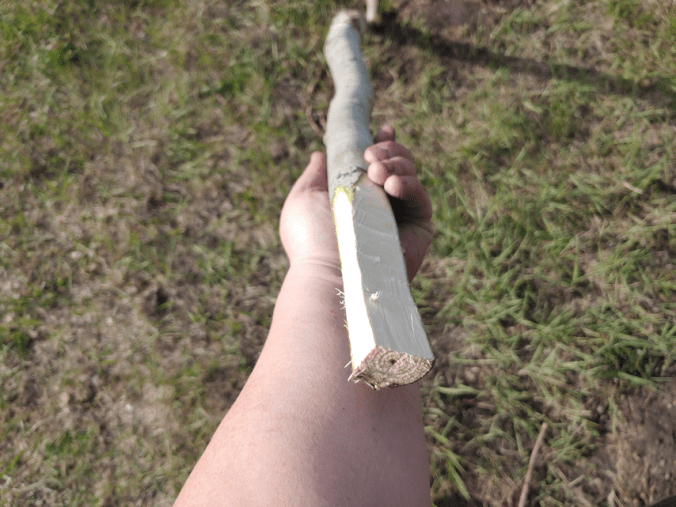
It was already starting to get hot by the time this was done, so we took advantage of the morning shade to transplant the Mongolian Giant sunflowers. It wasn’t until evening that I was able to work on the next step for the squash tunnel. I cut a total of 8 of the 16 cross pieces needed at 5’6″, then trimmed matching flat pieces at each end.

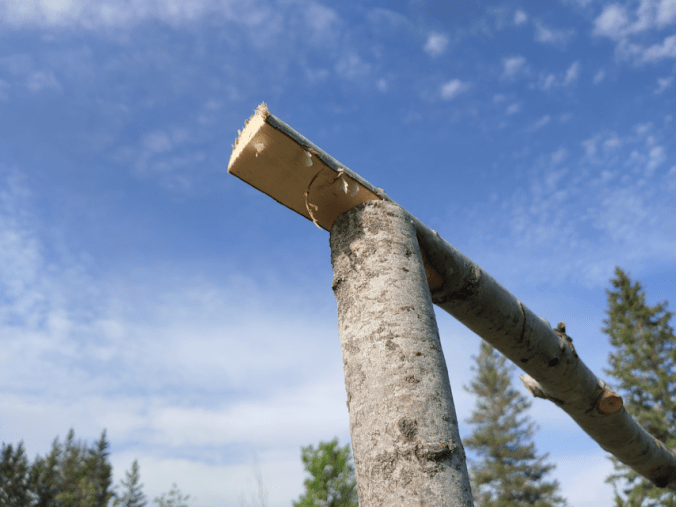
I also trimmed one side of the flattened ends a bit; just enough to have a narrow flat surface on what will be the top.

The flat parts are intended to butt up against the upright and the top cross piece. It will wait until tomorrow, but the plan is to screw the cross pieces to the upright, then add one more screw through the top cross piece, down into the side piece – and hopefully not hit another screw in the process. This should give it some more stability. The other 8 cross pieces will be attached a few inches from the bottoms, which should strengthen it even more, as well as provide a place to attach mesh for the vines to climb.

There are a couple of problems we need to figure out how to get around, to finish the job. We do have a cordless drill, but both batteries no longer hold a charge, and the company doesn’t make them anymore. Until we get around to buying a new one, we have several corded drills to choose from. Getting extension cords to reach this far, though… that’s going to take a bit! We have a pair of 100′ extension cords, which won’t reach reach from the outdoor outlet on the side of the house. I remember how far I could reach while using the electric weed trimmer, and three extension cords. We’ve since gotten more cords, so I think we’ll have enough to reach around the structure.

The next challenge is, we’re short. Well, except my husband, and he’s broken. ;-) To be able to drill a pilot hole through the stop cross piece will require clambering up and down a step ladder. For our gimpy household, that is somewhat risky!

But, it’ll need to be done. With this structure, we can’t get away with tying the cross pieces on with twine, like with the pea trellises.

With 5 uprights and 4 cross pieces per side, only two cross pieces can be placed up against the overhangs at the top, so each side will have two cross pieces mounted just under the other two. Which will hopefully also contribute to the stability. If that’s not enough, we’d have to add supports on the inside of the corners, and I really don’t want to get that finicky with a temporary structure.

We may not have finished the squash tunnel, but we accomplish other things, but that is for my next post! :-)

The Re-Farmer

Our 2021 garden: squash tunnel build, day one

Not that long ago, we were dealing with freezing temperatures. Now we’ve got a heat wave!

Today’s high was predicted to be 24C/77F. Instead, we reached 28C/82F. Tomorrow’s high is supposed to be 28C… does that mean we’ll be going to break 30C/86F? :-(

Hot as it was, we needed to get started on the squash tunnel. Thankfully, we could at least work in mostly shade.

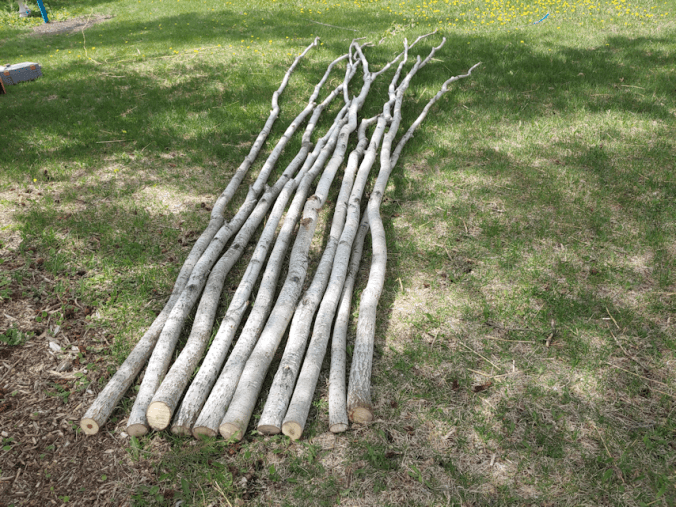
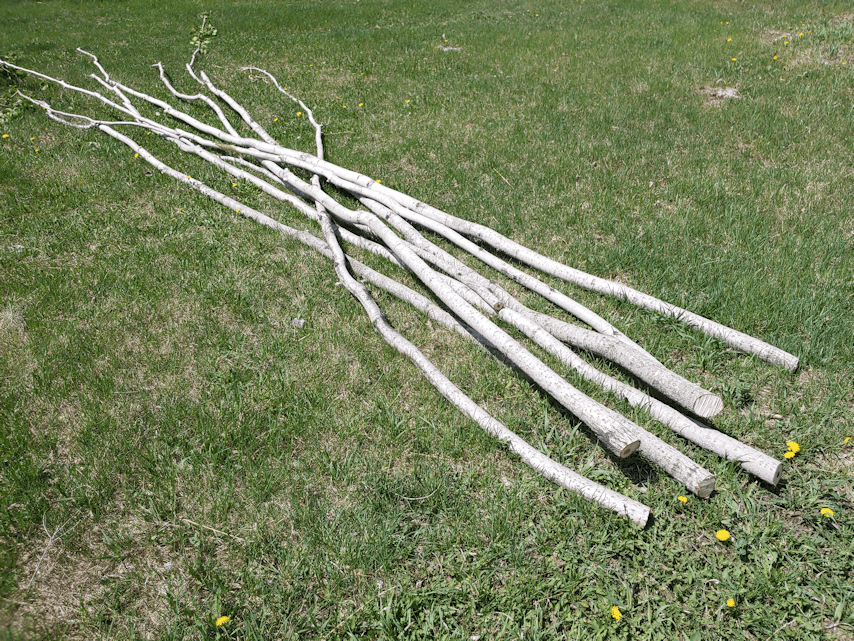
The first thing to do was go through our pile of poplar we’ve cleared out of the spruce grove, and pick the strongest, straightest ones. Straight for the first 7 feet, at least!

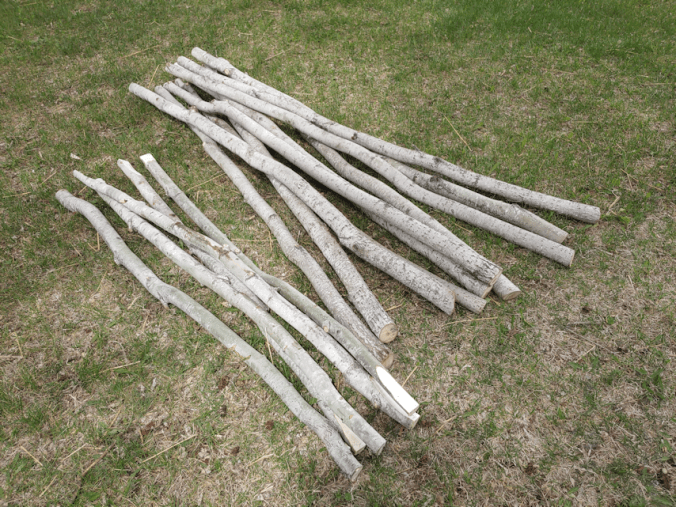
The upright supports were cut to 7 feet, but there was still enough from each of them to cut cross pieces at 5 1/2 feet. Of those, the strongest ones were selected, and at least 3 inches was trimmed from each end to have a narrower, flattish part to attach to the uprights.

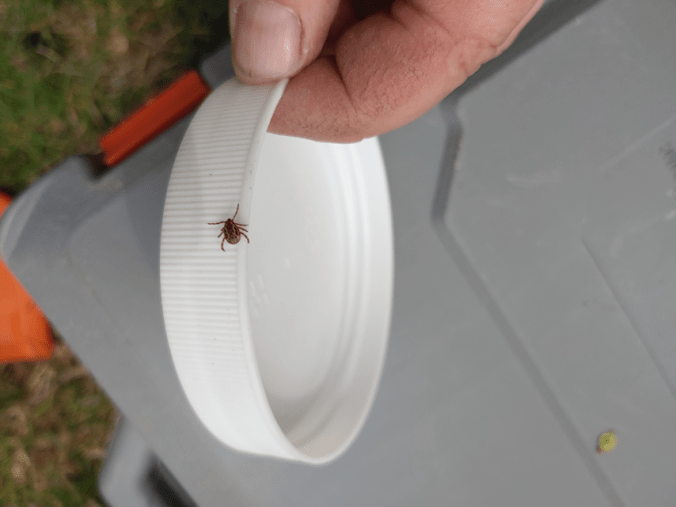
While preparing to screw the pieces together, I found our first wood tick of the season! We ended up finding a couple more, later on.

Time to dig out the bug spray to go with the sun screen… :-(

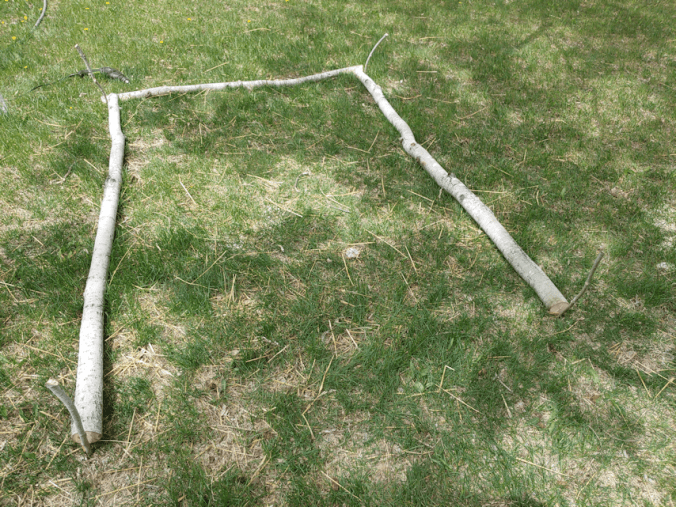
The uprights need to be 5 feet apart, and the cross pieces were to be attached to their tops. I measured out and shoved some sticks into the ground as guides. The bottoms of the uprights would be centered at the pegs at their based, while the tops would be placed with the two sticks at the top on the outsides, to have them lying parallel at 5 feet. The cross piece could then be laid out and the flat sides lined up to the tops. Pilot holes were then drilled and they were screwed in place.

Which sounds a lot easier than it actually was. A few cross pieces needed extra trimming to rest against tops of the uprights. Sometimes, the uprights needed to be turned until they all fit together as flush as possible. Still, it got done.

There they are! Five sets up upright supports for the squash tunnel! They just needed to be dragged out to where the squash tunnel will be set up.

At this point, they are very rickety. Unfortunately, with some of the screws pulled right out of the wood, so we had to redo them with longer screws. Which, thankfully, we had!

By this point, we’d reached that 28C/82F, so once we finished with these, we packed everything away and went indoors to get out of the heat for a few hours. The next stage was to dig the post holes, and there wasn’t any shade to be had, so we waited.

When I finally did head out, I first took the time to water the garden beds and blocks from the rain barrel by the peas. I was able to use the watering can to water everything but the Dorinny corn before the barrel was too low for me to refill the watering can anymore.

While I was watering, I found a friend.

Such a cute little frog!!

Then it was time to start the post holes. Each spot was marked with a flag, so I started by using the space to stab out a circle around each flag, then moving it so I could remove the sod. Once the sod was out, I went in with a hand trowel to take out the bigger rocks, then used a lopper to take out the many roots I found.

I had company.

I love how Rolando Moon will just hang out while we’re working outside. She doesn’t want us to pay attention to her. She just wants to be close by. She even settled down for a nap!

Finally, I brought over the post hole digger and got to work. It’s pretty much a one person job, so the girls took care of the evening watering, refilled the rain barrel by the peas, and watered the last corn block. Once the barrel was full, I decided to set up the sprinkler over the corn and sunflower blocks, to make sure the seeds got the moisture they need to germinate. Going over them with the watering can may or may not have been enough, so I wanted to make sure they got a thorough soaking while I continued digging post holes.

All done! Ten post holes, all 5 feet apart.

That was it for today!!

Getting those supports in will be a three person job. Particularly since they are still so wonky. Two people will be needed to place the supports into the holes, while the third person will back fill the holes. They will still be rather fragile until the cross pieces are added to the sides. We weren’t able to pick up a cordless drill on this month’s budget, so we’re going to have to string together a whole bunch of extension cords to drill the pilot holes! The cross pieces at the top should have enough extra length that we can put a screw through them, into the side cross pieces, too. We’re all short, though, so we’ll need a step ladder to do that!

I want to add cross pieces near the bottoms of each side, too. We’ll need a total of 16 pieces to do tops and bottoms of both sides, and then we can put either wire mesh or netting for the vines to climb up and over the tunnel. Then, we can start making the beds themselves, to transplant the winter squash, gourds and melons into. These will be on the outside of the tunnel supports only, keeping the tunnel nice and wide on the inside. If all grows well, it should create a nice shaded space that we can put chairs in, to rest and enjoy while tending the garden. :-)

Next on the list are the beds for the summer squash, and the block for the Montana Morado corn. They’re getting quite big in their cups, and hardening off nicely. I hope they handle being transplanted okay! I do with the toilet paper tubes had worked out. That would have been much better and less disruptive to the roots. Well, we’ll know for next time: pre-soak the growing medium before putting it into the tubes!

The next week or so is going to be very, very busy!

The Re-Farmer

Our 2021 garden: beans are in, and first spinach protectors

Once again, our temperatures have lurched from one direction to the other! From days cold enough for the furnace to turn on, and overnight lows below freezing, we’re back to the heat. It’s past 7:30pm as I write this, and our temperature is still at 24C/75F. A week from now, we’re expected to hit 31C/88F.

Well, by then we should be transplanting our squash seedlings, so that will be good for them, at least!

This morning’s job was to direct sow our bush beans. I am so glad we picked up that extra hose. The mini-beds we made for them needed to be soaked, re-soaked, then soaked again, before I even planted the seeds. I can’t believe how quickly things have dried out already, though I suppose with the winds we’ve been having, I shouldn’t be surprised. You can even see that the pea trellises have been moved around by the winds! I even found one end of a cross piece had come loose after one particularly windy days. The bags may work to startle critters, but they also act like sails.

The yellow and green bean packages had 200 seeds each. With a 20’/6m double row, we still had seeds left over. The purple beans were packed by weight, and a 50g package was just enough for its double row.

Once planted, they all got watered, and watered again! Normally, I would have pre-soaked the beads, but these were inoculated seeds, and I figure soaking them first would have washed off the inoculant!

After the beans were done, we set up the sprinkler to start soaking down the rows for the corn and sunflowers. We left it running over one side for a few hours, then moved it to cover the other end. Much to my surprise, the sprinkler can cover all but 3 rows. There isn’t a lot of pressure, this far out!

Our afternoon project was to see what we could do about protecting our spinach beds. After scrounging in a little shed near the barn, we dragged out the last of some narrow old, salvaged boards. Many of them had several 3″ deck screws in them that had to be removed, first. There were 13 boards, and we ended up using 12 of them, because they were not all the same length.

The roll of chicken wire (or 1″ hex wire) we got was 25′ (7.6m) long and 4′ (1.2m) wide. We have three spinach beds we need to cover. While the beds themselves are about 3-4′ (about a meter) wide and roughly 15′ (just over 4.5m) long, the rows of spinach were, of course, less than that. So we were able to use the roll to cover 2 spinach beds. Well, mostly.

We stole a couple of hoops from the small beet bed by the garlic beds to hold the wire up in the middle. The sides are held in place with sticks, that have a bit of mesh hooked onto their tops, so they are helping hold that up, too. Once we get more hoops, we’ll be able to stop using the sticks to hold up the mesh, which will allow us to move the covers to harvest the spinach.

The edges of the chicken wire were sandwiched between boards that were screwed together. Because of the different lengths, we had to cobble them together. A couple ended up with small gaps between the ends of boards, but they were still secure. The covers don’t really leave much room to do a second sowing, though, which we could do any time now, if we wanted. I think I will skip it, and save the seeds to sow later in the summer for a fall crop.

Like everything else we’re doing this year, this is a temporary thing, so we don’t need to get too fancy. When we build our permanent, high raised beds, we will make protective covers that fit properly, and be properly framed and supported. Right now, neither one completely covers the rows of spinach, so the ends might still get nibbled at, but it should be fine. If we want, we can tie on brightly colored or metallic ribbons to flap in the wind and discourage critters.

I’ll have to make a trip to the local dollar store again and see if they’ve restocked on things like pinwheels. I’ll pick up more hula hoops, too. I figure a couple more rolls of the chicken wire would not be a bad idea. I think we still have enough of that wood in the basement that we can make one more cover for the third spinach bed. For the small beet bed, I’m hoping the mosquito netting we ordered will come in soon, but if not, we can use chicken wire.

While in the city, I also picked up 200’/60.9m of yellow rope to string around where the corn and sunflowers will be planted. If what I read about deer not having good depth perception, so having two shorter fences a few feet apart works as well as a high fence, is accurate, we should be able to string just one “fence” of the yellow rope around half the garden, since it’s already so close to the barbed wire perimeter fence. Since most of the other half will be edged with squash, which deer don’t like, we might not need to do much more than that. We shall see!

Now that the blocks for the corn and sunflowers have been soaked down, tomorrow’s job is to plant the corn, with radishes in between to help break up the hard soil, and direct sow the rest of the sunflowers. The transplants are not done hardening off yet, and all our transplanting will wait until after June 2, regardless of what the weather forecasts are right now! The forecasts change so often, I don’t really trust them beyond a couple of days, and, even then, they are frequently wrong for our area.

Once the seeds are sown, we can finally get back to working on the squash tunnel!

The Re-Farmer

Testing, testing!

Well, I’m certainly glad I decided to switch memory cards on the trail cam over the tulips after I finished my last post.

With this camera, if it happens to be recording when I pull out the memory card, I have to manually turn it back on again after putting in the new card. This time, it wouldn’t turn back on again. After much fussing, and even loosening the camera so I could reach things better, I finally got it going again.

When I checked the card, there was nothing on it. Whatever happened that caused it to turn off and stay off, happened while I was positioning the camera in a new location.

So I went back, made a point of triggering the camera so I would have at least one file from it in position, then switched cards again.

I then went back and forth between re-positioning the camera, switching cards and checking the files, several more times.

There were a couple of problems. The first was, no matter how I positioned the camera on various parts of the apple tree, I couldn’t cover all of the tulip area.

The other problem was physically moving the camera. It is held in place by a long strap. One end has a gripping clasp that the other end is woven through. This is great if I have to put it on a large tree and leave it there. It also doesn’t make much difference when it was on a fence post, as I could just loosen the strap and lift it off the top of the post. To move it from place to place on the tree, the strap needed to be pulled through the clasp, every time, then placed around the trunk, reinserted into the clasp and pulled tight again. Meanwhile, the strap runs through slots in the back of the camera that grip nothing, so the weight of the camera itself kept causing it to slide around and swing.

Since it was still on while this was being done, I had a lot of videos that were very hard on the eyes to watch!

In the end, there was simply no place I could put the camera that would cover the area needed. And there were no other trees in suitable spots that I could attach the camera to.

I could see where the camera needed to be set up. What I needed was something there I could attach the camera to.

I found something.

I grabbed one of the old sawhorses. We have three, and this one is the odd sized one, so it doesn’t get used as much. I set it up on its end, and attached the camera to the cross bar. The bonus is, now that the camera is strapped onto it, making adjustments is easy. I just shift the saw horse instead of trying to move the camera. With the camera mounted so low to the ground, I can switch the memory card more easily by tipping the sawhorse onto its side, then popping it back up again, without shifting its position. If I check the files and find that it does need to be shifted, it is much, much easier to do so now, then trying to do it on a post or tree trunk.

I already have a file of Creamsicle Jr. walking past the camera!

This should work out just fine.

And yes, I did move the string of bells and plastic spinner to the sides, so that they wouldn’t trigger the motion sensor in the wind!

On the one hand, I hope to capture the critter that’s abusing our tulips. On the other, I hope the critter never shows up, because there aren’t many tulips with flower buds left. We have not found other materials we can use to protect them (the fence wire I was thinking we could use would not stop a skunk), and won’t be able to buy anything until at least tomorrow. We’ll be making our monthly bulk shopping trip to the city tomorrow, but I’m not sure if we’ll be able to find anything useful. Now that we’ve added Canadian Tire to our list of places to shop at, to get the stove pellets we’re using for cat litter, I’m hoping to at least be able to find some chicken wire or something like that.

We’ll see how things work out!

The Re-Farmer

Clean up: spruce grove, west side

Today, we continued work cleaning up along the west side of the spruce grove, between the garlic beds and the old outhouse. We haven’t really done anything there since last year.

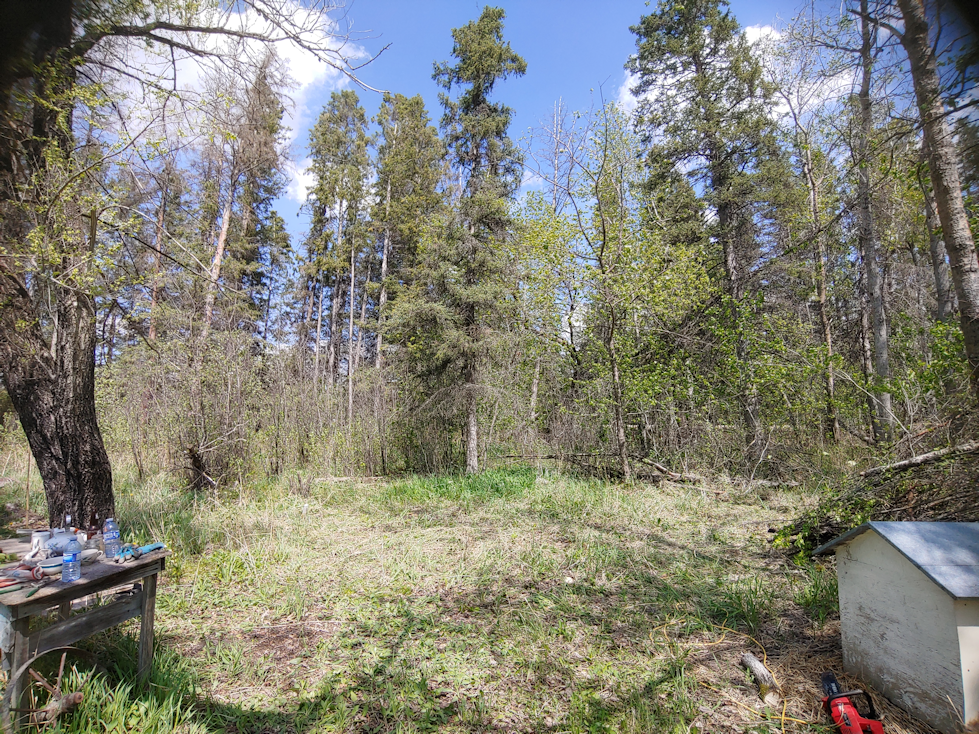
Here is how it looked before I started.

I could see some poplars in here that would make good upright support posts for the squash arch.

I broke out the little electric chain saw for this job, but only used it once. The rest was just too small, or had too many even smaller things growing around them, so I ended up doing most of the job with the loppers and the baby chain saw.

Here is how it looks now.

Yes, there are even spruces left in the spruce grove!

My goal was to clear enough to reach the apple tree (to the right of the spruce in the middle) and an old, rotten bench.

Yes, there is a bench in there. Can you see it? To the left of the spruce tree in the middle?

There had been cherry suckers growing on either side of the seat. I’ve left it for now, and will clean it out another time. We are finding the remains of benches and seats all over the place. As we work around the yard, we have often found ourselves wishing to have something to sit down on, and plan to put seating areas all over. It’s interesting to find that my parents had already done the same thing! Sadly, none have survived time and the elements.

The apple tree had a lot of things crowding around it – and a piece of tree stuck in its branches!

I cleared as much as I could to the apple tree. The next time I work around here, it’ll be with the chain saw, clearing away the fallen trees. At least for now, the apple tree is open and getting more light. When I dug my way to it last fall, to try it’s apples, I found it quite tasty, and we’re always happy to find a tree with apples that are actually edible! There are way too many that are not. :-/

Several trees were cleared out of this patch of flowers my mother planted, many many years ago. I’d found them while cleaning up the area behind the garden beds, but I don’t think I saw any of them bloom. Now that they have light, I look forward to seeing the flowers!

I also uncovered other flowers. Unfortunately, I had a hard time not stepping on them!

I think one of them might be tiger lilies, but I’m not sure.

I suspect we’ll have quite a few new blooms this summer, now that things are cleared up!

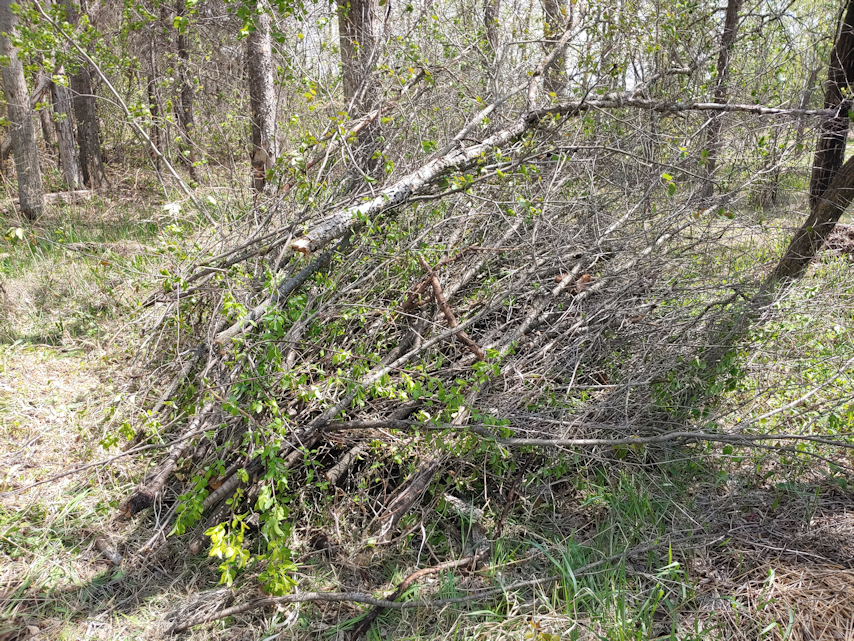
Much of what I took out were suckers of cherry trees, grown up around the remains of older, dead ones. Some were so old and rotted, I could pull them out with my hands.

The big branch on the top of the pile is the piece of tree I pulled out of the apple tree.

We really need to invest in a chipper.

Meanwhile…

My daughter did short work of cleaning up the poplars I set aside for building material. We not have more than enough larger, stronger ones to be our upright supports for the squash arch.

The smaller and thinner ones will also be used in various ways, including cross pieces and supports on the squash tunnel. My daughter added quite a bit more to this pile, then everything got moved to the stacks by the side of the house, closer to the garden. A nice shady place were we will be able to pre-assemble parts of the squash tunnel.

Temperatures were reaching 27C/81F by the time I headed inside, while my daughter finished the job. The winds were high, which at least made it feel cooler. As I type this, things are getting dark and and even windier. We’ve got severe thunderstorm warnings happening right now – with the potential for hail! Looking at the weather radar, it does look like the worst of it will pass us by, but…

I think it’s time to finish this and shut down the computer. Just in case!

The Re-Farmer

Our 2021 garden: last beets, and mulching

I’m taking a bit of a break from working outside, to avoid the hottest part of the day. We’ve reached 22C/71F, and our high is supposed to be 23C/74F.

One of the things I’ve been trying to do early in the day is water all the beds that we’ve planted. I’ve been concerned about them, since we are so incredibly dry right now. It’s hard to give the beds even a shallow watering, never mind the deep watering they need. The problem is that the surface dries out so quickly. What we need is a mulch. The only thing we have for mulch right now is straw. Which is fine if I’m mulching around larger plants, like when we transplant our squashes, etc. Not so good for things like greens.

What I do have, however, is a lawn mower.

So after I planted the last of our beet seeds – three types all mixed up – in the L shaped bed in the old kitchen garden, I brought out the mower.

We already had some chopped up straw that had been on top of the garlic beds; we’d removed most of it and it’s been sitting in the kiddie pool, waiting for use. I chopped all that up a couple more times with the mower, then filled the wheelbarrow with more straw and chopped it up several times, too.

The finished mulch, which now included leaf litter that was on top of the lawn, went back into the kiddie pool, which made it very easy to drag around to where it was needed.

The mulch is so light, I could let the wind distribute most of it for me!

The L shaped bed is all beets. I had thought to put some carrots along the edge of the bed, but there was no room! In fact, I ended up broadcasting the last of the seeds in another little spot.

The patch of mulched soil near the plastic and the tree is where the last of the seeds went. Almost all of these beets are last year’s seed, so who knows how many will germinated.

I then scattered mulch onto the poppy bed, too.

After thoroughly watering everything, I moved on to the big garden.

Once again, I could let the wind lightly cover the beds for me. The beds at each end, with the onions, got fully covered. The spinach beds have their first sowing in the middles only, so I just focused on that area. When we sow more in another week, we can add more mulch then.

Everything got another thorough watering. All the beds will be watered again this evening, when it starts to cool down.

Until then, my next job is to mark off and start preparing the block to direct sow the one variety of corn we have that needs to be planted before last frost. That’s going to be out by the peas, and that’s where we’ll be working on for the next while, as we prepare beds for the beans, corn and radishes, sunflowers, squash and gourds. Then, last of all, the block at the opposite end of the garden, where the Montana Morado corn will be transplanted. None of the sunflowers or corn starts have germinated yet, but it hasn’t been very long yet. I’m just impatient! :-D

We will also use the lawnmower to chop up more straw for more light surface mulch. That, at least, I’ll be able to work on in the shade this time! :-)

The Re-Farmer

Our 2021 garden: building the first pea trellis

We had a beautiful warm day today – prefect for working outside!

Our peas are among the things that require the most preparation before we can direct sow them, so we decided to focus on building trellises for them. After looking over some design ideas, drawing some sketches and making some decisions, I headed out with my baby chain saw and rifled through the pile of poplar poles we kept after doing some clean up and testing out the cordless pruner.

That baby chainsaw made cutting poles to size very fast!

In the background are the support poles, cut to 6 ft lengths. The poles on the wagon are the cross pieces. I am short a few to be able to complete all the beds, but I ran out of medium sized poles. We are saving the bigger ones for the squash trellises, as they will have the most weight on them. The smaller ones will be good as stakes, but are too thin to be cross pieces.

I’ll just have to do more clean up and gather more poles! :-)

Our purple peas have the fewest seeds, so it got the simpler trellis design.

I started by laying out the support poles near where they will be set. Each bed will have 5 support poles, with the biggest ones on the ends, and the middles.

That rain barrel in the background is the one I patched up last year, to keep water at ambient temperature near our squash beds. We will need to fill it with water soon, so it doesn’t blow away! It’s going to take all our hoses put together, to reach that far.

After finding the centre of the first bed, I started digging a post hole – and immediately started hitting roots and rocks!!

I did drag over one of the post hole diggers we found, to try it out.

I’m pretty sure it has pieces missing. :-D

It can handle smaller pebbles, but roots and larger rocks were a problem. For some of the rocks, I had to get in there and bring them out by hand, because not even the spade could get them out. We only have one spade, and I don’t want to break it! We did have a second spade. The handle broke while I was digging holes for the haskaps. :-/

First pole is in!

The pile of rocks was later added to the top of the soil around the post. The soil that was put back into the hole and tamped down was a lot softer, and sank down quite a bit.

Shortly after that, my younger daughter was able to join me, and the rest of the poles went in much faster. :-)

Attaching the cross pieces was a bit of an issue. What I really would have liked to do was screw them together. There’s no way to do that manually, since we’d end up pushing the poles around in their holes. We don’t have enough extension cords to reach this area to use a corded drill and drill pilot holes. Our cordless drill is old and the batteries no longer hold a charge – and it’s old enough that the brand no longer uses the same batteries and does not make them anymore. Once we work out a solution, we’ll go back and put in screws.

Before adding the cross pieces, we measured and marked heights at the top and bottom of each support pole, then cut flattened spots on the ends of the cross pieces and at the marked areas of the support poles. When cleaning up the basements, we found a ball of old bale twine, so we used that to tie the crosspieces in place. That twine is really old, so while it’s holding surprisingly well right now, I expect it to disintegrate fairly quickly.

Once that was done, I used the twine to weave on strings for the peas to climb.

Which took quite a long time! The ball of twine was lots of shorter pieces. I kept stopping to tie ends together and make centre pull balls, to make wrapping around the cross pieces easier. I ended up using most of the ball, so we’ll have to find something else to use for the other trellises.

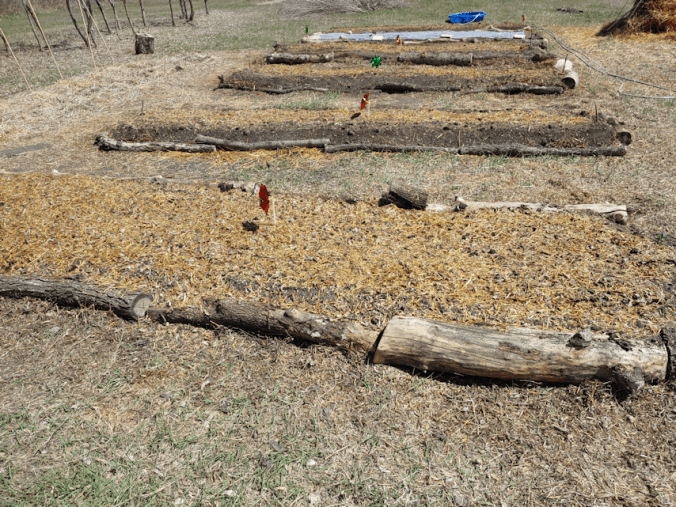
This bed is now ready to layer straw and soil down. We might even be able to find something usable in the old compost pile to add to the layers. We don’t have a lot of material that can be used to build over that grass, but anything is better than what’s already here! And we can deal with weeds.

It seems a bit much, to do all this burying of posts for a temporary garden, but wind is something we have to take into consideration. Hopefully, we were able to get the support poles deep enough that they won’t be blown over.

The other two beds will have double rows of peas planted in them, so the trellises we build there will not have the cross pieces at the bottom. Instead, we will put cross pieces about a foot away from the centre poles, at about the same height as these ones. Once these trellises are strung, they will form a sort of A frame, with each row having it’s own side of strings to climb.

When I was a kid, my mother always grew peas, but never used trellises. One of my jobs as a child was to flip the rows of peas, so that the sun could reach the other side of the plants. I do remember a lot of yellowed or rotted leaves when flipping my mother’s un-trellised peas. This would have been due to lack of sunlight in the bunched up plants, and contact with the soil. There was likely fungal issues, too, but as a child, I wouldn’t have recognized it for what it was. It worked, and we always had lots of peas, but this will be healthier for the plants, and should result in better yields.

While I was working out here, I was able to hear people out and about, walking on the road, etc. The old house across the road from us has no one living there, but the current owners come out regularly. It was so wonderful to hear the voices of children, playing outside! At one point, I was even visited by a very friendly little dog. The only down side was having our vandal come driving by on his ATV, very studiously avoiding looking our way and pretending to be doing something else other than creeping on me. As if his driving over, turning around and going home again wasn’t making it really, really obvious. :-/

We definitely need privacy screens! The corn and sunflowers will help, once they’re tall enough, but when we clear the fence line so we can repair the fence, we’ll be removing what little screening we have in that area right now.

For now, I’m rather pleased with our “rustic” pea trellis. Not too bad for something made of completely salvaged materials!

The Re-Farmer

Our 2021 Garden: solution found… maybe?

As the temperatures have gotten warmer and the snow melts away, I’ve been able to expand my morning rounds. Today, I was able to reach the barn and a shed near it, for the first time in months.

I had a purpose in mind.

One of the things we have found all over the place, beside mirrors and tires, are windows. All kinds of windows.

If there are windows, could there be… ??

… yes there could!

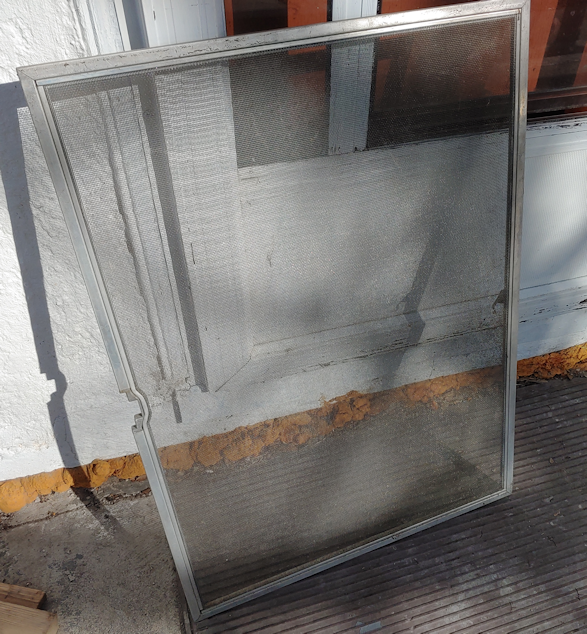
I found a fairly large screen at first, then found at least three like this one. It has an aluminum frame, and a very strong metal mesh.

This may work as a “lid” for the small fish tank greenhouse. It’s much bigger than the tank itself, but if I can secure it safely, I should be able to use it, even with the amount of overlap there will be at the front and sides. I can remove the light fixture from under the lid of the tank, and attach it to the underside of the screen – unlike the light on the big tank, this one can’t handle the weight of even one of our skinny cats on it. There is even a space I can use for the power cord from the light.

The screen itself is probably strong enough to hold even Dah Boy and Cheddar’s weights! As long as no jumping is involved. They don’t tend to try and get on the tanks in general, so I’m not too concerned about them.

The screen has been scrubbed and sanitized and is now set aside to dry. I have time to figure out what I can use to secure it to the tank, while still being able to open it easily to get at the seedlings inside.

Here’s hoping it works!!

Also, there are a LOT of old windows in the barn and shed. Some are broken, but others are still intact. I took a closer look at some in the barn. I am continually amazed by one group of reclaimed windows. They are so filthy with years of dust and grit, I actually didn’t realize they were windows until my brother told me that’s what they were! While some sort of canvas was draped over the middle one, to keep them from touching each other, they are thoroughly stuck to each other at the ends. I estimate them to be about 7 ft by almost 5 ft, and they are at least double pane. Possibly triple. There are a couple of others about 4 ft square that are double pane.

I am sure we will be able to find some use for these. Especially the big ones, if we can manage to separate them without breaking them. I see potential cold frames and mini greenhouses in them! :-)

The Re-Farmer

Our 2021 garden: making grow bags

One thing about our internet being a problem is that we’re really learning what browsers and websites are data hogs of one type or another. Chrome is better than Firefox, and WordPress is just awful. Not just the editor, but simply trying to view other WordPress blogs. I don’t know what they’re trying to do in the background, but it’s more than our internet can handle and they are constantly timing out or only partially loading.

Today, I’m trying a new browser, and it seems to be working MUCH better. Which is weird, because I’m using Tor right now, and it’s an onion, so you would think it would be worse, not better!

Either way, here I am, able to write a blog post!

As much as possible, we keep Sunday as a day of rest. What often happens during that rest period is that it becomes a time of inspiration. Today was one such day, and I came up with a garden solution.

When I posted about our layout plans for this year’s garden, one of the things mentioned is that our potatoes aren’t anywhere on it; we are planning to grow potatoes in containers this year.

The question was, what to use as containers?

The easy solution would be to buy grow bags. That requires money, of course. Money that would be more efficiently spent elsewhere. We had a number of things around the property we could use, but each had more negatives than positives about them.

So that problem got set aside, and we got to thinking about other things. Like how to preserve our harvest. Particularly the root vegetables. I got to thinking about the bags from deer feed and bird seeds we’ve been accumulating, and how they might be usable.

Which is when the inspiration hit.

The feed bags would make excellent grow bags!

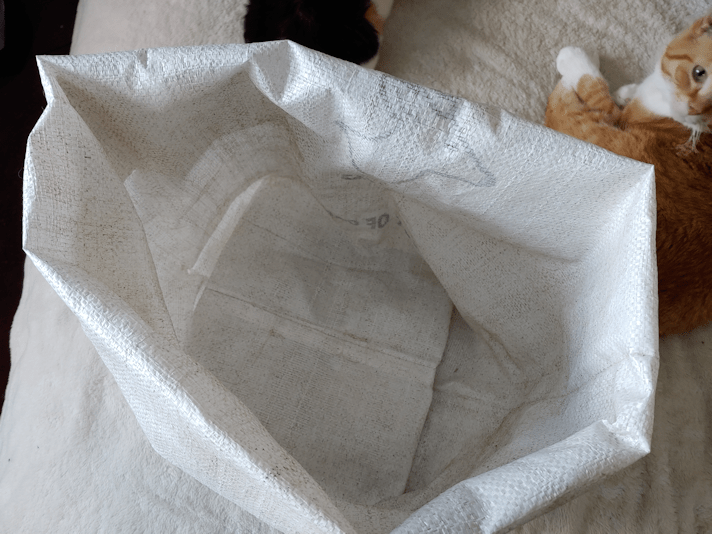
The bags are simple tubes with seams sewn on the top and bottom. The seams are basically slip stitched, so to open them, I trim one end of the thread close to the bag, then yank. The whole thread pulls out, leaving the top of the bag undamaged. Once the bags are empty, they lie flat.

So I grabbed one to experiment.

To use them as grow bags, they need a flat bottom. To create that, I folded the ends of the seam so the points met at the middle, then stitched them in place. Because of the layers of thickness from the seam, I had to do two rows of stitches on either side of the seam. I used a back stitch, as that would hold better. The thread I used was salvaged from the inside of a very long length of paracord. My younger daughter had made herself a corset, but the lacing she got was not long enough. The lacing is the same as the outside of paracord. My husband bought a 1000 yard roll of black paracord a while ago, so we had plenty to use. It took a while, but we got the inner strands out, which we then separated into individual strands to keep for other things. It’s remarkably strong, and we didn’t want to waste it! It was perfect for this job.

This is the end result. A flat bottomed bag with sides that can be rolled up or down to the height desired. The bags will allow for drainage, and are strong enough that we will be able to move them around as needed.

They’re fairly small. The bags are more long and narrow than wide, and the bird seed bags are taller than the deer feed bags. They are large enough for just a couple of potatoes, or maybe three or four fingerling type potatoes, at most. So we’ll need a lot. I don’t mind the smaller size, since that means they’ll be easier to move after being filled. We are pretty sure we know where they will go, but if that doesn’t work out, being able to easily move them is a bonus.

I brought in the rest of the bags from the sun room, which turned out to be another 12 bags, plus we’ve got two more bags of feed on the go. Over the next month or two, we will be getting more of both deer feed and bird seed, which will likely give us another 8 bags to work with. After that, we’ll just be buying bird seed, but by then, we’ll be planting, so it won’t matter. Until we actually get the seed potatoes, we won’t know how many we’ll have, since they’re sold by weight, not number of potatoes. If we don’t have enough bags, we’ll just try some of the other ideas we were thinking of.

I’ve stitched up three, altogether, to get the hang of it, and now they are set aside. Over the next few weeks, we’ll stitch up the rest so that they will be ready for our planting in late May or early June. Being in bags, we should be able to get away with planting earlier.

The cats, meanwhile, are absolutely fascinated by these bags, and all the smells that came in with them! :-D

The Re-Farmer
Guess what didn’t happen?

Yup.

We stayed home.

With my concerns about the drive, my older daughter was willing to take time off from working on commissions to go with me. Her sister is my back up driver, who would be able to take my mother’s car to come get me, if it ever came to that, so she had to stay home.

image source

I had gone ahead to start the van and give it time to warm up. The first time I started it, it immediately stalled. It started again, and I could hear the fan and belts screaming from being so frozen, and the idle was way too high.

It’s just cold. It’s entirely possible that, if I just left it running for a few minutes, the engine would have warmed itself up and been just fine.

Memories of a rental car’s engine block cracking from the cold, many years ago, were enough to convince me not to push our luck.

My daughter barely had time to get out of the house by the time I was closing up the garage again.

At least we have a garage! It may be completely insulated, but at least the vehicles are getting hit by the winds and snow; just the temperatures. Even when we were living in the city, we just had an outdoor parking spot, and our old home has been hit with the same bitter cold we have.

Which means it will be at least a week before we can do any sort of major shopping. I should be able to take my mother’s car (which has a battery warmer and trickle charger, as well as a block heater, and that part of the garage does actually have a bit of insulation) to the post office/general store. We can at least get some basic groceries, cat food and (I think) litter, if we need to.
For now, my younger daughter and I have been doing some bread baking, and I whipped up some mayonnaise. Making mayonnaise is easy, but it takes a lot of oil. Thankfully, the last time I picked up a few groceries, I did get a large jug of basic cooking oil, so we’ve got plenty.

All this, because our van started acting up and needed repairs at a time when we should have been using it to stock up! Frustrating, but our habit of stocking up in general means that we will manage okay, even if we do run out of a few things. It’ll be inconvenient, but we’ll be okay.

The Re-Farmer