Our 2021 garden: corn, melons and new critter damage

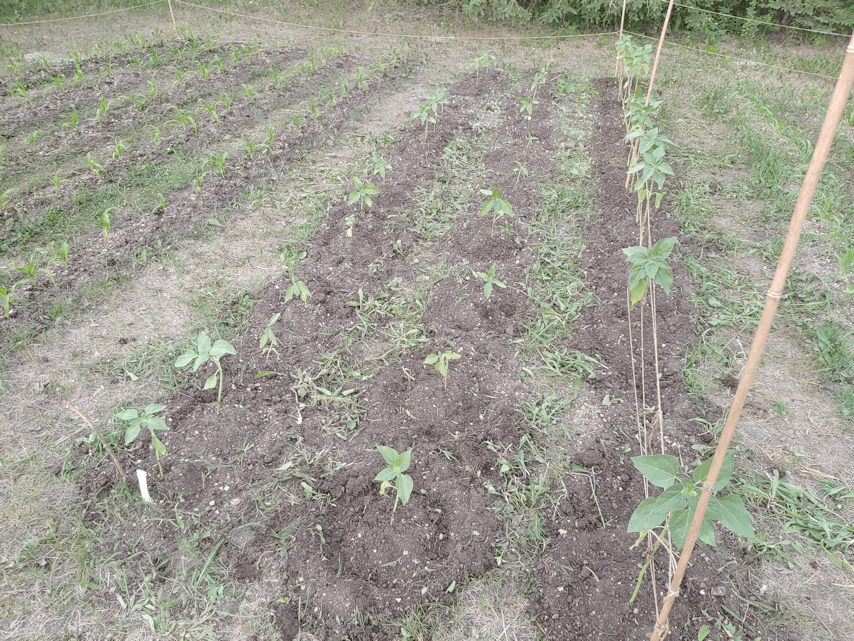
We have been very excited by how well the Montana Morado corn has been doing. However, as some of the stalks have gotten taller, they have started to fall over. The soil around the plants seems to be washing away as we water them. So, this evening, I added more garden soil to the bases of each one.

While watering these, my daughter has been focusing on giving a deep watering into the paths in between them, then using a finer spray to water the entire bed, so as to prevent more erosion. A couple of the stalks are also supported by stakes.

We are very curious about what the cobs will look like. Some of the stalks, silks and tassels are very purple, while others are varying shades of green. These are all supposed to give us corn so dark a purple, it looks black. But is that what we will get? We shall find out! It does look like several cobs are filling out nicely. :-) I’ve taken to hand pollinating every now and then, just to be on the safe side.

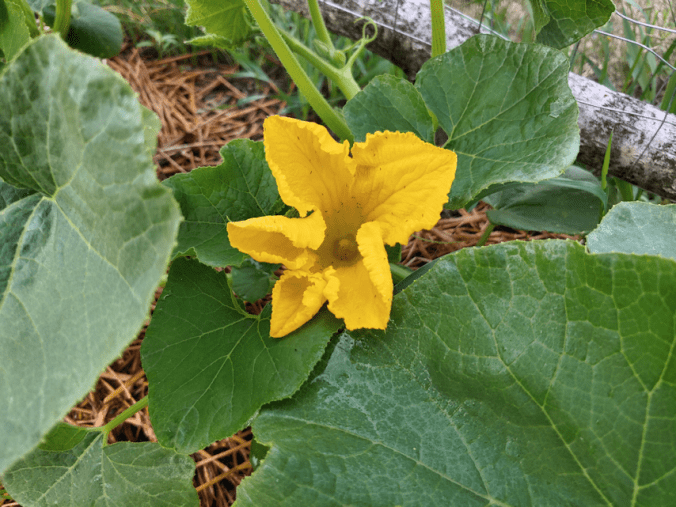
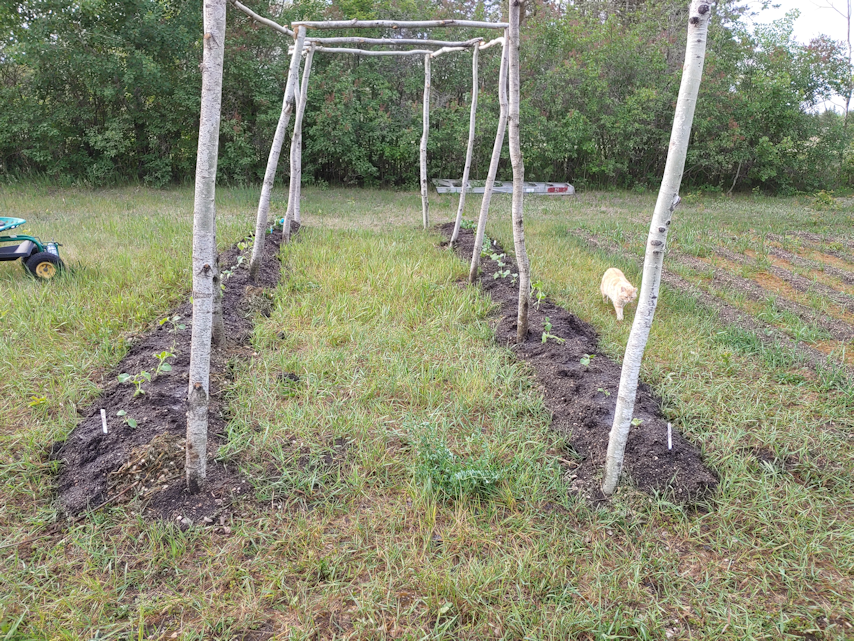
Meanwhile, while watering the squash tunnel, my daughter found another little melon!
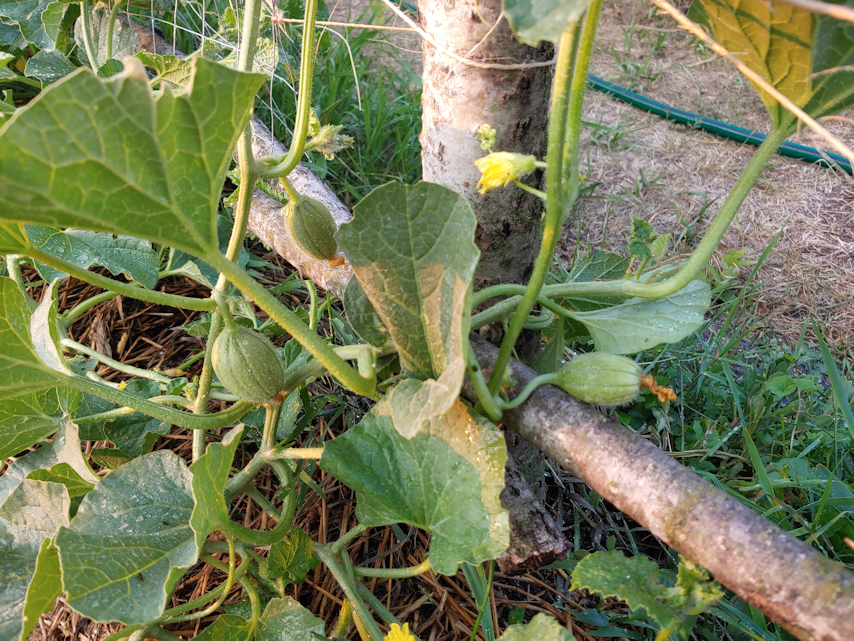
At first, she thought one of the ones she’d found before had fallen to the ground, but then she saw they were both still there, so she lifted the third melon onto the structure. This had me looking around for more, and I was very excited to see two of these.
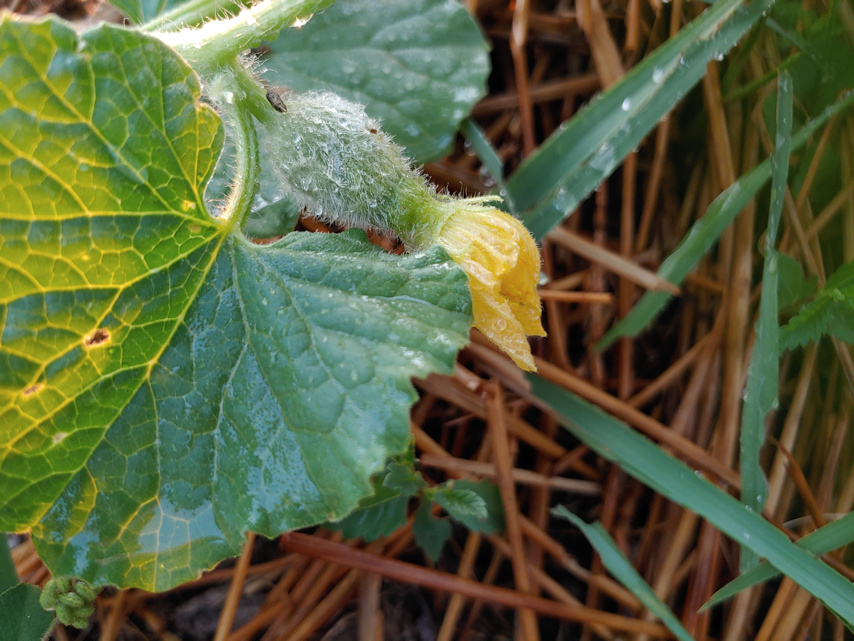
Tiny little melons, juuuust starting to form!

This is awesome!

I checked the other melons, squash and gourds. The summer squash is getting nice and big, and I might even have a couple of squash to pick tomorrow. The other melons and the winter squash have flowers and/or buds, but no fruit forming. Same with the Crespo squash. The luffa isn’t even showing flower buds, but it is climbing the trellis.

Then we went looking at the tomatoes (so many fruits are forming!), and they are doing great. The tiny little onions we planted under them are still tiny and little. :-D I noticed this morning, however, that a couple of self seeded (likely from the bird feeder) sunflowers seemed to be gone. This evening, I looked again and found their stems, leaves all eaten away. *sigh* More of the flowers in the bed nearby have not only had their heads eaten away, but in one area, even the stems are being eaten. We will not be getting many blooms out of that bed this year!

That reminds me: it looks like a lot of our French Breakfast radishes have been eaten, too. Possibly grasshoppers.

When checking the cucamelons, it looked like some of them had lost a few leaves and vine ends, too! They’re such small, fine plants, though, it’s almost hard to tell.

Then I saw this. :-(

This is the Thai Bottle Gourd. We had the one transplant, and a second seed germinated next to it. Now, the little one has lost most of its leaves, and the big one has lost a couple, plus a couple more leaves are partially eaten.

No damage to the Ozark Nest Egg gourds. Which is good, but we have more of those!

Very frustrating.

This year’s garden has been such a mixed bag of stuff going well, and stuff going badly, due to critter damage!

The Re-Farmer

Distractions

Last night, before doing the evening watering, I did a couple of things to – hopefully! – distract the deer away.

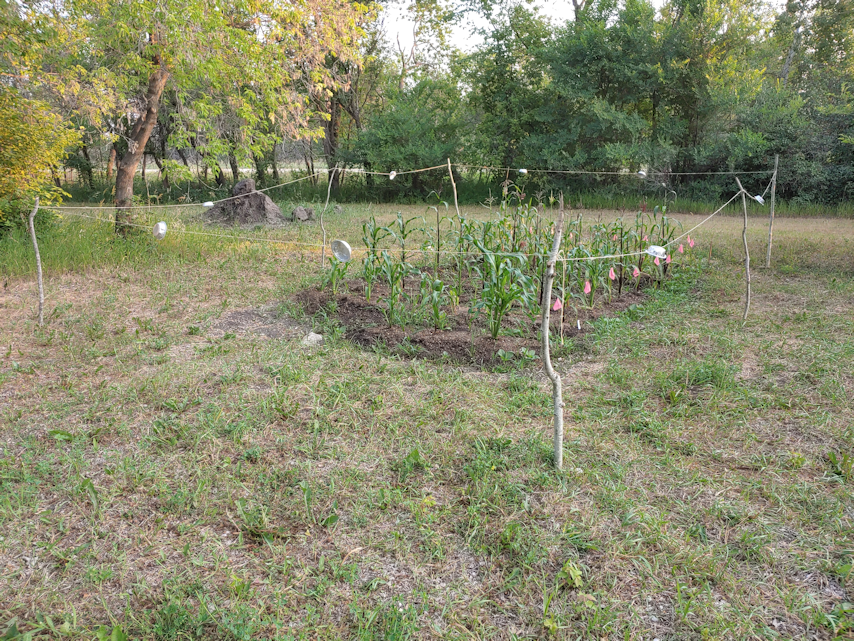
One of them went around the Montana Morado corn.

The aluminum tins spin freely on the twine, so I hope they will do as distractions. We can add more distractions after a while, to change things up before they get used to them.

This next one is more of a diversion than a distraction. On a wildlife group I’m on, someone had posted a picture of a deer with her fawn, in their yard. With the heat and lack of rain we’ve been having, they had put out a bucket of water for the wildlife. The mama and her baby promptly showed up and started drinking, even as the guy who posted the picture was sitting on his deck with a coffee!

We have water bowls all over the place for the cats, plus we found a way to keep using the cracked bird bath. Which is great for the cats and birds (and skunks, and probably the woodchucks and racoon), but they’re rather small for deer. I imagine they might still be drinking from them, but for the amount of water in the shallow containers, it wouldn’t slack their thirst.

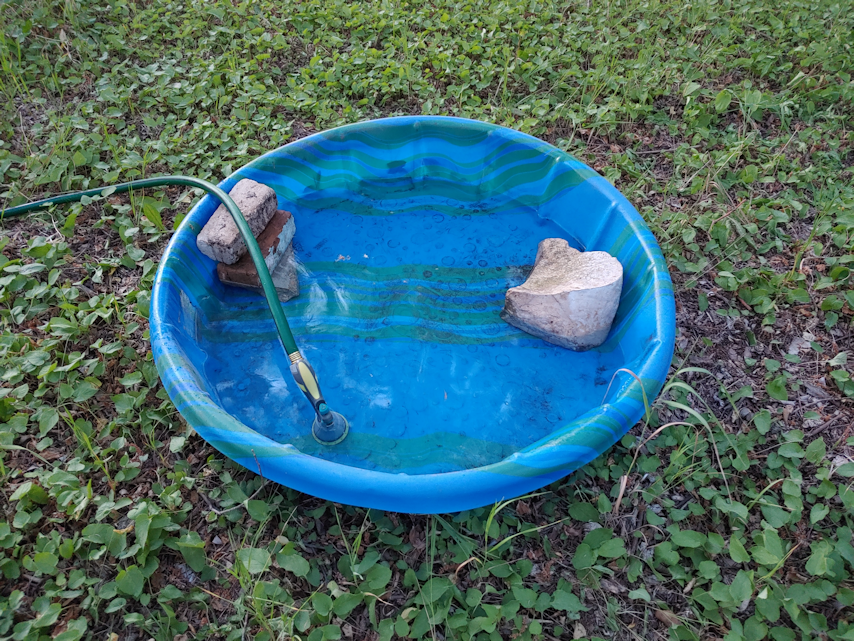
It occurred to me that if we could set up water for the deer in the right place, we might be able to divert them away from the garden. The deer damage we have been seeing has been comparatively small; they seem to be just nibbling a few things on the way by. My thought it, if they can get water somewhere away from the garden beds, they won’t have a reason to go by and nibble.

The deer go through the maple grove and jump the fence at the gates along West fence line. Our kiddie pool isn’t being used right now (who knew a kiddie pool could be so useful?), so I set it up near the old willow that overhangs the fence. The rocks and bricks are there to keep it from blowing away if it gets emptied, but for little critters, like frogs or kittens, to use to climb out if they fall into the pool.

I checked it this morning, but I honestly couldn’t tell if the water level had changed much.

We’ll see if it works!

Meanwhile, here are a couple of other distractions. Some pretty, developing tomatoes!

This is one of the Mosaic Medley plants. It’s such a dark green! There are others I couldn’t get good pictures of that are a much lighter green.

More like these.

These are the itty bitty Spoon tomatoes. They’re so adorable! :-D

Last night, after setting up the deer distractions, I stayed out to do a very thorough watering of the garden beds. Last night, I ended up awake and 4am and unable to get back to sleep, so I finally gave up and headed outside to do my morning rounds early. With the expected heat, I stayed out to give all the garden beds another thorough watering.

Then I napped. LOL

This afternoon, after coming back from a dump run, I stayed out to check the south garden beds and noticed that the gourds were actually drooping from the heat. When a hot weather crop like gourds are feeling the heat, I am glad I gave everything that extra watering!

Meanwhile, as I was writing this, my daughter went out to put frozen water bottles in all the cats’ water bowls.

Any little bit to help the furry critters deal with the heat!

The Re-Farmer

Our 2021 garden: nibbles and attempted nibbles

While doing my morning rounds, I found that something had tried to get under the floating cover on a beet bed.

It seems than an onion did its job of guard duty!

This particular union had been falling over on its own before, and when I picked it up, I could see it’s roots were gone and it had started to rot a bit.

There is now a brick where the onion used to be. LOL

Unfortunately, other things were not so lucky.

While our Crespo squash has not been bothered since we put distractions around it, for the first time, I’ve found some of our Montana Mordao corn has been nibbled on. Just two little ones, right at the corner, suggesting a passing deer. The flags I left from marking where to transplant seem to no longer be enough to keep them away.

Project for this evening, when things cool down a bit: place distracting things around the purple corn.

The Re-Farmer

Our 2021 garden: how it looked this morning

Apparently, we got rain last night.

I have my doubts.

Apparently, we got rain while I would outside, watering the garden, too.

That would have been nice, but all we had was hot, muggy, thick air.

*sigh*

One of the awesome things about gardening is how fast things can grow. We’ve got a whole bunch more summer squash blossoms, more squash growing (still no yellow zucchini, though), and the squash that started earlier could probably be picked right now. I’m going to wait until they’re a bit bigger, though.

I was very excited to see our very first WINTER squash blossom! Those are starting to get quite big. As we are able, we’re moving them to train them up the trellis, and some are sending out tendrils and looking almost ready to be climbing on their own, as are more of the melons. We’re going to have to go back with some twine to string between the sections of mesh and fill in the gaps a bit for the few plants that are under them. I had remembered to look for twine when I was last in the city, and found a huge roll of it. It should last us until next year! :-D

I am absolutely thrilled by the Montana Morado corn. This is the stalk that we are seeing silk on already. Pretty soon, it will have pollen, too! A few of the others are starting to show the little red bits, but they do not yet show corn silk.

We’re going to have to go in between these and “hill” the corn. With having to water so often, and not having a mulch, the water is eroding the soil at the base of the corn a bit. A couple were starting to fall over, so last night I worked the soil around their bases and secured them upright with it, but I want to do that with all of them. The ground here is so soft, though, we don’t walk in here at all unless we absolutely have to. I’d hoped to be able to add grass clippings for mulch, but with the heat and lack of rain, the grass hasn’t been growing.

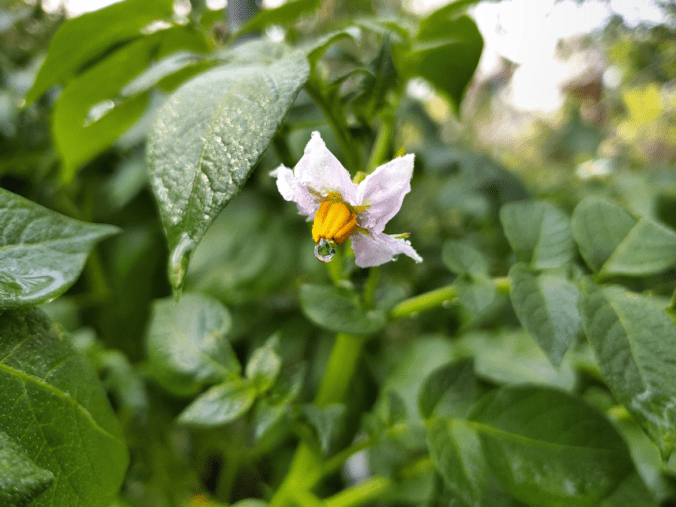
There are just a few potato blossoms that are fully open right now, but I am seeing many, many buds!

Of course, I’m always second guessing myself about deciding not to “hill” the potatoes more. As determinate type potatoes, it won’t result in more potatoes, but the plants have gotten so tall, it feels like they should be hilled! :-D

When I got to the old kitchen garden, I found the end of the L shaped beet bed was nibbled on.

I did see the woodchuck run under the garden shed this morning, but I’m not sure it is responsible for this. I think the carrots in this garden were nibbled on more, but I’m not sure. The motion sensor light would cover that carrot bed and the section of this beet bed next to it, and should be startling off any critters, but the section in the photo has a lilac bush between it and the light, so it wouldn’t be triggered by anything nibbling on the beets here.

I did see a deer going by the garden cam when I checked the files this morning. They seem to be just walking through, and not even going very close to the garden, now that I’ve put up the stakes and twine around the corn, and rope along the back of the Dorinny corn and the pea beds. I find myself wondering if a deer might have nibbled on the beets, since the woodchuck doesn’t seem to like beet greens, but that would mean the deer coming right up to the house, and pushing its way through the asparagus ferns and rhubarb, and I just don’t see that.

The beet beds in the old kitchen garden did get the Critter Ridder granules, but I was finishing off the container in the area in the photo, so there wasn’t as much there. It obviously doesn’t work to stop cats, since yesterday evening, we saw Junkpile and her kittens in the beets by the retaining wall. :-D

I still have to use the new spray we got, but it’s supposed to be applied on dry surfaces, so I’ll have to wait until later in the day.

Or until tomorrow, if we actually get the predicted storm!

Wouldn’t that be nice? :-)

The Re-Farmer
Our 2021 garden: we have silk! and loving the new tool

With today’s expected heat, I was out in the garden by 6am, and ended up staying out there for almost 3 hours, watering and weeding. The watering was started after replacing the connectors on three hoses.

I’m a goof, but it did work.

When I bought the connector repair sets, I got what was left on the display, and didn’t even think to look at the sizes. They are for 1/2 inch hoses.

We have 3/4 in hoses.

No matter. The clamps they came with could tighten enough to properly seal them. They will do while I am on the lookout for the right size connectors.

The little flexible piece I got for the tap, to prevent kinking, leaks. In several places! I guess I got a cheap one, though there wasn’t much choice. It still leaks less than it did before. One of the leaks is at the tap itself. Every single hose we’ve ever hooked up to that tap, leaks there. I plan to replace the tap itself, eventually. Meanwhile, there is some very luscious growth happening around the blocks we have under the tap. :-D

When I headed out again this evening, I got to break in the new action hoe.

What a fantastic tool!

I first tried it in one of the onion beds. It did well, but the onions are planted in a three row grid, and it just didn’t fit in between them, so there wasn’t a lot I could do with it, there. Mostly, I used it in the space in the middle, where the purple kohlrabi failed to grow.

It was at the Mongolian Giant sunflowers that it really did the job!

The soil here has always been rock hard, and baked bone dry. Right now, the only soft soil is the layer we put down for each row, and that was just a few inches deep. That anything we’ve planted here is growing at all is pretty remarkable. This thing worked like a dream!

Now, don’t get me wrong: it was still really hard to work around the sunflowers.The soil in between the rows is even harder now, as we walk between the rows to water things. It wasn’t just the hard soil, but also the very fibrous roots from the plants that were already growing here, and now enjoying regular watering for a change. This hoe was able to cut through those roots, and the rock hard soil at the edges of the paths. I was then able to pull out the cut weeds and their roots, before hilling the loose soil around the sunflowers a bit.

I am very impressed with this thing! The tool I was using around the corn before worked well; better than a regular hoe, but not as good as the action hoe. It was one of the unusual tools we’ve found around the place. The head of it is shaped almost like a mattock, except… not. LOL The “hoe” part of it is longer and narrower than a regular hoe, and it has a two pronged spike on the other side that I believe is a weeding tool. I’ve never tried to use that end, yet. It works really well at cutting into the hard soil. Better than a regular hoe, as least. Unfortunately, it’s quite old, and the head sometimes pops off the shaft.

I was doing one last row with the action hoe in the next corn bed, when my daughters came out to do the evening watering. My older daughter had finished watering the beds closer to the house with the hose, and when she came to continue watering where I was working, she told me about something awesome she found in the Montana Morado corn.

Silk!

Our very first corn to start showing silk!

If these are going to be maturing so unevenly, we may need to hand pollinate the silk, just to make sure they do get thoroughly pollinated. It would be pretty hit and miss to rely on the wind to pollinate the corn, when there might be only one or two corn plants ready to be pollinated at a time.

I am so happy that this corn seems to be working out so well!!

Today is supposed to be the last day of our heat wave. After this, we are dropping to more average temperatures. The expected high had been 38C/100C for a while, then it went down a few times. By morning, we were forecasted to hit 34C/93F, which we did hit. I don’t know what the humidex was. The forecasts for thundershowers tomorrow have shown up, disappeared, then showed up again, several times today! As I write this, it’s past 11pm, and we’re still at 28C/82F. The overnight low is expected to be not much cooler, but we are also supposed to get some rain, too.

I’ll believe that when I see it. From the looks of the weather radar, any rain or storms sweeping through are going to go right past us, and hit the city. But if we get even a little bit of rain, I will be happy. Even with all the watering we’ve been doing, twice a day, things are still really dry. I could really see that while weeding. Even at the start of the day, which the ground still looked damp from the previous evening’s watering. While hand weeding among the beets in the old kitchen garden, I had the hose set to mist, so the water would make it easier to pull the weeds out by the roots. I’d already watered the bed before I started weeding, yet when I pulled up the weeds, I could see how dry the soil still was.

When we build our permanent beds, having some sort of watering system would be very useful. We do have sprinklers we can use, but I’d rather have something less wasteful, like a drip system.

But that is something to figure out later. For now, we make do with what we have, and right now, that means watering twice a day with roughly 300 feet of garden hose and watering cans! :-D

The Re-Farmer
Our 2021 garden: more firsts – and more damage!

I will start with the good stuff, first!

Like these teeny, tiny first fruits!

These are the miniscule Spoon tomatoes! Several plants are now showing baby tomatoes, and they are so tiny and green, the only reason we could see them was because we were wrapping twine around stalks to the chain link fence to support them. Only now have enough of them gotten big enough to do that.

While watering the Montana Morado corn this evening, my daughter called me over to see some new growth.

Most of these handled their transplanting well, and the larger ones almost all now show these developing spikes. I somehow didn’t expect them to show up until the corn was taller, but we’ll see.

Now for the unhappy stuff.

While watering the corn and sunflower beds, I made a point of checking more closely where I saw the deer in the trail cam. Sure enough, a couple of corn had been nibbled on. I also found some Mongolian Giant sunflowers had been nibbled on. None of the larger, transplanted ones.

Then I saw this, while watering the Dorinny corn. The surviving plants are much larger – almost as large as the transplanted Montano Morado corn. Now, we’re down even more!

Three of the largest corn plants were chomped right down. :-(

While I was watering, my daughter came over from watering the old kitchen garden to ask me if I’d harvested the lettuces.

No. No I hadn’t.

Almost every single block with lettuce in it was eaten.

It was the groundhog.

I had hoped we’d driven it away, as it doesn’t seem to be using the den we’d found, anymore. We’re still spraying water in it, and this evening I left the hose running into it long enough to flood it. Wherever it’s gone to make a new den, it didn’t go far. This afternoon, while I was putting the DSLR on its tripod back at the living room window after vacuuming, I happened to see it just outside, with what looked like a dandelion leaf in its mouth. I called the girls over and it heard me, running off behind the house. The girls went outside to chase it off, but either it was already too late, or it came back.

Interestingly, it didn’t touch the beet greens.

I am not happy.

In watching the deer on the trail cam, they seem to be just nibbling as they go by. So after I finished watering, I took some bamboo stakes and set them up around the corn and sunflower beds, then used twine to join them, and the stakes that were already there, at two heights, around three sides. I ran out of twine just as I was finishing, so only a small section has one string instead of two. It won’t stop the deer, but if they’re just passing through, it’ll sort of guide them away.

After running out of twine, I used the last of our yellow rope and strung it from one of the support posts of the squash tunnel, through the pea trellis supports, and joining it to one of the new stakes I put in around the Peaches ‘n Cream collection corn blocks. I then stole another bamboo stake and used it to put a second, higher line at the Dorinny corn.

This leaves the beds in that corner with either twine or rope along the north sides of the Dorinny corn, the pea beds and the northernmost Peaches ‘n Cream corn block, all along the east side of the corn and sunflower beds, and the south side of the southernmost corn block.

Later, we will be stringing the aluminum tart tins I picked up to flash and spin in the wind.

Once we get more twine and/or rope, we’ll put up more to guide the deer away from the garden beds.

I also want to put a barrier and distractions around the Montana Morado corn. So far, they have been untouched, but I would rather lose any of the other corn completely, then this variety.

I also moved the garden cam and hopefully it will cover more of the garden beds.

There are lots of things we can do about the deer, even though we can’t put up anything permanent, like fencing, right now. The groundhog, on the other hand, is a different issue. It can get through or under most things, and now that it’s eaten all the lettuce, there is nothing to stop it from going after the beets. Unless it just doesn’t like beets.

This critter has got to go!!

The Re-Farmer
Our 2021 garden: corn, gourds, squash and melon transplants DONE!!

Yes!!!!! We managed to finish transplanting tonight!

I thought we might have to move beyond the squash tunnel, but since these will be trained to climb, we were able to plant them closer together than we normally would, and they all fit. Also, I was sure we had the little pumpkins to transplant. I was wrong. None of them germinated. We didn’t plant many to begin with, but I’d hoped to have at least one!

At the far end of the squash tunnel, we have 4 luffa vines on one side, and 3 dancing gourd on the other. Next to them are the two varieties of winter squash, and the two varieties of melon.

There are a lot more melons than anything else (I REALLY love melon!), and that’s even with several cups that never germinated. There are some cups with summer squash in them that never germinated, either, which is why we have only 15 transplants. We all really love summer squash, so we would have enjoyed more, but it’s still a bit more than we had last year.

Now that the squash tunnel’s transplants are in, they, and the summer squash, will be getting a mulch of straw as soon as we are able to get back to it. Then I’ve got to get those bottom cross pieces in, so we can attach the mesh for them to climb.

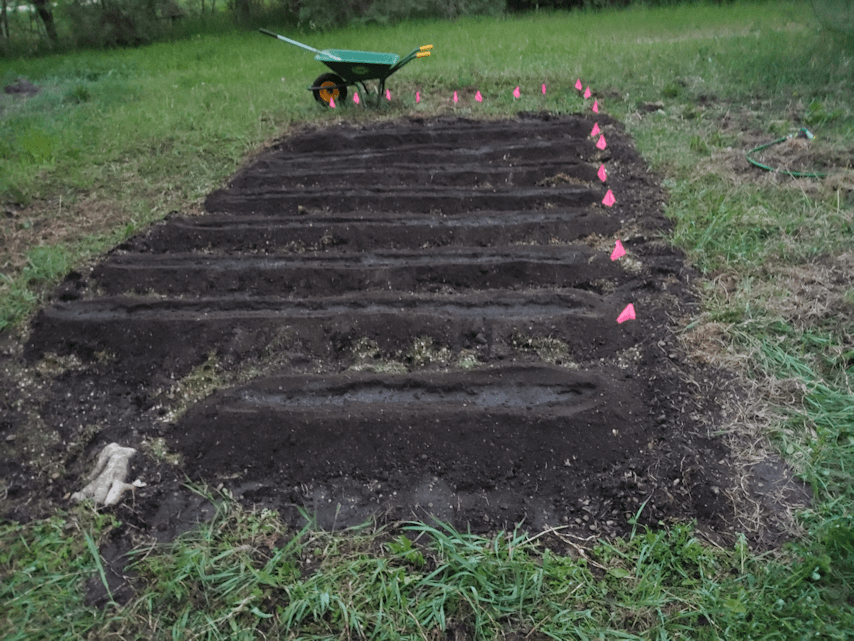
That done, it was time to finish the new corn block. I’d put a fairly deep layer of grass clippings down, first, so I wanted to put a fairly deep layer of soil. Plus, the garden soil tested high in nitrogen, which corn uses a lot of, so I wanted to make sure it had at least that for the transplants to start in.

After the soil was in place, I made a trench in each row to plant into, then thoroughly watered the trench with water from the rain barrel.

Doing the actual transplanting was rather cringe worthy. I keep hearing from others that corn doesn’t handle being transplanted well, their roots don’t like to be disturbed, and so on. At the same time, I have heard from zone 3 gardeners that only start corn from transplants and never had an issue. Still, I really would have loved for the toilet paper tube plan to have worked. I don’t know of anyone who has tried to grow Montana Morado in Canada, never mind in our province, nor can I find anything online about it, so this is all completely experimental.

The biggest, healthiest looking corn plants tended to be the ones were all 4 seeds in the cups germinated. Except for when they were taken outside to be hardened off, the cups with their drainage holes were all in a bin that had water on the bottom, so they could take up water from below. Which means that there were strong roots at the bottom of the cups, and with anything more than 2 plants in a cup, that meant having to tear the roots apart to separate them.

I am really, really hoping they survived this.

They are, however, all in! I even managed to get some in the little half row I wasn’t sure if I’d be using. I went ahead and planted the little ones, too. Considering they tended to be a single plant per cup, they might actually end up doing better!

Also, the flash makes it look darker than it actually was. I did still have enough light to see what I was doing.

After they were transplanted, I gave them a gentle watering with the hose. It was amusing to see a flashlight coming through the increasing darkness. My daughters hadn’t realized I’d stayed out to finish transplanting the corn, and one of them came out to check on me. :-D Which was handy, because that meant I had help putting things away. The washing of the cups and trays, however, will wait until tomorrow!

The only thing left to do with the corn is put a mulch in the paths between the rows. More to keep the new soil in place while watering than anything else.

Now that this is done, the girls and I can head into the city tomorrow, and I won’t be angsting over getting the transplants in the whole time we’re out! :-D

I’m tired and in a world of hurt – and really, really appreciating having my husband’s bath chair to use in the shower! – but I am very happy. :-)

The Re-Farmer
Our 2021 garden: growing and blooming

Wow, what a difference a day makes! After yesterday’s heat, our 9C/48F (feels like 5C/41F) is a welcome, if slightly chilly, reprieve. Welcome especially for the rain we got last night! I didn’t have to do any watering this morning!

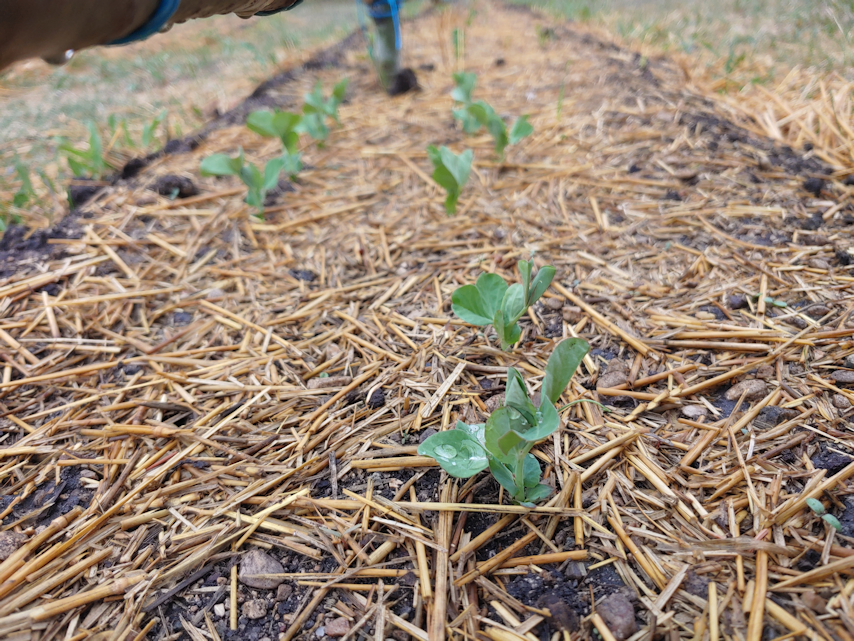
These are the purple pea seedlings. Definitely not a high germination rate, but it’s possible more will sprout yet. With these, the entire packet was planted, but with the others, we still have lots left. If there are still lots of gaps left in a week, we can successive sow more.

The forecasts have, of course, changed again. We’re supposed to stay wetter and cooler for the next while, and next week, there’s even an overnight low of -1C/30F predicted. But just on the app on my phone. The weather app on my desktop still predicts a low of 5C/41F for that day. We shall see.

It was cool enough that I did not plant the beans this morning. It will wait till later in the day.

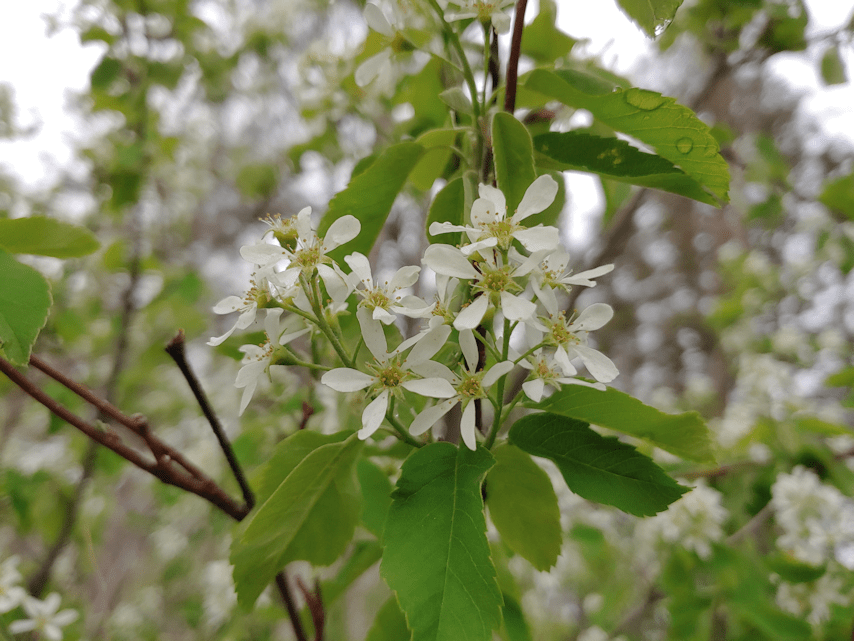
The Saskatoon bushes are in full bloom right now! I haven’t seen a lot of pollinators yet, but I hope we’ll have lots of berries this year.

It’s too cool and blustery to more our transplants outside. I want to harden them off, not kill them! The inner door to the sun room has been left open, though, and the window is open in the outer door, so that will cool the sun room down and, along with the ceiling fan, allow for more air circulation.

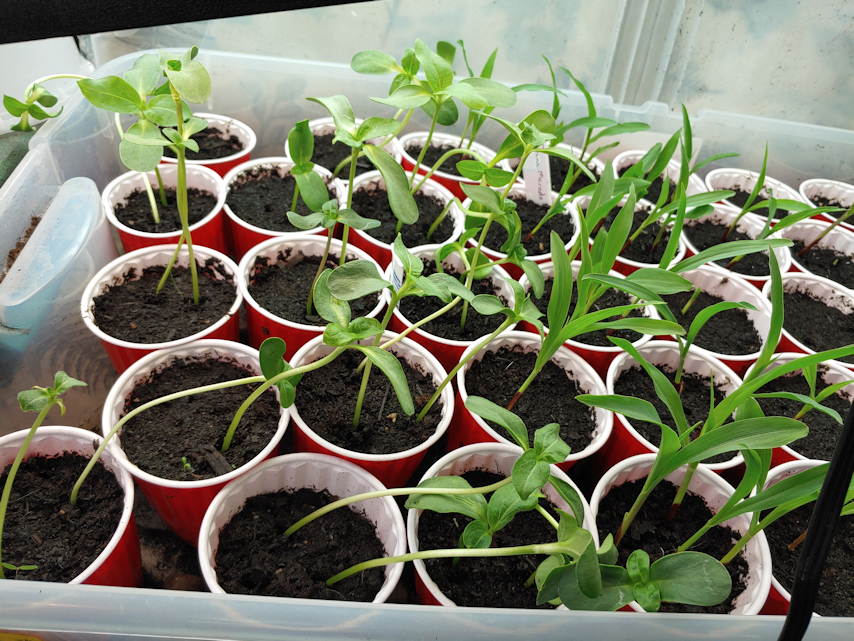
I rotated the bin the sunflowers and purple corn are in, and adjusted the lights above them to a higher level. I don’t know what to think of the sunflowers. They look really leggy, but these are also a giant variety of sunflower, so this might actually be normal for them.

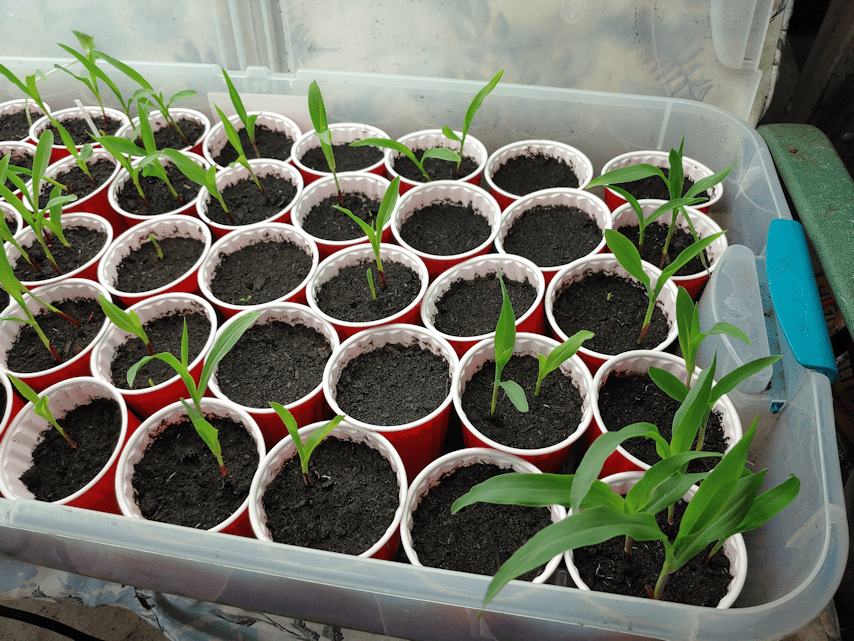
The corn next to them is doing quite well. Here are the rest of them…

There are still 10 cups that have no germination yet. We are still seeing new seedling popping up, though, so they may still come up. They really responded well after I found a way to put the aquarium lights above them.

The purple sunflowers still have zero germination. These are the ones that were planted in the tray of Jiffy pellets. I don’t know what to make of that. Especially with how quickly the Mongolian Giants germinated. At least the other seedlings are doing well, overall, and more of the squash and melon seedlings are slowly emerging. We should have a decent amount to transplant next month!

The Re-Farmer

Our 2021 garden: planting day, indoors – and that didn’t work!

Today’s priority was to start the last of the seeds indoors. I’d been preparing a bin with toilet paper tubes, as something that would allow the least root disruption when transplanting (at least, so I’ve read). After a couple of days, it was time to start planting the Montana Morado corn!!

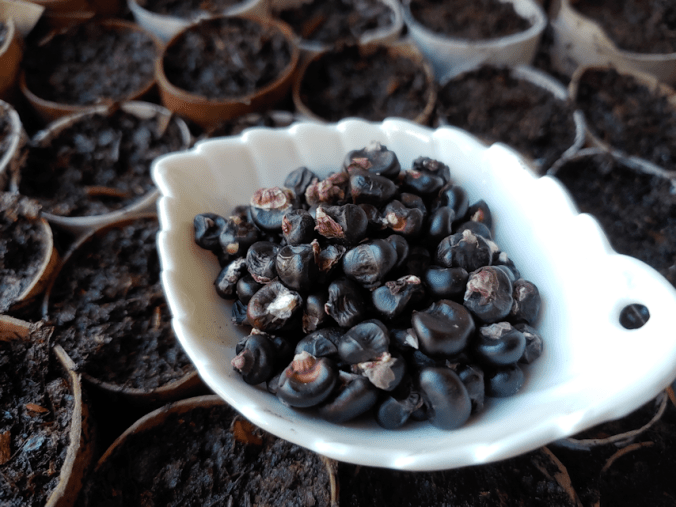
Aren’t they gorgeous?

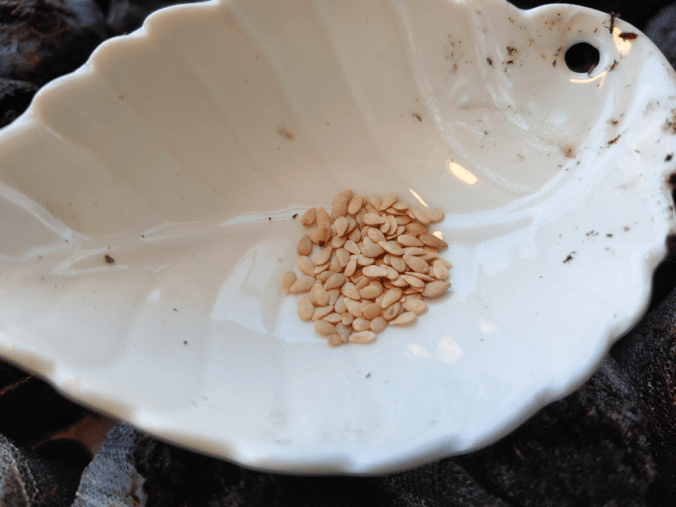
The seed packet said “at least 75 seeds”. That’s a lot more than 75!

I started puttering with the peat filled tubes in preparation of planting in them, but something felt wrong. Ever after a couple of days, some of the tubes were still floating on a layer of water, and as I made holes in the medium, it seemed really dry below the very top.

I didn’t want to take a chance, and decided to crack open one of the tubes.

I am very glad I did.

It was completely dry inside!

Well, so much for that idea. If the peat didn’t absorb the water after all this time, it wasn’t going to happen.

For the next while, I opened every one of those tubes to empty them.

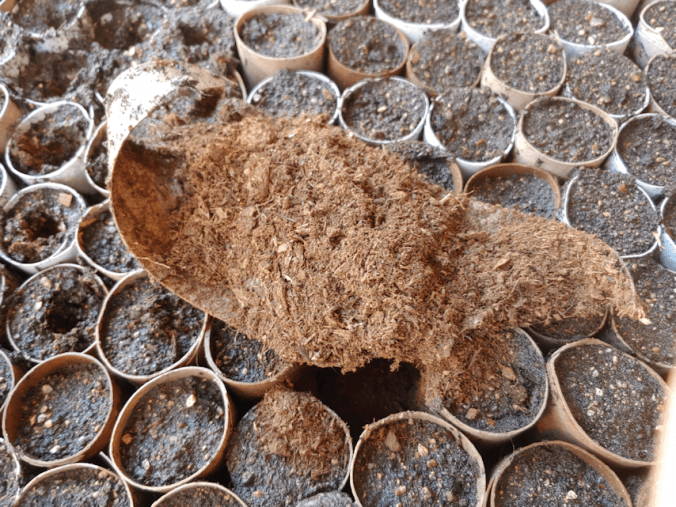
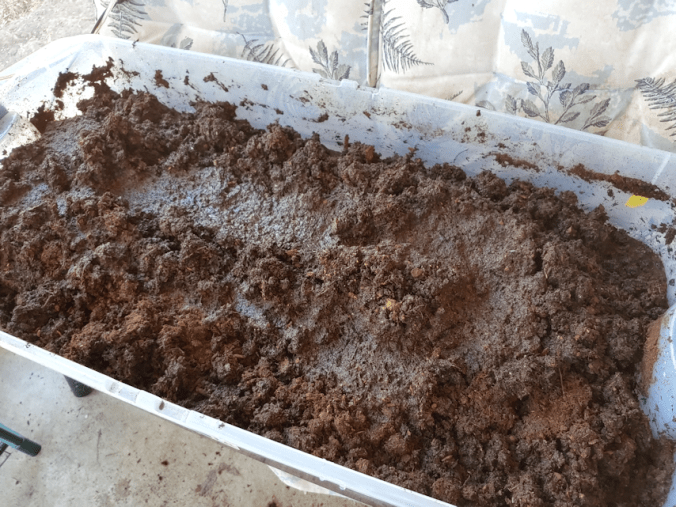
Once that was done, I kneaded it like bread dough, to work in the water. Then added more water and kept working the mixture until it was completely wet.

I should have done that right from the start!

I did work in the last of the sifted garden soil, too. The soil absorbs the moisture faster than the peat, so I thought that might help. The amount was quite small, compared to the quantity of peat!

As for the toilet rolls, they will not go to waste. These were dumped into the old kitchen garden, where they be composted directly into the garden, as we add soil.

The bin is still being used, though.

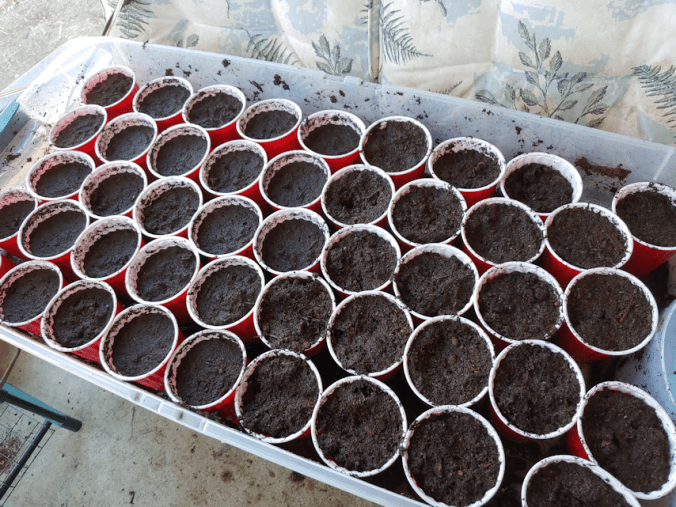
After punching holes into the bottoms of more cups and filling them, I ended up quite quite a bit of unused peat mix.

I made sure to water them from the top again, just to be sure, and left them to drain for a while.

For small seeds, I like to use a bamboo skewer to handle the seeds, but for larger seeds like this, I find a straw works great. It’s just the right size to push holes into the medium, and is perfect for pushing the seeds down to the right depth.

I knew I wouldn’t use up all the cups, so I didn’t cover up the seeds until they were all done, so I could easily see which cups were planted, and which were not.

Then I used some twine to wrap around and between the cups, to mark between the planted and unplanted cups.

I ended up with 33 cups with corn in them; 31 with 4 seeds each, and 2 with 3 seeds each.

I have some concerns about doing it this way, but starting corn indoors has been an active topic of discussion on several cold climate gardening groups I’m on. Most of the experienced Zone 3 gardeners say all corn should be started indoors (my mother never did; I would say the varieties make a difference!). Some insist that corn is too tender for transplanting, but the few who say that usually have many others commenting, saying they start their corn indoors all the time, and have never had issues with transplant shock.

So I’m hoping this works out. I really want to successfully grow this variety here!!

The remaining cups were planted with Mongolian Giant sunflowers. There isn’t a lot in the package, but the remaining 13 cups all got 2 or 3 seeds in them. I think there was a total of 33 seeds in the packet.

They all gone one last watering when all the planting was done.

The cover can be placed over the bin to help keep the moisture and warmth, if necessary. I think it should be fine, without, but we’ll see.

That done, it was time to plant the Hopi Black Dye sunflower seeds, and the cucamelons.

Again, there weren’t a lot of sunflower seeds in the packet. I’d forgotten how small the cucamelon seeds are! :-D

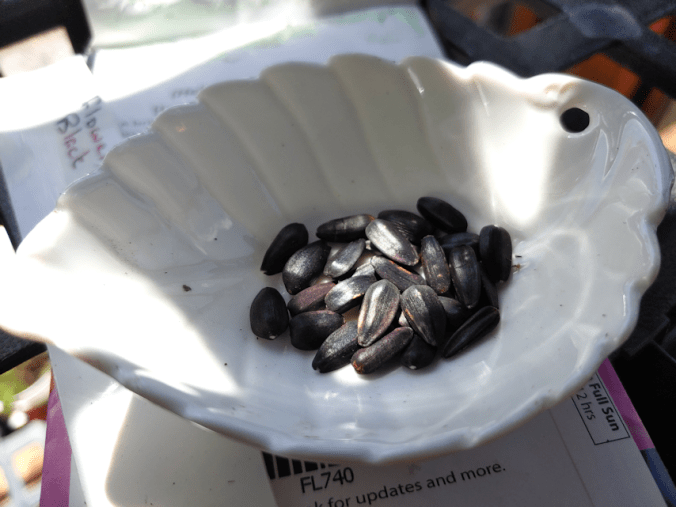
Since these were going into Jiffy pellets, the sunflower seeds each got their own pellet. It still filled less than half of the tray. There were 28 seeds in the pack, and I used the twine to mark between the two seeds. The cucamelons each got several seeds per pellet. I didn’t keep track of those. We still have the tubers from last year’s cucamelons, so it should be interesting to see which do better after they are planted out in June.

After these were done, we did the onions outside, which freed up shelves in the sun room. All the remaining seeds in the aquarium greenhouses are now in the sun room. I’m starting to be a bit concerned. Not a single squash or gourd has sprouted since the one Crespo squash germinated. That one is doing well (as are the dancing grouds), at least. I know gourds take a long time to germinate, but I would have at least expected more Crespo squash to germinate by now. I’m hoping the warmth of the sun room will be what they finally need to get them going. We shall see!

Starting the seeds indoors – and having to change plans on how to do some of them – took a lot longer than expected.

So did planting outdoors. Because, of course, things got changed up there, too!

You can read about that in my next post! :-)

The Re-Farmer
Our 2021 Garden: our Morado mystery

In choosing garden seeds this year, we kept a lot of things in mind. Choosing food that we’ll actually eat, choosing foods for long term storage, choosing foods we would eat more of, if they were more affordable at the grocery store, and choosing foods just for the fun or challenge of it.

One of the things I picked for the fun and challenge of it is corn that is such a deep, dark purple, it looks black.

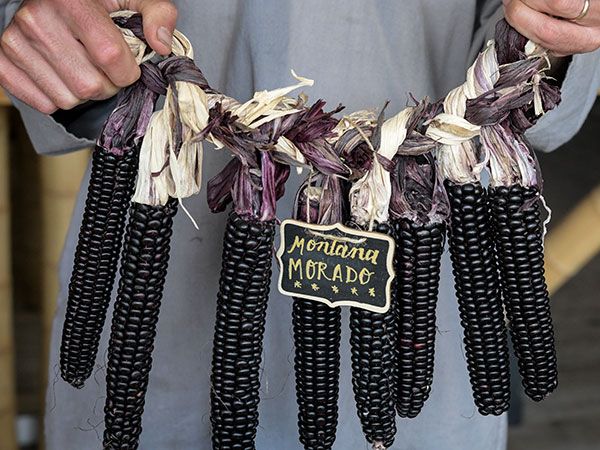
This image is from the Baker Creek website, where I got our seeds from. I chose it not only for it’s unique colour, but because it is a corn that can be used to make flour; something we have plans to do in the future.

Maize morado is a Peruvian corn, and I found the story behind how Baker Creek got their seeds to be really interesting.

The question is, how do I grow a Peruvian corn, in a Zone 3 prairie environment? So I started looking for people who had already tried to grow maiz morado.

I didn’t have much luck.

I did find things like this video from 2015.

Yeah. They didn’t do too well. I found an earlier video, and saw that these were the Kulli variety, also from Baker Creek.

I found a few other videos, and noticed one thing in particular. They started out with very few seeds. One guy had only five seeds, and of those five seeds, he got one corn plant that he had to hand pollinate, and only one ear of corn, which he intended to save the seed from to plant the next year. I found no follow up on that. Another person had planted 8 seeds, starting them indoors, but he deliberately intended to cross pollinate them with local varieties, to develop a hardier strain. He stopped posting videos soon after, so there was no conclusion to his experiment. All of these were older videos. Of the ones that showed the end product, they got very tall corn plants – 8 feet tall or more – very few cobs, and very few developed kernels on those cobs.

We have one advantage, in that our packet says it has a minimum of 75 seeds in it. At the very least, we should have plenty of corn plants and the wind can do the pollinating!

There is something else, though.

In spite of what the Seed Stories video from Baker Creek says, these are not Maize Morado.

They are Montana Morado.

From their website:

This variety is a northern adapted homage to the legendary Maiz Morado/Kulli corn from Peru. Ed Shultz, the accomplished and passionate open pollinated corn breeder who spent 30 years selecting this dark purple variety, explains that Montana morado is was actually selected from the Painted Mountain corn.

https://www.rareseeds.com/store/vegetables/new-items-2021/montana-morado-corn

These are apparently not from Peru at all.

These are shorter and stockier than the Peruvian Morado strains, and are bred for Northern gardens.

Except this is Montana, which means for us in Canada, it’s bred for Southern gardens.

Will this strain work here? Aside from a few articles about the development of the strain, I am finding nothing about people actually growing it, and how. It may simply be too new a strain. It’s all pretty much a mystery.

So we’re going to be flying by the seats of our pants on this one.

The plan right now is, we will start them indoors in the second half of May. As corn is not something that is normally started indoors, and their roots do not like to be disturbed at all, we will be using toilet paper tubes to start the seeds in. The tubes will be left open ended in a container, so that when it’s time to transplant them, they can be put into the soil, tube and all, with zero disruption to the roots. Hopefully. As their roots tend to grow more downwards than outwards, the open bottoms should mean no root constriction, while the cardboard tubes break down in the soil.

Unlike the one gardener whose video I found, we do not intend to deliberately cross pollinate, so these will be planted at the opposite end of the garden from the other varieties. With wind pollination, the only way to be absolutely sure no cross pollination happens anyway would be to put bags over the developing corn, and then hand pollinating.

I’m not that dedicated to preventing cross pollination.

I am hoping that this one packet of seeds will give us enough corn to be able to have some for fresh eating, maybe even freeze some, and hopefully even try making some chicha morada to drink, but mainly to keep some for seed to plant more next year. Then we will repeat the process until we eventually get a mill and can try grinding some for flour.

Along with the Montana Morado corn, I’d ordered a variety called Dorinny Sweet – a Canadian hybrid – from Baker Creek. We will be direct sowing the Dorinny Sweet, and plan to save seeds from those, too. The Veseys three pack of Peaches ‘n Cream varieties I also ordered was more because I wasn’t sure the Baker Creek order would make it past the border, and while we will have plenty of corn for fresh eating and preserving, Peaches ‘n Cream are just about sustenance, not any particular interest in the variety. They’re the Russet potato of the corn world, in my view. :-D

Well, that’s the plan.

Who knows. Things may even work out to the plan! Either way, I’m looking forward to trying out this variety of corn, and seeing how it handles our climate.

The Re-Farmer