I’m happy to say that I pretty much finished all the stuff I needed to get done before the hard freeze hit, but I just had to share this first.
One of the adult females we’ve been trying to get is Adam. She sometimes allows us to pet her, but we just haven’t been able to get her into a carrier.
As I was going through the sun room this evening, I spotted her.
That’s her, peeking at me from one of the carriers, back in its spot on the shelf.
Well, at least she associates carriers as a cozy spot to hang out. If only she would do this when we can get her to a vet for a spay!
*sigh*
The first thing I needed to do when I headed outside this afternoon was set up the emergency diverter for the septic, now that the tank area is covered in straw. In the basement, I grabbed a length of foam pipe insulation to put around the pipe first, then pushed it as far as it could go against the wall. When the ejector froze last winter, every time the pump turned on and greywater was pumped out the emergency bypass, I would hear vibrating noises of pipe against concrete that always got me nervous. I’ve become rather paranoid about our septic system! The pipe insulation I used is one of several lengths I found in the old basement that is meant to go over water pipes, not the larger pipe from the septic, but it’s split lengthwise, so I could get it around the half that was against the wall. That’s all I need.
Once outside, I had to remove the insert plug my brother had put on the outside end, which was secured with a steel ring hose clamp. The plug he got has the ridges that help keep it from being pushed out by pressure, plus the tightened the ring enough to squeeze the end of the pipe tightly. Basically, it would have been a great permanent plug. Unfortunately, it’s not meant to be permanent. It’s meant to be taken out as needed. An ordinary, temporary, end cap would have sufficed, but my brother is very thorough! It took considerable effort, and an adjustable wrench, to finally get it out. Plus a flat head screwdriver to create space between the pipe and the plug, just to be able to move it at all!
Once the end was open, I could set it into the PVC pipe I had ready. Then I used the collection of boards, bricks and scrap pieces of Styrofoam insulation to create a gradual slope from the rigid pipe and along the flexible hose so that grey water could be diverted far from the house, into the maple grove.
Hopefully, we will never need to use this again, but it’s good to have it set up and ready, just in case!
The down side of having that set up is that it blocks access around that corner of the house from where the bale is. Once the emergency diverter was set up, I got the wagon and the wheelbarrow to get straw to the various areas I wanted to mulch. When it came time to do the old kitchen garden, I had to go the long way around with the wagon and wheelbarrow loads of straw. Not a problem. Just a bit inconvenient.
The first area I worked on was in the main garden. The above picture is a little preview. By the time I was done, light was starting to fade fast. I decided to do a quick, impromptu garden tour video. I’ll be working on editing that tonight, and will likely have it ready to post tomorrow. I have a few hours to kill before I have to go to my mother’s for her bed time med and personal care assist.
Before I finished for the night, I grabbed one more wheelbarrow load of straw and set it by the covered greenhouse. Tomorrow, I plan to clear out the water bowl house and set straw on the floor, removing the huge crocheted blanket entirely. We’ll set that over the kibble house roof as extra insulation. I expect to have leftover straw, and will find other places to leave it for the cats. The cats really, really like the straw! The last thing to do will be to rake up around the bale to clean things up, then cover it with a tarp for the winter.
I am so glad we were able to get another straw bale this year – and that the renters had one to spare! Next year, when it’s time to use straw as mulch on the garden beds, I plan to run it through the shredder chute on the wood chipper, first. In the past, I tried using the push mower to shred the straw, but it clogged up the air filter so quickly. We only have my brother’s push mower now, so I’m not going to be doing that with his equipment!
Getting this last bit of progress done before things got too cold feels so good! 😊
I wasn’t sure if it was going to get done. When I headed out this morning to feed the outside cats, it was decidedly unpleasant.
I also counted 38 cats. I haven’t seen that one tabby that I didn’t recognize, but none of the ones I did see were unfamiliar. Which means the crowd was congregating all at once!
I didn’t soak the kibble in the morning, because I knew it would freeze, so I saved that for the afternoon. I counted 32, that time. Including this little fluff ball.
Tomorrow evening, we are going to get Frank and Pinky closed up in the isolation shelter, so that they can have their fast (after a treat of wet cat food) and be easier to catch in the morning, for their spays. The other cats and kittens are not going to be happy with not being allowed in the isolation shelter for a month! We’ve got the first two that will be in there until it’s time to switch them out for about 10 days, and then we’ll have the next two set up in there for their recovery period. Assuming we can catch two more females. If we ended up with males, they won’t need that much time for observation and recovery.
After the second feeding, I did my evening rounds before it got too dark – these are being done earlier and earlier! Today, I made a point of checking the asters. I’d left the flower bed untouched, so that the Cosmos could shelter the memorial asters from the frost, and hopefully give them time to go to seed.
I collected some to bring inside for planting next year. I left others to self seed. I’m so happy they had enough time to develop seeds before the deep freeze hit!
It was nice enough out that I grabbed a rake and collected leaves to do some mulching, then did a bit of winterizing.
The first picture in the slide show above is where the tiny strawberries were transplanted. I have no idea if they will survive in their new location, but it is worth a try. In the next picture, you can see that the strawberries transplanted into the retaining wall also got mulched with leaves. Next was the saffron. I don’t know if I am being too early with this, or too late, since they are showing new growth. The one flower bud that is still there looks like it froze before it could open, so I left it. I had considered leaving those until later, as we are supposed to warm up a little bit over the next week, but then I saw cats digging around them to leave “presents”, so the mulch is to keep them away, too.
I didn’t mulch the little herb bed, as we are still able to harvest from them, but I did get a pile of leaves ready for when it’s time.
Now that our septic tank is empty, it’s time to get that area ready for winter, too. We’ll be setting the emergency bypass up, just in case, so I stretched out the flexible hose so that it can warm up in the sun and straighten out. I ended up sitting a short length of pipe into the far end to flatten it, because it kept sticking up into the air. The two lengths of PVC pipe we set over the pipe from the basement got shoved into the flexible hose at the other end to help straighten that out, too. In a couple of sections, I leaned boards and bricks and whatnot to get them to straighten out and flatten to the ground.
We did not get the straw bale I was hoping to get this weekend. It might still get delivered in the next while but, just in case, I set the insulated tarp over the septic tank and weighed it down.
The forecast now says we should reach highs of 5C/41F next weekend, and that should be pretty much it for the winter. Time enough for a few last things, like covering the herb bed and, if the straw comes in, using that in various places. I’ll take advantage of every warmish day we have right now!
I had a wonderfully productive day in the garden today, so I am splitting things up into a couple of posts.
I decided to shift gears today. After looking at what I was wanting to winter sow and where, I decided to leave cleaning up the last two beds in the main garden area for later. Possibly until spring, depending on how things go over the next while. I needed to move on to other areas. Areas I knew would be faster to work on, since I wouldn’t be dealing with the roots and rocks situation!
The priority was going to be the old kitchen garden, but first I decided to do the winter sowing in the garlic bed. I didn’t want to have the plastic cover over the garlic for too long, as I was concerned the mini greenhouse it created might mess with the garlic.
Here is how it looked, after the plastic was removed.
I’d already raked up as many leaves as I could stuff into the wagon and the wheelbarrow for mulching.
As for the plastic, I was going to roll it up for storage, but remembered the low raised bed I had recently cleaned up. The cats have been digging in it, so I tided that up, then just shifted the sheet over.
The boards and bricks that had weighted down the sides against the hoops before are now being used to keep the plastic snug against the soil, and from blowing away. I found a short log that I could roll the excess up into. Later on, I did take all those rocks you can see at the end, and set them on the plastic, under the roll. It is slightly elevated, and the wind was moving it around quite a bit, considering how litter wind we had today. The rocks weighing down the other end weren’t enough, so I found a short board I could wrap the plastic around and weighted that down with the rocks. If it were spring, this would be a good solarization set up. For now, it’ll just keep the soil a bit warmer, and keep the cats from leaving me more “presents”. 😄
Then it was time to get back to the garlic bed, and clear away the hoops. With the twine marking the three rows of garlic, I used those as a guide while using stick to create furrows in between. I went back over them with my hands to lightly compact the bottoms for better soil contact – and remove as many little rocks as I was able to!
For the varieties, I chose American Spinach and Yellow Swiss Chard.
I didn’t mark the rows, so this picture is to help me remember what I planted and where!
I chose this variety of spinach because, after reading the back, it seemed the most appropriate for the location, as well as winter sowing. The Yellow Swiss Chard is a new variety, with an unusual colour for Chard, so I wanted to give it a go. Both packets still have seeds left, so we could potentially do another sowing in the spring, after these have germinated.
The seeds got lightly covered, and gently tamped down, again for better soil contact. I had made the furrows deep enough to form shallow trenches. The soil was damp and didn’t need watering – I don’t want them to germinate too early! – but next year, the trenches will help hold water, in case we end up with another drought year. Plus, it makes it easier to see where the seeds were sown.
You can see that in the next picture, along with the “first” mulching of grass clippings taken from other beds. Because the garlic is so close to the outside of the bed, and the bed has no log frame, I wanted to give the sides extra insulation. When the leaf mulch is removed in the spring, the grass clippings will be left as erosion and weed control.
I was originally going to remove the twine and stakes marking the garlic rows, but decided to leave them, and put the leaf mulch right on top, which you can see in the last photo. I finished off both the wheel barrow and the wagon of leaves before it was done. I got another wagon load to finish mulching the garlic bed, and had just enough left over to mulch the Albion Everbearing strawberries I’d transplanted from their original choked out bed to beside the new asparagus bed. The strawberry plants were still very green! Hopefully, they will survive the winter and we’ll have nice, big strawberries next year.
So the garlic bed is now DONE!!!
With the stakes left behind, the bed will be visible after the snow falls. This area gets very flat with snow in the winter. If we can get at the beds this winter, I would want to dig snow out from the paths and onto the winter sown beds for even more insulation – and moisture – in spring.
That done, I started moving my tools and supplies over to the old kitchen garden, where I wanted to work next, but first, I decided to gather a small harvest.
I dug up just a few Jerusalem Artichoke plants around the edges of the bed, and this is what I was able to gather from under them. I will leave the rest of the bed to overwinter. Later on, I’ll use loppers or something to cut the plants, which are still very green, and drop them on the bed as a sort of mulch.
The Jerusalem Artichokes (aka: sunchokes) did not grow very tall this year, compared to others. I did water it at times but, I’ll admit, it was largely ignored this year. As with everything else, I think the heat, the drought and the wildfire smoke set them back. I think they also got less light this year. The Chinese Elm trees beside them had been pruned, but the branches have grown back. I want to get rid of them entirely, because of the billions of seeds they drop in the spring, but for now we’ll just try to prune them again, when we can.
As for the sunchokes, I noticed a difference this year. For starters, I didn’t find any of those grubs I found so many of, when I harvested this bed completely, last time. Sometimes, I’d find them half burrowed into a tuber – both living and dead! Other times, I’d see the holes, then find a dead grub inside when cutting open the tuber. I was not impressed! This time, I saw zero grub damage. Sweet!
The tubers themselves are actually less nubby, too. A lot of the ones we harvested at the end of the season last year had so many nubs on them, they were hard to clean. This time, there are a couple of nubby ones, but most are smoother. Which I much prefer!
With leaving the rest of the bed to overwinter, I hope that we will have a much better growing season overall, and a lot more plants to harvest from. That seemed to work out when we did it before, as last year’s harvest was quite decent.
This done, I could finally move on to the old kitchen garden and start on the beds there.
Which did take longer than expected, but for a very different reason this time!
It was getting ridiculously hot and muggy, but I wanted to finally get a good mulch around the newest food forest additions. I had just gone around them with the weed trimmer and, with the rain we’ve been having, it would grow back fast if it didn’t get covered.
Of course, I forgot to take a “before” picture, before I started! 😄
In the first to photos above, I had just laid out the first wheelbarrow load of wood chips. Before that, I moved out the hose I had set up in the rain barrel, taken away pieces of wood from when we had our pea and bean trellises out there that were weighing down the cardboard, and removed the leaky rain barrel and my watering can. I left the cages and the metal spinner.
The plum tree already had the largest area mulched with grass clippings, so I added the wood chips only up to the wire mesh. With everything else, I mulched closer in, but still made sure to leave a “donut hole” around the plants themselves. There was also a pile of grass clippings set aside when the area was prepped for planting, so I went ahead and added that in, too. With that added in, it took 4 1/2 wheel barrow loads to mulch the area, nice and thick.
After I got the two “after” pictures, I set the rain barrel back between the gooseberry and apple, making sure the cracked side was facing the middle. One of the sticks I’d removed earlier had been under the opposite side of the barrel to tilt it slightly towards the cracks, and that was returned as well.
By the time I was done, I was dripping with sweat, and we hadn’t even reached out high of the day, so headed back inside once this was done. I still want to head out to take garden tour video, but not quite yet!
I did get some video, though. I had gone back to the paths I’d worked on earlier today, and wow, those ants work fast!
This was just one small section in the video. You can even see one ant going by, carrying an egg. Already I can see openings to tunnels, all over the place! Those buggers work fast!
Crud. I’m going to need to get ant traps to get rid of them, since they’ll cause lots of damage here, and these ants are biters. I hate having to kill them, though.
While we currently have sunshine, heat and humidity where we are, I’m happy to say that there is a large system of rain passing over the north of our province, where most of the wildfires as still burning. There’s a possibility of up to about 100mm (just under four inches) of rain by tomorrow!
I think, over the next few days, I’m going to have to start setting up supports around some of our beds. Looking at the long range forecast into September, we might actually drop to potential frost temperatures in the first week. Even in the next week ahead, we have at least one night where we are expected to drop below 10C/50F. The eggplant seem the most intolerant of cold, but we’ve finally got some female flowers on the winter squash showing up! If we can just stay above 10C/59F for another month, we might actually have something to harvest.
Ah, well. Whatever happens, we’ll just have to deal with it!
The beans with the tomatoes are doing really well. At first, it seems that one of the seeds had not germinated, but it did eventually show up. That makes for a 100% germination rate of these old seeds.
Too bad a cat dug one of them up. *sigh*
In the foreground of the first photo, you can even see some of the self-seeded carrots coming up!
In the next image, you can see the second planting of beans coming up in between the corn. Of the first planting, there ended up being a total of three, maybe four, that came up, and only one of them came up strong and healthy. Considering these are the same seeds in the same bed, it’s hard to know why the first sowing failed so badly.
The last image is of the Arikara squash bed – and the corn in there is so much bigger than the ones in the other bed!
I really like using the stove pellets to mulch around seedlings. The pellets land around the small plants, rather than on top of them. Then, after being watered, the pellets expand and fall apart, with the sawdust creating a nice, fairly thing, but really light, mulch. So far, it seems to be working out with anything I’ve used them around. It helps that the 40 pound bags are so cheap, and a little goes a surprisingly long way!
Once my rounds were done, my older daughter came out to help me remove the netting around the trellis bed. We had an unfortunate surprise while pulling it out, though. I’ve seen frogs – even large ones – squeeze through the rather fine mesh but, unfortunately, a garter snake didn’t make it. My daughter found it stuck around and under the corner of the bed. It hadn’t been dead for long, but long enough that a big beetle was chewing on its head. We had to cut a section of the netting off, because we couldn’t get it loose from the netting.
As my daughter said, it’ll be good when we no longer need to use netting! At least not this netting. It’s always a concern that a kitten or a bird will get caught in it. I never thought a garter snake would get caught!
We were being eaten alive by mosquitoes while we got the net down, stretched it out, folded it in half length wise, then started rolling it up on a bamboo stake for storage. They were after my daughter a lot more than me for some reason, so once the netting was rolled up enough, I sent her inside while I finished. It’s now tied off and in the garden shed. I made sure it was resting higher up in the shed so, hopefully, no critters will get into it.
That done, I brought out some of the trellis netting we’ve used in previous years. This netting has 4′ square spaces, making it easy to reach through to weed or harvest.
I started off by weaving a bamboo stake through one edge of the netting, where there is a pair of lines about a half inch apart, instead of 4 inches. I tied one end to the vertical post at the corner, then stretched out the netting flat before tying it to the next post. Then I added the next bamboo stake, weaving it into the netting and joining it to the first stake, before tying it off to the next couple of vertical supports, then did it again.
The netting ended on the third stake, so I added another piece of it to a fourth stake before joining the stakes and matching the netting up. That left a lot of excess netting at the end, but I just bunched that up and secured it while trying off the stake to the vertical.
I had woven in a plastic coated metal stake at each end of the bed to keep the netting straight. After the horizontal stakes were in place, I pushed the netting down so any excess was at ground level. I then took the garden stakes there were already in place to hold the protective netting that was there before, and used them in the trellis netting. Each one got woven vertically through the netting, then I used them to tighten things up a bit before pushing them into the ground. Where the two nets overlapped happened to be where there was already a longer bamboo stake, so I used that to join the sections together at the same time. Once all the stakes were woven through and pushed in the ground, I used ground staples to secure the netting to the soil, catching in the excess, to make it all fairly stretched out and tight.
I recall from using the netting before that the weight of plants climbing it can cause issues, so I added another level of horizontal bamboo stakes along the middle. These got tied to the vertical garden stakes, rather than the posts for the permanent trellis. This way, the netting is at a slight angle for the beans to climb.
This bed hasn’t been weeding since the protective netting was placed all around it. A lot of the self seeded onions I transplanted into rows were no longer visible.
I started weeding along the trellis side. I probably should have done it before the trellis net was added, but the mesh is open enough to reach through easily. The problem was more my hat constantly getting tangled in it!
As I was working my way along the beans, I spotted a little volunteer tomato plant! I remember finding volunteer tomatoes in this bed last year, too. I’m not sure where the seeds came from!
When I found one, I left it, thinking it would be fine were it was. Then I found another.
And another.
So I thought I would come back later and transplant them once I weeded and could see a space for them.
Then I found another.
And another.
And several others!
As I was working my way down the onion side of the bed and kept finding more even tiny tomato plants, I started pulling them up with the weeds, then transplanting them wherever I had enough space between the onions or the pumpkins. Then, when I finished weeding the bed, I went around the beans side to dig up the ones I’d left there and transplanted them.
By the time I was done, I counted 14 volunteer tomatoes.
Or 15.
I actually counted 13, first, after all the weeding and transplanting was done. Then noticed one I’d missed, so I counted again and got 15. Then I counted again, as I was scattering stove pellets around the bed and counted 14. I counted again and kept getting 14, so I either keep missing one, or I double counted one before.
Of course, it’s also possible I missed some volunteers when I went back to find and transplant them. If so, they’ll be easier to see, soon enough!
The last photo was taken after I’d scattered the stove pellets, but I forgot to take one after it was watered and the pellets were all expanded and breaking up.
This bed now has Red Noodle beans and Hopi Black Dye sunflowers along one side. On the other is onions from last year, going to seed, plus a whole bunch of tiny self seeded onions that I transplanted after clearing and preparing this bed for the beans and sunflowers. Then there is the pumpkins, and now the volunteer tomatoes.
This bed is going to look really interesting, once everything has reached maturity!
Today, I remembered to take some pictures of the radish seed pods that I’ve been snacking on.
The first three pictures are all from the same plant. What a difference! Some pods have just one pea-sized seed “bubble”. Others are longer, looking like they have a couple of seeds developing in them. Then there was a branch that has seed pods of all shapes and sizes!
The last pictures is of a different variety of radish in the winter sown East yard garden bed, with distinctive red lines on them. The seed mix had four different varieties of radishes in it, and I don’t know which is which, though I’m guessing the yellow variety is the one plant I’m seeing with yellow flowers.
I’m really happy with how the winter sowing experiment worked. The last time I tried it, I did the mild jug version, and it failed completely. Now I know that sowing directly into the beds, then heavily mulching, is the way to go for a lot of things. There are a few things I will now plan ahead to winter sow, but not as a mix. Beets, carrots, turnips, kohlrabi, spinach, and radishes for their pods. Also, that one variety of lettuce I planted was insanely prolific, and good at self seeding! I’ll have to be careful when collecting seeds this fall! Oh, the tiny bok choy worked, as did the chard – when they’re not being overwhelmed by other plants! There are also tiny onions all over, but they’re so far behind, I don’t expect we’ll be getting any bulb unions this year. Which is okay. We have the ones that are going to seed, so we can start onions indoors, using our own seeds, in January or February. The turnips also worked out much better than any other time we’ve tried them, so I think we will run through the varieties again to see which ones we like best.
I get the feeling we’ll be doing a lot of direct sowing in the fall from now on! Just in a more organized way. Peas are something else that are supposed to be good for winter sowing – we just have to make sure the bed they’re planted in doesn’t get destroyed by cats, to find out!
Obviously, tomato seeds survive the winter just fine. What variety they are, I have no idea, but if we’re going to winter sow tomatoes deliberately, they’ll have to be a very short season variety, if we’re going to get anything from them. If the Sub Arctic Plenty tomatoes turn out to be a variety the family likes, they would be an ideal candidate. Their growing season is so short, we could actually direst sow in the fall, then again in the late spring, to extend the harvest, if we wanted to.
We just need to be sure we actually enjoy eating them, first.
It’s taking us years to get things worked out, with a couple of major set backs along the way, but those set backs have actually helped us in our decision making for the future. Like now knowing that parts of our garden area are prone to flooding during wet years! Having beds raised even just a few inches has saved come of our plantings already.
I do look forward to when we can make the low raised bed higher, though. Working on the bed this morning, while much improved from working at ground level, was still pretty painful! Plus, the lower the bed, the shorter the reach. Even though these beds are 4′ wide on the outside, it was still hard for me to reach the middle of the bed. With the high raised bed, I can reach clear across, if I wanted to, without difficulty.
All in all, I’m pretty happy with the morning’s work.
My next garden project will be finally working on the old kitchen garden bed that will get wattle woven walls, but I’m going to have to put another job higher on the priority list. When going through the trail cam files this morning, the gate cam had over 100 files – and this camera is set to just take single still shots. Most of those were from the poplars coming up on the other side of the fence, blowing in the wind. Which is not really a step back, since some of them, at least, are of a size that could probably be used in the wattle weaving!
Lots to do, and the weather is finally cool enough to get to it. I’m loving every minute of it!
Last year, we planted a little plot of Albion everbearing strawberries. They did fantastic!
Until they got eaten by deer.
Repeatedly.
They even tore through the net barrier I’d put around them, and I ended up having to use some leftover pieces of chicken wire. By then, there wasn’t much of the season left, but the bed did get heavily mulched for the winter, with some chicken wire draped over the whole bed for protection.
I did remove some of the mulch in the spring, but in the end, the bed got severely neglected this year.
Amazingly, some strawberries survived.
The strawberries I’d planted in front of the new asparagus bed, however, did not. Not a single one made it. I had simply taken too long before planting them, I think.
We do, however, now have a third Jersey Giant asparagus fern growing! So I still have some home for the rest of those, and the purple asparagus.
The first thing to do was to find and dig up the Albion strawberries and see how many there were.
I’m afraid I had to be pretty rough with them. The crab grass rhizomes were bad enough, but I was also finding new elm roots invading from below. When I planted this bed, I’d dug up as many roots as I could, then covered the bottom with several layers of carboard before adding fresh soil on top, in which the strawberries were planted.
You’d never know I’d done all that, from the roots I was finding!
Those elm trees have got to go.
I actually found quite a few more strawberry plants than I expected! In the end, I found 10 plants, plus a runner with fresh roots in it, though no leaves yet.
All of these went into a bucket with some water while I worked on where to plant them.
At first, when I thought there were just a few, I had expected to plant them at one end of the bed with the Spoon tomatoes, but there were enough that I decided to reclaim the space I’d planted bare root strawberries in that failed. The shallow trench they were planted in were, of course, filled with elm tree seedlings, along with plenty of other weeds.
There was still some soil left in the old kiddie pool we used as a planter last year, so once the weeds were cleared out, I used that to fill in the shallow trench the strawberries had been planted in. This was more for the asparagus, since I didn’t feel I’d been able to cover the crowns properly on that side.
While clearing the weeds out, I did not find a single sign of the bare root strawberries that had been planted there.
Totally my own fault. They should have gone in the ground as soon as I got them. Instead, they sat for about a month.
Then I decided to take some short logs from the old kitchen garden retaining wall and set them along the little wire fence, to prevent erosion and water run off.
That done, I thoroughly watered the newly added soil. It was bone dry in that little pool. Once everything was well hydrated, I spaced out the strawberry plants in between where the asparagus crowns were planted.
Once those were in and watered again, I went and got more grass clippings to mulch both the strawberries and the asparagus.
Then, because I had enough for it, I got more loads of grass clippings and mulched the potatoes.
They’re not as big and juicy as they could be; we haven’t had a lot of rain, and the undergrowth is starting to crowd them again. We need to get under them with the loppers and clear it all out again.
All in all, things are going pretty good in the garden. At least, for our region. I have to keep reminding myself of that when I watch gardening videos, and I see all these people posting about their huge plants and amazing harvests. They all tend to be at least a month ahead of us!
I’m happy I got as much done this evening as I did. I’m not sure how much I’ll get to go tomorrow. Not only will it be hotter, but I’ll be driving my husband to his appointment. Thankfully, the AC in the truck works fine, because that heat is going to be brutal on him.
After tomorrow, the highs are supposed to drop a bit for the next while, then get right back up to the “heat warnings in effect” level again.
On the plus side, the peppers and eggplant will be just loving these temperatures!
One of the things I was able to get done while it was still cooler this morning, as I was finishing up with watering the garden beds, we to finally mulch the potato bed.
This bed had the summer squash winter sown in it and I made a point of saving the leaf mulch along one side, to be added as the seedlings came up. Except they never came up. Now that the potatoes are planted here and have had a chance to, hopefully, start rooting themselves, and I think I even saw some potato leaves starting to poke through, I decided it was time to return the mulch. I will not be hilling the potatoes, just mulching them.
The bed got a deep watering, first. Then I lifted the netting along the one side and basically just tossed handfuls of leaves over the soil, trying not to include any dandelion flowers with it! Quite a lot of dandelions were growing right through the mulch on the one side, so I pulled a lot of that, too. Once the mulch was in place, it got another thorough watering.
The next thing I worked on was planting carrots on either side of the sugar snap peas.
That job required some damage repair, first. When I watered the bed this morning, I found something had been digging into the edge, all along one side, undermining things.
So the very first thing to do was put the soil back into the bed. I was going to just use a hoe, at first, but realized there was a lot of creeping Charlie trying to creep its way into the bed again, so after removing the protective boards, I went through it all by hand, removing as many of the roots as I could, before replacing the dug away soil.
There isn’t a lot of space between the peas and the edge of the bed, though. Just enough for one row of carrots. I created a slight trench to plant them in, as we are expecting drought conditions this year, and a trench will have any rainfall flow towards the carrots, rather than washing away down the sides of the bed. I used the jet setting on the hose to basically drill water into the trench. This both ensures the water gets quite deep, but the water helps level out the trench itself for planting.
This side got the Atomic Red carrots I got from MI Gardener this year as back up seeds. While we do have carrots coming up among the winter sown beds, there don’t seem to be a lot of them, and I do want to have quite a lot of carrots to store for the winter.
After the seeds were sown, I used the mister on the the spray nozzle to “bury” the seeds a little. Then I put boards back over the trench. Two of the boards that were there before were pretty broken up on the ends, so I traded them for more solid ones that were weighing down the plastic on the bed that’s still solarizing. Three boards wasn’t quite long enough, but I already had a short scrap piece for the last bit at the end.
The boards had been placed along the outside of the peas, and mulch down the middle of the bed, to keep the cats from using the bed as a litter box. They would still walk across the bed, though, and would end up moving the boards. Every now and then, I’d find a board rotates with one end over the peas and the other hanging off the edge of the beds. To prevent that, I got out some of the short bamboo plant stakes I picked up at the dollar store that came in packs of 25. I stuck a bunch of them into the soil along the boards, to prevent the boards from moving if a cat walked over it.
That still left the problem of whatever was digging all along the side of the bed. For that, I went into the stacks of short logs that had been used to frame these beds, before they were shifted over into their permanent positions. I dug out the straightest ones I could find and jammed them into the soil along the sides of the bed. Hopefully, they will be enough to deter the digging.
I repeated the process on the other side. On this side, I used our home made seed tape with Uzbek Golden Carrots. These are older seeds, though, so I doubled them up. Thankfully, the wet soil was enough to keep the wind from blowing them away! A final misting, and they got covered with boards, too. Only one of these had to be traded out. I found more short logs to set on that side of the bed, too.
Over the next while, we’ll keep checking under the boards to make sure things are damp, and to remove them as soon as we see seedlings starting to come up.
Eventually, more protection will be added to this bed, to make sure the deer don’t eat the peas. I still haven’t decided just how to do that, though.
One job down! How many more could I get done today?
Not all of it. Just where the wild strawberries and herbs are growing.
This was the first time I used the pair of hand rakes my brother and his wife gave me. Now that they’ve sold their property, they are living in a townhouse, and have no need for gardening tools anymore. I don’t think these were ever used before!
They work really, really well! The only complaint I could have about them is the straps for the hands are on the small side. At least for broad simian hands like mine! 😄
Oh, gosh. I just realized what I caught a kitten doing in the other mulched bed in that first photo.
*sigh*
The next photo is the packaging for the hand rakes, though Instagram cut part of it off, even though I have it set to “original size” on the slideshow. The website says uncleweiner.com (not an affiliate link). A rather unfortunate name, but a good product!
Oh… gosh. They are located in Prince Albert. That’s… double unfortunate! 😂😂😂
In the last photo, you can see I had a helper when it came to mulching the Albion Everbearing strawberries in the main garden area. I put the chicken wire back over it to keep the leaves from being blown away but, as you can see, it doesn’t lie flat on the strawberry bed. Little Magda quite enjoyed going under there!
That done, I got another wagon load of leaves and started on the patch that’s been covered by the insulated tarp all summer.
After removing the old T posts and a board I’d put around the edges, to keep it from blowing away, I peeled off the tarp. That was unexpectedly difficult. All along the edges, Creeping Charlie had started growing on top of it. It turns out that some of them set their roots into, or even through, the tarp!
So the first thing I did was drag the tarp out to the front yard, where I have one hose still set up. The tarp was spread out to its full size. After hosing it down for a while, I went over it with a stiff bristle broom to get rid of the bigger debris, then used the hose to pressure wash it as best I could. It then got another scrubbing with the broom and a rinse.
For now, I’ve left it out where it is, to dry off as much as possible. Unfortunately, there are some holes in it. Some are tears from winds that happened a couple of years ago. Others were caused by weed roots pushing their way through and into the insulation layer! So parts of it now have water on the inside of the tarp. Not much I can do about that. I don’t have tarp tape, but I do have clear Gorilla tape, so I hope to at least patch up the bigger holes – if they are dry enough! Eventually, the other side will need to be cleaned, too.
That done as much as could be for now, it was back to the patch of soil it covered. In the second picture, you can see how it looked after the tarp was removed. Most of it does look dead but, along the edges, you can see white lines of roots extending into the what will be the growing area.
The soil needed to be loosened for the seeds, so I used the landscaping rake for that – and promptly found a roll of wire, buried in the soil! When we first moved here, this is where most of the chimney blocks and all the ceramic flues had been stacked, along with bricks and other odd things, and even garbage. We cleaned it up, but clearly missed this piece of wire!
The entire area got raked from the inside out, so as to pull the living roots out of the growing area, while also loosening the soil for the seeds.
As you can see in the next photo in the slideshow, the cats were very interested in what I was doing!
After the soil was loosened, I took the container of seeds shaken up in some seed starting mix, and scattered it evenly – I hope – over the area. Then I drew the back of the rake back and forth over the area to cover the seeds a bit.
While chasing away cats that figured this was a big new litter box, just for them!
Last of all, I scattered a wagon load of leaves over the entire area. This layer of leaf mulch is not as thick as on the garden beds. I was trying to more or less emulate how it would be, if leaves had fallen naturally on the ground. They will not be removed in the spring.
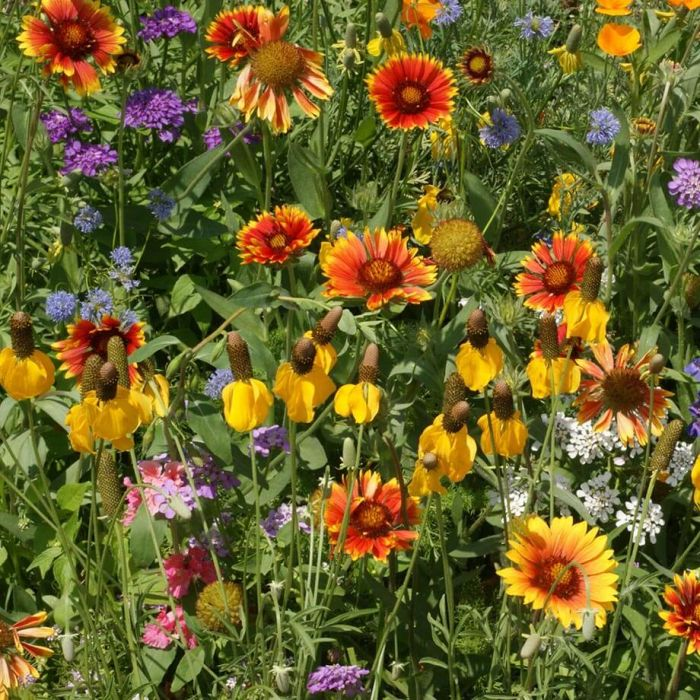
These seeds are a Western wildflower mix, so they should be able to handle the winter temperatures just fine. Any that succeed in germinating should have little problem growing through the light mulch.
The seed mix description doesn’t tell everything that’s in this mix. It just says “This mix includes Lupins, Poppy, Coreopsis, Flax, Blanket flowers and much more.” It should be interesting to see what comes up next year!
One packet of seeds is supposed to be enough for 1000 sq ft. I used two packets. Technically, this means this area should be very densely sown. I’m not going to assume they’ll all germinate. We’ve tried to plant these plus an alternative lawn mix in areas nearby, and only some of them took – a year after they were sown! – and in only one area.
Still, if all goes well, enough of them will germinate that they will choke out any weeds that might otherwise spread into the area, and the wildflowers will spread their own seed further into the maple grove.
By the time that was done, it was starting to get close to sunset, to I moved on to things to go in the front yard. One of those was to clean up the flower bed the haskap bushes are planted in.
The first two photos in the above slide show are before and after shots. The dead flower stalks were clipped with loppers for a chop and drop. The old mulch I’d pulled off the garden bed at the fence was then raked on top along one side, and leaves along the other edges were raked up and added to the other sides. I don’t mind if the mulch reduces the number of flowers here. They get so tall, they cover the haskaps! Now, they are a mulch for the haskaps, and the lilac at one end.
I also snagged a couple of bricks and broken pieces of sidewalk blocks from the pile in the foreground. I keep thinking the catio is going to blow away, now that it’s wrapped in plastic for the winter. A corner of the plastic did tear off in yesterday’s winds, so that got tacked back into place, and there is now a weight on each corner of the roof.
I finally got around to laying out the hoses, to get the kinks and twists out. Once they moved, I was able to get to the old basement window to clean it up, then switch the summer window for the winter one. There was more to clean up than usual this year. The kittens have been using the area in front of it as a little box. 🫤 The window is now clear, though, and has a cover leaning over it. Eventually, we will pick up a window well and cover for around this window. The window wells are pretty affordable. The covers can sure get expensive, though!
That cleaned up and done, it was time to roll up and tie off the hoses. I ended up using a garbage can, laying it on its side over a hose, then rolling it with the hose around it. Doing it that way prevents the hose from twisting and kinking, though in these cooler temperatures, any kinks that were in the hoses when I laid them out were still pretty bent up when they were rolled up. Those are now ready to set aside for the winter.
Aside from finishing cleaning the insulated tarp, this is it for winterizing on the south side of the house. Tomorrow, I’ve got some things I want to get done in the main garden area. Our high is expected to be only 4C/39F tomorrow, but the day after is now expected to hit 9C/48F. I might wait for the warmer day before breaking out the chain saw to clean up the dead spruce tree that fell on the crab apple tree.
How much I get done tomorrow, though, may be up for debate. I felt really good while working outside, but once inside and sitting for a while, all my joints are stiffening up. Including my hands. I’m having a heck of a time typing right now. I forgot to take painkillers before I started this post.
Hopefully, I will finally get a good night’s sleep, and that will help. What I’d really love is have a hot soak in the tub, but it’s not worth the risk of injury, trying to get in and out. Sitting on the bath chair in the shower just isn’t the same, though!
Ah, well. It is what it is!
Whatever happens tomorrow, it felt great to be working outside, and I’m quite happy with the progress I was able to do while I had the chance!
It felt so good to get a really productive day outside. It’s been so long!
I did have to wait until the afternoon, when it warmed up to our expected high of 6C/43F. Even so, some of the areas I worked in that were shaded longer were still partially frozen.
The first thing I did was finish off the bed I was working on yesterday. That little section was shaded and still rather frozen, so it took longer than it normally would have. When I was done, I grabbed a nearby roll of plastic that was rolled up and waiting to be put away for the winter and laid it out on the bed, starting from the shaded south end. It wasn’t long enough to cover the entire bed, but all I really wanted was to get the end that got more shade to warm up a bit, once the sun was able to start hitting it.
Once that was done, I shifted to the old kitchen garden and cleared the rectangular be that had the Forme de Couer tomatoes this year. That bed was shaded by the house on one side so it, too, was partially frozen. After clearing it of weeds and mint rhizomes, I grabbed one of the plastic sheets that had protected the eggplants and peppers earlier, and laid it over the soil. This bed is shorter, so the plastic was plenty long enough.
I had decided to use the high raised bed, which is already prepared, and the open section of the garlic bed for winter sowing, so I didn’t need to clear another bed, yet. Leaving the plastic to warm the soil, I headed into the house and started going through my seeds.
After going through my seeds, I decided on some ordered chaos.
I’m also going to need to clear one more bed.
Most of the seeds I will be sowing are older seeds, so I don’t expect a very high germination rate for some of them. I also decided to include some additions.
Here are the beds I was able to finish planting before it started getting too dark.
The first image of the slideshow above is in the old kitchen garden. With that theme in mind, I’ve got more “kitchen” greens. These include:
– spinach – four different varieties – Swiss chard – two different varieties – Shallots – saved seed collected from a lone surviving shallot a couple of years ago – Kohlrabi – both purple and green – Hedou Tiny bok choi – we got these as free seeds a couple of years ago, but they were smothered by elm tree seeds after they sprouted. A couple of seedling survived and bolted, so I let them go to seed and saved them.
Lastly, I included some onion seeds collected this year. Hopefully including the onions and shallots will keep the deer and damaging insects away.
These and another group of smaller seeds were added to a repurposed herb/spice shaker container, along with some seed start mix and vermiculite I had left over from starting seeds indoors in the spring, and given a thorough shaking.
After emptying this container into the old kitchen garden bed, it was mulched with a thick, insulating layer of leaves that was topped with some grass clippings, as was done with the garlic already planted.
In the next image, you’ll see the bed I had started on last night. This one is now a summer squash bed. Years ago I had accidentally bought three collections of summer squash when I meant to get just one. We’ve been using the seeds for several years now, but they are starting to get old. The only new seeds were the White Scallop patty pan squash. The others are Sunburst (a yellow patty pan), Endeavor (green zucchini), Goldy (yellow zucchini) and Magda (mottled pale greens, similar to zucchini). I don’t expect much for a germination rate for the older seeds.
With these larger seeds, I scattered them from end to end on the bed, then pushed each one into the soil, spreading them out more evenly in the process, used a rake to gently cover them over, then mulched with leaves and grass clippings.
The next two photos – the remaining end of the garlic bed and the high raised bed – have root vegetables, plus protective onion seeds. These include:
– the last loose seeds of Uzbek Golden carrot (I still have the home made seed tape of those) – pelleted Napoli carrot – beets – three red varieties left over from before, plus a white Albino variety given to me – Purple Prince turnip – radishes – three red varieties left over from before, plus a yellow variety given to me.
Plus, protective onion seeds were added as well.
I used the shaker over the small area next to the garlic, but I honestly couldn’t tell if any seeds got out. I mulched it anyhow, but when I got to doing the high raised bed, I took the shaker lid off and just scattered the mix. I could at least see the pelleted carrot seeds! This bed is shorter, and I ended up not finishing off the container. I’ll find somewhere else to sow the rest of the seeds.
After mulching the high raised bed, I moved the wire cover onto it for winter storage. The wire is open enough that it won’t prevent snow from covering the bed, and the snow is an important part of this winter sowing process.
This left me with two containers of seeds. I decided to plant the flower seeds. I wanted those in the main garden area and decided to use the space by the high raised bed where the pumpkins and drum gourds had been planted. It’s a small space and did not take long to clean up. That last space got:
– Butterfly Flower: Orange shades (a milkweed) that I tried starting indoors this past spring, but never got to direct sowing the rest. – Forget Me Nots – given to me by a friend – Nasturtium; Dwarf Jewel Mix – I got those this year and never got around to planting them.
I look forward to (hopefully) have a busy patch of flowers for the pollinators in the main garden area next year! The Nasturtium should also act as a trap crop, luring in insects that might harm some of the other plants.
For flowers, I also have two packages of Western wildflowers mix. I have an area along the edge of the maple grove that has been covered with the insulated tarp, folded in half, since it was taken off the septic tank lid in the spring. I’m hoping that did the job of killing off any weeds under it. Once the tarp is removed, that is where I intend to plant the wildflower mix. It has 16 varieties of annuals and perennials native to Western Canada in it.
I am now left with one last container of seeds to plant, but I was losing light and need to prepare another bed for them. This container has:
– Dalvay peas, including seeds I collected from the ones we planted this past year – King Tut purple peas; from collected seeds – Royal Burgundy bush beans – Hopi Black Dye sunflowers – just one of the two packages I had – Mongolian Giant sunflowers – I had only one packet of those – a small number of Montana Morado corn. We’d grown them a couple of years ago and left them to go to seed, as we were going to test grinding them into flour, only to have the cats dump the entire bowl of collected seed. I managed to salvage a few seeds – less than a dozen.
I chose this combination so that the peas could climb the sunflowers, while the pole beans can shade the ground. This group of seeds did also get onion seeds added to it. Everything in here is prone to being eaten by deer, so I’m hoping the onions will be enough of a turn off for them.
After talking to my daughter about it, we figured the place to plant this is in the long, narrow bed along the chain link fence. It’s mostly clear already, as it had potatoes in it this past year. There’s just one self seeded tomato plant still needing to be cleaned up. Plus, the kittens have been using it as a litter box, so that needs to be cleaned out, too.
So that is my plan for tomorrow. To get that last group of seeds winter sown seeds in. Then, I’m hoping to get a bit more clean up before taking the garden tour video I’d originally intended to take in the middle of the month. This will be the last garden tour video of the year.
In the spring, once the snow is melted away, the mulch on all of these will need to be removed, to allow the soil to warm up and the seeds to germinate. If all goes to plan, this will give us a head start to our 2025 garden.
With most of these, I completely finished off the seeds I had left from previous years. I still have plenty of other things that can be started indoors, and others for direct sowing.
Next year’s garden will be very, very different from how this year’s garden turned out. Not having four 18′ beds dedicated to winter squash and melons is going to make quite the difference! We will be planting fewer tomatoes next year, too.
Even if this winter sowing experiment doesn’t turn out turn out, I could get away with not buying any new seed this winter.
I will still buy more seed, of course! Just probably not until a month or two from now. I’ve already got my eye on some rare heritage breeds that I’d like to grow, if only to help keep the varieties going.
Mostly, though, I’d like to finally get some new beds started, and get at least one permanent trellis built.
I headed out early this morning, while it was still relatively cool, to do the watering and make use of the grass clippings that had been collected and spread out on the black tarp.
I was getting near the end of watering in the main garden area, about to move on to the strawberry bed, when I realized…
I have to admit, I was complacent. I’d seen a deer around the garden area a few times, but it never went to any of the beds and stayed in the tall grass. We’ve got spinners and flashy things and other distractions all over. It seemed they were making a difference…
Now, this.
Obviously, it’s late in the game, but I put a net around the bed so it won’t happen again. The plants will recover, and the runners are still there and rooting themselves. The main thing with the netting is to be able to lift it, as needed, to tend the bed. It’s held down with ground staples in the corners
*sigh*
The next time I can get to a Dollarama, I will see if I can pick up more of those green, plastic coated support posts. They are very handy!
The netting was put up last of all, though. Before that, as soon as the watering was done, I started filling the wheelbarrow with grass clippings and mulching things.
First I laid a pretty thick layer around the edges of the tomato and onion bed. Then I did the onion, shallot and summer squash bed. Setting handfuls of grass clippings between every onion took a while!
These two beds took up most of the grass clippings, but there was maybe half a wheelbarrow left, so I mulched around the onions going to seed, and around some melons at the end of the bed where the bush beans are trying to recover.
After that, I just had to get some photos of the huge vines we’ve got now!
The pumpkins are blooming enthusiastically, and I even hand pollinated a couple more. There’s one pretty large pumpkin developing, plus a few smaller ones. I got a picture of just the largest one.
There are lots of drum gourd flowers, but no female flowers, yet.
The winter squash that are developing right now are getting so big, so fast! So far, the only one I can identify – I think – is what is likely a Turk’s Turban squash. It will probably be a while before we can identify the others – two of which I think are the same variety. I was able to hand pollinate a couple of winter squash, too.
I also got some photos of the Forme de Coure tomatoes.
I think having the sump pump hose draining at one end of the bed is making a difference. A lot of the water does end up flowing down one of the paths, but the bed itself is benefiting from being watered indirectly like this. The tomato plants are lush and bushy, and the tomatoes seem to be growing much faster than other varieties.
It was about 17C/63F when I headed out to water the garden beds, at about 6:30-7am. It’s now coming up on 11, and we are at 24C/75F with the humidex putting us at 27C/81F. We are expected to reach a high of 29C/84F, with highs of around 30C/86F starting tomorrow and staying at or near that range into August.
Which means I’ll be out watering the garden in the cool of the morning pretty regularly.
Most of the prairies are under heat warnings and/or air quality warnings. We’ve got an increase in wildfires up north, but really, we’re doing all right, all things considered. Alberta is being hit hard, and Jasper had to be evacuated and seems to have mostly burned down! Thank God, there don’t appear to be any injuries or loss of life. The most recent article I can find, as of this writing, is here. (link will open in a new tab)
And that is why having a “bug out bag” is a good idea! As well as having emergency supplies in your vehicle, if you have one.
So we will do what we can with our own heat, and be thankful that it’s all we have to deal with!


 The Re-Farmer