After the rain

Oh, what an amazing rainfall we have had!!!

During a break in the rain, yesterday, we were able to bring in the onions that were still on screens under the canopy. They at least were dry enough to brush off the remaining soil, before their roots were trimmed and I strung them on twine, the same way I did the garlic.

The strings of garlic are cured and now in a cardboard box, while the braid of onions are now in the kitchen, making room for these to continue curing. It’s cool enough, but unfortunately, the humidity was at 77% at the time we hung these up. Which is still better than outside! With the fan going, I hope they will cure okay. I kept the tops on, so that they could later be braided.

While doing my rounds, I found several clusters of mushrooms had sprung up in front of the cucamelons and gourds, over night. An encouraging sign of soil health improving. :-)

There were a lot of hungry kitties! Junk Pile’s kittens are showing up at the kibble house more often, but I only see them because they heard me coming out of the house and ran off. One has been running under the cat house, whiel the others dash out of the yard. Our chances of socializing these ones seems rather low, unfortunately.

We are still leaving kibble further out for Butterscotch’s and Rosencrantz’s babies. There seems to be a bit of territorial disputes happening, and this ensures everyone still gets some food.
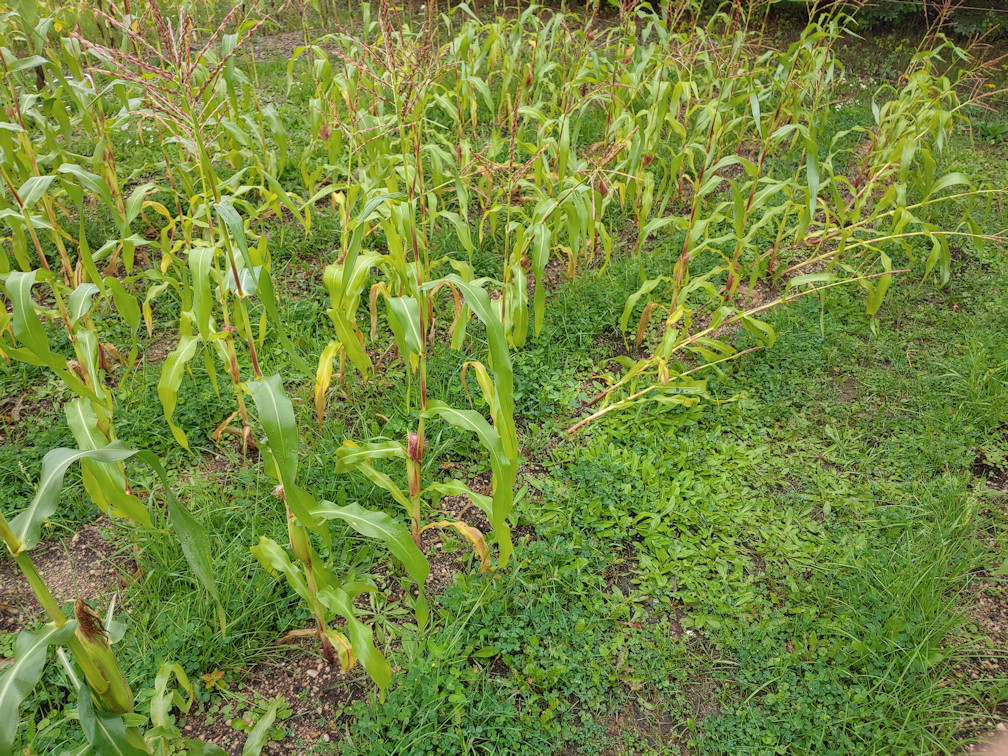
We didn’t get the predicted thunderstorms, but we did have high winds along with the driving rain, resulting in this wind damage to some of the sweet corn. This is the middle block, which has the tallest of the sweet corn.

I think some of those cobs may actually be ready to pick!

With so much rain overnight, I decided to go and check the gravel pit dugout. This is how it looked yesterday morning.
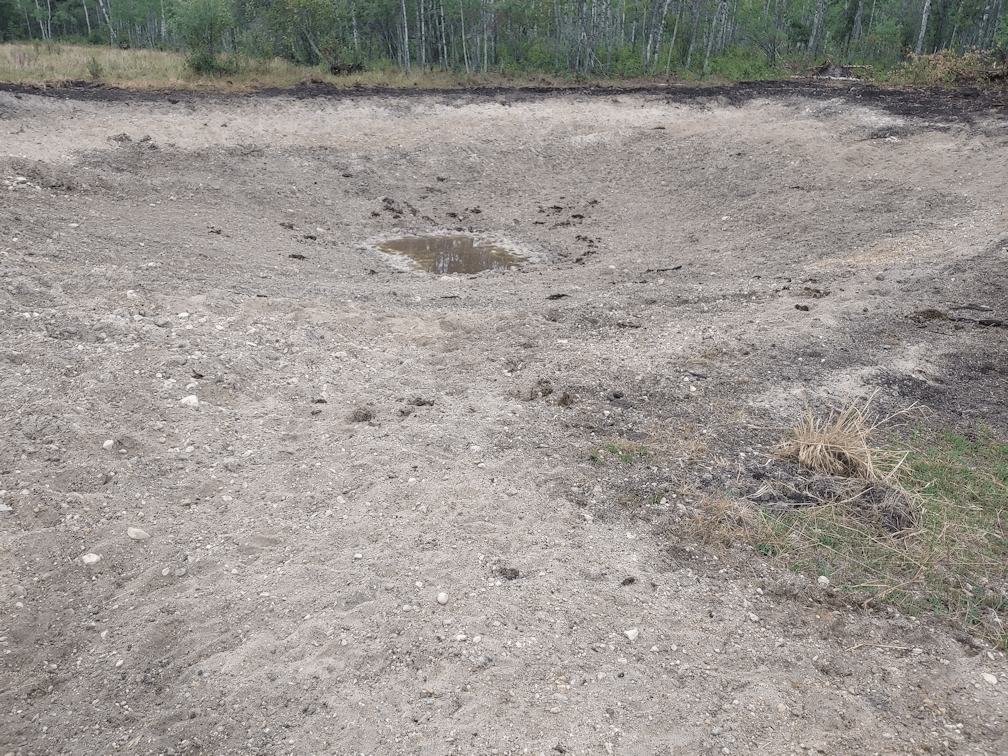
This is how it looked about 24 hours later.
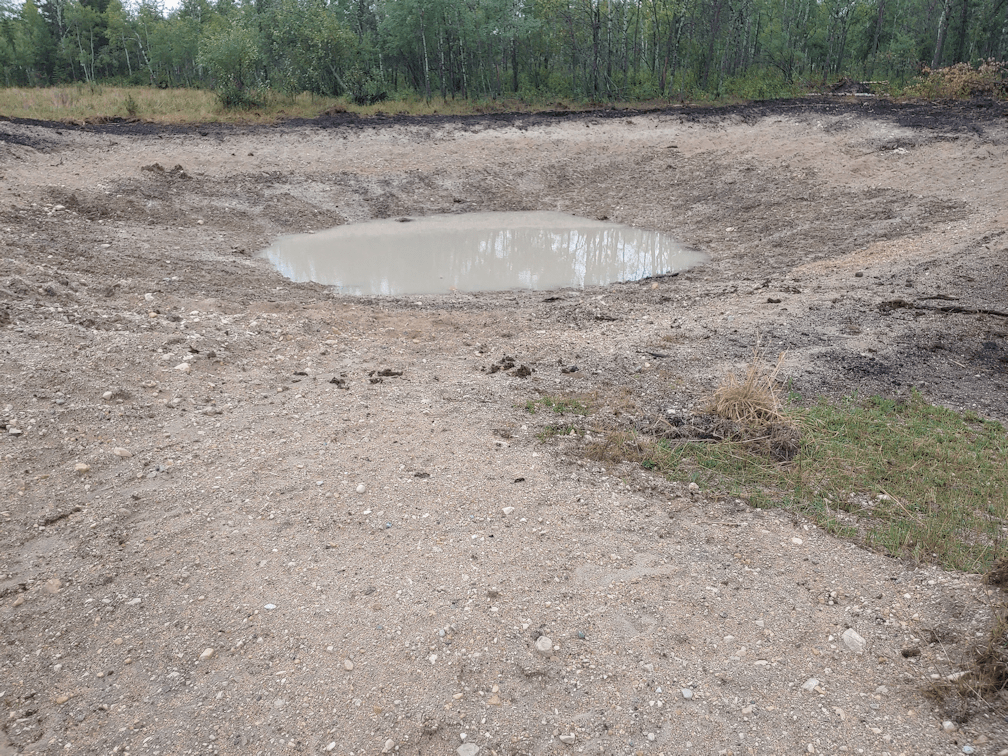
That is so amazing!!!!

For a bit of perspective, though, look at the green parts to the right of where I’m standing to take the photo, then at the top left, where there is an opening in the trees.

The green part on my right is part of the original gravel pit. While it wasn’t as deep as where the dugout is now, it would normally have been part of the pond that had developed in here. The area in the background on the left is basically mash, and would at least have been muddy. Which means, when we get an more average year of moisture, that entire pit should be full of water, with water extending into the low area on the right, and the marsh in the background. Where I am standing to take the photo would be a few feet from the water’s edge.

With so much water here, I just had to go and check the pond, too.

Yes!!! There is even water at the bottom, here!

That is just so awesome to see!

Okay, it took me a while to find, but I knew I’d posted photos of the gravel pit. Here is a photo of the old gravel pit, taken in June of 2019.

All that area of water that’s furthest away is where the new dugout was made. The area to the left is the shallower area that was left alone.

What a huge difference!

So appreciating the rain we got. For the cows and the wildlife, too!

The Re-Farmer

Our 2021 garden: fixing the beet bed, and last things

One of the things we’ve done to protect some of our garden beds from the groundhogs and deer was to use mosquito netting as row covers. The edges were weighed down with whatever was handy; rocks, bricks, pieces of wood… that sort of thing.

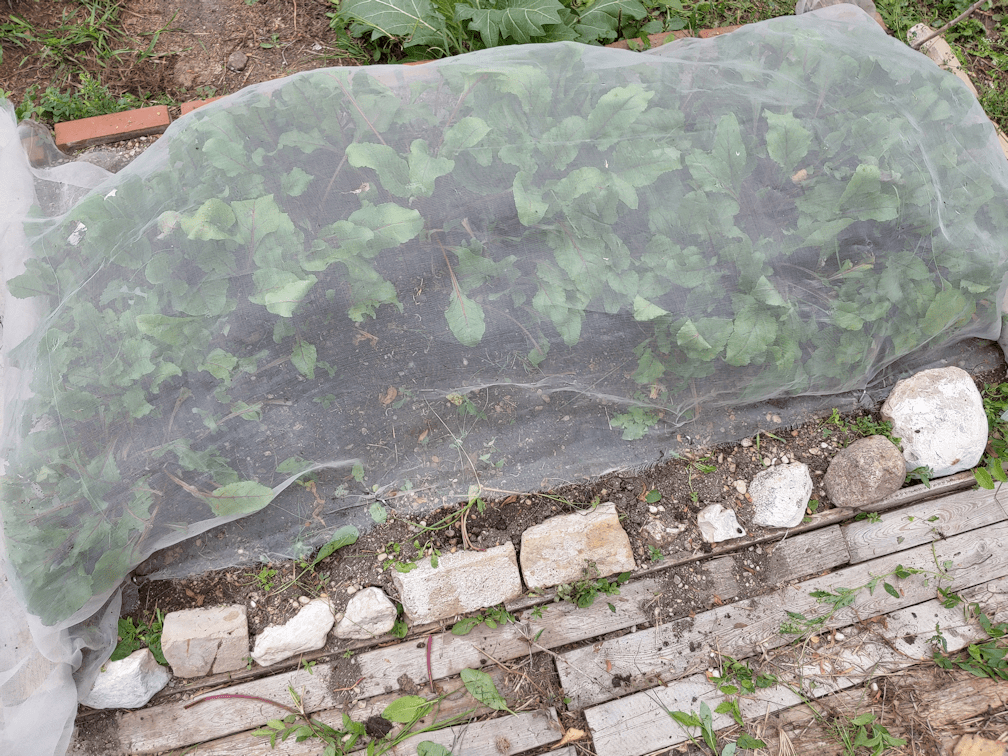
The beet bed near where the garlic had been planted has been recovering very well. So well that the greens were tall enough to pull the netting out from under the weights that were holding it in place, in spots.

More specifically, out from under this board and the rock that was weighing it down. A grog took advantage of the gap and had a bit of a snack.

There wasn’t a lot of damage. The netting still did its job.

I took advantage of the situation to do some weeding and pick the onions that had been planted around the beets as a deterrent.

The down side of adding the netting was that the onions were rather squished, as they were planted so close to the edges of the bed. A few ended up on the compost pile, but there were still a few good enough to harvest! These last onions joined the others that are curing under the canopy tent right now.

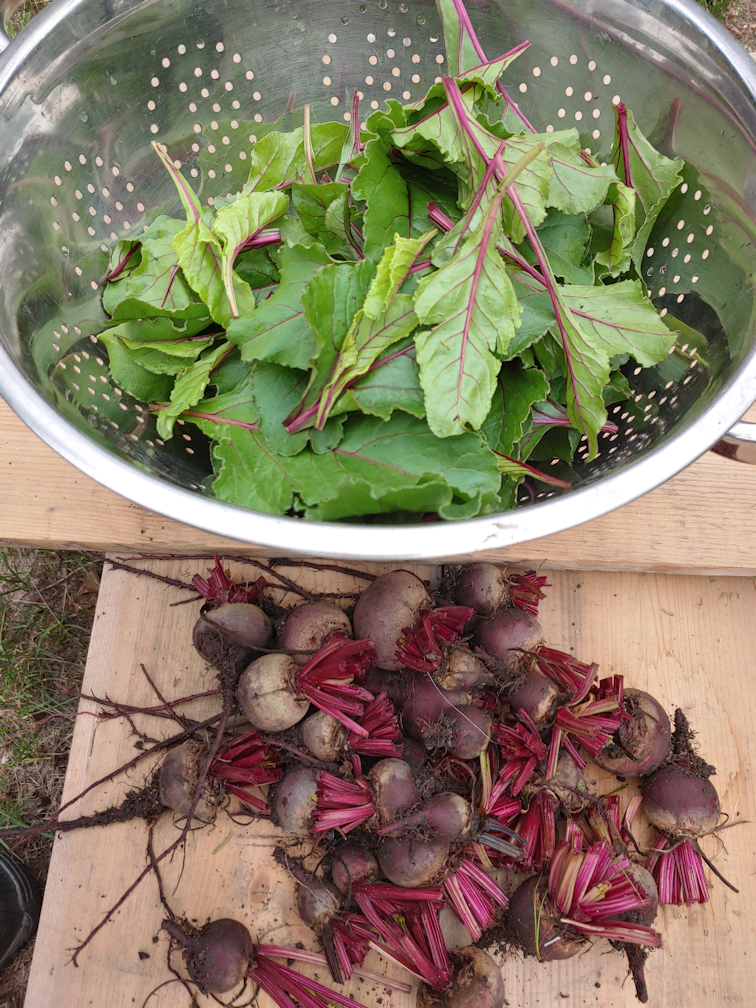
I picked the beets that had the most of their greens eaten, plus a few more while I was weeding, which left me with some greens to harvest as well.

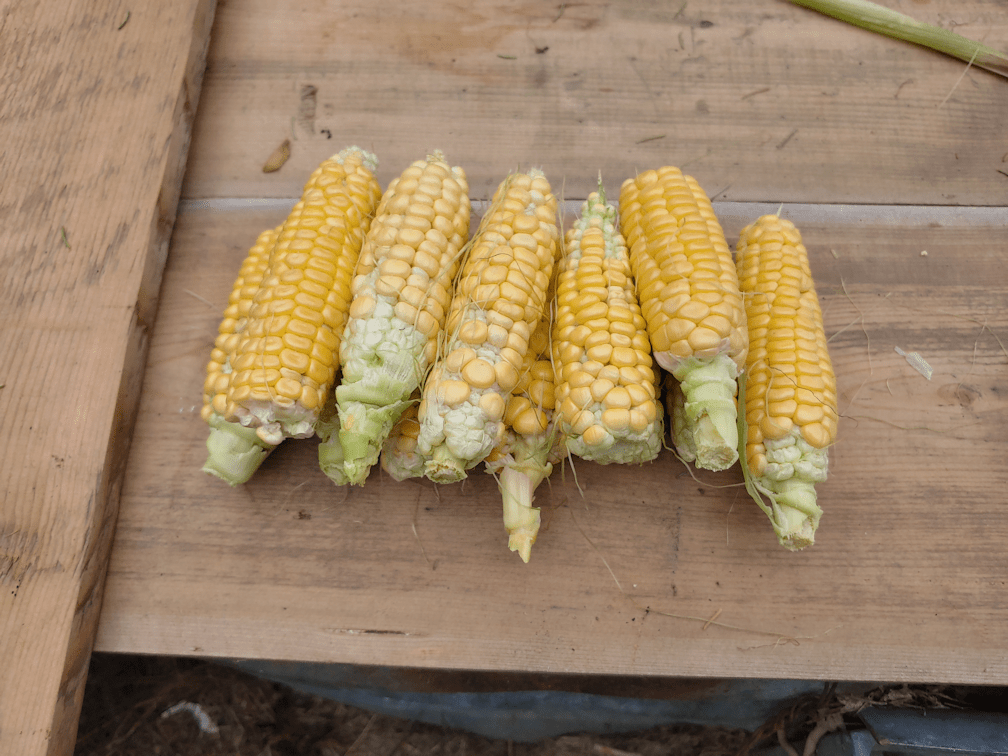
They got to join the corn I’d picked earlier.

This is pretty much the last of the Dorinny corn. There are still a few little cobs out there. I figure I’ll just leave those, and when we clean up the beds in the fall, we might have some seeds to save for next year, perhaps.

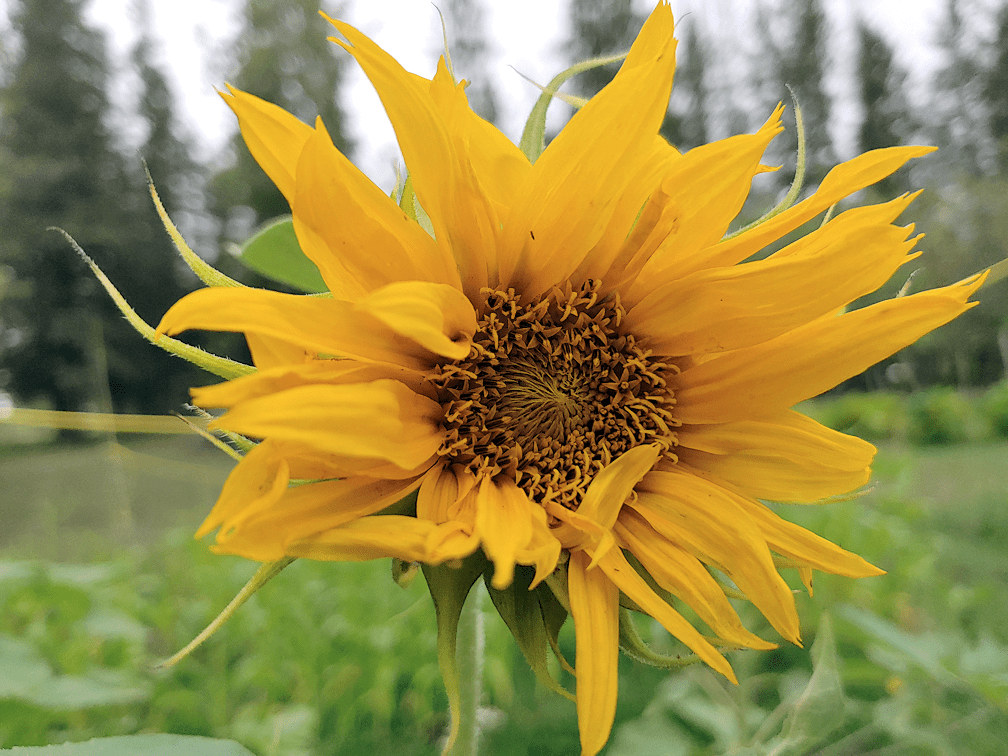
I just wanted to share how the first Mongolian Giant sunflower to start blooming is progressing, too. :-D

Back to the beets!

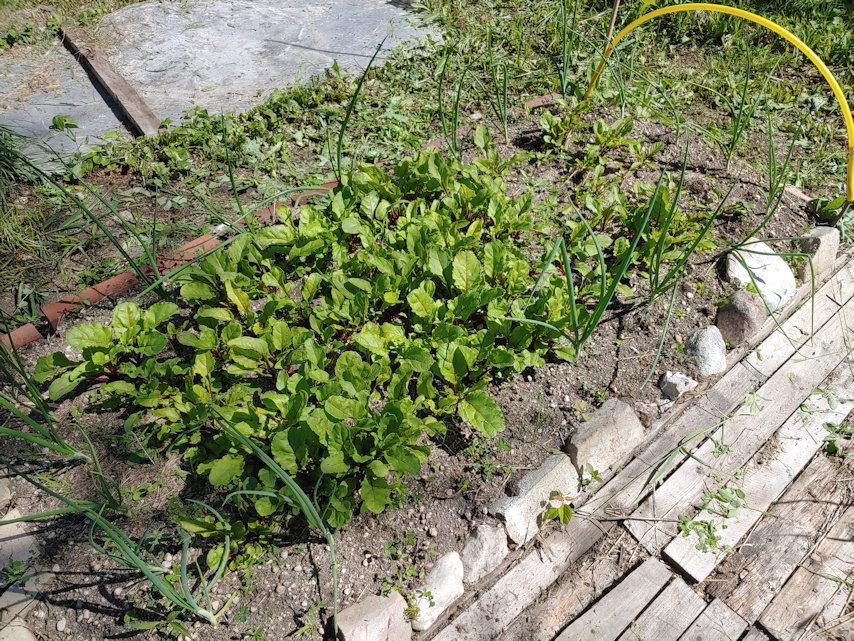
They are looking a lot better for a bit of clean up! There are some pretty big ones forming in there, too. It should be interesting to see what we get when it’s time to harvest the entire bed.

Then the netting was returned. I made good use of the bag of tent pegs I found in the garage, and pegged the sides down snug along the length, but close in to the beets, so that there would still be slack over the bed, with room for the beets to continue to fill out. I rolled boards into the excess netting at the ends and tucked them close under the leaves as well, so there would be no gabs in the corners for critters to get through.

The beets in the big L shaped bed in the old kitchen garden are starting to lift their floating row cover as well. I spotted a small gap where the rocks weighing the edge down had rolled off, and there are a few nibbled on greens at the very edge. There are heavier weights on either side of the gap, so a critter the size of a ground hog isn’t getting any farther. Tomorrow, I plan to uncover the bed, give it a thorough weeding, pick some more beets, then peg the netting down like this one, so it is more secure.

The beets planted against the retaining wall in the old kitchen garden don’t have this problem. They have not really recovered from when they got eaten. I think it has more to do with low light levels. That area is more shaded by the ornamental apple trees than the rest of the old kitchen garden. I’ll be uncovering them to at least weed them, and get a better look at how they are doing in the process.

As for what was picked today, the corn was added to the summer squash and teeny tomatoes the girls had picked earlier, and roasted in foil with some olive oil, granulated garlic, salt and pepper. The beets got roasted in another foil, with some chive blossom oil, salt and pepper. That way, I could roast both at the same time, in the same pan, without the beets turning the other vegetables all purple! :-D It turned out very well!

The Re-Farmer

Our 2021 garden: onions harvested, first melons, and more carnage

Today has turned out to be – so far – not as hot as predicted. On the down side, the smoke came back with a vengeance this morning. It has gotten better since then, thankfully.

While heading out to move the sprinkler, yesterday, I spotted Butterscotch and her brood.

I’m not sure if this is Bradicous or Chadicous. Either way, he’s adorable!

While tending the furthest garden beds, Butterscotch and her babies went through the squash tunnel on their way to the neighbour’s farm across the road. So much space they could have gone through, and they chose the squash tunnel! :-D

I also saw a lot of birds in the garden. They were appreciating the water on the ground from the sprinkler!

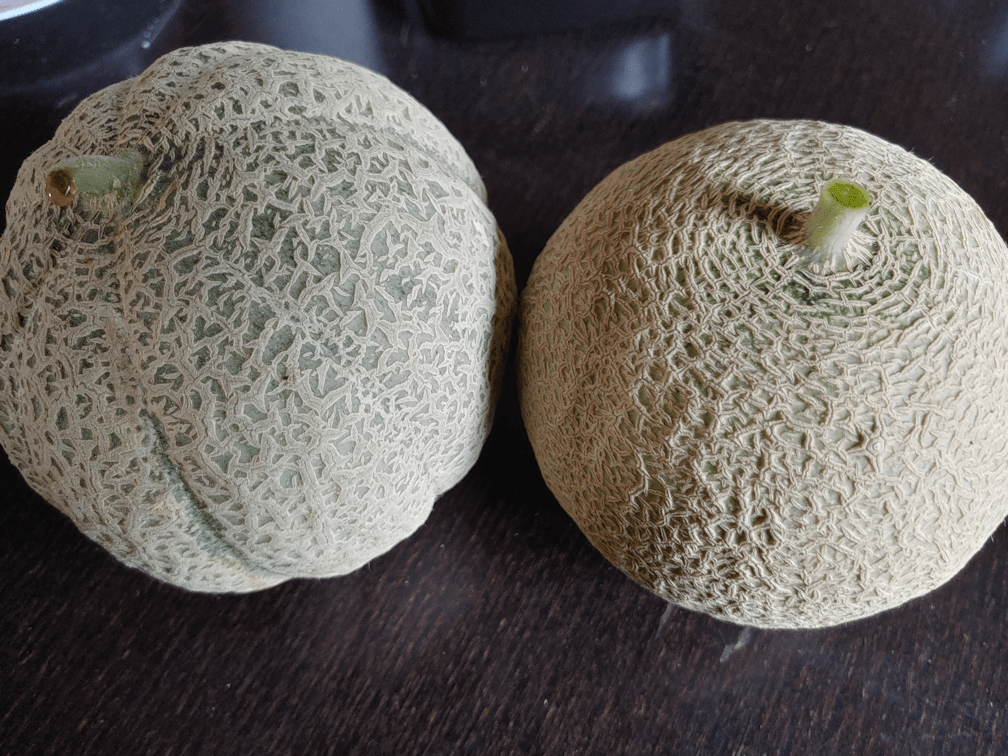
I decided to pick the two biggest, oldest melons to check them out. The one on the left is a Halona melon, and the one on the right is a Pixie.

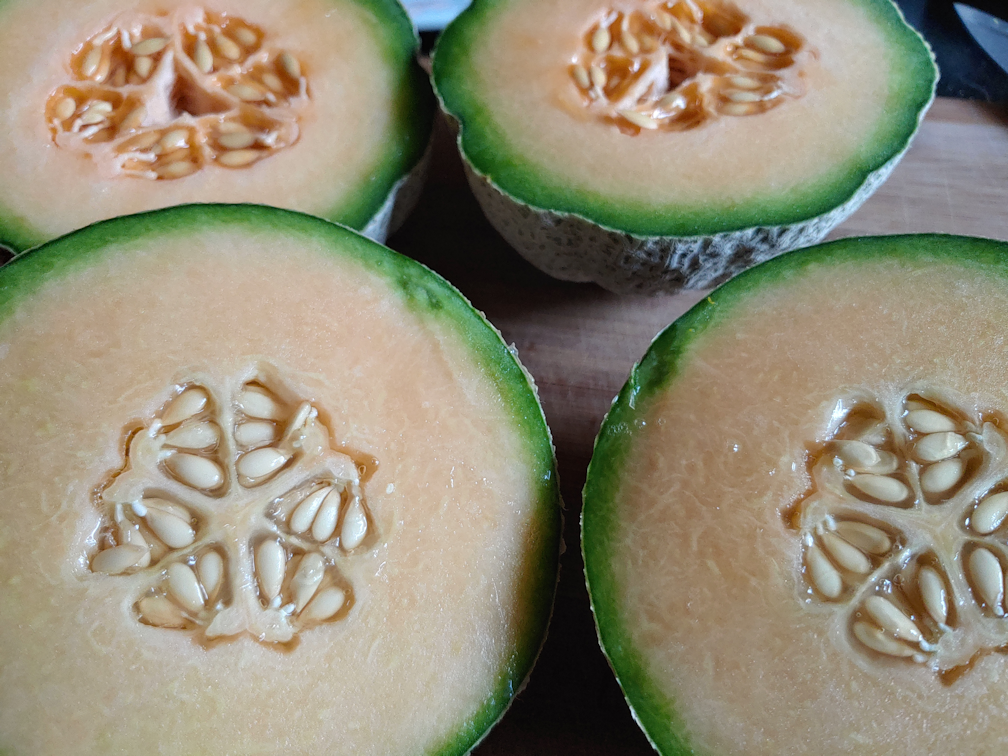
Here, the Halona is at the top, and the Pixie at the bottom.

First thing I could tell is that they were not fully ripe yet. So we knew, when we taste tested them, that they were harder and less sweet than they should be.

They were still very tasty, though. General consensus is that we like the Pixie a bit better than the Halona, though it was really hard to pick one as better than the other.

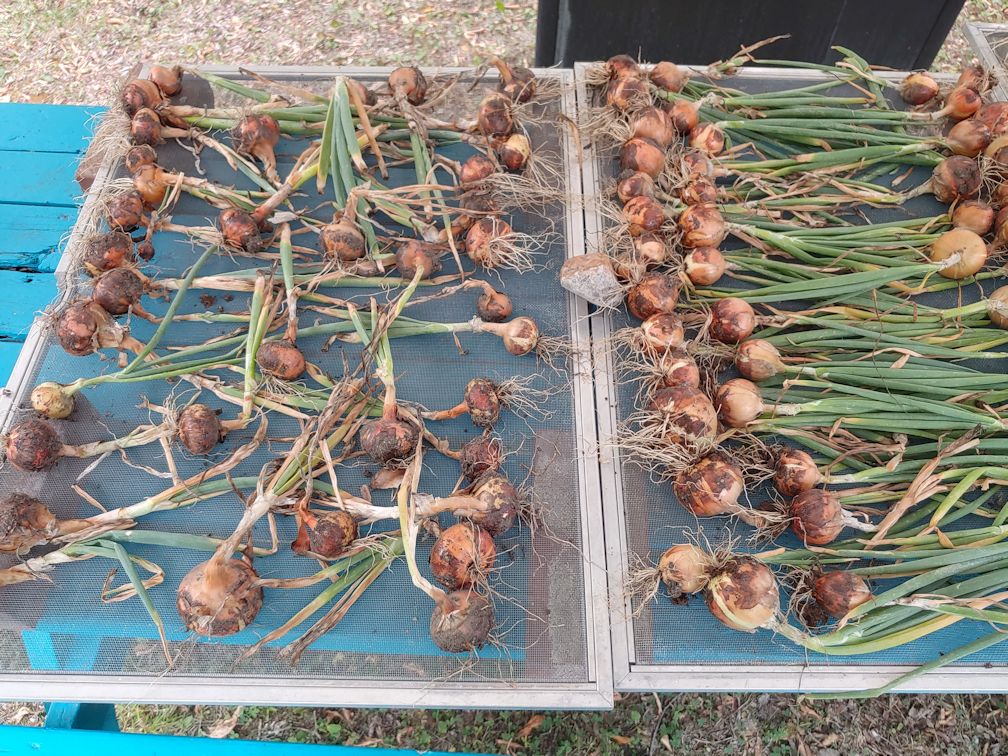
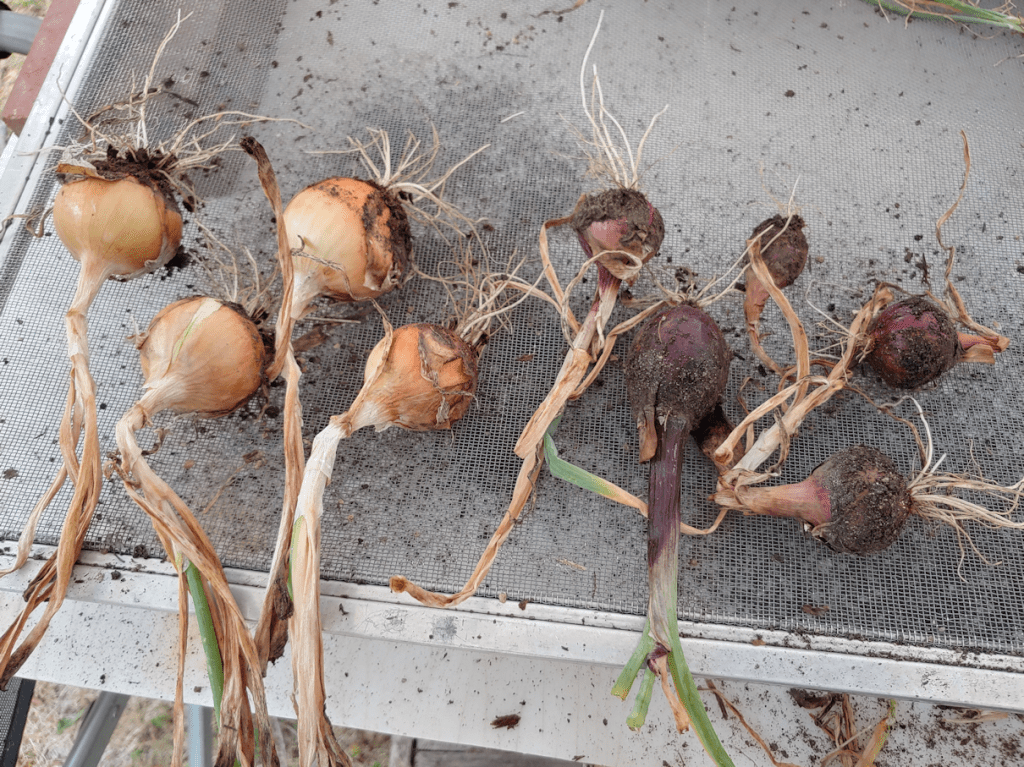
With the weather predictions including thunderstorms over the next few days, I decided it was time to harvest the rest of the onions.

The canopy has been moved over the picnic table, so that’s where we set up the screens to lay them out on.

The screen with the fewest onions on them are the ones grown from sets I bought locally. About half of those had already been harvested earlier and are hanging in the root cellar.

The red unions are the sets we got from Veseys, and the screen in the middle has the onions we grew from seeds. These will stay outside until the soil is dried enough to brush it off and trim the roots. At that point, I will decide if I will leave them under the canopy to cure longer, or set them up in the root cellar. It will depend on the weather.

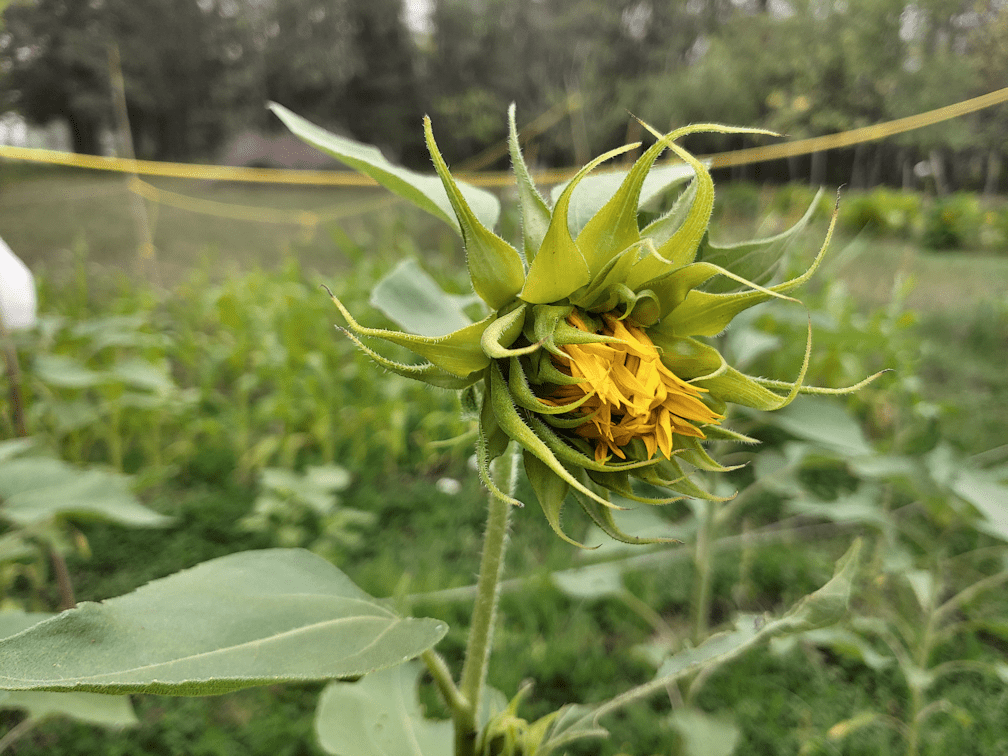
This morning, we are finally seeing yellow petals on the sunflowers! Most don’t even have heads developing yet. The Mongolian Giants are the only ones with developing heads right now. Given we’re in the second half of August right now, I don’t know that we have enough season left for them to develop. The sunflowers in the fields we pass are not only in full bloom, but today I drove by a field where the seed heads are already past blooming and starting to dry up.

In checking the rest of the beds this morning, I found this carnage in the purple corn.

Quite a number of stalks have been knocked down to the ground. From the looks of it, I think there may have been a cat fight in here or something. This is not the damage of a critter trying to eat the corn. I had to head out, so I left it until later today, when we’ll head out to clean up the mess. Hopefully, when it’s a bit cooler.

*sigh*

Anyhow.

Today I made a run to the nearer little city to do a Walmart run and pick up some more cat kibble, among other things. The smoke actually got thicker the further south and east I drove; most of the smoke we’d been getting before was from fires to the north. We are now getting predictions of possible thunderstorms starting tonight, which would go a long way to helping with the wildfires. I’m debating whether we should do an evening watering of all the garden beds or not. Some beds, like the tomatoes, got done already. Though we didn’t reach the predicted highs, I still had to run the hose into the rain barrel for a while, to get rid of the hot water, first. Otherwise, it would have scalded the plants. After letting it run, our well water still is not getting cold like it usually does. Even our ground water is warm! Which means there’s no danger of shocking the plants, I guess. I watered the potato bags, and those looked like something went crashing over them, too. Those, at least, can handle it better than the corn!

This year’s gardening has certainly been a learning experience.

The Re-Farmer

2021 garden: into the root cellar

With the blessed rain we’ve had, our garlic and onions hanging in the canopy tent did not get rained on, but when I checked them this morning, I was concerned about the effect the humidity might have on them. They need cool and dry to cure, but our options were hot and dry, or cool and damp. Suddenly hot and humid changes things. :-)

We did not get more rain today, and by the end of the afternoon the bulbs felt dry again, so I prepped them to bring into the root cellar.

The garlic got their tops trimmed, and everything got their roots trimmed off as well. The job was very quick and easy to do, with them all hanging in the tent!

It seems like so little, when they’re in the grocery bag I used to bring them inside!

I left them as they were on their twine, so they could be hung in the root cellar.

The root cellar is under the entryway, which is two steps lower than the rest of the new part of the house. I’m about 5’4″, and I had to make sure not to hit my head on the floor joists for the floor above! It’s definitely cramped in here!

There are quite a few large nails hammered into the floor joists. I used those to hang the strings up again, so they can continue to cure. You can’t see it in the photo, but there is a duct running between a pair of floor joists to outside, for air circulation. The duct is covered with mesh on the outside, to keep the critters and insects out.

We had been thinking of converting this room into a cheese cave and monitored the temperature and humidity in here for about a year, taking once a week readings. We missed a few weeks here and there, but still spanned a year.

The average temperature in here was 12C/54F, and the average humidity was 62%. The highest temperature was 18C/64F, which is what it was at while I was hanging the garlic. The lowest temperature was 6C/43F. The highest humidity reading was 88%, and the lowest was 28%. While I was hanging the garlic, it was just under 80% humidity.

The ideal average temperature for a root cellar should be between 0C – 4C (32F – 40F) with the humidity ranging from 85%-95%

So the conditions we should be getting, for a good root cellar, are winter temperatures and summer humidity levels.

:-/

One of the things I noticed while ducking around the ceiling to hang the garlic, is that the light bulb in there is putting off a lot of heat.

I was thinking of setting a fan up in here, but there is no outlet.

After scrounging and digging around, I found a low lumen “chandelier” LED bulb, and an outlet adapter for the fixture. My husband isn’t using his box fan right now, so I set that up in the root cellar, plugged into the outlet adapter. The adapter has a pull cord so that the light can be turned off while the outlet still gets power, but because of the type of light bulb in there now, it didn’t want to shut off, and just blinked on and off. So I left it on. It won’t add to the heat, and won’t use much power. We’ll just have to check the garlic and onions regularly, until they are cured.

Once the garlic is finally cured, they will be taken off their twine and packed into cardboard boxes or paper bags, depending on what we have available at the time, for storage. The onion braid will probably just stay hanging. I expect, before those are ready, we’ll have harvested the rest of the onions and will have them hanging in the canopy tent for a while, before moving them into the root cellar, too.

Hopefully, by winter, we will have more food stored in here, such as melons, winter squash and potatoes. We had high hopes of being able to store canned goods here, too, but between the critters and the drought, we’ll be lucky to be able to do some refrigerator pickles. :-( Anything else we have will be in quantities that will be more practical to freeze or dehydrate, rather than can. Even if we won’t be able to can much from the garden, I am planning on pressure canning heat and eat meals, at least, like chili or stew. Things like that are just really handy.

We shall see how things go over the next couple of months!

The Re-Farmer
Our 2021 garden: first bulb onions

This morning, I decided to go through our onions and harvest the ones I was sure were done for the season. Here are the first ones I picked.

These are the yellow onions we planted from sets that I picked up at Canadian Tire, and planted in the same bed as the shallots. This is about a quarter, maybe a third, of what was in the bed. There were also a few that I pulled and left behind, as they had no roots and were starting to rot.

These ones are mostly pretty small, as they died off too early, I think.

There were enough of them that space on the drying screen was an issue, but they had enough stems left for braiding, so now they are hung up to cure under the canopy.

Then I went back to check the other onion bed.

Very few of these were ready to pick. On the left are the surviving yellow onions we grew from seed, and they are looking the best of all the onions. The ones on the right are the red onion sets we ordered from Veseys.

These have been left outside to dry for a while, but they will be for immediate use in the kitchen! :-)

I’ve been looking up how to tell if onions are ready to pick and finding conflicting information. Some say they are ready after their tops have fallen over, which I think is way too early. Others says after the dry outer skin has developed. Still others say once the youngest leaves – the ones in the very middle of the stalks – are dry, they are ready to pick. That one seems too late!

So the ones I picked were ones that had died off the most, and I could be sure they would not be growing any bigger. I’m also on the lookout for those with roots that have died off, and pull up easily. Those tend to already be going soft, and often have what looks like mold growing in them. From what I’ve read, that’s a sign of fungal infection, so they need to be taken right out.

It should be interesting to see the differences in flavour. I probably won’t be able to tell the difference, and the medications my husband is on has changed his ability to taste things, but the girls should be able to taste differences. I’ll have to trust them to tell me which varieties are worth growing again! :-D

After the issues we had with cats destroying so many of the onions we started indoors, I’m just happy to have any onions at all right now! :-D

The Re-Farmer
Our 2021 garden: some growth, some critter damage, and WE GOT RAIN!!!!

I just have to start with the exciting part. We actually got rain today!

Okay, so it was maybe only for about 20 minutes, but it was a nice, gentle, steady rain, and enough that after several hours, the ground is still damp. Not only that, but we’ve got a 90% chance of more rain overnight and into tomorrow morning.

Thank God!

Hopefully, by then, the smoke will finally clear out of the air, and some of that rain will hit the areas that have fires right now.

It is not going to make up for months of drought and heat, but it will certainly help. Even the completely dry, crispy grass has started to wake up and show green already.

It was lovely and cool when I did my rounds this morning, then a daughter and I went and checked all the garden beds just a little while ago.

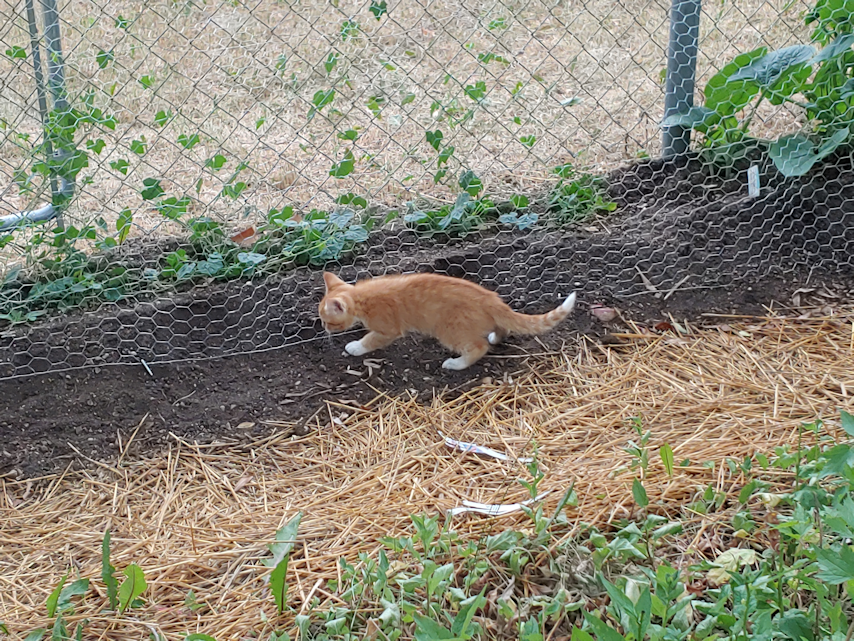
I’m really glad we set up the chicken wire over the gourds and cucamelons. I found this critter damage this morning. It looks like something, likely a woodchuck, leaned on the wire and managed to nibble on a leaf through the gaps. Just one leaf here, and another on the other side of the chain link fence. Without the wire, we probably would have had a lot more damage.

While I was checking on these, Nosencrantz was playing on the concrete block leaning on a tree nearby, so I paused to try and get her to come to my hand. I managed to boop Nosencrantz’s nose before she ran away. Toesencrantz, on the other hand, was far more interested in trying to get at a lump of dirt on the other side of the chicken wire! He could get his paws under the wire, but the tent pegs held and he couldn’t get the lump out. Not for lack of trying! So that confirmed for me that the kittens were doing the digging in the dirt. More reason to be glad for the wire! The dirt lump got broken up, so as to remove further temptation.

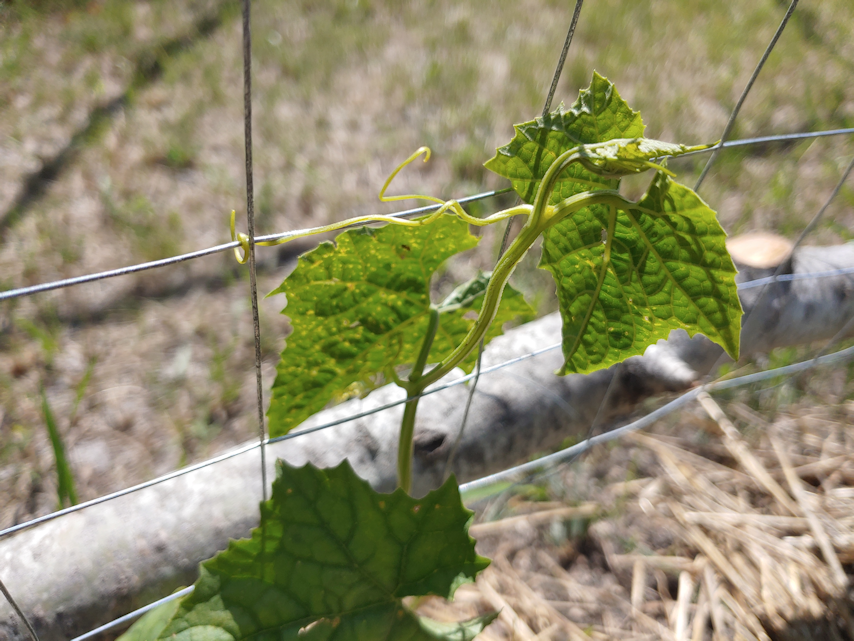
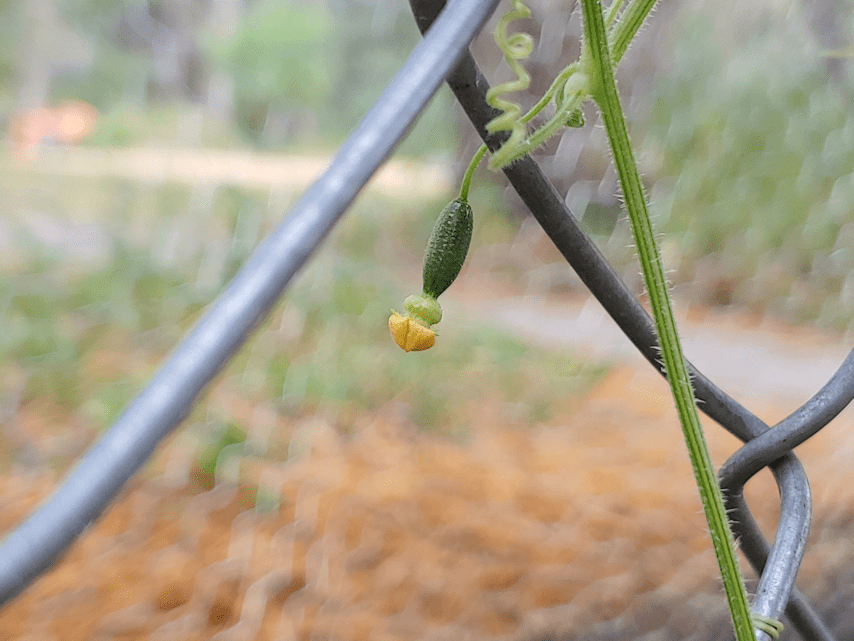
The cucamelon plants looks so tiny, but they are starting to develop fruit! The chain link fence gives an idea of just how tiny these are. I’m looking forward to seeing how they do in this location, which gets more sun than where we grew them last year. They produced quite well last year, for a plant that’s supposed to have full sun.

While checking things out with my daughter, I found new critter damage. When I checked the bed this morning, the damage wasn’t there. These are the Champion radish sprouts. Not all of them were eaten, and the purple kohlrabi sprouts next to them seem to have been untouched. Which would lead me to think it was grasshoppers, not a groundhog, except that after the rain, there were NO grasshoppers around. I didn’t see any in the morning, either, but I usually don’t, that early in the day. They tend to come out later.

Unfortunately, this bed has only the wire border fence pieces to hold up the shade cloth. We are out of the materials to make another wire mesh cover, so with the shade cloths not being used, this bed is unprotected, and there’s really nothing we can do about it right now. :-( On the plus side, it wasn’t a total loss, and I’m thinking the woodchucks, at least, are preferring the easy pickings under the bird feeder.

At the squash tunnel, we found this lovely friend, resting on a Halona melon flower. The melons, winter squash and gourds are doing quite well right now, though all the garden beds are due for another feeding. The baby melons are getting nice and big, and we keep finding more. I was really excited when my daughter spotted this, hidden under a leaf.

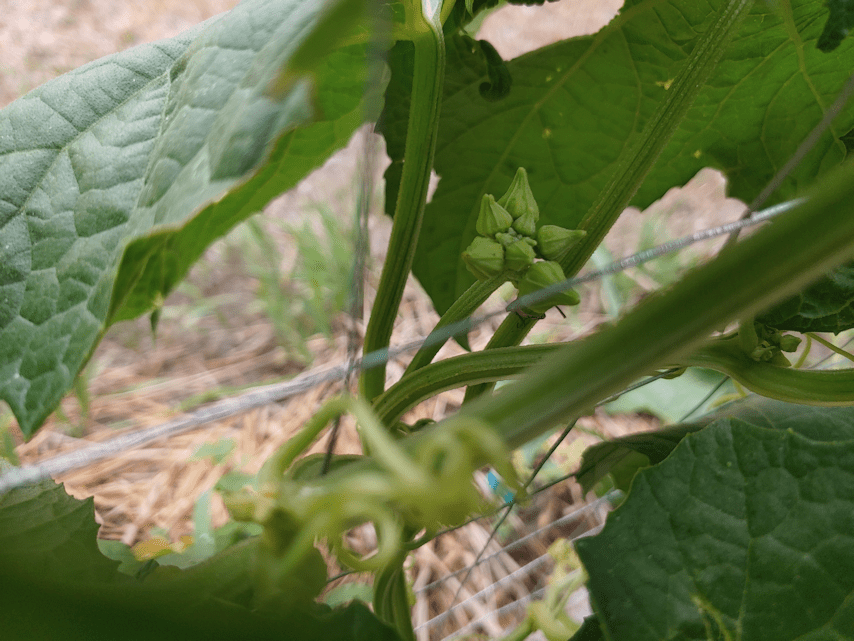
These are the first flower buds on the luffa! I was really starting to wonder about them. They started out well, then went through a rough patch, but since I started using the soaker hose, they are already looking more robust again.

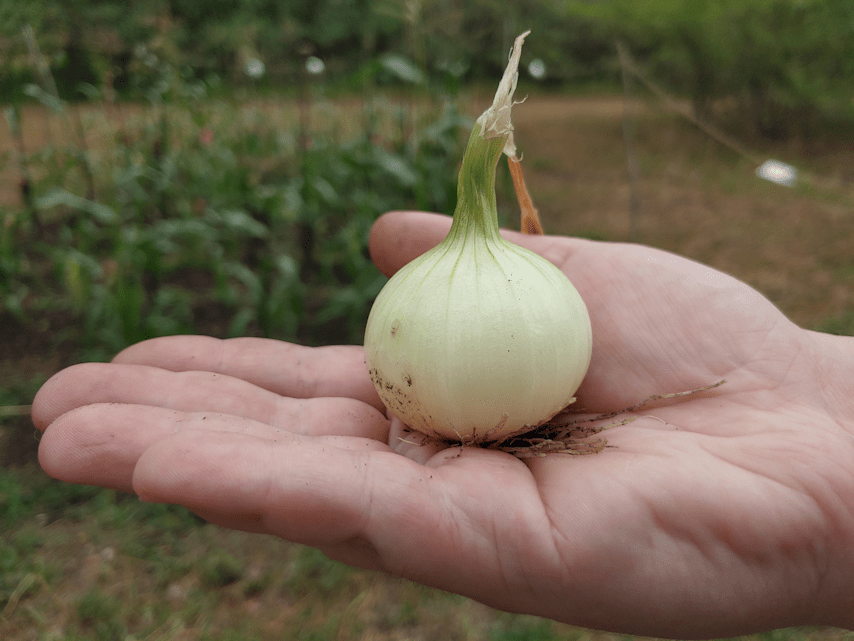
In checking the onion beds, my daughter spotted an onion that had lost its greens completely, so she picked it. It will need to be eaten very quickly. It is so adorable and round! This is from the onions we grew from seed. Though I’ve trimmed the greens of almost all the onions, we’re finding some of them with broken stems. Most likely, it’s from the cats rolling on them, as I’ve sometimes seen Creamsicle Baby doing.

We also found a green zucchini big enough to pick. I’ve checked all the plants, and while there should be at least one golden zucchini, I’m not finding any. Every plant is starting to produce fruit now, too, even if just tiny ones, and no golden zucchini. Odd. Perhaps the package was mislabeled and we got a different kind of green zucchini instead? There are differences in the leaves that suggest two different varieties, even if the fruit looks much the same.

Oh, in the background of the onion picture is the Montana Morado corn. We’re always checking them and the nearby Crespo squash for critter damage. There does seem to be some, but I am uncertain what to make of it. One corn plant, in the middle of the furthest row, lost its tassels and top leaves, but none of the others around it were damaged. It has a cob developing on the stalk, so I pollinated it by hand. Then I spotted another stalk, in the middle of the bed, that also lost its tassels. But what would have done that, while ignoring all the other plants around it? Very strange.

And finally, we have the poppies.

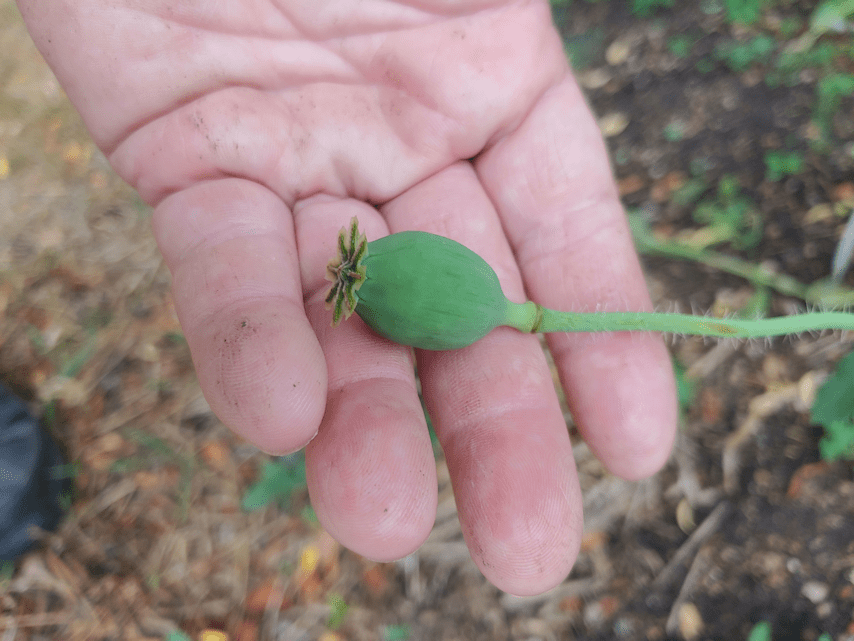
The Giant Rattle Breadseed poppies continue to bloom in the mornings, loosing their petals by the end of the day. Their pods are so tiny at that point, but in my hand, you can see the pod from the very first one that bloomed. It has gotten so much bigger!

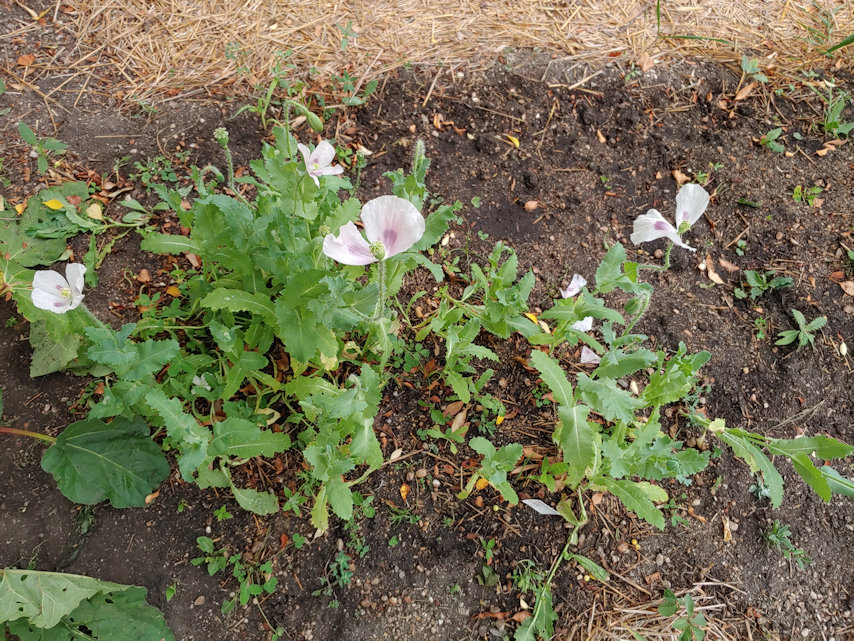
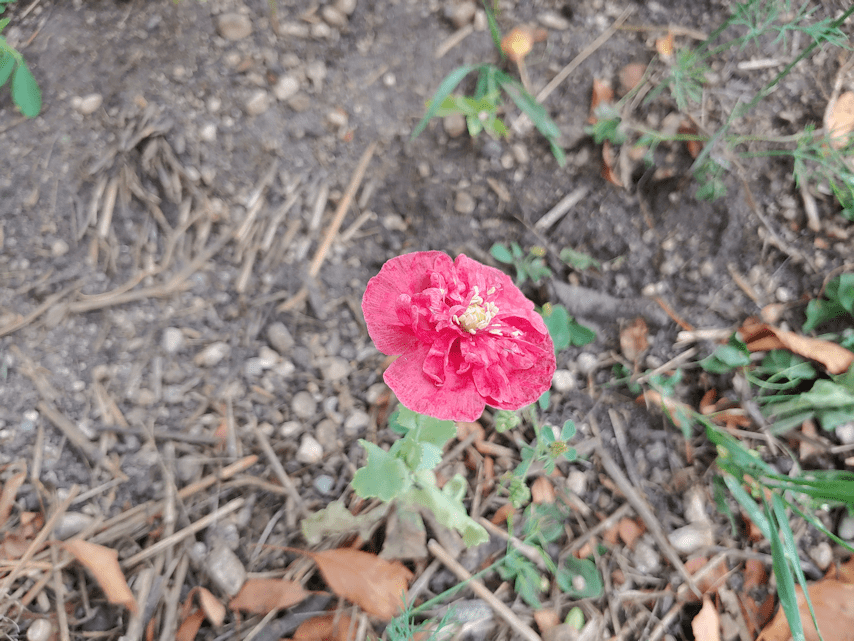
We also found a couple of these.

My mother had ornamental poppies in here, and even with the mulching and digging we did, some still survived. This photo is of the bigger of two that showed up in an unexpected place: where my daughter had dug a trench to plant her iris bulbs. Somehow, they survived, and now we have two tiny little ornamental poppies. :-D

In hopes that we will get rain tonight, we will not be doing our evening watering. If we don’t get rain, we will water everything in the morning, instead.

The Re-Farmer

Our 2021 garden: time for a hair cut!

It was a rough night for me, last night. Very little sleep, and the pain levels are just high enough to make any position uncomfortable after only a short time. Thankfully, my husband was well enough this morning to head out do all the food bowls for the cats, and refill the bird feeder, allowing me to postpone the rest of my morning rounds until later in the day.

Once I did get out, the first thing I noticed was the haze. I know we don’t have fires nearby, but we’re getting smoke. I’ll have to check the fire maps later, and see what the current status is.

The other thing I noticed was Junk Pile cat. Who looked at me and growled.

Now, why would she do that?

Because she had brought her kittens over, and they were around the cat shelter! I saw some furry little butts disappearing behind it, so I carefully went around, giving them lots of space, to check on the potatoes and grapes. I saw a little grey and white kitten run across to the storage out, while a little tuxedo squeezed under the cat shelter.

A tuxedo?

Yup. She had more kittens with her this time! There were at least three, possibly four. I was just catching glimpses of them, though later on I saw the tuxedo under a tree by the storage house, watching me from a safe distance.

I am so glad she’s bringing her babies over to the food bowls!! Hopefully, they will be moving into the inner yard now.

Before finishing my morning rounds, I got the hose going to refill the water barrel at the far beds. Unfortunately, it is still leaking. I’ll have to pinpoint exactly where, then empty it enough that it can dry and I can try sealing them again.

Once everything else was done, I came back outside to give the onions a hair cut. :-D

It was on one of the gardening groups I’m on that I saw someone post pictures of the green onions they had just harvested and bagged up for the freezer. I know it’s recommended to trim onions grown from seed, down to about 3 inches, before transplanting. I hadn’t thought about trimming them, other than to gather greens for the day’s cooking, before harvest. The gardener that posted the pictures said that trimming them meant more energy going towards growing the bulbs. If the greens start falling over, the onions stop growing for the season. I knew that last part, but it never occurred to me that the growing season could be extended by trimming. I’ve never grown onions before, and the onions my mother grew were left in the ground to come back, year after year, so I never saw her doing that, either.

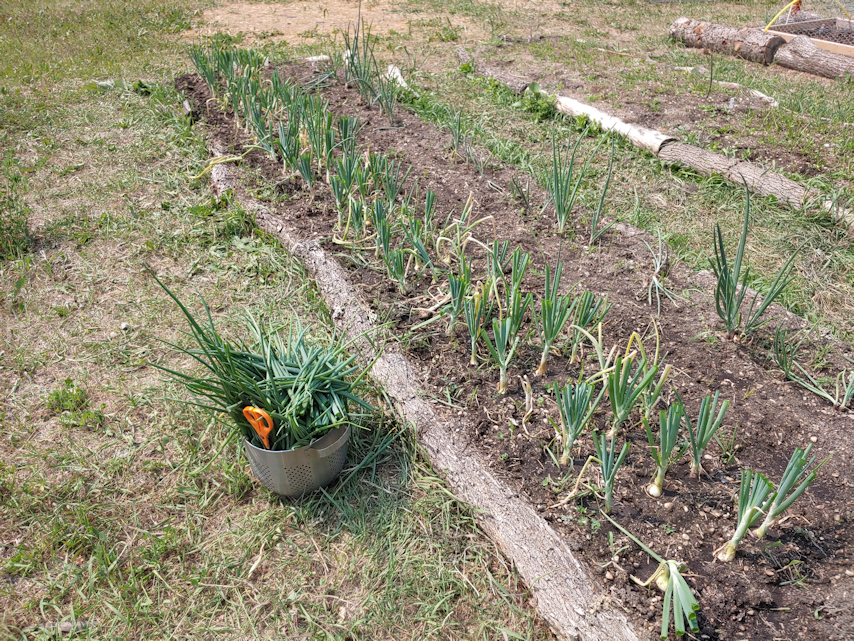
The yellow onions sets that I bought locally got really large greens. I quickly ran out of space in my colander, and had to come back to do the bigger shallots, then the other onion bed. The red onions (from sets) and the other yellow onions (from seed) did not have as many large greens, but the colander still got pretty full again! All the greens completely filled our giant metal bowl. Thankfully, it has a lid, because the cats were VERY curious! It’s full enough that the lid is sitting on top of greens, but at least that cats can’t get at them. Onions are toxic to cats, but that doesn’t stop them from being very curious about them!

We’ll have a lot of washing of greens to do, and then they’ll be coarsely chopped. We will probably dehydrate a couple of pans of them in the oven, and the rest will get frozen.

We’re going to have enough to last us quite a long time! :-)

The Re-Farmer

Our 2021 garden: how things are looking

Just a few pictures of the garden beds that I took while doing my morning rounds.

This is the newest bed in the area where the old wood pile used to be, and these beets were the first ones planted, so they are larger than the others. Well. Some of them are. We are curious about the one end there they are smaller, and not as many came up. There is no sign that deer have been eating them – the onions seem to be working! I recall that we had issues with birds digging in the garlic beds. I wonder if they were digging in here, too? I don’t know.

The onions are yellow onions we bought as sets locally, when it looked like the ones we started from seed might not make it.

Luffa, actively climbing the mesh of the squash tunnel! So far, they are the only ones long enough to reach/climb the supports.

I was thrilled to see this, nearby.

Several Halona melons are starting to bloom! So awesome! Nothing on the Pixie melons or winter squash, yet.

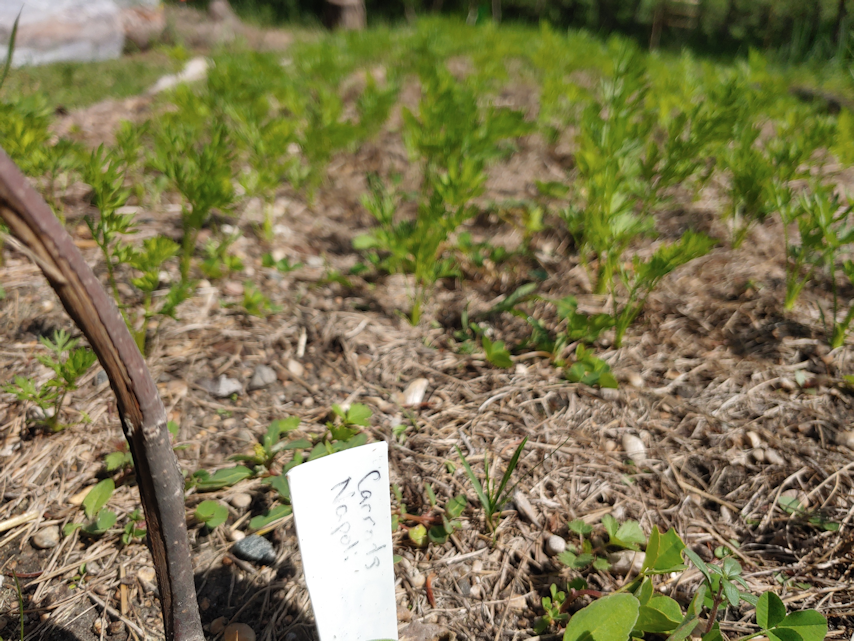
This bed has the two types of carrots – Kyoto Red and Napoli – that came in pelleted seeds. This allowed us to plant them further apart, so no thinning will be needed. That also meant that, even though they started coming up quite a while ago, their thin, feathery leaves were hard to capture in a photograph! :-D

These are the Norstar onions we started from seed. Size wise, they are much the same as the ones started from sets, including the red onions that share this bed with them, however none of the others are starting to bulb as much as these ones are.

Looking ahead to next year, sets are definitely easier than starting from seed, and they don’t take up the space indoors that seeds do, but I think the ones started from see seem to be doing a bit better. We shall see when harvest time comes.

Speaking of harvest, the spinach is starting to bolt. The three varieties we have are all supposed to mature at different rates, but all three are ready for harvest, now! We’ll pull the biggest plants first, and leave the smaller ones a while longer, simply because there is so much. I dug out more window screens from the shed and washed them, so we can use them to dry spinach in the sun room. Doing it in the oven worked, but the trays are smaller, and we can only fit two in the oven at a time. We have four screens in total, and we’ll be able to fit a lot more leaves on them.

We finally have a decent amount of lettuces, though some blocks don’t seem to be doing as well as others. After the spinach is cleared out, we plan to do more lettuces in those beds. Just on one side, as we will be planting more spinach for a fall harvest, later on. The lettuce seed packets were in a Ziploc bag and spilled, so most of them are now mixed up, but that’s okay.

The greens to the left of the blocks, past the plastic, are 4 varieties of beets, that my daughters planted. Not visible is the larger L shaped bed, in which we planted all the remaining beet seeds, including from last year, all mixed up.

The potatoes are doing really well! If those bags weren’t twice the height they started off at, I would think they hadn’t been “hilled” at all!

I am really happy with how the garden is looking, though we do have some failures. None of the purple kale came up at all, and it looks like the purple kohlrabi is a total loss, too. There *might* be some white kohlrabi coming up in the old kitchen garden, but I’m honestly not sure if what I’m looking at are kohlrabi seedlings, or weeds. There’s only a couple of them.

The strawberry spinach seems to be a loss, too. We thought they had started to sprout, but now it looks like there’s nothing but weeds. If they did sprout, they didn’t survive. It looks much the same with the poppy seeds, except for one little patch. We’ll see how they survive! They’re still really small. Ah, well. Whether they make it or not, I plan to get more for next year. Possibly in another variety that I’ve found, too.

It’s only June, though. I’m quite looking forwards to seeing how things grow over the next couple of months!

The Re-Farmer

Our 2021 garden: transplanting tomatoes and onions

After we got the sunflowers transplanted, the girls and I decided we would transplant the tomatoes today, too.

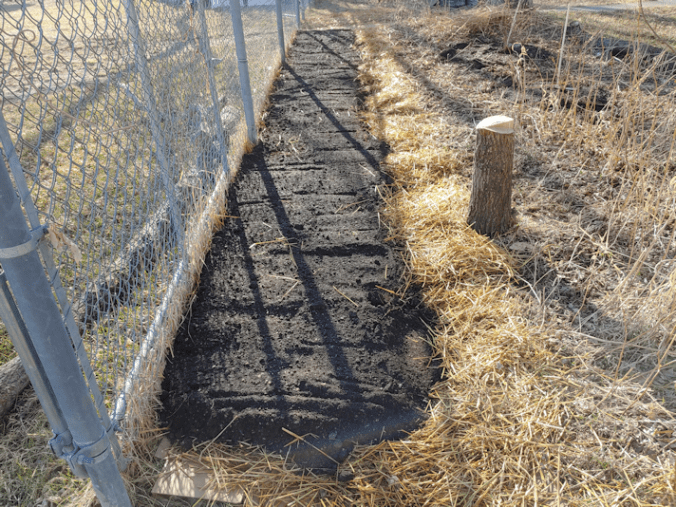
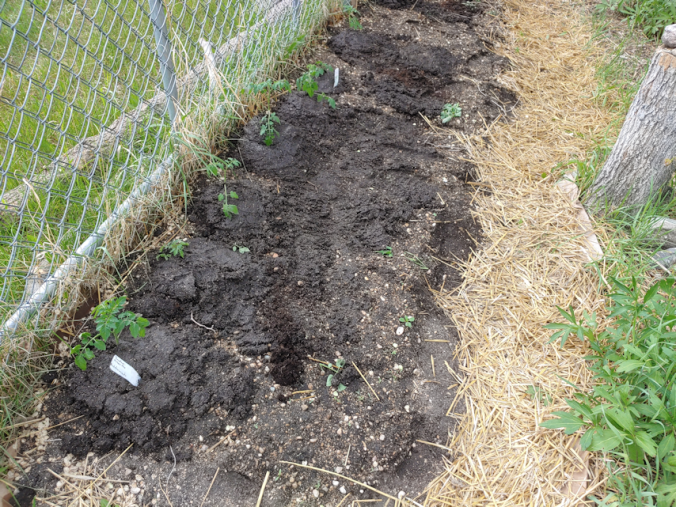
This is the area we prepared for the tomatoes, back in April, so that we can use the chain link fence to support them. You can read what we did to prepare it here. Though we have been wetting it down fairly regularly, there just hasn’t been enough moisture for the straw and cardboard to do much breaking down, and the soil layer was relatively thin.

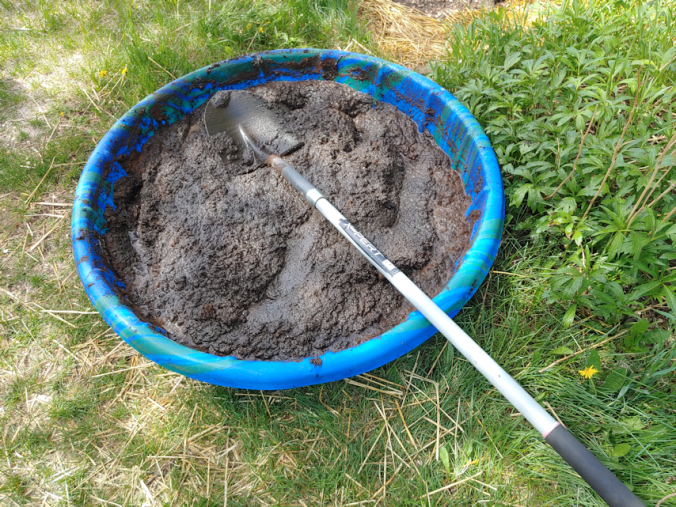
Since the new garden soil is alkaline, and tomatoes like slightly acidic soil, we decided to make use of the last of our bale of peat. Before heading in for lunch and out of the heat, we took the time to mix the peat with garden soil and soak it down.

Basically, we made peat soup. :-D

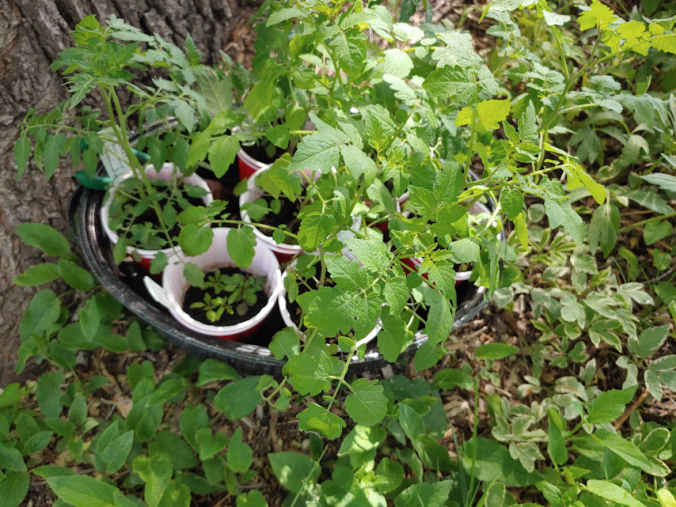
The seedlings were brought over to wait in the shade, then we headed inside to let the soil and peat mixture absorb more water.

Do you see that cup with the itty bitty tomato plants in it? That is a cup with Mosaic Mix seeds in it. It took forever for one seed to germinate, so when the plants got moved to the sun room, we decided to keep it. Then, just about a week ago, the other seeds planted in the cup germinated! They’re really too tiny to transplant, but the girls wanted to, anyway. We’ll see how they do!

When we got back to it, the transplants were separated and laid out, after getting their bottom leaves and branches trimmed off. We did dig small holes for each one, but there wasn’t a lot of depth before we hit straw. Each transplant got some of the peat mixture built up around it, up to the lowest remaining leaves, so that the buried stems will grow roots and the plants will be stronger.

Then we added more garden soil in between each plant, to build up the soil depth in the bed, and to make sure the peat mixture won’t wash away when we water them.

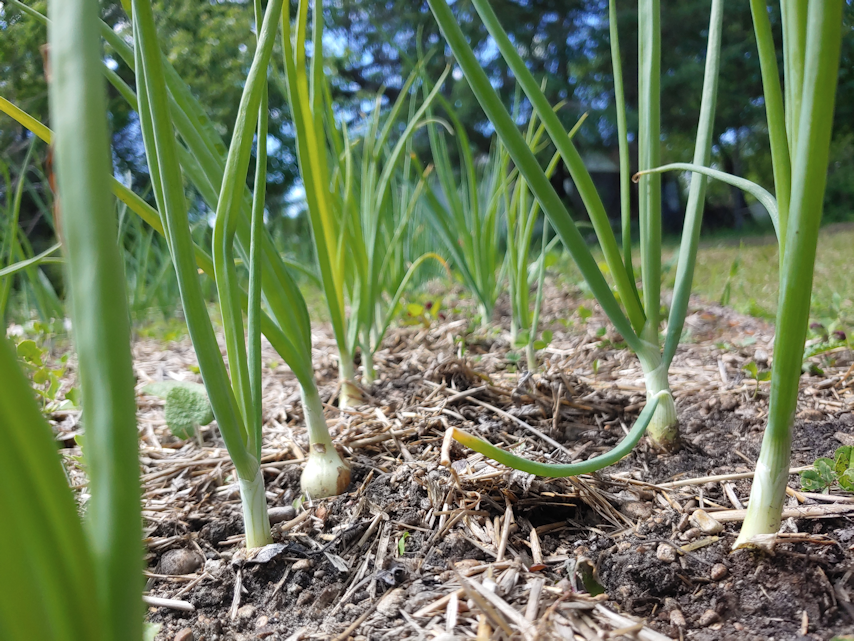
The first things we started from seed were onions, but we lost all of our Red Baron bunching onions, due to cats. When we started using the Solo cups as pots, I decided to broadcast sow the last of the seeds we had in a couple of cups and see what happened. With one of them, nothing happened, but with another, they did actually sprout. They’ve been hardening off along with everything else, and onions are supposed to be good companion plants for tomatoes, repelling insects, so we decided to go ahead and transplant the onions, too.

Some of them are REALLY tiny, but the girls went ahead and planted them anyhow. They’ll either make it or not.

The onions got planted in where we added more soil, but you’ll notice a gap in the middle. The tomatoes in the foreground are the tiny Spoon tomatoes, while the ones at the far end are the Mosaic Mix tomatoes. In the middle are the super tiny, sprouted really late, Mosaic Mix tomato plants. They’re so small, no extra soil was added around them; they would have been buried completely! We’ll see if they survive or not.

As always, we thoroughly watered the soil before putting in the transplants, so when we did our evening watering, they only got a misting, to help settle the soil.

We did hit 29C/84F today. As I write this, it’s just past midnight, and we’re still at 20C/68F. Our expected overnight low is 17C/63F. Instead of having to watch out for a last frost hitting our transplants, we have to watch out for excessive heat! We’ll be doing a lot of careful watering over the next while.

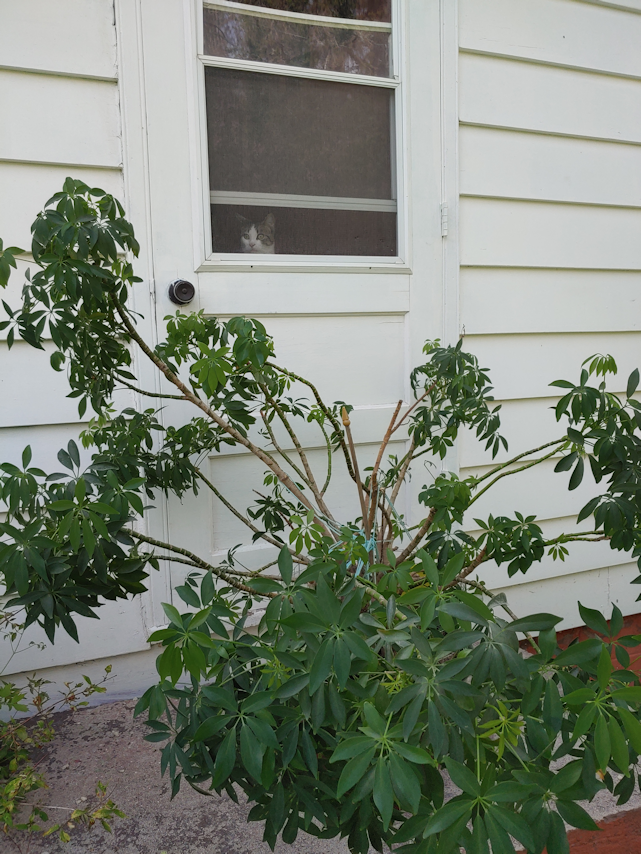
One thing the girls and I did finally remember to do; we put our poor, bedraggled umbrella tree outside. It took three of us. One to carry the pot, one to open and close the doors, and one to keep the cats away! :-D

Tissue was watching me through the door!

Yes, the plant is on the stairs in front of a door. In this spot, it will get full sunlight in the morning, while it’s still relatively cool, but be shaded during the hottest parts of the day. We don’t use this door, so it can stay there. Right now, during the day, we open the inner door and set up a little step ladder, so that cats can sit on it and look out the window. The window is open just enough to allow a breeze through the house to help keep it cool. The outer door has a tendency to unlatch on its own, so to make sure the cats don’t accidentally end up outside, we have it secured with some cord. It has become a favorite place for the cats to see and watch all the birds outside! :-)

So the tomatoes are now transplanted. Between them and the sunflowers, I had a lot fewer plants to bring back into the sun room for the night! :-) The rest cannot be transplanted until we finish the squash tunnel for the climbers, and build beds for them, but they are all hardened off and ready for transplanting. So we need to get those done as quick as we can! Friday and Saturday as supposed to be scorchers, too. Ah, well. Better the heat for transplanting, than frost!

Little by little, it’ll get done.

The Re-Farmer
Our 2021 garden: getting things planted, and trying things out

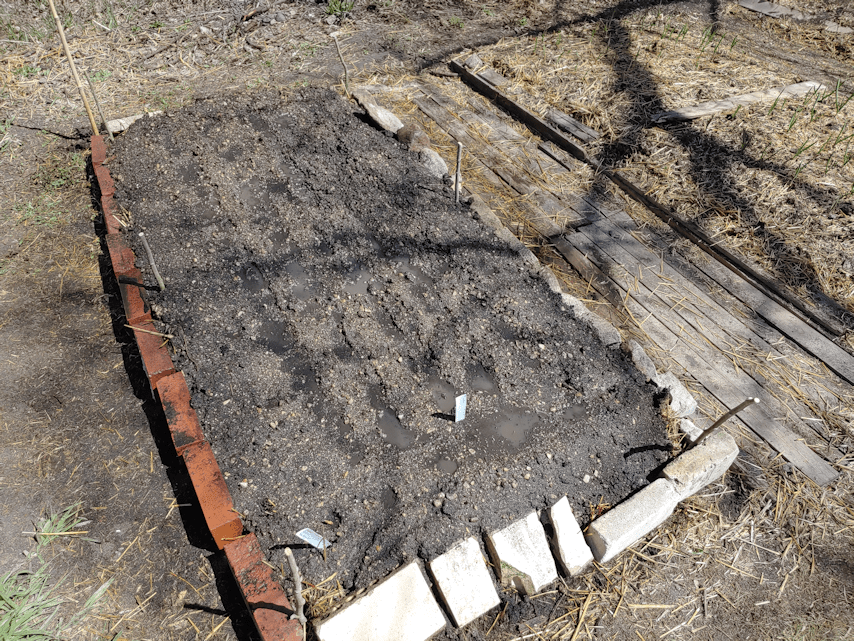
This morning, I wanted to get that half-bed planted with carrots. I was happy to discover that the Kyoto Red carrots I’d ordered were pelleted seeds (I’m sure I knew that when I’d ordered them, but completely forgot!), so they could go in right away. Before I did, though, I cooked up some cornstarch gel, and set the other two varieties of carrot seeds to soak. Last year, we used the technique described in the video below to plant carrot seeds, and it worked very well, so I wanted to do it again.
Those will wait until tomorrow, though. For now, the carrot bed in the old garden area is fully planted, and I covered them with plastic after watering them.

They’ll be checked often, and as soon as green can be seen, the plastic comes off.

The next job was the new garden bed beside the garlic.

Before topping it with fresh garden soil, I found what I could to shore up the sides, so things wouldn’t erode. This is a pretty small bed, so it only took two loads of soil to cover it.

Then began my experiment.

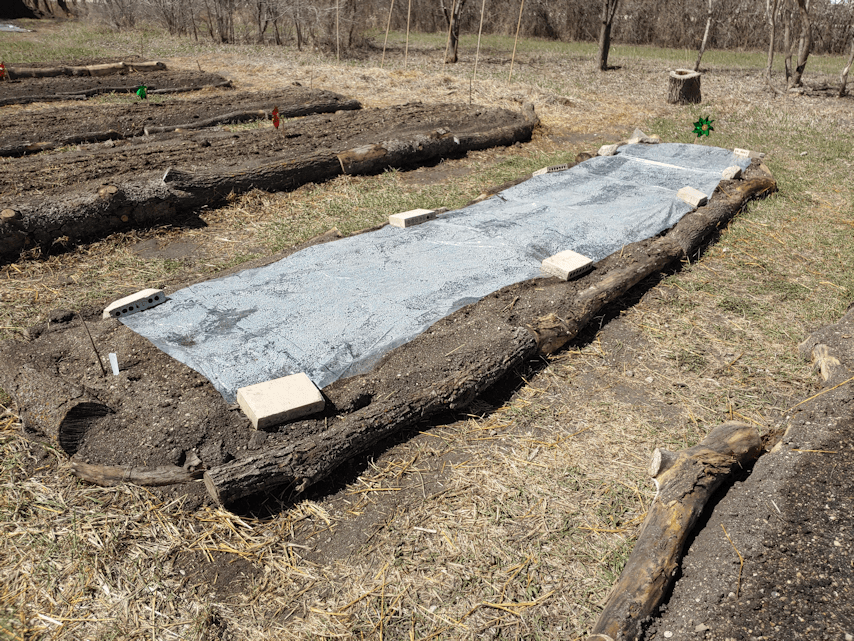
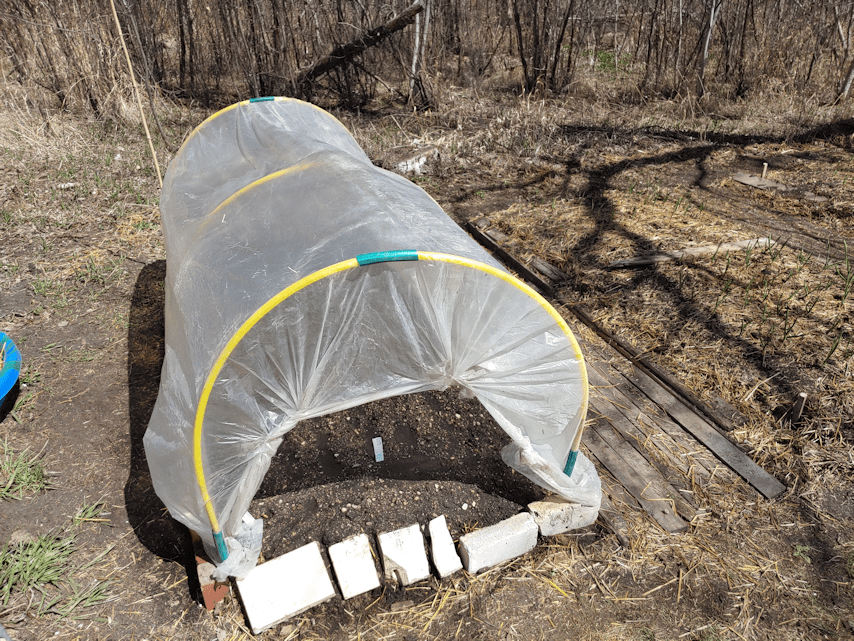
After planting the middle with Merlin beets, then surrounding it with the last of the yellow onion sets, I cut small lengths of poplar that were fairly thin. I’d opened up the three dollar store hula hoops I’d bought and removed the bits of what looks like decorative rocks that were inside, to make a rattling noise. The sticks were of a size to fit snugly into the openings of the plastic. I also cut lengths of old garden hose and split them lengthwise and grabbed some plastic that was used to cover one of the garlic beds over the winter.

I suppose I could have cut the plastic tubes from the hula hoops shorter, but I really didn’t want to fuss with it. I was able to fit the ends over the sticks and push them down quite far, even though some of the sticks were nubbly from twigs I’d cut off.

I used the pieces of hose to hold the plastic sheet to the hula hoops. Then I used packing tape to gather up the loose pieces at the end and pull things taught. I ended up getting a couple more piece of hose and used them to attach the plastic to the sides of the center hoops as well.

This thing is going to blow away in our next stiff wind! :-D It is by no means durable! This is more about keeping the deer away than anything else.

One of the wind socks we got to help deter critters ended up being spun so much in the wind, the twine I used to tie it to a tree broke. It’s in the shape of a spiral, so I hooked it to the top of a bamboo stake, then wrapped the spiral around the bamboo. It won’t get blown around as violently anymore, but still moves around the stake, so it should still help startle critters away.

So that bed is now done and planted!

In between watering the new bed, I made sure to water the strawberry spinach bed, and covered that with plastic, too. Though we’ve been diligent about watering, these are almost surface sown, and the surface dries out very quickly. I’m hoping it’s not too late to put the plastic over them. :-/ We shall see!

So that worked out rather well. Tomorrow morning, I’ll see if the hoop cover is still there, of it it blew away during the night. :-D

The next job was much larger! But that will in in my next post.

The Re-Farmer