Our 2022 garden: preparing to start seeds indoors

Last year, we converted two unused aquariums into greenhouses, where we hoped to protect our seed starts from the cats.

It mostly succeeded.

Today, I prepped the tanks for this year’s seeds.

The small tank – a 20 gallon tank – was a real problem with the cats last year.

Even when we pur the original hard cover back on at the end of the season, using the space inside to store the light, etc., the cats still got into it!

The foil around the back and sides were to provide reflective light for the seedlings. As you can see, the cats have torn up the foil, and even left scratches in the rigid insulation at the back!

Last year, we had tried using the lid that came with the tank at first, but the cats would reach through the opening for the water filter in the back, even if it meant fighting past whatever we put to block the opening. They managed to reach in and pull up the seed trays, anyhow. Having to block everything meant no air circulation, so what the cats didn’t destroy, mold did it’s damage. I finally rigged a window screen and that worked, though it was far too late to save the onions we’d tried to start in there at the time.

This tank will be for onions again. After seeing that onion seeds can be planted very close together, and they don’t really get transplant shock, I’m hoping to be able to get all 5 varieties of onions we have in hear.

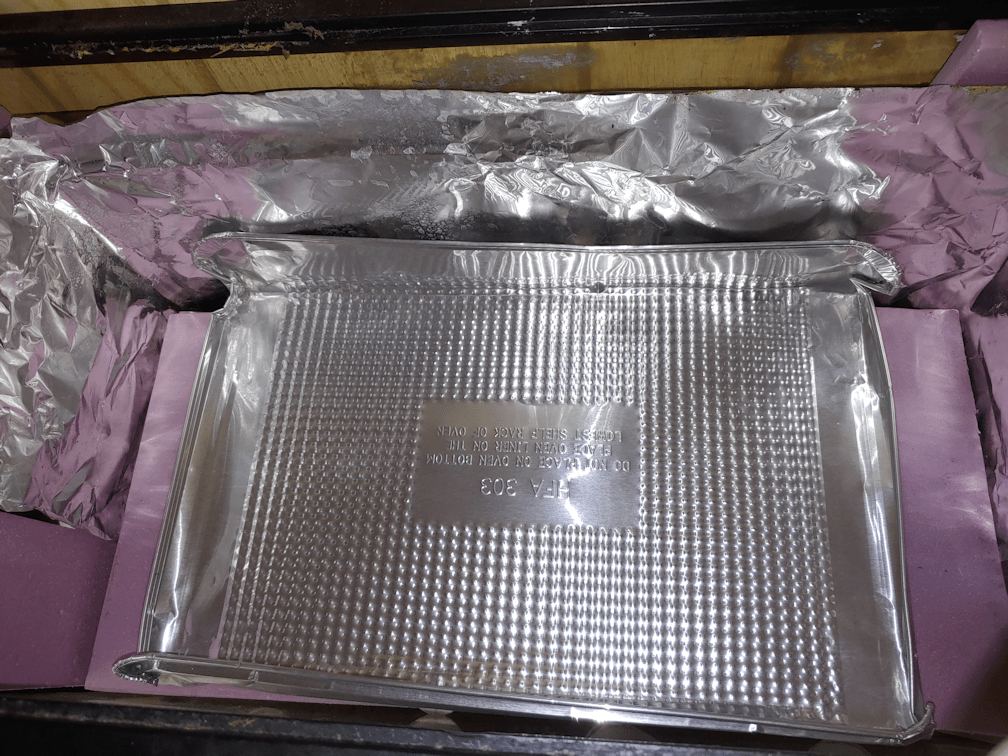
The problem is the size and shape of the tank is too small to fit any of the commercial seed starting trays we’ve been using. I want to be able to water the planting trays from below, which meant having to find something to use as a tray for the water.

I decided to try aluminum oven lines. They are pliable enough to bend to size, and strong enough that I could fold corners without it tearing. It’s not deep, but it doesn’t need to be.

There’s still quite a bit of space left. If needed, I can fold up another tray and overlap them. I’ll just have to make sure they are attached to each other with a water tight seal. Or we can just use the doubled Red Solo cups again, and not need to have a tray under them at all.

Then the screen window was brought back into action as a cover. A pair of 5 pound hand weights get added to the back, in case a cat walks onto the overhang in front. The metal screen is strong enough to hold their weights. The heavier cats don’t try to go up there, just the tiny ones, so that has worked out. If necessary, we have more weight we can put on it. At some point, I want to build a screened cover to fit, but that’s not an urgent thing.

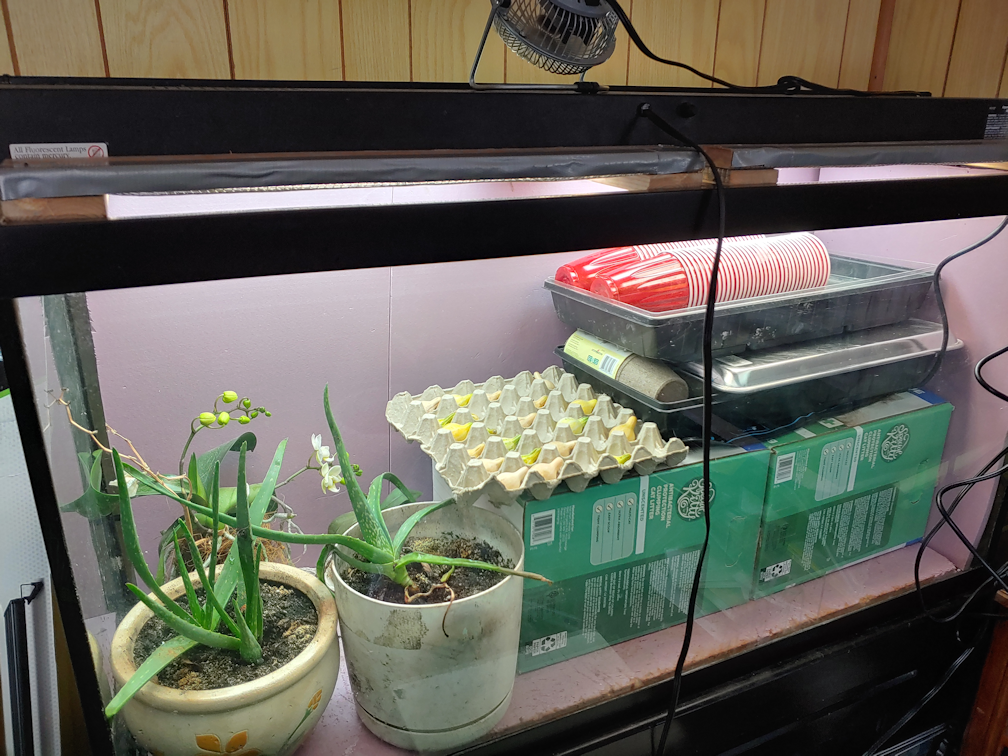
Since we can’t change the height of the light fixture, the egg cartons are being used to bring the seedling trays closer to the light, and can be taken out to lower the base as needed.

One thing we found last year is that this room is pretty cold, which is why we added the insulation around the back and sides. It was still difficult to keep it warm enough for the squash and gourds we had in there. Onions are a cool weather crop, so they should be fine in here, as far as the temperature goes.

Then there was the big tank to do.

I had to take out the biggest pot with an aloe vera in it to make space for the boxes that are being used to raise the seedling tray closer to the light. Previously, the boxes were under that sheet of insulation at the base to create a raised floor, but with the plants still in there, we can’t do that this time.

This is where we will be starting the luffa, and probably a few other gourds, at the same time as the onions. They will need the heat mat we got for under the seed trays, which is why they have to go in this tank. The mat won’t fit in the small tank. Right now, the mat is under all the trays and pots, so the weight can flatten it out a bit. There’s just enough room left to hold the curing Tennessee Dancing gourds.

At some point, we’re going to have to take the other aloe vera and my daughter’s orchids out. We’ll need the space for the tomatoes, eggplant and peppers, which are the next earliest seeds we need to start. After that, we will need space for the winter and summer squash. Hopefully, by the time they need to be started, we can start moving the onions into the sun room. The orchids (you can see one has started to bloom again!) are here because it was too cold for them to hang at the window in winter. The aloe is there to keep the cats from digging in the pots.

Which happened with the one pot I did take out, while I was setting things up in here! I caught Nicco, inside the barriers I put around the aloe vera. She’s so long and skinny, she snaked her way through the gaps! The little beast!

We had another, larger pot with an aloe vera in it in. It had been okay for months but, a few days ago, we came out to find the pot all dug up, and the only remains of the plant in it were a couple of leaf tips. We never found the rest of the aloe, and have no idea what happened to it! I’m sure we’ll find it, desiccated, under the couch or in a corner somewhere, months from now. :-D

As you can imagine, I’m not too keen on taking the plants out of the tank. They’re doing very well in there! But we won’t have a choice.

We have many things we need to start indoors, but a lot of them will have only a few seeds per packet used. Particularly with the squash and gourds. For the tomatoes, the paste tomatoes are the only ones we will be planting a lot of, since those are determinates being grown specifically for canning. The others are indeterminates and will be more for fresh eating, so we won’t need more than a few plants of each. We have enough varieties that, in the end, there should still be quite a few to transplant in the spring.

The other major thing we will need to start indoors will be the kulli corn, but those won’t need to be started until about the middle of May, at which point the sun room will be warm enough to use.

We are expanding the garden a lot this year, and will be expanding it more again, next year. I expect to be expanding it every year for quite some time. Which means that we will be needing lots of room to start seeds indoors every year. Until we are at a point when we can get a greenhouse or polytunnel, a goal of mine is to set up a corner in the sun room for starting seeds. We’d need grow lights, so that we wouldn’t have to constantly turn the trays for even sunlight, and we would need a heater sufficient to keep the room – or at least that corner – warm enough for germination. Or use more heat mats, but there is no outlet in that room. We are using an outlet in the old kitchen, with an extension cord running through a window to a power bar, right now. So warming the room would be more practical than using heat mats.

It’s funny. As we work on what we are doing this year, my mind is already on what will need to be done next year.

And the year after.

And the year after that…

As we work on things, we get a better idea of what plans we have will work, what needs to be modified, what needs to be re-priorities, or dropped entirely.

I don’t think we’ll ever reach the end of that process. Which is good, because figuring it all out is a bit part of the fun!

The Re-Farmer

As set up as can be, and fundraiser update

Well, we’ve been doing as much as we can in the sun room for now. It’s as ready as we’ll be able to get it, for Butterscotch and Nosencrantz’s recovery period.

We were able to tape up the wire on the old heated water bowl, so it can now be safely used again. The wire itself is not damaged; just the outside was cracked, right at the bowl. Thankfully, we’ve got a tape that can handle that tight of an area. If it hadn’t worked, we have a silicon sealant we would have used.

The main concern we have is with Butterscotch. We’ve used the sun room as a maternity ward before, for Butterscotch and Beep Beep to give birth in. Beep Beep handled it well, but Butterscotch tore her way through the old door’s screen to escape, no matter how many times we patched it up. She was more than content to leave Beep Beep to take care of both litters and probably wouldn’t have come back, if she hadn’t needed to nurse. She is not going to be happy in here. I do hope that, at least for the first day or two after surgery, she will be too drugged up to go too wild. It’s certainly going to make it interesting to go through here to get kibble and seed. Most likely, we’ll put a carrier in with her, and close her up until I’m done going in and out.

As we expect Butterscotch to basically tear the place apart while in there, my daughter and I bagged up the sunflowers heads, and they are now stored in the old kitchen. We’ve packed the top shelves against the window with as much gardening supplies as we could jam in, then made beds on the two bottom shelves. Then we tried to make the rest of the shelves and surfaces as impervious to destruction as we could.

I picked up a new litter pan for the sun room, since we’re using it for yard cat recovery so often. It’s set up under the swing bench. The heat bulb is ready to go, with scrap pieces of rigid insulation as walls, because there will be a cold draft from those windows, and more on the floor so they can eat and drink with their little toe beans kept off the cold concrete.

The plan is for Butterscotch and Nosencrantz to be brought in tomorrow, after we do the morning rounds. They have even been staying together when I put the kibble out, so they will be easy to catch at that time. They will have their own food and water until evening, at which point they will be put on a fast until after their surgery.

While organizing the space as best we could, one of the concerns is that, in her displeasure of being trapped in the sun room, Butterscotch might start attacking Nosencrantz. Since Butterscotch is not ever going to be an indoor cat and is not up for adoption, she has to stay in the sun room during recovery.

There is no such requirement for Nosencrantz. She will be adopted out. After they are fixed, vaccinated and de-wormed, and the non-adoptable indoor cats are done, we will start getting the adoptable indoor cats done near the end of February. We will bring them in to the vet in the morning, then the cat lady will pick them up in the evening and take them to the fosters for recovery before going to their forever homes. Then we will start working on getting the outside cats caught and done. They, too, will be taken to the vet in the morning, then the cat lady will pick them up in the evening.

It just doesn’t make sense to send Nosencrantz back outdoors after recovery, if we’re going to have to catch her again for the cat lady to take. Plus, if we bring her inside right after the surgery, there is no chance of Butterscotch going after her. This will also give us a chance to socialise her more, before the cat lady is ready to pick her up.

The next few months are going to be pretty cat crazy!

Speaking of the cat lady, I am incredibly thankful that there are already some fundraiser donations!! You can read about the fundraiser here or, if you wish, go directly to the donation page here. It just blows me away that she has been so willing to take on the expenses for Cabbages vet care, and going above and beyond in treating her. She even sent pictures (which I won’t ask permission to share right now; this fundraiser is a surprise, and I don’t want her to know about this blog, yet. :-D ), and Cabbages was eating out of a bowl and looking so much more alert.

I have not heard any news today, yet, which tells me that the recovery continues. It’s still “no news is good news” right now. Cabbages is being lavished with care and attention, and I have full confidence and trust in the cat lady, to do what’s right by her, however things go.

I am so thankful that we were connected with her when we did. The timing was downright providential!

The Re-Farmer

Our 2022 garden: T&T order, and McKenzie seeds

Well, this is it. Today, I placed my last order for our 2022 garden. While I was doing the first half of our monthly shop, I also picked up some pea seeds. I am now done ordering things we are planning to grow this year.

First, the peas.

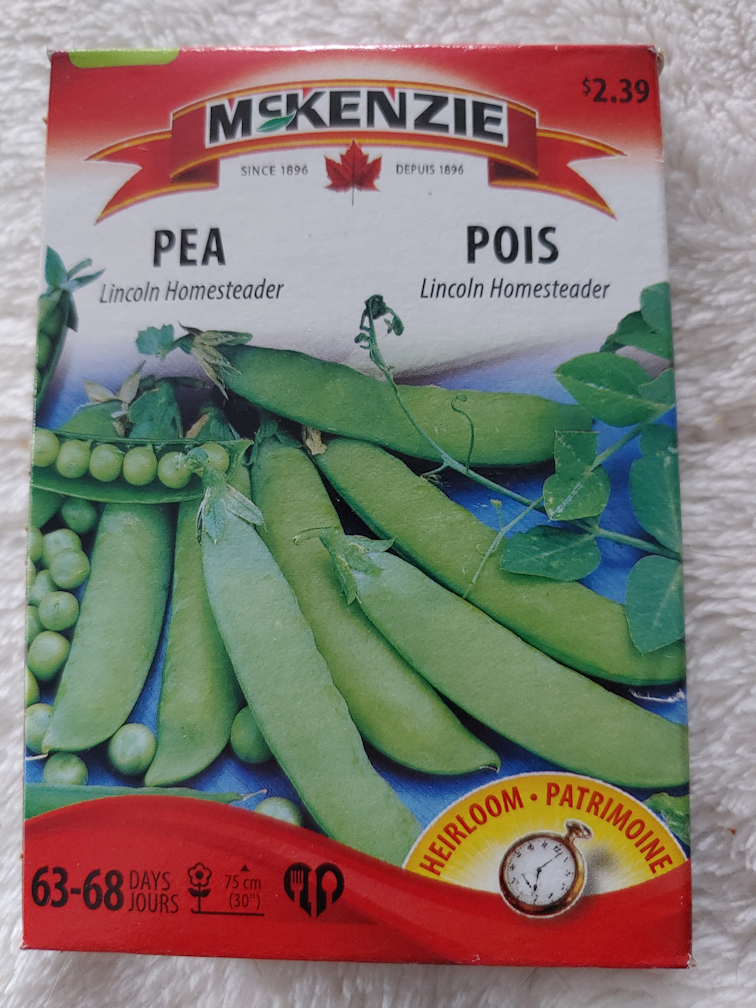
There are so many varieties of peas, I have been struggling on which ones to pick. While at the Walmart, I saw a new McKenzie Seeds display, and finally settled on one. As much as I love edible pod peas, I decided to go with shelling peas.

Some selling points on these: very productive, heat tolerant and disease resistant. Plus, of course, they’re supposed to be tasty. While I hope we don’t get another drought this year, our summers to get as hot as our winters get cold, so heat tolerant peas are a good thing.

My daughters are not big on peas, but they have never had peas, fresh from the garden. The ones we grew last year did not really produce, due to the heat (just the odd pod, here and there), then the green peas got eaten by a groundhog! The peas sown late in the season, in with the corn, were planted for their nitrogen fixing qualities, and the few pods we got were there only because we had such a long, mild fall. Nothing reached their full potential in flavour. Hopefully, this year will be different, and we will get lots of delicious fresh peas!

Once I got home, I placed an order with T&T Seeds.

All images belong to T&T Seeds.

First up is Jerusalem Artichokes, or Sunchokes.

I just ordered the smallest size; a 10 pack. A friend on a neighbouring farm successfully grows them, so I know they will grow here.

We’re sort of taking a chance on these ones. We’ve never tasted them before. I’ve never even seen one in real life before. However, these are something that can easily be propagated from year to year, and are supposed to be quite delicious. If we like them, we have another good storage food to add to our inventory of foods for self-sufficiency.

If not, well, they are in the sunflower family and have pretty flowers.

We will be planting them in a location that can be permanent, so not anywhere in our main garden areas.

Covington Sweet Potato

This one is pretty much just for me, as I seem to be the only person in the family that actually likes sweet potato, so I got the smallest option; five slips.

This variety is the only short season variety of sweet potato that can grow in our zone that I have found. I think I will make a grow bag or two from our feed bags, and set these up somewhere near the south facing side of the house, just to hedge my bets, though I would need to make sure there is space for the vines.

Highbush Cranberry.

The girls and I debated whether to get Highbush Cranberry, or more raspberry bushes. We decided to work with the raspberries we already have, and go for the Cranberry. I ordered two.

In cleaning up along the east fence line in the spruce grove, I actually found an American cranberry (at least that’s what Google Snap told me it was). It now gets light and everything, but I would like to transplant it, eventually, to a better location. Not sure where, yet.

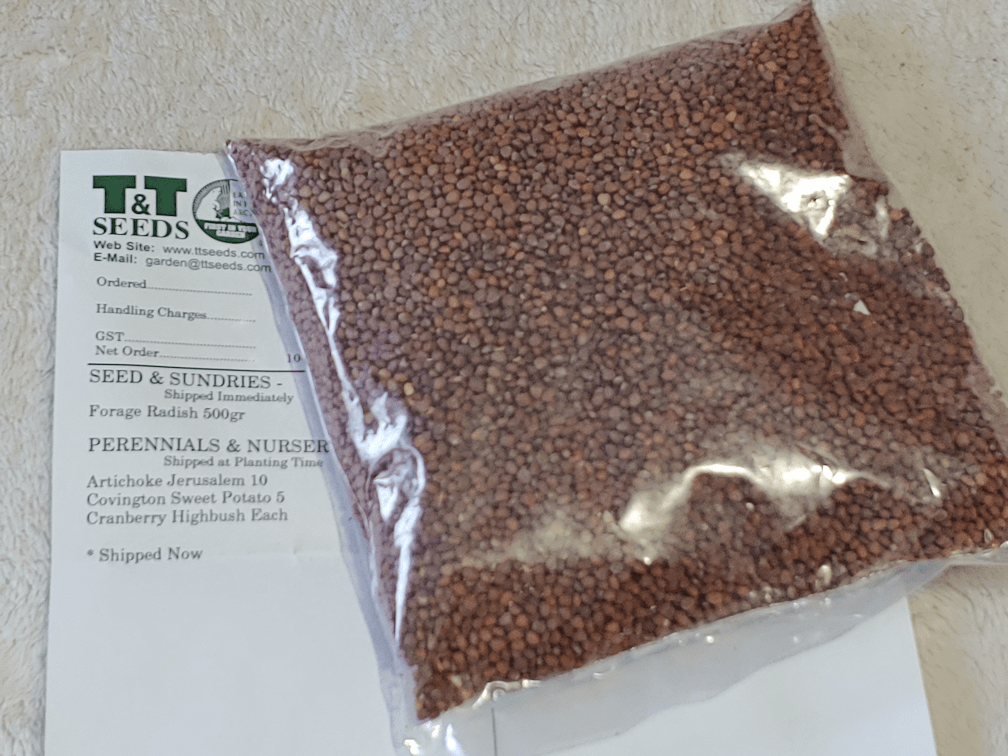
Forage Radish

Also called “tillage radish.”

We had tried to plant a daikon type radish to help break up the soil in the corn blocks last year, but I think something ate them shortly after they sprouted, because they all just disappeared. So I was quite excited to find these forage radishes.

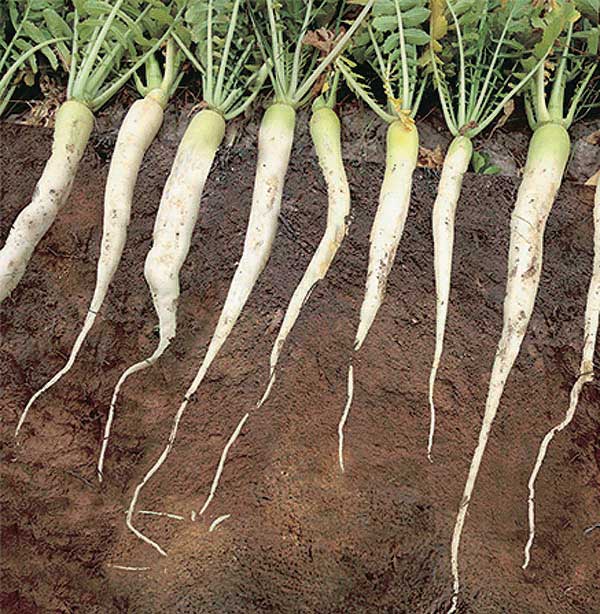
They are sold as a green manure and a type of cover crop. They get planted, then left to die off. Their roots can reach up to 6 feet in depth, boring into the soil as they grow. After they die off and decompose, they leave behind root channels that other plants can take advantage of.

With our concrete-like soil, filled with rocks, the plan is to basically just scatter these in strategic areas, so we got the 500 gram/1 pound size, which can cover 5,500 square feet. I don’t expect to use it all this year, but who knows.

So that is it for this year’s seeds and trees, though it’s entirely possible we might still order more. I forgot to order more alternative lawn and wildflower seed mixes from Veseys, but those would be sown in the fall, anyhow. We shall see how the ones I sowed this past fall turn out, this spring.

We still have a monthly “seed” budget, though, and now it will go to other things we need. I did pick up more potting soil today, as we will be starting onion seeds and luffa soon, and have lots more seeds to start over the next few months. After much searching, the girls and I found some netting online that we will be using to help protect our garden from critters. It’s a netting that is 14 x 200 feet. We can get one roll this month, and another roll later. Some of it will be used for the temporary fencing we will need to build around larger blocks, such as the corn. We can also cut it to the sizes needed to cover individual beds. We simply have too much ground to cover, and beds spread out in too many places, to fence it all in from both deer and smaller critters. Particularly since so much of it is still temporary. We’ll also have to figure out what best to use to support the netting, in the different ways we plan to use it, and get what we need for that. We are shooting to have consistent sizes on the permanent raised beds, so that any protective covers we build will fit any raised bed. The low box raised beds are 3 feet by 9 feet (because that’s the size the boards I found resulted in). The high raised beds will all be 4 feet by 9 feet, but with the thickness of the logs we are using, the planting area inside will be smaller, and the 3×9 covers should still fit. Other beds, such as in the old kitchen garden, are oddly shaped, so they will need completely different ways to protect them from critters.

Little by little, it’ll get done!

The Re-Farmer

Morning kitties, a mini convoy, seed sorting and s Cabbages update

Late last night, I got a message letting me know that a convoy was going through our area this morning, to join the main one heading for Ottawa. I was invited to be there to cheer them on. So I headed out early to do my morning rounds and make sure the van would start.

At -27C/-17F, with a wind chill of -35/-31F, the cats weren’t too keen on coming out!

Unfortunately, we’re using some of the donated cat kibble (we got one bag for the inside cats, one for the outside cats), and they don’t like it. It’s a Superstore no-name brand. I’m happy to have it, but the cats, not so much!

Once that was done, I headed out. There was a group of us that met up in a parking lot along the main road (I later saw there was another group at the one other area we could park and face the road at). Thankfully, I was able to keep in touch with someone in the mini-convoy, who was letting people know how things were going. There was a huge turnout at the starting point, with trucks, tractors and personal vehicles. An estimated 150 or so. It took them a longer time than expected to get organized, and a long time just to get through town and onto the highway.

Of course, none of those farmers in their tractors, and other supporters, were going to be joining the main convoy to Ottawa, so it was a smaller one heading our way. By the time they passed by, there was a bunch of us waiting, including a family with young kids, holding signs and making noise to support our truckers. The kids got a lot of horn honking and enthusiastic waiting. :-) I don’t have the winter gear to be outside for long in these temperatures, so I cheered them on from inside my van while taking video. It ended up being more than 7 minutes long!

This was the lead vehicle.

This, btw, is “downtown” in our little hamlet. LOL

As to the lies mentioned on this sign, to give one example, the CBC – a Crown corporation that gets about $1.6 billion in taxpayer dollars every year – had the most insane headline talking about the convoy leaving BC. It was described as people protesting dangerous road conditions. !! I haven’t trusted what the CBC says for decades, having had too many first hand experiences of how incapable they are of reporting accurately, but that is bad, even for them.

As I write this, the mini-convoy continues on its way to the city to join the main convoy and, from what I hear, as they pass through larger towns and another small city, more truckers are joining.

The truckers have been put through so much over the past couple of years, it’s insane. They have massive grassroots support.

Since I was there for so long anyhow, I hoped to pick up the mail on the way home, but it was still too early. The mail was in, but not sorted yet.

Of course, it was after I got home that my husband got a notification that a package is ready for pick up.

I am not going out again, today!!! It’s still -26C/-15F with a wind chill of -37C/-35F out there!

When parking the van in the garage, I saw Potato Beetle was perched on the old tire we use to keep the doors to where my mother’s car is. The black rubber is a favorite sun-warmed seat for the cats! As I tried to pet him on the way by, though, he didn’t want me to touch him.

He has a wound on his head!

He kept squirming around and wouldn’t let me look too close, but it seems like he’s had some fur torn out, a bit above and to the side of one of his eyes. It’s not bleeding, and the wound looks small. Mostly, it’s just missing fur. In this cold, however, we need to keep an eye on it.

That’s what he gets for all the fights he’s been picking! I’m guessing it was the Distinguished Guest. She doesn’t back down.

There were other cats out and about, too, but not this one…

Nosencrantz usually comes out for pets, but not this time. She was staying in their nice, cozy house!

I noticed the timer got knocked off its perch again, which means the light sensor is not facing the window. That means the heat bulb will be on, all the time.

At these temperatures, I’m good with that. When things warm up again, we’ll pop open the roof and set it facing the right way again.

We’ve got one more day of this cold, before things heat right up. I’m seeing all kinds of crazy temperatures in the forecast for Wednesday. The Weather Network is saying we’ll reach -1C/30F. The weather app that came with my desktop says -4C/25F. Accuweather says 0C/32F.

The only consensus is that we’re going to warm up by more than 20 degrees Celsius in less than a 24 hour time period!

I am not complaining. :-D

After that, we’ll be dropping back down and hovering around the -20C/-4F range and staying there for at least a couple of weeks.

It makes me want to start planting something. :-D

Last night, I went through our seed packets and sorted them. They had been sorted by how they arrived; by whichever company’s seeds arrived first. Since we have several things with multiple varieties, I sorted it by type, first. Then I put all the ones that need to be started indoors in their own box. Today, I’ll go through those and sort them by when they need to be started. The onions and luffa will be started the earliest. I’m also eyeballing what I might be able to do more winter sowing with, even if it’s just using the sun room. Oh, that might not be a good idea. That will be where Butterscotch and Nosencrantz will be recovering from surgery for 2 weeks. Butterscotch, in particular, is going to be hard to keep in there, and she’ll knock over anything on the shelves, trying to get out.

One of the other purposes of sorting through the seeds is to figure out where we want to plant things, and where we need to build new beds once things start warming up in April or May. Most of these will still be temporary beds, as we move things closer to the house, in preparation for planting trees further out. I am thinking, with all the winter squash we are planting, we may want to let those sprawl on the ground, rather than climb, to help shade and kill off the weeds. They would do better on trellises, though, and be more protected from critters. Hhmm. Something to think about.

Along with how to fence things off from the deer and groundhogs!

When I stopped to buy some honey from my cousin, after dropping Cabbages off, we chatted for a bit. They have gardens around their bee house (not the hives, but the little house they’ve got for their honey business). They have one small garden with a deer fence around it, but the rest is open. When I told him about our plans to plant sea buckthorn, he told me they have some – but no berries! They ended up with only female trees! They’re about 8 feet tall and bloom beautifully, but no berries at all. We’re getting only a 5 pack, so it’s possible we’ll have all males or all females. It’ll be at least a couple of years before we find out, one way or the other.

Oh, and before I forget. I got a Cabbages update last night. They are still force feeding her, but she did eat some food on her own, as well. I was sent a photo, and she’s being kept in a large kennel with all sorts of things to play with and climb on. She was looking right at the camera was HUGE eyes, and looking very alert. I am encouraged. She’ll be seeing a vet again tomorrow, if things stay to plan.

I think she will be fine, but I’m so glad our contact with this organization was able to take Cabbages and get her to a vet, just in case.

I will keep updating about her, as I hear more.

The Re-Farmer

Dramatic kitty, and looking ahead

I had a smaller crowd of outside cats this morning.

There was still kibble left from being topped up yesterday, so I think a lot of them were well fed and content to stay in wherever their preferred shelters are.

But not Chadiccus!

He kept flinging himself under my feet while I tried to walk, then lying there as if he’d been slain. :-D

What a ham!

We’ve got a couple more cold days after today, one really warm one, then back down to average temperatures for this time of year. I’ve been looking ahead at the end of the month, thinking on when would be best to head into the city for our monthly shop. We shall see if we will even bother going in. Thanks to continued draconian restrictions, the supply chain was being disrupted, and the truckers have finally had enough. There is currently a convoy of truckers on their way to Ottawa, in a protest to end medical tyranny. Last I heard, they had more than 50,000 trucks from all across the country, with more expected to join as they slowly make their way across the country. They’ve also raised over $2 million in donations, to help pay for fuel and other necessities for the truckers. About the only response we’ve had from our federal government has been for our Prime Minister to threaten to designate the truckers as domestic terrorists, which would allow GoFundMe to deny them the funds raised. Our government funded media (which is basically all mainstream media, since they got billions in bail out money), of course, is trying to ignore what’s happening completely, or if they do report on it, they don’t tell the truth about what’s actually going on. We shall see if their tune changes over the next few days. Personally, I doubt it. At least not for the biggest companies. Their survival has depended on government handouts for years, now.

We’ve got about a week before we need to go into the city to stock up again. Depending on how things go in the next while, there may not be a point in trying to shop in the city. There won’t be anything to buy.

The Re-Farmer

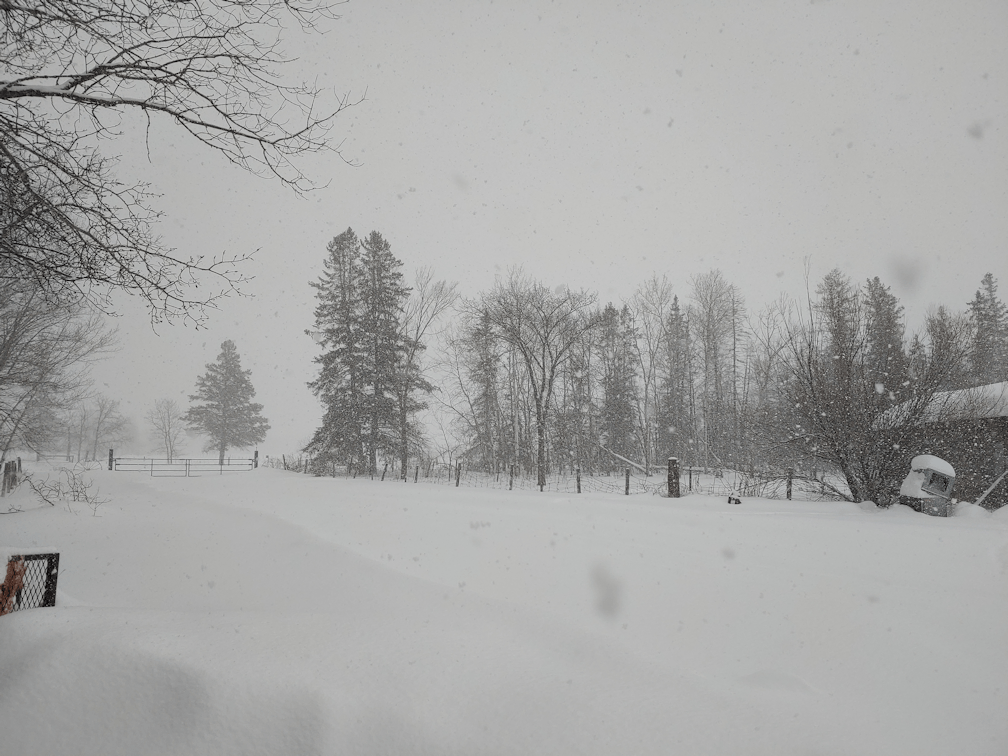
Lovely snow

So the snow that was originally supposed to start this evening and continue on through tomorrow, arrived last night.

The snow was pretty much stopped when I went out to feed the critters. I had to dig out the non-heated water bowls.

Then I had to shovel the path to the feeding station so I could put seeds out for the birds and deer.

Then I kept shoveling.

I am so glad I cleared the paths of the hard packed snow, yesterday. The snow we’ve been having is all light and fluffy, so it made clearing the paths again very easy work!

By the time I reached the garage, the snow was coming down in big, fluffy flakes. We are at a lovely -13C/9F right now. The wind chill is -24C/-11F, but it’s coming from the north, so most of the inner yard is well sheltered. It only got a bit blustery when I reached the bird feeder.

I did most of the paths, but not all of them. Later on, we might break out little Spewie and see what we can do about the driveway. Mostly, we’ll need to clear the end of the driveway, and that will likely need shovels. I don’t think Spewie can handle that! Not only will we have a plow ridge to deal with, but there’s no shelter from the winds there, so it’ll be drifted over and harder packed.

At some point, we’ll be able to set up the snow fencing that we’ve got, rolled up behind the old garden shed. I don’t know where it was used before we moved here, but it would be good to set some up on both sides of the driveway, for both the north and the south winds.

When I came inside and hung my coat on a chair to dry, I discovered this…

I somehow got snow in my hood! :-D I didn’t use it because the only way to keep it on is to close up the flaps in front. They go in front of my mouth and I can’t breath, so I keep having to jam it under my chin, which pulls the hood over my eyes. So I wore a cowl, instead. I guess that left my hood to be catch snow! :-D

I put it in a water bowl we keep near the kitchen for the cats, that happened to be empty. Within minutes, there were three cats checking it out, and a fourth watching because he couldn’t squeeze in. All of them orange. It was funny, except for having to step over them to get into the kitchen! LOL Within minutes, the snow was all gone!

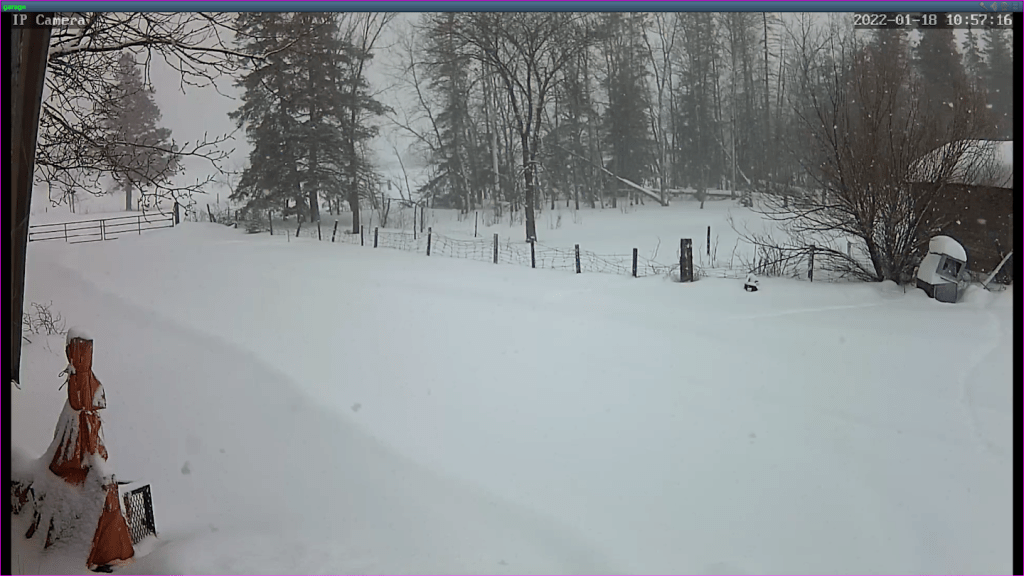
The view from the garage cam, not long after I came in. Looking at the live feed as I write this, the visibility has dropped even more, and those cat paths in the snow are almost completely gone.

I know people in the south of the province probably wouldn’t agree with me, but I am really happy will all this snow. It will be so good for the fields in the spring, and for the water table. Our municipality was among those that declared an agricultural disaster because of the drought, which allowed for farmers to get some financial assistance. So many lost entire crops – again! – and many were struggling with the the decision to cull their animals, because there was no feed to be had. Not that things are any better now. Thanks to the unnecessary, draconian government restrictions, animals aren’t getting to market. Tens of thousands of chickens are being culled. If the various government bodies don’t let up on their medical tyranny, we’re going to have major food shortages, even as farmers are having to throw away food because there’s no way to get it processed and to the stores. They’ll be blaming it on the Wu Flu, but this is the direct consequence of going against the emergency plans all levels of government already had in place.

We’ve long had the dream of being as self sufficient as possible. After moving here, I kinda hoped we would have more time to get there, though!

At least we’ve got our seeds in, and other orders processed for spring shipping. We’re going to be relying on our garden a lot more this year, if things don’t change!

Another reason to be glad for this snow. We are really going to need this moisture.

The Re-Farmer

Thoughts on being prepared

With all the crazy stuff going on these days, the price of food skyrocketing, and so many people losing their sources of income, all those “crazy preppers” out there are looking pretty vindicated!

There was a time, not all that long ago, when everyone was encouraged to be prepared for emergencies – usually around the time when whichever city we were living in at the time was faced with flooding or wildfires or some other natural disaster. I don’t know when reasonable prudence started being viewed as “crazy prepper” (and no, I’m not talking about the super paranoid doomsday types that have always been around). You know things have really gone bizarre when people on canning groups on Facebook start getting pop ups advising to report people who looked like they are becoming too prepared. !!

Going into our fifth year living here on my childhood farm, a lot of things now being recommended as preparedness was basically how I grew up, and not much different from how we live now. I mean, we’re already doing bulk shopping once or twice a month, with modest local shopping in between, so stocking up for at least a month is our normal. Stocking up for 2 or 3 months over the winter is also a necessary part of living here. We are nowhere near where we want to be, yet, but that’s where all the gardening and other plans are fitting in!

While the needs of living here hasn’t changed much since I was a kid, the resources and technology available sure has! I’m just loving the various groups I’m on for leading me to some excellent sites. Recently, someone shared a link to this Food Storage Calculator. It’s a really awesome tool for figuring out how much shelf stable foods you would need, for various lengths of time. This is for the absolute, minimum essentials recommended. I found this bit at the beginning interesting;

The below calculator is based on estimates from organizations like the CDC and recommendations from the Church of Jesus Christ of Latter-Day Saints Home Production and Storage manual. 

Years ago, in an early email support group for homeschoolers, the topic of emergency preparedness had come up. One of the members had been a Mormon, and said that they were encouraged to have at least a year’s worth of food stored up. Though she had left the church, that was a habit she kept up. It came in very handy when her husband suddenly lost his job and was unable to find a new one for months. The one thing they did not have to worry about was how to feed themselves and their kids, and she talked about what a boost to morale it was to be able to whip up a pan of brownies, while in the middle of such hard times. Her story really stuck with me. Seeing that the Latter-Day Saints manual was used for this was a huge plus, to me.

In the end, though, it’s still just a guide. Something to use as a starting off point, when planning one’s own supplies. (Also, it’s a fantastic site, and I encourage checking out the many useful and informative posts in there!)

So I figured it would be a good idea to go through the calculator results for ourselves, and talk about how I would modify it to our own particular circumstances and why. Hopefully, this will give you an idea on how you might modify your own results to your own situation.

Let’s start with the demographics. We are a household with 4 adults, and no very young children. I chose 3 months as the time frame, as we could potentially be stuck here for that long, if we had a particularly bad winter. Here is what the calculator came up with, and how I might modify the results.

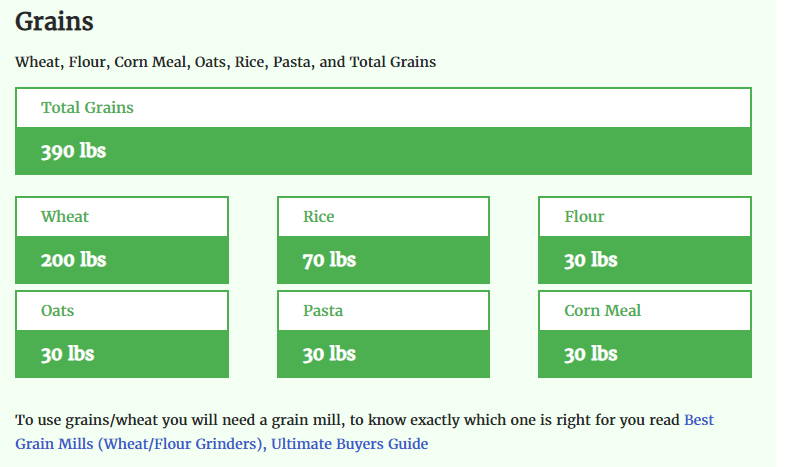
The first section is for grains: a total of 390 pounds.

For us, 200 pounds of wheat just isn’t going to happen! While it might be worthwhile to have some wheat berries to cook as a cereal, this is an amount intended for grinding into flour. We don’t have a flour mill. We do intend to get one, but for now, it would be a waste for us to have that much wheat. It’s the same with 30 pounds of oats. At the same time, 30 pounds of flour is laughably low, since we do quite a bit of baking. A lot of that wheat weight would get transferred to flour. I might get 15 pounds of rolled oats, then otherwise transfer the weights to rice and pasta. Both of which come in quite a few varieties, so there’s no need to be bored with just white rice and spaghetti. For our uses, I’d probably either stay the same with corn meal, or even reduce it.

That, of course, would change once we do get a mill. As losing power is something that is likely to happen, I would go with a hand crank mill, and since we are working towards growing flour corn, it has to be something strong enough to handle such a hard grain. Also, manual mills would be quieter than electric ones.

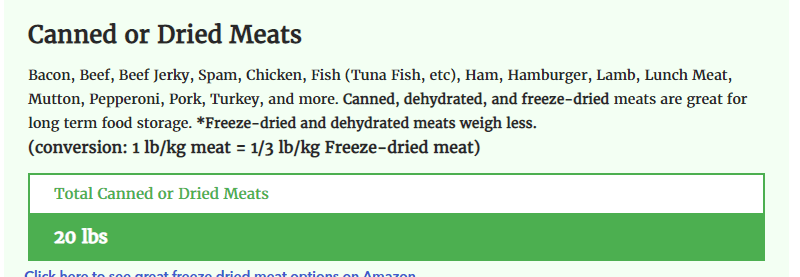
The next section is canned or dried meats.

Twenty pounds for three months? That seems so very low! Especially for 4 adults.

As we do have a chest freezer and I’m finding local sources for meat, we’re moving towards buying in bulk until we are able to start raising meat animals ourselves, so this is a flexible area for us. For now, we actually should be buying more canned meats for those “just in case” times, and we do need to take into account that if the electricity goes out for too long, we risk losing whatever is in our freezer. Hence the need for shelf stable supplies. Canning meat ourselves is something we are working towards.

So for our needs, I would increase this amount substantially, but not until we are at a point where we are canning our own meat.

Twenty five pound of fats and oils. Hmmm. Interesting that it lists more fats and oils than canned or dried meats!

The two gallons of vegetable oil would, for us, become a gallon of vegetable oil, another of olive oil, and probably a mix of other oils in smaller quantities. For a 3 month period, I would probably add in another gallon of vegetable oil. We don’t buy salad dressing. It’s an easy thing to make an oil and vinegar dressing. We do buy mayonnaise, but it is also easy to make, and can be a base for dressings, too. That’s where the “extra” oil would be used. Oil and fat can also be used for emergency fuel and lighting, so more would never go to waste.

We don’t buy shortening. Or margarine, for that matter. Just butter. We buy 8-10 pounds of butter for 1 month. More if we plan to do a lot of extra baking, like before certain holidays. For our usage, a 3 month supply would mean 24-30 pounds of butter. Not realistic! Butter is not shelf stable, so it would probably be a good idea to have a few pounds of shortening. If we were unable to get out, we could probably get away with using oil in place of where we might normally use butter, so we could play with the quantities and ratios a bit. The quantity of peanut butter could stay the same.

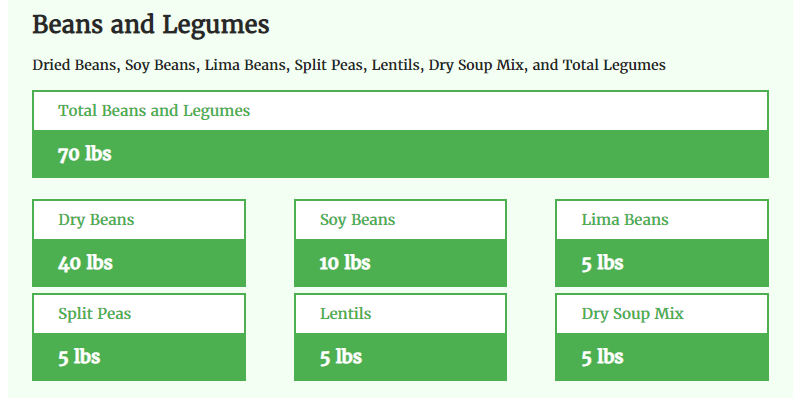
Beans and legumes: 70 pounds total.

That’s probably more than we would need, for how much we eat them. Soy beans and lima beans would be dropped completely. We don’t eat them. Also, I’d probably make my own dried soup mixes. It’s something I’ve done before, in quart jars, including things like dehydrated vegetables, mushrooms and bouillon cubes. They worked our very well, though I would do them in smaller jars in the future. Also, no black beans. They turn the end result a very unappetizing grey! :-D

One of the things I have been picking up at Costco is cases of baked beans. The prices of those has pretty much doubled recently. It would be cheaper to buy dry beans and cook them ourselves. Among our gardening plans is to grow beans for drying as well as fresh eating. Along with just keeping dry beans, I hope to can plain beans, as well as making baked beans for canning, too. I would add chickpeas to this list, canned or dried. There are chickpea varieties that grow in our zone, so that’s something else we could someday, potentially, supply ourselves.

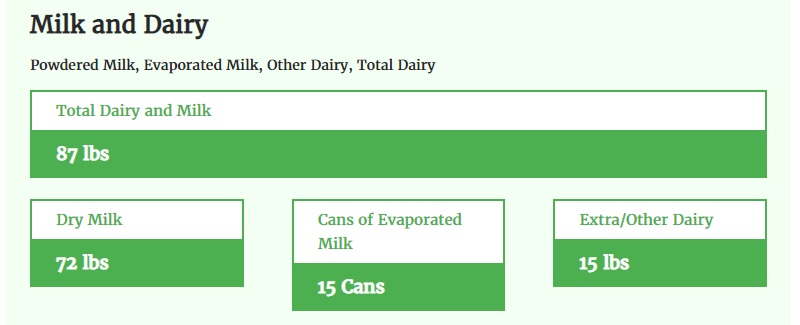
Milk and Dairy: 87 pounds

Shelf stable dairy products are a huge gap in our pantry. We should at least have some powdered milk. I don’t even know what to do with evaporated milk. And what does “other dairy” mean, in the context of shelf stable products? We don’t drink a lot of milk; it’s mostly used in cooking. What we do use a lot of is dairy products, such as cheese, sour cream, yogurt, more cheese, whipping cream… and more cheese. None of which is shelf stable. Well. I guess the cheese is, if stored properly. And we do love our cheese!

Sugars: 60 pounds.

I did not expect to see jams, powdered juice mixes or Jello in the sugars list.

White sugar and brown sugar are things we use quite a lot, since we do so much of our own baking. For honey, the 1kg (2.2 pounds) container we last bought from my bee-keeping cousin disappeared fast, so if we were to stock up on honey, we’d be getting more than what’s listed. Probably a 5kg (11 pounds) bucket, which is the largest my cousin sells. We’d probably get more molasses, too, though we don’t really use it all that much. Corn syrup would be off the list. We don’t use it. That amount of jam is probably more than we would need. I don’t know that we would include the Jello at all.

I wouldn’t not have thought of powdered juice mixes. Now that I think about it, though, it would be a good idea to have a supply of drink mixes, as their own category; juices, iced tea, lemonade, hot chocolate, coffee and tea would all be good things to have in the pantry. Plain water gets tiresome, fast!

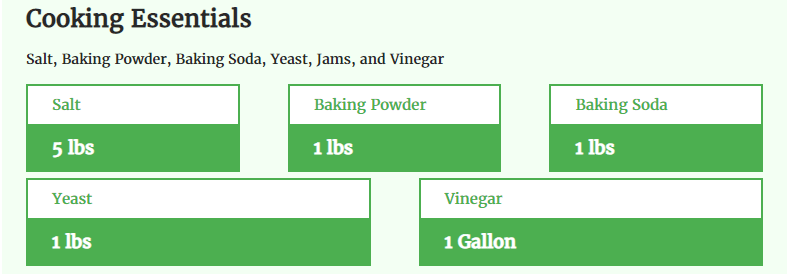
Cooking essentials! Gotta have these.

For the amount of baking we already do, I’d probably increase all of these. The vinegar would be used along with the fats and oils for those salad dressings we would be making ourselves. For salt, I’d want to have a variety, but if I had to choose just one type of salt, it would be course salt. We have salt grinders for seasoning meals, but I like to use course salt for a lot of things. If space allowed, I’d include a variety of vinegars, too. Salt, vinegar and baking soda can all double as cleaners, too, so extra of those would never go wrong.

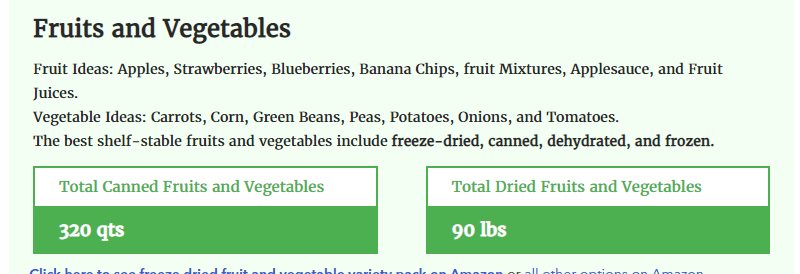
Canned fruits and vegetables: 320 quarts, plus 90 pounds of dried.

This is another area where we tend to be too dependent on our freezer, and why we want to move towards canning our produce. We do have a root cellar, so that helps. Almost all the fruits and vegetables we eat are fresh, with a small amount of frozen. We pretty much never buy canned, but once we’re growing enough to make it worthwhile to can them ourselves, it would make a big difference in the winter months. Before we moved out here, I had a dehydrator and used it to dehydrate purchased frozen vegetables. It works really well; the vegetables are already blanched and most are cut to size, so they can be laid out on the trays while still frozen, with no extra work needed. They were great in our jar meals.

While I’ve bought dehydrated vegetable mixes once in a while (they always include peppers in them, which is irritating for me), we’ve never really bought dried fruit. Sometimes I’d get dates, with their pits still in them, for snacking, but they’re quite expensive. We hardly even bought fruit leathers for the girls when they were little. We don’t buy raisins. Dried fruit in particular is something I would forget about when it comes to emergency supplies, but they would be good to have on hand. Ninety pounds, however, would be way more than our family would use.

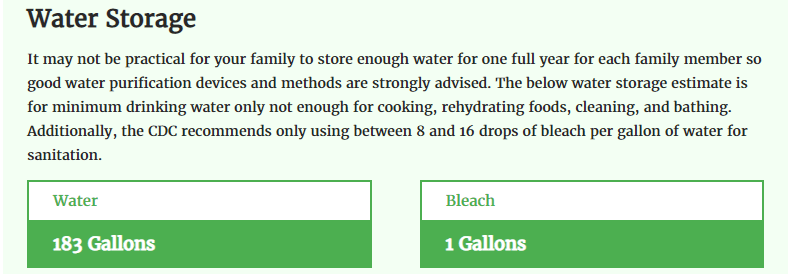
Water storage. This is our weak spot! We are already buying drinking water, so at least we do have the big water jugs. Storing 183 gallons, just for drinking, simply is not an option. This is a big part of why we want to get that old well repaired, so that we have access to water even if the power goes out. The bleach is something we don’t buy. We found a half empty bottle of bleach among the laundry supplies while cleaning up the old basement, and for the amount we use bleach, we’re still using that bottle we found! Still, it would be good to have bleach on hand. It’s something I would have forgotten about, so I appreciate it’s in the calculator.

That 183 gallons is the minimum water required for drinking. Much more would be needed for everything else. A safe supply of water is, typically, the biggest and most common hurdle in emergency situations for most people, I’m sure. At least for us, we have the possibility of getting the original well working again. Even here in the boonies, most people have wells that rely entirely on an electric pump.

Of course, in our situation, we would also have to add in wet and dry cat food. Since switching to the wood pellets for litter, we’ve been going through that a lot more slowly – and it’s a product that is actually a fuel, so it can do double duty. A single 40 pound bag goes a long way.

This calculator makes for a very interesting tool. I like that it’s just the shelf-stable essentials. There are so many lists out there that include everything but the kitchen sink – and then tell you what to use for a kitchen sink. Even just this list, for a 3 month period, can look overwhelming. However, it’s a place to start, to modify for our own circumstances, and the sort of thing that can be achieved, little by little, without taxing the budget too much.

It’s good to be prepared.

Even if Facebook thinks your a scary extremist for putting up a bit of extra food!

The Re-Farmer

This is a huge step

Well, we’ve gone and done it.

After much discussion with my daughters, we have made our “seed budget” purchase for this month, and it is trees.

We’ve been going through a number of websites for nurseries that supply cold hardy trees. Among the ones we want to get is a nut orchard collection, and the nursery that sells the one we’re looking at has scaled down the package deal, making it much more affordable. The collection, if planted spaced out as recommended, would cover 1 acre. However, some of the trees in the collection have the potential to reach 100 ft tall. That’s almost 40 feet taller than the tallest trees in our spruce grove! Which means we have to plant them in the outer yard, or even beyond, where the renter’s cows pasture, and we are just not going to be ready for that this year.

Beyond that, some of the sources we have been looking at just don’t have new stock listed yet. Among the things we are eyeballing are fruit trees, such as apple trees to replace the diseased crab apple trees we will have to cut down, pears, plums, Saskatoons, highbush cranberry, as well as different types of raspberries, etc. There’s only so much we can do in a year, though, and only so much space we are ready to plant into.

For this year, then, we settled on buying from Tree Time. They do a lot of shelterbelt trees, but also have fruit, nuts, berries, etc. They also come highly recommended. They are a reforestation nursery, which you can read about in their “how to order” page. Right from the start, they say:

We are a reforestation nursery that makes it easy for Canadians to purchase large quantities of tree, shrub, and berry seedlings at low prices.

Shop with us if you want convenience, selection, low prices, outstanding service, a guaranteed ship date, and high quality stock. Our customers tend to enjoy doing things themselves and watching their trees grow.

We grow our trees for maximum survival, not height or aesthetics. We mostly grow 1-2 year old trees because they have the best survival rates and are easier to ship in the mail.

We guarantee every tree we sell.

We decided to focus on two areas. First, creating our privacy barrier/living fence, and second, our first nut trees. Because of how they bundle their trees, the numbers we are getting are quite different than they would have been, elsewhere.

This is what we are getting (all images belong to Tree Time nursery).

Sea Buckthorn.

When talking about what to get as barrier trees, we were thinking of setting these aside for another year, but the way various things have changed since then, we’re going for it.

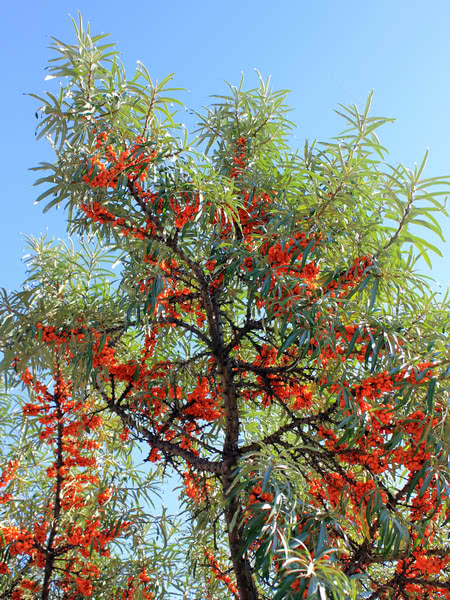
This is a zone 2b tree, so well suited to our zone 3. They are good in poor soil, are nitrogen fixers, and their berries are edible and healthy. They can grow up to 15 ft in height, with a 12 foot spread, and should be planted at 3-4 ft spacing, so they will do very well as a living fence/privacy screen, as well as a deer barrier, once they grow big enough. Plus, they will provide food for birds.

These will come as year old, bare root trees. We will be getting their smallest bundle, which is five trees. Sea buckthorn requires 1 male tree to 4 females to produce berries, but at only 1 year old, there is no way to know what sex the trees are. It may be a few years before we can tell! The males do not produce berries, but hopefully, there will be at least one male in the bundle.

Where we plant these will be partially dependent on how far we go with this next batch.

Silver Buffalo Berry.

This is one that disappeared from other sites we were looking at, so we were very happy to find them at Tree Time.

These are a super hardy, Zone 2a tree. Like the Sea Buckthorn, they can also handle poor soil and are excellent for attracting birds. They can grow to 18 ft in height, with a 10 ft spread, and should be planted 3-4 ft apart, so they should also make a good barrier and privacy screen. These will come as 1 yr old bare root stock.

We also got them in the smallest bundle of 30.

Which is triple what we expected to buy, when we first found these.

The area we planted the corn and sunflower blocks is where we intend to plant these. Right at the corner, along the north fence, the lilac hedge my mother slowly extended over many years, peters out. There is a gap there that the deer jump through. I am thinking that section would be a good place to plant the 5 Sea Buckthorn. Then, the Silver Buffalo Berry can be planted all along the east line, leaving a “lane” behind them to access the trees along the fence line itself, and also leaving a gap where the telephone line is buried.

With 30 of them, planted 3-4 feet apart, however, we will have WAY more than will fit in a row in that area. Since we will be slowly planting more food trees further west, we will be planting just the one row of them. Which means we’ll need to find another location to plant the remaining trees! I am thinking of the area we had originally considered planting the Sea Buckthorn later on, which is in along the north fence line in the outer yard. Or even filling in gaps west of the lilac hedge. This would go a long way to help reduce the road dust that drifts into our yard in those areas, every time a vehicle drives past on the gravel road.

Before the trees arrive, we will have to measure and mark out where we want to plant in that north east corner. Once we know how many we can fit into there, we’ll know how many we have to plant somewhere else. That is a lot of trees for how we want to use the spaces.

Now that I think of it, we could also gift some to my older brother, for the forest he’s been working on for the past couple of decades. :-)

Then there are our first nut trees. Pine nuts, to be more specific!

Korean Pine.

In other sources, we have seen these as being a Zone 2 tree, and some listing them as reaching up to 100 feet in height. !!! Considering where we intended to plant them, that was just not good.

These, however, are listed as Zone 3a, and reach “only” 60 ft in height – about as high as the spruces in the spruce grove. Which is about where we intend to plant these.

These also have a spread of up to 30 feet, but the website doesn’t list how far apart to plant them. We’ll get that information later.

We ordered two bundles of three, 2 yr old seedlings as plugs, not bare root. They have special requirements. For the first five years, they grow very slowly and need to be kept shaded, because their bark can be easily burned by the sun. This is why we want to plant them along the north side of the spruce grove, between the grove and the row of crab apple trees, where it is shaded for most of the day. At 5 years, they suddenly shoot up in height, and no longer need to be protected with shade. Since we’ll be getting 2 yr old seedlings, that should happen in three years.

I have some concerns.

The nursery we first found these at sells them with their roots in a plastic wrapped ball of soil – the only tree they don’t sell as bare roots – because they require a particular fungi at their roots for optimum growth. We may be able to buy the fungi to inoculate the soil, though. At least that’s what I learned from this other nursery. According to the Tree Time website, however, there is no mention of the fungi needs, plus it says they should be planted in full sun, not shade.

We’ll have to do more research on them, because this might be due to differences in varieties. We might end up having to plant these somewhere else. They would make a good shelter belt tree, and at 60 feet high, that would mean either along the north property line, or further out in the south, where we get hit with winds because there is a gap in the sheltering trees. Since we intend to plant permanent garden beds in the outer yard, anything we plant there has to be carefully placed so as not to create the very shade we are trying to get away from!

It’ll take about 7 years before these start producing pine nut containing cones. I don’t think I’ve ever bought pine nuts before, as much as I’d like to be able to use them for making pesto, etc. I enjoy them, but they are just too expensive. These trees have the potential to be a cash crop.

When placing our order, I chose a shipping date of May 30. Since our last frost date is June 2, I thought that would make the most sense. It also means that, in the week or so before they are shipped, we can get out and measure where they will be planted, and even pre-dig the holes (the ground should be thawed out enough), as well as making sure we have everything we need for planting, then protecting, the 41 seedlings we will be getting!

There we have it. After 4 years of living here, we are finally at the stage where we are starting to plant trees and shrubs in bulk. The first stage of a multi-year plan in planting food trees and reach our self-sufficiency goals. Given how long it takes for trees to start producing fruits or nuts, it would have been better if we’d started this years ago, but when we first moved here, we didn’t even know what we wanted, or how to get them. There is a big difference between planning for things that will live for decades, and can potentially become very large, and planning vegetable beds!

Placing this order really feels like a milestone for us!

The Re-Farmer
A lovely day, and getting ready

When we decided to go ahead and cancel our old satellite service outright, instead of waiting until the end of the month, after finding how excellently the Starlink system was working, I was working on the assumption that we’d have all sorts of cancellation fees. So, just in case, I budgeted more than what we would normally expected the bill to be, on top of adding on the new Starlink bill.

We were in for a pleasant surprise. We’re actually going to get a couple hundred dollars for a credit. We do still have to send back their transceivers (not the entire dishes, as I was mistakenly told) and their modems/routers/whatever they’re properly called. The packaging should be here when the post office is open again starting tomorrow. I figure we’ll get our credit once they get their items back. Until then, it still freed up a large chunk of our budget.

What a wonderful sense of relief that gives us!

While we did try to stock up as much as we could, the outside cats are going through the kibble a lot faster than usual. Which makes sense. There isn’t much for them to hunt these days, and they will be burning a lot more calories in the cold we’ve been having. Tomorrow was expected to be a warmer day, so I was going to make an extra trip into the smaller city to stock up on more cat food.

Today, however, turned out to be warmer than forecast, and already we’ve reached the high that we were supposed to hit tomorrow. So I decided to make the trip today. At -17C/1F, it feels like summer! Even with the -26C/-15F wind chill, which is coming from the north, so we are well sheltered from it.

The outside cats were practically having a party!

I had a surprise this morning, too. As I was coming back from leaving kibble in the tray under the shrine, I was startled by deer running through the gate in the chain link fence at the south side of the yard! This is the first time I’ve seen the deer going through, while I was outside. Then, when I came around the house with seeds for the feeding station, the doe and her little one were there. They hung back near the compost ring, before finally running off into the spruce grove, but they stopped and looked back repeatedly.

When I was finally ready to head out, I took a peek around the corner of the house and, sure enough, they were back and eating the seeds! They saw me and watched for a while, but didn’t run off until I crossed the yard to the garage.

I’m okay with them being used to finding food at the feeding station. I want them to associate that spot with food, not our garden beds!

Speaking of which, the new wiggle room in our budget meant I could get a few extras along with the cat kibble. Though I didn’t get as much kibble as I intended. They were almost entirely out of stock of the affordable big bags. I only got three. If I’d bought the six I’d intended, there would have been maybe one bag left, and I wanted to leave more for others.

Along with a couple of bags of seed starting mix, I got a heat mat. One of the big problems we had with starting seeds inside the aquarium greenhouses (besides the cats constantly trying to get at them!) is that the house is just plain too cold. Using things like heated rice bags or small water bottles filled with hot water helped, but some things just never germinated. I’m pretty sure that’s the main reason the Hopi Black Dye sunflowers didn’t germinate until so much later.

I went through our seeds to look at what needs to be started indoors and when. Actually, there’s two ways we can look at it. Most seed packets go by number of weeks before the last frost date. The other way is to look at how long until harvest, then count backwards from the first frost date in the fall.

Our first frost date, on average, is Sept. 10. For anything that requires more than 100 days to harvest, the latest we should have germination is about May 4. If we want to give up to 150 days, we’d need to have germination by April 30. I would calculate when to start the seeds from there, using the days to germination information on the seed packages.

Which isn’t too bad.

If we go by the package instructions using our average last frost date of June 2, we have several dates to go by. Four weeks puts us at May 5, six weeks at April 21, eight weeks at April 7, and ten weeks at March 24.

Having worked that out, however, there are still going to be things I plan to start earlier. Some of these, people on my Zone 3 gardening groups have already started!

The main one will be onions and shallots. With so many varieties and so many onions we want to plant, space would be the biggest issue… except maybe not. I found this, from MI Gardener.

Based on that method, we should have no problem planting all our varieties in just the big aquarium greenhouse.

The problem with that is, it’s currently housing several aloe vera plants to protect them from the cats, plus my daughter’s two remaining orchids. She’d had them safely hanging in front of the living room window, only to discover it was too cold for them there, and a couple of them died.

There is still the small aquarium greenhouse. Depending on what I have for growing trays, I could fit all the onions in there.

There are a few other things that need to be started very early, too. Among the things that can be started at 10 weeks are the eggplants and peppers (we will be starting just a few of those, since only 2 people in our household like them), the Sophie’s Choice tomato (just a few of those), the Cup of Moldova tomato (lots of those, since they are for processing), the Wonderberry (just a few of those) and the luffa (probably all the seeds we have left of those). All of these are things I’m seriously considering starting much earlier. Especially the luffa.

With those, we might be able to fit them all in the big tank, and still keep the orchids with them, but I have no idea where we can put the aloe vera pots that will be safe from the cats!

Among the things we can start at 8 weeks are the rest of the tomatoes, ground cherries, Crespo squash, Tennessee Dancing Gourds, and the Ozark Nest Egg gourds.

I think at 6 weeks is when I will start the kulli corn seeds which, according the the tracking information, has arrived in the city and should arrive at our post office in the next couple of days.

At 4 weeks, we need to start the cucumber, all the squash and melons, the rest of any gourds we will be trying this year, and the hulless pumpkins. It would also be the time for me to start the kohlrabi, if I decide I will try those again this year, since direct sowing them has been a complete fail for the past two years.

Everything else we’ve got can be direct sown, some as soon as the ground can be worked, and others after the last frost date.

I’m going to need more soil, but that’s something we can pick up little by little, as we need it.

I have to admit, I’m really torn right now about starting things too early. I know there are people in our zone that do it every year and have no problem, and others have started winter sowing outdoors, using this method. We don’t have a lot of milk jugs, but I’ve been keeping jugs from the distilled water for my husband’s CPAP, which would do. They are that blue, transparent plastic. Theoretically, we could set this up in the sun room, which does get below freezing, but still stays a lot warmer than outside. That would actually be a good experiment for the kohlrabi, now that I think about it. With so many yard cats, plus the deer, I’m not sure putting the containers outside would be wise, unless we can put some sort of protection over them. In theory, we could drag over the covers we made for the raised beds. They’re covered in snow right now, and probably frozen to the ground! :-D

For any experienced cold-climate gardeners reading this, what do you think? Would I be severely jumping the gun if I start our onions seeds this early? Or some of the tomatoes, the eggplant and peppers? What do you think?

The Re-Farmer
Enjoying a “warm” day

As I write this we are at an almost balmy -26C/-15F with a wind chill of -34C/-29F, and we’re supposed to continue to get warmer over the next couple of days.
Remarkable how our ideas of “warm” and “cold” change, when living somewhere that has such temperature extremes throughout the year!
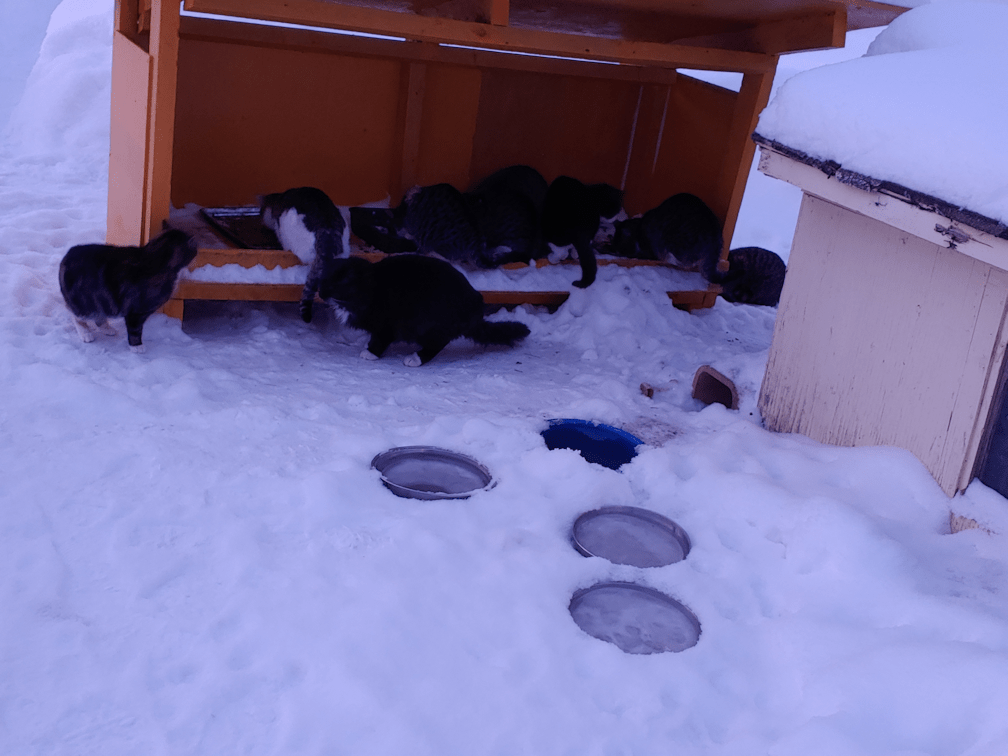
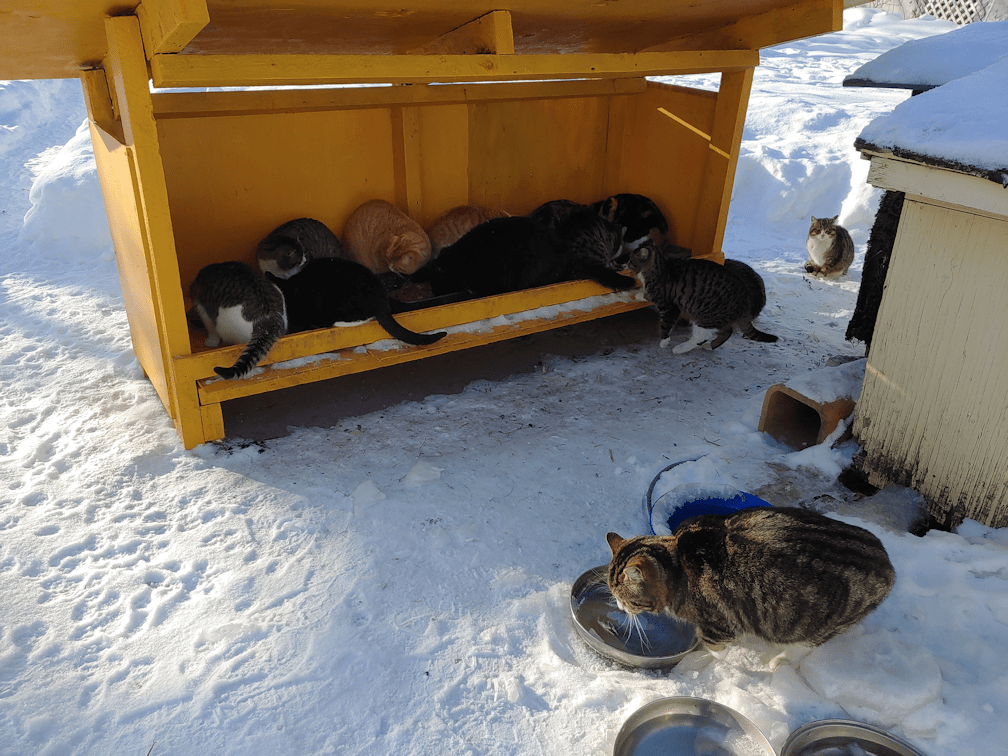
Yesterday evening, I’d treated the outside cats with a warm, meaty broth over their kibble top up, but this morning I found quite a bit of the kibble in frozen broth! It froze before the cats could eat it all, and the crowd of them was eating fast when I went back inside.

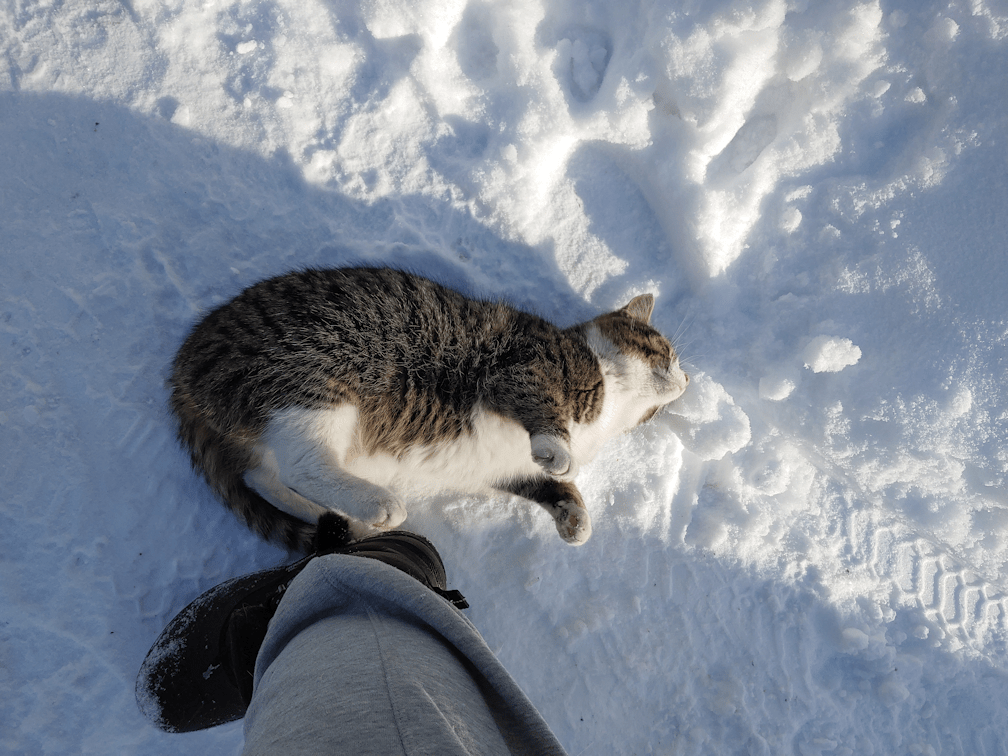
While the outside cats clearly don’t like the cold, they are doing quite all right, and spend a lot of time outdoors, instead of in one of the many shelters they have available for them. Seeing Chadicous exuberantly rolling on the snow sort of hits home how different the outside and inside cats are. It’s also a reminder of how important it is to let the outside cats develop their natural defenses against the cold. These are from generations of outdoor cats. They have the genetics to develop that insulating fur and body fat they need. Yes, they can still freeze, and having the heated cat shelter is a good thing, but it is equally important that it not be too warm in there, as that would seriously mess them up and potentially harm or kill them.

If our inside cats ever got outside in the temperatures we have now, most of them wouldn’t last more than an hour, even though most of them either started out as outdoor cats, or are from the same gene pool. Then there’s Fenrir. She has her long fur, but no undercoat, and that’s why we brought her indoors during her first winter. I don’t know where she came from or what breed she is, but it certainly wasn’t from any local cold-hardy genetics! A cat like David, with his long fur and deep, thick undercoat, would last longer, but having been in a warm house all the time, not even he would last long if he suddenly ended up outdoors. This is where going out through the sun room has its benefits, as it gives us two buffer zones, should the cats try to dash outside. Oddly, only Fenrir seems to actually be trying to do that. While other cats make a run for it, they’re more interested in exploring the old kitchen. Fenrir has managed to get as far as the sun room before we’ve caught her. In fact, going for the sun room door is the one sure way to get her out from under the couch in the old kitchen, or from behind the old wood cookstove, where we can’t reach her. I try to watch out for her before opening the door into the old kitchen, but it’s like she’s waiting for me. Many times, the moment that door opens, she appears out of nowhere and is in the old kitchen before I have a chance to react in any way. Knowing we’ll try to get her out, she immediately hides in places we can’t reach her. Sometimes, the only way I can catch her is to go into the sun room and leave the door open behind me. She always goes for it, and I can usually manage to catch her rather quickly after that.

When we win the lottery ;-) and can finally renovate this place, one thing I would want to keep and repair is all the doors between sections of the house, and add even more in places. None of this “open concept” stuff. :-D We once lived in a house that had doors between every room, including at the bottom of the stairs to the second level. I ended up really appreciating being able to so easily close off portions of the house, partly because it was even worse to heat than this one, and closing up rooms helped keep things warmer. We stopped using the second level completely in the winter, closed off the door at the stairs and added a draft blocker at the bottom to stop the waves of cold coming down. It was an awesome house, but yikes!

Ah, memories… :-D

Before I headed outside this morning, I saw deer at the feeding station. The usual doe and her little one, looking for any seeds the birds hadn’t finished off yet. I wasn’t at all quiet while setting food and water out for the cats, so it was a surprise when I came around the corner with feed and scared off two deer! I think they’ve gotten used to the routine, though. After putting feed out, I went back inside, and already could see the doe through the living room window. I quickly hung my coat, then went to watch when I saw the little one come bounding joyfully along the edge of the spruce grove to join Mom.

These two come back several times a day, now. Every once in a while we’ll see a buck but, so far, that’s about it. Later in the season, I expect we’ll start to see more deer coming by and will probably start to leave out more feed again.

I’ve left the remains of a sunflower there, because the birds like to perch on it. :-)

The 14 day forecast is interesting. Of course, it changes pretty much every time I check it, but the middle of the month is looking like it’s going to be quite mild! For all the cold we’ve been having in the last little while, this winter is shaping up to me so much nicer than the last couple of years, and a lot more like our 30 year average than the unusual cold we had during those polar vortexes.

We have been working towards being set up and ready, should we be stuck at home for weeks again, but this winter is looking like we’ll actually be able to get out and about like normal. No frozen vehicles! Hopefully, this will run through February, too. The way things are going, I’m hoping to pick up some (not-frozen) soil and maybe even a warming mat, to get some seeds started in our aquarium greenhouse. People in my cold climate gardening groups have already started things like peppers and tomatoes, but I’m mostly looking to start onions and shallots, first.

Plus, we still have to decide what seedlings or root stock we’ll be ordering this month for planting in the spring. :-)

The Refarmer