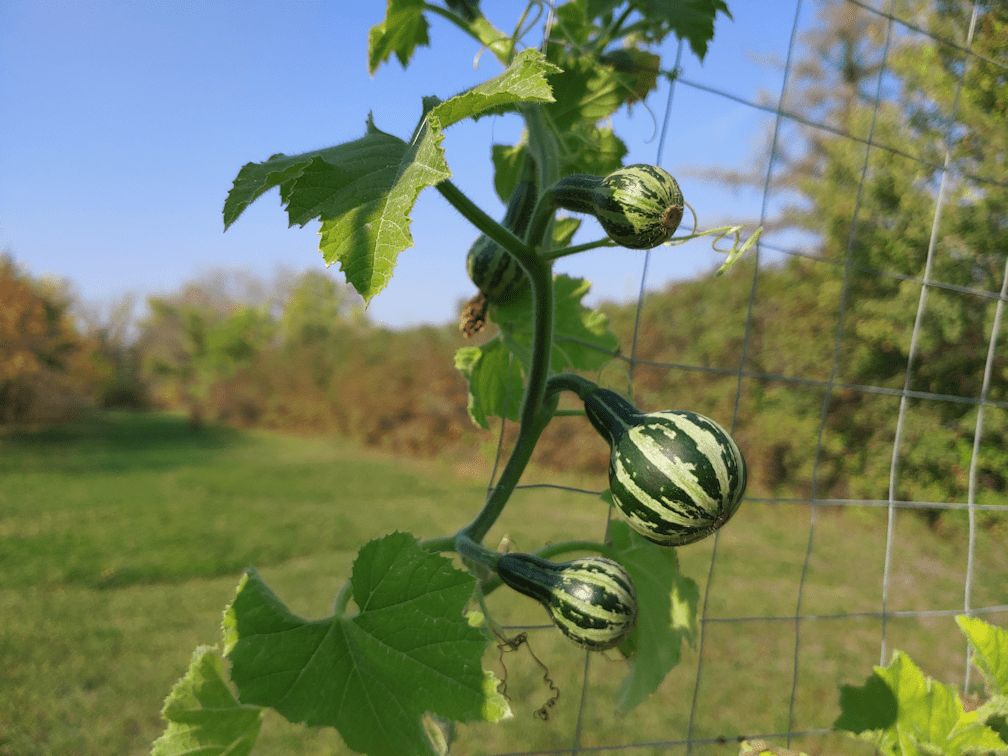
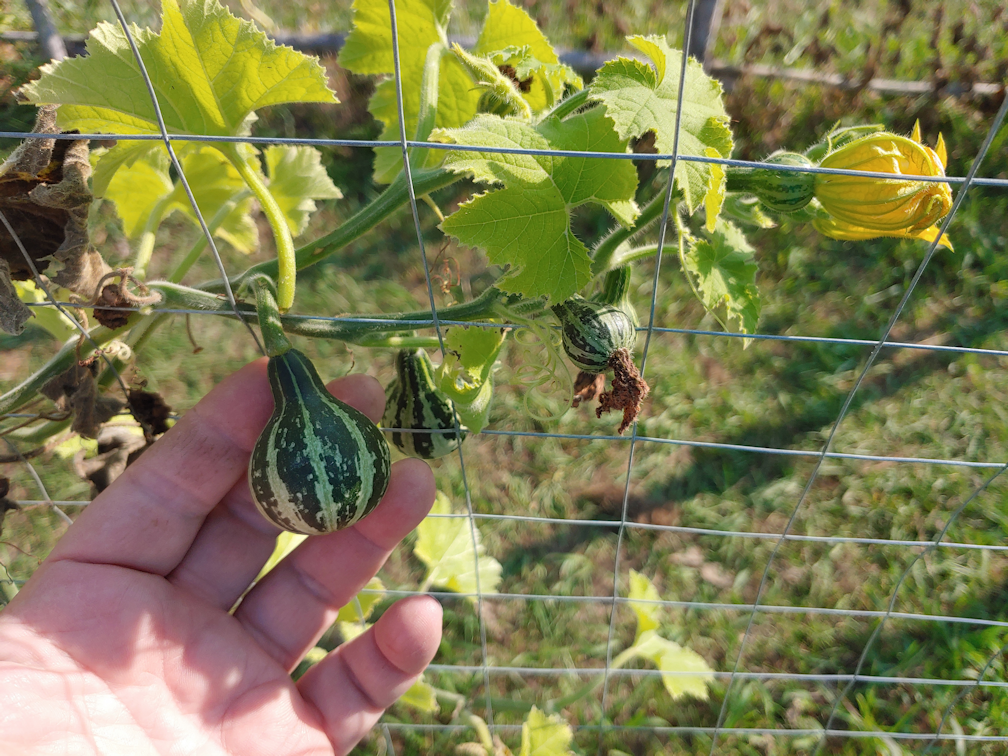
While the squash and melons are died back, or in the process of doing so, I continue to be amazed by the Tennessee Dancing Gourds.
These were one of our “fun” crops. Yes, I hope to use them for crafting purposes, but really, I just thought they were adorable and hoped that maybe, just maybe, they would grow in our Zone 3. From reviews I read when I bought the seeds, I knew they could be prolific, and the certainly have been, even with poor growing conditions.
While I’ve harvested only four mature dancing gourds, that are now drying out on our kitchen counter (protected from the cats!), there are more on the vines that are just as big, but still firmly attached.
More amazingly, the vines are still growing and blooming, with both male and female flowers. They have been doing amazingly well!
The luffa have decided to surprise me. I thought that, by now, they were basically a lost cause.
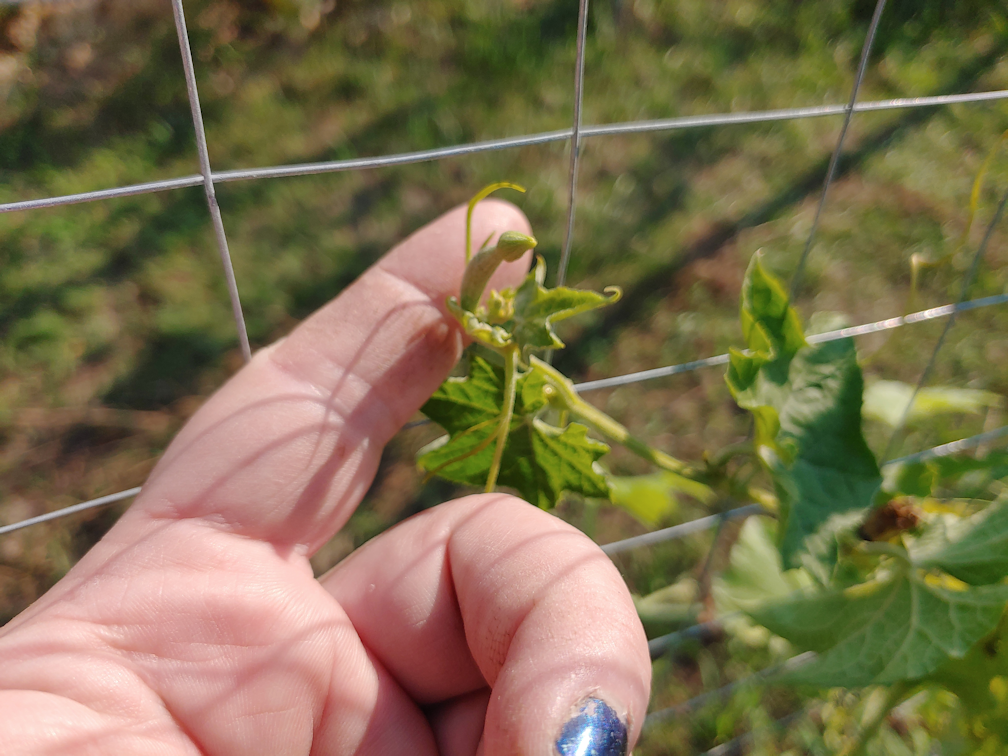
The very first luffa gourd that started to form ended up withering away, so when these ones showed up, I tried to hand pollinated them. Which I hope worked, but it’s still too early to tell.
You can just see a minuscule female flower developing, above my finger, too.
There are more male flower buds forming, and even another tiny female flower, with its tiny gourd, developing.
The vine itself is the only one that has grown enough to start making it’s way over the top of the squash tunnel.
I took this picture above my head to show the flowers that are blooming, but I was pretty blinded when I took it. So it was not until I uploaded the photo that I realized, there are gourds forming up there, too! There is no possibility of hand pollinating them, as I can’t reach them, but they might just make it!
None of the gourds we planted are zone 3, so that was a strike against them growing here, right from the start. While they would have loved the heat of our summer, it was difficult to water them adequately during drought conditions, so that was another set back. Though we have not have frost yet, we have had some pretty chilly nights, so I am really amazed they are still green, growing and flowering, while plants more suited to our zone, such as the nearby winter squash, are dying back. Especially the luffa, which didn’t even start blooming until very late, and didn’t start producing female flowers even later. It is unlikely the mild temperatures will continue long enough for the luffa gourds to fully mature, but the Tennessee Dancing gourds are doing just fabulously! I definitely want to try growing both, again. If they did this well in such poor conditions, imagine how well they’d do in better conditions?
While going through the garden beds this morning, I was just blown away by how much is still growing – and still getting a chance to grow, if the forecasts for October stay true!
The last time I had so many photos to share, I put them together into a video, but it only ever got one view. Clearly that’s not something people are interested in. So today, I will instead make a series of short posts, instead, starting with our winter squash and melons.
This is the very first Red Kuri/Little Gem squash that matures. As you can see in the photo, the vine is completely died back – except for the few inches on either side of the stem!
The vine with the next biggest one still has some green leaves on it. There had been another small squash that started to develop, but it withered away and fell off.
The other one, however, is still getting bigger, and just starting to deepen in colour. The vine it’s on has a lot of cold damaged leaves, but is still mostly green and growing, so this one may actually get a chance to fully mature.
The vine the mutant is on is also still growing, with fresh new leaves showing up even as the older ones get killed off by colder overnight temperatures. We still have not had a frost, which is the only reason we still have hope for our garden!
We are back down to the two Teddy squash, one on each plant. The others that had started to form, withered and fell off, likely due to lack of pollination. I don’t know how much bigger this well get, as they are a very small variety to begin with.
If you notice the white on the squash and leaves, no, that is not powdery mildew, or any other sort of fungal disease. That’s road dust. Even with the lilac hedge nearby, dust from the nearby road still gets through and coats things. Even the summer squash, which is furthest away, has road dust on them. Another reason we want to complete the hedge with dense bushes, and also plant taller trees. They will serve as more than wind breaks and privacy screens, in this area!
Here, you can see that the melon vines have all completely died back. All of them. And yet…
… the remaining melons are very firmly attached to their vines! Of course, they can’t grow any bigger, but I’m hoping as long as they stay out here, they will continue to ripen.
Under the conditions we’ve had, I’m really impressed with all of these. The melons managed to be quite prolific. The winter squash were not as prolific as they normally would have been, but we will at least have a few squash to try, and to see if we like them enough to want to grow these varieties again. We certainly would be willing to grow the Halona and Pixie melons again, though I think that we will try new varieties next year, to see what other varieties we enjoy eating.
The plan was to head over to the outhouse, quickly do a second coat of paint until we ran out, then get back to working on the bread baking.
Instead, I kept adding more things to do, and by the time I got inside, I had to get my daughter to continue the bread baking, as I was no longer physically able to do it. Which is what she is working on now, as I write this blog post!
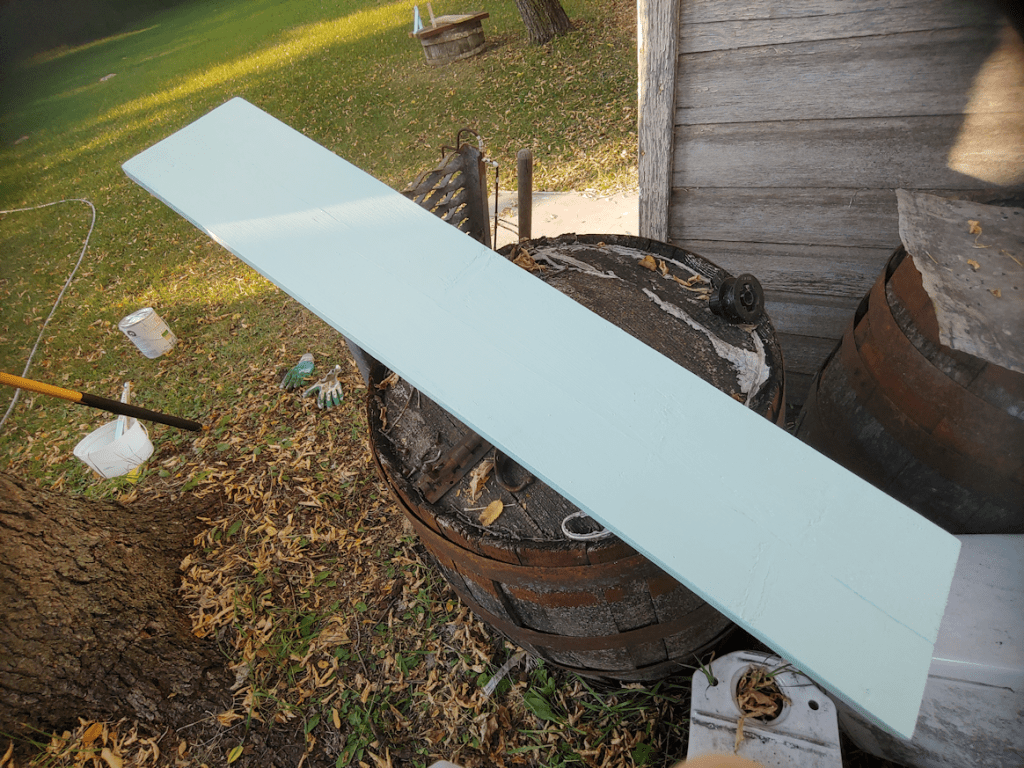
While looking for something else entirely, I found a pair of wooden shelf supports and instantly realized that they could be painted and used to put a shelf in the outhouse. So when I headed out to do the second coat of paint, I also poked around the barn and a shed to find a thin board wide enough for the supports. It was about six feet long, though, so I basically held it up to the outhouse door from the outside, and eyeballed where to cut it to fit along the back of the outhouse. It ended up being just over half the length of the board, so I figured if I was off with the longer one, I could still use the slightly shorter one.
It ended up being just a hair too wide to fit between the corner posts. A few swipes with a micro plan and some sand paper was enough to get it to fit perfectly!
That done, I sanded the rough edges, then scrubbed and hosed it down before setting it aside to dry. Then I added a second coat of paint, just to the seat box inside, before painting the shelf supports.
I’m thinking I might paint the rest of the board, too. If we get more shelf supports, we can add it onto one of the side walls.
It took a while for the washed shelf board to dry, so I decided to give the mirrored shelf a scrub down, too, then once that was dry, I hung it back up inside the outhouse.
Rolando Moon decided she absolutely had to be on top of where I was putting the tools and screws! The violent beast went from demanding I pet her, to attacking the hand that was petting here, making me bleed! I did manage to get the screws with washers out from under her, though.
I just wanted the washers, though. There were just two, for the top screw holes, which are slightly wider than the bottom ones. I used new screws to hang the mirror back up. After washing the blood off the new screws and washer, from the wound Rolando Moon gave me!
Previously, it had been hung up right against the centre joist, but I chose to centre it between the corner and the joist, instead.
Then, I just had to do it…
I just had to put the little mermaid I found while I first emptied and cleaned out the outhouse, inside the cabinet.
She lives here now.
:-D
Once we’ve picked one up, the LED battery operated light switch will be mounted directly opposite the mirror.
By the time this was done, the shelf board was dry.
After removing Rolando Moon, I got the one side painted. Tomorrow, I will paint the other side. By then, I should be able to mount the shelf supports, using the boards on the wall to make sure they are level, then attach the shelf board once the paint is dry. Only then will I continue doing the second coat of paint inside, until the can is empty. If I end up not doing the ceiling, or the narrow parts around the door, that’s not going to be a problem. As long as the areas that are most likely to get scrubbed in the future get a second coat, it’s all good.
Since I could no longer work on the inside, I decided to work on the outside, and empty the pit of groundhog gravel.
The wire mesh on the back was held in place by being hooked onto two bent nails, that were nowhere near each other. You can see one at the top right. The other is barely visible, near the bottom left. It didn’t take much to remove the mesh.
There was a second, smaller piece of mesh, partly buried until a thick layer of grass and roots.
*sigh*
That took some doing to move out of the way.
I thought I would be able to remove the two bottom boards by taking off the smaller pieces on the side, then pulling them off. They where, however, thoroughly nailed in place, with old and rusted nails that were not about to come out. So, I instead dug out my jig saw and used it to cut a piece off the bottom.
As you can see, it’s solid gravel against it! I ended up having to cut a second piece off. I was then able to start shoveling the gravel out, and when I could no longer get the shovel far enough in before the 2×4 across the bottom stopped me, I used a garden hoe to move more gravel closer, then shoveled some more.
I never did reach the … compost… layer. I did hit a lot of rocks, though! I emptied it as best as I could, without removing the more recent… deposits.
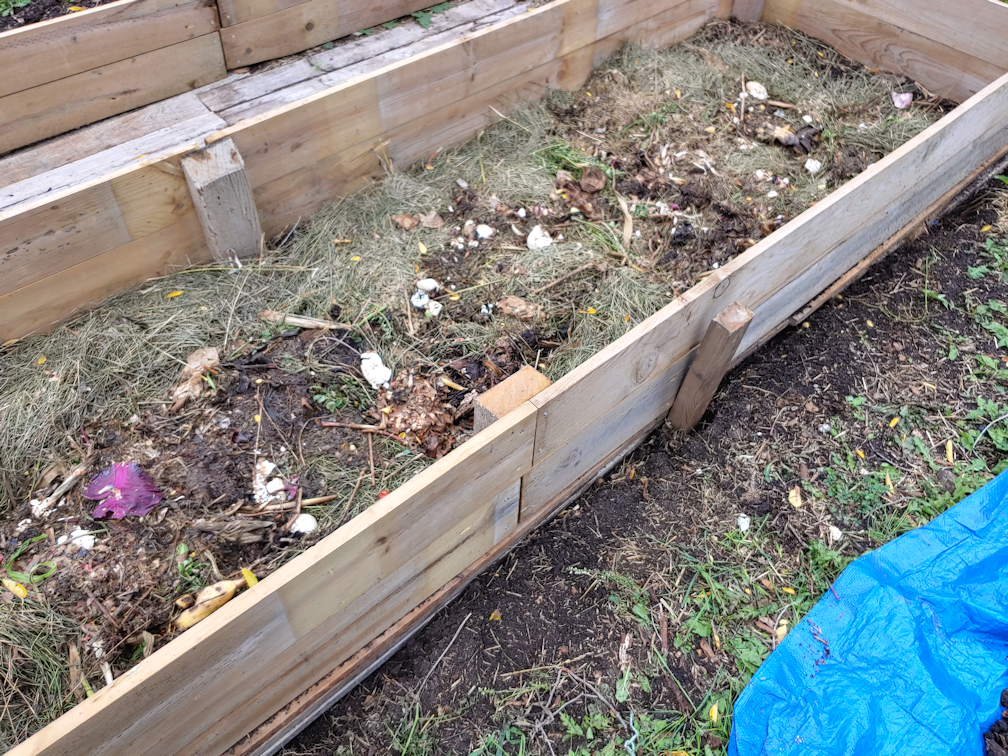
Then it was time to cover the hole back up.
I put the two pieces of siding back, then screwed the bottom one to the 2×4 behind it. The next time we need to get under there, we can just remove the screws and the boards will easily pop out again.
I then folded the smaller piece of wire mesh to fit the opening. I found a scrap piece of board with screw holes already in it, so I used that to fasten the mesh in place. The wire is folded at the bottom and weighted down with rocks. Critters can still get in if they really wanted to, but this is temporary. When we get to painting the outside, we’ll make things more permanent, perhaps replacing the cut boards with a hinged flap that can be latched to keep the critters out. Who knows.
I have no idea why that other large piece of wire mesh was used to cover almost the entire back of the outhouse. It really served no purpose, since only the gap at the bottom needed to be covered. Even the smaller one on the bottom couldn’t keep the critters out.
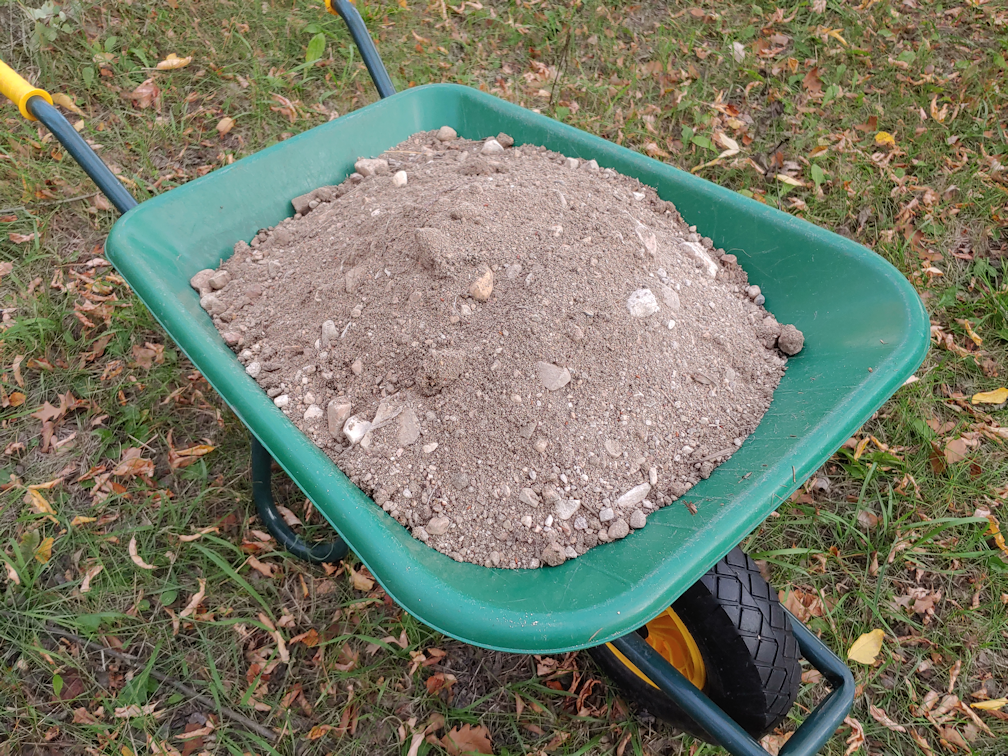
I was able to fill the wheelbarrow with clean groundhog gravel! If there was any chance the shovel full I pulled out wasn’t clean, it went onto the nearby cat litter compost pile, instead.
The clean gravel was put to good use.
It was enough to make a thin layer on top of the boards in the path between the new low raised bed boxes. The bigger rocks went up against one of the boxes, where there is a larger gap, then it all got spread out and hosed down, so that the finer particles would wash into the gaps between the boards below. It seems to be more clay than sand and gravel, though. We will still need to add more, but this is a good start.
And that was it for today!
Deciding to include a shelf added at least an extra day to finishing the inside, but I think it will be worth it. I’m more happy about getting the pit clean up over and done with for now!
With the help of my younger daughter, we got the shut off valve installed on the hot water pipe.
Ha!
Just kidding.
My daughter did all the work. I took pictures and passed her things.
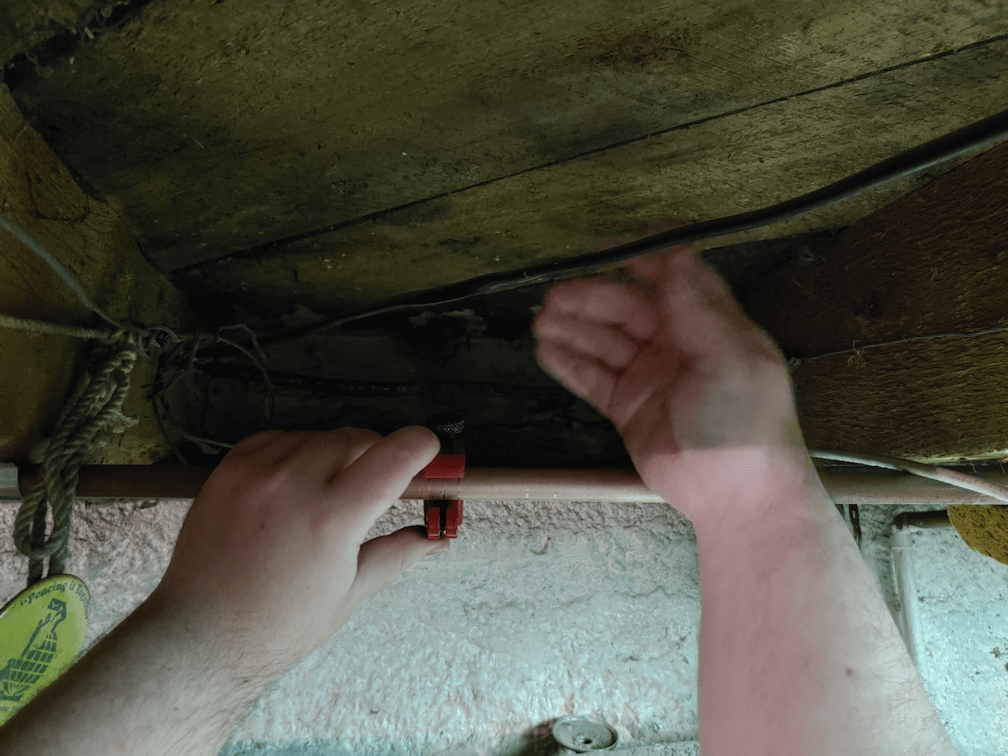
The first thing we needed to do was take off the “clamps” holding the pipe to the exposed floor joists above, on either side of where the pipes were in contact with each other and, I believe, the source of the vibrating noise that is so alarming. The “clamps”, however, were small strips of aluminum, hammered into place with finishing nails. We never did get the nails out. My daughter ended up ripping the aluminum off, instead. !!! While my daughter worked on that, I shut the water off to the hot water tank, then opened the tap to drain the pipe.
One of the things she noticed while trying to remove the aluminum strips is that the hot water pipe was actually bent upwards at this point. No wonder the crossed pipes were so jammed together.
Once there was a bit of flexibility in the pipe, it was easier to access and work on, too.
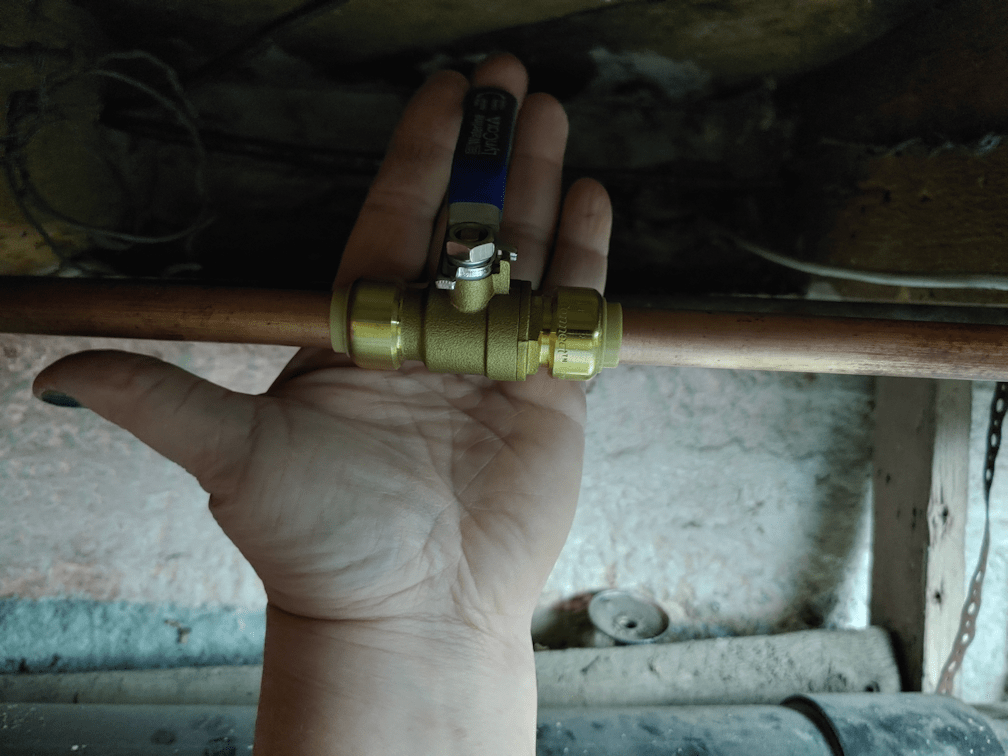
After deciding where to put the valve, the pipe got scrubbed clean, then the shut off valve was used to place marks on the pipe, so we could see where to cut it, and later see that the pipe ends were far enough inside the valve once installed. Thanks to needing to fix the kitchen sink a while back, we did have a nice little pipe cutter for the job. :-)
About two inches of pipe was removed, to make room for the valve.
The cut ends then got scrubbed and sanded, inside and out.
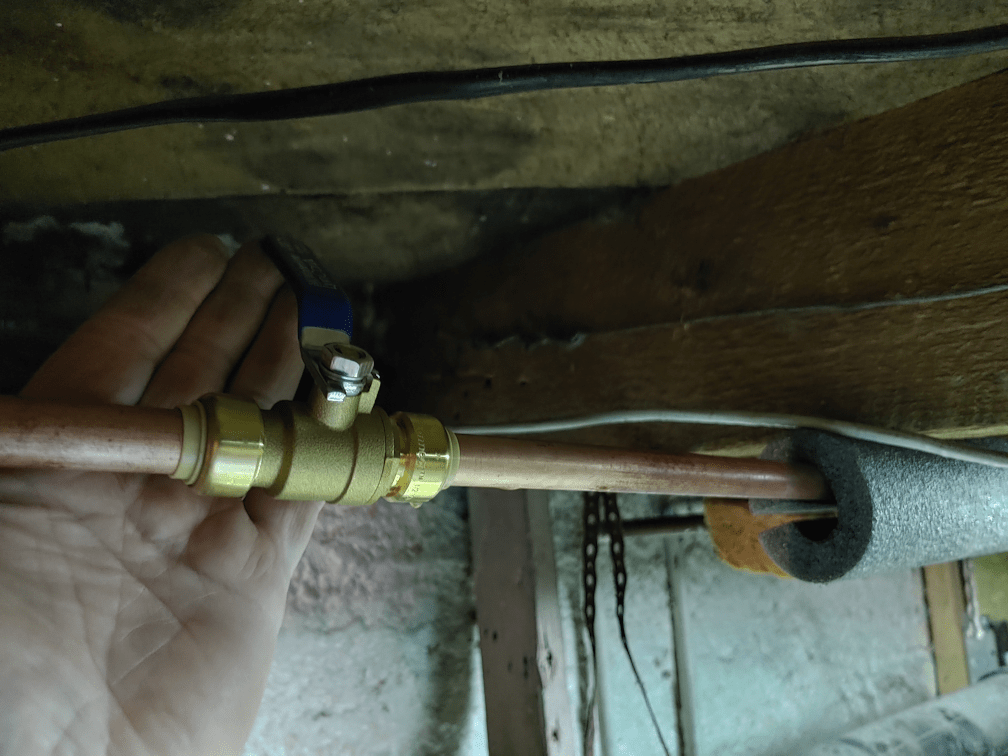
Then is was just a matter of sliding it in, and making sure the pipe was as far as it needed to go. The water to the tank was turned back on so we could test it for leaks, then the valve was shut off.
The whole thing took about 10 minutes.
With the valve in place, there is no water to leak at the tap, but if we need to use it for some reason before the tap can be replaced, we can just turn it on, use the tap, then shut it off again. Very handy.
Meanwhile, there is still the issue of the pipes.
For some reason, we have short lengths of pipe foam in the basement. It’s meant for a width of pipe I don’t see around. I put a section on the pipe, under the floor joists the pipe had been clamped to. It was just long enough to go under both.
I didn’t have any foam that was thin enough, so I jammed an old sponge I’d been using before, in between the two pipes that had been in contact, to absorb vibrations. I’d tried to squeeze it in before, but there was no give at all. I could only get it part way under, so it didn’t really stop the noise, though it seemed to make it better.
Now I am just waiting for someone to use the enough water to trigger the well pump, and see if the noise is still there.
We didn’t add a shut off valve to the cold water pipe, yet. For that, we’d need to shut water off to the entire house, and the pipe is behind the hot water pipe, so it will be harder to reach. That can wait until we are putting on the new taps.
I am quite pleased with how this worked out. I keep expecting things to go horribly wrong. :-D
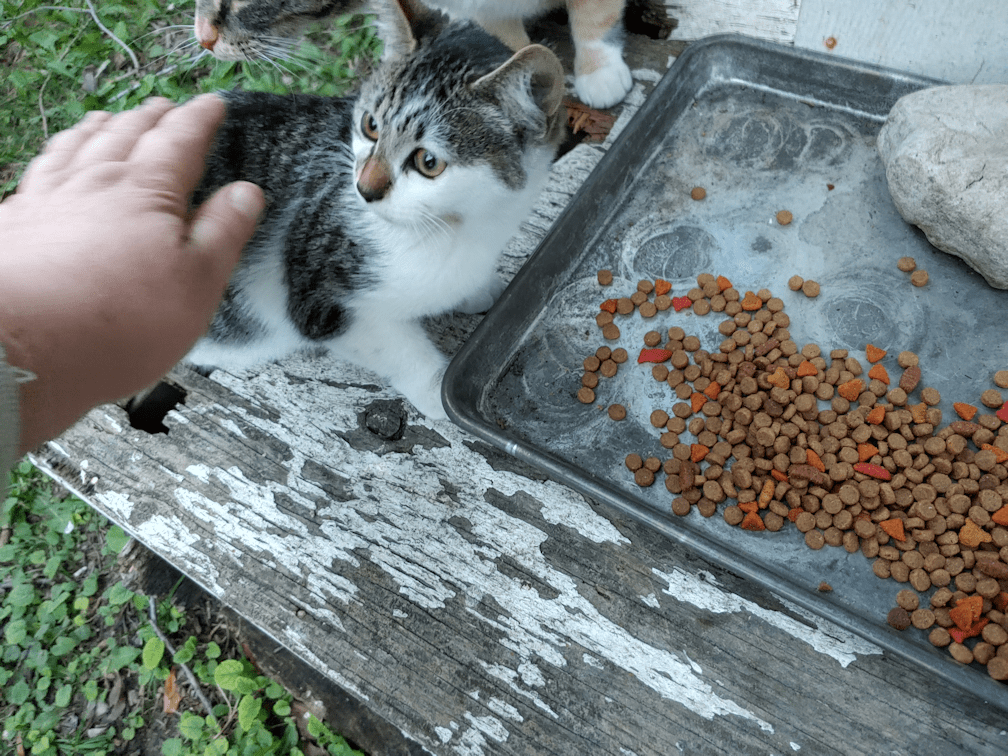
While topping up the yard cat’s kibble trays last night, I actually got to pet a kittie!
The fact that Rosencrantz let me pet her, for a change, probably helped, but Nosencrantz still looks pretty unsure of the situation! :-D
The lure of kibble was enough for her to ignore me petting her while she ate.
Unfortunately, she is still the only one of the yard kittens that doesn’t run away every time we come out, though a couple of them are starting to come back faster, or watch from nearby. I hope that, as winter sets in and they start using the cat shelter more, they will at least calm down in our presence.
After giving my hips a chance to recover, it was time for more manual labour today!
Today, I decided to do a bit more cleanup around the junk pile, so I could access some dead trees that need to be taken down.
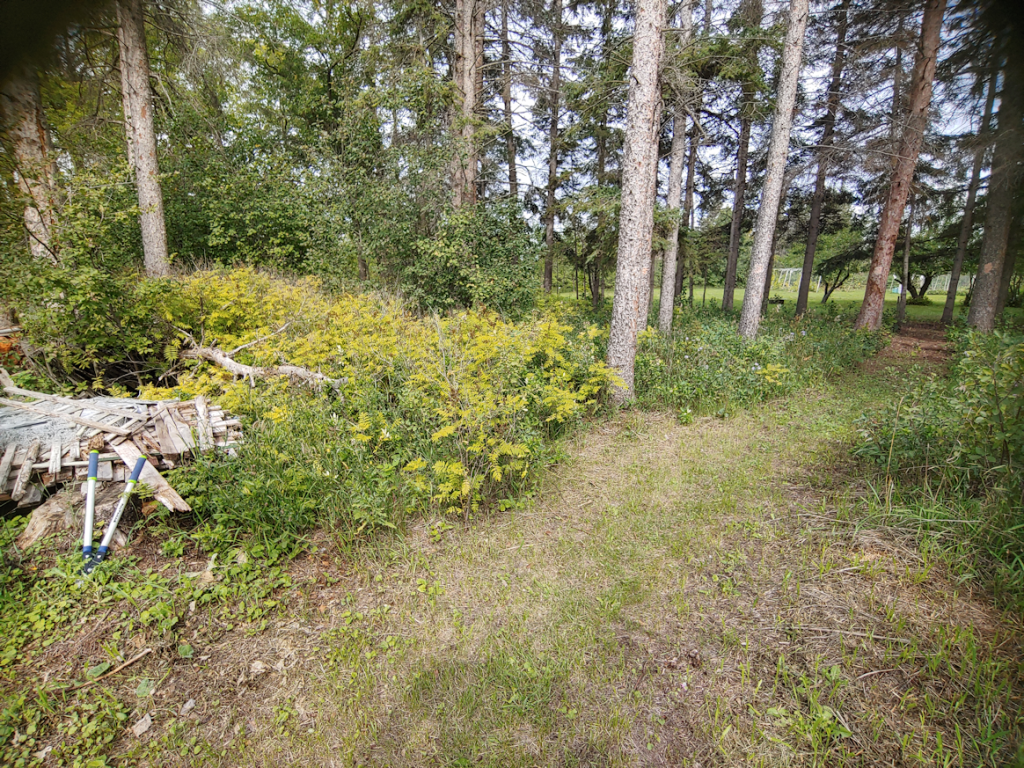
Here is how it looked before I started.
We have our ongoing battle with the spirea that’s choking everything out, so I wanted to pull them up by the roots as much as possible.
Some of them had roots so long, they started going under things. I pushed them aside after a certain point, so I could focus on clearing around three specific dead trees.
The thistles were much more of a problem. The thorns go right through my work gloves!
I did leave on thing behind, besides some wildflowers.
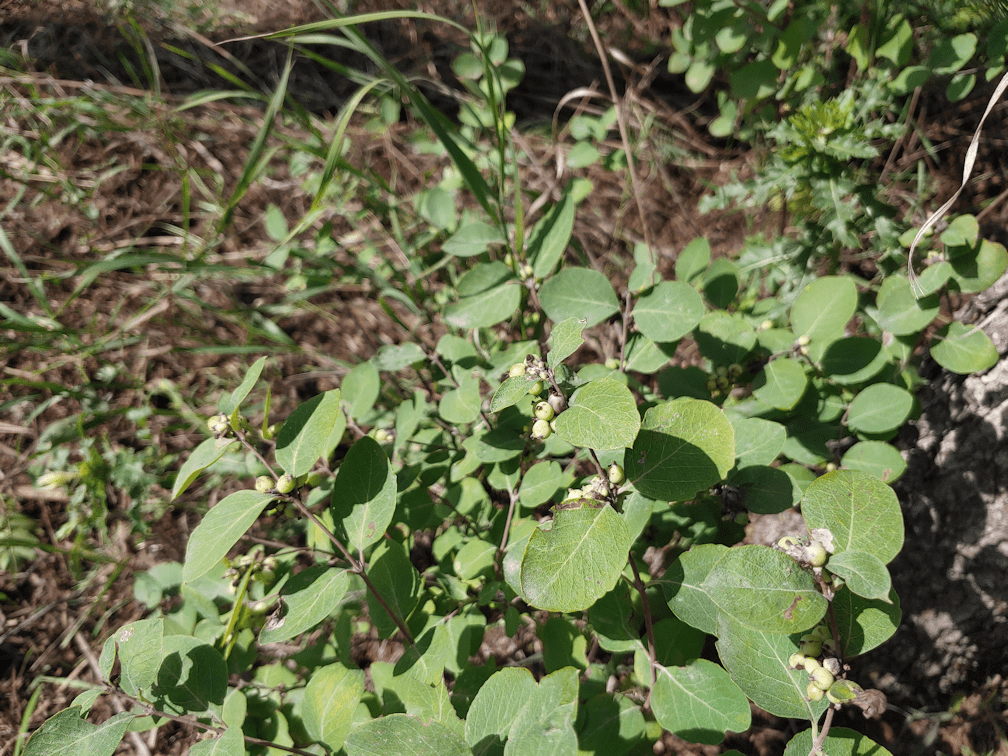
There was a little Saskatoon bush, at the base of one of the trees, and it’s actually trying to produce berries! Weather willing, the berries you see will turn a deep, dark purple, and look a bit like blueberries.
Once the area was cleared of tripping hazards, I started taking down the first tree, using a bucksaw. Because of where these trees are, I tried to do it in such a way that it would fall in a space between some other spruces. I didn’t want it falling towards the open yard, because then it might land on the beet bed or compost pile, or some Saskatoon bushes and an elm tree we want to keep.
It almost worked.
It fell too far to the south, and got hung up on another dead tree, that’s right nest to a still live one.
I was able to wrap some rope around the trunk and get it off the stump, but it would not come loose from the dead tree it was entangled in.
So I moved on to the next tree. This time, it actually fell into the gap I wanted it to fall into.
It still got hung up! I had hoped these trees would be heavy enough that the dead branches would break and let them fall to the ground, but apparently, they are still quite strong.
On the plus side, I was very pleased with what I saw after cutting them down.
The wood is nice and solid, with no sign of rot or ant damage. This is very encouraging, because I want to use the logs. These nice, solid stumps will later be used to make seats and tables.
Here is how it looked when I stopped for the day. I did try to use the rope and our van to try and get that first tree loose from the dead tree it’s hooked up on, but the rope kept breaking. We don’t have any stronger rope. If we’re going to need to use the van anyhow, I will pick up some sturdy rope and hook it up to near the base of the trunks, and pull the entire trees out into the yard, where we will break them down.
Since the wood is in such good shape, these will be used to make the high raised beds we will be building in the main garden area, where we currently have the low raised beds we’d planted spinach, onions and carrots in. I’m thinking of cutting the logs into 10 ft and 4 ft lengths, and I figure it will take about 4 logs to get the accessible height we are after, though of course, that will depend on how big the individual trees are. We don’t have a lot of time left, if we want to get these ready for next year. I’m hoping to get at least a couple built for next year. By using whole logs like this, we won’t have any concerns about the sides bowing out under the weight of the layers of wood, compostable materials and soil they will be filled with.
Once these dead trees closer to the edge of the spruce grove are down, we’ll be able to feel the other ones towards the yard, and there will be no other trees for them to get hung up on!
Once all the dead trees in this corner are down, and the area is cleaned up, we will be able to convert the trunks into seating and surfaces. Then we can start planting food trees that need a protected microclimate. I will be testing the soil, and if the acidity from all those decades of spruce needles is high enough, I hope to be able to plant blueberries. We do still want to grow a mulberry tree, since the one we got this spring got killed off by that one cold night in May, and it was in here that we originally intended to plant it. I think, this time, we will try and get a Canadian variety we found out about, that is increasingly endangered. We will still need the microclimate for it, but if we can help keep a variety at risk going, that’s what we prefer to do, if we can.
There are a lot more dead trees further to the east and around to the south, inside the spruce grove. Some will also have their trunks converted to seating, but as we go further into the grove, I want to start transplanting more spruces into the spruce grove! :-)
While we are getting rid of the spirea, we will be leaving the wild roses and red bark dogwood as underbrush. I will probably take out most of the chokecherries I’m finding in here, as there are so many, to make room for the Saskatoons to spread. We will also be transplanting new spruces in here, though more strategically. Lots to do, but I am really looking forward to when we have a lovely little sanctuary in here, where we can sit and enjoy the outdoors, somewhat protected from the elements by the trees. :-)
For now, however, I’m going to get some tweezers, and get that thistle thorn that got through my gloves!
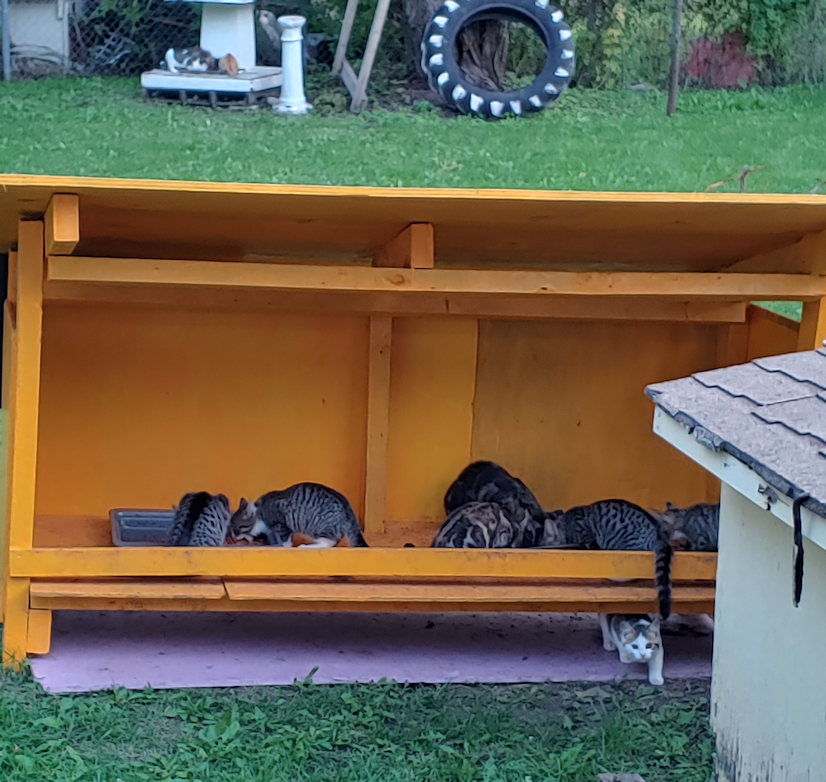
While heading out to do my evening rounds yesterday, I topped up the cat kibble – and got invaded by kittens!
There is only one adult cat in the kibble house in the above photo, plus Rosencrantz and her two are at their private dining area under the shrine.
All three litters of kittens were running all over the yard, playing with each other! The fact that most of them stayed to eat while I took photos – even with zoom – is very encouraging. :-) It will be good for them to get used to each other, since we can expect them all to be using the cat shelter over the winter.
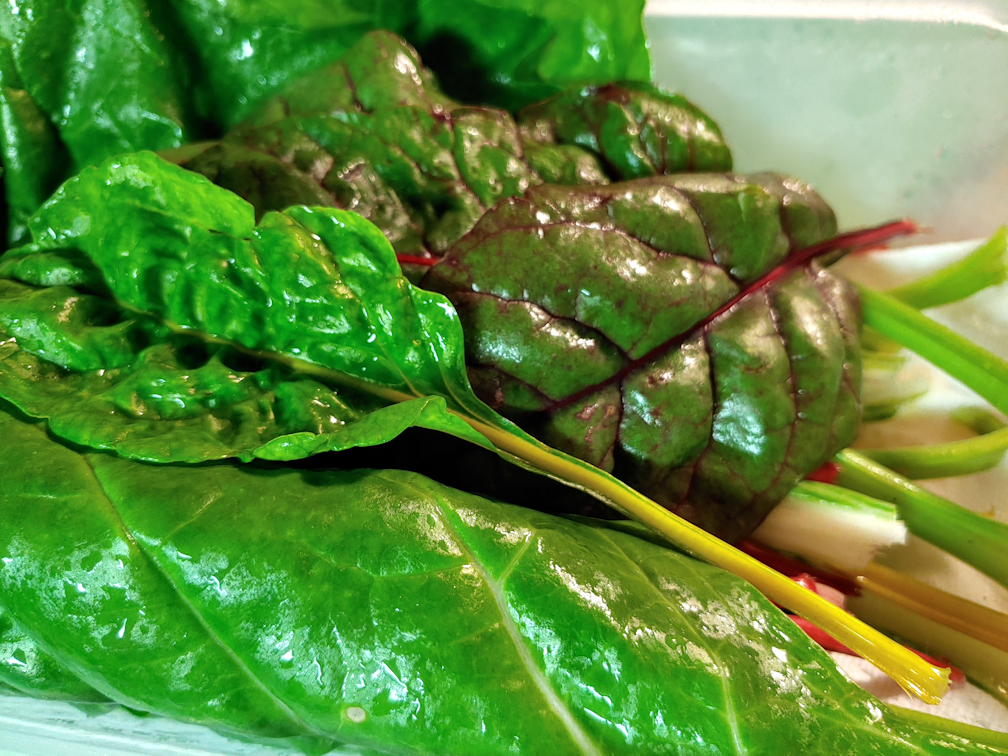
While checking the garden beds, the girls gave me a hand moving one of the mesh covers so we could collect our very first chard leaves!
These are the Bright Lights chard, with their brilliant colours.
In the other bed where we had planted chard and radishes, only a single chard plant has survived the grasshoppers, and it’s pretty small, still.
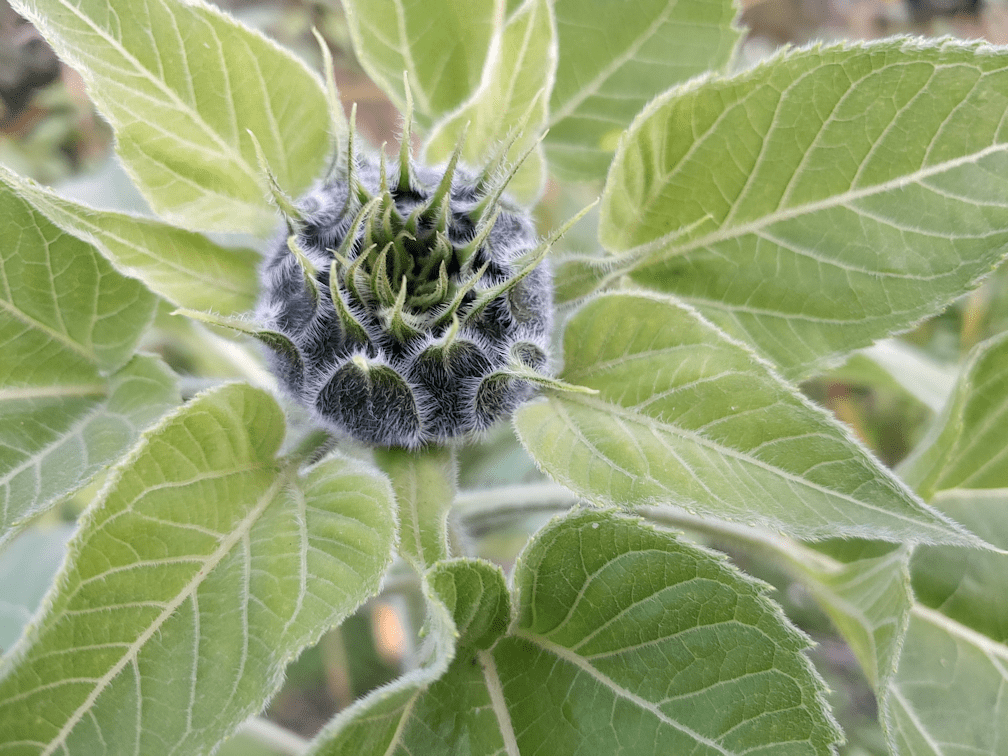
Here we have the largest of the developing Hopi Black Dye sunflower heads. These are the ones that were direct sown after last frost.
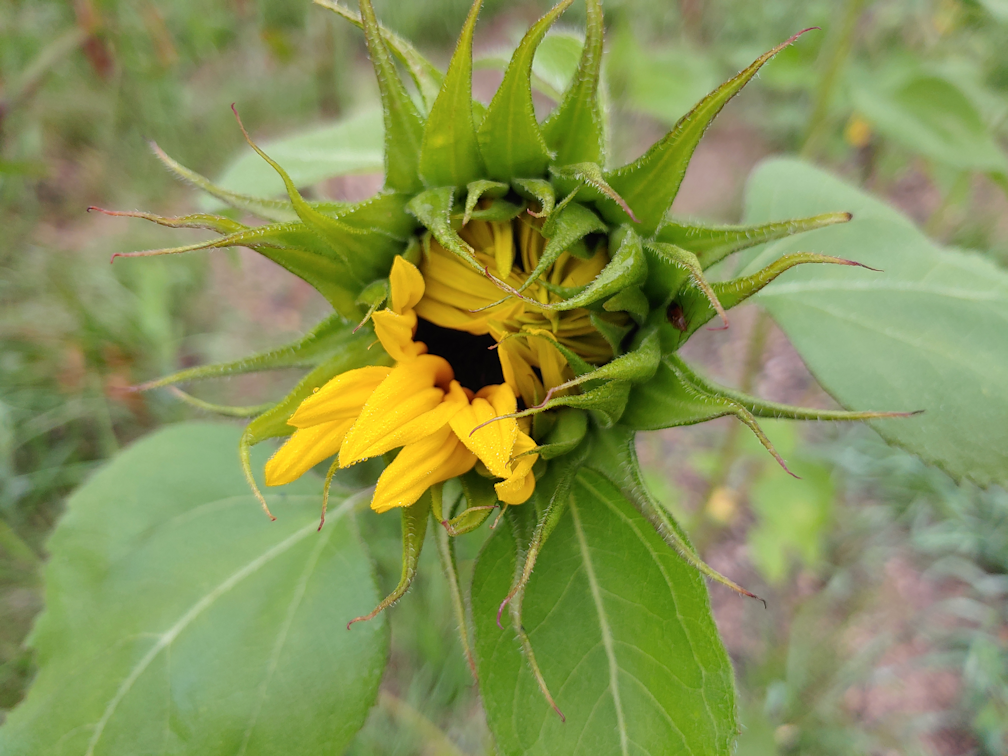
This morning, I found this.
This is another Hopi Black Dye sunflower, from the row of transplants. These are the ones that did not germinate until after the others were direct sown, so they were much smaller and further behind. Then they had their tops chomped off by deer. Yet here they are, spindly and barely knee high, yet the seed heads are starting to open before the big ones!!
Speaking of seed heads…
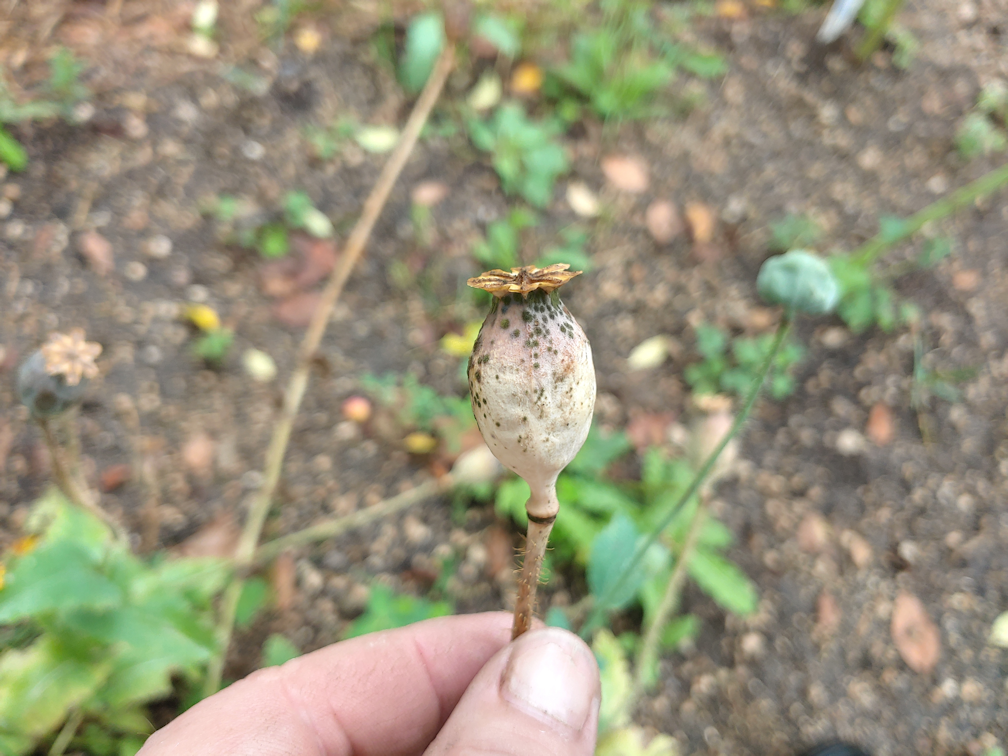
I collected the driest of the poppy pods. I was a bit concerned that the rain and humidity would create a mold issue, so they are now in the sun room. As you can see, some of them are even dropping seeds!
These are Giant Rattle Breadseed Poppy, and the pods should be much, much larger than this, but given the growing conditions of this year, I’m just impressed we have any at all. There are still others that are green, but starting to dry out. I am debating just leaving them be, to self sow for next year. Given how few survived, there isn’t enough for eating, other than a taste, but more than enough to keep seeds for planting in a different area next year, if we want. I wouldn’t mind even finding a spot to scatter them as if they were wildflowers, where we can access them to harvest seed pods, but also where we can leave them to self seed, year after year. At the same time, I’m thinking of ordering more of this variety from Baker Creek, plus trying a different variety of eating poppies I found from a Canadian source. This is something I don’t mind having lots of, as poppy seeds are among those things I enjoy, but rarely buy. Neither variety I’ve found are like the ones I remember my mother growing, but I believe she got her seeds from Poland.
As things are maturing, my mind seems to constantly assess for next year or, as in the case of the poppies, for a more permanent crop. For all the difficulties we’ve had with this year’s garden, due to things pretty much out of our control, we have learned a lot that we can apply to future gardens, what we want to keep, and what we need to change. Especially as we move from our temporary garden beds to our permanent ones. :-)
On a completely different note, today we had an early birthday party to celebrate my mother’s 90th birthday at my brother’s. I was my mother’s chauffeur. :-) We had a great time, and we able to see her great grandson for the first time in almost 2 years. They live in a different province, so it was fantastic that they could come out for the birthday party.
Between the drive and how long we stayed to visit, we were out pretty much all day, but my mother held out very well. She even seemed to like the necklace we got for her gift and put it on right away, though she was completely indifferent to the little bag I crocheted to “wrap” it in. Even when I suggested she could use it to hold one of her rosaries, she said nothing. Now that I think about it, I don’t even know if she took it home. I helped bring in and put away her packages, and it wasn’t in any of them, so unless someone tucked it into her purse, she doesn’t have it. Which is actually a better response than I was expecting. :-D
Some things just don’t change! ;-)
Anyhow.
As wonderful as it was to see everyone, this introvert needs a battery recharge. I think an early bed time is in order! :-D
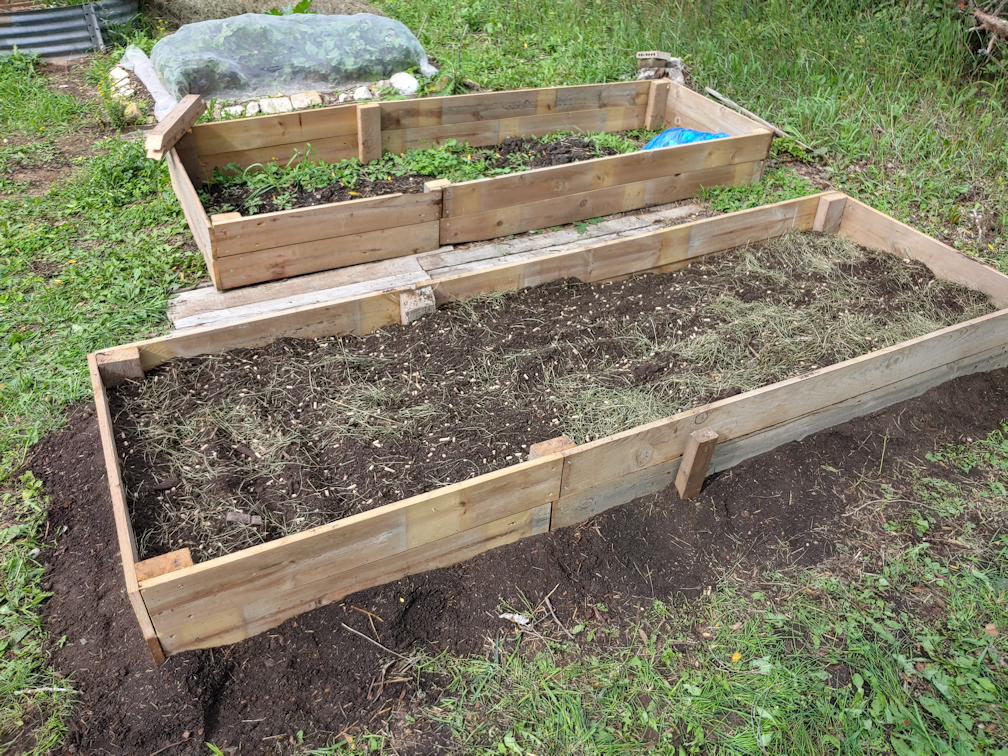
Today, I was able to get back to working on our first low raised bed. The first thing I had to do was scrounge through a shed and the barn, looking for something I could use to support the long sides and prevent them from bowing outwards once the bed is full of soil.
I found a piece that was strong enough, and long enough that I could cut it in half, first, then cut the two pieces in half at an angle, so they could be driven into the ground. Two were used for this bed, and the other two will be for the next one. The soil here is soft enough that I was able to use the pretty sledge hammer I found in the pump shack to hammer them in. I wasn’t too worried about them being perfectly straight. If this were a high raised bed, I’d be sinking posts to support them.
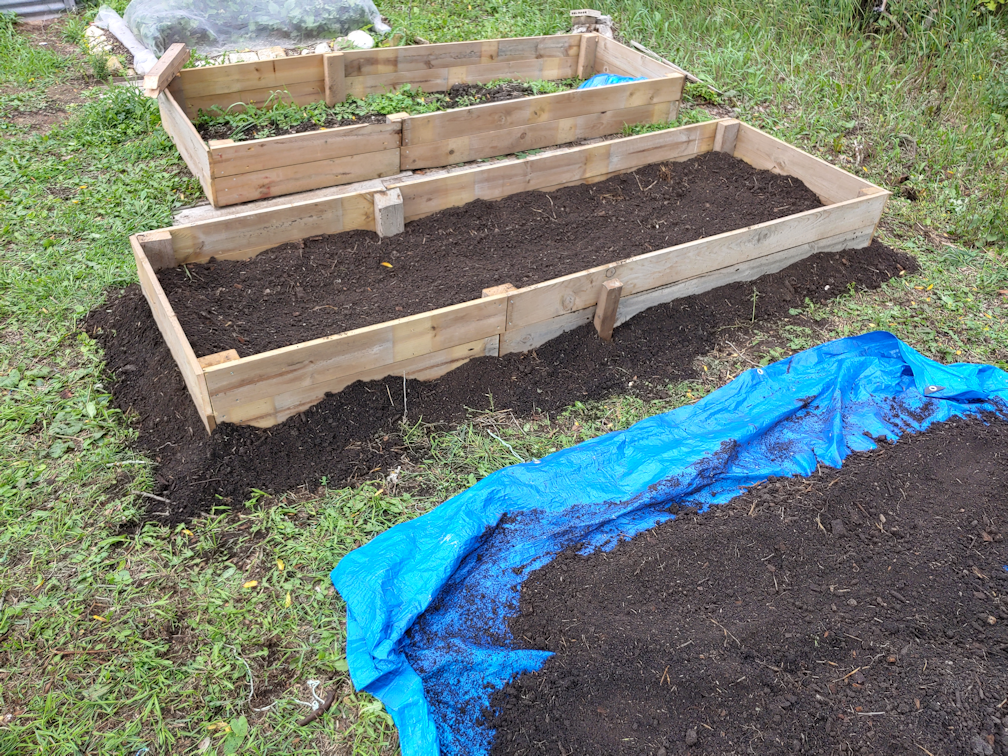
Next, I shoveled about half of the soil into the box, raking it out against the sides a bit, then added soil all around the box to bury the wood foundation. In total, that took up about 2/3 of the soil on the tarp. The wood foundation will break down over time, and I expect the whole box will slowly sink with it, but I don’t expect this to last more than a few years. Hopefully, by the time these need to be replaced, we’ll have access to more permanent materials and can replace them with high raised beds.
Now it was time to amend the remaining soil.
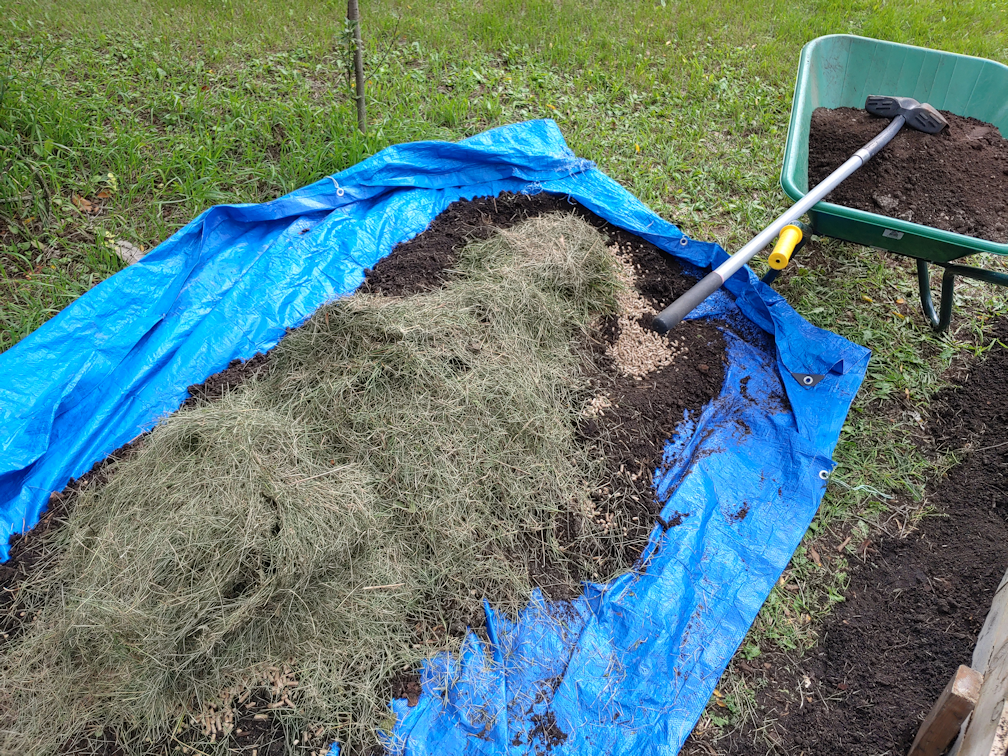
First I added about half a bag of wood pellets (roughly 20 pounds), maybe less, then got a load of the garden soil we bought in the spring.
An arm full of grass clippings was added on top of the load of soil, then a second load of soil was added.
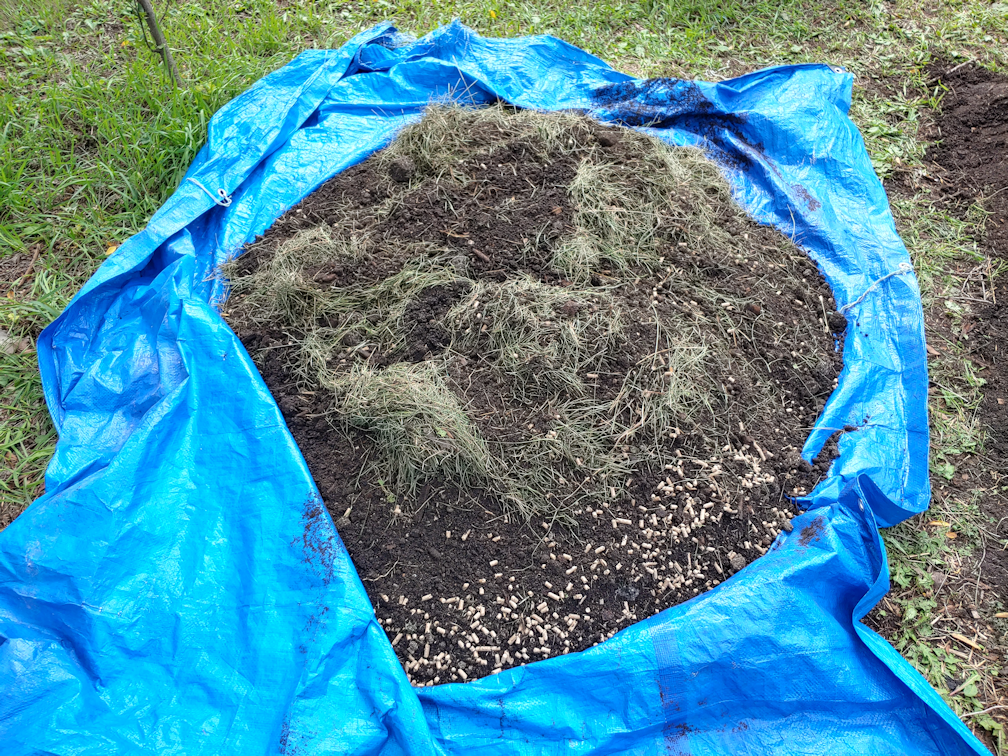
The whole thing was mixed together using a garden fork and the tarp itself. After a while, I shoveled about a third of it into the box, then used the tarp to mix it some more, shoveled more into the box, mixed the remains with the tarp again, and by then I was able to use the tarp to heave the whole thing into the box and dump the mixture out.
Then it was time to level it all out.
I also used the back of a hoe to tamp down the soil around the outside of the box a bit. If I can figure out how to transport it, after all the beds are done, I want to bring gravel from the pit over, to put around the boxes and in the paths.
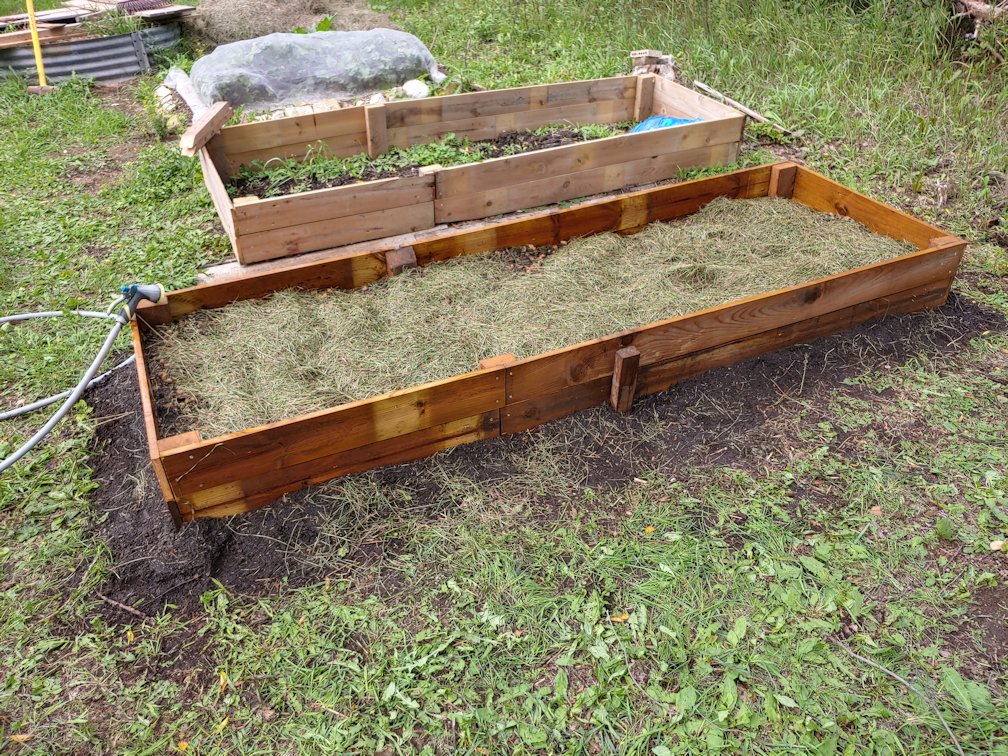
The final step was to cover it all with a grass clipping mulch and give it all a soak. It was a good chance to power wash the box itself a bit, in the process.
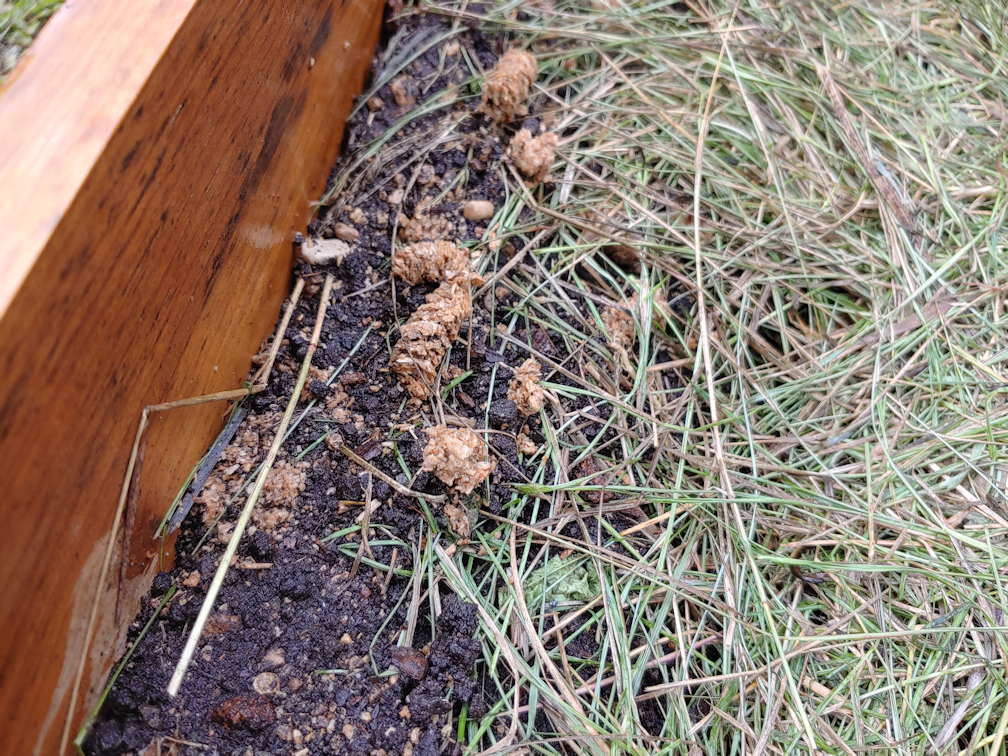
Here, you can see some of the wood pellets. This is why I decided to use these. Once the water hits the pellets, the sawdust begins to absorb it and expands pretty much immediately. Which means that all the pellets that are buried in the soil will push the soil away, breaking it up and preventing compaction. Depending on the conditions for the next while, these should decompose completely by the time we’re ready to plant into here, together with the grass clippings, adding organic matter that will keep the soil light and increase moisture retention.
As you could see from the previous photo, the box is not full to the top. It is, however, at a stage that it could be left as is, and be ready for planting in the spring. I might have a lead on getting a truck load of manure. If that pans out, and we can get some this fall, I would use some and, together with the garden soil and probably other organic material, top up the boxes. We shall see. Either way, this should all settle further over the winter, so I expect to need to add more material in the spring, before planting.
For now, the bed is done. The next two will be done the same way, though I still have to build the box for the bed that has beets growing in it. That will wait until after the second box is set up, since there’s nothing to do with that bed until the beets are harvested.
As always during my morning rounds, I checked on the various beds to see how things are growing.
This most mature of our Red Kuri squash has ceased growing in size, and is just beautifully deepening in colour as it ripens.
While it’s neighbour is getting bigger. We won’t have a lot of mature winter squash at the end of the season, but we might have at least the two of them before first frost hits. Which, I hope, will be very late this year!
The one Mongolian Giant with so many seed heads, now has more of them opening and blooming!
These ones just amaze me. These are the Hopi Black Dye sunflowers that were started indoors, but did not actually germinate until after the other ones were direct sown outside. They were much smaller when transplanted, then all but one got their heads chomped off by deer. And yet, not only are they recovering from the deer damage, they are producing seed heads! Meanwhile, the ones that were direct sown are looking a lot bigger, you can see where the seed heads are starting to develop, but so far, they still have not actually emerged as obvious seed heads.
I do want to try these sunflowers again, but I think we will have to invest in a seed tray heat mat to start them indoors, to help with germination.
Yesterday, we picked summer squash and beans. Today, it was tomatoes!
Because of their small size, I use one of the red Solo cups to collect the tomatoes, and this time I quite nearly filled it to the top! That’s the most we’ve gathered, yet. :-)
You can see a few of the tomatoes have split, from all the rain we’ve had recently.
I also “topped” the tomatoes this morning. I had no idea this was a thing, but a couple of garden related channels I follow had talked about it. It is only needed for indeterminate tomatoes, as they just keep growing taller, putting out more blossoms and fruiting, until the first frost kills them. That leaves a lot of green tomatoes. For this time of year, pruning the tops off the plants will stop them from getting bigger, and the green tomatoes will start ripening faster, instead of staying green longer, so there will be more ready tomatoes before first frost hits.
If that is what starts happening, with how loaded the tomatoes are with green fruit, that should hopefully mean we will start harvesting enough at once to make it worth preserving them in some way. With their small size, I’m not entirely sure what method we’ll use, yet. Only my husband and one of my daughters eats tomatoes, so it’ll pretty much be up to them to decide that one. :-)
Thinking ahead to next year, the Spoon tomatoes are fun, and they’re great for fresh eating – we’ll likely grow them again, though they are also likely to self seed. The Mosaic Mix tomatoes are doing well and being enjoyed, but we want to try others. There are several varieties of cherry and grape tomatoes my older daughter wants to try, and I want to grow paste tomatoes. I may not be able to eat tomatoes fresh, but I can eat them if they’ve been processed enough before being used as an ingredient. Plus, we have the Yellow Pear variety of tomato we already picked up seeds for to try.
We need to start going over our plans and wish lists for next year’s garden, so we can plan and prepare things this fall.
The last few days have been cooler and damp. Thankfully, we have not needed to do any watering at all of late.
I think some of the plants in our garden have gotten confused! :-D
We are finally getting some “big” Tennessee Dancing Gourds. Most have been turning yellow, soft and falling off before reaching this size. Now, we have several that are getting bigger, like this one. The vines are still blooming and being prolific in growing new little gourds! Gosh, they are so adorable!
We still have just the one little luffa gourd. I suspect it is not going to live to get full size, but who knows?
Some of our Giant Rattle poppies have dried out, and when shaken, you can hear the seeds rattling inside. They are not even close to how big they should be, but that’s okay.
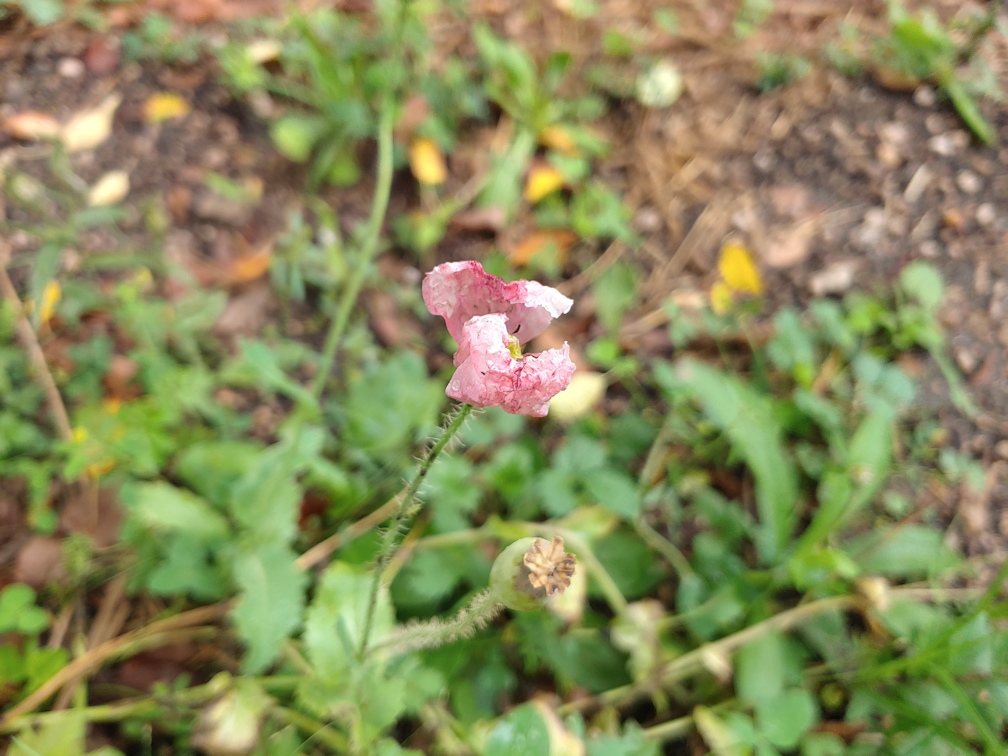
Remarkably, there was even one last poppy flower trying to bloom!
My big surprise is the Crespo squash.
These are remarkably resilient! I didn’t expect them to recover from the critter damage much at all, but now that it’s no longer getting eaten, it has started to shoot out new vines and leaves, and… !!!
It’s blooming again! Which just blows me away. Unfortunately, it is way too late in the season for fruit to develop. Particularly since these are supposed to get quite large.
I really look forward to trying these again next year. Even with the critters and drought, they seem to do very well in our climate!
























 The Re-Farmer