I’ve made a post that’s now pinned to the top of the main page on this blog, while we’ve got a fundraiser going for the Cat Lady. I got a call from her while I was outside this morning and got some other news.
With her new cat rescue organization started, she had an interview with a community paper. Not one we get in our area, though. Anyhow; she wanted to let me know about it, because they had asked a lot of questions about Cabbages’ history. She assured me she was careful and tactful about it, to respect our privacy, but also used our situation to illustrate the need for affordable spay and neuter programs in rural areas. Which I greatly appreciated.
She also expects to be able to take another cat to the vet she has worked an arrangement out with. It sounds like it will be one at a time, at first. It will be Turmeric. She has Saffron and Nicco listed on her new website, and has noted that Saffron’s sister will soon be available for adoption, too. She was asking me about keeping Saffron and Turmeric together or not. Saffron is apparently the most chill and adaptable cat she’s ever worked with. Nicco has been getting along well, too, but there doesn’t seem to be any bond between her and Saffron. Which doesn’t surprise me. Nicco never really had a chance to bond with any of the other cats here, as she was on the bottom of the pecking order here. I think she will be much happier somewhere with much fewer other animals around! The Cat Lady will contact us again when she has timing worked out between the vet and the foster families.
Speaking of bonding…
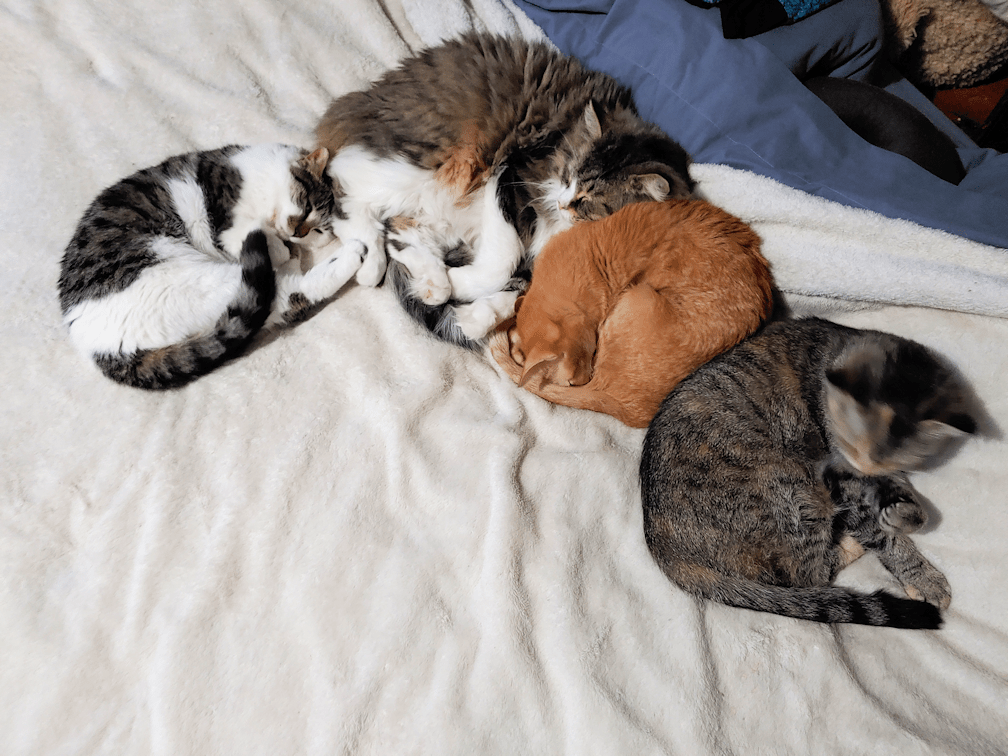
Check this out!
Nosencrantz joined a cuddle pile!!!
She was snuggled right up to David’s butt.
A lot of the cats like to snuggle up to David. :-D
This is HUGE, because Turmeric and Beep Beep are right there, and they tend to hiss at Nosencrantz pretty regularly. They hiss at the other cats, too, but as the new kit on the block, Nosencrantz hasn’t learned to just roll with it, yet.
There was another cuddle pile happening.
It involved me.
Fenrir decided to snuggle into my arms and take a nap on my chest while I was at the computer earlier.
This is Fenrir being all sweet and cuddly.
Yeah. She always has that “murder” look in her eyes.
It took almost 5 hours, but I’m done. I’ve sent photos and info to get cats fixed and adopted out.
I had to pause part way through and get a daughter to help me take pictures of Nico and Susan.
It took some doing to send these. She wanted it all texted to her phone.
Which means texting from my phone.
From a cell phone dead zone.
Yes, I have my phone set up for WiFi direct, but it doesn’t seem to work.
My first message was to confirm it was going to the right number, and that took almost 10 minutes to send. I even paired my phone to my desktop, so I could access the photos and type on a keyboard, but it still sent using data on my phone. I was able to leave my phone in the living room, though, where it got a better signal, while still doing everything from my desktop, which ended up working rather well.
It would be good to get the outside cats adopted into indoor homes. No more keeping their butts warm at the melted spot over the heat bulb! :-D
As we worked out on the phone, I started with pictures of Butterscotch and Nosencrantz first, with Nosencrantz being up for adoption, but not Butterscotch.
Then I found (or have to take) pictures of Saffron, Turmeric, Tissue, Nico, Cabbages and Big Rig, for getting fixed and adopted. Beep Beep was included to be fixed, but not adopted. Susan and Layendecker were also included for adoption, though they are already fixed.
Then I sent pictures of Agnoos, Tuxedo Mask, Chadicous, Potato Beetle and Chadicous to add to the list of outside cats that can be caught. So 6 more cats to get fixed and adopted out.
Once those are done, the next focus is the cats that are not at all socialized, or not socialized enough. I mean, we might be able to catch Rosencrantz, but that’s it. Rolando Moon is already fixed and not adoptable, anyhow. For the others, they will lend us traps to catch them, so we wouldn’t even consider it until summer, anyhow.
Of the ones we can catch, there are a total of 9 females, at $75 each, plus 5 males. I don’t know what the rate is for males, as we didn’t talk about it. Usually, it’s half the cost of getting a female done.
Can you imagine trying to get all the females done at $350 each?? Then another 5 males at $175? Plus the cost of vaccinations, on top of that? And then there would be the cost of the cats we’d need to trap.
As I was working on sending the info, I got a call from the shelter.
Talk about a completely different attitude! Not at all like that first call. She started by asking if I’d heard from the person she’d sent my contact info do, and assured her that yes, she had called me, and we had an excellent conversation and worked out a plan that will span months. I made sure to thank her again for getting us in contact with each other. She was happy to hear that.
Then she got to the real reason she called! :-D
She remembered I had mentioned a new cat showing up fairly recently, and she asked if I lived around a certain area several miles to the north of us. That is where a long haired cat, white with black spots, has gone missing. Our Distinguished Guest is a long haired black cat with a white blaze on her chest and white socks. So we traded descriptions. We’re a bit far from the white cat’s location, but it is possible it might find its way here. She asked about the Distinguished Guest and her condition, and she does appear to be healthy. She wasn’t starving or anything, when she first showed up. I did tell her I think we’re dealing with a cat dump, not a lost cat, but you never know. Someone might actually be looking for this cat, so it’s good to have the word out. It’s not like we can check the cat for tattoos at this point.
All of this is going to be done slowly over the next few months. If all goes well, we’ll have half of our indoor cats adopted out, and most of the outdoor cats, before next winter, and any remaining outdoor cats will be fixed. Which should basically be just Butterscotch and Rolando Moon.
Oh, we had something else nice happen in the middle of all this. While at my computer, I spotted some movement on the garage cam live feed. It was my daughter heading for the gate. She had received notification that UPS had delivered a package for her. I hadn’t seen the truck, but sure enough, UPS had found us, and tied the package to our gate.
The last time we tried to get something delivered by UPS, it was delayed something like a week, because UPS couldn’t find us. It looks like our new sign has already made a difference! Our physical address still doesn’t show up on any maps, but the package still got here, without any issues.
So all in all, it has turned out to be a really good day!
As the year winds down, it’s time to review the goals we’d set, see what worked, what didn’t and what we want to accomplish next year.
Among the goals we had:
Starting a cordwood shed to use as an outdoor bathroom, with a composting toilet, to replace the outhouse over a pit.
Well, that didn’t happen. Which is turned out to not necessarily be a bad thing.
The location we want to build it is in that open space behind the compost ring. One of the things I did this past summer was go through the spruce grove and mark most of the dead spruce trees I found. I marked almost 2 dozen, and there were several others I didn’t bother marking, or couldn’t get at. These were trees that were intended to be used for the cordwood walls, however priorities have changed. They will now be used to build high raised garden beds. Right now, the space we want to build in is going to be needed to drag logs out of the spruce grove. Thanks to my mother, we now have a wood chipper that we can use to break down the branches, so we’re not adding to all the branch piles, and will have plenty of wood chips for mulch.
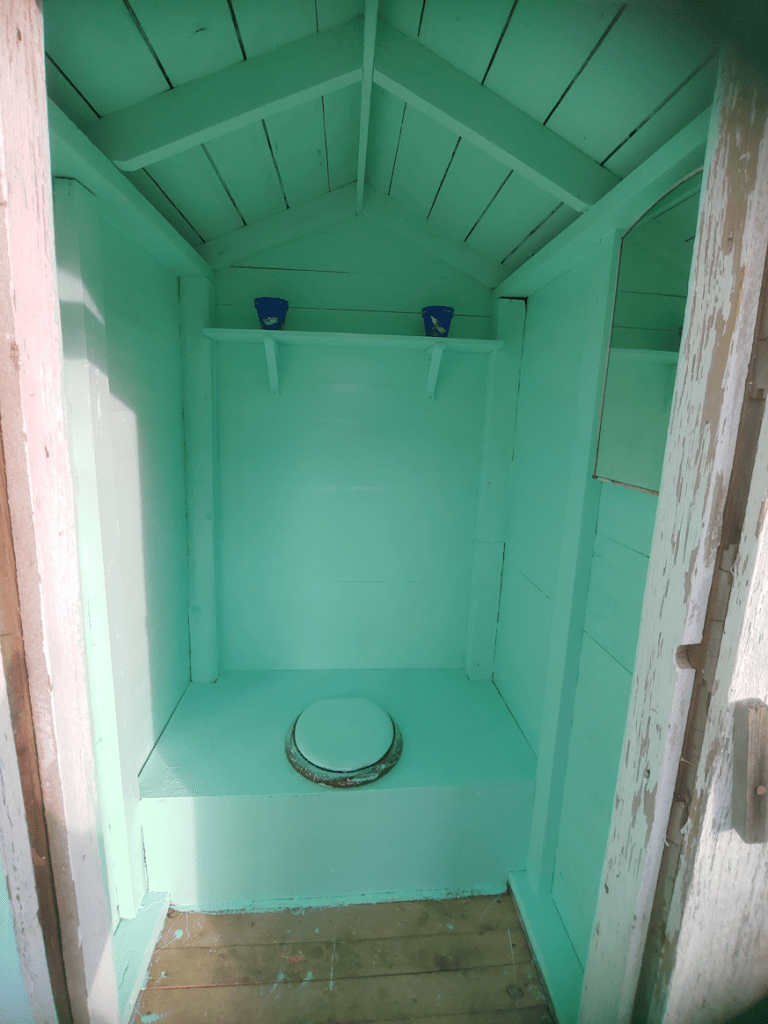
Until we can build the outdoor bathroom, we do still need something to use the next time we have plumbing problems, so the inside of the old outhouse was fixed up and made pretty (the photo here is from before it was finished). A goal for 2022 is to remove the old, moss covered shingles, extend the roof to create an overhang above the door, re-shingle it (or use some of the left over bits of metal roofing we still have in the barn), and do any repairs on the outside before giving it all a final paint job.
We did find that a groundhog had got into the pit and dug a den under the floorboards somewhere. Sadly, if we get an average amount of snow, this will likely result in a drowned groundhog. Our first two springs here, we found that snow melt would form a large puddle in front of the outhouse, and I could see in the hole under the door, which is now fixed, that the pit filled completely with water. There is nothing we can do about this. Hopefully, the groundhog will wake up early enough and leave the den before this is an issue.
Another of our goals is to have the branch piles chipped. While we now have this awesome new wood chipper, which can chip branches up to 3 inches thick, it is very slow going. The branches have to be trimmed of any sticky-outy bits, and be straight, or it won’t go through. For the sake of efficiency, it will be better to hire the tree guys and their massive chipper. When we got their estimate, they figured it would take 6 hours to chip all our wood piles. For our budget, I’m hoping that we can have them come out for three hours in the spring, to get at least the big pile in the outer yard done, and maybe the little ones in the maple grove. Then we can see about hiring them again, maybe in the fall, to do the remaining big piles. With the new wood chipper, we should at least not be adding more to the branch piles, as we clear dead trees out of the spruce grove!
Another goal that we once again failed to meet, was hiring someone to haul the junk pile away to the landfill. This irritates me, because that pile is getting so large, and we are getting to a point where we need to start cleaning up on that side of the chain link fence. If our budget allows, I’m hoping to at least have smaller loads removed, as we can afford it. The name I have for a guy that hauls junk uses a pick up truck, so if we can get him to come by a few times throughout the year, even that would be a help.
Our gardening goals were mostly met, as far as drought conditions allowed. We used poplars we’d cleared out of parts of the spruce grove to build trellises, and those will be used for another year. We planted in areas far from the house, partly to prepare the soil for permanent plantings. The corn and sunflowers were potentially there to provide privacy screens, too, but the drought and poor soil conditions prevented that. Having to use 300 feet of garden hose to water things, and still just barely being able to reach some corners, during a drought and heat waves, was something we could have done without! Add in damage from deer and groundhogs, and it’s a miracle we had as much produce as we did.
For 2022, our garden plans will continue, and this year we will start with the permanent plantings. We are pouring over websites and looking over what bushes we will be planting in those far flung areas. In one section, we will be closing off a gap in the hedge along the north fence line that the deer go through. My mother had been planting lilacs along this fence, but we are looking to plant berry producing shrubs and bushes, instead. We will also be planting them along the east side, both to help keep deer out and to create a privacy screen. We still need to make sure we can access the east fence line, and there has to be a lane kept open, over where the telephone wires are buried, so we will use other methods to close that off to the deer. We’ll have a better idea of what we can buy in January, when many of the nurseries will have their new inventory available. We might be going with sea buckthorn, if the other varieties we were looking at don’t come back into stock.
Other things we intend to order for 2022 are raspberry canes and, if all goes well, Korean Pine. These require shade for their first 5 years, so they will be planted just north of the spruce grove. If budget allows, we’d like to get new Saskatoon bushes, too.
We will have to take out more of the crab apple trees, to remove diseased trees. There are two trees that produce the best apples. If I can protect those, I will be happy. However, we will also be getting other types of fruit trees including, hopefully, a hardier variety of mulberry tree to replace the one that we bought last year, that got killed off by that one cold night that also killed off all the flowers that would have given us fruit and berries this past year. I’m not sure how many we will be able to squeeze out of our budget this year, but the more fruit trees we get, the better, as they can take many years before producing fruit. Berry bushes are also high on our list, as they will start producing much faster.
This past year, we expanded our garden plots significantly, but with our long term goal of growing as much of our own food as possible, we will need to continue to expand and prepare new ground. Now that we have a working chain saw, we’ll be able to clear dead trees out of the spruce grove and clean that up faster. Many of these dead trees appear to have no rot in them yet, and we plan to turn many stumps into benches and tables. We will also need to clear out the fallen rotten trees, and other fire hazards. Once things are cleared out, we will be planting more spruces in the spruce grove, as well as fruit and berry trees that require more protection from the elements. We’re also looking at getting some Rugosa roses, though they will likely be used more as a deer barrier!
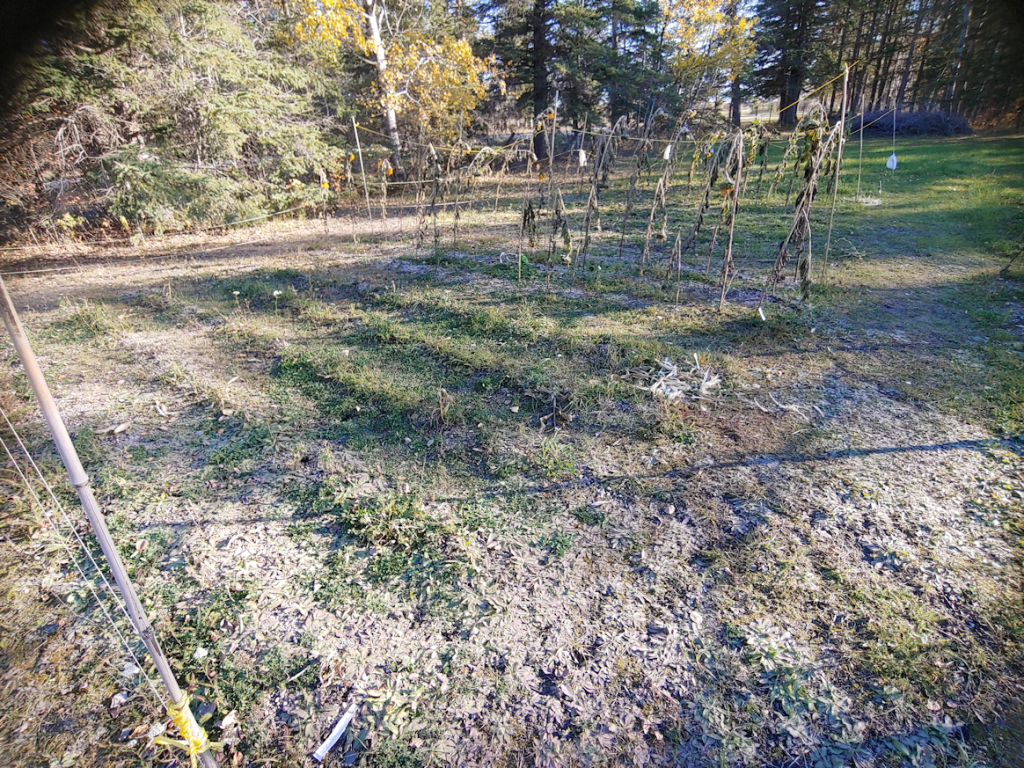
Where the trellises are now will eventually be converted to our food forest, except for the lane that needs to be kept open over the buried phone line, but we will use them where they are for one more year. We ordered quite a lot of seeds already, from Vesey’s (including replacement seeds) and Baker Creek again, plus two orders from Heritage Harvest, which is a new company for us this year. The only seeds we’ve ordered that are still en route are the kulli corn. The only other seeds I still plan to buy are peas, but I will pick those up from a local store when they come available, rather than ordering them in. We will also be making use of seeds from our inventory left over from last year. Which means we will need to build more trellises, once we decide where, because we’ll have quite a few vining plants, and there’s only so much we can plant along the chain link fence. ;-)
Along with the saplings, canes and root stock we plan to order, we will be ordering potatoes and sunchokes. This time, we will not try to grow potatoes in bags, but will use the Ruth Stout method again, as part of preparing new areas for either more garden plots, or permanent plantings, the following year.
At this point, we have three low raised bed boxes built, and one high raised bed. Next year, we will continue to use the current beds in the main garden area. The goal is to cut the dead spruce trees to size so that, after things are harvested in the fall, the remaining beds will be converted to high raised beds before next winter. With how much watering we had to do during the drought, filling the beds hügelkultur style will be an important part in moisture retention. Even under normal conditions, high raised beds are notorious for drying out too quickly, but with how we fill them, coupled with the judicious use of mulch, we should be able to prevent that from being a problem.
We will also be making new beds for corn and the many types of squash we have for this coming year, but those will be in areas that will eventually have trees planted in them. Ultimately, we will be building accessible high raised beds in the outer yard to the south of the house, where they will get more sunlight. Eventually, we intend to build a greenhouse or polytunnel out that way, too. It’s not something we’ll be able to start building in 2022, but we should be able to start preparing where they will eventually go. The renter plans to build new fences next year (maintaining the fences was part of the deal they’d originally made with my late father), since their electric fence has been not working as well as intended. I hope to talk to them again about putting a new fence line across the old hay yard, which will be much shorter (therefore, cheaper) than rebuilding the existing fence, but also takes away an area of pasture. We would need a gate in there, though, so that we can eventually haul away those old vehicles to the scrap yard. As that would not be something they’d normally include, I’d be offering to pay for the gate portion. If they are willing to do the new, shorter fence line through the old hay yard, we will be able to get rid of some old, messed up fences and a shed that looks ready to collapse pretty soon. Then we can start building new garden beds out that way. This is also the general area where we want to build the outdoor kitchen, as well as planting a wind break. None of which are worth starting, while there is a chance the renter’s cows can get through. There are also old, collapsing fences around the inner yard we want to take out completely, rather than repair or replace, but again, it can’t be done until the outer yard is fenced in. Long term, though, we won’t have an inner and outer yard anymore, but just one really big yard.
Which means that, on top of continuing our work in the inner yard and garden, we need to get more work done on cleaning up the outer yard. There’s a limit to what we can do, without heavy equipment, but we can at least get a start on it. That was something we should have worked on this past year, but accomplished very little. Hopefully, this coming year will not have the drought and heat waves that made heavy manual labour a very bad idea!
With what we’ve learned from the past year, we know that this year, we will need to focus on protecting our plants from deer, groundhogs and racoons. We will also be focusing on permanent plantings that are drought tolerant and can handle poor soil conditions, even with the amendments we’re working on. We are also looking into planting forage trees and fodder well away from the house and gardens, to give wildlife less reason to invade our yards, looking for food.
As we build our raised garden beds, we will also be ensuring they will all be the same size at the top, so that any covers we build can be interchangeable. The low raised beds are boards and are 3′ x 9′. The high raised bed is 4′ x 9′, and we plan to build them all that size. With the thickness of the logs, the actual growing space inside is closer to 3′ x 8′. So if we build covers to fit the low raised beds, they should also fit the high raised beds.
While most of our goals are going to be expanding or continuing previous goals, a new goal I want to add is to have chickens. For our egg needs, we would only need about half a dozen birds. The problem is, we don’t have anything to keep them in. I am wanting chickens to be part of our soil reclamation progress, which means being able to move their coop and enclosure regularly. Buying a new chicken tractor is well beyond our budget, but we don’t have the materials to build one, either, and with the cost of building materials right now, it’s as out of reach as buying a new one. Of the many, many videos I’ve looked at for making quick, easy and inexpensive coops and shelters for chickens, none of them are suitable for our climate. Oh, they could be temporary structures for the summer, and I do plan to build versions of them that will fit over our raised garden beds, but none of them would keep chickens alive during our winters.
That is something I need to work on. I’d love to get able to get chicks this spring, but if we can’t shelter them once they’re big enough to leave a brooder, there’s no point.
So there we have it. We did accomplish some of our goals for 2021, but many of our goals are multi-year things, so it’s more progress than accomplishment.
Now we’ll see how much we manage to get done next year!
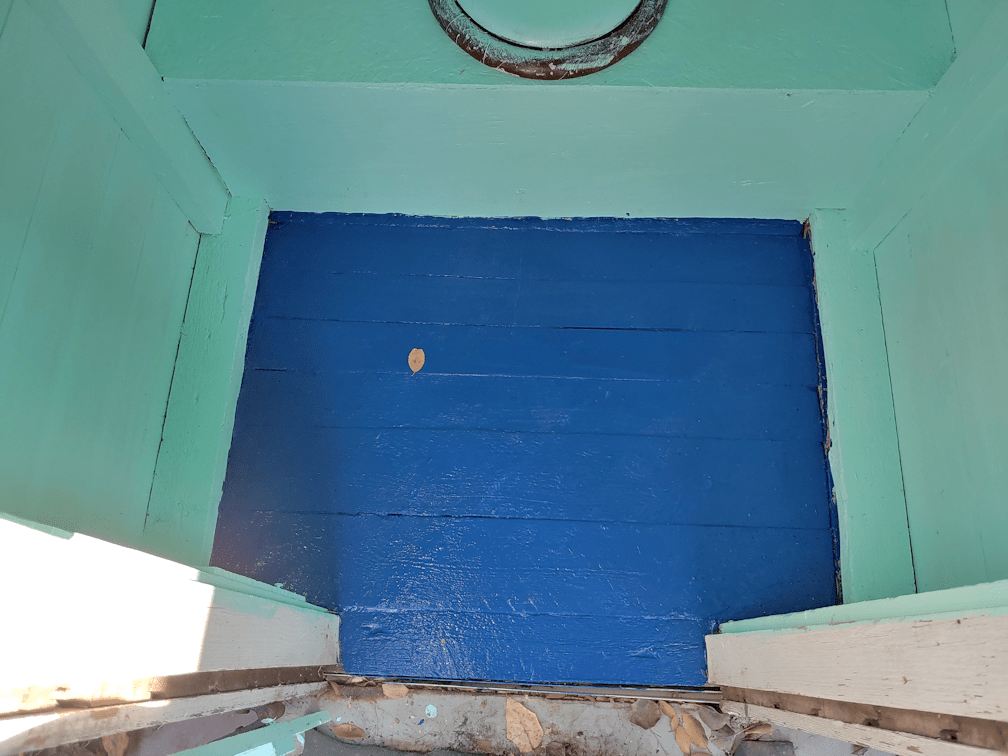
As our day warmed up in the afternoon, I took advantage of it to get some stuff done outside. Now that the sign’s lettering is done, I used the paint, which I chose for its durability, to get the floor of the outhouse painted, first thing.
The first thing to do was remove the remarkably heavy piece of … whatever the stuff is called … out, then sweep and scrub the floor as best I could. Unfortunately, there are cramped spaces on either side of the door frame that I just can’t get into. At least not without making efforts I’m just not willing to make for an outhouse! LOL
I just painted over the crud. I figure, if it’s stuck to the point I can’t get it out with a brush, it can stay there.
Of course, in the time it took for me to turn around and set the paint can and brush down, a leaf blew onto the wet paint!!
I was able to reach it without getting into the wet paint myself, though. :-D Then I quickly closed the door before more leaves blew in!
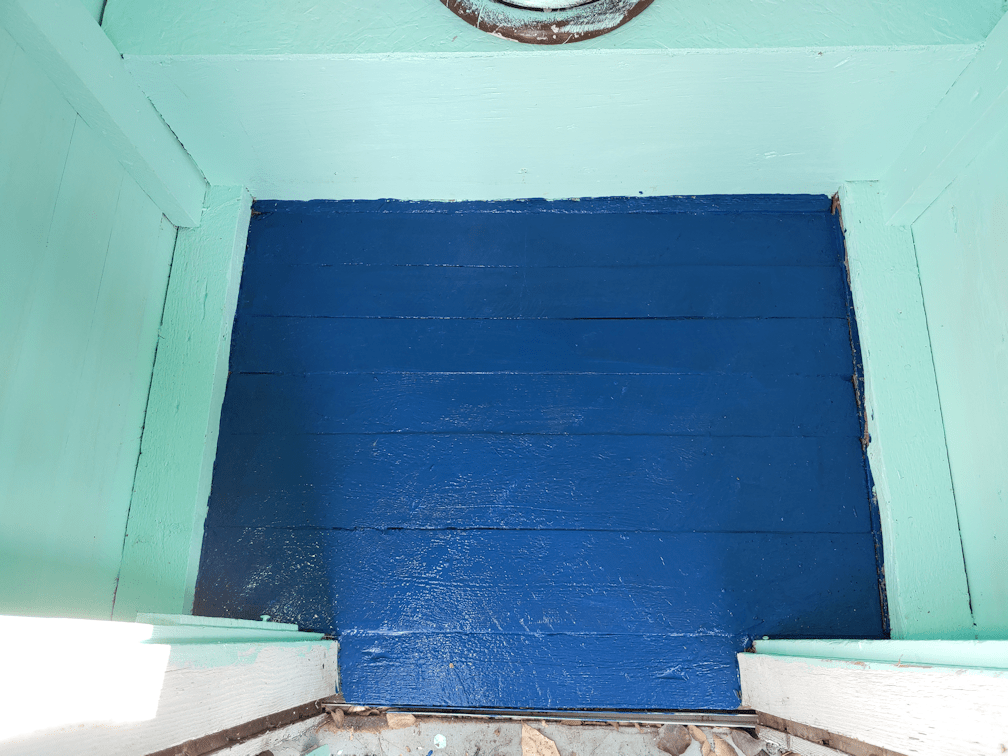
I don’t think I’ll bother with a second coat. If you look really hard, you can see some of the mint paint through the blue a bit, but most of this will be covered with the mat. I just wanted to protect the wood, really, and I think this will be just fine. If it isn’t, we can always add another coat next year, when we get more of the mint paint. The girls want to give it a final coat in semi-gloss.
It doesn’t look like we’ll be able to redo the roof before winter, so I’ll probably cover it with plastic before the weather turns, though at the state it’s in, it probably won’t make much difference if we don’t.
Which means that, once the paint is dry and the mat is returned, our emergency bathroom is now done for the year! :-)
Today worked out to be a longer day than planned. I had intended to do a Costco trip to the city tomorrow but decided that 1) I didn’t want to deal with weekend crowds and 2) Halloween is around the corner, and I didn’t want to deal with even bigger crowds because of it! So I headed into the city this morning. After this, we’ll need to go over what’s left that we need to pick up, then make one more trip – after Halloween!
Once that was done and everything was put away, I headed to the finished high raised bed, to start filling it, modified hügelkultur style.
While making the bed, I tried to put all the scrap bits of wood inside, so the first order of business was to spread those out more evenly. Then the short logs that had been used to frame this bed over the summer were added to the bottom. There weren’t a lot of those, but we have plenty of piles of wood to raid. I tried to put the bigger pieces on the bottom, then smaller pieces on top, using them to fill gaps as best I could. Then I started adding bark to fill gaps, too. Ideally, there would be no gaps, but with so many odd shaped pieces of wood, that wasn’t really an option.
Thankfully, we have lots of bark debris. This spot used to have a pile of logs between the two spruces. There is just one long one with a weirdly shaped end left. It needs to be cut up before we can use it.
The nice thing is, along with the partially decomposed bark, I was able to pick up quite a bit of spruce needles. Not enough to increase the acidity of our very alkaline soil, but every little bit helps!
I added a couple of wheelbarrow loads of bark into here, and even went around the bed to pick up little bits of wood and handfuls of sawdust to toss in. I wanted to fill the gaps as much as I possibly could.
Next, a few shovels full of soil was added. This is the soil that had been dug out of this bed before the high raised bed was built. Just a very thin layer was added to fill in the gaps a bit more, and give the breakdown of the wood a bit of a boost of soil microorganisms.
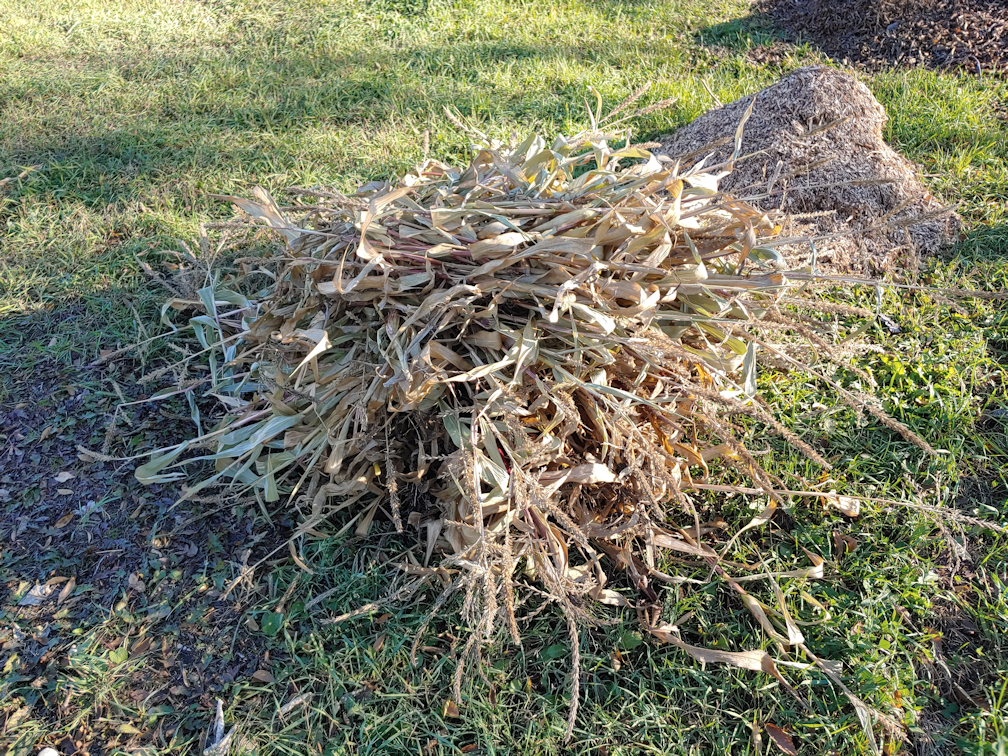
Next came a nice thick layer of corn stalks that we saved, just for this! If we did not have the corn stalks, this layer would have been straw, because straw takes longer to decompose than the other things that will be added.
Yes, we have straw, now!
This got delivered while I was working on the corn stalk layer.
I broke that baby open almost right away!
With the layers, I was alternating between “brown” and “green” layers. The corn stalks were a brown layer, so the next layer (after a bit more soil) was grass clippings, which are considered a “green” element.
I stole the grass clippings from the nearby garlic bed, replacing it with straw. I was concerned the grass clippings might smother the garlic. Later, we will replace the grass clipping mulch on the other two beds with straw as well.
But not today.
With each additional layer of soil, I added a bit more than the previous soil layer. The layers were still pretty thin, comparatively speaking, but I could already notice the weight of it was causing the looser layers below to settle and sink. If I had any, I would have been using compost or manure to layer instead of, or in addition to, the soil.
The next brown layer was leaves.
The final green layer got all the bitter lettuce and frozen chard that had been pulled from the other beds. The kitchen compost buckets got added as well, so there’s also things like egg shells and coffee grounds in there.
Now, it was time to add the rest of the soil. This job actually took the longest, because I frequently stopped to spread it out, pull out the roots and rocks, break up clumps, and make sure any worms that hitched a ride were gently and safely buried.
I stopped adding soil when I was getting too many crab grass rhizomes and rocks to make it worthwhile anymore, and the last of it got raked out evenly, as did the soil in the raised bed.
The very last layer was a mulch of wood chips. Thanks to my mother’s generosity in getting us the wood chipper, we had enough to add a couple of inches to the top.
I expect the contents to settle and sink over the next while. We’ll probably be down a few inches, by spring. Which is okay. We will continue to add more organic matter to build it up.
I must say, I am so thrilled with the height of this. It is SO much easier on the back to work at this height! I don’t even have a back injury. I’m just old. ;-) It might be a bit low for my husband, if he ever wanted to do a bit of gardening, but he would be able to reach while sitting in his walker just fine.
One down, five more to go!
Eventually. :-D
Temperatures are expected to continue to be mild over the next couple of weeks; a few degrees above freezing during the say, and just barely below freezing overnight. We’re expecting some rain tomorrow, then possible rain and snow over the next couple of days. Which means we can still continue preparing garden beds for next year. I might even be able to start cutting down more dead trees before things start getting too cold. It would be good to have the lengths pre-cut to build more beds, even if building them ended up waiting until next fall. Mind you, there’s nothing stopping us from adding more beds to the main garden area, other than possibly running out of material to layer with. My only hesitation is that we intend to expend our garden area into the outer yard, where there is better sun exposure, and those will all be high raised beds. Perhaps by the time we’re ready to build those, we’ll be able to use materials other than salvaged dead spruce trees!
Oh, my goodness, what a difference having that new chainsaw made!
But before I could break it in, I needed to drag down the stuck tree, so I could use the wood in the high raised bed. Thanks to my husband very securely attaching the hooks I got to the rope I got – rope rated to 450 pounds – it was a simple matter to use the van to pull it out.
My goodness, where those top branches ever entangled! When I started pulling it, it didn’t fall, but stayed stuck until I got far enough that the tree was no longer dragging on the ground, but lifting up. At which point, it rolled up and got dragged over the compost ring, then finally it broke free from the branches and dropped.
Right on the cherry trees we are intending to cut away, so there’s no loss there!
After replacing a large divot of sod that got dragged out, I then used the baby chain saw to start cutting away the branches, and cutting away the top of the tree.
Then it got rolled onto the compost ring, so the rest of the branches could be trimmed off.
Finally, it was time to break out the new chainsaw!
Of course, I took the time to read the manual, first, then added chainsaw oil to the reservoir.
Then I measured out and cut a pair of nine foot lengths from the tree trunk.
The bucksaw does a great job, but the chainsaw did in mere seconds what would have taken me probably 5, maybe even 10, minutes, per cut, by hand!
Then, while I dragged the logs over to the high raised bed, I helped a daughter move the rest of the tree trunk aside, so they could set up the wood chipper. They cleaned up all the dead branches from the tree, as well as the little cherry trees we’d cut away to access the last tree we’d cut down.
They spent more time prepping the branches to fit the chipper and shredder, than actually doing the chipping and shredding! Unfortunately, the little spruce branches were so twisted, they ended up clogging the shredder chute to the point that my daughter had to take it off to unclog it. Once that was cleared up, they did a few celebratory shreds before heading inside to start on supper.
Meanwhile…
I started working on the high raised bed by first taking it apart! I cut away the notches in the base logs so that the cross pieces would sit lower, and no longer have that gap that was there before. I also was able to clean up the cuts and make adjustments, as needed.
The new nine foot lengths were thicker than I thought, so after I put the bottom cross pieces back, I used the new logs for the next level.
I ended up not needing to cut notches in them at all. Instead, I was able to just adjust and cut the notches in the next level of cross pieces to fit.
It was SO much faster and easier to cut the notches with the chain saw! Pretty much every notch we’d cut before needed modification.
I used smaller, thinner, logs at the top, which turned out to be a pain. These are from higher in the tree, which meant they were not as straight, and had more little branch stubs all over. I ended up having to trim logs along their lengths to get rid of lumpy bits, so things would sit against each other better.
Then I went and cut two more four foot lengths to do the last cross pieces.
There we have it! The high raised bed is built!
Standing next to a corner, it’s just barely reaches my hip. For mobility and accessibility purposes, we could probably have gone higher than this, but I think this will be fine.
Now, we just need to fill it! We’ve got old logs for the bottom, with corn stalks, leaves, grass clippings and garden waste to layer in. I’ll add thin layers of soil in between each layer of organic matter before topping it off with soil for about the depth of the top logs.
That will be a job for tomorrow!
I may have had to juggle the budget a bit to get that chainsaw, but it was worth every penny. There is no way I could have finished this today, without it. In fact, I have my doubts I would have been able to finish it before winter, at the rate things were going!
About the only other thing we might end up doing with this is maybe get some short pieces of rebar, drill holes through the top couple of logs and set the rebar in them to really make sure the logs stay in place.
It’s really a horrible, messy, slapdash job, but it will still probably last us many years.
Now we just need to cut down more dead trees, so we’ll have the material to build more!
While things were still pretty wet from rain this morning, I used some of the stuff I picked up yesterday and worked on the outhouse.
The chain latch was something we already had in the basement, and the handle was something I picked up yesterday. I got a second one that I put on the outside of the back door into the garage, so I don’t have to pry that open with my fingers anymore. :-D This door is kept closed from the outside by a piece of wood that spins on a nail in the door frame. Turn the wood over the door and it holds it closed, rotate it 90 degrees and it basically just pops open. When we get around to replacing the hinges and rehanging the door so that it is straight, it should close better again, but for now, it needs a way for the door to stay closed while someone is inside!
I didn’t find the switch plate LED light I was after, so for now, I just screwed in a cup hook and hung the LED light I’d already brought over for use in here. You can see the sunlight on the wall from the door – and the reflected light from the mirror, too! The switch plate light I’m after can be mounted either with screws that fit into slots on the back, or with self adhesive velcro strips. When it’s mounted, we’ll use it to cover the hole I made with the cup hook, and the hole left behind by a nail from before. I was going to put the cup hook in the pre-existing hole, but it seems that there is a piece of metal broken off inside the hole!
There was enough light in here with the door closed that the auto-flash did not turn on when I took the photo. :-)
The main thing I wanted to do was add the second shelf, not that I have brackets for it.
Of course, if there is a shelf, there must be something on it!
I rifled through the garage again and found these miniature picnic tables. I believe they are condiment holders. They have larger holes cut into the table tops that look big enough to hold those round mustard and ketchup squeeze bottles, and a pair of smaller holes look like they could hold salt and pepper shakers. There were a few of the same flowers I used to decorate inside the mirror cabinet, left in the garage, so I grabbed them, too.
It occurred to me while I was working that the paint I picked up to do the lettering on the sign would be perfect for the floor in here. I’m in no hurry to do the lettering, so the floor boards will probably not get painted until spring.
I had been concerned that things would start raining again, but the sun came out while I was working on this, which meant I could get the stuck tree dragged down, and finish the high raised bed!
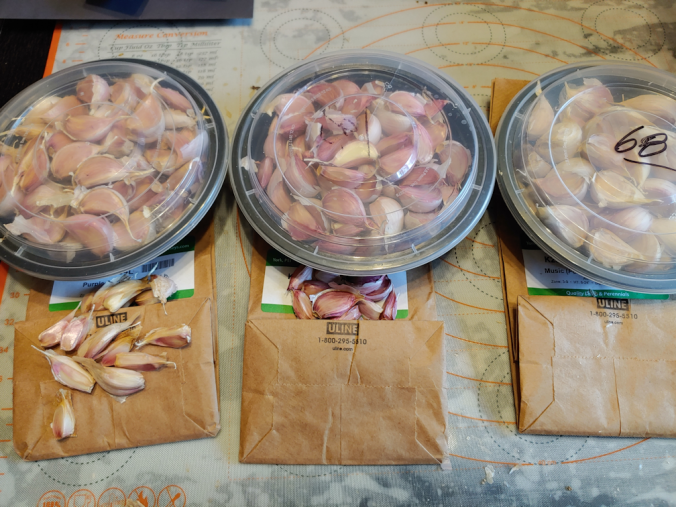
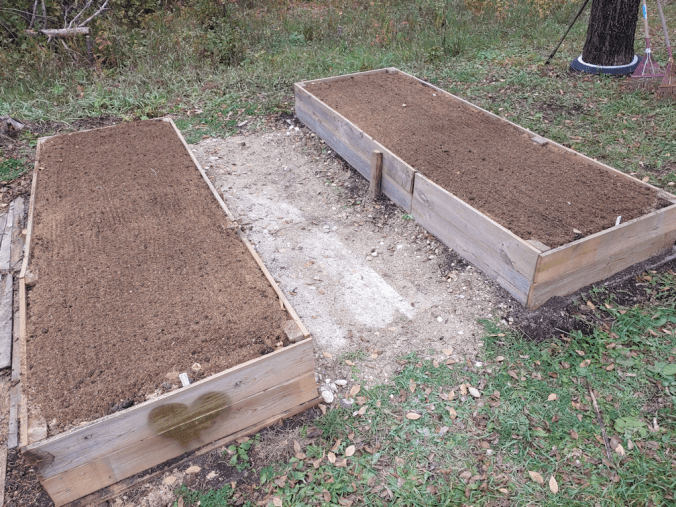
When it became clear we would be using our low raised beds to plant the garlic when it came in, I thought about how much space the garlic we planted last fall had taken, and thought we might be able to plant all three varieties in one bed. Maybe one and a half.
Boy, was I wrong. :-D
The garlic is sold by weigh so, technically, we got the same amount of seed garlic as we did last year, but when I opened the bags, it just seemed like… more.
It’s a good thing I take pictures and document everything, because I was able to look at last year’s post and compare.
The photo on the left is from last year, the one on the right is the garlic that came in today.
I even just happened to lay them out in the same order! The Purple Stripe is actually less than last year. Seven bulbs instead of eight, but this year’s bulbs were more consistent in size. Last year, we got seven Rocambole, but this year there is nine. The Porcelain Music had eight bulbs last year, and this year there is nine.
Separating hardneck garlic cloves is rather a lot more difficult than the soft neck garlic at the grocery store! :-D
Last year, we planted all the cloves. Even the little ones. The Porcelain Music had fewer cloves per bulb, but they were all large. With the other two, I separated out the little cloves for eating, and kept the larger ones for planting.
Which turns out to have been a good decision!
Last year, I planted the cloves at approximately six inches apart, but this time, I actually measured and marked a six in grid. Which was SO much easier now that the bed is raised up higher! Now I’m thinking I must have been closer to four or five inches, when I planted last year. At six inches, I filled one bed almost completely with Purple Stripe. There were maybe three prepared holes that did not get a clove planted in them. Which means this bed has 82 cloves planted.
The second bed got the Rocambole, which actually had more cloves. This bed is just a little bit longer than the first one, which gave me an extra row. I had exactly enough cloves to fit! That gives us 90 Rocambole garlic in that bed.
The third bed here still has beets in it, but thankfully, we finished cleaning up the carrot bed, yesterday.
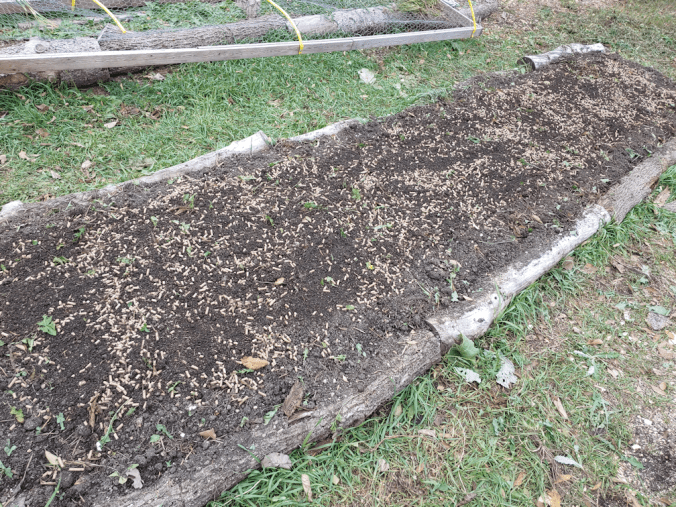
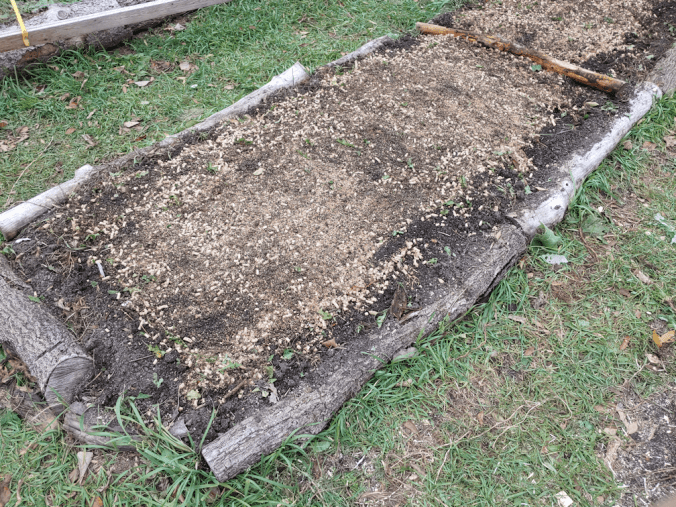
The first thing I did was add half a bag (about 20 pounds) of hardwood pellets and work them into the top couple of inches of soil. Then the bed got watered, so the pellets would start absorbing moisture.
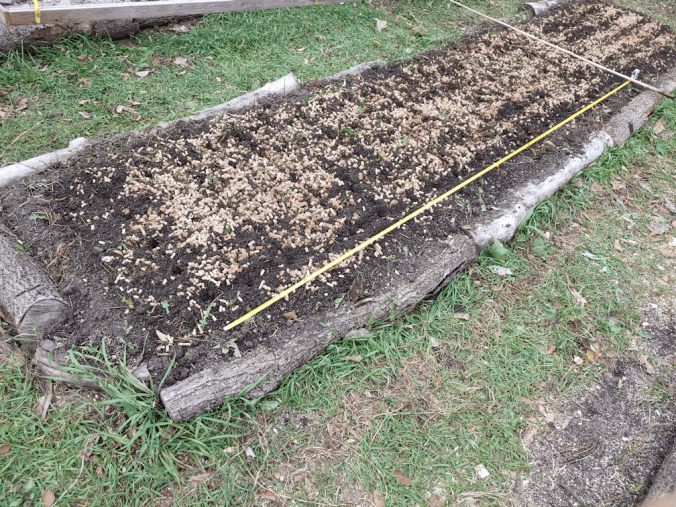
As with the other bed, I marked off a six in grid, though with this bed being so much lower, I did it by dragging a bamboo stake to mark the lines, first, then poking holes in where the intersected. Far less painful doing it that way!
I marked far more than I needed. Having just cleaned this bed out, I know that the edges get invaded by crab grass pretty heavily, so I tried to keep further away from the edges. I marked out 5 rows but, knowing I had fewer cloves with Porcelain Music, I laid the cloves out along four rows, first. I turned out to have exactly enough to fill a 4 x 13 grid, making for 52 cloves.
Which ended up being pretty much exactly half the bed. I placed the piece of wood across to mark how far the garlic is planted, so we know how much space we have when we plant something in the other half in the spring.
While I was working on the third bed, my daughter covered the low raised beds with a grass clipping mulch before moving on to other areas of the garden, then I used grass clippings the last bed. I hope to replace it with straw, when the bale comes in. The mulch has to be removed in the spring, once the overnight temperatures are warm enough. The garlic should be showing through the mulch by then. That is fine with straw, but the grass clippings may be too dense for the garlic to work its way through, so when the straw comes in, I plan to replace the grass clippings with it.
All three beds were finished with a fairly decent watering. Mostly to dampen the mulch than try and soak through it. We are still expected to warm up over the next few days, so this should be enough for now. Later on, as overnight temperatures drop and before the snow comes to say, we’ll cover the beds with plastic.
One thing is for sure. Working with the newly framed low raised beds is SO much better than the ground level beds, even though those ones are technically considered raised beds, too. It was easier to mark out distances, easier to reach the middle, and much MUCH easier on the back. Everything went so much faster because of this, too. I look forward to when all our garden beds are at least this high, or higher!
We had originally intended to double how much garlic we planted this year, but I am glad we decided not to, at the last minute. We would not have had enough beds ready to plant them all, if we had!
It should be interesting to see how these do next year. Not only will be be able to compare with the highly amended low raised beds in the same location as last year, but also the third bed in the main garden area. The low raised beds get full sun (meaning, at least 6 hours), but are shaded longer in the morning by the spruce grow and nearby Chinese elm. The third bed has nothing to shade the morning sun, and is far enough away from the trees by the house that it’s not affected by evening shadows, either.
It was a chilly day for it, but we got quite a bit done cleaning up in the garden today.
My focus was on finishing with the abandoned carrot bed that was half done yesterday.
This is how it was left lat night. The second half had the Kyoto Red carrots planted, and after the groundhogs got at them, most had gone to seed when they grew back among the weeds.
Yet we still managed to have some carrots of an edible size!
There were a lot more twisted ones than with the Napoli carrots. This bed had been built on top of one of the potato beds we’d planted the year before, then basically doubled the length. The half the Kyoto Red were on was on top of non-amended ground, and you could see in some of the longer carrots, where they had hit rocks or harder soil, and twisted their way around. Even using the garden fork to loosen the soil and pull up the carrots was harder than the first half.
What a difference with the carrots that had gone to see!
It doesn’t look like we’ll be collecting any; if there are any mature seeds on some of these, I can’t tell.
Once I pulled as much as I could, I started working on cleaning out the weeds and roots. One of my daughter came out after I started that part, and she started working on the sweet corn blocks.
She stacked those next the high raised bed, as I’ll be using some of them in the layers of material used to fill it.
The sunflowers were left for now, but all three blocks of sweet corn were cleared.
She also pulled the summer squash and beans. These beds will be used again next year, so I got her to leave the plants there for now. The beds still need to be weeded and prepped for next year, and I might be able to make use of the plants to improve the soil more.
My daughter also moved the sprinkler hoses, but they were pretty cold and brittle, so they’ve been laid out in the sun for now. It’s supposed to start warming up over the next while, so I’ll wait for a nice warm day before rolling them up for storage.
By the time she got all that done, I was just finishing cleaning the carrot bed. Thankfully, none of the other beds will need as much work to clean them, and will go a lot faster!
My daughter did the final leveling and raking of the bed while I got the tools to continue working on the high raised bed.
I’m finally starting to get a bit of a method down. Between that and the narrower logs, I’m getting the notches cut faster. The logs on the ends are so huge, if I were making this bed only two logs high, I could leave the ends as they are now! As it is, when I add the end pieces for the next level, the narrower side logs means I should only need to cut notches on the cross pieces.
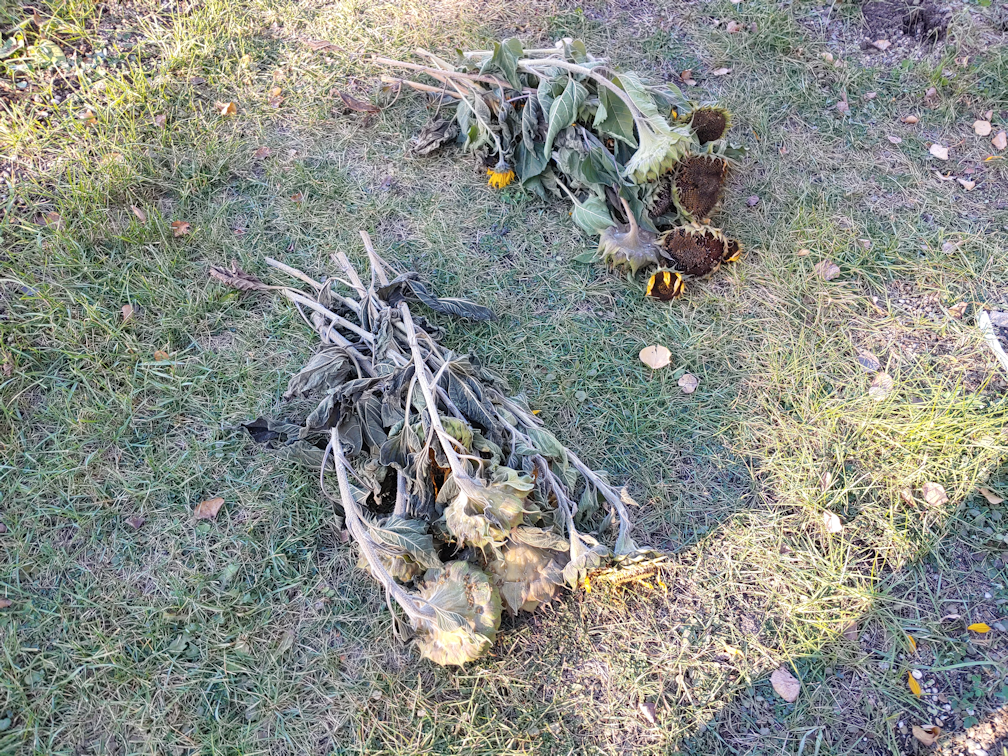
When I got to the point where the second battery on my baby chainsaw needed to sit for a bit before I could squeeze in a few more cuts, I took the time to cut some of the sunflowers. Checking them this morning, I was seeing a lot more losses to birds, so I figured we should get them inside while we still had seeds. :-D
One pile has the Mongolian Giants and the other has the Hopi Black Dye. I don’t know that all the seed heads I collected will give us finished seeds, but we shall see. I cut the stalks pretty long, which meant some of them included the little baby sunflowers that were branching out, too. Those will, for sure, not have any mature seeds on them, but that’s okay.
At this point, we would be hanging them someplace warm and dry. The best place right now is the sun room, and we have no way to hang anything in there just yet, so I made do.
They should still get good circulation around them on these shelves as they dry. I am very curious as to what we will get out of them!
There is a lot more clean up to do, but thankfully we are expected to continue to get mild weather. So much so, that I am still holding off in broadcasting the wildflower seeds for a while longer. Doing this in the fall will only work if there is no chance of germination, so I would rather wait a bit longer. I think one more week will do it, just to be on the safe side.
One of the things about living our here is that phone calls are pretty rare things.
We like it that way.
Every now and then, we’ll get a robocall. Sometimes, from political parties, for conference call town hall meetings, or urgent messages telling us that we are about to be arrested by Canada Revenue for some reason or another, if we don’t call them immediately – and give them our personal information, of course. You know. The usual.
I was just preparing to write this post when we got a robocall with a difference. It was for our municipality, but from the RCMP. It was a warning that there was possibly an armed and dangerous suspect in our area! And by “our area”, they meant the two nearest cities, plus our region. Not municipality. Region. Which is huge.
The alert came with a name, but no description of the person. We did get a description and license plate of their truck, as if that means anything.
After the call, I settled back at my compute to continue with this post. I am happy to say I finally got some progress on the high raised bed that’s worth blogging about. Of course, I’m keeping a close eye on the weather. One of the handy things is that I have a little icon from The Weather Network in the corner of my task bar with the temperature on it and, when warranted, it flashes red with a white lightning bolt as a weather warning. We used to get those whenever there was a frost warning, but I have not seen that, even after last night’s heavy frost. It was flashing when I sat down, though, so I figured we were finally getting a frost warning.
Nope.
My weather app was giving a public safety alert, and it took me to the exact same message from the RCMP that I got from the robocall!
There is no other information about this guy, but they sure to want us to know he’s dangerous and might be in the area!
Or hours away from us, considering how large of an area they are including!
None of us are particularly concerned, but the warnings are appreciated.
Anyhow. To the topic at hand!
Progress on the high raised bed has been frustratingly slow. My tools are the baby chain saw, a hatchet (our other axes are too big for the job), a hammer and a chisel. Basically, I use the baby chain saw until both batteries are drained, with the other tools used to remove material in stages.
Today, I also worked on the carrot bed next to the high raised bed, which meant the first battery actually had time to charge, giving me a chance to get more done than usual.
Which means I FINALLY got the second log in place on one side of the bed.
That took ridiculously long to do! But, it’s now in place, and I’ve started on the other side.
I used the second log to mark where I needed to cut the notches on the side log and end logs. The logs at the end are the thickest, so I started removing material from there, first.
I think part of why I’m so frustrated is, I’ve got three chain saws. The gas powered one broke when I tried to start it, simply because the plastic shell was so old and brittle. The electric one I found was checked out, and they found nothing wrong with it and just sharpened the chain for me, but I discovered it leaked chain oil when I found it in a puddle after the first time I used it, which was for just a single cut before I switched to the baby chainsaw. The next time I used it, I found it would simply stop cutting after just a few seconds. I still have the little, electric, convertible pole chain saw with a 10 inch blade my husband got for me a couple of years ago. It would be enough to do the job, but something went wrong with it the first summer we got it. I checked it out again today, and it basically just screams when I try to make a cut, and the chain stops turning. I’ve got that in the van now, for the next time I go into town and can leave it at the small engine shop to see if they can fix it. I can’t even try using the reciprocating saw. It runs, but no longer shuts off. It needs to be unplugged to turn it off, and it even starts trying to run when it’s plugged back in, making and it quite unsafe to use.
If even one of those chainsaws worked, this thing would be done by now!
*sigh*
Ah, well. It is what it is. Hopefully, I will still be able to complete the high raised bed, and fill it, before the snow flies.
One of the things I found with the baby chainsaw is that, when it first seems to run out of juice, and the red light starts blinking on the battery meter, I can set it aside for a little bit and it will actually “recover” and run again for a while. That usually gives me time to chop or chisel away excess wood. I can usually do this a few times before the battery is finally completely dead. This also gave me time to pull carrots while waiting on the battery life.
I just dug up the Napoli carrots in half the bed. With the Kyoto Red mostly gone to seed, I figured they could wait.
Pulling them all from in between the weeds was certainly a challenge, even using a garden fork to loosen the soil and weeds!
After draining the second battery on the baby chainsaw, I had time to clean up the weeds, pulling out all the roots I could. If some leaves got left behind, I didn’t care, but my goodness, there were some REALLY deep roots I had to dig out!
Half the bed, all done! Hopefully, I’ve pulled out enough roots that it won’t get this bad again, next year! The time it took to do this was enough for a battery to charge, and get more done on the right raised bed.
The temperatures are supposed to stay the same as today for a couple more days, then start to warm up again, which should hopefully give more time to work on the high raised bed and, of course, finish cleaning up all the garden beds and ready them for next year, too.