Our 2024 Garden: harvesting scapes, first pumpkin, and a bit of nip!

We’ve got a hot day coming, so I wanted to give the garden beds a solid watering, to help them cope with the coming heat. It was already 22C/72F at the time. I can’t remember what the humidex was.

While doing my morning rounds, though, I got a bit of a harvest.

There were quite a lot of scapes to harvest! There’s a few left to harvest over the next few days, but at this point, the bulk of them are harvested. We just need to figure out what we want to do with them all!

There were a few sugar snap peas large enough to pick. The little strawberries are the ones grown from seed last year, and the larger ones from the bare root plants we planted this spring. There is one plant among the asparagus that has berries, but the other three have been eaten, in spite of the barriers I put up to discourage the deer. *sigh*

I have spotted our first female pumpkin flower. The camera on my phone just did NOT want to focus on it, though. After I got the picture, I found a male flower and hand pollinated it. I later found a new female flower among the winter squash and was able to hand pollinate that one, too.

After a quick breakfast, my older daughter and I headed outside – my younger daughter is out of commission and walking with a cane again. 😢 We finally got around to removing the insulation around the base of the newer part of the house. This uncovered two windows – a third was already uncovered. These two windows don’t have screens on them, so I’m hoping to build some new screens for them. This way, we can have the windows open and allow more air circulation in the basement and hopefully help it dry out.

The insulation was taken to the barn for storage. My daughter took the smaller pieces in the wagon, fighting her way through the tall grass. With both of us, though, it took only two trips to get it all stored away.

Since I was going to be watering the garden anyway, I had decided to use the hose attachment and water soluble fertilizer. We have the 30-10-10 Acidifying fertilizer we’d found when cleaning out the old kitchen. Everything in the box was well sealed in plastic bags, so even though the box got wet at some point, the fertilizer is fine. With our alkaline soil, I decided it was worth trying. The peas and beans, of course, won’t get any benefit from the high nitrogen content, but anything that makes our soil at least closer to neutral will be a help.

I had a bit of trouble getting back into the sun room to get what I needed, though.

It was blocked.

Adam was nursing Button, in front of the door!

I was NOT about to interrupt Button getting some nip. Especially when he wasn’t having to fight the bigger kittens for it.

So I took advantage of the time to clear things on the patio blocks in front of the south facing basement window. The swing bench is there. The seat cushions have needed replacing for years, but I keep forgetting to get the measurements for cushions. Being out in the elements, moisture and debris gets caught in the fold between the back and the seat portions, so I undid the Velcro holding them in place and flipped the folds backwards for them to dry.

We stuck an old wooden bench against the wall that my daughter helped me move away after the insulation pieces were taken out. I ended up taking it off the patio blocks completely. All sorts of buckets and other things were stored under the bench, some of which got garbaged, some hosed off and set to dry in the sun. After that, it was old leaves, twigs, and other nature debris that needed to be scraped off the patio blocks and swept away. The window and the basement wall, of course, had to be swept clear of debris that got between the wall and the insulation pieces.

By the time I finished clearing that, Adam and Button were done, and I could fill the hose attachment and get to watering. The box of fertilizer has one large bag in it, with four smaller bags. One had been opened, but hardly anything had been used. Each one of the smaller bags was premeasured to put into the hose attachment. Handy! Of course, I used the one that was open already, even though it was missing a small amount, and set it up on the hose at the main garden area.

All the beds got a watering then, after the first watering had time to be absorbed by the soil, a second watering. Hopefully, it will be sufficient to protect the plants from the heat, even though a lot of these are heat loving plants.

I don’t know if the last Zucca melon will survive. When I did my evening rounds and checked on it, it was just covered in slugs, eaten to the point the stem with the newest growth on it broke off while I was removing the slugs! It still got a fertilizer watering, though.

That done, I switched to the front yard hose and did the East yard garden beds, and the beds along the chain link fence. There’s a section where we planted the Purple Caribe potatoes that never came up. I’m thinking of direct sowing something for a fall crop. I’m told we can actually still plant kohlrabi now, so I might do that. There is a single self seeded Jebousek lettuce that showed up in the gap, and I’m leaving it to go to seed, as it would be acclimating to our local conditions quite nicely by now. That, and the seed it came from survived the entire bed being reworked!

By the time the south and east beds were watered, the water in the attachment was looking pretty clear, so for the old kitchen garden, I switched gears. I used watering cans and water from the rain barrel, opening another bag of fertilizer and adding measured amounts into the cans after filling them. As I was watering, I spotted some Forme de Couer tomatoes developing!

I just realized; I forgot to water the green zucchini in the pot. The Magda and White Scallop pots still have nothing in then, and I’ve figured out part of the problem. I’ve got stakes to keep the cats out, but the kittens still fit! I’ve been finding kittens curled up in between the stakes, right over where the seeds were planted.

*sigh*

Oh, that reminds me. We now have all four G-Star seeds I planted, in the bed with the onions and shallots, germinated and starting to show their true leaves. Still nothing with the Magda and White Scallop I planted at the same time. I was really hoping to get those. We quite enjoyed the few Madga squash we’ve been able to grow over the years, and the White Scallop patty pans are a new variety we were really looking forward to trying. The G-Star, however, seem to thrive here, so we should at least get some of those!

After everything was watered, I took the time to put away some plastic for the garden. I’d laid the pieces out on the grass, weighted down to keep them from blowing away, to dry. Instead, it rained, and ended up with puddled. After a while, they were starting to kill the grass, so I finally gave up on that idea. Yesterday evening, I hung them up on the clothes line, instead. They’re pretty long, even with the biggest piece folded in half, so there was a risk the cats would start playing with the ends and tearing them up.

The wind was starting to pick up, and the plastic was starting to get twisted on the line, so I took them down. The biggest piece got folded smaller, before being rolled up into a bundle. The other pieces were long and thin – mostly clear garbage bags with the sides cut, and used to solarize a garden bed. Those got rolled up around a stick.

By the time I got inside and checked the temperature, we were – and still are – at 28C/82F, with the humidex at 31C/88F. The high for today is expected to reach 30C/86F.

I can’t complain. In the city we lived in before moving here, they hit 36C/97F with the humidex at 40C/104F, yesterday. Mind you, we’re expected to reach a humidex of 40C/104F today ourselves, even with a lower expected high. Most of the prairies, now extending into southwestern Ontario, are under extreme heat warnings. Tomorrow is supposed to be much of the same.

Looking at the extended forecast, we’re not supposed to get any more rain until the beginning of August, and temperatures are expected to remain high. Given the heat and humidity levels, though, I wouldn’t be surprised if we get sudden thunderstorms in there.

Well, all those squash and melons, peppers and eggplants, are going to love the heat! They might get a chance to really get growing.

Hmm. This is interesting. I just checked a completely different weather app, and it says we have a 100% chance of rain on Saturday, Sunday and Monday.

Every app seems to have a different forecast!

We shall see.

Until then, we’re going to hunker down inside the house. It’s not supposed to cool off out there until 7pm, and even our overnight temperature is supposed to be a low of 21C/70F!

Gotta love the prairies. We get as hot in the summer as we do cold in the winter!

The Re-Farmer

We have water, and future plans

My younger daughter and I started talking about what we wanted to do over the next while, both shorter and longer term. We got so into it, we ended up walking around the outer yard to talk about it more!

One of the stops we made was in the pump shack, where we tested out the old hand pump.

Much to my surprise, we soon had water flowing! I took video while my daughter started pumping. This confirms to me that all we need are new leathers for it to work properly. It shouldn’t take that long for water to start flowing again, once it had already started. It should stay primed and water should start flowing almost immediately.

Yes, the whole pump moves as the handle is pumped. It spins in place. I asked my brother about this, and he tells me this is because it is designed to basically float, allowing for the rise and fall of the water table. A neighbour of ours had the same system, but when they dug a new well and got indoor running water, they closed off the old well – I can’t remember how exactly that was done, but in the spring, when all the snow was melting and the water table rose, their pump ended up going through the roof of their pump shack!

After we ran water for a while, I even gave it a taste, and it tastes better than our household tap water. We really need to get our house well water tested, but we would need to do the full testing to find out what’s going on with it, which is out of our budget. Plus, once the samples are collected (full testing needs 2 samples in different sizes), we’d have to get it to a lab in the city within 24 hours. The sterile containers to collect the samples are, I believe, available in one of the larger towns in our municipality, but I’d have to confirm that. A fair amount of logistics is required for us to get the water tested, simply because of where we live. The full test, however, would include coliform, E. coli, HPC, Nitrogen-Nitrates and Nitrogen-Nitrites, total dissolved solids, calcium, magnesium, sodium, potassium, manganese, zinc, iron, Chloride sulfate, pH, hardness, conductivity, arsenic, boron, barium, fluoride, uranium, lead and copper – and the cost for all that has almost doubled since I first looked into it, 5 or so years ago. The basic test for just coliform and E. coli is just $30, but there are 7 different levels of testing available, including the total testing for everything.

Anyhow…

The important thing, though, is knowing we do have back up water, if something ever happens to our household water.

My daughter and I went through most of the old shacks and outbuildings, and into the barn, looking at the various materials strewn about. There are SO many old doors and windows, it’s mind boggling.

What started this all was my daughter asking what we needed before we could get some sheep or goats, and where we would set them up. We also talked about the trees that need harvesting, and the old shed with the collapsed roof that still needs to be dismantled. My daughter, it turns out, really dislikes working in the garden, doesn’t feel she’s good at it, and would much rather do other stuff. So for the next while, she’ll focus on harvesting and processing the dead trees and dismantling the old shed. The lumber from there can be used to build an animal shelter. The lumber used to frame it is still good, and the old cladding, which is very weathered and rotting, covers wider boards, protecting them enough that those should be useable, too.

I had originally thought we’d build our outdoor kitchen where the shed with the collapsed roof is, or right in front of it, but we now know that area is lower, collects water and the ground gets really soft. The other area I considered was next to the pump shack, facing the “driveway”. The old fuel tanks are still there, and we have no reason to move them. The outdoor kitchen is going to be 20’x20′, and those tanks would be in the way. There is, however, enough space behind the pump shack, between it and the old chicken coop. We just have to get it cleaned up of old tires and appliances still sitting there.

We also looked at the old chicken coop. This is a log building that still has its roof, though that is damaged. The original roof is wood shingled, and it had been covered with … tin? … corrugated sheets. I don’t think corrugated is the right word, but I don’t know what it’s actually called. Unfortunately, as with so many other areas, trees were allowed to grow right against the building. One had branches that scraped across the roof in the wind, which eventually tore off several of these metal sheets, destroying them and damaging the roof beneath, which now has holes in it, and the weather gets into the “attic” portion. We have other metal roof sheets like this that we can salvage from another collapsed shed by the barn, but have no way to safely get up there. We would need scaffolding, but the scaffolding my brother remembers being here is gone.

Still, we want to salvage this building. The log walls are still pretty solid. This building had been used as a summer kitchen, before my parents bought the property converted it to a chicken coop. It had electricity wired to it for lights, and heat lamps for the chicks. When my parents stopped having chickens, no one cleaned out the coop, so it’s quite a mess in there, and there are some things that were tossed in for storage, too.

We could potentially clean it up and fix it up. The whole building is slowly sinking. Instead of being on a concrete or rock foundation, it’s on giant wooden beams, and those are both sinking and rotting away, but they are also why the building is sinking evenly, and not twisting. The roof, however, is also dropping, to the point that the door had to be taken off entirely for us to be able to get in.

So that’s a project my daughter will work on as well; clearing up around the old chicken coop, first, then working inwards. Mostly, though, we have to cut back the trees some more – I’d already done some of that a few years back, but these are maples, so they’re growing back.

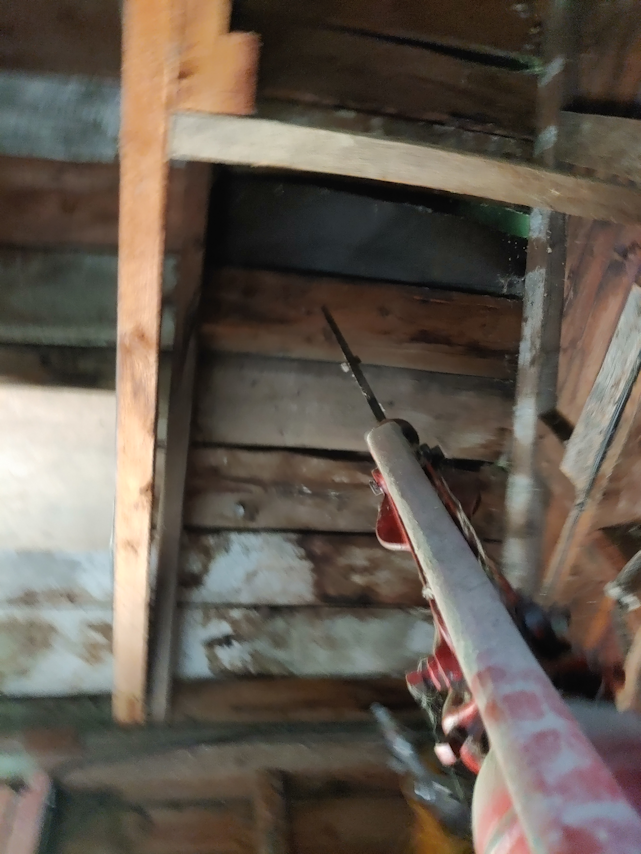
We’ll have to do the same around the pump shack, but one old stump has been sending out useable suckers. It’s basically been accidentally coppiced. We can maintain that. More material for wattle weaving! 😁 We also talked about what we can do to fix up the old pump shack. The exterior cladding it starting to rot and pieces are falling off – and on this building, there is no inner layer of boards the cladding is covering. It’s directly attached to the open wall joists, as you can see in the Instagram video. The concrete floor is cracking, but the bones of the structure are still sound, so we’ve got ideas on how to fix and maintain it.

We also went around the warehouse, which used to be my late brother’s workshop. We could seriously use that building for a workshop ourselves, but it’s completely full of my parent’s stuff. There’s basically two short paths among the stuff, and we can’t get to the back of it at all. My mother is still obsessed with her stuff in there, and is so worried someone will steal it. At the very least, though, we need to get the old mattresses to the dump, as well as the bags and bags of old clothing. She had suggested we have a garage sale, which I will not do, but she did approve of my suggestion that we could try selling things online, instead. That would be one way to help pay for the things that need to be done around here! That, however, would require going through all those boxes and seeing what is actually worth selling, and what is just junk.

But I digress!

It was around the warehouse that we decided on a place we could build animal shelters. My daughter is interested in sheep, for their wool (she wants to process and spin yarn). I would like a couple of milk goats, partly for their use in permaculture, partly because my family are lactose intolerant, and they can drink goats milk without getting sick.

We did talk about getting chickens, but both my daughters are hesitant about that. The problem is, they have friends with pet chickens, and their chickens are always getting sick. They think if we get chickens, they’ll get sick all the time, too, and we’re very unlikely to take a chicken to a vet. In a way, I understand this, but I think chickens raised outdoors would be much hardier and healthier than chickens raised as pets. Honestly, I’d be more concerned about sheep, goats or pigs needing vet care.

Yeah, I’d like a couple of pigs, too. Partly, all these animals animals are an important part of regenerative practices, and would go a long way in helping us to reclaim and improve our soil, with each contributing in different ways, and partly, they are a food source. Get a couple of piglets in the spring, send them out for processing in the fall, and have a freezer full of meat! I suppose we could get a steer and do the same thing, but I don’t think we’re up to an animal that big. Mostly, though, we need grazing animals for the outer yard. There’s no way we can mow all of it; it’s too rough in places. The overgrown areas are a fire hazard. A controlled burn would fix that, but with so many outbuildings, that would be very risky. Grazing animals would take care of that problem for us.

So my daughter is going to focus more on harvesting and processing the dead spruces for me to build raised beds, dismantle the shed and salvage materials to build animals shelters, as well as the outdoor kitchen and her smithy that she wants to build. I’ll focus more and gardening and building garden structures, and maintaining the yards. There will be crossover, of course, as we help each other out on the big stuff, but it’s clarified with each other what our areas of focus will be.

All in all, this made for a grand Mother’s Day! Well… except for all the wood ticks. We were picking those off our clothes constantly, and had to shower when we got back inside!

However, the three racks of ribs that have been slow roasting in the oven are now down, so it’s time to start focusing on our Mother’s Day dinner!

Mmmmmm….

The Re-Farmer

We have a second well… sort of

Today, I finally had a chance to move my dad’s old welder aside, so I could access and test the well in the old pump shack.

Do I want to know why there is apart of a toilet seat there?

No. No, I do not.

I moved a few more things around, then set the old cream can under the pump’s spout, just in case I actually got water flowing.

I took an accidental picture while pumping the handle. I thought it looked very dramatic, so I kept it! :-D

We got water!!!

Sort of.

This well was here before my parents bought the property, and it is a design that does not need to be primed. After much pumping, I was able to get water flowing, but if I so much as slowed down, the water would stop and I would have to start pumping hard, all over again. Which meant I wasn’t able to get a photo of actual water flowing from the spout. :-D

On the one hand, this is very encouraging. If something ever happened to our well, we will still have access to water. We should get the water flowing more to clear it out a bit, and then just get it going regularly. There is a problem, though, and you can see part of it in the above photo.

The pump is not fixed. It’s just sitting on top of the pipe. It actually rotated while I was pumping!!

When I was a kid, we had a different pump completely. It had a sort of frame around it, supporting the mechanical pump mechanism, which was run with electricity. If the power went out, we could attach a handle and pump it manually.

I don’t know when or why the old pump was removed, and I am flabbergasted that this manual pump was hooked up, without some sort of base to attach it to, so it won’t move.

My brother tells me there are repairs to the well pipe needed. I suspect that getting that done would result in it becoming much easier to pump water.

It would be worth getting that done. I would also like to set up the electric/manual system we had before, too. We still have the attachment for the spout of the pump that we used to divert water out a hole in the wall, to a water trough for the cattle outside.

Being able to use electricity to pump the water would make life easier in general, but if I had to choose only one, I would go with a manual pump over electric, as this would be a back up source of water should we ever lose power.

The Re-Farmer