I spent much of the day working on the old kitchen garden. We reached highs of 16C/61F, almost no wind, bright and sunny. It got ridiculously hot, and I had to stop for a couple of breaks in the middle of it. That, and my phone kept going off with notifications that I wanted to check.
More on that later.
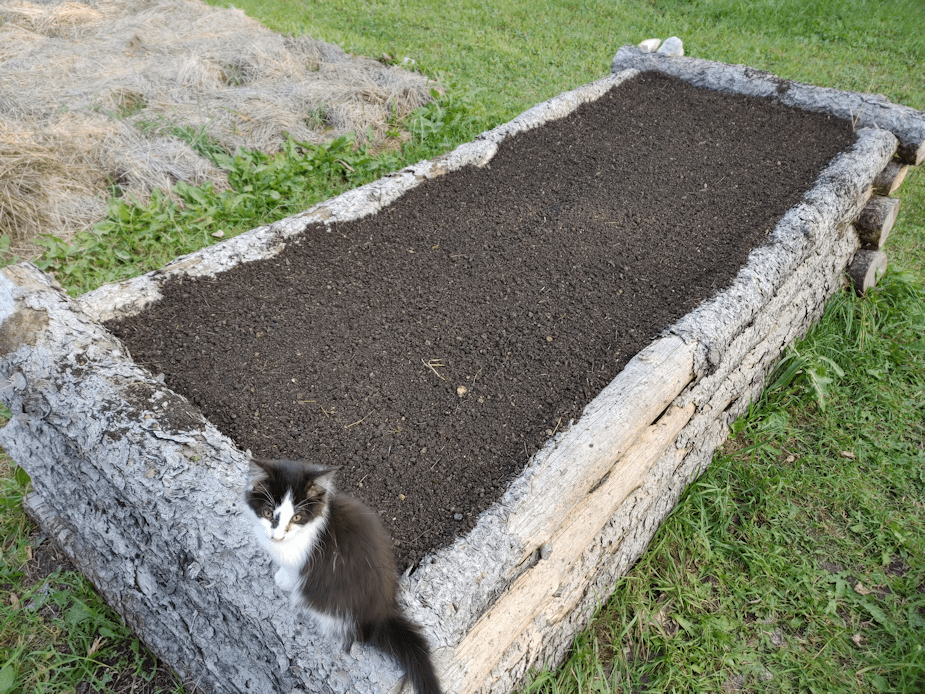
I was set up to do a time lapse video, and I’ll be continuing in another bed tomorrow, so this is a sneak peak of the first finished bed.
I ended up building it one level higher than I was originally expecting to, which means I’ll need to find another tree or two to work on the other one! I might add more garden soil to this later but, at this point, I’m calling it done.
Now for the idiot part.
One of the notifications I got was from a friend from high school that we’re connected with on Facebook, saying hello using Messenger. When I took a hydration and lunch break, I responded. By the time I finished up and was ready to go back outside, I could see she hadn’t looked at my responses yet, so out I went again.
When the heat started to get to me, I headed back inside and found she had responded. She was having some issues logging in with her Facebook, and was asking for my help. I knew of a security feature that allowed for approved friends to help with that. Still, I did check, scrolling up the message feed and confirming that there were past conversations. After all, I’ve had people message me from cloned accounts before. The past messages were there, and it seemed legit, so I helped out.
Then, like and idiot, I accidentally gave the person access to my own personal Facebook account, allowing them to log in with a new password. I was actually using my Facebook account at the same time and, suddenly, both my Facebook and my Messenger were logged out, and I realized what happened.
I could still log into my Re-Farmer account, and promptly changed the password. It was only later that I saw emails to my personal email, my backup email, and even my Re-Farmer email, telling me my password was changed and that my personal email had been removed as the primary email from my personal Facebook account. At least that one sent me the email address that it was changed to. The first part of it matched my back up email for my personal account.
On the plus side, other security features has ensured my other accounts were not compromised. I was able to find where to report the theft, so now it’s up to Facebook.
If I hadn’t been in the middle of things as I was, I probably would have caught on, but then again, maybe not. It’s hard to say.
Meanwhile, my Facebook, Messenger (which I used a lot) and Instagram (which I have pretty much stopped using), are now controlled by someone else.
I was able to let some people know about it. My husband was able to post a comment about my page, which is still up and unchanged, as of this writing, saying that my profile had been stolen.
What a pain. The good thing is, I don’t have anything of value as far as personal information on there. The one thing that is of value is my friends list, so I’m trying to warn as many people as I can, in case they start getting message from me like the one I got that I thought was from my friend.
We shall see how that plays out.
Until then, there isn’t much I can do but wait and see what Facebook does.
So tomorrow, it’s back to work.
Considering how much time I tend to be on Facebook, I might just end up being more productive because of this! 😄😄
Okay, it’s that time! I’ll be working on a serious of posts, going over how our 2022 garden went, what worked, what didn’t, and what didn’t even happen at all. This is help give us an idea of what we want to do in the future, what we don’t want to do in the future, and what changes need to be made.
Okay, so I’ve gone over how things went for our 2022 gardening year. We expanded our garden so much this year – and it was still less than we intended – I decided I need to do one last post to wrap it all together.
In a nutshell, though, I could probably just say this.
It was a terrible growing year.
In 2021, we got hit with drought and heat waves. For the longest time, we were out there watering the garden twice a day, just to keep it alive. With all that, things produced way better than I excepted, even when much of it did not thrive, or got eaten by groundhogs repeatedly, or got chomped on by deer.
I never thought that this year would be worse!
A lot of the failures can be attributed to things outside of our control. Winter dragged on long, as we got walloped with blizzards and large amounts of snow. I couldn’t complain about the snow, since we needed that moisture badly. Unfortunately, snow melts faster than ground thaws, and when the temperatures rose, the ground just couldn’t absorb it fast enough.
Even growing up here as a kid, I don’t remember ever having standing water in these areas!
The sad thing is, even with all this water, it would not have been enough to replenish the water table after years of drought.
Where, last year, we had things produce far better than expected, this year, it was the other way around. It turns out our garden handles drought and heat waves better than flooding and average temperatures.
Gotta look for that silver lining, though. We’ve had the two extremes, which gave us a lot of information to help us decide on our next steps.
The goal is to grow and produce as much of our own food, and be as self sufficient as possible. When we get animals, we want to grow their food as much as possible, too. How we get to that point can be changed or modified as much as it needs to be!
A lot of what we grew this year will be grown again in 2023, though not necessarily the same varieties.
As we expand our main garden area, we’ll be moving away from the distant garden beds, where we are now starting to build up our food forest. That’s what those beds where there to help prepare the soil for.
Which means that 2023 will have pretty much all the garden beds closer to the house, and we will be building more permanent structures. The temporary trellises have come down and, in the spring, we will be taking down the trellis tunnel, saving the wire to be reused.
We plan to start building permanent trellis tunnels where some of the newest, deep mulched garden beds were started. We will also focus on building more high raised beds – the challenge is to safely harvest the dead spruces to build them with, since we don’t have the funds to hire a company to take them down for us. I don’t begrudge them the cost at all; it would be worth every penny. We just have too many other things pulling at those pennies that are a higher priority, when we can do most of this work ourselves.
The low raised beds were enough to keep some things from getting drowned out, but in other areas, it still wasn’t enough. So while I do want to keep some beds low, the majority of our beds will be high raised beds.
The one high raised bed that is complete, filled hügelkultur style, did very well. By the end of the season, it had settled quite a bit and needed a top up, which was to be expected. At this point, I think the bed’s “topsoil” is deep enough that it could be used to grow longer root vegetables now. This is definitely the way we will continue to build and fill our high raised beds, though we might tweak a few details, such as finding better ways to join the logs in the walls. We have a few more and better tools to help us now, and will continue to acquire more.
Since a major component of building our permanent beds is accessibility and mobility, as we build the permanent structures, we will make sure that the paths will be at minimum 4 ft wide – wide enough for a walker or wheelchair to turn around in. That will include the trellis tunnels we will be building. Now that we are aware of how much water can accumulate where we plan to build them, we intend to build probably middle height beds on the outside of the tunnels. Those beds will be 2 ft wide, since they will be accessible from only one side. I figure we should shoot for building at least three or four of these in the main garden area (not all in one year!), along with the 9′ x 4′ high raised beds we will be making. We will be sticking to 9′ x 4′ as much as possible, regardless of how tall the bed is, so that any covers we build for them can be interchangeable. Obviously, the narrower beds we plan to build at the trellis tunnels will be the exception, but the things planted in there would need different types of protection – if any at all.
Even aside from the trellis tunnels, we will want to built quite a few other trellises that can be moved around to wherever they are needed. Among the things that actually started to grow well (if too late), I noticed that the hulless pumpkins really, really wanted to climb. The melons we want to plant are also climbers, as are some of the gourds we want to grow. These would need support that can hold the weight of their fruit, so they will need the strength of the permanent tunnel trellises. Lighter climbers, like peas and pole beans, would be fine with portable trellises.
While we will be focusing on permanent structures in the main garden area, we are also needing to plan ahead to when we build permanent garden beds in the outer yard, where there is better sunlight. We are also working on plans for an outdoor, off-grid kitchen in that general area. That’s on top of the shed we need to dismantle, so that we can salvage the lumber for other projects, like the mobile chicken coop I want to build.
We’ve got a lot of building and heavy labour ahead of us, and none of us are quite able bodied, so it might take a while to get it done!
As terrible of a growing year it was in 2022, it provided us with much useful data, and will actually help us in planning our next steps.
I put together images of the wattle woven raised bed and made a video out of it. This time, I borrowed my daughter’s microphone for the narration, and WOW was it better! I didn’t have to use background music to camouflage the background noises my headset microphone always made.
Something got glitchy when I saved it. I had to save it several times to get rid of some strange coloured stripes that showed up. They were only visible after I saved the file and checked it, never in the editing software. I uploaded the video, only to find the glitch had simply moved to the very beginning of the video. I had to re-save it and re-upload it, and I think this one worked.
I was going to post progress pictures, but I need to conserve storage space on WordPress until I go back and resize more old photos. I might do a start-to-finish photo video, instead. Until then, here it is! The L shaped wattle weave bed in the old kitchen garden is DONE!!
The insides of the woven walls were first lined with grass clippings. It turned out to be a very windy day, which made that job more challenging then it should have been!
Next, I used a hoe to make a trench down the middle, pushing the soil up against the grass clippings. The cardboard from the sun room I’d set aside for the burn barrel came in handy, as it was suitable for lining the bottom of the trench. With the bed being so narrow, the size of the boxes didn’t matter as much, since I had to cut them to fit, anyhow. The cardboard then got a soaking.
Next came a layer of corn stalks reserved from the garden clean up, which got a soaking. I raided the compost pile of half rotted kitchen scraps to put on top of the corn stalks, followed by a soaking. Then I raked some leaves off the grass nearby and added that on top, which then got a soaking. At this point, I climbed in and walked back and forth over it, to crush the organic materials. Whatever we decide to plant here next year, I don’t want the roots to be finding big gaps in the soil and drying out.
Finally, I headed out and uncovered the pile of garden soil we bought a couple of years ago. The cover kept the pile from washing away, but didn’t keep the light out, so the pile was covered with a matt of weeds!
I also realized the “tarp” I’d found to cover the pile had channels in it. We’d noticed them when we first dug it out, but only recently did I find the carport support peaces my brother said was in the hay loft. Some time after that, I’d dug out a tarp I thought we might be able to use to cover the hole in a shed roof, but when I unrolled it, I saw it was part of the carport. I figured it was a roof sheet or something, since it isn’t that big. Now I realize that this piece was part of it, too. So I dragged it off and lay it out on the lawn, with weights to keep it from blowing away. We’ll hose it down and see what we can do with it. The first sheet I’d found had a row of tears in it. This one does not.
I’ll have to find something else to cover the garden soil pile with.
It took 4 1/2 wheelbarrow loads of sifted soil (to get as many weed roots out as I could!) to cover the whole thing. In the process, I had to stuff more grass clippings higher up the wattles, so the soil wouldn’t fall through the gaps.
No, this time I did NOT give it a soaking! I didn’t want to compact the soil.
By this time, several hours had passed, so I took a break for a lunch the girls prepared for me, then it was back to work. There was a little bit of grass clippings left, so that got scattered over the soil – at least what the wind didn’t blow away while I was trying to spread it evenly! I then raked up and added a mulch of leaves. That did get a soaking, to keep the wind from blowing it away. Finally, I grabbed the wagon and filled it with as much wood chips as it would hold without spilling as I pulled it back. It turned out to be just barely enough to cover the entire bed with a thin layer.
Once that was done, the entire bed got a very thorough soaking. I wanted all the layers to be good and damp. I might even soak it a couple more times, before our highs start dropping below freezing. We hit a high of 18C/64F today (though with that wind, it didn’t feel like it!), but tomorrow our high is expected to be only 6C/43F, and that’s the warmest day we’ve got left. We are expected to have less than a week with highs above freezing. Which isn’t too bad, for November.
Anyhow. The more the bed gets moistened before things start to freeze, the better it will be for spring. With all the layers, the bed got filled to the top of the shortest walls. My intention was to have it a bit lower, and that will happen as the layers settle and the organic matter decomposes. I expect it to drop at least a couple of inches over time.
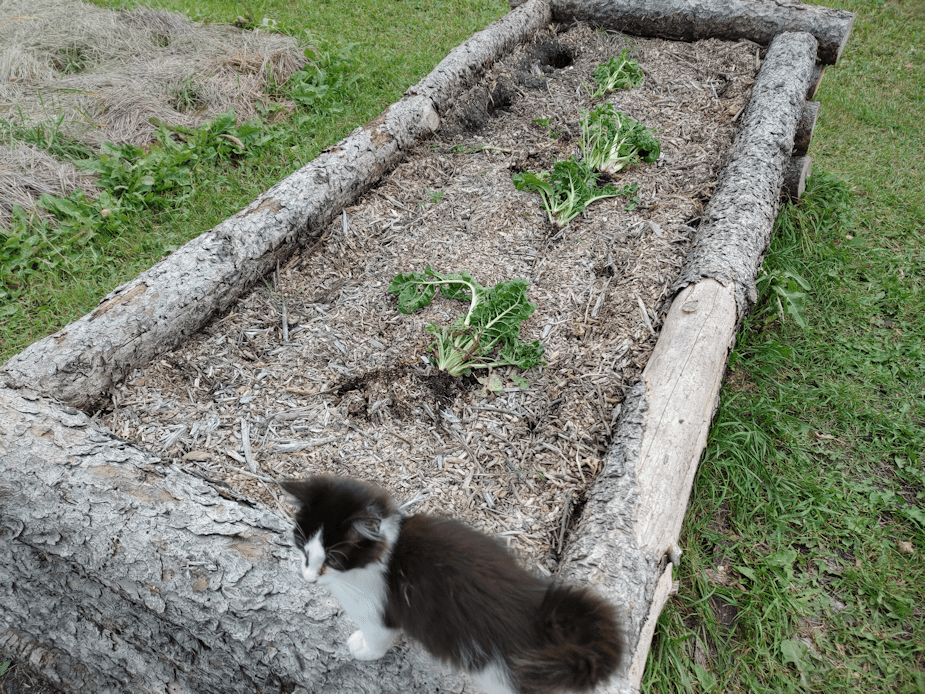
While working on this bed, I spent a lot of time going over and around the rectangular bed we’d planted beets in. Once the L shaped bed was done, I decided to work on that one, too. It is framed with logs, and I’d like to raise it a bit higher. This is how it looked, at the start.
The first year we had a bed in this space, it was a sort of triangle shape that was too wide at the end near the house. My daughter and I changed the shape of it, then grabbed some pieces of smaller dead spruces that had been cleaned up, to frame it on three sides and keep the soil in place. We planted carrots here last year, which the groundhogs decimated repeatedly. Amazingly, we still got a crop out of it. This year, we planted beets, which failed. Sort of. I’ll talk about that in a separate post!
There is a pink rosebush on the left, and this year – after pruning away more branches from the ornamental apple trees – it finally had substantial growth and huge numbers of flowers.
It’s amazing what a little sunlight will do!
This year, when we covered the rectangular bed, I had a board across the end by the rose bush to hold the mesh down, but otherwise, there’s nothing there. The ground slopes downwards from the house, so that end is lower than the end closer to the house.
That will be built up.
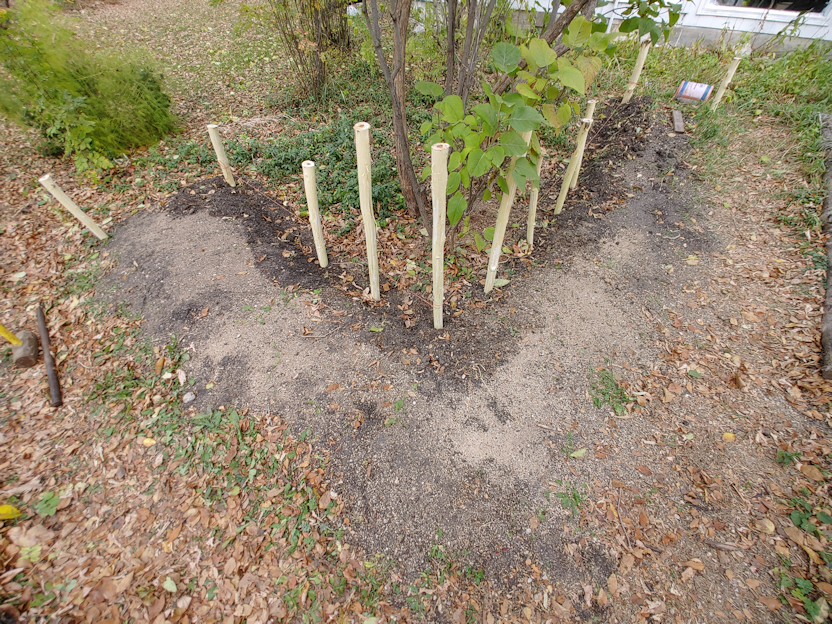
The first thing I did was dig a shallow trench across the bed near the rose bush. I still had some short logs I’d brought over for tiny log bed and border that didn’t get used (you can read about that here, here and here. Links will open in new tabs, so you don’t lose your place. 😊) I placed one of the shorter logs across, in the trench. Then I pounded in three stakes at each corner, to create upright supports. When I find logs long enough, they will be placed between the stakes. I want the long sides to go on top of the cross piece closer to the house, with a second cross piece to fit in between them, but have it the opposite way on the low side. One of the current side logs is a fair bit shorter than the other, but I think I find find something to fill the gap.
Though I plan to make the bed only one log higher, with the rose bush getting so big, the wall beside it is probably going to be three or four logs high to keep the branches out of the garden bed. I forgot to take a picture, but I’ve already added another log to that end. It’s slightly longer than the one in the photo, so that it is overlapping the longer side log. When I find a gap filling piece for the bottom, it will be tucked under that second log. The second log isn’t as thick as the bottom one, so I tied off the pair of uprights on either side of the ends, to secure them, and will do the same with each log that gets added. I made sure those pairs of upright supports where the tallest and strongest, since they’ll be holding the most logs.
And that was enough for today! I need to go hunting for long enough logs for those sides. If I can’t find any that are suitable, we might add more of those support stakes and use shorter logs instead. We have plenty of short ones that couldn’t be chipped, that were cut to roughly four foot lengths. The bed, however, is about nine feet long, so that might not work. We’ll see.
That done, I had time to work on emptying the rain barrel, which had enough water still in it to do the Korean Pine and Ash tree seedlings in the outer yard, as well as the haskaps and a currant bush in the south yards. So that’s now empty and ready for winter. Usually, I tuck it away in the old kitchen garden for the winter, but I think this time I’ll leave it where it is. It’ll get snow in it, which should be fine. I just don’t want to be chipping it out of the ice and snow again, to set it up to catch the snow melting off the roof in the spring.
While I was doing all this, I had the attention of so many yard cats! Even the ones that don’t like people, like to hang around while I work.
While I was putting things away for the night, I spotted this…
He was napping in the wheelbarrow at first, but I interrupted him while taking a picture. 😊
What a handsome boy! We have managed to pet him every now and then, but he isn’t a fan of attention.
I did get to give the bitty baby a cuddle, though! He came out to explore, and after several attempts, I was able to cat him. He put up quite a fight until I got him into snuggle position and started scritching his ears and he finally calmed down. I hung on to him for quite a while before putting him down, and he didn’t run away. Hopefully, he will become more accepting of cuddles as time goes by. We’ve had others that became less accepting of cuddles and attention over time. Ah, well. We do what we can!
I went and borrowed my husband’s phone to take a picture. It’s my old phone, but of course he’s set it up to how he wants it – which turns out to include fingerprint scan to unlock it. I really hate that function. I find they don’t scan fingerprints well, and the last thing I’d want is to get locked out of my own phone because the thing can’t recognize my fingerprint. It could well be because my hands are so rough, it messes up my fingerprints. Either way, it looks like I won’t be borrowing his phone when I got into the city after all. It’s changed so much, I had to get him to tell me where the camera icon was! He does love his funky themes and designs. 😁
Anyhow…
Here it is!
I had enough long poles that I could do the back without having to overlap any. The only problem came when it was time to do just the taller posts. It wasn’t too bad when I was weaving around seven of them, but when it came to just the three at the turn, it was more difficult. I had the shorter pieces for it, but three poles just isn’t really enough to hold the wattles in place, though for some of them, I could push the more flexible tips into the previous wattles to lock them down.
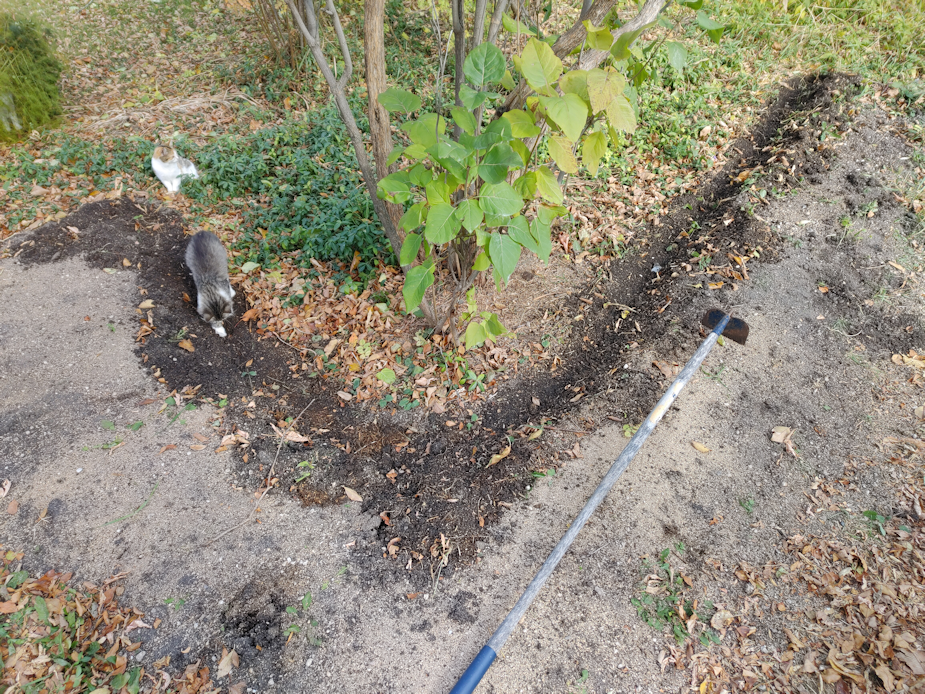
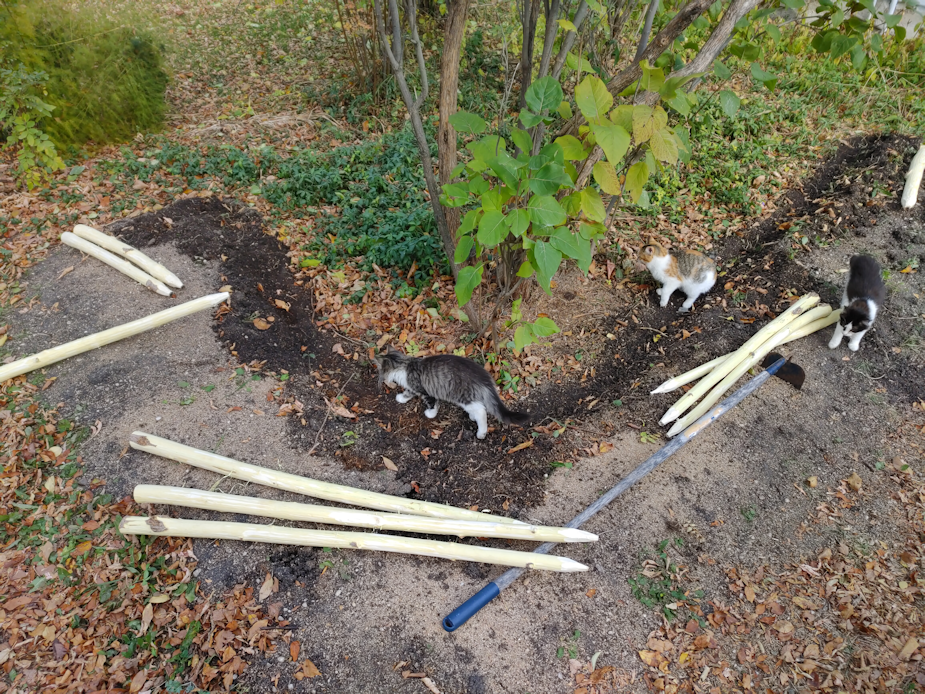
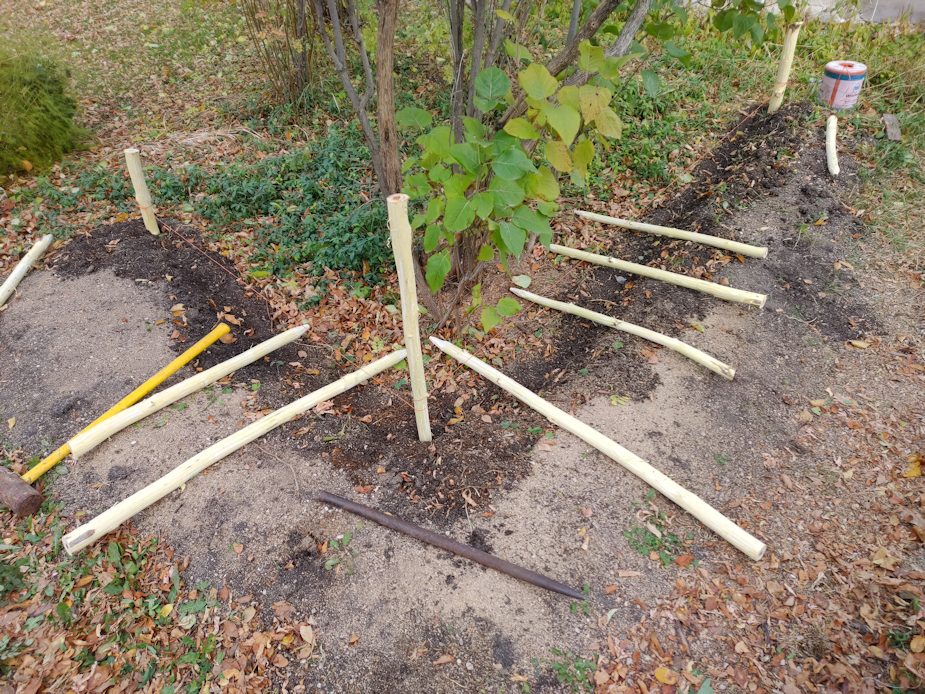
There was lots left over when the inside of the L shape was done, and I wanted to use them while they were still green and flexible, so I went ahead and did the outside. The first thing that needed to be done was to hoe the soil out of the path and back into the bed, while also clearing and leveling where I estimated the uprights would go. Once that was done, I measured two feet from that long pole right in the corner, marking three places; the left and right are lined up with the back walls, while the center one is in the middle.
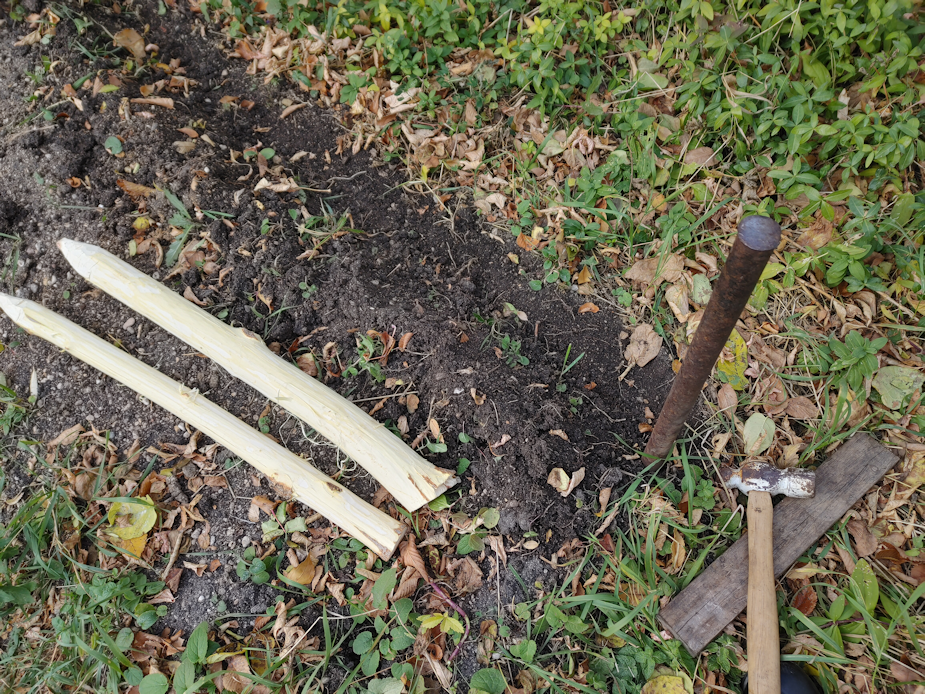
Knowing I would be working with much thicker poles, I spaced the uprights further apart along the sides, compared to the previous ones. That left me with four extra prepared posts. After using the pencil point bar and a sledge hammer to make holes for the posts, then sledge hammering the posts in place, I could see I wouldn’t be able to use the uprights at the ends, so I added another post at each end, just inside the posts supporting the end wattles.
When it came time to weave the wattles in, I used the longest poles first, with the thickest parts at the ends, so that the more flexible tops would go around the curve. Some of the posts were long enough to actually bend all the way around the curve! When I put in the second side, I was able to wrap the ends around the wattle in the first side. I was able to do this for the first several layers before I found myself having to weave a shorter third pole around the curve. Unfortunately, a few of the poles just couldn’t go around the curve without breaking.
With the more flexible ends going around the curve, this meant the ends built up higher, faster. Which I’m okay with. For the last few pieces, they weren’t long enough to go around the curve at all.
I will need more material to build up the curve, but I also want to build that corner higher, too. So what I need to look for now is a lot of thinner and flexible, pieces. If I can find enough of them, I might be able to not only build up the corner and the curve, but wrap a nice edging along the top, all the way around.
Finding appropriate materials to do this was surprisingly difficult, but I’m really happy with how it’s turning out. By the time this is finished, though, we probably won’t be able to accumulate enough materials to do it again anytime soon, except perhaps for some very small beds.
Once the walls are done, we can add amendments and more soil to this bed to build it up, and it will be MUCH easier on the back to work in it.
At some point, I’m going to have to borrow my husband’s phone or something, just to have handy to take some progress pictures!
And kitty pictures.
I counted 26 this morning. !! And I didn’t see Rosencrantz until much later, nor did I see Rolando Moon, who seems to have moved on again.
My new phone is expected to arrive on the 28th, which is the day I’m taking my mother’s car in to get the tire fixed. The shipping notice originally said the 27th, which I would have preferred, since that meant I could have the phone set up and ready before going in for our first city shopping trip for next month. I’ll definitely borrow my husband’s phone for that trip, at least.
Once I was done my morning rounds, I grabbed the loppers and went into the south side of the spruce grow. We haven’t done any clean up in there for quite some time. Much of that area was under water this spring, anyhow.
This area has been mostly taken over by poplars, and that was what I was after. As we clean out the spruce grove, one of the things I want to do is cut back a lot of the poplars and plant more spruces. I want it to stay a spruce grove, not turn into a poplar grow. Spruces are better for cutting the wind and snow year round.
What I was looking for were tall, straight poplars small enough to cut with the loppers. At that thickness, they should still be flexible enough to bend as I weave them around the uprights. If it’s too thick to cut with the loppers, it’s too thick for the wattle weaving.
While I was doing that, I found myself working around the apple trees we’ve been uncovering out there. I asked my mother about them, and these were trees she’s planted herself, mostly from seed. My mother still has a hard time understanding that you don’t get the same type of apples from seeds at the tree they came from (as far as I know, there is only one type of apple that grows true from seed). We have no idea what kind of apples these can produce. The area is so overgrown, the much shorter apple trees barely had enough sunlight to start blooming. I was even cutting poplars that were growing through the branches of an apple tree!
Since I was there anyhow, I went ahead and pruned several of the apple trees, cutting away dead branches, and opening them up to more light. With the number of poplars I cut away from around them, that will be a help, too. We will need to come back with other tools to cut away the ones that were too big for the loppers to cut through, as well as other bushes I can’t identify at this point. I was happy to spot little spruces trying to grow through the tall grass and fallen trees and branches, which also need to be cleared away. I was also very thrilled to find a single Tamarack tree. There were three others planted closer to the house, in between some spruces, that are way too crowded together. I’m hoping to save them, but that might require cutting down the spruces next to them, and I don’t want to do that if I don’t have to. This Tamarack, however, as all on its own and would not have been deliberately planted there. I really like Tamarack, and would like to eventually plant more of them.
Anyhow.
I kept finding more of these apple trees, but I couldn’t get at most of them. Of the ones that I was able to prune, though, I’m hoping they will finally get enough light to bloom and produce. I did see some flowers on one of them for the first time last spring, but no apples developed.
I am quite happy with how many small, straight poplar I was able to get at and harvest. Once I was done, it took several trips to drag the piles of them I’d made, over to where the burn barrel is. The branch pile may be chipped, but I’m already adding more to the remains that need to be burned! The next while was spent trimming all the branches and twigs off, adding those to the burn pile, then sorting the remaining poles more or less by length. Then they all got dragged over to the old kitchen garden.
I should actually have enough to finish wattle weaving the inside of the L shaped bed, and even start on the outside of it. What I think I will do for the outside is not have a 90 degree corner, like there is around the double lilac, but to have a curve, instead. I haven’t quite decided yet, but if I think having a curve would actually make things easier, and more even.
By the time the poles were dragged over to the old kitchen garden, I had to go inside to warm up! I don’t know what the temperature was outside at the time, but the thermometer in the sun room was at only about 3C/37F. Which is what our high of the day is supposed to be. It’s almost 2pm as I write this, and we finally reached that temperature outside. Tomorrow’s high is expected to be only 4C/40F, but after that, we’re supposed to have three days with highs of 13C/55F.
I have to get back at work with the poles I cut this morning, though, while they are still at their most pliable. It’s definitely going to be chilly work!
After finishing up my morning rounds, I did as much as I could with the wattle fence, using what materials we had been able to gather. There wasn’t much I could do with the longer sections. With the shorter part of the L shape, I was able to use a few single lengths, but even there I had to start combining them in pairs.
The girls had gathered some really nice, even pieces of maple suckers, though, and they were the perfect length for the wider end bit.
The red barked lengths are the maple the girls had gathered. When I used those up, I went to the pile of small willow branches I’d set aside and brought over the pieces that were close in size to the maple. Those are the greenish coloured branches. Last of all, I topped it with two thicker pieces of maple that I’d pruned from the nearby maples that are now clear of the branch piles. Those are are lot tighter, and will lock everything in place. I didn’t trim the top one to size yet, as I might need to move it out while the other section of wall is worked on. However, as it is now, that is as high as I intend to go for most of the bed.
It would be great if the whole thing could have been done like this! It looks so much prettier, with smaller gaps and more consistent sizes. The only down side is that such small pieces will also break down faster than the larger ones. It will likely still take a few years, but it’s something to be aware of.
I used more of the maple suckers I had gathered at this end, along with more willow that was left, and locked it down at the top with two thicker pieces of maple.
This corner looks a mess right now! It will be built up, end to end, until they are the same height as the walls at the ends. After that, it will be build up higher to match the heights of the debarked posts. By time I’m working on just the three tallest posts, I’ll be working with much shorter pieces, and should be able to tidy up the whole thing a lot more. Right now, it’s looking quite the mess!
That piece of 2×4 is my mallet.
At this point, I am out of useable materials. I think I will go hunting around the spruce grove for more material, before I start wandering father afield. The Red Osier Dogwood that we have would make excellent, flexible pieces, but that’s something I’m trying to encourage as undergrowth. I might still be able to harvest some, though. There might even be some young poplar I can harvest. Mostly, I just want to find enough material to finish this back wall. The remaining sections can wait until spring, if we have to. Once the back wall is done, the soil that has eroded into the paths can be hoed back into the bed and tidied up. I will likely use grass clippings that we still have all along the bottom of the wattle wall to keep the soil from falling into the gaps. Slowly, this bed will be built up to the height of the lowest sections of wattle, which will make growing in it MUCH easier on the back!
That’s about all I’ll be able to get done today, though. We’ve had another change in plans, with company coming tomorrow. We’re hoping to be able to have a bonfire with the remains of the big branch pile that got chipped, but it will depend on the weather. The forecasts keep changing. Just in case, we need to be prepared to move indoors, so we’re going to have to start moving things like our canning supplies back into storage, and all that other stuff that just sort of takes over every flat surface! We’ll need to be able to expand the dining table, too, which will take up twice the space.
We are terrible house keepers. 😂
But I’m really looking forward to seeing my BIL and his family, and really appreciate that they are willing to make the long drive out here, knowing that my husband can no longer go to their place. It’s going to be awesome!
Since I wanted to keep an eye on the kitties anyway, I decided to see what I could do with the willow branches. After sorting the longest ones out, I started weaving.
This is all of the branches I have so far.
Minus one that was too bent to use. At least here. When we’re ready to weave the ends, we only need pieces less than 3 feet long, so I could probably salvage it.
As we get more branches to weave in, they’ll get pounded as low as we can, with each layer added keeping everything below in place. Right now, some of them just sort of pop back up a bit after they’ve been pushed down. Until it’s all tighter together, it won’t be holding much soil in place! One more layer along the short wall, and I think we can get away with no longer debarking the branches.
I really hope those maple posts that still have their bark won’t start growing.
I’m just itching to get back out there and cut more willow branches for this, but the weather out there really sucks.
I want to keep an eye on the bitty kitties, though, so maybe…
(glances out the window and tries to convince myself the wind isn’t that bad, and it’s not that cold out…)
Today’s high was supposed to be 19C/66F. I don’t know if we reached it, but with the blustery winds, it never felt that warm. I’ve been keeping a close eye on the weather, and my app on my desktop includes historical data for each day, including 30 year record highs and lows for various data. I noticed that today had a record high for snow of 14cm/5.5in in 2019. In fact, we set record highs for snow on the 10th, 11th and 12th, all in 2019. We were just coming to the end of our second year here, so I went looking at my blog posts for those dates.
Ah, yes. I remember that blizzard!
The amazing thing is that, just days later, all that snow was gone, and while we were still cleaning up storm damage, everything was back to green and sunny!
Depending on which app I look at, however, we might be getting a mix of snow and rain starting tomorrow night, and by Friday afternoon, we’re expected to get between 3-6cm (roughly 1-2 inches) of snow.
That meant my focus was preparing to build up walls around the L shaped bed in the old kitchen garden.
I went through the maple pieces I’d cut yesterday and started cutting them to size, cutting points on them, and debarking some of them.
I had lots of furry help. So much help, one of the kitties got plumb tuckered out!
From the longest, straightest pieces of maple, I cut three into 4 foot lengths. Then I went through some of the strongest pieces to cut four 3 foot lengths, then four 2 1/2 foot lengths. After that, I just cut as many 2 1/2 foot lengths from the thinner straight pieces as I could get out of them.
I used a hatchet to cut the points on all of them. That was probably the most unpleasant part of the job. Not so much for the thinner pieces, but for all the thicker ones. I’m ambidextrous for most things, left handed when it comes to fine motor control, but for some things, I am completely right handed.
Using a hatchet is one of those things, and my right hand has been in terrible shape lately. I had difficulty gripping the hatchet, and had to stop frequently to give my hand a break.
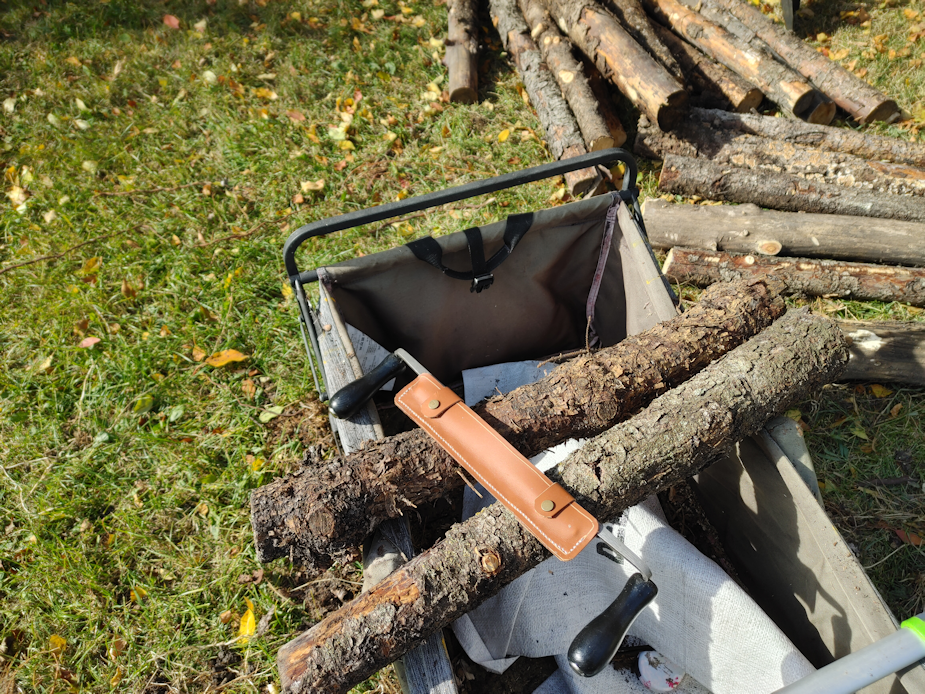
The draw knife was awesome for debarking the wood. It’s still quite green and came off easily. I don’t have a way to secure the pieces I’m working on well, so there were quite a few times when I was pushing instead of drawing the blade – and it works just as well that was, too. For some of the thinner pieces, though, it was easier to just use a knife to debark them.
Also, no, that is not rust on the blade of the draw knife. It’s stained with tree sap.
The stack of the thinnest pieces did not get debarked. It would have taken forever and, at their sizes, it would have been awkward. The pieces that will be taking the most stress, however, have been debarked.
That all took a few hours.
Then it was time to get to the garden bed. I pulled the lettuce I’d left to go to seed (it looks like we’ll get seed from just one of them) and got ready to prep the bed. Without walls, soil was falling into the path and the inside of the L shape, and I don’t like wasting good soil!
I used a hoe to draw some of that soil back into the bed, and level off the edge, where the uprights will be going.
The three longest pieces will form a triangle at the inside of the bend. When we start weaving branches through the posts, these will be taking the most stress. Working out from there, one 3 ft piece will go along the short end, and three down the long end. If I have enough materials to do it, I plan to build up the wall higher at these posts, as much to wall around the lilac as to create a wall for the bed.
The four 2 1/2 ft pieces are for the corners at the ends of the bed.
To install the posts, I used the pencil point bar and hammered it into the ground.
Unfortunately, that old hammer doesn’t have the right handle on it, and the head fell off again. I had to switch to a sledge hammer.
I really didn’t want to switch to the sledge hammer.
Ah, well. It worked better. I’m just going to be in a world of hurt, tonight!
I started by placing three posts in, then tied twine between them as guides for the rest of the posts. Then I laid out the spacing for the remaining two 4 ft posts, and the four 3 ft posts.
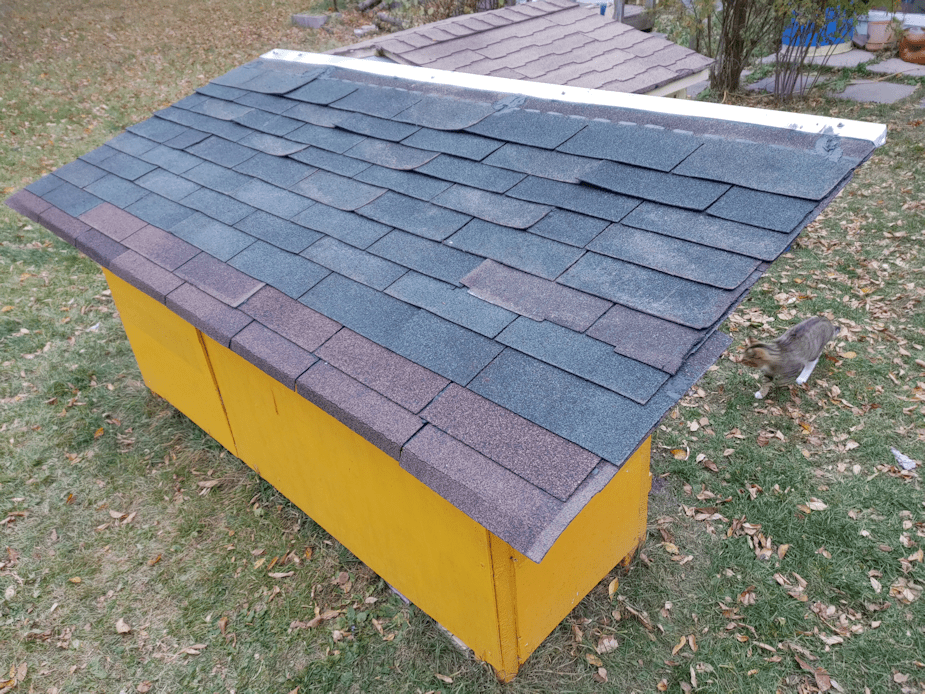
At this point my daughter, who had been working on putting salvaged shingles on the kibble house, ran out of roofing tar. I’d only picked up a small can for patch jobs, never expecting to need more.
So I left my daughter to continue pounding in the posts while I went into town to pick up more tar, and a few other things while I was there. When I came back, I found my daughter lying on a tarp on the ground surrounded by kittens. She is having much more success at socializing than I am!
She had even pounded the other two corner posts at the ends of the L shape.
The weather was starting to get worse, so I quickly filled in the gaps with the smaller 2 1/2 ft posts.
The long end of the L shape will be only 2 feet wide, so the end posts needed just one more added in between them, plus three more along the north side. The short end of the L shape needed only 2 more to fill the gap. Since this end can be accessed from three sides, we’re okay with it being wider than 2 feet, so the end posts there got two more in between. The rest of the posts will be for the outside of the L shape.
From the looks of it, I’m going to need to find more pieces to be able to finish the outside of the bed, but I’m not concerned about that right now. It’s the inside of the L shape that I need to get done first.
By this time, however, dark clouds were rolling in and it was starting to look like rain, so I left the job at this point and focused on cleaning up and putting away anything that might blow away. My daughter, meanwhile, finished the roof of the kibble house.
The green shingles are almost 50 years old and are in pretty rough shape. The brown ones are better, but they’re almost 30 years old.
The water bowl house roof is thinner plywood, so we’ll be using pieces of metal roofing that we’ve been scavenging for various things since we’ve moved here. If we used shingles, the nails we have would go right through by nearly half an inch, and that would be a problem! I dragged a piece of metal roofing out from the barn that we can cut in half and lay side by side to cover the roof of the water bowl house, but I also spotted a stack of corner pieces. I brought one over, and helped my daughter put it on the edge of the shingles on the kibble house. I found a bin of metal roofing screws in the warehouse, so I grabbed a bunch for when the water bowl house is done, and my daughter used a few of those to install the metal cap on the edge of the roof, using the screw holes that were already in the metal – after making sure to put some tar under each hole, first.
Almost everything about the kibble and water bowl houses has been done using scavenged bits and pieces we’ve found around the property, and a lot of it is pretty old and starting to rot. We don’t expect these to last long, but using paint and even decades old shingles will help them last longer. At some point, it’ll be nice to be able to build versions using new materials, all well measured and cut and leveled, etc. But this will do for now.
Once this was done, I set up a longer extension cord I found that was in good shape, and was able to plug in the cat’s house. We lifted the roof and put in the high density rubber mats I’d dragged out of the barn, which will help insulate the floor. There’s a thick scrap yarn crocheted blanket that is laid out on top of the mats, too. We will not be using straw this year. As much care as we have taken with the terrarium heater bulb, I would much rather not have straw in there! The heat bulb is working fine, with the heat shield still in place, and the timer is set to light sensor, so it will turn on when it gets dark, then off again when it gets light. The smoke detector was tested, too, and it’s working fine.
Once the water bowl house is done and set up where it will go, we’ll be able to plug in the heated water bowl through the cat’s house entry, too.
Tonight, the cats will have a warm and cozy place to stay if they start feeling too chilly. I especially hope the tiniest kittens will start using it!
As for me, I’ve pain killered up and hope I’ll be able to continue in the old kitchen garden tomorrow. For the weaving, I plan to cut the willow branches and use them right away, while they are still very green and flexible.
I really hope this works out. Otherwise, that’s a lot of work for nothing! Well. Not for nothing. Now that those posts are in, even if wattle weaving doesn’t work, I could still use them to hold whatever we find to use instead. It’s all fly-by-the-seat-of-our-pants work, anyhow!
There are some things I wanted to try with the old kitchen garden, but kept getting distracted. So today I gave the girls a to-do list for the main garden beds, and got started.
This is the main area that I wanted to make changes to.
The areas surrounded by red lines are where we currently have stepping stones. The long red line on the bottom is the border outside of where my daughter planted her irises. You can see the one walking onion, now laying flat on the ground, that has been coming up every year since we moved here. This year, it actually produced a head that, hopefully, has planted itself now. To the right of the onion is where my daughter’s daffodils are planted. We currently have a couple of boards on the outside of this area, but we’ve had issues with people completely ignoring them and stepping on the onion. So one of the things we want to do is build some kind of low wall along that red line, with openings to the stepping stones, just to keep wayward feet out of there.
Where I wanted to work on today, though, is the area marked in orange. That is where we planted our bread seed poppies, using seed collected from last year. They never got to their full size, and the area was way too full of weeds. There was just no way to pull the weeds without damaging the poppies.
So I decided to make a low raised bed in that spot. The first thing that needed to be done, though, was to get rid of those weeds and their root systems, as best as possible.
That meant breaking out the wheel barrow and soil sifter.
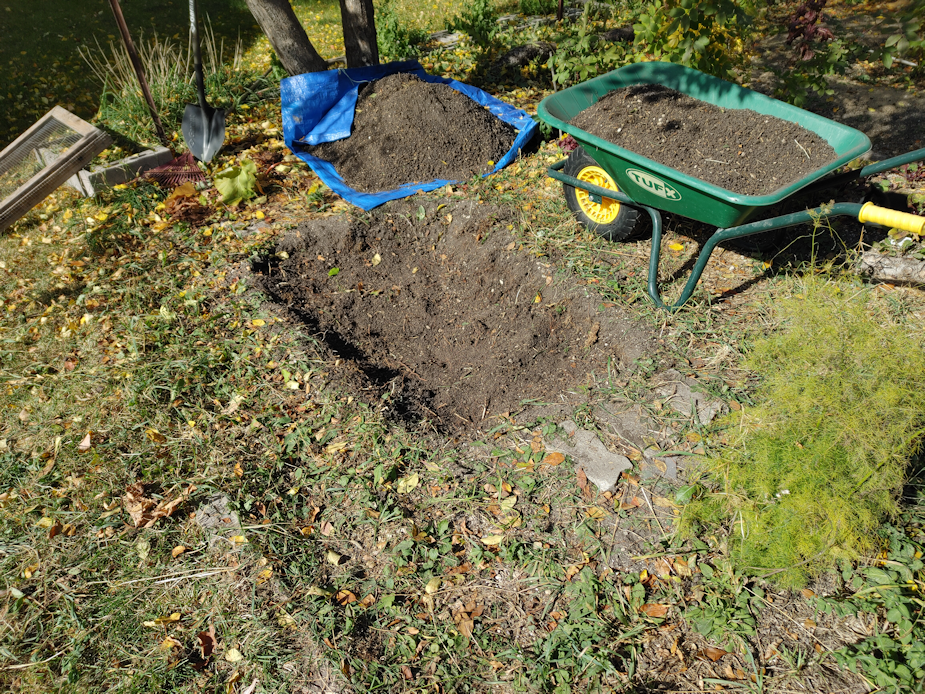
For such a small area, it took a long time to remove the soil and sift out the roots and weeds.
Some of the roots, from the nearby ornamental apple trees, needed loppers to clear them out. I ended up digging out a lot more of the soil than expected.
The tarp has two wheel barrow loads of sifted soil on it. I didn’t want to go too deep, so I loosened the soil on the bottom to try and pull up more roots, but there’s no way to get them all out. At least I got the bulk of them out.
I hope.
While sifting the soil, I pulled most of the roots out and tossed them onto the grass for later clean up, then whatever was left on the screen after sifting got dumped near some trees behind the storage house, where it will be used to fill in and level some low spots.
We’ve been building up the soil in this garden since our first summer here, and it really showed. Unlike other areas, I never hit the sand and gravel that is so close to the surface in our area.
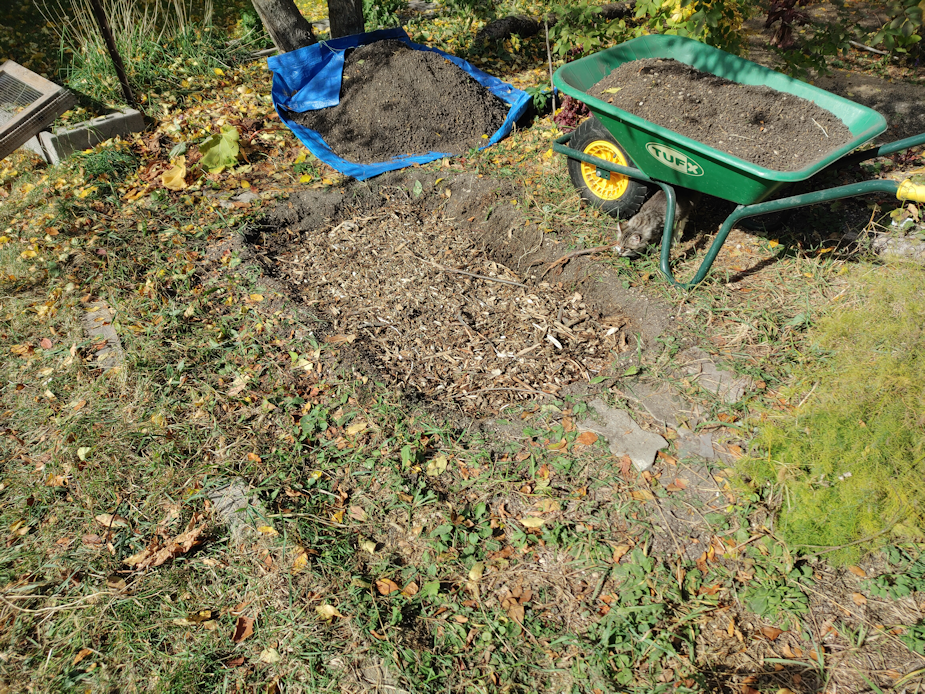
The soil was really, really dry, though, so my first amendment was a layer of wood chips, to act as moisture absorbing sponges as they break down. I’ll be adding other layers of organic material before putting the soil back, but first I wanted to build walls.
My initial thought was to drive strong stakes into the soil, then weave a wattle wall. I need to clear the suckers out from around the maples. Especially where the branch piles used to be. With those piles gone now, I can finally reach them. As I took a closer look at the suckers, though, I realized they were not straight enough, or long enough, to be suitable for weaving around the uprights, even for such a small bed.
There were, however, those lengths of wood that couldn’t be chipped, neatly stacked nearby.
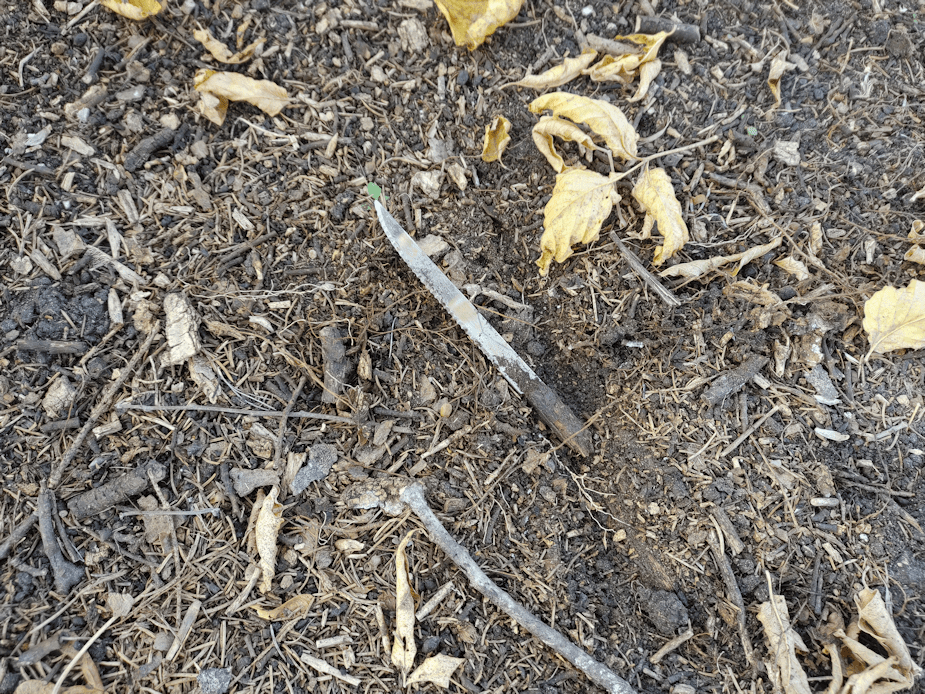
So I went through the pile and chose a whole bunch of the straightest ones and loaded them on the wagon. As I was taking them to the old kitchen garden, I went through where one of the branch piles used to be. It’s just bare ground, which is why I was able to see something reflecting in the sunlight.
Something pointy looking, and very bright.
Oh, the things we find around here!
Why on earth would there be an old steak knife buried in the soil here? It’s been here long enough that most of the wooden handle rotted away and broke off.
I’m glad I spotted that, because just the point was sticking out, and it would have been a pretty nasty thing to step on!
I brought more logs than I thought I would need, including shorter ones for the ends of the bed. When I made our high raised bed, the wood was not debarked, but I have a draw knife now, so I wanted to do that with these.
Isn’t the leather cover my husband made for it awesome? It fits perfectly, and he made sure the stitching is super strong.
I measured the space I’d dug out, and it was almost exactly 2′ x 4′. Conveniently, the tree guys cut these log pieces to a maximum about 4′ in length. I used my baby chainsaw (pruner) to cut pieces to length. I’m glad I got that extra battery, because I went through both of them to get it done! I also used it to remove the nubs of branches on some of them. I’ll let the batteries recharge before I finish that part of the job.
I cut enough to make the bed three logs high. As the soil slopes and is quite a bit lower on the outside, I plan to use the thicker logs on the outside and try and level it off a bit. Or I might have three logs on the outside, and only two on the inside. We’ll see.
It took me almost 3 hours to get to this point, and I was done for the day. Once all that was prepared, I cleaned up the log ends, bark pieces and the roots and weeds. Those went into the burn pile, where we also burn the sawdust from the used stove pellets in the litter boxes (sure beats hauling it all to the dump, like we did with the clay litter!), and our burnable garbage. The garden bed will have to wait until tomorrow to finish. There wasn’t much wind today, so I did a much needed burn.
While I was tending that, the girls headed out to the trellises to start salvaging the netting and bamboo stakes. It took them forever to free up the netting the pole beans were on! Those beans were well wrapped around it. They salvaged the netting and the bamboo stakes that joined the A frame supports across the bottoms. The A frame supports were left for now, as they are currently holding up the trellis frame! Those are going to all come down, eventually, but after it took so long to free up the netting, that got left for another day. Those trellises weren’t built to last more than a year, and we got two years out of them, so I’m impressed that they lasted as long as they did! The next ones we build will be much more permanent.
While they worked on that, and I was tending the fire, I started getting messages from the cat lady. She will be able to book three more spays and neuters for us soon. We pick which ones need to be done first. It’ll be in a town further out, so she will pick up the cats, keep them for their recovery period, then bring them back. There are still problems with too many surrendered cats in the adoption system, and she’s had virtually no progress with adopting any cats out at all, but she is still able to get donated spays and neuters at various vets around the area. Adoption will be easier with cats that are fixed.
We still have Big Rig and Tissue that need to be done, since they got into food while they should have been fasting and their previous appointments had to be cancelled. I was thinking we might want to start doing outside cats, though, as population control, but the kittens we’ve socialized enough may still be too young.
We have made socialization progress, though! Not with the black and white one in the back, looking at the camera. We still can’t touch that one. The three at the peak of the cat shelter roof are the most socialized – they LOVE attention! Those four are siblings from the same litter. The fuzzy grey tabby is a female.
The muted calico on the far left has been allowing us to pet it regularly now, though it’s not quite as socialized as the littler litter. It’s sibling, the brown tabby starting at the camera, is male. The girls have been able to pet him but today, for the first time, I was able to not only pet him, but even pick him up! He wasn’t too comfortable with the picking up thing, but loved the ear skritches, so after I put him down again, he came back for more!
If we are going to get the two indoor females fixed, we can also choose one male from among the outside cats. The girls were thinking one of the smaller ones. The thing is, once we’ve got an outside cat fixed, then being kept indoors with the cat lady during recovery before coming back to us, it’s not going to go back outside. Especially not with the weather changes right now. Plus, once fixed, chances of adoption are higher, and we’d have to made sure we can actually get at it, if a permanent home is found.
If all goes well, though, the cat lady will be able to find homes for several cats over the winter!











 The Re-Farmer